
2025: The Year in Cannibalism

Then every thing includes itself in power,
Power into will, will into appetite;
And appetite, an universal wolf,
So doubly seconded with will and power,
Must make perforce an universal prey,
And last eat up himself.
    — Shakespeare – Troilus and Cressida Act 1, Scene 3

January

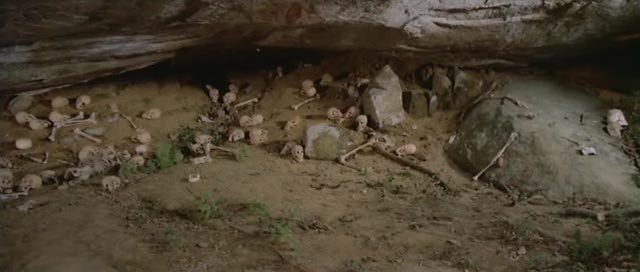
Violence in the Highlands of Papua New Guinea marred celebrations of the country’s 25th anniversary of independence. Armed men were shown in videos holding body parts and saying “this is our meat.” The story brought back memories of former US President Joe Biden claiming his uncle’s body was never found during the Second World War as he had been eaten in PNG, stating that “there were a lot of cannibals, for real, in that part of New Guinea”.

Sean ‘Diddy’ Combs, already in hot water for sex trafficking and racketeering charges, has been accused of cannibalism now. In the Peacock documentary Diddy: The Making of a Bad Boy – which covers the rise and dramatic fall of Combs, 55 – former Making the Band 2 contestant Sara Rivers revealed what she and others experienced when cameras weren’t rolling. When Diddy got angry, she says, he threatened her band member:

“You make me so mad I want to eat your flesh!”

In the North West Province of South Africa, one of a group of illegal miners (zama zamas, or “those who take a chance” inZulu) in the Stilfontein mine (which closed in 2013) has disclosed that he and his fellow miners turned to cannibalism when they ran out of food 2km (1.25 miles) underground. The police had cut off food supplies the previous August to ‘smoke out’ the illegal miners.

February

Two artists put on a show in Scotland where they made and cooked “black pudding” sausages from their own blood. Although they did not eat the sausages after this show due to legal considerations, they have done so in the past, although one of the artists has since become a vegetarian and has said he will not be eating them in the future.
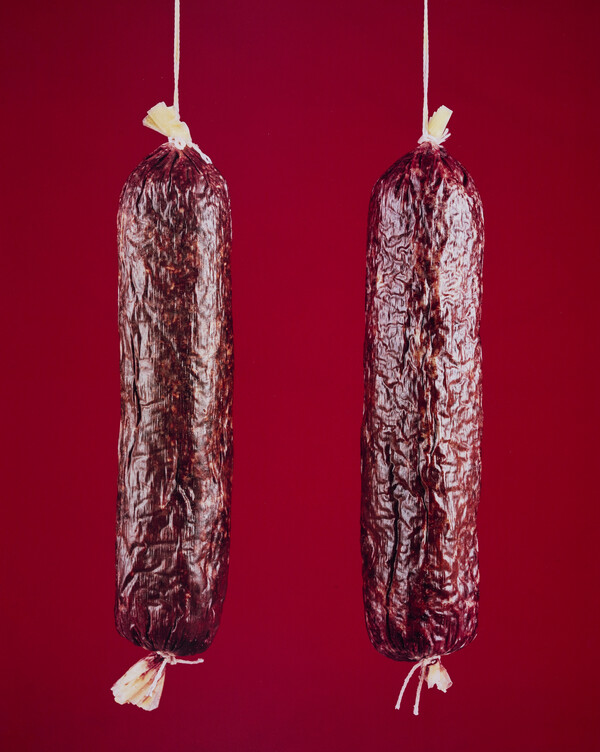
John Beagles and Graham Ramsay

Tyree Smith, the “Connecticut Cannibal”, was given conditional release by the Nutmeg State’s Psychiatric Security Review Board from the mental facility to which he was incarcerated. Smith was handed sixty years in 2013 for killing a homeless man and eating his brain and eyeball in a cemetery, washed down with sake. Doctors who have been treating Smith said he’s been fully rehabilitated, thanks to medications that quelled the voices in his head. Others, including the family of the man he killed and ate, are less optimistic about his future plans. Mr Gonzalez’s sister-in-law, Talitha Frazier, asked the review board “How do we know he’s not going to do this again?” Republican state Senator Paul Cicarella said “Murder and cannibalism and release in the same sentence … that’s a problem”.

What’s with all the eyeballs? A “preppy” Princeton grad was charged with murdering his brother at their luxury Princeton apartment, after which he ripped out the victim’s eyeball and ate it. He also reportedly set the family’s cat on fire. Even the Duke of Cornwall in King Lear would have blushed at that transgression.

March

A woman in Brazil barbecued and ate her victim’s heart and penis. Josefa Lima de Sousa, 65, left a blood-stained sign by the mutilated corpse with a message, using her street name, saying: “Gringa got rapist.” She told police the victim had been a child abuser.

A Texas embalmer with the wonderful name Amber Ludermilk was charged with the felony “abuse of a corpse” after cutting off the penis of a deceased sex offender and jamming it into his mouth. An arresting constable stated that “No matter what one thinks of his life, the law requires that he be treated with dignity in death.” In a world where thousands of humans die of starvation every day, and we casually torment, kill and then mutilate the corpses of billions of other animals every year for food, medical experiments, clothing or entertainment, are we expected to weep for this sex offender’s insentient corpse?

A South Carolina mental health facility was sued by family of a victim of murder and cannibalism. The lawsuit alleged that the killer, another inmate, had killed two men and eaten both the victims’ ears, as well as drinking their blood so he could “gain their power.”

In Rwanda, a minister said that persecution and cannibalism of Tutsi people are still “commonplace.” Readers may remember that just over thirty years ago, almost one million ethnic Tutsis in that country, some 75% of the Tutsi population, were slaughtered in the space of just 100 days. Although the word genocide has come to mean ‘anything done by someone you don’t like’, that one was a real genocide.

June

A young woman who calls herself pterodactylhunny disclosed on TikTok that her doctors had given her one her ribs which had been surgically removed. She took it home, boiled it to remove the meat, then ate the meat to see what it tasted like. Spoiler: the formaldehyde in which it had been soaked made it taste pretty bad. The cannibalism of eating her own flesh, however, she described as “cool” and “not that weird”. Viewers responses ranged from shocked to approving, pointing out that eating one’s own meat could be considered vegan, since the animal from which it came had given her consent.

July

16 men were arrested in the West Pokot region of Kenya after human remains were found including the bodies of several children. One boy was found in a maize field with his organs removed. Police say the suspects have confessed to killing and eating eight people.

Relatives of the victims of a mass-murderer in Idaho were outraged to find that he had taken a plea deal for the stabbing of four students in 2022, thus avoiding the death penalty. No indication of him eating his victims, but a forensic psychologist reported that he had become a strict vegan before that, because:

He was afraid that if he let himself go to taste meat once, he would become addicted to it—like he had become to heroin—and start killing and eating people.”

In Kenya, a man recently released from prison for killing his wife, murdered his second wife, cooked her flesh and fed it to his children. Irate members of the community lynched him and set him on fire. The incident elicited sharp debate among Kenyans over the old claims of cannibalism among members of the community. Samuel Bosire Angwenyi, the Secretary General of Abagusii Council of Elders, dismissed the claims saying it was a myth which some people blindly believed. “If there is a person who can eat a fellow human being, then that must be Satan.”

August

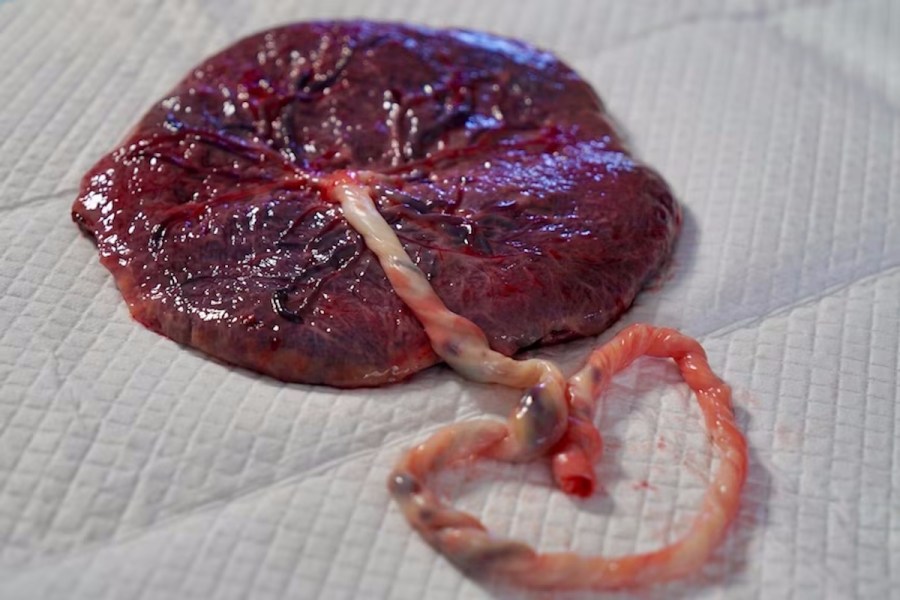
An Australian boxer whose nickname is “the Butcher” told fans he had “become a cannibal”. What he meant was that, as part of his training for a big fight, he had taken advantage of the birth of his child by eating his wife’s placenta, in tablet form, washing it down with a little breast milk. He said:

“I’ve technically become a cannibal. It’s actually like a superpower”

In Cuba, a man arrested for murder was found to have a jar filled with human fat, jars of fried meat, and a bag of ribs in his refrigerators. Cannibalism was suspected but never officially confirmed. Meanwhile, other residents of Santiago de Cuba, seeing an unusual level of police activity in September, fear that the case may be linked to the disappearance of other residents from the Abel Santamaría neighbourhood.

In Zimbabwe, a woman allegedly poisoned her four-year-old granddaughter, Tawanayasha Kadhene, before mutilating her body in Shurugwi on 26 August. Police said: “The suspect gave the victim a maheu drink laced with a maize pesticide pill. The child collapsed and died instantly. The suspect then cut flesh from the victim’s cheek, mixed it with herbs prescribed by a sangoma, cooked it and ate the mixture.” The ritual killing allegedly happened following the woman’s consultation of a traditional healer.

September

In an unusual case of auto-cannibalism, a patient at the University of California Los Angeles (UCLA) David Geffen School of Medicine received intravenous lorazepam to treat anxiety and claustrophobia in order to facilitate an MRI. He subsequently developed acute psychosis, performed self-inflicted digital enucleation of his left eye, and then ingested it. Lorazepam is a benzodiazepine that has been FDA-approved as a fast-acting anxiolytic and sedative. It is one of the most commonly used medications for these indications. The studies of the case claim that it is an “extremely rare paradoxical reactions to benzodiazepines.” Worth keeping an eye on though.

October

A thirteen-year-old boy in Egypt was arrested after reports he had murdered his classmate, sawed his body into pieces and ate them “out of curiosity”. He told the police that he that he found human flesh was “similar to breaded chicken”.

November

The strange case of Gabriela Rico Jiménez, a 21-year-old model from Mexico who disappeared in 2009 after raging against alleged cannibalistic captors while outside a fancy hotel in Monterrey Nuevo Leon, has been rediscovered by TikTok posters. Didn’t know this was happening until my blog on the story suddenly started to take wings recently.

@hfnkw1

She warned us… and then vanished. The Gabriela Rico Jimenez case gets DARK.#scary #scarystories #horrortok #fyp

♬ original sound – hfnkw1

In New Zealand, a mortuary technician lost his licence due to posting online talks ‘promoting cannibalism. He offered to obtain human tissue to interested readers, and added “When we have burn victims…. They smell so good sometimes”. The man also engaged in online conversations about rape and sexualising children, his own alleged drug use and ways of making explosives.

December

We closed the year with allegations from the Ukrainian government that Russian troops trying to occupy Zaporizhzhia in eastern Ukraine have run out of food and are killing and eating each other. The Ukrainian spy service GUR reported that:

“Due to a lack of food, the occupiers are sharpening their knives and preparing to eat their younger comrades”

Intercepted radio messages apparently include soldiers saying “We’ll eat each other, it’s all fucked up here. We’re already looking for someone younger” and “I’ve sharpened my knives. I don’t give a shit who I have to cut up. I just want to eat. Fuck everyone else”.

Around this time last year, this blog reported on several convicted Russian murderers who had admitted to cannibalism but been offered pardons if they agreed to serve in the Russian forces in Ukraine for six months. Later reports have noted that the pardons and repatriations may not ever have happened.

Back in Russia, “Perm cannibal” Mikhail Malyshev died at the age of 65 in a clinic, while waiting for a doctor. Malyshev was arrested in 2000 for two proven murders, although a polygraph test claims that he was involved in at least eight: he killed, dismembered and partially ate a man and a woman. Malyshev reportedly used the soft tissue to fry cutlets and threw away the rest. He often made kebabs out of stray dogs. He was sentenced to 25 years and served his sentence in the Perm region, undergoing mandatory psychiatric treatment. He was released from prison in October 2022. Some reports stated that after his release from prison, Malyshev had found work at a shelter for homeless animals. That part may be the most disturbing aspect of the 2025 story!

New cannibalism movies

A veritable swathe of new releases this year, showing again that cannibalism is the flavour of the month (sorry about the pun) or the year, or indeed the whole damn century:

Know Me: A True-Life DramaStory of the “Causeway Cannibal” and media response
DevourAll female metal band called “The Virginia Bitches” come across a town full of cannibals
Human Hibachi 3: The Last SupperCult of devout followers eat human sacrifices in a “last supper”
Cannibal ComedianCannibal takes a stab at stand-up
Cannibal MukbangShe makes vodcasts of voracious eating – mixed with cannibalism of bad men
DeliciousYoung working people work for, then eat, the rich
The WagerTrue story of a mutiny in the British Royal Navy in 1741 and the events that followed for those who survived
Red Night at Skye’sZombie meth cannibals led by a mad scientist
40 AcresDescendants of African American farmers fight roving cannibal gangs
Forgive Us AllNZ film – survivors flee through cannibal infested forest
River of BloodFour kayakers take wrong river into jungle of a cannibal tribe
No Tears in HellMother and son kill and eat poor people – based on Alexander Spesivtsev
Lone SamuraiSamurai battles cannibal tribe on island
StephenSerial killer’s victims are eaten by mysterious person
The BoatyardAtrociously acted ripoff of Hills Have Eyes
The Priest-Thanksgiving MassacreDepraved priest from earliest European settlement comes back to life to kill and eat people
The Weed EatersNZ film – new strain of marijuana turns users into cannibals
Quarantine CannibalWorking man fired from job cannot control cannibalism urges in quarantine

What a year. Can’t wait to see what 2026 is going to bring!
Boxer: “I’ve become a cannibal”

Australian boxer Nikita Tszyu has revealed that he became a “cannibal” as he prepared to fight Lulzim Ismaili this month (August 2025). The boxer said he needed to be at his very best to win over his unbeaten opponent, and hoped that his new diet would boost his training.

Tszyu revealed that his change in nutritional sources was all thanks to his wife, Nikita Bedwell. The couple welcomed their first child earlier this month, named Curiosity after the NASA Mars Rover, and the birth allowed Tszyu to change his diet.

The Australian boxer is eating his wife’s placenta in capsule form as part of his training program, and feels like he is benefitting from the change in diet. He told a Sydney radio station:

“we freeze-dried her placenta and I’ve been supplementing on her placenta recently… in tablet form”

Does that make him a cannibal? Well, he thinks so. He added:

“I’ve technically become a cannibal. It’s actually like a superpower. I’ve done tests with my sparring – days where I’ve had it and days where I haven’t – and it feels like I got all this crazy amount of energy”

If you’re not convinced by that, he told the interviewers he is also including breast milk in his diet. Asked if he had tried it, he replied: “I have, I have… and it’s delicious as well!”

Consuming placentas is a growing trend in America, with mothers usually consuming them as part of their postpartum recovery. The practice dates back to Chinese medicine, though studies are yet to confirm that there are benefits to eating them.

The bout on August 20 was subtitled (based on Tszyu’s nickname):

THE BUTCHER IS BACK

So, is cannibalism the next big thing in athletic enhancements? Well, Tszyu knocked Ismaili, who was previously unbeaten, to the mat in just over one minute. The shaken opponent sat on his stool and refused to leave his corner, throwing in the towel before round two commenced.

Athletes often boast of eating meat to improve their fitness and stamina, although there are also plenty of vegan ones who swear that dropping meat and milk makes them faster, stronger and more alert. But if there is any truth in the meat myth, then I suppose we need to consider the words of Anthropologist Marvin Harris, who stated in his book Good to Eat: Riddles of Food Culture that, while humans are clearly not obligate carnivores,

“our species-given physiology and digestive processes predispose us to learn to prefer animal foods… strictly speaking, human flesh itself contains the highest-quality protein that one can eat”

There’s one to chew on, next time you enter the ring.

Idaho killer avoids death sentence

Family members of one of the victims of a gruesome murder of four college students in Idaho are furious that Bryan Kohberger has been offered and accepted a plea deal.

Kohberger was accused of stabbing Xana Kernodle, Madison Mogen, Kaylee Goncalves, and Ethan Chapin to death in November 2022 in Moscow, Idaho. The students were found with fatal stab wounds in an off-campus rental home in the early morning hours. Investigators believe the four students, thought to be sleeping at the time, were fatally stabbed between 3 a.m. and 5 a.m. According to the coroner, there was no sign of sexual assault.

A little over a month after the killings, Kohberger, a 28-year-old Ph.D. student and teaching assistant in the Department of Criminal Justice and Criminology at Washington State University, was arrested at his parents’ home in Pennsylvania on Dec. 30, 2022, and extradited to Idaho.

Kohberger was facing a possible death sentence if convicted in a trial that was scheduled to begin Aug. 18, 2025.

A letter sent to families of the victims to inform them of the deal said Kohberger will appear in court Wednesday to enter his guilty plea and be sentenced in late July to life in prison, according to the Idaho Statesman. Kohberger will forfeit his right to appeal as part of the deal. The letter from Moscow Prosecuting Attorney Bill Thompson said:

“We cannot fathom the toll that this case has taken on your family. This resolution is our sincere attempt to seek justice for your family. This agreement ensures that the defendant will be convicted, will spend the rest of his life in prison, and will not be able to put you and the other families through the uncertainty of decades of post-conviction appeals.”

Goncalves’s family had an angry reply on their Facebook page.

“We are beyond furious at the State of Idaho. They have failed us. Please give us some time. This was very unexpected. We appreciate all your love and support.”

The family issued a later post explaining what had been taking place.

“I would like to clarify a couple of things…we DID talk to the prosecution on Friday about the POSSIBILITY of a plea deal and it was a HARD NO from our family. It was very nonchalant and barely discussed as the majority of the conversation was surrounding the upcoming trial. NOTHING in our conversation prepared us for the next steps.”

A family member of one victim told NewsNation that upon hearing of the plea deal, she felt like “all the power had been given back to Kohberger.”

Why is this case featured in a blog about cannibalism? Well, A forensic psychiatrist told  Newsweek after the arrest that Kohberger had battled with “cannibalistic urges.

Reports then surfaced that Kohberger had followed a strict vegan diet, and had reportedly struggled with heroin addiction in the past.

Forensic psychiatrist Carole Lieberman told Newsweek that Kohberger’s “obsessive-compulsive eating habits” indicate he was afraid he would become addicted to meat if he ate it.

“He was not only vegan, he refused to eat off of pots or plates that had had meat on them. Psychologically, this represents his struggle against his cannibalistic urges. He was afraid that if he let himself go to taste meat once, he would become addicted to it—like he had become to heroin—and start killing and eating people.”

A relative told the New York Post that Kohberger’s dietary restrictions were “very, very weird” and that he seemed “very OCD,” referring to obsessive-compulsive disorder.

The woman, who asked not to be named, but said she was previously married into Kohberger’s family, said:

“It was above and beyond being vegan. His aunt and uncle had to buy new pots and pans because he would not eat from anything that had ever had meat cooked in them.”

Casey Arntz, who was friends with Kohberger in middle and high school, said in a video posted on TikTok that he had been “a heavy heroin user” in high school. Kohberger’s struggles with drug addiction continued into his college years, a friend from Northampton Community College told Fox News. Criminal profiler John Kelly told Fox News,

“This kind of person has this volcanic rage inside that’s going to explode on its victim of choice.”

Lieberman told Newsweek that Kohberger had probably studied criminology both to “calm the demons inside him that were telling him to kill” but also to “learn how to commit the perfect crime.”

It is possible that he had been in touch with the so-called BTK killer, Dennis Rader, whose serial killings in Wichita were the subject of a book by his supervisor, Katherine Ramsland.

Kohlberger may have corresponded with Rader (a lot of criminology students do) but we don’t know that for sure. We have to wonder if Rader would have told him about working in the meat department of a Wichita IGA a few years before his murder spree began.  

Kohlberger’s obsession with meat reflects a lot of issues considered in Cannibal Studies. Firstly, the question of human meat: there really is no significant difference between the meat of humans and other large mammals such as cows, pigs or sheep. Hannibal Lecter takes delight in feeding human meat to his guests, such as the flesh of the flautist of the Baltimore Philharmonic, whose Board members subsequently enjoy the meal immensely in the book and film Red Dragon, thus becoming “innocent cannibals”.

But the point is that once meat is prepared (cooked, seasoned, presented) it is very hard to tell its provenance. Cannibals who have been asked have mostly compared it to pork or veal, with Armin Meiwes telling an interviewer

“It would have made no difference in somebody else had tasted it; he wouldn’t have questioned the meat…. During preparation, it is not as dark, but bright and fresh as pork, and tastes so very close to pork.”

Kohlberger’s belief that he might like human flesh if he tried any meat at all therefore has some logic to it. Since Charles Darwin’s writings overthrew the special status of humans as closer to angels than other animals, anthropocentrism has been amended to offer a story of humans as the culmination of evolution and thereby continues, rather less successfully, to obscure human animality. Should such beliefs falter, as happens repeatedly in many cases of contemporary cannibalism, it becomes a very short step from eating other animals to eating the human one.

But why should he become addicted to any meat? Well, we know Kohlberger has an addictive personality, shown by his very heavy usage of heroin. But we’re not talking drugs of addiction but lumps of protein, aren’t we? Well, there are plenty of studies about that. Marta Zaraska, for example, wrote in her book Meathooked that meat is highly addictive on several fronts – genetic, cultural, historic and commercial, and coined the term “meathooked” for the incongruous compulsion to eat meat despite the pangs of cognitive dissonance – the repressed feeling of guilt when considering oneself an animal-lover while also paying big corporations to kill them. Then there is the mythology of the Wendigo, a creature from Algonquin legend who starts off as a human but becomes a being who can only live on human flesh, which makes him grow bigger and at the same time hungrier. If you believe in Wendigos, then the slippery slope from carnivore to cannibal seems reasonably clear.

This leads us to the issue of Kohlberger’s apparently very strict veganism. Most people seem to believe (or want to believe) that vegans are fanatics, obsessed with animal welfare (or the environment, or their own health) who therefore compulsively avoid meat. But in fact most vegans would certainly wash a pot thoroughly after a relative had cooked meat, but are unlikely to throw it out as irretrievably ruined, as Kohlberger purportedly did. Veganism is an ethical system that attempts to minimise harm to sentient animals, which includes humans (yes, Virginia, humans are animals). If there is a slippery slope from the flesh of other animals to the flesh of Homo sapiens, then the vegan is furthest from the edge of that slope. When Kohlberger killed those students, he was not following any known vegan code of ethics, even if he didn’t sample their flesh on the way out.

Is Donald a cannibal? DONALD DUCK ON HOT ONES

It’s a question that never seems to grow old.

If Donald Duck (who vaguely resembles a duck) eats a chicken’s body parts, such as wings, does that make him a cannibal? You know, because he’s a (sort of) bird eating body parts of birds.

Donald appeared this week on the YouTube interview show HOT ONES (see link above). Hot Ones calls itself:

The show with hot questions, and even hotter wings.

It’s a talk show produced by First We Feast and Complex Media and hosted by the very congenial host Sean Evans. The simple but ingenious premise is that Evans interviews celebrities while they eat a platter of spicy chicken wings. To make it interesting, the wings are served with increasingly hot chilli sauces. The questions become deeper and more personal as the Scoville hotness score of the sauces is ramped up and the guest becomes hot and bothered.

The Scoville score on Donald’s last sauce, “Straight out of Hades”, is 1,454,000, which has the expected result on poor Donald.

So anyway, would eating chicken wings be classified as cannibalism for young Mr Duck (who, we are told, is actually celebrating his 90th anniversary of his animated life)? Well, I covered the biological question pretty comprehensively in my blog last Christmas, which looked at the ethics of Donald and family eating chickens and turkeys for their festive meal.  

The traditional definition of cannibalism is eating the flesh of a member of one’s own species. Now, it is not clear what species of duck Donald purports to be, but to be a cannibal, he would have to be eating a duck that wears clothes and speaks (sort of) English (the Hot Ones interview helpfully offers subtitles). This would probably limit his cannibalism feasting options to his nephews, Huey, Dewey and Louie, or Uncle Scrooge, and all of those people remain alive and uneaten, as far as we are aware. Or, of course, his long-time paramour Daisy, and he tells us that she is still around; indeed, she was the one who challenged him to agree to the interview while they were watching earlier episodes.

Now if we’re going to say that Donald eating any bird (Class: Aves) is cannibalism, then we need to agree that humans eating cows, pigs, sheep, goats, etc (Class: Mammalia) would also be cannibalism. I’m happy to go with that, but I haven’t found too many other takers.

But there is one more obstacle to the outrage of those condemning Donald’s consumption of chicken wings. Sean Evans states very clearly at the start of the feast

I notice you have the cauliflower wings on that side of the table, but no water or milk to help you out?

Donald doesn’t need them (he claims). What a rebel! That’s why we love Donald, far more than we love Mickey, at least, according to the totally unscientific surveys I have performed.

Donald doesn’t want chicken meat, or cow’s milk. Donald is a vegan! I guess in a world where humans eat twelve million ducks (and 200 million chickens) every day, we shouldn’t expect anything else.

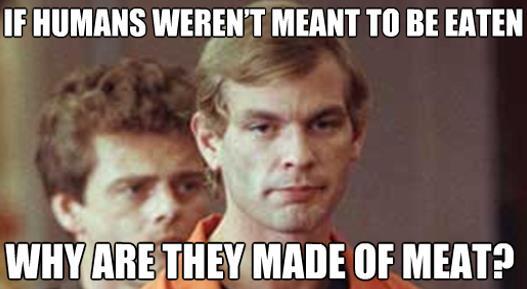
Dinner with Dahmer—Ariana Grande’s cannibalism fantasy

Ariana Grande managed to raise some serious eyebrows when she was asked on Penn Badgley’s podcast in June 2024 whom she would most like to have dinner with. She replied:

“Jeffrey Dahmer’s pretty fascinating. I really wish I could have met him.”

The mother of Tony Hughes, one of the men Jeffrey Dahmer murdered, criticised Grande last week, calling the singer “sick in her mind.” Tony’s sister, Barbara, told TMZ that she hopes Grande will apologise for her comments, and both shared disappointment in the singer’s apparent lack of empathy for the victims’ families. “Unfortunately, until it happens to her and her family, she just doesn’t know what we have been through,” Barbara said.

Jeffrey Dahmer murdered seventeen boys and young men between 1978 and 1991, mainly people of colour, and after his arrest spoke freely about consuming body parts from some of them.

According to Grande, her fascination with Dahmer began “years ago before the [Netflix] Dahmer series,” and she had mentioned it to young fans when she was a Nickelodeon star.

In the podcast, Grande suggested she would like to meet Dahmer, but “maybe with a third party or someone involved. I have questions,” she added.

Grande is a big deal in the world of celebs. She had reportedly sold over 85 million records and accrued 98 billion streams (so far), making her one of the most-streamed artists of all time. She was the most-streamed female act of the 2010s and has the second most songs with over a billion streams for a woman. Grande also has a massive social media following; with over 380 million followers, she is the sixth-most-followed individual on Instagram and one of the most-subscribed and most followed musicians on YouTube and Spotify.

I guess that keeps her busy, because honestly there is so much Dahmerabilia on the web that having dinner with him would be unnecessary (and messy, since he had his head caved in by another prisoner in 1994). Ryan Murphy made a hugely popular re-enactment of the case for Netflix in 2022, although it had been done before and rather well by Jeremy Renner (playing Dahmer) in a movie made by David Jacobson in 2002. Then there are the tape recordings – his defence team released their tapes of interviews with him a few weeks after the Ryan Murphy doco went to air. In 2023, Dahmer’s dad released his own interview tapes together with home movies etc, on Fox Nation. In prison, before his death, Dahmer was open and transparent about his activities with a range of interviewers. Not sure how much was left to uncover over a nice dinner of fava beans and a big Amaroni?

Some of the news reports have rather pompously asked if her preference for a cannibal for dinner means that she is therefore a cannibal herself? Well sorry guys, but we happen to know that Ariana is a vegan, and has been since watching the documentary Forks Over Knives in 2013. Ariana told a UK paper:

“I love animals more than I love most people, not kidding.”

She insists that (besides being kinder to animals and better for the environment) going vegan has improved her health immensely.

“The way I’m eating now has actually helped even out my blood sugar. As some of you guys may know, I’ve struggled with awful hypoglycemia for my whole life and it’s improved a ton since I changed my eating habits.”

Would Ariana eat a human at her dinner with Dahmer? About as likely as her eating a cow or a pig!

Mike Tyson’s edible ears

Mike Tyson, sometimes called “The Baddest Man on the Planet”, is nonetheless regarded as one of the greatest heavyweight boxers of all time. He was the world heavyweight champion from 1987 to 1990. After a spell in prison from 1992-95 for raping a young woman, Tyson made a comeback, and briefly held the championship again in 1996.

In 1997, Tyson fought Evander Holyfield at the Las Vegas MGM Grand Garden Arena in a fight that grossed $100 million. Tyson famously bit off a piece of Holyfield’s ear, which was later found on the floor of the ring. When he subsequently bit Holyfield’s other ear, he was disqualified, the first time in over fifty years a heavyweight fight had ended in disqualification. Tyson’s boxing licence was revoked by the Nevada State Athletic Commission and he was fined $3 million. Tyson claimed he was angry because Holyfield had been headbutting him without suffering any penalties for that.

In an interview with Fox News in 2013, Tyson was asked about his history, his fights, his religion, and becoming a vegan, a claim he had made on the Ellen DeGeneres show. He admitted to eating chicken occasionally, but said he never ate red meat.

“None at all, no way! I would be very sick if I ate red meat. That’s probably why I was so crazy before.”

Now, we are forced to admit that Tyson cannot really be called a cannibal since he did not swallow the piece of Holyfield’s ear. But he did make that significant connection between eating meat of other animals and biting (and almost eating) human meat. Had he been a vegan in 1997, he probably would not have aimed for that ear, unless it was an ear of corn.

The notoriety of that fight night has followed Tyson ever since, and now he is making money from it. He has created a cannabis company called Tyson 2.0 and is selling edibles in the shape of nibbled ears. Flavours include black eye berry, sour apple punch and watermelon (none of the products claim to taste like Evander Holyfield). The edibles are available from the company’s online store and have been sighted in dispensaries in New York. His website calls it “undisputed hemp.” No pun is out of bounds in the worlds of hemp or cannibalism.

In March 2024, Tyson announced he will be fighting YouTuber-turned-boxer Jake Paul in a bout that will be shown live on Netflix later this year. No doubt many people will be watching his teeth as closely as his gloves.

MOUNTAIN OF THE CANNIBAL GOD (Sergio Martino, 1978)

“Why is everyone so scared of the Pooka?”
“In their language, Rara Me means mountain of the cannibal god

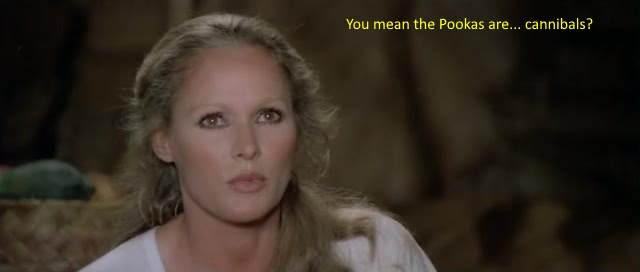
Well that explains it then. Why Susan (Ursula Andress, who was the first “Bond Girl” in Dr No), is tied up in the jungle naked, being smeared with cream by some local girls. Why her husband’s skeleton is being worshipped as a god because his Geiger counter is still ticking within his bones. Why Professor Foster (Stacy Keach) is admitting to having been a cannibal (spoiler: he didn’t like the taste much).

Hey, that pretty much sums up the whole movie. The film starts with stock footage of animals, intended to persuade us we are in the jungles of PNG, but they seem to be chosen at random. The grey-headed flying fox, for example, is native to Australia. Close, but no points.

Like all the Italian horror movies of the seventies, this one has the obligatory scene of real animals being cut up and eaten, some of them while still alive. It was intended to add “realism” to what were pretty dumb plots, but just managed to put a lot of people off watching the films. There is an inordinately long scene of a python eating a monkey alive, and then humans eating a lizard, which Foster tells us is “part of their religion”. Just like eating meat is part of the religion called ‘Humanism’. I guess these scenes also try to teach us that the law of the jungle applies just as much to humans as to other animals. Or else it teaches us to appreciate the fast-forward button.

Manolo (Claudio Cassinelli), a wandering adventurer, joins the merry band and tells them:

“Animals only follow their instincts. That of all living beings – killing and eating. Man too has the same instincts. To satisfy them, he uses more subtle means. Lying, trickery.”

He also tells them he doesn’t kill animals, which would probably make living in the jungle difficult (not many vegan restaurants), but they all seem to enjoy coconuts, so who knows?

The first half of the film is about a motley bunch of white people heading for Papua New Guinea (it was actually filmed in Sri Lanka) on a Pakistani plane, to explore a heavily wooded island inhabited by cannibals called the Pookas, and the various reasons they are there (uranium, that sort of thing, yawn).

The title card explains that “life has remained at its primordial level” – meaning the rest of us have advanced? Just turn on the news channel any time to fact-check that.

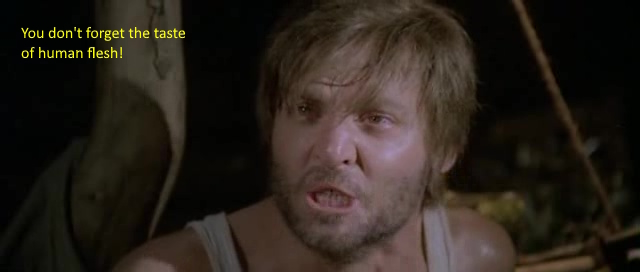
Cannibalism doesn’t get a look in until after the first half, when Foster admits to having lived with the Pooka tribe, where he had to eat human flesh. It haunts him still, and he wants to exterminate them. Sure, eating dead humans is horrifying, but killing live ones is fine.

Thirty minutes before the end, they finally agree that the Pooka exist, when they stumble into their pantry.

They are soon captured and the Chief checks them out for meat quality, but then he remembers that he has a photo of her with her husband who, I may have already mentioned, is being worshipped due to his clicking Geiger counter, a proof of his immortality, despite being a rotting corpse.

So now Susan is the new god, and gets dolled up for the occasion, while her brother, luckily dead, is disembowelled for the coronation feast.

Susan gets to eat some of her brother, while the girls who so enjoyed smearing her with whipped cream lie around pleasuring themselves, and the guys engage in bestiality with a totally uninterested pig. This is getting sillier and sillier.

One of the men, perhaps tiring of being ignored by the pig, tries some hanky-panky with the new goddess, and is pulled off and given a rather extreme form of circumcision. Following which, the tribesmen all start eating snakes, for no apparent reason, but with considerable gusto. The film by now is longing to reach some conclusion, so Manolo has a snack with his new friends (seems to be Kentucky Fried Lizard).

Susan is invited to chop up the rapist, but chooses to stick the knife in the Chief instead, and there is now so much meat to go around that everyone goes for a post-prandial nap. Except for Manolo, who watches a bird fight a snake (Pooka version of Netflix perhaps). Finally bored silly, Manolo and Susan fight their way out, kill a lot of cannibals on their way, and escape on a floating log into a river that we have been shown is full of crocodiles. Yes, it’s a happy ending. Maybe more so for the crocs.

Mountain of the Cannibal God is the translation of the Italian title (La montagna del dio cannibale). The movie was released in the US as Slave of the Cannibal God in 1979 and the UK as Prisoner of the Cannibal God, but not until 2001 due to its “graphic violence”. Can’t see the problem myself, but maybe I have watched too many cannibal movies.

The review from Allmovie said:

“a graphic and unpleasant film, with all the noxious trademarks intact: gratuitous violence, real-life atrocities committed against live animals, and an uncomfortably imperialist attitude towards underprivileged peoples.”

I found it a bit dull, with long scenes of exposition and lingering images of the cast struggling through the jungle or over waterfalls. I guess they had to pad it out somehow, considering all the action takes place in the last ten minutes.

The complete movie, at the time of writing, was available on YouTube.

200 And don’t miss “The Horror Geek” Mike Bracken’s hilarious review at Sick Flicks:

Vegan eats his own blood as a meringue

I don’t usually put warnings about graphic images in my blogs; I figure if you are reading a blog called “thecannibalguy.com” that you are probably not expecting unicorns and fairies. But this short clip has its own trigger warning, so I’ll just reproduce it here.

Vegans are often told by caring or sanctimonious friends and relatives that they need animal protein or they will get sick and die. This can be a bit wearisome, particularly for long-term vegans. Now here’s a novel solution.

Jamie Lee Curtis Taete (I wonder who his parents’ favourite film star was?) has been vegan or vegetarian for almost 20 years (and clearly has not died yet). After years of carnivorous peer-pressure, he’s decided to consume animal products from what he calls the only truly ethical source: himself.

Jamie seeks advice from “Blood for Food” activist, Laura Schälchli, about her recipes, which are made with blood from other animals. He follows her recipe for blood meringues, substituting his own blood for whatever unfortunate animal is usually slaughtered and bled.

And eats the results.

He starts by whisking the blood, because blood tends to clot, which even he describes as “disgusting”. But,

“I find the thought of it less gross than if I were eating the blood of an animal.”

Jamie is perhaps using shorthand, or forgetting that we are all animals?

The protein albumin comprises about fifty percent of human blood plasma, and is similar to egg whites, so the obvious choice for Jamie was to make a meringue, which is usually made from the whites of chicken eggs or, far less often, in the recipe he has chosen, the blood of goats or cows.

“I was expecting a sugary bowl of gore, but this looks like it could be real food.”

So look, autocannibalism is not an appetising prospect, but most vegans would say the same about dishes made from the organs, muscles or blood of an animal who was unwillingly slaughtered for the purpose.

 “I think I probably enjoyed this more than if I had made it using animal blood, because there was no death involved. I am really the only ethical source of animal products, because I can give my consent to myself in a way that a sheep can’t.”

Here are some of the comments from YouTube:

Some suggested that Jamie would end up a cannibal, a common thread through the literature – if you eat human flesh (or blood I guess), you will become addicted, because we are somehow irresistible. It is absolute nonsense of course. Others felt like it had made the point: eating any animal product, including from the ape known as Homo sapiens, is a bit disgusting. I have seen people flinch as they pull a piece of meat out of the fridge and pour out the blood that pools under it.

As Jamie says, if you must eat animal protein, use the nearest animal, and the only one that is able to consent, although the occasional cannibal like Armin Meiwes manages to find a willing third party to sate his cannibalistic desires. Remember the scene from The Restaurant at the End of the Universe, when the “dish of the day” offers them his shoulder to eat, braised in a little white wine sauce, saying “naturally mine, sir, nobody else’s in mine to offer!”

Jamie is not unique in this – remember Gwen van der Zwan, who made blood sausages out of her own blood, commenting, “Why is my idea considered disgusting, but doing the same thing with pigs’ blood isn’t?”

Jamie has the final summation, commenting perhaps on the flesh and blood of himself, and every other sentient being:

“It’s like eating a little baked nightmare.”

“…CANNIBALISTIC URGES” – Man on trial for brutal murder of four Idaho University students

A forensic psychiatrist has told Newsweek that the man charged in connection with the slayings of four University of Idaho students in November 2022 had battled with “cannibalistic urges.

Bryan Kohberger, a 28-year-old Ph.D. student and teaching assistant in the Department of Criminal Justice and Criminology at Washington State University, was arrested at his parents’ home in Albrightsville, Pennsylvania.

Kohberger is accused of breaking into a rental house in Moscow, Idaho, and fatally stabbing Kaylee Goncalves, Madison Mogen, Xana Kernodle and Ethan Chapin in the early morning hours on November 13.

Reports have surfaced divulging that Kohberger follows a strict vegan diet and has reportedly struggled with heroin addiction in the past.

Forensic psychiatrist Carole Lieberman told Newsweek that Kohberger’s “obsessive-compulsive eating habits” indicate he was afraid he would become addicted to meat if he ate it.

“He was not only vegan, he refused to eat off of pots or plates that had had meat on them. Psychologically, this represents his struggle against his cannibalistic urges. He was afraid that if he let himself go to taste meat once, he would become addicted to it—like he had become to heroin—and start killing and eating people.”

A relative told the New York Post last week that Kohberger’s dietary restrictions were “very, very weird” and that he seemed “very OCD,” referring to obsessive-compulsive disorder.

The woman, who asked not to be named, but said she was previously married into Kohberger’s family, said:

“It was above and beyond being vegan. His aunt and uncle had to buy new pots and pans because he would not eat from anything that had ever had meat cooked in them.”

Casey Arntz, who was friends with Kohberger in middle and high school, said in a video posted on TikTok that he had been “a heavy heroin user” in high school. Kohberger’s struggles with drug addiction continued into his college years, a friend from Northampton Community College told Fox News. Criminal profiler John Kelly told Fox News,

“This kind of person has this volcanic rage inside that’s going to explode on is victim of choice.”

Lieberman told Newsweek that Kohberger had probably studied criminology both to “calm the demons inside him that were telling him to kill” but also to “learn how to commit the perfect crime.”

It is possible that he had been in touch with the so-called BTK killer, Dennis Rader, whose serial killings in Wichita were the subject of a book by his supervisor, Katherine Ramsland.

Kohlberger may have corresponded with Rader (a lot of criminology students do) but we don’t know that yet. We have to wonder if Rader would have told him about working in the meat department of a Wichita IGA a few years before his murder spree began.  

Kohberger has been held without bond in Pennsylvania since his arrest. He will be tried in Idaho, the state in which the crimes took place, the only state in the US with a law against cannibalism, although no such charges have been laid against Kohberger.

His next court appearance will be June 26.

Kohlberger’s obsession with meat reflects a lot of issues considered in Cannibal Studies. Firstly, the question of human meat: there really is no significant difference between the meat of humans and other large mammals such as cows, pigs or sheep. Hannibal Lecter takes delight in feeding human meat to his guests, such as the flesh of the flautist of the Baltimore Philharmonic, whose Board members subsequently enjoy the meal immensely in the book and film Red Dragon, thus becoming innocent cannibals. Incidentally, being the Baltimore flautist seems to be a rocky road – their principal flautist Emily Skala, was fired in 2021 for spreading misinformation about the safety of coronavirus vaccines, the efficacy of face masks and the outcome of the 2020 presidential election, relieved of her post, but not eaten.

But the point is that once meat is prepared (cooked, seasoned, presented) it is very hard to tell its provenance. Cannibals who have been asked have mostly compared it to pork or veal, with Armin Meiwes telling an interviewer

“It would have made no difference in somebody else had tasted it; he wouldn’t have questioned the meat…. During preparation, it is not as dark, but bright and fresh as pork, and tastes so very close to pork.”

Kohlberger’s belief that he might like human flesh if he tried any meat at all therefore has some logic to it. Since Charles Darwin’s writings overthrew the special status of humans as closer to angels than animals, anthropocentrism has been amended to offer a story of humans as the culmination of evolution and thereby continues, rather less successfully, to obscure human animality. Should such beliefs falter, as happens repeatedly in many cases of contemporary cannibalism, it becomes a very short step from eating other animals to eating the human one.

But why should he become addicted to any meat? Well, we know Kohlberger has an addictive personality, shown by his very heavy usage of heroin. But we’re not talking drugs of addiction but lumps of protein, aren’t we? Well, there are plenty of studies about that. Marta Zaraska, for example, wrote in her book Meathooked that meat is highly addictive on several fronts – genetic, cultural, historic and commercial, and coined the term “meathooked” for the incongruous compulsion to eat meat despite the pangs of cognitive dissonance – the repressed feeling of guilt when considering oneself an animal-lover while also paying big corporations to kill them. Then there is the mythology of the Wendigo, a creature from Algonquin legend who starts off as a human but becomes a being who can only live on human flesh, which makes him grow bigger and at the same time hungrier. If you believe in Wendigos, then the slippery slope from carnivore to cannibal seems reasonably clear.

This leads us to the issue of Kohlberger’s apparently very strict veganism. Most people seem to believe (or want to believe) that vegans are fanatics, obsessed with animal welfare (or environment or their own health) who therefore compulsively avoid meat. But in fact most vegans I know would wash a pot well after a relative had cooked meat, but are unlikely to throw it out as irretrievably ruined, as Kohlberger purportedly did. Veganism is an ethical system that attempts to minimise harm to sentient animals, which includes humans (yes, Virginia, we are animals). If there is a slippery slope from the flesh of other animals to the flesh of Homo sapiens, then the vegan is furthest from the edge of that slope. If Kohlberger did kill those students (and at this stage it’s only alleged), then he is no vegan, even if he didn’t sample them on the way out.

Love and cannibalism: BONES AND ALL (Luca Guadagnino, 2022)

The modern cannibal is usually hard to identify. Jeffrey Dahmer was the all-American boy next door. Armin Meiwes used to mow his neighbours’ lawns to be helpful. Issei Sagawa was so small and helpless that he seemed vulnerable rather than threatening. Albert Fish was a sweet old man, so charming that the Budd’s let him take their little girl to a party.

They were normal, everyday people, a bit weird, but not monsters.

At least, not in appearance. This is a recent phenomenon – the original cannibals were called anthropophagi (Greek for man-eaters) and were humanoid in shape, but were usually some sort of hybrid – a mix of humans and gods or other animals – strong, ferocious, and clearly not quite human. From the 15th century, the alleged cannibals found by Columbus and other explorers were different in culture and skin colouring, so were easily distinguished, defamed and exterminated. It is only recently, since Jack the Ripper in 1888, that the cannibal walked among us, undetected until the victims were found (or what was left of them).

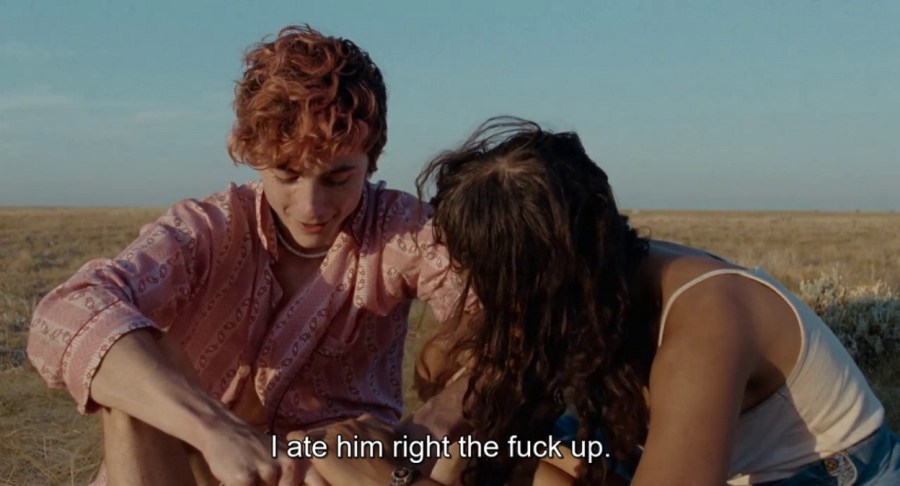
Bones and All presents as a coming of age cannibal romance, taking a sharp turn back into cannibal history for its themes. Maren (Taylor Russell from Lost in Space) is finishing high school, a spectacular end of term in which she is invited to her friend’s sleepover and bites a girl’s finger off, instead of, you know, just admiring the nail polish, as she had been invited to do.

She then goes on the run with her father, who has been keeping her ahead of the law as she grew up (her first human meat was her babysitter when she was three) but now ditches her, with a few hundred dollars and a birth certificate.

It then becomes a road movie, as she travels through the American Mid-West trying to find her mother, attracting suspicion not because of her eating habits but just because she looks too young to be on the road. She comes across another cannibal (they are called “eaters”) in the shape of a weird old man named Sully (Mark Rylance, Bridge of Spies) before meeting up with Lee, played by the love interest of seemingly everyone nowadays, Timothée Chalamet. Chalamet appeared in the third instalment of Guadagnino’s “Desire Trilogy”, Call Me by Your Name), in which he was the love interest of Oliver, played by Armie Hammer, who has recently been generating his own cannibalism headlines.

As a road movie it’s Thelma and Louise mixed with Romeo and Juliet, if they had been cannibals. In other words outsiders, star-crossed lovers, and lots of flesh being torn off dead (and sometimes living) bodies. Road movies rely on meeting new and weird people, and learning about the protagonists (and ourselves) from their stories.

Sully is a lonely old man who teaches Maren about being an eater, and how an eater has a super-power – like a vampire, they have a nose that can smell other eaters at great distances, and can also smell dying people, which allows him to feast on them fairly inculpably, although Maren rather wonders if they should be calling 911 rather than letting them gasp their last breaths. So they are anthropophagi, they smell different, have a strong sense of smell, and so are not quite human. We subsequently discover that the cannibal gene is passed on – Lee’s dad and Maren’s mother were also eaters. They are a breed apart, hybrid humans, who can mate with non-eaters.

They are also presented as ‘savages’ – related to the colonised peoples who were declared cannibal by the imperial powers. Maren is biracial, and Sully (although played by a classical British Shakespearean actor) seems to be presented as a Native American, with a long ponytail and a feather in his hat. The marginalised and disenfranchised are regularly presented as dangerous, thieves, murders, cannibals, regardless of any evidence.

An interesting character from colonial times is the wendigo, a figure from Algonquin mythology who eats his fellow humans and draws on their strength to grow huge and powerful, which only makes him hungrier and deadlier. Sully tells Maren that her fate is to need more and more flesh as she gets older.

Just like the wendigo, who is an indigenous version of the anthropophagus, and one that was used by the victims to characterise the European invaders and their voracious appetite for land and gold. The phrase “bones and all” reminds us of the colonial greed that denied the humanity of those invaded and insisted on taking everything, leaving nothing and nowhere to go but a few reservations or missions in remote, unprofitable areas. Eating bones and all is also a perfect way of getting rid of the evidence.

The title Bones and All is taken from the book of the same name by Camille DeAngelis, but the phrase was not used in the book – it just meant that Maren and the other eaters would automatically eat the whole person, bones and all. Except for her first, the babysitter, because she was too small to swallow bones – she left a pile of them, a pool of blood, and the hammer from an eardrum. In a movie, though, it can be harder for the viewer to maintain a willing suspension of disbelief, so eating the victim bones and all becomes a rite of passage – the next level of being an eater. Maren and Lee don’t know how to eat a person bones and all, so they are not yet postgrad eaters. Maren puts it succinctly – “that’s impossible.” But what about eating the flesh? Armin Meiwes took ten months to eat 20 kilograms (44 lb) of Brandes, but we are asked to accept that Maren and Lee can eat a whole body in a night.

But then, everything is ambiguous in this story, which has been widely described as a metaphor for otherness and queerness. The story is set in 1981, as Ronald Reagan is entering the White House. Being different, queer, compassionate, seeking social justice were all considered laughable or dangerous. Greed was good, and so eating a victim bones and all might have seemed laudable. Drug addiction was escalating, and some have seen the cannibalism in this film as a metaphor for this as well – Maren and Lee can’t go too long without their feed, and will do whatever they need to in order to get it.

Some of the ambiguities are more subtle: Maren looks young, which bothers various people she deals with, although she is 18 and technically an adult in most places. Lee falls in love with her, but is also capable of appearing to be cruising for gay sex.

He chooses a carnival worker who has been mean to a child, leads him into the bushes and masturbates him, slitting the man’s throat as he orgasms. It was not until twenty years later that gay sex was legalised in the US, and this man’s secret desire for same sex petite mort becomes his real mort. They then discover that the man had a wife and family, and are stricken with guilt, because apparently eating some people is OK, but not family people.

Then we have the eaters – Maren is naïve and caring, horrified by her need to feed. Lee is a puny dude who kills seemingly effortlessly, but like Hannibal Lecter, Lee prefers to eat rude people – when we first meet him, he challenges a rude person in a supermarket and leads him to a deserted shed where he kills and eats him. Sully is an senior eater, so has to eat regularly, but says he tries not to kill people – sniffs out those who are dying, but later he gets violent when Maren rejects his advances.

Jake (Michael Stuhlbarg) is an eater who has graduated to eating bones and all, but he is accompanied by a friend named Brad (David Gordon Green), a cop (!), who is not a natural eater, but just likes doing it. Maren accepts that she and Lee have to eat people, but is revolted by Jake’s wish to do the same. We’re back to the old debate of nature versus nurture. Are people born queer? Or with addictive personalities? Or psychopathic? Or cannibalistic?

The Director, Luca Guadagnino, has made a number of changes from the book, which are examined elsewhere. The most obvious one, though, is that Maren is brought up and then eventually abandoned by her mother in the book, but her father in the film. This changes the dynamic considerably, because we now have two eaters in the family, both female. The eater parent in both versions is locked up in an asylum, having eaten their own hands, but in the movie it’s her mother, (a short but superb appearance by Chloë Sevigny). We arrive at last at the modern horror archetype, the “monstrous-feminine”, the figure that confronts the male viewer with his fears of being castrated (Freud’s favourite explanation), as well as “the monstrous womb” – a terrifying image of a “black hole which threatens to reabsorb what it once birthed” (Creed, The Monstrous-Feminine, p. 27). The female cannibal is quintessentially monstrous-feminine, terrifying men with the antithesis of popular female stereotypes of giving life and nurturing. In the book, Maren only eats boys or men (after the initial babysitter) – she is drawn to eat those who seek to be close to her. In both versions of the story, the ambiguity is clear to us and the female cannibals – they have a compulsion to eat, but don’t want to hurt others.

Maren’s solution is to try to act normal, fall in love, get a job, get “clean” of the eating. Her mother’s was to lock herself away, and even then she chewed off her own hands.

To me, the most fascinating ambiguity in this film and in our societies generally is the question “who can you eat?” Eating some animals is considered just “normal” – Lee is chewing on bacon (pig flesh) served to him in a very respectable café, and has been working in an abattoir. When they need money, he and Maren rob the abattoir at night, later sitting on the overhead walkway watching the cows who are to be killed for legal, non-controversial eating, when Maren observes

“every one of them has a mom and a dad, sisters, brothers, cousins, kids. Friends even.”

The real question, Derrida says, is not what to eat but how to eat well. Perhaps, as Chalamet has said, it is impossible to live ethically – every act of consumption or energy usage wrecks the environment a little bit more. For some carnivores, this is seen as a ‘bones and all’ issue, they call it “nose to tail” – killing is OK, but wasting any part of the animal is the real crime. But as Maren says, cows also feel terror, pain, bereavement when their babies are taken from them. The author of the book, Camille DeAngelis, went vegan before writing it, indicating that the problem of who to eat, the rude or dying, the human or the cow, weighed on her, and the scene filmed in the slaughterhouse indicates that Guadagnino may have felt the same. Cat Woods’ review in Salon reminds us that Brad, the off duty policeman, chooses to be a cannibal:

“Why would he hunt, slaughter, and feast upon human flesh if he doesn’t need to?
And, if we the audience can be repulsed by that – and his evident choice to slaughter and eat flesh when there is abundant satiety that doesn’t cause violence, pain and loss – then perhaps we need to venture a little deeper into our own psyches and ask: Why would we feast upon flesh if we don’t need to?”

This is a seriously good film, with a great cast and, in the midst of all this carnage, we are treated to magnificent scenery beautifully captured by cinematographer Arseni Khachaturan. I have not revealed the ending, and hope I have not revealed too many other plot points. I recommend you go see it.