Is Donald a Cannibal?

No, not that Donald, the one that dresses in a blue suit with no trousers. That still didn’t help? I mean the Duck of course, the Walt Disney creation, who has been around since 1931.

In several films, including the 1948 cartoon Soup’s On (the above clip), Donald is seen enjoying the flesh of a bird, presumably a turkey or large chicken. In the Christmas or Thanksgiving movies such as Mickey’s Once Upon a Christmas, it is normally a turkey, because that is the animal people are encouraged or sometimes browbeaten into eating on those festivals. In that film, Donald actually chases the terrified turkey with a knife. I found it more disturbing than most of the cannibal films I have reviewed on this blog!

Turkeys are birds, and so are ducks, so every now and then, Social Media breaks out in a rash of accusations that Donald is a cannibal, because he is a bird who is eating a bird. Cannibalism, though, is defined as eating another of the same species, so let’s look at this a bit more closely.

It is far from clear what species of duck Donald might be. Taxonomy texts do not reveal any species that speaks (quacky) English, dresses (or half-dresses) in human clothes, or live in human houses. Nor have I been able to discover any animal other than Homo sapiens who cooks its food. Or a species of duck with TEETH! Or, as far as we can tell, one that believes in an afterlife.

Several cartoons depict humans (however vaguely) as cannibals – Disney had a go with Alice Cans The Cannibals in 1925, Merrie Melodies produced Jungle Jitters in 1938, a cartoon so racist that it was later placed  on a list known as the Censored Eleven, the very first episode of Bob’s Burgers explored the commercial perils of serving human meat, and a very odd stop motion video from Robot Chicken explored their theory that cryogenically preserved heads (in this case Walt Disney’s) could be revived as cannibalistic monsters.

A social media dispute arises regularly, in which the “Peanuts” cartoon character Woodstock (who is usually interpreted to be some sort of canary) is depicted eating chicken. Peanuts fans take to social media to accuse Woodstock of cannibalism for being a bird eating a bird, although it seems unlikely that he is eating a canary.

Likewise, there are many species of ducks, none of which Donald seems to be eating.

Ducks have the following taxonomy:

CLASS: Aves (birds)
ORDER: Anseriformes (water fowl – Anatidae plus a couple more species – the screamers, and the magpie goose)
FAMILY: Anatidae (ducks, geese, swans)

The “domestic” turkey, the one most eaten by humans, is quite different. They are one of the two species in the genus Meleagris and are the same species as the wild turkey.

CLASS: Aves (birds)
ORDER: Galliformes (ground-feeding birds – landfowl)
FAMILY: Phasianidae (185 species, including pheasants, partridges, chickens, turkeys and peafowl)

Now if we compare our own animal bodies, we find that humans are:

CLASS: Mammalia (animals that milk-feed their young)
ORDER: Primates (a wide collection of animals from lemurs to simians)
FAMILY: Hominidae (the “Great Apes” – 8 species including orang-utans, gorillas, chimps and humans)

So, if Donald were to eat a duck of a different species or a goose, from the family Anatidae, he would be committing the same sort of act that might cause offence if we found, say, gorilla meat in our supermarket. Very unlikely to happen in most of the places this blog reaches, but not so uncommon in times of shortage in Africa, where it is called “bush meat” and is a major cause of species extinction. Not cannibalism though, because even a goose is a different species to a duck.

But if Donald eats a turkey, he is simply eating another bird of the same Class, Aves. The outrage that accompanies his action should, therefore, be emulated when we see humans eat other Mammalia, such as pigs, sheep and cattle.

Categorically, if Donald is a cannibal, so are most humans. Small children, who tend to gush over other animals, seem instinctively to recognise this. But, by the time they reach the age of Huey, Dewey, and Louie (whatever that is), they are socialised to objectify others as us and them, friend and foe, sacred and edible.

May you have a splendid celebratory season, no matter your metaphysical beliefs, and enjoy lots of festive foods, from Kingdoms other than our kin Animalia.

WINNIE-THE-POOH: BLOOD AND HONEY (Rhys Frake-Waterfield, 2023)

Winnie-the-Pooh is a much-loved (but sometimes intensely disliked) fictional bear who evolved from the childhood stories told to his son (Christopher Robin) by A. A. Milne, the author of a series of books first published almost a century ago. The original Pooh was an actual toy bear bought in Harrods in 1921. Other toys belonging to the little boy, Piglet, Eeyore, Kanga, Roo, and Tigger, were incorporated into Milne’s stories as friends of Pooh, who was presented as “a bear of very little brain”. Pooh and his friends lived in the 100 Acre Wood, where they got into all sorts of scrapes.

The anthropomorphic bear, his name now without hyphens, was licensed by the Disney company in 1961 for a very successful series of features that became one of their most popular franchises. I loved the books as a child, and hated what the cartoons had done to him, but maybe that’s just me.

Anyway, Milne’s U.S. copyright in Winnie-the-Pooh expired at the end of 2021, 95 years since publication of the first story. The character therefore entered the public domain in the United States, with Disney no longer holding exclusive rights. Independent filmmaker Rhys Frake-Wakefield seized on this opportunity to create a horror film titled Winnie-the-Pooh: Blood and Honey.

The premise, told through a cartoon opening, is that Winnie and Piglet feel betrayed and abandoned by Christopher, who has grown up and moved on to big-boy things like college and sex. (For a wonderful discussion of the difference between being “lost” and being “abandoned”, I recommend Hayley Singer’s new book, Abandon Every Hope). They have gone feral.

During a particularly cold winter, they are starving, and decide to kill and eat their old friend Eeyore the donkey, which drives them to detest humanity. They make a pact:

“they renounced their humanity and returned to their animalistic roots, swearing never to talk again.”

When Christopher comes to the 100 Acre Woods with his fiancée Mary five years later, he looks for his old friends, telling her “It’s going to be OK, alright, I promise.” Only of course it isn’t.  Pooh and Piglet kill her and capture him, and chain him up in their old house, where he can see his (late) fiancée hanging defleshed (eaten?) from a meat-hook, while Pooh flogs him with the late Eeyore’s tail.

Pooh and Piglet then proceed to hunt and kill a group of women students who have come to a holiday house in the woods to help one of them recover from a stalking incident (clever poetic irony) and then Pooh kills some men who try to help them. There is a lot of extreme violence involved including strangling, crushing with cars, mauling (by piglet of all people), insertion into a wood-chipper, and bludgeoning with a sledge-hammer.

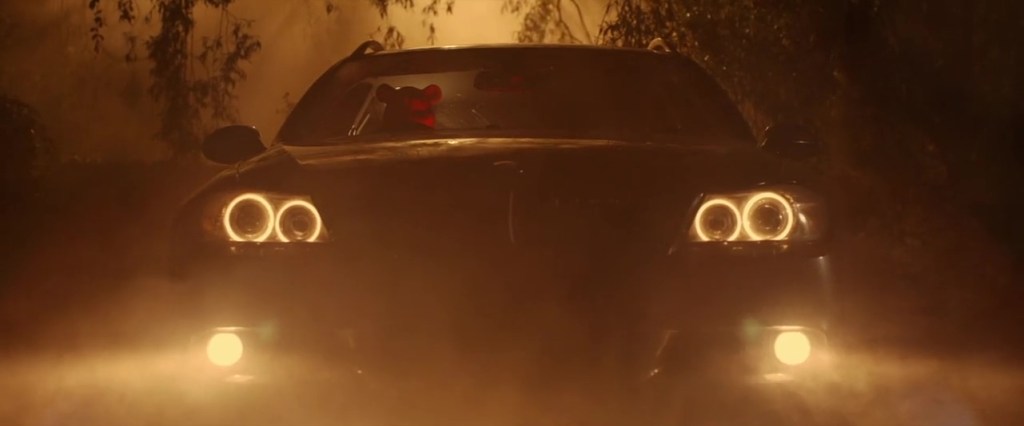
At this point, I need to come clean and admit that I am having trouble classifying this as a cannibal film. Lots of people get killed (it’s definitely a slasher), and toys eat another toy at the beginning, which is a sort of cannibalism (but only in the way that Woodstock from Peanuts is a cannibal for eating turkey on Thanksgiving). I don’t know that toys are a discrete “species”, but if not then even a real pig and bear eating a donkey is nowhere near cannibalism. But the introduction says they “renounced their humanity”, so I’m taking that as a licence to include this in a cannibalism blog; they were anthropomorphically human when they ate the human donkey, right? Hey, even Princess Fiona from Shrek wasn’t really human (she was a secret ogre) but we wrote up her exploits, eating brave knights who came to save her. So we have some fun ontological challenges like “what is cannibalism?” what is “eating?” and “what is human?” Apparently they believe that not talking is the way to renounce humanity, which both bolsters anthropocentric arguments about human superiority (we are often described as the only species with a language, to the annoyance of the whales), but also raises some interesting questions for the voiceless, or those who choose not to talk. Does a vow of silence mean a renunciation of humanity? A question for another time and, hopefully, a different blog.

But from a Cannibal Studies point of view, there are some other interesting ideas in the back-story. It starts with starvation cannibalism (if we allow that name) in that, like survivors of plane crashes, shipwrecks, or ill-considered trips across the Sierra Nevada, Pooh and Piglet are driven to eat their friend Eeyore through extreme deprivation. But then we move to a new motivation – social degeneration, where the formerly very civilised, polite toys become psychotic murderers, much like the feral humans in Texas Chain Saw Massacre, The Hills Have Eyes or Death Line. Look, we don’t really see them eat humans, although we see a skull and jars of blood, and hear reports of mutilated bodies being found in the woods, so there is a certain implication. But they are not human, so that’s OK. They’re not even officially animate, although you wouldn’t say that if they were swinging a sledge-hammer toward your head. And just when did they learn to drive cars?

The film has had almost universally awful reviews, collecting a woeful 4% “fresh” on Rotten Tomatoes, with The Times critic saying:

“Rhys Frake-Waterfield cloddishly desecrates your childhood, and AA Milne’s beloved classic, with a dimly written, shoddily realised, sub-standard slasher whose artistic aspirations never reach beyond making a fast buck.”

The Guardian was even less impressed, describing the film as:

“…a terrifying combination of not-scary and not-funny, and a cast of Love Island types on Xanax apparently reading the dialogue off an optician’s chart held up behind the camera.”

Look, it’s not that bad – the woods look nice but also somewhat ominous, and while some of the acting is wooden, they all have great death scenes, and the violence is enough to attract any gorehound. Anyway, the film was a big success on its release in January (in Mexico) and February (US, UK). As of 23 February 2023, Winnie-The-Pooh: Blood and Honey had grossed $1.8 million in the United States and Canada, and $2.4 million in other territories, including over $1 million in Mexico, for a worldwide total of $4.2 million. The budget was apparently less than $100,000, making it proportionally one of the most profitable films ever made, surprising even the film-maker.

Is it surprising though? Fan fiction has been rewriting classic stories for a while now (have you seen what sexual gymnastics some Fannibals have created for Hannibal and Will?), while stories of the perils of civilisation being brought down by thoughtless dedication to progress and neo-liberalism are the zeitgeist. Winnie-The-Pooh is our abandoned childhood, coming back to haunt us.