There are tendencies, dispositions, that characterise each era, each year, sometimes each day. Call them spiritus mundi or the zeitgeist, they appear to us in the media of the time – never more so than now, when we can express instant expression and instant outrage on social media. The current trend seems to be about oppressive elites who are manipulating, enslaving, sometimes consuming us. On the ‘right’ this is sometimes expressed as “the Deep State”, on the ‘left’ it is variously called capitalist exploitation or racist colonialism.
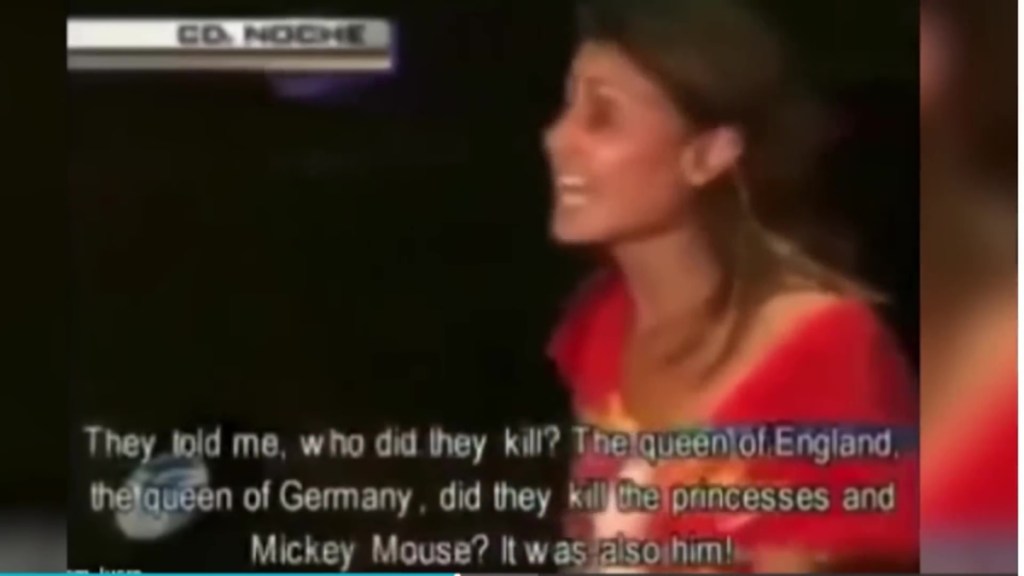
A story that has been doing the rounds for a decade has recently gone (a bit) viral again this month after a podcast called Mexico Unexplained revisited the story of Gabriela Rico Jiménez, a 21-year-old model from Mexico who disappeared some 15 years ago after raging against the machine outside a fancy hotel in Monterrey Nuevo Leon. Jiménez is usually described as a “supermodel” although there is little evidence of that in Google searches. But then again, if she has been “disappeared” by the elites against whom she railed, then they would have made sure to delete her history as well, n’est pas? The Daily Mail rediscovered the story on June 1 2024 and brought it back to life:
Anyhow, she made some interesting if somewhat mystifying accusations:
“I wanted my freedom. Monterrey freed me but it cost me a lot of work. I was in Mexico City for a year and four months. All this began in mid-2001. I barely remember. They were young and powerful, and they killed them. I’ve been knocking on doors. What I wanted was my freedom. I want my freedom. Carlos Slim knew about this. I want my freedom. It hurts my soul that they took him away.”
Carlos Slim at that time was apparently the richest man in Mexico or maybe the world, controlling América Móvil, Latin America’s biggest mobile telecom firm, so it’s not too surprising that her rant was shut down pretty quick, and she was carted off, presumably to a mental asylum, wherein she perhaps still rots, unless she has been cured, killed, or eaten.
As the police (or stooges of the elites if you prefer) began to move in, she screamed,
“You! You were there! … You killed Mouriño! They told me who did they kill? The Queen of England? The Queen of Germany? Did they kill the princesses and Mickey Mouse? It was also him! What? Nothing is going to come here. The people where you come from are crazy! They killed a lot of people. Death to that kind of human! Go away! They ate humans! Disgusting! They ate humans! I wasn’t aware of anything. Of the murders, yes, but they ate humans! Humans! They smell like human flesh!”
Now, Germany does not have a Queen, nor is Mickey Mouse a real live mortal being (sorry for the spoiler, kids). Were other royals and plutocrats engaged in cannibalism? Unfortunately, the sudden disappearance of Ms Jiménez makes it difficult to work out what she was alleging, let alone the truth of such claims. But conspiracy theories love angry rants and disappearing complainants, and so a (smallish) cult has followed Jiménez, particularly after an anonymous person on a blog called “The Black Manik” claimed to have spoken to Jimenez and witnessed the incident, until he was pulled away by “some tall, well-dressed people”. Accusations fly thick and fast about elites and their alleged members, some of whom are occasionally accused of being rich cannibals.
Despite the best efforts of the Daily Mail, no further sightings of Gabriela Rico Jiménez have been reported.
The narrative of cannibalism to describe class warfare is nothing new – in 1789, the sans-culottes felt that French aristocrats were (perhaps metaphorically) eating their flesh, and in turn, the poor eating the aristocrats (more literally) became popular after the Revolution. In films, there are a lot of phantasies about the poor eating the rich, such as the silly English movie Eat the Rich. Indigenous people were routinely accused of eating their European invaders, often as a pretext for enslavement and extermination, but sometimes the eating of the foreigner was presented as a form of liberation. Sawney Bean and his incestuous clan were supposedly preying on rich travellers in the fifteenth century, and have been revived for horror stories ever since. We see cannibalism as a form of revenge on rich exploiters in the classic Suddenly Last Summer, in which the rich, white, effete Sebastian is eaten by the impoverished boys he has been sexually abusing.
But the more realistic horror movies usually show those with money, influence and power eating the poor. Jack the Ripper was never conclusively identified, but seems to have been someone rich and powerful, who got his kicks in 1888 from killing sex workers and, in one case at least, eating parts of them. The film Never Let Me Go showed a future (or alternate present) in which the protagonists were bred as clones, not to be eaten exactly, but to be cut up for organ transplants. More recently, films have speculated on the rich forming clubs to eat the poor, or paying entrepreneurs to kidnap and sell parts of young women to satiate their jaded appetites. In the wonderful Welsh film The Feast, the rich are over-consumers of the environment, and their punishment is to eat each other. And let’s not forget the extraordinary accusations made against actor Armie Hammer, who declared to a girlfriend on social media “I am 100% a cannibal. I want to eat you.”
So it’s not clear who is eating whom – the rich or the poor, or perhaps there is some sort of cultural pendulum. But leaving aside the actual flesh, we are all involved in consumption of the other in some form. Philosophers from Voltaire to Derrida have declared “we are all cannibals”.
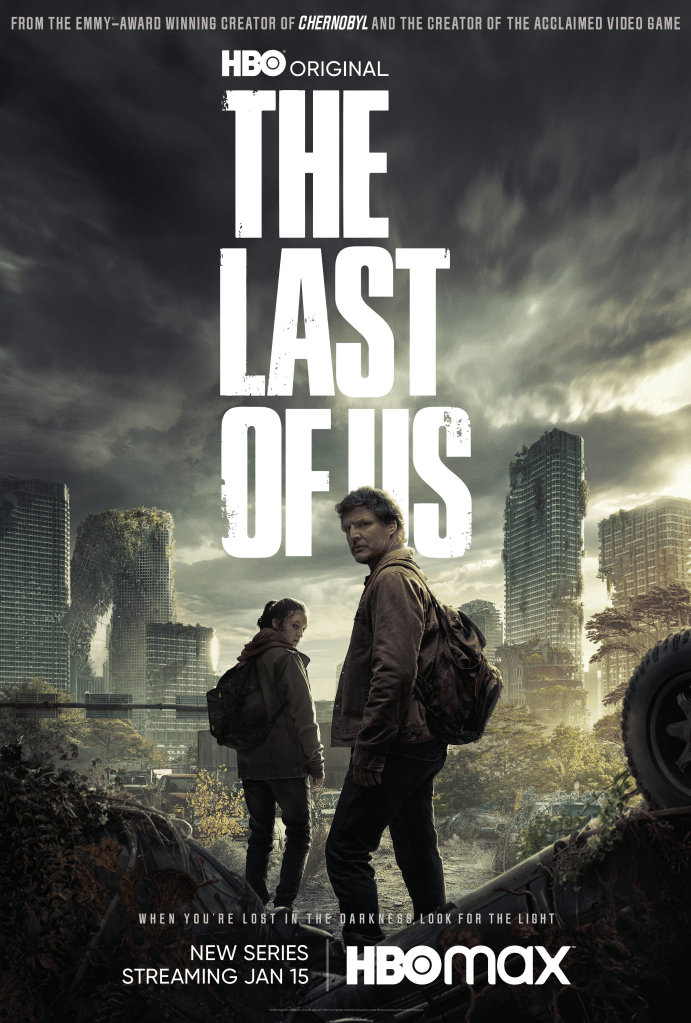
The Last of Us is an HBO original TV series which was released to streaming on January 15, 2023. It was adapted by Neil Druckmann, the writer and creative director of the video game of the same name, and Craig Mazin, the showrunner of the highly acclaimed miniseries Chernobyl.
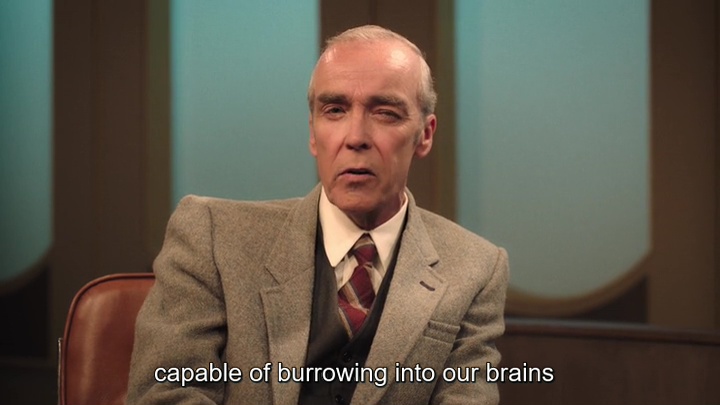
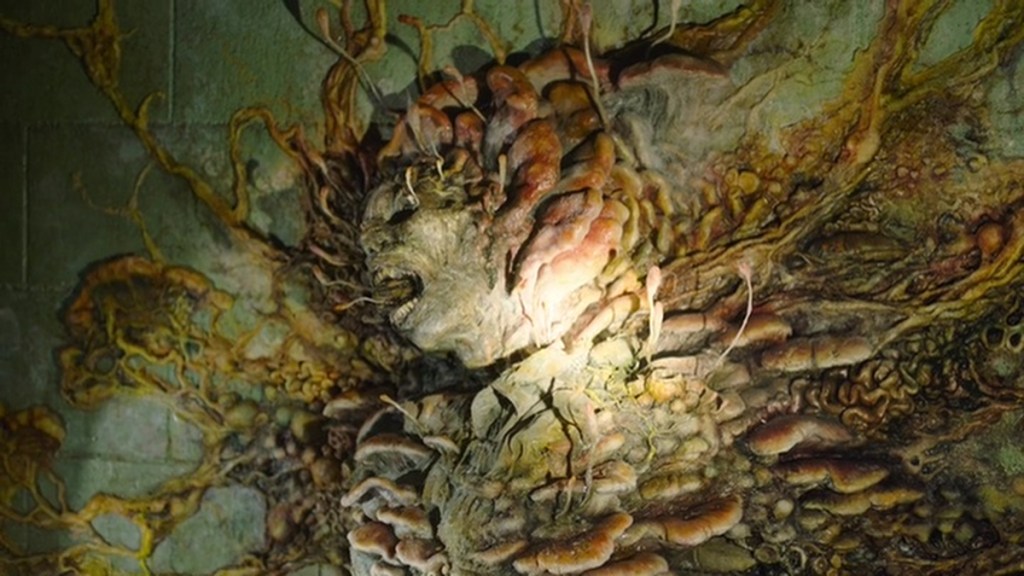
The show opens with a panel discussion; a couple of epidemiologists arguing about what sort of organism will wipe out humanity. Turns out bacteria and viruses can be terrible, but we always beat them. But fungi – one of them, cordyceps, can take over the brain, make you a slave, dedicated to one thing – spreading its spores to everyone else. Apparently, part of this fungal strategy is to kill other people and eat bits of their bodies, a lot like, y’know, zombies!
Some of this is factual – the fungus quoted, Ophiocordyceps unilateralis, is sometimes called the “zombie ant fungus” because it takes over the bodies of ants and forces them to climb to a high place and wait for spores to sprout from their heads, to be spread by the wind.
That’s one smart fungus but, as the epidemiologist says, fungus cannot live at human body temperature. Unless of course they are forced to evolve heat-tolerant forms – if, for example, hypothetically, the planet started warming. Yes, we’re talking yet another side-effect of the global warming caused by our voracious consumption of the resources of the planet. Human cannibalism of Mother Earth.
The good news is that Scientific American says there is zero chance of Ophiocordyceps surviving in our warm bodies and taking over our brains. The bad news is that there are plenty of other new strains developing, including Candida auris, which has spread to fifty countries so far and there are no drugs that treat it effectively. It won’t turn us into flesh-eating zombies, but it can do lots of other bad stuff.
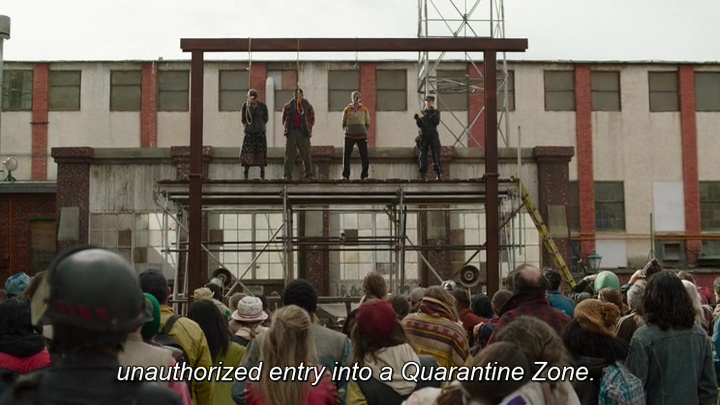
From the cranky 1960s epidemiologists we jump forward to 2003, when the fungus suddenly takes hold. The nice, senile old lady next door starts eating her family, and our protagonist, Joel (Pedro Pascal from Game of Thrones and Mandalorian) tries to escape the city with his brother and daughter, as civilisation collapses around their ears. I won’t tell you how that turns out, in case you are planning to watch it (or play the game), but the plot then jumps twenty years to 2023, a terrible year, in which people live in quarantine zones under martial law, which provides the gallows for anyone who tries to escape, or to break in.
The authoritarian government is at war with the infected, but also with a rebel group called Fireflies. The gallows, the walls, the restrictions seem perhaps a comment on the COVID lockdowns that took place only a little before this series was made, but whether in favour or against is not clear. In a pandemic, no one knows what to do, but everyone has an opinion, and whatever course is chosen will likely be seen as either ineptitude or oppression. The fungus is not COVID, which is a virus but, like COVID and other pandemics, it has the effect of causing everyone to be at the throats of everyone else. In this case, literally.
So in 2023, Joel, has a nice steady job (gig economy, but still earning a bit, and trading drugs as a side-hustle), burning corpses and cleaning sewers, neither of which tasks seem likely to become obsolete any time soon. But he’s a professional smuggler, and finds himself transporting a young girl, Ellie (Bella Ramsey, also from Game of Thrones) across the country. Ellie is valuable cargo – she is apparently immune from the fungus, and lots of people would love to cut her up and find out why and how. Heading cross-country does not (just) mean finding affordable gas (or solar chargers?), food and weapons (the basis for most games), but also has problems since the areas outside the quarantine zones are full of “the infected” (what the show calls the zombies) as well as raiders and slavers. Well, it’s based on a computer game, so there are sure to be obstacles.
The question of nomenclature keeps coming up in reviews. Assuming “zombie” can be defined clearly, many reviews argue that these dudes are not zombies because they are not ‘undead’, which seems to be a prerequisite for graduating to zombiehood. In fact, Eben Bolter, the cinematographer who shot four episodes of the first season, said that the term “zombie” (AKA the “Z-word”) was strictly forbidden on set. To me, it seems to be splitting hairs – the “infected” twitch like zombies, kill like zombies, eat (other people) like zombies. If it walks like a zombie, attacks like a zombie, and eats like a zombie, to me it’s a zombie, even if it doesn’t smell like one. What never became clear to me was why these particular zombies, their minds controlled by the fungus, insisted on killing and eating people (there is a good discussion of this on Reddit). Most parasitic organisms keep their hosts alive, because when the body dies, so do they. But I guess with billions of people alive (or not undead) in the twenty years of the fungus, eating a few can be understood. Even a zombie (infected) has to eat.
There are plenty of films and TV shows about people turning into cannibal zombies through some external threat. 28 Days Later showed a virus that was developed in a laboratory (London, not Wuhan) that turned people into rage-filled consumers. Doghouse showed all the women of a small English village turning into mindless zombies through a virus that was being tested by the military for germ warfare. Drive In from American Horror Stories suggested that just seeing a movie with the right subliminal suggestions could do it.
Then there’s The Girl with All the Gifts, in which a fungus (cordyceps, the same one as Last of Us) takes over infected humans, turns them into mindless zombies called “hungries”, and makes their bodies feeding stations for its spores. And yes, there is a young girl who is the main character, who ends up having to face off with the bad guy. Well worth watching if you get a chance. There has been some reasonably polite (for the Internet) debate over which came first, and if either stole the idea from the other. The Girl with All the Gifts was released in 2016, obviously well before the TV series of TLOA. But the game came out in 2013. But the book TGWATG was based on a short story by M.R.Carey called Iphigenia in Aulis, which was published in 2012 as part of a short-story collection called An Apple for the Creature.
Maybe it was just coincidence – the zeitgeist of the time. Innovations like 3D printing of body parts and cloning of stem cells were shaking faith in the anthropocentric division of the world into nature/culture and animal/human. Out of this fog of indistinction came two stories of cultural collapse and redemption through nature, their central characters young girls (Ellie and Melanie) who were both vulnerable but strong, warriors, hunters and protectors like Artemis, the Greek goddess at the centre of the myth of Iphigenia in Aulis. With nature fighting back in the form of climate change, perhaps our cultural consciousness recalled Artemis to lead us out of the mess. In the shape of Ellie and Melanie.
The word “zombie”, like the word “cannibal”, comes from the invasion, genocide and cultural obliteration of the nations colonised by the Europeans. Roger Luckhurst’s excellent review of the zombie trope points out that the slave labourers in the cane fields of Haiti were called zombies, but were definitely living humans who were certainly not undead but rather exhausted by endless toil, and perhaps shackled so they walked in a shuffling pace. They, like the “infected” of Last of Us, were slaves of an alien master.
Look, the show’s well made, and the reviews keep emphasising that it’s the best adaptation ever made of a computer game, which I think may be damning it with faint praise. The acting is very good, the photography superb and the graphics are terrific, as you would expect in a big-budget show. It is currently scoring 96% fresh on Rotten Tomatoes, with most critics praising the suspense, the narrative and the relationships of the main characters, Joel and Ellie. Rebecca Nicholson, the critic from The Guardian, called it
“…one of the finest TV shows you will see this year”
Of course, it is being watched by many gamers who are dedicated to Joel’s story, having lived and died with, or as him, in their hours spent playing the game. They may not be aware of the many, many zombie apocalypse movies and shows that have graced the screen since George Romero introduced us to characters lurching around the graveyard and smashing open windows hoping to find fresh brains in Night of the Living Dead in 1968 (he called them “ghouls” rather than zombies, but that never caught on). The zombie film goes back even further, to The White Zombie (1932), in which Bela Lugosi turned Madge Bellamy into a mindless love object – returned to life, but as a slave with no will of her own, precisely what Jeffrey Dahmer was hoping to achieve by pouring muriatic acid into the brains of his hoped-for sex slaves.
Storytelling in games is a very different beast to a film or TV show. In games, we have a goal and many obstacles to overcome, crash through or kill. On screen, we have (hopefully) realistic, sympathetic characters who interact, clash, and begin to love. The premise of a game is action, of a film or show, interaction. For a good summary of all the things a gamer might hate about the adaptation to screen, check out Ian Bogost’s review in The Atlantic. He sums up,
“It’s just not interesting to watch an angry man escort an irritable girl across the country amid a cartoonish zombie apocalypse cosplaying a credible global pandemic.”
But most critics felt that the writers had overcome this minefield and turned the characters, particularly Joel and Ellie, into real, sympathetic people.
Like games, a series of discrete episodes, some barely involving Joel and Ellie, take place during their journey across a devastated America. This is how games and TV shows have to be – gamers and bingers have to stop and sleep sometimes (well, maybe not gamers).
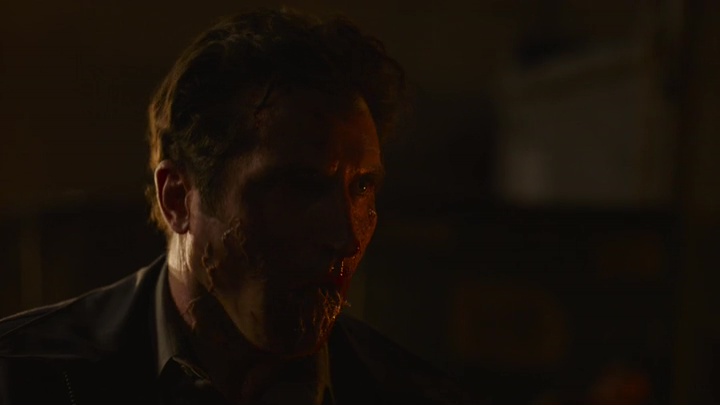
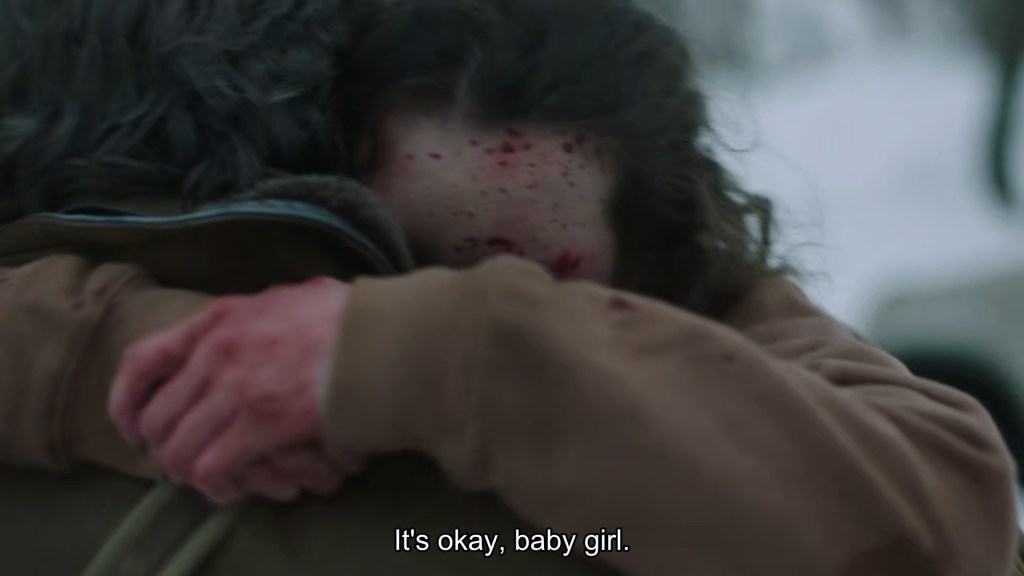
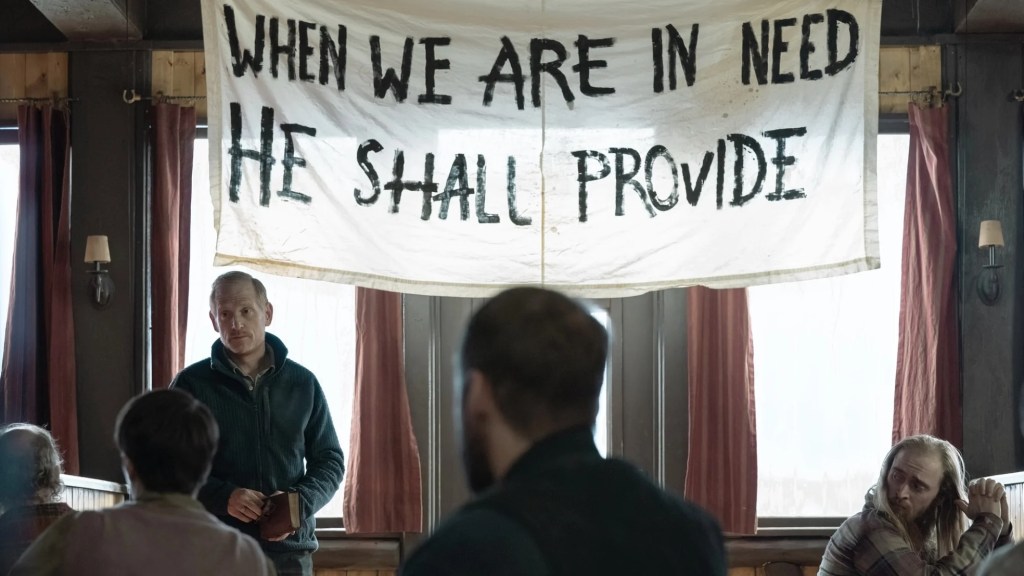
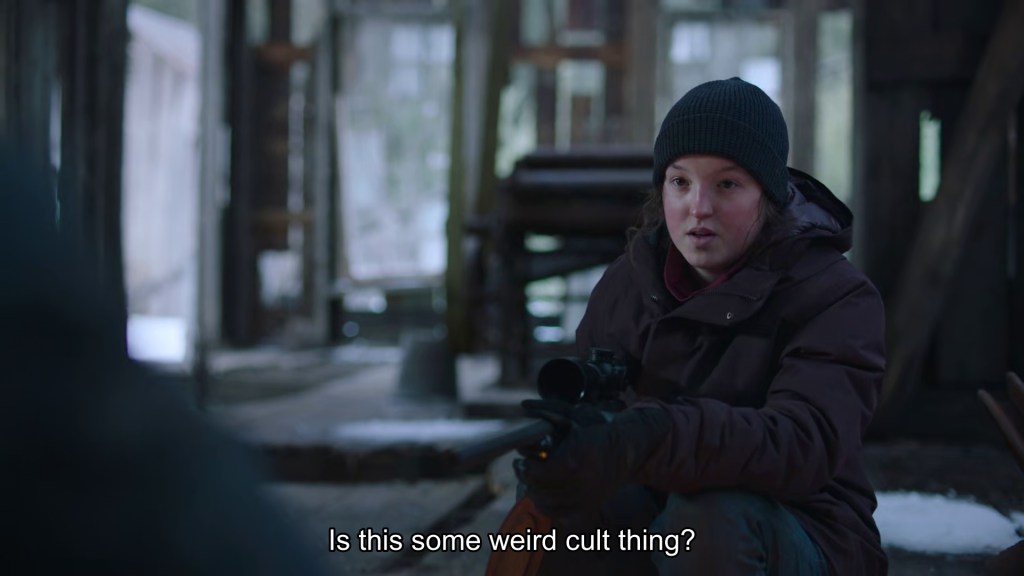
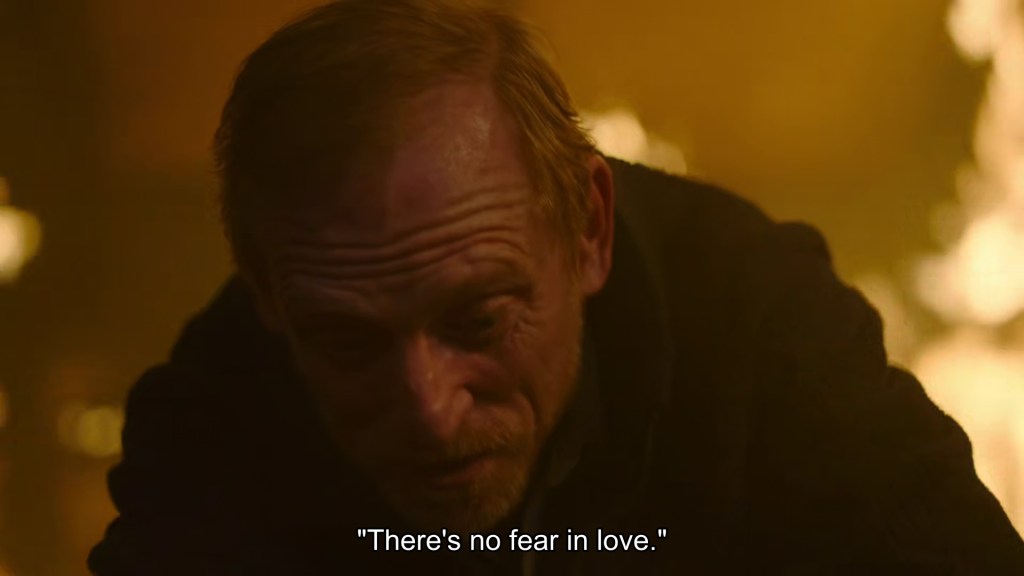
Then we get to episode eight, titled “When We Are in Need”, which Belen Edwards of Mashable predicted would “mess you up”. Joel and Ellie meet a cannibal (yes, you are on the right blog, sorry it took us a while to get here). Ellie is seeking penicillin for a wounded Joel, and finds it through a preacher named David (Scott Shepherd) and his off-sider James (Troy Baker, who played Joel in the video game!) who are trying to carry off the carcass of a deer that Ellie wounded. David the cannibal is a preacher; these cannibals are Christian devotees. In the game, they were ‘just’ psychopaths, but the show has added some backstory.
The episode starts with David reading from Revelation 21:1-4, which talks about “a new heaven and a new earth”, in which there will be no more death, mourning, crying or pain. Quite a promise for an apocalyptic series. Ellie is not impressed.
The advantage of being religious is that almost anything can be justified with a quote, out of context, from the holy books. David rationalises his attempted rape of Ellie with John 4:18 – “There is no fear in love”. Nice try. The context, trying to rape a young girl in a burning building, is definitely Satanic imagery. David is presented as the devil, because he feeds his flock the only meat available to him. Also because he is a murderer and a rapist, but that doesn’t seem so unusual in post-fungus world.
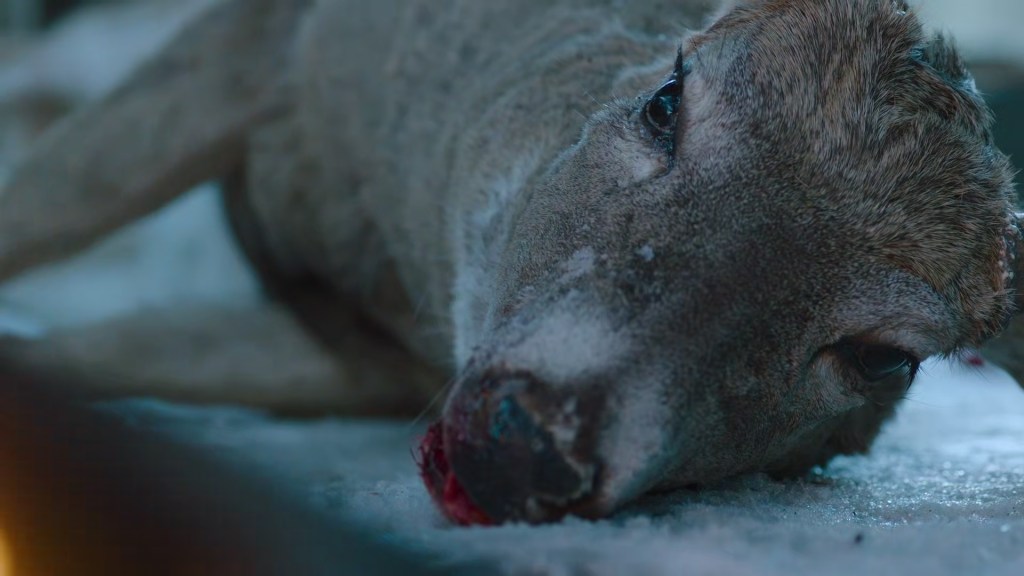
There’s a lot written about the moral twists and turns in this episode, mostly people being horrified by the cannibalism (although it is the standard operating procedure of the “infected”), and pointing out that only a preacher adept at using (twisting?) the teachings of the Bible could justify the eating of human flesh by his flock. But let’s not forget that Catholic Communion insists that it involves eating the actual body and drinking the actual blood of Christ. The Old Testament also has incidents of cannibalism during the siege of Jerusalem. Yet there is a strange consensus that shooting a living deer, wounding him so he dies later in agony, then eating him, is perfectly acceptable, while eating dead humans, who have probably died from lack of food, is somehow the work of the devil. One website says:
“David and the others are engaging in an unspeakably disgusting practice, and the fact that he’s okay with it demonstrates his moral rot.”
David tells Ellie he does not hate the fungus cordyceps, because it fights and kills for its own preservation. He feels he must do the same, be a strong, even violent leader, to protect his “flock”.
“What does cordyceps do? Is it evil? No. It’s fruitful, it multiplies. It feeds and protects its children, and it secures its future with violence if it must. It loves.”
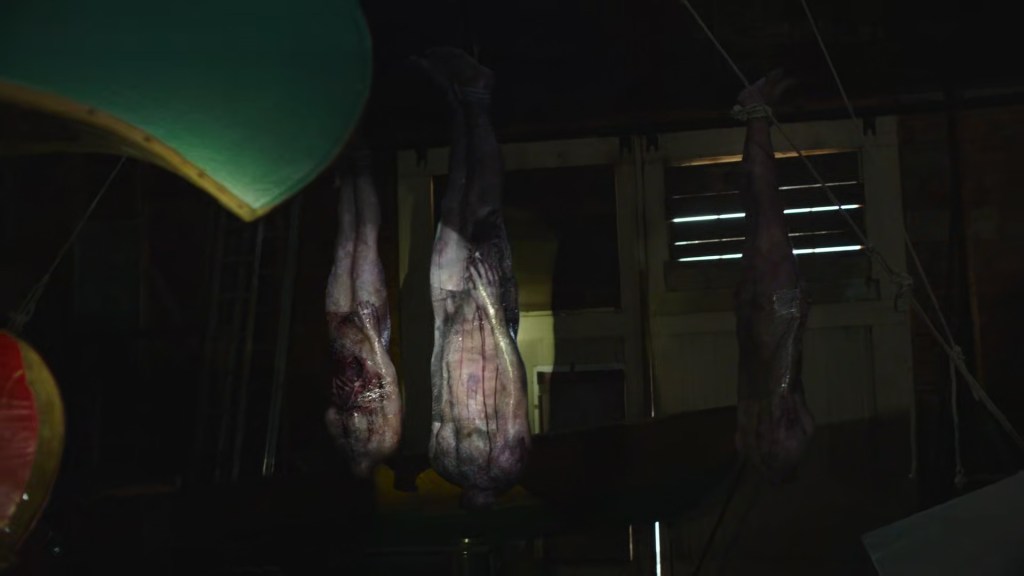
Do David’s followers know they are eating people? The cold room is full of corpses hung and ready, as Joel discovers when he stumbles in hoping to save Ellie, so it seems probable.
David tells Ellie that he keeps the cannibalism secret, because the followers (or “sheep” as he calls them) are too weak to accept what is necessary. Or perhaps David’s followers didn’t a) know or b) care that the flesh they are eating is from one mammal rather than another. There’s a scene where they all solemnly chow down on plates of what seems obviously to be the meat of the guy Joel killed last episode. Here’s a summary from the Digital Mafia website, which believes that they knew but pretended not to:
“People had turned into animals, but they still wanted to reassure themselves that they had strict regard for what was morally right.”
Killing of deer or rabbits is presented as totally uncontroversial in the show. Yet Ellie shouts at David:
“You’re an animal!”
He replies:
“Well yes, we all are. That’s sorta the point. But what was I supposed to do? Let them starve? These people who put their lives in my hands. Who expect me to keep them safe. Who love me!”
I found the killing of the stag, which I hope was sophisticated computer graphics, far more shocking than the images of hungry people eating a human corpse, which after all is a dead animal who can no longer feel any harm.
Joel and Ellie also kill to survive. Joel killed a member of David’s community in the previous episode, the one who was that night’s main course at David’s diner, and he gratuitously kills two of David’s men after he has tortured them to find out where Ellie had been taken, beats them to death as they beg for their lives. But Joel doesn’t eat the resultant corpses; human life is not sacred in this ruined earth, nor was it ever, only human flesh is sacrosanct. David sees that we are animals, “That’s sorta the point”, and so would consider Joel’s casual disposal of the corpses a shocking waste of good food. If we are happy to eat animals, and humans are animals, I guess he has a point.
The “infected” lost their humanity when they were taken over by the fungus. Joel maintains a thin red line between killing people and eating them. David’s followers have tried to retain their obsolete humanism even though threatened with starvation. David, the teacher turned preacher, sees the hypocrisy of such arbitrary distinctions. When civilisation goes up in smoke, so does its normative ethics. And when you’re in the middle of a zombie apocalypse and hungry, maybe caring is an anthropocentric luxury that most people cannot afford?













 The Cannibal Guy