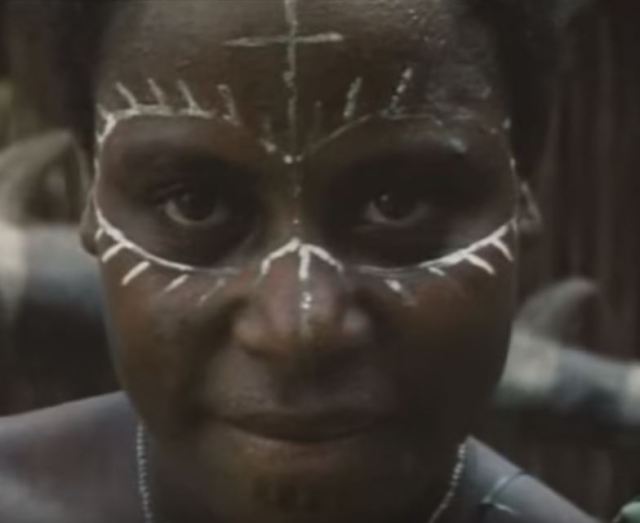
Cannibal Tours is a documentary by Australian director and cinematographer Dennis O’Rourke. The scenes in it are presented without comment, but its irony and disquiet at the nature of ‘cannibal tourism’ is blindingly obvious.
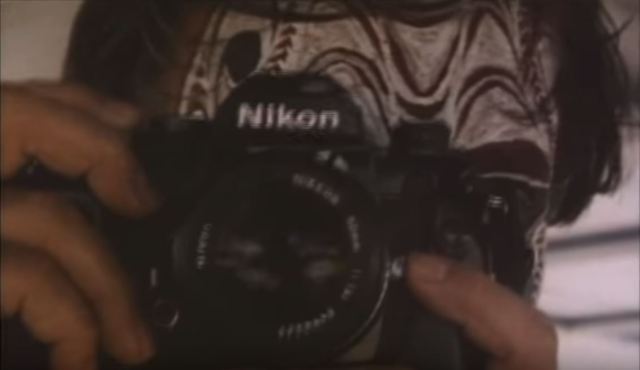
The soundtrack of the film is a mixture of music, sounds of nature, and a symphony of camera shutters.
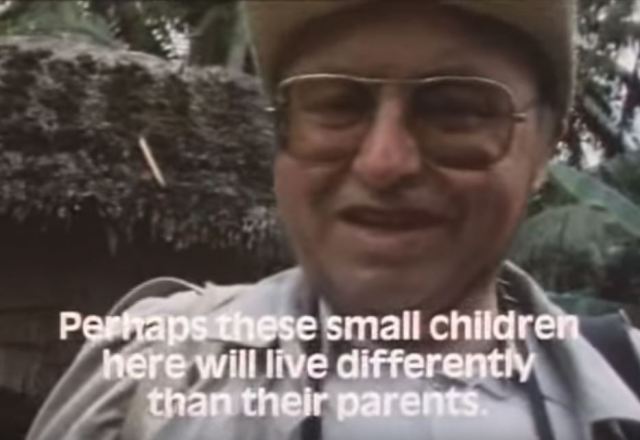
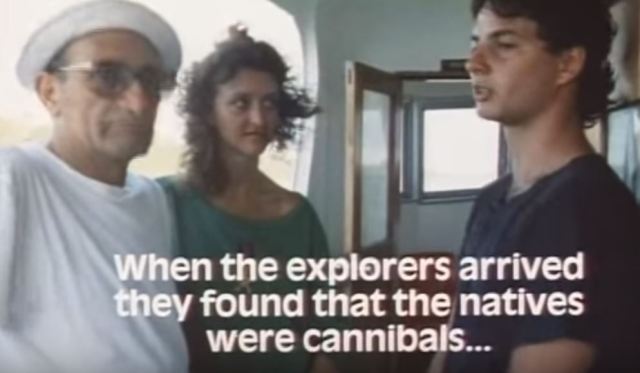
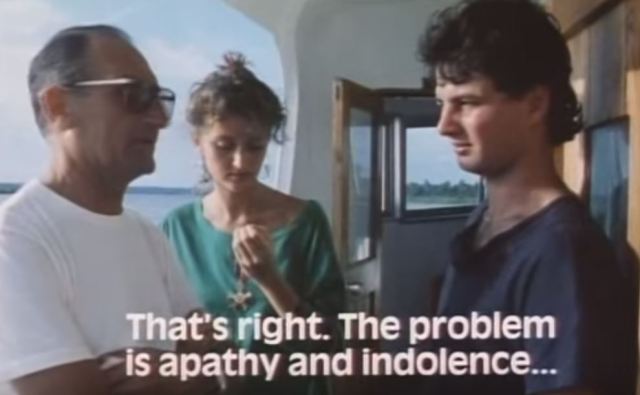
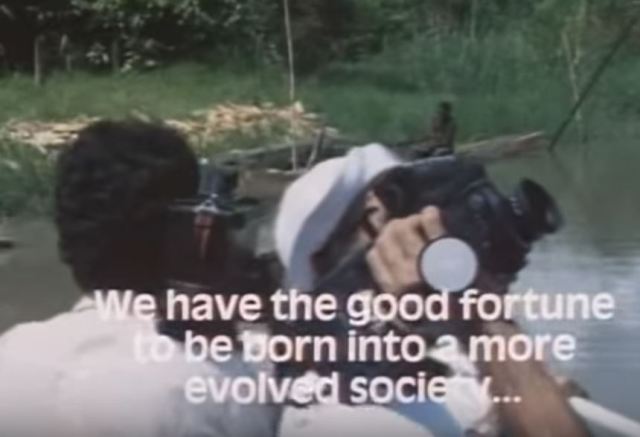
The film follows European and American tourists as they travel the middle Sepik River in Papua New Guinea. Most of the villages in the film are inhabited by the Iatmul people. The tourists enjoy bargaining for local handcrafts such as woodcarvings and baskets, snap endless photos of the colourful savages, hand out cigarettes, watch dance performances, and offer naive comments about native people and how they live in harmony with nature.
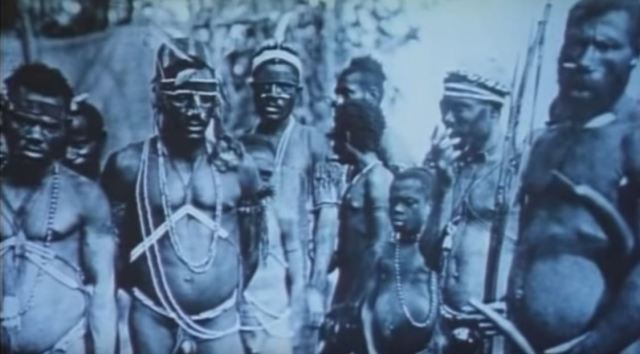
It intersperses the scenes of the tourists with black-and-white photographs from the era of German colonialism of New Guinea.
The pervasive ethnocentrism of the tourists casts them as the savages, as they dehumanise and exoticise Sepik River life.
Some of the tourists’ observations are reproduced below without comment, just as O’Rourke does on camera.
German tourist: I heard that German colonists were very popular!
Where have they killed the people? Here? Local: At those stones we would dance and cut off heads. German tourist: Now I need a photograph!
An Italian tourist observes:
They are truly primitive. I wonder though if their way of life is better than ours. Truly living with nature. Not really living, more like vegetating. The experts assure us they are satisfied. Happy and well fed. Nature provides them with the necessities of life. And they don’t have to worry about thinking of tomorrow.
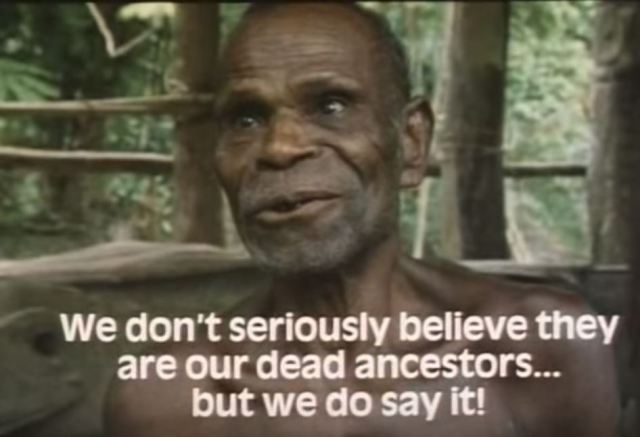
Local: The previous generation saw the Germans arrive by boat and thought their dead ancestors had returned. Now, when we see tourists, we say about them ‘the dead have returned!’
There are lengthy scenes of tourists bargaining for carvings and masks.
Native woman – tourists come and look but never buy. You white men have all the money! We village people have no money!
Talking about the Spirit House, one local person recalls:
The Germans, the English and Australians took all the sacred objects. The missionaries destroyed all the most powerful symbols kept in the spirit house. The missionaries threw them out saying “It’s the devil! Get rid of it!”
German tourist [into his tape recorder]: Now we see the remains of a house where, in the past, cannibalism was practised.
…for reasons of survival. And custom too, I think. It was symbolic. I think cannibalism was a cultural practice, not a necessity. Because wildlife must have been plentiful.
Local: We sit here confused while they take pictures of everything. We don’t understand why these foreigners take photographs.
Italian: we must try to help them advance in the world, bringing to them some values and convictions. Naturally, this will involve going into their villages as the missionaries do to teach them. To educate and stimulate them to behave differently.
… living in a world completely overwhelmed by nature. They are also human.
even though our evolution could still be disputed by some.
There is much hilarity when the tourists find a phallus for sale.
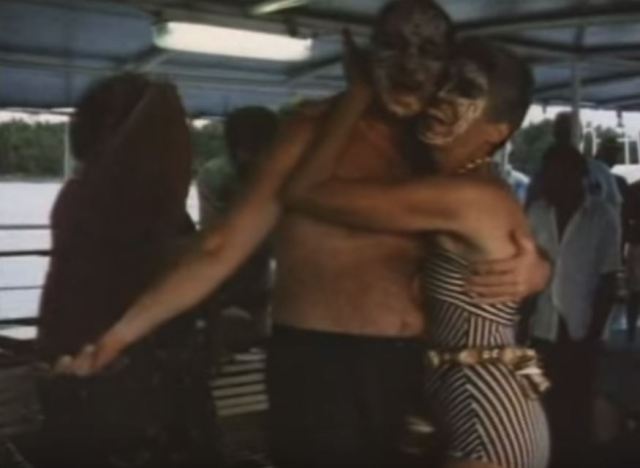
Back on their boat, the tourists wear native warpaint and play at being savages.
Maggie Kilgour wrote that
“the figure of the cannibal was created to support the cultural cannibalism of colonialism, through the projection of western imperialist appetites onto the cultures they then subsumed “.
The imperialists now have cameras rather than guns. The film really asks – who are the cannibals?
The film is available (at time of writing) on YouTube:
IF YOU LIKE MY BLOG, PLEASE FEEL FREE TO RECOMMEND IT (WITH DISCRETION) TO FRIENDS ON SOCIAL MEDIA.
IF YOU HAVE ANY QUESTIONS OR COMMENTS, YOU CAN USE THE TAG, OR EMAIL ME ON CANNIBALSTUDIES@GMAIL.COM.
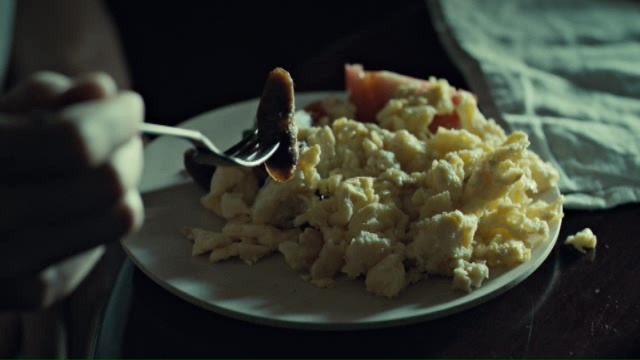
At its core, cannibalism is about food, eating, the joy of taste. This episode therefore commences with a comparison of the meals of Hannibal, free, prosperous, creative
and Will, confined, subject to whatever gruel is dished up in the asylum.
As Hannibal tells Jack:
Hannibal eats food, not friends. He is cooking for Jack, again, making Jack perhaps the pre-eminent innocent cannibal of the series, since he dines there so often. But this time, he is pre-occupied, upset that his wife tried to kill herself, grateful that Hannibal stopped her. Hannibal discusses his own dilemma: as a doctor, he had no choice, but
Hannibal is a good friend, says Jack. That, as we know, won’t last.
Beverly Katz has been neatly dissected and mounted into giant slides. As Will figures, she has been pulled apart layer by layer, as she would dissect a crime scene.
Will asks to see her, and is given the same treatment Hannibal received in the film of Silence of the Lambs: straight-jacket, hockey mask and transported on a furniture trolley.
He does his pendulum, re-enactment, this is my design, thing. He knows who killed Beverly, but cannot tell Jack, because Jack doesn’t want to believe it. Will does say that she will be missing organs:
She is indeed missing kidneys. And guess what Hannibal’s having for lunch?
Yep. Nice steak and kidney pie. Seems to be enjoying it too.
So, as Clarice once asked, why does Hannibal do what he does? Abel Gideon has his own theory, not so different to the way Madds said in an interview that he chose to play him:
He warns Will that he will never catch the Ripper – he will have to kill him. Another insight into where the series might be heading.
Hannibal now has a couple of people who suspect him: Will, of course, but also Abel Gideon, who Will brought to his house the night Gideon removed most of Chilton’s guts. He asks Chilton why, in those circumstances, he would bring Gideon back to “your hospital for the unworried unwell” [great Hannibal quip BTW]. Chilton claims it was not for “selfish reasons”. “Ah, selfishness” comments Hannibal
He goes to meet Gideon, who is still interested in his satanic analysis:
Outside the asylum, he is photographed by Freddie Lounds. You have to give her credit for bravery – Hannibal says something that would bring a chill to those who know him like we do, know his penchant for eating rude people:
She goes in to interview Will, and is given the same instructions Clarice received in Silence of the Lambs:
Will is using Freddie to contact his “admirer” – the one who killed the bailiff in his trial, hoping to get him exonerated. Turns out to be the nurse in the “hospital for the unworried unwell”. Why? Well, smaller birds will mob a hawk.
Yes, another elitist. Perhaps even a Nietzschean. He wants the hawks to work together. Happy to help Will any way he can. What favour can he do for Will? Will wants to make sure what happened to Beverly cannot happen again.
Will dreams he is becoming the beast – antlers growing from his back. Hannibal is doing laps of the pool, which explains why he is in great shape and able to kill people who often seem somehow younger and fitter. Also, cold water is great for shifting blood stains. The nurse is the only other swimmer (obviously a very exclusive pool) and shoots Hannibal with a tranquiliser dart. He sinks, but that’s not a suitable death, so next we see him teetering on a bucket, bleeding out, and in a semi-crucifixion position.
The nurse knows that Hannibal is the Ripper, and asks him
How many times have you watched someone cling on to a life that’s not really worth living? Eking out a few extra seconds. Wondering why they bother.
The nurse, like Hannibal, is into becoming.
Maybe your murders will become my murders. I’ll be the Chesapeake Ripper now!
Jack arrives in the nick of time. But Hannibal has faced death, and therefore has grown. Now it’s Will’s turn.
IF YOU LIKE MY BLOG, PLEASE FEEL FREE TO RECOMMEND IT (WITH DISCRETION) TO FRIENDS ON SOCIAL MEDIA.
IF YOU HAVE ANY QUESTIONS OR COMMENTS, YOU CAN USE THE TAG, OR EMAIL ME ON CANNIBALSTUDIES@GMAIL.COM.
Although film directors have revisited colonial era stories of cannibalism with gusto, they have generally done so with modern perspectives. Cannibals in most films, therefore, are not the inhuman savages of Daniel Defoe, Edgar Rice Burroughs or Edgar Wallace. The ‘savages’ in even the earliest films are often presented with humour, for example Lupino Lane’s Be my King (1928), Crosby and Hope in Road to Zanzibar (Schertzinger 1941) or The Wrong Box (Forbes 1966) in which amorous cousins Michael and Julia are reassured that she is not a blood relation: she was adopted after her missionary parents were “eaten by his bible class”. In more serious depictions, the ‘savage’ is either a noble one, or at least is offered some humanity, and often his characterisation (we rarely see female savages) is given an ironic edge to criticise modern, “civilised” society. However, a positive image can be as degrading as a negative one.
The example here of the cannibal as colonised savage is Luis Buñuel’s Robinson Crusoe (1954). Crusoe is, according to James Joyce “the true prototype of the British colonist… the manly independence, the unconscious cruelty, the persistence, the slow yet efficient intelligence, the sexual apathy, the calculating taciturnity”.
Buñuel opens his film of the eighteenth-century novel with a shot of Defoe’s book sitting on an ancient map, a nod to the importance to film makers of classic literature. Crusoe (Dan O’Herlihy, who was nominated for Best Actor at the 1955 Oscars) tells us he was on a voyage
when his father’s warnings of disaster came true; we next see him struggling ashore amid the debris of his lost ship. The island, or at least a severely constrained and isolated space, was considered a prerequisite for cannibalism in the eighteenth century. All his shipmates, or at least the human ones, have been consumed by the sea. Barefoot and hungry, he cracks an egg he finds in a nest, but his European sensibilities do not allow him to eat the baby bird inside.
Unlike the savages he is yet to meet, he has little hope of surviving in the wild, but is saved by finding and plundering the wreck of his ship, salvaging building supplies, guns and flint to make fire (more important, he realises, than the gold in the drawer below). His whole focus is to secure himself against the wild world: beasts and savages. Although this is a long way from his early surrealist movies, this is still classic Buñuel, particularly the fever dream, reminiscent of his later films The Discreet Charm of The Bourgeoisie and Belle De Jour in which his giggling father pours water on a pig, while the delirious Crusoe begs for a mouthful.
On the island, European civilised life is represented by Crusoe and his weaponry, and Rex, a dog who has also swum ashore. He finds in a ship’s chest a cure for
tobacco and the Bible.
Buñuel seems to have felt Crusoe’s pain – he had been exiled from his native Spain for 14 years when he made the film, and was living in Mexico, having lost his job in MOMA after being denounced as a Communist. His longing for home while surrounded by “the other” is obvious in his character’s affection for the dog, while he is quite prepared to shoot birds and stamp on rats and spiders. He domesticates native goats and parrots, but is devastated by the death of Rex, feeling “now truly alone”. Sinking into eccentricity, he talks to two insects, “my little friends” and feeds them an ant.
But his difficulties on deciding which species of insects are friends soon escalates as Crusoe has to decide which humans deserve to be saved, and which sacrificed. The difference is their status: as cannibals or victims. His reunification with humans after 18 years comes as we follow his footsteps along the beach, only to be confronted with another distinctly human footprint. His abjection is immediate.
“Men-eaters! From that very land I had once thought to sail to. Revolted, horrified, all that night I watched the cannibals at their ghastly entertainment”.
Their guilt is assumed, but only confirmed after they leave and he comes across their fire-pit which is surrounded by human heads and bones: Typically, cannibal literature paints a “primal scene”, the proof of cannibalism, which is usually not the act of eating human flesh, but the aftermath.
Crusoe plots a technology-based massacre, including another dream sequence, this time of planting a bomb under their fire-pit, but realises
“I had no heaven-sent right to be judge and executioner on these people, who had done me no injury. I would leave them to God’s justice”.
This resolve is short-lived; seeing Friday (Jaime Fernández, who won a Silver Ariel award – the Mexican equivalent of the Oscar) escape from the cannibals, he steps in to kill the pursuers and rescue the boy. Friday bows to him in a homo-erotic scene in which Crusoe puts his foot on the boy’s head.
He explains that the boy will be called Friday, while Crusoe’s name is “Master” and that they are “friends”. The boy spits out Crusoe’s carefully harvested and baked bread, indicating that he would rather dig up the pursuers whom they buried earlier.
Crusoe sits up all night in fear of this new “friend”: “if the cannibals fail to come at me before morning, he might”. He won’t let Friday handle weapons; he shoots birds out the sky to frighten him and puts a strong door on his cave so he can sleep securely. He is reassured to watch Friday eat the flesh of animals, “knowing that the only source of that other meat he so relished”
He comes to appreciate once more having a servant. The balance of alterities, man to animal, civilised man to cannibal, master to servant, has been restored, yet his fear of the primitive cannibal increases. When Friday sneaks into his room hoping to try his pipe, Crusoe decides to put leg-irons on him, remembering how he had intended those instruments to be used on the savages he planned to carry off to slavery. But Friday is misjudged: “Friday love Master always.” He seizes Crusoe’s gun, but it’s a suicide plan – “kill Friday – no send Friday away.”
In a moment that crystallises the dreams of empire, Friday has become the good savage, brought to civilisation by the white man, even feminised when he finds a dress in Crusoe’s chest. The primitive cannibal has submitted to our will, but lovingly, in gratitude rather than through force. In the next scene, Friday is armed and helping hunt wild pigs, with Crusoe’s admission that Friday was “as loyal a friend as any man could want.”
But if Friday is to take on Crusoe’s civilisation, he must also accept his morality. Friday finds Crusoe’s gold coins and thinks them a gift from God. “From the devil”, Crusoe mumbles, but Friday goes off to make a necklace with these baubles, which in this closed circle are of value only to the savage. While they shave each other and share a pipe, Crusoe tries to explain the devil and his works – he also has evolved, or converted, from conquistador to missionary. Yet he is baffled by Friday’s broken epistemic posing of the problem of evil – why doesn’t God just kill the devil? Why is God mad when we sin, if he lets the devil tempt us? Friday, the innocent, the savage, baffles Crusoe, the colonialist, expressing Buñuel’s overt anticlericalism.
They are set upon by the cannibals and Crusoe is saved by Friday’s gun, just as Crusoe’s gun saved Friday years before. The civilised savage fights the cannibal savages for the life of the Englishman. His gunpowder exhausted, Friday kills the third cannibal in hand-to-hand combat, but the beach is swarming with others. Their preparations for a last stand are interrupted by gunfire; to their amazement the beach is now full of white men who are slaughtering the fleeing cannibals. Like Friday’s foes, these white men have prisoners tied up – their ship’s captain and bosun, against whom they have mutinied.
Friday and Crusoe free the prisoners, who agree to take Crusoe and “my man” to England if he helps them recover the ship, which of course they do in due course, tempting the ‘civilised’ mutineers, like the devil, with Friday’s gold necklace.
Dressed like an Englishman again, Crusoe makes a melancholy farewell to his kingdom. He has defeated the evil of the savages and the mutineers, whom he leaves to rule his kingdom.
Friday has witnessed the violence and oppression of the “civilised” white men, but avers that he is not afraid to go back to civilisation “if master is not”. He is already dressed as a servant. The cannibal can become tame, can learn to eat what he is told, but clearly he can never become “your own kind.”
IF YOU LIKE MY BLOG, PLEASE FEEL FREE TO RECOMMEND IT (WITH DISCRETION) TO FRIENDS ON SOCIAL MEDIA.
IF YOU HAVE ANY QUESTIONS OR COMMENTS, YOU CAN USE THE TAG, OR EMAIL ME ON CANNIBALSTUDIES@GMAIL.COM.
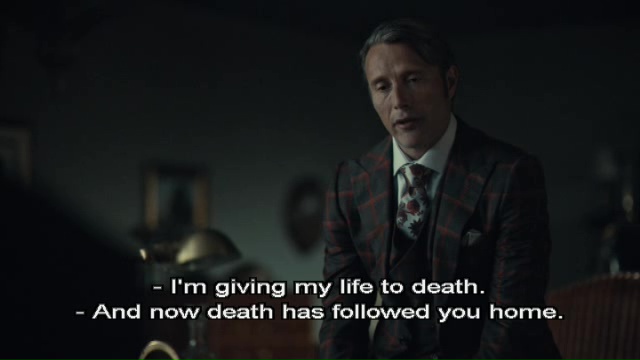
Previously on Hannibal, Will Graham was arrested for Hannibal’s murders, and chose to plead not guilty; but if the verdict goes against him, the penalty will be death. However, he now has a short reprieve thanks to a secret admirer, who generously killed the judge in his case. We, the audience, have a chance to “draw a breath”, which is also the term for being alive. And this episode is all about life and death, and choosing between them, for ourselves, for those we love, and for our victims. It is summed up in the “previously on Hannibal” reprise, where Jack and Hannibal discuss death. Jack has spent his life chasing serial killers:
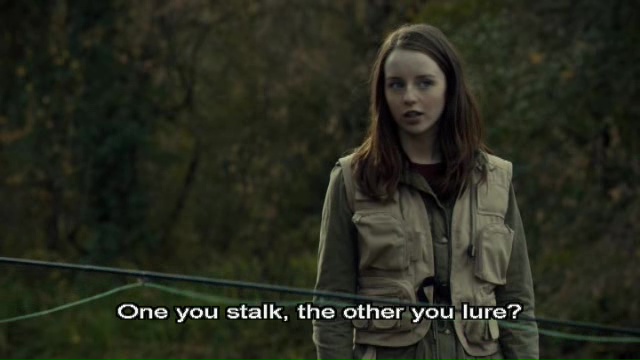
Will mentally escapes his prison purgatory by remembering good times – fishing. He finds this, as many people describe, relaxing and even meditative. In this memory, he visualises teaching Abigail to fish, the same Abigail who everyone believes is dead and at least partly inside Will’s digestive tract (in that he vomited up one of her ears). Abigail sees no real difference between hunting with her father, who killed and ate girls who looked like her, and trapping and killing fish. She has a point.
Beverley, the super smart FBI investigator, wants to believe Will is not guilty, but cannot buy his accusations against Hannibal. She seeks Will’s assistance to understand who killed the dude who made mosaics out of corpses, and gets mad at him when he accuses, who else, Hannibal. Why, she asks, would he do it?
He tells her: “There will be a clever detail – he wouldn’t be able to resist it.”
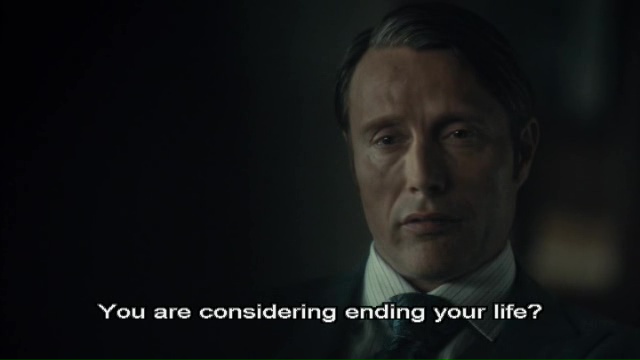
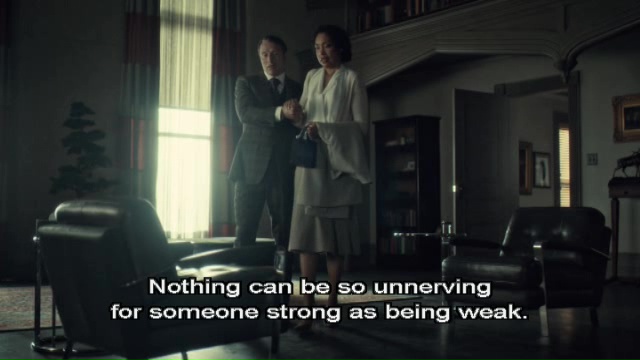
Will is contemplating murder, Beverley is contemplating motive, and Jack’s wife, Bella, is contemplating suicide. Her breast cancer has spread, and she is consulting Hannibal about life and death, subjects on which, like most things, he is expert. Her cancer has won the battle, and she has no quality of life, is only staying alive for Jack.
That thought, she tells Hannibal, makes her feel alive. How, she asks, does it make Hannibal feel? And that question affords us a fascinating glimpse into Hannibal as Übermensch:
“The thought that my life could end at any moment frees me to fully appreciate the beauty and art and horror of everything this world has to offer”
Nietzsche, like Hannibal, was a Dionysian, contemptuous of the moralising of Christian ethics. Dionysus was the god of controlled passion, a worthy adversary to Christian suppression of passion. Nietzsche pictured himself as a satyr, half man, half goat, a bridge between man and nature, an affirmer of life. Will Graham sees Hannibal, after he realises that he is the killer they seek, as a faceless man with stag-horns, a windigo, a monster from Algonquian legend, transformed from human shape into a powerful creature driven by a lust for human flesh. Hannibal is Dionysus, in his form as satyr.
Hannibal is clearly a master of ancient Greek culture, telling Bella, as they discuss suicide (according to Sartre, the only subject worth discussing):
“Upon taking his own life, Socrates offered a rooster to the god of healing, to pay his debt. To Socrates, death was not a defeat…”
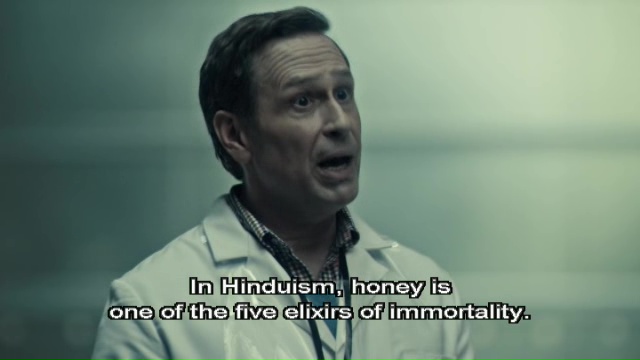
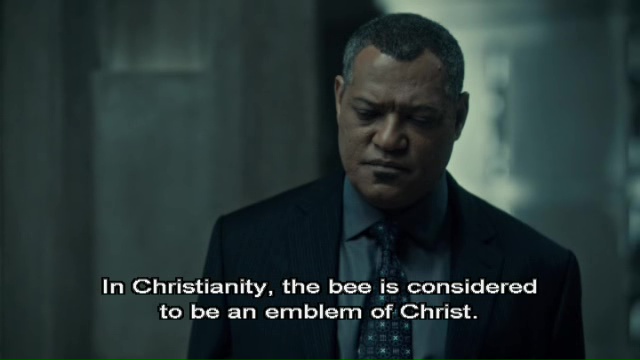
There is of course a separate killer keeping the FBI team busy – a sweet, new agey woman who wants to put people out of their misery, taking away their pain with her herbal cures, in one case blinding a patient, in the other killing him and filling his head with bees. She is also, the team speculates, into mythological symbolism:
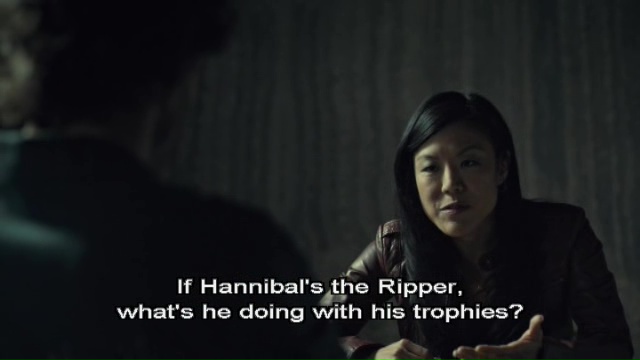
Beverley discovers, after some broad hints from Hannibal, that the killer from last episode, the dude making mosaics out of corpses, is missing a kidney. This links the murder of the murderer to the Chesapeake ripper, who takes surgical trophies from his victims.
Will remembers Hannibal’s first visit to his home in Season 1 Episode 1, with breakfast neatly packed in a picnic basket.
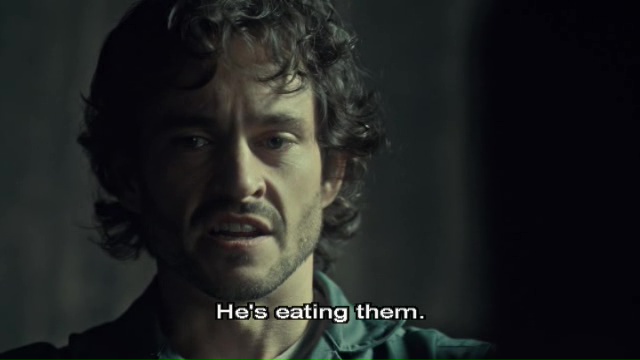
Will realises that Hannibal was feeding him human flesh, and so he also is a cannibal, if innocently. And we know Jack has been dining regularly at Hannibal’s table.
Bella has taken Hannibal’s musings about suicide to heart, and decided that the life Jack wants to preserve (hers) is of a quality not worth saving.
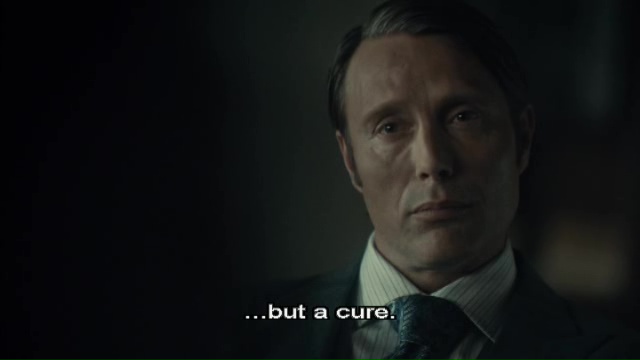
She has taken a lethal dose of her morphine. Hannibal has reservations – not about death, which, we remember, he described as a cure. But about the effect on his friend, her husband, Jack.
Life, death. They are no more than the flip of a coin.
He revives her. She wakes up and gives him a pretty good slap, for someone who was nearly dead. Her view: he has robbed her of her release, her “cure”.
Meanwhile, Beverley is convinced of Will’s claims against Hannibal and goes snooping in his basement. This was never going to end well.
IF YOU LIKE MY BLOG, PLEASE FEEL FREE TO RECOMMEND IT (WITH DISCRETION) TO FRIENDS ON SOCIAL MEDIA.
IF YOU HAVE ANY QUESTIONS OR COMMENTS, YOU CAN USE THE TAG, OR EMAIL ME ON CANNIBALSTUDIES@GMAIL.COM.











 The Cannibal Guy