You don’t often see Siberia in the news, particularly remote towns like Gaz-Sale. But this month (November 16, 2021 to be precise) it made a splash on news sites, with the sentencing of Vladimir Yadne for killing three people and eating their flesh, washed down with vodka.
The murders took place on March 6, 2021. The court heard that Yadne had gone out to buy some hard liquor when, on his way home, he saw a 51-year-old man and 59-year-old woman embracing. It is not clear if he knew them – the total population of the town is 1,800 so it is quite possible. At any rate, he got into an argument with them, and then stabbed them both to death.
Gaz-Sale, Siberia
Feeling hungry, perhaps from all the exertion, Yadne then cut pieces from the bodies and ate them raw, with his vodka, according to Inna Nosova, the head of the criminal justice department in Yamalo-Nenets Autonomous Region.
“He came in with alcohol on him, and drank it as he was eating the meat.”
Apparently finding the taste to his liking, Yadne later that night stabbed to death another 52-year-old man and ate some of his flesh too. He then tried to dump the bodies (or what was left) but was arrested a few hours later, after police found them. He confessed to the murders and even helped police by recreating the crimes.
Yadne recreates the killings
He underwent psychiatric evaluation, which determined that, at the time of committing the crimes, Yadne was ‘sane’.
Vladimir Yadne
The case has at least put Gaz-Sale on the map, with reports in the British tabloid press, US news services, Hindi Newstrack and even withinnigeria.com. One way to get famous I guess. The really fascinating question for me relates to the role of cannibalism in determining the newsworthiness of a story. A man who killed three people in northern Siberia would barely rate a mention in a Russian news outlet, let alone on websites all around the world. Take a bite of the corpses, though, with or without vodka, and everyone wants to know. The conclusion has to be that we are more interested in what happens to dead bodies than living ones.
Yadne has been sentenced to life in a very uncomfortable Siberian prison colony.
This new Showtime series (this first episode aired November 14 2021) crosses many genres. There’s the whole Mean Girls range of stories about the angst of going through puberty and surviving high school, where everyone else seems desperate to drag you down in order to lift themselves up. There’s the Lost genre of survival stories that started with Robinson Crusoe (first published in 1719) and its bastard child, Gilligan’s Island. There’s psychological thrillers and murder mysteries with a twist like Psycho. And, of course, there is cannibalism, the subject of this humble blog. Yellowjackets is all the above, with an ensemble cast.
Yellowjackets jumps between eras, with the main characters portrayed by teenage (or close) actors in 1996, and adult actors as them 25 years later – now. The pilot episode shows a terrified girl running barefoot through the snow before she plunges into a bear pit. Then we’re back in grungy 1996, surrounded by teenage angst and jealousy, following the girls in a champion New Jersey soccer team called the “Yellowjackets” as they prepare to fly from New Jersey to Seattle for a championship match. A yellowjacket is a predatory wasp who attends picnics and can get very antisocial very quickly. It’s a nice metaphor.
The plane crashes in a frozen Canadian wilderness; it’s one of those stories where our pretensions of human supremacy are stripped away by the fragility of our technology and the awesome and indifferent might of nature. Right away, we are thinking Alive, the story of the Uruguayan footballers who crashed in the Andes in 1972 and survived on the flesh of their dead teammates. The action moves back and forth from the pre-crash period to the present, as the survivors interact and relive their guilt and PTSD, which have been festering for 25 years. There is a deep, dark secret which is not fully revealed in the first episode (although it’s mentioned prominently in every review). We see that girl falling into the trap and being impaled on stakes, her bloody body being dragged through the snow then strung from a tree and sliced open.
We see her meat being cooked and served to a group of girls in animal furs and full savage garb, including the horned headdress that is the symbol of primitive cannibals in so many movies.
Later episodes will show that the girls didn’t sit about and discuss divinity like the Uruguayan footballers in Alive. We viewers are in on the secret – they split into warring, cannibalistic tribes and survived on human flesh, but not necessarily already dead bodies like Alive. These girls go hunting girls. And like many cannibal narratives, including most of the “evidence” presented by missionaries and explorers to demonstrate the savage nature of the people they were invading, the evidence is often more to do with the detritus left from the feast than the feast itself.
This is Alive meets Lord of the Flies, but with girls. Although the movies of Lord of the Flies did not offer any explicit cannibalism, Golding’s book made it pretty clear that the other boys intended to do to Ralph what they did to the pig they captured, i.e. a barbecue. This post-war (well justified) pessimism about the way our thin veneer of civilisation can so easily be stripped from us was the origin of both the misanthropic 1960s view of society and, later, reality TV; and the two are profoundly related.
Lord of the Flies showed us that boys will be boys (AKA vicious cannibals). Mean Girls showed us the hidden savagery in teenage girls. Yellowjackets puts these together and shows girls as cannibals, which makes it that much more sensational. We’ve seen cannibal girls in films like, well, Cannibal Girls, where the cannibalism derives from supernatural sources, and The Lure, which shows us the dangers of hooking up with human/fish hybrids, but this may be different, unless the producers decide to introduce some sort of entities driving the cannibal mayhem (please don’t). So far, Yellowjackets seems to be much more interesting than just another Wendigo story; it’s what Freud (in The Future of an Illusion) warned about when he spoke of the “instinctual wishes” for cannibalism, incest and murder that live in each of us, and are “born afresh with every child.” We are barely capable of civilised interactions in high school, so how are we going to relate to each other in a disaster? We are animals who deny our animality, and we normally consume each other in such polite, socially acceptable ways. Until we don’t.
The series was created by Ashley Lyle and Bart Nickerson (Narcos and Dispatches from Elsewhere), who were inspired to do the show when they saw the scorn social media keyboard warriors poured on the idea of a female Lord of the Flies. In a New York Times interview, Lyle recalls an on-line comment she read that inspired her to conceive Yellowjackets:
One man’s comment read, “What are they going to do? Collaborate to death?” Lyle recalled what she immediately thought in response: “You were never a teenage girl, sir.”
The first episode is directed by Karyn Kusama, who seems to specialise in movies about female rage, including the wonderful Jennifer’s Body.
With 100% fresh rating on Rotten Tomatoes, this is one to watch, and maybe keep watching.
In 2012, police in Garanhuns, Brazil, arrested for murder Jorge Beltrao Negromonte da Silveira, his wife, Isabel Pires, and his mistress, Bruna Cristina Oliveira, who all lived together in a group they called “The Cartel”. Residing with the Cartel was a small child named Vitória, who had been the daughter of their first victim. In 2018, all three adults were found guilty and sentenced to decades in prison.
However, the worldwide public interest in the crimes did not stem from their murder of three young mothers, but from the fact that the Cartel stripped the flesh from the victims and baked them into salgados, salty, deep-fried pastries, which were then sold to the unsuspecting public. To the disappointment of the media, the pictures of the perpetrators showed them as three ordinary Brazilian people, not the monsters the public had expected.
Isabel Pires, left, Jorge Beltrao Negromonte da Silveira, and Bruna Cristina Oliveira
This case, one of about one hundred reported incidents involving cannibalism since the year 2000, is of particular interest because it incorporates many of the issues considered in this blog.
Reports of cannibals from earliest times almost invariably labelled them ‘monsters’, the same term the media used in this case to describe the members of the Cartel. Silveira muddied this even further by accusing his mistress Oliveira of being a witch, who had tortured him and Pires into taking parts in “purification” rituals.
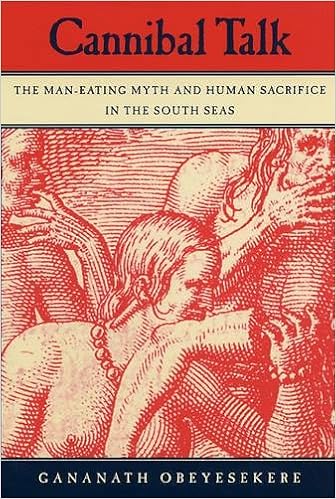
Cannibalism has been a useful accusation against colonised peoples since the time of Columbus, and Brazil has been particularly singled out in the literature as offering indisputable examples of “savage” cannibalism. Gananath Obeyesekere, one of the foremost scholars of cannibalism, writes that he omitted a chapter on the Tupinamba of Brazil from his book Cannibal Talk, which casts significant doubt on the existence of systemic savage cannibalism, partly because of the passionate commitment of Brazilian scholars to the “empirical reality of conspicuous anthropophagy”.
Contemporary narratives of cannibalism, particularly since Jack the Ripper, assume that there are psychogenic bases for the act; de Silveira was found to have written a book called Revelações de um Esquizofrênico(Revelations of a Schizophrenic).
Unknowing cannibals are often described as “innocent” in that they are offered meat without recognising its provenance. The enduringly popular Sweeney Todd, the ‘demon barber of Fleet Street’, is supposed to have, in the late eighteenth century, murdered his customers and furnished their flesh to his accomplice, Margery Lovett, who turned them into meat pies for her unknowing but enthusiastic customers, just as the Cartel did with their salgados. In neither case were there any misgivings because, according to da Silveira, human meat tastes almost the same as beef.
Reports of cannibalism usually leave readers hungry for explanations – the motivation of the act. The Cartel chose its victims partly on the basis that they were tackling overpopulation by killing off single mothers who were unable to care for their children. The Cartel had its own methods of selecting victims, involving not just their unmarried maternity but a set of rules provided by “spiritual entities” which determined which women were evil and should be killed, based on the numbers on their identity cards adding up to 666.
At the heart of this case lies an ethical question: is there a fundamental difference between a salgado (salty) snack full of beef and one filled with human meat? The premise of arguments for such a difference is the concept of anthropocentrism, the belief that (some) humans can transcend their disowned yet undeniable animality, and attain a higher moral status than other animals, such that intentionally killing a human is ‘murder’ while killing other animals is considered commercial harvesting. This sometimes called “speciesism”, except that there has never existed a culture where humans honestly considered all other humans their equals, or sometimes just human narcissism.
Silveira was sentenced to 71 years in prison, while his wife received 68 years and his mistress 71 years and 10 months. This is on top of another conviction in 2014, where the trio were found guilty of killing Jéssica Camila da Silva Pereira. Silveira was sentenced to 23 years in prison for that murder, while his wife and mistress were each sentenced to 20 years.
References
Araújo, E. L. V. M. d. (2018). Estudo do Caso dos Canibais de Garanhuns. (Law thesis), Centro Universitário Tabosa De Almeida, Caruaru, Brazil. Retrieved from http://repositorio.asces.edu.br/handle/123456789/1548
Haining, P. (2007). Sweeney Todd: The True Story of The Demon Barber of Fleet Street. London, Robson Books.
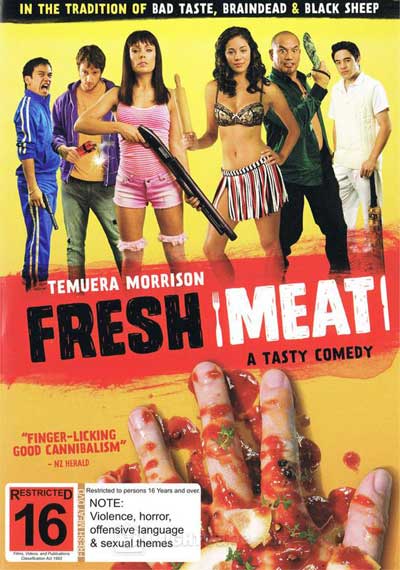
New Zealand has produced some world class directors; think of Jane Campion, or Peter Jackson. Not a lot of cannibal movies unfortunately, considering the country’s reputation – Jackson’s first feature film Bad Taste had a lot of humans being eaten but, unfortunately for this blog, the eaters were space aliens, so not technically cannibals. Jackson’s Braindead was closer, involving zombies. Can you be a cannibal if you are undead? We’ll have to consider that question some time, perhaps when we run out of movies about living cannibals (probably about the time we get to net zero).
But Danny Mulheron gets right into freshly killed, cooked (and sometimes raw) human body parts in this film. Like Jackson’s Bad Taste, Fresh Meat was Mulheron’s first feature film, and it’s an impressive inception.
The plot involves a family of Maoris, recently converted cannibals, being taken hostage by some bumbling criminals. Rina (Hanna Tevita) is home from her lesbian explorations at “St Agnes Boarding School for Young Maori Ladies” when a bunch of criminals break in to her home to hide from the police, having killed some prison guards to free their boss from a prison van.
But that’s Rina’s second shock of the day; the first was finding her parents’ new eating regime in the fridge.
Turns out her Dad (Temuera Morrison from Once Were Warriors and The Mandalorian) is reviving an “eighteenth century post-colonial religion” – he has found the prophecies of Solomon Smith and become a “Solomonite”; he now believes that eating people (“taking their life-force”) will cause the family to flourish.
Yes, among the satire on Maori and Pakeha cultures, there is the odd dig at Christian transubstantiation.
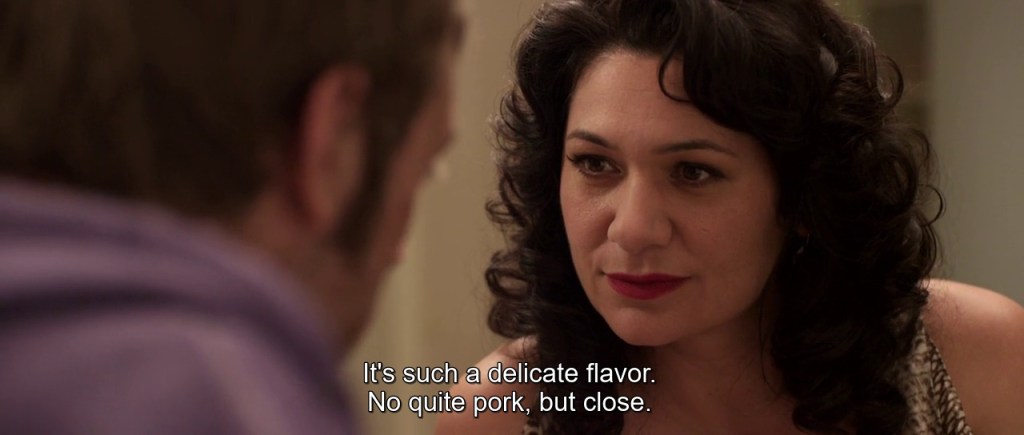
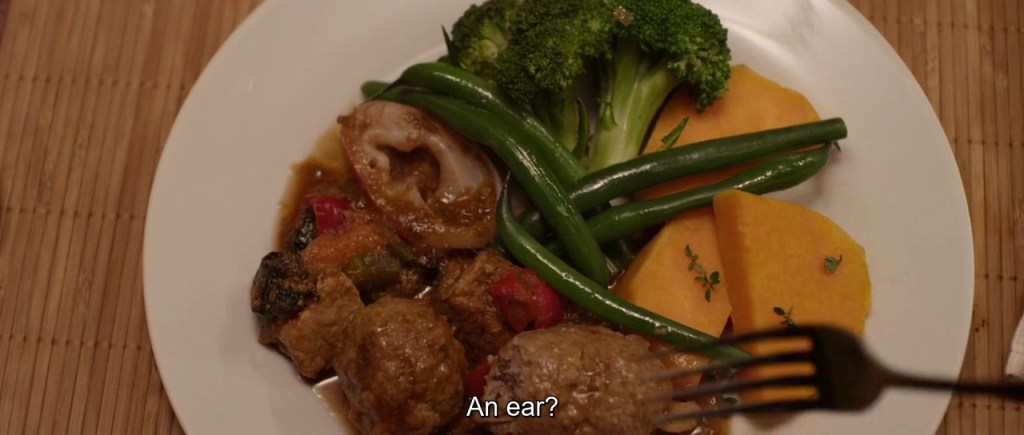
Mum (Nicola Kawana) produces hugely popular cooking shows and books, she’s a Maori Nigella, into marinades, and she describes the meat she uses:
Rina is shocked that her brother (Kahn West) would agree to eat human flesh, until he tells her about the pork and rosemary pies that her family sent to her at school. It wasn’t a choice.
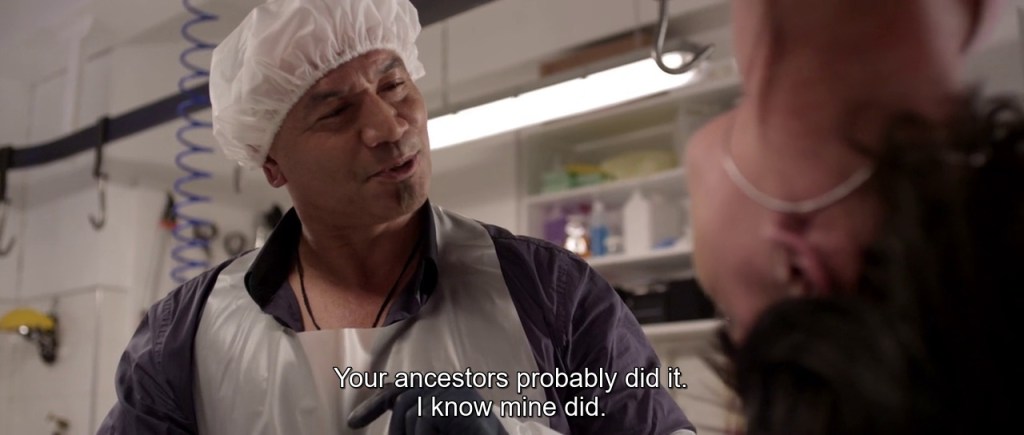
The subsequent bloody altercation with the criminals is set to fill the larder nicely. Dad tells the last living criminal, Gigi (Kate Elliott), who is hanging upside down ready for slaughter, that
“ritualistic cannibalism dates back to 1000BC to the Hun phase in Germany. The Bible itself refers to the siege of Samaria in which two women made a pact to eat their children. The Aztecs, the French, the Brits… Your ancestors probably did it. I know mine did.”
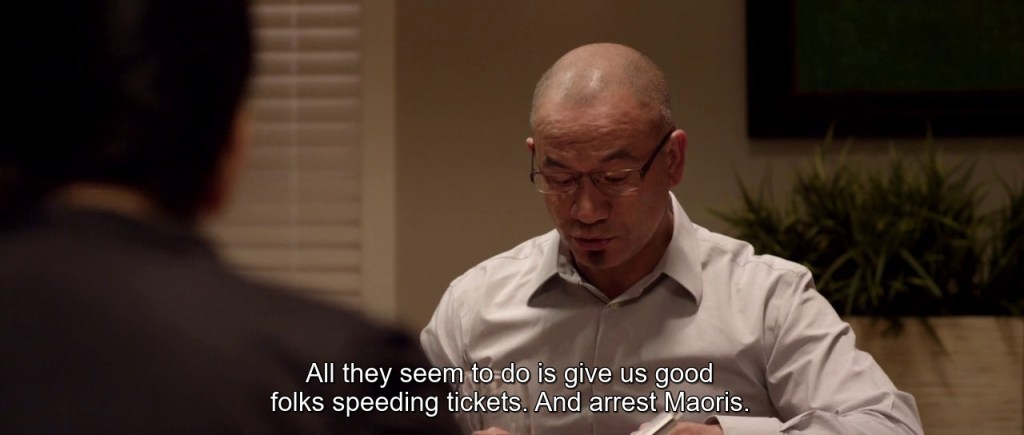
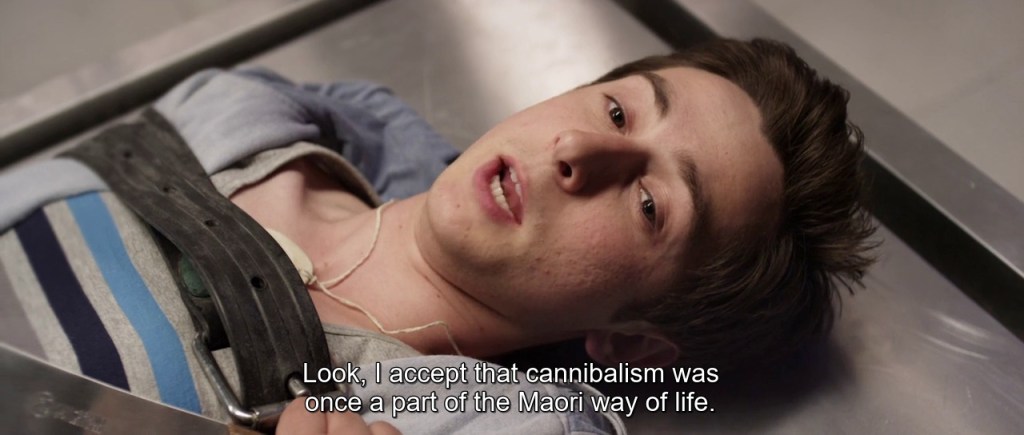
There is lots of Maori humour, and not all relating to cannibalism. Dad is an Associate Professor at the University, and blames white racism for his failure to be given tenure as full professor. When the cops knock at the door, he complains
Rina’s neighbour is a white boy who is in love with her. When he appears and is invited in (“we’ll have him for dinner” says Dad – yes, Hannibal lives), he points out that he is a vegetarian, but politely eats what turns out to be a human testicle, only getting suspicious when he spots something else on his plate.
Even when they have him tied up in the basement ready for slaughter, he politely tells them
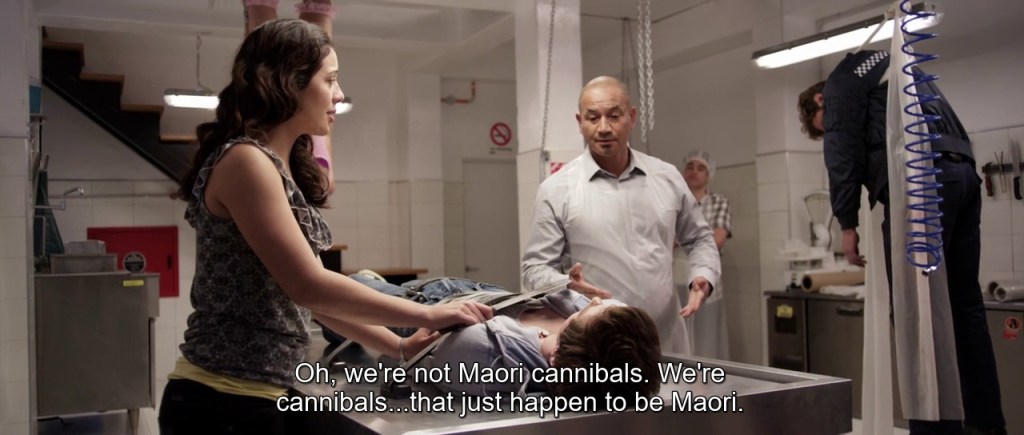
Dad replies with the best line of the movie:
“Oh, we’re not Maori cannibals. We’re cannibals… that just happen to be Maori.”
But Dad has his own agenda: to become immortal:
“By eating the still-beating heart of my youngest son, I’m halfway towards immortality. But I still need to drink the blood of my virgin daughter.”
Doesn’t quite work out that way, Rina’s not a “virgin” after that scene in the shower with her girlfriend. Or does it?
What is it about virgins and blood sacrifices anyway? Are the rest of us not good enough to sanitise humanity’s sins with our polluted blood? We exploit the innocent and gentle ones, and then expect that, by slaughering them, we somehow clear our guilt at doing so. Remember the line from Leonard Cohen’s song Amen:
Tell me again When the filth of the butcher Is washed in the blood of the lamb…
Anyway, the takeaway from this movie is that Maoris, traditionally accused of cannibalism, can be Maoris and cannibals without being “Maori Cannibals”. The two identities can be separated, even as they coexist. There are other families of cannibals who are not defined by their race; consider the Mexican film Somos lo que hay or its American adaptation We are what we are.
In cannibal studies, it is not unusual to be buttonholed by someone who has become aware of your field of interest and told with great solemnity “the Maori were cannibals, you know.” I tend to politely thank the informant for sharing a “fact” that almost everyone “knows”. But if I am feeling feisty, or have had a few drinks, I might invite them to unpack that statement – which Maori, whom did they eat, and what evidence are you presenting for this?
The British invaders of New Zealand were keen on declaring that the indigenous peoples, of wherever they went, were cannibals – it made their job of invading, enlightening and/or exterminating the inconvenient locals so much easier. But there is some evidence that much of the talk of Maori cannibalism was either misinterpretation or just slander – imperialists in the age of expansion tended to use words like “savage”, “barbarian” or “cannibal” pretty interchangeably – if you had dark skin and didn’t speak English, you were probably a cannibal, with no evidence required other than some hearsay from conquistadors or missionaries. But if an alien civilisation invaded Earth and found a copy of the Grimm’s Fairy Tales in a bookshelf, they might well assume that it was a history book, and that we were all cannibals.
Ganath Obeyesekere’s excellent book on cannibalism in the South Seas makes clear that the oversimplification of Maori culture and mythology (and perhaps humour) probably led to often tragic misinterpretations of local customs. In fact, he says, it is likely that many Maori were convinced that the British were cannibals. And who could blame them? If those aliens mentioned above put down Grimm’s Fairy Tales and took a look inside our industrialised slaughter factories, where 135,000 farmed animals are killed every minute, they would assume we were far more bloodthirsty than they, or the Brothers Grimm, could have imagined. No wonder they don’t make contact.
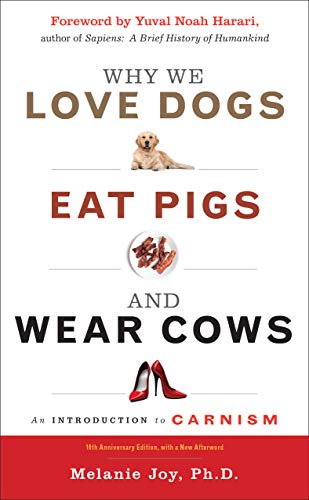
It is interesting to consider the differing responses to cannibalism in the family of this film. Social Psychologist Melanie Joy calls the ideology surrounding and justifying the eating of meat, dairy and eggs “carnism” – a set of largely unconsidered beliefs in three beliefs that start with the letter N: that these products are “normal, natural and necessary“. We drink milk, eat meat, scramble eggs, based on the insouciant assumption that all these things are normal, necessary and natural (and, a fourth N, nice to taste). The family members reflect these views, but in relation to a different food source: Homo sapiens. Dad thinks eating humans is “necessary” in order to absorb the life force of the victims, and make himself immortal. Mother is a celebrated chef; for her, eating meat is “natural”, and where it comes from is not an issue, as long as it cooks well and tastes good. Rina’s brother finds the whole thing “normal” – his parents do it, and he wants to learn from them, and make them proud. Only Rina objects, although she was willing to eat the pies they sent her when she thought they were bits of a different animal. She’s like a vegan at a barbecue, heart-broken to see her family so unthinkingly accepting the death of animals, or at least, those that she can see and talk to.
If you don’t like gore and body parts (and violence and lesbian kissing) then you might want to skip this movie. But if you don’t mind all that, and like a rip-snorting plot, plenty of humour, a little suspense, and lots of intertextual winks to cultural foibles, some (perhaps unintentional) observations on the ideology of carnism, as well as some great acting and direction, then watch Fresh Meat. Recommended.







 The Cannibal Guy