In the past 18 months, the war between CJNG (Cartel Jalisco Nueva Generacion) and the Sinaloa cartels has been intensifying. Sinaloa is the largest, while CJNG is arguably the most violent.
The Mexican state of Zacatecas is their main battleground.
Sicarios (cartel assassins) on both sides fight for territory, and the profits from the production of synthetic drugs, particularly fentanyl, in that region.
They also profit mightily from kidnapping refugees trying to cross into the USA, and cooking the ones whose ransoms are not paid.
Violence in this war is not just done, but is seen to be done, with videos being released onto social media showing various atrocities, in order to demoralise the opposing cartel members. An earlier video involved a CJNG soldier using a spoon to remove the eyes of a captured rival.
A new video (widely and ironically known as “Sponsored By Adidas” due to the killers’ love of that brand of shoe) is circulating on the Internet now. It shows a soldier from the CJNG crouching over the disembowelled body of a man from a rival cartel, supposedly the Sinaloa. The man opens the corpse’s chest and removes an organ, either the heart of liver (some say a lung), and bites into it, then seems to offer it to the corpse to see if it wants a bite.
This seems to be the latest escalation of cartel violence. Before 2006, beheadings were unknown; but now there are dozens of beheadings every year in Mexico. How do you up the stakes from beheading? The previous video from a cartel, called “Funky Town” showed a live and conscious prisoner having his face flayed from his head, later to be sewn onto a soccer ball. But the big new thing for the cartels now seems to be cannibalism.
Man-eating appears to have become a requirement for new recruits to CJNG at its training camps or “cannibal schools.” One member of CJNG told a journalist that there is widespread cannibalism at the camps. Recruits are taught how to cut fingers and toes, and eat them They then graduate onto larger internal organs. He reported (anonymously) that:
“You have to do it without reacting or vomiting or you are beaten. If you didn’t want to [eat human flesh] they wouldn’t let you leave, they had you there.”
The video in question can be found on the Internet if you look hard enough. I am not posting links, because those who don’t want to see it might accidentally click, and those who do are gorehound enough to find it.
Why is cannibalism such a popular strategy for terrifying the enemy? Because there is no higher form of humiliation, no greater insult, than being killed, eaten, and then crapped out of the anus of your enemy.
The Cannibal that Walked Free (AKA Cannibal Superstar) is a British documentary produced by Visual Voodoo for Channel Five which explores the case of Japanese cannibal Issei Sagawa. It uses dialogues with police and psychiatrists and, most intriguingly, extensive interviews with the cannibal himself.
Sagawa murdered a young Dutch woman, Renée Hartevelt, a fellow student at the Paris Sorbonne, then mutilated, cannibalised, and performed necrophilia on her corpse over two days.
The mellow voice of the narrator, Struan Rodger (Chariots of Fire), announces:
“This man murdered and ate a woman in Paris… he has never stood trial. Today he walks the Tokyo streets a free man, a free man with an ongoing appetite for human flesh.”
Around midnight on June 13 1981, 32 year old the Japanese exchange student, Issei Sagawa, emerged from his apartment at 10 Rue Erlanger in the 16th arrondissement of Paris with two large suitcases, hailed a taxi and travelled the short distance to the Bois de Boulogne. His hopes that the park would be empty at night were in vain, and several witnesses saw this 4’9” (145cm) smartly dressed Asian man trying to drag two large suitcases to the lake. Worn out (and probably full of meat), Sagawa fell asleep on a bench and woke to find an old man opening one of the cases. When the old man began to scream, Sagawa walked calmly away.
The police found that someone had removed flesh from parts of the body. During the autopsy, they discovered there had been post mortem sexual intercourse – necrophilia.
Within four days, the police tracked Sagawa through the taxi driver, and he confessed immediately. In his refrigerator, they found a large quantity of human flesh.
On the table was a plate with pieces of cooked human flesh, condiments and mustard.
The case was reported globally with the press expressing horror and disbelief. Patrick Duval, Author Le Japonais Cannibal interviewed Sagawa for several hours.
Sagawa said that the feelings began when he was very young: “I was very weak, very ugly, like a small monkey.” He described as an important memory from his childhood a game in which his uncle would play a ravenous cannibal, out to gobble up Issei and his brother.
As he grew up, he felt unable to attract the kind of women that he desired:
“Object of my desire is definitely the white girl, beautiful blonde hair, blue eyes.”
Jean-Pierre Van Geirt – a journalist from Paris Match, said “Sagawa was deeply in love with Renée, and his love was so mad that he thought the most he could love her was to eat her.”
Sagawa had invited the young student to his apartment to discuss literature. He said he asked Renée to read a German language poem he had chosen, a poem about cannibalism, and that she was unaware that he was standing behind her, holding a rifle. He shot her in the back of the neck.
“I had decided before that the first bite would be the buttocks. I was able to cut through the skin, I’m a fool so I didn’t have a clue about human body structure. I thought that red flesh would appear straight away but it wasn’t like that, and this layer that was like sweet corn just carried on for ages, however deep I cut through. I couldn’t reach with my knife so I ripped out the flesh with my fingers and put it in my mouth. After I had sex with her, I tried to kiss her I said out loud I love you, in French. And I felt a huge shiver.”
He had a tape recording of the murder and a camera with which had recorded the stages of what he did to Renée after her death; police found both in his apartment after his arrest. He had also saved a good deal of her flesh in his fridge, before packing up her remains in two suitcases.
Just 34 months after his confession, Sagawa would be a free man. Found to be insane and unfit to stand trial in France, his father employed an influential French lawyer who argued successfully that it was unfair for the French taxpayer to pay for indefinite confinement in a mental hospital, and that he should be sent back to Japan to be cured. Accordingly, less than three years after his confession, Sagawa was put on a plane and sent back to Japan. The only condition was that he could never come back to France. He spent 18 months in a Japanese mental hospital but then checked himself out, and has been free ever since.
The interviewers tracked down his psychiatric report: it said
“He was hung up by his height, not self-assured, over-sensitive and most of all emotionally cold and self-satisfied when he talked about the murder. Someone who is capable of feeling guilty wouldn’t commit such an act. You have to be completely devoid of some human emotions. Among which is the sharing of the universal taboo of cannibalism.”
The interviewer visited Sagawa’s Tokyo apartment where he lives under a false name and found him enjoying Beethoven’s 9th Symphony – the second movement, popularised in the film Clockwork Orange. He claims that he wept for the victim’s family and for his family, who were devastated – his father lost his high-powered job, his mother attempted suicide.
Despite his alleged distress, in the mid-1980s he wrote a book “In the Fog”, against the express wishes of both his and Renée’s family. It is the story of his crime, written from his perspective. It sold out. He wrote a further 19 books about his crime, became a columnist in magazines, joined a symposium at a Japanese university and appeared in two stage shows, finally appearing in torture porn, including recreations of his crime, using tall, Western actresses.
Under his false name, he told the interviewer, he meets up with Western sex workers.
“My final desire is just the same – when I see all the beautiful girls’ legs, I want to eat. So I’m not cured at all. But now, I’m not interested in at all the white women. I hate them. I found that Japanese women are the most beautiful in the world.”
Sagawa now feels the urge to cannibalise young Japanese women.
At the programme’s request, Sagawa agreed to attend his first psychiatric assessment in over ten years. In the documentary, he tells the Criminal Psychiatrist, Dr Susumu Oda:
“My libido and appetite are connected. This is very important. For instance, you see the beautiful girls on the train in summer, and you see their legs, don’t you. I think they look delicious.”
He says that he masturbates to make his feelings disappear.
Oda reported:
“A child suckles on his mother’s breast. A child survives eating breasts. So it is not that strange that a child would want to eat something he loves.”
Sagawa was small, weak and spoiled, so he never learnt to suppress those desires.
“Deep down, he doesn’t regret what he has done. He has a tendency to slowly turn the other person into an object. I think this is very dangerous.”
The doctor’s conclusion:
Freud maintained that there are two “pregenital” forms of sexual organisation in very young children not yet predominantly motivated by their genital zones. The first of these he called “oral-sadistic” or “cannibalistic”, in which sexual activity is not separated from ingestion (the second was “sadistic-anal”), and he suggested that these were “harking back to early animal forms of life”. In this “cannibalistic” stage, “the object that we long for and prize is assimilated by eating and is in that way annihilated as such.” It is not surprising, therefore, that Sagawa wanted to eat his ideal woman, and he made a particular point of eating her breasts.
“Too Much Blood”, a song on the Rolling Stones‘ 1983 album Undercover, is about Sagawa and violence in the media. His crime also inspired the Stranglers‘ 1981 song “La Folie”. The Noise Black Metal band Gnaw Their Tongues released an EP titled Issei Sagawa in 2006.
The documentary is available in full on Youtube at the time of writing. The link is at the top of this blog.
A more recent look at Sagawa is the 2017 documentary Caniba.
This blog has laboured mightily to keep up with the constantly growing catalogue of cannibalism movies and TV shows, as well as the increasing number of actual cases reported in the media. So this week we are taking a rather exciting side-trip into the wonderful world of short stories, a place where the sets can be as lavish as the author wishes since there are no Producers cutting budgets, the protagonists can do anything the mind can conjure up without the need for stunt persons or insurance, and the whole thing requires no masks or social distancing.
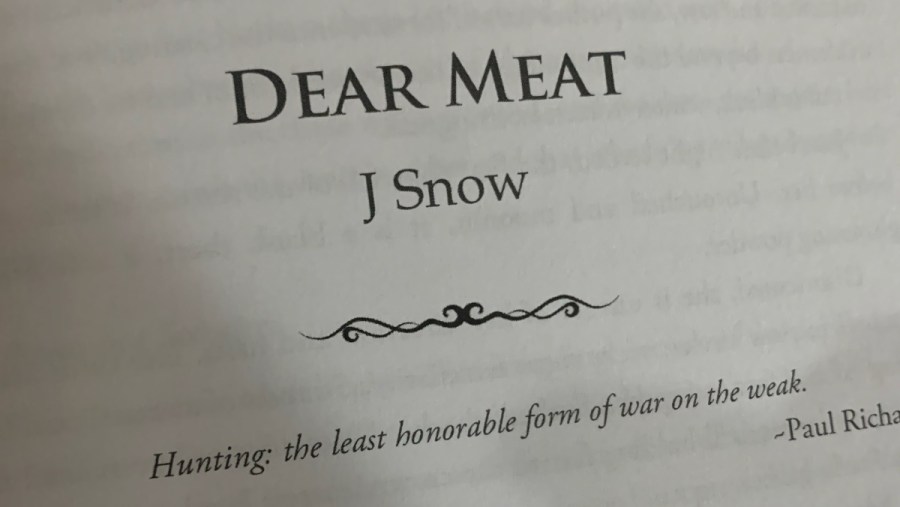
The story considered in this week’s cannibalism blog is called DEAR MEAT, and it appears in the third Women of Horror Anthology, titled THE ONE THAT GOT AWAY.
The anthology contains an amazing assortment of thirty fresh looks at the wonderful world of horror. I have, naturally, chosen to review the cannibalism story by J Snow, since that’s what I do, for reasons best known to myself and the Department of Culture and Communications at the University of Melbourne.
Ms Snow has written and published five cannibalism stories; reassuring to know that others also labour in these fields. For those of you who wish to know how (or why) she writes, there is an interview at Paula Readman’s Clubhouse.
Dear Meat was written a few years before the pandemic, but reads like it could be taken from tomorrow’s newsfeed. It involves a small elite group of rich and powerful men who have decided that human population growth is threatening to destroy the biosphere, and so must be stopped and reversed. More than two thirds of the population, billions of people, must be “eliminated.”
Various ingenious and possibly prophetic strategies are mentioned such as introducing viruses and tainted vaccines, genetically modified foods and contaminated water supplies. Free tubal ligations and vasectomies are encouraged, and abortions allowed up to two months after birth. But the key plan in this story is to set the populace at each other’s throats, or more precisely at the barrels of guns. Yes, hunting season for humans becomes the only way to feed the family. Tags are issued, which is apparently the way hunting works in the USA, and the distribution is weighted according to the discriminatory preferences of these shadowy rulers – the “unworthy and unholy” are allotted the most tags meaning the poor and the non-Christians are most likely to be hunted and cooked. Illegal immigrants are always open season. The rich and the politicians, however, don’t ever seem to end up on the butcher’s slabs.
English cleric and economist Thomas Malthus pointed out in 1798 that population increases geometrically, but food availability increases only arithmetically. All things being equal, this means we must run out of food, unless there is a disaster or an intentional reduction in human population growth. Too many people and not enough food is likely to lead to cannibalism, although Malthus did not venture into such abject speculations. The ethologist John Calhoun crossed that bridge in his study of rats, where he found that putting rats into a utopian environment, with no shortage of food or shelter, and letting them breed unconstrained, ended up in a chaotic maelstrom of sexual deviance and cannibalism. A Malthusian/Calhounian scenario is the basis for the film Soylent Green which is set (honest, I’m not making this up) in 2022, when overpopulation has led to a situation where the enormous population of poor people can only be fed by recycling the bodies of those who die or can be persuaded to accept euthanasia.
Not so in Dear Meat. The people running the government know one thing that has been true since the start of humanity: when there is hunger,
“People turn on each other, become monsters, all for one tiny morsel.”
The people turning on each other in this story are from a family; a man, a woman and a child. Not even close to a large family by today’s standards, but in the world of the story, any increase in population (child) must be balanced by a decrease (a hunted tag). One person must die, be carted to the butcher and carried home as meat, just as the odd hunter does now to deer or kangaroos or anyone else that happens to move at the wrong moment.
I am introducing some levity because this is a grim scenario, skilfully crafted, beautifully written and with an ending that I absolutely will not spoil. The wonderful thing about eBooks is that they are ridiculously affordable and offer hours of reading pleasure. This collection, and particularly Dear Meat, is highly recommended.
In The Tempest, Shakespeare created a monstrous, malformed semi-human character named Caliban, the son of a witch, who is accused of trying to rape Miranda, the daughter of Prospero, the magician that took over Caliban’s island after losing the dukedom of Milan. Caliban has fascinated scholars over the years, with his name often taken to be an anagram of “canibal”, which was then starting to become the preferred term for humans who ate other humans, formerly known as “anthropophagi”. The word “canibal” or “cannibal” came from Christopher Columbus’ clumsy rendering of the name of the Caribs, a tribe he came across in the Lesser Antilles, and who, he was told, were man-eaters. Caliban, then, can perhaps be seen as a satire on the way colonial people were misrepresented and slandered by the imperialist explorers of the time. Post-colonialist versions of the play, including Julie Taymor’s version (you might remember her superb version of Titus), showed Caliban more as a “noble savage”, representing the indigenous inhabitants so rudely displaced from their homes during the period of European expansionism.
As Elvis said, “I said all that to say all this”. The semi-human monsters of our time are plentiful, and include neo-Nazis, whoever is on the other side of your political divide, and all the world’s various terrorist groups. One group that we (the West) went to war with (and lost) was the Taliban, who have taken over Afghanistan, a country now sliding into economic ruin and famine, since the withdrawal of international relief funds. This is not to say that there is anything noble about the Taliban – they are bunch of vicious thugs who apply mediaeval forms of punishment in their courts and slaughter, starve or otherwise deny basic rights to women and ethnic minorities. They are, in a sense, Caliban, and the media never tire of detailing their atrocities and transgressions, whether proven or dubious. The latest is, of course, the old favourite, cannibalism. Yep, the fourth cannibalism case we’ve reported so far in 2022.
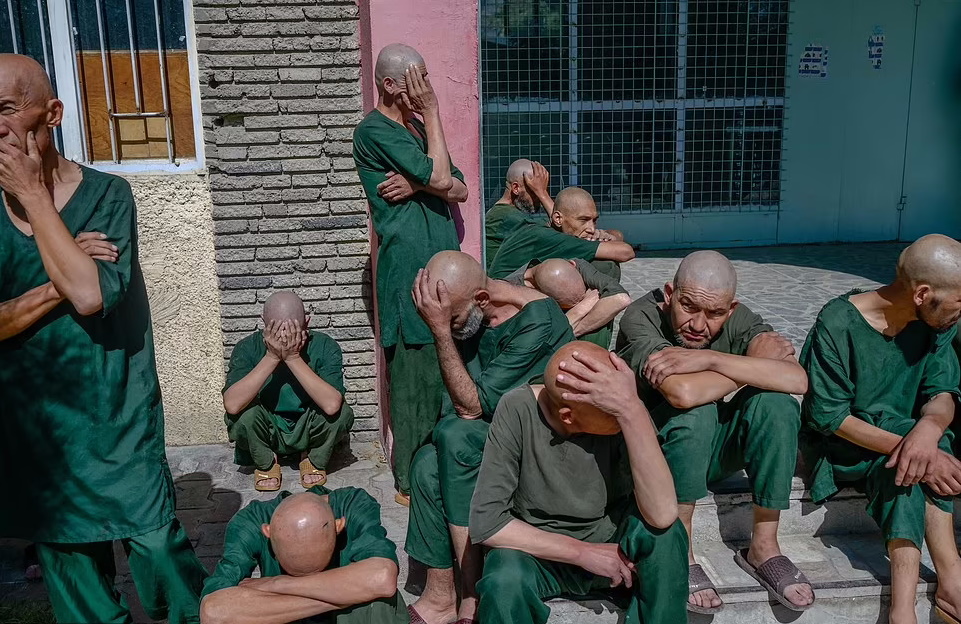
Al Jazeera reported back in October 2021 that the Taliban, back in power after being routed by the US and its allies twenty years earlier, were arresting drug addicts and locking them up to make them go “cold turkey” (what they call “detoxification”). Former guerrilla fighters now raid Kabul’s drug-ravaged streets and bridges, rounding up hundreds of homeless men addicted to heroin and methamphetamines. They are beaten and marched to treatment centres as part of the Taliban’s pledge to clean up the drug trade.
Most of the world’s heroin comes from the vast poppy fields of Afghanistan and, while the crop has financed the Taliban for decades, it has also supplied cheap drugs to the domestic market, leading to a major problem of addiction. The Avicenna Medical Hospital for Drug Treatment, formerly the US military base Camp Phoenix, is chronically short of the alternative opioids, buprenorphine and methadone, typically used to treat heroin addiction. There is no money; the doctors have not been paid for months.
And there is little or no food. The Daily Mailhas reported, via a Danish journalist who asserts that he spoke to a recovering addict, that the patients are sleeping three to a bed. They are forced to eat grass just to stave off hunger pangs, and there are “rumours they have resorted to eating cats and even cannibalism in order to survive.” One addict told the journalist:
“They killed a man and made a fire. They took his intestines and ate them.”
In scenes reminiscent of last century’s genocides, men in prison uniforms sit in despair. Denmark Radio reported that a prisoner told them that:
“People ate cats out in the park yesterday. One cut off the cat’s head and ate it.”
Of course, one report from a tabloid does not a cannibalism outbreak make. But it is undeniable that the sudden collapse of the old regime and sweeping to power of the Taliban has been followed by political and economic chaos as Western funding was suddenly withdrawn, and relief agencies struggle with ways to supply support without simply enriching the new Taliban Calibans. Where there is starvation, be it on a shipwrecked lifeboat, a crashed plane, a region facing famine, or a future post-apocalyptic landscape, there will eventually be cannibalism. People will do what they must in order to stay alive, be they Caliban or Prospera.

















 The Cannibal Guy