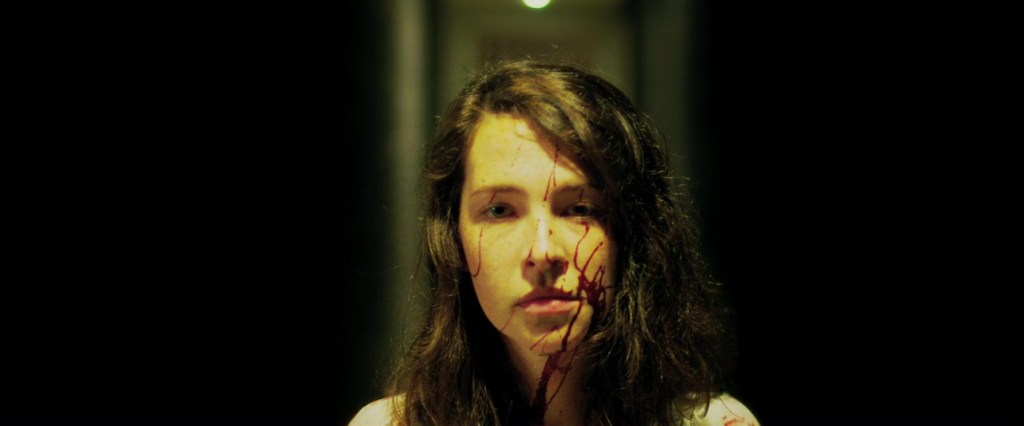
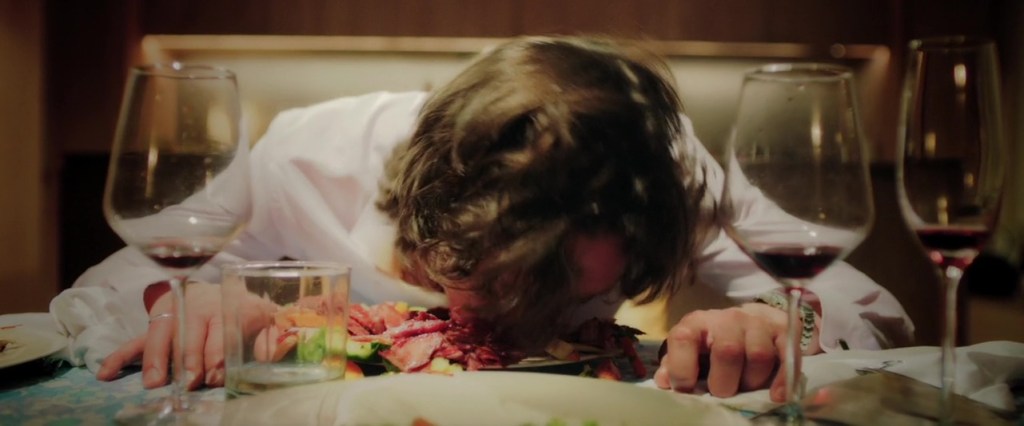
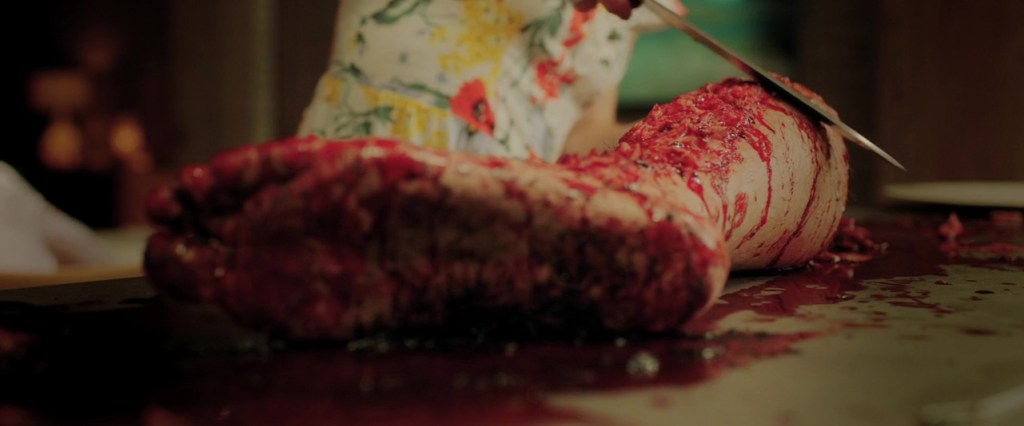
Tomorrow I will cook him – “ARMIN MEIWES” (SKYND, 2022)

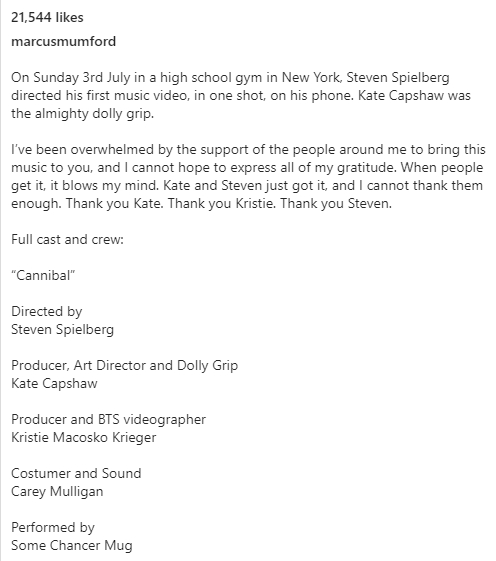
Seems to be the month for cannibal music videos. Last week we looked at the new song CANNIBAL by Marcus Mumford, directed by Steven Spielberg. A beautiful ballad about metaphoric cannibalism, the kind of cannibalism that relationships can turn into, particularly abusive ones. Mumford seems to be referring to child abuse, accusing his abuser of taking “the first slice of me and you ate it raw. Ripped it with your teeth and lips like a cannibal.”

This week’s video (the clip is at the top of this blog) is by the industrial/electronic music duo SKYND, who pioneered the true crime music genre, which presents stories based on murders and other crimes. They have previously written about the death of Elisa Lam whose body was found in a hotel cistern in LA, the manslaughter of Conrad Roy whose girlfriend sent text messages encouraging him to commit suicide, the mass suicide in Jonestown, the Columbine High School massacre, and killers such as Gary M. Heidnik and Katherine Knight.

Most of those songs weren’t about cannibals (Katherine Knight maybe, who killed and cooked her husband, although she didn’t eat him). But the song we are reviewing today retells poetically the story of one of the world’s most famous cannibals, Armin Meiwes, the German man who advertised for someone who wanted to be eaten, and then ate him.

The song starts with the repeated refrain

Let him be fat or lean, let him be fat or lean
Tomorrow I will kill him, tomorrow I will…
Let him be fat or lean, let him be fat or lean
Tomorrow I will cook him, tomorrow I will

This is a reference to the fairy tale Hänsel und Gretel, recorded by the Brothers Grimm and published in 1812. You may remember this one giving you nightmares when you were very small – two children are abandoned in a forest by their penurious parents and, on the verge of starvation, come across a gingerbread house which they proceed to chew on, only to be captured by the owner, a witch, who wishes to enslave Gretel and eat Hansel, be he fat or lean. The story was reimagined a couple of years ago as the splendid movie Gretel and Hansel.

You may also remember (at least, Fannibals will) that Hannibal Lecter referred to this fairy-tale when he was serving up dinner to Abel Gideon; Gideon’s own leg, smoked in candy apples and thyme, glazed, and served on a sugar cane quill.

Armin Meiwes advertised in 2001 on a fetish website called The Cannibal Café for “a well-built 18 to 30-year-old to be slaughtered and then consumed”. The only reply that seemed sincere, indeed eager, was from a man named Jürgen Brandes, who was not really well-built or 18-30, but Meiwes was a tolerant sort of bloke, or perhaps desperate for his first human-meat meal, so they got together and, after getting to know each other (which included slicing off Brandes’ penis and cooking it), Meiwes left his friend to bleed out in the bath, and then proceeded to butcher his carcass and eat the meat, in a variety of cuts:

Cutlets
Ham
Goulash
Steaks
Knuckles
Bacon
Portion by portion
Cator, you’re a part of me now

Forever

There is also a reference to Meiwes in the Hannibal episode “Digestivo”, when Mason Verger is planning on eating Hannibal and refers to Meiwes and Brandes eating the latter’s penis, even though it was radically overcooked.

If you want to know more about the case (for which Meiwes is still serving time), there are several excellent links on the Skynd case files website (these guys do their homework!).

Skynd said in an interview:

“When I investigated the case, I watched an interview with him. Meiwes didn’t seem like the typical beast you’d imagine when you think of a ‘cannibal.’ But then again, you might ask yourself, ‘What does a cannibal even look like?’ It’s a story that hasn’t left me for years and I feel like I have finally translated it into music.”

There are a lot of documentaries on this event, which mostly involve ominous music and hushed narratives and absurd comparisons to Hannibal Lecter. Also a movie in which their names were changed, and another one in which they weren’t given names at all.

Or you can just watch this video, which sums up the salient points rather succinctly.

Table set for tonight
Waited for this all my life
Candle lights shining bright
Pull the cork, pour the red wine
Long, big steak on my plate
Potatoes and sprouts on the side
I savor my first bite
Satisfied my appetite
.

But before the killing and eating, which Meiwes had wanted to do for most of his life (and which Brandes seemed to want just as much), there was the question of what the “livestock” industry likes to call “humane slaughter”, one of the great oxymorons of the modern world. Brandes apparently wanted to be eaten alive, feel teeth tear into his flesh, but Meiwes was more considerate – pain may be a fun sexual fantasy, but it can really hurt. So they stopped on the way home (Brandes had only bought a one-way train ticket) and bought cough medicine (BREToN, which according to Google is Tulobuterol Hydrochloride and is for “asthma exacerbation”, although the website does rather hilariously say:

Breton Syrup may also be used for purposes not listed here”

Two bottles of that, a fistful of sleeping tablets washed down with a bottle of schnapps, and Brandes was good to go. They collaboratively cut off his penis (again, it was supposed to be a tooth job, but it was too tough) and cooked it. It was inedible, and Meiwes threw it out (although an urban myth has developed that he fed it to a dog). Then Meiwes put Brandes in the bath to bleed to death and went off to read a Star Trek novel.

Pain killers, cough syrup
Sleeping pills, bottle of schnapps
Sink your teeth, chew it up
Take a knife, make a clean cut
Roast the flesh, medium heat
Add garlic, pepper and salt
Meat is too tough to eat
So I’ll feed it to the dog.

Waiting for him to bleed out
Reading Star Trek for three hours
Finally kiss him once and kill him then slaughter him like a piece of…
Like a piece of livestock
.

The clip ends with Father (the multi-instrumentalist other half of the duo) appearing as Meiwes, sitting down to have ‘an old friend for dinner’.

Of course, that is the point of this story. Farmers claim to love their animals and then send them off to a terrifying death, hung upside down with their throats cut. There is evidence that Meiwes probably witnessed the slaughter of pigs when he was a child, and found it arousing. In an interview, Meiwes said the butchering was simple:

“It was like cutting up a pig. Meat is meat.”

Meiwes was originally convicted of manslaughter, which caused an uproar in the media. His story was soon adapted in movies, and in the song Mein Tell” by Rammstein, who then faced the threat of being sued by the cannibal for plagiarism!

Meiwes’ verdict was later amended to murder, a strange decision – can you murder someone who wants to die? His simple claim in his defence was that, unlike pigs, sheep, cows, chickens and other animals, here was a willing victim who consented to, indeed demanded, his own slaughter and consumption. Is it not clearly more ethical to eat an animal who wants to be eaten, whatever the species, than one who does not?

Marcus Mumford and Steven Spielberg: CANNIBAL (2022)

Does Steven Spielberg make music videos? Well, not usually. But he whipped out his phone for this recording of a new single from Marcus Mumford (of Mumford & Sons) – his first solo venture, and the first song from his soon to be released (September 16) album called (Self-Titled). The album is produced by Blake Mills and featuring Brandie Carlile, Phoebe Bridgers, Clairo and Monica Martin.

Fans of Mumford & Sons have been perturbed to hear about Marcus’ solo album, wondering if it denotes the end of a great band, particularly considering that founding member Winston Marshall left the band in 2021 after calling controversial journalist Andy Ngo’s book Unmasked: Inside Antifa’s Radical Plan to Destroy Democracy “brave”. But Marcus has confirmed that the band will not be disbanding and he will not be leaving, saying his solo album has the “full blessing and permission of the band”, who wrote on Instagram that:

“We are excited about the next chapter of Mumford & Sons, we’re working on what that looks like, but for now we hope you can enjoy this person, our friend, being a human being.”

Anyhow, the first song we have seen from the album is called CANNIBAL (the clip is at the top of this blog) which is lucky, as otherwise I would have had no excuse to crap on about it on this cannibalism blog. Marcus stated on his Instagram account that he had faced and danced with “demons” for a long time during COVID-19 isolation, and wrote “Cannibal” in January 21.

Rolling Stone wrote that the video was shot on July 3 in a high school gym in New York. Steven Spielberg “directed his first music video, in one shot, on his phone”.

Abby Jones on the Consequence website describes the song:

“Cannibal is a somber, rootsy tune that feels a bit like a pared-down version of Mumford & Sons’ arena-sized folk rock — that is, until around the three-minute mark, when the song transforms from an acoustic ballad into a rousing barnburner.”

The song is about the cannibalistic nature of relationships. The one described in the song appears to be complicated and toxic, arousing love and hate. For example,

I can still taste you and it kills me
That there’s still some sick part of it that thrills me
That my own body keeps betraying me
There is such power that it may destroy me, but it compels me

Camille Paglia in her controversial book Sexual Personae: Art and Decadence from Nefertiti to Emily Dickinson describes the sparagmos rite of the Dionysian cult in which the body of a god, or the animal (human or other) representing it, was torn apart and eaten raw, otherwise known as omophagy. Rending the body of the god and spreading the parts acted to inseminate the earth, so was an act of love, and Paglia suggests that oral sex retains a suggestion of omophagy – raw cannibalism.

What is this connection between love and cannibalism? Hannibal Lecter of course has an answer, pointing out (in the episode where everyone is sleeping with everyone) that

“farmers who hand-raise lambs can love them and still send them to slaughter.”

Metaphoric cannibalism, particularly in terms of affectionate or sexual imagery, is a vast topic that cannot be adequately covered here. Suffice it to quote Italo Calvino in his book Under the Jaguar Sun perfectly summed up what he called “universal cannibalism”:

“…our teeth began to move slowly, with equal rhythm, and our eyes stared into each other’s with the intensity of serpents’ — serpents concentrated in the ecstasy of swallowing each other in turn, as we were aware, in our turn, of being swallowed by the serpent that digests us all, assimilated ceaselessly in the process of ingestion and digestion, in the universal cannibalism that leaves its imprint on every amorous relationship.”

CANNIBALcould be about the challenge of living and continuing to love someone during interminable COVID isolation. But at least one review suggests it is about childhood trauma and abuse, and posts a trigger warning. If that is one of your triggers, approach with caution. Such truths are hard, sometimes impossible to talk about: “when I began to tell, it became thе hardest thing I ever said out loud. Thе words got locked in my throat.”

I can still taste you, and I hate it
That wasn’t a choice in the mind of a child and you knew it
You took the first slice of me and you ate it raw
Ripped it in with your teeth and your lips like a cannibal
You fucking animal!

Sigmund Freud wrote that the two original prohibitions of humankind are incest and cannibalism, and it sounds a lot like Marcus Mumford has definitively linked them in this piece. The song finishes with a cry of pain: “Help me know how to begin again!”

“After you’ve taken everything, what will be left?” THE FEAST (Lee Haven Jones, 2021)

First things first, and this is a first – the first time THECANNIBALGUY.COM has reviewed a Welsh film. They are not as rare as we imagine (particularly in Wales) but the fortunate coincidence of Welsh language and cannibalism has not raised its head before. Luckily, this one makes up for lost time – Dread Central called it

“a delightful, sumptuous dish from start to finish”

And that is exactly what we are served – a fancy dinner party in which the hired help, Cadi (Annes Elwy) has a lot more to offer than just laying the table and preparing the feast. The feast is to be held in the Welsh mountain home of a rich family who clearly owe their fortune to outrages against the environment. They have invited a sleazy businessman, Euros (Rhodri Meilir), who has been drilling for oil on their land.

The film opens with the contrast of the green fields (and how green is Wales!) being penetrated, raped, by a giant exploration-drilling rig. A man standing next to the machine is then seen staggering through the fields, only to collapse with blood streaming from his ears.

This is a cannibalism blog, and the cannibalism takes place near the end of the film, so I apologise for spoilers. The Feast is on Hulu or available for purchase or rent on the usual platforms, so if you’re going to watch it, and don’t like spoilers, go and watch it then come back (please) for my analysis. Then again, the Director recommends watching it several times, saying you’ll get more out of it each time. So it is not really a mystery, more a mood piece, and knowing what is going to happen may actually enhance the enjoyment of the story.

Cadi as a hired kitchen hand is the epitome of the saying “you can’t get good help anymore” taking ages to actually do any work, and getting it all wrong – she knows nothing of human etiquette. Turns out she is a nature goddess, disturbed by the drilling, taking the body of a woman who has just drowned, and she knows the humans in that house are up to no good. She is badly frightened by the sound of the father, the local (and clearly corrupt) politician, shooting rabbits. Her hands excrete mud, and she stains the pure white tablecloth she has just laid out; messy nature is invading the stark and sterile human house. When he brings the rabbits for her to skin, she flees into the fields, where one of the sons tells her that’s why his father likes to come back to Wales from Parliamentary duties in London.

The MP’s wife Glenda (Nia Roberts) takes over the skinning of the rabbits, much to Cadi’s disgust. Nature, as Tennyson told us, is red in tooth and claw, and rabbits routinely come to a sticky end by way of fox or disease or trap. But Cadi, who it seems is not too worried by bloodshed when it comes to humans, is horrified not at the slaughter and plunder, but at the use of technology to do it – guns, oil rigs. Nothing natural enters this human world, because civilisation, in its modern technological form of patriarchal capitalism, is built on the rejection of animality and domination of nature.

The man most guilty is Euros (Rhodri Meilir), an oil driller who is hoping to use the dinner party to persuade the family’s neighbours to allow drilling on their land. Euros arrives in his fancy car and admonishes Cadi for slacking off, whereupon he drops (perhaps with her magical intervention) a bottle of expensive wine. Told to clean it up, Cadi tastes the wine on the driveway and then inserts a piece of the broken bottle in her vagina, with no sign of any discomfort. This acts as a vagina dentata; she subsequently uses it to kill one of the sons by offering him sex.

He’s the one who had left medical school to prepare for a triathlon, part of his training involving eating nothing but raw meat. And he’s not the weirdest person there. Nor is his the most gruesome death.

Some people don’t like subtitles, but generally hearing the words in another language adds a dimension, a music or poetry, and this film would not have been as powerful in English, even though the patriarch is an MP who spends most of his time in London. As the Director put it,

“Our culture’s incredibly rich in terms of myths and legends.”

The film adapts various Welsh folk legends. One is the story of Blodeuwedd, who was made of flowers by two magicians in order to help their protégé, Lleu Llaw Gyffes, who’d been cursed by his mother never to take a human wife. Jones explained:

“This wizard harnessed the forces of nature and put her in a body of flesh and blood. But, of course, Blodeuwedd was very frustrated by that, and therefore decided to get her revenge. The character of Blodeuwedd is very definitely in the DNA of Cadi.”

The drilling site is called “The Rise”, a burial site that is considered sacred, although modern, rationalist people like Glenda scoff at this, claiming it was just a way to frighten children away from the fields. But Cadi is the goddess who was resting in The Rise, and they have disturbed her. She is out for revenge.

Freud wrote about the “death drive” which propels all life in the direction of death, a return to its original organic form. In The Future of an Illusion, he described how humans connect this death drive to nature, which is interpreted as the enemy of civilisation. Humanity therefore fights an unremitting war with nature, seen as the cause of the excruciating “riddle of death”, a war in which we may win every battle but, as mortals, we must lose the war.

German philosophers Max Horkheimer and Theodor Adorno wrote in Dialectic of Enlightenment that

“Human beings are so radically estranged from themselves and from nature that they know only how to use and harm each other.”

Humans invented the “seven deadly sins” to judge themselves and others. So now Cadi, or the goddess who controls her body, judges and executes judgement on the family according to their sins. The father represents greed (taking bribes even though he is already rich), the mother exhibits envy, trying to bully her friend, who is content being a simple farmer, into giving in to the oil company’s plans, and the sons exhibit wrath and lust (one is a drug addict who is furious with his family for confining him in the country, and the other has been fired from the hospital for raping sedated patients). Then there is Eunos, the skinny man who offers the perfect image of gluttony; the corrupt capitalist is voraciously eating everything left on their plates, his face plunged into the food, not bothering with cutlery. The mother, in a trance, butchers her son’s body and puts slices of his leg in front of the insatiable Eunos, who gobbles them down. This is the “feast” of the title, and it’s the last supper for that family.

Eunos falls into food catalepsy, and when he awakes, Glenda has a shotgun pointed into his mouth, and asks him the question that sums up the film, our society, Western civilisation and the era that has come to be called the Anthropocene.

“After you’ve taken everything, what will be left?”

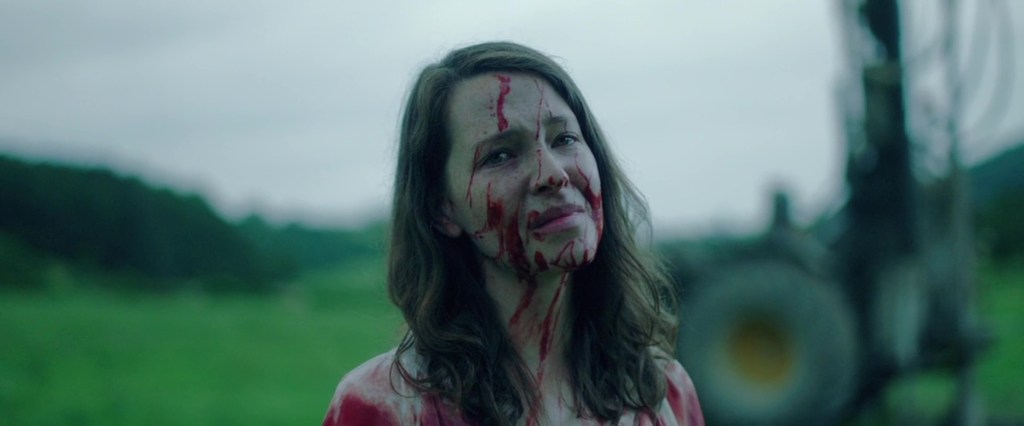
The final scene of the film is a tour de force by Annes Elwy, no longer Cadi but now the goddess, covered in blood, at first smiling at her triumph, but then sinking into grief at the prospect that the war will continue until either humanity or nature (including us) is destroyed utterly.

Like Helen Mirren in The Cook, The Thief, His Wife and Her Lover, she is looking directly at us, the viewers, accusing us of complicity, both in the war and the cannibal feast.

The film scored a very respectable 82% on Rotten Tomatoes, meaning that four times more critics liked it than didn’t. Those who didn’t carped about it being slow in the first half, a criticism that is often levelled at movies sold as horror but offering more intelligent themes than just slasher gore. The acting is superb, the photography is stunning, particularly of the natural environment and the contrast with the stark family home, and the soundtrack is never less than interesting, and often (especially the Welsh songs) quite enchanting. Well worth seeing, and perhaps, as the Director suggests, more than once.

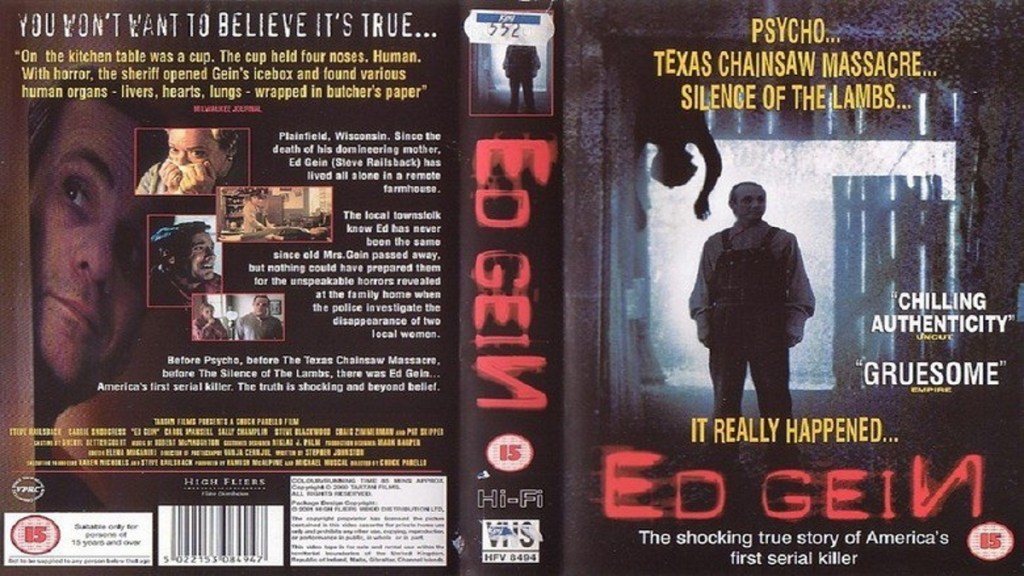
The Butcher of Plainfield: ED GEIN (Chuck Parello, 2000)

Ed Gein is an important figure in the study of American cannibalism, not because he ate a lot of people (we can’t be sure how many) but more for the inspiration his deviant activities furnished to some great books and movies, after his arrest and incarceration.

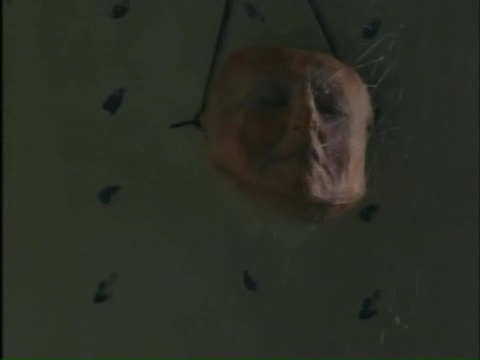
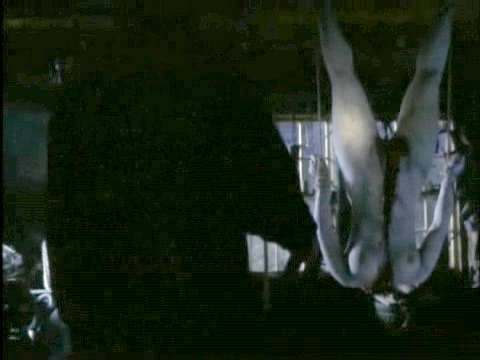
This film, called Ed Gein in the US and Australia and In the Light of the Moon in other markets, follows the life and crimes of the Wisconsin man who became known as “The Butcher of Plainfield”. Plainfield is a little town in Wisconsin, about forty miles from Chicago. Gein would haunt the cemetery at night to dig up corpses of recently deceased women, take them home and make all sorts of things out of their body parts. As well as chairs and lampshades covered in skin, bowls made of human skulls and belts made of nipples, ideas inspired by his fascination with Nazi atrocities, Gein would make women suits out of human skin (which inspired Jame Gumb – “Buffalo Bill” – in Silence of the Lambs) and then dress up as his Mama (which inspired the book and later hugely successful 1960 Hitchcock movie Psycho). His facemasks made out of human faces inspired the character Leatherface in The Texas Chain Saw Massacre. Truly a seminal figure in cannibal studies!

The plot is pretty much an accurate retelling of his hijinks, as far as anyone can tell without asking him (and he claimed he couldn’t remember anything about the murders, plus he’s dead now anyway). Ed (Steve Railsback, who had played Charles Manson several years earlier) grew up with a mother (played by Carrie Snodgress of Diary of a Mad Housewife fame) who was a vituperative fundamentalist and beat the fear of God into her children.

Ed worshipped her and thought she was a saint, and went batshit crazy when she died.

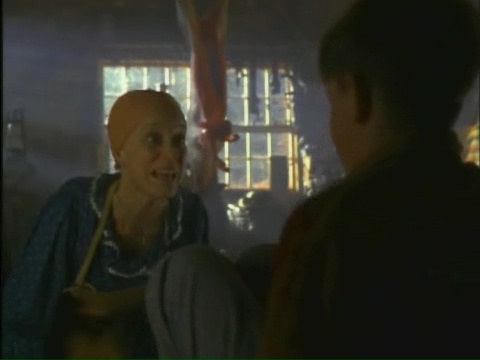
But in a tiny little town like Plainfield WI, everyone was a bit weird (the film starts with some genuine interviews of the locals, and they look even stranger than Ed). Local people thought him odd but harmless, and even employed him to babysit their kids. He seems to have had no interest in women, until the ghost of his mother appears to him in a burning bush (I kid you not, this is how much he is Biblewashed).

Meanwhile, Ed spends his nights digging up recently deceased women and souveniring their parts, particularly their lady-parts, which he has researched pretty solidly.

His house if full of his trophies: lamps made from human spines, and shrunken heads.

But what he really wants is for Mama to return from the dead. He practices on his excavated corpses to see if he can command them to “AWAKE – AND ARISE!” and one seems to turn her head, but by now we are deep in his psychosis. He visits his mother’s grave and begs her to return.

He reads books about head-hunters, Nazis, and even the pulp detective comics that he used to get into trouble for wanking to in his younger days.

There are flashbacks to those younger days, including the funeral of his brother (whom, the movie tells us, he killed, which may also be true). Ed hugs his Mama, telling her it’s just the two of them now, but she pushes him away, feeling his overenthusiastic erection. Ed is a sinner, and he needs his saint.

So anyway, Mama’s ghost tells him that the women of the town are all sinners, whores, and he must visit God’s judgement upon them, then she will be able to return to him. Pretty clear to us, the audience, that he is having psychotic delusions, but to him it’s all very real, so he heads off to shoot, kidnap and eventually fillet and cook two of the townswomen – the one that runs the bar in town and the one that runs the general store. He also collects mementos like noses and breasts, and he particularly likes vulvas.

The rest of the bodies are not wasted either.

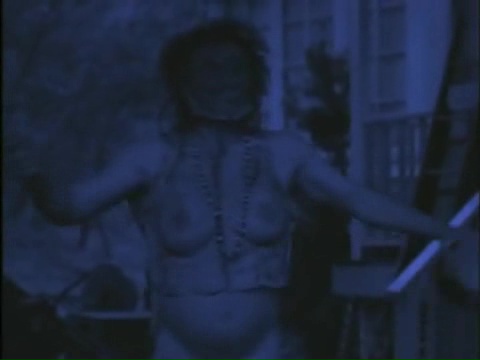
He has no neighbours within screaming distance, so he can get up to whatever he wants, including dancing in the moonlight in what Hannibal would call a “vest with tits”.

But bloodshed is not really his thing (even though he killed his brother, but that was for insulting their mom). The men of the town go off hunting deer as soon as the season starts, but Ed tells one of his prospective victims that he hates hunting.

But Mama has other ideas, and it’s clear that Ed has learnt, as a good Wisconsin carnophallogocentric man, how to dress a carcass. The men of the town are spending their nights inculpably slitting open harmless ruminant mammals of the family Cervidae, but are shocked and nauseated when the carcass in Ed’s basement turns out to be of another species. The word “butcher” has dual meanings – the butchers of Plainfield are horrified by activities of the “Butcher of Plainfield”. Put a capital B on the word butcher and it moves from blameless to shocking. But it’s hard not to notice that, until his psychotic delusions of mother take over, poor Ed is doing what everyone else is doing, but he’s doing it to dead bodies rather than living white-tailed deer.

Once the cops finally accept that Ed is not a harmless eccentric, they find lots of interesting things in his house.

This was a huge story in 1957!

So that’s Ed, our modern, domestic cannibal – a man (usually) who seems a bit odd but, everyone thinks, is apparently harmless. Think of the big names of modern cannibalism – Albert Fish, a sweet old man who took ten-year-old Grace Budd off to a purported children’s party, but really took her home for his dinner. Jeffrey Dahmer, who took young men home for photography and sex but then drugged them, drilled holes in their heads and ate parts of them. Armin Meiwes, who advertised on the Internet for someone who wanted to be eaten, and ate the successful applicant. Issei Sagawa, who shot a fellow grad student at the Sorbonne because he wanted to have sex with her corpse and then eat bits of her. Each of them were described by their neighbours as either “normal” or a bit odd but harmless.

Chuck Parello and Steve Railsback won Best Film and Best Actor respectively at the 2000 Sitges Film Festival, one of the leading festivals featuring horror and fantasy films. But the film scored a wretched 10% on Rotten Tomatoes, with critics calling it “dry and dull.” I beg to differ. Ed is played as dull, because he appeared to be so, right up until he imagines Mama riling him up to declare war on loose women. His dullness and misapprehension of social and religious conventions that are usually unquestioned, is the whole point of the film, and the two main actors, Steve Railsback as Ed and Carrie Snodgrass as Mama, do a superb and convincing job. The slow, rural pace makes the sudden appearance of violence and body parts all the more shocking, and there’s plenty of both. The deaths when they happen are slow and wretched, as they would no doubt be in real life. There’s a surprising amount of suspense, the soundtrack admittedly is incredibly annoying, but other than that it’s a pretty great cannibal film, with lots of interesting philosophical questions to chew on.

Is Anne Hathaway a cannibal?

The short answer, as far as anyone who knows anything about it knows, is NO.

The long answer is still no, but involves a Twitter experiment, which turned into a viral storm.

It started on Saturday, June 25, when a fan posted a picture of Anne Hathaway (below) from Elle France magazine. When I last checked, this post had over 300,000 likes, 23,000 retweets and 4,600 quote tweets.

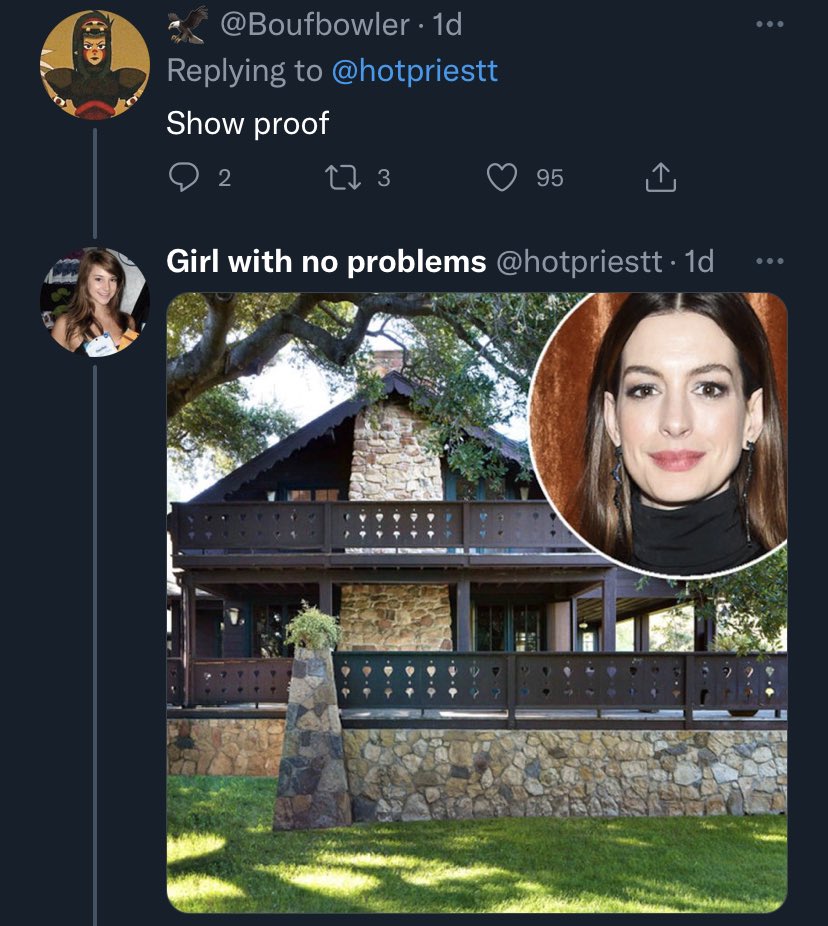
That’s where it got complicated, because while most of the comments declared undying love for her, one of the quote tweets, from a user named hotpriestt, stated 

“every tweet about anne hathaway going viral like police didn’t find human remains and evidence of cannibalism in her LA home that she sold in 2013”

The original quote tweet was later deleted, but others have since tweeted the same, rather confusing, text.

This understandably caused some consternation, since we are all sure that everything printed on the Internet generally, and Twitter in particular, is invariably true.

One tweeter demanded: SHOW PROOF, to which the original tweeter replied with a picture of the supposed house in which the purported cannibalism had taken place. Not sure that evidence would stand up in a court of law as proof, but apparently it was pretty convincing for some Twitter users.

Some thought that the fact she never seems to get any older indicates that she is eating human flesh, or at least bathing in the blood of virgins like Elizabeth Báthory. Or else eating human fetuses, like Mrs Li in Dumplings.

One Hathaway fan declared that she “doesn’t look like” she had eaten people. Another replied:

“What are you meant to look like when u eat people?”

After leaving this internationally important debate to brew for a few hours, the tweet’s author returned to Twitter on June 26 to say:

Harvard University has provided no information to the media regarding this purported study, or any evidence that Anne Hathaway has any connection to cannibalism, and it seems unlikely that a University would involve itself in a study that sounds decidedly defamatory. Meanwhile, the user who posted the viral tweet cancelled their Twitter account.

So it was, amazingly, all a fake. One Twitter user admitted to having spent “15 minutes googling this shit.” Another admitted:

There’s a moral there somewhere.

Hathaway does have some odd eating habits though. She went vegan in 2011, not for ethical reasons but to lose weight for the role of Catwoman in The Dark Knight Rises. She kept it up until a dinner with Matt Damon during the filming of Interstellar in 2014, when she tried some fish and “my brain felt like a computer rebooting”.

That statement of course is somewhere between wishful thinking and deliberate obfuscation. She felt like fish and ate it without qualms, because she had not gone vegan in order to spare fish or other sentient animals from the agony of being farmed and killed, but simply for her own appearance. The idea that anything other than drugs can instantly affect the brain before even being digested, let alone distributed to the cells of the body, is absolute bullshit (which is also not vegan). To me, the fish story is the silliest untruth of this blog, more so than the cannibalism story.

 Hathaway went vegan again recently (raw vegan this time) to prepare for the role of Rebekah Neumann in the new series We Crashed, which premiered on Apple TV+ in March 2022. That didn’t stick either, and she is reportedly back on burgers.

So. Anne Hathaway is not a cannibal, in that she doesn’t knowingly eat human flesh. She is a mammal eating mammalian flesh though, so I guess that makes her (like most people) a kind of cannibal.

And after all, who knows what was in that burger?