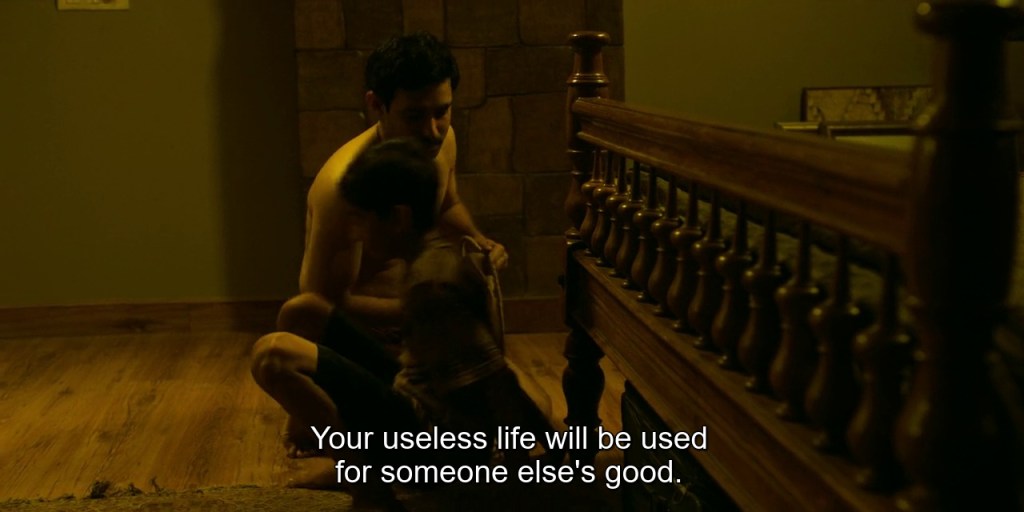
Christmas warning: “THE 12 DEATHS OF CHRISTMAS (MOTHER KRAMPUS)” James Klass, 2017

According to Hollywood, everyone eagerly anticipates Christmas, which must be why incidents of violence flare over the festive season (largely driven by festive booze). Christmas goes for twelve days (they tell me), which covers the New Year mayhem as well, and reportedly involves a lot of odd things like lords leaping and pear trees containing medium sized birds. This film covers the twelve days, but omits French hens and turtle doves, etc, in favour of lots of blood and gore. I reviewed it many years ago, but it seems worth a fresh “bah humbug” as I recover over my keyboard after battling greedy retailers and stressed-out motorists.

“Bah! Humbug” always seems like a pretty good response to the confected cheer of Christmas, particularly to those who do not, for various reasons, celebrate the event or conform to the voracious consumerism that accompanies it. If you are one of the many who is over the Christmas rom-coms and tear-jerkers, you may have already come across the German Christmas demon Krampus, who appeared in a 2015 movie from Michael Dougherty, involving goblins, killer toys, malicious snowmen and a jack-in-the-box that eats a child whole, although he has been punishing naughty children for a lot longer than that, and may date back to pre-Christian folklore.

The cannibal movie reviewed today, though, was originally called The 12 Deaths of Christmas and features a different villain – a Christmas witch named Frau Perchta who, according to legend, steals a child each of the twelve nights of Christmas. The witch is also said to slit open the bellies of disobedient children (not dissimilar to the threats of cannibalism which Andre Chikatilo’s mother used to keep him in line). The film’s name was changed to Mother Krampus for the American audience, many of whom have adopted Krampus as a sort of anti-Santa. Frau Perchta does not have nearly the same fan base.

The Santa Claus dogma is of course about socialisation – children are told that a large stranger will sneak into their houses at night and reward them if they are “good”. What if they are not good? Who will sneak into their house then, and what mayhem will ensue? Krampus was one answer, Frau Perchta another. Then there was Santa’s assistant, Père Fouettard who, in a nod to the suffering energy corporations, hands out lumps of coal to children who are not deemed to have been good, and sometimes whips them too (the name Père Fouettard translates as “Father Whipper”. Following Santa around appears to have been his punishment for engaging in a bit of entrepreneurial cannibalism, in which he and his wife drugged three children, slit their throats, cut them into pieces, and stewed them in a barrel, to be sold as Christmas hams. The taste, allegedly, is almost identical.

But today’s film is not just about stealing the bad children, and perhaps killing them, no, it’s all about the punishment of the wicked being extended to the following generations – a popular theme in the Bible (check out Deuteronomy 5:9 for some unfair shit). Perchta is coming for the children of adults who wronged her.

One of these children, and the protagonist of what passes for the plot, is Amy (Faye Goodwin – Mandy the Doll). Her mum is Vanessa (Claire-Maria Fox of Suicide Club and Bride of Scarecrow), and Vanessa’s dad – Amy’s grandpa – (Tony Manders, from The Young Cannibals) lives outside the village, near a scary forest in Belgrave (the UK one), and asks her to drive him, on Christmas no less (no Ubers I guess) to the Church, where a bunch of locals want to discuss the focal local issue – lots of village children are disappearing. There we finally get to hear the legend of the witch:

“Frau Perchta was a witch, who over Christmas stole the souls of children.”

Dad admits to Vanessa that the peaceful villagers got together to kill an old woman 25 years ago. We, the audience, know the background, through an endless voiceover accompanied by cards at the start of the movie. 12 kids disappeared over the 12 days of Christmas in 1921, and none were found, except for one girl whose mind was gone, and she could only scream “the witch! The witch!”

Then, in 1992, five more kids disappeared, their bodies were found in the forest, and the villagers believed, for reasons far from clear, that a nice old lady was the killer and was in fact Frau Perchta the witch, so they stabbed her and lynched her, as you do if the local constable is on leave, in a backward and primitive town like Belgrave, which apparently hosts the National Space Centre!

But as she died, she shouted a curse – that Frau Perchta would be back to wreak revenge on them, and their children. So, maybe she wasn’t quite so nice. Yeah, that’s about it for plot – we see (several times) the stringing up of the old woman, we see the risen witch. The witch kills lots of people in creative ways, including one who is cut up and made into a Christmas light show, another whose flesh is pressed into a cookie cutter to make Christmas peoplebread men, while another is trussed up like a Christmas turkey with an apple in her mouth and carved up, and her flesh cooked and fed to her boyfriend, who is Amy’s absentee dad. Then dad has his heart pulled out and eaten (not uncommon in cannibal stories – think Fresh Meat or even Hannibal).

The climax of a horror film (or any action movie) is usually the last ten minutes, in which the story is resolved and the bad guy defeated (until the sequel). This one goes on (and on and on) for about half an hour, presumably to ensure the film is considered a full-length feature, and it resolves nothing much, with a twist at the end that makes no sense at all. But lots of people get killed, and several have parts of them eaten, which is enough to get a mention in this blog, I guess. The plot is thin, the acting is often appalling, the continuity director in some parts seems to have been taken into the forest and eaten. But it’s presented as a low-budget slasher, and that’s what they are often like – they are not dramatic masterworks, but gruesome pantomimes. The idea of one child’s aunt walking him home through the dark forest at night when bodies are turning up everywhere is narratively absurd but, in a panto, we want to anticipate the villain, we want to guess what is going to happen, and yell at the actors to “look behind you!” And the gore, and the fright factors, are quite well done.

The moral of the story, if there is such a thing, is pronounced by a mysterious woman who turns out to be Amy’s grandma, not that it does her much good.

“Taking it into our own hands, playing God. That’s why all this is happening.”

Isn’t that exactly what humans do – play God? Nietzsche told us that God is dead, we killed him, so we have to become God. We play God in so many ways – the Christmas story in essence is about a Jewish family trying to escape one of the many psychopaths who have played God over the centuries. We play God when we nominate ourselves as above nature, more angel than animal, and proceed to destroy our own ecosystem. Who bears the suffering from such follies? The children. Like Frau Perchta, our vicious brutality usually comes back to haunt us, through the generations.

At the time of writing, the full movie (should you wish to bother) is available on YouTube.

A Fear in Provence – DELICIOUS (Nele Mueller-Stöfen, 2025)

Delicious is a German horror film, a genre that has a proud history, but it’s also a psychological and socio-political drama that examines the many ways the rich eat the poor, and the potential for revenge. It is written and directed by Nele Mueller-Stöfen in her directorial debut, although it as well made as a work from far more experienced directors.

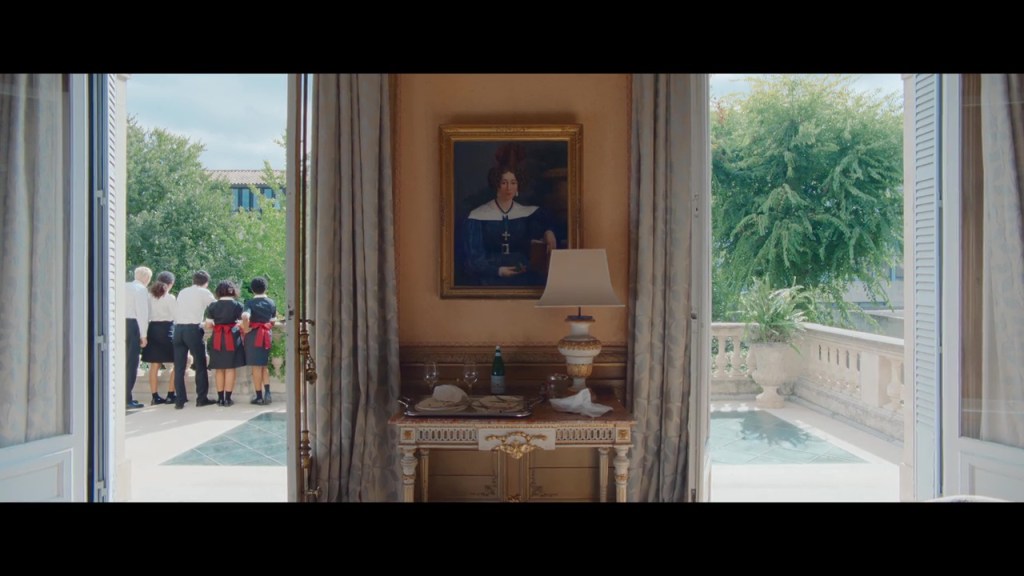
The film starts with social and class-based unrest. In the opening scene, a rich German family are in a car fitted with bulletproof glass as protesters swarm the streets of Paris, jumping on the car and fighting with police. The father is unworried – “they’re not interested in us.” Perhaps that’s true, but the protests are about poverty and the cost of living, and others are very interested in this family.

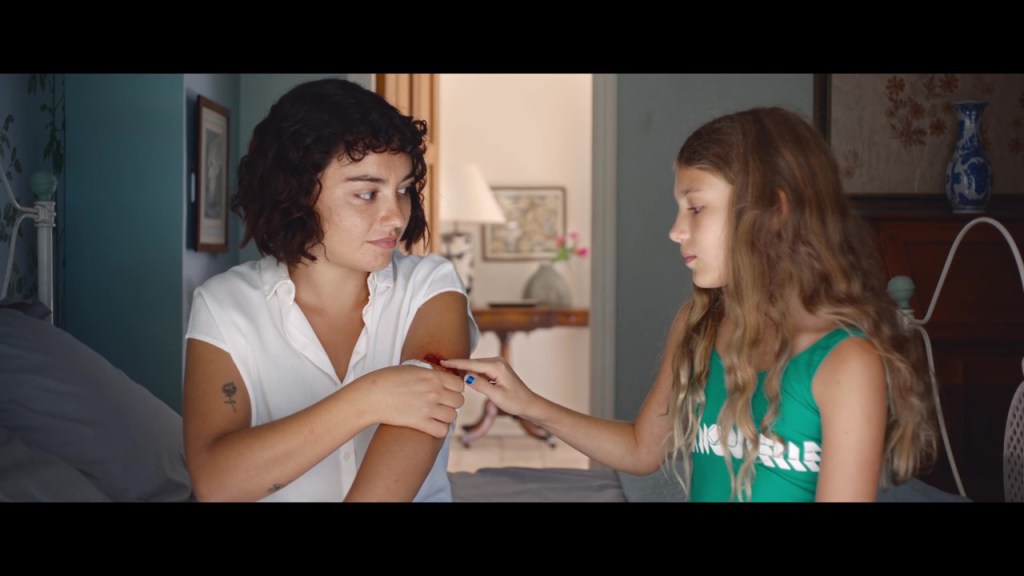
As they settle into their holiday home in Provence, another group of young working-class people watch them, the serving staff, who live impoverished lives as they wait on the rich, in a hotel room where they are lying on rich people’s beds and pissing in their fancy mineral water bottles. They work at a fancy hotel nearby, and observe as the family have dinner and a few drinks. On the way home, somewhat tipsy, they appear to hit a young woman walking across the road. In fact, we know that her friend has deliberately cut her arm to make the accident more believable. She reopens the wound when necessary, to maintain her connection to their guilt.

The next day, she tells them she has been fired for not being able to work after the accident, and asks for a job as a maid, but she gradually infiltrates the lives of each member of the family. They have designs on her body, but she and her friends have designs on theirs, and (this being a cannibal blog) you can probably work out what is going to happen well before they do.

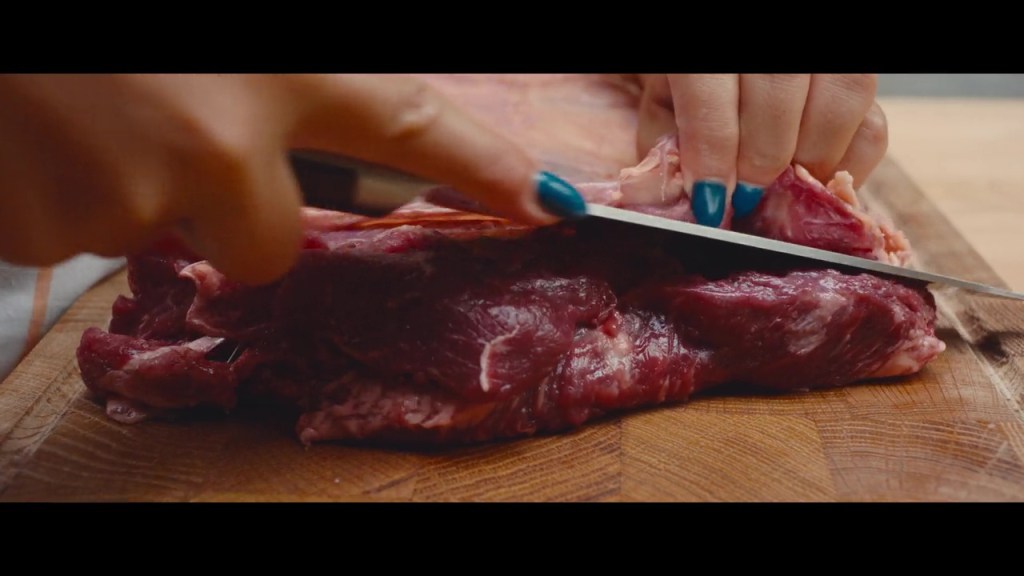
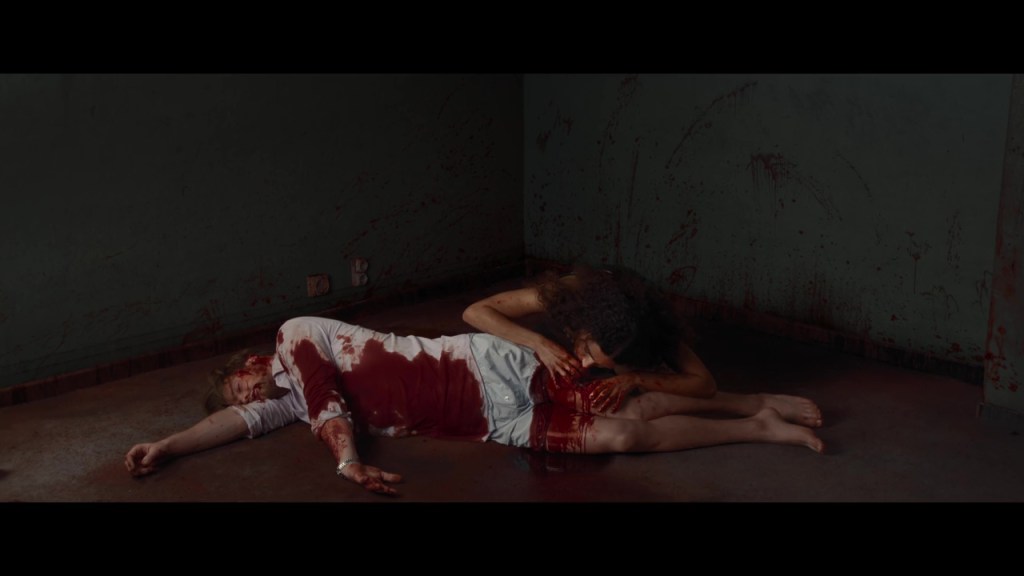
Serving the rich (in some novel senses) is definitely on the menu, as blood and meat (eaten raw) feature in the early scenes. Less gory versions of eating too, including cunnilingus.

I’ll avoid spoilers, because it’s on Netflix, which means a lot of people will probably watch it. It’s beautifully filmed and well acted, but does tend to drag in the middle, although that is not unusual for European films – they never seem to be in the same hurry as Hollywood, which may explain some of the appalling reviews. But by the time the wife goes to a party with the young ones, we are right into it.

The way of the world is usually the rich squeezing the life out of the poor, and while there are many films about that (think Fresh, The Cannibal Club or What You Wish For), there are not many that look at the retaliation which the exploited must often crave. Eating Raoul captured that anger and propensity to violence well, and this one does it too, without the humour, but with a cast of fine young cannibals for whom the viewer may well feel some sympathy. The family, beset with their own issues to do with work and relationships, does not see disaster coming, and that is the basis for most good horror.

“You have high gates, but your perfect world cannot be separated from ours.”

The plot unravels slowly and by the time blood starts to flow, it’s almost time to finish the film. If you like plots where the invisible reclaim their power, you may enjoy this. Think Parasite or Saltburn, but with the added spice of cannibalism.

At one point Teodora, the “maid” quotes the Marxist, Antonio Gramsci, to her supposed boss.

“The old world is dying, and the new world struggles to be born: now is the time of monsters”

In the time of the monsters, when humanity has turned the planet into a giant abattoir, assuming that some are edible and some are not is just a social construction, with little rational basis. Riding off on their motorbikes, the cannibals seem to have cast off such contingent social customs. But who, the film asks, are the monsters?

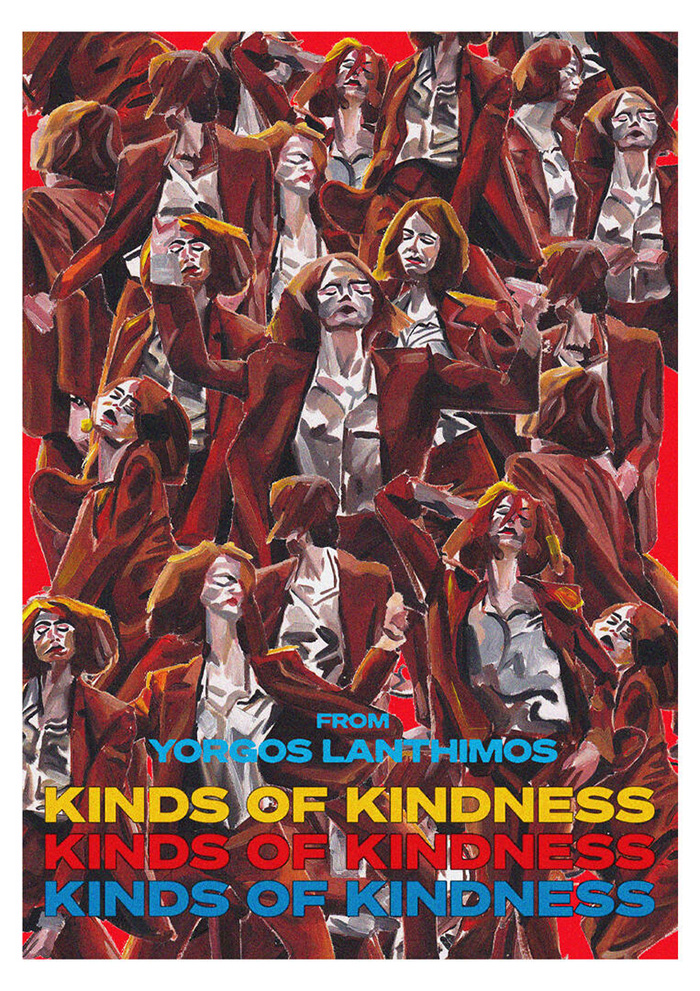
“Your fingers are revolting”: KINDS OF KINDNESS (Yorgos Lanthimos, 2024)

Kinds of Kindness is a black comedy drama, presented as a “triptych fable” – three separate stories which are nevertheless connected. The director, Yorgos Lanthimos, has made many celebrated films, including The Lobster, The Killing of a Sacred Deer and most recently Bugonia. He has won a BAFTA and been nominated for five Academy Awards. Kinds of Kindness has his regular extraordinary cast, including Emma Stone, Jesse Plemons, Willem Dafoe and Margaret Qualley.

When directors use ensemble casts, it usually means they use the same actors in a series of unrelated films, but this one is really three films in which the same actors play different roles. The one of interest to us is the middle section, “R.M.F. is flying”, which employs the theme of this blog, cannibalism. But the whole film is a entertaining (if somewhat lengthy), and there is a relationship between the three parts that makes an interesting, if somewhat disorienting and bewildering, whole. Life imitates art, in that the director and Stone have recently been involved in signing uninformed statements about international politics, an area in which they clearly are sadly ignorant. Imagined kindness becomes abusive behaviour, the theme of the film.

Spoiler alert – if you haven’t seen the movie, and plan to do so, maybe do that first.

The first part of the trilogy explores abusive relationships, particularly in the workplace, as Robert (Jesse Plemons) lets his boss Raymond (Willem Dafoe) control every aspect of his life. Raymond is loving and generous (a kind of kindness), but only as long as Robert obeys every order Raymond gives him, including his daily food regime, his sexual activities, and the order to kill a person known only as R.M.F. Kindness is presented as a toxic attachment.

The second story, R.M.F. is Flying, follows a police officer named Daniel, (Plemons), whose wife Liz (Emma Stone) has disappeared at sea while on a biology research expedition. Despite all predictions, she is found and flown back home by R.M.F., but Daniel believes she is an imposter – her shoes don’t fit, she does not remember his favourite song, and she suddenly loves chocolate which she previously could not stand, telling of a dream where dogs were the master species and fed their pet humans on chocolate.

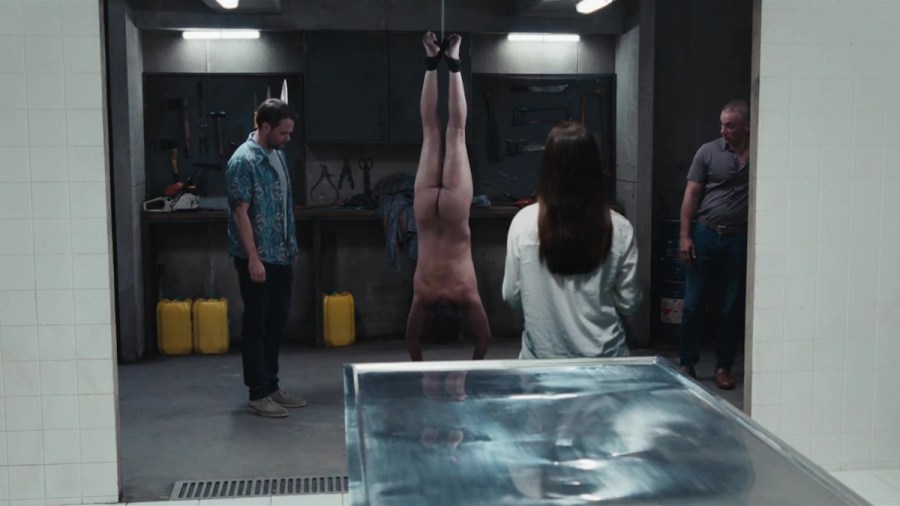
Flashbacks reveal how she survived – by cannibalising the other members of the team.

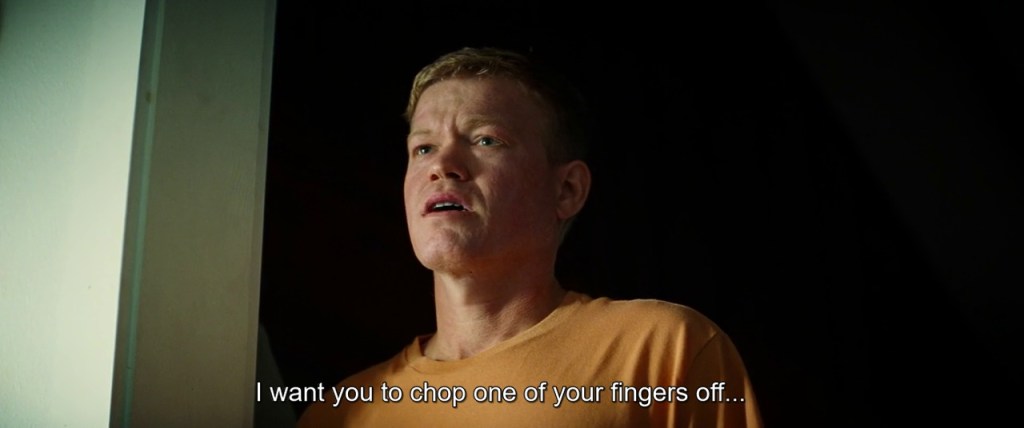
At one point, the distraught cop Daniel shoots a suspect in the hand, and starts licking up the blood from the wound, just as a dog might do. Like the dogs in her dream, Daniel becomes Liz’s pack leader and she accepts his humiliation and cruelty like a “beta dog” would. Demanding she prove her love, Daniel asks her to cook him one of her fingers or thumb, and we see her cut it off and fry it.

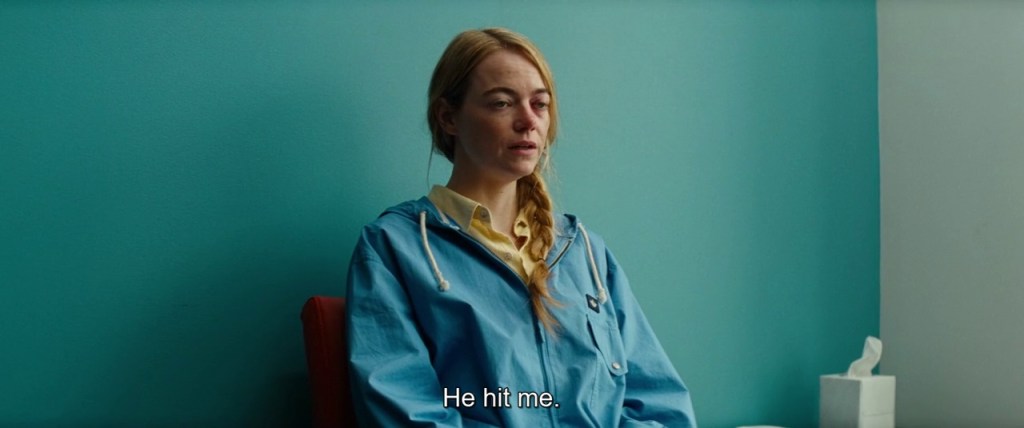
When she reveals she is pregnant, he beats her until she loses the baby.

Finally, he says he is still hungry, famished, and says he wants her liver. She removes it with a kitchen knife, dying in the process, and we see the ‘real’ Liz appear at the door, to be greeted lovingly by Daniel.

The closing credits show dogs driving a car, a dead human lying by the roadside like roadkill. This story exposes kindness as vulnerability in intimate relationships. Daniel is determined that Liz be exactly as he wants her and rejects all her overtures of love, eventually leading to her death and rebirth as his ideal wife.

The final story examines a sex cult led by Omi (Dafoe) and Aka (Hong Chau) where followers are purified by drinking water cleansed by the tears of the leaders, and can thereafter only have sex with Omi and Aka. Emily (Stone) and Andrew (Plemons) are paired and sent out to find a messiah – a woman who can revive the dead. Emily, like many converts to cults, has left her family behind, although she sneaks into her old house sometimes to sit on her little girl’s bed. Eventually she goes to visit her family, but the daughter is asleep and her ex-husband drugs and rapes her, meaning that she is now, to the cult, ‘contaminated’, and so ejected from the compound. She perseveres and eventually finds the messiah, a veterinarian named Ruth (Margaret Qualley) who heals a stray dog whose paw Emily has cruelly cut. Liz drugs Ruth and takes her to the morgue, where Ruth brings back R.M.F. from the dead. Triumphant, Emily drives the still dazed Ruth to cult headquarters after doing a victory dance that appears in the trailer at the top of this blog. As the credits roll, though, her reckless driving ends up with her driving her Dodge Charger into a wall, killing Ruth. Abusive kindness again, this time as spiritual devotion turned toward thralldom and abuse.

In all three stories, the characters seek fulfilment and, yes, kindness, going to excessive lengths to achieve it – Daniel kills a man to win his boss’ love, Liz cuts out her own liver to feed her husband and placate his repulsion, and Emily kidnaps her purported messiah to win back the love of her cult leader.

The film is an absurdist romp, reflecting the incongruity of human relationships and social behaviour. In each part, someone is being exploited and abused, a form of consumption, but the middle story makes cannibalism, inherent in all abuse, graphically apparent. There are many variations of cannibalism; Liz indulges in starvation cannibalism to survive as she waits to be rescued, Daniel becomes psychotic and licks blood from a wounded civilian, Daniel indulges in revenge cannibalism, ultimately killing Liz.

When he is convinced the woman that was rescued is not really Liz, he becomes contemptuous, and from that point, her death and consumption are inevitable. She has been, in his eyes, dehumanised, objectified like the animals sent to their deaths by the billions every year for human consumption. They are “de-animalised” – their flesh turned into commodities, made to look as little as possible as the living, feeling animals from which it came. For humans to be cannibalised, they must first be animalised, then de-animalised.

Thus, Daniel licks the wound of the man he shot like a dog might treat a wound; thus, Liz’s dream in which the dogs are in charge and feed the humans, not exactly what they want, but chocolate, of which there is plenty, probably because dogs cannot eat it (it’s toxic for them).

In relationships built on distrust and rage, we are animalised, and animals like dogs become the paradigm of civilisation. The humans are just wearing people masks.

Cannibal eat thyself!

The immigration debate in the USA and in other countries has quickly polarised between those who see immigrants as pioneers, walking in the footsteps of all those who settled the lands during the period of colonialisation and their descendants (which is almost everyone except surviving indigenous people), and subhuman invaders who flood the country, take the good jobs, and rape and kill the innocent.

President Trump has referred to undocumented immigrants as being criminals and rapists (although he said some might be “good people”), who come from:

“… jails, prisons, from mental institutions, insane asylums. You know insane asylums. That’s ‘Silence of the Lambs’ stuff. Hannibal Lecter…”

So we waited eagerly (or perhaps apprehensively) to meet these undocumented Hannibals. Now, the Homeland Security Secretary, Kristi Noem, has described how federal agents nabbed a purported cannibal illegal migrant who started to eat his own arms during a deportation flight.

On July 1 2025, Noem was visiting the “Alligator Alcatraz” deportation camp in the South Florida Everglades alongside President Trump. This is a the detention centre located about 40 miles west of Miami and surrounded by alligator- and python-infested swampland.

At a press conference, she said:

“The other day I was talking to some Marshals that had been partnering with ICE. They said that they had detained a cannibal and put him on a plane to take him home and while they had him in his seat, he started to eat himself, and they had to get him off and get him medical attention.
These are the kind of deranged individuals that are on our streets in America that we’re trying to target and get out of our country because they are so deranged, they don’t belong here. They shouldn’t be walking the streets with our children, and they shouldn’t be living in the communities with our families who just want to grow up, go to [their] job, raise their children to grow up and get a job, and to live the American dream….
We are going after murderers and rapists and traffickers and drug dealers and getting them off the streets and getting them out of this country.”

Hard to know what to make of this, since the Department of Homeland Security could not immediately provide corroborating details of any case to match Noem’s story. Was this person a cannibal, and if so, who did he eat? Why did he chew on himself? Is airline food that bad?

The story of human evolution: get eaten, or eat ourselves.

“WHAT YOU WISH FOR” (Nicholas Tomnay, 2024)

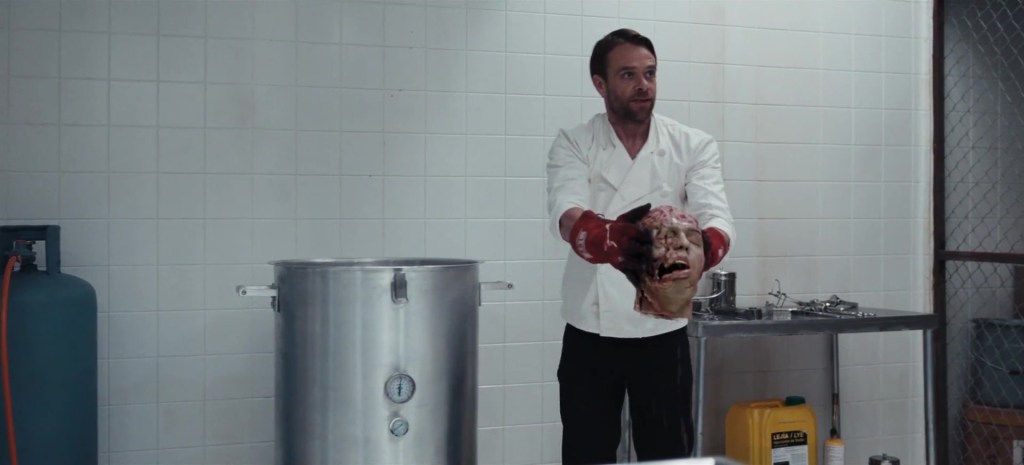
Be careful what you wish for! Aesop warned us of that over two thousand years ago, in his fable “The Old Man and Death.” In that story, an old man is so sick of picking up wood in the forest that he drops his bundle and calls on death to free him from his never-ending labours. But when Death appears, he reconsiders, and asks Death just to replace the bundle of sticks onto his back. In this movie, the sticks are gambling debts, and Death is a catering agency that pays chefs to kill people and cook them for rich people. Can his request be retracted like Aesop’s old man?

Look, many of us have sat in a restaurant, even (perhaps especially) the expensive ones, wondering what the hell we were eating. We rarely ask though – too polite, too squeamish, or too indifferent. If it’s on the menu, we figure, it must be OK. Once we’ve asked the waiter for the dish, it’s usually too late to retract. In Mark Mylod’s 2022 film The Menu, audiences speculated on whether the Chef (Ralph Fiennes) had served up humans in his exquisite banquets, including perhaps the Sous Chef and even his own mother, but it was never spelled out, so has not graced this cannibalism blog.

But in this week’s film, Nicholas Tomnay’s What You Wish For, the cannibalism is much more open, particularly for the diners, who are willing to pay big bucks for this, shall we say, unorthodox cuisine. Nicholas Tomnay is an Aussie (like the author of this blog) who works out of Sydney, New York and San Francisco. His first feature film was The Perfect Host (2010) which also included a lot of dining, and What You Wish For follows in this vein, but with a lot of human flesh involved.

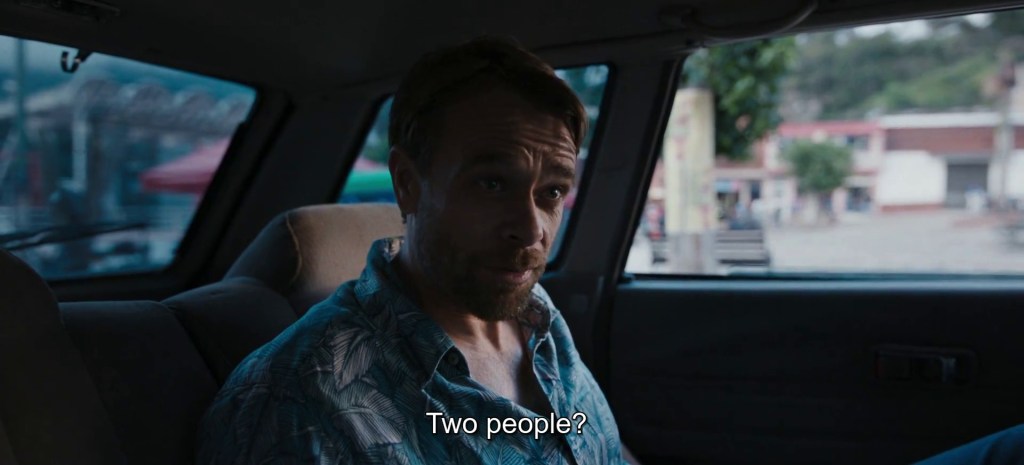
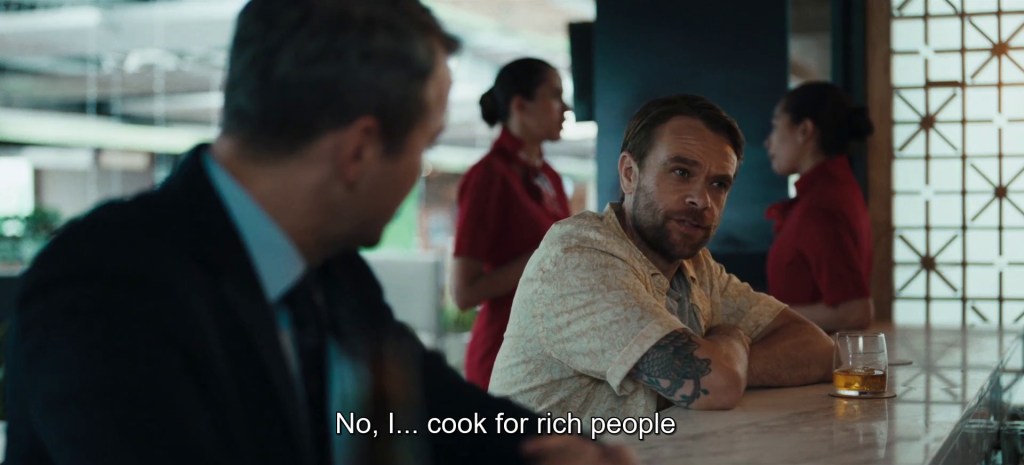
Ryan (Nick Stahl from Man Without a Face) arrives in Colombia (South America) at the invitation of his old friend Jack (Brian Groh). Ryan is on the run from massive gambling debts he has foolishly amassed. Although the debt collectors don’t know where he is, they do know where his mother is, and send him pictures to prove it. He needs lots of money and quickly. His friend Jack seems to have it all – a fancy house where he just has to cook one meal for the agency that contracts him, a fortune in his bank, and big pay cheques delivered after each meal.

But Jack is troubled by conscience, telling Ryan,

“The reward always matches the atrocity”

While Ryan is still coveting Jack’s lifestyle, Jack hangs himself. Recovering from the shock, Ryan realises that all he needs is a fake driver’s licence and a new password to become Jack and access all his money.

But when the agency people arrive – Imogen (Tamsin Topolski) and Maurice (Juan Carlos Messier) – they think he is Jack, and assume he knows what they want him to cook, are angry that he has not yet harvested the meat.

It turns out that his “ingredients” are local poor people, preferably ones who won’t be missed, and Imogen warns him that preparing and serving one bad course will be fatal not just to the person being cooked, but to the chef as well. The guests pay $1.5 million for the meal, including the exotic location, the private jets, and the specially sourced meat. They have special requests too – Imogen tells him “make sure you harvest the tongue.” So any thought of Ryan skipping out before the feast is extremely unpalatable (sorry).

The rationalisation is the same one found in most capitalist enterprises. It is the utilitarian argument in favour of the greatest good for the greatest number. Imogen tells Ryan:

“We kill on average fifty people a year, plus twenty-five in the clean-up. So, 75 deaths a year, and we generate over one hundred million dollars. We funnel 100% of our profits back into the communities. The farming, the infrastructure. We ensure clean drinking water for the entire population. You might say that’s simply self-interest. But we don’t eat everybody. Not even one percent. Now, you tell me what company makes that amount of money, has global presence, assists more than 99% of the people in the communities within which it operates, and their footprint has only ever killed 75 people a year? Oil companies kill on average 110 people a year, farmers are on about 250. Groundskeepers, truck drivers, roofers, they all thrash us in fatalities.”

 The rest of the discussion is phrased in the same vocabulary as used by the meat industries. Old ones will taste disgusting, fear will taint the meat, the butcher will be covered in blood.

The victims are “produce” and become no more or less than “livestock”. Maurice, the agency killer who goes hunting with Jack, assures him “they won’t feel a thing”. When Ryan asks him if he feels bad, the reply is,

“Do you feel sad for a pig when you eat the bacon?”

Jack does what he has to do, after all his attempts to escape or alert the police are foiled.

Imogen sympathises with his nagging conscience, telling him what every soldier, assassin, slaughterhouse worker or meat eater is told at first:

“No one likes it at the beginning. But after a while, it does stop bothering you”.

There is a popular meme about “eating the rich”, and even a few movies about it (e.g. Eat the Rich and Eating Raoul). But the facts of nature, humanity and economics are that the rich and powerful get to choose what, and who, they eat. In the film The Cannibal Club, rich Brazilians watch poor people fight to the death and then eat the loser, in Fresh, the protagonist chats up young women then drugs them and sells their flesh and their underwear to the “one percent of the one percent” who want what no one else can have, and can afford to pay for it. Jeffrey Epstein had a similar gig, supplying sex rather than meat.

The people with the power, the rich, eat the poor: they swallow their surplus labour, they squeeze rent from them, they sell them their shoddy products paid for by lending them money at ruinous rates, and they send their children off to war. Why not go the next step and literally cook them for dinner? It’s what we do to other animals, purely because we can.

The film is sumptuously presented, the direction is assured and convincing, and the actors are all first rate, including the wealthy guests and the police who pop by and share the main course. The film is rated 80% “Fresh” on Rotten Tomatoes.

One reviewer opined, What You Wish For will convert you to vegetarianism forever”.

Trick or meat: SECTOR 36 (Aditya Nimbalkar, 2024)

Children wandering door to door, sometimes unsupervised, is often likely to end in tears. In this film Sector 36, immigrant parents, struggling to survive, have not the time to keep a watchful eye on the kids, resulting in sexual abuse, murder, organ trafficking, and cannibalism.

The words “inspired by true events” allow for all sorts of poetic licence, offering the fascination of actual criminality without the need to prove the veracity of each scene. This one is fairly close to the facts, being based on the 2006 Noida serial murders, in which over thirty children disappeared from a town in Uttar Pradesh in northern India. Evidence was presented, in the trial of the two alleged perpetrators, that the children had been sexually abused and murdered, had their organs sold to traffickers, and in some cases were eaten. The charges included abduction, rape, murder, criminal conspiracy and trafficking. The two men involved, a rich man and his servant, were found guilty of murder in 2009 and sentenced to death but were later (2023) acquitted of all charges against them due to insufficient and largely circumstantial evidence, despite the servant’s recorded confessions, which included admissions of cannibalism.

Before the acquittals, the BBC released a documentary called The Slumdog Cannibal, which tried to examine the motivations of the servant who had admitted to the crimes. The legal position becomes a lot more complicated once convictions are quashed, so in the two-hour Netflix special Sector 36, the original names have been changed, and various details are embellished for dramatic effect. The twists and turns of the plot at the end are completely fictitious. But the direction is sure and never intrusive, the plot is taut and engrossing, and the acting excellent, from the smallest victim to the extraordinary interactions of the two main characters, Prem and Ram.

We start by meeting the hungry servant, in this case called Prem Singh (played by Vikrant Massey), who is looking after the house of his boss, Balbir Singh Bassi (Akash Khurana). He calls his family, tenderly tells his wife he loves her, and then goes off to a storeroom where he starts chopping up a dead woman.

We then we meet a policeman, Ram Charan Pandey (played by Deepak Dobriyal) who is also a loving family man, driving his daughter to school on his scooter, but he turns out to be corrupt and lazy at work, not bothering to investigate the reports of the many small children who have gone missing in the town. They’ll turn up, he tells the distraught parents. He believes it too, until Prem tries to abduct his daughter. Then he takes the cases seriously, only to be hindered and suspended by his superior officer who is a friend or perhaps employee of the rich man, Bassi. When the father of one of the abducted girls appears at Bassi’s house screaming about murder and rape, Bassi reveals that the father was the girl’s pimp.

But then, a child from a wealthy family is taken, a nationwide manhunt is launched, and the child is found almost immediately. One cop tells his colleagues that while Gandhi freed the country, the picture of Gandhi’s face on Indian banknotes will free this rich child. Eventually, Ram’s new superior officer reinstates him and lets him arrest Prem, but only because he wants his temporary posting in Delhi to become permanent.

Is everyone corrupt in this story? The theme, stated at the beginning, is Isaac Newton’s third law of thermodynamic: for every action there is an equal and opposite reaction, which has become in social interactions a “system”. The system means that when a crook gives Pandey a box of cash, he is allowed to leave, while others who have no funds are beaten up and incarcerated. When a rotting child’s hand is found in a sewer, Pandey declares it is a monkey’s paw and gives a reward to the boy who found it.

This boy is then captured by Prem who has his own system, capturing little kids to be abused and then slaughtered for their flesh and organs. Prem tells the boy that the police will forget about him after a few days, and even his parents will eventually just replace him. But someone else, someone rich and worthy, will live longer through the appropriation of his organs.

Why, we wonder, is he like this? We have a flashback to Prem’s early life – he is working in his uncle’s butcher shop, chopping up goats and “servicing” his uncle, who enjoys raping little boys. We see him fight back, killing the uncle and then chopping him up, presumably getting rid of the evidence by bundling it up with the goat flesh, and eating his uncle’s liver, raw.

I cut that fucker up and fed him to the dogs. Had a few pieces myself!

As an adult, he has no scruples doing the same thing to kids (human ones), for his own pleasure and profit. Ram, the policeman, arrests Prem who immediately confesses, boasts, that he kidnaps kids, rapes them, chops them up after killing them, eats some of the meat, disposes of the rest, and sells their organs. His “business” involved all the missing children that the police have been ignoring. He tells the police,

Sir, the thing is that after killing Uncle, I got a taste for human flesh. I used to crave it. I needed it every couple of months…. I avoided it for a year, I tried to quit. But that craving wouldn’t go away.

He admits to abducting Ram’s daughter, but says it was an accident. He just didn’t know her father was a cop. Ram asks, “what’s the difference between them and my child?” Prem is outraged – there is no comparison, the kids he kidnapped and slaughtered were nobodies, who would never amount to anything.

While Prem is a bit naïve (one might say stupid), his question is real. No one cares about the sheep, goats or chickens that he chopped up in his Uncle’s shop as a child, nor would they be able to tell the difference if he added Uncle to the mince. Prem’s argument that he became addicted to human flesh is just an excuse – those who have tried the meat of humans report it is hard to distinguish from veal or pork. But poverty, homelessness and alienation is real, and if we can utterly disregard the moral value of any sentient being, we can do the same to those humans who seem, to criminals and authorities alike, outside our scope of care. Those whose lives don’t matter become disposable, and ultimately edible.

THE LION KING (1994, 2019, 2024)

With the release of another Lion King franchise film, Mufasa, this one a prequel to the earlier story, it is perhaps worth considering the subject of talking animals, and particularly whom they feel OK about eating.

The first film was released in 1994, and was a glorious animation, with music by Elton John and Tim Rice, but was clearly a cartoon, one that has earned almost a billion dollars since its release.

Although we can get into the plot and the emotions of the film, we don’t really feel obliged to believe in the anthropomorphic veracity of cartoon characters. Do we really care if a cartoon duck eats other birds? No, not if he wears clothes and speaks (a form of) English. It is clearly a line drawing that moves, and requires no ethical work.

But in 2019, the film was remade as a photorealistic animation. With a small dose of suspension of disbelief, the animals looked like they were real, roared like lions, but somehow spoke English, some of them, strangely, with an eastern European accent. It was a sensation, so far earning over 1.6 billion dollars.

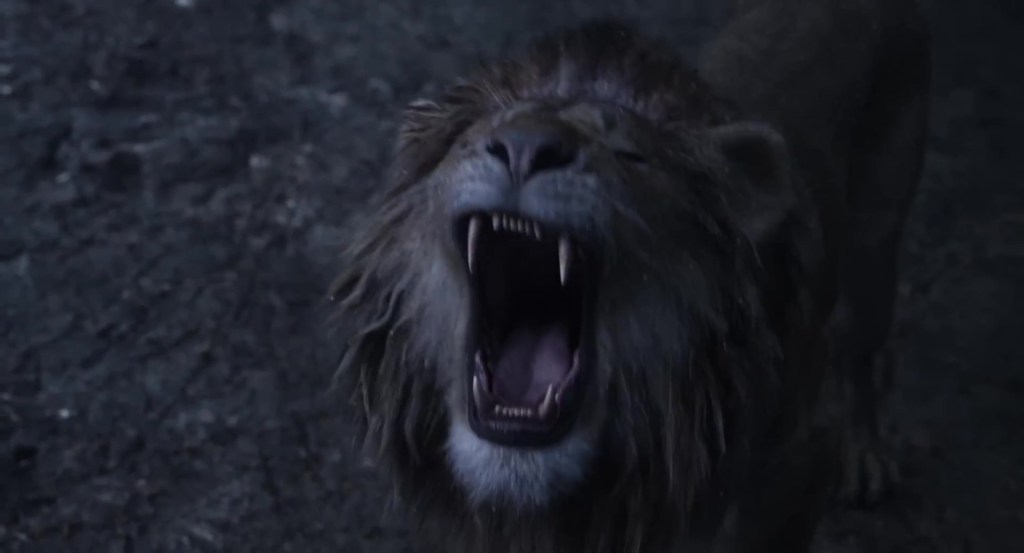
This blog will appear around Christmas, so I guess it is not unreasonable to unleash my inner Grinch, at least when it comes to anthropomorphic representations of carnivorous virility. As far as we are aware, lions can’t talk, except in movies. They can certainly communicate though, and that communication, particularly the roar that can be heard miles away, is featured prominently in all versions of the Lion King.

If they could talk, would they say and do the things shown in the film? Would they, for example, let a mandrill take their cub and hold him, Michael Jackson-like, over a cliff for the other animals to worship and celebrate? I’m even less sure of how celebratory the prey animals would be about the birth of yet another predator, no matter how cute.

But the main thing that bothered me throughout the film was the food, and it wasn’t (just) because I watched it at lunchtime. We are shown a happy monarchy (the “pride land”) where the devoted subjects are summarily executed and eaten by the king and his family. This is later turned into a blasted desert filled with the bones of the prey animals by a usurper king lion, an evil uncle lifted from Hamlet and made leonine.

Those not privileged to live in the pride-land inhabit a shadow terrain, the “elephants’ graveyard”, where (dark-skinned) hyenas skulk, with little evidence of anything to eat and, we are assured, always hungry. We have the “circle of life” followed by a circle of hell.

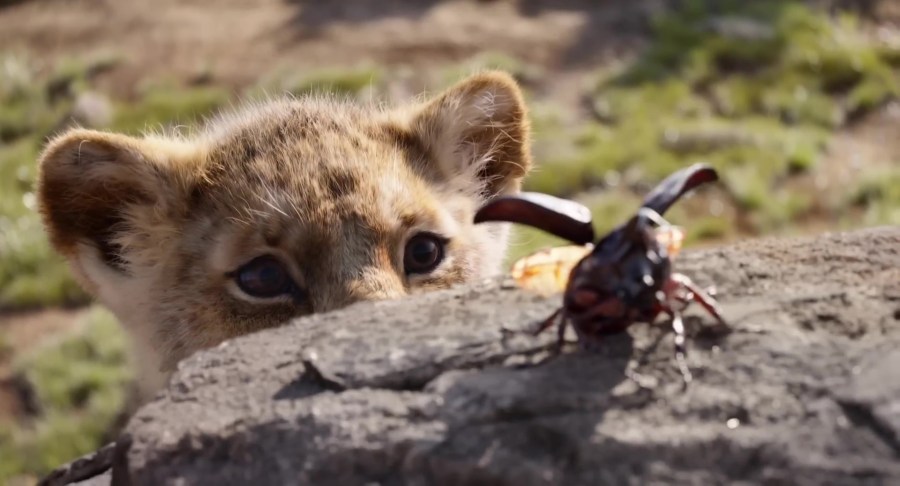
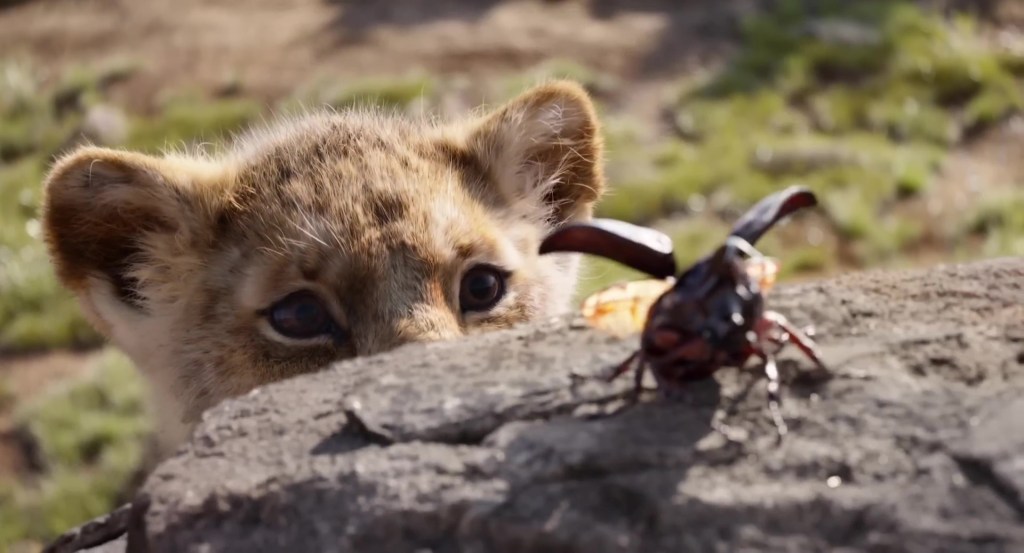
Even further away, in a wildness to which the exiled lion cub Simba flees from his evil and murderous uncle, we have a sort of Garden of Eden II. Here, mammals take a pledge not to eat each other, an expanded ring of utopian privilege, which excludes only insects and their pupal forms, who clearly would have to exist in immense numbers to feed a growing lion, let alone his friends.

Listen kid: if you live with us, you’re gonna have to eat like us.
This looks like a good spot to rustle up some grub.
A grub. What’s it look like?
Tastes like chicken.

What is the ecology here, and the ethic behind the food choices?

Simba, the cub and heir apparent, wonders about this too. He and his future wife (lions get married?) are the only ones to connect with all these environments, and Simba the only one to question the implicit ethos of each one. Early in the piece, as he surveys the kingdom where “the light touches” (as opposed to the darkness of the hyena shadowlands), he asks his father why they eat their loyal subjects, the zebras, antelopes and presumably anyone else slower than them. It’s a question most parents dread as they feed lumps of animal flesh to their children, and then read them books about happy animals. It’s the circle of life, says Simba’s Dad, clearing his throat for us all to join a singalong. We eat them, then when we die, our bodies feed the grass, and future victims eat the grass.

Now this is just absurd. I’m not sure how much grass the average antelope eats, but it would need an awful lot of dead lions buried underneath it to make it fecund. Photosynthesis, which combines carbon dioxide and water into carbohydrate and oxygen, is what makes the grass grow. Lion corpses (and presumably lion shit, now enriched with zebra fat) might add some trace elements, but they are hardly necessary. What lions actually do for the environment is thin out the number of herbivores so that they don’t eat all the vegetation and turn the area into desert, which is what inexplicably happens when the bad lion, Scar, and his army of hyenas, eat all the herbivores. Where does all the grass go? It should be a jungle without all those antelopes and giraffes.

Then we have the entemo-vegetarians of the land beyond the shadows where, you know, hakuna matata, there are no worries, unless of course you are an insect. If you search the internet, you will find learned articles on how many hours a day a lion would need to be chewing pupae (it’s a lot more than 24) in order to sustain his life, let alone progress from cub through puberty to full sized adult male. And why can the various mammals and birds talk, but the insects can’t? Jiminy Cricket could talk in the early days of Disney – when did he fall out of the circle of privilege?

It’s all absurd, of course, but it’s what we teach kids, and not just by taking them to see Lion King. When they ask questions like “I love animals, so why are we eating them?” talk of feeding grass with our bones doesn’t cut it, which is probably why so many young people go vegan. The correct answer, which won’t satisfy anyone, is “because we want to, and because we can”. We have the appetite, and we have the power. We arbitrarily decide who is within our circle of privilege.

In the film, lions and all mammals, and some other odd creatures, live without being eaten in a hippie paradise. In the pride-land, under good king Mustafa (Simba’s dad) certain animals are part of the elite and don’t get eaten, while the anonymous proletariat animals seemingly go willingly to their just deserts (or desserts). Contrast this with the hyena shadow land, where, according to a Disney comic book, the hyenas enthusiastically engage in cannibalism, as well as presumably eating the dead elephants who come to the elephant graveyard to die (which, BTW, elephants don’t really do). The human circle of life is less well defined, depending on the culture: in the West, humans consider chickens, pigs and cows outside the elite of the inedible, while dogs, cats and dolphins are inside, and we express moral outrage when these capricious lines are crossed. In other parts of the world, dogs and cats may be delicacies, or cows or pigs may be forbidden. And this blog has brought you many films in which humans are the preferred repast.

Animal activists are often accused of anthropocentrism, having the nerve, for example, to suggest that fish feel pain or dogs feel love. But truly toxic anthropomorphism appears in narratives of talking animals, where we offer temporary anthropomorphic capacities to other species, so that we can push ideological or commercial messages like a “circle of life” to an audience of minors, while pleading disingenuously that these are just cartoons. This cartoon lies to kids about the nature of nature, to promote the acceptability of carnivorous virility.

We don’t do our society any favours by lying to our kids. Lions don’t think about dying or the benefits their carcasses will bestow on the grass. They hunt because they are obligate predators and will starve otherwise, regardless of the available insect population. Humans, on the other hand, are closer to hyenas – scavengers who are never satiated. We don’t keep herbivore numbers in check by eating them; the opposite is the case – we deliberately breed them by the billions, often in appalling conditions, then slaughter them, in terror and agony, in industrial killing centres, polluting the land, degrading the water and filling the air with methane.

It’s not clear if Simba will impose insectivarianism on his kingdom after the credits roll – he may have to, insofar as the flocks seem to have been decimated. But Simba, if he really could talk, would be appalled by the way humans cynically misappropriate the role of predator in order to feed our insatiable appetites. I think perhaps even the hyenas would agree with him.

Convict Cannibals: FOR THE TERM OF HIS NATURAL LIFE (Norman Dawn, 1927)

For the Term of His Natural Life is a 1927 Australian film directed, produced and co-written by Norman Dawn. It is based on the 1874 novel by Marcus Clarke, and was the most expensive Australian silent film ever made. It remains one of the most famous Australian films of the silent era. John Laws, in the trailer above, calls it “the grandest of them all, the climax of Australia’s silent cinema.” Amazingly, it was the third attempt to film the story, starting in 1908 with the film version of a stage play of the book,  and then in 1911 another filmed stage adaptation, The Life of Rufus Dawes.

It’s the story of a gentleman (in the traditional sense of that obsolete term) who is wrongly convicted and transported to Australia for “the term of his natural life.” This was a fairly common trope in Victorian novels (no one wanted to read about real criminals), and was recreated by Tim Burton when he made Sweeney Todd into a returned convict in his version of the Demon Barber of Fleet Street. As a convict, he changes his name to Rufus Dawes, and the rest of the story tells of the brutality of life as a convict at Macquarie Harbour in Tasmania and his eventual escape to claim his innocence. And, in the American version of the film, a happy ending (the book and the British version saw the hero and his true love come to a watery end).

The bit that interests devotees of Cannibal Studies in this story is the escape of a group of men led by a particularly evil-looking convict named Matt Gabbett (played by Arthur McLaglen in the 1927 film).

Being a silent movie, even the narrator gets an intertitle card:

After nine days with no food, Gabbett points out that there are only two choices— starvation, or eating one of the followers, who has fortuitously become lame. We see him taking an axe to a fellow escapee, while the others cringe, as we suppose semi-civilised folk would.

Gabbett tells them:

The cannibalism subplot was one of the most controversial aspects of the film. Gabbett is based on the true story of Alexander Pearce, who escaped from Macquarie Harbour in 1822 with seven other prisoners. Once recaptured, Pearce confessed that he had eaten his companions, but the magistrate in Hobart refused to believe him. A year later, Pearce escaped again and this time he was recaptured with the flesh of another man still in his pockets. He was taken to Hobart and hanged.

The story languished somewhat until revived in a six hour mini-series in 1983. In 2008-09, a number of Australian films were made that referenced Pearce – The Last Confession of Alexander Pearce (2008), directed by Michael James Rowland; Dying Breed (2008 – about his supposed offspring who are still eating people in the 21st century), directed by Jody Dwyer; and Van Dieman’s Land (2009), directed by Jonathan auf der Heide, which cut the crap and concentrated on the cannibalism story. We’ll get to revue this one, dear reader, one of these days.

The controversy over Norman Dawn’s 1927 version was driven partly by Tasmanian sensitivities about the unwholesome revelation of the island’s history. Marcus Clarke’s book was one thing; a big international motion picture, intended for a mass audience overseas, was quite another. Certainly, the film does sensationalise the cannibalism, shifting the focus away from the book’s message, which was to advocate prison reform. Prisoners like Gabbett (played by the brother of well-known British actor Victor McLaglen) seemed more likely to offer justification of capital punishment.

Australia is sorely lacking in cannibal stories, so even though Alexander Pearce was Irish (as were a large percentage of convicts), we claim him as our own. He did, after all, eat people and get hanged here, and if he hadn’t, no one would even remember he ever existed.

The film is currently available on YouTube.

Need to feed, need to breed: THE DYING BREED (Jody Dwyer, 2008)

Two hundred years ago (July 19 1824), Alexander Pearce was hanged in Hobart, Tasmania, and his body dissected for research. He was a cannibal.

Australia has a bit of a dearth of cannibal stories (compared to places like the USA and Russia). Ask Aussies about cannibalism and they will often make a joke about state or federal politicians. Then they may search their memories and come up with Katherine Knight, a slaughterhouse worker who in 2000 had passionate sex with her partner John Price, then stabbed him 37 times, professionally skinned him, hung his hide on a meat hook over the lounge room door, decapitated him, butchered his corpse and cooked some of his flesh. She served up his meat with baked potato, carrot, pumpkin, beetroot, zucchini, cabbage, squash and gravy in neat settings at the dinner table, putting beside each plate placenames for Price’s children. Another meal was tossed into the backyard; it appears she intended to eat it but decided against it. So, no points on that one I’m afraid – no one got eaten, so no cannibals. More recently, the Snowtown bodies in the barrels case was revealed to have an element of cannibalism in the final murder, but this was very much an afterthought to the killings, and not even mentioned in the film of the events.

Most of the real cannibals in Australian history were in fact convicts sent to the worst penal settlements the British could devise (and they were very good at that) then escaping, only to eat their comrades when other food sources were exhausted. Edward Broughton did just that in 1830, as did Thomas Jeffrey, who became a murderous bushranger, in 1836. But before them, a cannibalistic pioneer one might say, there was Alexander Pearce.
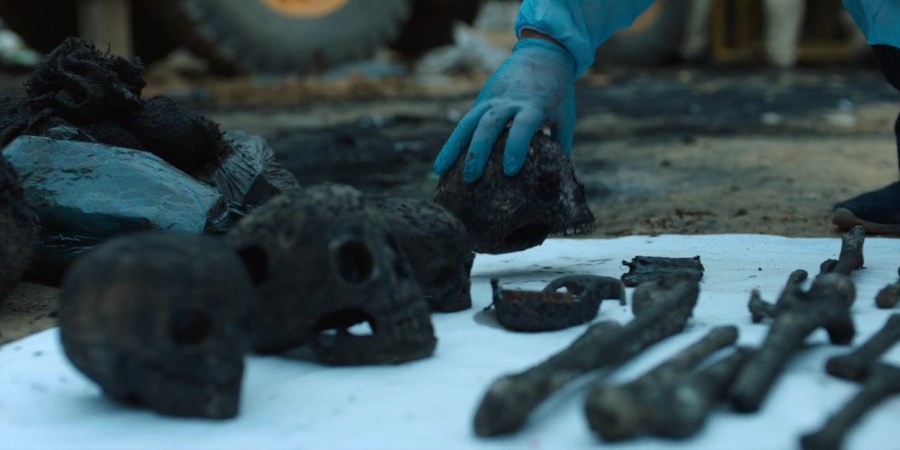
Pearce escaped the brutal penal colony only to eat his companions, not once but twice (he confessed when recaptured the first time, but the authorities didn’t believe him). He is shown very briefly in this movie as a historical flashback before the opening title, an escapee who is cornered by a very angry soldier whose gun misfires. Pearce tears the man’s throat out, swallows some and throws a bit to a thylacine (Tamanian Tiger) who is stalking him, to allow him time to escape.

The thylacine was a carnivorous marsupial who was endemic only to Tasmania, until wiped out by European colonists, the last one dying in Hobart zoo in 1936. There is no evidence of them eating humans. Thylacines were not the only targets of white settlers: Tasmanian Indigenous peoples were also rounded up and subjected to genocide in the first half of the nineteenth century.

Anyhow, the plot of this movie revolves around a biologist named Nina and her friends, who are trying to find proof that the thylacine is not extinct – her sister found a paw print, but was killed mysteriously near the Pieman River on the west coast. The film and other sources often claim that Alexander Pearce was known as the pieman due to his love of the meat of a wide variety of animals, although in fact it seems it was named after a pastry cook named Thomas Kent.

They get a punt across the river, driven by a cranky old man with a small girl who is playing with bones and reciting bloodthirsty rhymes. She bites the boyfriend.

They get to the town, where the locals are killing puppies and who knows who else.

Long story short, as they say, these are a cannibal family descended from Alexander Pearce, who they call the Pieman. The city slickers, mocking the locals as they depart, head down the river where, at the midpoint of the film (where the really good or really bad stuff happens) Nina finally but briefly sights a thylacine!

Of course, she doesn’t have her camera, so she grabs it and they go look for the animal, splitting up to search, proving without a doubt that none of them has ever watched a horror film before. You don’t split up! The other girl meets the creepy child from the punt, then is grabbed from behind and killed, and we get to watch her tongue torn out and eaten. The others find her strung up on a meat hook and butchered like any prey animal.

There’s plenty of gore and somewhat predictable jump scares (or maybe I’ve just seen too many of these types of movies) but the plot is interesting, the acting great, the direction and photography first-rate, and the scenery is spectacular, although the depiction of the Deliverance-like locals may reduce the usefulness of this film for promoting Tasmanian tourism.

“What did you hope to find? We’ve been here a long time. Almost as long as the nation. We have a life to protect, a tradition. You tourists have no tradition.”

The cannibals in this film capture tourists and either eat them or breed them, not that different to what humans do to other animals. When modern twenty-first century humans eat others they are often referred to as degenerate cannibals – they are accused of devolving into the cannibalistic savages that early humans are portrayed as, even though there is little evidence that earlier cultures were into cannibalism or that modern ones have outgrown it.

Humans often turn to cannibalism when food runs out. The Biblical story of the siege of Samaria in Israel some 3,000 years ago (2 Kings 6) relates that, unable to afford asses’ heads and doves’ dung, two women agreed to boil their babies for sustenance. But after they’d eaten the first one, his mother found that the second woman had hidden her child, a shocking breach of contract.  Such starvation cannibalism became common in the day of sailing ships, but even on land, Sawney Bean in fifteenth or sixteenth century Scotland is supposed to have stopped tourists as they passed through his wild lands and taken them home for dinner. Some of these stories seem to stray from cannibalism into something like an aversion to getting a job, which is how the modern versions like Texas Chain Saw Massacre and Hills Have Eyes are sometimes framed. We eat flesh because we need to or want to, and because we can. That still applies in the meat section of every supermarket. We don’t degenerate to cannibalism, we simply objectify the prey, be it human or any other animal. This objectification is at the heart of all politics.

The moral of these stories (they all have one, even the most basic slasher), is that there are other worlds out there, away from what we are used to in our own little niche. There are people outside our ways of understanding life and morality, whose daily existence may be inconceivable to those looking in. Coetzee said that the “upper intelligentsia” (Nina is a scientist) live lives irrelevant to most people, who may be “devoted to brawling and guzzling and fucking”. That’s whom we meet in the unexplored wilderness of Deliverance or Sawney’s Scotland or the Texas of the forgotten, and in this film; they fight, they kill, they eat and they reproduce. They survive and breed: the basis of all evolution. It’s what animals do, and a good cannibal film like this reminds us that we are, beneath our veneer of civilisation, just another brawling, guzzling, fucking animal.  

Sorority initiation: CANNIBAL HOOKERS (Donald Farmer, 1987)

Also known as I Will Dance on Your Grave, this film’s videotape release by Hollywood International Pictures “through Italian Stallion Video Comportation [sic]” has a notice on the front and back covers that cautions the potential viewer: “Warning: graphic scenes of violence and horror”, and adds that it has a running time of 91 minutes. Subsequent VHS releases were (badly) re-cut to 63 minutes, including the 4 minute end credits. All DVD releases are ripped from the 63 minute version. Which is still about 62 minutes too long.

So, to the “story” (sic). At a sorority initiation (we are told it is “the sleaziest sorority in the State), two girls are given a chance to prove themselves to the sisterhood by posing as hookers. But then they turn into vampires and start killing and eating the frat boys. Not good for business, but luckily there seem to be no bounds to the number or stupidity of the local men.

The movie starts with a guy following a woman to a bar, leering at her from the bed as she returns naked except for an axe held tactfully behind her back, bites off his finger (resulting in lots of the most watered-down fake blood I have ever seen), then chops him up.

Move to domestic turmoil as college girl tells mom she wants to join a sorority, then in the car on the way to college, agrees with her friend it’s only because they like to party. Stark realism so far. They pledge, and their initiation is to dress as sex workers and pick up one man each, on Sunset Boulevard. They agree, because “do you want to be socially ostracised all year?” The other girl suggests they join a frat house as “little sisters” instead. The best line of the movie follows:

“Little sisters? For your information, being a little sister has all the social status of being gang raped by Nazis.”

Despite the occasional zinger, the rest of the film is full of bad writing, laughable acting, gratuitous breast shots, and fake gore. There is an unexplained weirdo named Lobo at the brothel, who takes men’s coats when they arrive, and then kills them while they are getting it on with the girls.

Besides killing people, Lobo’s job is to bring glasses of blood to the head vampire, on whom he has a crush. She sleeps with a human skull on her stomach. Much as one does in sororities, I suppose.

The protagonists are both turned into vampires, and the rest of the film revolves around necks and teeth. There is a detective on their case, but he is easily captured, and told:

“We have a very special diet. We only eat warm human flesh.”
“No kidding. I think I read about that diet in the National Enquirer.”

I won’t give any spoilers in case you are tempted to watch it, but let’s just say that, while some of the female vampires meet a sticky end, there is far more sacrificial killing and eating of males, which makes this somewhat unusual in cannibal films.

I don’t know whether the writer/director Donald Farmer ever saw the German movie Die Wiebchen which came out in 1970. At any rate, male terror at being eaten by females, reabsorbed by the Monstrous-Feminine, is much underrated, and this film, badly made as it is, at least helps to remind us of that uncanny terror and restore the balance, however marginally.

I couldn’t resist this review on IMDB:

The full movie (or the bits that weren’t cut) can be seen if you really want to at https://tubitv.com/movies/100014132/i-will-dance-on-your-grave-cannibal-hookers