Meat is meat: THE MAD BUTCHER (Guido Zurli,1971)

Some months ago, I reviewed a film called Auntie Lee’s Meat Pies, in which I asked readers “What’s in your pie?” This film, The Mad Butcher (Lo strangolatore di Vienna), asks a far more profound question: “What’s in your sausage?” In each case, a better pronoun might have been “who”.

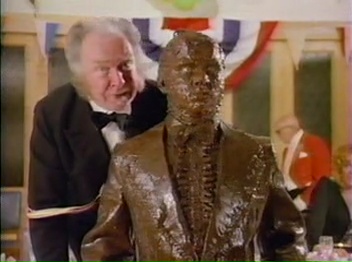
Guido Zurli was an Italian director but this film was made in English, set in Vienna and starred the wonderful, larger-than-life Hollywood actor Victor Buono, who plays the “Mad Butcher” of the title. In the USA, it was released as Meat is Meat, a better title IMHO – describing cannibals as “mad” is such a lazy approach, an intellectual shrug of avoidance. And to the butcher of this film, meat really is… just meat.
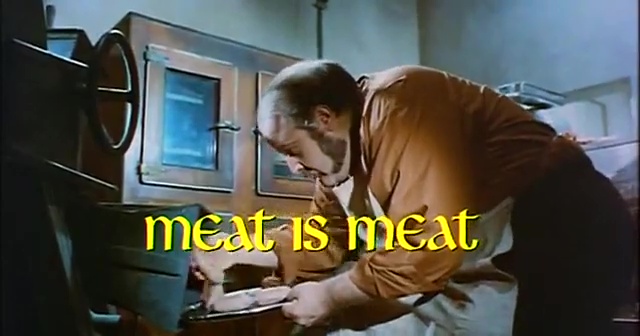
Otto (Buono) is dedicated to his calling – cutting up and selling animal flesh, and to him, the women he kills and minces are just that – meat. Otto has anger issues, which caused him to be confined to an asylum for three years, after slapping a customer with a piece of liver. But now he is being released, with an official certificate allowing him to say, “I’m not crazy now.”
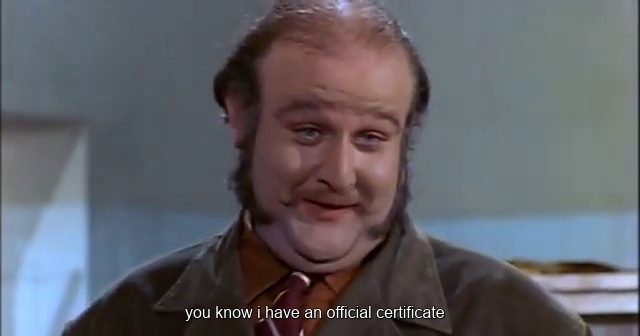
His wife, who had had him committed (to save him going to jail, she claims) wants him to come home with her, worried about what the neighbours will say, but he wants to move into his butcher store where, he tells anyone who will listen, he is “the best butcher in Vienna”.

While throwing from his window the rubbish left by his wife’s brother who was running the store in his absence, Otto sees a neighbour as she showers, in silhouette. She looks, well, edible to him.

His wife catches him staring at the neighbour and, during the resulting row, he strangles her. At first horrified, he realises that there is only one way to get rid of the evidence. After that, he has to dispose of a sex worker brought home by the brother-in-law, and then the brother-in-law, who he has spent much of the film calling a “pig”. Well, he is a very popular butcher, the best in Vienna, and after all, as he opines, “I need this meat.”

But then, when he manages to abduct the neighbour (she of the long showers with the lights on and the blinds open), he has to deal with the American protagonist – a journalist who inexplicably is allowed to hang out with the police and investigate their cases. Otto rips off her clothes (there’s a lot of that sort of thing) and promises her

“I’m not just the best BUTCHER in Vienna!”

As the logline says, in one of those double-entendres that haunt cannibal movies, “His sausage was a cut above the others!

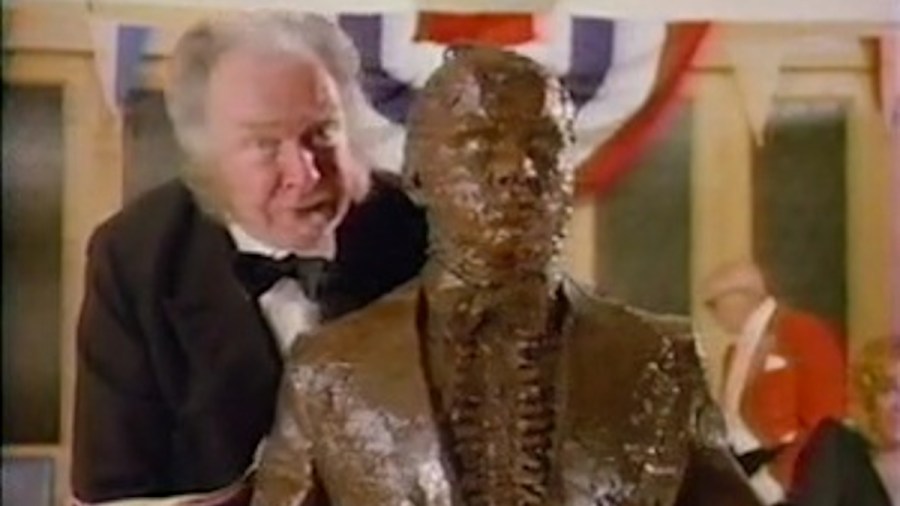
This is more black comedy than traditional horror – Otto relishes turning his customers into innocent cannibals. They, in turn, rave about his sausages, lining up to buy them from his push-cart in the park.
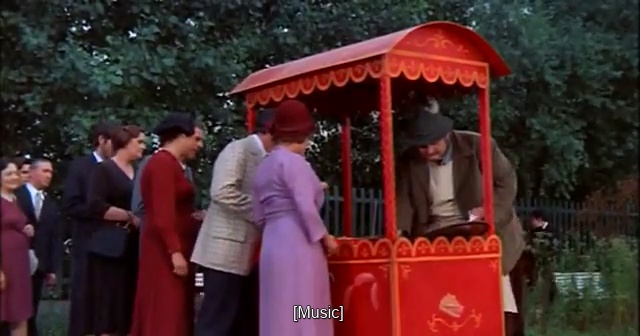
When his activities are disclosed, the police chief, who has been happily eating other animals all movie, is suddenly smitten by a serious bout of nausea.

“Those sausages that I ate! They were made of human flesh!”

The innocent cannibal theme has been popular since Sweeney Todd, who first appeared on film in 1928. Forty years earlier, Jack the Ripper had terrified the citizens of the heaving metropolis of London, brimming with workers drawn to the dark Satanic mills, driven into town by the centralisation of agriculture and the promise of gainful employment. Social cohesion seemed to be failing (isn’t it always?) and the cannibal was the figure who best represented the city as voracious beast. Henry James described London as “an ogress who devours human flesh to keep herself alive to do her tremendous work”. The “savage” of foreign climes who had so thrillingly filled the imaginative accounts of the colonial explorers had come home personfied as their own city, and the unknown faces dwelling within it were chief suspects. This was reflected in H.G. Wells’ first novel, The Time Machine, in which the proletariat, thousands of years in the future, have evolved into a highly technological cannibalistic tribe who feed off the soft, effete gentle people who are all that remain of the bourgeoisie.

Sweeney Todd took this to a new level, showing that even a “gentleman”, an apparently respectable member of society, could kill people. But Sweeney is never shown eating anyone; it is his customers, or the customers of his girlfriend who owns a pie-shop, who enjoy (immensely) the flesh of his victims. This could be done for revenge, as in the later, Tim Burton version of Sweeney, or for profit, particularly in times of shortage, such as Ulli Lomel’s Tenderness of Wolves concerning the German serial killer and cannibal Fritz Haarmann, who supplied meat of many species, particularly human, to his unwitting and grateful neighbours.

The outer limits of the world were still full of cannibalistic savages, but now they were in the same country – Texas Chain Saw Massacre featured a bunch of rednecks who captured tourists and fed them to other tourists (as well as catering to the extended family of course). But we were more worried about the cannibal in our midst, driven by the spectre of Ed Gein, an unassuming if eccentric man who dug up graves and used the bodies for ornaments, graduating into killing people and possibly feeding their flesh to neighbours as venison, an accurate term for animals hunted down for food and fun. A later version was Farmer Vincent in Motel Hell who collected tourists to serve in his motel, quoting his motto “meat’s meat and a man’s gotta eat!). Another slightly less light-hearted group of entrepreneurial cannibals like Vincent were the merry animal liberationists who farmed, milked, slaughtered and sold the flesh of those observed eating animals (to others who pay to eat animals) in The Farm.

Other films from all around the world feature butchers profitably selling human flesh for human consumption: The Butchers, Ebola Syndrome (from Hong Kong), Delicatessen from France, The Green Butchers from Denmark, and Barbaque (Some Like it Rare), also from France. In most of these films, the flesh of humans is found to be irresistibly delicious, until its provenance is discovered (although in Barbaque, only flesh from vegans has that special something). This is also the theme of Sweeney Todd even in the latest personification, The Horror of Delores Roach, in which New Yorkers line up around the block to buy the most delicious empanadas, unaware they are made of the chef’s landlord. Hitchcock had explored the same territory in 1959 with his episode called Specialty of the House, in which members of an exclusive men’s club crave the specialty “lamb Armistran”, which turns out to be the flesh of patrons who had enquired too deeply into the methods of the chef. Just so in this film, The Mad Butcher, which was the subject of this blog before I embarked on one of my legendary tangents.

Hannibal Lecter, untypically, did not eat humans because they were irresistibly delicious, but because they were another species of edible mammals, inferior to Hannibal the Übermensch and those few he considered his equals, no more or less acceptable morally and gustatorily than any other meat animal. Hannibal found amusement watching his guests enjoy his cooking, not because of the type of the meat, but because of his gastronomical skills. Hannibal’s meals were just as delicious whether filled with human, cow, pig, sheep, or anyone else. It’s the preparation, what Claude Lévi-Strauss called “the cultural transformation of the raw”. Hannibal refined the rude into delicious concoctions. Otto feels the same way about refining annoying people through the artistry of his butchery.

“Let me explain. Animals tear meat. Butchers carve.”

Rotten Tomatoes gives this film a solid 42%, based on the wordless review of one critic. I think as cannibal films go it would be forgettable, except for the amazing performance of the great Victor Buono, who turns it into a melodrama, or even a pantomime. It is, whatever its critical failings, very watchable and a lot of fun, and for those who are interested in such things, there is no gore but lots of meat, and lots of dresses being ripped from female bodies. To the protagonist, Otto, sex is one more appetite, like hunger, easily satisfied by violence, and not to be denied by the stultifying conventions of society.

If you speak Italian, the full movie can, at the time of writing, be seen at: https://ok.ru/video/1511628212842

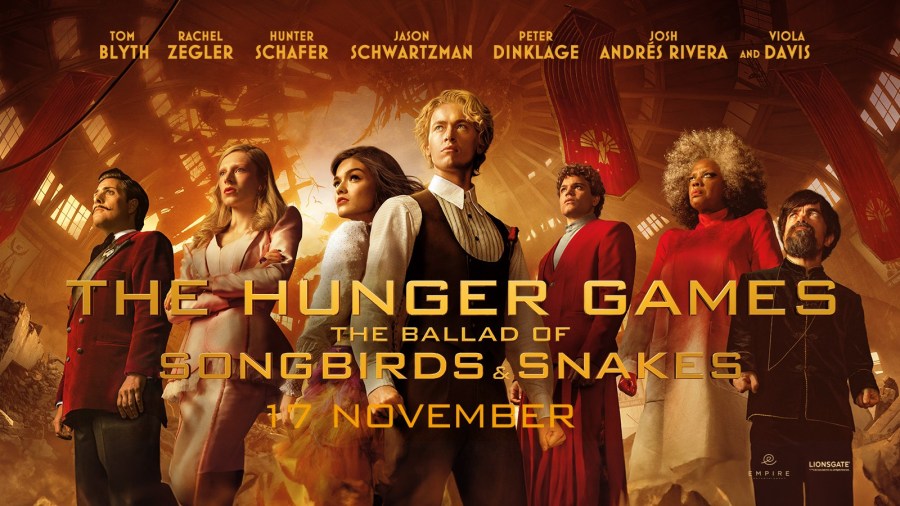
THE HUNGER GAMES: Ballad of Songbirds and Snakes [and Cannibals] (Francis Lawrence, 2023)

The Hunger Games began as trilogy of novels by American author Suzanne Collins (2008-2010). The prequel, The Ballad of Songbirds and Snakes, was released in 2020. The first three were adapted into four films (annually from 2012-15), all of which set various box office records. The first film, The Hunger Games (2012), recorded for biggest opening day and biggest opening weekend for an original IP. In 2023, the prequel to the trilogy, titled The Ballad of Songbirds and Snakes, was released as a film.

The Hunger Games is a post-apocalyptic dystopia set in Panem, a North American country consisting of the wealthy Capitol and 13 districts in varying states of poverty, punished for rebelling against the Capitol. Every year, children from the first 12 districts are selected via lottery to participate in a compulsory, televised battle to the death called The Hunger Games. The name Panem derives from the Latin phrase Panem et circenses, which literally translates into “bread and circuses”, the ideology used by the Roman emperors to distract the citizens from their daily struggles and the obscene indulgence of the elites. One of the highlights of the Roman circuses was the gladiators, who would fight to the death, as a popular form of entertainment.
There are not really any rules to the Hunger Games (except kill everyone else) but cannibalism is frowned on, as the audience find it a bit gross. Compared to just, you know, chopping people up. Titus (named after one of the crazier Roman Emperors) kills combatants in the 66th Games by tearing out their throats and eating their organs; he is killed in an avalanche, presumably created by the organisers because of his threat to their ratings. Like many cannibals, he is dismissed as just plumb crazy.

The Ballad of Songbirds and Snakes is a prequel, starting 64 years before the Hunger Games, during the ‘Dark Days’ which led up to the failed rebellion in Panem. How, it wonders, did we get this way? Well, cannibalism of course is part of the answer. In the novel, the narrator says:

“…the siege had reduced the Capitol to cannibalism and despair.”

But this is a movie, and you know the golden rule: show don’t tell. So the opening reveals two children, a young Coriolanus and his cousin Tigris, running through the snowy streets of the Capitol during the rebellion, hunting for food. A man appears with a cleaver and chops the arm from the corpse of a woman.

“Why is doing that?” asks the boy. Tigris replies simply:

So, the scene is set for the rise of Coriolanus Snow, who eventually becomes the ruthless President of Panem (played by Tom Blyth in this film, and later the incomparable Donald Sutherland). To him, the ends justifies the means, and what ends are more important than staying alive, even if it requires killing and sometimes eating people? It’s the human condition, particularly in post-apocalyptic dystopias. That’s entertainment!

“See how quickly we become predator? See how quickly civilisation disappears?”

Is Donald a Cannibal?

No, not that Donald, the one that dresses in a blue suit with no trousers. That still didn’t help? I mean the Duck of course, the Walt Disney creation, who has been around since 1931.

In several films, including the 1948 cartoon Soup’s On (the above clip), Donald is seen enjoying the flesh of a bird, presumably a turkey or large chicken. In the Christmas or Thanksgiving movies such as Mickey’s Once Upon a Christmas, it is normally a turkey, because that is the animal people are encouraged or sometimes browbeaten into eating on those festivals. In that film, Donald actually chases the terrified turkey with a knife. I found it more disturbing than most of the cannibal films I have reviewed on this blog!

Turkeys are birds, and so are ducks, so every now and then, Social Media breaks out in a rash of accusations that Donald is a cannibal, because he is a bird who is eating a bird. Cannibalism, though, is defined as eating another of the same species, so let’s look at this a bit more closely.

It is far from clear what species of duck Donald might be. Taxonomy texts do not reveal any species that speaks (quacky) English, dresses (or half-dresses) in human clothes, or live in human houses. Nor have I been able to discover any animal other than Homo sapiens who cooks its food. Or a species of duck with TEETH! Or, as far as we can tell, one that believes in an afterlife.

Several cartoons depict humans (however vaguely) as cannibals – Disney had a go with Alice Cans The Cannibals in 1925, Merrie Melodies produced Jungle Jitters in 1938, a cartoon so racist that it was later placed  on a list known as the Censored Eleven, the very first episode of Bob’s Burgers explored the commercial perils of serving human meat, and a very odd stop motion video from Robot Chicken explored their theory that cryogenically preserved heads (in this case Walt Disney’s) could be revived as cannibalistic monsters.

A social media dispute arises regularly, in which the “Peanuts” cartoon character Woodstock (who is usually interpreted to be some sort of canary) is depicted eating chicken. Peanuts fans take to social media to accuse Woodstock of cannibalism for being a bird eating a bird, although it seems unlikely that he is eating a canary.

Likewise, there are many species of ducks, none of which Donald seems to be eating.

Ducks have the following taxonomy:

CLASS: Aves (birds)
ORDER: Anseriformes (water fowl – Anatidae plus a couple more species – the screamers, and the magpie goose)
FAMILY: Anatidae (ducks, geese, swans)

The “domestic” turkey, the one most eaten by humans, is quite different. They are one of the two species in the genus Meleagris and are the same species as the wild turkey.

CLASS: Aves (birds)
ORDER: Galliformes (ground-feeding birds – landfowl)
FAMILY: Phasianidae (185 species, including pheasants, partridges, chickens, turkeys and peafowl)

Now if we compare our own animal bodies, we find that humans are:

CLASS: Mammalia (animals that milk-feed their young)
ORDER: Primates (a wide collection of animals from lemurs to simians)
FAMILY: Hominidae (the “Great Apes” – 8 species including orang-utans, gorillas, chimps and humans)

So, if Donald were to eat a duck of a different species or a goose, from the family Anatidae, he would be committing the same sort of act that might cause offence if we found, say, gorilla meat in our supermarket. Very unlikely to happen in most of the places this blog reaches, but not so uncommon in times of shortage in Africa, where it is called “bush meat” and is a major cause of species extinction. Not cannibalism though, because even a goose is a different species to a duck.

But if Donald eats a turkey, he is simply eating another bird of the same Class, Aves. The outrage that accompanies his action should, therefore, be emulated when we see humans eat other Mammalia, such as pigs, sheep and cattle.

Categorically, if Donald is a cannibal, so are most humans. Small children, who tend to gush over other animals, seem instinctively to recognise this. But, by the time they reach the age of Huey, Dewey, and Louie (whatever that is), they are socialised to objectify others as us and them, friend and foe, sacred and edible.

May you have a splendid celebratory season, no matter your metaphysical beliefs, and enjoy lots of festive foods, from Kingdoms other than our kin Animalia.

“Every cannibal wants to be a director”: LONG PIGS (Nathan Hynes, Chris Power)

Long Pigs is a 2007 “found footage” movie, in which two desperate filmmakers come across a cannibal, ask him if they can document his eating habits, and then are shocked when he starts killing people and eating them. It is presented as a documentary, with all the usual warnings about graphic scenes etc.

Bit silly, and found footage has rather been done to death, but it has some interesting ideas, particularly the sympathetic approach to the main character, even as he commits his crimes. Look, it seems to say, everyone needs a hobby and, to this cannibal, killing and eating people is no more ethically questionable than hunting or fishing. Stalk, catch, kill (as quickly and painlessly as possible) and then enjoy. He does his best to keep the movie interesting, with a patter of jokes, historical facts and philosophical observations as he slices and dices.

The cannibal is played by Anthony Alviano (Headcase, A Matter of Justice), and he presents the cannibal, also called Anthony, as a boy-next-door persona, one who kills and guts people. Like a farmer of animals, he starts the film explaining that it’s bad to frighten the victims, not for ethical reasons, but because the adrenaline ruins the taste of the meat. The filming starts as he drives around looking for a “certain kind of woman”, because he wants to make “long pig stew”. “Long pig” is a term supposedly used in the Pacific region before colonisation to designate human meat, although that definition is widely contested. Anyway, Anthony is looking for “marbled meat”, so he searches for a sex worker (traditionally victims who are not exhaustively looked for by police) who is, let’s say, of a heavy build.

“People who eat stew make perfect stew. It sounds obvious. Yeah, she looks like she eats well.”

As she smiles at the camera, he sneaks up behind with a sledgehammer and cracks her skull, resulting in the cameraman vomiting (which is actually rather more gross than the murder). They ask Anthony if gets a sexual thrill from killing women, but he dismisses this, in the same way a slaughterhouse worker might deny any pleasure in killing a different species of mammal.

“I’m not a freak or anything like that. This is all culinary, this is hard work!”

“Any hunter would recognise this position. We got the corpse hanging by the ankles. The first thing I’m gonna do here is make a little incision and tie off the anus. That’s to stop contamination from the feces. You would do that whether it was a deer carcass or a cow or a person… Absolutely necessary for health reasons.”

He cooks a stew from a portion of her thigh, then after dinner goes off to brawl in an ice-hockey game, an arena that seems the very essence of carnivorous virility.

Afterwards, he cooks ribs on a barbecue, assuring the viewers that there are “no animal by-products” used – just soymilk. And a woman’s ribs, of course, thus reinforcing the anthropocentric mythology of the human as not really animal, even though he has just butchered one in the same way as any other animal prepared for human consumption. He quotes the Arawak word barbaca, the grill on which human meat was supposedly cooked, according to explorers like Hans Staden and Jean de Léry, which became the Spanish word barbacoa, and eventually morphed into English as barbecue. Staden’s narratives were later illustrated by Theodor de Bry in his 1592 book Americae Tertia Pars, and the film sneaks in a quick peek at that glimpse of sixteenth century sensationalism.

There’s a lot of moral philosophy interwoven in the scenes of murder and gastronomy. Anthony the cannibal and his friend try to persuade the filmmakers to try some of the ribs, saying, it’s dead, and therefore cannot suffer, whereas we eat live vegetables, and “broccoli feels pain! Did you know that?” This is precisely the argument tossed at vegans by carnists, but in this case, it demonstrates the contention of the nutritionist Herbert M. Shelton:

The cannibal goes out and hunts, pursues and kills another man and proceeds to cook and eat him precisely as he would any other game. There is not a single argument nor a single fact that can be offered in favor of flesh eating that cannot be offered with equal strength, in favor of cannibalism.

Anthony works as a valet in a fancy restaurant, parking cars for rude people, and if you follow the lore of Hannibal Lecter, you will know that rude people are prime targets of cannibals. They park the car of a particularly rude man, take down his address from his licence and, next day, shoot him and load him in their car trunk. Unfortunately, they have a flat tyre and have to head to a pig farm for help, where they witness pigs being slaughtered and prepared for sale, in identical ways to Anthony’s own processes, but with rather better technology, and, oh yes, totally legally.

Most of the film is a spoof on cooking shows, which regularly have smiling chefs, or hopeful chefs, preparing lumps of animal flesh, hoping to win prizes. Anthony shows, in high-speed motion accompanied by the music of the Sugarplum Fairy, exactly how he prepares a body, stripping it and dismembering it until all that is left is two feet (still in socks) and the long femurs. He demonstrates how to get rid of the bones, cutting them up and putting them in a kiln at 2600 degrees – he even uses the line “these are some we prepared earlier.” This is a cooking show for cannibals.

Anthony is a typical modern cognate cannibal; as he says, people expect Hannibal Lecter, so “no one is going to suspect the valet”. This gives him the invisibility that we saw in cases like Jeffrey Dahmer. He loves his old mother who is in a nursing home, and is bewildered by a doctor’s request to do a post mortem analysis brain when she dies, a sophisticated update of cannibalism. He sadly tells the filmmakers that she has Alzheimer’s, but we eventually find that she died of Creutzfeldt-Jakob spongiform encephalopathy, a human version of mad-cow disease, probably from eating human meat that he fed her. He also admits to eating a five-year-old girl called Ashley, because people prefer meat from young animals, but was subsequently perturbed by the extensive police searches, and now avoids playgrounds and schools: “It’s like a supermarket, man.” As New Year celebrations explode outside, he comes to realise the filmmakers are going to release the movie, which will detail all his criminal history, and goes to get his sledgehammer. The rest, as Shakespeare says, is silence.

Anthony has a philosophy that rejects anthropocentrism and sees nothing wrong with cannibalism, or at least nothing that does not apply to any other meat. It’s a cannibalistic rejection of what Richard Ryder and later Peter Singer called “speciesism”.

“It’s only human beings that are so arrogant that they believe they are better than every other kind of animal out there. Worms don’t think about, you know, oh my god, why did mama worm get eaten by a fish; fish eats the worm and that’s that, it’s completely accepted by the worm, and the fish, and small fish gets eaten by the big fish, and if it was so wrong to eat it, then why would it taste so good?”

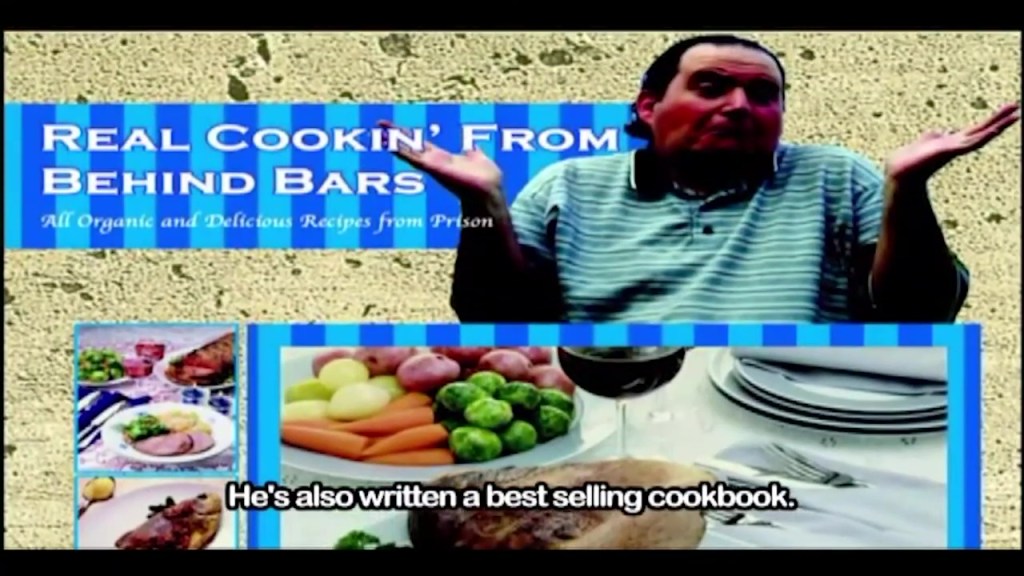
At the end, he is in jail, but he has published a cookbook. His cooking show has finally paid off.

This is a low-budget film, but is a lot better than might be expected. The creators were lucky enough to secure the services of Chris Bridges, the special effects artist whose credits include the Dawn of the Dead remake, Saw III & IV, 300 and Star Trek Discovery. Unless they actually killed and dismembered people, the result is spectacularly authentic. Anthony Alviano is brilliant in the role, which was written with him in mind.

The full movie (although slashed drastically from 81 minutes to 56 minutes) can, at the time of writing, be seen at https://youtube.com/watch?v=vnGXBRkxXuo.

Revenge cannibalism: LAST HOUSE ON THE LEFT (Wes Craven, 1972)

“Revenge is a dish best served cold”

Don Corleone said it in The Godfather, as did  Khan Noonien Singh in Star Trek II: The Wrath of Khan, but the saying goes back at least 100 years before that. It doesn’t seem to apply so much in cannibalism movies though, because if you’re really mad at someone, I suppose you’d want him to be warm and watching as you devour him, like Hannibal eating Abel Gideon, after feeding him oysters and acorns and sweet wine to improve his taste. Or Titus feeding Tamora, the queen of the Goths, a pie made of her own sons.

Revenge cannibalism is an exquisite form of retribution, going beyond murder to total destruction of the enemies (or his loved ones), incorporation of their essence, and conversion of their physicality into your excrement. Dante’s Inferno (Canto 33) depicts Count Ugolino in hell, gnawing eternally on the head of Archbishop Ruggieri, the man who had walled him up in a cell with his sons, whom he had eventually cannibalised. Perhaps the earliest narratives of revenge cannibalism appear in Greek legends, particularly that of Thyestes, who was fed the flesh of his sons by his pissed-off brother.

I’m adding this old classic film to the catalogue of cannibal texts as there is some human flesh eaten in anger, although it is not the main course of the film (puns are so hard to avoid in cannibalism blogs). The film starts with a couple of young girls heading to a rock concert, being abducted on the way, raped and murdered. If you are sensitive to such things (I hope most people are) or traumatised by recent news events, you may wish to give this film a miss.

I had forgotten about this movie until the Supernova Festival in which over 260 young people were abducted, raped and murdered, with a savagery reminiscent of that which befalls Mari and Phyllis in this week’s film. The barbaric slaughter of some 1,400 Israelis on October 7 2023 was followed by the IDF’s massive revenge, the extent of which shocked some of the world and impressed the rest. “Well, what would you do?” many online commentators asked.

Well, what would you do if, like the parents of one of the girls, you offered a warm welcome and overnight accommodation to some travellers who, you later discovered, were a gang of escaped criminals who had raped and murdered your child? The film answers that with a shotgun, a chainsaw, and an electric booby-trap.

Not what the UN would call a “proportionate response” (whatever that means), but many in the audience cheered at each gruesome death when it finally made it into cinemas (not until 2004 in Australia). Oh yes, one other form of killing that qualifies this otherwise simple slasher as a cannibal film—the girl’s mother, Estelle, pretends to seduce one of the gang members, then bites off his penis and swallows it.

The film critic Robin Wood spoke of what he called “the return of the repressed”. We repress our animal instincts to live in community, but beneath that veneer of respectability and normative morality lies “the monster”, the one we take out to exercise in the comparative safety of the cinema screen. Horror films such as this one depict the overcoming of repression, the shedding of the façade of respectability, in both the escaped psychopaths and then the vengeful parents, who shed their polite decorum to slash and kill. Craven shows the same thing in his later movie The Hills Have Eyes. Films from the seventies routinely explored a moral equivalence, a Vietnam War era pacifism that assumed any violence was equally appalling. Cannibal Holocaust, made at the end of that decade, sums up this view of the cycle of violence and the moral degeneracy of revenge when the anthropologist asks, “I wonder who the real cannibals are?” Later films from more cynical times tended to depict the killer or cannibal as either an irredeemable monster or a heroic figure, taking on bankrupt social imperatives. Right and wrong has come back into fashion but divides the viewers, depending on what their social media bubble tells them.

The film starts with a statement that it is a true story, which I guess used to be all the fashion—think Punishment Park, Cannibal Holocaust and the Blair Witch Project. The good old days, when truth was optional… oh forget I even started that sentence.

Anyway, this film wasn’t a true story, it was a remake of Ingmar Bergman’s 1960 film The Virgin Spring, in which a father takes merciless vengeance of a group that has raped and murdered his daughter. That was in turn based on a mediaeval Swedish ballad called “Töres döttrar i Wänge” (“Per Tyrsson’s daughters in Vänge”) in which the vengeful father discovers that the rapists he has just killed were actually his sons, sent off by him into the cruel world.

But it was Wes Craven’s film that introduced a bit of cannibalism into the revenge recipe. Wes Craven is best known for the Nightmare on Elm Street franchise and the first films of the Scream franchise. Last House on the Left was his first feature film, and he had such low expectations of its success that he felt he could be as outrageous as he liked and no one would ever hear about it, particularly his conservative family. But it did a lot better than he expected, to the extent that,

“I literally had people who would no longer leave their children alone with me. Or people that would, when they found out I had directed the film, say “That was the most despicable thing I had ever seen,” and walk out of the room.”

Audience members would get into fistfights, have heart attacks, and in many cases invaded the projection room to slash the film. Well, consider yourself warned.

Craven decided he would avoid horror, but was a complete failure at his attempts at more socially acceptable work. He had become known as the master of the slasher, leading him to another revenge cannibalism film in 1977 which became a cult classic, The Hills Have Eyes, in which a group of mutant cannibals kidnap, rape and slaughter (and eat) a ‘normal’ American family, who then inflict massive retaliation on them, adopting their savagery and raising the stakes.

In early 2023, a viral video seemed to show a couple of hunters gloating over a lion they had killed, and then being attacked and eaten by another lion, supposedly the dead lion’s brother.

Well, what would you do?

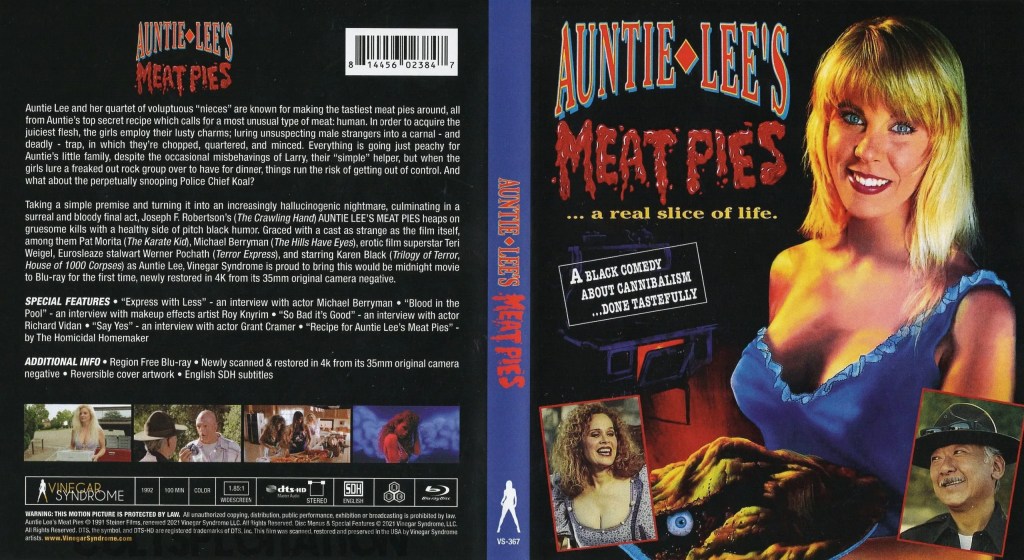
What’s in your pie? AUNTIE LEE’S MEAT PIES (Joseph F. Robertson, 1992)

This is described on the cover of the Bluray disc as:

“A black comedy about cannibalism… done tastefully”

The particular genre of this little known 1992 film is “innocent cannibalism” – humans slaughtered and made into meat dishes for sale to unwitting customers; those customers thereby becoming the cannibals. It’s eternally fascinating, because everyone at one time has pulled something a bit lumpy or fibrous from their pie, hot dog or burger and wondered what (or who) that came from.

The plot is simple, even simplistic. Auntie Lee (the wonderful Karen Black) is a Satan-worshipper who sends her nubile nieces out to lure men back to the house/bakery (often by shooting out their tyres and then offering them a lift) where they are slaughtered in various grisly ways and then chopped up and made into pies, which are irresistibly delicious and widely sought after in the nearby restaurants.

This trope started with Sweeney Todd, the “Demon Barber of Fleet Street”, a crucial figure to modern cannibalism. There are those who argue that Sweeney really existed and was hanged outside Tyburn Prison in London in 1802. At any rate, his story was popularised in the 1846 “penny dreadful” A String of Pearls: a Romance (Prest, 2010) and remains enduringly popular. Sweeney in his early nineteenth century incarnation insouciantly slaughters his clients, dropping them through a trap-door and supplying their corpses to his partner, Mrs Lovett, to use in her popular meat pies, unwittingly setting a precedent for the industrial slaughter facilities that would proliferate in following years. The first movie version was a silent film in 1928, in which the whole narrative turned out to be a nightmare. A 1936 version showed Sweeney as a true hedonist, a man who just enjoyed killing and robbing his customers. Several remakes have happened since, most recently a musical by Tim Burton. A Danish adaptation called The Green Butchers with Mads Mikkelsen, who later played Hannibal in the eponymous  television series, depicted unsuccessful butchers suddenly becoming wildly popular when they start serving human flesh. The 2021 French film Barbaque [Some Like it Rare] depicts French butchers hunting vegans whose flesh, unpolluted by animal products, turns out to be hugely popular with their customers.

Most recently, the Sweeney story has been reborn as a fictional “true-crime” podcast becoming a Broadway play, which in turn becomes a television series: the wonderful Horror of Dolores Roach, which I finished reviewing last week. Like Dolores Roach, Auntie Lee reverses the usual order of carnivorous virility—instead of the psychopathic male murderer (there is one, but he is dispatched quickly after raping one of the women), the killing is done by young, nubile women who lure men into traps which are increasingly intricate and gory. This is the monstrous-feminine – the male fear of what may happen when lust overcomes caution and the female reverses the birthing role and instead reabsorbs her victim.

The female killers are Playboy models, and were clearly chosen for talents other than their acting. However, other main characters are really good—Karen Black who has appeared in several horror B-movies is Auntie Lee, sending the girls out to bring home “the makings”, Pat Morita (Happy Days, Karate Kid) as the witless sheriff, and the inimitable Michael Berryman (One Flew Over the Cuckoo’s Nest (1975), The Hills Have Eyes), whose hypohidrotic ectodermal dysplasia gave him such an unusual appearance that he made a career from portraying everything from idiots to monsters.

Except for the wooden acting by the “nieces”, this is a well-acted, light-hearted if gory comedy, and many of the images are very striking.

At the end, after every man who enters the house is dead and being cooked, Auntie Lee and the nieces speculate about moving out of the town to New York City, where “we’ll never run out of beef”. In popular parlance, the brawny male is often called “beefsteak”, while sex is offered as a transaction, becoming almost indistinguishable from any other form of commodity, including feeding. As Coral says to the man she is leading to his death (using one of the most popular double entendres in Cannibal Studies):

“I can’t wait to have you inside me”

Such is the nature of modern capitalist cannibalism – the human is just another species, a resource like any other, potentially exploitable, vulnerable, even edible. Auntie Lee won’t cook Mormons or Californians, but New Yorkers are fair game, just as some people won’t eat pigs or dogs but will eat sheep or chickens. As Isaac Bashevis Singer said:

“As long as human beings will go on shedding the blood of animals, there will never be any peace.”

At the time of writing, the full movie is available on YouTube.

“Cannibal chocolates”: CONSUMING PASSIONS (Giles Foster, 1988)

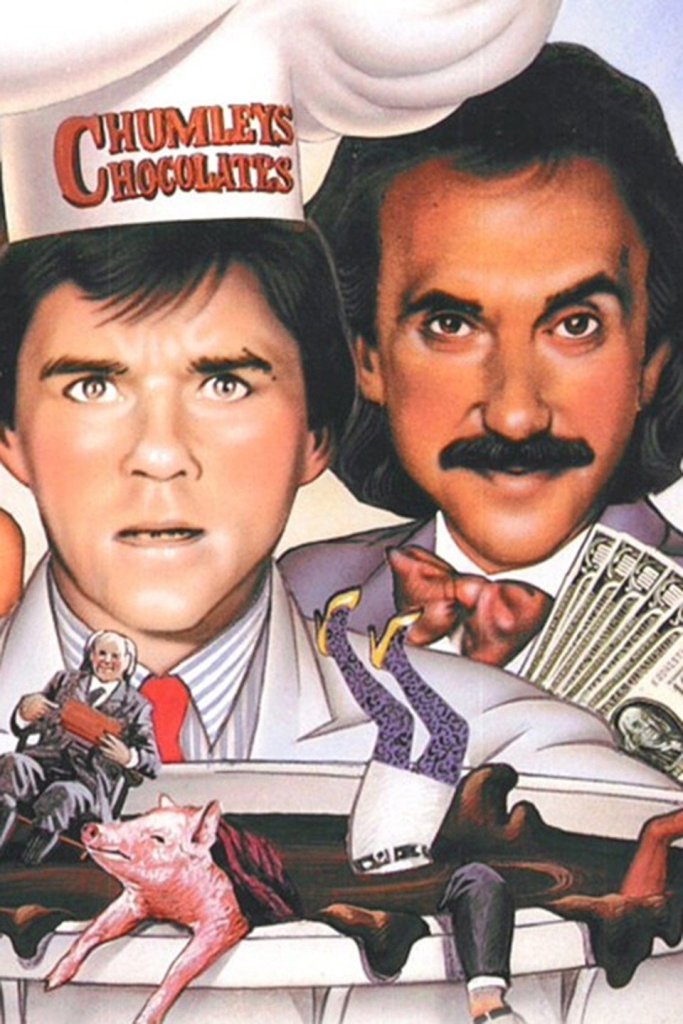
Consuming Passions is a black-comedy film directed by Giles Foster (Hotel du Lac). The film is based on the stage play Secrets by two of the Monty Python greats, Michael Palin and Terry Jones, which was filmed and shown on the BBC in 1973.

This is what I call entrepreneurial cannibalism, with a subgroup of accidental or fortuitous circumstances. A chocolate factory is preparing to launch a new luxury range, Passionelles. However, during production, the new management trainee causes three of the workers to fall into the giant vat of chocolate, where their flesh is mixed into the first batch.

The horrified boss tries to recall the chocolates, but they have already gone on sale. They prove a huge hit with the public. Market feedback says:

“Pleasantly nutty
subtle and delicious
addictive, compulsive
tasted full of goodness…”

They try to replicate the taste with meat from other animals, including a horrific scene where the guileless protagonist, Ian, orders a mountain of meat from the local butcher, including:

“three young porkers, with heads, ears and trotters”

But this bombs – only human flesh will give the chocolate that something special. As the secretary of the company (played by the wonderful Prunella Scales) says:

“People don’t want to eat chocolates with cows and pigs in them. People want to eat chocolates with people in them.”

They contemplate various ways to obtain dead bodies to use in their chocolate, including murder and/or chucking unemployed people in the vat. The new boss, played by the wonderful actor Jonathan Pryce (Brazil, The Two Popes, and many more) states the ultimate in neolib rationalisation:

“Think of all those millions and millions of unemployed school-leavers, yeah? A tragic, tragic situation. But we can give them a chance to do their bit for society yeah… think how it will shorten the dole queues.”

This seems to be based on Jonathan Swift’s 1729 pamphlet A Modest Proposal, in which he satirically suggested that the Irish, who were already being devoured economically by the landlords, should now sell the oppressors their children to make “a most delicious, nourishing, and wholesome Food; whether Stewed, Roasted, Baked or Boiled.”

In fact, the whole film is a commentary on the neoliberal ideologies that were dominating political policy at the time under Reagan and Thatcher. This toxic reasoning, which is still rampant, aspired to free up corporations while crippling any resistance from workers. Profit became the only determinant of policy – here the new owner of the company rejects the idea of putting real chocolate in the product, preferring artificial flavours and colours. When the market demands human bodies, that’s what they must have. Ian has to trawl morgues, hospitals, funeral parlours and medical schools. When his girlfriend, the quality control chemist, discovers there is human flesh in the chocolates, he assumes she will leave him, but she tells him,

“doesn’t hurt them if they’re dead. They’d probably be glad to know they’re being useful, like!”

By the end of the film, Ian is chocolate man of the year, knighted by the Queen, and made chairman of the company. He is no longer disgusted by cannibalism, but in fact is appraising everyone he meets, including his fiancée, for their weight, fat content and likely edibility. In an extreme example of what Marx called commodity fetishism, we have all become comestible commodities. Nancy Fraser writes and speaks convincingly about the way Cannibal Capitalism systematically destroys and consumes the sectors of society on which its own survival depends. In order to sell more commodities to the public, corporations will consume any resource, including the air we breathe, and our bodies too.

The Danes used a similar plot device later with The Green Butchers, starring Mads Mikkelsen (yep, it’s Hannibal, but not as we know him) as a butcher who accidentally locks the electrician in the freezer overnight and finds his customers love the resulting offcuts. The French tried it more recently with Some Like it Rare, in which a couple who own a butcher store accidentally run over and kill a vegan who has been protesting against their store for selling the flesh of animals. They too find their customers love human flesh, but only if it is uncontaminated by eating the meat of other animals – they only kill and cook vegans, a consummation (or consumption) of which Annie Potts and Jovian Parry have found, on social media, many carnists dream.

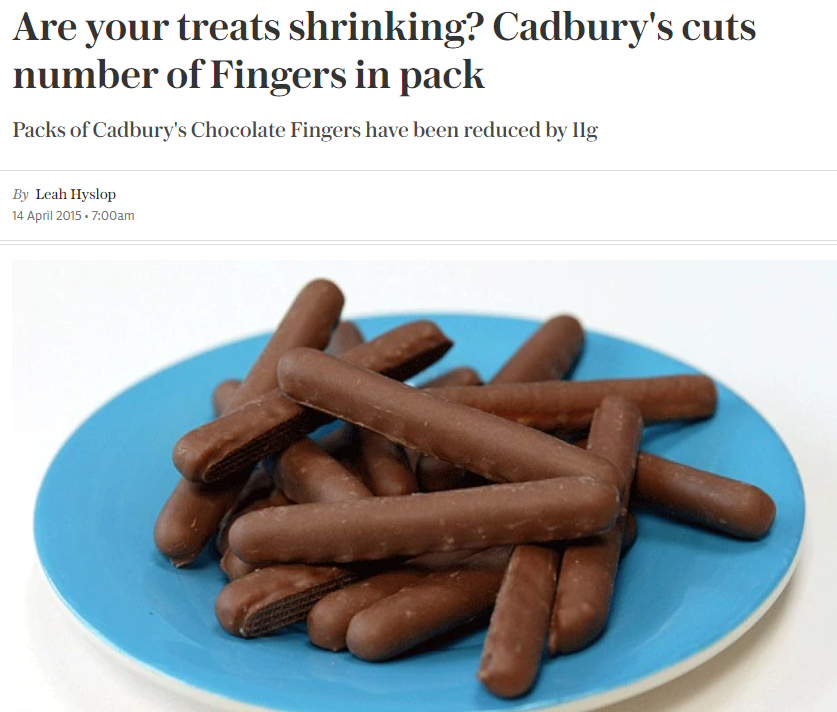
Talking about human body parts in chocolates, do you remember choc fingers? I used to scoff them down as a child. I was somewhat surprised to see they were still available, and were subject of a scandal in the UK in 2015 – Cadbury had reduced the size of the packet by two biscuits!

The headline is somewhat unfortunate, and that’s not what this movie is about. But I’d forgotten their very existence, until a recent ‘news’ report that a Sri Lankan woman bit into a chocolate and found the inside rather hard. Thinking it was a ‘fruit and nut’ variety, she persevered, but when the nut still did not crack she decided to check it out by holding the piece of chocolate under tap water. 

In case her tweet has been removed, here is the photo:

It was a bit of a finger, and it reminded me of this long-forgotten (perhaps deservedly) movie. That news, story, like the film, reminds us that, like the ouroboros, our society is busy eating its own tail, it’s workers.

For me, the only really repulsive bit was the dead piglets being dropped into the vat. I’m going to assume they were very realistic models, perhaps made of marzipan, but I’m aware that in a world that kills 1.3 billion pigs a year, buying real corpses would be a lot cheaper for a low-budget movie.

Consuming Passions received a 20% rotten rating on Rotten Tomatoes. It’s a nice idea, but they play it as farce, hanging the comedy on the assumption that we will all be so disgusted by the thought of eating human flesh that we will ignore the often silly dialogue and the occasionally appalling acting, particularly Vanessa Redgrave who, totally unnecessarily, flounces through the film proclaiming herself a “loose woman” and butchering a Maltese accent.

But there are some interesting ideas about masculinist theories of meat-eating, with one woman saying she was going to buy those chocs for her husband to “put the lead back in his pencil”. The idea that men somehow need meat for virility is a basic plank of meat marketing, despite the clear links to heart disease, colon cancer, environmental crises, and of course appalling animal cruelty. And the film’s basic principle, that we are all edible in our consumerist culture, is apposite and well argued, as more and more bodies are sucked into that vat of delicious brown ooze.

Peter Jackson’s first feature film: BAD TASTE (1987)

Peter Jackson is a New Zealander, and the fourth-highest-grossing film director of all time, behind only Spielberg, Cameron and the Russo brothers. He is best known for The Lord of the Rings and The Hobbit trilogies, as well as movies like King Kong and the documentary The Beatles: Get Back.

But we all have to start somewhere, and Jackson’s first feature was Bad Taste, a splatter comedy which took years to make as it began life self-funded and only later received a grant from the NZ Film Commission. Many of Jackson’s friends acted and worked on it for no charge. Shooting was mostly done on weekends since Jackson was then working full-time for a newspaper in Wellington, the NZ capital. 

Bad Taste is about aliens who plan to capture humans for food. They take over a (fictional) NZ town called Kaihoro (which means something like “fast food” in Maori) and butcher all the residents.

“There’s no glowing fingers on these bastards. We’ve got a bunch of extra-terrestrial psychopaths on our hands.”

It turns out that they are not just hungry but entrepreneurs from the “Crumbs Crunchy Delights” company, and need to collect human flesh for the home planet market, and get it there before competing alien corporations.

“I am certain  that when the Homo sapiens taste takes the galaxy by storm, as it will, Crumbs Crunchy Delights will be back at the top”

They are disguised as humans until they drop the pretence and, luckily for us, they speak English to each other to reveal their plans. Their plans are foiled by a team of agents from the Astro Investigation and Defence Service (AIDS) entering the town to take down the invaders.

The action sequences are actually very well done, long before Jackson had access to special effects studios, with choreographed fight sequences and buckets of gore and brains and other body parts. Jackson took two roles, a nerdy scientist who is a member of the government agents, and a leader of the aliens, including a famous scene in which he fights himself on top of a cliff.

The film is most famous for its unapologetic gore, including half-eaten bodies, heads coming off, and brains leaking out of skulls. The brave Kiwis mow the aliens down in an interminable gun-fight, which culminates in Derek (Jackson) killing the alien leader, Lord Crumb, by jumping on him from the floor above while wielding a chainsaw, a favourite of cannibal films, cutting the alien’s body in half and disappearing inside the corpse. The film was banned in Queensland briefly, which did wonders for its publicity; the video release proudly proclaimed on the cover “Banned in Queensland”.

But is it cannibalism? It is after all a completely alien species from another world eating humans, or at least trying to. So not strictly cannibalism, but humans being eaten by aliens dressed as humans is a popular narrative in science fiction texts (see for example Under The Skin), and raises some interesting questions. Anthropocentric humanism maintains that we are somehow on a higher level than “animals”, even though we are animals, a species of Hominidae (Great Apes). Because of this ontological division, bolstered in past centuries by religious beliefs about humans being made in the image of the divine, we tend to judge other animals as possessions, inferior beings to whom we can do as we wish, so we kill them, skin them, shear them, eat them, experiment on them, race them, and so on. Not just other animals; the colonisers of Africa, South America and other parts of the world felt the same way about the indigenous peoples who lived in the areas they coveted, and so they were conquered, enslaved, converted or simply exterminated.

What if travellers from another planet, considering themselves far superior to us (not an entirely unreasonable proposition if they have conquered deep space travel), decide to colonise, exploit or even eat us? If we could take them to the Galactic High Court, the learned judges might rule that the aliens were simply doing to us what we do to billions of other earthlings each year. As John Harris wrote:

Suppose that tomorrow a group of beings from another planet were to land on Earth, beings who considered themselves as superior to you as you feel yourself to be to other animals. Would they have the right to treat you as you treat the animals you breed, keep and kill for food?

Bad Taste is well made, entertaining and, if you are not worried by lots of gore and brains, very watchable. It debuted at the Cannes Film Festival in May 1987, which is not bad for a first movie, a splatter comedy, made on a shoestring. It currently has 71% “fresh” rating on Rotten Tomatoes, which is far better than many far better financed films. A number of critics made great sport of the title, saying that “bad taste” described the film well, but that was deliberate, a clever combination that tells the audience that it is bad taste cinema (may leave a bad taste in your mouth) and that human meat tastes bad, which according to all the cannibals who have testified about it, is simply not true. We taste somewhere between veal and pork, and would certainly be very popular in galactic fast-food joints.

MOUNTAIN OF THE CANNIBAL GOD (Sergio Martino, 1978)

“Why is everyone so scared of the Pooka?”
“In their language, Rara Me means mountain of the cannibal god

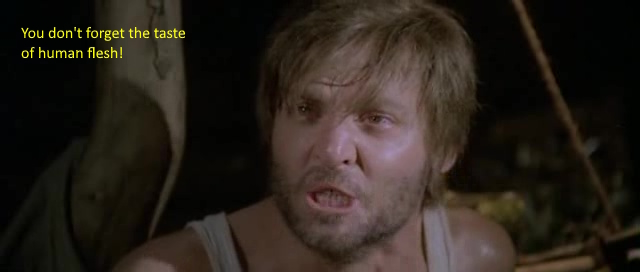
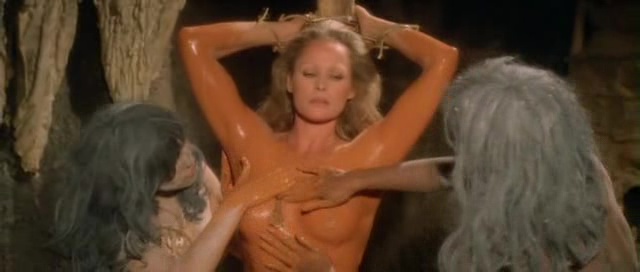
Well that explains it then. Why Susan (Ursula Andress, who was the first “Bond Girl” in Dr No), is tied up in the jungle naked, being smeared with cream by some local girls. Why her husband’s skeleton is being worshipped as a god because his Geiger counter is still ticking within his bones. Why Professor Foster (Stacy Keach) is admitting to having been a cannibal (spoiler: he didn’t like the taste much).

Hey, that pretty much sums up the whole movie. The film starts with stock footage of animals, intended to persuade us we are in the jungles of PNG, but they seem to be chosen at random. The grey-headed flying fox, for example, is native to Australia. Close, but no points.

Like all the Italian horror movies of the seventies, this one has the obligatory scene of real animals being cut up and eaten, some of them while still alive. It was intended to add “realism” to what were pretty dumb plots, but just managed to put a lot of people off watching the films. There is an inordinately long scene of a python eating a monkey alive, and then humans eating a lizard, which Foster tells us is “part of their religion”. Just like eating meat is part of the religion called ‘Humanism’. I guess these scenes also try to teach us that the law of the jungle applies just as much to humans as to other animals. Or else it teaches us to appreciate the fast-forward button.

Manolo (Claudio Cassinelli), a wandering adventurer, joins the merry band and tells them:

“Animals only follow their instincts. That of all living beings – killing and eating. Man too has the same instincts. To satisfy them, he uses more subtle means. Lying, trickery.”

He also tells them he doesn’t kill animals, which would probably make living in the jungle difficult (not many vegan restaurants), but they all seem to enjoy coconuts, so who knows?

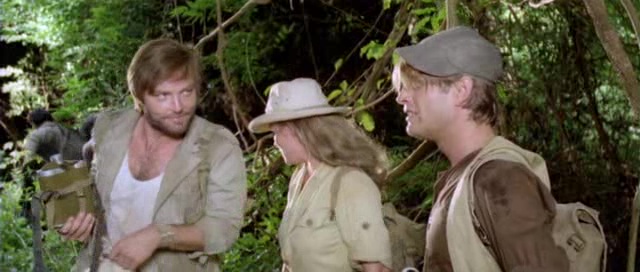
The first half of the film is about a motley bunch of white people heading for Papua New Guinea (it was actually filmed in Sri Lanka) on a Pakistani plane, to explore a heavily wooded island inhabited by cannibals called the Pookas, and the various reasons they are there (uranium, that sort of thing, yawn).

The title card explains that “life has remained at its primordial level” – meaning the rest of us have advanced? Just turn on the news channel any time to fact-check that.

Cannibalism doesn’t get a look in until after the first half, when Foster admits to having lived with the Pooka tribe, where he had to eat human flesh. It haunts him still, and he wants to exterminate them. Sure, eating dead humans is horrifying, but killing live ones is fine.

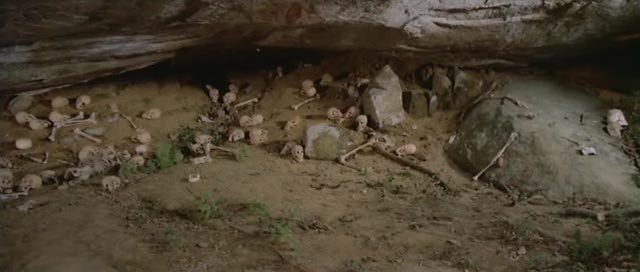
Thirty minutes before the end, they finally agree that the Pooka exist, when they stumble into their pantry.

They are soon captured and the Chief checks them out for meat quality, but then he remembers that he has a photo of her with her husband who, I may have already mentioned, is being worshipped due to his clicking Geiger counter, a proof of his immortality, despite being a rotting corpse.

So now Susan is the new god, and gets dolled up for the occasion, while her brother, luckily dead, is disembowelled for the coronation feast.

Susan gets to eat some of her brother, while the girls who so enjoyed smearing her with whipped cream lie around pleasuring themselves, and the guys engage in bestiality with a totally uninterested pig. This is getting sillier and sillier.

One of the men, perhaps tiring of being ignored by the pig, tries some hanky-panky with the new goddess, and is pulled off and given a rather extreme form of circumcision. Following which, the tribesmen all start eating snakes, for no apparent reason, but with considerable gusto. The film by now is longing to reach some conclusion, so Manolo has a snack with his new friends (seems to be Kentucky Fried Lizard).

Susan is invited to chop up the rapist, but chooses to stick the knife in the Chief instead, and there is now so much meat to go around that everyone goes for a post-prandial nap. Except for Manolo, who watches a bird fight a snake (Pooka version of Netflix perhaps). Finally bored silly, Manolo and Susan fight their way out, kill a lot of cannibals on their way, and escape on a floating log into a river that we have been shown is full of crocodiles. Yes, it’s a happy ending. Maybe more so for the crocs.

Mountain of the Cannibal God is the translation of the Italian title (La montagna del dio cannibale). The movie was released in the US as Slave of the Cannibal God in 1979 and the UK as Prisoner of the Cannibal God, but not until 2001 due to its “graphic violence”. Can’t see the problem myself, but maybe I have watched too many cannibal movies.

The review from Allmovie said:

“a graphic and unpleasant film, with all the noxious trademarks intact: gratuitous violence, real-life atrocities committed against live animals, and an uncomfortably imperialist attitude towards underprivileged peoples.”

I found it a bit dull, with long scenes of exposition and lingering images of the cast struggling through the jungle or over waterfalls. I guess they had to pad it out somehow, considering all the action takes place in the last ten minutes.

The complete movie, at the time of writing, was available on YouTube.

200 And don’t miss “The Horror Geek” Mike Bracken’s hilarious review at Sick Flicks:

THE LONE RANGER (Verbinski, 2013)

This film had a lot of publicity due to the cast – Armie Hammer (since mired in cannibalism scandals as detailed elsewhere) plays the Lone Ranger and, wait for it, Johnny Depp (mired in different scandals altogether) plays his Native American off-sider Tonto. Depp claims he has Native American ancestry, perhaps a great-grandmother, so I guess that’s fine. Helena Bonham-Carter is in there somewhere too, as a brothel madam with an ivory leg – she has certainly graced this blog before, and with Johnny Depp! The director, Gore Verbinski, directed The Ring and the first three Pirates of the Caribbean movies, at least one of which I recall walking out of, but so forgettable were they that I can’t remember which one.

Set in the Wild West in 1869, the Lone Ranger starts off as a lawyer named John Reid, coming to Texas as DA to impose law on a savage land, like Jimmy Stewart in High Noon. His “bible” (he tells the Presbyterians on the train) is John Locke’s Treatises, which insist that

“Whenever men unite into society, they must quit the laws of nature and assume the laws of men, so that society as a whole may prosper.”

Good luck with that.

Reid’s brother, a Texas Ranger, deputises him to help catch an escaped outlaw named Butch Cavendish (William Fichtner from Armageddon, Black Hawk Down and many more). All the deputies are killed by Butch’s gang, except the old drunk, who is working with the outlaws and leads them into an ambush. That could easily (and perhaps mercifully) have been the end of the movie, but Reid is awakened by a “Spirit Horse” and Tonto explains he cannot be killed in battle. He also tells Reid that Butch, the outlaw, is a Wendigo, a figure from Algonquin legend – the tribes from the north of America, and nothing to do with Comanche mythology, but hey, maybe Tonto read this blog.

A Wendigo eats people and gets bigger and stronger as a result, but also hungrier. According to Tonto, he can only be killed with a silver bullet (I think that’s actually vampires, kemosabe). Incidentally, Tonto in the original radio series was not a Comanche but from the Potawatomi nation (who might have referenced Wendigos), but let’s not bother too much with, you know, facts. After all, a spirit horse may have edited the script.

So Reid is still alive and puts on his mask (about an hour into the film), Butch captures his dead brother’s wife and child, a whole tribe of Comanches are massacred by the US Cavalry (that has a ring of truth to it at least), but why on earth is this nonsense being reviewed in a blog about cannibalism?

Well, Butch may or may not be a Wendigo, and may or may not require a silver bullet to kill him (he doesn’t), but he is a cannibal. He is pretty keen on eating people’s hearts, or eyes, or maybe his own foot, according to rumour.

The problem with the movie is that it really can’t decide if it’s a Western drama or a comedy. The bad guys are the essence of evil, but the good guys are clowns. Then in the middle they put a gratuitous massacre of Comanches which at least adds a touch of historical realism.

The special effects are pretty great, with people on horses chasing trains, jumping on trains from horses, jumping on horses from trains, and trains getting derailed and crashing spectacularly. The scenery is gorgeous (Monument Valley of course, even though the film is purportedly set in Texas).

But it flopped at the box office, grossing $260 million against the $650 million that it was estimated to need to break even. Rotten Tomatoes gives it a miserable 31% ‘rotten’ rating, with those 31% mainly loving it, and the rest totally trashing it. The New York Post called it a

“bloated, misshapen mess, a stillborn franchise loaded with metaphors for its feeble attempts to amuse, excite and entertain.”

Then again, the San Jose Mercury News was more forgiving, describing it as a “one hot mess”, but an entertaining one.

If you have two and a half hours to waste, I guess it will keep you amused or shocked or sickened or whatever you take from it. I reviewed it here because it has a bit of cannibalism (Butch eats the Lone Ranger’s brother’s heart) and because Tonto calls him a Wendigo. And there’s not much that’s better than a Wendigo movie.