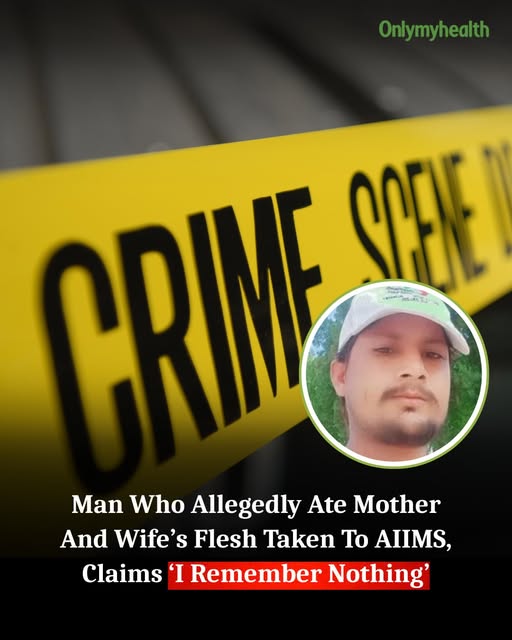
Screams, smashed skulls, flying flesh were not what villagers of an Uttar Pradesh village expected on a quiet Monday morning when a 30-year-old labourer brutally murdered his wife and mother on the rooftop of his house and then chewed flesh from their smashed skulls as his neighbours watched.
A 30-year-old man was arrested on 12 January 2026 in Kushinagar’s Parsa village for the double murder of his mother and wife. The suspect, who has been identified as Sikandar Gupta, had returned to the village about a month previously after working as a labourer in Mumbai. According to police reports, the victims were identified as his wife, Priyanka (28), and his mother, Runa Devi (60). Gupta initially attacked the victims with wooden sticks, and then with cement bricks, causing fatal head injuries to them.
Local residents rushed to the scene as the screams of the women echoed through the neighbourhood. Witnesses reported seeing Gupta mutilate the bodies and consume portions of the remains. When the crowd attempted to stop him, Gupta began throwing pieces of debris and human flesh at them, which caused widespread panic until the Ahirauli police arrived to detain him.
Kushinagar Superintendent of Police, Keshav Mishra, said that,
“a case of double murder was registered, and police are also examining the accused’s mental condition as part of the investigation.”
Neighbours informed police that Gupta had a history of substance abuse involving alcohol and cannabis and was known for frequent domestic disputes. The accused remains in custody pending a formal psychiatric evaluation to determine if he is fit to stand trial or if the murders were the result of a total psychological collapse.
Gupta has been admitted to the Psychiatry Department at AIIMS (All India Institutes of Medical Sciences) under police custody. According to reports, Gupta is speaking incoherently, at times claiming he was drunk during the incident and at other times saying he does not remember anything at all. Doctors have sedated him due to aggressive behaviour and are closely monitoring his condition.
Experts suggest the violence points to deep-seated psychological issues. Dr. PK Khattri, a senior clinical psychologist in Lucknow, said that Gupta’s agitated and non-communicative behaviour “points toward a severe psychotic break” that led to cannibalism.
As Dr Watson used to say, “No shit, Sherlock!”
Ashok Srivastava, an independent criminologist and an associate of the National Forensic Sciences University (NFSU), said that such extreme acts often stem from a
“desire for total domination”
He added that this type of behaviour represents an “ultimate expression of control, often triggered by internal frustrations or extreme psychopathology.”
Which could be said of human societies generally. From bullying in school to sexual abuse to war atrocities to the commercially pressured obsession with eating the flesh of other animals, appetites are driven by this “desire for total domination”, of territory, of food, and of the bodies of others. Anthropocentrism, sometimes called speciesism, is maintained by the practice of killing other animals in ever increasing numbers, to prove our superiority and deny our own animality and mortality. The French philosopher Jacques Derrida called that “carnivorous virility”, the sacrificial slaughter and consumption of “inferior” animals by the rational, patriarchal civilised meat-eater.
What happens when the lust to dominate or kill outruns the limits of anthropocentrism and is instead turned back on fellow humans? The biological fact is that humans are animals, and animals are made of meat. When a society reaches a point where the old ethical agreements are disintegrating, it can either forge new ones or dissolve into chaos, war and, yes, cannibalism. The psychopath, such as the one in this case who allegedly started his brutal rampage with domestic violence before turning to murder and flesh eating, seems to understand this better than most ‘sane’ people.
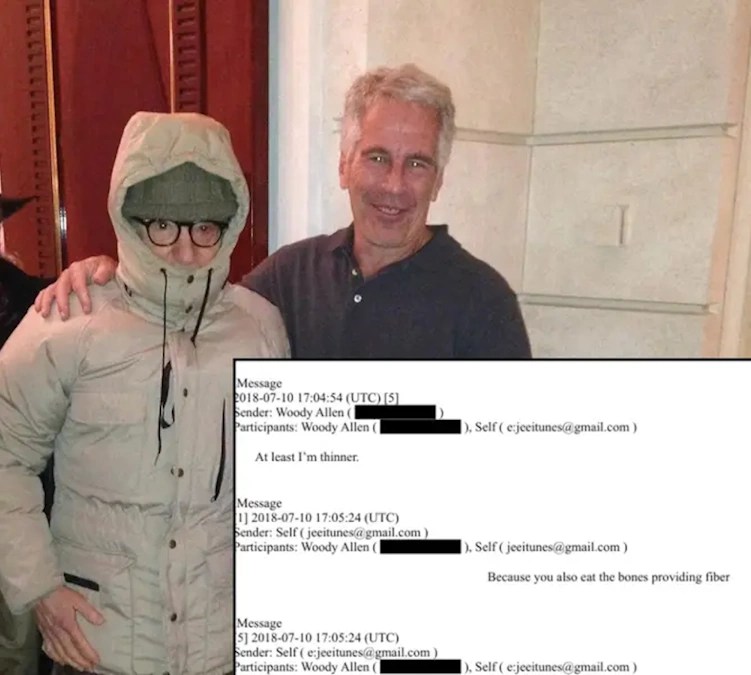
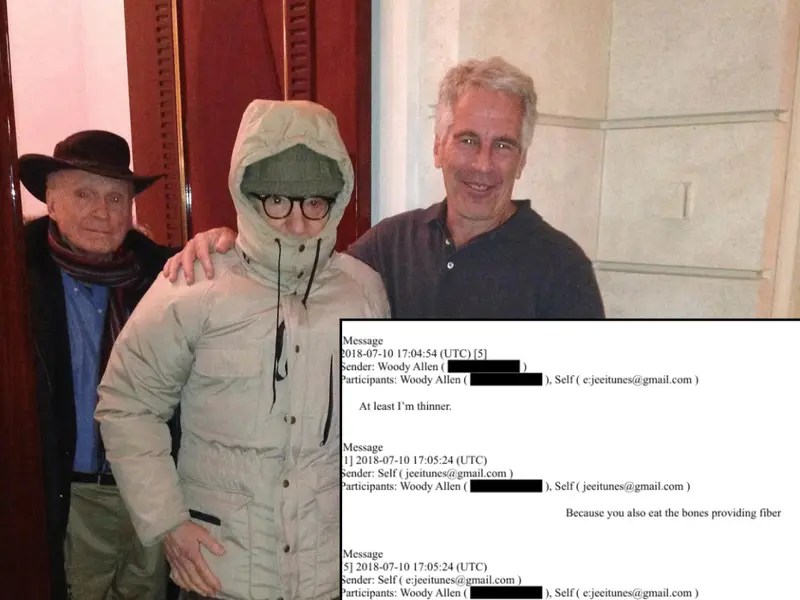
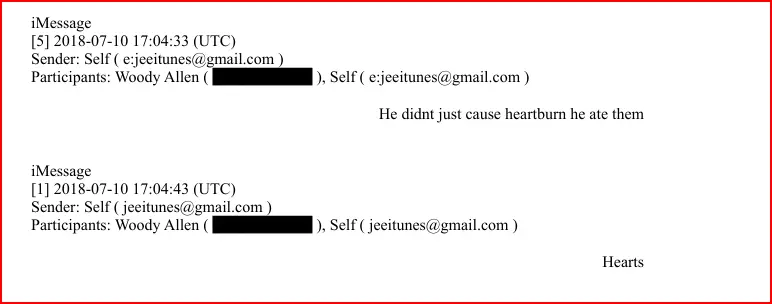
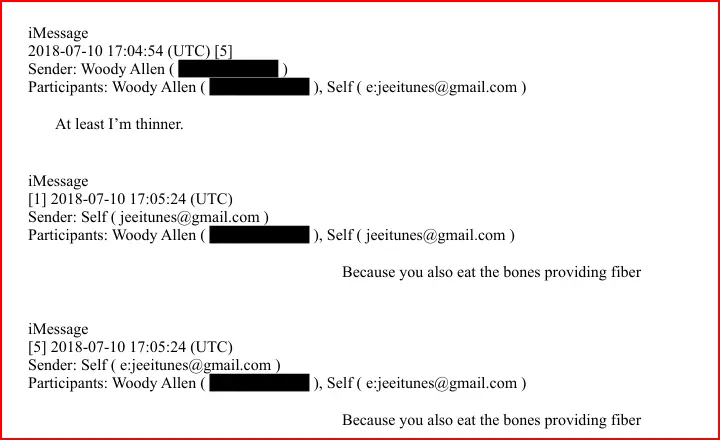
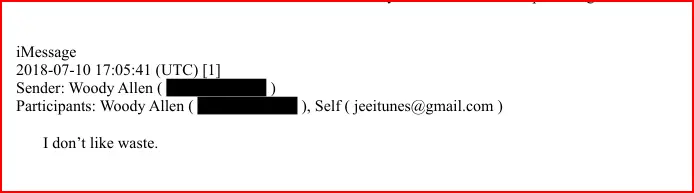
The undated and unlocated iMessage text and image above appeared on a handout released by Democrats on the House Oversight Committee, on December 18, 2025. It shows late convicted sex offender Jeffrey Epstein and US filmmaker Woody Allen. It appears that they had a humorous conversation about eating hearts and bones.
Woody Allen is part of a long list of names that feature in the documents released by the Department of Justice on January 30. Netizens have flagged Allen and Epstein’s exchange as eerie, creepy and disgusting, expressing shock at the dark humour at play. In the chat, Epstein tells Allen,
“He didn’t just cause heartburn, he ate them. Hearts.”
“Thanks. At least I’m thinner.”
“Because you also eat the bones, providing fibre.”
“I don’t like waste.”
Comedy is Allen’s business, and cannibal jokes are common.
However, the exchange between Epstein and Allen immediately triggered further speculation about Epstein’s purported cannibalism, as covered in this blog last week. Although there is no direct evidence of the sex offender or his guests eating human remains, social media has been abuzz.
Epstein and Allen were neighbours in New York City and had known each other for a long time. Allen and his wife, Soon-Yi Previn, reportedly dined with Epstein and attended common gatherings where famous names from media and academia were also present. In 2015, Epstein used his contacts in the Obama administration to arrange a White House tour for Allen and Previn. However, there is no evidence of Allen being linked to Epstein’s sex crimes.
Woody Allen was at the centre of another controversy in 1992 when he started dating Soon-Yi Previn, who was 21 at the time, while he was 56. Soon-Yi was the adopted daughter of Allen’s then-girlfriend Mia Farrow.
Allen was also investigated over allegations by farrow that he had assaulted their adopted daughter, Dylan Farrow, who was seven at the time. Epstein and Allen were in touch during all these times. Their correspondence shows that they supported each other during the controversies. Maybe Jeffrey hoped that Woody was a kindred spirit.
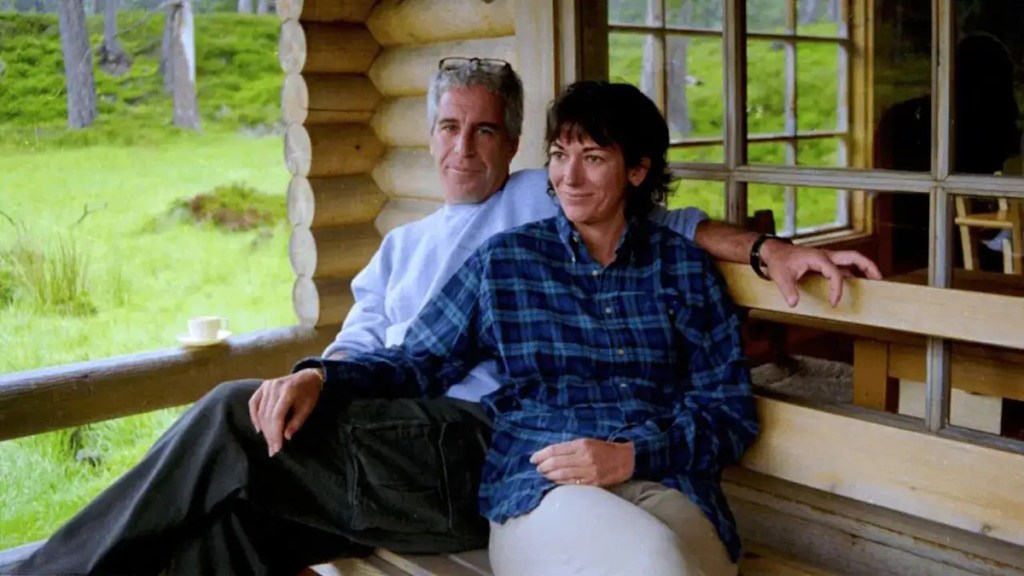
Another document has raised speculation of a link between Epstein and the disappearance of three-year-old Madeleine McCann, who was taken from the Ocean Club in Praia da Luz, Portugal in 2007. According to an unnamed witness, Madeleine (or a child of the age she would have been then) was seen was a woman who looked a lot like Ghislaine Maxwell, Epstein’s former partner, in 2009.
Rampant speculation and muckraking, but I guess it’s only a matter of time before every lost child will be rumoured to have been in Epstein’s bed or on his table.
“Get your hand off my knee and get me, uh, my lunch!
What’s leading the news? Wars roiling the globe? Economic dislocations? Warnings about possible new and very nasty pandemics?
No. All anyone seems to want to talk about is Jeffrey Epstein, the late financier and convicted sex offender, and the millions of pages of documents and photos that are being released (the latest and final batch on January 30) by the US Department of Justice in a hodgepodge of verified or dubious forms, some heavily redacted.
Claims are now circulating online that Jeffrey Epstein engaged in cannibalism or, to be more precise, “ate babies”.
One document, cited by online users, contains allegations that babies were dismembered and their remains consumed. The same document makes a reference to “George Bush 1”. However, the claims have not been substantiated, and their origins remain obscure.
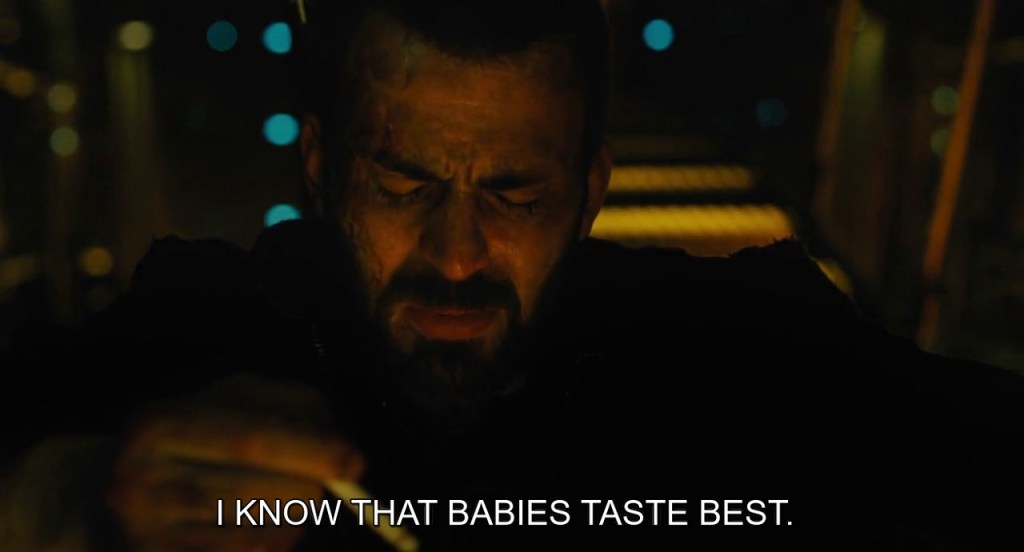
Babies are the first choice of predators and scavengers like humans, because they are easier to catch and their meat more tender. Think of how “lamb” or “veal” sell at a premium to “mutton” or “beef”, how “suckling” pigs are a delicacy, or how so-called “broiler” chickens are killed and eaten at six to seven weeks old. As Curtis says in the movie Snowpiercer:
Some have even suggested, satirically, that eating babies would be a good thing for the environment.
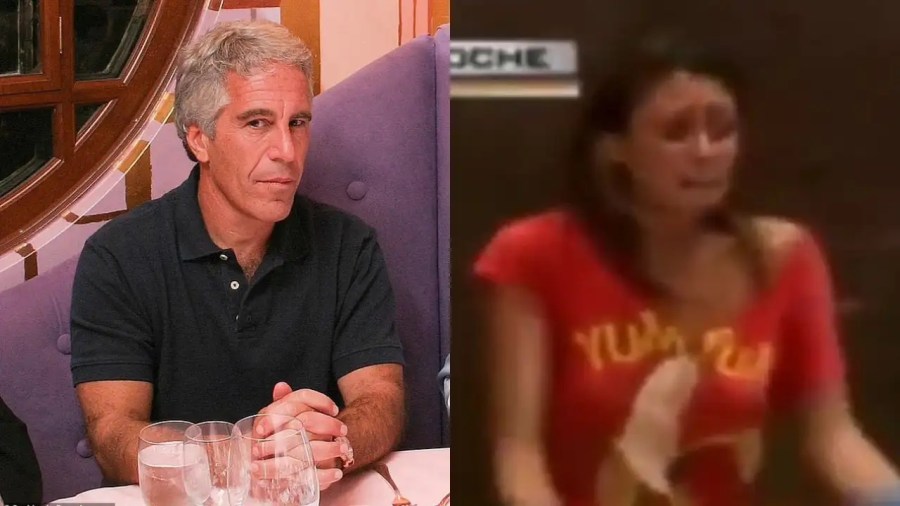
The allegations have been further amplified by the resurfacing of a video from 2009 featuring Gabriela Rico Jimenez, recorded in Mexico. In the clip, Jimenez alleged that she attended a private gathering of wealthy individuals where she witnessed cannibalism.
This story was covered by this blog some months ago, when it last made the rounds due to an exposé on a podcast called Mexico Explained. The blog about her is linked here.
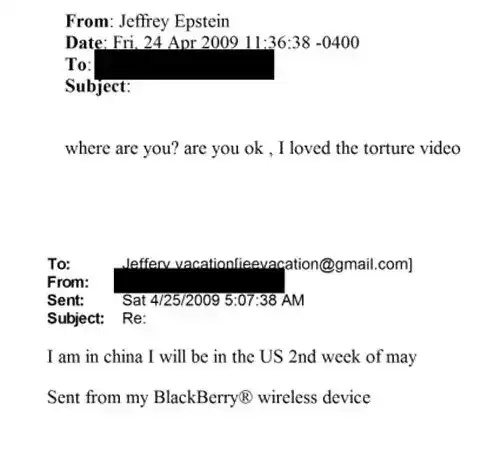
Interest in Jiménez’s case has now surged again, after newly released Epstein documents referenced a party on a yacht and included allegations involving extreme behaviour. One email allegedly sent from Epstein’s known email address read:
“Where are you? Are you okay? I loved the torture video.”
These references, revealed as part of the January 2026 document release, sparked widespread public concern and renewed online theories linking Epstein’s network to past claims made by Jiménez. The material has led many online to speculate on connections between the Epstein files and Jiménez’s 2009 accusations. While no new verified information has emerged about Gabriela Rico Jiménez’s whereabouts or fate, the mystery surrounding her disappearance continues to enthral internet users worldwide. However, there is a dearth of concrete evidence linking her allegations to Epstein.
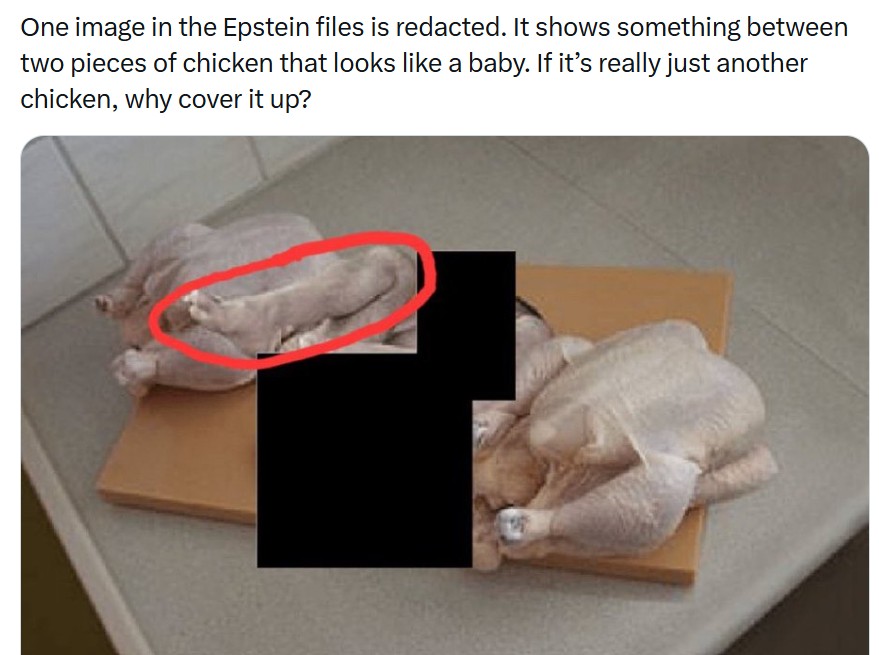
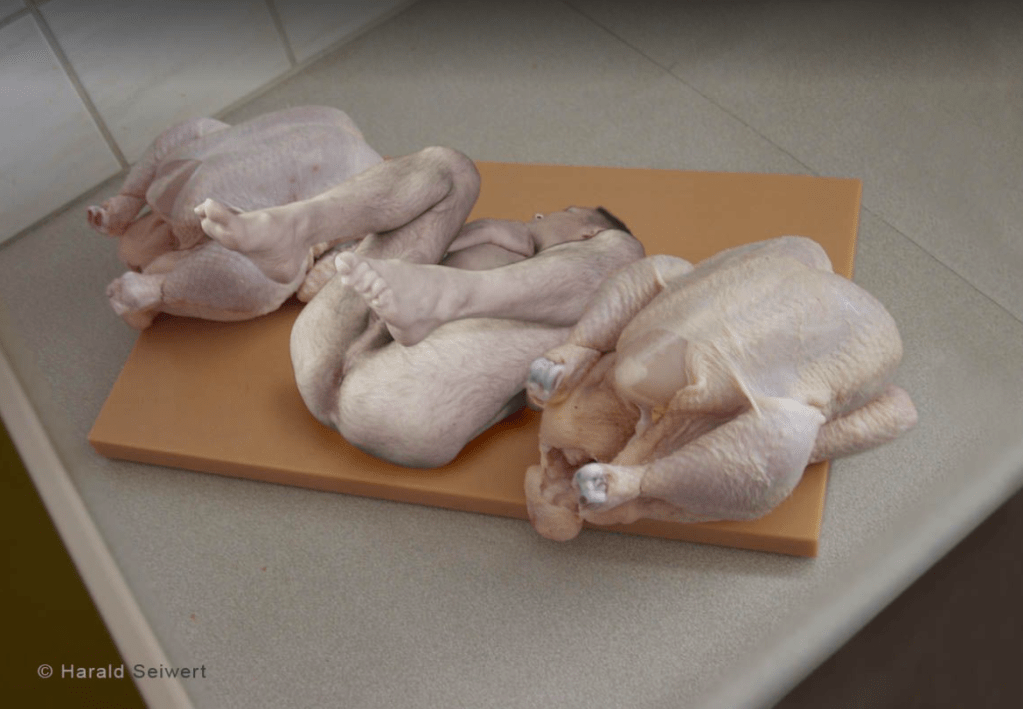
Social media users have drawn further conclusions from unrelated material, including an image (heavily redacted) that they claim emerged from the Epstein files showing a baby among chicken corpses. Observers have noted that the photograph was actually an art work from 2003 by a German artist named Harald Seiwert, used in vegetarian campaigns.
Why cover it up? Well, maybe because it was showing a guy’s hairy bum. Here’s the original:
Several posts on X have promoted conspiracy theories in response to the files. Others are circulating (again) a long-debunked image, clearly a deepfake which first appeared in 2023, purporting to show Epstein with young boys from a rap duo called “Island Boys”, Alexander (Alex) and Franklyn (Franky) Venegas. Some are even claiming the twins are Epstein’s children. However, Snopes rated the claim false in January 2026, Reuters found no supporting evidence, and the Island Boys themselves denied ever meeting Epstein in a 2023 statement to TMZ.
Still, a bit of evidence (or lack thereof) should not spoil a good story. One user wrote:
“These scumbags ate children. Some documents state that they conducted rituals on a yacht and consumed the fetus; they even compared its taste to cheese. They are messengers of the devil in their purest form.”
Another claimed:
“Jeffrey Epstein emails with the gruesome subject ‘Slicing a Pizza’ probably means that Pizza-Gate is most certainly real. Sadly Conspiracy Confirmed.”
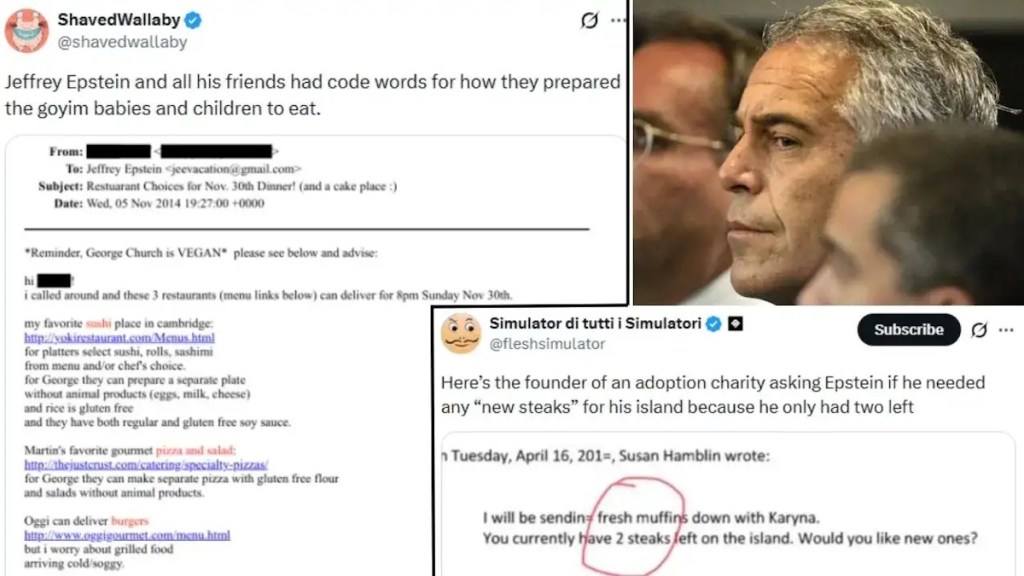
The Pizzagate theory — since widely debunked —was a conspiracy theory that exploded online during the 2016 U.S. presidential election, alleging that a child sex-trafficking ring involving prominent Democratic officials was being run out of a Washington pizzeria called Comet Ping Pong, interpreting food-related terms as code words. Posts suggested that words such as “pizza” or “steak” were code for children. One user alleged that an adoption charity founder asked Epstein if he needed “new steaks” for his island. A text search for the word “pizza” in the Justice Department documents comes up with an astonishing 849 results, most clearly related to Italian cuisine, but someone will no doubt find something there to reignite Pizzagate.
Others invoked comments made by comedian Roseanne Barr in 2024, when she claimed on a television appearance that Hollywood and political elites were “vampires” who drank blood and ate babies.
Note the antisemitic implications in the post above from someone who calls himself “ShavedWallaby”:
“Jeffrey Epstein and all his friends had code words for how they prepared the goyim babies and children to eat.”
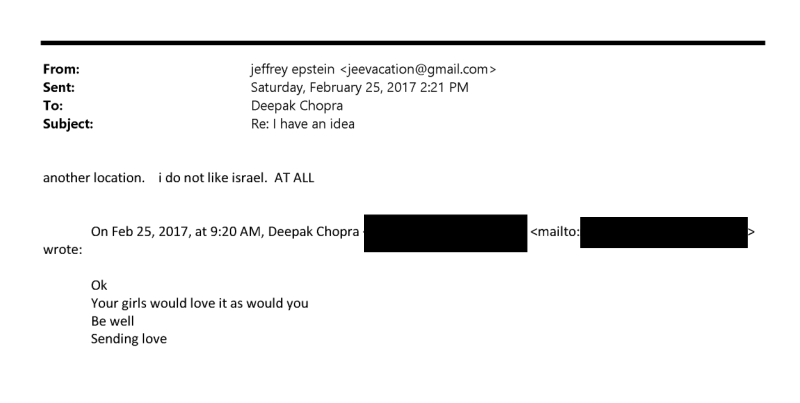
“Goyim” is a word from Hebrew, found in the Bible where it means “nations”, particularly those being described in the narrative of wars from over 3,000 years ago: Hittites, Amorites, Jebusites, etc. Since then, its use has evolved to refer, sometimes disparagingly, to Gentiles, or everyone who is not Jewish. Most languages have a sometimes extensive range of words for outsiders; the Roma refer to outsiders as Gadjo, and the Japanese talk about foreigners as Gaijin. The person posting the above is implying that only non-Jewish children are being eaten at these dinner parties. Epstein of course is a Jewish name, although there is absolutely no indication that he adhered to any religious precepts whatsoever, and was certainly not a Zionist according to a tweet to Deepak Chopra revealed in the latest batch of documents from the Justice Department.
Other posters have alleged that they found evidence in the files proving Epstein was involved in “Baal worship”, was a “Mossad agent” or championed “Jewish supremacy,” old conspiracies are being repackaged as new revelations. In fact, the bank account named “Baal” was a scanning failure: the document says “Bank”. Also, for those who have ever looked at a Bible, a lot of it involves God telling the Israelites to avoid any contamination by the idolatrous Baal worshippers.
The reference to Jews eating (non-Jewish) children is, however, very familiar, even in the twenty-first century, and derives from the “blood libels” that caused riots and pogroms for centuries throughout Europe, starting in the twelfth century. Jews, and those accused of being witches, were tortured, exiled or slaughtered due to totally unsubstantiated claims of infant cannibalism, or more precisely the use of infant blood in religious rituals – an accusation that makes no sense when placed against the strict Kosher rules that forbid eating blood of any animal in any form. But such claims do not fade easily, and will often be seen in new forms, such as descriptions of Israeli soldiers deliberately starving, kidnapping or killing Gazan children in a (singularly unsuccessful) attempt to perform genocide. Only the most malicious and vituperative claims now involve cannibalism, and they are usually posted anonymously (I presume the above is a pseudonym since, in Australia, we do not usually shave wallabies).
A protest in Washington, D.C. on November 20 2025 featuring activists dressed as Israeli Prime Minister Benjamin Netanyahu, U.S. President Donald Trump, U.S. Secretary of State Marco Rubio and other officials dining on food and drink meant to resemble organs, skin and blood. The demonstration took place both inside and outside Union Station, the capital’s central train station. The activists deemed it as “Israel’s Friendsgiving Dinner,” with signage behind a long dining table displaying a menu consisting of “starter: Gaza children’s limbs,” “main: stolen organs,” “drink: Gaza’s spilled blood” and “dessert: illegally harvested skin.”
Meanwhile, this image appeared on the campus of San Francisco State University, or perhaps a modernised version of it (this one was from the second intifada). It is classic blood libel: Thomas of Monmouth would be jealous of the modern technology, but would recognise the vilification strategy.
Epstein’s crimes involved a type of cannibalism – the exploitation and abuse of children who were also supplied to other sexual predators. But despite the volume of accusations filling the social media of those with nothing better to do, there is no concrete evidence in the released documents that Epstein or anyone else in his circle of the rich, entitled and depraved engaged in actual consumption of babies. But then, I guess it’s a bit much to expect them to leave proof, or even bones, lying around. Men (and I guess a few women) who see themselves as gods, masters of the universe, happily guzzle all the evidence.
See also my post on Woody Allen and his friendship with Epstein.
Violence in the Highlands of Papua New Guinea marred celebrations of the country’s 25th anniversary of independence. Armed men were shown in videos holding body parts and saying “this is our meat.” The story brought back memories of former US President Joe Biden claiming his uncle’s body was never found during the Second World War as he had been eaten in PNG, stating that “there were a lot of cannibals, for real, in that part of New Guinea”.
Sean ‘Diddy’ Combs, already in hot water for sex trafficking and racketeering charges, has been accused of cannibalism now. In the Peacock documentary Diddy: The Making of a Bad Boy – which covers the rise and dramatic fall of Combs, 55 – former Making the Band 2 contestant Sara Rivers revealed what she and others experienced when cameras weren’t rolling. When Diddy got angry, she says, he threatened her band member:
“You make me so mad I want to eat your flesh!”
In the North West Province of South Africa, one of a group of illegal miners (zama zamas, or “those who take a chance” inZulu) in the Stilfontein mine (which closed in 2013) has disclosed that he and his fellow miners turned to cannibalism when they ran out of food 2km (1.25 miles) underground. The police had cut off food supplies the previous August to ‘smoke out’ the illegal miners.
February
Two artists put on a show in Scotland where they made and cooked “black pudding” sausages from their own blood. Although they did not eat the sausages after this show due to legal considerations, they have done so in the past, although one of the artists has since become a vegetarian and has said he will not be eating them in the future.
John Beagles and Graham Ramsay
Tyree Smith, the “Connecticut Cannibal”, was given conditional release by the Nutmeg State’s Psychiatric Security Review Board from the mental facility to which he was incarcerated. Smith was handed sixty years in 2013 for killing a homeless man and eating his brain and eyeball in a cemetery, washed down with sake. Doctors who have been treating Smith said he’s been fully rehabilitated, thanks to medications that quelled the voices in his head. Others, including the family of the man he killed and ate, are less optimistic about his future plans. Mr Gonzalez’s sister-in-law, Talitha Frazier, asked the review board “How do we know he’s not going to do this again?” Republican state Senator Paul Cicarella said “Murder and cannibalism and release in the same sentence … that’s a problem”.
What’s with all the eyeballs? A “preppy” Princeton grad was charged with murdering his brother at their luxury Princeton apartment, after which he ripped out the victim’s eyeball and ate it. He also reportedly set the family’s cat on fire. Even the Duke of Cornwall in King Lear would have blushed at that transgression.
March
A woman in Brazil barbecued and ate her victim’s heart and penis. Josefa Lima de Sousa, 65, left a blood-stained sign by the mutilated corpse with a message, using her street name, saying: “Gringa got rapist.” She told police the victim had been a child abuser.
A Texas embalmer with the wonderful name Amber Ludermilk was charged with the felony “abuse of a corpse” after cutting off the penis of a deceased sex offender and jamming it into his mouth. An arresting constable stated that “No matter what one thinks of his life, the law requires that he be treated with dignity in death.” In a world where thousands of humans die of starvation every day, and we casually torment, kill and then mutilate the corpses of billions of other animals every year for food, medical experiments, clothing or entertainment, are we expected to weep for this sex offender’s insentient corpse?
A South Carolina mental health facility was sued by family of a victim of murder and cannibalism. The lawsuit alleged that the killer, another inmate, had killed two men and eaten both the victims’ ears, as well as drinking their blood so he could “gain their power.”
In Rwanda, a minister said that persecution and cannibalism of Tutsi people are still “commonplace.” Readers may remember that just over thirty years ago, almost one million ethnic Tutsis in that country, some 75% of the Tutsi population, were slaughtered in the space of just 100 days. Although the word genocide has come to mean ‘anything done by someone you don’t like’, that one was a real genocide.
June
A young woman who calls herself pterodactylhunny disclosed on TikTok that her doctors had given her one her ribs which had been surgically removed. She took it home, boiled it to remove the meat, then ate the meat to see what it tasted like. Spoiler: the formaldehyde in which it had been soaked made it taste pretty bad. The cannibalism of eating her own flesh, however, she described as “cool” and “not that weird”. Viewers responses ranged from shocked to approving, pointing out that eating one’s own meat could be considered vegan, since the animal from which it came had given her consent.
16 men were arrested in the West Pokot region of Kenya after human remains were found including the bodies of several children. One boy was found in a maize field with his organs removed. Police say the suspects have confessed to killing and eating eight people.
Relatives of the victims of a mass-murderer in Idaho were outraged to find that he had taken a plea deal for the stabbing of four students in 2022, thus avoiding the death penalty. No indication of him eating his victims, but a forensic psychologist reported that he had become a strict vegan before that, because:
He was afraid that if he let himself go to taste meat once, he would become addicted to it—like he had become to heroin—and start killing and eating people.”
In Kenya, a man recently released from prison for killing his wife, murdered his second wife, cooked her flesh and fed it to his children. Irate members of the community lynched him and set him on fire. The incident elicited sharp debate among Kenyans over the old claims of cannibalism among members of the community. Samuel Bosire Angwenyi, the Secretary General of Abagusii Council of Elders, dismissed the claims saying it was a myth which some people blindly believed. “If there is a person who can eat a fellow human being, then that must be Satan.”
August
An Australian boxer whose nickname is “the Butcher” told fans he had “become a cannibal”. What he meant was that, as part of his training for a big fight, he had taken advantage of the birth of his child by eating his wife’s placenta, in tablet form, washing it down with a little breast milk. He said:
“I’ve technically become a cannibal. It’s actually like a superpower”
In Cuba, a man arrested for murder was found to have a jar filled with human fat, jars of fried meat, and a bag of ribs in his refrigerators. Cannibalism was suspected but never officially confirmed. Meanwhile, other residents of Santiago de Cuba, seeing an unusual level of police activity in September, fear that the case may be linked to the disappearance of other residents from the Abel Santamaría neighbourhood.
In Zimbabwe, a woman allegedly poisoned her four-year-old granddaughter, Tawanayasha Kadhene, before mutilating her body in Shurugwi on 26 August. Police said: “The suspect gave the victim a maheu drink laced with a maize pesticide pill. The child collapsed and died instantly. The suspect then cut flesh from the victim’s cheek, mixed it with herbs prescribed by a sangoma, cooked it and ate the mixture.” The ritual killing allegedly happened following the woman’s consultation of a traditional healer.
September
In an unusual case of auto-cannibalism, a patient at the University of California Los Angeles (UCLA) David Geffen School of Medicine received intravenous lorazepam to treat anxiety and claustrophobia in order to facilitate an MRI. He subsequently developed acute psychosis, performed self-inflicted digital enucleation of his left eye, and then ingested it. Lorazepam is a benzodiazepine that has been FDA-approved as a fast-acting anxiolytic and sedative. It is one of the most commonly used medications for these indications. The studies of the case claim that it is an “extremely rare paradoxical reactions to benzodiazepines.” Worth keeping an eye on though.
October
A thirteen-year-old boy in Egypt was arrested after reports he had murdered his classmate, sawed his body into pieces and ate them “out of curiosity”. He told the police that he that he found human flesh was “similar to breaded chicken”.
November
The strange case of Gabriela Rico Jiménez, a 21-year-old model from Mexico who disappeared in 2009 after raging against alleged cannibalistic captors while outside a fancy hotel in Monterrey Nuevo Leon, has been rediscovered by TikTok posters. Didn’t know this was happening until my blog on the story suddenly started to take wings recently.
In New Zealand, a mortuary technician lost his licence due to posting online talks ‘promoting cannibalism. He offered to obtain human tissue to interested readers, and added “When we have burn victims…. They smell so good sometimes”. The man also engaged in online conversations about rape and sexualising children, his own alleged drug use and ways of making explosives.
December
We closed the year with allegations from the Ukrainian government that Russian troops trying to occupy Zaporizhzhia in eastern Ukraine have run out of food and are killing and eating each other. The Ukrainian spy service GUR reported that:
“Due to a lack of food, the occupiers are sharpening their knives and preparing to eat their younger comrades”
Intercepted radio messages apparently include soldiers saying “We’ll eat each other, it’s all fucked up here. We’re already looking for someone younger” and “I’ve sharpened my knives. I don’t give a shit who I have to cut up. I just want to eat. Fuck everyone else”.
Around this time last year, this blog reported on several convicted Russian murderers who had admitted to cannibalism but been offered pardons if they agreed to serve in the Russian forces in Ukraine for six months. Later reports have noted that the pardons and repatriations may not ever have happened.
Back in Russia, “Perm cannibal” Mikhail Malyshev died at the age of 65 in a clinic, while waiting for a doctor. Malyshev was arrested in 2000 for two proven murders, although a polygraph test claims that he was involved in at least eight: he killed, dismembered and partially ate a man and a woman. Malyshev reportedly used the soft tissue to fry cutlets and threw away the rest. He often made kebabs out of stray dogs. He was sentenced to 25 years and served his sentence in the Perm region, undergoing mandatory psychiatric treatment. He was released from prison in October 2022. Some reports stated that after his release from prison, Malyshev had found work at a shelter for homeless animals. That part may be the most disturbing aspect of the 2025 story!
New cannibalism movies
A veritable swathe of new releases this year, showing again that cannibalism is the flavour of the month (sorry about the pun) or the year, or indeed the whole damn century:
Know Me: A True-Life Drama
Story of the “Causeway Cannibal” and media response
Devour
All female metal band called “The Virginia Bitches” come across a town full of cannibals
Human Hibachi 3: The Last Supper
Cult of devout followers eat human sacrifices in a “last supper”
Cannibal Comedian
Cannibal takes a stab at stand-up
Cannibal Mukbang
She makes vodcasts of voracious eating – mixed with cannibalism of bad men
A few years ago, I got chatting to a couple who owned a business in New Zealand – they were undertakers. When I mentioned my doctoral thesis, the thin red line between cannibalism and carnivorism, they told me they often received calls and emails seeking body parts. I doubted the story at the time – after all, cannibalism was a convenient story in the early days of British colonialism, and while Maoris have agreed it happened occasionally, it seemed unlikely to be a regular commercial proposition in the twenty-first century.
But the story lives on. In November 2025, The New Zealand Health Practitioners Disciplinary Tribunal found that a former mortuary technician had posted comments to social media “promoting cannibalism” and boasted that he could “literally steal an entire heart”.
The man – who cannot be named for legal reasons – also shared an image online of a dissected human skull with a handwritten message inside: “We’re inside your head”.
The Tribunal ruled that this constitutes professional misconduct, stating that he:
“engaged in conversations … promoting cannibalism and eating post mortem tissue”
Their ruling noted the man identified himself online as someone who worked in forensic pathology and/or was involved in post-mortems.
The man also engaged in online conversations about rape and sexualising children, his own alleged drug use and ways of making explosives, offering to show others how to make explosives.
One online conversation saw the man claim:
“When we have burn victims…. They smell so good sometimes”
In another online discussion about cannibalism, he discussed the provision of human (post-mortem) tissue to others.
“When you’re working here. We got enough [muscle] to go around. Save your muscle”
He also boasted about being able to access body parts.
“I mean. It’s not actually that hard. I could literally steal an entire heart. It all just goes back into a bag we stitch back inside them not like anyone checks it”
He told one online user he could “sneak a little heart slice next week. It’ll be me conveying my love to you. Sending some actual human heart.”
The man also claimed that he’d decapitated a corpse “to boil her head”.
The Tribunal ruling noted the man “accepts that his rhetoric, comments and information about post-mortems, post-mortem procedures, and dissections that he posted and/or circulated in his social media posts was inappropriate and that his conduct fell below the expected ethical and professional standards that apply to members of his profession”.
The Tribunal also noted the “charge of professional misconduct is established”.
No charges have been laid regarding the man actually carrying out any of these acts. What happened to free speech and entrepreneurialism in New Zealand?
A 13-year-old schoolboy allegedly murdered his classmate, sawed his body into pieces and ate them “out of curiosity”. The teenager killed his friend, Mohamed, by beating him with a wooden stick before using a power saw to cut his body into small parts that would fit into his school rucksack.
The killer reportedly lured his classmate to his family’s home in Ismailia’s Al-Mahatta Al-Jadida district on October 20, 2025. While alone, the child cannibal said he repeatedly hit the victim on the head with a stick until he died. The suspect, known as Youssef A, said he was reenacting the murder scenes which he saw in films and online games. The killer explained that he wanted to “try the way” he had seen online. Police officers were made aware of the attack after the victim’s remains were found near a shopping centre.
After conducting a search, the authorities then found further severed pieces of the victim under a bridge, in a pool and on an open field.
Youssef admitted to the killing and using an electric saw to dismember his victim. He also said he scattered his remains across the city in Egypt.
The suspect added that he ate part of the victim’s body “out of curiosity” and explained that it was “similar to breaded chicken”.
The child cannibal was made to re-enact the crime for investigators, leading police around the city to the places he had disposed of the body parts.
The suspect was transferred to a juvenile care facility after being detained for four days by Public Prosecution. He remained there for a week while judges reviewed his case.
Youssef also underwent a full physical examination, drug testing and forensic analysis to compare samples with Mohamed’s.
Investigators continue to look into the violent film and video content which he said influenced him to conduct the gruesome act. The case ignited calls for children to have greater protection from graphic content, with increased supervision from parents.
The case begs the question – plenty of children watch gruesome movies without then eating their friends. What did Youssef see in these media that led to his curiosity? The movies offered the blueprint for homicidal techniques, but behind all that is the isolation that saw two children on their own long enough for mayhem to ensue, and the constant reiteration of the cheapness of life, both human and non-human, that led a child to wonder what difference there might be between a friend, and a breaded chicken.
Australian boxer Nikita Tszyu has revealed that he became a “cannibal” as he prepared to fight Lulzim Ismaili this month (August 2025). The boxer said he needed to be at his very best to win over his unbeaten opponent, and hoped that his new diet would boost his training.
Tszyu revealed that his change in nutritional sources was all thanks to his wife, Nikita Bedwell. The couple welcomed their first child earlier this month, named Curiosity after the NASA Mars Rover, and the birth allowed Tszyu to change his diet.
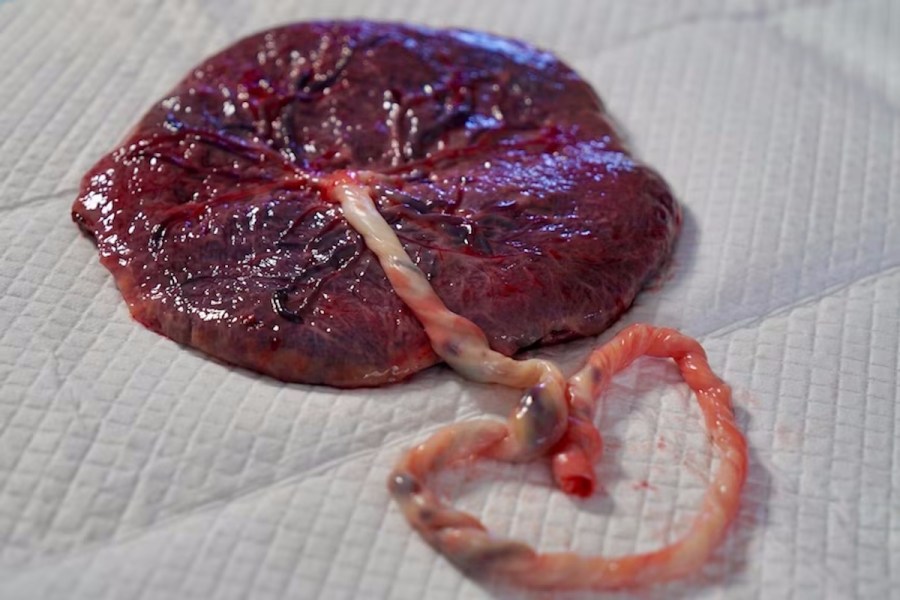
The Australian boxer is eating his wife’s placenta in capsule form as part of his training program, and feels like he is benefitting from the change in diet. He told a Sydney radio station:
“we freeze-dried her placenta and I’ve been supplementing on her placenta recently… in tablet form”
Does that make him a cannibal? Well, he thinks so. He added:
“I’ve technically become a cannibal. It’s actually like a superpower. I’ve done tests with my sparring – days where I’ve had it and days where I haven’t – and it feels like I got all this crazy amount of energy”
If you’re not convinced by that, he told the interviewers he is also including breast milk in his diet. Asked if he had tried it, he replied: “I have, I have… and it’s delicious as well!”
Consuming placentas is a growing trend in America, with mothers usually consuming them as part of their postpartum recovery. The practice dates back to Chinese medicine, though studies are yet to confirm that there are benefits to eating them.
The bout on August 20 was subtitled (based on Tszyu’s nickname):
THE BUTCHER IS BACK
So, is cannibalism the next big thing in athletic enhancements? Well, Tszyu knocked Ismaili, who was previously unbeaten, to the mat in just over one minute. The shaken opponent sat on his stool and refused to leave his corner, throwing in the towel before round two commenced.
Athletes often boast of eating meat to improve their fitness and stamina, although there are also plenty of vegan ones who swear that dropping meat and milk makes them faster, stronger and more alert. But if there is any truth in the meat myth, then I suppose we need to consider the words of Anthropologist Marvin Harris, who stated in his book Good to Eat: Riddles of Food Culture that, while humans are clearly not obligate carnivores,
“our species-given physiology and digestive processes predispose us to learn to prefer animal foods… strictly speaking, human flesh itself contains the highest-quality protein that one can eat”
There’s one to chew on, next time you enter the ring.
Family members of one of the victims of a gruesome murder of four college students in Idaho are furious that Bryan Kohberger has been offered and accepted a plea deal.
Kohberger was accused of stabbing Xana Kernodle, Madison Mogen, Kaylee Goncalves, and Ethan Chapin to death in November 2022 in Moscow, Idaho. The students were found with fatal stab wounds in an off-campus rental home in the early morning hours. Investigators believe the four students, thought to be sleeping at the time, were fatally stabbed between 3 a.m. and 5 a.m. According to the coroner, there was no sign of sexual assault.
A little over a month after the killings, Kohberger, a 28-year-old Ph.D. student and teaching assistant in the Department of Criminal Justice and Criminology at Washington State University, was arrested at his parents’ home in Pennsylvania on Dec. 30, 2022, and extradited to Idaho.
Kohberger was facing a possible death sentence if convicted in a trial that was scheduled to begin Aug. 18, 2025.
A letter sent to families of the victims to inform them of the deal said Kohberger will appear in court Wednesday to enter his guilty plea and be sentenced in late July to life in prison, according to the Idaho Statesman. Kohberger will forfeit his right to appeal as part of the deal. The letter from Moscow Prosecuting Attorney Bill Thompson said:
“We cannot fathom the toll that this case has taken on your family. This resolution is our sincere attempt to seek justice for your family. This agreement ensures that the defendant will be convicted, will spend the rest of his life in prison, and will not be able to put you and the other families through the uncertainty of decades of post-conviction appeals.”
Goncalves’s family had an angry reply on their Facebook page.
“We are beyond furious at the State of Idaho. They have failed us. Please give us some time. This was very unexpected. We appreciate all your love and support.”
The family issued a later post explaining what had been taking place.
“I would like to clarify a couple of things…we DID talk to the prosecution on Friday about the POSSIBILITY of a plea deal and it was a HARD NO from our family. It was very nonchalant and barely discussed as the majority of the conversation was surrounding the upcoming trial. NOTHING in our conversation prepared us for the next steps.”
A family member of one victim told NewsNation that upon hearing of the plea deal, she felt like “all the power had been given back to Kohberger.”
Why is this case featured in a blog about cannibalism? Well, A forensic psychiatrist told Newsweek after the arrest that Kohberger had battled with “cannibalistic urges“.
Reports then surfaced that Kohberger had followed a strict vegan diet, and had reportedly struggled with heroin addiction in the past.
Forensic psychiatrist Carole Lieberman told Newsweek that Kohberger’s “obsessive-compulsive eating habits” indicate he was afraid he would become addicted to meat if he ate it.
“He was not only vegan, he refused to eat off of pots or plates that had had meat on them. Psychologically, this represents his struggle against his cannibalistic urges. He was afraid that if he let himself go to taste meat once, he would become addicted to it—like he had become to heroin—and start killing and eating people.”
A relative told the New York Post that Kohberger’s dietary restrictions were “very, very weird” and that he seemed “very OCD,” referring to obsessive-compulsive disorder.
The woman, who asked not to be named, but said she was previously married into Kohberger’s family, said:
“It was above and beyond being vegan. His aunt and uncle had to buy new pots and pans because he would not eat from anything that had ever had meat cooked in them.”
Casey Arntz, who was friends with Kohberger in middle and high school, said in a video posted on TikTok that he had been “a heavy heroin user” in high school. Kohberger’s struggles with drug addiction continued into his college years, a friend from Northampton Community College told Fox News. Criminal profiler John Kelly told Fox News,
“This kind of person has this volcanic rage inside that’s going to explode on its victim of choice.”
Lieberman told Newsweek that Kohberger had probably studied criminology both to “calm the demons inside him that were telling him to kill” but also to “learn how to commit the perfect crime.”
Kohlberger may have corresponded with Rader (a lot of criminology students do) but we don’t know that for sure. We have to wonder if Rader would have told him about working in the meat department of a Wichita IGA a few years before his murder spree began.
Kohlberger’s obsession with meat reflects a lot of issues considered in Cannibal Studies. Firstly, the question of human meat: there really is no significant difference between the meat of humans and other large mammals such as cows, pigs or sheep. Hannibal Lecter takes delight in feeding human meat to his guests, such as the flesh of the flautist of the Baltimore Philharmonic, whose Board members subsequently enjoy the meal immensely in the book and film Red Dragon, thus becoming “innocent cannibals”.
But the point is that once meat is prepared (cooked, seasoned, presented) it is very hard to tell its provenance. Cannibals who have been asked have mostly compared it to pork or veal, with Armin Meiwes telling an interviewer
“It would have made no difference in somebody else had tasted it; he wouldn’t have questioned the meat…. During preparation, it is not as dark, but bright and fresh as pork, and tastes so very close to pork.”
Kohlberger’s belief that he might like human flesh if he tried any meat at all therefore has some logic to it. Since Charles Darwin’s writings overthrew the special status of humans as closer to angels than other animals, anthropocentrism has been amended to offer a story of humans as the culmination of evolution and thereby continues, rather less successfully, to obscure human animality. Should such beliefs falter, as happens repeatedly in many cases of contemporary cannibalism, it becomes a very short step from eating other animals to eating the human one.
But why should he become addicted to any meat? Well, we know Kohlberger has an addictive personality, shown by his very heavy usage of heroin. But we’re not talking drugs of addiction but lumps of protein, aren’t we? Well, there are plenty of studies about that. Marta Zaraska, for example, wrote in her book Meathooked that meat is highly addictive on several fronts – genetic, cultural, historic and commercial, and coined the term “meathooked” for the incongruous compulsion to eat meat despite the pangs of cognitive dissonance – the repressed feeling of guilt when considering oneself an animal-lover while also paying big corporations to kill them. Then there is the mythology of the Wendigo, a creature from Algonquin legend who starts off as a human but becomes a being who can only live on human flesh, which makes him grow bigger and at the same time hungrier. If you believe in Wendigos, then the slippery slope from carnivore to cannibal seems reasonably clear.
This leads us to the issue of Kohlberger’s apparently very strict veganism. Most people seem to believe (or want to believe) that vegans are fanatics, obsessed with animal welfare (or the environment, or their own health) who therefore compulsively avoid meat. But in fact most vegans would certainly wash a pot thoroughly after a relative had cooked meat, but are unlikely to throw it out as irretrievably ruined, as Kohlberger purportedly did. Veganism is an ethical system that attempts to minimise harm to sentient animals, which includes humans (yes, Virginia, humans are animals). If there is a slippery slope from the flesh of other animals to the flesh of Homo sapiens, then the vegan is furthest from the edge of that slope. When Kohlberger killed those students, he was not following any known vegan code of ethics, even if he didn’t sample their flesh on the way out.
June 2025: The Sutter County District Attorney has issued a statement declaring that, on June 10, 2025, the California Board of Parole Hearings rescinded a February 2025 grant of parole for Leslie Closner. Mr. Closner will remain incarcerated until another parole hearing is required by law.
Closner was sentenced to 25 years to life after pleading guilty to first degree murder in 1988.
The statement noted that:
Closner strangled his girlfriend to death on the evening after her daughter’s wedding. Once the victim was dead, Closner raped her corpse. He then mutilated and consumed part of her body. He then raped the corpse again. The Sutter County District Attorney believes that this offender should remain behind bars for the remainder of his life. The People would like to thank the victim’s family for their dedication all these years, for attending every hearing and representing their loved one so fiercely. The Sutter County District Attorney’s Office will continue to represent the People of the State of California in these hearings, speaking up for justice for the family of his victim and the well-being of the community.
In October 1987, Closner and his girlfriend, Jan Ferguson, checked into a motel to attend her daughter’s wedding. During a fight, Closner threw Ferguson onto the floor and strangled her to death, according to a parole review document.
After the murder, Closner moved her body to a bed, ripped her clothes off and raped her corpse. He attempted to give Ferguson mouth-to-mouth resuscitation but when that was unsuccessful, he fled from the room.
However, after leaving, Closner realised that he left his wallet in the hotel room. He climbed through an open window to get it, then had sex with Ferguson’s corpse again, bit off both of her nipples and swallowed them.
According to the parole review document, Closner then fled the motel but turned himself in to Oregon police two days later.
This is not the first time Closner was granted parole which was later rescinded. In a 2018 decision to deny Closner parole, former California Governor Jerry Brown wrote that this wasn’t Closner’s first aggressive crime. During Closner and Ferguson’s five-year relationship, he allegedly inflicted repeated emotional and physical abuse on her.
During a short separation, Closner followed Ferguson around “to the point of obsessing over her,” the parole review document said.
Closner told the board during a parole hearing, “I was really obsessed with her, and this obsession was sexual, um, and it just — it spiralled into even more and more heightened tension between us.”
He was also in an abusive relationship with his ex-wife, the parole review document said. In one instance, he attempted to strangle her to the point where she couldn’t breathe. Their marriage ended in divorce, after his ex-wife filed for a restraining order.
Brown wrote in his decision to deny Closner parole that he didn’t think Closner knew why he has violent tendencies. When the board asked him why he committed such an appalling crime, Closner said, “My view is that I was dealing with some, you know, negative core issues that extend back from early childhood and in relationship with my mother.”
Closner said during a parole review that he believes his violent tendencies came from the fact that he was physically abused as a child and saw his mother’s naked body.
A psychologist said in 2014 that Closner spoke about his mother differently, “sometimes with anger and sometimes with a lustful voice” and that at some point during their interview, he “seemed to become sexually excited as he described watching his mother undress,” the parole review document said.
Former Governor Brown wrote that Closner poses an unreasonable danger to society if he was to be released.
Cosner has been in jail for almost forty years. Under California law, Closner could be scheduled for future parole reviews, but given his threat profile, denials are likely.
In the year 2000, 44-year-old slaughterhouse worker Katherine Knight had a night of passion with her partner, John Price, then stabbed him 37 times, professionally skinned him, hung his hide on a meat hook over the lounge room door, decapitated him, butchered his corpse and cooked parts of him. She served up his meat with baked potato, carrot, pumpkin, beetroot, zucchini, cabbage, squash and gravy in neat settings at the dinner table, putting beside each plate place-names for Price’s children. Another meal was tossed into the backyard; it appears she intended to eat it but couldn’t do so. The police arrived before Price’s children so, as far as we know, none of him was consumed (by humans anyway).
Knight pleaded guilty to murder and the judge ordered that her papers be marked “never to be released.” An appeal was quickly denied, and she is still serving her life sentence at Silverwater Women’s Correctional Centre in Sydney.
Shoreline Entertainment planned to make a film of the incident based on Peter Lalor’s book Blood Stain, but so far it has not surfaced.
It appears that Knight was NOT a cannibal, despite one of the favourite media labels about her being “Kathy the Cannibal”. Other reports called her “The Woman Hannibal Lecter”, a comparison that makes no sense at all, since Hannibal did not use 37 strokes to kill people, definitely did eat parts of them, and did not (as Knight did) take a cocktail of sleeping tablets afterwards while lying in bed with the mutilated corpse.
Darren O’Sullivan, whose documentary is linked at the top of this blog, commented,
“this is possibly the most horrific thing I have ever discovered”.
Although the series is called “Real Twisted Tales”, I suspect O’Sullivan must have led a sheltered life. Knight was a slaughterhouse worker, recognised for her skills in knife work. She grew up in the NSW town of Aberdeen, where everyone in her family and most of the town were employed in the abattoir. Her job, from a young age, was to kill and cut up animals. She did to John Price what she was trained to do to other animals – slaughter them, cut them up, cook them. She did try to feed bits to his children, which is what farmers did in the UK (feeding cattle bone-meal to cattle), an act of cannibalism which led to Mad Cow Disease. But there is little evidence that she herself ate any of him.
The documentary above states that Katherine Knight is “one of the most evil people in the world”, because she was found sane enough to stand trial. But really, what she did was what she was paid to do every day, just to a different species than those who usually suffered and died under her hand.
Superstitious anthropocentric beliefs put humans on a tier somewhere between angels and animals, but really we are a species of Great Ape, closely related to the chimpanzee. Rationally speaking, there really is only a thin red line between killing and eating any species of animal.


































 The Cannibal Guy