Russia is a big place, and has a population of around 144 million, so we could expect some cannibal news to come out of there. But two stories in one month is a new record.
Last week’s story concerned Vladimir Yadne who ate three people in Gaz-Sale in northern Russia, up near the Arctic Circle. This new case is 4,300 km (2,700 miles) west, near the border with Finland.
A suspect identified as Yegor Komarov, 23, has been arrested in Sortavala, Northern Russia, following a car accident on November 22, 2021, in which he crashed into a road safety barrier and a headless body fell out of his car boot, according to the news agency Tass.
Komarov and two other men fled into a nearby forest after the crash, leaving behind spades, ropes and sacks in the car boot.
After he was apprehended, Komarov admitted to being a cannibal and stated that he ‘likes killing people’. He confessed to stabbing and killing another man in a park in Sosnovka Park St Petersburg last year for the sole purpose of tasting human flesh, and said he had sliced off the tongue and fried it in butter before disposing of the body.
“When he died, I gutted his neck and tasted the blood and meat. However, because the knife was blunt, cutting the meat was difficult, and the taste of his veins was unpleasant. But I probably would have liked another part of the body.”
He said he regretted killing that victim:
“I killed that one in Sosnovka in vain, It turned out he was not tasty.”
A video of the court hearing was leaked to social media:
“I nibbled to just take a taste.” “Are you ready to eat a human again?” “Do you have some?”
Online media 47news reported that during the interrogation police took Komarov’s handcuffs off, and he screamed: “What are you doing, I can bite you to death!” “Police thanked Komarov for his confession, twisted his arms behind this time and put the handcuffs back on,” the report said.
Komarov is interested in ‘anarcho-primitivism,’ ‘elixirs of immortality,’ and psychedelic music, according to his social media profile on the Russian site VKontakte.
One comment on social media said:
“You walk on the streets, stroll in the parks without any clue that some pedestrian who looks like an ordinary man, could turn out to be a man eater”
Such is the nature of modern, domestic cannibalism. To the contemporary cannibal, humans are just one more animal, and if you are going to eat pigs or cows, why not add one more mammal to the menu? Fried in butter of course.
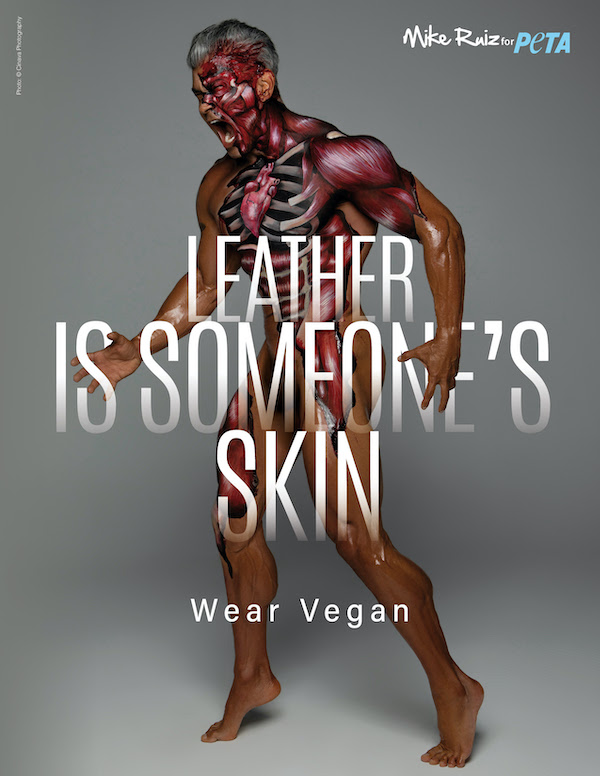
This website purports to sell leather goods: shoes, belts, coats, etc., all made from human body parts. And like many websites in this competitive time, they offer free shipping!
The campaign is from PETA (People for the Ethical Treatment of Animals) and started back in June with a poster from celebrity photographer Mike Ruiz, who has photographed Kim Kardashian, Ricky Martin, Katy Perry, and Paris Hilton, as well as being a judge at America’s Next Top Model and RuPaul’s Drag Race.
PETA’s press release stated that leather production isn’t just cruel, but also contributes to the climate crisis, releasing hazardous chemicals. The World Bank has also cited cattle ranching as one of the largest drivers of deforestation in the Brazilian Amazon. Farming, transporting and killing animals for meat and leather is responsible for a very large proportion of global greenhouse emissions.
Here’s the poster near Penn Station in New York.
On the Urban Outraged website, the items for “sale” reveal human faces, human teeth, and oozing blood. Each item is named after an individual who was “killed” for it and is “reviewed” by customers. (“I’m not really a boot person, but I’m glad Meg was, because these are the best boots I’ve ever worn.”). Users can even send a fake “gift card” to their friends’ emails using the form on the last page.
After the initial page, the website gets deadly serious and asks:
Why is it OK to raise sheep just to shear off their wool?
Why is it OK to kill a cow for leather?
Why aren’t you horrified by what’s already in your closet?
“While Urban Outfitters, Anthropologie, and Free People (all owned by Urban Outfitters, Inc.) don’t actually kidnap, abuse, or kill humans or other animals for their products, they do sell skin and other animal-derived materials from farms and suppliers that exploit and kill animals. Every year, billions of animals suffer and die for wool, cashmere, leather, down, mohair, silk, and alpaca fleece production. Sheep are often beaten, stomped on, and kicked in the wool industry. Goats exploited for cashmere scream out in pain and terror as workers tear out their hair with sharp metal combs. Later, their throats are slit in slaughterhouses and they’re left to die in agony. And cows are routinely beaten and electroshocked for leather at some of the largest suppliers”
Many cannibal films featured in thecannibalguy depict not just the consumption of human flesh but the use of other body parts, particularly skin. Think of Leatherface in The Texas Chainsaw Massacre, wearing a mask made of human skin. Or Jame Gumb, “Buffalo Bill” from The Silence of the Lambs, making a woman suit because he is frustrated at being diagnosed as not a true transsexual. Both characters, as well as Norman Bates from Psycho, were based on the real-life “Butcher of Plainfield”Ed Gein, who did kill a couple of women but mostly sourced his body parts from gravesites, and produced a bewildering array of chairs, waste-baskets, bedposts, bowls, corsets, masks, belts and lampshades from human skin and bones.
The use of human skin, including for binding books, is known as anthropodermic bibliopegy. Human skin used as a medium goes back into prehistory, and was reportedly popular among the Assyrians, who would flay their prisoners alive and display their hides. Perhaps the best known modern examples were the lampshades of Nazi concentration camp guards, but it was also not uncommon among slave owners, who felt that, since they owned the slave, they could use his or her body as they wished.
People have expressed shock and outrage at PETA’s new website, but that really was the point. Such atrocities against humans were carried out by people who saw nothing particularly wrong with what they were doing. The workers who skin cows and sheep, minks, snakes and crocodiles, dogs and cats and so many other animals are just, they say, doing their job. But that acceptance of appalling suffering for the sake of meat or clothing brings us closer to the possibility of adding one more species to the list of edible, flayable animals.
You don’t often see Siberia in the news, particularly remote towns like Gaz-Sale. But this month (November 16, 2021 to be precise) it made a splash on news sites, with the sentencing of Vladimir Yadne for killing three people and eating their flesh, washed down with vodka.
The murders took place on March 6, 2021. The court heard that Yadne had gone out to buy some hard liquor when, on his way home, he saw a 51-year-old man and 59-year-old woman embracing. It is not clear if he knew them – the total population of the town is 1,800 so it is quite possible. At any rate, he got into an argument with them, and then stabbed them both to death.
Gaz-Sale, Siberia
Feeling hungry, perhaps from all the exertion, Yadne then cut pieces from the bodies and ate them raw, with his vodka, according to Inna Nosova, the head of the criminal justice department in Yamalo-Nenets Autonomous Region.
“He came in with alcohol on him, and drank it as he was eating the meat.”
Apparently finding the taste to his liking, Yadne later that night stabbed to death another 52-year-old man and ate some of his flesh too. He then tried to dump the bodies (or what was left) but was arrested a few hours later, after police found them. He confessed to the murders and even helped police by recreating the crimes.
Yadne recreates the killings
He underwent psychiatric evaluation, which determined that, at the time of committing the crimes, Yadne was ‘sane’.
Vladimir Yadne
The case has at least put Gaz-Sale on the map, with reports in the British tabloid press, US news services, Hindi Newstrack and even withinnigeria.com. One way to get famous I guess. The really fascinating question for me relates to the role of cannibalism in determining the newsworthiness of a story. A man who killed three people in northern Siberia would barely rate a mention in a Russian news outlet, let alone on websites all around the world. Take a bite of the corpses, though, with or without vodka, and everyone wants to know. The conclusion has to be that we are more interested in what happens to dead bodies than living ones.
Yadne has been sentenced to life in a very uncomfortable Siberian prison colony.
In 2012, police in Garanhuns, Brazil, arrested for murder Jorge Beltrao Negromonte da Silveira, his wife, Isabel Pires, and his mistress, Bruna Cristina Oliveira, who all lived together in a group they called “The Cartel”. Residing with the Cartel was a small child named Vitória, who had been the daughter of their first victim. In 2018, all three adults were found guilty and sentenced to decades in prison.
However, the worldwide public interest in the crimes did not stem from their murder of three young mothers, but from the fact that the Cartel stripped the flesh from the victims and baked them into salgados, salty, deep-fried pastries, which were then sold to the unsuspecting public. To the disappointment of the media, the pictures of the perpetrators showed them as three ordinary Brazilian people, not the monsters the public had expected.
Isabel Pires, left, Jorge Beltrao Negromonte da Silveira, and Bruna Cristina Oliveira
This case, one of about one hundred reported incidents involving cannibalism since the year 2000, is of particular interest because it incorporates many of the issues considered in this blog.
Reports of cannibals from earliest times almost invariably labelled them ‘monsters’, the same term the media used in this case to describe the members of the Cartel. Silveira muddied this even further by accusing his mistress Oliveira of being a witch, who had tortured him and Pires into taking parts in “purification” rituals.
Cannibalism has been a useful accusation against colonised peoples since the time of Columbus, and Brazil has been particularly singled out in the literature as offering indisputable examples of “savage” cannibalism. Gananath Obeyesekere, one of the foremost scholars of cannibalism, writes that he omitted a chapter on the Tupinamba of Brazil from his book Cannibal Talk, which casts significant doubt on the existence of systemic savage cannibalism, partly because of the passionate commitment of Brazilian scholars to the “empirical reality of conspicuous anthropophagy”.
Contemporary narratives of cannibalism, particularly since Jack the Ripper, assume that there are psychogenic bases for the act; de Silveira was found to have written a book called Revelações de um Esquizofrênico(Revelations of a Schizophrenic).
Unknowing cannibals are often described as “innocent” in that they are offered meat without recognising its provenance. The enduringly popular Sweeney Todd, the ‘demon barber of Fleet Street’, is supposed to have, in the late eighteenth century, murdered his customers and furnished their flesh to his accomplice, Margery Lovett, who turned them into meat pies for her unknowing but enthusiastic customers, just as the Cartel did with their salgados. In neither case were there any misgivings because, according to da Silveira, human meat tastes almost the same as beef.
Reports of cannibalism usually leave readers hungry for explanations – the motivation of the act. The Cartel chose its victims partly on the basis that they were tackling overpopulation by killing off single mothers who were unable to care for their children. The Cartel had its own methods of selecting victims, involving not just their unmarried maternity but a set of rules provided by “spiritual entities” which determined which women were evil and should be killed, based on the numbers on their identity cards adding up to 666.
At the heart of this case lies an ethical question: is there a fundamental difference between a salgado (salty) snack full of beef and one filled with human meat? The premise of arguments for such a difference is the concept of anthropocentrism, the belief that (some) humans can transcend their disowned yet undeniable animality, and attain a higher moral status than other animals, such that intentionally killing a human is ‘murder’ while killing other animals is considered commercial harvesting. This sometimes called “speciesism”, except that there has never existed a culture where humans honestly considered all other humans their equals, or sometimes just human narcissism.
Silveira was sentenced to 71 years in prison, while his wife received 68 years and his mistress 71 years and 10 months. This is on top of another conviction in 2014, where the trio were found guilty of killing Jéssica Camila da Silva Pereira. Silveira was sentenced to 23 years in prison for that murder, while his wife and mistress were each sentenced to 20 years.
References
Araújo, E. L. V. M. d. (2018). Estudo do Caso dos Canibais de Garanhuns. (Law thesis), Centro Universitário Tabosa De Almeida, Caruaru, Brazil. Retrieved from http://repositorio.asces.edu.br/handle/123456789/1548
Haining, P. (2007). Sweeney Todd: The True Story of The Demon Barber of Fleet Street. London, Robson Books.
The news serviceNoticias Telemundo recently reported a case of kidnapping, murder and cannibalism which, it seems, may not be so uncommon among refugees trying to cross Mexico into the United States.
Noticias Telemundo Investiga interviewed 32 migrants kidnapped from 2019 to 2021 in Mexico and the U.S. Their relatives were made to pay $1,500 to $5,000 as ransom to criminal gangs for the release of the kidnapped migrants.
The latest story follows the ordeal of a young man named David Sanabria and his little girl Ximena, who are from Honduras.
David Sanabria had arranged a coyote (smuggler) to escort them to the Texan border, where he planned to turn himself and his daughter in to U.S. immigration authorities and seek asylum. But when they reached Reynosa in the Mexican state of Tamaulipas, the coyote turned them over to a cartel gang. David and other captives were repeatedly made to call relatives to ask for a ransom, and were beaten if the relative said they couldn’t afford it. The victims are not US citizens so relatives cannot ask for help from the FBI, and in many cases the local police in Mexico are in the pay of the cartels.
If the ransom was not paid by the deadline, the captives would be murdered. David said:
“With a machete they dismembered them, killed them, and the only thing I could do was cover my daughter’s eyes and ears so that she would not know what was happening, nor would she have those memories for her whole life.”
After that, the corpses were cooked and the surviving migrants were made to eat the human meat, “so that there would be no trace of anything — that’s what one had to eat.” The term “innocent cannibal” is usually reserved for those who are not aware that human meat is in their meal, but in this case, I think we can apply it to David and Ximena.
At night, the kidnappers performed satanic rituals. “They knelt down. They had images of the devil, of Santa Muerte. They made pleas. They made offerings. It was something horrible,” he said. Several survivors who spoke to Noticias Telemundo Investiga talked about the kidnappers’ “cult of death”.
David’s brother borrowed money from his co-workers, friends and relatives and even asked strangers for money on the streets of Nashville. He eventually raised the $7,500 ransom and David and Ximena were released. David waded across the Rio Grande with Ximena on his back. So they made it to the US border where they were detained for three days, but then were returned to Mexico. Under Title 42 to curb the spread of COVID-19, migrants who are detained at the border are returned to Mexico while their petitions for asylum are processed. This year, 100,000 migrants a month are being returned to Mexico.
They were put in a shelter by the National Migration Institute of Mexico, and Al Otro Lado, which provides free legal assistance to migrants from Baja California, helped David fill out an asylum application.
In August, the U.S. granted David and Ximena humanitarian parole so they could enter the country and live with his brother in Tennessee while they await the results of their asylum petitions.
This is Ximena in the shelter.
The United Nations estimates there are over 82 million people in the world who have fled their homes, of whom 26 million are refugees, half of those under the age of eighteen. That means one in every ninety-five people on earth has fled their home as a result of conflict or persecution.
Imagine, if you can, being a refugee, anywhere in the world. You are fleeing from a place which doesn’t want you, and where people are possibly threatening to imprison or kill you, to another place that also does not want you and may send you back, and almost no one will support you en route. Men, women and children are helpless, easy prey for unscrupulous smugglers and criminal gangs. If you disappear, no one will find you, particularly if you have been eaten.
Migrant kidnappings happen all the time. Mexican authorities at the beginning of September 2021 reported a total of 697 migrants kidnapped and rescued in just 10 days. These are not statistics. They are people like David and Ximena, who may be robbed, kidnapped, beaten, killed, forced into cannibalism, and even eaten themselves, as the world ignores them. In a world where we capture, kill and eat some 350 million animals every hour of every day, is it really surprising that we sometimes do the same to members of our own species?
Who’s in your burger? One of the best parts of any news story about cannibalism (and don’t the media just love them?) is the cheeky double entendre, the thigh-slapping pun, the sly innuendo. This story has generated many of them. E.g.
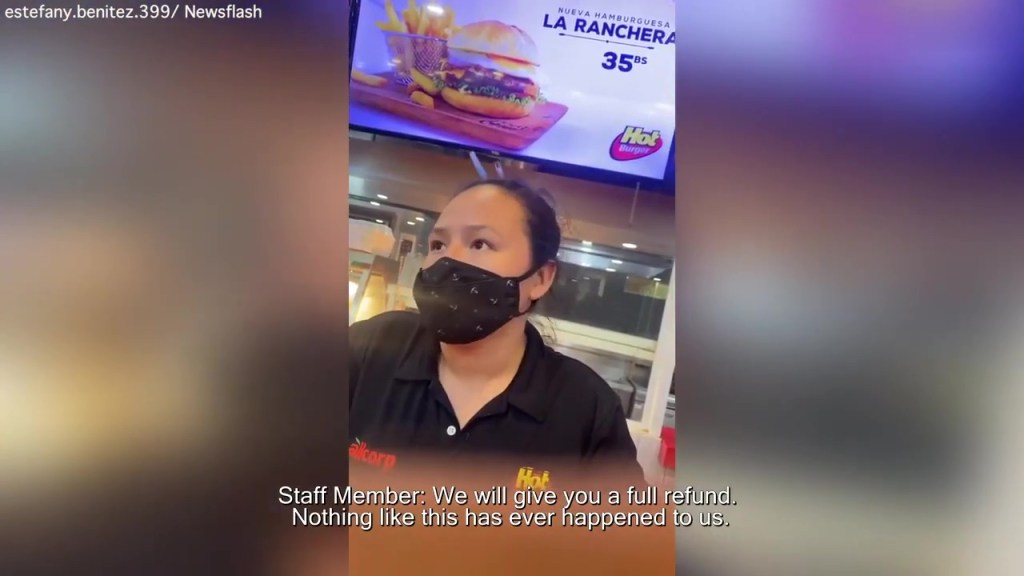
Estefany Benitez wrote in a Facebook post about an incident she alleges occurred on Sunday September 12 at the Hot Burger store in Santa Cruz de la Sierra in Bolivia. Benitez claimed that she chewed on a severed finger with her first bite of her hamburguesa magnifica burger.
Accompanying photos show what appears to be a rotting fingertip on the plate next to the burger.
In Benitez’s accompanying video, which currently boasts more than 60,000 views, she says,
“Here we are at the magnificent Hot Burger where a finger ended up in my burger.”
The video shows an employee pleading “Please tell me what you want and we will give it to you.” The young employee tells the angry customer that the burgers arrive at the restaurant pre-prepared and that “nothing like this has ever happened to us before.” But the video claims that the restaurant then reportedly continued “serving customers like nothing had happened”.
UNINTENTIONAL PUN OF THE WEEK GOES TO:
“This issue is out of our hands.”
After the post went viral, a company spokesperson called the discovery an “unfortunate incident” and explained that an employee had lost two fingers while prepping the meat — a story that has been confirmed by local police.
It’s not unusual for customers to discover human body parts in their food. In an incident in 2019, a UK couple claimed they’d found a tooth in their Chinese takeout. This trope of the innocent cannibal eating human body parts under the assumption that they are from some anonymous animal who is not human has been around since the legend of Sweeney Todd, the ‘demon barber of Fleet St’ who processed his customers into meat pies, and who was supposedly hanged in London in 1802. Todd has graced several movies, most recently a musical with Johnny Depp and Helena Bonham Carter. Other similar stories include Motel Hell and the Danish comedy Green Butcher, starring Mads Mikkelsen. Of course, The Texas Chain Saw Massacre famously begins with a group of tourists chowing down on some unnamed “barbeque” before themselves becoming the ingredients.
In the movie The Farm, a group of animal activists make a living cutting up tourists who stop at their hotel, selling their meat as part of a catering business. Female victims are artificially inseminated to make saleable milk. Like the Hot Burger company, they also have production problems, when a customer finds a tooth in his delivery of meat.
In light of the events at Hot Burger, the Bolivian vice-minister for the defense of consumer rights ordered the temporary closure of the burger branch and fined the firm. However, it’s unclear whether Benitez will pursue legal action. Comments on her Facebook page are running hot, many of them condemning her for putting hard-working restaurant staff out of work. And, when you think of it, is it really so very shocking to find meat from a large mammal in a burger?
An Army veteran from Utah who has been accused of assaulting police during the Capitol insurrection was refused bail after he threatened to “eat the flesh” of a probation officer.
Federal prosecutors revealed the threat made by Landon Copeland during a bail hearing on Friday 10 September. They told U.S. District Judge Meriweather that Copeland had been on pretrial release for “all of two days” before making the threat, resulting in him being re-arrested. According to a motion from prosecutors seeking to keep him detained, Copeland told the probation officer,
“I will eat your flesh for nutrients. I don’t think you don’t know what I am”
Copeland later stated “I was well within my First Amendment rights in speaking to him the way I did.” At a Zoom hearing on May 6, Copeland had shouted at a judge and court officials. He then drove to probation services where he spoke to the officer through a glass partition. According to the detention memorandum (page 7), he was “ranting about government conspiracies” and claiming “the government was out to get him. At times, he banged his head against the glass and pressed his face against the glass.”
Copeland said he was furious because, during the May hearing, an attorney for another defendant said his client had become addicted to Fox News and suffered from “Foxitis.” Copeland said the attorney’s comment was “spitting in the face of the 258 million people that tune in to the Tucker Carlson show,” complaining that he was “allowed to lambast all of Fox News’ viewers without objection from the judge or any of the other attorneys present.”
Prosecutors also said during Friday’s hearing that if Copeland is released pending trial and placed on home confinement, multiple agents would be required to conduct check-ins because law enforcement “is not welcome” in Hildale, Utah, where he lives, according to a report from WUSA9’s Jordan Fischer. Hildale is home to the Fundamentalist Church of Jesus Christ of Latter-Day Saints, led by jailed president Warren Jeffs.
Copeland’s Defense attorney told the judge Friday that Copeland would abide by release conditions as he had a child, and that he “does renounce what he said, with regards to anything that could be interpreted as threatening or wanting violence.” However, prosecutors countered that Copeland “renounced nothing” during two recent interviews with the media, but “he has a reason for saying something differently today.”
With regard to the insurrection, Copeland has said that former president Donald Trump “invited” him to be there — and that he would “willingly do it again.”
Judge Meriweather concluded Friday that if she only had the January 6 conduct to consider,
“I might not find the threat to be as substantial as I do. But Mr. Copeland’s conduct on the short time of his pretrial release speaks loudly. My concern is that it does appear mental health and substance use played a role in May 6… so I don’t believe that stringent release conditions in this case would adequately ensure the safety of the community.”
Enquiries have not established what or whom Mr Copeland is eating in jail.
French police fatally shot a 32-year-old man suspected of cannibalism on Monday morning (July 19) following the discovery of the decapitated corpse and partially consumed head of a 13-year-old boy.
Police found the remains on Sunday in an apartment in the southern France town of Tarascon, a town between Avignon and Arles.
Public prosecutor Laurent Gumbau told Agence France-Presse that strips of flesh had been ripped from a shoulder, sparking suspicions of cannibalism.
“The body found may be that of the minor… However, it was impossible at the current time to confirm the hypothesis of anthropophagy (cannibalism).”
The boy disappeared on his way from his foster home in Marseille, about 60 miles away, to see his mother in Tarascon.
Late Sunday night, a neighbour called police and reported seeing a body in a garbage bag. A man, who had previous convictions for acts of violence, fled from his apartment when police arrived by jumping over rooftops, neighbours told the news outlet. Three hours later police found the man and shot him dead, the prosecutor said, adding that the suspect did not appear to have been armed at the time of his death, and had not been formally identified as the killer.
In his apartment, the Bouches-du-Rhône police discovered a dead body in the kitchen, but its right arm and head were missing. The head was later found in a bucket in the bathroom and, according to Le Figaro, had been partially eaten. Satanic cult objects were also found in the home.
Homicide has been with us since the first apeman lifted a bone to beat a rival to death (or actually well before that, using teeth and claws). It is likely that the victor in those early spats would have been loath to waste the resulting meaty corpse.
2001: A Space Odyssey
Accounts of cannibalism still seem to focus on the primitive, the ‘savage’ cannibals eating the unwary missionary who stumbles upon their village, even though there is little evidence that such events ever happened. But in recent years, cannibalism has increasingly been found within our ‘civilised’ cities and towns. 2020 was a big year for cannibalism. So far in 2021, we have had THE OKLAHOMA CANNIBAL in the US and the MEXICAN CANNIBAL who allegedly killed and ate some thirty women. In South Africa at the moment, deadly rioting has led to food shortages that, according to one community leader, has led people to consider cannibalism. Then we have the whole Armie Hammer uproar. These cases, like the one in France, are usually put down to psychotic deviance, the psychological equivalent of a mystified shrug. But economics and politics play their parts too, as does a loss of respect – treating humans as animals (which of course we are) emanates from treating animals as morally valueless, as mere commodities.
Could it be that a toxic mixture of urban loneliness and rampant consumerism, particularly of animal bodies, together with the stripping of humans of their formerly assumed metaphysical superiority to other animals, is leading the murderer to the same conclusion chosen by our pre-sapien ancestors: why waste the meat?
Halloween display in Ukrainian butcher shop window
Bulawayo man, Rodney Tongai Jindu, has just lodged an appeal to the Zimbabwean Supreme Court challenging a High Court ruling which sentenced him to death for murdering two of his friends, Mboneli Joko Ncube and Cyprian Kudzurunga, in 2017.
Jindu told the court, in gruesome detail, how he had eaten the men’s livers raw, and cooked and eaten their brains.
Rodney Tongai Jindu
The court had heard that Jindu was mentally incapacitated, but a medical examination presented in court declared him fit to stand trial. During the trial, Jindu stated that he was sent by the devil to kill the two men, and threatened to unleash Lucifer onto prosecutors.
Jindu requested assisted suicide after the decision was handed down, but has now changed his mind, and is seeking acquittal on the grounds of mental incapacity. His appeal states in part:
“There was cogent evidence that appellant was mentally incapacitated to appreciate the implications of his actions at the material time of committing the offence. Wherefore, appellants prays that the appeal be and is hereby allowed”
There’s a thorough analysis of the cases on the Amanda and Banele vodcast, at the top of this blog.
No longer a monster or ‘savage’, the contemporary cannibal is hard to tell from anyone else in a suit and tie.
On Friday, 18 June 2021, a Swiss court sentenced 46-year-old Alieu Kosiah, a West African rebel leader, to 20 years in prison for rape, murder and cannibalism, committed during Liberia’s civil war. The case before a three-judge panel at the federal criminal court in Bellinzona was Switzerland’s first war crimes trial held in a civilian court.
Kosiah, AKA “bluff boy”, was a commander in the rebel faction United Liberation Movement of Liberiafor Democracy (ULIMO) that fought former President Charles Taylor’s army in the 1990s. He faced 25 charges, including one in which he was accused of eating slices of a school-teacher’s heart. He was found guilty of all but four of the charges. The court listed the charges as
“recruitment and use of a child soldier, forced transportation, looting, cruel treatment of civilians, attempted murder, murder (directly or by order), desecration of a corpse and rape.”
Criminal complaints were filed by Liberian victims, represented by civil rights group Civitas Maxima. The indictment says Kosiah killed or participated in the killing of 18 civilians, forced a displaced woman to be his “wife”, raping her repeatedly, and recruited a 12-year-old boy as his personal bodyguard. In one incident described in the indictment, Kosiah joined fighters in eating slices of a dead man’s heart off a metal plate. Acts of cannibalism were not uncommon in the conflict.
Child soldiers with ULIMO
Kosiah was arrested in 2014 under a Swiss law that allows prosecution for serious crimes committed anywhere, under the principle of universal jurisdiction. He had denied all the charges and told the court he was a minor when first recruited into the conflict.
Dubbed “the Monster” by survivors of the war, Kosiah is infamously remembered for the Black Monday attack on June 28, 1993 when rebels rounded up and massacred villagers in Foya, Lofa County.
Other Liberian war criminals
Liberia has ignored pressure to prosecute crimes from its continuous wars between 1989-2003, in which about 250,000 people died and thousands of child soldiers were conscripted and taught to kill and commit atrocities. Charles Taylor is himself currently serving a 50-year prison sentence for aiding and abetting rebels who committed atrocities in neighbouring Sierra Leone, but not for his actions in Liberia. His son, Chuckie, was sentenced for torture in Liberia by a U.S. court in 2009.
Ex-warlord Mohammed “Jungle Jabbah” Jabateh has been jailed for 30 years in the US for lying about his past as a leader of a force that carried out multiple murders and acts of cannibalism.
In July 2018, France detained naturalised Dutch citizen Kunti K, a suspected former militant ULIMO commander and placed him under formal investigation for crimes against humanity including torture and cannibalism. Another Liberian commander, Gibril Massaquoi, known as “Angel Gabriel” is on trial in Finland accused of eating his victims, burning kids alive and raping women. A verdict is expected around September this year.
Gibril Massaquoi
An ULIMO commander named Joshua Milton Blahyi known as “General Butt Naked” gave evidence to Liberia’s Truth and Reconciliation Commission in 2008:
“Any time we captured a town, I had to make a human sacrifice. They bring to me a living child that I slaughter and take the heart off to eat it… A lady offered me her child for my sacrifice. After cutting up the child I divided the heart among my boys and myself. The blood of the child was still on my hand when Jesus appeared to me and asked me to stop being a slave.”
Blahyi’s crimes included child sacrifice, cannibalism, the exploitation of child soldiers and trading blood diamonds for guns and cocaine, which he provided to boy soldiers as young as nine. He was never charged, and is now an evangelical pastor. He published an autobiography about his conversion.
General Butt Naked and Edna Fernandes
The cannibal as animal
One observation.
During his trial, Alieu Kosiah broke down and shouted:
“I’ve been locked up for six years, I have emotions, I’m not an animal.”
Well actually, he is an animal. We all are: humans are a species of Great Ape, as are our closest relatives the chimpanzees, who also wage war and indulge in occasional cannibalism. The point here, though, is that Kosiah saw himself stereotyped as a black man, an African, in a court full of white Europeans passing judgement on him. To the European, only a century or so ago, all Africans were considered savages and cannibals, little more than beasts, a libel which is hard to expunge, and a demonisation that was just as useful to European imperialist expansion as the use of gunboats. As recently as 1959, New York Times reporter Homer Bigart (an almost perfect name) wrote to his foreign news editor about his contempt for the new class of African leaders such as Kwame Nkrumah,
“I vastly prefer the primitive bush people. After all, cannibalism may be the logical antidote to this population explosion everyone talks about.”
The savagery and cannibalism of the multitudes of wars that have swept Africa in the last decades have led to appalling atrocities. But let us not forget the role of the colonialist rulers who divided the continent up, regardless of the local tribal areas, and sucked the riches out of the land, leaving the newly independent countries destitute and riven with implacable hatreds.
As Malcolm X wrote in 1965 about the colonisers of Africa:
They projected Africa always in a negative light: jungles, savages, cannibals, nothing civilized.
The legacy of this demonisation (see Milton Allimadi’s new book “Manufacturing Hate: How Africa Was Demonized in Western Media.”) is seen in the support given to psychopathic dictators who seize control for their own enrichment, but also for that of their overseas sponsors.
Milton Allimadi
Is it so surprising that this mythology of the ‘savage’ cannibal should be internalised and acted out in the heat of the internecine wars of our time?