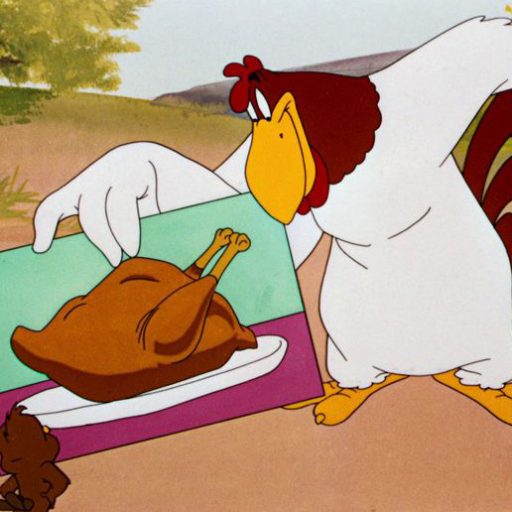
The cannibal in the will: (Ingrid Newkirk, PETA)

There seem to be less heroes lately. If you watch the news, the heroes – the paramedics, the nurses, the teachers, the activists – those who choose to do good things because it’s the right thing to do – are usually unrecognised. The ones in the spotlight, the ones being treated as heroes, are the rich and famous, even the ones whose only claim to fame is being famous. The news cycle concentrates not on virtue but on suffering, and on vanity, fear, guilt and greed: the tools of the marketers.

I present for your consideration a hero of mine: Ingrid Newkirk, who founded People for the Ethical Treatment of Animals (PETA) almost forty years ago, and has steered it into becoming the largest and most active animal advocacy organisation in the world, with more than 6.5 million members and supporters.

The PETA mantra is:

Animals are not ours to eat, wear, experiment on, use for entertainment, or abuse in any other way.

How does this relate to a cannibal studies blog?

Well, Ingrid Newkirk has put a number of requests in her will, one of which is:

That the “meat” of my body, or a portion thereof, be used for a human barbecue, to remind the world that the meat of a corpse is all flesh, regardless of whether it comes from a human being or another animal

Ingrid tells the press: I want it fried up with onions, because people find it hard to resist the smell of frying onions.  I can imagine them coming over and saying enthusiastically,  “Oooh, what’s that?’ and then, “OMG, it’s HER!” 

All abuse starts at the point where the proposed victim is objectified, turned from a living, breathing subject into a thing, an other, an “animal”, a piece of meat. To achieve this, we have all sorts of linguistic tricks which range from changing the names of victims (cows become “beef”, pigs become “pork”) to absurd suggestions that other animals are either mentally incapable or are automata that feel no pain. To make an animal brainless and painless, and therefore morally insignificant, is done through a nifty sleight of hand where non-humans are called “animals” and the Great Ape known as Homo sapiens somehow is not an considered an animal at all.  An example: reports from medical researchers will usually distinguish “animal” trials from “human” trials.
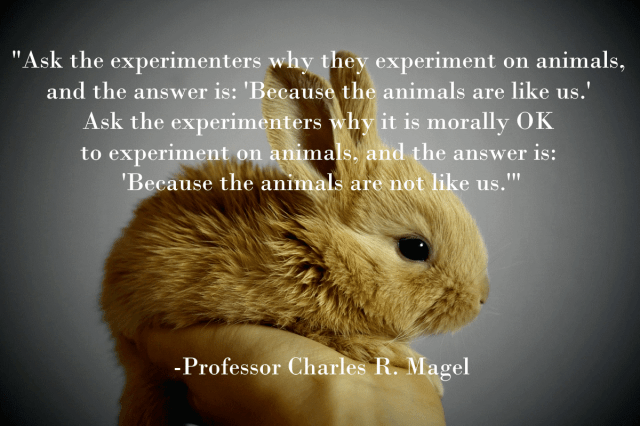
Animal testing - like us

Human cannibalism reminds us that we are animals, and that we are made of meat. It reminds us that, while we may be different to other animals (cognitively swifter than some, physically slower than others), we all suffer and die in the same ways. As Shakespeare said:

If you prick us, do we not bleed? If you tickle us, do we not laugh? If you poison us, do we not die?

One of the additional dangers of stripping moral worth from “animals” is that this can so easily be done to other humans who happen to be different colours, different genders, different faiths, different anything to us.

DSC_0886

We need to be reminded that we are not demi-gods, that when we eat or wear or laugh at or test on “animals” we are causing massive suffering to beings not essentially different from ourselves. Even if no one eats from Ingrid’s planned barbecue (which I hope will not be held for many decades to come) they will hear the message. And if this offer of a cannibal feast makes people question why they are willing to feast on other sentient beings, then one more hole will be made in the rotten edifice that holds up the death industries, the exploitative corporations whose existence future generations will rightly condemn.

The cannibal goes out and hunts, pursues and kills another man and proceeds to cook and eat him precisely as he would any other game. There is not a single argument nor a single fact that can be offered in favor of flesh eating that cannot be offered with equal strength, in favor of cannibalism.
             Dr. Herbert Shelton, Superior Nutrition
If you like my blog, please feel free to recommend it (with discretion) to friends on social media. If you have any questions or comments, you can use the tag or email me on cannibalstudies@gmail.com.

Facebook cannibalism: “Eschatology” 2018

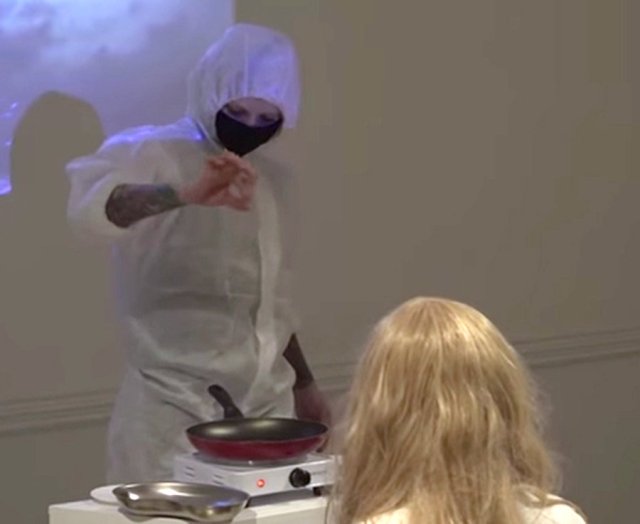
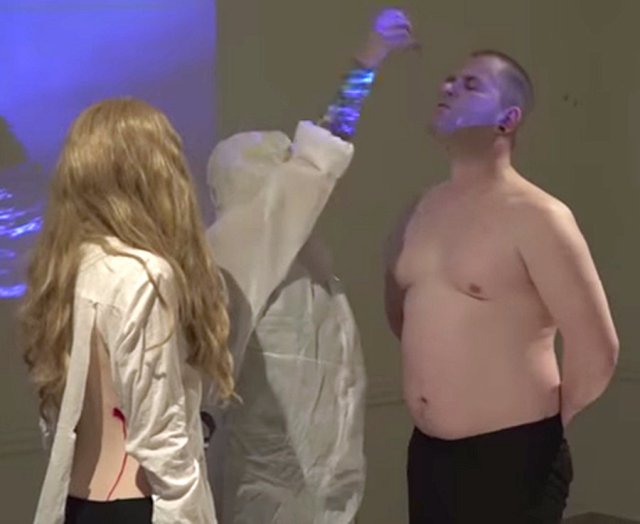
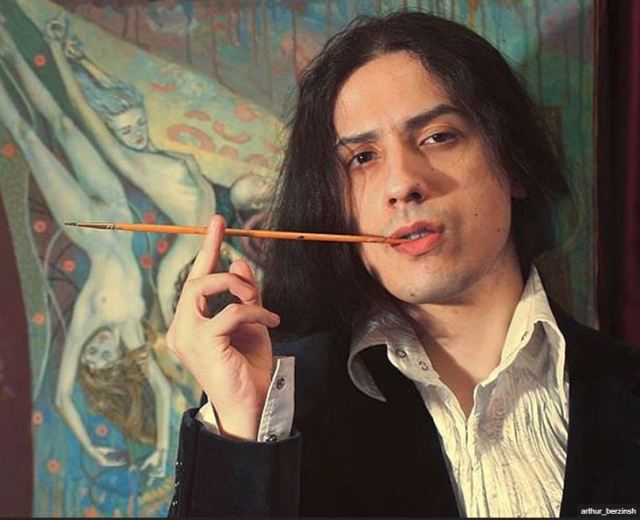
I don’t know if you’re into Facebook Live streaming, although lately people seem to be leaving Facebook rather than trying to find new ways of spending time on it. But a lot of people seem to have tuned in to a stream on 6 March 2018 of a performance named ‘Eschatology’ by artist Arturs Bērziņš at Museum LV un Grata JJ, in Riga, Latvia.

1 Artist
Portrait of the artist as a young autophage

The footage showed Bērziņš’s assistant pulling on a white medical outfit, scalpel in hand, and cutting chunks of meat from the backs of two volunteers, one male and one female, apparently without anaesthetic. The assistant then fries the meat it in a large black pan.

I’ll spare you the unkindest cut, but you can, if you wish, see it on Youtube:

A small audience watches, phone cameras ready, and a couple more stand in the doorway, perhaps anticipating the need for a quick getaway. Spooky music plays as the assistant adds salt and pepper and perhaps some more exotic spices to the meagre meal and feeds the fragments to the volunteers.

1306534

The artist later said: “It’s not fake, but it also is not cannibalism. Each of them ate his or her own piece of skin after (a) scarification procedure. Otherwise fingernail gnawing also can be proclaimed as cannibalism.” Something to consider next time you can’t be bothered reaching for the nail-file.

1306541

The artist later commented “What we do daily with ourselves is much worse than any performance. The viewer has to face the genuineness. Genuine pain. Genuine action that has stepped out of abstraction into a real world. The viewer needs to be intellectually prepared for such an experience as this. Otherwise they’ll simply claim I have a screw loose and return to the infernal trance of everyday life.”

Is this the new face of competitive cooking shows?

If you like my blog, please feel free to recommend it (with discretion) to friends on social media.
If you have any questions or comments, you can use the tag or email  cannibalstudies@gmail.com.

“Cannibalism is not a crime” – S.African expert

The trial is about to start of five men in KwaZulu Natal in relation to alleged cannibalism. In July 2017, a man appeared at Estcourt police station and claimed he was “tired of eating human flesh”. This led to his and the others’ arrests, after body parts were discovered in their possession.

When the men first appeared in court, police fired rubber bullets and stun grenades to break up crowds hurling insults at them.

The suspects were back in the dock at the Estcourt Magistrate’s Court, KwaZulu-Natal, last week, Estcourt News reports, but the trial was postponed as the state reported that the mental assessment of accused number one, Nino Mbatha, is incomplete. He was admitted into Fort Napier Hospital during the second week of March, after he was found mentally and emotionally unstable.

Image result for Accused number one, Nino Mbatha
Accused number one, Nino Mbatha is still undergoing a mental assessment.

The Ladysmith Gazette reported that hundreds of people in the Amangwe area confessed to cannibalism – being given human flesh to eat as traditional medicine. But former police profiler and forensic psychologist Professor Gérard Labuschagne says that cannibalism in South African was “a very rare thing”. “It’s not occurring frequently and is not associated with multi murder… Remember there is no crime for cannibalism like there is no crime for taking drugs. You are charged with dealing in drugs. And for cannibalism, you will be charged with the possession of human body parts,” he said. “If you cut the parts of a dead body you will also be charged with desecration of a corpse. So you have to be cautious, and, remember, police often arrest people and then withdraw the charges. We can’t assume all were eating the body parts.”

The case resumes on April 16.

Divine cannibalism

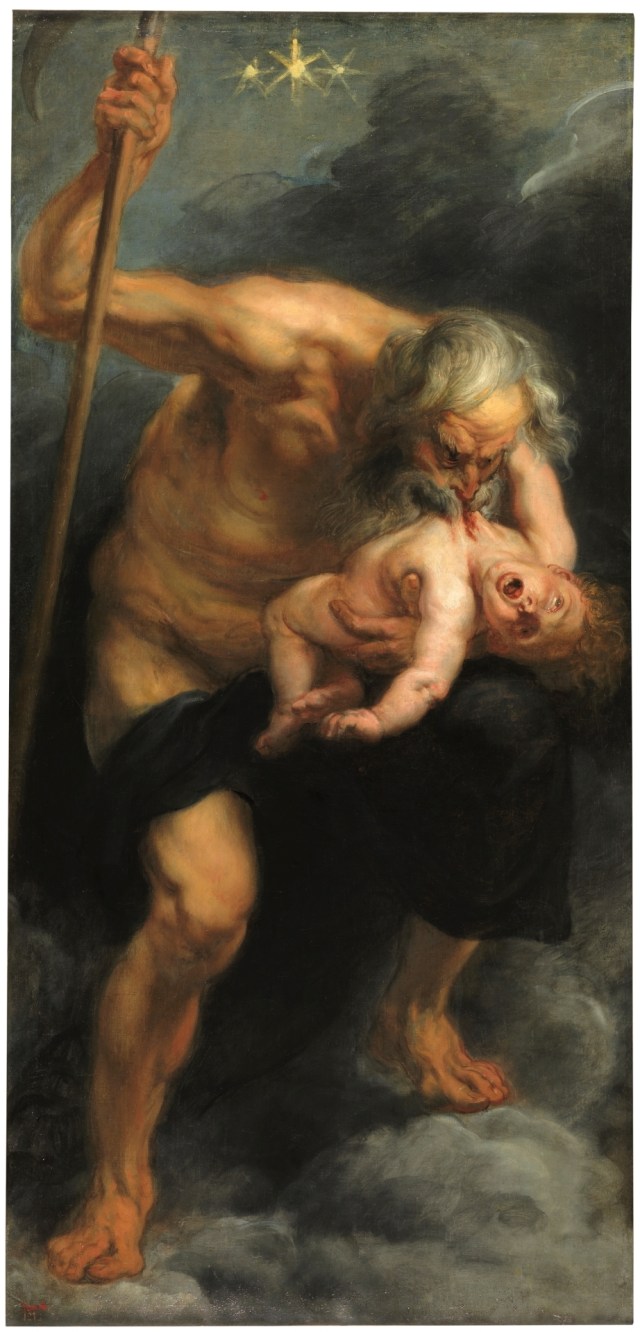
This picture is “Saturn devouring his son” by Peter Paul Rubens, painted in 1636.

01 saturn-devouring-his-son-1636-oil-on-canvas-peter-paul-rubens

The Greek myth tells of Chronos, who in Roman mythology became Saturn. He learned that one of his children would overthrow him, so he ate each one as they were born. His wife hid Zeus, who of course did eventually overthrow Chronos to become king of the gods, and she replaced him with a stone. This painting presumably represents one of the less stoned siblings.

saturn-devouring-his-son-goya

Almost 200 years later, in his Black Paintings, Francisco Goya shows the same divine cannibal god as nightmare and psychopath, and the victim as a bleeding, barely recognisable figure, neither human or god, but clearly animal in content. There is evidence that, in the original version, Goya gave Saturn a partially erect phallus, implying that cannibalism is, at least in the divine realm, apparently something of an aphrodisiac.

Good to know even gods can be cannibals.

Who is the “cannibal guy”?

The cannibal guy has a PhD from the University of Melbourne. The thesis for this PhD concerns cannibalism, and how its cultural manifestations (i.e. books, films, news reports, etc) challenge the assumed superiority of humans over other animals.

Alive

What, or whom, would you be willing to eat, if you were starving?

We face daily a marketing chorus telling us to consume ever more voraciously, while at the same time being warned that resources are being depleted, temperatures are rising and limits to growth are being reached. People hunger for the abundance they see paraded around them and are enraged as their own life gets more difficult.

Those we are willing to eat must first be objectified, turned into impersonal “things”, divorced from the cute animal who was slaughtered at our behest. But aren’t humans supposed to be different? This blog will look at the ways humans are similarly objectified by cannibals (real and fictional).

The growing public fascination with cannibalism reminds us that we, too, can be prey and then meat, and offers a stark choice: are we also more than “just” meat? Or will we let that anger, that frustrated entitlement, and that knowledge of our indisputable fleshiness, bring us ever closer to crossing that thin red line between carnivore and cannibal?

This blog started, as texts about food should do, at a dinner table. A friend of mine was a commercial sales rep for a big technology company and had to fly around all parts of Asia, and was required to socialise and dine with prospective clients. Cultural variations in cuisines had made his eating habits extremely eclectic, and he boasted that night, to a table including a number of vegans, that there was no kind of animal he had not eaten, or would not eat. I pondered this: in our restricted circles, horse meat, kangaroos and even rabbits would be looked on askance; monkeys, snakes, dogs and cats would be right out. Yet there was one animal that, it turned out, he had not eaten, despite his bravado, a species of hominid (great ape) named Homo sapiens.

The subject of food choices is endlessly intriguing: people who will run screaming when faced with a cockroach will happily tuck into a plate of prawns, which are the underwater versions of the same type of animal. Pescatarians, those who eat no meat but happily eat fish, will often refuse to touch shark flesh. In our own class, Mammalia, we will chow down on a seemingly random selection of species: we eat cows but not horses, sheep but not cats, pigs but not dogs. Yet in cultures all over the world, we will find seemingly arbitrary exceptions: in the Middle East pigs are out, cows are sacred in most of India, and horses are a delicacy in some countries and a scandal when found in pies in others. I have another friend who will happily eat most kinds of mammals but will not go near rabbit flesh.

Calvin

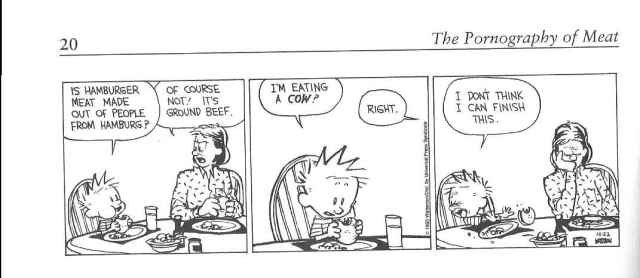
When asked about how these choices are made, the common response is a shrug of the shoulders and a reference to what we were taught to eat as children. But of course nothing is ever that simple: many children love non-human animals and are shocked when they discover the connection with the contents of their dinner plates. A period of socialisation, of seeing some animals as loveable and others as food, is necessary before they can again face the family over a Sunday roast. Much later we discover, or are brutally informed, of the horrors of industrial agriculture: the confinement, torment and industrial slaughter of billions of gentle domesticated animals each year for food, for profit. We then have a new learning phase of dissociation: putting on the blinkers, erasing the sounds and sights of the slaughterhouses. Erasing what we know, just as we do when the ads come on for starving children or refugees.

“Others” – be they non-human animals, refugees or terrorists, have to be objectified, a process which is a necessary prerequisite for any form of abuse. A prerequisite of objectification, in turn, is supremacism, the view that a certain group are superior to others and should therefore be entitled to dominate, exploit and sometimes even eat those others. As humans, we believe we are superior to other animals, (or just “animals” as we call them), pretending that we are not in fact animals ourselves. Within our species, we find all sorts of ways to objectify other human groups such as racism, sexism, ageism, ableism, etc.

This blog will look at ways the animal known as “human”, one that is usually not considered prey, is dissociated, objectified, turned into meat, both in fiction and in fact. Some writers have tried to place the act of cannibalism into a historical footnote, but, as I will cover in future blogs, it still happens, and happens often. If society deteriorates, be it through political division, climate change, natural disasters, war or a perfect storm of outside events, could we revert to the cannibalism of which we so readily accuse our forebears? Will our voracious appetite for meat (we kill some 70 billion land animals annually for food) make it that much easier to harvest the flesh of our fellow humans?

The Cannibalguy blog will be updated weekly and will concentrate on reviewing movies and books and television shows that involve cannibalism. Some weeks, I will concentrate instead, or as well, on news items regarding actual or at least alleged acts of cannibalism reported in the press.

cropped-foghorn-square.jpg

The name of the blog, “The Cannibal guy”, is used ironically – I am not advocating cannibalism! Please don’t tell the magistrate that it was my idea – I am appalled at the way we callously kill chickens and lambs and pigs and cows, so certainly don’t want to add another victim species to the list. But what we do to other animals – be it eating them, wearing them, experimenting on them, or making them perform for our amusement – requires us to see ourselves as different, higher, closer to angels than to our fellow denizens of earth. I hope that a glimpse into the world of those who see us as “just meat” might in some way alter those perceptions, and help us toward a kinder, more considerate world for humans and other animals.

You can contact me on cannibalstudies@gmail.com.

Can human subjectivity survive the experience of humans as “just meat”?