Donner Party revisited: snowstorm strands hundreds on the DONNER PASS

Videos such as the one above by freelance journalist Jonathan Petramala show hundreds of cars and trucks bogged in deep snow on the infamous Donner Pass, a stretch of road 7,088 feet above sea level over the Sierra Nevada mountains in Nevada County, California. On Saturday March 2 2024, more than three feet of snow fell on and around Interstate 80 northwest of Lake Tahoe, according to the Weather Channel. In winter, the old Donner Pass, now the historic US40, is often at risk of snow avalanches and blizzards, but this one was the strongest blizzard in California in years, and is being called a

‘Snowpocalypse”

Blizzard warnings have been issued with snowfall of up to twelve feet expected in some higher elevation locations. 

Many people would not associate the words “California” and “Snowpocalypse”, but that is exactly what happened in 1846-7 when a group of pioneers became snowbound in the Sierra Nevada over winter, and famously turned to cannibalism to survive. Only 48 of the original 87 members of the party survived. Many of the others were eaten after they died, and when they ran out of corpses, they murdered two of the Native American guides to use as protein.

There have been quite a few films and books about the events of that winter in 1846. Most emphasise the cannibalism that became inevitable, but omit any ethical discussion (probably no record was kept of it anyway) and gloss over the clearly racist decision to kill and eat the Native American guides in preference to “white” meat, even where the potential victim had volunteered. The movie Alive covered this rather better, showing a group of young men, all devout Catholics, debating how to justify eating their dead fellow passengers after the crash of a Uruguayan Air Force plane chartered by their football team in the Andes in 1972.

Back to the future – March 2024. The California Highway Patrol issued an appeal to people not to head out there, for obvious reasons.

The skiers, in particular, were not interested in listening to warnings – they wanted powder, and plenty of it. Despite snowfall of up to 12 feet being expected in some higher elevations, people headed out from San Francisco and all parts of the USA to find a mountain they could slide down. Many of them promptly got stuck in cars that would not respond in the freezing temperatures, and ski resorts had to shut down anyway. Big rigs also were stranded, blocked from moving (even if they had chains) by the inactive cars, or jack-knifing in the treacherous conditions.

Like 1846, this was a recipe for disaster. Residents of Truckee, California, one of the closest towns to Donner Pass, reported having inches of snow in front of their houses making it difficult to get out.

It did not take long for social media to pick up those reports of a “significant number of vehicles stranded over Donner Summit”. One headline read:

Untold Number of People Trapped at Site of Great American Tragedy

Some, of course, made the inevitable logical leap:

Sorry to disappoint, but there have been no reports of cannibalism from the stranded cars, trucks or town-folk. Unlike 1846, there are now emergency services available, including all sorts of technology from drones to snowploughs, and in fact emergency teams and tow services worked tirelessly to reach those affected.

While many had to leave their cars behind, no gnawed bones have been discovered so far. Maybe when the snow melts…

It’s just meat: SOCIETY OF THE SNOW (La sociedad de la nieve)  (J.A. Bayona, 2024)

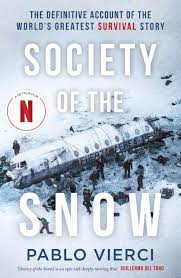
Society of the Snow is a new account of the 1972 Andes plane crash. It is an adaptation of Pablo Vierci‘s book of the same name,which included detailed accounts of all sixteen survivors, many of whom Vierci had known from his earliest years.

The twist here (not really a spoiler as they keep presaging it) is that the narrator of the film is one of those who were not among the sixteen.

Uruguayan Air Force flight 571, chartered to transport the “Old Christians” rugby team to Santiago, Chile, crashed into a glacier in the heart of the Andes. Of the 45 passengers on board, only 16 survived for the 72 days before they were rescued. Trapped in one of the most inaccessible and hostile environments on the planet, they had to choose cannibalism to stay alive. In this blog, we are most interested in the debate that led to the decision to eat their friends and crew, but the whole story of their pursuit of survival goes beyond what they ate and is equally fascinating.

We see a group of very devout young people, laughing and joking as they organise the trip to Chile, horsing around as the plane gets most of the way over the Andes, and then their reactions as the plane just does not reach the required altitude.

After a week without food, their urine turning black from lack of protein, they start exploring their very limited options. One group believe they will be rescued, even though their plane is painted white and they are in one of the biggest snowfields in the world. But most of them start to think about the only realistic way to survive, particularly after they find a portable radio and hear that the search for them has been called off.

The film has some interesting discussions regarding the ethics of cannibalism.

“What’ll happen to us? Will God forgive us?”
“He’ll understand we’re doing everything we can to survive.”

Roberto, the medical student who has been trying to keep the injured alive, explains what happens to the body without food – it dries up, starts to absorb the organs. There is reference to the “God of the Mountains”, a different being to the one in the city. Arturo, one of the wounded, has a fascinating soliloquy about this God:

“That God tells me what to do back home, but not what to do out here…. I believe in another God. In the God that Roberto has in his head when he treats my wounds. In the God that Nando has in his legs when he keeps walking no matter what. I believe in Daniel’s hands when he cuts the meat, and Fito when he gives it to us, without saying which of our friends it belonged to. So we can eat it, without having to remember the life in their eyes.”

They discuss the legality and the practicality of cutting up bodies, the similarity to organ donation, but of course without consent. So that inspires them to make a pledge.

And so they begin to eat. There are scenes of skeletons being picked clean as the three Strauch cousins offer to cut up the bodies in an area that is hidden from the plane, “to keep the ones who eat from losing their minds”.

What the film glosses over is the Catholicism that permeates much of Latino culture. While they make the point that the bodies are now “just meat”, they do not look for the parallels of their cannibalism to the Eucharist, the eating and drinking of the wafer and wine in church which is supposed to transubstantiate into the blood and body of Christ. It is a theme explored in more detail in the earlier film, as well as in the memoirs of the survivors.

“Drawing life from the bodies of their dead friends was like drawing spiritual strength from the body of Christ when they took Communion”
(Parrado & Rause 2006. Miracle in the Andes: 72 Days on the Mountain and My Long Trek Home, p.117.)

They quote to each other Matthew 26:26: “Take and eat, this is my body.”
(Canessa & Vierci 2016. I Had to Survive: How a Plane Crash In The Andes Inspired My Calling to Save Lives,  p.27).

I suspect this might have been considered a bit too close to the bone (apologies for the pun) for the Spanish speaking audience to whom the film is mainly addressed. Or else they wanted to appeal to a wider audience than just the Catholics. Or perhaps a bit of both.

The story is best known in print for Piers Paul Read’s 1974 book Alive: The Story of the Andes Survivors, which was turned into the film Alive in 1993 by Frank Marshall. Since then, several of the survivors have written their own accounts, to set straight some of the alleged inaccuracies in Alive, but none are as well known. Outside of the Hannibal story and perhaps Soylent Green, Alive is the film most people seem to recall when they hear I have written a thesis on cannibalism.

Alive had a few problems that this film nicely avoids. For one thing, it was very Hollywood, or “Anglo” as the politically aware like to say. It starred American actors who did not look like they were starving, even when they were fondly reminiscing and lusting for the food they missed, which seemed to be mainly pizza. Society of the Snow has Uruguayan and Argentinean actors speaking in Spanish, and makeup and special effects have improved markedly in the thirty years between the films, so they look hungry, and their wounds look ghastly. It is a more authentic look at the situation in which a group of deeply religious young men could decide to eat their dead fellow passengers and friends, who conveniently lay around them, preserved in the snow.

The film closed the 80th Venice International Film Festival in an ‘Out of Competition’ slot. It was theatrically released in Uruguay on 13 December 2023, in Spain on 15 December 2023, and in the US on 22 December 2023, before streaming on Netflix in January 2024.

Society of the Snow received positive reviews. At the 96th Academy Awards, it was nominated for the Best International Feature Film, representing Spain, and Best Makeup and Hairstyling.

Society of the Snow is arguably a better movie than Alive, although at two hours forty minutes, I thought a bit more editing might have been useful. Still, sitting through that 160 minutes gave a miniscule sense of the despair of sitting in a wrecked plane in freezing conditions for 72 days, so we cannot complain!

But I was sorry to see them drop the cannibalism/communion issue, even though there is a hint in the final scene where the survivors sit around a dinner table like the Disciples at the Last Supper, their dead friends being the bread of life, transubstantiated from sacred to edible, the reverse of what is supposed to happen to the church wafer. Whether you consider this a cannibal movie or an epic of survival (and yes, there is controversy raging about that), exploring why people do or don’t eat each other is endless fascinating, and the question of cannibalising the body of Christ is, or should be, at the heart of this story.

Having old friends for dinner – YELLOWJACKETS (episode 1, 2021)

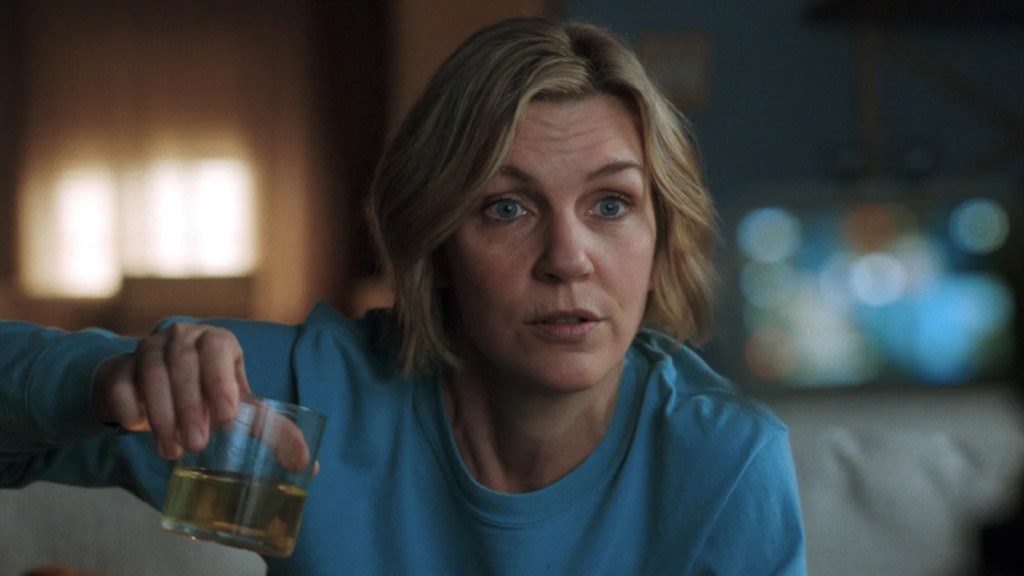
This new Showtime series (this first episode aired November 14 2021) crosses many genres. There’s the whole Mean Girls range of stories about the angst of going through puberty and surviving high school, where everyone else seems desperate to drag you down in order to lift themselves up. There’s the Lost genre of survival stories that started with Robinson Crusoe (first published in 1719) and its bastard child, Gilligan’s Island. There’s psychological thrillers and murder mysteries with a twist like Psycho. And, of course, there is cannibalism, the subject of this humble blog. Yellowjackets is all the above, with an ensemble cast.

Yellowjackets jumps between eras, with the main characters portrayed by teenage (or close) actors in 1996, and adult actors as them 25 years later – now. The pilot episode shows a terrified girl running barefoot through the snow before she plunges into a bear pit. Then we’re back in grungy 1996, surrounded by teenage angst and jealousy, following the girls in a champion New Jersey soccer team called the “Yellowjackets” as they prepare to fly from New Jersey to Seattle for a championship match. A yellowjacket is a predatory wasp who attends picnics and can get very antisocial very quickly. It’s a nice metaphor.

The plane crashes in a frozen Canadian wilderness; it’s one of those stories where our pretensions of human supremacy are stripped away by the fragility of our technology and the awesome and indifferent might of nature. Right away, we are thinking Alive, the story of the Uruguayan footballers who crashed in the Andes in 1972 and survived on the flesh of their dead teammates. The action moves back and forth from the pre-crash period to the present, as the survivors interact and relive their guilt and PTSD, which have been festering for 25 years. There is a deep, dark secret which is not fully revealed in the first episode (although it’s mentioned prominently in every review). We see that girl falling into the trap and being impaled on stakes, her bloody body being dragged through the snow then strung from a tree and sliced open.

We see her meat being cooked and served to a group of girls in animal furs and full savage garb, including the horned headdress that is the symbol of primitive cannibals in so many movies.

Later episodes will show that the girls didn’t sit about and discuss divinity like the Uruguayan footballers in Alive. We viewers are in on the secret – they split into warring, cannibalistic tribes and survived on human flesh, but not necessarily already dead bodies like Alive. These girls go hunting girls. And like many cannibal narratives, including most of the “evidence” presented by missionaries and explorers to demonstrate the savage nature of the people they were invading, the evidence is often more to do with the detritus left from the feast than the feast itself.

This is Alive meets Lord of the Flies, but with girls. Although the movies of Lord of the Flies did not offer any explicit cannibalism, Golding’s book made it pretty clear that the other boys intended to do to Ralph what they did to the pig they captured, i.e. a barbecue. This post-war (well justified) pessimism about the way our thin veneer of civilisation can so easily be stripped from us was the origin of both the misanthropic 1960s view of society and, later, reality TV; and the two are profoundly related.

Lord of the Flies showed us that boys will be boys (AKA vicious cannibals). Mean Girls showed us the hidden savagery in teenage girls. Yellowjackets puts these together and shows girls as cannibals, which makes it that much more sensational. We’ve seen cannibal girls in films like, well, Cannibal Girls, where the cannibalism derives from supernatural sources, and The Lure, which shows us the dangers of hooking up with human/fish hybrids, but this may be different, unless the producers decide to introduce some sort of entities driving the cannibal mayhem (please don’t). So far, Yellowjackets seems to be much more interesting than just another Wendigo story; it’s what Freud (in The Future of an Illusion) warned about when he spoke of the “instinctual wishes” for cannibalism, incest and murder that live in each of us, and are “born afresh with every child.” We are barely capable of civilised interactions in high school, so how are we going to relate to each other in a disaster? We are animals who deny our animality, and we normally consume each other in such polite, socially acceptable ways. Until we don’t.

The series was created by Ashley Lyle and Bart Nickerson (Narcos and Dispatches from Elsewhere), who were inspired to do the show when they saw the scorn social media keyboard warriors poured on the idea of a female Lord of the Flies. In a New York Times interview, Lyle recalls an on-line comment she read that inspired her to conceive Yellowjackets:

One man’s comment read, “What are they going to do? Collaborate to death?”
Lyle recalled what she immediately thought in response: “You were never a teenage girl, sir.”

The first episode is directed by Karyn Kusama, who seems to specialise in movies about female rage, including the wonderful Jennifer’s Body.

With 100% fresh rating on Rotten Tomatoes, this is one to watch, and maybe keep watching.

Whales and cannibals: IN THE HEART OF THE SEA (Ron Howard, 2015)

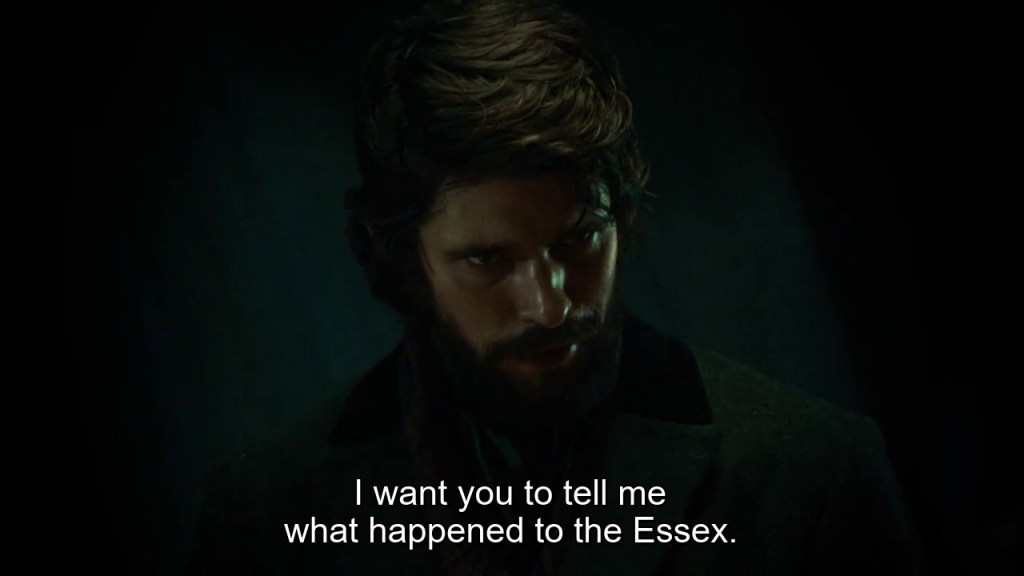
Herman Melville’s Moby Dick, the original ‘Great American Novel’, was based on the story of the Essex, a whaling ship that was destroyed by a bull sperm whale in 1820. The story of the wreck, and particularly the subsequent cannibalism that some of the survivors employed to survive, has largely faded from public knowledge (Moby Dick finished with the whale sinking the ship), but in the nineteenth century, every American child would have learnt about it at school, and this film starts with a young Melville (Ben Wishaw, who played a very different role in Perfume) seeking out the last survivor some decades later, hoping to get the full story to use in his novel.

This film is based on a meticulously researched 2000 book of the same name on the Essex disaster by Nathaniel Philbrick, which won him the National Book Award for Nonfiction in that year. Whaling was no more controversial in the early nineteenth century than crude oil in the early twentieth – it was used to power the factories and light up the cities of the world, and was worth a fortune. As the fleets decimated the whales near shore, the boats had to head further into, well, the heart of the sea, to find their victims. Whaling was, and remains, an incredibly brutal business, with small boats harpooning the giant mammals then drawing near and stabbing them to death. A successful kill was signalled by a plume of blood spurting out of the whale’s blowhole.

Whaling was a class-based system, with the captains drawn from the powerful old families in Nantucket, the tiny American island that was the centre of the industry. The main protagonist of the film is Owen Chase (Chris Hemsworth – the mighty Thor) as the first mate, who was refused the captaincy because he is socially inferior, an “off-islander”.

His best friend is the second mate Matthew Joy (Cillian Murphy from 28 Days Later). The Captain, George Pollard (Benjamin Walker from Abraham Lincoln: Vampire Hunter) is ineffectual but is from one of the original Nantucket families, and so has been promoted over Chase. In fact, the ships were run on strict class and race lines: the African-Americans and off-islanders lived in the Foc’s’le or front of the ship, where the food was inferior, and did the dirty work. The Nantucketers lived aft, and were fed and treated better. They were, in general, the ones that survived sinkings. Six African-Americans made it into the whaling boats – none survived. True Nantucketers were also mostly devout Quakers, pacifists who, however, saw no problem in killing magnificent whales and “raising bloody havoc at sea” as Philbrick put it. Class conflict is the basis of the story for the first half, before the angry whale comes along.

The story of the Essex is told to Melville by a decrepit old drunk who is the last remaining survivor, Thomas Nickerson (Brendan Gleeson, who was also in 28 Days Later). Nickerson had been a cabin boy (played by Tom Holland – Spiderman) when the boat sank. Nickerson did write an account of the events, but it was not discovered until 1980, so Melville did not in fact use his words. Chase’s brief account would have been the one known to Melville, who embroidered the conflict, as authors do, to make the whale white and almost supernatural, and avoided the controversy, not mentioning the cannibalism that resulted from the wrecking of the boat.

This does shed some light on the different reception of cannibalism over time. When the Essex set sail, cannibalism at sea after shipwrecks was not uncommon, and was generally considered embarrassing but necessary. The Monty Python team did a skit based on a version of this incident.

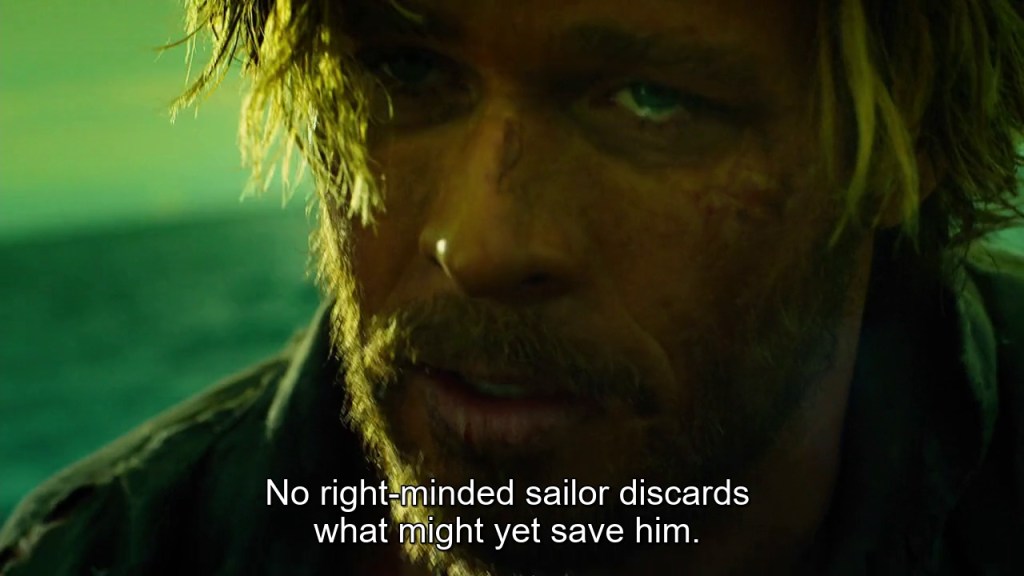
In the Heart of the Sea suggests a conspiracy by the whaling company to ignore the cannibalism as the presence at sea of a giant, angry whale would discourage further exploration, but Chase and Pollard refuse to cooperate. By Melville’s time, cannibalism was too graphic for his potential audience (he wanted to sell books after all). In our time, the great white whale is still of interest, in that he represents nature fighting back against human rapaciousness, but the real point of this film is now the cannibalism. Would anyone go to see a movie about a shipwreck if Thor didn’t eat anyone?

Or even if he did. The film’s tagline was “Based on the incredible true story that inspired Moby-Dick”, which did not inspire enough people to see it – it grossed $93 million, which sounds great until you see that it’s budget was $100 million. It scored a paltry 42% on Rotten Tomatoes, with the Seattle Times critic summarising it as:

“Thor and Spider-Man fight a whale.”

Despite some critics seeing the movie as over-long and dull, the scenes at sea are full of action (if not exactly Pirates of the Caribbean) and very well done, and the special effects are spectacular, especially the whales and the sails, and the whales demolishing the sails (you can guess which side I was on).

But as Philbrick wrote in his book,

The Essex disaster is not a tale of adventure. It is a tragedy that happens to be one of the greatest true stories ever told. (p.236)

The halfway point of a movie is usually the turning point in some form, and it certainly is here – in the middle of the film, in the middle of the Pacific, they finally find an abundance of whales, including the great white whale that they were warned about on a stop in Ecuador. He charges the ship, staves in the side, the whale oil they had collected goes up in flames, and they have to abandon ship and fit as much food as they can (which isn’t much) into their little whaling boats.

The rest of the movie is all about how some (a few) of them survived the long voyage of 4,500 nautical miles back to South America. They reach a small but uninhabitable island, and the white whale makes them welcome by tipping over their boats as they head for the beach. Chase and the Captain abandon their class struggle to engage in dialogue about anthropocentric carnivorous virility instead.

Pollard answers with presupposed anthropocentric arrogance.

“We are supreme creatures, made in God’s own likeness. Earthly kings, whose business it is to circumnavigate the planet bestowed to us…”

The island cannot sustain them – they find the skeletons of a previous party that took shelter there, so repair the boats and head off again for another agonising trip across the endless ocean. After 48 days stranded, with almost no food or water, one of the sailors on Chase’s boat dies. The others prepare to toss him overboard, but Chase stops them. It’s all handled quite delicately, but it’s definitely become a cannibal movie.

“We prepared the body. We removed the organs. Separated his limbs from his body and cut all the flesh from the bones.”

In the other boat, no one dies so conveniently, so they draw straws for a victim. The captain gets the short straw, but his cousin cannot shoot him and shoots himself instead, keeping the catering in the family.

The whale comes back, but he and Chase exchange a look, and Chase cannot bring himself to kill the magnificent bull.

After ninety days at sea, the survivors reached South America. According to the book, a boat that drew up alongside saw two men sucking the marrow from the bones of the dead, refusing to give them up. Unlike some survivor cannibal stories such as Alive, where the actors looked pretty much the same weight at the end of the ordeal, Hemsworth reported that the cast were put on a strict ration of 500–600 calories a day, and he lost 40 pounds (18kg), giving him a reasonable idea of what the sailors had gone through.

What the film doesn’t mention is that the survivors could have had a much easier time of it if they had headed not for South America but west toward the Marquesas Islands, only 1,200 miles away. They chose not to do so, because of earlier reports that the natives were, yep, cannibals. One mariner, Georg von Langsdorff, had written in 1804 that the natives so loved human flesh that “those who have once eaten it can with difficulty abstain from it.” Of course, it was all nonsense.

Instead, they headed east, and ended up eating each other.