Six dead(ish) serial killers: THE BUTCHERS (Steven Judd, 2014)

If you could somehow bring a dead serial killer back to life, let me ask you this:

  1. What question would you ask him?
  2. Why the hell would you bring him back to life??

This movie was called The Butchers in some markets and Death Factory in others, but didn’t exactly set the world alight in either case. The “plot” (sic and sick) concerns a bunch of misfits reciting a spell that returns to life some of the more notorious recent serial killers, who are featured in a bizarre museum called The Death Factory: Albert Fish, John Wayne Gacy, Jack the Ripper, Jeffrey Dahmer, Ed Gein, and the Zodiac Killer. Wait – that doesn’t make sense? Well, enjoy the ride.

 Before the ride, though, a flashback – Simon (Damien Puckler – Grimm) is having a nightmare about when he was a little boy and killed his father with a golf club. First we get to sit through the father killing a neighbour and Simon’s mother, in grisly detail. Yeah, Simon has serious issues. So did I after watching a woman have her teeth knocked out.

He’s on a bus with his brother (who reads Dante’s Inferno, as you do) and a bunch of misfits representing various stereotypes of America, heading for the Grand Canyon, but the bus breaks down and so they hoof it the Death Factory.

Meanwhile, a lawyer from Africa comes to visit the Factory, gets a guided tour of the killers (for the sake of the audience rather than him I rather think) and sees the vials of blood collected from them (how the hell did they get blood from Jack the Ripper?) and then kills the owner.

He has a big antique book, which we just know is going to be full of magic spells. The Goth couple from the bus find it and recite the spell of resurrection (you know, just for fun), and all hell breaks loose. No, really, it’s all a Satanic plot. Say the words, and the drops of blood form columns of fire and the dead butchers are resurrected.

But keep your disbelief suspended – it gets worse. When they get killed, they return to dust and smoke and enter the one who killed them. Confused? So were the writers I fear.

Of course, no slasher film is complete without the impending victims arriving from a broken-down vehicle at a sinister and run-down gas station / diner.

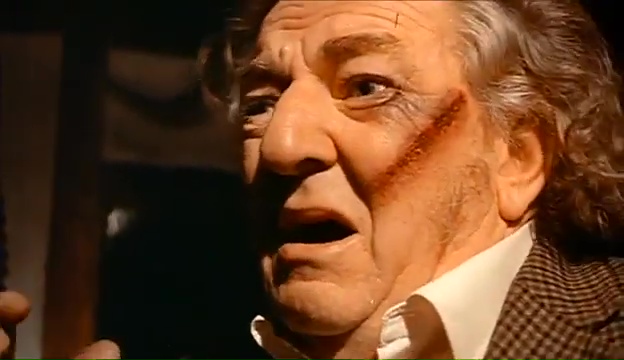
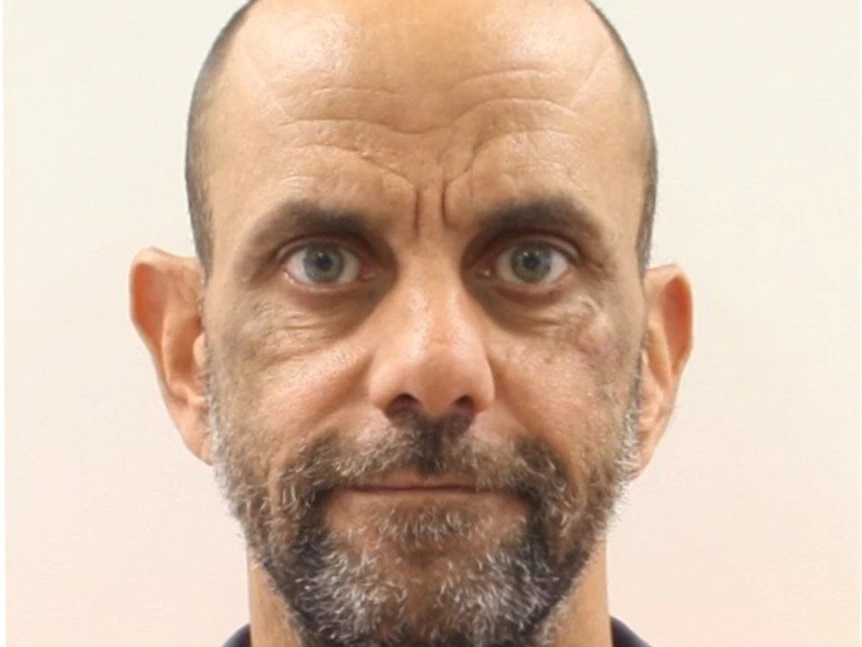
But the interest in this script is not so much in the bus passengers but the six born again killers who stalk them. From the point of view of a cannibalism blog, we only really care about four of them (the cannibals) and there are some real plot problems here. For a start, Albert Fish was ostensibly a harmless old man, unless you were a young child (he used to kidnap children, flog them, murder them and eat them), but he was clearly not up to a fist fight, unless you were under eight years old. Here is the movie Fish, and the real one. Not a bad likeness, but a scary monster?

Jack the Ripper was never identified (nor was Zodiac come to that) so this one wears an old person mask and talks with an English accent. But we have a revelation when Jack takes off the mask! Yes, Jack the Ripper turns out to be a lesbian, who finds out what little girls are made of (with the help of a cut-throat razor). Well, glad they sorted out that mystery anyway. Any clues on who killed JFK while you’re there?

Ed Gein was technically not even a serial killer since he only killed a couple of people, preferring to source his body parts from gravesites, and he was also pretty decrepit, an unlikely partner for hand-to-hand combat. Not even trying for a likeness here – just a scary Fred Flinstone.

That leaves Jeffrey Dahmer who was certainly a serial killer, but his M.O. was to drug his victims then drill holes in their heads when they were unconscious, hoping thereby to keep them around as zombie boyfriends. So, Dahmer was a lover, not a fighter.

Dahmer does, however, have the best line in the movie; after biting one dude:

“33% of Caucasians are A positive… I prefer A negative.”

Another great line is when Simon and the bible thumping lady find a series of pentagrams and vials of serial killer blood (curiouser and curiouser). She has some expertise here, which turns out to be as useless as it sounds:

“I wrote a paper on the psychological dysfunction of fanatical religious behaviour. At Emory.”

But most of the dialog consists of people saying to other people “stay here, I’ll go check it out.” You just know that’s not going to end well. Several times (yawn).

This is a pretty awful movie, garnering a handsome 12% on Rotten Tomatoes. If you like gore, that is well done and you might enjoy it, if you can get past all the metaphysical nonsense of pentagrams and life force transfers. If, however, you are a student of cannibalism, you will be mystified by their portrayals of these murderers. Have these people never heard of Wikipedia?

More importantly, how did they decide on these six as the world’s worst serial killers, and why were four of them (67%) best known for their cannibalistic behaviour? Our fear of death is notorious – watch a group of people flee from a loud noise like a flock of pigeons. The primal part of our brain, like that of the pigeon, takes over when survival seems to be at issue. Cultural anthropologist Ernest Becker argued that our terror of death is the basic motivation of human behaviour.

But the enormous interest in cannibalism indicates that there is something even more terrifying than dying: being eaten. Dramatic headlines announce the victim of the latest shark or crocodile attack, while meanwhile hundreds die unremarked, in more mundane incidents taking place all around them. We build mausoleums or place immense marble slabs over our graves to keep out marauders, we pour chemicals into the veins of our corpses to preserve them from worms and bacteria. The worst terror, though, is incorporation into the body of another human. Theologians write learned pieces on God’s options for restoring the body on the day of judgement; if we have been absorbed into another body, to whom would the restored flesh belong? Ed Gein is included in the canon of cannibals not for the numbers he killed but because he used the body parts to make furniture and lampshades.

Cannibalism feeds our darkest fears – that we are not made in the image of God (however that is interpreted) but that we are edible animals, no different to the millions of other animals we slaughter every day: for their flesh like Dahmer and Fish, for their skins and bones like Gein, or just to see what’s inside, like Jack.

CANNIBAL NEWS 2021: Mexican man allegedly ‘slaughtered and ate 30 women in a cellar’

Andres Filomeno Mendoza Celis, 72, was arrested on Saturday evening, 15 May 2021, in his home in Calle Margaritas, in the Mexican municipality of Atizapan de Zaragoza. Detectives arrived at Mendoza’s home to interview him about the suspicious disappearance of a woman, Reyna González, a mother of two children, only to find her mutilated remains on a table. González is said to have gone to the house of Mendoza, a family friend, to buy cellphone parts for her business.

Mendoza reportedly admitted to slaughtering around thirty women over the last twenty years. Most of their names were listed in a notebook found on the premises. According to Imagen Television Mexico, Mendoza confessed to eating his victims’ body parts; he recorded the murders and mutilations on 25 videotapes. He allegedly peeled off his victim’s faces and scalps, the last one because she was “pretty”.

From @c4jimenez

Bystanders watched as personnel from the Attorney General’s Office of the State of Mexico (FGJEM) came and went, carrying out excavations inside the house, looking for skeletal remains.

Investigators used sniffer dogs to locate human body parts; officers drilled through the flooring to recover the remains and hair of several other women. They also found women’s shoes, items of clothing and the voter identification cards of Flor Vizcaino, 38, who was last seen October 16, 2016 and Rubicela Castillo, 32, who was reported missing July 20, 2019.

According to the news site Televisa, the police found the skeletal remains of up to five people at the suspect’s house, as well as knives suspected of being used to kill and dismember the “victims.”

If confirmed, this would exceed the toll of Mexico’s “Monsters of Ecatepec” – a couple who killed and ate about twenty victims between 2012 and 2018 in in Ecatepec de Morelos.

Local reports claim the suspect “could not bear the rejection of young and pretty women.” A young neighbour reported:

“He always bothered women, his gaze travelled over their bodies and fixed on their buttocks, legs and breasts… They always said he looked perverted. When they found him drunk on the street, they preferred to turn around. He drank too much and made them uncomfortable by comments he made to 30-40-year-old women.”

Mendoza is being held at the Tlalnepantla Penitentiary for the murder of Reyna González, whose remains were found at the property. Lead prosecutor for the Attorney General’s Office division, Dilcya García, said the evidence investigators were able to uncover and gather strongly indicates that they could be dealing with a cannibal “serial” killer.

Mendoza, like many modern, domestic cannibals, seemed a harmless citizen; he had been president of the council of citizen participation in the Municipal Government of Atizapán de Zaragoza. He had also been a butcher for many years, working in a slaughterhouse that prepared meat for human consumption in Tlalnepantla, so he knew how to cut skin and keep it in good condition. Well preserved, skinned faces were found, with the hair still attached.

Are there more such cases of cannibalistic murders happening now, or are authorities discovering cases which previously might never have been uncovered? In either case, there is a clear trend toward the innocuous neighbour, the seemingly bland citizen, being dragged off in cuffs, leaving behind mangled corpses missing portions of flesh. Very often, the perpetrator has been shown to have worked in a slaughterhouse. Eduard Seleznev, the “Arkhangelsk Cannibal”, worked in an abattoir, as did Sofia Zhukova, the ‘Granny Ripper.’ Alberto Sánchez Gómez lived next to a bullfighting ring. Watching other animals being sliced up into commodities must make it easier to do it to humans.

Is our flesh fetish catching up with us?

Young Leatherface: THE SAWYER MASSACRE (Steve Merlo, 2022)

Whether you loved or hated (or anything in-between) Tobe Hooper’s The Texas Chain Saw Massacre, it is widely acknowledged to be a seminal work in the history of slasher movies generally, and specifically of cannibal films. Total Film made it number one of the fifty greatest horror movies of all time (Psycho was number 6!) and Richard Zoglin of Time said that it set “a new standard for slasher films”. Ben Woodard called it “unambiguously the greatest horror film ever made.” That makes creating a sequel (or actually a prequel) all the more fraught!

Chainsaw was based partly on the real-life (real-death?) exploits of Ed Gein, the “Butcher of Plainfield”, who decorated his house with all sorts of furniture made of human bones and skin, but Gein had dug most of them up from graveyards. The man-monster from TCSM was Leatherface who wore a mask (well before the rest of us) and even made it himself (far more sustainable than the rest of us). It was, however, made of human skin, which you can’t get readily even on Etsy, and he sourced his raw materials from those travelling through his little corner of Texas, cutting them up with a large and noisy chainsaw, often bashing them on the head with a mallet first, as the more primitive slaughterhouses used to do to the cattle in their yards.

But why did he do that? We get some hints in the movie from his brother, the Hitchhiker, who makes it clear that the family had been “in meat” and worked in the local slaughterhouses, which had closed as industry fled the “fly-over” states. But a lot of people lost their jobs in the seventies, and most of them did not go out and buy chainsaws with murderous intent. So how did Leatherface get started? And whose idea was it to eat the victims?

Such questions have clearly been on the mind of TCSM fan Steve Merlo, who recently sat down for an interview with Bloody Disgusting about his intended feature film THE SAWYER MASSACRE, intended as a prequel to the 1974 classic.

The film has been crowdfunded through Indegogo (now closed unfortunately) but should have raised enough to see it released in about August 2022.

Here’s the plot from the Director:

While recovering from the loss of someone close, Jimmy’s friends bring him to the Texas countryside to escape city life. In need of supplies for their cabin, they head to a gas station where they are directed to an isolated farmhouse. The property is not as it seems. They find themselves hunted by the cannibalistic psychopath known as Leatherface.

Clearly, it follows the formula that was also seen in The Hills Have Eyes, Wrong Turn, The Farm and loads of other slasher movies where humans are on the table instead of sitting around it. But, as Merlo says,

“It is our intent not to copy what the original did, but use it as influence in a stylistic way. Our film will have more blood and kills, but will still be very subtle in its delivery.”

The film is due for release in 2022, the date that appears in IMDB. The film also has a Facebook, Twitter and Instagram page if you wish to follow its progress.

Family feeding frenzy: FRIGHTMARE (Pete Walker, 1974)

The British Daily Telegraph called this movie a “moral obscenity”, or perhaps that was their mission statement. The trailer (above) is a hoot, offering the warning

Of course, these ‘small segments’ which are the only ones they dare show are the most gruesome parts of the movie. If you’re coming for the gore, just watch the trailer. But Frightmare has a lot more to offer than just slasher-fare. It is a British film, which is pretty refreshing in itself, as the British tend not to make a lot of cannibal films, sadly. Among the best are Revenge of Frankenstein, and Death Line. The Brits like to analyse their cannibals, find behaviourist explanations of their eating preferences. This film is in that tradition, but with some nice variations.

The film was variously titled Frightmare, Cover Up and Once Upon a Frightmare. Released in 1974, it was directed by Pete Walker, who spent the 1970s battling the censors with a string of gory movies, which didn’t set the box offices alight, but eventually became cult classics, particularly this little cannibal thriller.

 The story starts with a shy young man (Andrew Sachs, best known as Manuel from Fawlty Towers!) asking to be allowed into a trailer-home, from whence we know he will not be departing.

He’s not from Barcelona…

Then we see a very cranky judge sentencing Edmund and Dorothy Yates to a mental institution; he had hoped to send them to the gallows, but unfortunately there was this medical report…

Seventeen years later, Dorothy (Sheila Keith from Ballet Shoes) and Edmund (Rupert Davies from The Spy Who Came in from The Cold) have been deemed officially cured, and live in an isolated farmhouse. Dorothy ate at least six people in 1957, while her husband was convicted as well, having faked insanity in order to remain with his wife, although in reality he had not been involved in her murders. But that’s all in the past, says Dorothy, who now is just a harmless old pensioner. Dorothy has taken up hobbies, including needlepoint, and the use of power tools.

In the current day (well, 1974) Dorothy is back to her old tricks. She lures lonely and friendless young people to her home, promising tea and tarot card reading, at which she is deadly accurate, as the session always finishes with the same tarot card.

Then there’s the kids – Jackie (Deborah Fairfax), Edmund’s daughter from a previous marriage, who seems relatively normal, and Debbie (Kim Butcher), Dorothy’s actual daughter, conceived shortly before Dorothy was committed to the asylum; Debbie has never met her parents. Debbie is only fifteen but rides with a violent bikie gang and has apparently inherited her mother’s appetite for human flesh. She initiates a fight in which her boyfriend and his gang beat to death a barman, who had refused to serve her because she was under-age. The bikie gang flees when witnesses arrive, but Debbie stays, and carries off the body. Jackie meanwhile is delivering packages every week to her step-mother. They bleed, and they turn out to be the brains of some unfortunate sentient animal. She buys them at the butcher (oh the horror!), pretending she has been hunting humans, as a good step-daughter would, but Mum is not fooled – she wants human brains. Probably likes the way they come pre-scrambled.

Edmund tells his daughter that Dorothy has started up her old gustatory habits, and shows her a corpse in the back of his boss’ Rolls Royce to prove the point. If you have a chauffeur, you might want to dash outside now and check the boot (trunk) of your Roller. We’ll wait for you.

Jackie’s boyfriend is, conveniently, a psychiatrist, who searches out Dorothy’s case history. As a girl, the chief boffin says, she had a pet rabbit who, during the Great Depression, her family decided to kill for food. Traumatised by the consumption of her beloved family member (of the furry variety) she “twisted the horror of the situation into something pleasurable.” She started catching small animals and eating their brains, then started on larger ones, of the sapiens variety.

“It was the only case of cannibanthropy on record in this country. Pathological cannibalism. There were a couple of cases in the United States, almost unheard of anywhere else.”

Now we’re just getting silly, in a way that would embarrass Manuel and Basil. For a start, there is no such word, and if there were, it would just mean someone who cannibalises humans, which is somewhat redundant. Pathological cannibalism didn’t exist in 1974? In the country that birthed Jack the Ripper less than one hundred years earlier? Only fifteen years earlier, Tom Burns had killed, molested and eaten (more or less in that order) two little girls in the town of Barrow in Lancashire. But it’s an interesting observation that in less than fifty years ‘pathological cannibalism’ has gone from almost unknown to a regular headline for the yellow press.

Jackie confronts Debbie about her wild, wild ways, then tells the cops where to find the (partially chewed) body of the barman. Debbie and her boyfriend head to the country home to, you know, meet mum and dad. Find out a bit about the old folks.

It’s a touching reconciliation of mum and daughter, even when mum takes a pitchfork to the boyfriend.

Look, it might have been horrifying and gruesome in 1974, but maybe we’ve all become hardened by watching cannibal movies or the TV evening news. Rotten Tomatoes gave it a measly 55% but, to be fair, it is highly watchable and, being a British production, the character actors are superb, particularly Rupert Davies and Sheila Keith.

The daughters are also more than just the gorgeous young teens that seem to swarm in slasher films. There is conflict between the older Jackie who feels responsible for everyone, and the younger Debbie, who lives for kicks (and a bit of flesh). Jackie represents the delusional nature of modern social customs, which see humans as defined by being other-than-animal, and so she is happy to buy the brains of cows or sheep (socially acceptable) in order to fool her step-mother (socially awkward), but horrified to find the older woman preferring the real thing (socially unacceptable). I’m sure most cannibals (and zombies) would think she is delusional: a brain is a brain.

The fascinating part of the movie for me is the main antagonist, Dorothy, the (unfortunately rare) female cannibal. Cannibalism remains an extreme form of carnivorous virility, and women have not yet won equality in number of perps or number of victims, and they probably even earn less flesh than men. I liked that Debbie, who had never met her cannibalistic mother, was already eating bartenders, disproving the expert psychiatrists who had blundered in releasing Dorothy, and before that misinterpreted her cannibalism as an unfortunate response to the eating of her pet rabbit. Debbie adds nature into the mix, offering support for a kind of genetic cannibalism, almost a wendigo syndrome, something that runs in families, like the Finnish family in Bloody Hell, or the Parker family in the Catskills. Frightmare was released a year before The Texas Chainsaw Massacre, which of course became the quintessential family-cannibal movie.

Anyway, Dorothy is a superb villain, a mixture of Arsenic and Old Lace and Leonarda Cianciulli, who murdered three women to make soap and teacakes in wartime Italy. Sheila Keith portrays at one moment a frail old woman, broken by years in an asylum, and the next a cackling serial killer with an electric drill and a flaming poker, both of which she plunges into various victims. Her husband has the role of the weak, supportive spouse, he is Mrs Lovett to Dorothy’s Sweeney Todd. Simon Flynn on the Peter Cushing tribute website called her “the most memorable woman the horror genre has ever seen.” Amen to that.

You can get the movie at Amazon or you might find it on Youtube – currently the full movie is showing at https://www.youtube.com/watch?v=aJj_ir8vi2I

Cannibal news: ALBERTO SÁNCHEZ GÓMEZ BUTCHERED HIS MOTHER BEFORE SHARING HER BODY PARTS WITH HIS DOG

Gómez ‘cut mother’s body into 1,000 pieces and shared her meat with his dog’

The court case has finally begun of Alberto Sánchez Gómez, a Madrid waiter who told police he butchered his own mother before sharing her body parts with his dog. In February 2019, police arrived at the house which Gómez shared with his mother after family friends reported that they hadn’t seen her for several days. Gómez opened the door and reportedly told them that he had strangled his mother to death, then allegedly said “Me and the dog have been eating her, bit by bit.”

Officers found the 66-year-old mother’s limbs, wrapped in plastic, spread around various rooms, while other parts were in the fridge and in the oven. Some pieces had been cooked and were still in a pan. Several police officers were reportedly violently sick due to the overwhelming stench and shock of what they were seeing.

The suspect was arrested and has since admitted that he strangled his mother, dismembered her body using a carpenter’s saw and two kitchen knives, and then spent 15 days eating her remains whilst feeding the bits he did not want to his dog. Police found body parts in six large Tupperware containers. The 66-year-old pensioner was chopped into at least 1,000 pieces and her vital organs were missing. It is claimed that her intestines were found mixed with domestic waste inside the flat.

Former friends of the alleged cannibal told of how he had a number of problems after becoming addicted to drugs. According to local media, the court believes that the suspect is suffering from a mental illness, possibly borderline personality disorder, and was at the time consuming hard drugs. The cocktail of drugs and mental illness could have resulted in an outburst that led to him killing his mother. The results of psychiatric tests on the defendant are expected to be presented later in the trial. Friends reported Gómez used to spend his days hanging out on a park bench near his mum’s flat, drinking with local homeless people.

The court heard that Gómez, 26, had frequently been violent towards his mother Maria Soledad Gómez, 66, who had taken out a restraining order against him, yet she would always take him back, telling friends: “What can I do, he is my son”.

Gómez has been charged with murder and the desecration of a corpse, for which he is facing 15 years and five months in prison along with EUR 90,000 compensation to be paid to his brother. Local media have called Gómez the ‘Cannibal of Guindalera’, which is a Madrid barrio dominated by Las Ventas, a 1920s bullring with a striking Moorish-influenced design. Bullfighting is a barbaric spectacle in which each year thousands of bulls are violently killed for the entertainment of the largely inebriated crowd. Here is PETA’s description of the “fight”:

In a typical bullfight, the bull enters the arena and is approached by picadors—men on horses who drive lances into his back and neck muscles. This attack impairs his ability to lift his head and defend himself. The picadors twist and gouge the lances to ensure significant blood loss…

Finally, the matador appears and—after provoking a few exhausted charges from the dying animal—tries to sever the bull’s aorta with his sword. If he misses, succeeding only in further mutilating the animal, he exchanges his sword for a dagger to try to cut the spinal cord. If he blunders this stroke, the bull may be conscious but paralysed when chained by the horns and dragged out of the arena.

If the crowd is happy with the matador, the bull’s ears—and sometimes his tail—are cut off and presented as trophies. A few minutes later, another bull enters the arena, and the sadistic cycle starts again.

The remains of the tortured bull are sold for meat after the event.

Interesting how many cannibalism cases we have already reported this year: the guy who kidnapped a little girl, claiming he wanted to eat her, the woman who chopped off her mother’s head after a fight, the guy in Oklahoma who cut up a neighbour to cook for his family, the “Arkhangelsk Cannibal” who killed and ate three friends, and of course the “Granny Ripper” who killed and ate several people before dying of COVID-19. And, at the time of writing, the year is barely one third through.

Globally, millions of people are reported missing each year, just like Maria Gomez. Many are never found – could some have been eaten? And why are we surprised when what is done to other animals is done to humans, particularly so near a bullring, which specialises in the torment and consumption of sentient animals?

Fun fact: this week, as the court case began, IFL Science reported that “New evidence has shed light on an 800,000-year-old cannibalistic murder” – the skeletal remains of a young female from the species Homo antecessor, perhaps the last common ancestors of Neanderthals and us. Researchers found on her bones teeth marks, butchering marks, and signs of marrow extraction – fairly solid evidence she was chopped up and eaten.

Nice to know how much progress we’ve made in the last 800,000 years.

Cannibal news April 2021: PAEDOPHILES AND CANNIBALS

Cecil Maurice Mabb, 42, has pleaded guilty to assault and attempted abduction

The headline on the ABC News site on 14 April 2021 read:

“Man who abducted 5yo from campground wanted to eat her, court hears”

Cecil Maurice Mabb, 41, pleaded guilty to assaulting and abducting the girl from Montagu Campground, in Tasmania’s north west, on January 24.

The Prosecutor told the Burnie Supreme Court that the girl went on a bike ride with her four-year-old male friend while her family was pitching their tent at the site.

She said Mabb had parked his ute in isolated bushland near the campground before he grabbed the girl by her legs, threw her over his shoulder and then threw her in his car as she screamed.

The court was told Mabb also strangled the child, who later said she was not able to breathe or speak while his hands were around her neck.

The family was alerted by her young friend, who had been screaming at Mabb to let her go and told them “the man scared me … he got her.”

Another camper found the girl on the beach alone, about one kilometre from the family’s campsite.

Mabb called police shortly after the incident, telling them “it’s all bad … it’s a real emergency … I just tried to kidnap a child”.

Mabb has denied there was ever any intention of doing anything sexual with the girl, and the prosecution did not argue otherwise.

The court has heard he told police he “just needed company, someone to listen to me, someone to give me a cuddle”, and that the child reminded him of his granddaughter.

While in maximum security at Risdon Prison, Ms Prence said Mabb told prison staff his motivation for the abduction was to eat her, and that he had wanted to eat people since he was a child.

His solicitor told the court while he did say that, it was on the advice of fellow inmates, who told him to make his circumstances “as bad as possible” so he had greater access to medication and therapeutic help.

The court was told that between 1995 and 2003, Mabb had been sexually offending, in behaviour he described as “exploring his sexuality with behaviour that had been normalised”.

The headline in The Mercury was more direct:

“Paedophile snatches little girl so he ‘could eat her’”

They paint a different picture of the evidence, with the prosecutor saying:

“intelligence from Risdon Prison indicated Mabb had told staff he told police he was a paedophile because that was better than “what he really was”. He told staff he had taken the little girl so he could eat her.”

Defence counsel Hannah Phillips told the court was no evidence Mabb said those words in jail.

“My client told me he had been instructed by other inmates to make up stories and to make them as bad as possible to get better access to medication.”

Mabb will be sentenced next month for his admitted crimes of assault and attempted abduction. Meanwhile, the locals have decided their own sentence.

Mabb had bought land and set up a caravan and shed at Rosebery in 2019. Those structures have been burnt down since Mabb has been in custody following the attempted abduction.

The interesting point about this story is that the offender has pleaded guilty to what he did and will be sentenced accordingly. But the prurient media interest is not in what he did but in what he said: he said he had grabbed a little girl for a cuddle (?) and that he wanted to eat her. Neither was true, apparently – he wanted to get caught so he would get medicated by the state. Yet the headlines offered another charge: “Paedophile snatches little girl so he ‘could eat her’”. Someone who read that promptly burnt down his shed and caravan, in a form of rough justice.

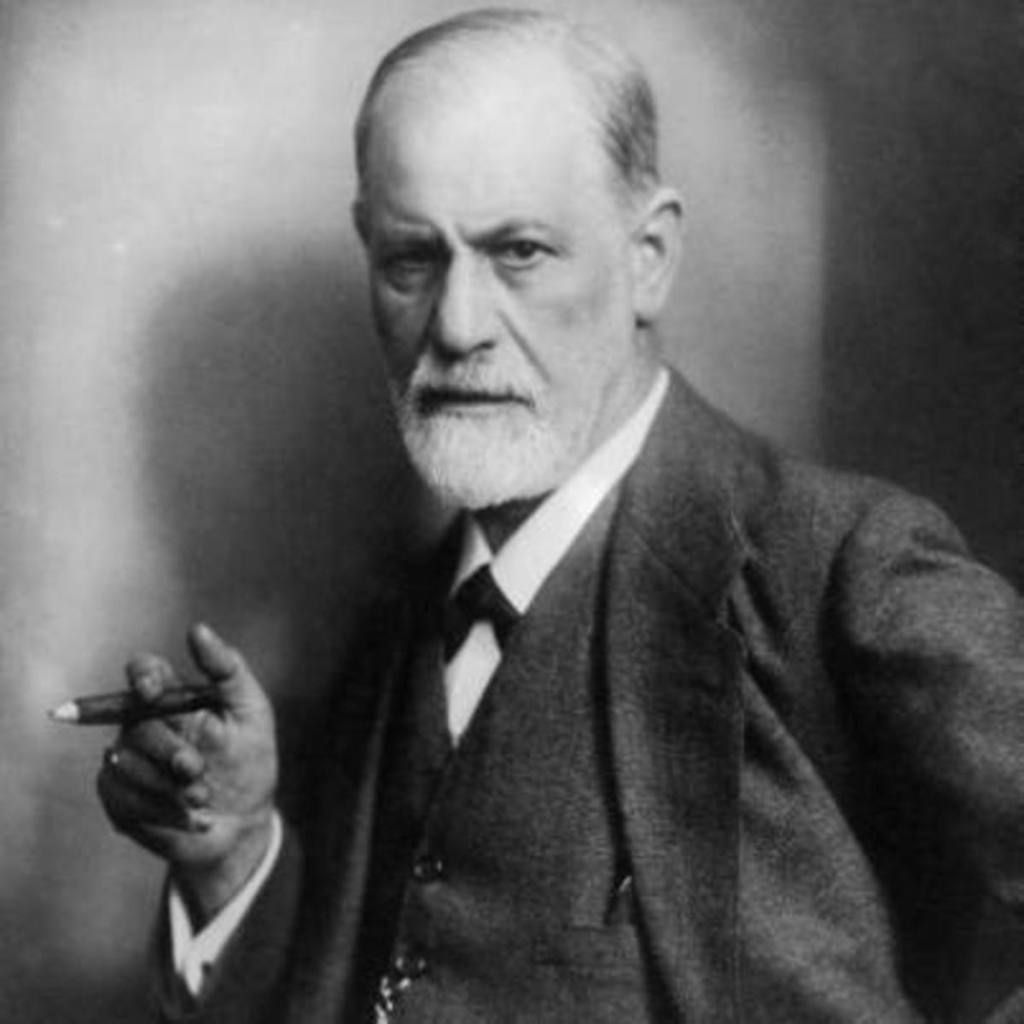
Wikipedia tells us that paedophilia was first formally recognized and named in the late 19th century. Sigmund Freud was writing then, and knew all about the subject, but wrote in a letter to Marie Bonaparte in 1932 that incest and cannibalism are the two original prohibitions of mankind. If he read the papers today, he might scratch out incest (and decades of work) and substitute paedophilia.

But cannibalism is still right up there, in the top two headline grabbers, the gold medal for salacious scandal.

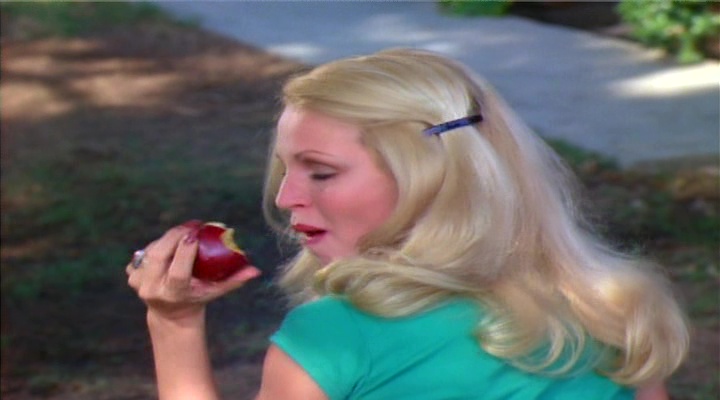
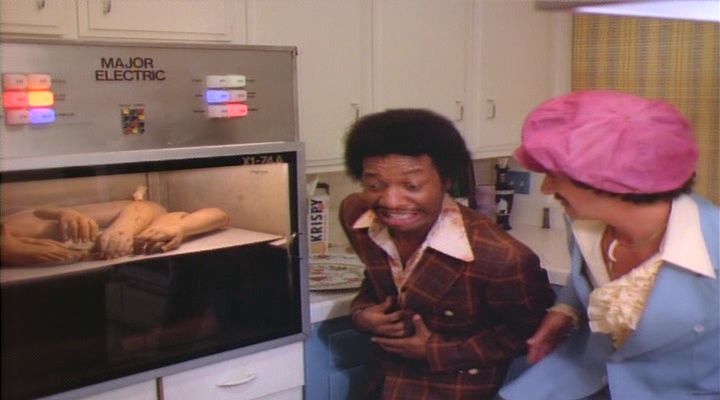
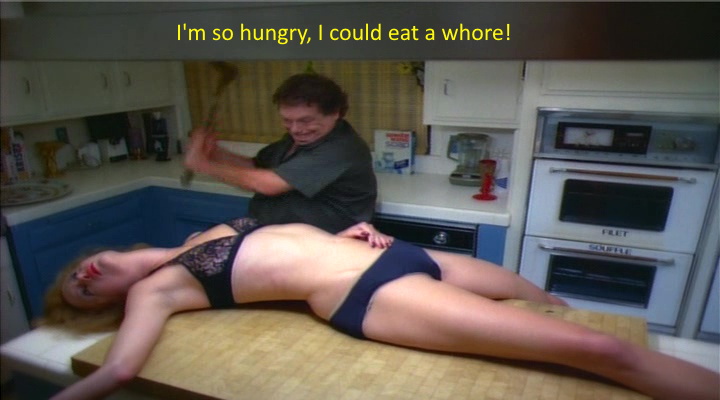
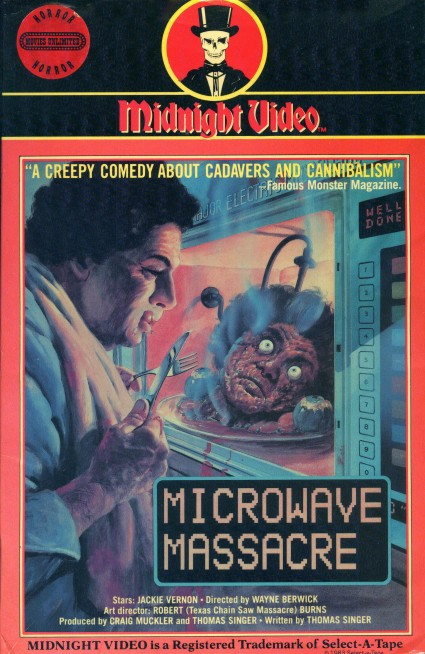
Meat the wife: “MICROWAVE MASSACRE” (Berwick, 1979)

“Anthem Pictures reluctantly presents what is considered to be the worst horror film of all time…”

That’s the start of the trailer (above) and like many trailers, it has some exaggeration and outright untruths to offer. This is not the worst horror film of all time, it may not even be a horror film, being perhaps better categorised as a comedy with blood and boobs (both presented somewhat gratuitously).

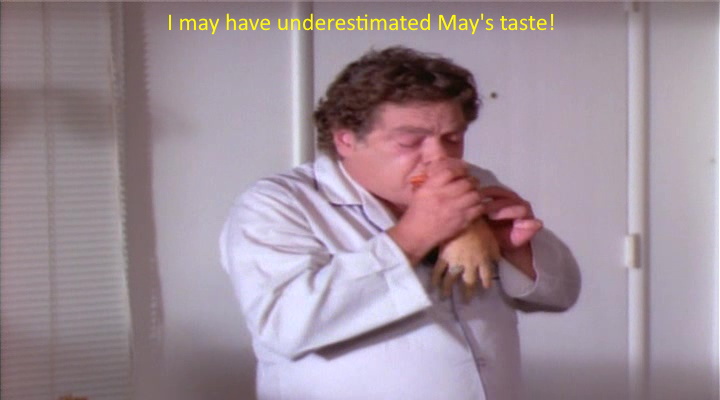
The story ‘follows’ a construction worker named Donald (Jackie Vernon, who was an American stand-up comedian and actor best known for his role as the voice of Frosty the Snowman; this was his last feature film). Donald’s wife May has bought an absurdly huge microwave, and after a quarrel about the fact that he doesn’t like the gourmet dishes she prepares in it (he only likes “food he can pronounce”), he kills her and puts her in it.

Has he never heard of preparing his own meals? Well, that’s what he ends up doing, with a sudden abundance of meat – perfectly cooked, as soon as he turns on the microwave.

He finds that his friends on the construction site love his cooking, turning them into what cannibal studies calls “innocent cannibals”, those who eat human flesh unknowingly, as did the customers of Sweeney Todd.

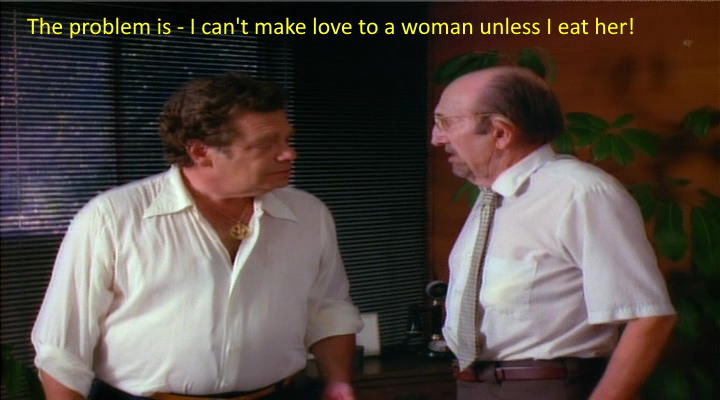
To keep the food flowing, he takes home a prostitute and kills her during sex, then lights a cigarette, only to wonder if the smoke is for “after sex or before dinner.” Getting the picture? Other victims follow, including a woman dressed as Big Bird which allows the film some levity with chicken jokes such as “I thought you were a leg man, not a breast man”. We witness Donald’s M.O. – screw them, kill them and cook them. He tells his psychiatrist, who sleeps through his confession, that

The psychiatrist, newly awakened, assumes he is talking about a more symbolic cannibalism, cunnilingus, and encourages him to “do it do it do it! She’ll lose her head over you!” Ah, the witty double entendres! Donald goes to Chinatown, and promises his friends he’ll be making “Peking Chick”.

It’s full of those sorts of puns, and they are closer to horrendous than humorous. Each joke is based on racism, sexism or speciesism, and usually all three woven together, into a dish less palatable than the unfortunate May. Except for May and her sister, women are presented as promiscuous and available temptresses: a mixture of Eve and the Serpent who enticed her to taste the forbidden fruit in the original sin. There is in this film virtually no character development required before the victims are fucked and eaten.

The movie is barely longer than a modern TV episode at just under 1¼ hours. That seemed at times to be about seventy minutes too long. However, the film somehow managed to get 35% on Rotten Tomatoes, with Allmovie stating:

“Despite utterly failing as comedy, horror and pornography, Microwave Massacre is grotesque enough in design and attitude to be fascinating, much like a car accident.”

This is actually a better result than the director’s later movie The Naked Monster which managed a massive 12% rating of rottenness.

On the other hand, The Independent Critic thought it was “incredibly funny”, but warned:

“Vegetarians beware, this is a meateaters (sic) delight and the faint of heart should probably steer clear.”

Now, I’m just not sure why ‘meateaters’ would find images of women being murdered and cut up a ‘delight’. It seems to me after some careful study that meateaters prefer to maintain a judicious nescience about the source of their protein, which is why we see high walls around slaughterhouses and the careful dismemberment and presentation of the ‘products’ as not the parts of an animal but ‘just meat.’ Donald’s friends are horrified to find that the food they have been eating is a different kind of mammal to the one they expected. But they never asked about the species inside the lunchbox.

The combination of sex and slaughter is entirely aimed at and inflicted upon young women (Donald is nauseated at the prospect of having to eat May’s middle-aged sister, and leaves her tied up in a closet). This reflects the practices of animal agriculture which predominantly exploits the juvenile female body (eggs, milk, babies) before slaughtering them for meat. As a cannibal studies text (as opposed to a bad movie), this might appeal less to ‘meateaters’ and more to Carol J. Adams, who describes this process in detail in her book The Sexual Politics of Meat, which she describes as:

“an attitude and action that animalises women and sexualises and feminises animals.”

If I haven’t put you off yet, the film is available at Amazon for sale as a 2-disc special edition or for download or rent.


While we’re here, I would like to thank you for reading this blog – the readership has been going up steadily each month, and set a new record in March.

THANK YOU!

Cannibal News: “Acts of decapitation and cannibalism” – JESSICA CAMILLERI jailed for 21 years for murder of her mother in Sydney

Rita Camilleri and her daughter Jessica, who killed her in July 2019

WARNING: EXTREMELY GRAPHIC CRIME SCENE REPORTS

A Sydney woman who cut her 57-year-old mother’s head off with kitchen knives in July 2019 was found guilty of manslaughter in the NSW Supreme Court, after pleading not guilty to murder due to mental impairment. The court was told that Jessica Camilleri – who had a history of refusing to take psychiatric medications – had only stopped the attack when her mother’s head fell off and her eyeballs came out of their sockets.

A judge said Camilleri had practised “grave and mutilating depravity”, had squeezed and prodded her mother’s eyeball after removing it, and engaged in “acts of decapitation and cannibalism”.

Camilleri was sentenced, in March 2021, to serve 21 years and 7 months in prison, but may be eligible for parole when she’s 41, in 2035.

Mother and daughter had been at home in the mother’s St Clair house where they had dined on Red Rooster (chicken) before Jessica demanded a second delivery from the food outlet, then turned on Rita, who had threatened to have her daughter taken into mental health care. Jessica dragged her mother into the kitchen by the hair and attacked her with steak knives, beheading her and removing her tongue, eyeballs and nose.

The week-long trial saw graphic police evidence, crime scene bodycam video and a police interview with Ms Camilleri, her face still coated with her mother’s blood and her hands bagged.

Senior Constable Jodie Bennett, who examined the living room and a bedroom in the Camilleri house, found blood-soaked hair, human tissue, pools of vomit, overlapping blood-soaked footprints, plus a Crocodile Dundee figurine, the head of which had been detached.

The court heard Ms Camilleri was obsessed with figurines and violent horror movies featuring decapitation such as Texas Chainsaw Massacre.

Detective Sergeant Brett Griffin, who examined the crime scene between 12.42am and 7am on Sunday July 21, told the court that out on the footpath in front of the neighbour’s house he found Rita Camilleri’s mutilated head.

“I saw an area of apparent bloodstaining and human tissue,” he said. “A short distance away I saw a human head with numerous injuries including a severed nose, removed eyes and numerous groupings of apparent lacerations and incised stab wounds.”

In her judgement, Justice Helen Wilson SC said:

“I’m satisfied the offender knocked her mother to the floor and then dragged her by her hair into the kitchen… The focus of the onslaught was upon her mother’s head and face, with over 100 individual blows landed, many on Mrs Camilleri’s right cheek. Mrs Camilleri was conscious and trying to defend herself for long enough to have sustained over 90 defensive injuries and a knife wound to a vein in her neck.”

Camilleri had previously been diagnosed with a range of conditions, including an intellectual disability, an autism disorder and ADHD. However, she didn’t like to take her medication and Mrs Camilleri had no recourse when she failed to do so, the trial heard.

A four-year-old, known as Child A, whom Jessica referred to as “the little bastard”, was in the house at the time and tried to jump on her to stop the attack. She fought off and wounded the child.
A forensic psychiatrist, Professor David Greenberg, told the NSW Supreme Court last year that in addition to her mild intellectual disability and autism spectrum disorder, Ms Camilleri suffers from a rage disorder that causes her to lose control and “explode like a bomb” when provoked or triggered by stressors.

Justice Wilson said Camilleri fully understood the wrongful nature of her actions and had squeezed one of her mother’s eyeballs after the decapitation. “The removal of Mrs Camilleri’s eyes does not appear to have been an act of deep and uncontrolled rage, rather, at this stage, the offender was indulging a sort of macabre curiosity sparked by her obsessive viewing of horror movies.”

Asked how Ms Camilleri’s decision to remove her mother’s eyeballs sits with the intermittent explosive disorder diagnosis, Professor Greenberg replied:

“it could also be more consistent with her autism spectrum disorder, her fascination for horror movies and body parts, decapitation, cannibalism, in her interest in these horror movies that she collected and views all the time.”

Camilleri later told a forensic psychiatrist she bit off her mother’s nose and that she got the idea to cut off her head from horror movies. She had a fixation on horror films, and owned eight copies of The Texas Chain Saw Massacre and five of Jeepers Creepers, the court was told. The Crown Prosecutor added “A feature of these movies was killing people violently and dismembering their bodies”. Cannibalism featured prominently in both films.

After the attack, Camilleri dropped her mother’s head in the street and called the police emergency number, telling them that:

“I was just so caught up in the anger I kept stabbing and stabbing her and I took off her head. I ran to my neighbour and I had my mum’s head in my hand and I was taking it as evidence to show that in the struggle, I didn’t know what I was doing so I cut her head off. I chopped her head off with a knife.”

Jessica Camilleri – from police video

She said that she used “about seven knives” to murder Rita, breaking four of them, before adding there is “blood everywhere” in the kitchen. The recording of the call is at this site.

Camilleri told police when they arrived: “My mum’s head is on the concrete over there. Can you bring someone back to life if they don’t have a head? There’s nothing you can do, she’s a goner? They can’t restart her heart? ‘Cos I know doctors can do miracles they can’t resew her head?”

Police officer: “That’s a bit of a stretch.”

Neighbours hold a vigil outside Rita Camilleri’s house

Her older sister Kristi Torrisi Rita’s testified at the trial about her sister’s troubled childhood and how, once in desperation, her mother had paid a medium $2,500 to get “the demon out of Jessica”. She said the mum was “killed and butchered like she was nothing, all because of a fit of rage”.

The case raises a lot of definitional issues. The judge stated that Camilleri had engaged in “acts of decapitation and cannibalism” yet none of the news stories mention any swallowing of human flesh (although biting off a nose might count). But cannibalism is a slippery concept, hard to define. We assume the cannibal to be the person who eats the flesh or organs of other humans. However, Robert Myers, who wrote a careful study of the allegations of Carib cannibalism, pointed out that this is too narrow:

“There is an absence of a clear definition of cannibalism, a practice encompassing an extremely broad and sometimes ambiguous range of behaviours. Cannibalism can include drinking water-diluted ashes of a cremated relative, licking blood off a sword in warfare, masticating and subsequently vomiting a snippet of flesh, celebrating Christian communion, or gnawing on entire barbecued limbs as De Bry depicts Caribs doing.“

Then we have Camilleri’s sister accusing her of butchering their mother “like she was nothing”. Butchery is a term used in warfare for massacres, but most commonly it is a business term. A butcher used to be someone who killed farmed animals and sold their parts, but now it usually involves no killing, which is done elsewhere behind high walls, and is a retail profession – selling bits of the dead animals to customers. The animals are not “nothing” in butchery but the raw material, valuable commodities to be sold, their ‘nothingness’ restricted to the moral value of which they are deprived by the logic of capitalism. Butchery, in other words, is normally done for profit. But the lessons we draw from its ubiquity in our societies can be taken to heart in many different ways.

“For as long as men massacre animals, they will kill each other. Indeed, he who sows the seed of murder and pain cannot reap joy and love.”
– Pythagoras c. 500BC (attributed by Ovid)

Next month we’ll take a look at the ever-evolving Armie Hammer story. Spoiler: he’s not a cannibal, he’s a very naughty boy!
You can read more “cannibalism news” at this link.
Meat is meat! THE BUTCHERS (Paulmichel Mielche, 1973)

Since at least the time of Sweeney Todd, the barber who killed his customers and turned them into pies in the early 19th century, enterprising business people have been selling human meat to their customers. In Soylent Green, the US government does a roaring trade in it, and demonstrates sustainable recycling, well before it became fashionable. It’s a trope that is enduringly popular, because it offers metaphors for the fears people hold about their own society. Who among us has not suspected we have been exploited, chewed up and spat out at some time? Except for those doing the chewing up of course. 
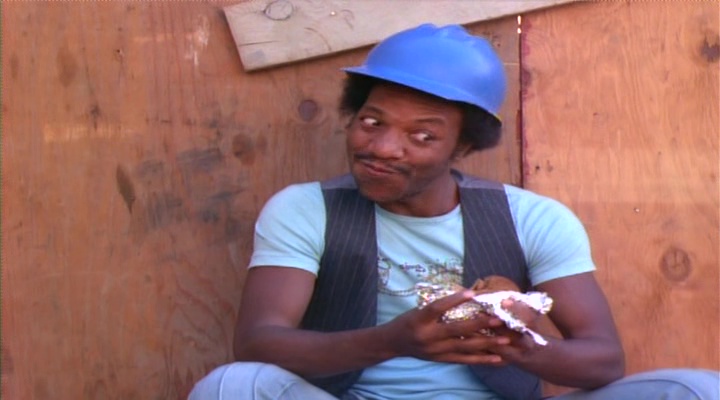
The movie was originally called Maxie, but that must have been a bit subtle, as it was renamed for marketing purposes to The Butchers or sometimes Murderer’s Keep. The lead character is a young girl named Maxie (K.T. Baumann) – a difficult role as Maxie is a deaf mute who witnesses the local butcher chopping up dead people for his shop, and is kidnapped by his assistant to ensure her “silence”. They’re afraid she is going to learn to talk. It’s complicated (not really). Baumann expresses what most actors get to say by using her face, movements and sounds, and she is very impressive.

The butchers are Smedke (Vic Tayback from Bullitt as well as bit parts in almost every TV show ever made) and his half-witted assistant Finn, played with gusto by Robert Walden (Lou Grant and lots of other shows). The problem is that, as horror movie villains, they are neither scary nor villainous. Except for their business practices, they are quite sympathetic characters. The gore we usually associate (expect?) with cannibal movies is mainly the result of Finn, the apprentice butcher, screwing up the slaughter of some unfortunate hens. We see that in gory detail, as if the director wants us to question whether it’s worse to eat a living, breathing animal fighting for her life, or a dead body who can feel nothing. The scene reminded me of the gratuitous animal cruelty in Cannibal Holocaust and other Italian cannibal movies, which were supposedly added to make the audience think the violence and cannibalism were real. No such pretence here – they just kill chickens. Life is cheap.

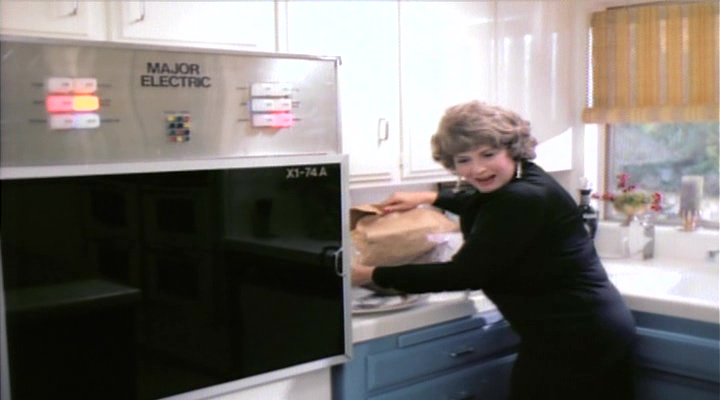
Smedke is buying human corpses, wrapped in brown paper, from a shipping yard (no further explanation is offered) and happily chopping them up for customers who don’t want to pay the prices he charges for the regular cuts. His refrain is:

“Meat is meat! And a man has to make a living.”

A refrain that is lost in this film, but was used to great effect a few years later (“meat is meat and a man’s gotta eat!”) by the ever-cheerful Rory Calhoun in Motel Hell. Smedke is an entrepreneur in Nixon’s America, which is careering toward neo-liberalism, Reagan and “greed is good”. Although he doesn’t get to expand on his philosophy, it seems clear that a dead body is worthless buried, so it might as well be bought and sold.

The interesting aspect of the ‘plot’ is that Maxie cannot tell anyone what she has seen (basically a human foot sticking out of the brown paper) and has no social skills since her father has kept her at home rather than risk her humiliation at school. Yet she can take an ethical position – she tosses out all the meat in her father’s fridge, choosing vegetarianism.

This barely ranks as a B movie, and while I have reviewed a few films on this blog that got a fat zero on Rotten Tomatoes, this might be the first that did not even get onto the site at all. Check this less than glowing review:

“Miekhe… ends up creating the cinematic equivalent of a staph infection, an oblique mess that just spreads and oozes across the screen like fissures on an untreated leg gash. By the end, you aren’t hoping for closure so much as a conclusion – ANY conclusion – just to get us out of this asylum as anti-horror film… And yet, for all its baffling movie machinations, its lack of gory goodness and substantially less than successful storytelling, The Butchers is still a fascinating film experience.”

Indeed, it has a certain fascination if you can navigate through the paper-thin plot – it is a glimpse of small-town America in 1970 as it moves from the optimism of the sixties to the rapacity of the seventies. The cast are mostly great, particularly Baumann and Walden. Talia Coppola, (aka Talia Shire, the sister of Francis Ford Coppola) is shown as a star on the credits, although she has a minor role in the film. She played Connie Corleone in the Godfather series, and Adrian Pennino in the Rocky films, and was nominated for an Oscar in both roles. She is a bit wasted here.

The music is quirky, sometimes totally inappropriate and never boring or obvious like so many horror films. And sometimes it’s just fun to watch a film that no one has heard of, and probably no one ever will. And it asks the key question of cannibal studies: why do people find the killing and eating of some animals unremarkable and others repulsive?

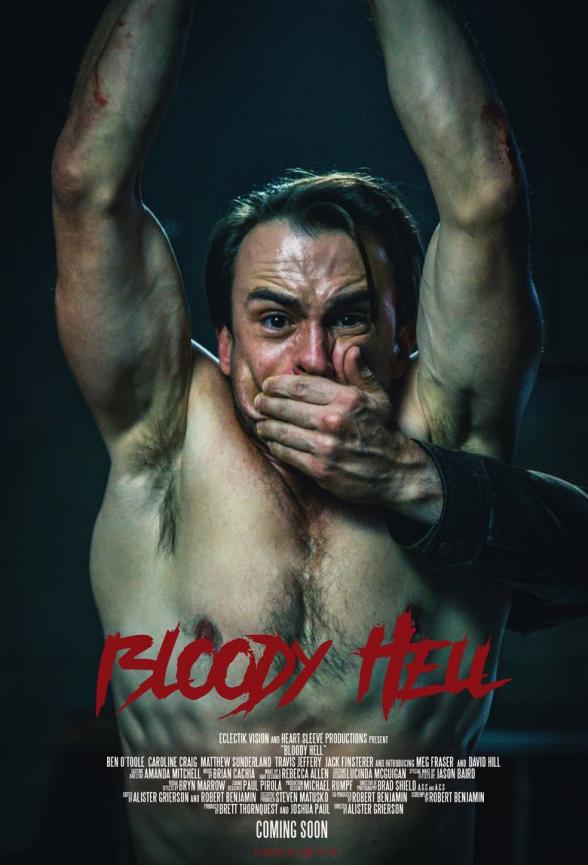
BLOODY HELL (Alister Grierson, 2020)

This is a ripsnorter of a thriller, and full of surprises. Defiantly internationalist, the film is an Australian-British action/horror film directed by Alister Grierson (Kokoda, Sanctum, Tiger) and written by Robert Benjamin. It is set in a basement in Helsinki Finland with scenes in Boise, Idaho, and features mostly Australian and New Zealand actors, with American or Finnish accents and dialogue as necessary. It was made on the Gold Coast in Queensland (as many blockbusters have been recently).

The main characters are both personas of Rex (Ben O’Toole – Hacksaw Ridge, Detroit, The Water Diviner).  O’Toole is superb (imagine a combination of Bruce Willis and Robert Downey Jr) in two roles: both the physical Rex and his inner voice, the part of him (and all of us) which commentates his life and ordeals, screams abuse, even when pretending to be calm and collected or even unconscious, and debates the best responses, rational or emotional, to every aspect of what is going on around him. O’Toole called this Rex his character’s “conscience”, but it’s not a Freudian split between an ego and a superego (or id) – it is more nuanced, and the invisible Rex (invisible to other characters – the audience and physical Rex can see and hear him) argues about practical and ethical issues all the time, sometimes compassionate, sometimes sneering and violent. That inner voice, as we all know, is exhausting.

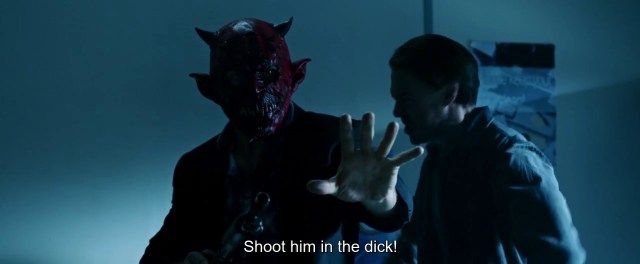
Rex and his inner voice are off to Finland. Why? Well, Rex was in a bank, chatting to a teller he fancied, when a gang of heavily armed men came storming in and violently robbed both the bank and the customers. Rex, ex-military, was able to take on the gang and kill them all, but the last one was ready to surrender when invisible Rex screamed:

As the last robber collapsed, dickless, his gun went off, killing an innocent teller who had been hiding in a cupboard. Rex became a media sensation, with half the population calling him a hero, and the rest a “psycho twat”, and a plea bargain saw him in jail for eight years for causing the teller’s death, leading to his decision to emigrate, on his release. In a flashback to his court case, Rex is asked why he shot the bank robber in that particular spot.

“I wanted him down… and I didn’t want him to reproduce… win – win!”

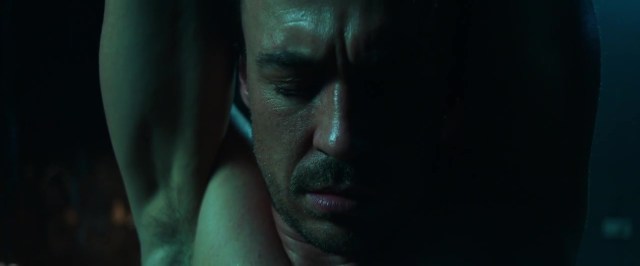
Why Finland? Well, he shot spitballs at a world map in his jail cell, and fate led him to that country. Where, unfortunately, a family of cannibals awaited him, and he wakes up, barely twenty minutes into the film, hanging by his wrists from a water pipe in a dark basement.

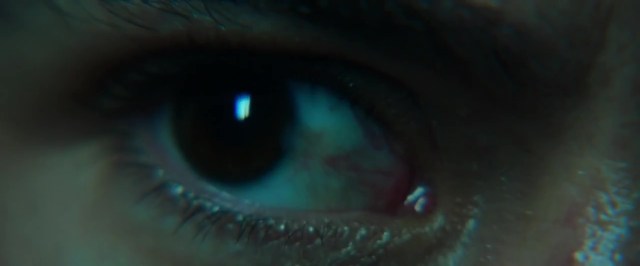
With the classic trope of cannibal films, used so well in Texas Chain Saw Massacre – the extreme close-up.

He is missing a leg, blood dripping from the stump, but his inner Rex is still fine and walking around, and furious at their precarious situation. Our imaginary self, after all, is as threatened by our mortality as we are.

It is clear to us, the audience, that Rex’s body parts are a living larder, although it takes the Rexs a bit longer to figure out why his leg is missing.

“Black market limb trade… is that a thing? I’m pretty sure there’s a niche there.”

It’s actually a very funny film – the dialogue between the two Rexs and even some of the murderous Finns is often hilarious. Rex pulls himself up to the huge knot to try to free himself with his teeth, observing that, short of one leg,

Rex’s love interest is Alia (Meg Fraser – Leech) the daughter, who has spent her life trying to escape her family.

Rex offers to “rescue” her (which considering his position is ambitious), and tells her,

“If we get out of here, I’ll tell you the whole story over dinner. I’ll even pay, huh?”

Now Rex has to dump on vegans to the girl whose family is upstairs eating the meat of his right leg; the family are definitely not vegans, nor can they see anything much wrong in giving their oldest son his preferred meat species. Alia explains that her older brother Pati is “the oldest and the hungriest”. Like Rex, he certainly does like a bit of meat, but, like the Wendigo, there is only one source that will satisfy him. Many omnivores will eat any meat except human. Pati will eat any meat as long as it’s human. As omnis like to say “it’s a personal choice.”

“He’s the reason you’re here. And very soon, there will be nothing left of you.”

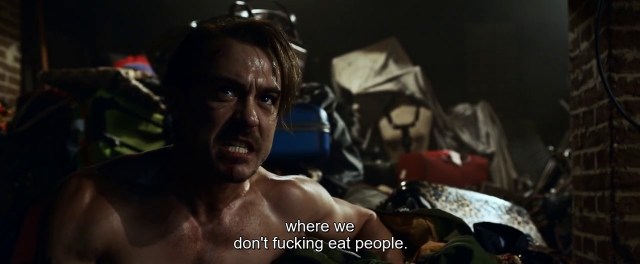
Cannibal Studies is usually concerned with the anthropological or metaphorical aspects of the act – exposing the outsider as uncivilised, or else dripping irony about our own rapacious appetites. This film manages to do both, as Rex rants about the Finnish family, and how he wants to be back in the good ol’ USA,

Which is ironic, because if you check the “Cannibal News” category on this blog, you will see that a goodly proportion of modern cases of cannibalism occur in the good ol’ USA (and none in Finland*). The USA is the apotheosis of consumer societies where, just like Alia’s brother,

The rest of the film concerns Rex’s attempts to escape – not easy when one leg is gone and one of the family members has just tried to saw off the second one. You’ll have to see it to find out how that goes. It’s well worth it. Film critic Rob Hunter sums it up nicely:

“It’s a serious tale of survival encased in blackly comic humor, maliciously creepy twins, and the most sweetly sensual stump-washing scene you’ve ever had the pleasure of witnessing.”

The movie premiered in Australia on October 8, 2020, and in the United States a day later at the Nightstream Film Festival. It has a 91% fresh on Rotten Tomatoes, with comments like “blissfully, absurdly over-the-top, but in a twistedly charming way”.

This is a blackly humorous horror-thriller, and is quite brilliantly executed by Alister Grierson, particularly as the hero, normally the action figure of such stories, is tied to the ceiling and missing a leg for most of the film. You might think that would slow down the pace, but director Grierson keeps it tearing along. I usually stop and start when reviewing a movie, but this one I gulped down in one sitting, then came back for details.

As for the lead actor, Ben O’Toole, he seems to have got a taste for the cannibal stories. He said in an interview that he’d like to play Titus Andronicus, who was William Shakespeare’s favourite cannibal.

Let’s not forget, too, how much cannibalistic symbolism is involved in sex, such as “I could eat you up” as well as various foodie words for cunnilingus and felatio. And of course the French (or Finnish) kiss, when Rex and Alia finally escape.

And just to prove other people like puns too, here is the last frame of the film.

* Actually, there is a case of Finnish cannibalism – Jarno Elg, a supposed Satanist, who was sentenced to life imprisonment in 1998 for murdering a 23-year-old man, eating some of the body parts and inciting some friends to participate in a ritual that included torturing the victim while listening to songs from The Cainian Chronicle album by the Norwegian black metal band Ancient. Elg was granted parole in 2014.

The movie is available at Amazon.