Cannibal influencer arrested in Brazil

If you by any chance have watched any of the videos of the influencer Israel dos Santos Assis, better known online as Pinguim (Penguin), you may not have guessed that anything controversial was being shown. The Brazilian, from São Francisco do Conde, a city in the metropolitan area of ​​Salvador in Bahiahad, had been gaining more and more followers on social media over the months before his arrest on July 23 2024, when he was apprehended after being caught desecrating graves in the cemetery of San Francisco the Count, in the Salvador Metropolitan Region, and stealing human bones.

Not just bones. The 22-year-old influencer used human flesh from the corpses to cook his most popular dish: feijoada, a bean stew usually involved simmering beans with beef or pork. Both of which have been reported as tasting very similar to human flesh.

One of Pinguim’s videos, which went viral on social media, explained the secrets of adding meat to beans — and how to get the most out of the final dish.

“Treat and throw it in the beans. But you can’t eat it, no, you just chew it and then throw it away. You don’t swallow it, you just chew it and throw it away, you just taste it, it’s sweet.”

The remains were not only for use in his recipes. After being arrested, Israel led the local police to a mangrove swamp where he had hidden numerous bags of bones. He had been sending these to Salvador, the state capital, to be used in satanic rituals.

The suspect was caught after families of buried people reported that graves had been violated and several bones had been stolen.

Pinguim made a video confession to police which was later released to the media. He reported that he had spent hours at the cemetery to see which graves were the most recent; those with the freshest human flesh. He told police he had fried a piece of a person’s leg and seasoned it with lemon and vinegar before chewing on it.

Local reports say he told police that he stole the body parts to order, in exchange for a payment equivalent to about $US50 from three people who wanted to use the bones as part of a black magic ceremony. He used the money to buy shoes and sandwiches, as well as getting his hair cut.

Surprisingly, Pinguim was released on bail pending an ongoing investigation into charges of desecrating a tomb. His lawyer, Luan Santos, told local media his client suffered from mental health issues and was taking anti-depressants. He added that he would be demanding psychiatric tests to ascertain whether the accused was fully aware of what he was doing.

Pinguim’s social media accounts have been deleted.

Brazil has always been a fascinating area for students of cannibalism. One of the most famous tribes was the Tupinamba, who captured a German soldier and explorer named Hans Staden in the sixteenth century. He claimed to have witnessed their cannibalistic rituals and did very nicely from his subsequent writings, illustrated by the graphic woodcuts of Theodor de Bry. As a result, the Portuguese came to save the ‘savages’ from their sins, and through enslavement, assimilation, extermination and the introduction of Smallpox, managed to wipe them out completely.

The classic cannibalism film How Tasty Was My Little Frenchman (Como Era Gostoso o Meu Francês) is set in this period of imperial invasion, and tries to give a new perspective on the way colonialism used cannibalism as its pretext.

More recently, modern Brazilians have been involved in some of the more interesting cannibalism stories that have graced our news cycles, including the “Cartel” who sold pastries made from human flesh to unwitting customers, and the Brazilian who was arrested in Lisbon for eating a man who had tried to help him. Like most cannibalism films, the ones set in Brazil vary between seeing it as something savages naturally do, such as Emanuelle and the Cannibals, and those that see it as typifying the exploitation of the poor by the rich, such as The Cannibal Club.

The Brazilian anthropologist Eduardo Viveiros de Castro proposed a ‘post-structural anthropology’ in his book Cannibal Metaphysics. De Castro sought to ‘decolonise’ anthropology by challenging the increasingly familiar view that it was ‘exoticist and primitivist from birth’, denying that cannibalism even existed, and so transferred the conquered peoples from the cannibalistic villains of the West into mere fictions of colonialism. This alternative view of Amerindian culture rejects the automatic assumption of the repugnance of cannibalism, which serves to either confront it or deny its existence. Accepting those parts of colonial culture that are useful (they speak Portuguese for example) can be seen as a form of reverse, cultural cannibalism.

But Pinguim demonstrates that even Brazilians have not fully embraced this philosophy, particularly when it involves digging up their relatives.

There is a video showing Pinguim confessing to cooking human bodies. More interesting if you speak Portuguese though.


IDAHO amends its anti-cannibalism bill – cannibalism news, March 2024

Idaho lawmakers have voted to expand a law that bans cannibalism because of fears about the popularity of human composting. Rep. Heather Scott introduced a bill in February 2024 to expand the state’s cannibalism ban and told a legislative committee that she’s worried about the possibility that people are eating other people.

Scott said:

“This is going to be normalized at some point, the way our society’s going and the direction we’re going.”

People are often surprised to hear that Idaho is the only state in the USA to have outlawed cannibalism. Other states have laws which target abuse or desecration of a corpse, making cannibalism legally impractical and problematic. Idaho introduced its law during the frenzy called the “Satanic Panic” last century.

The US is not unique in this – most countries do not have specific laws banning cannibalism. Germany didn’t, until Armin Meiwes ate his new social media friend.

The new bill, 522, adds to Idaho’s existing prohibition of cannibalism a ban on giving someone else “the flesh or blood of a human being” without that person’s “knowledge or consent.” Scott said she is “disturbed” by the practice of human composting, which is legal in several states as an option for disposing of the dead that is more sustainable than other burial methods and reduces a funeral’s carbon footprint. Human composting involves decomposing human remains like other organic matter and turning it into soil that can be returned to the family or used to make land more fertile. But Scott said outlawing composting would require overhauling rules for morticians, and so instead she focused on banning the act of deliberately giving human flesh to another person.

“I didn’t want to see that in my Home Depot stores.”

Scott said she was on a plane and watched a clip from a TV show displaying a chef feeding human flesh in sausage to contestants, which inspired her to take action. The clip, which she sent to the Idaho Statesman, is from a TruTV prank show, in which they pretend to feed people flesh. “They didn’t tell the people, they fed it to them,” Scott told the Statesman, though she noted it may have been a spoof.

Scott also submitted a link to a video featuring a Chinese official denying that his country had sold canned human flesh to people in Zambia. The canning claim was a hoax, spread with fake photos of butchery, according to news reports from 2016. Scott additionally pointed to a North Idaho man who pleaded guilty to murder last year and was initially also charged with cannibalism after investigators found postmortem mutilation and a bloodied bowl at the crime scene. The cannibalism charge was later dropped, meaning that the Idaho anti-cannibalism laws have still not been tried in court.

An editorial in the Idaho Statesman concluded:

But that’s where we are in Idaho: Unhinged, unreal legislators can bring forth just about any crazy idea and get a bill printed.

But imagining that humans might unwittingly eat other humans is not so far-fetched. Mythology is full of innocent cannibals—Agave eating her son Penteus, Thyestes eating his sons at his brother’s feast, Tereus eating Itys. Becoming “innocent” cannibals make us squirm, writes Donald Tuzin, because it denies us the escape of declaring the cannibal a maniac or monster—anyone can become a cannibal. In the movie The Farm, humans are treated as “living meat” exactly the way cattle are regarded on factory farms—the men are slaughtered for meat, the women bred and their infants pitilessly killed in front of the mother (as often happens in the dairy industry) so the farmers can sell the mothers’ milk. The final commodities are sold to innocent cannibals, who occasionally ring up, horrified to find residues such as a human tooth in their meat. Inverting the agricultural business plan, the “livestock” are human, while the farmers are dressed in animal masks.

But it doesn’t only happen in fiction. The Farm may be based on the Canadian pig farmer and serial killer Robert Pickton who confessed to 49 murders in the 1990s, and allegedly “processed” the meat of his rape and murder victims by feeding them to his pigs and, police said, possibly mixing them up with the pork products he sold to neighbours.

Joe Metheny claimed to have killed 13 people in the Baltimore area in the 1990s and turned them into burgers. He reported:

“Over the next couple weeks on the weekends I opened up a little open-pit beef stand. I had real roast beef and pork sandwiches and why not they were very good. The human body tastes very similar to pork. If you mix it together no one can tell the difference.”

In 2007, two men in England were arrested for the murder of a 14-year-old girl, with the prosecution claiming that her body had been cut up and minced into kebabs in a Blackpool takeaway called “Funny Boys”.

On April 9, 2012, police in Garanhuns, Brazil, arrested for murder Jorge Beltrao Negromonte da Silveira, his wife, Isabel Pires, and his mistress, Bruna Cristina Oliveira, who all lived together in a group they called “The Cartel”.

Residing with the Cartel was a small child named Vitória, who had been the daughter of their first victim. The child’s mother was a seventeen-year-old homeless woman whom the Cartel had invited into their home in Olinda in May 2008. She had been murdered by the Cartel, who then dismembered and skinned her body, storing the meat in their refrigerator before seasoning it with salt and cumin, grilling and eating it. The woman’s daughter was fed some of her mother’s flesh.

The worldwide public interest in the crimes did not stem from their murder of three young mothers, but from the fact that the Cartel had baked the victims’ flesh into salgados, salty, deep-fried pastries, which they then sold to the unsuspecting public. To the disappointment of the media, the pictures of the perpetrators showed them as three ordinary Brazilians, not the monsters the public had expected.

Back to Idaho, where Rep Heather Scott’s bill 522 sailed through the House and is heading to the Senate. She quoted in support of her bill from a recent article in The New Scientist which reviewed the human history of cannibalism (they concluded that it happened a lot) and stated:

“Ethically, cannibalism poses fewer issues than you might imagine. If a body can be bequeathed with consent to medical science, why can’t it be left to feed the hungry? Our aversion has been explained in various ways. Perhaps it is down to the fact that, in Western religious traditions, bodies are seen as the seat of the soul and have a whiff of the sacred. Or maybe it is culturally ingrained, with roots in early modern colonialism, when racist stereotypes of the cannibal were concocted to justify subjugation.”

We don’t have to buy mulch to end up cannibals. Any sausage or burger might have human flesh in it, and no one would know the difference. We are animals, large mammals, made of red meat like cows, pigs and sheep. Unless you think we have some sort of supernatural dissimilarity from other animals, the thin red line between different species can only be identified as a cultural construct.

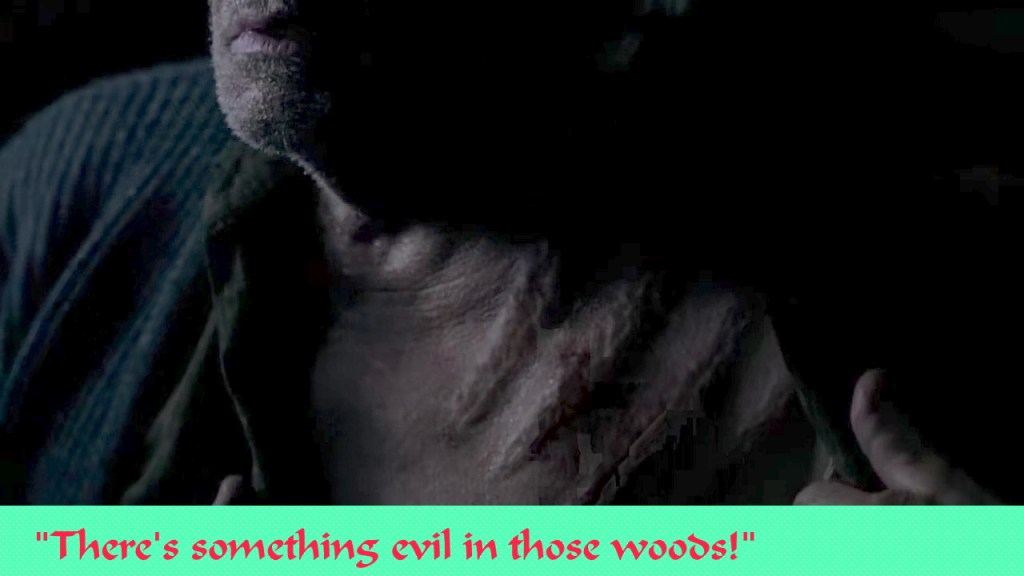
“There’s something evil in those woods”: SUPERNATURAL Season 1, Episode 2 “Wendigo”

Supernatural is a TV series created by Eric Kripke, first broadcast in 2005. Fifteen seasons later, the final episode (there were 327 in total) aired on November 19, 2020. You could call that a successful series.

The plots follow two brothers, Sam (Jared Padalecki) and Dean (Jensen Ackles) Winchester, who hunt demons, ghosts, monsters, and other supernatural beings. The first two episodes were directed by David Nutter, who later won an Emmy for Game of Thrones.

Sam and Dean’s origin story in the pilot episode shows an idyllic home with a loving mother, doting father, and a demon who drips blood into baby Sam’s mouth, then ties their mom to the ceiling where she bursts into flames. Well, you can’t blame them for being a bit down on supernatural entities.

Dean’s metaphysical mission statement is:

“Killing as many evil sons of bitches as I possibly can.”

In episode 2, the boys come across a Wendigo, normally explained as a human transformed into a monster by the act of cannibalism. They find a love interest in a girl who is looking for her brother, one of a group of campers recently snatched by said Wendigo while playing computer games with friends in their tent in the deep woods (as you do) and reading Joseph Campbell’s book about the hero’s journey

Turns out the Wendigo eats a sounder of people every 23 years, and they find a man who, as a child, was attacked by the monster in 1959 but survived, with massive scars. He tells them:

Well, they finally get around to reading their Dad’s journal – he has a slim leather volume of handwritten notes on every evil thing you could need to know about. They explain the Wendigo to the other campers.

Cultures all over the world believe that eating human flesh gives a person certain abilities: speed, strength, immortality. You eat enough of it, over years you become this less-than-human thing. You’re always hungry.”

You can’t kill a Wendigo with bullets or knives.

Dean attempts to draw the Wendigo away from the others, with the hilarious taunt:

“You want some white meat, bitch?”

The Wendigo is a figure from Algonquin folklore, a spirit who possesses his human victim, giving him an insatiable hunger for human flesh, but the flesh makes him grow larger, and so his appetite can never be satisfied, thus the emaciated form.

The Wendigo is said to have a heart, or whole body, made of ice. The creation of the Wendigo, like Nietzsche’s Übermensch, is a “becoming” which requires the destruction or transformation of lesser beings, just as humans like to believe that the processing of “lower” animals into meat is required for their continued existence. In the television series Hannibal, Lecter is often shown as a dark figure with antlers, a Wendigo, who manifests and wreaks carnage (e.g. the episode “Hassun”).

Margaret Atwood in her lecture on the Wendigo pointed out that, unlike most monsters, the Wendigo offers two different terrors – being eaten by it, but also transforming into it. While all cannibals threaten us with physical dissolution through their digestive tracts, a simple bite from the Wendigo, or being possessed by its spirit during the act of eating human flesh (even if the act is necessary to survive) can destroy one’s will and endanger the whole tribe.

To the First Nations people, the Wendigo represented winter, hunger or selfishness and, particularly in subsistence communities, there is a direct causal link between those things – winter means shortages, which lead to hunger and struggles for resources, and sometimes cannibalism. In times of starvation, we are capable of anything. Cannibalism stories were not uncommon on the American Frontier, and popular culture has often told tales of white-man cannibalism using the Donner Party, Alferd Packer and the Wendigo, sometimes all mixed together, as in Antonia Bird’s Ravenous.

But when the Europeans came with their ships and guns and viruses, those they dispossessed, enslaved, raped, tortured and massacred came to the obvious conclusion that the white man must be possessed by a Wendigo spirit. This Wendigo spirit of ruthless and voracious consumption may be less blatant in the twenty-first century, but is still evident in the exploitation of sweat-shop workers, in human trafficking, and in the intensive factory farming that turns sentient animals into commodities by the billions. Also in the covert sexism and racism in shows like this, that depict “cis-het” white men taking on the world of evil and saving civilisation from the outsiders and aliens that haunt our dreams.

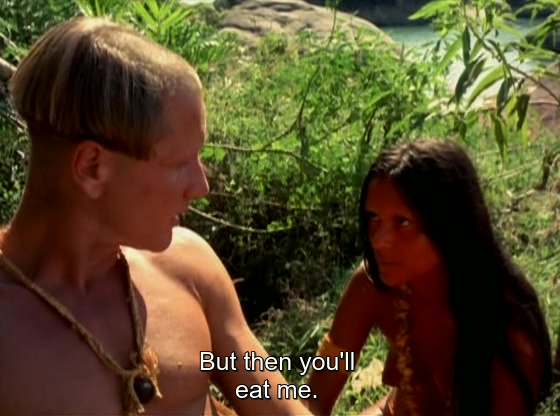
Eat the imperialists: HOW TASTY WAS MY LITTLE FRENCHMAN (Como Era Gostoso o Meu Francês) – Nelson Pereira dos Santos, 1971

Let’s get this out of the way – there is nudity. Lots of it and throughout the movie. Well, it’s set in pre-colonial Brazil, and the Indigenous peoples did not bother with a lot of clothes, so it’s historically accurate. To ensure authenticity, the actors and the crew were all naked, so that nudity would become natural. If that bothers you, please read the blog but skip the movie.

While it was refreshingly authentic, the nudity was also a problem. First, because the authenticity is somewhat diminished, as The New York Times critic pointed out, by the fact that the natives are “middle-class white Brazilians… stripped down and reddened up for the occasion”. Secondly, the film was refused entry to the Cannes Film Festival because of all the swinging dicks. In Brazil, the censors were eventually persuaded that the natives indeed did walk around naked, but remained vehemently opposed to the nude Frenchman, a telling comment on the racist distinction that the film was intending to expose.

So, the plot in a nutshell: the French and the Portuguese are fighting to control the rich lands of South America. Each has allied with local tribes who are at constant war with each other, often involving (so the European narrative goes) capturing and eating each other’s warriors.  The Tupinambás are allied with the French, while the Tupiniquins are allied with the Portuguese. The Frenchman of the title escapes his own command, is captured by the Portuguese, and is then captured by the Tupinambás, who are allies of the French, but believe him to be Portuguese, so intend to eat him. Got all that? – there will be a test.

Tupi custom involved bringing the captive into the community, feeding and homing him, and even finding him a wife, then eventually killing him in a ceremony that will allow them to capture his essence, bravery, speed, and so on.

This wide-spread belief about the Tupi comes from a European who was captured but then escaped in 1554, came back to Europe and wrote a book. His name was Hans Staden, and he was actually a German who was trying to get to India. But since it was the French who were invading South America at the time, the director changed his nationality.

De Bry’s engravings of Tupi cannibalism were “eaten up” by the Europeans.

Tupi cannibalism has a whole literature explaining it or denying it – William Arens claimed the ‘evidence’ was mostly based on Staden’s account, which contained several contradictions, and had been continually retold as if it had happened to new re-tellers. Other anthropologists such as Rene Girard explained Tupi cannibalism as a seamless explanation for the way culture and religion have evolved. The universal violence of the human species is redirected toward the outsider, who is taken into the tribe, but remains foreign enough to be killed as a scapegoat, to release the social pressure that would lead to endless internal revenge feuds. For many, Jesus became the ultimate scapegoat under this theory, even to the extent of insisting that his followers eat and drink wine and bread transubstantiated into his “blood and body” in the Eucharist ritual.

For my flesh is meat indeed, and my blood is drink indeed.

John 6:55

The Brazilian anthropologist Eduardo Viveiros de Castro proposed a ‘post-structural anthropology’ in his book Cannibal Metaphysics. De Castro sought to ‘decolonise’ anthropology by challenging the increasingly familiar view that it was ‘exoticist and primitivist from birth’, denying that cannibalism even existed, and so transferred the conquered peoples from the cannibalistic villains of the West into mere fictions of colonialism. Arguing that the ‘Other’ is just like us is to deny any separate identity and to return the focus of anthropology to that which interests us: ourselves. Rather than deny the existence of cannibalism, which allows a reclassification of the Amerindian peoples as like the colonialists, de Castro examines the details of Tupinamba cannibalism, which was ‘a very elaborate system for the capture, execution, and ceremonial consumption of their enemies’. This alternative view of Amerindian culture rejects the automatic assumption of the repugnance of cannibalism, which serves to either confront it or deny its existence.

Well, that’s pretty much where this film planned to go. Pereira dos Santos challenges the Eurocentric perspective which insists on a superior civilisation overcoming a primitive one. It is true that Tupi civilisation was destroyed by the slavery, smallpox and slaughter of the Portuguese who, the film tells us at the end, also wiped out their allies the Tupiniquins. The Tupi peoples are now a remnant, confined to small areas and currently being decimated by COVID-19.

But the chief, in the killing ceremony which promises the Frenchman’s body parts to his relatives (his wife will get his neck), tells the story as a mirror image:

“I am here to kill you. Because your people have killed many of ours, and eaten them.”

So the film asks: who were/are the cannibals? It does not fully succeed in telling this story, because the audience gets involved with the Frenchman’s story, instead of his captors. Pereira dos Santos lamented that the public:

“…identified with the French, with the coloniser. All spectators lamented the death of the hero. They did not understand that the hero was the indigenous, not the white, so much were they influenced by the adventures of John Wayne.”

Nonetheless, the binary of the colonised and the powerless occupied victims is so deeply embedded in our cultural stories that it is refreshing to see this mirror image version, where the indigenous win the battle, if not the war.

From the sublime to the ridiculous: LOVE BOAT Season 3 episode 13 (Duchowny & Rafkin, 1979)

Crew.jpg

Tom Paine said it is only a small step from the sublime to the ridiculous, so it seems fitting to move from last week’s blog, HANNIBAL, one of the most concise studies of the cannibal psychosis of postmodern society, to a glimpse of the bourgeoisie at play, or at least their aspirations of what that might look like. I refer, of course, to LOVE BOAT, a series that ran for an absurdly long nine years and 250 episodes. Aaron Spelling was the producer – he also made Charlie’s Angels, Dynasty, Beverley Hills 90210, Charmed and a string of other shows, which always seemed to capture the zeitgeist of the time.

Aaron_Spelling_TWA_ad_photo.JPG

Why are we watching Love Boat you ask (or wail, while pathetically covering your ears)? Well, there is an interesting cannibal reference in episode 13 of season 3, which went to air on November 24, 1979. The episode has the catchy title of “Not Now, I’m Dying / Eleanor’s Return / Too Young to Love” – there were always a few threads going on at the same time.

Warning: the following theme song is a mind worm and will be running through your head relentlessly during your worst hangovers.

Anyway, getting to the point. One of the main characters on the ship is the Doc (Dr Adam Bricker) played by Bernie Kopell, who also played the KAOS agent Siegfried in Get Smart. On this particular cruise, Lucy, a friend of Doc’s (Barbi Benton), comes on board with her boyfriend Peter (Dack Rambo). She wants a romantic conclusion, a proposal, but Peter keeps on making excuses.

DR05c.jpg

Eventually, Peter “admits” to having a terminal illness, saying he has Kuru, a disease he spotted on the front of a magazine. Doc calls his bluff, pointing out that Kuru is only contracted by “eating people”. But then Peter drops a pen, can’t hold a book, and Doc realises that he really does have a disease – ALS (Lou Gehrig’s Disease). A sad irony in that Dack Rambo was to die of complications from AIDS only five years after this episode went to air. Barbi Benton, who started off as a Playboy model, is still going strong, as is Bernie Kopell at the time of writing.

dackloveboatpic.jpg

This is interesting not so much for the longevity of the stars but the mention of Kuru. This is a prion disease, a rare, incurable neurodegenerative disorder that was found in the Fore people of Papua New Guinea. Kuru is a form of transmissible spongiform encephalopathy, related to the “mad cow” disease that cured people from eating beef for many years and is still tested for when you go to donate blood.

Kuru was first suspected to be related to funerary cannibalism (eating your relatives rather than burying them, to return their life force to the village) after extensive studies by the Australian anthropologist Shirley Lindenbaum starting in 1961. Kuru was found to be eight to nine times more prevalent in women and children than in men. Fore men reported that they considered that consuming human flesh would weaken them in times of conflict or battle, while the women and children were allowed to eat the bodies of the deceased, including the brain, where the prion particles were particularly concentrated. Daniel Carleton Gajdusek, a virologist, was later awarded a Nobel prize for mapping the transmission of the disease to chimpanzees by transferring into them parts of the brain of an 11-year-old Fore girl who had died of Kuru.

FavorableGregariousCowbird-size_restricted
From a 2010 documentary of Kuru

Kuru is rare and hard to catch (even the Fore people have a high rate of immunity to the disease). It is, however, very popular among people who write about cannibalism on social media, as they think it proves that human cannibalism is a ‘bad thing’ because it can make you ill (although they don’t mention the bovine version, in case that ruins their dinner). The Nobel prize was the cherry on top of the brain tissue theory of cannibalism.

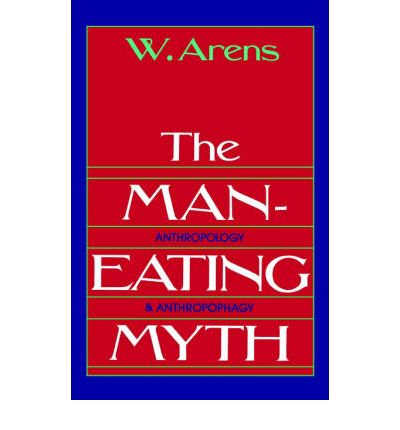
In 1979, the same year this episode of Love Boat was aired, an American anthropologist, William Arens of Stony Brook University, New York, published his book The Man-Eating Myth, in which he challenged the automatic assumption of cannibalism among those dubbed “savages” by the colonial powers of the West. In fact, Arens caused a major uproar in anthropological circles by saying he could find no adequate documentation of cannibalism as custom in any form for any society – it may have happened, but not as a socially sanctioned system. He was more interested in why people are so fascinated by the depiction or suspicion of it (and so am I, hence this blog). As for the Fore, Arens said “the evidence is circumstantial, since Fore cannibalism has never been observed by an outsider”.

Arens.jpg

So, did the Fore get Kuru by eating their dead? We’ll never know for sure, but we can be confident, with Doc, that Peter didn’t.

NEXT WEEK: HANNIBAL Season 1 Episode 2

If you like my blog, please feel free to recommend it (with discretion) to friends on social media.
If you have any questions or comments, you can use the tag, or email me on cannibalstudies@gmail.com.

The first cannibal film was made in Australia? “The Devil’s Playground” (Bindley, 1928)

We tend to think of ‘cannibal films’ as starting with the Italians: Ruggero Deodato’s Ultimo Mondo Cannibale (1977) or, before that, Umberto Lenzi’s Man From Deep River (Italian title Il Paese Del Sesso Selvaggio, 1972). These followed a formula in which civilised Europeans blundered into savage lands (Lenzi’s film was set in Thailand) and are captured by cannibals, tortured, witness terrible atrocities and then escape.

Chief2
Chief Trelua, cannibal king, actually a Sydney lifeguard

But cannibals have appeared in movies well before the Italians invented their special exploitation genre. Tarzan films from the early twentieth century showed the lost British Lord living with apes but killing cannibals – they were prima facie cannibals, because they were savages. But they were background noise, they were the predators in the jungle, assumed to be cannibals by trade, but not usually caught in the act (and, in the books, Tarzan’s British aristocratic breeding stops him tasting human flesh, for reasons he can’t quite understand).

Image result for tarzan johnny weissmuller
Johnny Weismuller as Tarzan the podiatrist

One of the very first film to show savages as cannibals, before Johnny Weissmüller hit the vines, was actually an Australian film called The Devil’s Playground, written and directed by Victor A. Bindley.

This is the opening card (it’s a silent movie):

Far off the beaten track, in the South Seas, lies a beautiful island – a jewel of the sea. Its waters, abounding in the low grade island pearl shellfish, have brought a few white traders to its shores. The sinister reputation borne by its native population in fetish and cannibal rites, in the past, and the wild doings of some of its present white population, has earned for the island the name of:

“THE DEVIL’S PLAYGROUND”

 Not to be confused with Fred Schepisi’s 1976 film of the same name, which revolved about quite different appetites.

Bindley’s silent movie was made with a budget of £2,000, not a fortune even in 1926, when production commenced. This required a certain financial prudence: according to Australian Film 1900–1977, scenes were shot on beaches near Sydney (Bilgola) and interiors in the Mosman Town Hall. Natives were played by Sydney lifeguards in black-face!

Painted savages

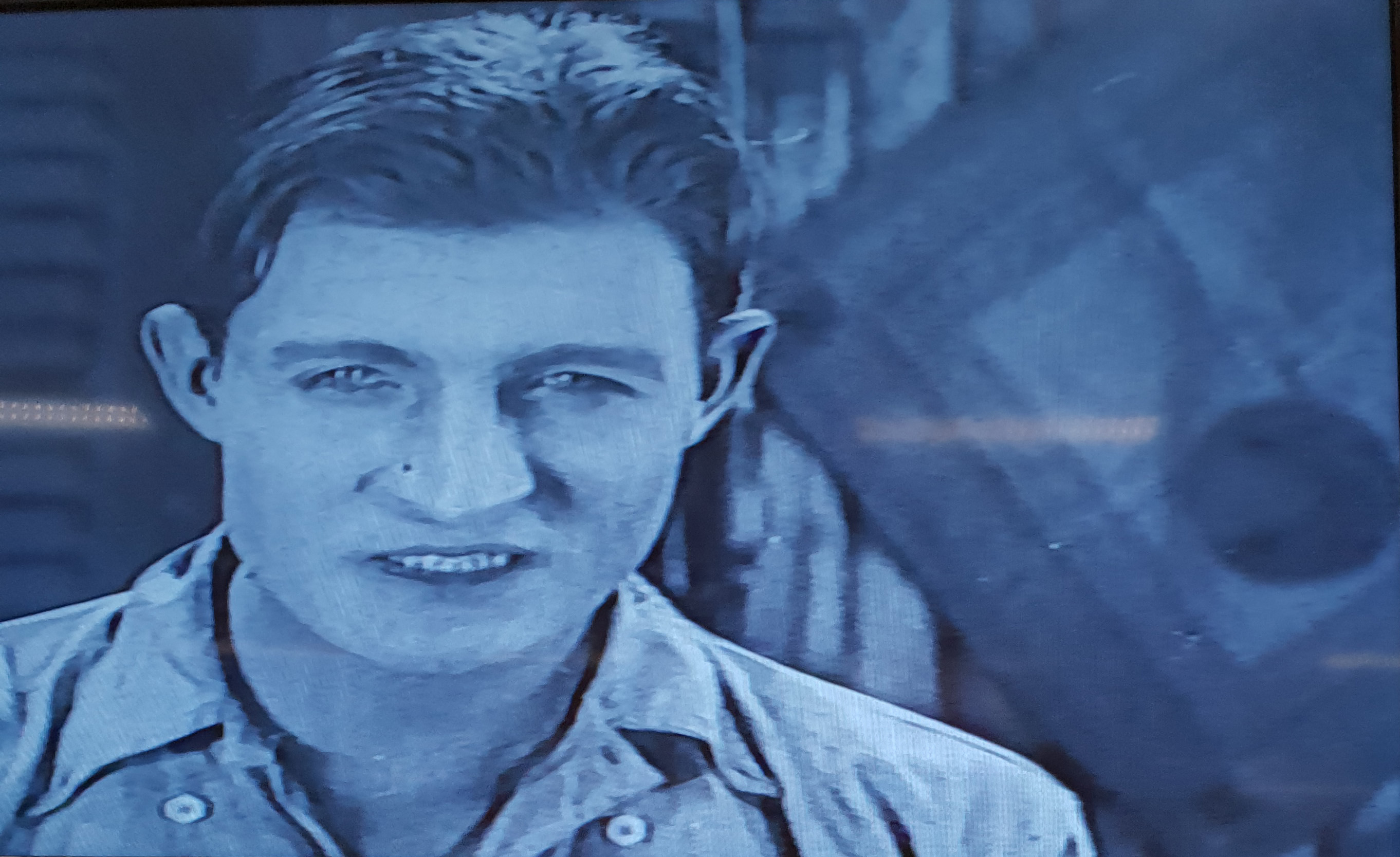
The villain, however, is a corrupt white man named Bull Morgan who exploits the natives and forces the heroine, Naneena, to marry him, after murdering her brother. Fun fact: Naneena is played by Elsa Jacoby, later a prominent Sydney socialite, philanthropist and opera singer. Meanwhile, the locals are not content to put up with colonialist discourses:

Trelua seeks counsel of the wise man, Malatai!

“Malatai! Our warriors grow fat and lazy under the white-man’s rule, and our men-children are weaklings!

“Our spears would but splinter against the might of the whitemen, for they are as many as the white sands of the sea! Their great men are wise! Let Trelua seek justice in their councils!”

“Your puny words cannot hold me for long, O Malatai! Better to die fighting like men, than like women upon our sleeping mats!”

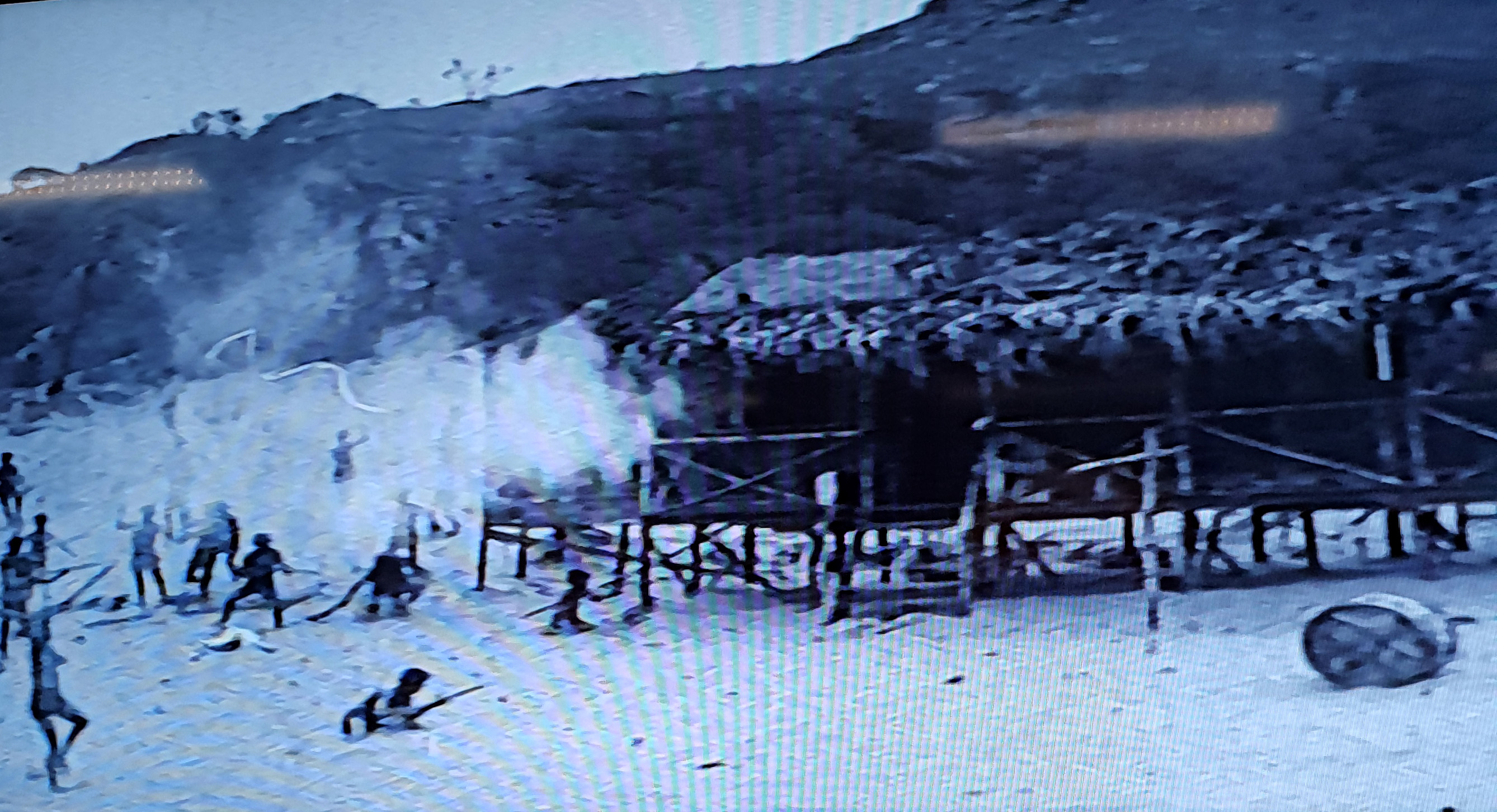
The natives rise up, but not to rescue Naneena – they are cannibals and cannot be seen to do too much good. She is rescued by an airman, who calls in a British cruiser to quell the native revolt although, before the cannons roar, the cannibal chief kills Bull, proving that no one is all bad.

Attacking the grog shop
The cannibals attack the grog shop!

Hero
The noble hero

The Sydney Morning Herald of 8 February 1930 reported that the film had been banned from export (another first for the director) under the censorship regulations which included blasphemy, indecency, or obscenity, being injurious to morality, or likely to be offensive to the people of the British Empire. It may be that the violence of Bull whipping poor Naneena was a bit over the top for the censors (although she gave him back as good or better than she got), or that the British navy blasting natives with cannons was “offensive to the people of the British Empire”.

Navy
The navy arrives to put down the cannibal mutiny

Bull-whip
Bull whips Naneena!

Bull whipped
Naneena whips Bull!

But the most likely reason for the ban is that showing the corruption of the white traders, who were widely known to be exploiting and corrupting the indigenous inhabitants of the islands, was a bridge too far. Like most cannibal films, it raises the question: who is eating whom?

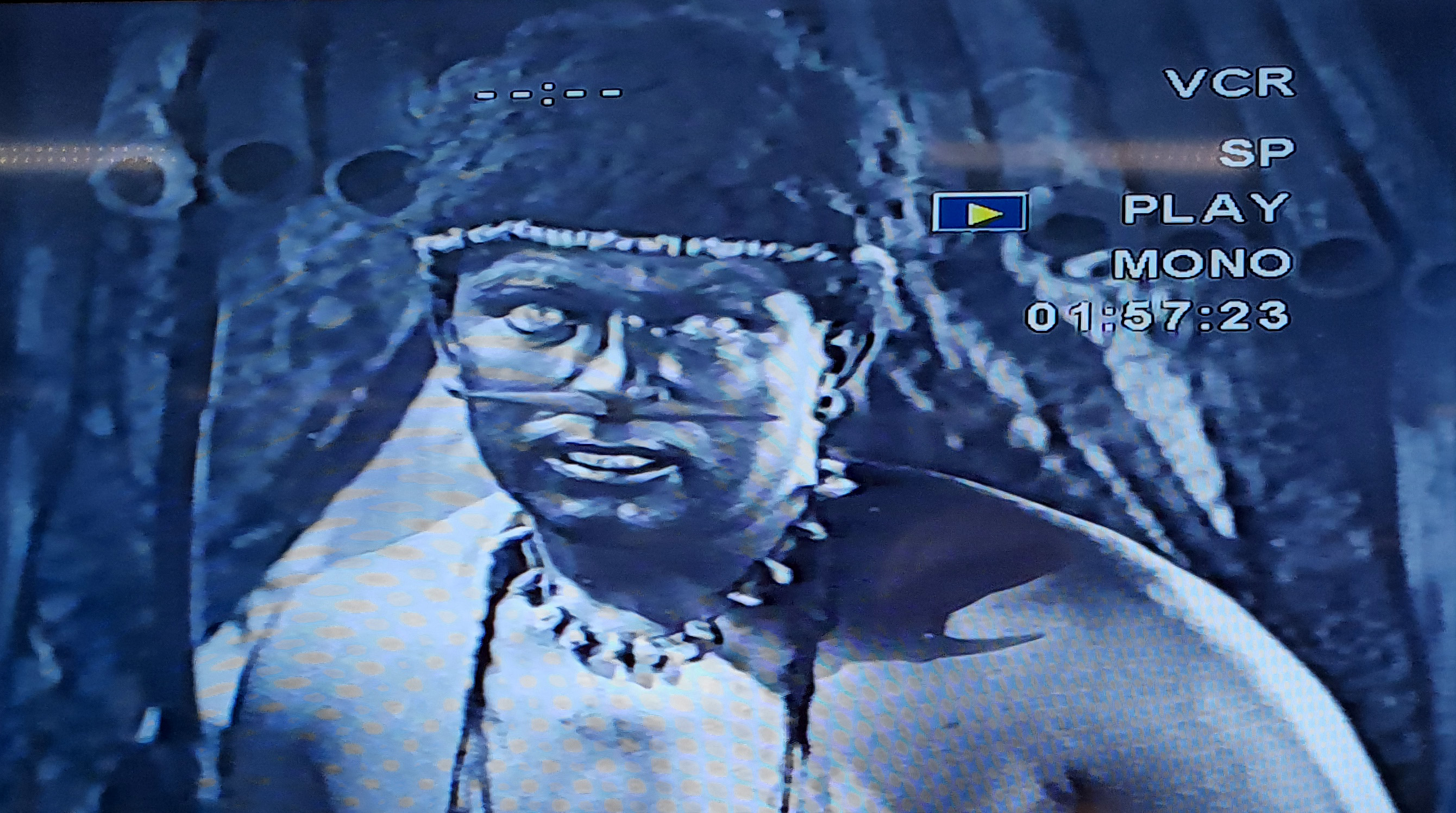
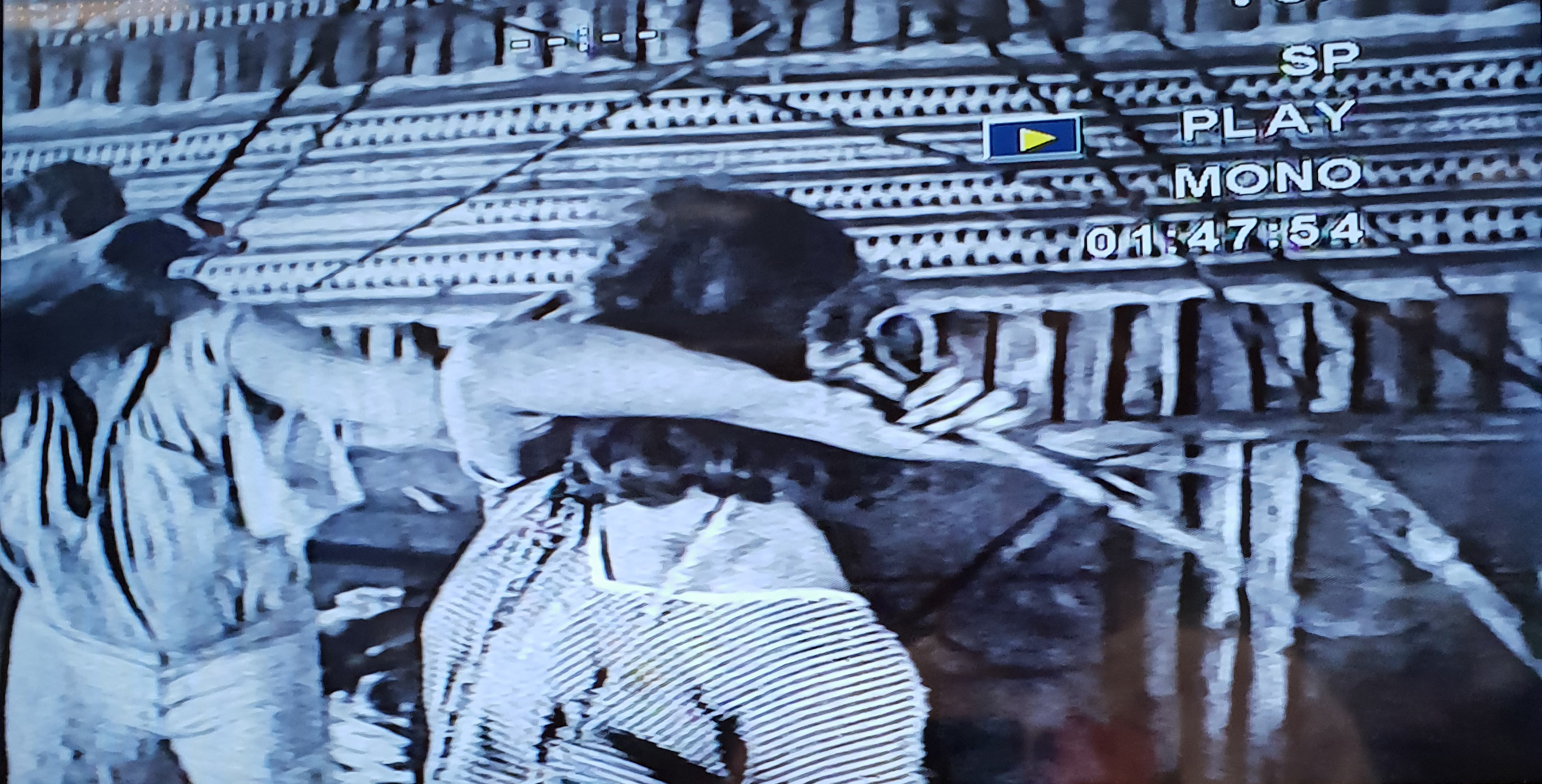
At any rate, the film was shelved and did not have a public screening until 1966, by which time it was just a historical oddity. It is available in the NSW State Library on VCR, which led me to spend an excruciating two hours there recently. It’s not much of a cannibal film, really, but then it’s not much of a film. Pretty exciting, for a cannibal film blog, to find a very early specimen, especially when it’s home-grown!

Incidentally, the Oxford Apartments in Milwaukee where Jeffrey Dahmer killed and ate most of the boys and young men who took his fancy in the 1980s was torn down after his arrest and a playground built, but the locals refused to use it, calling it – you guessed it – the devil’s playground”.

If you like my blog, please feel free to recommend it (with discretion) to friends on social media.
If you have any questions or comments, you can use the tag, or email me  on cannibalstudies@gmail.com.

NOT a cannibal movie: “Black Panther” (Coogler, 2018)

https_blogs-images.forbes.comscottmendelsonfiles201802au_rich_hero_blackpanther_1_3c317c85-1200x526

Western culture, and cinema is no exception, has shamelessly used cannibalism as an unexamined accusation against “others” – mainly the black and brown people of lands coveted by imperial powers: Africa, the Pacific, South America and others. The Greeks used it to dehumanise any barbarians who happened to become bothersome, and of course Columbus made some very nice profits when he “discovered” that the Caribs, a tribe he hadn’t met, were man-eaters and needed to be converted, enslaved or exterminated (and the Spanish then did all three, very successfully, to most of South America).

Very early cannibal movies showed stereotyped cannibals, bones in their noses, dancing around a cauldron containing a sorry looking white man, often a man of God.

Lupino Lane Be My King 1928
This is from a 1928 film called Be My King (Lupino Lane)

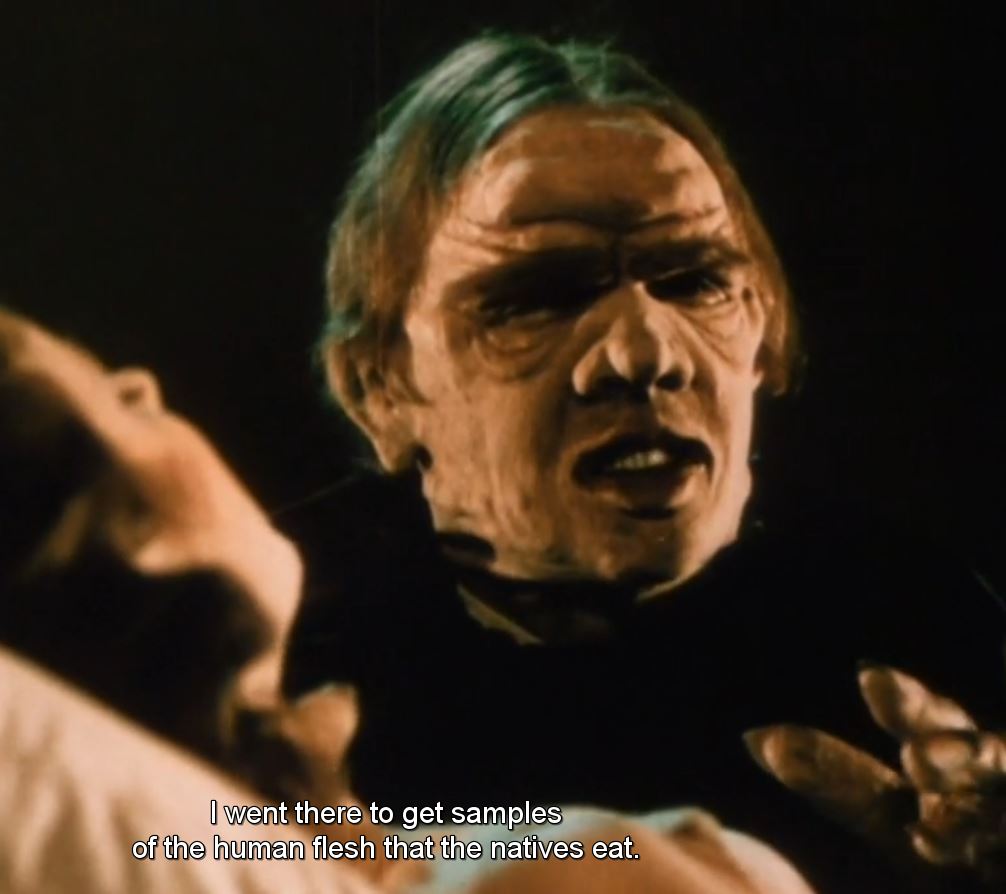
Doctor X (Curtiz, 1932) saw the villain going to Africa to learn the secrets of the cannibals.

Dr X 1932

Even Bing Crosby and Bob Hope headed off to the “Dark Continent” and almost got eaten.

Road to Zanzibar 1941
Road to Zanzibar (Schertzinger, 1941)

The cannibals’ nationality changed, but the victim, the civilised white man (or sometimes even woman) stayed pretty pale, just being in the wrong (savage) place at the wrong (then) time. Think of Robinson Crusoe (Bunuel 1954)

Cannibal feast Robinson Crusoe 1954
The after-party from Robinson Crusoe (Bunuel, 1954)

Robinson Crusoe is one of the classic stories of the savage being tamed by the civilised white man. Crusoe has been shipwrecked on an island. Friday is a cannibal whom Crusoe saves from a rival tribe as he is about to become lunch. Friday is taught to serve the master, and has to promise never again to eat humans.
The civilised Crusoe, incidentally, is described as having been shipwrecked on his way to the area to capture slaves.

Think of the “Cannibal Boom” of the 1970s:

Man from deep river 1972
Man from Deep River (Lenzi, 1972)

The cannibal story likes to pretend that civilisation has eliminated such savagery, but it still fascinates and repels us at the same time. In 2013, the “savages” were at it again in Eli Roth’s Green Inferno (this time white people, just trying to save the jungle, being eaten by crazy Peruvian cannibals).

So this is the image of the intersection of empire and indigenous culture: civilisation and savagism. Uncivilised cannibals are shown as inexplicable antagonists, as amoral as sharks or predatory aliens. Their cannibalism is usually seen as acculturated and therefore distinguishes those cultures as uncivilised and morally inferior to the white (usually male) hero’s culture.

That’s why I was interested to see the take on cannibalism in Black Panther, which is set in the mythical African kingdom of Wakanda, but involves a lot of cultural interchange with an increasingly violent America. Everett Ross (Martin Freeman), a U.S. State Department employee stationed in Wakanda, becomes an ally to T’Challa (Chadwick Boseman), the King of Wakanda. When Ross attempts to speak to the leader of the Jabari tribe — M’Baku (Winston Duke) — he’s told:

“One more word, and I will feed you to my children.”

There it is. There’s the colonialist trope. And here is how Black Panther handles it:

“I am kidding – we are vegetarians.”

So, not a cannibal movie, but a worthwhile flipping of the tired imperialist stereotypes.
It sneaks into this blog because of the cool cannibal joke.

And they’re not really vegetarians, because they are wearing furs and catching fish. Sigh.

Good movie though.
IF YOU LIKE MY BLOG, PLEASE FEEL FREE TO RECOMMEND IT (WITH DISCRETION) TO FRIENDS ON SOCIAL MEDIA.
IF YOU HAVE ANY QUESTIONS OR COMMENTS, YOU CAN USE THE TAG, OR EMAIL ME  ON CANNIBALSTUDIES@GMAIL.COM.