WINNIE-THE-POOH: BLOOD AND HONEY (Rhys Frake-Waterfield, 2023)

Winnie-the-Pooh is a much-loved (but sometimes intensely disliked) fictional bear who evolved from the childhood stories told to his son (Christopher Robin) by A. A. Milne, the author of a series of books first published almost a century ago. The original Pooh was an actual toy bear bought in Harrods in 1921. Other toys belonging to the little boy, Piglet, Eeyore, Kanga, Roo, and Tigger, were incorporated into Milne’s stories as friends of Pooh, who was presented as “a bear of very little brain”. Pooh and his friends lived in the 100 Acre Wood, where they got into all sorts of scrapes.

The anthropomorphic bear, his name now without hyphens, was licensed by the Disney company in 1961 for a very successful series of features that became one of their most popular franchises. I loved the books as a child, and hated what the cartoons had done to him, but maybe that’s just me.

Anyway, Milne’s U.S. copyright in Winnie-the-Pooh expired at the end of 2021, 95 years since publication of the first story. The character therefore entered the public domain in the United States, with Disney no longer holding exclusive rights. Independent filmmaker Rhys Frake-Wakefield seized on this opportunity to create a horror film titled Winnie-the-Pooh: Blood and Honey.

The premise, told through a cartoon opening, is that Winnie and Piglet feel betrayed and abandoned by Christopher, who has grown up and moved on to big-boy things like college and sex. (For a wonderful discussion of the difference between being “lost” and being “abandoned”, I recommend Hayley Singer’s new book, Abandon Every Hope). They have gone feral.

During a particularly cold winter, they are starving, and decide to kill and eat their old friend Eeyore the donkey, which drives them to detest humanity. They make a pact:

“they renounced their humanity and returned to their animalistic roots, swearing never to talk again.”

When Christopher comes to the 100 Acre Woods with his fiancée Mary five years later, he looks for his old friends, telling her “It’s going to be OK, alright, I promise.” Only of course it isn’t.  Pooh and Piglet kill her and capture him, and chain him up in their old house, where he can see his (late) fiancée hanging defleshed (eaten?) from a meat-hook, while Pooh flogs him with the late Eeyore’s tail.

Pooh and Piglet then proceed to hunt and kill a group of women students who have come to a holiday house in the woods to help one of them recover from a stalking incident (clever poetic irony) and then Pooh kills some men who try to help them. There is a lot of extreme violence involved including strangling, crushing with cars, mauling (by piglet of all people), insertion into a wood-chipper, and bludgeoning with a sledge-hammer.

At this point, I need to come clean and admit that I am having trouble classifying this as a cannibal film. Lots of people get killed (it’s definitely a slasher), and toys eat another toy at the beginning, which is a sort of cannibalism (but only in the way that Woodstock from Peanuts is a cannibal for eating turkey on Thanksgiving). I don’t know that toys are a discrete “species”, but if not then even a real pig and bear eating a donkey is nowhere near cannibalism. But the introduction says they “renounced their humanity”, so I’m taking that as a licence to include this in a cannibalism blog; they were anthropomorphically human when they ate the human donkey, right? Hey, even Princess Fiona from Shrek wasn’t really human (she was a secret ogre) but we wrote up her exploits, eating brave knights who came to save her. So we have some fun ontological challenges like “what is cannibalism?” what is “eating?” and “what is human?” Apparently they believe that not talking is the way to renounce humanity, which both bolsters anthropocentric arguments about human superiority (we are often described as the only species with a language, to the annoyance of the whales), but also raises some interesting questions for the voiceless, or those who choose not to talk. Does a vow of silence mean a renunciation of humanity? A question for another time and, hopefully, a different blog.

But from a Cannibal Studies point of view, there are some other interesting ideas in the back-story. It starts with starvation cannibalism (if we allow that name) in that, like survivors of plane crashes, shipwrecks, or ill-considered trips across the Sierra Nevada, Pooh and Piglet are driven to eat their friend Eeyore through extreme deprivation. But then we move to a new motivation – social degeneration, where the formerly very civilised, polite toys become psychotic murderers, much like the feral humans in Texas Chain Saw Massacre, The Hills Have Eyes or Death Line. Look, we don’t really see them eat humans, although we see a skull and jars of blood, and hear reports of mutilated bodies being found in the woods, so there is a certain implication. But they are not human, so that’s OK. They’re not even officially animate, although you wouldn’t say that if they were swinging a sledge-hammer toward your head. And just when did they learn to drive cars?
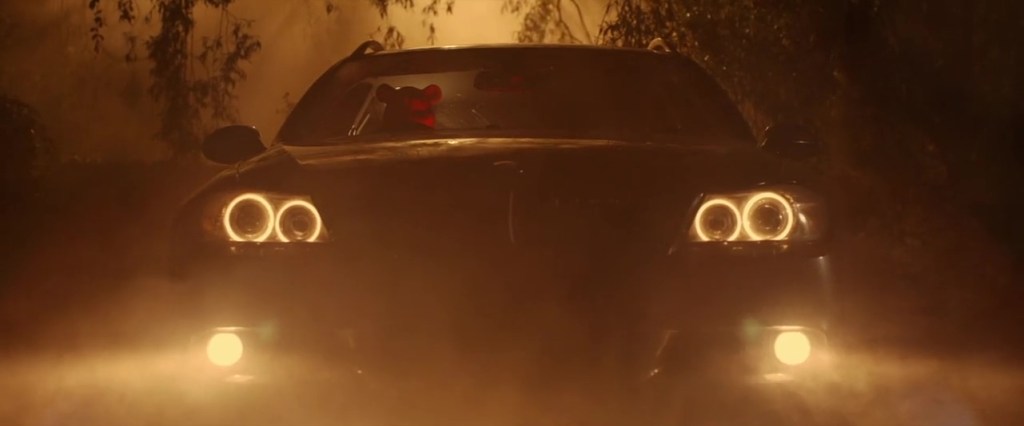
The film has had almost universally awful reviews, collecting a woeful 4% “fresh” on Rotten Tomatoes, with The Times critic saying:

“Rhys Frake-Waterfield cloddishly desecrates your childhood, and AA Milne’s beloved classic, with a dimly written, shoddily realised, sub-standard slasher whose artistic aspirations never reach beyond making a fast buck.”

The Guardian was even less impressed, describing the film as:

“…a terrifying combination of not-scary and not-funny, and a cast of Love Island types on Xanax apparently reading the dialogue off an optician’s chart held up behind the camera.”

Look, it’s not that bad – the woods look nice but also somewhat ominous, and while some of the acting is wooden, they all have great death scenes, and the violence is enough to attract any gorehound. Anyway, the film was a big success on its release in January (in Mexico) and February (US, UK). As of 23 February 2023, Winnie-The-Pooh: Blood and Honey had grossed $1.8 million in the United States and Canada, and $2.4 million in other territories, including over $1 million in Mexico, for a worldwide total of $4.2 million. The budget was apparently less than $100,000, making it proportionally one of the most profitable films ever made, surprising even the film-maker.

Is it surprising though? Fan fiction has been rewriting classic stories for a while now (have you seen what sexual gymnastics some Fannibals have created for Hannibal and Will?), while stories of the perils of civilisation being brought down by thoughtless dedication to progress and neo-liberalism are the zeitgeist. Winnie-The-Pooh is our abandoned childhood, coming back to haunt us.

Cannibal Romcom: FRESH (Mimi Cave 2022)

If you’ve heard about this new movie, you’ll know it’s a sort of cannibal romcom.

Perhaps the first romcom was Adam and Eve – she was created from his rib, as “an help meet” (Genesis 2:18-21) because he was incapable of looking after Eden on his own. And he was, you know, horny. Ever since, relationships have been tricky – they’re about status, property rights and, above all, appetites. Feudal lords sealed alliances by betrothing their children, often marrying their small child off to a complete stranger. For most of human history, women were property, owned by their fathers until ownership was transferred to their husbands. What happened to them after that was up to the appetites of the man. It often still is.

Modern dating has in many ways returned to the realm of the unknown betrothal. Pictures appear on a phone screen and are assessed in an instant. If a candidate is deemed possibly sponge-worthy, a meeting is arranged and may lead to casual sex, long-term commitment or, in unfortunate cases, cannibalism.

What do we know about the person on the dating scene? Each click, each drink, is a contract, the person being (inter)viewed is already objectified by the algorithm that has decided he or she may be suitable. Relationships are chosen in the same way (and often with less forethought) as an Uber-eats meal. The app reduces us to our basics – appearance, tastes – we’re just meat.

This movie, Fresh, the first film by director Mimi Cave and writer Lauryn Kahn (good interview here but beware of spoilers) and produced by Adam McKay (Don’t Look Up), takes the metaphor to its logical conclusion. Noa (Daisy Edgar-Jones from Normal People), finds herself dating boors who feel entitled to comment on her appearance, are interested exclusively in themselves, and abuse her if she dares to refuse sex. As a woman, her body is their entitlement.

Noa meets Steve (Sebastian Stan from Winter Soldier), not on her dating site, which has been a huge disappointment to her, but in a supermarket. Steve seems charming, clever, and doesn’t press her for sex. When he draws back from sex on their first date, the first time a man has done that in her experience (maybe in history) she asks him if he wants something to drink or eat, and he says “no, just you”. He ruins her enjoyment of her spare ribs by saying “I don’t eat animals.” He means non-human animals, but it’s a common piece of lazy language; he eats humans, and humans are of course animals.

Noa agrees to a weekend getaway with Steve after only a few dates. Bad idea. This starts as a romcom but ends up covered in blood and body parts. Images of other animals waiting to be eaten reinforce the point.

Steve wants to know whom Noa has told. Who knows she is going away with him?

Steve drugs Noa (another common dating strategy) and only then do the credits start, some 33 minutes into the film, as she collapses to the floor.

Steve imprisons her, finally revealing his plan: to keep her alive and slowly sell her meat to his wealthy cannibal clients, keeping the rest of her alive and “fresh” (thus the film title) as long as possible.

Sounds grim? Sure, but also darkly funny. Steve is witty and charming apart from the, you know, kidnapping and cannibalism, and Noa is smart and tough, as she has to be in this dog-eat-dog, or man-eat-woman, world. She has to woo her abuser, as so many women do, in order to escape, even if that means eating human flesh, even perhaps her own.

This is a smart and gripping cannibal film from – wait for it – Disney! Produced by Searchlight, the studio of Nomadland and The Shape of Water, it premiered at Sundance in January this year and was released on Disney+ in the UK but Hulu in the US. It certainly is a long way from Mickey Mouse and Snow White. Yet, like them, it has a moral of sorts. As one reviewer put it:

You will want to become a vegetarian after watching “Fresh.”

Another reviewer (beware of spoilers in this link) wrote:

I don’t know about you, but I, for one, am never eating meat again.

Noa is the protagonist, and the main plot involves her predicament and her attempts to escape (no spoilers!) But Steve is a fascinating character in that he really likes Noa, feels a little bit bad about what he does, but likes the money more. Does that remind us of the farmers who claim to “love” their animals, even as they fatten them up for the abattoir? How many stories have we heard of country kids who befriend a baby lamb or calf or piglet and weep when dad appears with a cleaver, only to get over it and become killers themselves. Steve is the same, but his “livestock” are young women. He likes them, but it’s a business – he packages up their meat, their hair, even their underwear for those who want them. His cold room is full of chilled meat, carefully labelled with the names of the women it came from.

Steve’s wife, who knows exactly what he does, asks him “how was work?” He replies that he is very busy with the “new product”.

He can’t afford to care. Nor can his wife, who is missing a leg. She is a “product” whom he adopted. She knows the answer to the header of my blog “what’s it like to be edible?

It reminded me of an interview with a slaughterhouse worker in Gail Eisnitz’s extraordinary book Slaughterhouse about the workers who kill for a living and the animals who we choose to eat, the ones that are least aggressive, the gentle and friendly species:

If you work in that stick pit for any period of time, you develop an attitude that lets you kill things but doesn’t let you care…. You may want to pet it. Pigs down on the kill floor have come up and nuzzled me like a puppy. Two minutes later I had to kill them – beat them to death with a pipe. I can’t care.

This is not a dystopia, it is our world, now, a world in which the rich can buy anything they want including the labour, homes and bodies of others. Steve describes them as the “one percent of the one percent” – they want what no one else can have.

And it’s women they want to eat, because it’s all about ownership and power.

Think of Jeffrey Epstein who supplied underage girls to the rich and powerful. Gary Heidnik started a church which made him a lot of money and then, like Steve in this film, kidnapped, tortured, and raped six women, killing two of them and allegedly feeding the survivors with the flesh of one of the dead. Patrick Bateman was a (fictional) cannibal in the book (if not the film) of American Psycho, consuming human brains because there were absolutely no limits to his appetites.

Is there really anything to stop the “one percent of the one percent” paying to satisfy their cannibalistic appetites? If they are tired of beef and lamb, what meat is next? Millions of people disappear each year, and many are never found. Could some of them be ending up on the plates of the rich?

What Steve does to the lonely women he kidnaps is shocking. But so is what we pay minimum wage workers to do to other species. As Hannibal said, “It’s only cannibalism if we’re equals”. Eating other mammals such as Bos taurus, Ovis aries or Sus domesticus is only one thin red species line away from eating Homo sapiens.

Fresh is currently showing 81% fresh (has to really) on Rotten Tomatoes.

Walt Disney: eating children: ROBOT CHICKEN S1E2 “Nutcracker Suite”

Robot Chicken is a stop-motion television series which started in 2005 on Adult Swim, the “adult” channel of Cartoon Network. It is created and produced by Seth Green and Matthew Senreich along with co-head writers Douglas Goldstein and Tom Root.

The show takes a sometimes sardonic look at popular culture. This episode, the second ever shown (and it’s now in its tenth season!) took on the rumour circulating on social media that Walt Disney’s head had been frozen after his death in 1966, in the hope that he could be revived later (there is a huge industry of cryogenics).

vlcsnap-00001.jpg

vlcsnap-00002.jpg

It’s not true, just BTW.

In this reimagining of the Disney legend, Walt is not the lovable avuncular figure that (older) readers may remember from black and white TV. The episode starts by rehashing the old story about his antisemitism, then we see his head being cut off with a chainsaw for freezing. Under the Matterhorn, later, his head is thawed out and grafted onto a steel spider frame, reminiscent of War of the Worlds. He has death rays in his eyes, and he HUNGERS!

vlcsnap-00017.jpg

vlcsnap-00014.jpg

He’s in this cannibal blog because he’s, well, become a cannibal, eating children to keep his monstrous form alive. They are brought to him by his minions.

vlcsnap-00005.jpg

“Bring in the first human child!”

vlcsnap-00006.jpg

He builds a theme park in Florida, so that he can access lots of children, and keep his appetite satiated. But then, “one fateful day”, he sees on television the story of Elián González, the little Cuban boy was was involved in a huge custody battle which became an international incident between the US and Cuba.

He hungers for Elián and decides to invade Cuba. As he begins his attack on Cuba, the Cuban standing at the monitor can be heard yelling the same Spanish phrases as the popular cartoon character Speedy Gonzales.

Disney causes havoc, knocking planes out of the sky à la King Kong. Poor Elián appears on the shore, offering to sacrifice himself to save his beloved Cubans, but then Fidel arrives!

vlcsnap-00018.jpg

vlcsnap-00020.jpg

Look, it’s a satire on American imperialism of course, but it has a lot to say about the cannibalistic nature of capitalist consumerism and the voracious appetite of corporates who look to eat up the culture and the cash of their target audience. Imperialism is not just via planes and tanks and giant spiders with frozen heads on top. Cuba has been embargoed from receiving the benefits of American culture for decades, and some of them seem to like it just fine that way.

vlcsnap-00009.jpg