What would you do? HUNGER (Steven Hentges, 2009)

People who automatically flinch at the idea of cannibal movies (or cannibalism generally) give a little mental shrug when the subject turns to starvation. What would you do if you had no food, nothing containing any life-giving nourishment except other human bodies? The honest answer to that is, usually, ‘I don’t know, and I hope never to find out’.

Several films considered in this blog have looked into what we might call “survival cannibalism”, a sub-group of the wider “castaway” genre—films like Hitchcock’s Lifeboat—which derive from the narrative of Robinson Crusoe. The most famous in Cannibal Studies is still Alive, which retold the story of the young footballers who survived a plane crash in the Andes, only to discover that the search had been called off and there was literally no food in the snow, except the bodies of their fellow passengers (most of whom were their friends). It was recently rebooted in Spanish in Bayona’s La sociedad de la nieve. Such stories are contemporary versions of the old shipwreck stories which motivated much of the cannibalism narratives of early modern Europe, horrifying the Europeans, when they weren’t accusing the colonialised of the same thing. A classic story is the whaling ship Essex, the wreck of which inspired Moby Dick. The film In the Heart of the Sea follows that story – what happened to them after the ship sunk? Well, weeks in a lifeboat with nothing but each other for company and no food…

Then we have the many, many post-apocalyptic stories, starting with Soylent Green, in which overpopulation and climate change have led to the recycling of dead people into delicious crackers. Other classics of this genre include Delicatessen, We Are The Flesh, Cadaver, and of course the bleak glimpse of the future, The Road. Such disasters can be intentionally created, such as Stalin’s famine in the Ukraine, during which the starving ate their own relatives. In the USA, the classic case of starvation cannibalism is the Donner Party.

This week’s film, Hunger, explores the same question: what would you do? If you were starving, what, or who, would you eat? An apocalypse is not the fault of the victims, and surviving any way you can, feeding yourself and your family, is difficult to criticise. It may still be gross to some (or most) people, but it is nevertheless, in some ways, understandable.

But this film complicates it by taking away the excuses of an indifferent nature or a catastrophic global event. In Hunger, there is no apocalypse. The characters are just five people who wake to find themselves in a dark dungeon, with no idea how they got there. It’s a cistern, a larger version of the abandoned well in which Catherine Martin found herself trapped in Silence of the Lambs. And, of course, like Catherine, there is no food being catered. Science hates anecdotal evidence, so in this film we have a scientist who has gathered ‘ordinary’ people in extraordinary circumstances, just to see what would happen. You may remember Mason Verger boasting of a similar experiment in Hannibal:

“I adopted some dogs from the shelter. Two dogs that were friends. I had them in a cage together with no food and fresh water. One of them died hungry. The other had a warm meal.”

They have access to four barrels of water, a toilet (of sorts, but only four toilet rolls) and a day-clock that marks off 30 days, the length of time the human body can survive without food.

On the second day, they find on their water barrels a scalpel, an instrument that Jordan, the doctor played by Lori Heuring (Mulholland Drive), calls “a human carving knife”. It soon becomes clear what that is for, and it ends up (after much discussion) being used for just that purpose – to kill and butcher each other.

We find out as they talk that they seem to have been chosen because they have all taken a life – one killed her abusive partner, another in a hold-up gone wrong, another through euthanasia. Doctors like Jordan handle life and death every day. But the scientist wants to know, are they willing to kill out of hunger alone?

Then there is that scientist who kidnapped them; we find that he had been a young boy who survived a car crash: we later discover he cannibalised his mother’s corpse to stay alive. Now he watches his captives, and takes careful notes.

He shares their predilection for taking life: when a couple come to have sex in the quiet country area and hear the pleas for help from their oubliette, he shoots them with tranquiliser darts and pushes their car into the river, but not until they wake up. He thereby reveals a sadistic streak, a psychopathy, or at least a disavowal of empathy, common in scientists who experiment on mice, rats, dogs, monkeys and other animals. Most of us react to seeing other sentient beings in pain by initiating an empathetic response called resonance in the inferior frontal gyrus and the inferior parietal lobule of our brains. Recent research in which rats were given electric shocks and responded similarly both to pain and to watching other rats in pain showed that this ability is not restricted to humans, and in fact may be better developed in rats than in some scientists. Like Descartes torturing dogs or Josef Mengele experimenting on camp inmates, a psychopathic scientist can justify any cruelty for the sake of research.

Cannibalism, the act of killing and eating another, is sometimes considered transcendent (by the cannibal), with one character making reference to cannibalism as a spiritual pursuit:

“Human flesh is essence. It captures a person’s soul!”

The scientist likes this idea, because he ate his mother, so it’s comforting to think that he now contains her soul. But the main theme of the film remains starvation cannibalism, in this case forced on the victims, as it was in the Ukrainian famines or the Nazi death camps. The counterpart of this cannibalism is happening in their bodies. As Dr Jordan tells us, the process of starvation progresses as “your body basically cannibalises itself.” The alternative is what the scientist hopes to witness, the choice to “become a savage”.

Jordan, the doctor, is the only character who refuses to consider cannibalism. Like “the Man” in The Road, she wants to “carry the fire”, and that anthropocentric ideal does not include eating humans. The others spurn such naïve ideology:

“You can hold on to your precious humanity. We’re doing what we have to do to survive.
And your boyfriend? He tasted surprisingly delicious.”

Cannibalism is usually depicted by society as a form of madness or monstrosity involving a devolution from civilised to savage, from enlightened to barbaric. Unless we pay someone else to do it for us—then it’s called animal husbandry.

The film was produced for a tiny $625,000, so the special effects and production time are limited (except for the buckets of gore), but it is still extremely effective. Hunger was released on Fangoria’s Frightfest DVD line, the same distributor as the (reworked) Armin Meiwes story Grimm Love. It does not seem to have received wide distribution, which is a shame, as it is well made, well acted (particularly Lori Heuring, who is quite incandescent) and is well worth your while chasing down. Moreover, it covers a crucial question that becomes more urgent as the world goes to hell in a handbasket – what would you do?

“…would break people’s souls”: AMERICAN HORROR STORIES Episode 3 “Drive In”

American Horror Stories is part of the American Story franchise. It is a 2021 spin-off of the hugely popular American Horror Story, an anthology series created by Ryan Murphy and Brad Falchuk, who were responsible for other terrifying shows like Nip/Tuck and Glee. American Horror Story is currently in its tenth season, and has been renewed for seasons 11-13. Each season is a self-contained mini-series, whereas in this new series, American Horror Stories, each episode is a self-contained narrative.

While there were cannibals in American Horror Story, (the Raspers in season 2 and the Polk family in season 6), the new series seems to be a lot more into them – the first season has two cannibal stories out of the seven episodes, an impressive 28.6% (if anyone is counting).

Episode 3 is called “Drive In” because that’s where most of the gore happens. Kelley (Madison Bailey) and Chad (Rhenzy Feliz) have been arguing about her reluctance to have sex with him, even though he is playing Bob Ross The Joy of Painting on his laptop (he’s been told it’s a sure fire aphrodisiac due to its reputation for causing a relaxed, tingling sensation known as ASMR (autonomous sensory meridian response). Anyway, that trick doesn’t work on Kelley.

Bob Ross is an interesting choice for a horror story opening, as he seems to live on through Twitch and the internet, despite having died in 1995. So much horror is about the undead stalking promiscuous teenagers!

Chad’s friends assure him that ASMR won’t work – what he needs is horror! That’s why horror films are so popular, they are aphrodisiacs, OK? The link between fear and sex – the subject of a whole new dissertation.

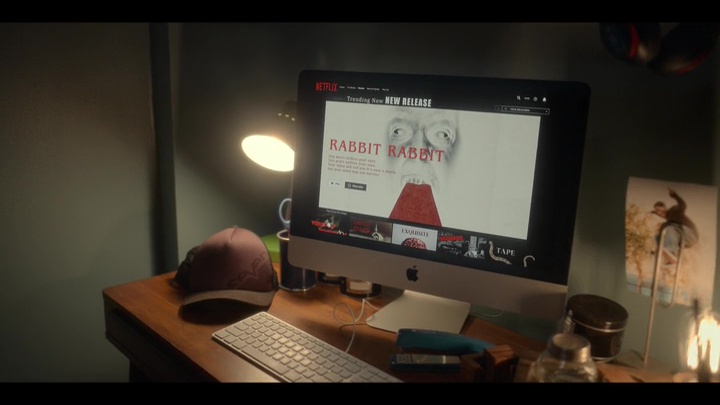
Chad’s friends have one ticket left for the drive-in screening of a film called Rabbit Rabbit. The film was banned by Tipper Gore (Amy Grabow) after the audience at the only showing in 1986 started to massacre each other, and she ordered all prints of the movie destroyed. Except they missed one: the director’s cut. Chad dismisses this whole massacre business as an urban legend, but takes the ticket.

As they drive in, a lone woman is protesting, demanding the screening be stopped. She tells Chad she was at the showing in 1986, where her boyfriend plucked out her eye and ate it before being killed himself. He listens politely, but then Kelley turns up with the biggest bucket of popcorn ever created, and he has to, you know, go. Presumably now full of popcorn, Kelley tells Chad that she is finally ready to have sex with him, and various cannibal metaphors fill the cars before the movie starts – Chad and Kelley pashing in his car, fellatio in his friend’s car next door.

Chad and Kelly’s steamy petting fogs up the car windows, so they cannot see the film, nor do they see the mayhem erupting outside, where people are attacking and devouring each another. They try to drive away when a cannibal smashes through their window but they crash, and have to retreat to the projection room, where we see Chad, who just yesterday was trying to seduce his girlfriend by playing The Joy of Painting, use the last copy of Rabbit Rabbit to cave in the skull of the projectionist, who has just eaten her assistant.

Of course, it’s not the last print. There is a rumour of another print being shown next night. Their mission, should they choose to accept, is to find the director and destroy the NEXT last copy.

So, we finally get to the cannibalism, and it’s plentiful and gory, as we would expect. Those affected by the film get bloodshot eyes, their veins swell, and they are only interested in one thing – human flesh. Chad’s best friend approaches as they leave, eyes bloodshot, veins swollen, and Chad appeals to him to THINK! Remember when we were two little boys, innocently watching porn in the afternoons? Now, according to Aristotle’s theory of the human being as the rational animal, Chad’s appeal to reason, love, friendship, shared porn, should have broken through the spell. Ha!

So what’s with this movie, with the most innocuous title imaginable: Rabbit Rabbit? The rabbit is a gentle, timid, vegan animal who is massacred pretty much everywhere he is found, due to his propensity to breed – a lot! Sounds kind of human?

Chad has done some research before going to the movie; he watched, on YouTube, Tipper Gore’s committee condemning the movie and having it banned after the audience massacre in 1986. Banning things is popular in America due to deep religious convictions, but also not popular due to, you know, the First Amendment. Tipper Gore, married to Vice President Al Gore, was responsible for making music companies add warning labels to songs with explicit content around that time, after finding her 11 year old daughter listening to Darling Nikki by Prince, so this is not just idle chatter – she was seriously into banning stuff.

But why is the government banning Rabbit Rabbit and destroying all copies (or so they imagine)? Well, the director, who glories in the name Larry Bitterman (John Carroll Lynch from Fargo and The Drew Carey Show) is asked by Tipper about his claim in Fangoria Magazine that his movie:

“…would break people’s souls, and anyone who saw it would be damaged forever.”

Publicity hype, laughs Bitterman, but Tipper is worried about the effects of violent content on society, which must be an in-joke for Murphy and Falchuk, after presenting us with ten seasons of violent content, and now this gorefest. Critics have been warning about that sort of thing forever. Civil society has been threatened by the Internet, porn mags, the horror genre, and before that television, movies, radio… hell, conservative Cro-Magnons were probably warning about the evils of cave paintings 40,000 years ago.

Is there any sense to it? Can porn turn us into sex offenders, horror stories into cannibals? The internet certainly turns some people into trolls. Bitterman wants to make cinematic history – he tells the teens that this “was his finest hour” – a cinematic happening, a horror movie where the horror isn’t on screen, it’s in the audience. He refers to Friedkin’s (actual) use of subliminals in The Exorcist – two frames of a demon’s face in reel six had people throwing up in the aisles and women going into labour. Rabbit Rabbit took this to the next level,

“The universal combination of image and sound that would trigger the fear centre of every human brain. I studied intrusive memory formation, the CIA hijinks with MK-Ultra…”

Bitterman had jumped the hearing bench and attacked Tipper Gore when she boasted about destroying the prints of his movie, which resulted in him being locked up for fifteen years for assault. His conclusion: “a society that locks up its artists doesn’t deserve to survive.”

There’s another in-joke – the series was made by FX for Hulu. What if a film like Rabbit Rabbit was to appear on, I dunno, a rival streaming platform – imagine the damage it could do!

But there’s another question for us among all the hacked flesh and explosions. Have you ever felt like you are in a horror movie? Maybe while in the throes of a personal tragedy, or watching a pandemic unfold, or contemplating changing climate. Perhaps you’ve wondered if “they” are playing with your brain. Or perhaps they really are breaking your soul. Or maybe eating you alive. Cannibalism is a brutal metaphor for pretty much every atrocity we visit on our fellow earthlings. A movie, a cataclysm, political upheaval – what would it take to start us eating each other?