I did it Meiwes – “THE CANNIBAL NEXT DOOR”

December 1, the date on which I am writing this blog, is the birthday of perhaps the most famous living cannibal, the German named Armin Meiwes. He became famous around the globe when he was arrested in December 2002 for killing and eating a willing volunteer he had met on the Internet in 2001, a man named Bernd-Jürgen Brandes, who had helped sever and cook his own penis before being finished off and filleted by Meiwes. Movies have been made based on the events, from reenactments like Dora’s Cannibal to fantasies like Weisz’s Grimm Love. Songs have been written about him and sensationalised retellings haunt our documentaries, often inexplicably comparing him to Hannibal Lecter.

Meiwes was born in Essen in 1961, and was raised by his stern and controlling mother after his father and half-brother moved out, not unlike the story of Ed Gein, who tried to resurrect his severe and hard-hearted mother by killing and eating the genitals of local women in Plainfield Wisconsin. Armin Meiwes, hopelessly devoted to his late mother as he brooded in his thirty-room house, sometimes dressing in her clothes and impersonating her voice, was not dissimilar to Norman Bates in Hitchcock’s film Psycho, which was based on the Gein murders. Many have tried to pin his later conduct on his childhood feelings of abandonment and helplessness although, if that were the case, we would expect millions of similar cases around the world. Maybe there are, but they don’t get caught?

At any rate, young Meiwes developed a taste for cannibalism (sometimes called vorarephilia) from reading fairy tales, particularly the Grimm Brothers’ Hansel and Gretel, in which abandoned children almost get eaten by a witch. The witch, we might note, was the only adult to show them any affection, even though her ulterior motives were clear, at least to the children who were reading the story. The Grimms wrote their fairy tales near Rotenburg, where Meiwes killed and butchered his friend. You may also remember (at least, Fannibals will) that Hannibal Lecter referred to this fairy-tale when he was serving up dinner to Abel Gideon; Gideon’s own leg, smoked in candy apples and thyme, glazed, and served on a sugar cane quill.

Meiwes fantasy of eating and incorporating a brother culminated in 2001 in him advertising on a fetish website called The Cannibal Café for “a well-built 18 to 30-year-old to be slaughtered and then consumed”. The only reply that seemed sincere, indeed eager, was from Brandes, who was not really well-built or 18-30, but fitted the bill because he was determined to be eaten.

They got together and, after getting to know each other (which included slicing off Brandes’ penis and cooking it), Meiwes left his friend to bleed out in the bath, and then proceeded to butcher his carcass and eat the meat, in a variety of cuts, over several months.

In case there are still a few psychologists and journalists who haven’t yet pontificated on Meiwes and Brandes, this week we consider a 2023 UK Channel 5 documentary called The Cannibal Next Door, directed by Calum Farmer. This is quite a good reenactment of the events, although like many others, it relies too heavily on brooding, portentous music and opinions from experts, all of whom are universally repulsed by the cannibalism, a repulsion that Meiwes and many of his correspondents clearly did not share.  

“It had broken humanity’s last great taboo.”

Trigger warning: the real Meiwes (seeing it’s his birthday): This website claims it has actual leaked stills from Meiwes’ video. If you don’t like pictures of chopped up humans, maybe skip the link. They look fake to me, but this Reddit reader swears they are real.

Meiwes is still in jail in Germany, not for cannibalism, which is still not a crime, but for murder, which is absurd since Brandes wanted to die, and was in fact obsessed with being slaughtered and eaten. If anything, Meiwes is guilty of assisting a suicide. There was no law in Germany against eating a human.

We know so much about the case because Meiwes was very open in describing what happened, even videotaping the whole process of slaughtering and butchering. The jury in his case watched this video, and reportedly turned quite green, but it seems likely that they would have also done so had they been made to watch some of the horror clips of cruelty and killing in abattoirs that are abundant on YouTube. His lawyer argued:

“We say it is neither murder or manslaughter, but killing on demand. My client is not a monster.”

As it was clearly not murder and there was no law against eating a corpse, Meiwes was sentenced for manslaughter and given an 8½ year sentence. Public outrage resulted in a retrial which then found him guilty of murder, on the devious premise that Brandes had been mentally incapacitated by depression, and therefore open for manipulation by his killer. He was sentenced to life, which in Germany requires a minimum of fifteen years imprisonment. Meiwes has already served more than that.

Meiwes believed that he did nothing wrong. It seems that the only thing he can see as a moral failing is not the fact that he ate human meat, but that he ate any meat; he subsequently became an environmentalist and a vegetarian, both of which would obviate eating any flesh, including human. His simple claim in his defence was that, unlike pigs, sheep, cows, chickens and other animals, here was a willing victim who consented to, indeed demanded, his own slaughter and consumption. Is it not clearly more ethical to eat an animal who wants to be eaten, whatever the species, than one who does not?

Our own flesh: HONEYDEW (Devereux Milburn, 2021)

This cannibal movie starts with the standard building blocks of so many cannibal/horror films: car breaks down, isolated farmhouse, friendly but weird person answering the door, munching of human flesh. Think Texas Chain Saw Massacre, The Farm, or even The Rocky Horror Show. Going to strange places, meeting weird people, eating unknown things – these are what our mothers warned us against, and so does the horror genre.

This one starts with a biblical quote, from Corinthians 6:19-20:

“do you not know that your body is a temple of the Holy Spirit within you?”

While we listen to this from a cassette tape (younger readers may need to google what that is), a young woman eats meat and eggs, while an older woman grinds peanuts. We finally meet the protagonists – Sam (Sawyer Spielberg – yep, you know his dad) is an aspiring actor, Rylie (Malin Barr) is a botanist, investigating an outbreak of a fungus called sordico (an invented name for ergot), which poisons farm animals who must then be “put down”. It’s a metaphor for what we call “sin”.

We hear another recorded piece, this time about the fungus and its resulting diseases, including images of “ignorant peasants” baking the fungus into their bread and suffering gangrenous wounds requiring amputation, and eventually madness. The disease was considered a punishment for sin. Yes, this is the formula for the movie.

Sam and Rylie’s car GPS loses its signal and Sam asks directions from a weirdo on a bike, who just stares at them. Think the hitchhiker in Texas Chain Saw.

They camp in a field while Rylie photographs plants and Sam practices an elusive script. They have sex in their tent, a sure sign in most slashers that divine punishment is coming. But divine punishment can come from eating the wrong things (fungus) or from other people, who have their own interpretations of sin. Rylie and Sam are judged by Karen (a masterful performance by Barbara Kingsley from Jessica Jones) and Eulis (Stephen D’Ambrose), who have become sort of Gretel and Hansel cannibals due to their crops going bad, and of course eating crops poisoned with sordico.

Karen offers them dinner, red meat, but Sam is off it because of his cholesterol, and Rylie is a vegan. More judgement – Sam can’t resist Karen’s red meat and cakes. His appetite is his undoing. Like the cattle, he’s eaten the wrong stuff.

Karen and Eulis capture random travellers, lobotomise them to keep them compliant, and then eat their body parts. The man Karen claims to be her son, disabled by being kicked in the head by a bull, is actually a hunter gradually being eaten. A brief cameo by Lena Dunham (or at least Lena without arms and legs) as Karen’s daughter Delilah, indicates the fate of Sam and Rylie – they are to be lobotomised, stripped of limbs and Sam is to be bred with Delilah: “we’re aiming for grandbabies. Bring some sunshine into this black world”. The meat is kept Fresh by keeping it alive as long as possible.

Karen explains her thinking:

“We are living in a time of tribulation. We have perverted God’s divine love to abuse his gifts. We were overindulgent in God’s food, and so he took it away, forcing us to seek more sources, so that he may not forsake us… we have been given an opportunity for absolution, a second chance, to sustain life by consumption of what we can access, of our own flesh, so we may be judged in His image.”

The term “rump steak” may never seem the same when you see what they do to Sam.

The film achieved a respectable 67% fresh on Rotten Tomatoes, with some critics loving it and some repulsed. The Guardian critic gave it 3/5, a fresh score (only just), saying it “plays interesting variations on an all-too-familiar plot premise.” The RogerEbert critic on the other hand said “This listless genre exercise mostly plays like a film-school-spun tribute to The Texas Chain Saw Massacre with some Hansel and Gretel clumsily mixed in, but without a political or philosophical foundation to stand on.”

I found the score annoyingly obvious, indulgently raising our tension level (which is its job) but a bit too perceptibly. The plot would have made a good episode of American Horror Stories, but at 107 minutes, I found it dragged. I’m not sure if it is fair to say it has no philosophical foundation – the nature of our food choices and nature’s revenge on human greed through spores, bacteria or viruses is right up to date. Moreover, Karen and Eulis are simply doing to their “guests” what farmers have always done – domesticated them and performed surgeries to make them docile – castrating bulls or destroying the frontal lobe of humans (or removing their tongues as in Motel Hell). It’s what Jeffrey Dahmer wanted to do when he drilled holes in his lovers’ skulls and poured in muriatic acid in an attempt to create living sex zombies. These guys just use a screwdriver through the eye-socket.

Anything for a steak, apparently.

“…we are all potential cannibals”: SERIAL KILLERS: THE REAL LIFE HANNIBAL LECTERS (Sean Buckley, 2001)

This is an American documentary about serial killers, but specialising in those who ate parts of some of their victims. I guess that makes it inevitable that they will throw the name Hannibal Lecter in there, even though the similarities are not immediately apparent.

There are a lot of documentaries about cannibals, some mostly interested in sensationalism, and others seeking some sort of journalistic accuracy. This is one of the better ones, with a good selection of experts commenting on the various cases.

Cannibals, and particularly cannibal serial killers, are a real problem for the media. The difficulty comes from the scepticism that journalists need to cultivate in interpreting a world of stories that are stranger than fiction, or sometimes are fiction disguised as fact, or just fiction that people want to believe. Cannibal books and films fall into the horror genre and are usually lumped together with vampires, zombies, ghouls and other strange monsters out of their creators’ nightmares. So cannibals are a problem.

Cannibals are real. Many cannibals have had their activities thoroughly documented, some are even willing to be interviewed. Jeffrey Dahmer gave a range of interviews in which he spoke openly of the way he lured young men and boys to his apartment in Milwaukee and drugged them, then drilled holes into their heads and injected acid, hoping to create compliant zombie lovers, or else strangled and ate them. Dahmer was killed by a fellow prisoner after serving only a tiny fraction of his sentence of 937 years imprisonment.

But others are still alive – Armin Meiwes is in prison in Germany for eating a willing victim whom he met on the Internet and has willingly given interviews revealing his deepest passions, and he even gets out on day release from time to time. Another documentary reviewed on this site a couple of years ago compared him to, yep, Hannibal Lecter.

Issei Sagawa was arrested in Paris for killing a Sorbonne classmate whose body he lusted after and then eating parts of her, but was not sent to prison as he was declared insane. When the asylum sent him back to Japan, he was released (the French didn’t send any evidence with him), and lives in Tokyo where he has made porn movies, written for cooking magazines, and yes, done interviews for unnerved journalists. There are at least three documentaries on him, which we will get to – eventually.

Documentaries like this one love to compare real-life cannibals, or the much wider field of serial killers, with the fictional character, Hannibal Lecter, “Hannibal the Cannibal”. The problem here is that the serial killers in this doco (or any that weren’t) are not very much like Hannibal. Actual modern cannibals are usually categorised as banal, normal-looking folks who under the polite surface are depraved psychopaths, while Hannibal is civilised, educated, rational, brilliant and independently wealthy. He is a highly respected psychiatrist (until his arrest) and remains a likeable protagonist to many readers and viewers, despite his penchant for murder and guiltless consumption of human flesh. He even introduces his own ethical guidelines: he prefers to eat rude people: the “free range rude” to quote another Hannibal epigram.

Much of the commentary in this documentary is by Jack Levin, a Criminologist with a rather distracting moustache, or perhaps a pet mouse that lives on his upper lip. He sums up the modern cannibal serial killer:

 “Many Americans when they think of a serial killer will think of a glassy-eyed lunatic, a monster, someone who acts that way, someone who looks that way. And yet the typical serial killer is extraordinarily ordinary. He’s a white, middle-aged man who has an insatiable appetite for power, control and dominance.”

The standard serial killer appears very ordinary indeed. According to the doco, 90% of serial killers are white males. Many serial killers, we are told, experienced a difficult childhood, abused emotionally, physically or sexually. Hannibal of course saw his sister eaten, and probably innocently joined in the meal, so I guess you might call that a difficult childhood. But of course many people have difficult childhoods (less difficult than Hannibal’s, one hopes) without becoming cannibals or serial killers. Many of these so-called “real life Hannibal Lecters” featured in this program were not even cannibals, such as John Wayne Gacy, who murdered at least 33 young men and boys, but did not eat them, and was not even vaguely similar to Hannibal in appearance, MO, or dining habits. Same with Ted Bundy, who also gets a segment. These killers killed because they enjoyed it – as an act of dominance. Serial killers, Levin tells us, get “high” on sadism and torture. Hannibal, on the other hand, just killed his victims the way a farmer might choose a chicken for dinner – slaughter the tastiest, fattest one, or else the one who has been annoying him.

 “There is much discussion as to whether cannibalism is an inherent characteristic in all human beings, our animal impulses, or whether cannibalism stems only from the minds of mad beasts such as some of the most prolific serial killers.” Richard Morgan, narrator.

Eventually, we get to the cannibals. First up is Andrei Chikatilo, the Russian cannibal who sexually assaulted, murdered, and mutilated at least fifty-two women and children between 1978 and 1990. Chikatilo, we are told, liked to cook and eat the nipples and testicles of his victims, but would never admit to eating the uterus – far too abject for his psychosis. Sigmund Freud and Julia Kristeva would find that fascinating.

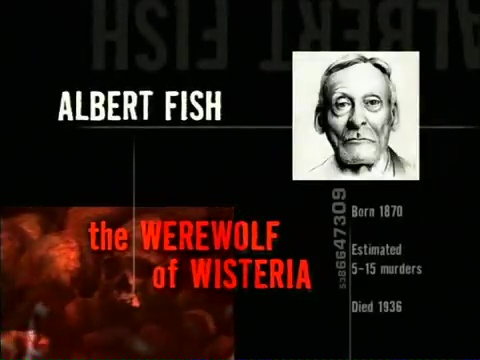
 We look in some detail at Albert Fish, the “Gray Man” who tortured and killed probably fifteen children around the US at the beginning of the twentieth century. He mostly specialised in the children of the poor and people of colour, but was eventually caught because he ate a little white girl, causing the police to take the cases seriously at last.

A large section of the documentary is dedicated to Jeffrey Dahmer, perhaps the most famous of the modern real-life cannibals. Dahmer was not a sadist, disliking violence and suffering, so he did not really fit the description used in the doco, and was certainly no Hannibal.

The other experts wax lyrical about cannibals, such as author and psychiatrist Harold Schechter, who speculates that

Anthropological evidence seems to suggest that cannibalism was a kind of activity that our pre-human ancestors indulged in with a certain regularity, so I think there is probably some sort of innate impulse towards that kind of activity… serial killers act out very archaic, primitive impulses that clearly still exist on some very very deep level.”

Well, that’s definitely not Hannibal, the Renaissance man, who carefully considers each action and dispassionately stays several steps ahead of his pursuers. Jack Levin again:

“Any serial killer who cannibalises victims has broken one of the most pervasive and profound taboos in all of society. Psychologically, this means the killer has achieved the opposite of what he had hoped… in terms of ego, in terms of self-image, he has got to feel worse about himself.”

That certainly is not Hannibal!

But there are some interesting observations in this documentary if we set aside the obvious problems with the comparisons with Hannibal. Zombie flesh-eaters were first popularised in Night of the Living Dead which came out in 1968, what the documentary calls “the most murderous decade” – the 1960s, followed a few years later by The Texas Chain Saw Massacre. People flocked to the cinema to see people being eaten because two Kennedys and MLK were assassinated and the brutal, unending Vietnam war was filling the television screens? Maybe so.

Levin tells us

Most people don’t see the difference between Hannibal Lecter and Jeffrey Dahmer. To the average person, there is no difference between fact and fantasy.

 Col. Robert K. Ressler, who founded the FBI Behavioural Sciences Unit (which makes him a real life Jack Crawford) points out that there are no serial killer psychiatrists, nor do serial killers normally become well integrated into the upper levels of society like Hannibal. So he’s not helping the Hannibal comparison at all. Nor is Levin, who points out that Dahmer was remorseful at his trial, and went out of his way to avoid inflicting pain, unlike most serial killers to whom the killing is a “footnote” to the main text – the torture of the victim. So Dahmer does not fit into the model of serial killer presented here, and he has nothing in common with Hannibal Lecter.

But author Richard Lourie, who wrote a book about Chikatilo, points out that we, the audience, really want to see the serial killer as a Nietzschean Übermensch (superman) – a brilliant criminal genius. He also tells us that Hannibal seems asexual, above the primal drives that motivate people like Chikatilo and Dahmer. Not entirely true of course, if you have read the end of the book Hannibal or read any of the Fannibals’ fan fiction which speculates on some juicy homoerotic episodes between him and Will.

But there is a point to all these rather painfully stretched comparisons between real serial killers and the fictional Hannibal Lecter. Hannibal, Leatherface, the Zombies, are all the inchoate faces of our nightmares, and horror stories are our way of understanding the terrors that fill the news sites. Hannibal is not typical of the real-life serial killer or cannibal, but remember that the apparently kindly old woman who wanted to eat Hansel and Gretel was hardly typical of the horrors of Europe at the time of famine and plague when the Grimms were writing their stories. Each is a facet of horror.

Schechter talks about the simplistic view that cannibalism is in itself “evil”. Which is actually worse, he asks, to torture and kill a person or to eat their flesh when they are dead, an act which can certainly do them no more harm? Indeed.

Levin sums up:

It could be argued that cannibalism as this ultimate form of aggression lurks within every one of us…. We have an aggressive part of ourselves, it’s part of basic human nature, and to that extent we are all potential cannibals.

A kind face, a deceptive smile, a gingerbread house or psychiatrist’s couch can sometimes be more terrifying than the sordid crime scenes left by Chikatilo, Dahmer and Fish. The seeming normality of Albert Fish, Andrei Chikatilo, Jeffrey Dahmer or Hannibal Lecter conceals something that we hide deep within our shadow selves.

The full documentary is available (at the time of writing) on YouTube.

The Beautiful Child: GRETEL AND HANSEL (Osgood Perkins, 2020)

Here’s Horror royalty: the classic “fairy tale” from the Brothers Grimm, directed by Oz Perkins, son of the one and only Anthony Perkins (Norman Bates in Hitchcock’s Psycho). Oz is also an actor – he appeared as the young Norman Bates in Psycho II.

The witch, bloodthirsty and cannibalistic, is in many ways the exemplar of what Barbara Creed calls the monstrous feminine – and her victims are most often children, which is perhaps why children love stories about witches. Some adults dismiss children’s stories as light-weight and simplistic. But kids interpret the world through what they see, and the stories they hear. What kids understand is their own powerlessness – parents and teachers have control, and their youthful grasp of justice can make that seem uncomfortable or even intolerable. The bildungsroman, the coming of age story, is all about finding their power, in the face of seemingly inexorable oppression.

The usual title of this story is Hansel and Gretel, the 1812 Grimm story of the children who are abandoned in the forest and find an enchanted gingerbread house in which lives a cannibalistic witch, who fattens up Hansel for her dinner. The story is an important one in cannibal studies – even Hannibal quotes it from time to time.

Perkins has reversed the title deliberately to make Gretel (Sophia Lillis from It) the older child, a girl on the verge of womanhood, who must unwillingly take responsibility for her little brother Hansel (Sam Leakey in his debut role), see through the deceptions and dangers of adults, and make decisions that can be literally life and death, eater or eaten.

There is a fairy story within the story:

“The beautiful child in her little pink cap”

It tells of a little girl who was saved from a fatal illness by an enchantress, but,

The child was granted second sight. People came to hear what she saw, but did not like what she said.

She had other powers, and could deliver death to anyone, even her own father.

Fairy stories have morals, and the moral of the beautiful child, and Hansel and Gretel, is

Their mother sends them out to offer her services to a local lecher, who takes advantage of a “terrible pestilence” (sounds familiar) and asks the young girl

Furious at Gretel’s refusal to sell her body to help with the finances, the mother chases them out with an axe. Their world, once they are alone, is one of mystery, magic and terror. “The big, bad world opened up in front of us…”

There is plenty of intertextual humour to keep us guessing: Gretel is a sassy American, with strong views on the feudal class system.

Hansel is a cheeky English boy. They are rescued from an ogre by a huntsman, who tells them if they stray from their path, they can expect to meet wolves (a reference to a different cannibal story called “Little Red Riding Hood”.)

They find the gingerbread house, well, at least it smells of cake (and bacon, says Hansel). Inside is a table groaning with an abundance of food. Gifts!

There’s a witch of course, named Holda (Alice Krige, the Borg Queen from Star Trek: First Contact) who is charming and courteous. She plucks a strand of Hansel’s hair as he hoes into dinner, and sniffs it, like Hannibal sniffing Will Graham.

What can I say – she loves children!

But there is much more to this story (both stories). Is she “the beautiful child” of the internal fairy story? She senses that Gretel has second sight and magical powers. In the house, in dreams or in second sight, Gretel sees several children who appear out of mirrors.

Gretel is vegetarian, while Hansel likes his meat; at eight he is already imbued with carnivorous virility.

The witch, Holda, is not impressed, pointing out that “the ox, with his vegetable-made bones pulls the cart and the fat man who sits atop it!” She is dismissive of his carnivorous virility. Of course, we have to wonder, as Gretel does, where all the meat and milk come from, considering there are no animals on the property. Except for human ones. Are our cities any different?

Gretel starts to appreciate her powers, and the abundance they will offer her.

“This is your power. To see what is hidden and to take it. A small mind believes only what it can see. But we know that we are our fate’s own masters, don’t we?”

Hansel remembers Gretel’s lessons:

“You always say there aren’t any gifts in this world. That nothing is given without something taken away.”

To take on her full powers, Gretel realises that she’ll need to lose Hansel, who is a burden. The witch warns that

“he’ll soon come to fear you, as all men should if they’re smart.”

We only see Holda eat once, and when she finishes, she pulls out of her mouth a long lock of blonde hair with a little bow on the end. Well, we guessed what she ate, especially if we ever quaked through a Brothers Grimm story or two.

The witch in psychoanalytic terms is the oral-sadistic mother, and Creed calls her an “implacable enemy of the symbolic order”, because she demonstrates its frailty. Holda at first seems maternal – she offers the lost children food and shelter, but the fact that they can so quickly end up in that food warns us of that frailty – she reminds us that we, too, are edible animals.

Gretel soon finds out where all the food is coming from.

The witch tells her the real story of the beautiful child and of her power. Gretel has achoice – will she take the gift and pay the price? But hey, no spoilers. See the movie to find out what Gretel decides. It’s worth it.

The reviewer on RogerEbert.com called it:

“the kind of low-key gem that horror fans are always looking for but so rarely find—one that is smartly conceived, visually stylish and genuinely creepy at times.”

The story is even more relevant than it was when the movie was made (or the Grimms wrote it down) because of the weird conspiracy theories circulating in the USA about politicians torturing and killing children in the basements of pizza restaurants in order to harness their youthful energies. But leaving aside the magic and the second sight, isn’t the cynical utilisation of the young the basis of advertising, wars and agriculture? Society is built on the exploitation and sometimes the slaughter and consumption of the innocent.

The cinematography of this film is splendid, and the actors are sensational, particularly G&H despite, or perhaps because of, their youth. Overall, a very satisfying reboot of a classic cannibalism story.

Hansel, Gretel and incestuous cannibalism: WE ARE THE FLESH – Tenemos la carne (Emiliano Rocha Minter, 2016)

It’s Hansel and Gretel, Captain, but not as we know it. This Mexican film is a visual experience, rather than a traditional narrative. It is set, like many of the films we have covered in this blog, after what appears to be an unexplained apocalypse. The “witch” is a crazy old guy named Mariano (Noé Hernández) who makes fuel out of old bread and trades it to persons unknown, through a hole in the wall, for food – mostly eggs and meat. Mariano is more Satan than witch.

vlcsnap-00059.jpg

He believes in chance, which, he says, is “the greatest criminal to ever roam the Earth.”

He is an aficionado of solitude, but when a young brother and sister, Lucio (Diego Gamaliel) and Fauna (María Evoli), appear in his abandoned apartment, he feeds them and puts them to work on ever more peculiar projects, such as a womb-like cocoon, made of wooden struts and vast amounts of packing tape.

vlcsnap-00009.jpg

Mariano receives some meat through the hole in the wall, and cooks it for his guests. But there’s a problem: Lucio is a vegetarian. Fauna tucks into her steak, rather reversing the normal situation where Hansel ignores Gretel’s warnings and eats the gingerbread. But Mariano has laced the meat with poison that, he says, the Nazis used to kill Jews. He won’t give Fauna the antidote until Lucio eats his meat.

vlcsnap-00019.jpg

So, it’s all about transgression, overcoming taboos, abandoning inhibitions, accepting pleasure rather than bothering with difficult questions of ethics. Mariano then decides that the kids need to have sex, and Lucio’s objection, that she is his sister, is dismissed:

“Do you think your cock gives a damn about her being your sister?”

So then there’s lots of incestuous sex, some of which is captured in lurid neon heat-map images. Mariano sings to them and masturbates as they perform for him, finally fainting as he ejaculates. Or dies, but is resurrected, because, as we know, the monster is never really gone.

vlcsnap-00034.jpg

vlcsnap-00036.jpg

The Brothers Grimm was never like this. Although who knows what siblings Jacob and Wilhelm Grimm got up to before they became philologists?

Anyway, we finally get to the cannibalism, about an hour into the film, as Mariano captures a soldier, tells him exactly what they have planned.

“We won’t kill you for money. We won’t kill you for an ideology. Or for the pleasure of watching you suffer. It’s not revenge for what you have done. We are neither avengers nor executioners.”

vlcsnap-00056.jpg

vlcsnap-00057.jpg

vlcsnap-00058.jpg

They sing the Mexican anthem and then slit his throat, catching his blood in a container. Various body parts are rendered into liquid and sealed into buckets, presumably to be traded through the hole in the wall.

Another girl comes into the maze looking for shelter, but is instead raped by Fauna and then Lucio.

vlcsnap-00070.jpg

Have we shattered every convention and broken every taboo yet?

vlcsnap-00022.jpg

Not quite. Mariano celebrates his naming day, a party in which all sorts of weirdos turn up and get it on. Mariano is to be the guest of honour, but also the main course.

vlcsnap-00076.jpg

“It is also the day I’ll live inside your squalid bodies. Don’t forget that the spirit does not reside in our flesh. Flesh is the spirit itself! So I kindly ask that all you lowlifes devour me until there is nothing left.

vlcsnap-00082.jpg

vlcsnap-00083.jpg

vlcsnap-00090.jpg

There’s a twist at the end, but hey, enough spoilers. Go watch it – it’s only 80 minutes.

Catherine Bray in Variety called the movie a “joyously demented portrait of humanity.” She summarised the theme very well:

“Much of its most vivid imagery is purpose-built to interrogate the moral values society projects onto biological matter: human meat ground to a slush, slopping about in a bucket; a clitoral close-up; a pipette inserted casually into a hole in a boy’s temple; a sister’s gelatinous menses dripping into her brother’s mouth.”

The stubborn belief that humans, unlike other animals, have some sort of spirit that elevates us into the ranks of demi-gods and therefore justifies the havoc we unleash on the rest of nature has crumbled. As Mariano insists, flesh IS the spirit. We are meat, driven by our appetites. Our carefully crafted moral convictions can vanish like smoke in the face of hunger or desire.

vlcsnap-00024.jpg


Hansel and Gretel is a seminal cannibal text of course: innocents, abandoned for daring to expect to be fed, and left to face the voracious appetite of the outside world. Many of us probably first heard about cannibalism while sitting on a parent or relative or baby-sitter’s knee, crafting our next nightmare as they read us stories from the Brothers Grimm. Variants of the story are everywhere – a new movie is due soon (I’m looking out for it) called Gretel and Hansel. Here’s the trailer: