This is such a great show. I was going to blog a couple of episodes at a time, but there is so much content in the short episodes that I had to do this one, the fourth, in splendid isolation. Also, I’m uploading it on father’s day (in Australia and probably some other places), and having a character eat some of his father just seems so pertinent!
If you haven’t read my blogs on the first episodes, you might want to do that first. In a nutshell, in episode 1, Delores has just been released from prison after 16 years. She heads back to Washington Heights NY but it’s all gentrified now, except for the Empanada Loca shop of her old friend Luis, who offers her a room and sets her up as a masseuse, a skill she learnt in jail.
In episodes 2 and 3, Delores kills the landlord who has been harassing Luis for his overdue rent, which he can’t afford because the neighbourhood is now fancy, and people don’t buy empanadas much. Luis creates a new empanada, MUY LOCO. It is hugely successful, like the chocolates in last week’s blog, because it contains, yep, human flesh, in this case, the landlord. Whose son, Jonah, appears in the shop at the end of episode 3, with two cops behind him.
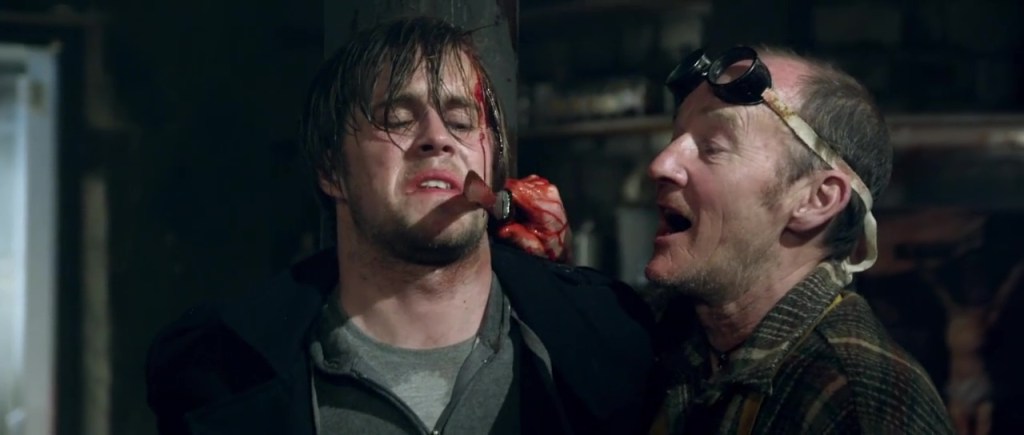
All caught up, and now we’re at episode 4. It turns out Jonah does not know his dad is missing, and the cops are just waiting for their empanadas. But Delores does not want to go back to jail, having just got out after sixteen years, so you might think that finding Luis destroying (or actually cooking and selling) the evidence should be good news, but (call her old fashioned) she is horrified by the idea of cannibalism (although, funnily, not so much the murder she committed) and disgusted by the secret contents of the muy loco empanadas.
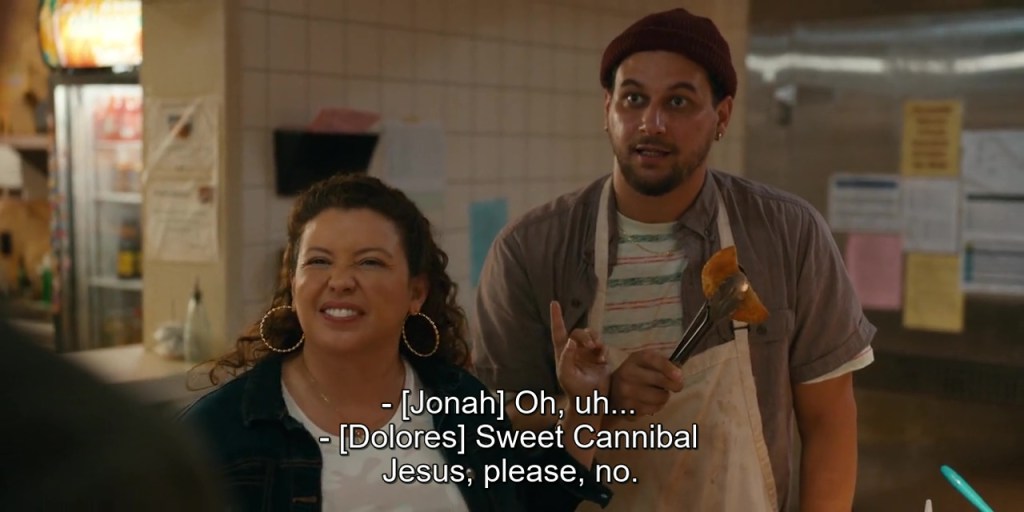
This dissonance between getting rid of the evidence of her rather serious crime and disgust at the fact that the evidence is being fed to an enthusiastic clientele is aggravated when Luis offers Jonah an empanada to try, a muy loco, reminding us of the lyrics of the old Stanley Holloway song about Sweeney Todd, on whom this story is based:
“For many a poor orphan lad The first square meal he ever had Was a hot meat pie made out of his dad From Sweeney Todd the Barber”
Luis tells Jonah “the meat’s locally sourced” which is particularly true for him. Jonah loves the taste, asks if the meat is duck.
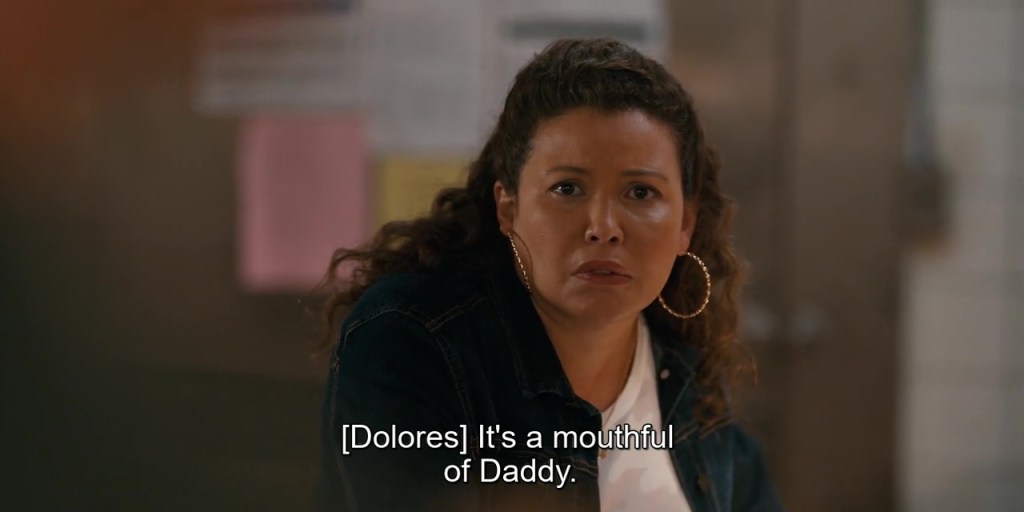
No, it’s no duck. We hear Delores’ thoughts:
Furious at Luis for feeding the landlord to his son, Delores takes the rest of the meat and sets fire to it, putting the muy loco off the menu. Luis is furious, and cannot see what the problem is, and then comes one of the great double entendres of the cannibal genre –
Luis barks at her:
“Hey, it’s edible! Like the Greek myth.”
Now we’re getting to the meat of the cannibalism debate!
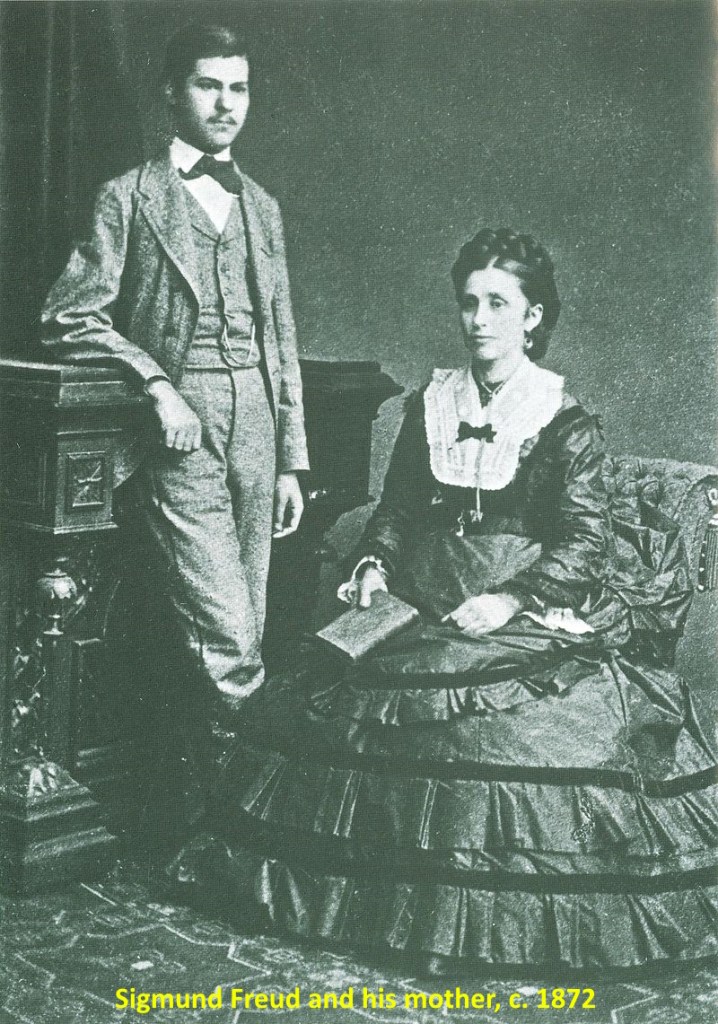
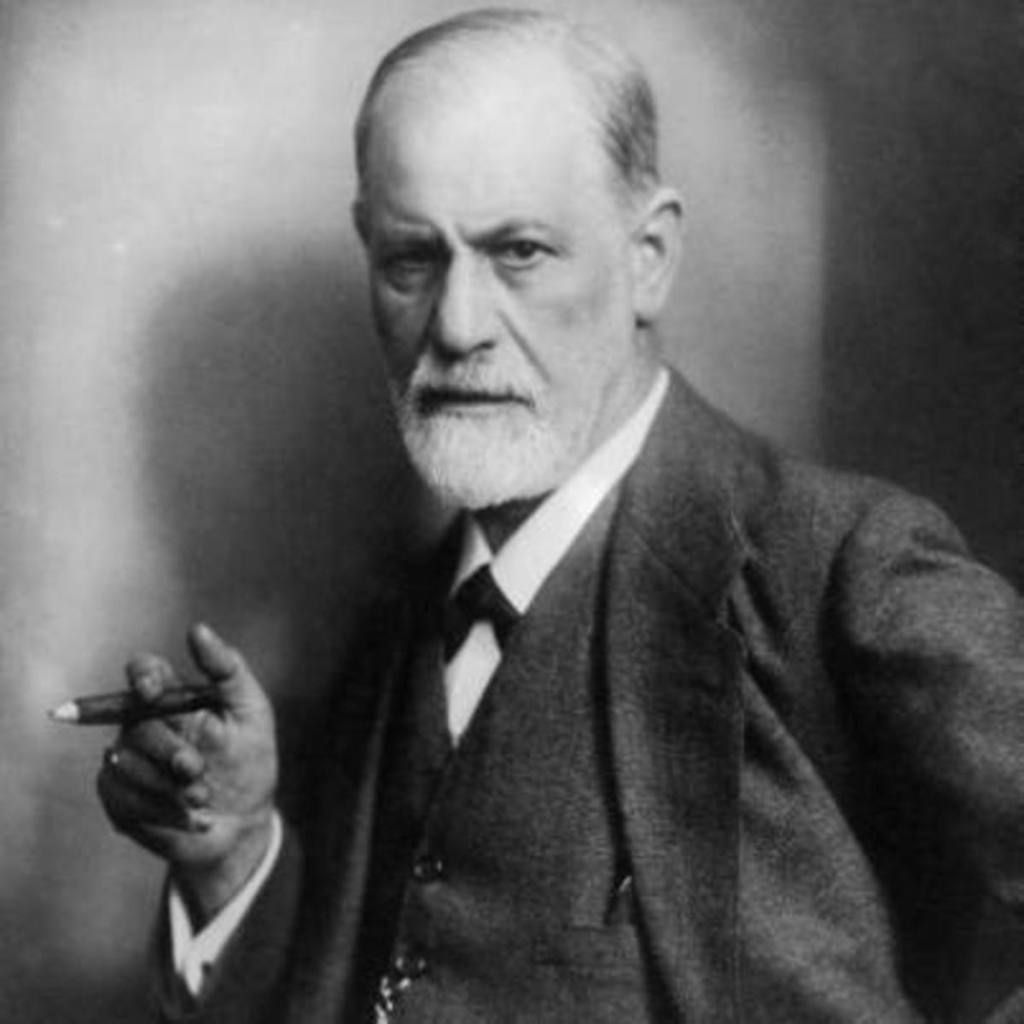
Quick refresher: Oedipus was a mythological figure depicted in the play Oedipus Rex written by Sophocles some 2500 years ago. Oedipus became king of Thebes after unwittingly fulfilling a prophecy that he would kill his father, Laius (the previous king), and marry his mother, Jocasta (whom Oedipus took as his queen). It was more a case of mistaken identity and road rage than some deep psychosexual drive, but Sigmund Freud used it as the basis of what he called the Oedipus complex. This referred to a child’s sexual desire for the opposite-sex parent and hatred for the same-sex parent which, if not reconciled, leads to neurosis. Freud wrote that,
“It is the fate of all of us, perhaps, to direct our first sexual impulse towards our mother and our first hatred and our first murderous wish against our father. Our dreams convince us that this is so.”
Oedipus didn’t eat his father, but Freud believed that cannibalism is a foundation of the human unconscious. He asserted that cannibalism is one of the two original prohibitions of humankind, the other being incest. Freud’s conception was that the origin of human civilisation was an act of incestuous patricide and cannibalism by a group of pre-sapien savages, which became the origin of cooperative civilisation. In Totem and Taboo, he speculated that a prehuman group of brothers in a “primal horde” had come to resent their father’s monopolisation of the tribe’s females (common among primates) and conspired to kill the father and take their mothers and sisters for themselves. “Cannibal savages as they were, it goes without saying that they devoured their victim as well”. A later wave of remorse led these conspirators to create “out of their filial sense of guilt the two fundamental taboos of totemism”, the proscription of cannibalism and incest. This father/son guilt, he argued, corresponds with the Oedipus complex, which he called “the nuclear complex of the neuroses”.
So Jonah, like Oedipus has unwittingly eaten human flesh, the flesh of his father, not knowing what it was. If Luis had said it was duck, he would have believed him, and accepted that contentedly, because social conventions say we can eat ducks, but not dads. Yet the taste is so close that he couldn’t tell the difference. And since his dad was already dead, was this worse than deliberately killing a living, sentient duck?
Meanwhile, the local drug dealer, Marcie, accuses Delores of selling drugs and stealing her customers, because of the long queues of people waiting for muy loco empanadas. Delores tries to persuade her she is running a massage business and takes her downstairs for a massage, where Marcie starts to vandalise her room looking for drugs, and mocks her for protecting her old boyfriend, revealing that he cheated on her and eventually turned her in to the DEA to save his own hide. They fight, and Marcie becomes the new supply for the next batch of muy locos.
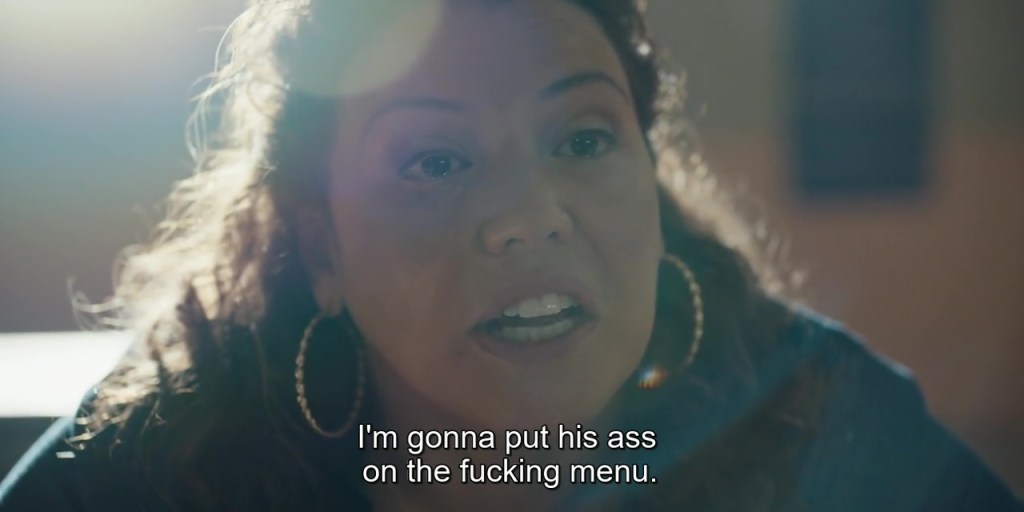
Delores is determined to find the cheating boyfriend. When she does, she promises,
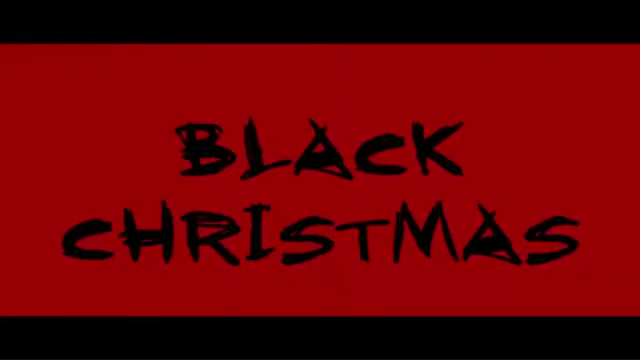
Black Christmas is the middle film in what is sometimes called the “Black Christmas series” – three films that actually have very little to do with each other, except that they bear the same title, one made in 1974, one in 2006, and one in 2019. The original was made in 1974 and widely panned, but has since been revived as the proverbial “cult classic” and hailed as one of the earliest slasher movies – it was released on the same day as The Texas Chain Saw Massacre, and is considered an influence on the making of the Halloween series (crazy killer, young women, buckets of gore). The remake in 2019 presented a completely different story and character list.
I am reviewing the middle, 2006 movie not because it’s the best of them, but it is the only one featuring CANNIBALISM, which is what this blog is all about. Also because I needed something uplifting to review on Christmas Day, 2022.
The films all involve a group of co-eds (young female college students for those of you who don’t speak American) being slaughtered by a serial killer. The 1974 film was about to be released for television in 1978 but was withdrawn because serial killer Ted Bundy had just murdered two young co-eds sleeping in their sorority house on the campus of Florida State University in Tallahassee. Bundy had started his killing spree in 1974 before being captured in 1975, incarcerated and then escaping, and there is some speculation that the film was based around his brutal murders, and that he in turn, might have been motivated to escape and return to his pathological ways by the imminent TV release of the film. The film may also be partly based on the exploits of Ed Kemper, who killed his family and then a number of co-eds in 1972-73, although his M.O. was to offer them lifts as they hitchhiked which, as we all know (I hope), is a very bad choice of transportation.
But Bundy was not a cannibal to the best of our knowledge, and nor was cannibalism mentioned in the 1974 film. Ed Kemper did admit under truth serum to slicing flesh from the legs of his victims and eating it in a casserole, although he later changed his mind and denied it. So Kemper, who is still locked up the California Medical Facility in Vacaville, may well have been an inspiration for this 2006 version. It is a very loose reimagining of the 1974 film, with the added frisson of child abuse and a bit of paedophilia, as well as incest and cannibalism – the taboos that Freud described as “the two original prohibitions of mankind”. Director Glen Morgan, who wrote several episodes of X-Files and The Twilight Zone reboot, is not skimping on any taboos in this one.
It starts off with a murder of course, then moves swiftly to an asylum for the criminally insane (a nice nod to Hannibal’s residence through all of Red Dragon and most of Silence of the Lambs, and quite a bit of the third season of Hannibal too). Here we come across Santa Claus, as you’d expect in a movie called Black Christmas, and we get the back story on the dude who killed his family many years ago, and is, we expect, going to kill lots more people before this movie drags itself to a gruesome end.
The asylum caterer, a very careless man who lets the high security door get jammed open with a carton of milk, says they are giving him a special Christmas dinner.
“It tastes like chicken, because it’s chicken. It’s the closest we could get to how Mom used to taste.”
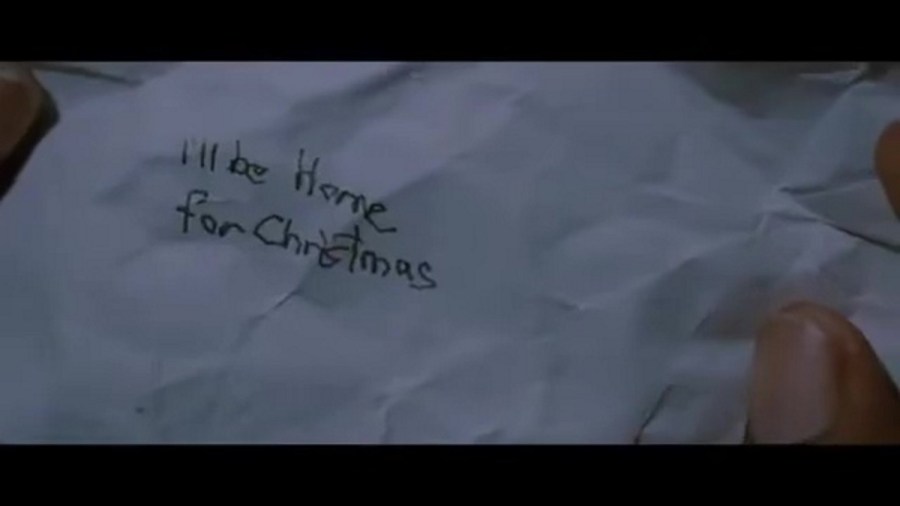
Billy Lenz is clinically insane, so that may explain why he thinks his Mom tasted like chicken (humans are red meat, and most cannibals claim the taste is like pork or veal). Anyway, he scoffs his chicken/Mom substitute through the feed-hole on his door, pockets the candy cane as a handy weapon, and we are told that he tries to escape each year; he wants to go home for Christmas. And the Delta Alpha Kappa co-eds, whose sorority house at Clement University in New Hampshire is Billy’s old house, are not going to enjoy his visit.
Well, we don’t have to sit through all the jump scares, because they are just slasher gore with no one getting eaten (as far as we can see). There are some amusing rants against Christmas though. The girls know the history of the house, and their “Secret Santa” ritual includes someone having to buy a present for Billy each year. It’s a pagan sacrifice to ward off evil spirits on Christmas.
“What Christmas shit in this room resembles anything Christian, huh? It’s all neo-pagan magic. Christmas tree – a magical rite ensuring the return of the crops. The mistletoe is nothing but a conception charm. Fifth century Christians jacked a Roman winter festival – twelve days in December where the nights were long – and the Earth was roamed by the demons of chaos. And fucking Santa Claus? This fat voyeur that watches you all year long to make sure you live up to his standards of decency, before breaking into your house? And that is different from what Billy did – how?”
So what, we wonder, did Billy do?
“Billy Edward Lenz was born with a rare liver disease that gave him yellow skin. His parents hated each other. The mother hated Billy. He was not the child she always wanted.”
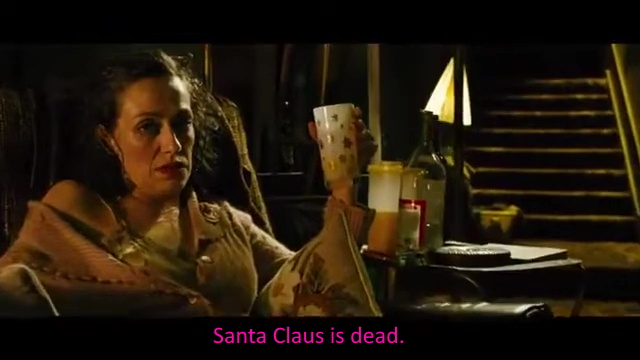
When Billy is five, on Christmas Eve, his mother tells him the Russians shot down Santa.
He then witnesses his mother’s new boyfriend kill Billy’s father, who is the only one who ever loved him. Realising he saw it all, they lock Billy in the basement (did they see Tommy?), where he spends his time rocking (as in, in a rocking chair, not engaging in popular music).
When he is twelve, his mother, frustrated by her new husband who falls asleep mid-coitus, climbs up into the basement, drops her gown and reinstates the original meaning of “rock and roll”, adding incest to insult and injury. Not to mention paedophilia. This show has it all!
So Billy has a sister and a daughter and Mom has a granddaughter and a daughter, and step-dad is still snoring through copulation, so everyone lives happily ever after.
Just kidding – nine years later, Billy has been driven insane by isolation, while his sister/daughter is doted on by his mother, who constantly tells her “you’re my family now”:
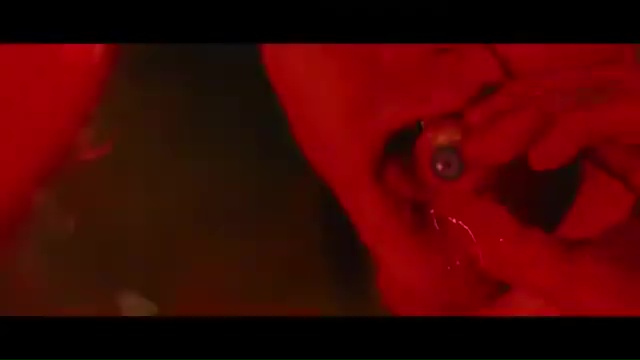
Billy escapes from the attic and disfigures his eight-year-old sister by gouging her eye out, and then eating it.
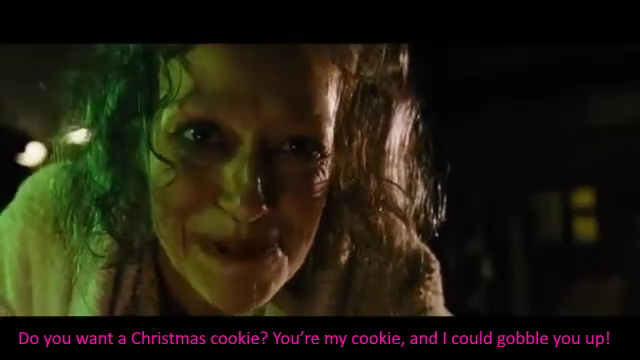
Much of the terminology of love and sex derives from cannibalism. When we tell a child “I could eat you up” or (at a different time and place presumably) perform oral sex on a lover, we use the metaphors of cannibalism.
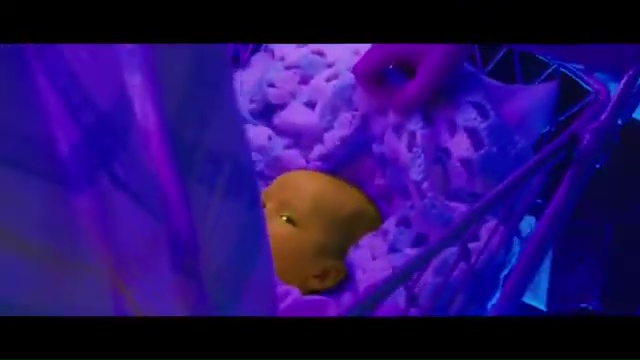
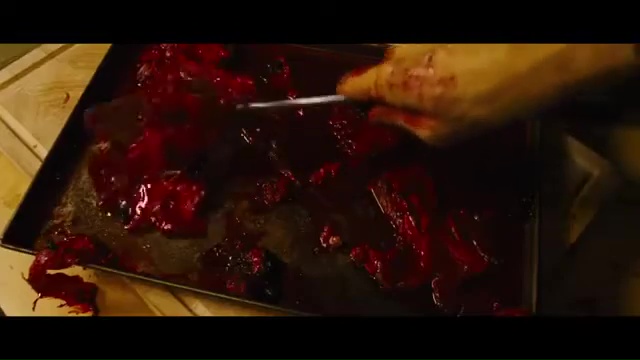
Billy murders his mother and her sleepy lover, and the cops find him eating cookies made out of his mother’s flesh. There’s a cookie-cutter involved, and a hot oven. Not sure where he got the recipe.
The rest is pretty standard slasher stuff, with some inventive deaths, but at least Billy has qualified as a cannibal, and it’s about time, because we’re 36 minutes into the film by now. If you can’t be bothered watching the whole thing, there is a trailer at the top of this blog that covers a lot of the good bits, plus a whole lot of other stuff that never made it into the movie, apparently filmed at the insistence of the distributor, Dimension Films, run by Bob and Harvey Weinstein, who have, between them, much expertise on matters of horror, family discord, and the abuse of young women.
Look, if you want an entertaining slasher with lots of gore, you might like this. From the point of view of Cannibal Studies, the film is interesting mainly as an example of revenge cannibalism – eating the rude and abusive, like Son or Titus or even Sweeney Todd. Also, horror movies timed to coincide with Christmas are very often based on some aspect of revenge, such as The Twelve Deaths of Christmas, also featuring a cookie-cutter used to make people-bread men. It’s a fascinating genre, in which the audience is offered the opportunity to sympathise with, or at least understand, the act of cannibalism as homicide and anthropophagy justified by grievance.
Not so much with Billy. The sorority sisters are treated the way humans treat animals contingently labelled as “vermin” – they are swarming around his house, and he exterminates them but, significantly, he doesn’t eat them. His Mom and his sister/daughter, though, they’re family, and the only way to keep them with him, restrained, constrained and compliant, is to eat them. It’s Billy’s version of love.
Merry Christmas and Gory in Excelsis to all my readers!
The full movie is available (at the time of writing) on YouTube:
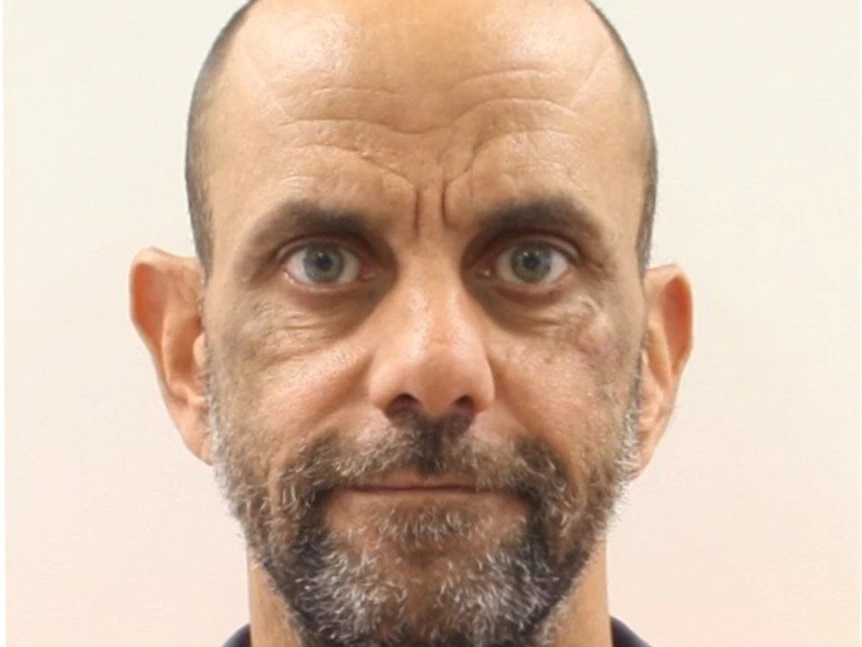
Cecil Maurice Mabb, 42, has pleaded guilty to assault and attempted abduction
The headline on the ABC News site on 14 April 2021 read:
“Man who abducted 5yo from campground wanted to eat her, court hears”
Cecil Maurice Mabb, 41, pleaded guilty to assaulting and abducting the girl from Montagu Campground, in Tasmania’s north west, on January 24.
The Prosecutor told the Burnie Supreme Court that the girl went on a bike ride with her four-year-old male friend while her family was pitching their tent at the site.
She said Mabb had parked his ute in isolated bushland near the campground before he grabbed the girl by her legs, threw her over his shoulder and then threw her in his car as she screamed.
The court was told Mabb also strangled the child, who later said she was not able to breathe or speak while his hands were around her neck.
The family was alerted by her young friend, who had been screaming at Mabb to let her go and told them “the man scared me … he got her.”
Another camper found the girl on the beach alone, about one kilometre from the family’s campsite.
Mabb called police shortly after the incident, telling them “it’s all bad … it’s a real emergency … I just tried to kidnap a child”.
Mabb has denied there was ever any intention of doing anything sexual with the girl, and the prosecution did not argue otherwise.
The court has heard he told police he “just needed company, someone to listen to me, someone to give me a cuddle”, and that the child reminded him of his granddaughter.
While in maximum security at Risdon Prison, Ms Prence said Mabb told prison staff his motivation for the abduction was to eat her, and that he had wanted to eat people since he was a child.
His solicitor told the court while he did say that, it was on the advice of fellow inmates, who told him to make his circumstances “as bad as possible” so he had greater access to medication and therapeutic help.
The court was told that between 1995 and 2003, Mabb had been sexually offending, in behaviour he described as “exploring his sexuality with behaviour that had been normalised”.
“Paedophile snatches little girl so he ‘could eat her’”
They paint a different picture of the evidence, with the prosecutor saying:
“intelligence from Risdon Prison indicated Mabb had told staff he told police he was a paedophile because that was better than “what he really was”. He told staff he had taken the little girl so he could eat her.”
Defence counsel Hannah Phillips told the court was no evidence Mabb said those words in jail.
“My client told me he had been instructed by other inmates to make up stories and to make them as bad as possible to get better access to medication.”
Mabb will be sentenced next month for his admitted crimes of assault and attempted abduction. Meanwhile, the locals have decided their own sentence.
Mabb had bought land and set up a caravan and shed at Rosebery in 2019. Those structures have been burnt down since Mabb has been in custody following the attempted abduction.
The interesting point about this story is that the offender has pleaded guilty to what he did and will be sentenced accordingly. But the prurient media interest is not in what he did but in what he said: he said he had grabbed a little girl for a cuddle (?) and that he wanted to eat her. Neither was true, apparently – he wanted to get caught so he would get medicated by the state. Yet the headlines offered another charge: “Paedophile snatches little girl so he ‘could eat her’”. Someone who read that promptly burnt down his shed and caravan, in a form of rough justice.
Wikipedia tells us that paedophilia was first formally recognized and named in the late 19th century. Sigmund Freud was writing then, and knew all about the subject, but wrote in a letter to Marie Bonaparte in 1932 that incest and cannibalism are the two original prohibitions of mankind. If he read the papers today, he might scratch out incest (and decades of work) and substitute paedophilia.
But cannibalism is still right up there, in the top two headline grabbers, the gold medal for salacious scandal.
The author John Steinbeck wrote to a friend in 1941 that:
“It isn’t that the evil thing wins—it never will—but that it doesn’t die… two forces are necessary in man before he is man.”
Horror depends on our inability to accept the inevitability of our own deaths, and cannibalism adds to the recipe the terror of that death involving our total disappearance, not just our spirit but our bodies, incorporated into the stomach, then the cells and finally the shit of another. We cheer the death of the ‘bad guy’ because we feel at a primal level that his death is required for the continuance of our life. But what if, as Steinbeck says, the evil never dies, and keeps coming back for us?
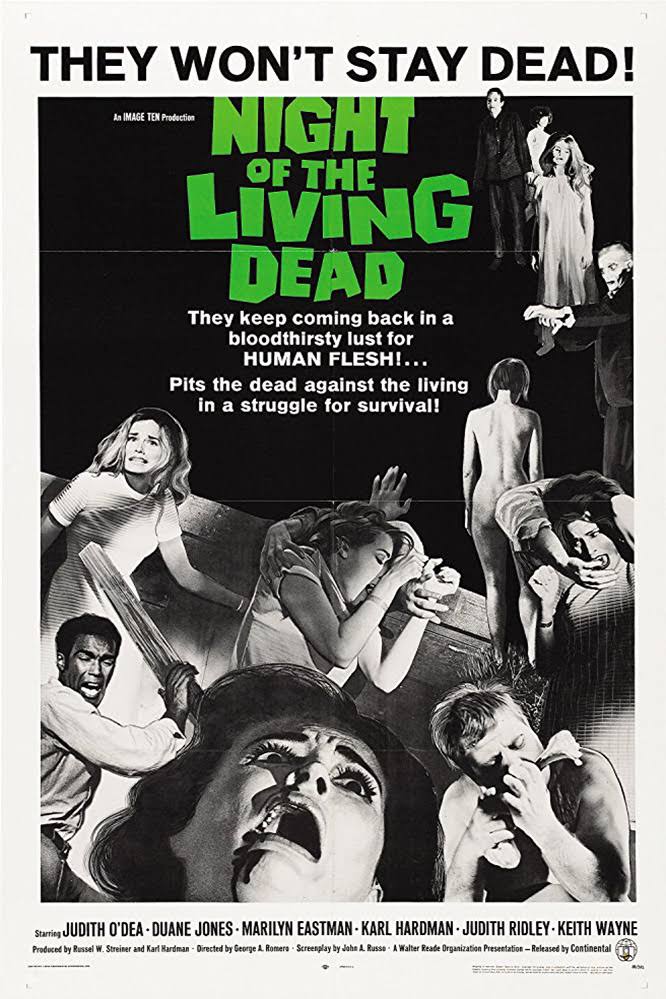
This I think is the attraction of the zombie, who has become a critical character in our culture since the release of this movie in 1968. An earlier movie, The White Zombie (1932) saw Bela Lugosi turned Madge Bellamy into a mindless love object – returned to life, but as a slave with no will of her own. Those zombies did what they were told, but they did not go out of their way to eat people. That type of compliant, submissive zombie is pretty much what Jeffrey Dahmer was hoping to achieve when he drilled holes in his lovers’ skulls and poured in what he hoped were non-lethal doses of acid.
George Romero’s genius was to combine the undead with the cannibal to create what in this story is called a “ghoul”. The zombie was still, in 1968, the undead servant of Haitian mythology. In this film, the ghoul, a figure that traditionally hangs out in graveyards and sometimes digs up corpses, becomes those corpses, and so gives birth to what we will ever after call zombies. These zombies are cheaper by the dozen – they have no will, no intelligence, just the force of numbers, and overwhelm the living with their ragged, shuffling weight of numbers.
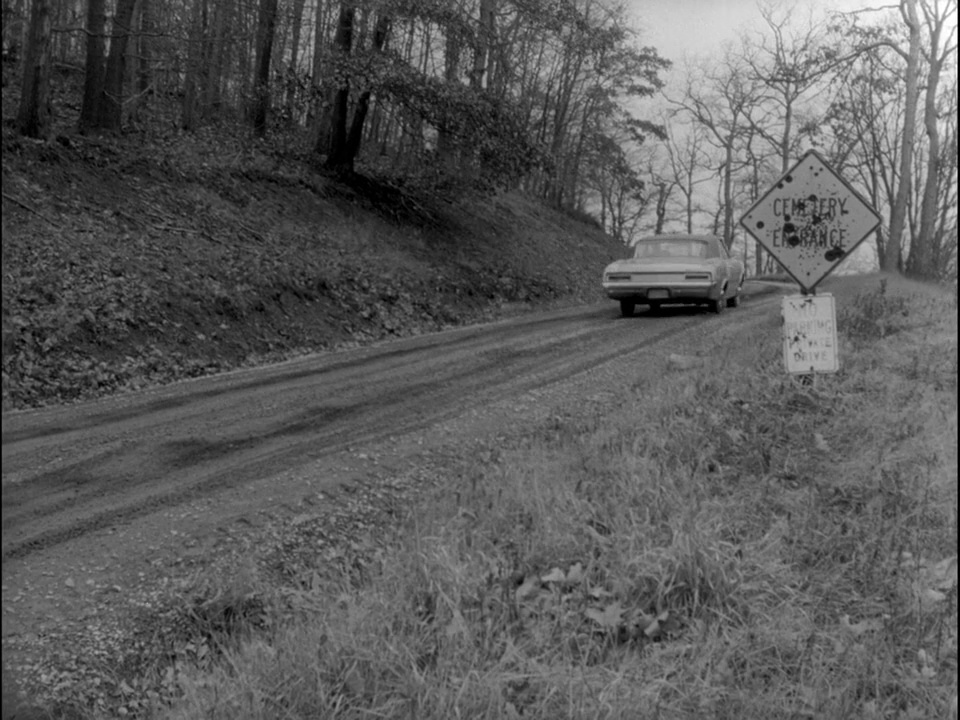
What raises these dead? We are told by a TV newsreader that a strange phenomenon, perhaps radiation from a space probe that exploded in Earth’s atmosphere, is causing the dead to rise from their graves. They are voraciously hungry, but very fussy eaters – their preferred cuisine is living human flesh, although cooked (when a truck explodes) will do. But the horror in this movie is from the “banality of evil” – the things that really haunt our nightmares are not ogres and aliens, but cemeteries at dusk,
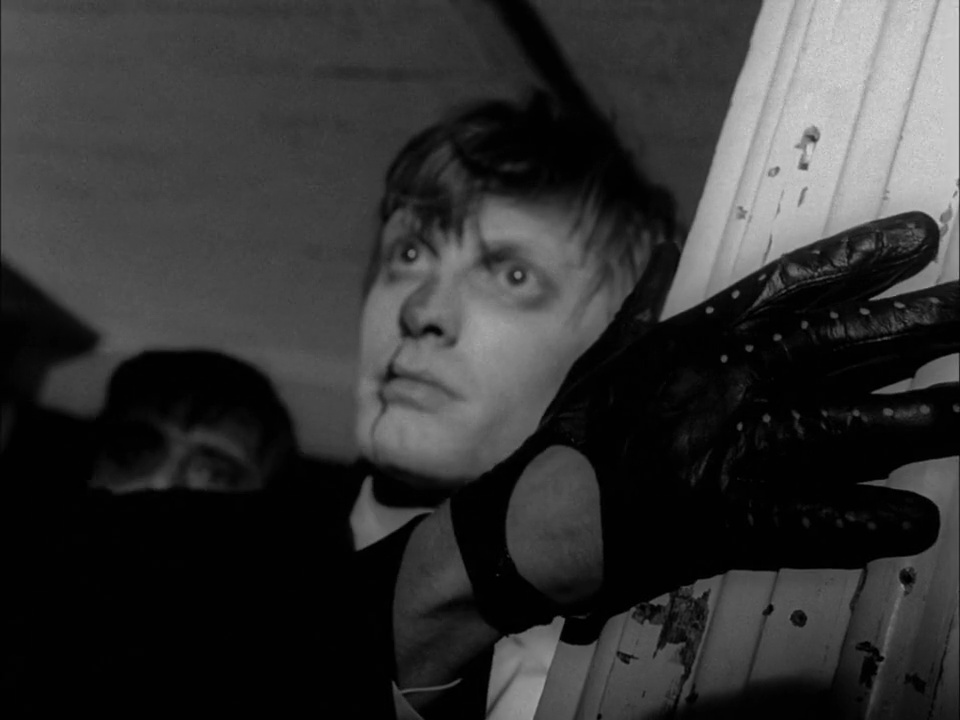
Ordinary (ish) looking people trying to get into our car, when we can’t find the keys
Technology that won’t work at times of crisis
And of course the dead. Particularly when they look angry. And hungry!
Romero did not just bring to life the zombie hordes, but also very many cannibal movies owe a debt to him, as do “splatter” movies generally. The simple opening scene of a couple of siblings driving across the desert to visit their father’s grave was later replicated to some extent in The Texas Chain Saw Massacre, and The Hills Have Eyes. And of course many, many zombie movies and TV shows have followed in the shuffling footsteps of this one. Without Night of the Living Dead, there is no Walking Dead.
The story revolves around a group of people sheltering in a farmhouse in western Pennsylvania, which is under assault by a growing crowd of cannibalistic, undead corpses. The phone doesn’t work, which is annoying, but the radio and even the TV are fine, which is useful as a dramatic device to fill us in on what’s going on.
The radio reports that they are:
“things that look like people but act like animals.”
The horror of this film seems so much greater by their ordinariness (although the low budget may have had something to do with it). Cannibals are often described as acting “like animals”, but of course, we are all animals, great apes, and cannibals are just as likely to be accused of treating their prey “like animals.” Ordinary people, animals, fall down when shot, but the horror of these undead is their invincibility. It’s hard to kill someone who is dead, and has just risen from the grave. Shoot them in the chest and they fall over and then get up again and keep coming. They can however be shot in the brain or walloped on the head or burnt, so we are not left without hope.
But there are other dynamic binaries – heroism and cowardice, fire and fuel, shelter and intrusion, eater and eaten, and a scene where an infected girl within the boarded up house eats her own parents, and an undead brother returns to eat his sister. In two short scenes, Romero takes Freud’s insistence that cannibalism and incest are the two original prohibitions of mankind, and merges them into incestuous cannibalism. The film comprehensively problematises the narrative of humans vs monsters. We are all hiding in our houses, terrified of the latest headline, and we are also all members of the monster horde.
The protagonist is Ben (Duane Jones), an African-American hero, which in itself was rare in the sixties. Romero says Jones was chosen just because he gave the best audition, but the dynamic he brings, particularly in the inter-relationship battles inside the house, where he insists on being boss, and of course in the climax, took the film into the heart of darkness that was 1968 America. As the ghouls lurched toward the house, the Vietnam war was raging, students and police were battling on the streets of Chicago outside the Democratic Party convention, Martin Luther King and Bobby Kennedy were gunned down, and in Paris revolution was in the air.
But it’s not “all right”. The racism issues raised by the film further complicate the dichotomy between human and ghoul; human and, well, inhuman. Because when the authorities arrive, they are basically a vigilante mob killing ghouls with a random collection of guns, and building bonfires to dispose of the corpses. When they see a black man – will they recognise him as a real, live human? Well, no, Ben has made it through the night, surviving the attack of hundreds of the ghouls, only to be shot through the head by a police sharp-shooter as he emerges. The film ends with grainy images of him being pulled from the house with meat-hooks and burnt with the corpses of the again-dead, and the pictures are unmistakably reminiscent of photos taken at lynchings.
The review from the Pulitzer Prize-winning movie reviewer, Roger Ebert, sums up the response to the movie at the time. This was written after he had watched the movie in a cinema filled with kids, who had been dropped at the cinema, unaccompanied, for an afternoon of fun scary time.
The movie had stopped being delightfully scary about halfway through, and had become unexpectedly terrifying. There was a little girl across the aisle from me, maybe nine years old, who was sitting very still in her seat and crying. I don’t think the younger kids really knew what hit them. They were used to going to movies, sure, and they’d seen some horror movies before, sure, but this was something else. This was ghouls eating people up — and you could actually see what they were eating. This was little girls killing their mothers. This was being set on fire…
The movie has 98% on Rotten Tomatoes, with the Chicago Reader summing up:
Over its short, furious course, the picture violates so many strong taboos — cannibalism, incest, necrophilia — that it leaves audiences giddy and hysterical.
Interestingly, the movie was removed from Netflix in Germany, following a written demand from the German Commission for Youth Protection.
“Banality of evil” is a phrase coined by Hannah Arendt in her report on the trial of Adolf Eichmann, the Nazi organiser of the death camps in which millions died. What shocked Arendt was that, while it would have been comforting to find that Eichmann, one of the most pivotal figures in the Holocaust, was a monster, in fact she found him “terribly and terrifyingly normal”.
This is the crucial difference between the early cannibals of Herodotus or Columbus and the ones inside our cities after 1888 (the year of Jack the Ripper). They don’t look that different from us. They are men and women, young and old, dressed and naked. We can no longer tell them for sure from our next-door neighbours.
The ghouls of Night of the Living Dead are human but dehumanised. They are dead, but still walking and eating, and the dead and the undead all burn in the same fire. In fact, the ghouls are us, filled with rage at the fact of our mortality, but they don’t look that dissimilar from people you might be standing next to at a political rally.
It is often difficult to impossible to determine the truth of cannibal stories. Was there a Sweeney Todd? Did Ottis Toole eat up to 600 people in the US? How important to Jeffrey Dahmer was the cannibalism component of his murders? So it is for the older myths, such as that of Sawney Bean.
According to the mythology, Sawney was a Scotsman who, in the fifteenth or sixteenth century, moved into a cave in Bennane Head on the west coast of Scotland with his wife “Black Agnes” Douglas. They had eight sons, six daughters, 18 grandsons and 14 granddaughters, the grandchildren all being products of incest, since no outsider was found in the cave. Alive. Freud said that humanity’s “original” taboos were cannibalism and incest. Sawney won the daily double.
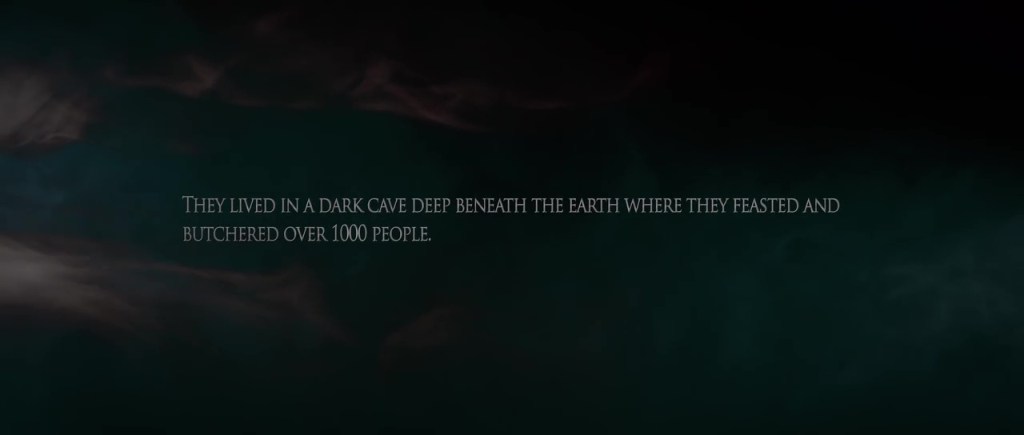
The Bean clan would ambush unwary travellers on the sparsely populated coast, but killing the victims and stealing their riches wasn’t enough to feed hungry, inbred mouths, because there were not a lot of pawn shops in the area, and eBay hadn’t been invented yet. Sawney’s revolutionary idea, a forerunner of modern serial cannibals, was take the bodies back to the cave and eat them, or preserve the flesh by pickling. The story goes that up to one thousand victims were so handled, making him, if real, the first and most prolific serial killer ever caught.
The reign of terror ended when a prospective victim escaped the Beans (although his wife did not) and alerted authorities. The king (possibly James VI) led a heavily armed party to capture the clan. Sawney and the men were condemned without trial and had their genitalia cut off and thrown into the fires, their hands and feet severed, and were left to bleed to death. After watching the men die, the women and children were tied to stakes and burned alive. By such methods is civilisation restored. Wes Craven based his film The Hills Have Eyes on the legend of Sawney Bean, it also makes a point about the vengeance of the civilised being as bad as the savage.
But, so the story goes, Sawney’s dying words were:
“It isn’t over, it will never be over.”
That’s where this film starts.
A descendant of the original Mr Bean now lives in Sawney’s cave, presented as the very image of a voracious mouth. The landscape here is a devourer, much like the peaks of the Andes, which looked like teeth in the movie Alive. Nature seeks to eat us up, from the bacteria and mosquito to the great white shark. We tend to see ourselves as outsiders to nature, at war with the natural world, but the cannibal reminds us that we are animals too, so he is, like nature, red in tooth and claw. Nature, like Sawney Bean, is indifferent to our pretensions of civilisation, merciless in killing and eating us (and this new Sawney likes a bit of rape too).
Lots of ultraviolence and growls and screams from Sawney’s hoodie-wearing kids.
Look, it’s a video nasty, which seeks to challenge the viewer with plenty of gore, shocks and carnage, and it succeeds to some extent. The plot has some annoying loose ends and is a bit thin, with sombre music announcing (as if we couldn’t guess) the forthcoming demise of anyone silly enough to wander around Scotland solo (which almost everyone in the film does at some stage). The acting is pretty great, particularly David Hayman, who has a ripsnorting and hilarious time as Sawney, spicing his cruelty with evil laughter. Like Sawney’s clan, the production seems to be a family affair, with direction by Ricky Wood, screenplay by his father Rick Wood and cinematography by his brother Ranald Wood. The cinematography is splendid, taking full advantage of the stunning scenery around Aberdeen and western Scotland.
The most scary image is Sawney’s mode of transport – a big, black British taxi. Those things terrified me when I was in London, and I can now see why. You get into one of those, and you might come out ready for Uber Eats.
Sawney also has a creature chained up at the back of the cave, and prepares tender morsels of brains, limbs, fingers and intestines, covered with “gravy” (fresh blood).
He hands the delicacy to his son, saying “give this to mother”. We eventually get to meet mother, and it doesn’t go well. How they made babies is hard to imagine. Maybe he slipped a roofie in her evening gore.
Sawney also tends to quote scripture and, like most who do that, picks the bits that suit him.
“Jesus said: unless you eat the flesh of man, and drink his blood, you have no life in you.”
The avenging hero is Hamish (Samuel Feeney), an investigative journalist with the requisite three-day stubble, an English accent and a Scottish capacity for alcohol. He goes to visit the Druid sacrificial site where the latest body was found, his girlfriend’s sister, or rather her head and someone else’s arms, all showing human tooth marks. He tells his recording device:
“Predatory killers often do far more than commit murder. Some have sexual desires, humiliation. They create gruesome rituals, as much for pleasure as for any other reason. This killer is not merely deranged, but evil.”
Well, maybe so, although the Bible-wielding Sawney would disagree. He feels that those he captures are fair game, prey for his hunters, and if he adds rape to cannibalism and murder, well, isn’t that pretty much what factory farms do, with their artificial insemination and culling?
No thriller would be complete without the bad guy spilling the beans to the hero, secure in the belief that he will soon be killing (and eating) the listener. Sawney tells the captive Hamish:
“You have to go back over 500 years and follow my bloodline. To the time when food was scarce, life was cheap, and only the ferocious survived.”
Then he’s back in the Bible, this time John 6:51.
“Any man who eats of this bread will have everlasting life on the bread that I give. This will be my flesh for the life of the world.”
And then verse 65:
“My flesh is meat indeed, and my blood is drink indeed.”
Yes, a favourite verse among Cannibal Studies scholars, and one that Sawney takes literally. He tells Hamish, as a slaughterhouse worker or a supermarket shopper might tell a pig,
“You’re just food, you’re a gift from God, which is who we are… You see, anyone can eat human flesh, you just have to make sure you wash it and garnish it well to avoid disease. Now, I particularly like the thighs and the calves… I prefer the taste of women to men, and I never eat hands or feet or testicles.”
Sawney would have been a hit as a judge on a cooking reality show.
It’s Hansel and Gretel, Captain, but not as we know it. This Mexican film is a visual experience, rather than a traditional narrative. It is set, like many of the films we have covered in this blog, after what appears to be an unexplained apocalypse. The “witch” is a crazy old guy named Mariano (Noé Hernández) who makes fuel out of old bread and trades it to persons unknown, through a hole in the wall, for food – mostly eggs and meat. Mariano is more Satan than witch.
He believes in chance, which, he says, is “the greatest criminal to ever roam the Earth.”
He is an aficionado of solitude, but when a young brother and sister, Lucio (Diego Gamaliel) and Fauna (María Evoli), appear in his abandoned apartment, he feeds them and puts them to work on ever more peculiar projects, such as a womb-like cocoon, made of wooden struts and vast amounts of packing tape.
Mariano receives some meat through the hole in the wall, and cooks it for his guests. But there’s a problem: Lucio is a vegetarian. Fauna tucks into her steak, rather reversing the normal situation where Hansel ignores Gretel’s warnings and eats the gingerbread. But Mariano has laced the meat with poison that, he says, the Nazis used to kill Jews. He won’t give Fauna the antidote until Lucio eats his meat.
So, it’s all about transgression, overcoming taboos, abandoning inhibitions, accepting pleasure rather than bothering with difficult questions of ethics. Mariano then decides that the kids need to have sex, and Lucio’s objection, that she is his sister, is dismissed:
“Do you think your cock gives a damn about her being your sister?”
So then there’s lots of incestuous sex, some of which is captured in lurid neon heat-map images. Mariano sings to them and masturbates as they perform for him, finally fainting as he ejaculates. Or dies, but is resurrected, because, as we know, the monster is never really gone.
The Brothers Grimm was never like this. Although who knows what siblings Jacob and Wilhelm Grimm got up to before they became philologists?
Anyway, we finally get to the cannibalism, about an hour into the film, as Mariano captures a soldier, tells him exactly what they have planned.
“We won’t kill you for money. We won’t kill you for an ideology. Or for the pleasure of watching you suffer. It’s not revenge for what you have done. We are neither avengers nor executioners.”
They sing the Mexican anthem and then slit his throat, catching his blood in a container. Various body parts are rendered into liquid and sealed into buckets, presumably to be traded through the hole in the wall.
Another girl comes into the maze looking for shelter, but is instead raped by Fauna and then Lucio.
Have we shattered every convention and broken every taboo yet?
Not quite. Mariano celebrates his naming day, a party in which all sorts of weirdos turn up and get it on. Mariano is to be the guest of honour, but also the main course.
“It is also the day I’ll live inside your squalid bodies. Don’t forget that the spirit does not reside in our flesh. Flesh is the spirit itself! So I kindly ask that all you lowlifes devour me until there is nothing left.”
There’s a twist at the end, but hey, enough spoilers. Go watch it – it’s only 80 minutes.
Catherine Bray in Variety called the movie a “joyously demented portrait of humanity.” She summarised the theme very well:
“Much of its most vivid imagery is purpose-built to interrogate the moral values society projects onto biological matter: human meat ground to a slush, slopping about in a bucket; a clitoral close-up; a pipette inserted casually into a hole in a boy’s temple; a sister’s gelatinous menses dripping into her brother’s mouth.”
The stubborn belief that humans, unlike other animals, have some sort of spirit that elevates us into the ranks of demi-gods and therefore justifies the havoc we unleash on the rest of nature has crumbled. As Mariano insists, flesh IS the spirit. We are meat, driven by our appetites. Our carefully crafted moral convictions can vanish like smoke in the face of hunger or desire.
Hansel and Gretel is a seminal cannibal text of course: innocents, abandoned for daring to expect to be fed, and left to face the voracious appetite of the outside world. Many of us probably first heard about cannibalism while sitting on a parent or relative or baby-sitter’s knee, crafting our next nightmare as they read us stories from the Brothers Grimm. Variants of the story are everywhere – a new movie is due soon (I’m looking out for it) called Gretel and Hansel. Here’s the trailer:
This is going to be a long blog, because Hannibal (three seasons 2013-15) really was one of the best shows on television, and although I am only covering the first episode here (out of 39 made), this was the pilot and introduced most of the main characters and themes of the whole “Hanniverse.”
The cancellation of the show after three seasons was apparently due to insufficient ratings. The surveys used to determine such decisions consider total numbers of viewers, but not the fervour of the viewing. Judging by the comments on social media (and some very weird stuff on Tumblr), the fans of Hannibal were fervent and avid (Francis Dolarhyde, the “Red Dragon”, who appears in Season 3, was of course the first to call himself an “avid fan” of Hannibal Lecter). It has since become a cult series, and far more people have seen it on DVD or streaming services than ever watched it on network television.
Episodic TV when it began was usually static: the main character, whether cop, lawyer or doctor, tended to be the same at the end of the episode, the antagonist dead or defeated. You could pretty much watch any episode in any order. Such was television before video and streaming: if you missed an episode or came in late, it was important that you could quickly work out what was happening, because there was no way to pause or go back. Streaming has opened this up, to the point where now protagonist can change, learn, grow and even die (think Breaking Bad, or Game of Thrones). Hannibal is all about growth. And death.
Hannibal Lecter (Mads Mikkelsen), the famous psychiatrist and infamous cannibal, is an avid fan of growth, evolution and death. Yet the chief protagonist of the series is ostensibly Will Graham (Hugh Dancy), who lectures to FBI rookies, and can recreate mental pictures of the murders being investigated. The first episode starts with a gory crime scene (there is some speculation that Francis Dolarhyde, who does not appear until Season 3, may have committed this particular crime). Will stands and watches the police as they take pictures and collect evidence, then closes his eyes. The heartbeat starts, and then the swinging pendulum, that will become familiar as the series progresses; these props allow him to recreate the murders in his mind, with himself in the disturbing role of perp. He looks for patterns that will help him put a motive and a face to the killer. Each step of each murder is accompanied by his mantra: “this is my design”.
Lecturing his students at the FBI academy, Will tells them: “Everyone has thought about killing someone, one way or another”. At the end of the lecture, Jack Crawford, (Laurence Fishburne), head of Behavioral Sciences at the FBI, asks him where he sits “on the spectrum”. Looking away, Will tells him:
“My horse is hitched to a post that is closer to Asperger’s and autistic than narcissist and sociopath”.
Will lives in Wolf Trap, Virginia, and rescues and adopts a multitude of stray dogs (People for the Ethical Treatment of Animals is also headquartered in Virginia, making it a very animal-friendly place). Will’s talent is empathy, and the imagination to see into the thoughts of others, even those whose dark secrets most of us would rather avoid.
This imagination is what Jack Crawford needs. Eight young women have disappeared, but no bodies have been found. When they find the eighth victim, whom Will discovers has been returned to the bed where she was killed, they discover that her liver has been removed, and then replaced. Why would the killer put it back in? The crime scene investigators Beverly Katz (Hettienne Park), Jimmy Price (Scott Thompson) and Brian Zeller (Aaron Abrams) are baffled. Like a Greek chorus, they explicate each mystery, and lay it out for Will to solve.
Just so, Will figures this one out: they are looking for a cannibal.
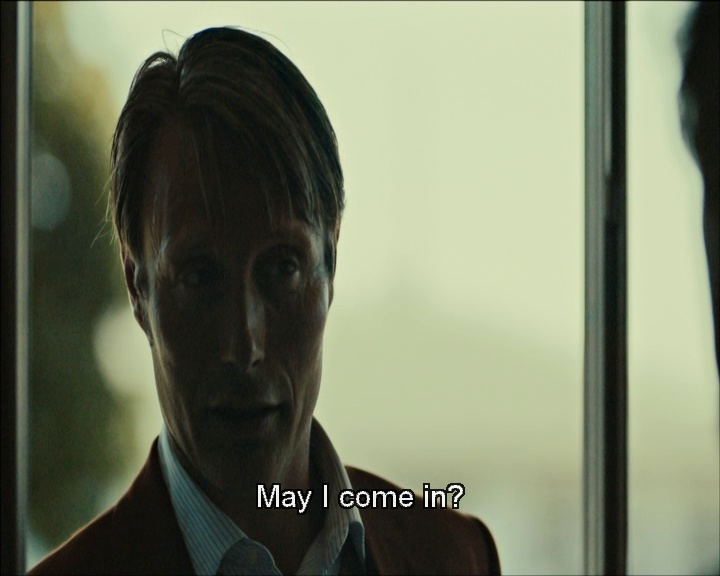
Hannibal Lecter, after whom the series is named, does not even make an appearance until 21 minutes into the first episode. This is the horror genre, so his introduction involves a close-up of his face, which “emphasize(s) its shadows to the point of engulfing it in pitiless darkness” (Deleuze & Guattari, A Thousand Plateaus). Pity, we will discover, is not one of Hannibal’s attributes. He appears to the music of Bach: the Aria from the Goldberg Variations, the music that Anthony Hopkin’s Hannibal requested in Silence of the Lambs, the music that he was playing as he killed and flayed the guards during his escape.
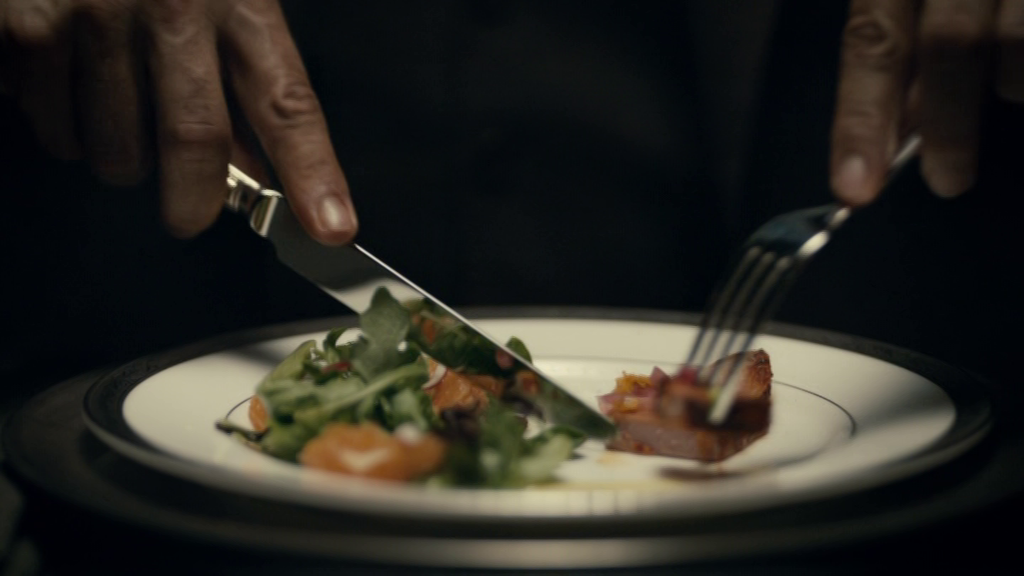
This new Hannibal is enjoying an exquisitely prepared meal of liver, certainly not a diseased one. He is then shown at work, wearing a perfectly fitted blue three-piece suit, analysing a neurotic patient, and annoyed by the blubbering of this patient, and particularly the snotty tissue he leaves on Hannibal’s perfect side-table. At the end of the session, he is visited by Jack Crawford, who admires his drawings, and compliments him on his academic work. He wants Hannibal to help with the investigation. Hannibal agrees, but it’s a whimsical project (and as Clarice Starling says in the book Hannibal, it’s whimsy that gets him caught). He plays with them – a game of hidden identity .
Hannibal is the Renaissance man in all aspects – educated, elegant, tasteful. Crawford wants his help with the case, but his brief really is to evaluate Will’s mental stability.
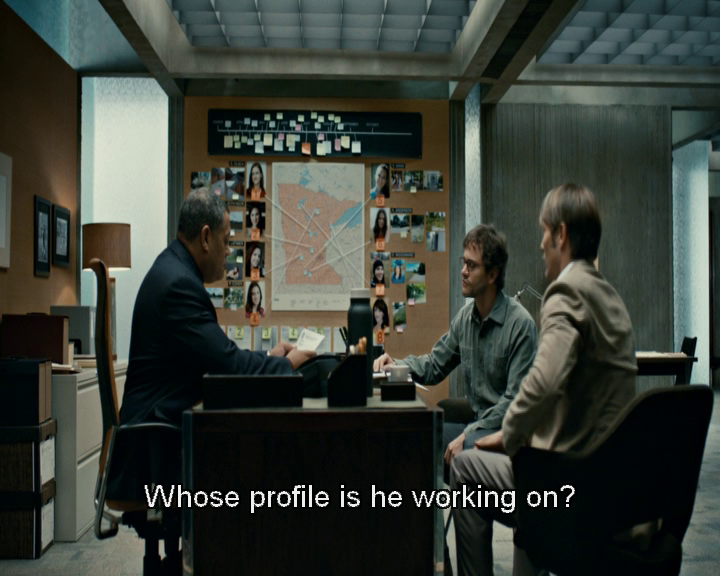
Will soon realises what is going on: “Jack, whose profile is he working on?” Hannibal is analysing Will. Keeping track of his potential issues. He will use this information later in the season.
A ninth victim is found in a field, impaled on stag-horns. Velvet from such antlers was found in the wounds of number eight, but possibly was put there as a healing agent, an apology. The police and the gutter press (the gossip paper is now called TattleCrime) start calling the killer the “Minnesota Shrike”, named after a bird that spears its prey on sharp objects and then carries off the flesh for later consumption. Will immediately realises that this is not the work of the same killer.
This slideshow requires JavaScript.
The team finds that the victim’s lungs have been removed. In the next scene, Hannibal is preparing, flaming and enjoying a healthy dinner of lungs.
It’s time for Will and Hannibal to go do some FBI investigating (no Supreme Court jokes, please). You may remember that in Bram Stoker’s book, Dracula could never enter a house unless he had been invited. Well, if you don’t remember that, I think Bryan Fuller certainly did:
Hannibal takes an immediate interest in Will. Later in the series, we will see this develop into something resembling love, but let’s not get ahead of ourselves. At this stage, Hannibal sees a kindred spirit and wants Will to grow – he wants to (re)create Will in his own image. For Season 1, only we, the audience, know that the image he wants to recreate is that of a serial killer and cannibal. A man of such superior taste and discernment that eating humans is of no more consequence to him than eating a pig. A ‘super-man’, what Nietzsche called an “Übermensch”. He sees that potential in Will:
The teacup will become a very important plot point later in the show. Hannibal accepts Nietzsche’s “amor fati” (the love of fate) and so is a fatalist, but he also watches Stephen Hawking’s videos and hopes that, if the universe reverses its expansion and time begins to flow backwards, his sister will be resurrected. More on that in a later blog.
Very few characters in Hannibal or the books or films previous to this series refer to Lecter as anything other than “a monster”. Monsters are supposed to scare us, fill us with dread of the “other” who plans to ambush and devour us alive. The genre owes much of its success to our evolution from the tiny, prototype mammals who lived, hundreds of millions of years ago, in terror of the dominant reptiles. We can go back further; most animals will feel fear when faced with a predator. Fear is a biological necessity, a warning; fear keeps us alive. Monsters are grotesque, horrifying, easily identified. Frankenstein’s creature, Dracula, the Wolfman – these are what monsters should look like.
But Hannibal is not such a monster. He is a well-respected psychiatrist, a snappy dresser, a renaissance man who loves art, classical music and rare wines. He is also a sophisticated gourmet cook, albeit with a slightly wider range of meats than your average chef. But here’s the main thing about Hannibal – we like him. It’s difficult to like Dracula, or the Wolfman, or the Walking Dead. But it’s hard to dislike Hannibal, and his evident pleasure in his meals only makes us appreciate his skill the more, even as we realise what he’s cooking. He accepts the consequences of his decisions: Hannibal has staged the copycat crime as a mirror image that will lead Will to the killer, and ensure that Will will have to use lethal force, the trauma of which will change him. Change, growth, death. But the serial killer, Garrett Jacob Hobbs, has killed all those girls because he doesn’t have the heart to kill his daughter, for whom he has incestuous feelings (the other taboo that Freud used to lecture us about).
When Hannibal warns Hobbs that the FBI “know”, Hobbs kills his wife and slits his daughter’s throat, forcing Will to shoot him. Hobbs’ final words to Will are “You see?” Will sees: he sees death, he sees change, he sees the thrill of the chase and of the kill.
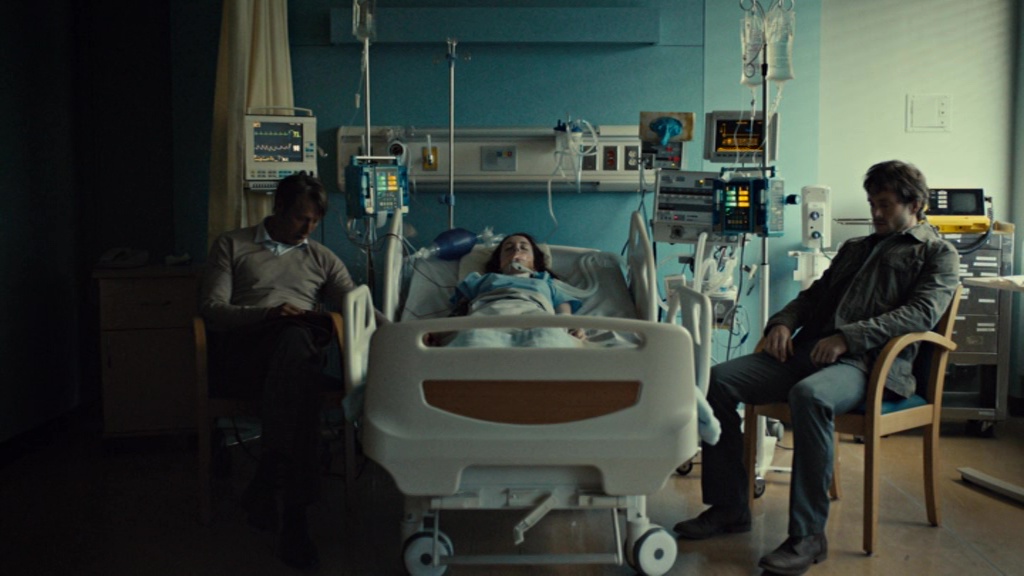
The daughter, Abigail (Kacey Rohl), has been orphaned and almost killed by Hannibal’s ploy. She is collateral damage in Hannibal’s design. Hannibal rarely admits to regret, but he still can take responsibility for this girl, for reasons that will become a little clearer later when he addresses the death of his sister. Will finds Hannibal in Abigail’s hospital room asleep, head bent sideways, clothes crumpled, the devoted parental figure guarding the child.
The character Victor Frankenstein in Mary Shelley’s Frankenstein was terrified by his creation. Similarly, in the foreword to the book upon which the Hannibal series is based, Red Dragon, Thomas Harris considered Hannibal a monster, and was also terrified by him. He described “meeting” his characters as he wrote them:
“I am invisible to my characters when I’m in a room with them and they are deciding their fates with little or no help from me…. Graham and I went on to the Violent Ward and the steel door slammed shut behind us with a terrific noise. Will Graham and I, approaching Dr Lecter’s cell. Graham was tense and I could smell fear on him. I thought Dr Lecter was asleep and I jumped when he recognised Will Graham by scent without opening his eyes. I was enjoying my usual immunity while working, my invisibility to Chilton and Graham and the staff, but I was not comfortable in the presence of Dr Lecter, not sure at all the doctor could not see me.”
Luckily for us, unlike Dr Frankenstein, Harris did not abandon Hannibal to his own devices but gave him brilliance, taste and opportunity. And a massive superiority complex.
Bryan Fuller, the showrunner, reimagined some of the plot and many of the characters. Jack Crawford is now black, Alan Bloom is now Alana Bloom (Caroline Dhavernas) and is a kind of love interest for Will, the journalist Freddy Lounds is now Fredricka “Freddie” Lounds (Lara Jean Chorostecki). Many of the other characters we knew from the books and movies will be reinvented in later episodes with different skin colour, sex or other characteristics.
Hannibal Lecter himself is quite different, and not just because he is now played by a Danish rather than Welsh actor. Hannibal actually grew more complex and nuanced in each textual rendition of the previous stories. In the book Red Dragon, he was called a psychopath, and Will reported that he had tortured animals as a child, which is a very common marker of that affliction. But by Hannibal Rising, the prequel book and film that explained Hannibal’s history, he is a deeply traumatised child who has witnessed (and perhaps indulged in) the cannibalism of his baby sister. However, his cruel responses are never to non-human animals and never to weaker children – Hannibal picks on the bullies at his orphanage, and his first murder is a vulgar and uncouth butcher who insults his aunt. From that time, he prefers to eat the rude – “free range rude” as he calls them. In the films (most of them) Anthony Hopkins played Hannibal as brilliant but twisted, the crazed jester.
Mads Mikkelsen prefers his Hannibal to be a fallen angel – the devil himself, first diagnosed by a gypsy in the book Hannibal, but brought to full rendition by Bryan Fuller, Mads and the production crew. Director of Photography James Hawkinson explained how this effect was achieved from this first episode, where Hannibal emerges from the chiaroscuro effects that are so prominent in the show:
“He’s basically Satan hiding in plain sight. He’s right there in front of everybody, but no one is able to see him for what he really is. We determined that he should always be shrouded in a certain amount of darkness because of that.”
The use of darkness continues through the whole series. Consider the scene in Will’s motel room, where Hannibal brings Will a breakfast of sausages and almost certainly turns him into an ‘innocent’ cannibal with their first shared meal. What’s in those sausages? What’s really in any sausage?
Hannibal brings the darkness into the lives of the other characters as he instructs, feeds or kills them. Hannibal has reversed the Frankenstein story: the talented doctor is now the killer, creating serial killers, super-men and women in his own image. Far from running away from his creations, he devises convoluted ordeals to forge their new personas.
Satan, if he walked among us, would no doubt ensure he was rich, brilliant, and a connoisseur of all the good things of life, those things that the rules of religious humility would disdain. He would also be incredibly powerful. He would be a super-man, an Übermensch. I’ll get to Nietzsche when we arrive at Season 2. That may be a while. Super-men, like psychopaths, are very hard to catch.
If you like my blog, please feel free to recommend it (with discretion) to friends on social media.
If you have any questions or comments, you can use the tag, or email me on cannibalstudies@gmail.com.
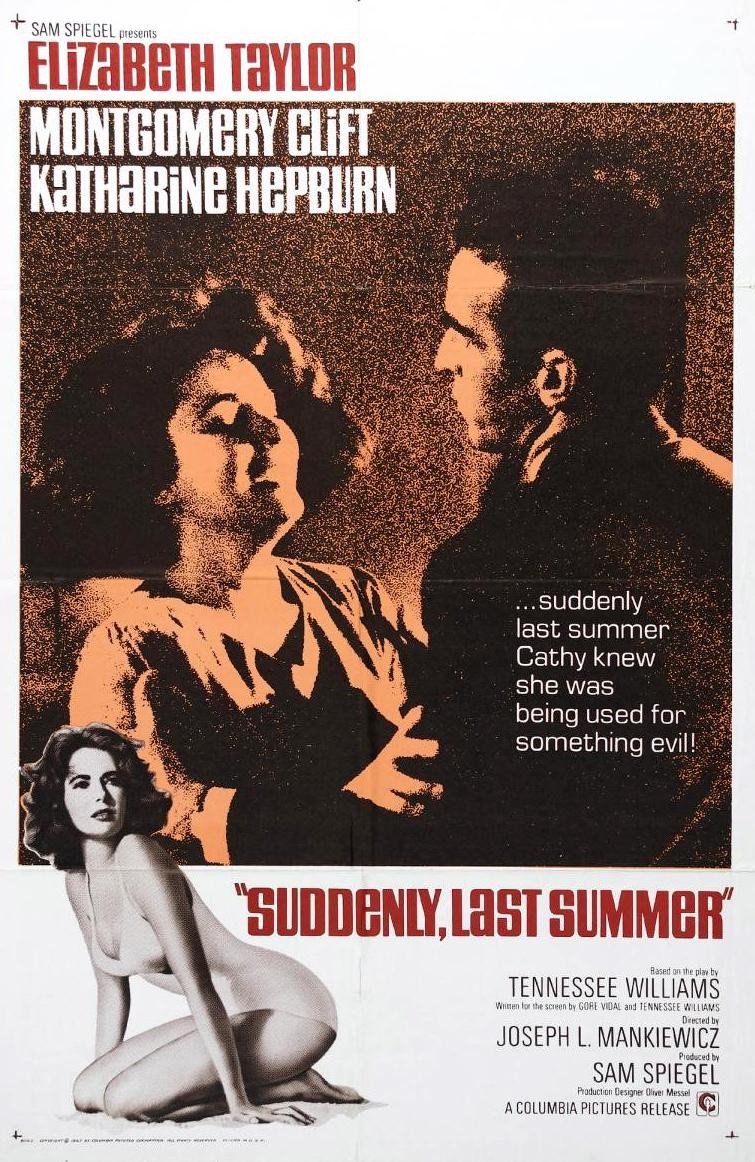
Some movies drip with stars, to the extent that you start to wonder if most of the conflict in the film was about who would get higher billing. Not this one – as well as star power, we have a story of homosexuality and cannibalism, and it’s not totally clear which was more shocking to the audiences of 1959.
As for the stars – we have Elizabeth Taylor, Katherine Hepburn and Montgomery Clift, in a film directed by Joseph L. Mankiewicz (All About Eve, Guys and Dolls, Cleopatra, etc), and loosely adapted from a play by Tennessee Williams. Gore Vidal wrote the screenplay. A veritable galaxy of stars.
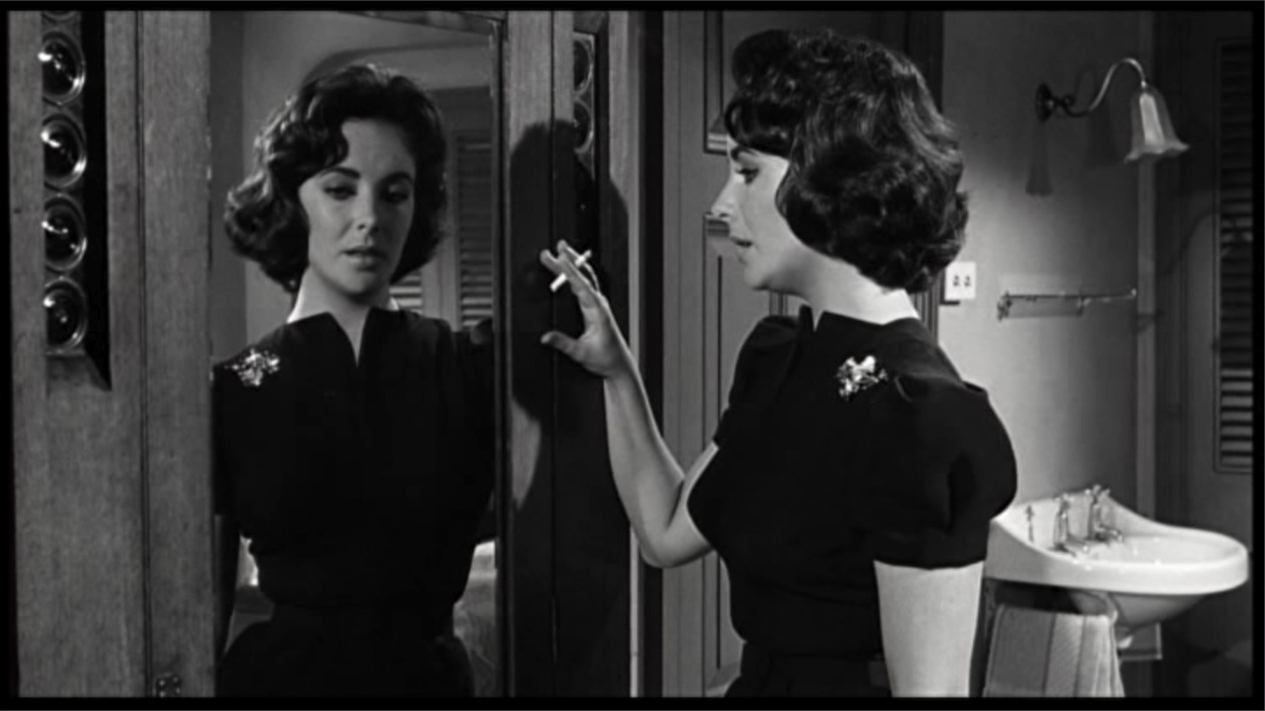
The film is about a young woman who has descended into mental illness due to a traumatic experience with cannibalism, the details of which the audience are not shown until the very end. Catherine Holly (Elizabeth Taylor) is being evaluated by a psychiatrist, Dr. John Cukrowicz (Montgomery Clift), at the insistence of her wealthy New Orleans aunt Violet Venable (Katherine Hepburn). Violet suspects there is more to her son Sebastian’s death than she wishes to become public, and offers to finance a new wing for the hospital if they will pressure Dr Cukrowicz to give Catherine a lobotomy (which is what had happened to Tennessee Williams’ sister). Violet hopes thereby to remove the memory of what happened to Sebastian (who is only seen in flashbacks and never front on), while Catherine was travelling with him in Spain “last summer”.
Sebastian has rejected his smothering mother, with whom he has had an almost Oedipal relationship, and instead has been using his cousin Catherine, as he used his mother on earlier trips, to attract young boys, whom he then procures for sex. Sebastian’s appetite changes though – just as he discarded his mother when she got older, now he no longer wants these Spanish boys: he says he is “fed up with the dark ones” and is “famished for blondes”, intending to head to Northern Europe.
Catherine reflects on her naivety
Catherine in the final scene is given a truth serum by her psychiatrist and finally recalls Sebastian’s death. She remembers that the boys followed Sebastian, calling for bread (pan), and when he refused and ran, they chased him, tore him to pieces and ate his flesh.
“…there were those children along the beach which was fenced off with wire. Our table was less than a yard away from the wire fence. And those… children… there was a band of them, they looked like a flock of plucked birds and they came darting up to the wire fence as if they’d been blown there by the wind by the hot white wind from the sea. And they were all calling out… Pan Pan Pan.”
Psychiatry and cinema evolved together and are closely tied, particularly in cannibal films (consider Hannibal Lecter), where madness is sometimes used as a convenient explanation to avoid deeper social analyses. This film brings together complex themes that often were avoided in the 1950s. In the conflict between the rich tourists and the starving children of the seaside village we witness savagery as a response to a colonialist mentality of exploitation, objectification in Sebastian’s use of the boys and of his relatives as sexual objects to bait the boys, voracious appetite and the breakdown of normative morality. Sebastian’s sexual appetite is mirrored in the hunger of the boys he has abused, enjoyed and abandoned.
“…cousin Sebastian was, he was lying naked on the broken stone… and this you won’t believe…nobody, nobody could believe it… it looked as if they had devoured him…as if they had torn or cut parts of him away with their hands or with knives or with jagged tin cans they made music with. As if they had torn bits of him away and stuffed them in their gobbling mouths.”
Tenessee Williams hated the adaptation of his play. To him, the cannibalism should have been metaphorical, not graphically represented (although it was certainly polite by today’s standards). He wrote:
“I walked out. Sam Spiegel, the producer, gave a private showing of it at a big party, and I just got up and walked out. When you began to see Mrs Venable, and it became so realistic, with the boys chasing up the hill – I thought it was a travesty.”
The New Yorker called the film “a preposterous and monotonous potpourri of incest, homosexuality, psychiatry, and, so help me, cannibalism.”
It’s not totally clear how a film about incest and homosexuality got round the Hollywood “Production Code”, which had strict rules against such immoralities. Critics have opined that Sebastian’s grisly death gave the film a free pass, because, the review board said, it “illustrates the horrors of such a lifestyle” and “can be considered moral in theme even though it deals with sexual perversion.” Weirdly, the cannibalism seems to have cancelled out the homosexuality.
Anyway, it was a hit at the box office due to its big stars and scandalous content, earning $6.4 million on release, a tidy sum in those days. Both Katharine Hepburn and Elizabeth Taylor received nominations for the Academy Award for Best Actress.
The film pressed all the buttons of 1959 America: homosexuality, incest and cannibalism. But what happens to the cannibals? The film leaves them on the top of the hill, their mouths stuffed with pieces of Sebastian. Like the angel of death in Violet’s parlour, they have passed judgement on Sebastian’s proclivities and handed him a sentence equally unpardonable (in those days) – to be eaten alive. Presumably they remain there, ignored and hungry until another rich man seeks to sate his appetite by arousing theirs. There is no judgement offered – these cannibals are simply forces of nature, a “flock of plucked birds”. Savages inhabiting our own travel itineraries.
If you like my blog, please feel free to recommend it (with discretion) to friends on social media.
If you have any questions or comments, you can use the tag, or email me on cannibalstudies@gmail.com.


























 The Cannibal Guy