Cannibalism news – the 2024 round-up

‘There will be cannibalism, and rumours of cannibalism”

Yes, I paraphrased the Book of Matthew. Although not all that many people got eaten, the media was full of cannibal stories, and here are a few of them, sorted by their places of occurrence.

Australia

One of the men imprisoned for the so-called Snowtown murders (which mostly did not take place in the little town of Snowtown) was released. Mark Haydon was charged with assisting the men who did the actual killing and who ate part of one victim’s leg some 25 years earlier.

Brazil

Influencer Israel dos Santos Assis, better known online as Pinguim (Penguin) was arrested for desecrating graves in the cemetery of San Francisco the Count in the Salvador Metropolitan Region, stealing human bones, and using human flesh from the corpses to cook his most popular dish: feijoada, a bean stew usually involved simmering beans with beef or pork. Seems rotting human is a good substitute for pork.

Canada

Robert Pickton, the pig farmer convicted of six counts of second-degree murder (although he was charged with at least twenty others), was attacked by another inmate in prison and died a few weeks later. Pickton allegedly “processed” the meat of his rape and murder victims by feeding them to his pigs and, police said, possibly mixing them up with pork products he sold to his neighbours for their personal consumption.

China

Netflix released a new version of the classic science fiction book 3 Body Problem and ran into a storm of criticism from China for its depictions of the extreme violence of the Cultural Revolution. Although most of the victims of the purges were killed by shooting, live burial, drowning, boiling alive, and disembowelling, there is evidence that several hundred had been cannibalised, as the ultimate in humiliation.

The General who presided over a Cultural Revolution massacre that included cannibalism of those deemed “enemies of the people”, Wei Guoqing, was reburied (or at least his ashes were) with full honours in Beijing’s Babaoshan Revolutionary Cemetery – the resting place of China’s high-ranking leaders and revolutionary heroes. Wei’s name is most strongly linked in the public mind with cannibalism during the massacre period in Guangxi’s Wuxuan and Wuming counties and Nanning city. Researchers have found that at least 137 people were eaten, with thousands participating. “Paying tribute to a legendary gourmet,” wrote one wag on social media.

Cuba

Stories began circulating this year that the extreme food shortages in Cuba were leading to the danger, or actual occurrence, of cannibalism. This was bolstered by reports from 2022 of two hospital workers who had been stealing hearts and fat from human bodies and selling them as mince.

Haiti

Rumours circulated that the natural disasters and gang violence in Haiti was leading to starvation cannibalism. Jimmy Cherizier, a gang leader called Barbecue (“Babekyou” in the local parlance) was known for his penchant for burning people alive, and there was at least one video on Twitter/X of one gang member supposedly “tearing flesh from the leg of a burning corpse and eating it.” Such stories cannot be selfishly maintained by one little country, so of course it was not long before Bill and Hillary Clinton were accused of joining the cannibal feast. To add to the hilarity, Elon Musk posted on his own site, X, that a picture of a man near a fire was evidence of cannibalism, only to have the post removed by his own team for violating community standards. The fact-checking website Snopes pointed out that videos of bodies in Haiti being roasted on spits had previously appeared as accusations against a Nigerian restaurant, and were in fact from a Halloween prank in China in 2018. Still, you know, voodoo and all. Meanwhile, Trump ally Laura Loomer supplied conclusive proof that Haitians were cannibals: apparently, if you Google it, you will see a lot of results. The Prosecution rests its case.

India

India’s top court put a temporary stay on the execution of a man convicted of killing his mother and eating her remains in what is being deemed as the “rarest of rare” cases of cannibalism. Sunil Rama Kuchkoravi of western Maharashtra state’s Kolhapur district was handed a death penalty by a lower court in 2021 for killing his 63-year-old mother in 2017. The High Court in October this year upheld the death sentence against Kuchkoravi, stating that the convict possibly has a “syndrome of pathological cannibalism”. The execution has been delayed until the case is reheard in April 2025.

Israel (and around there)

Francesca Albanese, the U.N. special rapporteur for Palestinian rights, has been condemned for antisemitic rhetoric by the governments of the U.S., France and Germany among others. Albanese, known for accusing Israel of genocide (an odd charge seeing that the population of Gaza has increased in the last twelve months), wrote that the Israeli army was “rotten to the core”. A follower immediately introduced the classic blood libel: “Jews are capable of eating human flesh”, to which Albanese replied along the lines of “not all Jews”. Reassuring to note that a person paid by the taxpayers of the West, who finance the UN, can admit that some Jews are not cannibals!

A Yazidi woman was rescued from Gaza by Israeli troops. She revealed that, after being captured by ISIS in 2014 and forced to be sex slaves, the women were starved and finally fed meat which, they later told her, was from the bodies of a beheaded Yazidi baby, the child of one of the women. They told her:

We cooked your one-year-old son that we took from you, and this is what you just ate’.

Indonesia

Police investigated a suspected cannibalism case in West Java Province. The Head of the Criminal Investigation Unit confirmed that a video on social media showed the alleged perpetrator consuming a small portion of the victim’s flesh. He said that police had found 12 body parts of the victim at the crime scene.

Italy

An inmate in the notorious Poggioreale Prison in Naples tore the finger off another inmate and ate it. The Campania Guarantor, Samuele Ciambriello, observed that “it is now clear that the Poggioreale prison needs a structure suitable for hosting inmates suffering from mental disorders.” Seems like a good idea.

Mexico

A podcast called Mexico Unexplained revisited this year the story of Gabriela Rico Jiménez, a 21-year-old model from Mexico who disappeared some 15 years ago, after raging against the machine outside a fancy hotel in Monterrey Nuevo Leon. Ranting about the elites, including oddly the Queens of England and Germany (which is a Republic), she had shouted that “They ate humans! Disgusting!… They smell like human flesh!”

Nigeria

A man accused of being a sorcerer was blamed by villagers of the small town of Kirikiri for the disappearance of several children and elderly people. He was supposed to be “feeding on the flesh of the innocent.” Several claimed to have located the individual on the edge of a forest, wearing clothes “stained with blood” and mumbling mysterious incantations. A group of villagers beat the man and left him for dead.

Russia

Erkinzhon Abdurakhmanov, 47, intended to cure his own heart problems ‘after making a pact with the devil’, he told police. He killed a 65-year-old male pensioner in the Kuyurgazinsky district of Russian region Bashkortostan by striking him three times with an axe, according to reports. He then then cut out the heart and ‘ate the meal’ as he waited at a bus stop. He gave the uneaten remains to a woman also waiting for a bus ‘and asked her to bury it’. He was not arrested, however, until he headed into a liquor store and tried to steal some drinks. Cannibalism is not against the law in Russia, but murder and stealing alcohol is.

Vladimar Putin’s policy of giving pardons to criminals who agreed to fight in Ukraine in lieu of serving their sentences, was honoured in a pardon to a charmer named Denis Gorin, who had been convicted of at least four murders, and had eaten the flesh of his victims.

Another pardon involved Dmitri Malyshev. Malyshev was sentenced to 25 years in prison in 2015 for multiple criminal offences. Ten years ago, he murdered an acquaintance, a Tajik native, and then filmed himself cutting the heart out of the victim and roasting it in a frying pan and eating it. Neighbours seemed uneasy about his imminent return home.

South Africa

On December 26, 2024, eight illegal miners known as zama zamas emerged from Shaft 10 of a mine near Stilfontein, located in Northwest South Africa. They were taken by police, who confirmed that twelve bodies remained trapped beneath the ground, with miners reportedly resorting to eating human flesh due to severe food shortages.

Ukraine

Novosibirsk Archpriest Alexander Novopashin became notorious for claiming that Ukrainians are “cannibals”. Although conspiracy theories about cannibals are becoming more common, this particular Archpriest is taken seriously in Russia, and regularly lectures Russian security forces and soldiers.

UK

Marius Gustavson, who called himself “the eunuch maker”, offered a service where he charged men to destroy or remove their testicles, and then charged subscribers to his website to see him perform the operations. The court heard that that there was “clear evidence” of cannibalism and that Gustavson had “cooked testicles for lunch in an artfully arranged salad platter”.

Meanwhile, a candidate from a party called Reform UK was suspended for saying that meat-eaters should “eat other humans” and said humanity should be “obliterated”. Just saying what many are thinking, perhaps.

USA

The cannibal story of the year was the President, Joe Biden, claiming that his uncle had been eaten by cannibals in New Guinea. The leaders of PNG took exception to the stereotyping of their people as cannibals. Apparently, only some of them had been.

Speaking of Presidents, Donald Trump embellished his rhetoric on immigration by pointing out that some of the undocumented people pouring over the border were from insane asylums, and called that “Silence of the Lambs stuff”. Trump had previously claimed that Hannibal Lecter had endorsed his candidacy, which is a bit odd since Hannibal is a fictional character, but by far not the oddest claim in the 2024 election.

In March, a homeless man in Kern County was arrested for picking up the leg of a person who had been killed in a train accident and chowing down on it. California has no laws against cannibalism, but he was charged with “mutilating the body” which is a bit odd, since the train had already done that.

In Utah, which also has no law against cannibalism (Idaho is the only state that does), a law was passed to criminalise the ‘ritual abuse of a child’, which apparently regularly includes making the little ones eat “organic substance or material” (i.e. bits of people) before they are allowed to have their desserts. This in addition to claims that such rituals would sometimes involve eating the children instead.

A keen-eyed traveller pointed out that the road once taken by the Donner Party, which ended up in them getting lost and eating each other, was now signposted with a sign indicating dining was available. Much hilarity ensued on social media.

Conservative political commentator Candace Owens managed to link transexuals, Native Americans and cannibals, all in one sentence. No wonder she is so widely admired.

Much to the relief of the good people of Idaho (the only State in the Union with laws against cannibalism), the law was amended to ensure that giving someone else human flesh to eat was also prohibited. This led, on its long road to farce, to the accusation that bodies were being turned into compost which could be used to grow food for humans to consume. Rather than DNA test all compost, the law confined itself to banning the act of deliberately giving human flesh to another person. The legislator who introduced the bill cited a disturbing case on the show TruTV, which she admitted might have been a prank (it was) in which diners were told they had been eating human flesh, just to whet their appetites perhaps.

Ariana Grande raised some eyebrows when she was asked on a podcast whom she would most like to dine, and named Jeffrey Dahmer. Not sure Dahmer would have agreed – he was more into man-flesh, and there’s not much meat on Ariana anyway.

In April, a man was arrested in Las Vegas for eating a victim’s eyeballs and ears. The victim was pronounced dead. What happens in Vegas stays – internal.

Talking of ears, Mike Tyson, famous for biting the ear of Evander Holyfield in a fight in (where else) las Vegas in 1997, released a line of marijuana gummies shaped like nibbled ears.

Allegations were raised that Gilgo Beach ‘serial killer’ Rex Heuermann’s family was involved in the murders, which took place near the remote beach town of Gilgo in Suffolk County, New York from the 1990s to 2011. His daughter, who likes to paint the odd Satanic scene including body parts and cannibal feasts, was accused of being involved in his depredations. Homicide experts said that was insane, a word that gets tossed around a lot in cannibal stories. Heuermann was charged with a seventh murder last week.

On October 9, a woman in Kentucky, Torilena May Fields, was arrested after a dismembered body was found behind a home in Northern Kentucky and cooked human body parts were found in the oven. The body, and its parts, turned out to have been her mother. She was also charged with cruelty in that she “intentionally tortured and killed a domestic dog.”. A contractor found the dismembered body of the mother, and told police the perp had been “casting spells.” Her bail was set at $1.5 million. Her next court appearance is set for March 10, 2025 in Robertson County.
Some people just give cannibalism a bad name.

Another Kentucky woman, a former youth counsellor, was arrested for allegedly discussing cannibalism and other hobbies with a convicted murderer.

In Oklahoma, Kevin Ray Underwood was executed by lethal injection in December (on his 45th birthday, the press gleefully informed us) for killing a ten-year-old girl in a “cannibalistic fantasy.” The man admitted to luring the girl into his apartment and beating her over the head with a cutting board before suffocating and sexually assaulting her. He told investigators that he nearly beheaded her in his bathtub before abandoning his plans to eat her. So not really a cannibalism story, but near enough.

International

Citizen of the world, Donald Duck, appeared on the interview show Hot Ones on the Internet (which is global), where guests eat chicken wings with hot sauce. Turns out Donald is a vegan though, preferring cauliflower, and since ducks aren’t chickens, the controversy that ensued over whether he was (or would have been) a cannibal by partaking of chicken was just silly.

HAPPY NEW YEAR, and may your worst problems be mild gastro-oesophageal reflux.

And don’t forget to go to the dentist.

Dinner with Dahmer—Ariana Grande’s cannibalism fantasy

Ariana Grande managed to raise some serious eyebrows when she was asked on Penn Badgley’s podcast in June 2024 whom she would most like to have dinner with. She replied:

“Jeffrey Dahmer’s pretty fascinating. I really wish I could have met him.”

The mother of Tony Hughes, one of the men Jeffrey Dahmer murdered, criticised Grande last week, calling the singer “sick in her mind.” Tony’s sister, Barbara, told TMZ that she hopes Grande will apologise for her comments, and both shared disappointment in the singer’s apparent lack of empathy for the victims’ families. “Unfortunately, until it happens to her and her family, she just doesn’t know what we have been through,” Barbara said.

Jeffrey Dahmer murdered seventeen boys and young men between 1978 and 1991, mainly people of colour, and after his arrest spoke freely about consuming body parts from some of them.

According to Grande, her fascination with Dahmer began “years ago before the [Netflix] Dahmer series,” and she had mentioned it to young fans when she was a Nickelodeon star.

In the podcast, Grande suggested she would like to meet Dahmer, but “maybe with a third party or someone involved. I have questions,” she added.

Grande is a big deal in the world of celebs. She had reportedly sold over 85 million records and accrued 98 billion streams (so far), making her one of the most-streamed artists of all time. She was the most-streamed female act of the 2010s and has the second most songs with over a billion streams for a woman. Grande also has a massive social media following; with over 380 million followers, she is the sixth-most-followed individual on Instagram and one of the most-subscribed and most followed musicians on YouTube and Spotify.

I guess that keeps her busy, because honestly there is so much Dahmerabilia on the web that having dinner with him would be unnecessary (and messy, since he had his head caved in by another prisoner in 1994). Ryan Murphy made a hugely popular re-enactment of the case for Netflix in 2022, although it had been done before and rather well by Jeremy Renner (playing Dahmer) in a movie made by David Jacobson in 2002. Then there are the tape recordings – his defence team released their tapes of interviews with him a few weeks after the Ryan Murphy doco went to air. In 2023, Dahmer’s dad released his own interview tapes together with home movies etc, on Fox Nation. In prison, before his death, Dahmer was open and transparent about his activities with a range of interviewers. Not sure how much was left to uncover over a nice dinner of fava beans and a big Amaroni?

Some of the news reports have rather pompously asked if her preference for a cannibal for dinner means that she is therefore a cannibal herself? Well sorry guys, but we happen to know that Ariana is a vegan, and has been since watching the documentary Forks Over Knives in 2013. Ariana told a UK paper:

“I love animals more than I love most people, not kidding.”

She insists that (besides being kinder to animals and better for the environment) going vegan has improved her health immensely.

“The way I’m eating now has actually helped even out my blood sugar. As some of you guys may know, I’ve struggled with awful hypoglycemia for my whole life and it’s improved a ton since I changed my eating habits.”

Would Ariana eat a human at her dinner with Dahmer? About as likely as her eating a cow or a pig!

“Every cannibal wants to be a director”: LONG PIGS (Nathan Hynes, Chris Power)

Long Pigs is a 2007 “found footage” movie, in which two desperate filmmakers come across a cannibal, ask him if they can document his eating habits, and then are shocked when he starts killing people and eating them. It is presented as a documentary, with all the usual warnings about graphic scenes etc.

Bit silly, and found footage has rather been done to death, but it has some interesting ideas, particularly the sympathetic approach to the main character, even as he commits his crimes. Look, it seems to say, everyone needs a hobby and, to this cannibal, killing and eating people is no more ethically questionable than hunting or fishing. Stalk, catch, kill (as quickly and painlessly as possible) and then enjoy. He does his best to keep the movie interesting, with a patter of jokes, historical facts and philosophical observations as he slices and dices.

The cannibal is played by Anthony Alviano (Headcase, A Matter of Justice), and he presents the cannibal, also called Anthony, as a boy-next-door persona, one who kills and guts people. Like a farmer of animals, he starts the film explaining that it’s bad to frighten the victims, not for ethical reasons, but because the adrenaline ruins the taste of the meat. The filming starts as he drives around looking for a “certain kind of woman”, because he wants to make “long pig stew”. “Long pig” is a term supposedly used in the Pacific region before colonisation to designate human meat, although that definition is widely contested. Anyway, Anthony is looking for “marbled meat”, so he searches for a sex worker (traditionally victims who are not exhaustively looked for by police) who is, let’s say, of a heavy build.

“People who eat stew make perfect stew. It sounds obvious. Yeah, she looks like she eats well.”

As she smiles at the camera, he sneaks up behind with a sledgehammer and cracks her skull, resulting in the cameraman vomiting (which is actually rather more gross than the murder). They ask Anthony if gets a sexual thrill from killing women, but he dismisses this, in the same way a slaughterhouse worker might deny any pleasure in killing a different species of mammal.

“I’m not a freak or anything like that. This is all culinary, this is hard work!”

“Any hunter would recognise this position. We got the corpse hanging by the ankles. The first thing I’m gonna do here is make a little incision and tie off the anus. That’s to stop contamination from the feces. You would do that whether it was a deer carcass or a cow or a person… Absolutely necessary for health reasons.”

He cooks a stew from a portion of her thigh, then after dinner goes off to brawl in an ice-hockey game, an arena that seems the very essence of carnivorous virility.

Afterwards, he cooks ribs on a barbecue, assuring the viewers that there are “no animal by-products” used – just soymilk. And a woman’s ribs, of course, thus reinforcing the anthropocentric mythology of the human as not really animal, even though he has just butchered one in the same way as any other animal prepared for human consumption. He quotes the Arawak word barbaca, the grill on which human meat was supposedly cooked, according to explorers like Hans Staden and Jean de Léry, which became the Spanish word barbacoa, and eventually morphed into English as barbecue. Staden’s narratives were later illustrated by Theodor de Bry in his 1592 book Americae Tertia Pars, and the film sneaks in a quick peek at that glimpse of sixteenth century sensationalism.

There’s a lot of moral philosophy interwoven in the scenes of murder and gastronomy. Anthony the cannibal and his friend try to persuade the filmmakers to try some of the ribs, saying, it’s dead, and therefore cannot suffer, whereas we eat live vegetables, and “broccoli feels pain! Did you know that?” This is precisely the argument tossed at vegans by carnists, but in this case, it demonstrates the contention of the nutritionist Herbert M. Shelton:

The cannibal goes out and hunts, pursues and kills another man and proceeds to cook and eat him precisely as he would any other game. There is not a single argument nor a single fact that can be offered in favor of flesh eating that cannot be offered with equal strength, in favor of cannibalism.

Anthony works as a valet in a fancy restaurant, parking cars for rude people, and if you follow the lore of Hannibal Lecter, you will know that rude people are prime targets of cannibals. They park the car of a particularly rude man, take down his address from his licence and, next day, shoot him and load him in their car trunk. Unfortunately, they have a flat tyre and have to head to a pig farm for help, where they witness pigs being slaughtered and prepared for sale, in identical ways to Anthony’s own processes, but with rather better technology, and, oh yes, totally legally.

Most of the film is a spoof on cooking shows, which regularly have smiling chefs, or hopeful chefs, preparing lumps of animal flesh, hoping to win prizes. Anthony shows, in high-speed motion accompanied by the music of the Sugarplum Fairy, exactly how he prepares a body, stripping it and dismembering it until all that is left is two feet (still in socks) and the long femurs. He demonstrates how to get rid of the bones, cutting them up and putting them in a kiln at 2600 degrees – he even uses the line “these are some we prepared earlier.” This is a cooking show for cannibals.

Anthony is a typical modern cognate cannibal; as he says, people expect Hannibal Lecter, so “no one is going to suspect the valet”. This gives him the invisibility that we saw in cases like Jeffrey Dahmer. He loves his old mother who is in a nursing home, and is bewildered by a doctor’s request to do a post mortem analysis brain when she dies, a sophisticated update of cannibalism. He sadly tells the filmmakers that she has Alzheimer’s, but we eventually find that she died of Creutzfeldt-Jakob spongiform encephalopathy, a human version of mad-cow disease, probably from eating human meat that he fed her. He also admits to eating a five-year-old girl called Ashley, because people prefer meat from young animals, but was subsequently perturbed by the extensive police searches, and now avoids playgrounds and schools: “It’s like a supermarket, man.” As New Year celebrations explode outside, he comes to realise the filmmakers are going to release the movie, which will detail all his criminal history, and goes to get his sledgehammer. The rest, as Shakespeare says, is silence.

Anthony has a philosophy that rejects anthropocentrism and sees nothing wrong with cannibalism, or at least nothing that does not apply to any other meat. It’s a cannibalistic rejection of what Richard Ryder and later Peter Singer called “speciesism”.

“It’s only human beings that are so arrogant that they believe they are better than every other kind of animal out there. Worms don’t think about, you know, oh my god, why did mama worm get eaten by a fish; fish eats the worm and that’s that, it’s completely accepted by the worm, and the fish, and small fish gets eaten by the big fish, and if it was so wrong to eat it, then why would it taste so good?”

At the end, he is in jail, but he has published a cookbook. His cooking show has finally paid off.

This is a low-budget film, but is a lot better than might be expected. The creators were lucky enough to secure the services of Chris Bridges, the special effects artist whose credits include the Dawn of the Dead remake, Saw III & IV, 300 and Star Trek Discovery. Unless they actually killed and dismembered people, the result is spectacularly authentic. Anthony Alviano is brilliant in the role, which was written with him in mind.

The full movie (although slashed drastically from 81 minutes to 56 minutes) can, at the time of writing, be seen at https://youtube.com/watch?v=vnGXBRkxXuo.

LIVE CANNIBALISM SHOWS: Post Mortem Live

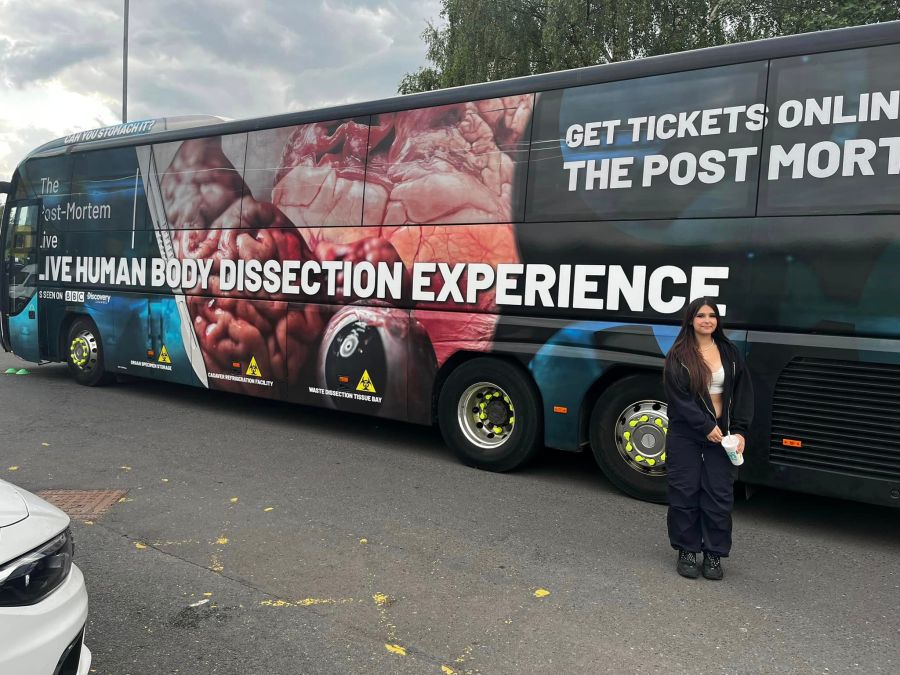
What’s your idea of a great night out? How about attending a post mortem examination of a cannibal serial killer’s victims? That is the theme of “Post Mortem Live” which is touring various parts of the UK, purporting to show the workings of a crime lab, with some extras for the paying audience – they supposedly get to taste parts of the corpses! The press release asks:

“Ever wanted to try a real organ? Well now’s your chance. What does it taste like? Tender, fatty, juicy? Will introducing the pallet to organ meat leave you wanting more, and what lengths will you go to in order to satisfy your hunger?”

This press release is not on their website or Facebook page as far as I could see. If it ever existed (it is reported on several outraged social media sites) then it must have been a joke, and has now been removed.

The show is based on the real murders committed by Dennis Nilsen in the UK and Jeffrey Dahmer in the USA, and gives the audience a hands-on experience of the post-mortem and forensic processes used to gather evidence of cause of death and identity of the victims, as well as piece together the actions of the serial killer, including tracing evidence of cooking and eating body parts.

​​

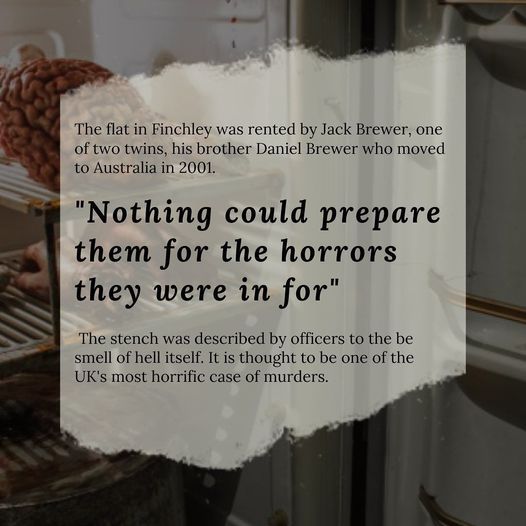
The storyline involves the (fictional) killings of 23 people, brutally murdered and dismembered by an equally fictional serial killer called Jack Brewer, who is said to have had a “feast”. Audience members will investigate the crimes in an “immersive and one-of-a-kind experience” through forensic tests similar to those used to catch and prosecute Nilsen and Dahmer. 

Jeffrey Dahmer killed at least seventeen young men and boys between 1978 and 1991, and ate parts of some of them. Dahmer did not look monstrous, just a lonely young gay man befriending marginalised others and offering them money to pose for photographs or friendship and sex, then drugging them. In some cases, he injected acid into their brains in a desperate but vain attempt to turn them into sex zombies, before killing and eating them, often preserving their skulls so that they would always remain with him.

Dennis Nilsen was a Scottish serial killer who murdered at least twelve young men and boys between 1978 and 1983. Following each murder, Nilsen would bathe and dress the victim’s body, which he retained for extended periods of time, before dissecting and disposing of the remains by burning them or flushing them down the toilet. Nilsen expressed surprise at the public revulsion towards his disposal of his victims’ corpses, which included cooking the flesh to render it down, and perhaps to consume it. Nilsen was trained as a butcher and chef, and we know that a number of serial killers worked as butchers, one of many occupations conferring a professional detachment from the carcasses of non-human animals, which are not very different from human ones.

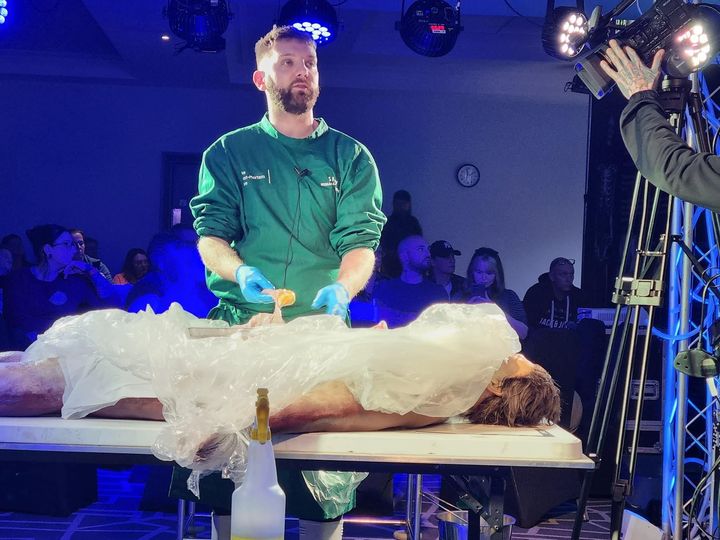
The audience at this show are offered the opportunity to dissect organs, a method used in crime labs to determine whether a suspect had tried to dismember, degrade, cook or consume the victims. Is it possible, they ask, to deceive the science and conspire to carry out the perfect murder?

The FAQ states that the show is aimed at students and healthcare professionals, but anyone can attend as long as they’re over 14, and buy a ticket. The ticket price includes “basic PPE, gloves, specimens and clinical consumables.”

What happens at the show?

“The Post Mortem Live offers the chance to get hands on with real anatomical specimens of porcine origin contextualised into a simulated human body dissection.”

There is some eating. For a bit extra, you can book a “Dinner & Dissection”. The offer asks “Are you ready for main-corpse? or Dead-ssert?” Ah, no cannibalism story is complete without a few puns, and the organisers aggravate the crime by calling this a “cutting edge insight” into dark world of homicide detection, forensics and pathology.

The website blog features a number of particularly gruesome images of diseased and injured body parts, nothing to do with the fictional case, but maybe a warning of what to expect. Many of them are on their Facebook page too, some with graphic content warnings, others (possibly worse ones) without. Go figure. I can safely predict you will either love or hate these pages. If you think you will hate them, maybe don’t open them.

I’m not using the images of smashed limbs and spiked eyeballs on this site – all images here are from the show. Which is not real humans.

But… it is is bodily material from real pigs – that’s what they mean by “real anatomical specimens of porcine origin.” I wonder if this is supposed to be reassuring? No dead humans were harmed in the making of this show, but a whole lot of live pigs were killed so that they could be cut up for human amusement. That is sicker than the atrocity pics.

What the Fox? “My Son Jeffrey: The Dahmer Family Tapes”

A new streaming series promises “never-before-heard” conversations between serial killer Jeffrey Dahmer, “The Milwaukee Cannibal”, and his father, Lionel.

My Son Jeffrey: The Dahmer Family Tapes is streaming from Sept. 18 on Fox Nation, Fox News Channel’s subscription-based streaming service.

The four-part documentary series replays conversations recorded with Dahmer while he was in Columbia Correctional Institution in Portage, Wisconsin, serving 15 life sentences after confessing in 1991 to a string of crimes including murder, necrophilia and cannibalism. The recordings, made by Lionel Dahmer, have not been heard publicly before, according to Fox Nation.

The series also includes Dahmer family home movies, and interviews with a variety of others, including Mike Kukral, a high school friends from Ohio; Michael Prochaska, Dahmer’s college roommate; Ronald Flowers, the man who escaped after Dahmer had drugged, sexually abused and imprisoned him at Dahmer’s grandmother’s house in West Allis; and retired Milwaukee Police lieutenants Kenneth Mueller and Michael Dubis, who were on the scene the night of Dahmer’s arrest.

Dahmer was beaten to death in prison in 1994, but you wouldn’t know from watching streaming services. In 2022, Netflix went full Dahmer-mania, with Ian Brennan and Ryan Murphy’s dramatisation of the life and crimes called DAHMER: MONSTER – The Jeffrey Dahmer Story.   

“Monster” won a Golden Globe for best actor in a miniseries or TV movie for Evan Peters for his portrayal of Dahmer. The series received 13 nominations at the Primetime Emmy Awards, which drew some ire from Thomas M. Jacobson, the attorney who represented eight of the families of Jeffrey Dahmer’s victims. He told entertainment industry news site The Wrap that nominations for shows like that contributed “to glamorizing or desensitizing violence and crime in society.”

Netflix quickly followed up their re-enactment with Conversations with a Killer: THE JEFFREY DAHMER TAPES, a set of tapes made by his defence attorneys in which he made all sorts of fascinating admissions. At this point, there wasn’t much the keen true-crime aficionado didn’t know about Dahmer.

Actually, most of this information had long been out there. Plenty of evidence had been removed and studied after his arrest, including the fridge full of human body parts, several skeletons and the barrel of acid he used to dissolve unwanted flesh. Dahmer had spoken freely to his interrogators about the murders he had done, in graphic detail, all of which was revealed at trial. After his sentencing, and before he was killed (obviously), he gave interviews to news programs who could not believe their luck, and treated him like a celebrity.

Jeremy Renner had portrayed Dahmer when Netflix was still sending movies in the post, in a movie called Dahmer.

So what does this new Fox program hope to add (besides some sorely needed ratings)? FOX Nation President Jason Klarman said in a press release:

“The Jeffrey Dahmer case has captivated the public for over three decades and now with these exclusive tapes released for the very first time, viewers will hear from Dahmer in his own words and get insight into his relationship with his father”

Fox is featuring in the promos the fact that Dahmer was killing and pickling men back in the 1980s when he was living with his dear old grandma in Wisconsin. He had lured three men back to granny’s place and killed them, and kept mummified souvenirs in his room and in the basement.

The recording does not make clear to which victims the mummified remains belonged; Jamie Doxtator, Richard Guerrero and Anthony Sears were all killed at the location. Another victim, Steven Tuomi, was murdered by Dahmer in a nearby hotel but he kept those mummified remains in her basement as well. He told his father:

“Remember when you visited grandma? Remember that small, one-by-one square foot box? You know what was in it, don’t you? The mummified head and genitals of the last victim at the West Allis location”

Dahmer’s dad was presumably relieved to hear that it only had mummified body parts, because he was worried it was something naughty:

“It was wooden, but it had a metal covering, and you were very insistent that I opened that up because you thought I had pornography magazines”.

The show also plays up the fact that the dad, Lionel, admits to his son that he also had strange and disturbing thoughts in his youth, and perhaps actions too, since he expressed surprise that he had never been caught. He tells his son, “You’re just like me, Jeff”.

Showing audio on television is pretty dull so, like the Netflix tapes, it’s illustrated with lots of archive pictures. There are skulls, and meat from Dahmer’s fridge,

And his mug shot, which is actually a lot less terrifying than some we’ve seen recently.

It’s hard to imagine that the relatives of Dahmer’s victims, who objected to the Emmy nominations for the Netflix series, are going to be too thrilled at Fox Nation digging up the corpses again. But then, it’s Fox, and they love being on the edge.

2023: Louisiana man sentenced to 45 years for trying to kill and eat gay men

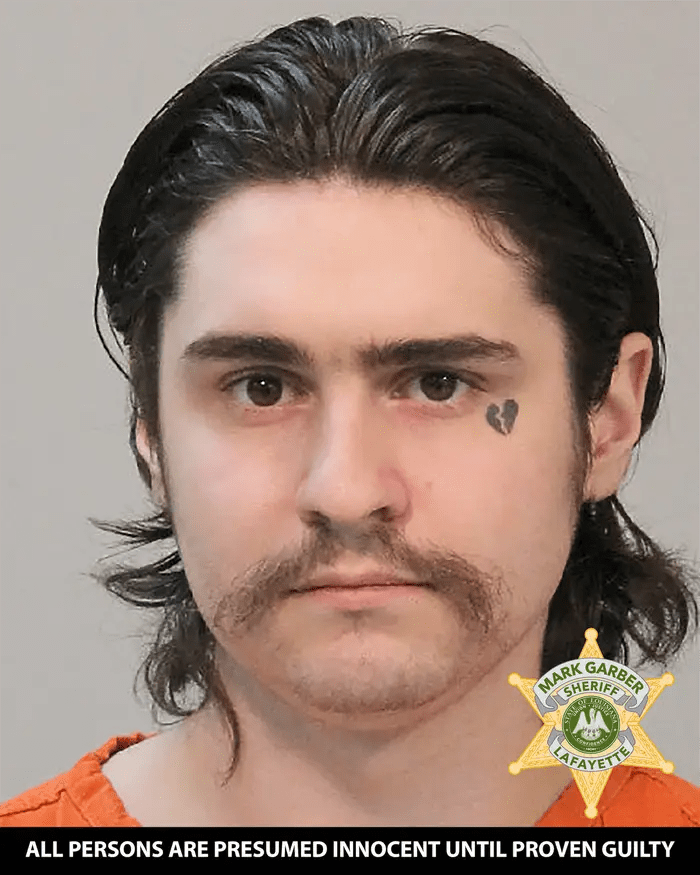
Chance Seneca, 21, of Lafayette, Louisiana, was sentenced on January 25th to 45 years in federal prison for kidnapping and attempted murder, as part of his elaborate scheme to kidnap, murder and cannibalise gay men. 

The court based its sentence on several factors, including its determination that the defendant intentionally targeted the victim and other gay men because of their gender and sexual orientation. Assistant Attorney General Kristen Clarke of the Justice Department’s Civil Rights Division said:

“The facts of this case are truly shocking, and the defendant’s decision to specifically target gay men is a disturbing reminder of the unique prejudices and dangers facing the LGBTQ+ community today. The internet should be accessible and safe for all Americans, regardless of their gender or sexual orientation. We will continue to identify and intercept the predators who weaponize online platforms to target LGBTQ+ victims and carry out acts of violence and hate.”

Evidence was presented that Seneca, in June 2020, had used Grindr, a dating application for gay and bisexual men, to kidnap and attempt to murder a gay man identified in court only as “H.W.”  A day earlier, he used the app to set up a meeting with another gay man, but decided not to kill him.

Seneca proposed a meeting with H.W. with the intent of murdering and dismembering him, and he met H.W. and drove him to his father’s home in a 2006 Toyota Corolla. On arrival,  he took out a handgun, instructed H.W. to put on handcuffs, and then used several methods (details in the link if you want to know) to attempt to murder him, including strangulation, a hammer, an ice-pick and a knife. Believing that H.W. was dead, Seneca then attempted to dismember him. After his arrest, Seneca admitted that he had planned to continue murdering gay men until he was caught or killed. 

Seneca acknowledged that he had kidnapped and attempted to murder H.W. in order to satisfy a compulsive murder-fantasy. Seneca had become fixated with the idea of killing gay men, and this fascination led him to spend months designing a murder-kidnapping scheme that mirrored the murders of gay men committed by the cannibal serial killer Jeffrey Dahmer. Seneca specifically targeted gay men, as Dahmer had done. He also intended to eat and preserve the bodies of his victims, as Dahmer had done. 

The FBI and the Lafayette Police Department conducted the investigation. Lafayette police had responded to a call from Seneca in June 2020 and found a man, Holden White, 18, in a bathtub with severe injuries, including strangulation marks on his neck and “wrists slit to the bone,” according to an unsealed affidavit.

The affidavit was filed by an FBI agent based on information from Lafayette police and a conversation the agent had with Seneca. It said Seneca told police he had called 911 after the attack “in a self-described effort to be put into a mental institution.” Seneca had kidnapped two other men on June 19, the indictment said.

H.W, the Louisiana man stabbed by Seneca, identified himself as Holden White (pictured above). In an interview, he gave details of the night that he thought would be his last. He said he wants people to have hope for survival, even in their darkest moments.

White told KATC TV:

 “Part (of what) I remember is that I reached over to grab something out of my bag. That’s when I felt a cord wrap around my throat and he started pulling me backwards. He strangled me for, I can’t tell you how long, but it felt like a very long time. And he did it to the point as to where every single blood vessel in my face ruptured.”

White woke up in a bathtub sometime later, with his attacker standing over him.

“There was just blood all over my chest and stuff. He was just kind of sitting there watching me, and I was like, ‘Okay this is it.’ My final words to myself was, ‘Just stay calm.’ In my mind I kept repeating to myself, ‘Just stay calm, stay calm.’ Slowly, I passed out.”

Seneca apparently couldn’t go through with the murder, and contacted law enforcement instead. White woke up in a hospital bed.

“I’ve been told that Chance called the police and he said, ‘Hey, I just tried to murder somebody, send an ambulance,’ and when they found me I was still naked in the bathtub.”

White has spoken out to make sure the world understands that the attack was a hate crime – something local police had hesitated to declare. “This is a hate crime due to a fact that he made it a point to choose a gay man on a gay app,” he explained. “He made sure I was a gay man and then in the same breath, he also idolized Jeffrey Dahmer.

As his scars healed, White decided to mark the event with some body modification of his own: a new tattoo of a semicolon.

“Basically, what a semicolon does is it puts a pause on a sentence,” White explains. “Chance tried to stop my life, so instead of a period I made it a semicolon. I’m staying strong. “I’m not going to let this incident get to me.”

Chance Seneca remains in holding at Lafayette Parish Correctional Center awaiting trial.

White said the attack has coloured the way people view him and treat him and has at times been used in verbal or online attacks during arguments or disagreements.

“People tell me he should have killed me that night. He should have finished the job. They should bond him out so he can kill me.”

The case inevitably reminds us of the murders committed by the so-called Milwaukee Cannibal Jeffrey Dahmer between 1978 and 1991 in which he drugged young men and boys, attempted to turn them into sex slaves by injecting acid into their brains, and then (when that failed) killed and dismembered them and ate parts of their bodies. Chance Seneca wanted to emulate Dahmer, but couldn’t bring himself to do it.

More recently, Mark David Latunski, the “Michigan Cannibal”, met a young man on Grindr, slit his throat and fried and ate his testicles, and perhaps other parts of his body. This happened on Christmas Eve 2019, but did not go to trial until October 2022.

Gay men have been subject to abuse and violence for a long time; it is only recently that laws against gay sex were repealed, and even more recently that same-sex marriage was permitted. Although there has been some progress in those areas, change always comes with resistance, and the social media responses to the plight of Holden White reflects the victim-blaming that comes from a rejection of his humanity and his right to seek consensual pleasure as he chooses.

Chance Seneca wanted to be a cannibal serial killer like Dahmer and Latunski, but something stopped him half-way through the process, perhaps a recognition of White’s humanity. To kill and eat any animal requires a deanimalisation – turning them from living, sentient beings into meat. To kill and eat a human is one further step – the victim must be animalised (denied humanity) before being deanimalised and slaughtered. Apparently Seneca could not carry through, but plenty of others, including his idol Jeffrey Dahmer, could.

Another Seneca, the Roman Stoic Lucius Annaeus Seneca the Younger, who lived some 2,000 years ago, wrote about another “Chance”. Don’t you love coincidences like this?

Love and cannibalism: BONES AND ALL (Luca Guadagnino, 2022)

The modern cannibal is usually hard to identify. Jeffrey Dahmer was the all-American boy next door. Armin Meiwes used to mow his neighbours’ lawns to be helpful. Issei Sagawa was so small and helpless that he seemed vulnerable rather than threatening. Albert Fish was a sweet old man, so charming that the Budd’s let him take their little girl to a party.

They were normal, everyday people, a bit weird, but not monsters.

At least, not in appearance. This is a recent phenomenon – the original cannibals were called anthropophagi (Greek for man-eaters) and were humanoid in shape, but were usually some sort of hybrid – a mix of humans and gods or other animals – strong, ferocious, and clearly not quite human. From the 15th century, the alleged cannibals found by Columbus and other explorers were different in culture and skin colouring, so were easily distinguished, defamed and exterminated. It is only recently, since Jack the Ripper in 1888, that the cannibal walked among us, undetected until the victims were found (or what was left of them).

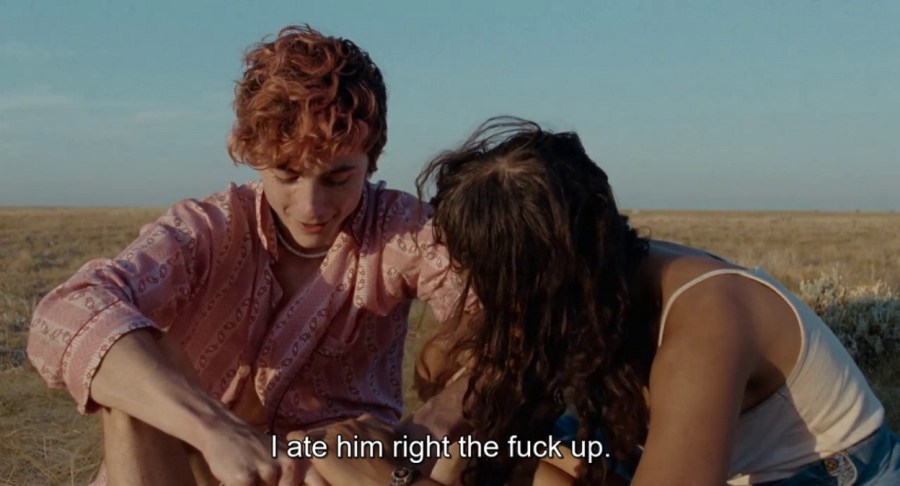
Bones and All presents as a coming of age cannibal romance, taking a sharp turn back into cannibal history for its themes. Maren (Taylor Russell from Lost in Space) is finishing high school, a spectacular end of term in which she is invited to her friend’s sleepover and bites a girl’s finger off, instead of, you know, just admiring the nail polish, as she had been invited to do.

She then goes on the run with her father, who has been keeping her ahead of the law as she grew up (her first human meat was her babysitter when she was three) but now ditches her, with a few hundred dollars and a birth certificate.

It then becomes a road movie, as she travels through the American Mid-West trying to find her mother, attracting suspicion not because of her eating habits but just because she looks too young to be on the road. She comes across another cannibal (they are called “eaters”) in the shape of a weird old man named Sully (Mark Rylance, Bridge of Spies) before meeting up with Lee, played by the love interest of seemingly everyone nowadays, Timothée Chalamet. Chalamet appeared in the third instalment of Guadagnino’s “Desire Trilogy”, Call Me by Your Name), in which he was the love interest of Oliver, played by Armie Hammer, who has recently been generating his own cannibalism headlines.

As a road movie it’s Thelma and Louise mixed with Romeo and Juliet, if they had been cannibals. In other words outsiders, star-crossed lovers, and lots of flesh being torn off dead (and sometimes living) bodies. Road movies rely on meeting new and weird people, and learning about the protagonists (and ourselves) from their stories.

Sully is a lonely old man who teaches Maren about being an eater, and how an eater has a super-power – like a vampire, they have a nose that can smell other eaters at great distances, and can also smell dying people, which allows him to feast on them fairly inculpably, although Maren rather wonders if they should be calling 911 rather than letting them gasp their last breaths. So they are anthropophagi, they smell different, have a strong sense of smell, and so are not quite human. We subsequently discover that the cannibal gene is passed on – Lee’s dad and Maren’s mother were also eaters. They are a breed apart, hybrid humans, who can mate with non-eaters.

They are also presented as ‘savages’ – related to the colonised peoples who were declared cannibal by the imperial powers. Maren is biracial, and Sully (although played by a classical British Shakespearean actor) seems to be presented as a Native American, with a long ponytail and a feather in his hat. The marginalised and disenfranchised are regularly presented as dangerous, thieves, murders, cannibals, regardless of any evidence.

An interesting character from colonial times is the wendigo, a figure from Algonquin mythology who eats his fellow humans and draws on their strength to grow huge and powerful, which only makes him hungrier and deadlier. Sully tells Maren that her fate is to need more and more flesh as she gets older.

Just like the wendigo, who is an indigenous version of the anthropophagus, and one that was used by the victims to characterise the European invaders and their voracious appetite for land and gold. The phrase “bones and all” reminds us of the colonial greed that denied the humanity of those invaded and insisted on taking everything, leaving nothing and nowhere to go but a few reservations or missions in remote, unprofitable areas. Eating bones and all is also a perfect way of getting rid of the evidence.

The title Bones and All is taken from the book of the same name by Camille DeAngelis, but the phrase was not used in the book – it just meant that Maren and the other eaters would automatically eat the whole person, bones and all. Except for her first, the babysitter, because she was too small to swallow bones – she left a pile of them, a pool of blood, and the hammer from an eardrum. In a movie, though, it can be harder for the viewer to maintain a willing suspension of disbelief, so eating the victim bones and all becomes a rite of passage – the next level of being an eater. Maren and Lee don’t know how to eat a person bones and all, so they are not yet postgrad eaters. Maren puts it succinctly – “that’s impossible.” But what about eating the flesh? Armin Meiwes took ten months to eat 20 kilograms (44 lb) of Brandes, but we are asked to accept that Maren and Lee can eat a whole body in a night.

But then, everything is ambiguous in this story, which has been widely described as a metaphor for otherness and queerness. The story is set in 1981, as Ronald Reagan is entering the White House. Being different, queer, compassionate, seeking social justice were all considered laughable or dangerous. Greed was good, and so eating a victim bones and all might have seemed laudable. Drug addiction was escalating, and some have seen the cannibalism in this film as a metaphor for this as well – Maren and Lee can’t go too long without their feed, and will do whatever they need to in order to get it.

Some of the ambiguities are more subtle: Maren looks young, which bothers various people she deals with, although she is 18 and technically an adult in most places. Lee falls in love with her, but is also capable of appearing to be cruising for gay sex.

He chooses a carnival worker who has been mean to a child, leads him into the bushes and masturbates him, slitting the man’s throat as he orgasms. It was not until twenty years later that gay sex was legalised in the US, and this man’s secret desire for same sex petite mort becomes his real mort. They then discover that the man had a wife and family, and are stricken with guilt, because apparently eating some people is OK, but not family people.

Then we have the eaters – Maren is naïve and caring, horrified by her need to feed. Lee is a puny dude who kills seemingly effortlessly, but like Hannibal Lecter, Lee prefers to eat rude people – when we first meet him, he challenges a rude person in a supermarket and leads him to a deserted shed where he kills and eats him. Sully is an senior eater, so has to eat regularly, but says he tries not to kill people – sniffs out those who are dying, but later he gets violent when Maren rejects his advances.

Jake (Michael Stuhlbarg) is an eater who has graduated to eating bones and all, but he is accompanied by a friend named Brad (David Gordon Green), a cop (!), who is not a natural eater, but just likes doing it. Maren accepts that she and Lee have to eat people, but is revolted by Jake’s wish to do the same. We’re back to the old debate of nature versus nurture. Are people born queer? Or with addictive personalities? Or psychopathic? Or cannibalistic?

The Director, Luca Guadagnino, has made a number of changes from the book, which are examined elsewhere. The most obvious one, though, is that Maren is brought up and then eventually abandoned by her mother in the book, but her father in the film. This changes the dynamic considerably, because we now have two eaters in the family, both female. The eater parent in both versions is locked up in an asylum, having eaten their own hands, but in the movie it’s her mother, (a short but superb appearance by Chloë Sevigny). We arrive at last at the modern horror archetype, the “monstrous-feminine”, the figure that confronts the male viewer with his fears of being castrated (Freud’s favourite explanation), as well as “the monstrous womb” – a terrifying image of a “black hole which threatens to reabsorb what it once birthed” (Creed, The Monstrous-Feminine, p. 27). The female cannibal is quintessentially monstrous-feminine, terrifying men with the antithesis of popular female stereotypes of giving life and nurturing. In the book, Maren only eats boys or men (after the initial babysitter) – she is drawn to eat those who seek to be close to her. In both versions of the story, the ambiguity is clear to us and the female cannibals – they have a compulsion to eat, but don’t want to hurt others.

Maren’s solution is to try to act normal, fall in love, get a job, get “clean” of the eating. Her mother’s was to lock herself away, and even then she chewed off her own hands.

To me, the most fascinating ambiguity in this film and in our societies generally is the question “who can you eat?” Eating some animals is considered just “normal” – Lee is chewing on bacon (pig flesh) served to him in a very respectable café, and has been working in an abattoir. When they need money, he and Maren rob the abattoir at night, later sitting on the overhead walkway watching the cows who are to be killed for legal, non-controversial eating, when Maren observes

“every one of them has a mom and a dad, sisters, brothers, cousins, kids. Friends even.”

The real question, Derrida says, is not what to eat but how to eat well. Perhaps, as Chalamet has said, it is impossible to live ethically – every act of consumption or energy usage wrecks the environment a little bit more. For some carnivores, this is seen as a ‘bones and all’ issue, they call it “nose to tail” – killing is OK, but wasting any part of the animal is the real crime. But as Maren says, cows also feel terror, pain, bereavement when their babies are taken from them. The author of the book, Camille DeAngelis, went vegan before writing it, indicating that the problem of who to eat, the rude or dying, the human or the cow, weighed on her, and the scene filmed in the slaughterhouse indicates that Guadagnino may have felt the same. Cat Woods’ review in Salon reminds us that Brad, the off duty policeman, chooses to be a cannibal:

“Why would he hunt, slaughter, and feast upon human flesh if he doesn’t need to?
And, if we the audience can be repulsed by that – and his evident choice to slaughter and eat flesh when there is abundant satiety that doesn’t cause violence, pain and loss – then perhaps we need to venture a little deeper into our own psyches and ask: Why would we feast upon flesh if we don’t need to?”

This is a seriously good film, with a great cast and, in the midst of all this carnage, we are treated to magnificent scenery beautifully captured by cinematographer Arseni Khachaturan. I have not revealed the ending, and hope I have not revealed too many other plot points. I recommend you go see it.

ISSEI SAGAWA – “the Kobe Cannibal” – DEAD at 73

Issei Sagawa, a Japanese murderer known as the “Kobe Cannibal”, died of pneumonia on November 24 2022 at the age of 73. His funeral was attended only by relatives, with no public ceremony planned, according to a statement from his younger brother and the publisher of the brother’s 2019 memoir.

In 1981, 32 year old Sagawa, then a Japanese exchange student, murdered a young Dutch woman, Renée Hartevelt, a fellow student at the Paris Sorbonne, then raped, mutilated, and cannibalised her corpse over two days.

After that, he cut up her remains and packed them into two large suitcases, called a taxi and tried to drop the cases off in a park in the middle of Paris. He fell asleep in the park (eating too much meat can have that affect) and someone opened one of the cases. Sagawa walked calmly away, but within four days, the police tracked Sagawa through the taxi driver, and he confessed immediately. In his refrigerator and on his dining table, they found a large quantity of human flesh.

Sagawa was declared insane, but his father employed an influential French lawyer to argue, successfully, that it was unfair for the French taxpayer to pay for indefinite confinement in a mental hospital, and that he should be sent back to Japan to be cured. Accordingly, less than three years after his confession, Sagawa was put on a plane and sent back to Japan, the only condition being that he could never come back to France. He could not be prosecuted in Japan because the French had sealed the case files after the murder charge had been dropped. He spent 18 months in a Japanese mental hospital but then checked himself out, and has been free ever since.

There is a comprehensive study of the case in the documentary THE CANNIBAL WHO WALKED FREE, which I reviewed in this blog in February – you can read it here. It contains a link to the documentary on YouTube.

Another fascinating documentary which looks more closely into the psyche of both Sagawa and his brother through interviews (sometimes disturbingly close-up ones) is CANIBA, made by two artists/anthropologists in 2017. I reviewed that in May, and you can read it here. It has a link to the production site where you can buy the DVD should you be so inclined.

The French philosopher Georges Bataille is widely quoted on the Internet as saying

“A kiss is the beginning of cannibalism.”

I hate to be a party pooper, but there is no evidence of Bataille ever saying this. Nonetheless, the concept makes sense. Sex is a very oral experience – from passionate kissing to cunnilingus and fellatio, much of foreplay consists of licking, tasting and biting. Even non-sexual love often involves phrases such as “I could just eat you up.” Cannibals like Armin Meiwes and Jeffrey Dahmer ate their victims to keep them close. Sagawa did the same, claiming he loved Renée.

Sagawa, with a massive inferiority complex based around his conviction that he was small and ugly, saw a bullet in the neck as his only way he would ever have sexual experiences with a live partner, particularly a beautiful young woman who seemed totally out of his league. Murder in such a belief system must have seemed like a form of courtship, and cannibalism a way to keep her with him forever. For forty years, he has done just that, living off his notoriety, making films, appearing in torture porn, writing books and comics (from which the drawings in this blog are taken), and even reviewing restaurants for foodie magazines.

Sagawa appears in the documentaries mentioned above (and several others I have not yet reviewed) as a repulsive, sick individual, but never as repulsive and sick as he firmly believed himself to be.

Cannibalism as eating disorder: FEED ME (2022)

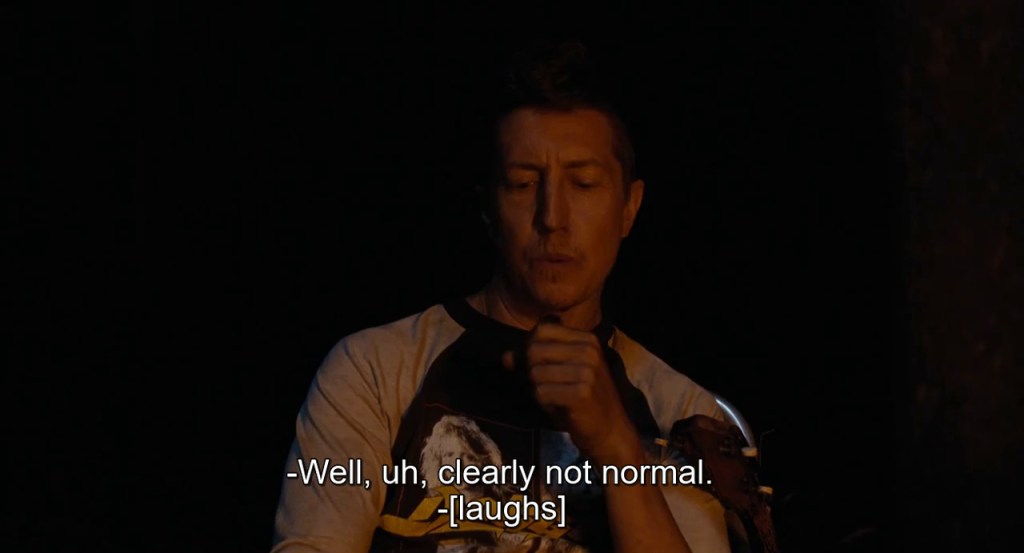
So, the buzz for this movie is ‘Ted Lasso goes cannibal’. By that, they don’t imply we will need to sit through any football matches, but that there is going to be a lot of American “can-do” ardour, conflicting with British reticence and melancholy. Also some dark humour, and a whole lot of gore, which some may find objectionable. Consider yourselves warned.

Feed Me is directed by Adam Leader and Richard Oakes (Hosts). XYZ Films released the horror-comedy on October 27 2022 on digital and on demand platforms. Feed Me follows Jed (Christopher Mulvin) whose life is shattered when his wife Olivia (Samantha Loxley) suddenly dies, leaving him feeling guilty. The blurb says:

“Spiralling into an abyss of depression, he finds himself in a bar with a deranged cannibal, Lionel Flack (Neal Ward) who convinces him he can redeem himself through the glorious act of allowing himself to be slowly eaten to death.”

Suicide, usually unassisted, is sadly common in modern society, and besides making the relatives wretched, it is also an enormous inconvenience to the police, medics and trauma-cleaners who have to deal with it. So why not benefit someone – the local cannibal who promises a painless death that will not require housekeeping, because he will eat the resulting mess? Jed moves in with Lionel, whose tiny house is filthy and full of body parts. But Jed is ready, eager to die, and Lionel is tremblingly eager to eat him.

Cannibalism, particularly vorarephilia (the erotic desire to consume or be consumed by another) can be seen as a type of eating disorder, particularly in cases where there are other foods readily available, but if that is the case, so can any form of carnivory. The film starts and finishes with such reflections – Jed’s wife is a beautiful young woman who is convinced she is fat and ugly, and eventually dies from the effects of bulimia – she starves herself and vomits out whatever nourishment she does eat, until her body closes down.

As Jed explains it, her mental illness meant that she “was eaten from the inside out.” Lionel’s solution is that, if Jed is determined to kill himself, he should do it from the outside in.

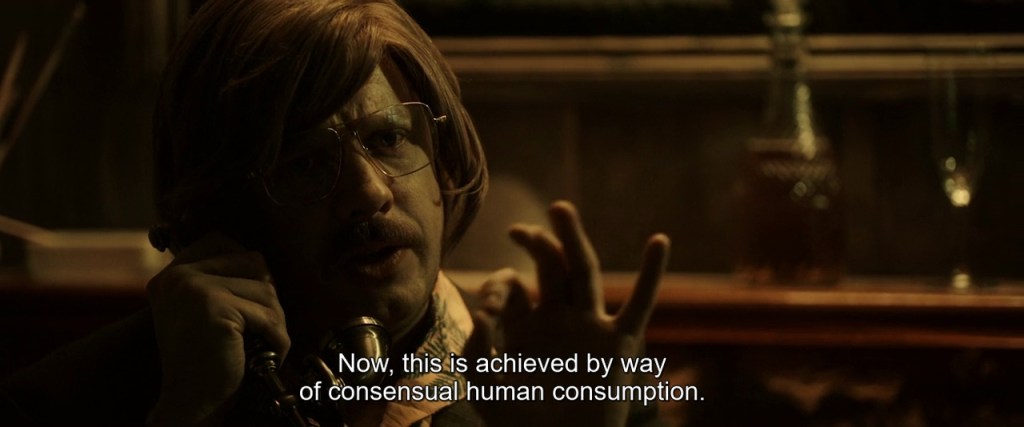
Lionel quotes some fake anthropology – a tribe called the Yiurkun who, he says, live in perpetual happiness,

His offer (and there is a written contract involved) is to eat Jed, quickly and painlessly, so he can join his beloved. Why not, Jed thinks, since Olivia has effectively (in his dreams) eaten his heart?

Lionel starts small – local anaesthetic, one finger chopped off with secateurs and carefully cooked, the wound cauterised with a hot clothes iron. “How do you feel?” Lionel asks.

But of course you can’t eat a whole person one finger at a time, and it’s not long before Lionel is removing limbs, but now without anaesthetic, because he gets mad at Jed.

Lionel says he has heard that

“some cultures believe that torturing the animal alive improves the taste and quality of the meat.”

This is not an invention of the director – it’s well known that dogs and cats and other animals are often beaten or burnt or at least made to watch the death of other animals, to make the terror and agony generate adrenalin, which is supposed to add flavour. Astonishingly, Hillary Clinton was accused of doing the same to small children. Other politicians have had the same accusations hurled at them. While these are almost certainly nonsense, it is true that almost every one of the seventy billion land animals humans eat each year will go through extremely painful ordeals, and all of the trillions of sea creatures. Jed is just one more animal in agony.

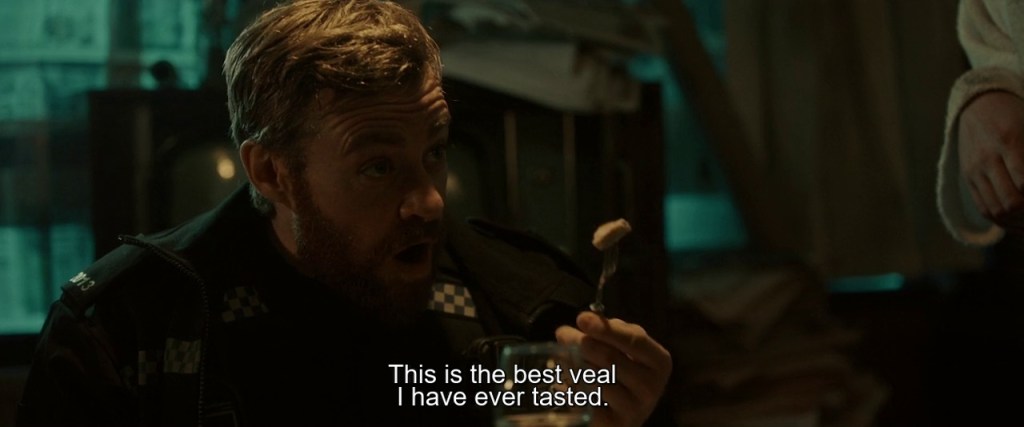
When the neighbour calls police about all the screaming going on, Lionel invites them in and feeds them some of his “mild veal”.

The enjoyment of food depends largely on what we believe about it. The actor playing the cop is probably in fact eating a piece of veal. His character, the cop, believes he is indeed eating veal. The audience, us, suspends disbelief so we can imagine that he is actually eating part of Jed’s leg. This turns the meal from gourmet to horror – a simple change of species, entirely within our imagination. The title, FEED ME, challenges the assumption that food will be prepared and served with our preconceptions catered for – it will be tasty and uncontroversial. In this society, eating a baby cow who wanted to live is praiseworthy; eating a man who wants to die is horrific.

The title reminded me of a foodie show called “Somebody Feed Phil” which sees writer and producer Phil Rosenthal (Everybody Loves Raymond) travelling around the world eating huge dishes of food while adding no weight to his irritatingly slim frame. In a recent episode, Phil lands in Madrid and apologises to a suckling (newborn) pig –

“you’re very cute, but I’m going to eat you.”

Most cannibals, like carnivores everywhere, do not usually have their victim’s permission, and usually do not apologise either, although they may feel some cognitive dissonance, knowing that their meal required the suffering and slaughter of the animal whose flesh is involved. Phil didn’t kill the new-born baby pig, but did apologise for eating him. Jeffrey Dahmer killed seventeen men and boys and also didn’t apologise (until it was far too late). The closest parallel to the plot of this film (the trailer above states it was “inspired by true events”) is the true case of Armin Meiwes, who advertised for a man who wished to be killed and eaten, had dinner and sex with the only genuine respondent, and then killed and ate him. He felt there was no apology needed, since Jorgen Brandes had wanted, indeed demanded, to be eaten. So it is with Lionel, who offers to kill and eat Jed, and then slowly and gradually makes good on his promise.

Neal Ward plays Lionel as an over the top, twitchy, verbose American con-man, the kind of man we like to think serial killers and cannibals look like, because that would make them easy to spot. Yet the essence of the real modern cannibal is his (or sometimes her) completely normal and unremarkable appearance – they walk among their peers, unknown and unidentified until their arrest (if they are ever found). Neighbours, for example, praised Meiwes as a nice young man who would mow the lawn for them. Issei Sagawa was so small and apparently innocuous that the young woman he killed and ate had been happy to come to his apartment to read poetry together.

The tagline for this movie is

“You are who you eat…”

The concept is interesting – if you are who/what you eat, do you want to eat pigs or chickens or sheep, all of whom are used, quite unjustly, as common insults (for gluttons, cowards or mindless followers). If you are what you eat, Lionel tells us, you should eat humans.

The anthropologist Marvin Harris wrote in his book Good to Eat: Riddles of Food and Culture that, while humans are clearly not obligate carnivores, “our species-given physiology and digestive processes predispose us to learn to prefer animal foods”. This presents a problem for him, since “strictly speaking, human flesh itself contains the highest-quality protein that one can eat”. Lionel’s pathology stems from his calculating, impeccable logic.

The film is a fascinating study of love, loss, despair, friendship, loneliness and appetite. The gore is perhaps a bit over the top, but no longer unusual in modern films. The acting, despite what other reviewers have said, is great and the story compelling. Neal Ward plays Lionel as both a monster and a clown, a hard role to portray, but he is, in the end, seeking the same as all of us – self-acceptance, love, a validation of his humanity, and a good meal.

Conversations with a Killer: THE JEFFREY DAHMER TAPES (Netflix 2022)

It’s definitely Dahmer month, with Netflix releasing this second blockbuster series on October 7, less than three weeks after Ryan Murphy’s ten-part series “Monster”.

The massive interest in Jeffrey Dahmer has been simmering since he was arrested in 1991, but it burst into a conflagration on September 21 2022 with the release of Ryan Murphy’s new documentary MONSTER – The Jeffrey Dahmer Story. This re-enactment, with Evan Peters playing Dahmer, became number one on the Netflix hit parade immediately. According to The New Yorker, as soon as it was released on September 21st, “Dahmer” became far and away the streaming service’s most-watched title of the week and its biggest-ever series début, despite receiving little advance marketing. Subscribers logged nearly two hundred million hours watching the program in its first week of release—more than three times as many hours as Netflix’s next most popular series. There’s even a walking tour in Milwaukee in the footsteps of Jeffrey Dahmer.

My earlier blogs on the Dahmer movie with Jeremy Renner as the killer, and the documentaries showing the real Jeffrey Dahmer being interviewed for news shows, are getting hundreds of hits each week (thank you!), in this new era of Dahmer-mania.  Family members of Dahmer’s victims are speaking out against the “Monster” series, saying it forces them to relive the traumatic events and personalises Dahmer, and even complaining about a Kesha song from 2010 which mentioned Dahmer. Nevertheless, Netflix has now released (October 7) a new series of Conversations with a Killer, this time using some previously unreleased tape-recorded interviews of Dahmer himself and his defence team, including his lawyer Wendy Patrickus, during his high-profile case. It was her first case, and she said, “I felt like Clarice Starling in Silence of the Lambs.” She spent months talking to Dahmer about each victim, preparing a defence which could only be based on an insanity plea, since there was a mountain of evidence against him, and he had already confessed everything to the police. Wendy’s DAHMER TAPES cover 32 hours of conversations held from July to October 1991. These tapes were never previously released – and are the basis of this three-part series.

This three-part true crime documentary is the third in a series from Academy Award nominee Producer/Director Joe Berlinger, whose earlier “Conversations with…” covered The Ted Bundy Tapes (2019) and The John Wayne Gacy Tapes (2022). Bundy and Gacy were prolific serial killers but, as far as we know, were not cannibals (although an English tabloid suggested Bundy might have had a few mouthfuls).

This is the Netflix summary of the Conversations with a Killer: The Jeffrey Dahmer Tapes series:

When Milwaukee police entered the apartment of 31-year-old Jeffrey Dahmer in 1991, they weren’t prepared for what they’d find. From a freezer full of human heads to decomposing body parts, the discovery amounted to the grisly personal museum of a sadistic killer. Dahmer quickly confessed to sixteen murders in Wisconsin over the span of four years, plus another murder in Ohio — but the most shocking revelation involved acts of necrophilia and cannibalism…. Why was Dahmer, who had been convicted of sexual assault of a minor in 1988, able to avoid suspicion and detection from police as he stalked Milwaukee’s gay scene for victims, many of whom were people of color?

Like the previous movies and documentaries and even the interviews with Dahmer himself and his family, the question that keeps being raised is why he did these things? Earlier texts concentrate on the psychopathy of the man himself, skirting the politics, while Murphy’s series, and this new documentary, spend more time on the ineptitude and racist privilege that seemingly kept delivering him get-out-of-jail-free cards.

“It [cannibalism] made me feel like they were a permanent part of me.”

This new release sheds much heat but very little new light onto that question. Dahmer has already told interviewers that he just wanted to possess the young men and boys who came to his home under the pretence of taking photos for money, keep them with him, without the complications of building actual reciprocal relationships. He lured them to his apartment, drugged them and then killed them or drilled holes into their skulls and injected muriatic (hydrochloric) acid. He wanted to turn them into zombies, with no will of their own, who would stay with him and be available for sex whenever he wanted. He tells his lawyers all this on the scratchy recordings that assail our ears here. The interviews are accompanied by blurry re-enactments of the prison interviews by actors dressed as Jeff and Wendy, and interspersed with contemporary interviews of the actual journalists, police, lawyers, psychiatrists, friends of the killer and the victims, all noticeably older and still in many cases clearly distressed by their involvement in the case. There are images of his victims, of the saws and drills he used, home movies of him as a (pretty happy and normal) child, as a teen, as a prisoner. There is news footage, from outside the building, of stunned crowds and news reporters doing what they do – repeating the few snippets of information they have, over and over.

But there seems to be a lot more that is alluded to but not fully analysed in both of these new Netflix releases. In flashbacks in the Monster series, and in the “conversations”, we see things like Jeff impaling worms on his hooks with his Dad, saying “ouch!” as they pretend to empathise with the animals’ suffering. We see him as a little boy examining a dead marsupial that, his Dad says, must have crept under the house to escape a predator, despite already having its skull crushed, indicating that brainless (zombie) life is feasible; Dad takes him on road trips to find and then dissect road kill. He tells a wide-eyed Jeff of the biology experiments (Dad was a chemist) in which frogs with most of their brain destroyed will still react to pain stimuli. We see him mock a vegetarian girl in biology class who doesn’t want to dissect a piglet, and later find him torturing small animals including neighbourhood dogs and cats, actions which are strikingly common in the personal histories of serial killers. Dahmer tells the lawyer:

“I didn’t seem to have the normal feelings of empathy.”

Insensitivity to animals (human or otherwise) can snowball. Killing and eating the other has always been the ultimate symbol of domination. Humans have probably done it to enemies for millennia, and psychologists tell us that industrial society since the late nineteenth century has undermined the formation of stable identities through technology-based isolation, mass mediated representations of cultural interactions, the conversion of all human relationships into fiscal transactions and the disintegration of communities. Mass-murderers and particularly cannibals like Dahmer, Fish, Meiwes or Sagawa could not have operated so freely in communities where people more intimately knew their fellow citizens’ daily movements and actions.

But such social and cultural changes affect us all, and we are not all cannibals (at least, not at this historical moment). There is more to it; the borderline pathology formed by modern life has to be ignited into violent action by an often (seemingly minor) inciting incident – Meiwes watched pigs being butchered, Sagawa recalled his uncle, who regularly played cannibalism games. Many cannibals, like many murderers, start their abuse with the objectification of other animals, as did Dahmer. Vincenzo Verzeni, who was arrested in 1871 on suspicion of killing up to twenty women, put his sexual obsession with killing and drinking blood down to the pleasure he had experienced wringing the necks of chickens when he was twelve years old. Jeffrey Dahmer had hidden his sexuality from his disapproving family for so long that he no longer wanted the gay sex that was becoming available in the 1980s – he wanted to sate his appetites without having to satisfy his partners. Sleeping pills, easily obtained due to his work as a night-shift operator at a chocolate factory, meant that he could put them to sleep and do whatever he felt like.

“I could just lay around with them, without feeling pressure to do anything they wanted to do. They wouldn’t make any demands on me. I could just enjoy them the way I wanted to.”

The men he chose were in many cases ready to have casual sex, but that was not enough. He wanted permanent relationships, but only he was to benefit. From drugs, he moved to experiments aimed at creating compliant, subservient zombies. Of course, this didn’t work, so he did the next best thing, killing them, keeping their body parts, eating their flesh so they would be a part of him.

Dahmer had learnt to ignore suffering in his fishing expeditions, at his father’s dissection table, and of course in the kitchen, where we all watch pieces of meat being prepared, our childish minds wrestling with the dawning knowledge that these were the same living, breathing, suffering animals we saw on farms, or whose representations we enjoyed in our toy-boxes or television shows.

One psychiatrist has opined that Dahmer struggled with both borderline personality disorder and schizophrenia, and therefore suffered “great confusion about what’s real and what isn’t”. There is some evidence that Dahmer couldn’t live with what he’d done, or couldn’t live without doing it any more, offering to admit to a crime he didn’t commit (the murder of six-year-old Adam Walsh) if it would get him the electric chair in Florida.

The Dahmer legend continues to grow, despite it being over thirty years since his arrest. How unique is his story? The police investigators called for a manifest of missing persons, trying to establish the identities of the remains found in Dahmer’s apartment. In episode 2, the detective says they were getting 300 calls every day from people looking for their lost loved ones, and wondering if they had ended up in Dahmer’s abattoir. Where do all these missing people go? Is it possible that there are more successful cannibals out there, busily eating the evidence, not raising the suspicions of their neighbours, and not getting caught?

In a world where humans routinely and legally do to other sentient beings what Dahmer did to his victims, it may be that the cannibal is just less tolerant of ambiguity, and when taught that the ‘other’ can be casually and ruthlessly collected, kept captive, killed and eaten, he (or occasionally she) just takes that to its logical conclusion. Interestingly, PETA is already getting feedback about that.

This documentary does not offer any revelations to those of us who already know a lot (too much?) about this case. But it lays it all out in sequence, explained by those who were involved – the police, the journalists, the doctors, and most of all Dahmer himself on the tapes. His voice is that of a witness, trying to explain what he does not understand. He killed and ate people not because he was some uncanny monster, but for the same reason anyone eats anything: because he wanted to, and he could. The jury in his case were adamant that Dahmer was sane.

What does it mean, to say that a person is sane, and how is a jury of non-experts to decide that? In episode 2, the forensic psychiatrist for the Defence, Fred Berlin, says:

“If a man who is preoccupied with having sex with corpses, if a man who is drilling holes in the heads of human beings to try to keep them alive in a zombie-like state doesn’t have a psychiatric disorder, then I don’t know what we mean by psychiatric disease. How many people does someone have to eat in Milwaukee before they think you have a mental disease?

Dahmer comes across as the picture of the civilised male subject, fully initiated into the symbolic order. As the Milwaukee journalist who was first to report the case, Jeff Fleming, put it:

“The danger could be someone who looks just like your next door neighbour. He passed on the street as a very normal person. He didn’t look scary.”

Dahmer’s comment:

“My desires were bestial, obviously.”

Or were they just, as Nietzsche said, “Human, all too human”? In the book Enemies, a Love Story, Isaac Bashevis Singer says:

“…in their behavior toward creatures, all men were Nazis. The smugness with which man could do with other species as he pleased exemplified the most extreme racist theories, the principle that might is right.”

But what we see in factory farms is not the hatred and the wish to exterminate that motivated the Nazis. Animal agriculture corporations often tell us that they “love” their animals, just as Dahmer loved his men and boys, and wanted to enjoy them. Perhaps it would be more accurate to say that in our behaviour to animals, all men are Dahmer.