Indiana court upholds life sentence for man convicted of murder and cannibalism

On May 17, 2023, The Indiana Supreme Court in Indianapolis upheld the life sentence without parole for a 41-year-old Indiana man convicted of killing his ex-girlfriend and dismembering her body before partially eating several of her internal organs.

Joseph Oberhansley was convicted in September 2020 of murder and burglary in the slaying of 46-year-old Tammy Jo Blanton in Jeffersonville in September 2014. Clark Circuit Judge Vicki Carmichael sentenced Oberhansley to life in prison without parole, based on the jury’s recommendation.

Oberhansley’s legal team filed a brief for an appeal in June 2022. It is available at this link. His attorney, Victoria Casanova, argued before the court in April 2023 that her client’s mental health was not taken into consideration and that the jury did not return a proper verdict form in weighing aggravating and mitigating circumstances.

The opinion, written by Justice Christopher Goff, said the jury made “the necessary weighing determination.” Three other justices concurred and Justice Geoffrey Slaughter agreed in part.

The body of Blanton, 46, was found at her home the morning of Sept. 11, 2014, badly mutilated with more than 25 sharp force injuries and multiple blunt force injuries.

Jeffersonville Police reported that at approximately 9:30 a.m. on the morning of Sept. 11, 2014, officers responded to a call requesting a welfare check at Blanton’s home. Several hours earlier, Blanton had called 911 because an angry Oberhansley was upset about the end of their relationship—refusing to leave her home until ordered by several police officers.

Upon arriving at Blanton’s home, officers knocked on the door and Oberhansley answered. A detective on the scene noticed a cut on Oberhansley’s hand and searched him, finding in his pocket a brass knuckle and a knife that appeared to have hair and blood on it.

Investigators obtained a warrant for the home and inside the bathroom found a “big bloody mound of something in the bathtub.” It was Blanton’s body. She had been stabbed 25 times in the head, neck, and chest.

The body had also been extensively mutilated. The front portion of her skull, a portion of her brain, lung, and most of her heart had been removed. Further investigation revealed that parts of her organs were found on a dinner plate next to a frying pan, bloody knives, and a pair of tongs that had blood on them.

During a subsequent interview with police, Oberhansley “revealed to the detectives that he ate Tammy’s brain” and that he also “tried to pull the ‘third eye’ out with tongs,” police wrote. He also admitted to eating the organs that he removed from Blanton. Oberhansley was originally charged with murder, abuse of a corpse (because cannibalism is not a crime in 49 US states) and breaking and entering.

Oberhansley testified that two men had been at the victim’s home when he arrived around 4 a.m. that morning and said they were responsible for Blanton’s death. He said the men had knocked him out and that he awoke when police arrived.

Clark County Prosecutor Jeremy Mull told jurors Wednesday during opening statements in Oberhansley’s murder trial:

“Joseph Oberhansley butchered Tammy Blanton like you wouldn’t kill a livestock animal. But this lady died with dignity.”

Mull said Blanton locked herself in a bathroom before Oberhansley kicked a door down and attacked her — just one week after holding her captive and raping her. Oberhansley told police during a videotaped interview that Blanton “really wasn’t all that scared, surprisingly,” as if she knew she was about to die, Mull recalled. “In her last moments, she wasn’t going to give him the pleasure of seeing her scared,” the prosecutor said.

 A psychologist testified at trial that Oberhansley was “the most severely mentally ill person whose case she had reviewed,” Oberhansley’s defence attorney Cara Schaefer Wieneke wrote:

“It would be easy to look at the horrors visited upon Tammy and conclude they were simply the actions of a monster. But doing so would be reductive, and this Court’s 7(B) review must look deeper. This Court must consider his actions in the context of his profound mental illness.
There is also no question that Oberhansley was suffering from a severe mental illness when he committed this crime. What there is a question about, however, is whether Tammy would be alive today if Oberhansley were not so severely mentally ill. There are reasons to believe that she would. Because of that, Oberhansley asks this Court to find his sentence of life without parole is inappropriate.”

Oberhansley’s mental state was a recurring complication in the court process, in which he was found at different times competent and incompetent. For example, in 2017, his defence wrote that their client believed they were working for the devil, according to The Courier-Journal.

The case was originally declared a mistrial after witness testimony put forth information about Oberhansley’s past that parties had stipulated would not be introduced during the proceedings. For example, it was not specified in court that the defendant had spent a 12-year stint in a Utah prison for manslaughter because—while he was jealous and high on meth—he shot and killed his girlfriend Sabrina Elder, and shot his own mother (who later forgave him).

Oberhansley’s sister had grabbed his and Elder’s infant son. He shot at them, but missed. Then Oberhansley shot himself in the head. He survived, but a psychiatrist wrote he’d given himself a “partial lobotomy.” He pleaded guilty to a manslaughter charge, down from murder. His family was reluctant to take the stand, prosecutors said.

In his first trial over Blanton’s death, Oberhansley’s defence asserted that their client’s mental state was a major factor. Lawyer Bart Betteau cited horrifying details of the murder, saying that jurors would hear that Oberhansley believed Blanton was going to kill him and that she could hear his thoughts.

“Think about the process and say to yourself, is this someone who’s thinking right? His thought was that someone was after him.”

Oberhansley’s attorneys couldn’t mount an insanity defence, however. They lost their ability to do so in return for the state declining to seek the death penalty. The attorneys’ previous attempt to lodge an insanity defence was thwarted when Oberhansley filed a motion to withdraw it. He denied living with a mental illness.

Oberhansley is incarcerated at the New Castle Psychiatric Unit of the Indiana Department of Correction.

The most interesting part of this extended legal battle (nine years) from the point of view of Cannibal Studies is the statement from the prosecutor about the victim being “butchered… like you wouldn’t kill a livestock animal.” Philosophers struggle with the inconsistency of our social customs – we cherish dogs and cats, protect whales, but accept the butchery in mind-boggling numbers of cattle, sheep, pigs, chickens, and others. We know about the horrendous suffering in the slaughterhouse, but close our minds to it. We know that on top of its appalling cruelty, the meat industry is one of the largest sources of greenhouse emissions as well as a cause of several severe human health problems such as hypertension and colon cancer. Yet the meat industry remains exempt from much of the environmental and health debate that surrounds other issues. Stanley Cavell states that becoming part of a social contract requires becoming “conspirators”, agreeing implicitly what will be acceptable, disregarding its ethical conundrums. Such “perpetual failure of justice invites the threat of madness”.

Cannibals are routinely described as insane, as if their capricious psychotic episodes fully explain both their choices and the appalled revulsion of the rest of society. Oberhansley’s appeal described him as “detached from reality”. But the persistent portrayal of cannibalism as unthinkable and cannibals as insane relates to their refusal of the fissure between reality and the language able to describe it. The cannibal personifies ruthless attempts to satisfy voracious human appetites, while realising the animality of fellow humans; he puts the unthinkable into reality through the flesh and blood of his victim. His madness arises in the gap between the carefully expurgated language of the social contract and the reality of the world as a giant slaughterhouse.

Cannibalism as eating disorder: FEED ME (2022)

So, the buzz for this movie is ‘Ted Lasso goes cannibal’. By that, they don’t imply we will need to sit through any football matches, but that there is going to be a lot of American “can-do” ardour, conflicting with British reticence and melancholy. Also some dark humour, and a whole lot of gore, which some may find objectionable. Consider yourselves warned.

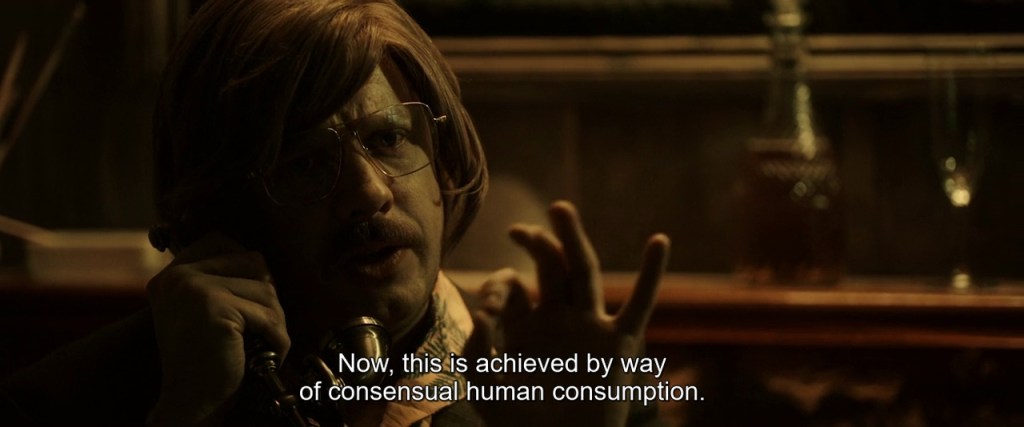
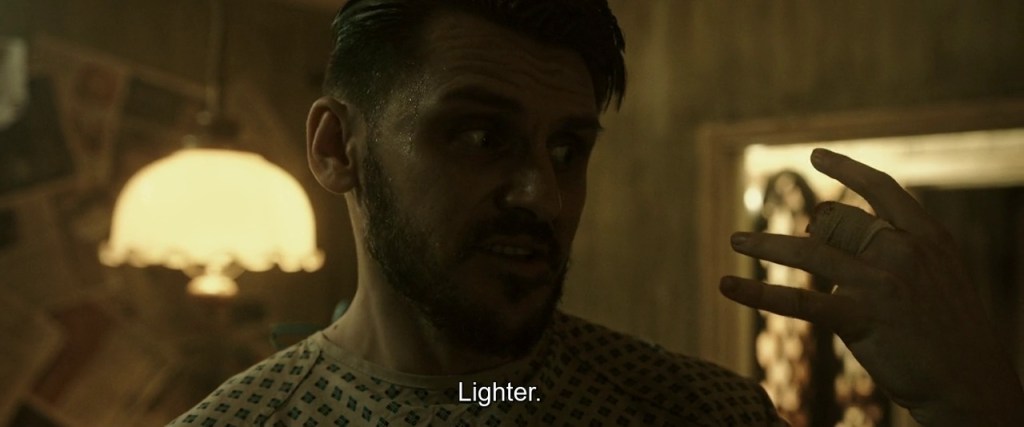
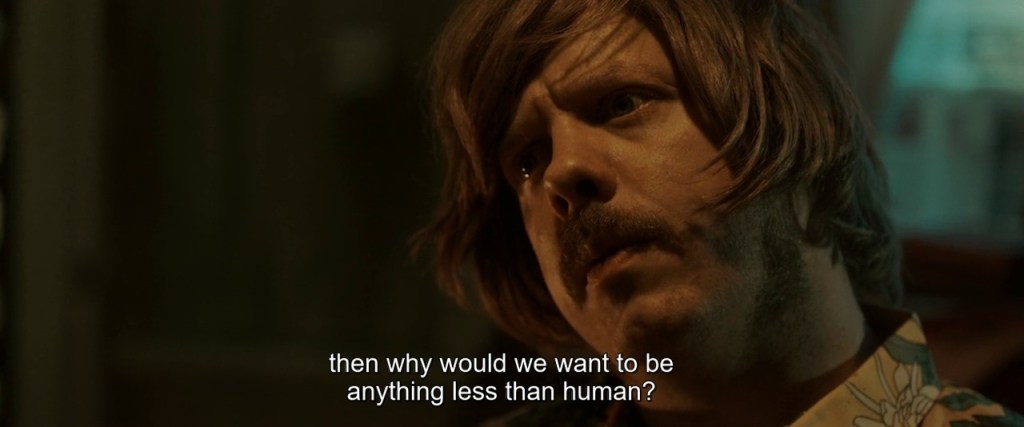
Feed Me is directed by Adam Leader and Richard Oakes (Hosts). XYZ Films released the horror-comedy on October 27 2022 on digital and on demand platforms. Feed Me follows Jed (Christopher Mulvin) whose life is shattered when his wife Olivia (Samantha Loxley) suddenly dies, leaving him feeling guilty. The blurb says:

“Spiralling into an abyss of depression, he finds himself in a bar with a deranged cannibal, Lionel Flack (Neal Ward) who convinces him he can redeem himself through the glorious act of allowing himself to be slowly eaten to death.”

Suicide, usually unassisted, is sadly common in modern society, and besides making the relatives wretched, it is also an enormous inconvenience to the police, medics and trauma-cleaners who have to deal with it. So why not benefit someone – the local cannibal who promises a painless death that will not require housekeeping, because he will eat the resulting mess? Jed moves in with Lionel, whose tiny house is filthy and full of body parts. But Jed is ready, eager to die, and Lionel is tremblingly eager to eat him.

Cannibalism, particularly vorarephilia (the erotic desire to consume or be consumed by another) can be seen as a type of eating disorder, particularly in cases where there are other foods readily available, but if that is the case, so can any form of carnivory. The film starts and finishes with such reflections – Jed’s wife is a beautiful young woman who is convinced she is fat and ugly, and eventually dies from the effects of bulimia – she starves herself and vomits out whatever nourishment she does eat, until her body closes down.

As Jed explains it, her mental illness meant that she “was eaten from the inside out.” Lionel’s solution is that, if Jed is determined to kill himself, he should do it from the outside in.

Lionel quotes some fake anthropology – a tribe called the Yiurkun who, he says, live in perpetual happiness,

His offer (and there is a written contract involved) is to eat Jed, quickly and painlessly, so he can join his beloved. Why not, Jed thinks, since Olivia has effectively (in his dreams) eaten his heart?

Lionel starts small – local anaesthetic, one finger chopped off with secateurs and carefully cooked, the wound cauterised with a hot clothes iron. “How do you feel?” Lionel asks.

But of course you can’t eat a whole person one finger at a time, and it’s not long before Lionel is removing limbs, but now without anaesthetic, because he gets mad at Jed.

Lionel says he has heard that

“some cultures believe that torturing the animal alive improves the taste and quality of the meat.”

This is not an invention of the director – it’s well known that dogs and cats and other animals are often beaten or burnt or at least made to watch the death of other animals, to make the terror and agony generate adrenalin, which is supposed to add flavour. Astonishingly, Hillary Clinton was accused of doing the same to small children. Other politicians have had the same accusations hurled at them. While these are almost certainly nonsense, it is true that almost every one of the seventy billion land animals humans eat each year will go through extremely painful ordeals, and all of the trillions of sea creatures. Jed is just one more animal in agony.

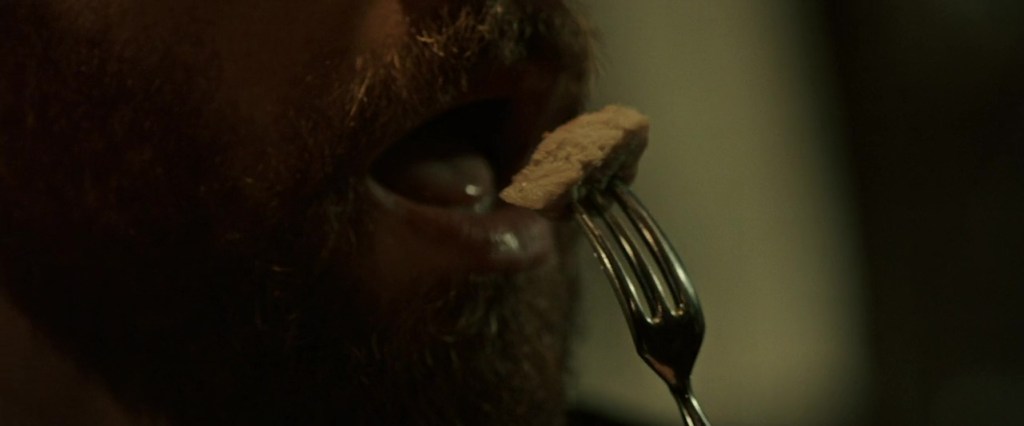
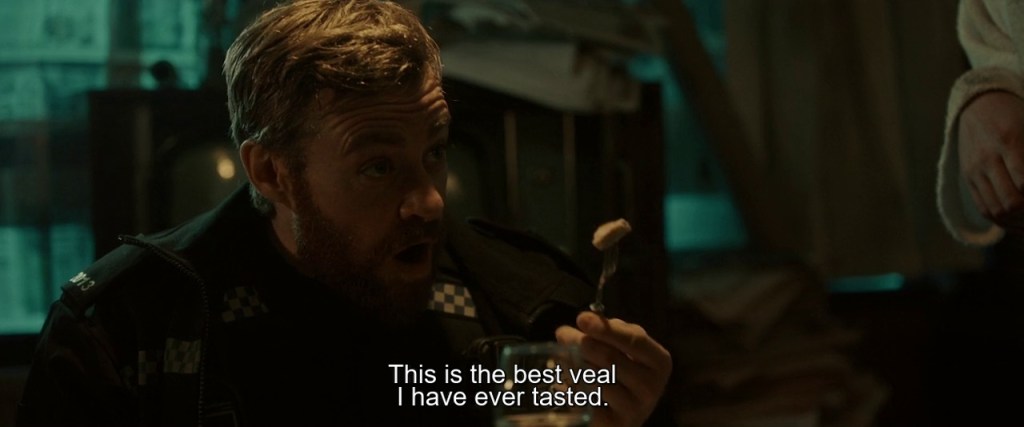
When the neighbour calls police about all the screaming going on, Lionel invites them in and feeds them some of his “mild veal”.

The enjoyment of food depends largely on what we believe about it. The actor playing the cop is probably in fact eating a piece of veal. His character, the cop, believes he is indeed eating veal. The audience, us, suspends disbelief so we can imagine that he is actually eating part of Jed’s leg. This turns the meal from gourmet to horror – a simple change of species, entirely within our imagination. The title, FEED ME, challenges the assumption that food will be prepared and served with our preconceptions catered for – it will be tasty and uncontroversial. In this society, eating a baby cow who wanted to live is praiseworthy; eating a man who wants to die is horrific.

The title reminded me of a foodie show called “Somebody Feed Phil” which sees writer and producer Phil Rosenthal (Everybody Loves Raymond) travelling around the world eating huge dishes of food while adding no weight to his irritatingly slim frame. In a recent episode, Phil lands in Madrid and apologises to a suckling (newborn) pig –

“you’re very cute, but I’m going to eat you.”

Most cannibals, like carnivores everywhere, do not usually have their victim’s permission, and usually do not apologise either, although they may feel some cognitive dissonance, knowing that their meal required the suffering and slaughter of the animal whose flesh is involved. Phil didn’t kill the new-born baby pig, but did apologise for eating him. Jeffrey Dahmer killed seventeen men and boys and also didn’t apologise (until it was far too late). The closest parallel to the plot of this film (the trailer above states it was “inspired by true events”) is the true case of Armin Meiwes, who advertised for a man who wished to be killed and eaten, had dinner and sex with the only genuine respondent, and then killed and ate him. He felt there was no apology needed, since Jorgen Brandes had wanted, indeed demanded, to be eaten. So it is with Lionel, who offers to kill and eat Jed, and then slowly and gradually makes good on his promise.

Neal Ward plays Lionel as an over the top, twitchy, verbose American con-man, the kind of man we like to think serial killers and cannibals look like, because that would make them easy to spot. Yet the essence of the real modern cannibal is his (or sometimes her) completely normal and unremarkable appearance – they walk among their peers, unknown and unidentified until their arrest (if they are ever found). Neighbours, for example, praised Meiwes as a nice young man who would mow the lawn for them. Issei Sagawa was so small and apparently innocuous that the young woman he killed and ate had been happy to come to his apartment to read poetry together.

The tagline for this movie is

“You are who you eat…”

The concept is interesting – if you are who/what you eat, do you want to eat pigs or chickens or sheep, all of whom are used, quite unjustly, as common insults (for gluttons, cowards or mindless followers). If you are what you eat, Lionel tells us, you should eat humans.

The anthropologist Marvin Harris wrote in his book Good to Eat: Riddles of Food and Culture that, while humans are clearly not obligate carnivores, “our species-given physiology and digestive processes predispose us to learn to prefer animal foods”. This presents a problem for him, since “strictly speaking, human flesh itself contains the highest-quality protein that one can eat”. Lionel’s pathology stems from his calculating, impeccable logic.

The film is a fascinating study of love, loss, despair, friendship, loneliness and appetite. The gore is perhaps a bit over the top, but no longer unusual in modern films. The acting, despite what other reviewers have said, is great and the story compelling. Neal Ward plays Lionel as both a monster and a clown, a hard role to portray, but he is, in the end, seeking the same as all of us – self-acceptance, love, a validation of his humanity, and a good meal.

Auto-cannibalism: “In My Skin” (de Van, 2002)

First off, if you don’t like gore (hey, it’s a blog about cannibal films, not necessarily slashers), then you may want to avoid this little French number. If graphic scenes don’t bother you (or if you like them) then this one is quite intriguing and very well made. But –– you’ve been warned.vlcsnap-2019-02-16-15h47m58s843.png

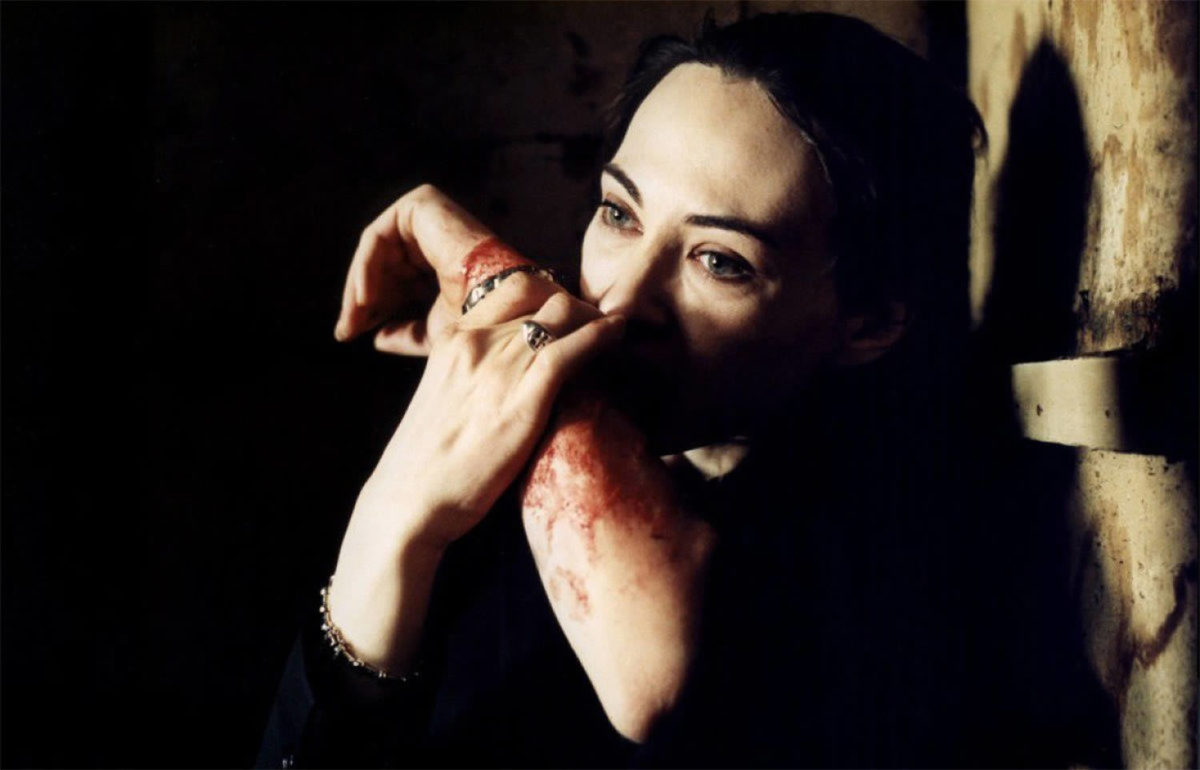
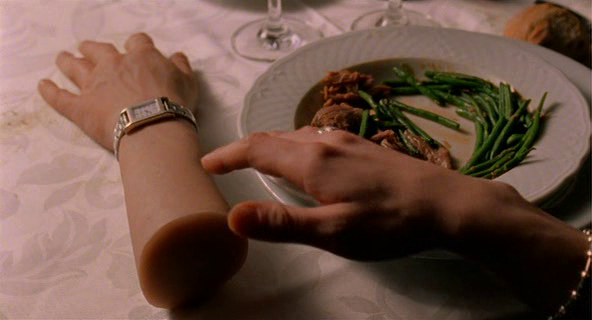
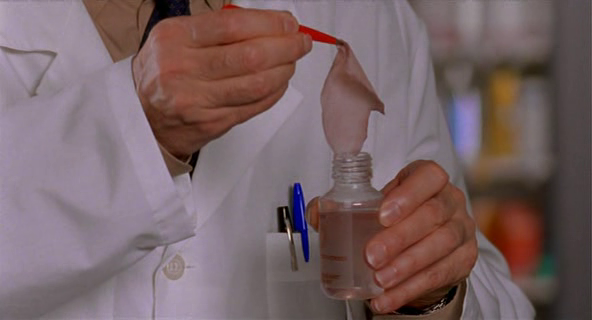
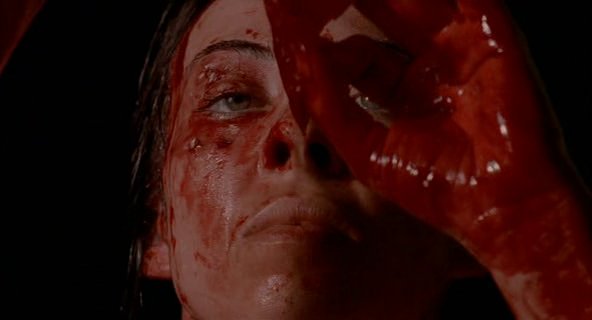
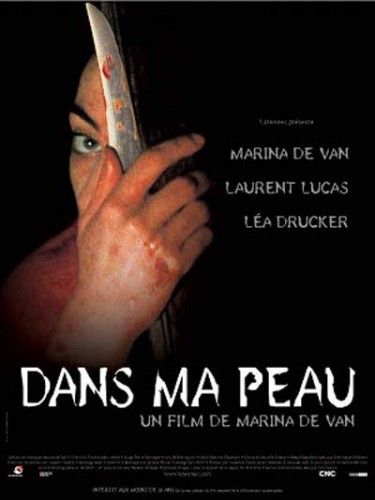
Marina de Van both directed and starred in this film, one in a genre of French movies which became known as New French Extremity films. There’s not a great deal of plot, but there’s a lot to the film in terms of the concepts and questions it raises. The film starts with a series of scenes: traffic, buildings, doors, etc, split screen into the image on one side, and a negative version on the other. So we’re already exploring dualism. The lead character, Esther (played by the director, Marina de Van), is a picture of privilege: she is white, well paid, well off, has a loving boyfriend – she’s on top of her world. Then she has a fall. A real fall, onto some rubbish, and actually injures her leg. But it doesn’t hurt. She doesn’t even notice the abrasions for some time.

Her doctor (played by her real-life brother, Adrian de Van) and her boyfriend (Laurent Lucas) are both concerned about her feeling no pain, but she brushes them off. Then she starts poking her wound, then the cutting starts, then the stabbing, then later the chewing (which qualifies it for my cannibal blog). That’s all I’m saying – no spoilers.

In-My-Skin-e1549986752157.jpg

In the director’s words, the movie asks “does this body really belong to me?” In an interview, she revealed that the story is based on an childhood accident, when she was hit by a car and had her leg broken, and she saw her leg not as part of her, but as a “fascinating, deformed object.”

vlcsnap-2019-02-16-17h17m23s509.png

Here’s the point: we look at each other with love or lust or hatred or fear, but it’s always only skin deep. What is beneath that surface? Derrida tells us that the binary opposition of inside to outside is the “matrix” of all oppositions. We consume the insides (muscle, fat, blood) of other animals but are horrified at our own internals – think of the warning given on the news when showing an accident or terrorist event, often quickly followed by an advert or a kitchen show involving bits of a dead lamb.

vlcsnap-2019-02-16-17h03m14s707.png

Why are we so repelled by what’s under our skin? Judith Halberstam tells us that skin is a “metonym for the human”, and any breach of it reveals a “semiotic of monstrosity” – the uncanniness within the body. Or as Angela Carter put it, “if flesh plus skin equals sensuality, then flesh minus skin equals meat”.

DpUdQUrU0AIX2hr.jpg

This film, and cannibal films generally, remind us that we are not gods or angelic beings – we are animals, and are made of meat, just like the animals we torment and slaughter. When Esther looks into her own being, she feels the same appetite others feel when walking past a roast.

vlcsnap-2019-02-16-17h02m45s986.png

In My Skin received 65% on Rotten Tomatoes, with one reviewer saying “A spellbinding, forceful film that refuses to be ignored” and another slamming it as “a bloody mess, in more ways than one.” The film received the Best International Film award at the Fantasia Film Festival in 2003. Make up your own mind.

Dans-ma-peau_Marina-De-Van-s-In-My-Skin-2002-movie-6-375x500.jpg

I’m so sorry Jack: “Relevés” HANNIBAL Season 1 episode 12 (Fuller, 2013)

This episode is called “Relevés”, an obscure term in the French menu – it comes sort of after the main course, but is not the Rôti (roasts) of episode 11; this one is joints – big butcher joints, served with heavy accompaniments and garnish. Appropriate for a meaty episode, in which Hannibal takes steps not just to cover his own tracks, but to lay a path of suspicion to Will, who has been behaving very strangely lately, thanks to his encephalitis (which Hannibal has also covered up). The real meat of this episode, though, is its treatment of mental illness – where it starts (physical and/or psychological) and how it develops, and the paucity and inadequacy of treatments.

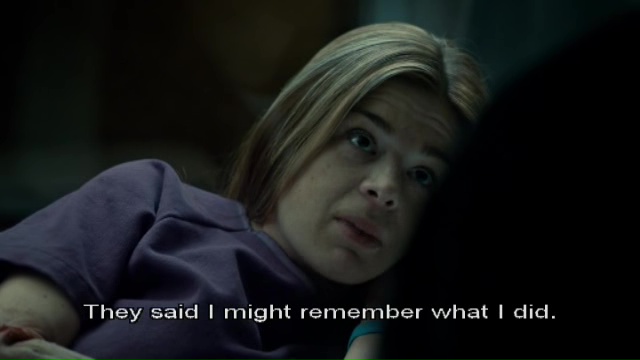
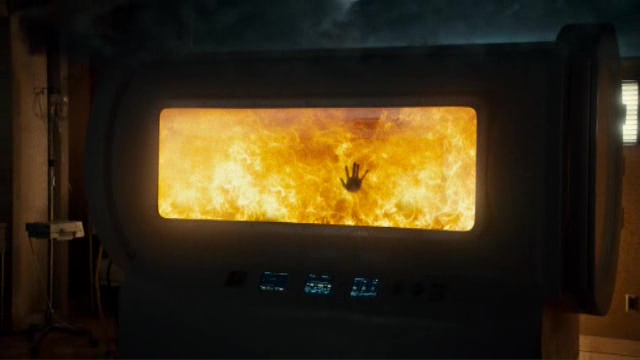
At the start of the episode, everyone is starting to recover. Georgia Madchen, who killed her friend and witnessed Hannibal killing the doctor who knew about Will’s condition, is in an oxygen tank, awaiting shock treatment which may restore her memory.

vlcsnap-00015.jpg

But she doesn’t want to remember.

Hannibal has brought Will one of his gourmet concoctions: “Silkie chicken in a broth: a black boned bird prized in China for its medicinal value since the seventh century. Wolfberries, ginseng, ginger, red dates and star anise. Will’s bemused response, as though Hannibal was his Jewish mother, making chicken soup to treat a psychic crisis that just seems to get worse:

vlcsnap-00016.jpg

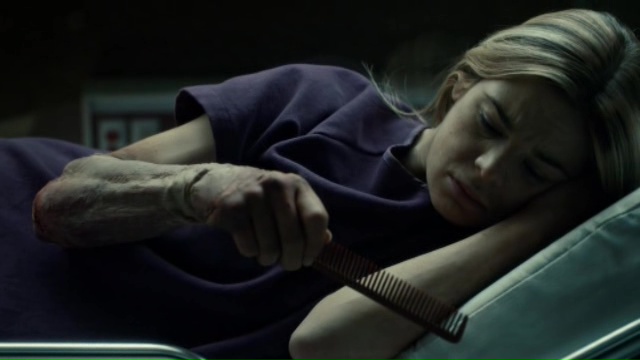
Hannibal also does not want Georgia to recover her memory, because he is vulnerable, even if she was unable to see his face. She wakes up in her oxygen tent and finds a plastic comb, naturally, she starts to comb her hair, and naturally the static creates a spark that ignites the oxygen.

vlcsnap-00017vlcsnap-00020

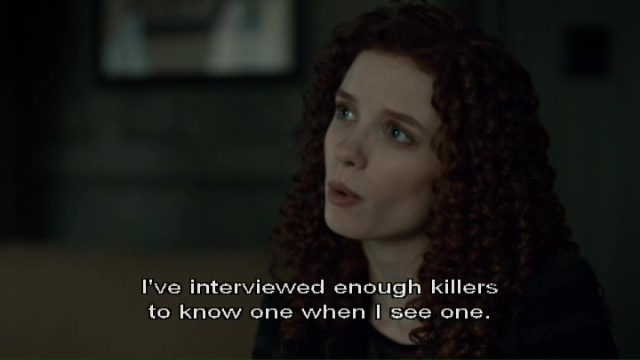
So that leaves Abigail as apparently the only one who could spill the fava beans on Hannibal. She is busy writing her book with Freddie Lounds, who tells her she knows what killers look like

vlcsnap-00021.jpg

She looks for a specific brand of hostility. She sees it in Will Graham, every time she looks at him. Very convenient for Hannibal. But Will has released himself from hospital, and is starting to realise that the spate of copycat deaths are all the same, but slightly different, to the murders they copied – the copycat killed all of them, including Georgia, who saw his face. Will is furious that Georgia was misdiagnosed and misunderstood her whole life, and doesn’t want the same thing to happen with her death, which Jack is treating as suicide.

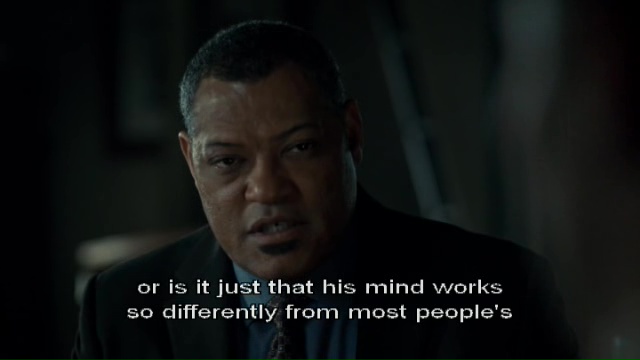
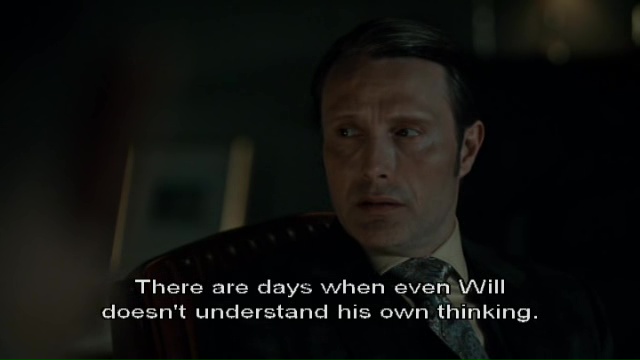
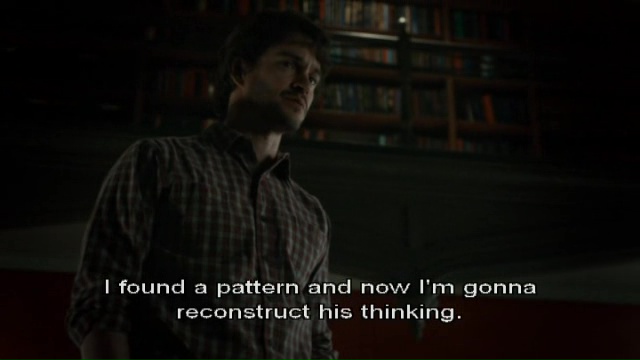
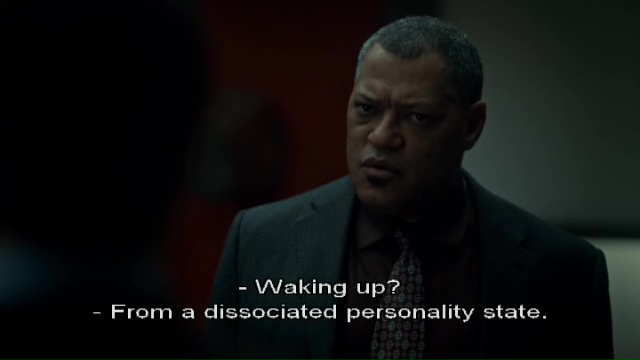
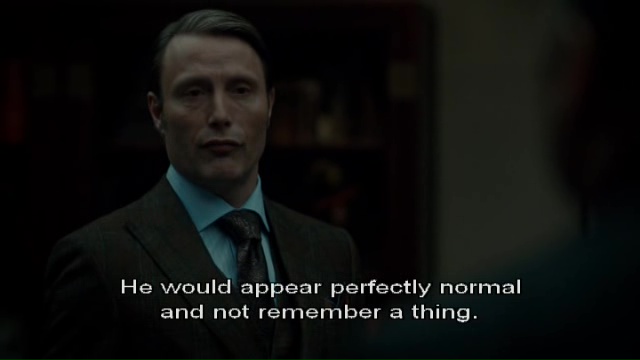
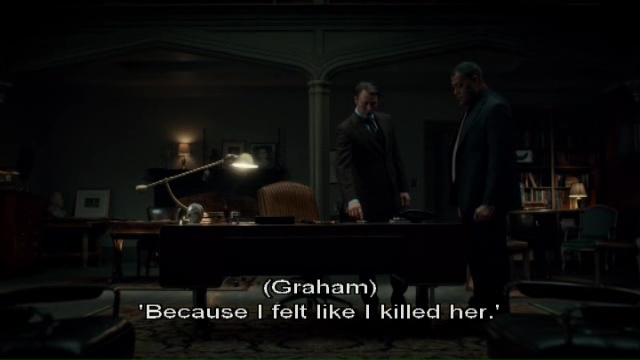
Will’s vehement reaction worries Jack, who consults Hannibal, allowing Hannibal to plant the seed of suspicion: does Will suffer from a mental illness that would allow him to do things he doesn’t normally do?

vlcsnap-00024.jpg

That’s true for Will, but even more true for Hannibal, who sees himself as a species apart from the common herd, an Übermensch, who has cast off normative humanism for his own ends, which we are yet to understand.

vlcsnap-00025.jpg

Will is visiting Abigail in hospital. They discuss the nature of killing. Will admits killing her dad was terrifying, but then made him feel powerful. She replies that

vlcsnap-00026.jpg

She wanted to escape, but Will is doubtful

vlcsnap-00027.jpg

Her dad is still out there, in the form of the copycat. Will thinks he can catch him,

vlcsnap-00028.jpg

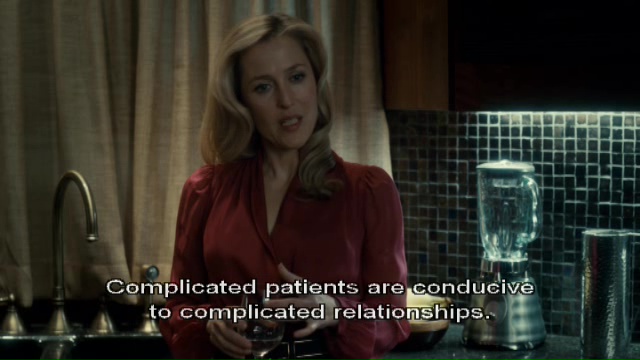
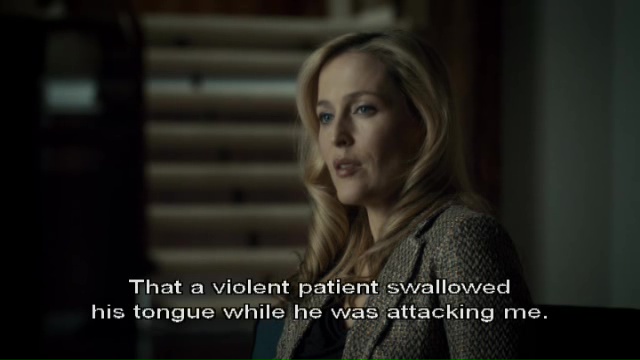
Jack has been visiting Bedelia, who has covered for Hannibal (as any professional psychiatrist would) and has been asking about a case in which a patient, referred to her by Hannibal, tried to kill her, but luckily died by swallowing his own tongue ( a reference to Multiple Miggs in Silence of the Lambs). Hannibal, Jack points out,

vlcsnap-00029.jpg 30

vlcsnap-00030.jpg

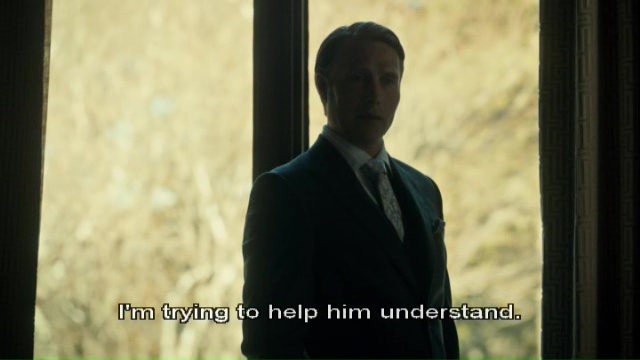
Hannibal asks what she told Jack?

vlcsnap-00034.jpg

She doesn’t know quite what Hannibal is trying to do with Will (it seems to us, the omniscient spectators, that he wants to turn Will into a clone of his own powerful self)

vlcsnap-00031.jpg

vlcsnap-00032.jpg

vlcsnap-00033.jpg

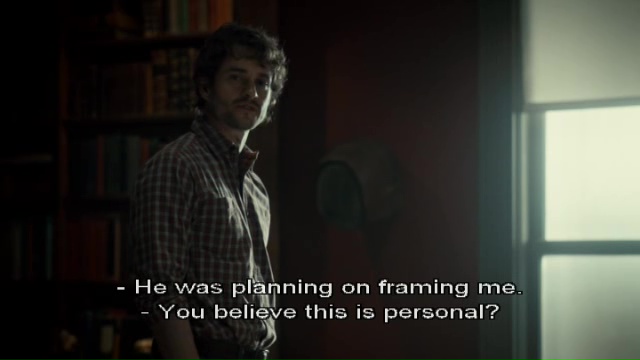
Will is thinking clearly again, he tells Hannibal, and starting to understand the copycat killer that so baffles the FBI. Georgia was killed for seeing the killer, who ended up framing her for it, but

vlcsnap-00035.jpg

vlcsnap-00036.jpg

Now it’s personal. Will realises it could be someone at the FBI or the police. He doesn’t, however, realise what we realise, that he is in the same room with the killer. Like a pantomime, we feel like shouting at the screen: look behind you! But we don’t, because we don’t have interactive TVs (yet), and also because we like Hannibal, and don’t really want to see him unmasked (yet). But Will’s clarity, and Abigail’s book, are both threats to Hannibal. And he has only one episode of Season 1 to neutralise them.

Fortunately for Hannibal, everyone is on the wrong scent. Jack is still convinced Abigail is the killer, while Freddie is still convinced it is Will, and tells Jack so.

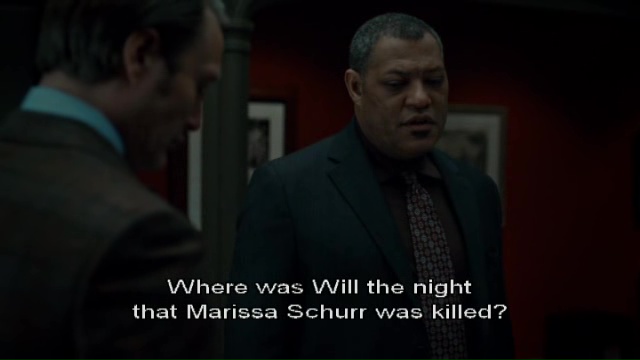
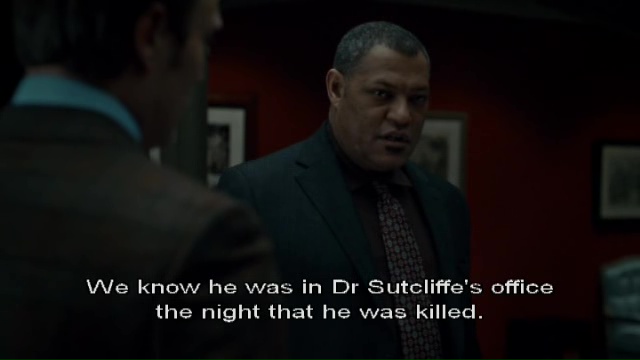
Will takes Abigail out of the hospital, back to the crime scene – her home in Minnesota. Jack is furious and goes to see Hannibal, who admits to Will’s confused mental states, where he loses time and doesn’t know what he has done. He plays Jack a selected section of the recording of his discussion with Will about the murder of Melissa Schurr.

vlcsnap-00037vlcsnap-00038vlcsnap-00039

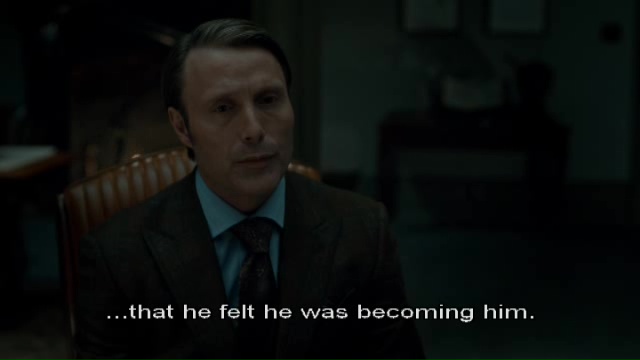
Together with Hannibal’s revelations about Will’s mental state, Jack is starting to suspect Will.

vlcsnap-00040vlcsnap-00041vlcsnap-00042

Will had told Hannibal, who hadn’t told Jack, that he was getting so close to Hobbs that

vlcsnap-00044.jpg

Now he has Hobb’s daughter, who Hobbs intended to kill. Jack fears the worst. As for Hannibal:

vlcsnap-00047.jpg

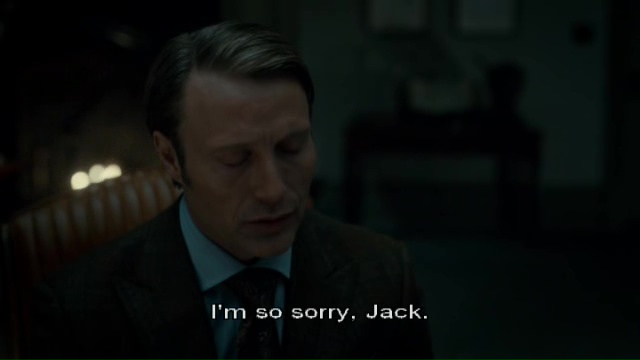
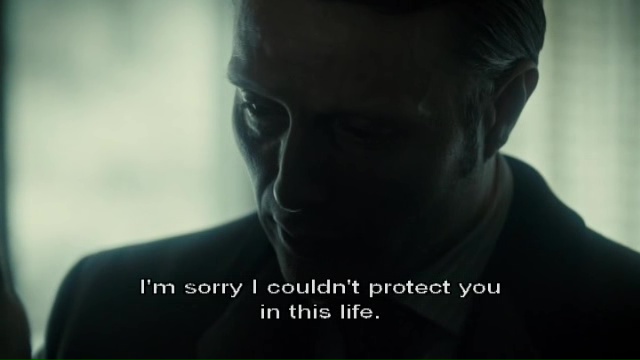
Hannibal is sorry, but not, as Jack thinks, for hiding the “truth” about Will’s mental state. He is truly sad and sorry, for losing his friend, his only friend, feeding him into the jaws of the justice system.

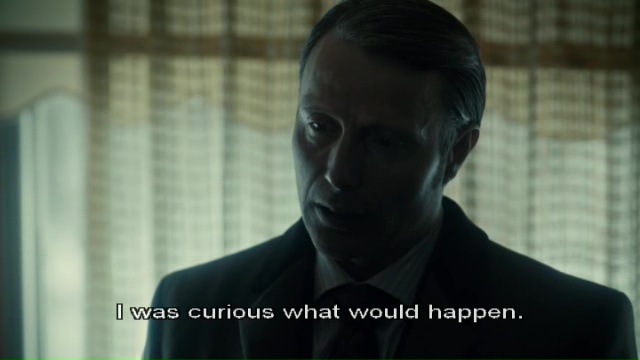
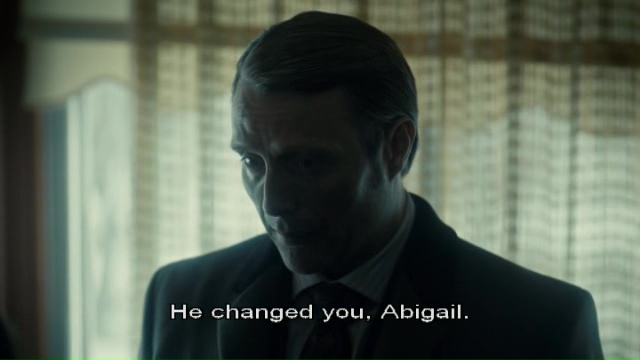
Why does Hannibal do these things? Abigail asks him, and he tells her the truth, at last. He called the house to warn Hobbs they were on their way. Why? she demands. And this is crucial to an understanding of Hannibal:

vlcsnap-00052.jpg

He killed Marissa, hoping that Abigail would kill the victim’s brother. Abigail is another of his projects

vlcsnap-00058vlcsnap-00059vlcsnap-00060

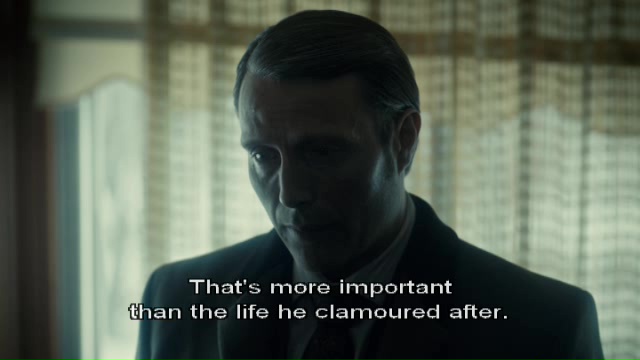
Hannibal believes, as Dolarhyde says in Manhunter, that the people who are killed in these becomings are not real: “You alone know the people I use to help me in these things are only elements undergoing change to fuel the radiance of what I am Becoming. Just as the source of light is burning.” Abigail’s Becoming is far more important than Nick Boyle. But Abigail is scared of Hannibal now: he tells her that he has killed far more people than her father.

vlcsnap-00063vlcsnap-00065

Will he or won’t he?

Next episode – the season finale.


IF YOU LIKE MY BLOG, PLEASE FEEL FREE TO RECOMMEND IT (WITH DISCRETION) TO FRIENDS ON SOCIAL MEDIA.
IF YOU HAVE ANY QUESTIONS OR COMMENTS, YOU CAN USE THE TAG, OR EMAIL ME ON CANNIBALSTUDIES@GMAIL.COM.