A few years ago, I got chatting to a couple who owned a business in New Zealand – they were undertakers. When I mentioned my doctoral thesis, the thin red line between cannibalism and carnivorism, they told me they often received calls and emails seeking body parts. I doubted the story at the time – after all, cannibalism was a convenient story in the early days of British colonialism, and while Maoris have agreed it happened occasionally, it seemed unlikely to be a regular commercial proposition in the twenty-first century.
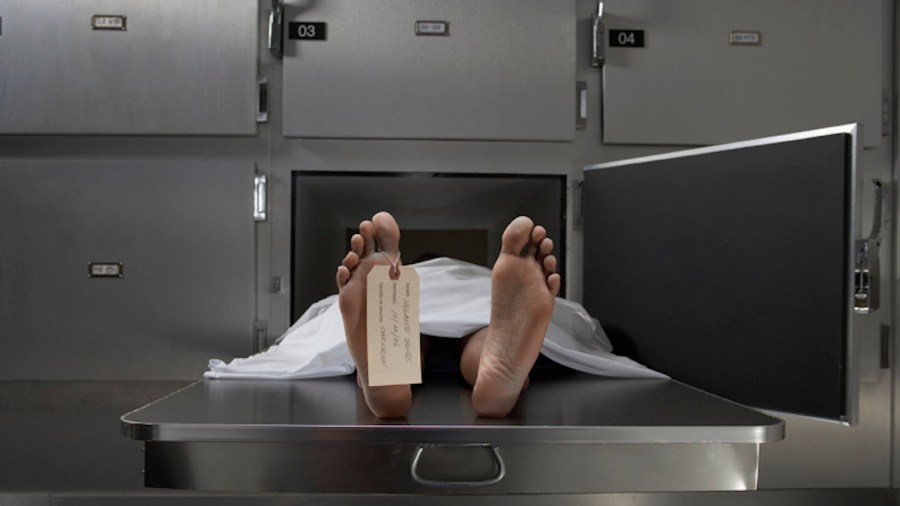
But the story lives on. In November 2025, The New Zealand Health Practitioners Disciplinary Tribunal found that a former mortuary technician had posted comments to social media “promoting cannibalism” and boasted that he could “literally steal an entire heart”.
The man – who cannot be named for legal reasons – also shared an image online of a dissected human skull with a handwritten message inside: “We’re inside your head”.
The Tribunal ruled that this constitutes professional misconduct, stating that he:
“engaged in conversations … promoting cannibalism and eating post mortem tissue”
Their ruling noted the man identified himself online as someone who worked in forensic pathology and/or was involved in post-mortems.
The man also engaged in online conversations about rape and sexualising children, his own alleged drug use and ways of making explosives, offering to show others how to make explosives.
One online conversation saw the man claim:
“When we have burn victims…. They smell so good sometimes”
In another online discussion about cannibalism, he discussed the provision of human (post-mortem) tissue to others.
“When you’re working here. We got enough [muscle] to go around. Save your muscle”
He also boasted about being able to access body parts.
“I mean. It’s not actually that hard. I could literally steal an entire heart. It all just goes back into a bag we stitch back inside them not like anyone checks it”
He told one online user he could “sneak a little heart slice next week. It’ll be me conveying my love to you. Sending some actual human heart.”
The man also claimed that he’d decapitated a corpse “to boil her head”.
The Tribunal ruling noted the man “accepts that his rhetoric, comments and information about post-mortems, post-mortem procedures, and dissections that he posted and/or circulated in his social media posts was inappropriate and that his conduct fell below the expected ethical and professional standards that apply to members of his profession”.
The Tribunal also noted the “charge of professional misconduct is established”.
No charges have been laid regarding the man actually carrying out any of these acts. What happened to free speech and entrepreneurialism in New Zealand?
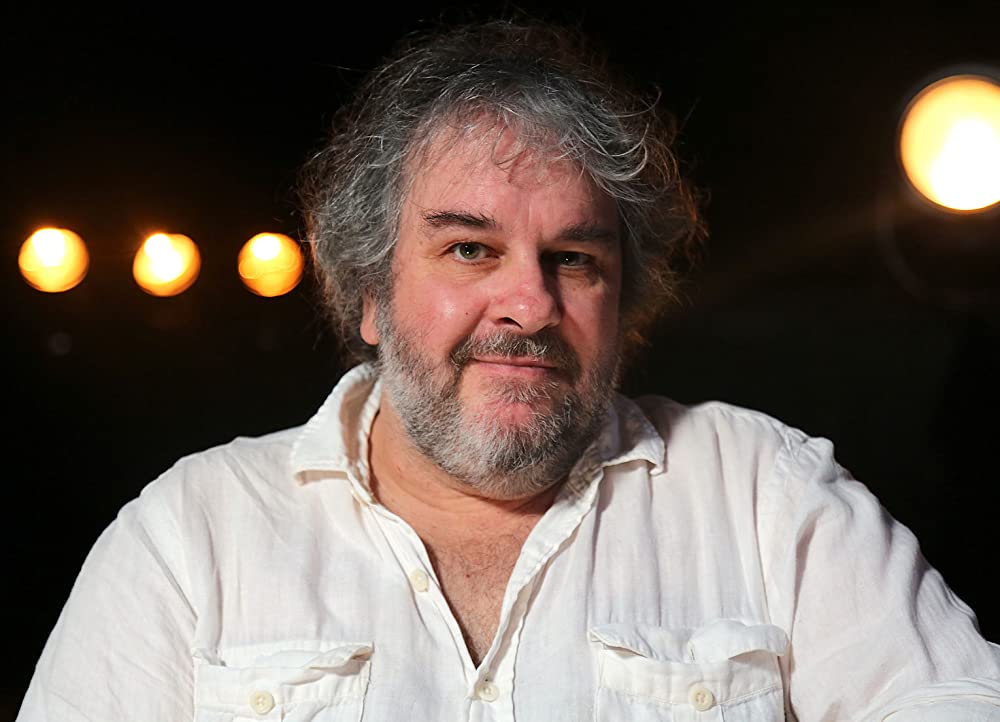
Peter Jackson is a New Zealander, and the fourth-highest-grossing film director of all time, behind only Spielberg, Cameron and the Russo brothers. He is best known for The Lord of the Rings and The Hobbit trilogies, as well as movies like King Kong and the documentary The Beatles: Get Back.
But we all have to start somewhere, and Jackson’s first feature was Bad Taste, a splatter comedy which took years to make as it began life self-funded and only later received a grant from the NZ Film Commission. Many of Jackson’s friends acted and worked on it for no charge. Shooting was mostly done on weekends since Jackson was then working full-time for a newspaper in Wellington, the NZ capital.
Bad Taste is about aliens who plan to capture humans for food. They take over a (fictional) NZ town called Kaihoro (which means something like “fast food” in Maori) and butcher all the residents.
“There’s no glowing fingers on these bastards. We’ve got a bunch of extra-terrestrial psychopaths on our hands.”
It turns out that they are not just hungry but entrepreneurs from the “Crumbs Crunchy Delights” company, and need to collect human flesh for the home planet market, and get it there before competing alien corporations.
“I am certain that when the Homo sapiens taste takes the galaxy by storm, as it will, Crumbs Crunchy Delights will be back at the top”
They are disguised as humans until they drop the pretence and, luckily for us, they speak English to each other to reveal their plans. Their plans are foiled by a team of agents from the Astro Investigation and Defence Service (AIDS) entering the town to take down the invaders.
The action sequences are actually very well done, long before Jackson had access to special effects studios, with choreographed fight sequences and buckets of gore and brains and other body parts. Jackson took two roles, a nerdy scientist who is a member of the government agents, and a leader of the aliens, including a famous scene in which he fights himself on top of a cliff.
The film is most famous for its unapologetic gore, including half-eaten bodies, heads coming off, and brains leaking out of skulls. The brave Kiwis mow the aliens down in an interminable gun-fight, which culminates in Derek (Jackson) killing the alien leader, Lord Crumb, by jumping on him from the floor above while wielding a chainsaw, a favourite of cannibal films, cutting the alien’s body in half and disappearing inside the corpse. The film was banned in Queensland briefly, which did wonders for its publicity; the video release proudly proclaimed on the cover “Banned in Queensland”.
But is it cannibalism? It is after all a completely alien species from another world eating humans, or at least trying to. So not strictly cannibalism, but humans being eaten by aliens dressed as humans is a popular narrative in science fiction texts (see for example Under The Skin), and raises some interesting questions. Anthropocentric humanism maintains that we are somehow on a higher level than “animals”, even though we are animals, a species of Hominidae (Great Apes). Because of this ontological division, bolstered in past centuries by religious beliefs about humans being made in the image of the divine, we tend to judge other animals as possessions, inferior beings to whom we can do as we wish, so we kill them, skin them, shear them, eat them, experiment on them, race them, and so on. Not just other animals; the colonisers of Africa, South America and other parts of the world felt the same way about the indigenous peoples who lived in the areas they coveted, and so they were conquered, enslaved, converted or simply exterminated.
What if travellers from another planet, considering themselves far superior to us (not an entirely unreasonable proposition if they have conquered deep space travel), decide to colonise, exploit or even eat us? If we could take them to the Galactic High Court, the learned judges might rule that the aliens were simply doing to us what we do to billions of other earthlings each year. As John Harris wrote:
Suppose that tomorrow a group of beings from another planet were to land on Earth, beings who considered themselves as superior to you as you feel yourself to be to other animals. Would they have the right to treat you as you treat the animals you breed, keep and kill for food?
Bad Taste is well made, entertaining and, if you are not worried by lots of gore and brains, very watchable. It debuted at the Cannes Film Festival in May 1987, which is not bad for a first movie, a splatter comedy, made on a shoestring. It currently has 71% “fresh” rating on Rotten Tomatoes, which is far better than many far better financed films. A number of critics made great sport of the title, saying that “bad taste” described the film well, but that was deliberate, a clever combination that tells the audience that it is bad taste cinema (may leave a bad taste in your mouth) and that human meat tastes bad, which according to all the cannibals who have testified about it, is simply not true. We taste somewhere between veal and pork, and would certainly be very popular in galactic fast-food joints.
The recent tour of Australia by British anti-trans campaigner Kellie-Jay Keen-Minshull— who also goes by the name of Posie Parker — added cannibalism to the culture wars already raging over transsexual rights.
Keen-Minshull organised a “Let Women Speak” tour of Australia and New Zealand, holding rallies in several cities to claim the push for transgender rights is “silencing”, endangering and discriminating against women.
There has been a lot said about Keen-Minshull, mostly debating her claim to be a warrior for women’s rights and accusing her of being an extremist, expressing views that are designed to be harmful to the transgender community. The rhetoric she uses is far more extreme than usually expressed in Australian politics, although it has become common in other countries, particularly the USA. She suggests, among other claims, that trans women are sexual predators who pose a safety threat to girls in female bathrooms. She describes gender affirmation healthcare as mutilation, and being transgender as a “fetish” — positions totally at odds with the views of experts who work with people who are transitioning.
Keen-Minshull’s rally in Melbourne was attended by far-right extremists who performed Nazi salutes. Although organisers claimed the masked thugs had “gate-crashed” the event, a trans rights activist and TikTok star known online as LilahRPG said “everyone was just furious, seeing Nazis doing salutes uninterrupted and interacting with the TERFs.” TERF is an acronym for “trans-exclusionary radical feminist“.
This is one of the clearest indications that far-right social media is using the “gender-critical” movement to promote membership of their groups.
Keen-Minshull has made a series of videos (see Twitter message above) about “Grooming Gangs” – repeating unproven claims that a young girl in England was killed and eaten as kebab meat. These claims are then used as racist conspiracy theories, saying that the botched police investigation was in fact a cover-up of paedophile elites who, they say, control everything. Keen-Minshull says:
“What we know is that there’s grooming gangs in Telford. A young woman that never actually really made it to mainstream news, wasn’t a big story, was cut up and I think she was put into meat that was sold for human consumption. We know that there are vast numbers of men involved in these grooming gangs, and we know that there’s weird cover-up stuff going on, that only makes sense if the other people in power are also raping children.”
The case she is referring to seems to be the disappearance of 14-year-old Charlene Downes, who disappeared in Blackpool in north-west England in November 2003. Accusations were made of a child-grooming ring, which induced young girls into having sex in return for cigarettes, food and alcohol. At least one newspaper was quick to claim that investigations had been “hampered by political correctness”, because the girls were white and the perpetrators non-white.
Two men, Ilyad Albattikh and Mohammed Reveshi, were tried in May 2007—the first for Downes’ murder, the other for helping dispose of the body—but the jury failed to reach a verdict. A re-trial was scheduled, but in April 2008 the accused were released because of concerns about serious errors in the evidence compiled by Lancashire Constabulary, who were chastised for their inept handling of the case.
The prosecution had claimed Charlene’s body had been cut up and minced into kebabs in a Blackpool takeaway called “Funny Boys”.
At the time of the trial, the court was told the fast food shop owner had “joked” that Charlene Downes had been chopped up and put into kebabs that were sold to the public.
There is a lot of racism involved in this story. White children being raped by men of colour is stated or implied in many of the reports, although there is little evidence to show that white offenders were not also involved. Many actual cases of the cannibalism of children indicate the opposite – that white men like Jeffrey Dahmer and Albert Fish prey on children of colour, because such missing children are less likely to be investigated by white detectives. Meanwhile, the Indian current affairs website OpIndia did not mince its words about the alleged mincing of the victim:
Groomed by Muslim gangs, minced into pieces, fed as kebabs
Of course, Ms Keen-Minshull did not invent the idea of using cannibalism as a weapon of dehumanisation (Christopher Columbus did that very successfully) or even as a part of the culture wars – recall the hate and scorn aimed at the New York Times when it suggested the “cannibalism has a time and a place… and others suggest that that time is now”.
Classical mythologies told of savage gods who ate their own children, and paranormal entities such as witches, who used body parts for their rituals. Such usages were not exclusively supernatural, with “blood libel” accusations that Jews were killing Christian children to use their blood for religious rituals and cannibalism dating back to the twelfth century, and being revived with nauseating regularity up to the present day.
QAnon has been very successful recruiting members in the US, partly based on accusing everyone from Hillary Clinton to a pizza shop owner of killing and eating children. The accusations are meant to dehumanise the alleged perpetrators, but usually end up doing the same to the victim. Poor little Charlene is now almost unknown, except as the “kebab meat girl”.
Lots more details of her case are available on YouTube investigations such as the one below, some of them are quite lurid.
Imagine you are trapped on a ship surrounded by ice in the Arctic, and some of your friends might actually not be whom they seem. Dread Hunger, a New Zealand computer game in which players can cannibalise their friends, has become a huge success, mainly in China.
I usually blog about cannibal movies here, or news stories about cannibalism when they break. This is the first game I have covered, although I am waiting to see the game “Borneo: A Jungle Nightmare” which is due for release this year – it is scripted and directed by Ruggero Deodato, who brought us one of the seminal cannibal movies in 1980: CANNIBAL HOLOCAUST. This game was originally going to have the same title, but is not a remake (in game form) of the original, but more like fourth in Deodato’s cannibal saga. Due out sometime in 2022.
Anyway, back to DREAD HUNGER! When the Christchurch company, Digital Confectioners, released the game earlier this year, they were hoping they might reach 10,000 players in the US. To their surprise, they found that more than 260,000 people in China play the game every day. Due to time zones, says Director Sam Evans, the demand is mostly between the hours of 12.30am and 5am New Zealand time (which for computer nerds is a fairly normal operating time).
Dread Hunger is a survival game set during an Arctic exploration in 1847-48. Players can build fires, fight off wolves, and hunt for food, including, sometimes, human flesh from their shipmates.
There are various weapons, and the players can also “pick up severed heads and limbs and use them to kill.”
One of the strategies is:
“Betray Your Friends Feed them tainted food, lure animals to attack them, hex them with blood magic, or if all else fails… just shoot them in the back.”
The game has become a target of hackers, including DDOS attacks and “cheats” where hackers find a loophole in the game code they can exploit to give players an unfair advantage.
Dread Hunger has just passed 1 million copies sold, a figure Evans called “insane”. The graphics are splendid and, well, graphic.
This has led to some new, if profitable, challenges.
“The American market largely treats games like a product. They buy the game, they play the game on average 10-15 hours over a few weeks, then they move on. But in China when they find a game they like, they play it for hundreds of hours, for years and years. This forced us to treat the game like a service. We now have to focus on continual development and regularly updating the game to add more cool features over time.”
The game is mainly based on the 1845 expedition of 129 men led by explorer Sir John Franklin, which left Britain for the Canadian Arctic in search of the elusive Northwest Passage. Their ships, the H.M.S. Erebus and the H.M.S. Terror never returned.
Rumours that the crew resorted to cannibalism have swirled around the doomed expedition since the nineteenth century. Evidence suggests that Franklin’s crew may have not only consumed the flesh of deceased compatriots, but also cracked their bones, to eat the marrow inside. In 1854, interviews with local Inuits described piles of human bones, cracked in half.
In 1864, Sir Edwin Landseer‘s painting Man Proposes, God Disposes caused a stir at the Royal Academy exhibition for its depiction of two polar bears, one chewing on a tattered ship’s ensign, the other gnawing on a human ribcage. Cannibalism did not get a mention – yet.
More recently, in the 1980s and 1990s, researchers recovered remains of the crew on King William Island. Knife marks on the bones backed up early accounts of human cannibalism. A newer analysis of 35 bones by anthropologists Simon Mays and Owen Beattie suggests that the men did indeed eat each other. The bones showed signs of breakage and heating—indicating that the crew members probably cooked them to extract the marrow. Mays and Beattie published their results in 2015 in the International Journal of Osteology.
Horror writer Dan Simmons‘s 2007 book The Terror was developed as a 2018 AMC television series also called The Terror. The expedition has, over the years, taken on the mythic value to the British that the Donner Party holds in the USA.
One of the lines from the launch trailer (above):
“I have heard it said that this land can change a man. Turn him into a beast. Well, to that I would say—men were always beasts. Some you see, well, they’re just better at hiding it than others.”
Dread Hunger is what is called in games parlance a “social deduction game”. This is a category of game in which players attempt to uncover each other’s hidden role or team allegiance. It’s an ideal formula for a population who never know quite who the agents of their government might be. And also an ideal cannibalism game for the recent history of man-eating, in which the cannibals like Albert Fish, Jeffrey Dahmer, Issei Sagawa and Armin Meiwes all appeared as very ordinary, normal neighbours.
We all need to do some social deductions, it seems.
New Zealand has produced some world class directors; think of Jane Campion, or Peter Jackson. Not a lot of cannibal movies unfortunately, considering the country’s reputation – Jackson’s first feature film Bad Taste had a lot of humans being eaten but, unfortunately for this blog, the eaters were space aliens, so not technically cannibals. Jackson’s Braindead was closer, involving zombies. Can you be a cannibal if you are undead? We’ll have to consider that question some time, perhaps when we run out of movies about living cannibals (probably about the time we get to net zero).
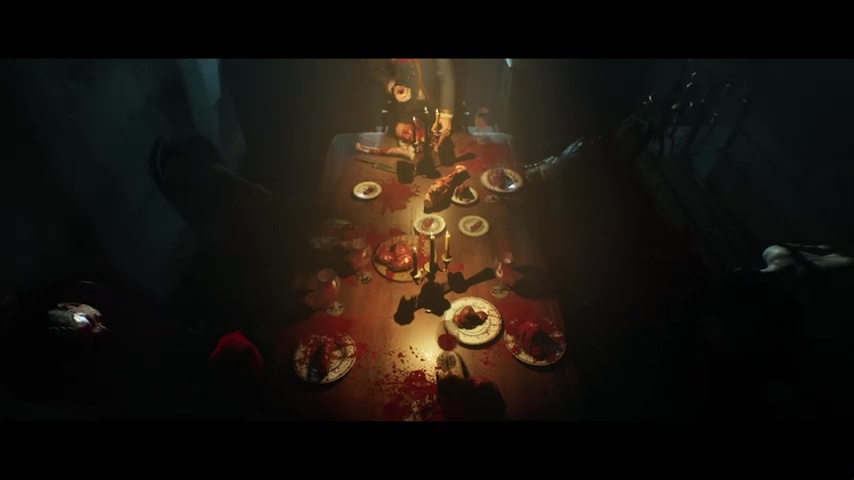
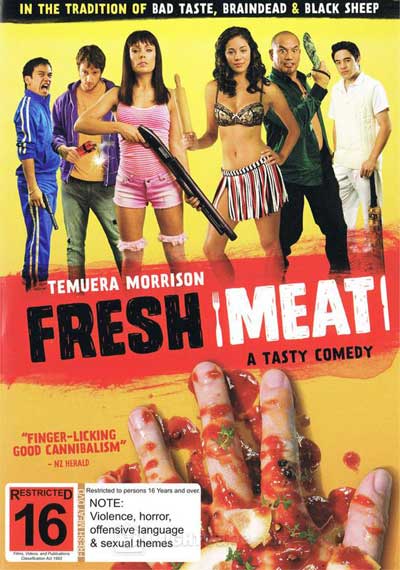
But Danny Mulheron gets right into freshly killed, cooked (and sometimes raw) human body parts in this film. Like Jackson’s Bad Taste, Fresh Meat was Mulheron’s first feature film, and it’s an impressive inception.
The plot involves a family of Maoris, recently converted cannibals, being taken hostage by some bumbling criminals. Rina (Hanna Tevita) is home from her lesbian explorations at “St Agnes Boarding School for Young Maori Ladies” when a bunch of criminals break in to her home to hide from the police, having killed some prison guards to free their boss from a prison van.
But that’s Rina’s second shock of the day; the first was finding her parents’ new eating regime in the fridge.
Turns out her Dad (Temuera Morrison from Once Were Warriors and The Mandalorian) is reviving an “eighteenth century post-colonial religion” – he has found the prophecies of Solomon Smith and become a “Solomonite”; he now believes that eating people (“taking their life-force”) will cause the family to flourish.
Yes, among the satire on Maori and Pakeha cultures, there is the odd dig at Christian transubstantiation.
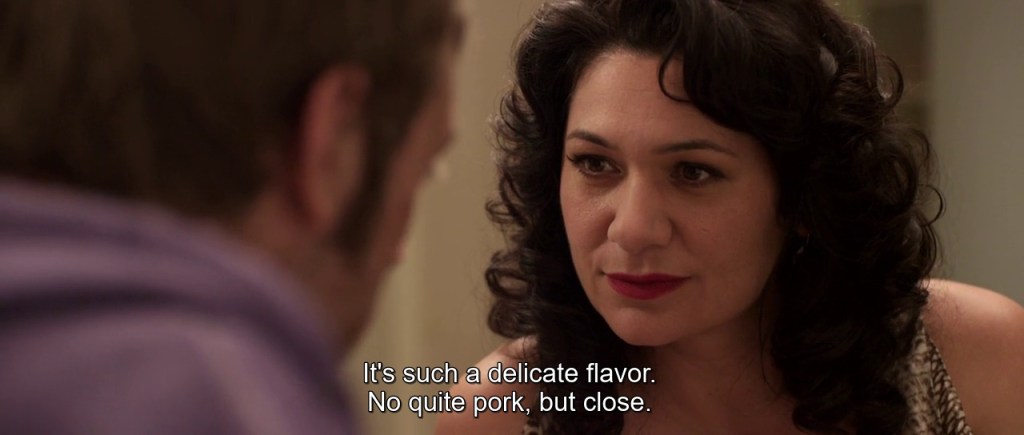
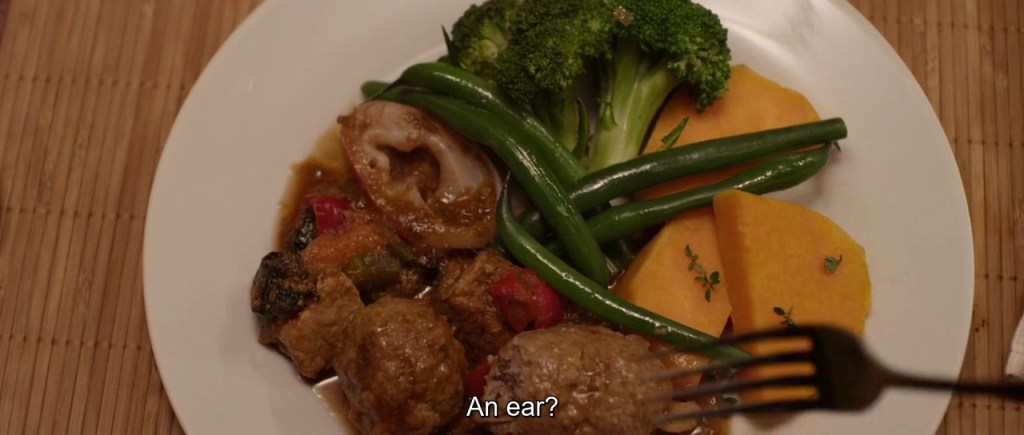
Mum (Nicola Kawana) produces hugely popular cooking shows and books, she’s a Maori Nigella, into marinades, and she describes the meat she uses:
Rina is shocked that her brother (Kahn West) would agree to eat human flesh, until he tells her about the pork and rosemary pies that her family sent to her at school. It wasn’t a choice.
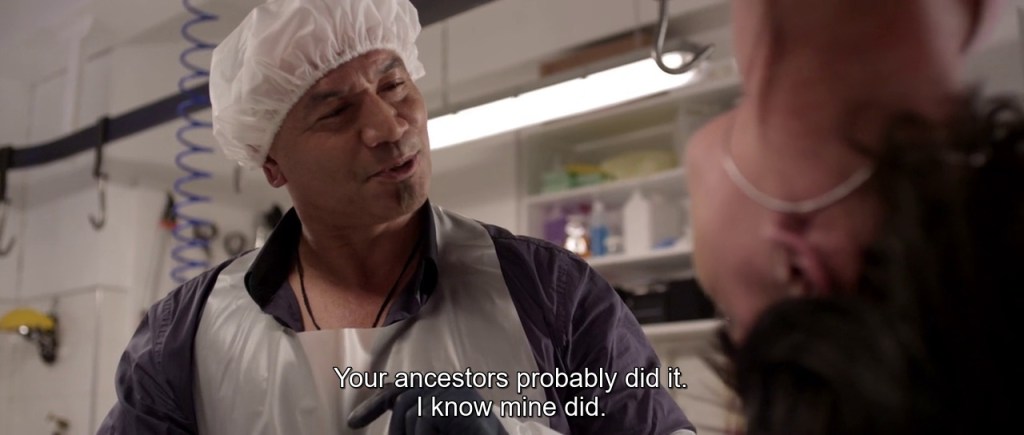
The subsequent bloody altercation with the criminals is set to fill the larder nicely. Dad tells the last living criminal, Gigi (Kate Elliott), who is hanging upside down ready for slaughter, that
“ritualistic cannibalism dates back to 1000BC to the Hun phase in Germany. The Bible itself refers to the siege of Samaria in which two women made a pact to eat their children. The Aztecs, the French, the Brits… Your ancestors probably did it. I know mine did.”
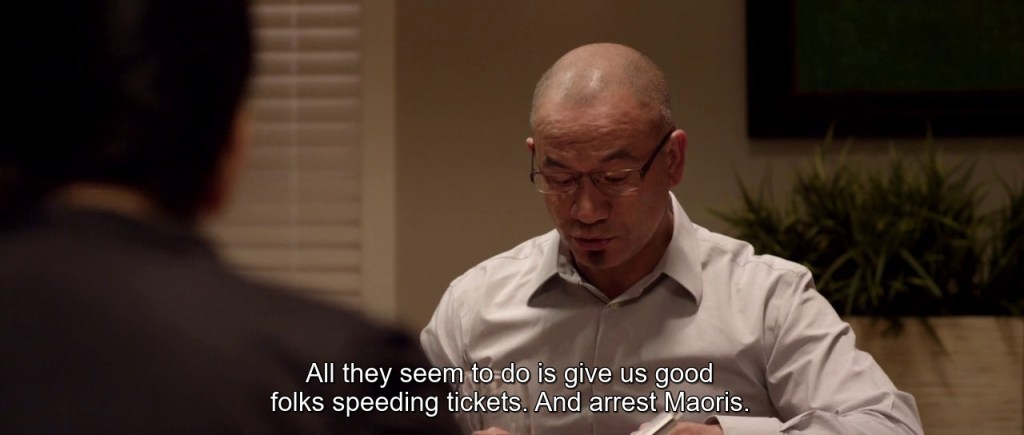
There is lots of Maori humour, and not all relating to cannibalism. Dad is an Associate Professor at the University, and blames white racism for his failure to be given tenure as full professor. When the cops knock at the door, he complains
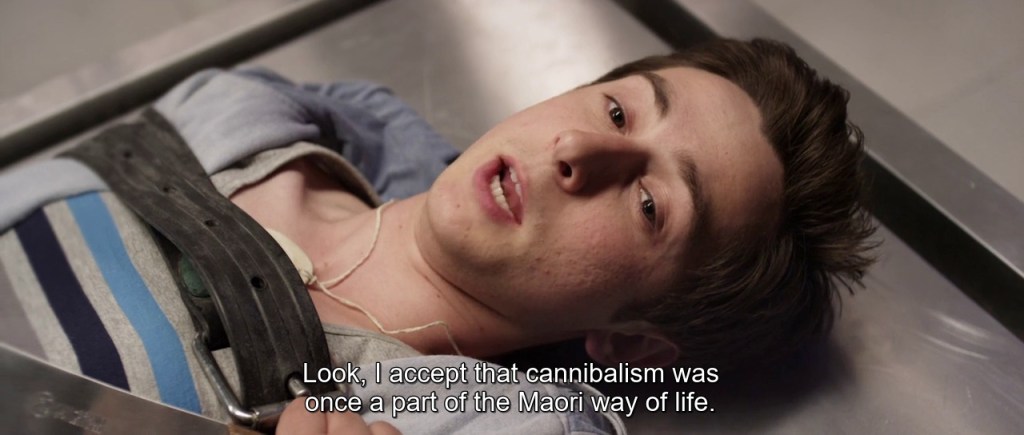
Rina’s neighbour is a white boy who is in love with her. When he appears and is invited in (“we’ll have him for dinner” says Dad – yes, Hannibal lives), he points out that he is a vegetarian, but politely eats what turns out to be a human testicle, only getting suspicious when he spots something else on his plate.
Even when they have him tied up in the basement ready for slaughter, he politely tells them
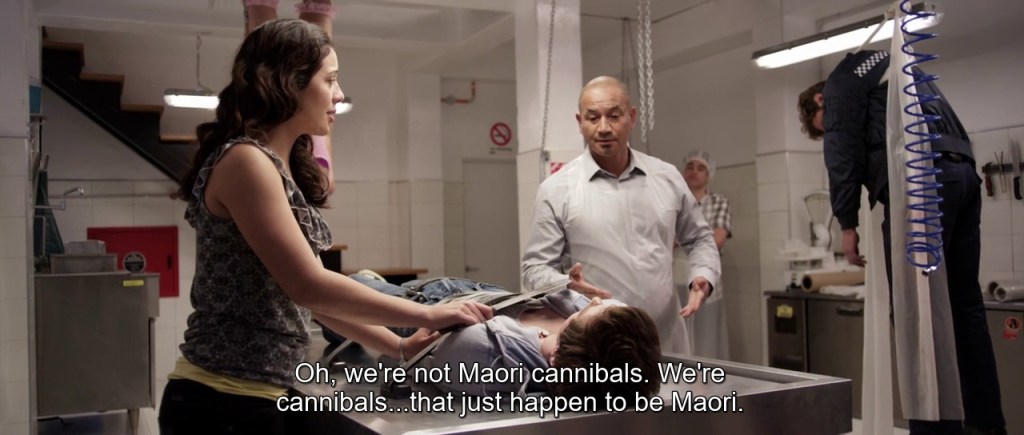
Dad replies with the best line of the movie:
“Oh, we’re not Maori cannibals. We’re cannibals… that just happen to be Maori.”
But Dad has his own agenda: to become immortal:
“By eating the still-beating heart of my youngest son, I’m halfway towards immortality. But I still need to drink the blood of my virgin daughter.”
Doesn’t quite work out that way, Rina’s not a “virgin” after that scene in the shower with her girlfriend. Or does it?
What is it about virgins and blood sacrifices anyway? Are the rest of us not good enough to sanitise humanity’s sins with our polluted blood? We exploit the innocent and gentle ones, and then expect that, by slaughering them, we somehow clear our guilt at doing so. Remember the line from Leonard Cohen’s song Amen:
Tell me again When the filth of the butcher Is washed in the blood of the lamb…
Anyway, the takeaway from this movie is that Maoris, traditionally accused of cannibalism, can be Maoris and cannibals without being “Maori Cannibals”. The two identities can be separated, even as they coexist. There are other families of cannibals who are not defined by their race; consider the Mexican film Somos lo que hay or its American adaptation We are what we are.
In cannibal studies, it is not unusual to be buttonholed by someone who has become aware of your field of interest and told with great solemnity “the Maori were cannibals, you know.” I tend to politely thank the informant for sharing a “fact” that almost everyone “knows”. But if I am feeling feisty, or have had a few drinks, I might invite them to unpack that statement – which Maori, whom did they eat, and what evidence are you presenting for this?
The British invaders of New Zealand were keen on declaring that the indigenous peoples, of wherever they went, were cannibals – it made their job of invading, enlightening and/or exterminating the inconvenient locals so much easier. But there is some evidence that much of the talk of Maori cannibalism was either misinterpretation or just slander – imperialists in the age of expansion tended to use words like “savage”, “barbarian” or “cannibal” pretty interchangeably – if you had dark skin and didn’t speak English, you were probably a cannibal, with no evidence required other than some hearsay from conquistadors or missionaries. But if an alien civilisation invaded Earth and found a copy of the Grimm’s Fairy Tales in a bookshelf, they might well assume that it was a history book, and that we were all cannibals.
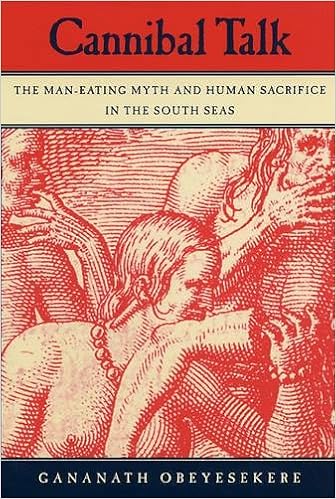
Ganath Obeyesekere’s excellent book on cannibalism in the South Seas makes clear that the oversimplification of Maori culture and mythology (and perhaps humour) probably led to often tragic misinterpretations of local customs. In fact, he says, it is likely that many Maori were convinced that the British were cannibals. And who could blame them? If those aliens mentioned above put down Grimm’s Fairy Tales and took a look inside our industrialised slaughter factories, where 135,000 farmed animals are killed every minute, they would assume we were far more bloodthirsty than they, or the Brothers Grimm, could have imagined. No wonder they don’t make contact.
It is interesting to consider the differing responses to cannibalism in the family of this film. Social Psychologist Melanie Joy calls the ideology surrounding and justifying the eating of meat, dairy and eggs “carnism” – a set of largely unconsidered beliefs in three beliefs that start with the letter N: that these products are “normal, natural and necessary“. We drink milk, eat meat, scramble eggs, based on the insouciant assumption that all these things are normal, necessary and natural (and, a fourth N, nice to taste). The family members reflect these views, but in relation to a different food source: Homo sapiens. Dad thinks eating humans is “necessary” in order to absorb the life force of the victims, and make himself immortal. Mother is a celebrated chef; for her, eating meat is “natural”, and where it comes from is not an issue, as long as it cooks well and tastes good. Rina’s brother finds the whole thing “normal” – his parents do it, and he wants to learn from them, and make them proud. Only Rina objects, although she was willing to eat the pies they sent her when she thought they were bits of a different animal. She’s like a vegan at a barbecue, heart-broken to see her family so unthinkingly accepting the death of animals, or at least, those that she can see and talk to.
If you don’t like gore and body parts (and violence and lesbian kissing) then you might want to skip this movie. But if you don’t mind all that, and like a rip-snorting plot, plenty of humour, a little suspense, and lots of intertextual winks to cultural foibles, some (perhaps unintentional) observations on the ideology of carnism, as well as some great acting and direction, then watch Fresh Meat. Recommended.
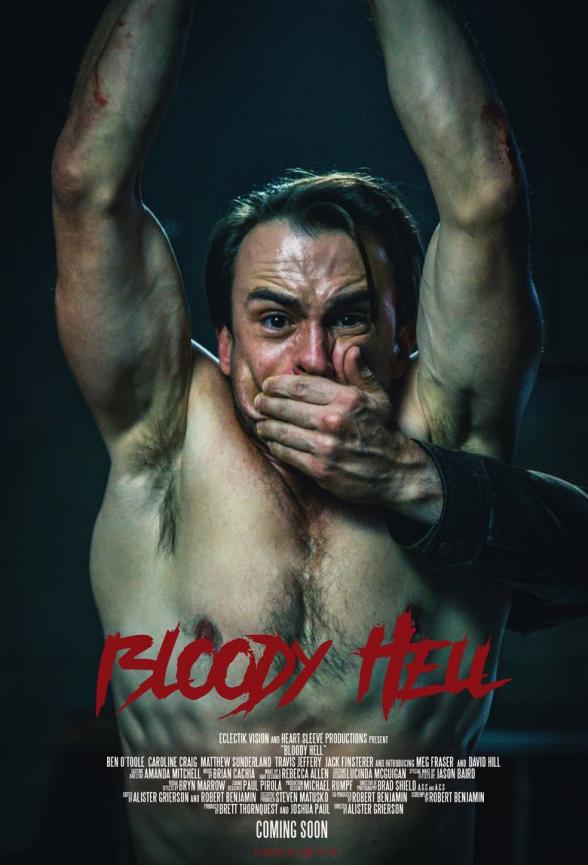
This is a ripsnorter of a thriller, and full of surprises. Defiantly internationalist, the film is an Australian-British action/horror film directed by Alister Grierson (Kokoda,Sanctum, Tiger) and written by Robert Benjamin. It is set in a basement in Helsinki Finland with scenes in Boise, Idaho, and features mostly Australian and New Zealand actors, with American or Finnish accents and dialogue as necessary. It was made on the Gold Coast in Queensland (as many blockbusters have been recently).
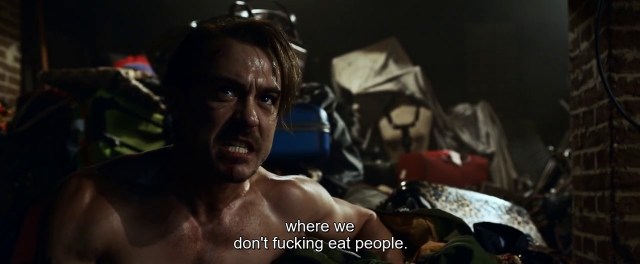
The main characters are both personas of Rex (Ben O’Toole – Hacksaw Ridge, Detroit, The Water Diviner). O’Toole is superb (imagine a combination of Bruce Willis and Robert Downey Jr) in two roles: both the physical Rex and his inner voice, the part of him (and all of us) which commentates his life and ordeals, screams abuse, even when pretending to be calm and collected or even unconscious, and debates the best responses, rational or emotional, to every aspect of what is going on around him. O’Toole called this Rex his character’s “conscience”, but it’s not a Freudian split between an ego and a superego (or id) – it is more nuanced, and the invisible Rex (invisible to other characters – the audience and physical Rex can see and hear him) argues about practical and ethical issues all the time, sometimes compassionate, sometimes sneering and violent. That inner voice, as we all know, is exhausting.
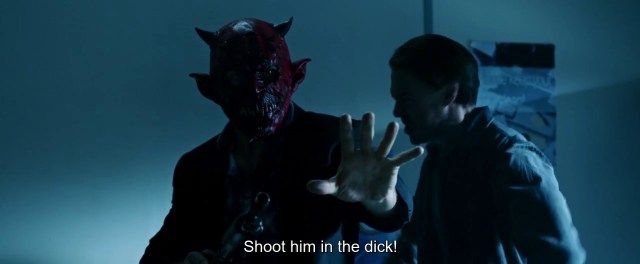
Rex and his inner voice are off to Finland. Why? Well, Rex was in a bank, chatting to a teller he fancied, when a gang of heavily armed men came storming in and violently robbed both the bank and the customers. Rex, ex-military, was able to take on the gang and kill them all, but the last one was ready to surrender when invisible Rex screamed:
As the last robber collapsed, dickless, his gun went off, killing an innocent teller who had been hiding in a cupboard. Rex became a media sensation, with half the population calling him a hero, and the rest a “psycho twat”, and a plea bargain saw him in jail for eight years for causing the teller’s death, leading to his decision to emigrate, on his release. In a flashback to his court case, Rex is asked why he shot the bank robber in that particular spot.
“I wanted him down… and I didn’t want him to reproduce… win – win!”
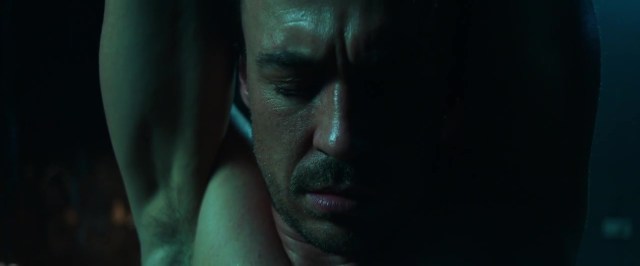
Why Finland? Well, he shot spitballs at a world map in his jail cell, and fate led him to that country. Where, unfortunately, a family of cannibals awaited him, and he wakes up, barely twenty minutes into the film, hanging by his wrists from a water pipe in a dark basement.
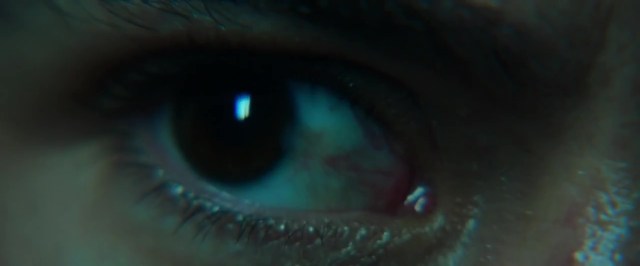
With the classic trope of cannibal films, used so well in Texas Chain Saw Massacre – the extreme close-up.
He is missing a leg, blood dripping from the stump, but his inner Rex is still fine and walking around, and furious at their precarious situation. Our imaginary self, after all, is as threatened by our mortality as we are.
It is clear to us, the audience, that Rex’s body parts are a living larder, although it takes the Rexs a bit longer to figure out why his leg is missing.
“Black market limb trade… is that a thing? I’m pretty sure there’s a niche there.”
It’s actually a very funny film – the dialogue between the two Rexs and even some of the murderous Finns is often hilarious. Rex pulls himself up to the huge knot to try to free himself with his teeth, observing that, short of one leg,
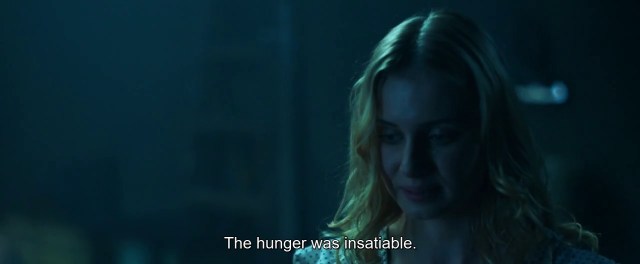
Rex’s love interest is Alia (Meg Fraser – Leech) the daughter, who has spent her life trying to escape her family.
Rex offers to “rescue” her (which considering his position is ambitious), and tells her,
“If we get out of here, I’ll tell you the whole story over dinner. I’ll even pay, huh?”
Now Rex has to dump on vegans to the girl whose family is upstairs eating the meat of his right leg; the family are definitely not vegans, nor can they see anything much wrong in giving their oldest son his preferred meat species. Alia explains that her older brother Pati is “the oldest and the hungriest”. Like Rex, he certainly does like a bit of meat, but, like the Wendigo, there is only one source that will satisfy him. Many omnivores will eat any meat except human. Pati will eat any meat as long as it’s human. As omnis like to say “it’s a personal choice.”
“He’s the reason you’re here. And very soon, there will be nothing left of you.”
Cannibal Studies is usually concerned with the anthropological or metaphorical aspects of the act – exposing the outsider as uncivilised, or else dripping irony about our own rapacious appetites. This film manages to do both, as Rex rants about the Finnish family, and how he wants to be back in the good ol’ USA,
Which is ironic, because if you check the “Cannibal News” category on this blog, you will see that a goodly proportion of modern cases of cannibalism occur in the good ol’ USA (and none in Finland*). The USA is the apotheosis of consumer societies where, just like Alia’s brother,
The rest of the film concerns Rex’s attempts to escape – not easy when one leg is gone and one of the family members has just tried to saw off the second one. You’ll have to see it to find out how that goes. It’s well worth it. Film critic Rob Hunter sums it up nicely:
“It’s a serious tale of survival encased in blackly comic humor, maliciously creepy twins, and the most sweetly sensual stump-washing scene you’ve ever had the pleasure of witnessing.”
The movie premiered in Australia on October 8, 2020, and in the United States a day later at the Nightstream Film Festival. It has a 91% fresh on Rotten Tomatoes, with comments like “blissfully, absurdly over-the-top, but in a twistedly charming way”.
This is a blackly humorous horror-thriller, and is quite brilliantly executed by Alister Grierson, particularly as the hero, normally the action figure of such stories, is tied to the ceiling and missing a leg for most of the film. You might think that would slow down the pace, but director Grierson keeps it tearing along. I usually stop and start when reviewing a movie, but this one I gulped down in one sitting, then came back for details.
As for the lead actor, Ben O’Toole, he seems to have got a taste for the cannibal stories. He said in an interview that he’d like to play Titus Andronicus, who was William Shakespeare’s favourite cannibal.
Let’s not forget, too, how much cannibalistic symbolism is involved in sex, such as “I could eat you up” as well as various foodie words for cunnilingus and felatio. And of course the French (or Finnish) kiss, when Rex and Alia finally escape.
And just to prove other people like puns too, here is the last frame of the film.
* Actually, there is a case of Finnish cannibalism – Jarno Elg, a supposed Satanist, who was sentenced to life imprisonment in 1998 for murdering a 23-year-old man, eating some of the body parts and inciting some friends to participate in a ritual that included torturing the victim while listening to songs from The Cainian Chronicle album by the Norwegian black metal band Ancient. Elg was granted parole in 2014.




















 The Cannibal Guy