Dear Meat (J. Snow, 2020)

This blog has laboured mightily to keep up with the constantly growing catalogue of cannibalism movies and TV shows, as well as the increasing number of actual cases reported in the media. So this week we are taking a rather exciting side-trip into the wonderful world of short stories, a place where the sets can be as lavish as the author wishes since there are no Producers cutting budgets, the protagonists can do anything the mind can conjure up without the need for stunt persons or insurance, and the whole thing requires no masks or social distancing.

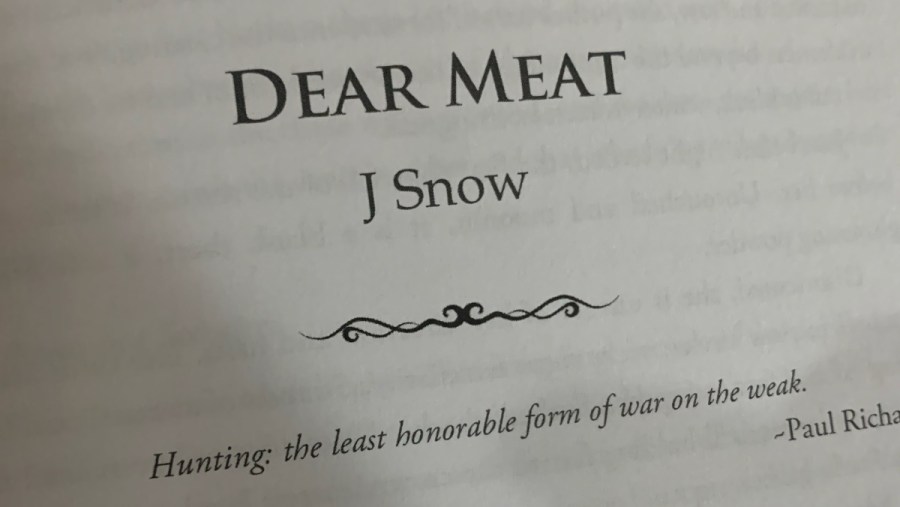
The story considered in this week’s cannibalism blog is called DEAR MEAT, and it appears in the third Women of Horror Anthology, titled THE ONE THAT GOT AWAY.

The anthology contains an amazing assortment of thirty fresh looks at the wonderful world of horror. I have, naturally, chosen to review the cannibalism story by J Snow, since that’s what I do, for reasons best known to myself and the Department of Culture and Communications at the University of Melbourne.

Ms Snow has written and published five cannibalism stories; reassuring to know that others also labour in these fields. For those of you who wish to know how (or why) she writes, there is an interview at Paula Readman’s Clubhouse.

Dear Meat was written a few years before the pandemic, but reads like it could be taken from tomorrow’s newsfeed. It involves a small elite group of rich and powerful men who have decided that human population growth is threatening to destroy the biosphere, and so must be stopped and reversed. More than two thirds of the population, billions of people, must be “eliminated.”

Various ingenious and possibly prophetic strategies are mentioned such as introducing viruses and tainted vaccines, genetically modified foods and contaminated water supplies. Free tubal ligations and vasectomies are encouraged, and abortions allowed up to two months after birth. But the key plan in this story is to set the populace at each other’s throats, or more precisely at the barrels of guns. Yes, hunting season for humans becomes the only way to feed the family. Tags are issued, which is apparently the way hunting works in the USA, and the distribution is weighted according to the discriminatory preferences of these shadowy rulers – the “unworthy and unholy” are allotted the most tags meaning the poor and the non-Christians are most likely to be hunted and cooked. Illegal immigrants are always open season. The rich and the politicians, however, don’t ever seem to end up on the butcher’s slabs.

English cleric and economist Thomas Malthus pointed out in 1798 that population increases geometrically, but food availability increases only arithmetically. All things being equal, this means we must run out of food, unless there is a disaster or an intentional reduction in human population growth. Too many people and not enough food is likely to lead to cannibalism, although Malthus did not venture into such abject speculations. The ethologist John Calhoun crossed that bridge in his study of rats, where he found that putting rats into a utopian environment, with no shortage of food or shelter, and letting them breed unconstrained, ended up in a chaotic maelstrom of sexual deviance and cannibalism. A Malthusian/Calhounian scenario is the basis for the film Soylent Green which is set (honest, I’m not making this up) in 2022, when overpopulation has led to a situation where the enormous population of poor people can only be fed by recycling the bodies of those who die or can be persuaded to accept euthanasia.

Not so in Dear Meat. The people running the government know one thing that has been true since the start of humanity: when there is hunger,

“People turn on each other, become monsters, all for one tiny morsel.”

The people turning on each other in this story are from a family; a man, a woman and a child. Not even close to a large family by today’s standards, but in the world of the story, any increase in population (child) must be balanced by a decrease (a hunted tag). One person must die, be carted to the butcher and carried home as meat, just as the odd hunter does now to deer or kangaroos or anyone else that happens to move at the wrong moment.

I am introducing some levity because this is a grim scenario, skilfully crafted, beautifully written and with an ending that I absolutely will not spoil. The wonderful thing about eBooks is that they are ridiculously affordable and offer hours of reading pleasure. This collection, and particularly Dear Meat, is highly recommended.

Here’s a review from Goodreads:

And here’s one from Amazon:

The author’s details are here, and the book is available at on line retailers including Amazon.

Would you like virus with that? EBOLA SYNDROME (伊波拉病毒) (Herman Yau, 1996)

Director Herman Yau has made a bit of a career from telling stories of “innocent cannibalism”, in which diners in restaurants unknowingly eat human flesh. His 1993 film The Untold Story was based on the “Eight Immortals Restaurant murders” of a family of ten, which took place in August 1985 in Macau. Portions of the bodies were never found, leading to speculation – yeah, you got it.

Following Gordon Gecko’s statement that “greed is good!” in Wall Street (1987), the 1990s saw a spate of films about entrepreneurs selling human flesh for fun and profit. Beside The Untold Story, Untold Story II and Ebola Syndrome from Hong Kong, we saw Delicatessen from France, Aranyak from India, The Deathmaker from Germany, Perdita Durango from Mexico, while the Americans contributed Ice Cream Man and Fried Green Tomatoes.

You see what I’m up against, trying to update you on all these masterpieces?

vlcsnap-00015.jpg

This film gets even weirder, because there is also a pandemic involved – Ebola, the so-called “flesh-eating” disease. Ebola never really got the public going like COVID-19, maybe because it only affected people in places like the Congo and so did not keep the rest of us awake at night. Also, it spreads much more slowly but, if you do get it, you have a 50-90% chance of dying, and it isn’t “just” pneumonia – it is haemorrhagic, meaning that you can bleed out “through your wazoo”, as they say in Last Man on Earth.

“People with Ebola first have symptoms of influenza, but within 72 hours after infection, the virus will dissolve the internal organs”

Ah Kai (Anthony Wong) is an escaped criminal from Hong Kong who bolts to South Africa after killing his former boss, his boss’s wife and another employee. Here is an image showing Hong Kong industrial relations in action.

vlcsnap-00014.jpg

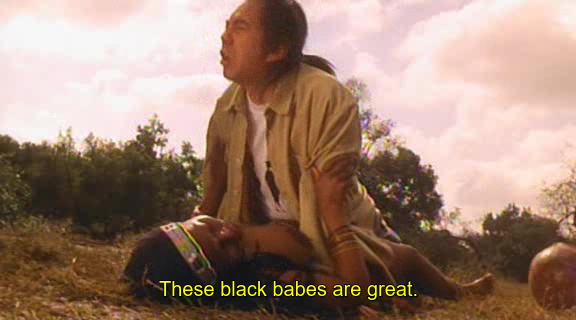
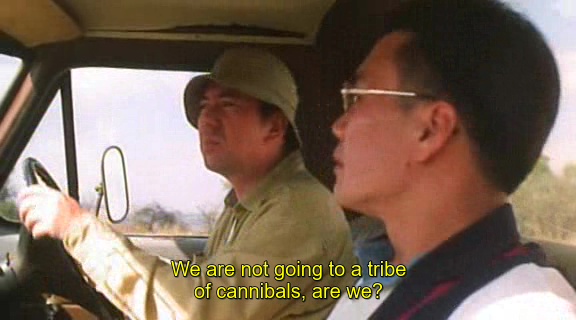
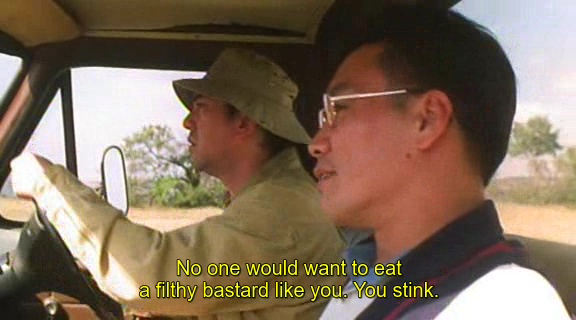
In South Africa, he works at a Chinese restaurant and one day travels with his boss to a Zulu tribe that is infected with the Ebola virus [NOTE: there is no record of Ebola among the Zulu]. He comes across a woman dying of the disease, and decides to rape her – he’s that sort of guy.

vlcsnap-00047.jpg

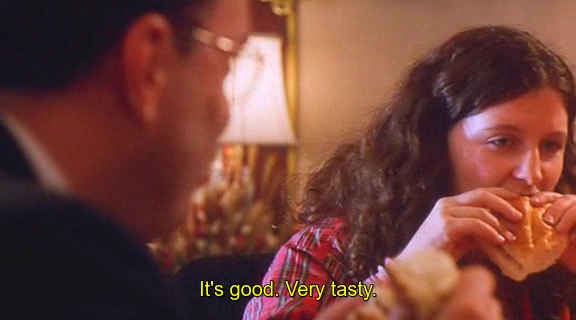
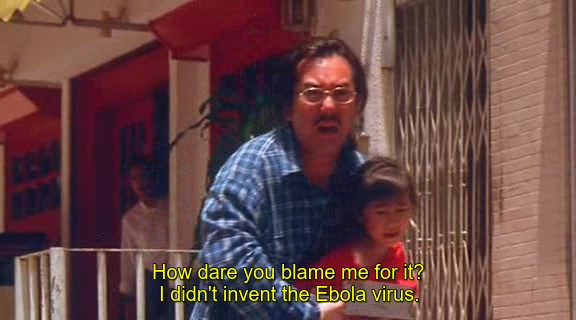
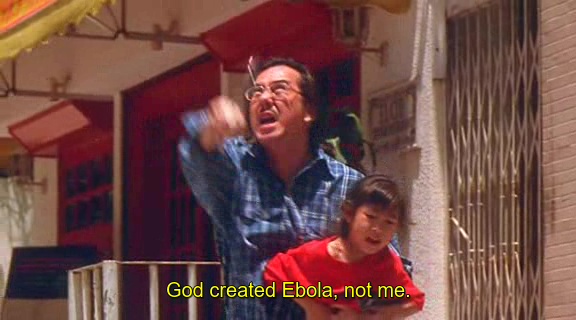
He is immune to the effects of the virus, so becomes a living carrier, spreading the disease to others through his bodily fluids. He kills his new boss and his boss’s wife and cousin (seems to be becoming a habit), but he has already given the virus to them, so when he cuts up their corpses and serves them as hamburgers in the restaurant, he spreads the virus all over South Africa.

vlcsnap-00064.jpg

vlcsnap-00068.jpg

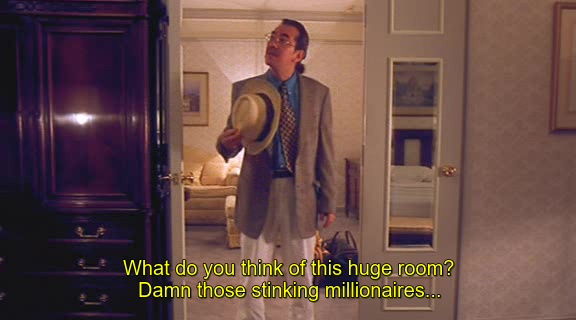
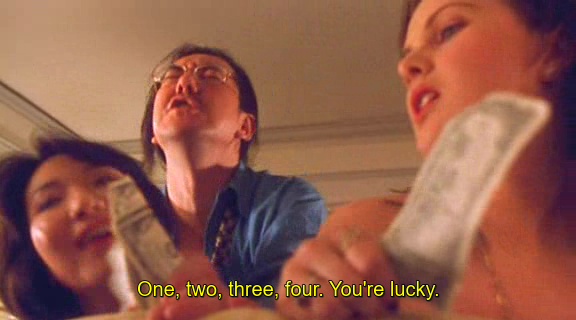
He heads back to Hong Kong with the boss’ cash and moves into a fancy hotel, where he proceeds to spreads the virus to the prostitutes he hires, and everyone else he encounters – dramatic music accompanying each new infection.

vlcsnap-00077.jpg

vlcsnap-00082.jpg

Cannibalism as a carrier for pandemics seems apposite right now. Cannibalism and incest, Freud said, were the two great taboos of civilisation, but their prohibitions also define civilisation, so it is not unreasonable to expect at least one of them to pop up in a civilisation-wide disaster. COVID-19 hasn’t been spread by cannibalism yet, or incest (as far as we know) but this movie looks at more than just crime and disease as social disrupters. Ah Kai is aggressive and violent to anyone whom he believes bullies him, usually the rich people who take advantage of his fugitive status. In South Africa (not a place known for Ebola), he is subject to casual racism from the whites, including prostitutes who refuse him their services. The whites, he complains, treat him like a black, and the blacks treat him like a white. He and his victims are dehumanised, which is a precondition for cannibalism – humans are animalised, animals are objectified and become meat.

vlcsnap-00018.jpg

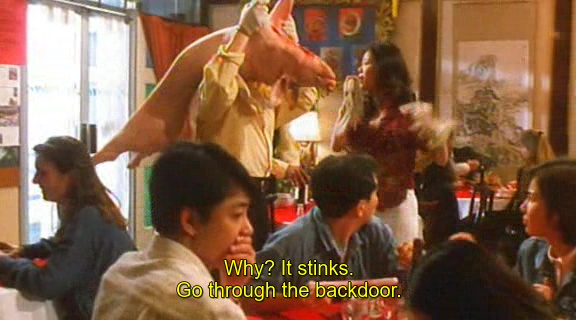
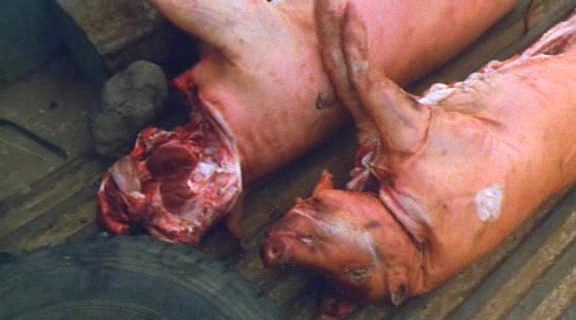
Chinese restaurants, where he works, use a lot of pork, and several scenes problematise the close proximity of pigs to humans in the way they look and, according to some informants, the way they taste. The Ebola is caught at a Zulu camp where multiple people are dying from it; Kai and his boss are there because the racist white butcher is charging too much for pigs.

vlcsnap-00034.jpg

vlcsnap-00035.jpg

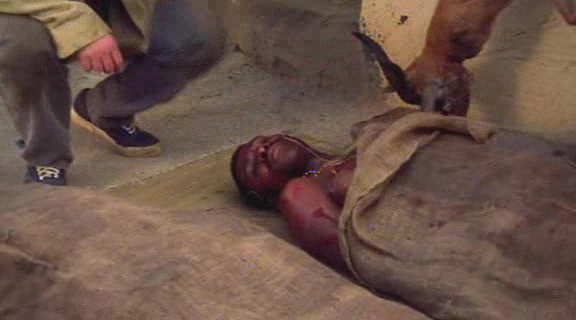
When they go to pick up their purchases, Kai uncovers human bodies instead, before he finds the pig corpses.

vlcsnap-00040.jpg

vlcsnap-00043.jpg

Is there really such a difference between corpses? More than 75% of emerging diseases originate in other animals. COVID-19 is said to have originated at a fish market, where close contact between humans and live animals in a small space made it easy for the virus to jump species. Other coronaviruses, such as severe acute respiratory syndrome (SARS) and Middle East respiratory syndrome (MERS), not to mention bird flu and swine flu, all spread due to the human appetite for flesh.

We used to assume that exotic diseases came from wilderness areas where they had been hosted in exotic animals, which then, like the dying Zulu, were used and abused by humans. But a lot of current research seems to indicate that it is actually our destruction of habitat and biodiversity that causes the spread of diseases like Ebola and COVID-19.

“We invade tropical forests and other wild landscapes, which harbor so many species of animals and plants — and within those creatures, so many unknown viruses. We cut the trees; we kill the animals or cage them and send them to markets. We disrupt ecosystems, and we shake viruses loose from their natural hosts. When that happens, they need a new host. Often, we are it.”

David Quammen in the New York Times January 28, 2020

vlcsnap-00086.jpg

vlcsnap-00088.jpg

Really?

Dread Central summed up the movie:

“The horrid acting and paper thin story are forgivable only for the hilarity with which it’s presented.”

That’s a bit harsh! Chinese movies are not as a rule exemplars of subtlety, but Anthony Wong as the virus super-spreader gives it all he’s got, and a bit more too. It’s a rollicking yarn, and it asks some serious questions too. I was surprised to find I quite enjoyed it.

The full movie has been removed from YouTube, but you can still watch the always delightful review by THE HORROR GEEK, Mike Bracken.