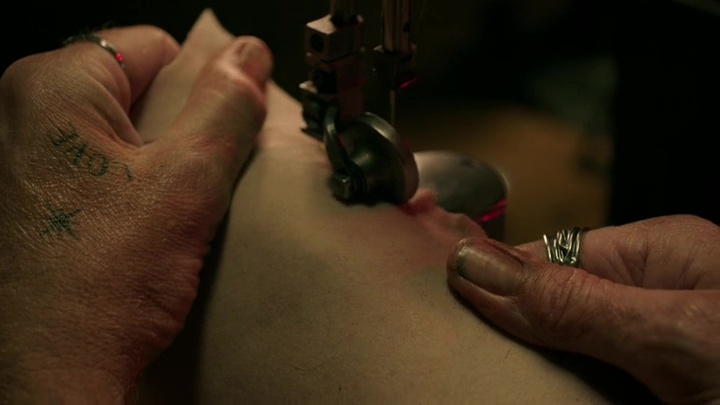
Vietnam vets and cannibals: CANNIBAL APOCALYPSE (Antonio Margheriti, 1980)

This is one of those horror flicks that’s a bit hard to categorise. It’s an Italian “cannibal boom” film in the tradition of Ruggero Deodato’s classic Cannibal Holocaust which came out the same year, as well as earlier efforts such as Deodato’s Last Cannibal World, Joe D’Amato’s Black Emanuelle films, and the one that started the Italian cannibal boom, Umberto Lenzi’s The Man from Deep River. But Antonio Margheriti, using his alias Anthony M. Dawson, turned the genre on its head. The cannibal boom movies were usually set in the jungle, where tribes of primitive savages killed and ate Western interlopers, who richly deserved their fate. In other words, the archetypal colonialist cannibal story with a post-colonial twist (revenge!)

This one starts in the jungle too, but it’s a jungle in Vietnam, and the Western interlopers are American soldiers prosecuting the disastrous and eventually futile Vietnam War. A squad led by super-macho Norman Hopper (John Saxon from Nightmare on Elm Street) lands in a village and torches the place, after getting blown up by a dog (yeah, it gets worse). They find some POWs captured from their squad, Tommy Thompson (Tony King, who is now head of security for the hip-hop group Public Enemy) and Charlie Bukowski – a intertextual reference to the poet Charles Bukowski I guess, although the link seems tenuous. Bukowski (the soldier, not the poet) is played by John Morghen from Cannibal Ferox, an actor who pretty much always dies horribly in every movie he’s been in, and this is no exception.

They have somehow caught a virus (?) which makes them crave human flesh. That makes it sound more like a zombie movie than a cannibal one (think 28 Days Later), but let’s give it a cannibal pass by referencing the Wendigo films like Ravenous or Eater. Or you could claim, as the doctor says to Norman, it’s a “form of rabies.”

No, it isn’t. He really should have gone with Wendigo, a mythical figure – giant, fierce and cannibalistic, who gathers strength from feeding on human flesh, but the flesh makes him grow larger, and so his appetite can never be satisfied. He is sometimes protective (like Norman), and sometimes a figure of revenge (like Charlie and Tommy). The Wendigo gets inside people who are weak, hungry, or filled with rage.
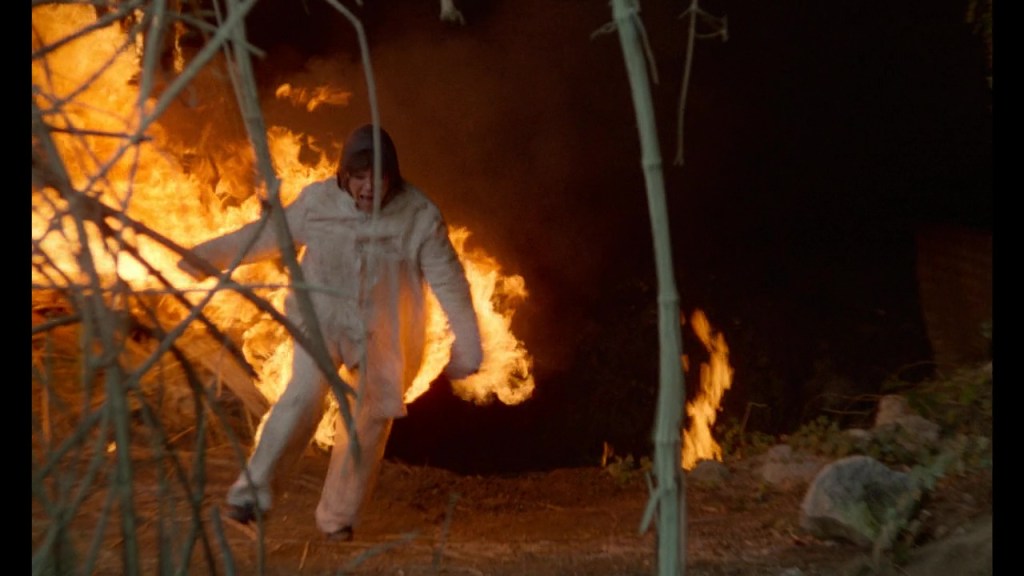
Anyway, the squad is using flamethrowers to fight the Vietcong (and their women and small children) and one burning woman falls into the pit where the POWs are confined, making for a cooked meal. No home delivery jokes please.

Back in the States, Norman is having nightmares of being bitten by the POWs as he rescued them from their meaty pit. He realises something is wrong with him (the virus from getting bitten maybe?) and stares in horror and fascination at a bleeding lump of flesh in the fridge. Why is there flesh left to bleed in the fridge – isn’t that a health hazard?

One of the rescued POWs, Bukowski, suddenly phones him – he’s on day release from the “Hospital for Nervous Disorders”, or what the cops call a “loony bin”. Norman can’t meet him because the teenage neighbour is lasciviously pointing a hairdryer at him, and he is drawn to her lower regions, but for someone infected with the cannibal virus, ‘eating her out’ means something different to what she expects. She drops by later to tell him that she enjoyed being bitten. What do you know.

Meanwhile, Charlie has gone to see a war movie, as you do when you’re been treated for months for severe PTSD. It’s Umberto Lenzi’s From Hell to Victory, a lovely in-joke among amici, with lots of explosions and deaths. But no one is watching the war.
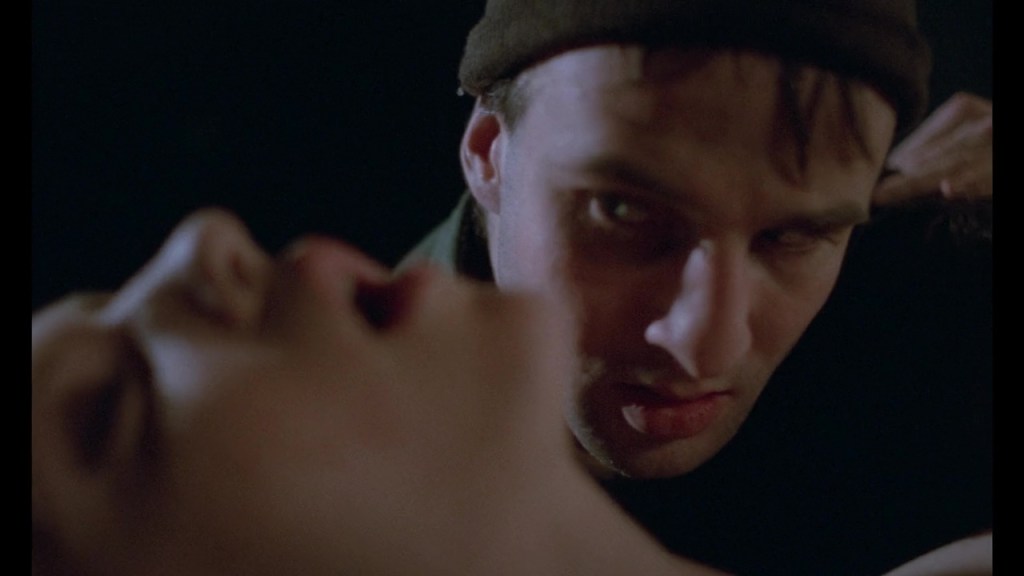
In front of him, a couple are doing oral things – exchanging saliva and sucking on boobs, erotic cannibalism, but Charlie joins in by taking a healthy bite of the girl’s neck as she leans back in her seat. He runs, there’s a shootout, he kills and eats a bikie and a security guard – it’s all downhill from here. The Atlanta police chief wants to know about him, not his name (despite it’s fascinating intertextuality):

Is he a subversive, a queer, a black, a commie, or a Moslim fanatic?

No, he’s a clean cut all-American (Italian) Vietnam vet, who wants to eat people.
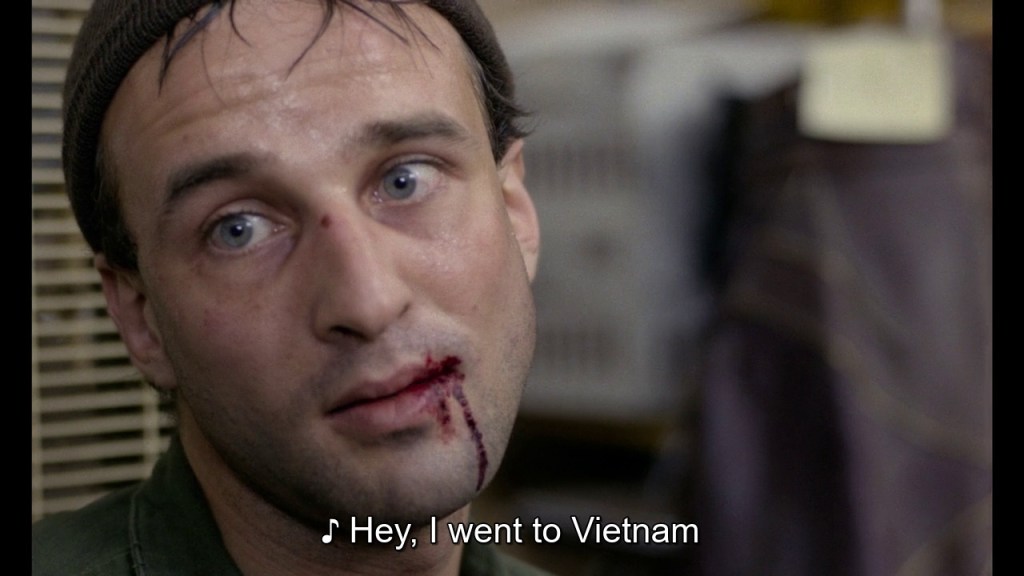
Lots of people get bitten or scratched – a cop, a nurse, who then bites off the doctor’s tongue, and of course there’s that wanton teenager from next door (what horror film would be complete without promiscuous teenagers?), who was infected by Norman’s bite, even though he thought he could overcome the craving for meat.

Point is, they all have the cannibal virus, and the cannibals end up in the sewers (apparently hoping to hoof it to the airport and hop on a flight back to Vietnam), where they are chased by men with guns and flamethrowers; it’s really just like Nam, but now they have become the enemy.

The movie was one of 39 films to be prosecuted in Britain during the 80s as a ‘video nasty’. The acting sometimes leaves a little to be desired, but the main characters, Saxon and Morghen, are great. The special effects are by the legendary Giannetto De Rossi and are, like most of his work, spectacularly abject. The music is a mix of elevator and disco, creating what TV Tropes calls “soundtrack dissonance” – it’s either disturbing or just annoying, I’ll leave that up to you to decide.

In his commentary on the film, the director Antonio Margheriti proudly states that this film was Quentin Tarantino’s favourite of his movies. Tarantino referenced the film a couple of times: in Inglourious Basterds, Donnie Donowitz uses an alias “Antonio Margheriti”, while in Once Upon a Time in Hollywood, Leonardo DiCaprio character goes to Italy in 1969 to star in Spaghetti Westerns and also one Bond-type spy thriller supposedly directed by Margheriti titled Operazione Dyn-o-mite.

But video nasty or not, Cannibal Apocalypse has some interesting things to say about the fallacies and phalluses of war and cannibalism. The cannibal virus comes back to the USA with Vietnam veterans, a group who were sent to fight a vicious and often brutal war, often against civilians, and returned to abuse or neglect, with far more veterans dying from suicide than died in that war. They also brought back with them, on top of their trauma, exotic diseases, drug habits, and acute psychological damage. Many went as conscripts, and came back as severely damaged killing machines, metaphorically lusting for human flesh and spreading the anger and violence to all those near to them. It’s happened over and over in every war – a culture of killing leads to a spiral of violence. Even when you think the nightmare is over and all the cannibals dead, there’s still the teenager and her little brother to consider (hey, it’s been over forty years – where is the sequel this seems to promise?)

Probably not.

The drive to kill and to eat flesh are closely linked in human history. Consider the words of Isaac Bashevis Singer in the forward to the book Vegetarianism, a Way of Life, by Dudley Giehl:

As long as human beings will go on shedding the blood of animals, there will never be any peace…

If you think Cannibal Apocalypse sounds interesting but you’re short of time, most of the good (gory) bits are covered fully in the review by Mike Bracken, AKA The Horror Geek (@horrorgeek). Mike’s vodcasts are always very entertaining, but this review had me guffawing out loud, which is a bit weird when you’re watching with headphones, in apparent silence, and pretending to be writing an academic thesis. In fact, Mike’s review is much better than the film, IMHO.

The Silence of Hannibal: CLARICE episode 1 (CBS 2021)

So first the bad news – due to contractual arrangements, Hannibal Lecter does not make an appearance in the new TV series called Clarice. He can’t – the DeLaurentiis company (which produced Bryan Fuller’s Hannibal as well as the movies Manhunter, Hannibal, Red Dragon and Hannibal Rising) has exclusive rights to the characters originating in the novels Red Dragon, Hannibal and Hannibal Rising, and MGM have exclusive rights to The Silence of the Lambs, and own the movie too. Clarice Starling first appeared in Silence of the Lambs, so can be revisited in this series, while Hannibal and Will Graham originated in Red Dragon, so can come to life in Fuller’s brilliant series, but the three of them cannot ever meet. With intellectual property as hot as the characters that came from the Promethean mind of Thomas Harris, sharing it around among production companies is about as likely as two dogs with one bone.

The good news is that Clarice is a damn good show, and Rebecca Breeds, the Aussie actor with the West Virginia accent (it sounded good to me, although I’ve never been to WV) is just right in the role. In the pilot, she manages to convey a complex picture of a young woman who is smart, resourceful and tough, fighting for her place in a man’s world, while still haunted by untreated PTSD from her run-in with Buffalo Bill in the movie.

This is a sequel to Silence of the Lambs, and while there is no appearance from Hannibal (who, after all, was on the run after his gory escape in the movie), there are plenty of references to the film, particularly Buffalo Bill (Jame Gumb), the serial killer whom Clarice killed at the climax of the film.

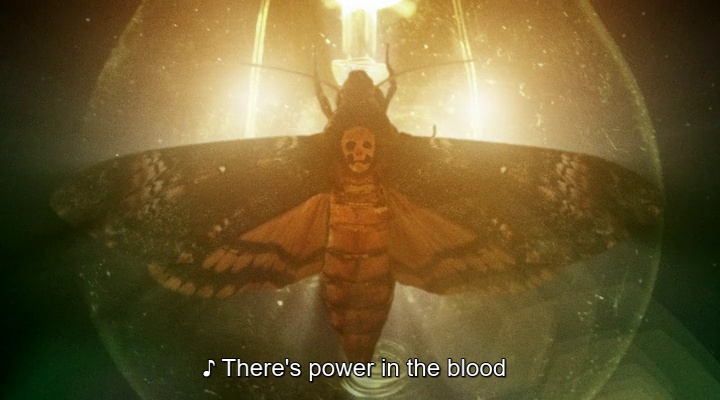
A year after the events of the film, Clarice is waking up at night from nightmares full of violence and deaths-head moths.

She is attending mandatory psychiatric sessions, which she is not happy about, and tries to joke, argue and obfuscate her way out. The therapist says that is

“understandable, given that your last therapist was an inmate in the Baltimore Hospital for the Criminally Insane,”

If you remember Silence of the Lambs, you will recall that the serial killer, Jame Gumb, had captured Catherine Martin, whose mother was a US Senator, and was about to skin her to make a “vest with tits” as Hannibal so elegantly put it. The mother, Ruth Martin (Jayne Atkinson), is now Attorney General of the US, and determined that a new serial killer will not be running wild on her watch.

Ruth Martin drags Clarice out of the Quantico FBI HQ where she has been hiding and doing data entry, and attaches her to the new ViCAP (Violent Crime Apprehension Program) task force. She tells Clarice,

“You saved my little girl. You are a woman with a very public reputation for hunting monsters, Clarice.”

The pilot episode is largely procedural, as was Hannibal when Season one started. Someone is killing women and mutilating them. Is it a crazed serial killer? Well, he is biting them, so that qualifies him for this cannibalism blog, but Clarice notices something odd about the wounds. There’s no intimacy. No frenzy.

 “A true psychopath? We’d still be looking. But a true sociopath – they wouldn’t have left their faces.”

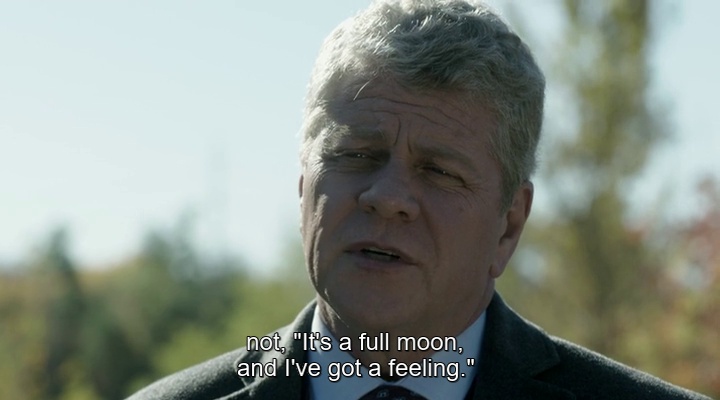
The ongoing antagonist in this is Paul Krendler (Michael Cudlitz from Walking Dead) who barely appeared in the film Silence of the Lambs, although he was an important opponent in the book, and became more important as he destroyed her career in the book and film Hannibal in revenge for her unwillingness to indulge his sexual appetites. In this series, he is a cranky old man, dubious of her talents (he thinks she just got lucky in pursuit of Buffalo Bill) and not willing to let her play hunches.

The FBI grunts play tricks on her, putting lotion on the handles of her desk drawers and telling her

Which of course were Gumb’s instructions to Catherine, using the impersonal pronoun ‘it’ to dehumanise her.

Clarice remembers what Hannibal taught her about the Emperor Marcus Aurelius, with a little prompting from her friend Ardelia (Devyn A. Tyler).

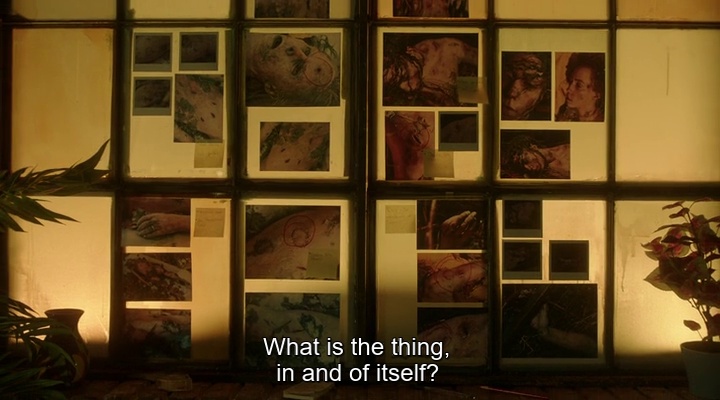
She works out that the wounds are “desperately random”, which is what Hannibal told her about the apparently random dumping of the bodies by Jame Gumb. She realises that the murderer is not a crazy serial killer but is cold, calculating and has a set of targets. The rest of the episode is about her tracking him down, while still haunted by her past. Meanwhile, Catherine Martin is frantic to talk to her; Catherine is now an anorexic recluse, because Gumb only took big girls, whose skin would fit on his frame (but at least she has Gumb’s dog Precious, who I always thought was a nod to Tolkein). Clarice suffers flashbacks and nightmares: Catherine in the oubliette, Jame Gumb sewing a garment of human hide.

The press are obsessed with Clarice, the National Tattler calling her (as in the movie), the “Bride of Frankenstein”.

Krendler wants her to toe the official line and tell the press that this is a crazy guy. But this is Clarice. She’s going to tell it like it is.

Now, I know a lot of Fannibals would have preferred a fourth season of Hannibal to a new series about Clarice (and have said so quite vociferously). But let us not forget what Clarice meant to Hannibal, or at least Hannibal in his twentieth century persona. She was one of the first to interview him successfully in his solitary cell. He found her fascinating and was, let us admit it, somewhat smitten with her, in the books and the films. Remember Hannibal’s words:

“I think it would be quite something to know you in private life.”

So let’s not disparage our opportunity to know her. In the movie Hannibal, he points out that he has travelled half way around the world to watch her run, and wonders why she won’t now let him run, then chops off his own hand rather than harm her.

vlcsnap-00135

Unlike many male authors, Thomas Harris can write female protagonists as real, complex people, and he does it so well; not just Clarice Starling, but also the central characters of his first and most recent novels (both non-Hannibal stories) – Dahlia Iyad in Black Sunday (1975) and the eponymous protagonist of Cari Mora (2019).

Hollywood was not willing to countenance a romance between a law officer and (as they saw it) a psychopathic serial killer. But in the novel, the relationships are far more complex: Hannibal hopes Clarice might provide a position in the world for Mischa, his sister, who was eaten by Nazi collaborators during the war. Clarice suggests an alternative: Mischa can live through him, Hannibal, instead, and “she” and Clarice can be like sisters. Remembering Hannibal’s question to Senator Martin (in Silence of the Lambs), she asks if he was breastfed, and if he ever felt that Mischa had made him give up the breast when she was born. Well, he won’t have to give up this one: she offers him her breast, with a warm drop of Chateau d’Yquem suspended from the nipple. He sucks it, but not as a cannibal; as a child, or as a lover. Freud of course would wonder if there is actually a difference.

Unlike the film, in the book Hannibal and Clarice are presumed live happily ever after; the asylum guard Barney sees them at the Teatro Colon, the opera house in Buenos Aires. They are watching Tamerlane, an opera that starts with an Emperor in chains, and ends with a love duet.

This new series, Clarice, is what happens between Hannibal`s escape at the end of Silence of the Lambs and their renewed encounters in Hannibal. It’s important history, one which those of us who loved the books and movies need to explore, even if we loved the Hannibal TV series too.

Clarice is on CBS (where you can watch the first episode if you are in the USA or have a VPN) and streaming on Stan in Australia.

A complete listing of my Hannibal film and TV blogs is at https://thecannibalguy.com/2020/07/08/hannibal-film-and-tv-blogs/