South Carolina mental health facility sued by family of an alleged victim of murder and cannibalism

A South Carolina mental health facility is being sued by the family of an alleged victim of a man who has been accused of murdering and cannibalising patients.

A lawsuit filed by the family of 22-year-old Jared Ondrea claims Richland County’s New Hope Home Solutions, facility owner Brittany Reynolds-Jackson and the South Carolina Department of Mental Health (SCDMH) are responsible for his death.

According to documents, Ondrea suffered mental disabilities which led to his placement in 2023 into an assisted living facility, New Hope’s Harper Street facility, which had been recommended to his grandmother by SCDMH. Ondrea was meant to learn independent living and socialization skills there.

Ondrea’s grandmother noticed bruising on his neck and face when she picked him up for a visit in March of that year, but he did not divulge the cause. He also appeared to be “unkempt, his hair was not combed, his clothes were dirty, and his nails were long and dirty,” which seemed odd considering the facility’s undertaking to help him learn independent living skills.

Ondrea was dropped off at the facility later that evening, the last time his family saw him. When his grandfather arrived to pick him up for an appointment two days later, he was not there. The next day, the facility called to let his grandmother know that he had been missing since that night he had been dropped off. Staff was reportedly alerted to his disappearance by another patient who told them they “should be alarmed that Jared was missing.”

That patient was Marc-Anthony Cantrell, who has a violent history, including multiple instances of animal cruelty and arson, allegedly to cover up the torture and killing of his family’s three dogs. He was interviewed during the search for Ondrea and reportedly displayed strange behaviour, which was subsequently reported to law enforcement.

In July, a few months after Ondrea’s disappearance, another resident named Deshea Butler went missing. This time, Cantrell was caught on video removing that victim’s body from the facility. When interviewed, he confessed to the killing and told police that he also killed Ondrea, providing “specific, graphic details as to how the murder was conducted” including that he had strangled both men.

Cantrell reportedly told police that he was compelled by his “alternate personality”, called Robert Baldwin, to kill the victims and consume parts of their bodies “so he could gain their power.” While Ondrea’s body was never found, an autopsy of the second victim was consistent with Cantrell’s description of the killing.

The lawsuit alleges that Cantrell ate both the victims’ ears after killing them and,

…after he had strangled Deshea, he hit him in the head with his lifting weights so he could drink his blood, which he did over several days from a coffee cup.”

A grand jury indicted Cantrell for both killings.

The lawsuit brought by Ondrea’s family blames the facility and SCDMH for allowing what they describe as “a budding serial killer” to be placed in a home with vulnerable adults. Law enforcement and SCDMH were aware of Cantrell’s violent history, and attorneys argue that “SCDMH failed to take any appropriate steps to treat Cantrell or to otherwise prevent the obvious danger that he posed to the public and to those living in close proximity to him.”

The lawsuit also claims New Hope did not have the proper license to be operating as a mental health facility, and “had no business housing mental health patients of any sort — much less ones with the type of violent tendencies displayed by Cantrell.” It also faults staff for failing to notice Ondrea’s disappearance for three days, which was allegedly only brought to their attention after the man accused of murdering him told them they should be concerned.

The defendants are being sued for several claims, including negligence, gross negligence, and wrongful death. The plaintiffs offered to settle with SCDMH for $600,000, but the offer was rejected. A jury trial roster meeting has been scheduled for April 7.

Murder is not unusual in the USA, peaking at 2,000 per month in 2020. Although the rate has decreased a little, murder is still so quotidian that it is rare to see it reported widely in the media. Unless, like this one, it includes cannibalism, which Freud described as one of “the two original prohibitions of mankind” (the other, he thought, was incest). Cantrell believes he had an alternative personality, a wendigo perhaps, who maintained that eating human flesh bestows power. Such a psychotic belief stems from anthropocentrism, the faith in human transcendence, that we are somehow ‘more’ than other animals, so even our flesh must have magical properties. But there is nothing special about us, and no power is imparted by eating human ears, any more than eating a pig’s ear. We are made of red meat, like most mammals, and eating any animal causes appalling suffering, environmental catastrophe and quite often dangerous maladies.

Jack The Ripper – “a different breed of killer” – “FROM HELL” (Hughes Brothers, 2001)

Even those who are not True Crime aficionados know of Jack the Ripper, a mysterious serial killer who slaughtered women in the Whitechapel district of London in 1888, took body parts for trophies, and on one occasion wrote to the authorities boasting of having eaten a victim’s kidney. Well, half a kidney – the other half was enclosed in the letter, and was positively identified as human tissue. The letter was entitled “FROM HELL”.

In my thesis, I date modern, domestic cannibalism from 1888, when Jack the Ripper murdered five or more women in the summer and autumn of that year.

The From Hell letter was sent to the Chairman of the Whitechapel Vigilance Committee in October with a box containing half a kidney.  The letter stated that the writer had taken the kidney from a woman, and half of it was enclosed as proof. “tother piece I fried and ate it very nise” (sic).

This letter, and the half-kidney, are featured in this week’s movie.

A huge literature has developed on the history and likely identity of Jack, but none of it is conclusive; the crime writer Patricia Cornwell argued that the Ripper was the famous artist Walter Sickert. Others have written credible accounts of other suspects, including Prince Edward Albert Victor, second in line to the British throne. The enduring mythology of Jack the Ripper, though, depends on the fact that he remains unknown, a figure hidden by his presumed uniformity with those of his milieu. Jack was the domestic cannibal – murderous, voracious, and indistinguishable from any other citizen, just another face in the street, as demonstrated by the fact that he was never apprehended, or even conclusively identified.

Jack rapidly became an international phenomenon. A Chicago doctor wrote in the Medical Standard that,

… the Whitechapel murderer is a cannibal pure and simple. The Whitechapel murders are clearly the work of a lunatic of the so-called “sexual pervert” type, fortunately rare in Anglo-Saxon lands but not infrequently met with in Russia, Germany, Bohemia and France. In these lunatics there is a return to the animal passions of the lowest cannibalistic savage races. Cannibalism is shown in a thirst for blood, and these animal passions come to the surface when the checks imposed by centuries of civilization are removed either by disease or by the defects inherited from degenerate parents.

So critical to the creation of the domestic monster was The Ripper that almost a century and a half later, books and films are still investigating and theorising on his acts and identity.

Jack went “viral” long before the internet was around to invent the term. Jack conventions are held around the world offering attendees the opportunity to view and buy merch and listen to “experts” tell them who Jack (maybe) was. Many books have offered definitive proof of Jack’s secret identity, only to have other experts contradict them. One writer actually bought at auction a shawl belonging to one of the victims, Catherine Eddowes, and had it forensically examined, finding, through links to the DNA of descendants, that it contained her blood, and the semen of a long-suspected Polish immigrant named Aaron Kosminski. Seems conclusive, doesn’t it, but other Jack-fans were sceptical; DNA can be contaminated. Richard Cobb, who organizes Jack the Ripper conventions, told the Guardian that the shawl had been “openly handled by loads of people and been touched, breathed on, spat upon.”

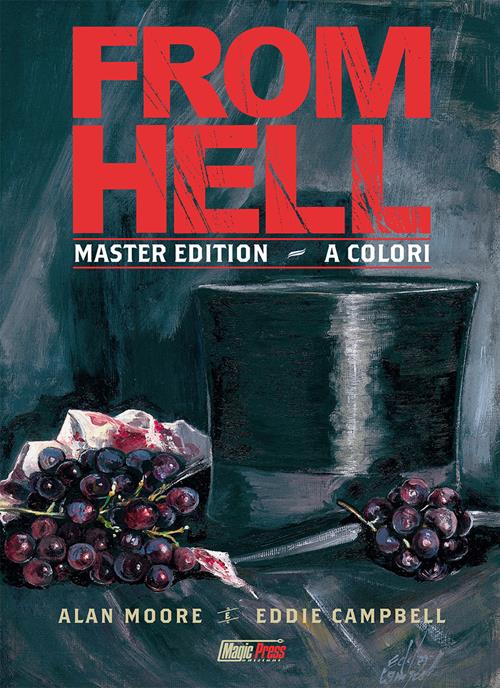
This film, From Hell, has a somewhat more circuitous lineage, being based on a graphic novel (formerly called comic book series) by Alan Moore and Eddie Campbell which was published from 1989-1998 and then collected into book form. That novel is based on a 1976 non-fiction book by Stephen Knight with the rather unfortunate title of Jack the Ripper: The Final Solution. Knight’s theory proposes a conspiracy by the Freemasons, in which high-ranking Freemason Sir William Gull, royal surgeon to Queen Victoria, is told to cover up the marriage of a shopgirl, Annie Crook to Prince Albert Victor, the heir to the throne, which had resulted in a baby who would be in line for the crown, particularly as the Prince was dying of syphilis. The murders themselves were not the crimes of passion common in impoverished London, particularly from the pimps that the women feared most, but involved the careful dissection of the bodies and removal of organs and often vulvas. The basis of many theories was that these were clearly the work of an educated man with medical or at least anatomical training.

“Martha Tabram was raped, tortured and killed. This is methodical. The butchery is irrational, yet meticulous and deliberate. Altogether a different breed of killer.”

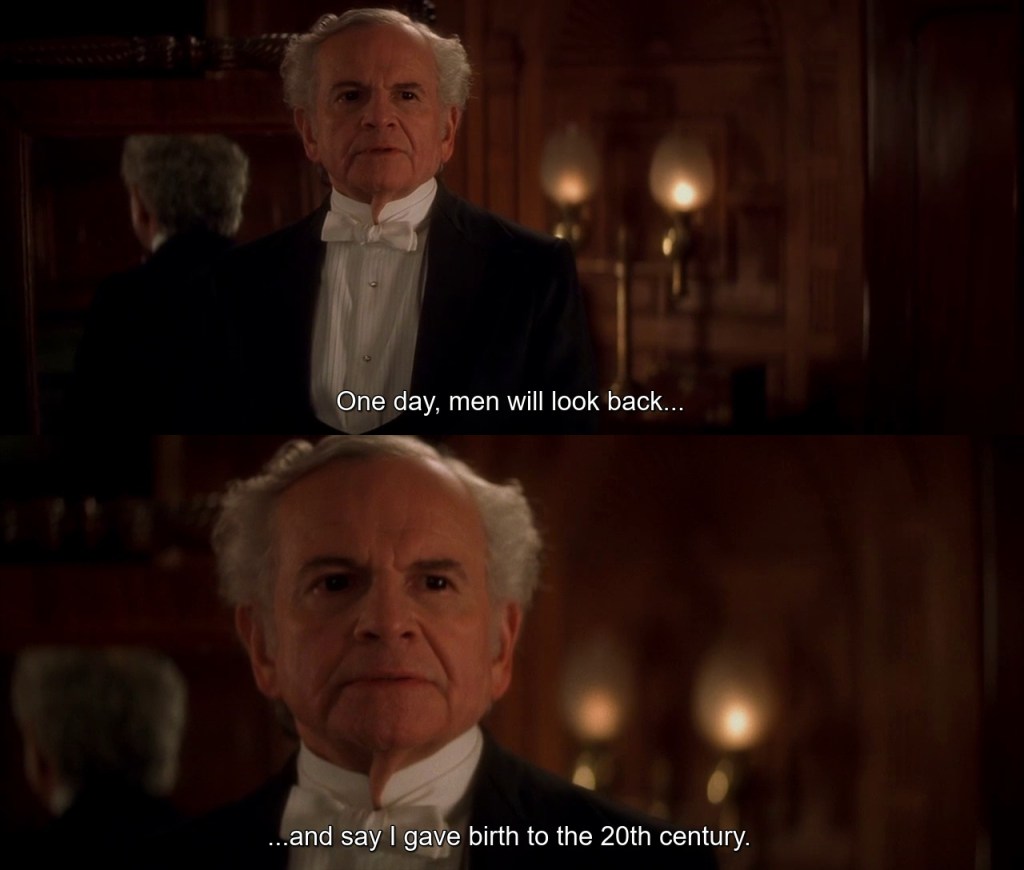
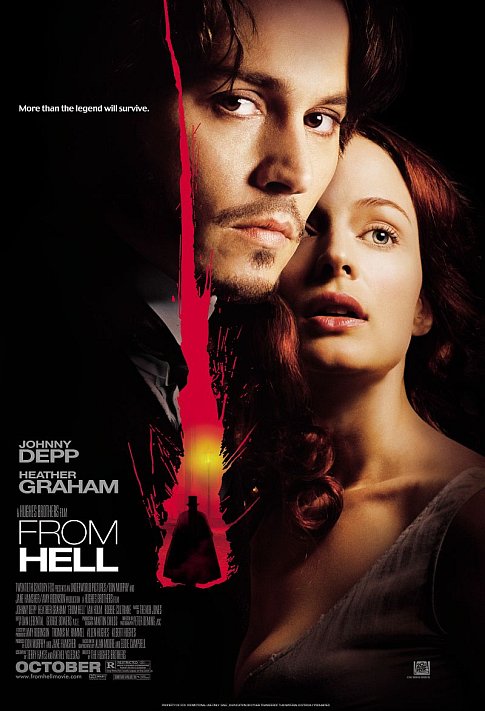
The film had mixed reviews, getting a 57% “fresh” rating on Rotten Tomatoes, but I found it an easy to watch, interesting tale told with some gusto, by a stellar cast: Sir William Gull, physician to His Maj and presumed serial killer, is played by the late lamented Ian Holm, who was playing a sweet, doddery, 111 year old Bilbo Baggins in The Lord of the Rings: The Fellowship of the Ring the same year he played Jack.

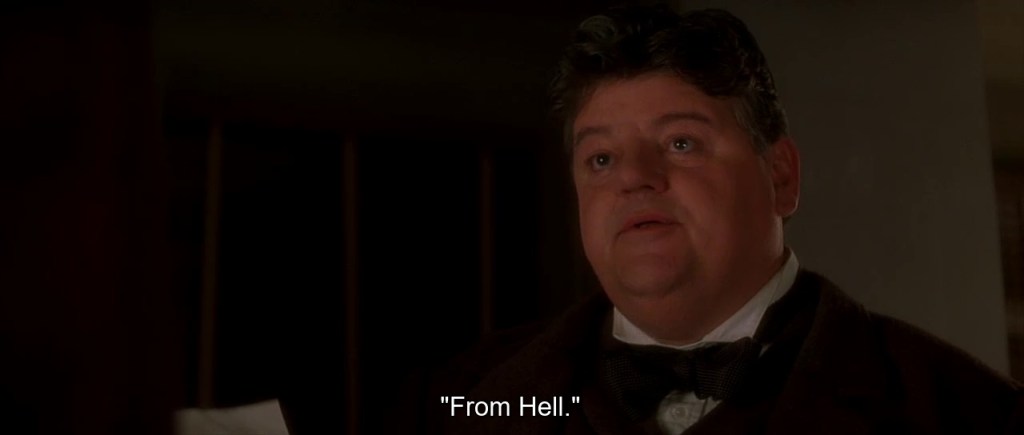
Johnny Depp plays Inspector Abberline, the cop searching for Jack, with his usual brooding sensual close-ups, while Heather Graham (Boogie Nights) is quite luminous as the sex worker Mary Kelly, who becomes his love interest as well as a target of Jack. Then there’s a delightful performance by Robbie Coltrane (Hagrid from the Harry Potter films) as Abberline’s sergeant, who quotes Shakespeare as he tries to revive Abberline from his opium den dreams, where he imbibes absinthe laced with laudanum and “sees” the murders as they happen.

Ian McNeice (Bert Large from Doc Martin) pops up as the coroner, and there are a host of other familiar faces. If you like a boisterous story and some great performances, you might enjoy this. But if you are serious Jack groupie, you will wince at the anachronism that puts the receipt of the kidney some time before the murder of Catherine Eddowes, from whom that kidney is likely to have been taken.

Like any fictional recreation of history, there is inevitably exaggeration and speculation. The film depicts an all-powerful Freemason movement infiltrating the police and medical establishment and threatening or killing anyone in their way. There is an evocative depiction of the life of late nineteenth century sex workers (called “whores” by the police, and often themselves, and “unfortunates” in official language). There is also some cursory mention of the classism and racism that English society exhibited in the age of Empire (and still does), seeking to blame the American natives in “Buffalo Bill’s Wild West Show” (perhaps a wink to the serial killer in The Silence of the Lambs?), foreigners, Orientals, Jews, Socialists – anyone other than the rich and powerful. Several scenes feature the hatred of Jews that saw the police and the populace open to antisemitic provocation when looking for a scapegoat. The chasm between the respectable killer and the honest but disreputable poor is made by means of an (otherwise gratuitous) appearance by the Elephant Man, Joseph Merrick who, like Jack, was a famous denizen of Whitechapel. He stands surrounded by respectable white men, wondering at his ugliness, but having no inkling of his humanity.

Foreigners, the disfigured, the “unfortunates” and Jews were outsiders in English society, and outsiders are denied the protection that other citizens expect, and so are easily accused, attacked, killed and sometimes even eaten. The “unfortunate” mother of the royal baby is kidnapped and given a frontal lobotomy, a new scientific technique which was instantly turned to the advantage of the elite.

In Victorian England, the poor were blamed for any and all of society’s ills, with the idea of suspecting a rich, educated man excluded from consideration. Of course, the Indigenous people in Queen Victoria’s empire were similarly objectified, enslaved or slaughtered, also using the benefits of modern technology such as the gunboat and machine-gun.

The movie opens with a quote, Jack, saying “One day men will look back and say I gave birth to the twentieth century.”

I can see no other reference to such a quote in any source other than this movie, but it has a certain ring to it, it makes sense of this modern drama between the rich, who only ever want more, and the poor, who scrabble just to stay alive. At a time when the environment has been appropriated and cannibalised by the ruling class, has Jack’s comment in 1888 proved prophetic?

Jack the Ripper was less “a return to the animal passions of the lowest cannibalistic savage races” and more a manifestation of the voracious appetite and greed of modern capitalist industrial society, where the value of everything, including the life of humans and other animals, is counted only in monetary terms, and the marginalised and objectified are cast out and consumed.

Criminals becoming “real cannibals” in Ukraine?

In October 2022, thecannibalguy blog reported on the news that Russia has been boosting the number of soldiers fighting in Ukraine by recruiting within its worst maximum-security prisons, including enlisting a convicted cannibal.

The cannibal, Yegor Komarov, had been the subject of an earlier blog in December 2021. He had been arrested for murder in the town of Sortavala (near the Finnish border) after a headless body fell from his car. Komarov admitted to being a cannibal and confessed to stabbing and killing another man in a St Petersburg park the previous year for the sole purpose of tasting human flesh, adding that he had sliced off the victim’s tongue and fried it in butter.

The recruiters of this motley army of murderers, rapists (and at least one cannibal), all of who are promised freedom if they survive six months of war, is a mercenary force called The Wagner Group. It had first been deployed to the Ukraine back in 2014 to help pro-Russian separatists battle Ukrainian forces.

Yevgeny Prigozhin, an oligarch known as “Putin’s chef” because he rose from being a restaurateur and caterer for the Kremlin, is the leader of the Wagner Group. Many of Mr Prigozhin’s companies are currently under US sanctions for what it calls his “malign political and economic influence around the globe”. 

Prigozhin originally denied any connection with the Wagner Group, but now a new video has surfaced (at the top of this page) where he shows how his mercenaries are trained before being sent in as the shock troops of the Russian war to occupy Ukraine.

In the video, Prigozhin speaks about so-called “elite” fighters from a special training base in the village of Molkino in the Krasnodar region of southern Russia:

This is a supplementary training base for our fighters…. Here experienced fighters are given additional training in their specialties. So they raise young eagles there, and here they make real cannibals.

These prisoners from the worst Russian prisons are considered disposable, sent into the front lines in Ukraine as cannon fodder. According to the Ukrainian President, after the fighting around the Soledar salt mines in January 2023,

“Thousands of their people were lost: the whole land near Soledar is covered with the corpses of the occupiers and scars from the strikes. This is what madness looks like.”

Commanders of the brutal mercenary group are reportedly castrating their own soldiers who try to surrender or retreat. In an intercepted call in December 2022, US intelligence said that they learned a member of the Wagner Group was castrated for either trying to retreat or surrender. The intercepted call heard a Russian soldier say, “The Wagnerians caught him and cut his fucking balls off” but the video tape was not released.

We have no reports yet about the fate of the recruited cannibal, Yegor Komarov, nor do we know if he is finding ‘gainful’ employment teaching other recruits how to be “real cannibals”.

We do know that cannibalism is a recurring event in Russian and Ukrainian history, particularly in the last hundred years. Russia’s worst serial killer was a cannibal named Andrei Chikatilo, who was convicted of killing fifty-two women and children between 1978 and 1990, although he had confessed to many more. Chikatilo blamed his cannibalism fetish on the story his mother had told him about his brother being taken and eaten by the neighbours in the 1930s, during the Holodomor.

The “Holodomor” (literally “murder by starvation”) was an event that took place in the Ukraine in 1932-3, during which the population was deliberately decimated by Stalin’s collectivisation of the farms and seizure of food stores. As starvation set in, corpses began to disappear, and the government response was simply to put up signs saying, “Eating dead children is barbarism”.

Not so in war, apparently. What exactly Yevgeny Prigozhin meant by turning his soldiers into “real cannibals” is not clear. But in view of his total disregard for their welfare, we have to wonder how well Prigozhin feeds his soldiers. Or, as Putin’s chef, does he simply give them a recipe book?

THE CROSSBOW CANNIBAL (Living with a Serial Killer, Season 2 Episode 2)

Oxygen True Crime is a program brand within the NBCUniversal stable, and is rather oddly described as:

“a multi-platform high quality crime destination brand for women”

I guess because most of the murderers reported by the show are men?

Anyway, the show we are reviewing here is part of the 2022 second season of an Oxygen series called Living with a Serial Killer, the first season of which aired in 2021. The program has covered a number of British and North American killers, including Steve Wright (the Suffolk Strangler), Peter Tobin, Timothy Boczkowski and a couple of women: Elizabeth Wettlaufer, a Canadian nurse who murdered several of her patients and Joanne Dennehy, who stabbed three men to death in 2013.

Living with a Serial Killer concentrates not so much on the killer, as do most true crime shows, but on the partners or friends or even children who lived with them, the people who thought they knew them, and it tells how they lived either in fear or else were oblivious to the exploits of the murderers. Most, but not all, of these unwilling companions were women.

Most of the killers were not cannibals, disappointingly for this blog, but one was, or says he was, despite there not being enough left of his victims to confirm or deny his claim. This was Stephen Griffiths, who stood up in court for his arraignment for murder and, when asked his name, identified himself as THE CROSSBOW CANNIBAL.

Griffiths killed three women in the city of Bradford, West Yorkshire, England in 2009 and 2010; 43-year-old Susan Rushworth disappeared on 22 June 2009, followed by 31-year-old Shelley Armitage on 26 April 2010 and 36-year-old Suzanne Blamires on 21 May that year.

The women were all Bradford sex workers. Parts of Blamires’s body, including her severed head still containing a crossbow bolt, were found in the River Aire in Shipley, near Bradford, on 25 May. Other human tissue found in the same river was later established to belong to Armitage. No remains of Rushworth were ever found. Griffiths was arrested after CCTV security footage caught him in the act of killing Suzanne Blamires. He not only committed the execution on camera but, after dragging her body inside his apartment, returned carrying his crossbow and gave a middle finger to the camera, knowing he had been seen.

Griffiths was a postgraduate research student studying criminology and specialising in British murderers, so he knew a great deal about killing and disposing of bodies. He also knew what sort of activities led to sensationalist press coverage, and he seems to have been determined to become more famous than one of his pin-ups, the Yorkshire Ripper, Peter Sutcliffe. Sutcliffe had murdered thirteen women in the same area between 1975 and 1980, and was at the time rotting in prison with several life sentences to serve, and judicial instructions that he was never to be released. Sutcliffe died in November 2020 after refusing treatment for COVID-19.

After his arrest, which happened a few days later when the caretaker checked the CCTV tapes, Griffiths readily admitted the murders to the police, telling them he had eaten some of his victims’ flesh, and adding, “That’s part of the magic.”

The program focuses on Kathy Hancock, who lived with Griffiths for a considerable time. A tough woman, a prison officer when they met, she was physically abused by him, poisoned, and perhaps worst of all psychologically tortured (particularly when he stole her dogs) to the extent that she was unable to escape his influence. She did not know that he was a serial killer, but was not very surprised when she found out. Despite the occasional escape, she was with him or under his influence for much of the decade from 2001 until his arrest in 2010.

When interviewed by West Yorkshire Police (extract at the top of this blog), Griffiths was asked why he killed the three sex-workers. His reply:

“I don’t know. Well, I’m misanthropic. I don’t have much time for the human race.”

Police divers found 159 pieces of human tissue when they searched the River Aire; almost all were from the final victim, Suzanne Blamires. There were only two parts of Shelley Armitage found – a part of her spine and a section of flesh revealing knife marks. Susan Rushworth’s family had no definite confirmation of her death or disposal, and no remains over which to mourn. He told the police:

“… it was just meat in the bath that was chopped up and churned, some of it eaten raw and I don’t know after that. I don’t know where she is.”

Griffiths claimed to be possessed by an alter ego named Ven Pariah who took over his social media accounts and boasted of his exploits. Psychiatrists found him fit to be tried, but it is still possible that his psychotic episodes (he was diagnosed as a sadistic schizoid psychopath) accompanied the murders and he really does not know what happened subsequently. It does sound a bit convenient though, like Hans Beckert in Fritz Lang’s M – EINE STADT SUCHT EINEN MÖRDER, who claimed he could not remember murdering and consuming his child victims, particularly as Griffiths seems to have clear recall of the actual murders and dismemberments.

Or he could be making it all up, since we know that Griffiths was desperate to be (in)famous and, as a student of criminology, would have been aware that cannibalism would make far bigger headlines than murder.

But here’s another explanation. Griffiths told police that he did not particularly despise sex workers, but that they were easy targets – they worked on dark, run-down streets and, due to their propensity for addiction, the police were unlikely to worry too much if they disappeared – there were plenty of other possible explanations besides murder. This is reminiscent of Albert Fish, who killed and ate African-American and Latino children, not because he was a racist, but because he knew the police would not look too hard for them.

Griffiths’ hatred was not aimed at sex workers but at women in general. He was insecure, vain, and had a desperate need to dominate. This is indicated in his relationship with Kathy Hancock, whom he abused and tormented despite the fact that she was voluntarily cohabiting with him. When she finally left he stalked and threatened her, to the extent that she finally moved overseas to get as far away from him as possible.

The ultimate form of control is to kill and consume the ‘other’. Humans do it all the time to other animals to establish an ideological superiority and supremacy – we eat meat (some of us) not because it is necessary for our health but because sacrificing the animal demonstrates human exceptionalism. It elevates the human, or those privileged to be considered human, to a higher plane than other animals and ‘lesser’ or sub-humans (untermenschen), whom we feel free to exploit in a wide variety of ways such as slavery, sweatshops and, in the extreme, cannibal feasting. Griffiths’ profound misogyny could find its deepest expression not in paying for the use of their bodies, or even ‘just’ killing them, but in utterly destroying them, and at the same time absorbing them into his own body, thereby destroying their independent subjectivity and making them exist only as part of him. Cannibalism offers ultimate power and control over the victims.

David Wilson, Professor of Criminology and Criminal Justice at Birmingham City University, said that

“We want to see serial killers as real aberrations, as different from dominant beings in our culture, but often they are just extreme versions of other beings of their time.”

Was Stephen Griffiths a cannibal or a braggart? We’ll never know for certain. Claims of cannibalism are hard to confirm, as the perpetrator is often undiscovered, unreliable, or dead. Except for cases where cannibals recorded their acts on video tape (such as Armin Meiwes), we only have the verification of missing flesh or slashed bones, evidence over which everyone from archaeologists to forensic scientists can argue forever, or the confessions of the cannibal, which can be easily retracted before trial or may prove to be just boasting and narcissistic grandstanding. Griffiths told the police:

“It was just a slaughterhouse in the bath tub.”

The cannibal, whether literal or metaphorical, is essentially enacting an extreme form of carnivorous virility, and thereby questioning the conventional view of humans as above nature, as not animals, not meat. The cannibal makes us look at ourselves as edible, and thereby question our place in, and exploitation of, the natural world. The bath tub, our symbol of cleanliness and separation from the dirt and smell of nature, becomes a slaughterhouse. The slaughterhouse, normally hidden in remote towns behind high walls, comes home.

“I’m just gonna make you my zombie”: DAHMER: MONSTER – The Jeffrey Dahmer Story (Murphy and Brennan, Netflix, 2022)

This new docudrama (I can’t believe that’s a word) is quite a big deal in the highly respected academic discipline of Cannibal Studies. While many people think of Hannibal Lecter when the subject of cannibalism arises, in terms of contemporary culture (and therefore putting aside the Donner Party for now), Jeffrey Dahmer, known as the “Milwaukee Cannibal”, is a crucial figure, not least because he really existed, we know a lot about him, and we have a good understanding of what he did. Dahmer typifies the modern cannibal in that he seems so unremarkable; we have seen, and perhaps remarked at, his cool demeanour and the fact that he seemed like just an ordinary, everyday boy next door.

There have been a few Dahmer movies and documentaries, including some interesting interviews with the man himself, arranged in jail, before a fellow prisoner caved his head in with a metal bar. This new one has a pedigree though. First of all because it is presented by Ian Brennan (Glee, Scream Queens, The Politician) and  Ryan Murphy, who signed a $300 million deal with Netflix in 2018 and who brought us such enormous and terrifying hits as Glee, Nip/Tuck, American Horror Story and American Horror Stories.

Monster – the Jeffrey Dahmer Story runs over ten episodes, released concurrently on September 21, 2022. The length alone (almost nine hours) makes it more comprehensive and immersive than the other treatments. It is also different to most serial killer / cannibal documentaries and films in that it is presented not from Dahmer’s point of view, but from that of those around him – the victims, but also the family and the neighbours (who had to put up with the appalling stench of death that always emanated from his rooms or apartments).

“We had one rule going into this from Ryan, that it would never be told from Dahmer’s point of view.”

The first episode drops us into the main event – Dahmer in his Milwaukee apartment, trolling gay bars and offering young men and boys money to come home with him for a photo session, where he drugs them and attempts to turn them into love zombies by drilling holes in their skulls and pouring acid into their brains. When this doesn’t work, he has sex with their corpses, and harvests their meat.

One man escapes and flags down the police, who arrest Dahmer. The series then turns back to his childhood, his parents’ messy divorce, and the isolation which left him free to hatch his murderous plots. Later, we meet some of his victims, and his neighbour Glenda Cleveland who repeatedly tried to notify the police and FBI of what she heard, saw and smelled, but was comprehensively ignored and even threatened for her interventions.

“What do you do in there? The smell, power tools going all hours of the night, I hear screaming coming from your apartment.”

Dahmer, threatened with eviction due to her complaints, offers her a sandwich, saying “I used to be a butcher. I made that just for you.” Glenda refuses to eat it, and we know why – it looks like a chicken sandwich (and probably is).

But our willing suspension of disbelief declares it human meat, which is not kosher in any religious tradition. He tells Glenda to “eat it!”

Most of this documentary is very true to the facts as we know them, but in any re-enactment, there will be gaps to fill in or characters that need to be heard, without filling the cast list with an unmanageable number of people to remember. So the sandwich was apparently a fact, but was not given to Glenda but to another neighbour, Pamela Bass, who thought he was a generous if shy young man, and admitted that she ended up eating it.

Glenda, played superbly by Niecy Nash (from Scream Queens and Claws), is a strong woman caught in one of those nightmares where you know there is horror, but no one will believe you.

She demands to know what is in the sandwich.

“It’s just meat… It’s like a, uh, pulled pork.”

This is a regular theme of cannibal texts: they remind us that humans are animals, and our flesh and organs are made of meat. It’s a popular meme on animal rights social media sites. This one shows the real Dahmer, in case you’ve forgotten what he looked like.

Dahmer was looking for love, but he was not willing to risk losing it, so he tried to conscript his victims as undead zombies or as corpses, skeletons, or just happy meals. He showed affection – he is seen lying with his corpses, holding their hands, preserving their body parts. He loved them in much the same way that farmers often claim to love their cattle, sheep, pigs, etc, just before putting them on the abattoir trucks.

Dahmer is played brilliantly by Evan Peters (American Horror Story, X-Men, Mare of Easttown), who looks a lot like Dahmer, but with a touch of the young Malcolm McDowell – imagine Clockwork Orange but with cannibalism. If you want to know what Dahmer might have looked like forty years after his arrest, check out McDowell in Antiviral.

Jeffrey Dahmer murdered and dismembered seventeen men and boys between 1978 and 1991, thirteen years during which the police had no clue about his serial murder spree and, some might say, didn’t care much, since most of the victims were people of colour. And this is the heart of this rendition of Dahmer’s story – he was protected by the racism and incompetence of the American justice system. Here was a clean-cut white man, and people of colour disappear without trace all the time, apparently, so the police did not bother him, while the judges treated him as just a naughty boy.  Glenda’s frantic calls were met with apathy or rudeness.

He kept getting away with everything – one of the most extraordinary moments is shown in flashback in episode 2. On May 27, 1991, Glenda Cleveland called the police to Dahmer’s apartment after her daughter, Sandra Smith, and her niece, Nicole Childress, found a bleeding, naked and incoherent boy on the street who was running from Dahmer. Dahmer appeared, white and polite, and told the police that the boy was his 19 years old boyfriend.

He said the boy was drunk and they had been in an argument, and so the cops helped him take the boy back to his apartment, had a quick look around, made homophobic remarks about AIDS, and left the boy there.

The boy was bleeding from a hole drilled in his skull. After the police left, he was dead within the hour. It was later discovered that the boy was 14-year-old Konerak Sinthasomphone, Dahmer’s 13th victim. Incredibly, Dahmer was actually on parole for an earlier arrest for the molestation of another child, who was one of Konerak’s older brothers.

When Cleveland spotted Konerak’s photo in a missing person alert in the newspaper days later, she realised he was the young boy Dahmer had claimed was his boyfriend. She contacted the police and the FBI yet again, but they didn’t even return her call. Five of Dahmer’s seventeen murders, including that of Konerak, were carried out after Cleveland began contacting police. All but three of Dahmer’s victims were non-white.

The Reverend Jesse Jackson, a leader in the Civil Rights movement since the time of MLK, got involved in the case despite the urgings of some of his supporters, who didn’t think the movement should be linked to “a gay serial killer who eats people”. But as he says:

“I realised it was not just a gruesome horror show. It’s a metaphor for all the social ills that plague our nation. Bad policing, underserved communities, the low value we assign to our young Black and brown men, especially if they happen to be gay.”

The old profiling stereotypes no longer work, in fact never did. Dahmer was a serial killer who was ignored by the law for thirteen years, because he was white and male. In the Soviet Union at the same time, Andrei Chikatilo was killing and eating parts of over fifty women and children, ignored by the police force, because serial killing was considered impossible in the “workers’ paradise”. But those profiles still endure: a Black man on the street is instantly suspected of criminal intent, a white man, even Jeffrey Dahmer, is largely untouchable. In that sense, society dehumanises the poor, the coloured, the disabled, just as effectively as Dahmer did to his prey.

As the philosopher Michel Foucault observed, the world outside was a scary place filled with monsters up to the seventeeth century, and those monsters were thought to be probably criminals. But in modern times, the criminal is considered likely to be a monster. Ancient monsters were recognisable – usually grotesque and often hybrids of humans and other animals. But the contemporary monster looks, speaks and eats pretty much like the rest of us. Like Jeffrey Dahmer – the boy next door.

Cannibals in the Soviet paradise: CITIZEN X (Chris Gerolmo, 1995)

Three years ago (where has the time gone?) I reviewed a pretty great movie called Child 44, with Tom Hardy as a Soviet investigator in pursuit of a murderer, based on the most prolific serial killer of the Soviet Union (excluding Stalin), Andre Chikatilo. Yes, pretty great, but it had some problems; from the point of view of this blog, it barely mentioned cannibalism. The murderer was “just” a psychopathic sadist. It also changed all the names and dates, presumably to protect the guilty.

But ten years earlier, today’s film Citizen X was made as an HBO television movie, based on Robert Cullen’s non-fiction book The Killer Department. This is a much more accurate rendering of the career of Andrei Chikatilo, the “Rostov Ripper”, who was eventually convicted of 52 murders, although he confessed to several more.

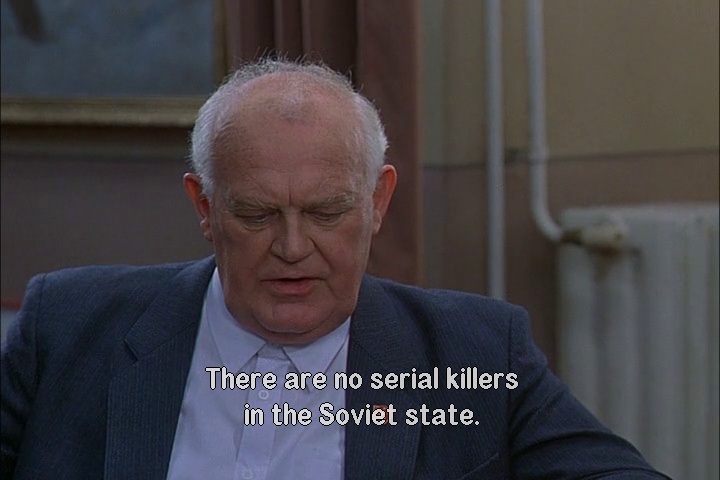
Chikatilo was able to continue killing for seventeen years, from 1978 to 1995, due to a combination of general ineptitude, official denial of the possibility of such a thing as a Soviet serial killer (they considered it a bourgeois American crime, inconceivable in the workers’ paradise), and luck (apparently his semen was found to have a different grouping to his blood). The authorities preferred to round up the Rostov homosexual community because of some absurd reasoning that homosexuals are also paedophiles, and some of the victims had been boys, which resulted in some gay men committing suicide in custody.

Chikatilo claimed that his mother had told him that his older brother had been kidnapped and cannibalised by starving neighbours when he was little. This may have been her way of trying to scare him into behaving, but he had been born in Ukraine at the time of the Holodomor, when Stalin was busy starving millions of people to death as part of the process of Collectivisation, so could well have been true.  Chikatilo was a self-confessed cannibal, stating that he gained sexual satisfaction from torturing his victims, and would sometimes drink their blood and eat their genitals, nipples and tongues.

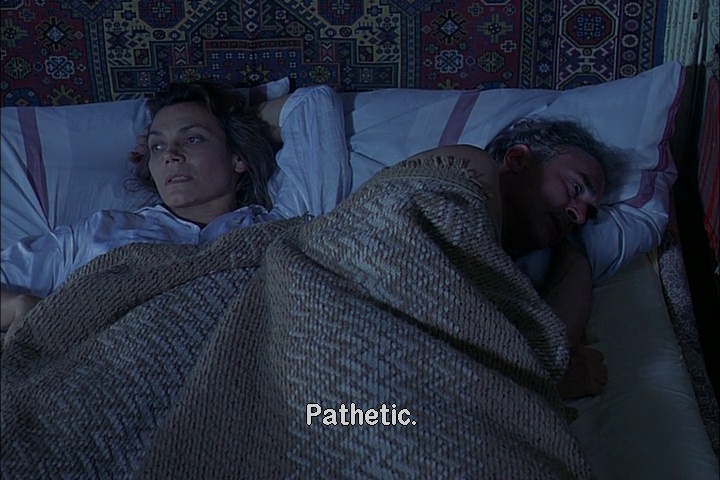
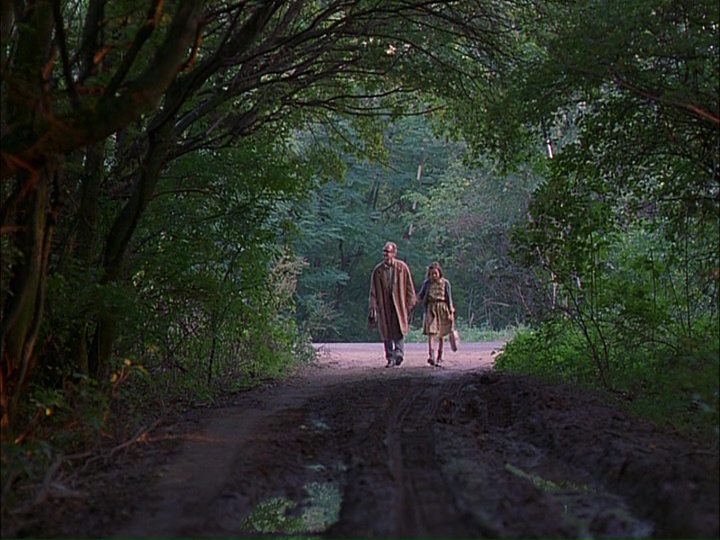
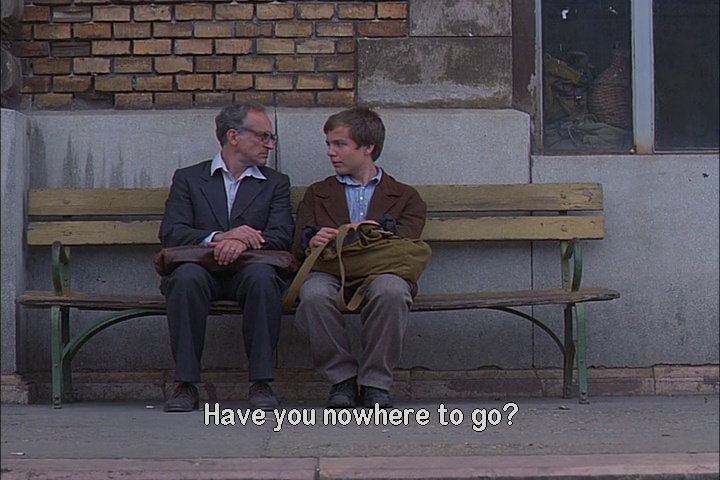
This film is presented as a true-crime documentary. The viewer knows very early who the killer is – Chikatilo, a loser driven insane by rejection and humiliation at work and in bed.

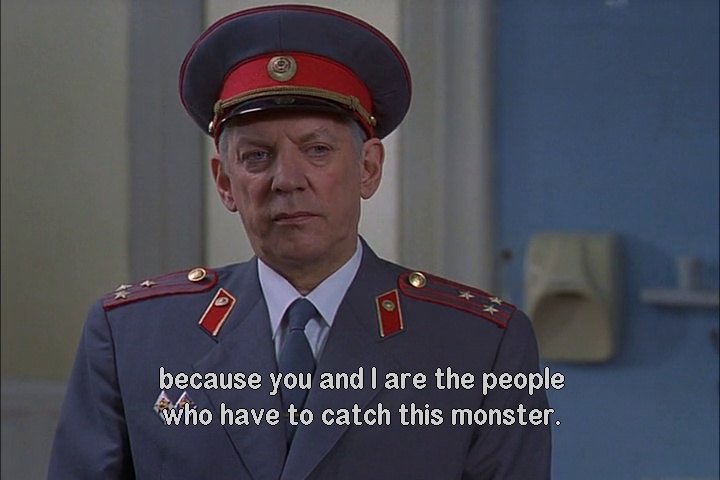
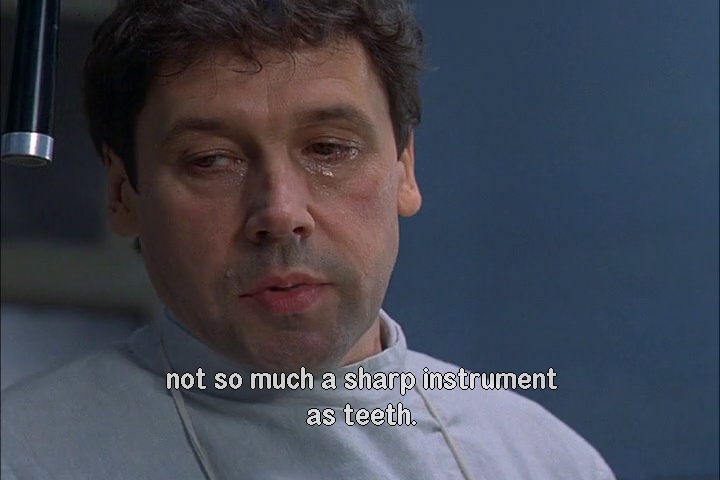
Chikatilo is played with nerdish rage by Jeffrey DeMunn, who we know now as Charles Rhoades, Sr. in Billions; no wonder he captures a psychopath perfectly. The rest of the cast is just as impressive – the forensic cop is played with tightened jaw and occasional tears by Stephen Rea (The Crying Game, Interview with the Vampire), his wife is played by the iconic actress Imelda Staunton, and his boss, Colonel Fetisov, is the wonderful Donald Sutherland, looking uncomfortable in a Soviet army uniform yet getting away with it due to his devilish grin.

The psychiatrist who helps them crack the case is played by the doyen of cinema Max von Sydow, who played chess with Death in Bergman’s The Seventh Seal, played Jesus in The Greatest Story Ever Told and even got an Emmy nomination for his role in Game of Thrones. With a cast like that, what could go wrong?

Roger Ebert nominated Citizen X as his example of a movie that totally immerses the viewer in a believable reality:

“We experience the hopelessness, self-loathing, fear, and bleak reality displayed by most of the characters, regardless of station, age, self-discipline, or level of humanity.”

Chikatilo, the very image of the alienated outsider, preys on society’s lost and abandoned, befriending them (like Fritz Haarmann in Germany in the 1920s) and then luring them to their death.

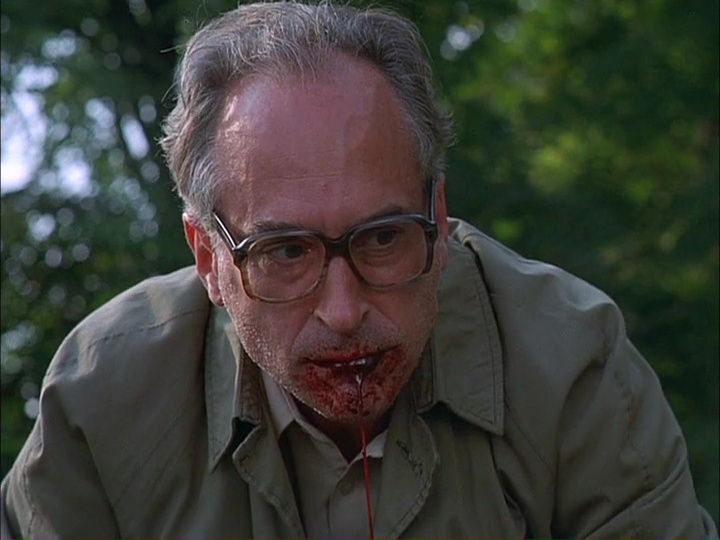
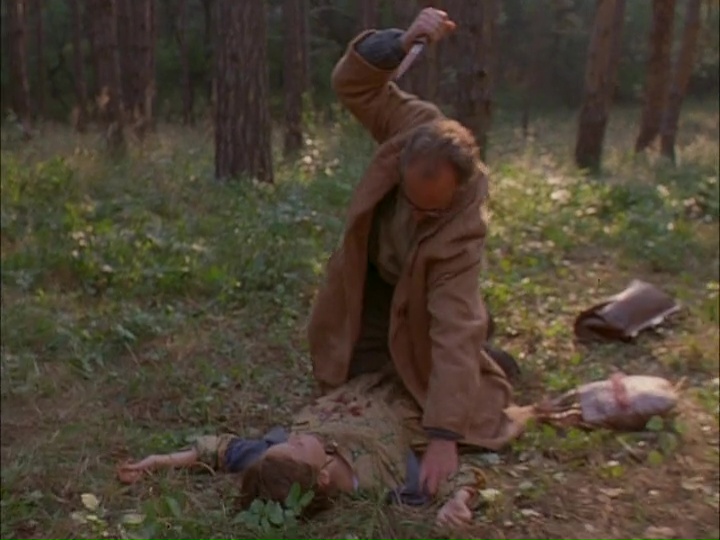
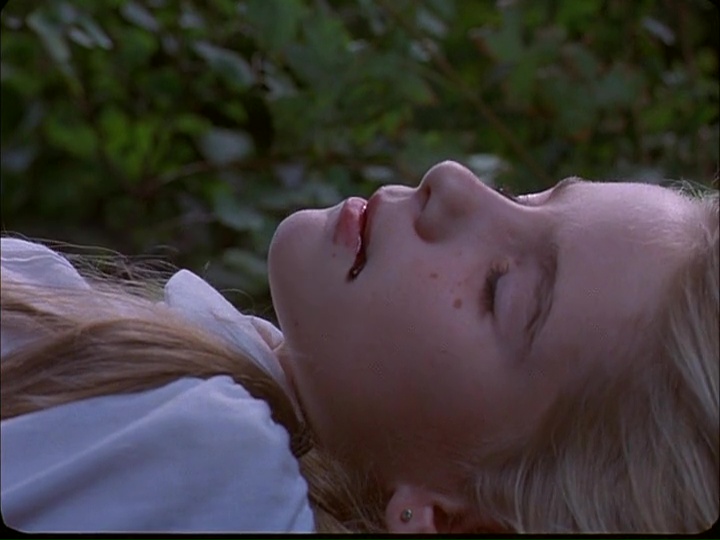
The story shows a lot of murders, children falling backwards, blood dribbling from their mouths, knife plunged into their defenceless breasts.

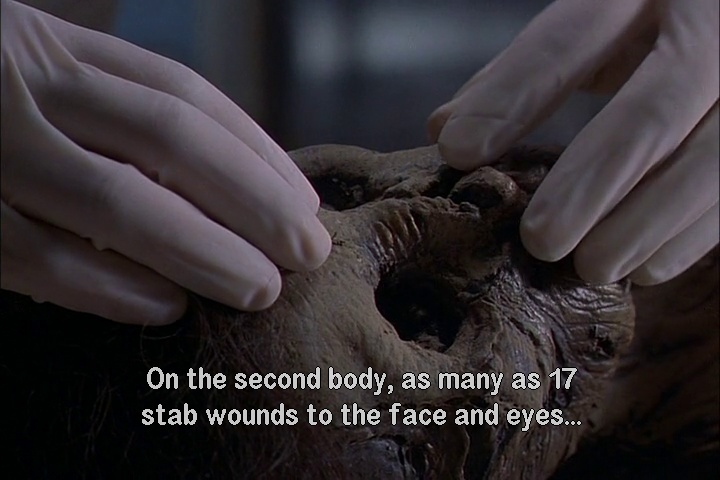
We see graphic scenes of their post mortem examinations after the bodies are eventually found.

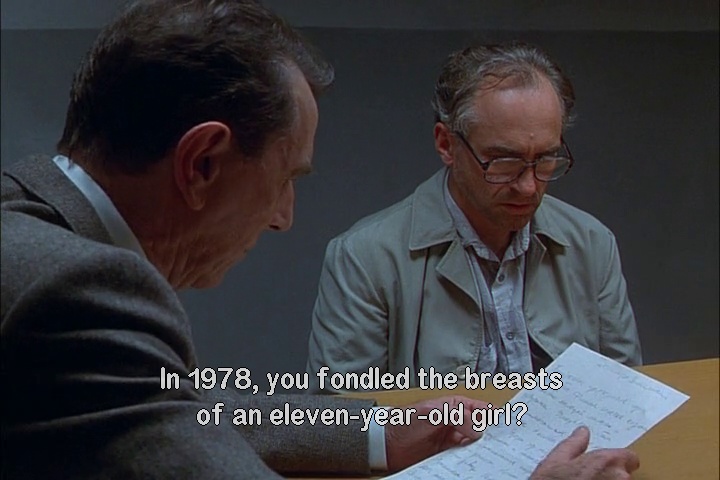
But that’s not really what the film is about – it takes us into the stultifying atmosphere of a grey bureaucracy in which truth is determined not by facts but by favouritism, prejudice and nepotism. In that sense, it is a fascinating portrait of the closing years of the Soviet Union, but it also jolts us into the realisation that we have all been there, a system where, in order to make any progress, you have to play along with the idiots in charge. A world where who you know is more important than what you do, a frustration that is felt universally. It is really a psychological thriller more than a murder procedural. The militsia make little progress, stymied by the bureaucracy, the unwillingness to admit to the fact that a serial killer could inhabit the workers’ paradise, by the apparent blunder in typing Chikatilo’s blood and semen, and by the insistence that the hectoring interrogation is the only way to succeed in getting the truth.

Ultimately, it is the psychiatrist, reading his paper, in which he had earlier tried to profile the killer, that makes Chikatilo confess, recognising that someone has finally understood the torments churning inside him.

The story is not about Chikatilo’s hunger for flesh, but his appetite for compliant sex, for a partners unable to resist his sexual appetite, because they are dead or squirming in agony. Children were ideal objects for his cravings, particularly young ones who were lost, homeless or runaways.

“Citizen X has probably had a tendency towards isolation since childhood. His internal world, filled with fantasy, is closed to those around him, even those close to him. The adolescence of such a person is, as a rule, painful, because he is often subjected to the laughter of his peers, at a time when success among them is the subject of his secret dreams. His sexuality is not noticeable to those around him, however it is an external asexuality that frequently coincides with steady masturbation and wild erotic fantasies. He is painfully sensitive in company, incapable of flirting and courtship, however it cannot be excluded that he has fathered a family.

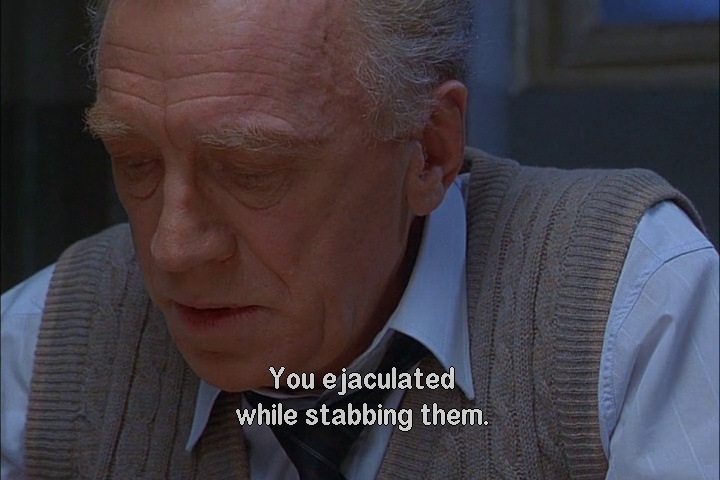
There is reason to think that Citizen X has a weakness of sexual potency.He sits or squats astride his victim. The orgasm and ejaculation most likely occur at this stage of the act and in this position, sitting on the victim in the period of her agony…. You ejaculated while stabbing them.”

The film scored an 86% “fresh” rating on Rotten Tomatoes. The director, Chris Gerolmo, also wrote the screenplay, which earned him an Emmy nomination, a Writers Guild of America Award, and an Edgar Award. It’s an absorbing film, the acting is great (although the fake Russian accents don’t really convince anyone), but I still have an issue. Chikatilo is known for being the most prolific serial killer in the Soviet Union. But he is most notorious for being a cannibal, and that is barely mentioned.

What is it about cannibalism that makes it so comprehensively abject that a film about a serial killer who admitted to murdering over 53 people, 35 of them children, cannot bring itself to mention his regular feasting on the bodies?  Evidence aplenty spoke of the mutilation of the victims, particularly their eyes and sexual organs, and Chikatilo admitted in court that he had eaten the sexual organs. Yet the film, like the later Child 44, skipped over this aspect except for one brief glimpse.

Freud wrote that the two primary taboos of humanity are incest and cannibalism. It seems that his words are still accurate. We routinely see murder in films and television series – but it happens to someone else, and our attention is usually on the authority figure solving the crime. Cannibalism though is different – it opens up the human body and shows that we are made of meat, just like the animals we so carelessly torment and kill by the billions. Unlike the sometimes shocking, sometimes light-hearted killing of other people, cannibalism shows us what is inside us. It shows us our own mortality.