The cannibal weeping demon: Akira Kurosawa’s DREAMS (1990)

Dreams (夢, Yume) is a 1990 magical realist anthology of eight stories, written and directed by Akira Kurosawa, inspired by his recurring dreams. An international co-production of Japan and the United States, Dreams was made with assistance from George Lucas and Steven Spielberg.

Akira Kurosawa (Japanese: 黒澤 明, March 23, 1910 – September 6, 1998) was a Japanese filmmaker and painter who directed thirty films in a career over fifty years. Kurosawa directed around one film per year throughout the 1950s and early 1960s, including a number of classics which were often adapted by other directors. These included Rashomon (1950), Ikiru (1952), Seven Samurai (1954) – which was remade in 1960 by John Sturges as The Magnificent Seven, Throne of Blood (1957), Yojimbo (1961) and High and Low (1963). He is widely considered one of the most important and influential filmmakers in the history of cinema.

Kurosawa’s bold, dynamic style was strongly influenced by Western cinema, yet distinct. In 1990, the year Dreams was released, he accepted the Academy Award for Lifetime Achievement.

Dreams is his most personal work, taken from his own life and unconscious mind. He addresses themes such as childhood, spirituality, art, death, and the mistakes and transgressions made by humans against nature. The episodes within Dreams do not have a single narrative, but are the fragmentary adventures of a “surrogate Kurosawa” (often recognizable by the character wearing Kurosawa’s trademark hat) through eight different segments, or “dreams”, each one with a title. Each is more a fairy tale than a dream in the filmic sense.

A child sees a forbidden fox wedding ceremony and is told he must suicide, another weeps as he witnesses the spirits of a peach orchard that has been cut down by his family, reflecting the human war on nature.

The fear of nature fighting back is a bleak dream of men struggling through a mountain blizzard. The horror of war is demonstrated as a Japanese officer is confronted by the ghosts of his annihilated platoon.

Our understanding of nature is questioned in “Crows”, the only dream not made in Japanese, where Vincent van Gogh is portrayed by American filmmaker Martin Scorsese, with a broad New York accent, and the protagonist travels through the images that fill van Gogh’s tortured imagination.

Our abuse of nature comes to its logical conclusion as we see nuclear power points explode behind Mount Fuji, human ingenuity able to create but not control these forces; in the end, all they can do is colour the toxic pollution so people know what is killing them.

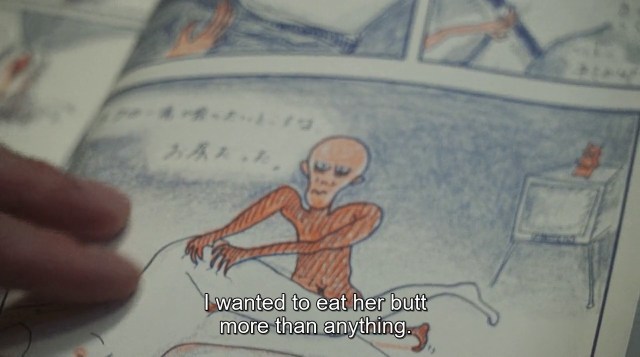
The Weeping Demon” is the seventh dream, and of particular interest in Cannibal Studies. It shows the aftermath of nuclear devastation, a fear that has haunted us all for eighty years, particularly the Japanese, who were the first and only people to experience nuclear weapon attacks.

A man is wandering around a misty, bleak mountainous terrain. He meets an oni (demon or ogre), who is a mutated human with a single horn on his head. Oni are known for indulging in murder and cannibalism when they get the chance. They are typically portrayed as hulking figures with one or more horns growing out of their heads, massive teeth, and occasionally a third eye in the centre of the forehead.

The demon tells him that there was a nuclear conflagration, which resulted in the destruction of nature and animals, the growth of dandelions taller than humans, and horns sprouting on the heads of those humans left. The horns cause them to feel excruciating pain each evening; but they cannot die, so they howl in agony all night. Many of these demons were formerly millionaires and government officials, who are now suffering through a hell befitting their sins.

Even in this apocalyptic post-war world, the social hierarchies continue to oppress – the demons with two or three horns eat those with only one.

“There’s no food! We feed on ourselves. The weak ones go first. It’s about my turn now. Even here we have grades. One-horn demons like myself always get eaten by those who have two or three horns. Before they were powerful and pretentious. And now they still throw their weight around as demons.

The demon that the man meets is waiting to be eaten, seeing this as an escape from his agony and nagging hunger, but also as a punishment – before the wars, he was a farmer who poured milk into the river and buried vegetables to maintain market prices. He warns the man to flee, but when the man asks where he should go, the demon just asks if he too wants to become a demon. The terrified man runs away with the demon in pursuit.

The film finishes with a meditation on death, the final and irrevocable return to nature. Laying down our technology, our appetites and our bodies is celebrated – peace at last.

Condemned as disjointed by some critics, the film has a logic to it, a dream logic, in which things are out of place yet seem quite natural. It starts with a little boy witnessing the wedding procession of the foxes, a slow funereal procession that is forbidden for human viewing, and finishes in a village that has spurned technology and progress in favour of clean air and water and long, peaceful lives, where we witness a funeral procession that is pure colourful celebration.

Dreams is a sumptuous, thoughtful, dramatic, film from which I found it hard to look away. Although it is one of Kurosawa’s last films, it shows him at the height of his power and creativity, and offers a glimpse into his mind, just as he glimpses the mind of van Gogh.

Dreams is now a classic, as are all Kurosawa’s works, but it currently has only 66% fresh rating on Rotten Tomatoes, proving that a lot of people can’t be bothered listening to (or even watching) other people’s dreams. The New York Times critic called it:

“…a collection of short, sometimes fragmentary films that are less like dreams than fairy tales of past, present and future”

But dreams, like the evening news, are always fragmentary – narratives jump from tragedy to kitsch to humour. Dreams often reflect and amplify our repressed emotions and fears, and fairy tales are mythic versions of dreams. Many, perhaps most, fairy tales include cannibalistic giants, wicked step-parents, witches and ogres, such as Little Red Riding Hood, Hansel and Gretel or The Juniper Tree. Children wander, lost and hungry, through brooding forests and come across strange and fantastic creatures. Dreams reveal our repressed fears about the human attacks on nature and each other, the struggles and conflicts that lead to monsters or demons.

In dreams, we lose our rational sense of causality – anything can happen. We get lost, like in fairy tales, in forests or snowstorms or in the mind of Vincent van Gogh, seeing the world the way he had to, consuming it and reimagining it before he could paint it. We meet ghosts of people who don’t know they are dead. Nuclear power plants explode, a fear on everyone’s mind in 1990, four years after The Chernobyl disaster. In dreams, ethics become aesthetics, to quote from Hannibal.  Dreams, like fairy tales, are episodic and disjointed, and the film captures this brilliantly.

Although fairy tales date back centuries, they remain ever popular, with new versions or completely new stories released to reflect the fears of each historical period. In our modern period, the growing and changing presence of media makes us all aware of the bloodshed on the battlefields and in the death camps and slaughterhouses of modern industrial societies, images that we desperately try to forget or repress. It is no wonder that dreams are full of cannibals.

2022 CANNIBAL NEWS and VIEWS

What a year! These are some of the cannibalism stories, films and songs that arrived in 2022, with links back to the original reports, so that you can look up the ones that catch your interest, and so that this blog does not take all of 2023 to read.

January

  • A German man dubbed by the press the ‘cannibal teacher’ was convicted of murder and sentenced to life in prison. Stefan R., a 41-year-old maths and chemistry teacher, had apparently searched on the dark web for terms such as “long pig” and “fatten and slaughter people”. The man claimed his victim died of natural causes after a (presumably vigorous) sexual tryst, and he had removed the man’s penis “since my DNA could still have possibly been present due to the oral sex I performed”. In other words, he didn’t mind a bit of mutilation and perhaps cannibalism, but was concerned not to be “outed” as gay.
  • Djalma Campos Figueiredo, 46, was arrested in Brazil. He had been sentenced by the Court of Justice of Rondonia in the city of Porto Velho to 42 years in prison for several counts of aggravated murder but had escaped custody. The Civil Police alleged he would eat his victims’ eyes and ears and drink their blood.
  • Meanwhile, the Zamfara (NW Nigeria) State Police Command arrested a 57-year-old man, Aminu Baba, for allegedly eating and selling human body parts. Baba and three others were arrested after the murder of a nine-year-old boy. The Police Commissioner reported that Baba had “confessed that he usually ate the body parts and identified the throat as the most delicious part. He also sold some of the human parts to his customers.”

February

  • In Afghanistan, we discovered that the Taliban were rounding up drug addicts and putting them in rehabilitation centres to detox, which is a nice thought, except that they gave them little or no food (“cold turkey” does not count), so they apparently resorted to cannibalism.

April

We have been following the case of an Idaho man, James David Russell, who was accused of killing and eating a neighbour in September 2021. This was a big deal for us in Cannibal Studies, because Idaho is still the only state in the Union to have a law against cannibalism, a statute that hit the books in 1990, but has never been used. In April, Russell was deemed fit to stand trial.

  • In the Indian state of Assam, a man who had had perhaps more than a few drinks smelt cooking meat in a crematorium in a Hindu cremation ground. He helped himself to a few portions of the body, but was caught by villagers and handed over to police; but not before he had eaten about half of his purloined flesh.

May

  • A man calling himself The Chinese Zodiac Killer was arrested by the FBI in Jefferson County, New York for sending letters to media outlets, government offices including the White House, and other organisations, claiming he killed people and ate their flesh, and that he plans to kill more. He seems to have based his story on the Zodiac killer who terrorised California in the late 1960s. The original Zodiac Killer (who was not accused of cannibalism) was never caught, but this one was easily found, posting his threatening letters (what century is this again?) at the same letterbox he had previously used.

June

  • The case against James David Russell (see above in April) went to preliminary trial. Sadly, the judge threw out the charge of cannibalism, saying there was insufficient evidence to pursue it, and went with the rather more mundane offence of first-degree murder. Since this has a life sentence attached, the practical effect of dropping the cannibalism charge is negligible, but as the first cannibalism case in the USA, it would have been fascinating.
  • A rumour swept the Internet that the actress Anne Hathaway was a cannibal, based on a cryptic Tweet saying “police didn’t find human remains and evidence of cannibalism in her LA home that she sold in 2013.” We were all later astonished to discover the whole thing was a hoax.
  • The effects of the war in The Ukraine were starting to be felt in Europe and the UK (whose people often do not think it’s part of Europe). The Russians fell gladly on a statement from one Jeremy Clarkson (a car enthusiast) that “Hunger makes people eat their neighbours” to predict that the British will soon be a nation of cavemen feeding off each other. Of course, if you’ve ever been to a soccer match…
  • industrial/electronic music duo SKYND released their tenth song, called ARMIN MEIWES, about the German man who killed and ate a willing volunteer.
  • Back in the USA, the Utah County Attorney felt he had to go public to deny accusations that he and his wife are cannibals. Honest. I wouldn’t/couldn’t make this stuff up.

July

  • The New York Times raised the temperature of the culture wars with its review of several books, movies and TV shows about cannibalism, culminating in the (somewhat tongue in cheek) statement that “Cannibalism has a time and place… that time is now.” The right-wing press predictably jumped on the story accusing the NYT of everything from irresponsibility to Satanism.
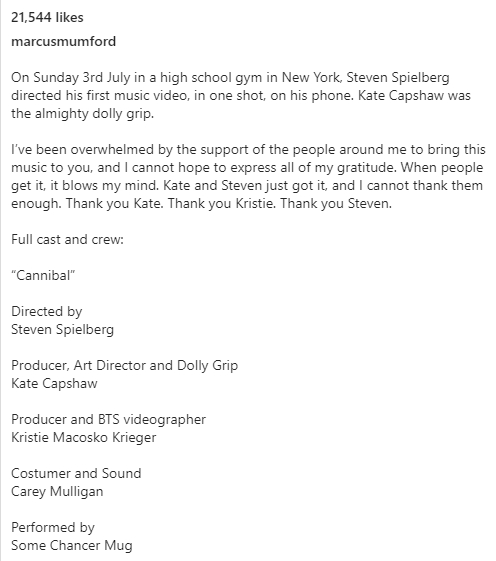
  • Also in New York, Steven Spielberg whipped out his cell phone to record Marcus Mumford singing his new work, a haunting song called “CANNIBAL“. The song might be about love and lockdown, or it could involve child abuse.

August

September

  • DISCOVERY+ launched a three-part series called HOUSE OF HAMMER. The series explored allegations from various girlfriends of the actor Armie Hammer that he was a cannibal, or had at least threatened them with cannibalism. It also examined his relatives, many of whom seemed to be presented as even worse specimens than Armie.
  • Russia discovered the war was not going well in Ukraine, and started recruiting murderers and rapists to be sent to the front as reinforcements. Also – one cannibal, Yegor Komarov, whose man-eating exploits we learned about in December 2021.

October

  • In the Indian state of Kerala, there were allegations that a couple who ran a massage centre were bringing women home not so much for massages, but for human sacrifice and ritual cannibalism.
  • In the US state of Michigan, Mark David Latunski, who had been arrested in 2019 for killing and eating his Grindr date, finally came to trial and entered a plea of guilty.

November

  • Issei Sagawa, the “Kobe Cannibal”, died of pneumonia at the age of 73. Sagawa had killed and eaten a young Dutch fellow-student in Paris in 1981. He was found insane and sent back to Japan, where he was released and lived free ever since, making movies, writing books, and even becoming a restaurant reviewer.
  • Rapper Comethazine released Bawskee 5, the 12th song on which was called “CANNIBAL“.
  • Back in Brazil again! A patient in the Municipal Hospital of Nuovo Hamburgo in the state of Rio Grande do Sul attacked other patients, screamed and spat at people, and eventually chewed off his own fingers and toes. A witness said “while he was chewing his own meat, you could hear the crackling of bones in his mouth”.

December

  • Mark Latunski, 52, was sentenced to life in prison without the possibility of parole on December 15 for the murder of his Grindr date three years previously. Kevin Bacon, 25, had been killed and mutilated by Latunski on December 24, 2019 at Latunski’s Bennington home. Latunski pleaded guilty in September to killing Bacon and eating one of his testicles, after stabbing him in the back and slitting his throat. In a victims’ impact statement, the victim’s father said “Evil does exist, and it touched us.”

On the screen

The big news on streaming television this year was Jeffrey Dahmer, the “Milwaukee Cannibal”, who took Netflix by storm with not one but two titles, despite having been killed by a fellow prisoner in 1994.

  • Ryan Murphy and Ian Brennan’s docudrama called “MONSTER: THE JEFFREY DAHMER STORY“, which logged nearly two hundred million hours of watching in its first week of release
  • Joe Berlinger’s third series of CONVERSATIONS WITH A KILLER, featuring previously unheard defence attorney tapes of interviews with Dahmer.

Lots of new cannibalism feature films in 2022, some of which I will catch up with next year:

  • Luca Guadagnino’s BONES AND ALL, featuring Timothée Chalamet and Taylor Russell as teenage cannibals in a tender and gory road movie, has been getting heaps of publicity.
  • Mimi Cave’s FRESH is a charming romcom, until the knives come out. A fascinating insight into ultimate consumerism.
  • Leatherface came back (again!), this time older but no wiser. This is the ninth (!) instalment of the TEXAS CHAINSAW MASSACRE franchise, and went straight to Netflix.
  • John Ainslie’s DO NOT DISTURB depicts a couple renewing their romance by taking peyote, but finding that this particular variant of the drug awakens a taste for human flesh.
  • Leatherface came out to play again, this time as a fan-film prequel called THE SAWYER MASSACRE. Made on a shoestring but arguably superior to the other sequels and prequels.
  • Liam Regan’s EATING MISS CAMPBELL, in which a vegan, goth student falls in love with her new English teacher and develops a taste for human flesh.
  • Sean Patrick Flanery’s enjoyable road movie FRANK AND PENELOPE, in which a couple take on a cannibal cult in the wilds of Texas.
  • Timo Vuorensola’s JEEPERS CREEPERS REBORN, the umpteenth take on a supernatural tale of the demon who eats people and incorporates their bodies, but only every 23 years.
  • Fred Olen Ray’s PIRANHA WOMEN offers a totally believable story of women who turn into man-eaters because of an anti-cancer treatment.
  • THE MENU has Ralph Fiennes as a demented chef and Anya Taylor-Joy as the fly, as it were, in his menu plan. There is no obvious cannibalism involved in the movie, but there is some speculation on-line about the final cheeseburger.
  • Ted Lasso goes cannibal’ in Adam Leader & Richard Oakes’ FEED ME, a jolly rant in which a grieving man wants to die, and a nearby cannibal wants to help him, but by instalment.

And now for something completely different

From out of the future, we have some new AI software of which Shital Shah, a senior research engineer at Microsoft, said:

ChatGPT is “a large language model that has been trained to generate human-like responses to text input.” In other words, you can ask it questions and receive (often) intelligent answers, rather than a series of links, like Google. You can try it for free (at the moment) here.

Naturally, I asked it questions such as “is meat murder” and it replied:

Ultimately, whether or not eating meat is considered murder is a matter of personal belief and moral judgement.”

So, I barked back, like a prosector out for a conviction, “Where does that leave the cannibal?”

“Whether or not eating other humans is considered murder would also be a matter of personal belief and moral judgement. Most people would consider cannibalism to be morally reprehensible, as it involves the killing and consuming of another human being. However, there may be some individuals who do not see it that way, and their personal beliefs and moral judgement would dictate their view on the matter.”

The Internet has spoken, at last.

Marcus Mumford and Steven Spielberg: CANNIBAL (2022)

Does Steven Spielberg make music videos? Well, not usually. But he whipped out his phone for this recording of a new single from Marcus Mumford (of Mumford & Sons) – his first solo venture, and the first song from his soon to be released (September 16) album called (Self-Titled). The album is produced by Blake Mills and featuring Brandie Carlile, Phoebe Bridgers, Clairo and Monica Martin.

Fans of Mumford & Sons have been perturbed to hear about Marcus’ solo album, wondering if it denotes the end of a great band, particularly considering that founding member Winston Marshall left the band in 2021 after calling controversial journalist Andy Ngo’s book Unmasked: Inside Antifa’s Radical Plan to Destroy Democracy “brave”. But Marcus has confirmed that the band will not be disbanding and he will not be leaving, saying his solo album has the “full blessing and permission of the band”, who wrote on Instagram that:

“We are excited about the next chapter of Mumford & Sons, we’re working on what that looks like, but for now we hope you can enjoy this person, our friend, being a human being.”

Anyhow, the first song we have seen from the album is called CANNIBAL (the clip is at the top of this blog) which is lucky, as otherwise I would have had no excuse to crap on about it on this cannibalism blog. Marcus stated on his Instagram account that he had faced and danced with “demons” for a long time during COVID-19 isolation, and wrote “Cannibal” in January 21.

Rolling Stone wrote that the video was shot on July 3 in a high school gym in New York. Steven Spielberg “directed his first music video, in one shot, on his phone”.

Abby Jones on the Consequence website describes the song:

“Cannibal is a somber, rootsy tune that feels a bit like a pared-down version of Mumford & Sons’ arena-sized folk rock — that is, until around the three-minute mark, when the song transforms from an acoustic ballad into a rousing barnburner.”

The song is about the cannibalistic nature of relationships. The one described in the song appears to be complicated and toxic, arousing love and hate. For example,

I can still taste you and it kills me
That there’s still some sick part of it that thrills me
That my own body keeps betraying me
There is such power that it may destroy me, but it compels me

Camille Paglia in her controversial book Sexual Personae: Art and Decadence from Nefertiti to Emily Dickinson describes the sparagmos rite of the Dionysian cult in which the body of a god, or the animal (human or other) representing it, was torn apart and eaten raw, otherwise known as omophagy. Rending the body of the god and spreading the parts acted to inseminate the earth, so was an act of love, and Paglia suggests that oral sex retains a suggestion of omophagy – raw cannibalism.

What is this connection between love and cannibalism? Hannibal Lecter of course has an answer, pointing out (in the episode where everyone is sleeping with everyone) that

“farmers who hand-raise lambs can love them and still send them to slaughter.”

Metaphoric cannibalism, particularly in terms of affectionate or sexual imagery, is a vast topic that cannot be adequately covered here. Suffice it to quote Italo Calvino in his book Under the Jaguar Sun perfectly summed up what he called “universal cannibalism”:

“…our teeth began to move slowly, with equal rhythm, and our eyes stared into each other’s with the intensity of serpents’ — serpents concentrated in the ecstasy of swallowing each other in turn, as we were aware, in our turn, of being swallowed by the serpent that digests us all, assimilated ceaselessly in the process of ingestion and digestion, in the universal cannibalism that leaves its imprint on every amorous relationship.”

CANNIBALcould be about the challenge of living and continuing to love someone during interminable COVID isolation. But at least one review suggests it is about childhood trauma and abuse, and posts a trigger warning. If that is one of your triggers, approach with caution. Such truths are hard, sometimes impossible to talk about: “when I began to tell, it became thе hardest thing I ever said out loud. Thе words got locked in my throat.”

I can still taste you, and I hate it
That wasn’t a choice in the mind of a child and you knew it
You took the first slice of me and you ate it raw
Ripped it in with your teeth and your lips like a cannibal
You fucking animal!

Sigmund Freud wrote that the two original prohibitions of humankind are incest and cannibalism, and it sounds a lot like Marcus Mumford has definitively linked them in this piece. The song finishes with a cry of pain: “Help me know how to begin again!”