“WHAT YOU WISH FOR” (Nicholas Tomnay, 2024)

Be careful what you wish for! Aesop warned us of that over two thousand years ago, in his fable “The Old Man and Death.” In that story, an old man is so sick of picking up wood in the forest that he drops his bundle and calls on death to free him from his never-ending labours. But when Death appears, he reconsiders, and asks Death just to replace the bundle of sticks onto his back. In this movie, the sticks are gambling debts, and Death is a catering agency that pays chefs to kill people and cook them for rich people. Can his request be retracted like Aesop’s old man?

Look, many of us have sat in a restaurant, even (perhaps especially) the expensive ones, wondering what the hell we were eating. We rarely ask though – too polite, too squeamish, or too indifferent. If it’s on the menu, we figure, it must be OK. Once we’ve asked the waiter for the dish, it’s usually too late to retract. In Mark Mylod’s 2022 film The Menu, audiences speculated on whether the Chef (Ralph Fiennes) had served up humans in his exquisite banquets, including perhaps the Sous Chef and even his own mother, but it was never spelled out, so has not graced this cannibalism blog.

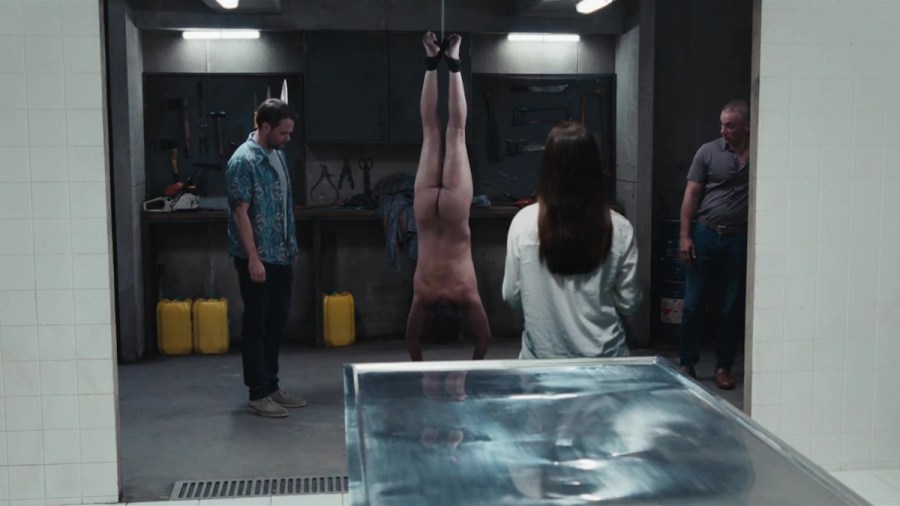
But in this week’s film, Nicholas Tomnay’s What You Wish For, the cannibalism is much more open, particularly for the diners, who are willing to pay big bucks for this, shall we say, unorthodox cuisine. Nicholas Tomnay is an Aussie (like the author of this blog) who works out of Sydney, New York and San Francisco. His first feature film was The Perfect Host (2010) which also included a lot of dining, and What You Wish For follows in this vein, but with a lot of human flesh involved.
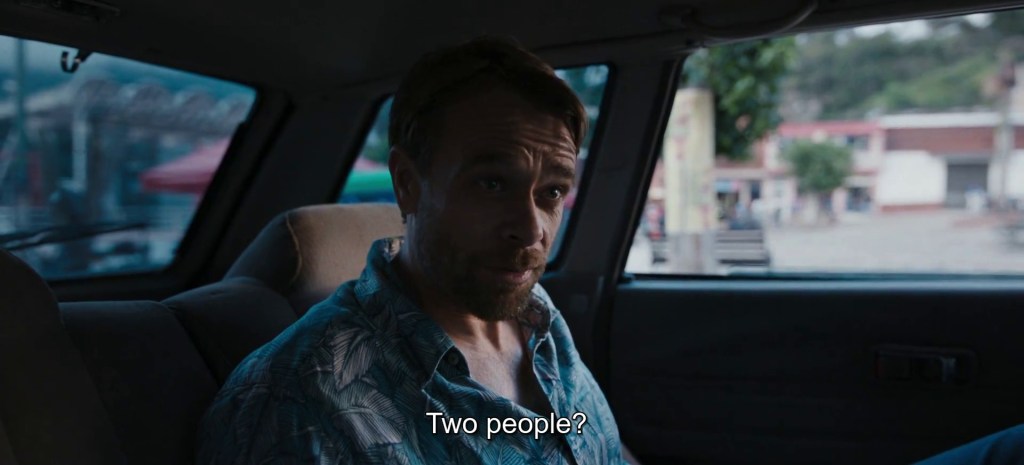
Ryan (Nick Stahl from Man Without a Face) arrives in Colombia (South America) at the invitation of his old friend Jack (Brian Groh). Ryan is on the run from massive gambling debts he has foolishly amassed. Although the debt collectors don’t know where he is, they do know where his mother is, and send him pictures to prove it. He needs lots of money and quickly. His friend Jack seems to have it all – a fancy house where he just has to cook one meal for the agency that contracts him, a fortune in his bank, and big pay cheques delivered after each meal.

But Jack is troubled by conscience, telling Ryan,

“The reward always matches the atrocity”

While Ryan is still coveting Jack’s lifestyle, Jack hangs himself. Recovering from the shock, Ryan realises that all he needs is a fake driver’s licence and a new password to become Jack and access all his money.

But when the agency people arrive – Imogen (Tamsin Topolski) and Maurice (Juan Carlos Messier) – they think he is Jack, and assume he knows what they want him to cook, are angry that he has not yet harvested the meat.

It turns out that his “ingredients” are local poor people, preferably ones who won’t be missed, and Imogen warns him that preparing and serving one bad course will be fatal not just to the person being cooked, but to the chef as well. The guests pay $1.5 million for the meal, including the exotic location, the private jets, and the specially sourced meat. They have special requests too – Imogen tells him “make sure you harvest the tongue.” So any thought of Ryan skipping out before the feast is extremely unpalatable (sorry).

The rationalisation is the same one found in most capitalist enterprises. It is the utilitarian argument in favour of the greatest good for the greatest number. Imogen tells Ryan:

“We kill on average fifty people a year, plus twenty-five in the clean-up. So, 75 deaths a year, and we generate over one hundred million dollars. We funnel 100% of our profits back into the communities. The farming, the infrastructure. We ensure clean drinking water for the entire population. You might say that’s simply self-interest. But we don’t eat everybody. Not even one percent. Now, you tell me what company makes that amount of money, has global presence, assists more than 99% of the people in the communities within which it operates, and their footprint has only ever killed 75 people a year? Oil companies kill on average 110 people a year, farmers are on about 250. Groundskeepers, truck drivers, roofers, they all thrash us in fatalities.”

 The rest of the discussion is phrased in the same vocabulary as used by the meat industries. Old ones will taste disgusting, fear will taint the meat, the butcher will be covered in blood.

The victims are “produce” and become no more or less than “livestock”. Maurice, the agency killer who goes hunting with Jack, assures him “they won’t feel a thing”. When Ryan asks him if he feels bad, the reply is,

“Do you feel sad for a pig when you eat the bacon?”

Jack does what he has to do, after all his attempts to escape or alert the police are foiled.
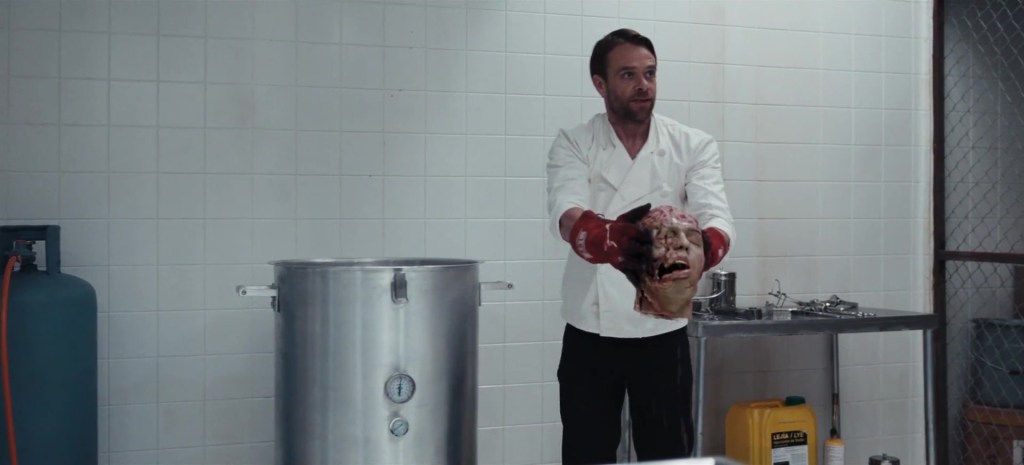
Imogen sympathises with his nagging conscience, telling him what every soldier, assassin, slaughterhouse worker or meat eater is told at first:

“No one likes it at the beginning. But after a while, it does stop bothering you”.

There is a popular meme about “eating the rich”, and even a few movies about it (e.g. Eat the Rich and Eating Raoul). But the facts of nature, humanity and economics are that the rich and powerful get to choose what, and who, they eat. In the film The Cannibal Club, rich Brazilians watch poor people fight to the death and then eat the loser, in Fresh, the protagonist chats up young women then drugs them and sells their flesh and their underwear to the “one percent of the one percent” who want what no one else can have, and can afford to pay for it. Jeffrey Epstein had a similar gig, supplying sex rather than meat.

The people with the power, the rich, eat the poor: they swallow their surplus labour, they squeeze rent from them, they sell them their shoddy products paid for by lending them money at ruinous rates, and they send their children off to war. Why not go the next step and literally cook them for dinner? It’s what we do to other animals, purely because we can.
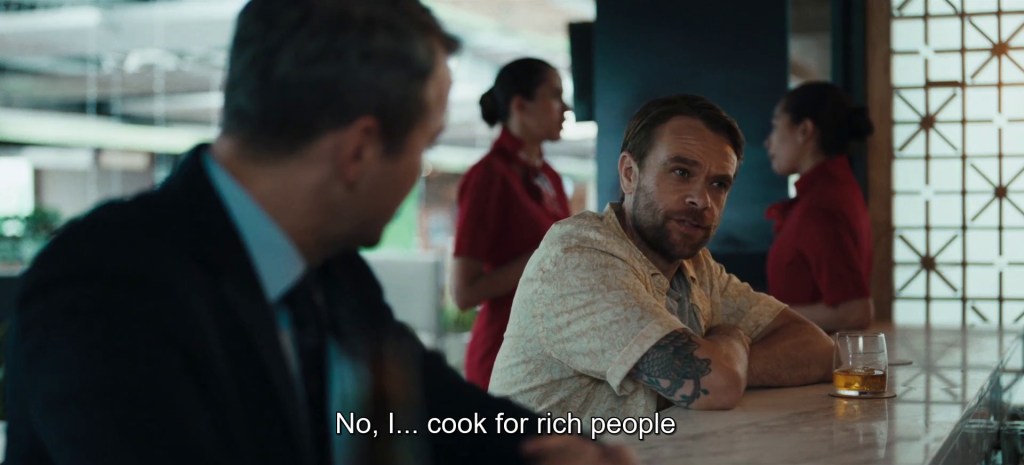
The film is sumptuously presented, the direction is assured and convincing, and the actors are all first rate, including the wealthy guests and the police who pop by and share the main course. The film is rated 80% “Fresh” on Rotten Tomatoes.

One reviewer opined, What You Wish For will convert you to vegetarianism forever”.

Black pudding and anti-cannibalism guards

John Beagles and Graham Ramsay are artists who play with the concept of human exceptionality. They also add a new flavour to the old saying “Art is always a matter of personal taste.”

For two decades, the artists and performers have been making, cooking and sometimes eating black puddings made from their own blood. Ramsay says:

“There is a tang. And it is quite salty too.”

The pair have been collaborating since 1996 and making their “cannibal” sausages since 2004. They call their performance and exhibition a “black pudding self-portrait” or Sanguis Gratia Artis.

John Beagles and Graham Ramsay

They are staging the show again this year. Their meat products are on display in a fridge at the Scottish National Portrait Gallery, and they will be cooking them for a live audience on February 13.

Ramsay, who says he likes a good black pudding, stresses: “We do not usually eat them ourselves, but we have tried them.” He adds that his partner will not be sampling them:

“One of us has quite recently become a vegetarian, and it is not me.”

There are no plans to eat the sausages in Edinburgh. Previous performances have involved some harmless light cannibalism and have attracted some bizarre audiences.

In London back in 2007, Ramsay says, word got out that they would be eating the puddings.

“The performance got a bit of attention in advance; people knew it was happening. So there was a queue of quite gothic people — vampiric characters — outside the gallery and it was a bit weird. There was a kind of feeding frenzy then. As part of the performance, we put slices of the puddings on a silver platter and paraded them through the audience, just to show them, but people started grabbing them. The performance involves us in costume, in the gallery, and we’re basically chopping and frying the pudding, with audience watching.”

The sausages are made with a pint of blood from each man, combined to symbolise nearly thirty years of collaboration.

The process of getting the blood is not easy. They have had to convince nurses to extract small quantities — no more than a syringe at a time — over a long period, and then freeze it. The kind of equipment used by blood transfusion services is tightly controlled, so the artists have to endure sometimes painful extractions, over and over again.

Why do it? Beagles and Ramsay are both respected art academics, teaching at Edinburgh University and Glasgow Art School respectively. Heavily influenced by feminist criticism, they are challenging the old idea of the artist, especially the male artist, as a lone genius separate from the world. They are playing with the idea of self in self-portrait. Their mixed blood represents their joint work.

“We fuse ourselves, but we also use a daft form to present ourselves in. It’s not heroic. We have picked a mundane modest foodstuff to represent us.”

The performance feels different now than it did when they first had their blood extracted. Both men are in their fifties now, and aware of their mortality. “Age starts to creep up on you, waistlines expand, and you become more aware of death and people’s health around you,” Ramsay says.

The artists may not see themselves as heroes, but there is an edginess to their idea, even legally. They debuted their sausages in New York in 2004. Back then there was a lot of angst in America about meat products, mad cow disease and foot and mouth. They had to send their puddings in the post with fake customs descriptions, one batch wrongly labelled as second-hand books.

One the night of their big performance, officials became antsy about health and safety, and security was brought in to stop punters eating the human sausages. Beagles and Ramsay, in a diary of their escapades, called them “anti-cannibalism guards”.

Will they have to find a way to keep their puddings safe from the Edinburgh audience? Perhaps. People are fascinated by cannibalism, even as they claim to be repelled. A few months ago, we reported on a vegan writer and photographer who finally gave in to the demands of his relatives to eat animal products by making meringues from his own blood.

He was not unique in this – remember Gwen van der Zwan, who made blood sausages out of her own blood a few years back. She commented,

“Why is my idea considered disgusting, but doing the same thing with pigs’ blood isn’t?”

Great question, Gwen. Disgusting or not, at least no one died for Van der Zwan’s or Beagles and Ramsay’s sausages.

I did it Meiwes – “THE CANNIBAL NEXT DOOR”

December 1, the date on which I am writing this blog, is the birthday of perhaps the most famous living cannibal, the German named Armin Meiwes. He became famous around the globe when he was arrested in December 2002 for killing and eating a willing volunteer he had met on the Internet in 2001, a man named Bernd-Jürgen Brandes, who had helped sever and cook his own penis before being finished off and filleted by Meiwes. Movies have been made based on the events, from reenactments like Dora’s Cannibal to fantasies like Weisz’s Grimm Love. Songs have been written about him and sensationalised retellings haunt our documentaries, often inexplicably comparing him to Hannibal Lecter.

Meiwes was born in Essen in 1961, and was raised by his stern and controlling mother after his father and half-brother moved out, not unlike the story of Ed Gein, who tried to resurrect his severe and hard-hearted mother by killing and eating the genitals of local women in Plainfield Wisconsin. Armin Meiwes, hopelessly devoted to his late mother as he brooded in his thirty-room house, sometimes dressing in her clothes and impersonating her voice, was not dissimilar to Norman Bates in Hitchcock’s film Psycho, which was based on the Gein murders. Many have tried to pin his later conduct on his childhood feelings of abandonment and helplessness although, if that were the case, we would expect millions of similar cases around the world. Maybe there are, but they don’t get caught?

At any rate, young Meiwes developed a taste for cannibalism (sometimes called vorarephilia) from reading fairy tales, particularly the Grimm Brothers’ Hansel and Gretel, in which abandoned children almost get eaten by a witch. The witch, we might note, was the only adult to show them any affection, even though her ulterior motives were clear, at least to the children who were reading the story. The Grimms wrote their fairy tales near Rotenburg, where Meiwes killed and butchered his friend. You may also remember (at least, Fannibals will) that Hannibal Lecter referred to this fairy-tale when he was serving up dinner to Abel Gideon; Gideon’s own leg, smoked in candy apples and thyme, glazed, and served on a sugar cane quill.

Meiwes fantasy of eating and incorporating a brother culminated in 2001 in him advertising on a fetish website called The Cannibal Café for “a well-built 18 to 30-year-old to be slaughtered and then consumed”. The only reply that seemed sincere, indeed eager, was from Brandes, who was not really well-built or 18-30, but fitted the bill because he was determined to be eaten.

They got together and, after getting to know each other (which included slicing off Brandes’ penis and cooking it), Meiwes left his friend to bleed out in the bath, and then proceeded to butcher his carcass and eat the meat, in a variety of cuts, over several months.

In case there are still a few psychologists and journalists who haven’t yet pontificated on Meiwes and Brandes, this week we consider a 2023 UK Channel 5 documentary called The Cannibal Next Door, directed by Calum Farmer. This is quite a good reenactment of the events, although like many others, it relies too heavily on brooding, portentous music and opinions from experts, all of whom are universally repulsed by the cannibalism, a repulsion that Meiwes and many of his correspondents clearly did not share.  

“It had broken humanity’s last great taboo.”

Trigger warning: the real Meiwes (seeing it’s his birthday): This website claims it has actual leaked stills from Meiwes’ video. If you don’t like pictures of chopped up humans, maybe skip the link. They look fake to me, but this Reddit reader swears they are real.

Meiwes is still in jail in Germany, not for cannibalism, which is still not a crime, but for murder, which is absurd since Brandes wanted to die, and was in fact obsessed with being slaughtered and eaten. If anything, Meiwes is guilty of assisting a suicide. There was no law in Germany against eating a human.

We know so much about the case because Meiwes was very open in describing what happened, even videotaping the whole process of slaughtering and butchering. The jury in his case watched this video, and reportedly turned quite green, but it seems likely that they would have also done so had they been made to watch some of the horror clips of cruelty and killing in abattoirs that are abundant on YouTube. His lawyer argued:

“We say it is neither murder or manslaughter, but killing on demand. My client is not a monster.”

As it was clearly not murder and there was no law against eating a corpse, Meiwes was sentenced for manslaughter and given an 8½ year sentence. Public outrage resulted in a retrial which then found him guilty of murder, on the devious premise that Brandes had been mentally incapacitated by depression, and therefore open for manipulation by his killer. He was sentenced to life, which in Germany requires a minimum of fifteen years imprisonment. Meiwes has already served more than that.

Meiwes believed that he did nothing wrong. It seems that the only thing he can see as a moral failing is not the fact that he ate human meat, but that he ate any meat; he subsequently became an environmentalist and a vegetarian, both of which would obviate eating any flesh, including human. His simple claim in his defence was that, unlike pigs, sheep, cows, chickens and other animals, here was a willing victim who consented to, indeed demanded, his own slaughter and consumption. Is it not clearly more ethical to eat an animal who wants to be eaten, whatever the species, than one who does not?

Accused Nithari cannibal serial killers go free: “THE SLUMDOG CANNIBALS”

The 2006 Nithari serial murders case was alleged to have taken place in the house of businessman Moninder Singh Pandher in Noida near Nithari village, Uttar Pradesh, India between 2005 and 2006. Moninder Singh was convicted in two out of the five cases against him, while his servant Surinder Koli, accused of assisting him or possibly instigating the killings, was convicted in 10 out of the 16 cases against him.

Koli admitted to killing six children and a 20-year-old woman referred to as “Payal” after sexually assaulting them. He later confessed to eating their livers and other parts of their bodies. Both men were sentenced to death, Koli ten times, but eventually, in October 2023, after some 2,000 hearings, Allahabad High Court acquitted them both, citing lack of evidence.

Despite being from a family of Hindu vegetarians, Koli was from the Dalit, the Untouchable caste, who are considered subhuman by much of society, marginalised, excluded, with their human rights routinely violated. They survive by doing the jobs no one else wants. From 14, Koli worked as a butcher’s assistant, learning to slaughter and dismember large mammals, which seems to have been a useful skill later in his life. He apparently developed a taste for meat at this time.

In 2005, Koli became a servant to Pandher, where he witnessed some pretty lively parties involving Pandher’s friends and visiting sex workers. In March that year, a little girl went missing in Nithari, and a couple of weeks later it happened again. Between 2005-06, a child went missing in Nithari every six weeks on average.

Police told parents they had probably run away (although the youngest was three years old) and would return by themselves. Frustrated by police inaction, parents and local residents in December 2006 organised the excavation of the reeking drains behind Pandher’s house where they found bags of bones, which proved to the hands and legs of small children. Skulls were found on the other side of the house. Police arrested the two men, and found some of the children’s belongings in the house. Police put the number of child victims at more than 31. Locals rioted outside the house, claiming that the police were corrupt and had concealed evidence of crimes involving rich people; the father of one girl alleged that the police had threatened and harassed him.

They demanded that the local police force be replaced by the Federal Government agency, the Central Bureau of Investigation. In 2007, six police were suspended for incompetence and the CBI filed sixteen cases against the two men involving abduction, rape, murder, criminal conspiracy and trafficking.

The CBI investigated the case, which by now was surrounded by accusations that tried to explain the disappearances – an organ transplant racket, or a child pornography ring. Pandher’s laptop was found to contain images of naked children, but they turned out to be his grandchildren. The logistics of harvesting and selling organs of small children turned out to be almost certainly insurmountable. Extensive psychological evaluations found that Koli was obsessed with young girls aged 5-7, while Pandher had a thing for 18-19 year old sex workers (one victim was twenty, the rest were children). Koli admitted on tape to luring the little girls into the house, strangling them and having sex with them before killing them, then cutting up their corpses and eating body parts. The way he dismembered them was similar to what he would have learned as a butcher’s assistant when he was a teenager. Yet investigators found that he had behaved entirely normally with his own children back in his home village, where his wife and family lived.

On 12 February 2009, both the accused—Moninder Singh Pandher and his domestic servant Surinder Koli—were found guilty of the 8 February 2005 murder of Rimpa Haldar, 14, by a special sessions court in Ghaziabad. This verdict embarrassed the CBI, as they had earlier given a clean bill of health to Pandher in all their charge-sheets. Both were given the death sentence. Other victims were identified, including:

  • On 4 May 2010, Koli was found guilty of the 25 October 2006 murder of Arti Prasad, 7, and given a second death sentence eight days later.
  • On 27 September 2010, Koli was found guilty of the 10 April 2006 murder of Rachna Lal, 9, and given a third death sentence the following day.
  • On 22 December 2010, Koli was found guilty of the June 2006 murder of Deepali Sarkar, 12, and given a fourth death sentence.
  • On 24 December 2012, Koli was found guilty of the 4 June 2005 murder of Chhoti Kavita, 5, and given a fifth death sentence.

On 16 October 2023, 17 years after the crimes first came to light, Koli and Pandher were acquitted of all charges against them due to insufficient and largely circumstantial evidence, despite the recorded confessions of Koli. The parents were naturally shattered.

It seems likely that between the animalisation of lower caste humans and the sacralisation of certain species of cattle in India, some people are unable to discern any line between humans (except for their kin) and other large mammals.

“Moninder used to have call-girls coming home all the time. Seeing them, I wanted to have sex as well. Slowly, these feelings turned into my wanting to murder and eat them. A girl from Sector 30 called Dimple was passing in front of the house. I called her inside. I then strangled her with her chunni. When she was unconscious, I tried to have sex with her but failed. So I killed her. I wanted to eat her. So I took her body into the bathroom upstairs. I got a knife from the kitchen and cut her body into little pieces. I then cooked a piece of her arm and chest and ate it.”

Koli later denied any involvement in the murders, saying that the CBI made him “remember” names and details to frame him, as they were protecting rich men who were raping and killing girls and selling their organs (a high-tech form of cannibalism). Pandher is now free; Koli remains in jail. The victims’ families continue suffering, even as some of them were given houses and cash settlements. When money talks, nothing and no one is off the menu.

The BBC released a documentary on the case called The Slumdog Cannibal in 2012. This was after the initial trials, but before the several appeals. The documentary, which concentrates on the background and motivations of Surinder Koli, can be watched (at the time of writing) on YouTube.

Vegan eats his own blood as a meringue

I don’t usually put warnings about graphic images in my blogs; I figure if you are reading a blog called “thecannibalguy.com” that you are probably not expecting unicorns and fairies. But this short clip has its own trigger warning, so I’ll just reproduce it here.

Vegans are often told by caring or sanctimonious friends and relatives that they need animal protein or they will get sick and die. This can be a bit wearisome, particularly for long-term vegans. Now here’s a novel solution.

Jamie Lee Curtis Taete (I wonder who his parents’ favourite film star was?) has been vegan or vegetarian for almost 20 years (and clearly has not died yet). After years of carnivorous peer-pressure, he’s decided to consume animal products from what he calls the only truly ethical source: himself.

Jamie seeks advice from “Blood for Food” activist, Laura Schälchli, about her recipes, which are made with blood from other animals. He follows her recipe for blood meringues, substituting his own blood for whatever unfortunate animal is usually slaughtered and bled.

And eats the results.

He starts by whisking the blood, because blood tends to clot, which even he describes as “disgusting”. But,

“I find the thought of it less gross than if I were eating the blood of an animal.”

Jamie is perhaps using shorthand, or forgetting that we are all animals?

The protein albumin comprises about fifty percent of human blood plasma, and is similar to egg whites, so the obvious choice for Jamie was to make a meringue, which is usually made from the whites of chicken eggs or, far less often, in the recipe he has chosen, the blood of goats or cows.

“I was expecting a sugary bowl of gore, but this looks like it could be real food.”

So look, autocannibalism is not an appetising prospect, but most vegans would say the same about dishes made from the organs, muscles or blood of an animal who was unwillingly slaughtered for the purpose.

 “I think I probably enjoyed this more than if I had made it using animal blood, because there was no death involved. I am really the only ethical source of animal products, because I can give my consent to myself in a way that a sheep can’t.”

Here are some of the comments from YouTube:

Some suggested that Jamie would end up a cannibal, a common thread through the literature – if you eat human flesh (or blood I guess), you will become addicted, because we are somehow irresistible. It is absolute nonsense of course. Others felt like it had made the point: eating any animal product, including from the ape known as Homo sapiens, is a bit disgusting. I have seen people flinch as they pull a piece of meat out of the fridge and pour out the blood that pools under it.

As Jamie says, if you must eat animal protein, use the nearest animal, and the only one that is able to consent, although the occasional cannibal like Armin Meiwes manages to find a willing third party to sate his cannibalistic desires. Remember the scene from The Restaurant at the End of the Universe, when the “dish of the day” offers them his shoulder to eat, braised in a little white wine sauce, saying “naturally mine, sir, nobody else’s in mine to offer!”

Jamie is not unique in this – remember Gwen van der Zwan, who made blood sausages out of her own blood, commenting, “Why is my idea considered disgusting, but doing the same thing with pigs’ blood isn’t?”

Jamie has the final summation, commenting perhaps on the flesh and blood of himself, and every other sentient being:

“It’s like eating a little baked nightmare.”

“I did it… Meiwes!” CANNIBAL (Marian Dora, 2006)

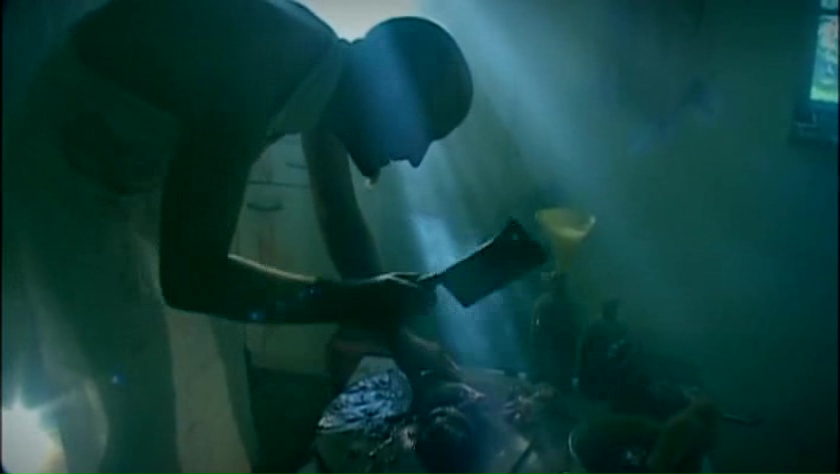
Cannibal was the directorial debut of the German director Marian Dora in 2006, and is basically a re-enactment of the famous case of Armin Meiwes (pronounced like the Sinatra song “I did it my way”), the so-called ‘Rotenburg Cannibal’. Meiwes was a German computer technician who was into “vorarephilia” (sexual attraction to eating, or being eaten by, another). He advertised on the Internet for a man who was willing to be killed and eaten, and ended up doing both of those things to an engineer named Bernd Jürgen Brandes whose greatest desire was to be eaten. Unlike most crime re-enactments, this one was easy to research, because Meiwes videotaped most of the killing, butchering and eating of Brandes. We’ve met Meiwes in a couple of earlier blogs: in Grimm Love an American researcher (Keri Russell) searches for the videotape and then freaks out when she gets hold of it. The documentary Copycat Killer covered the famous case with lots of dramatic music and comparisons to Hannibal Lecter, which was absurd. The Australian comedy Rake also did a great simplified version of it with the wonderful Hugo Weaving as both an economics professor and a cannibal (which is more terrifying?).

Marian Dora is a pseudonym used by a film-maker whose real name is shrouded in mystery. Probably for good reason – his first two releases were included in anthologies of short films named Blue Snuff 1 and Blue Snuff 2, the latter of which was withdrawn due to its extremely graphic content. He then went on to work with Ulli Lommel on a number of crime/slasher films.

This film was assigned to Dora by Lommel, but proved too rich for Lommel’s taste, and Dora ended up releasing it himself, direct to video. Really? Too rich for Ulli Lommel, whose grisly bio of Fritz Haarmann we reviewed earlier this year? Well, that’s promising. Lommel went on to make his own version of the Meiwes story, with the protagonist changed to female for some reason. This was also called Cannibal at first, then changed to Diary of a Cannibal, and has graced the “Bottom 100” lists of Yahoo and IMDB ever since. We… might get to it one day. Maybe.

Meiwes and Brandes are not named in this film – the eater is just called “The Man” and the eaten “The Flesh”. There is very little dialogue, except for the Man’s mother reading him Hansel and Gretel at the beginning (when he was presumably called the Boy), presumably turning him into a cannibal (didn’t that happen to everyone who read the Brothers Grimm?)

We then Get To See A Selection Of The Man’s preferred reading matter: cannibal art by Hieronymus Bosch and Hans Staden, books on Jeffrey Dahmer, and some interesting texts on anatomy and butchering, which he will find handy later.

We see the Man having a series of meetings with a bunch of guys (and one woman) he has contacted on internet chats, all of whom turn out to be not that serious about going through with the whole, you know, kill me and eat me thing. The woman might have been ready, but he writes, “Women are too important for the survival of mankind.” Pretty much how the dairy and egg industries operate, when they sex the calves and chicks and immediately kill the males.

He even meets up with a couple of kids, not presumably through the web, but seems to prefer his meat aged and consensual.

The Man finally meets the Flesh, who introduces himself,

“I’m your flesh”

But then adds:

“I don’t want to suffer”

Yeah, no probs, mate; the Man stops on the way home from picking up the Flesh at the railway station to buy some schnapps and some cough medicine.

Then after a game of petanque and some sweaty sex, the Flesh won’t feel a thing. Hmmm.

“You’ll become a part of me”

Seems to me to be a bit of a misunderstanding of how the alimentary system works. However.

Once they enter the house, the movie becomes very dark. Literally – one of those movies where it’s hard to see what the hell is going on. They’re going to have sex, one of them is going to eat the other, but first, a nice cuppa tea.

There’s a lot of plinky-plonky music and sex scenes which drag on interminably, and end with the Flesh anally penetrating the Man. No one was expecting that. Isn’t cannibalism supposed to be about dominance? It’s an interesting conflict. They curl up on the floor together and, when they awake, the Flesh demands the Man bite off his penis. My thoughts immediately went to Monty Python (“ergh! With a gammy leg?”) at the thought of biting his penis after anal sex; but hey, call me old fashioned. Anyway, the Flesh is not called the Teeth or even Jaws, and can’t do more than draw blood, a kind of ineffective circumcision, and the Flesh growls:

“You are too weak!”

Freud would have had an orgasm of his own at this point – we have power, guilt and of course male fears which, he said, were based around the act of castration, usually due to the fear of the father’s anger at the boy’s Oedipal desires. But this man is too weak to eat him! Perhaps because he needs to eat. They need to merge before they can merge. It’s another challenge. But as Freud said, the cannibal “only devours people of whom he is fond”, which is why, according to Brigid Brophy, Christians eat God to affirm the love of the Father. The Man is seeking the transubstantiation of the Flesh.

So anyway, the Man does what any man does when his lover is disappointed – runs for the cough medicine; let’s knock him out! But then they both fall asleep, seeming to decide that this wasn’t such a hot idea. When they wake, it seems like it’s all over, but they are a stubborn pair – a splash of water on his face and the Flesh is ready and raring to get ate. This time they pick up prescription sleeping tablets at the pharmacy – Stilnox, very popular among Australian athletes apparently, and the Flesh washes it down with a bottle of brandy.

“Castrate me, then kill me. Do it now.”

The Man sets up the video (and this is all pretty much as it happened – Meiwes did videotape the whole procedure, which helped the police considerably during the court case). He puts on a record of church music, and fetches a knife. We get to see a lengthy scene of Bobbitting (hint – don’t try amateur anaesthesia at home: the cough medicine and booze don’t work very well).

He fries the severed cock up with some garlic (yep, all true to the actual case) but they find it tough and inedible. They spit it out (in the real case they fed it to Meiwes’ dog, but the sensible dogs of Germany refused to sign up for this movie).

Then the rest of the film is the killing of the Flesh and the preparation of his flesh. The Man puts the Flesh in the bathtub to bleed out, and reads a Jerry Cotton book while he waits. This is an outrageous fictionalisation – Meiwes in fact read a Star Trek novel. Ah well, poetic licence.

When the Flesh refuses to die by the time the Man finishes his book, the Man drags him out of the bath, vomiting, urinating and defecating, and lays him out in the Schlachthof he has set up, arms outstretched like the Broken Christ, then cuts his throat.

The final twenty minutes or so of this film (if anyone is still watching) is clinical – a masterclass in butchery. The Flesh is strung up by his feet and the Man disembowels him in great detail, vomiting as he does so. The Flesh, already dehumanised, is now deanimalised too; he is simply a carcass being prepared for the meat chiller.

I loved this review from Letterboxd which complains that the movie describes:

“how a cannibal prepares his food, everything is in detail and the scene came exactly when I was going to have my breakfast fuck me it’s like the movie knew when I’m going to eat my food, this has happened quite a few times with me now and its getting creepy 😂”

Scott Weinberg of DVD Talk wrote,

“One of the sickest and freakiest movies ever to come from a nation well-known for its freaky and sick movies (Germany)”

To me, the butchery was not the most abject part of the film; it was the sort of thing you might see in an instructional video for abattoir workers, except not with the usual species of victim. The defecation and vomiting were harder to take, but I guess that is subjective. All in all, most people will find something to disgust them in this film, and perhaps that was the point. It’s disgusting, but it’s not that different to what we get minimum-pay workers in slaughterhouses to do eight hours a day to some seventy billion animals every year. Unless the special effects budget was huge (not obvious from the rest of the film), a real animal was gutted and chopped up to make this film, which is actually the sickest part of it.

The butchery is shown in loving detail and for extended time. It lets us experience what it would be like to do that (I’m guessing most of us have not butchered an animal, human or otherwise). Being his first time, the Man keeps stopping to either snack on some flesh or to remorsefully throw up; pretty sure neither would be encouraged in the industrial meat corporation.

For a real slaughterhouse worker, wielding the cleaver would be sickening the first time, then boring for the hours thereafter. We see the Flesh reduced to just meat cuts. As King Lear said, when stripped of civilisation:

“unaccommodated man is no more but such a poor, bare, fork’d animal”

If you don’t want to watch the whole thing, there is an excellent and hilarious summary by Mike Bracken “The Horror Geek” which had me laughing out loud several times, despite the content.

At the end of the film, the Man has a nice Flesh dinner (the Flesh is present at the table, short of one body), then jerks off to his home movie, and next morning is all scrubbed up, in a nice suit, and trotting off to meet his potential next sacrifice. In fact, Meiwes was eventually caught because he advertised for another victim a few months later, when he started running out of Brandes. Meiwes is still in jail in Germany, and is now apparently a vegetarian.

As I said, we know very little about the director, except that Dora is not his real name, and that he is vegetarian and works as a physician. After watching this movie, you’ll understand why he wants to remain anonymous. Perhaps also why he’s a vegetarian.

50 ways to eat your lover: GRIMM LOVE (Martin Weisz, 2006)

You may remember Armin Meiwes (pronounced like the Sinatra song “I did it Meiwes”). Meiwes was a German computer technician who was into “vorephilia” (sexual attraction to eating, or being eaten by, another human). He advertised in 2001 on a fetish website called The Cannibal Café for “a well-built 18 to 30-year-old to be slaughtered and then consumed”. The only reply that seemed sincere was from a man named Jürgen Brandes, who was not really well-built or 18-30, but hey, eaters can’t be choosers.

The real Brandes and Meiwes

The Meiwes case was covered in somewhat sensational terms (they kept comparing him to Hannibal Lecter, which was patently absurd) in this copycat killers documentary. It was also retold in a more light-hearted way in the first episode of the Australian television show Rake.

This film is not a documentary but a fictional retelling of Meiwes’ story, with the names changed, to protect whom – the non-existent?  

The movie seems to need a narrator, so it makes up a fictional PhD student, Katie Armstrong (Keri Russell, who was also a student in Felicity, but a Russian spy in The Americans).

Katie is an American studying criminal psychology, who finds herself inexplicably drawn to an uncanny murder case for her thesis. Why would someone study cannibalism for a PhD thesis (I ask myself that every time I apply for an extension to my submission date). Well, Katie feels that she is “searching for something to fill that dark hole inside of her”. Same – but I use chips (“fries” for my American readers). She wants (and dreams of) “someone who can see inside of you”. Yes, cannibals can surely do that.

Anyway, Katie chooses to research the notorious German cannibal Oliver Hartwin (based on Meiwes) and his dead lover Simon Grombeck (based on Brandes), who had volunteered to let Oliver murder and eat him, an obsession that haunted him his whole life.

“Oliver Hartwin wanted to eat someone. Simon Grombeck wanted to be eaten. They were a perfect match.”

Katie becomes obsessed with the case. Sitting in the lecture theatre, the professor announces that “many cannibals have been diagnosed with schizophrenia” – but the sanity defence is too glib for her. “Why them and not us?” she wonders to her friends.

“It’s natural to wonder what separates us from them. What matters is what makes us the same.”

She studies the men’s childhoods: Simon was smitten by guilt about his mother’s suicide after she was told he was “playing doctor” with another boy. Oliver was left with an overbearing mother when the father moved out, then bullied at school and finding solace in an imaginary friend ‘Franky’. Katie goes to find Oliver’s house in Rotenburg, which is not far from where the Brothers Grimm wrote those tales that filled our childhood nightmares with monsters and cannibals. She finds and breaks in to Oliver’s house, taking endless photos, but each click is interspersed with flashbacks of Oliver with his mother and with Franky; Simon with his boyfriend and computer full of images of death, and requests to male prostitutes to “bite my thing! Bite it off!” (spoiler: it can’t be done). Are these actual flashbacks or Katie’s fantasies and rationalisations? It doesn’t really matter, because the sequence of email exchanges and the steps leading up to the slaughter are all well documented in the case of Meiwes and reproduced here.

Katie wants to understand Oliver.

“Was he so afraid to be alone? Was it his need to feel whole that drove him? Or was it just his desire for flesh, to devour something dear.”

Oliver makes a figure of a man out of something – maybe pork? He cuts off the penis and eats it voraciously, and feeds the rest to his work colleagues.

When one asks for the recipe, he smiles and says “It’s a family secret”. I was immediately reminded of Hannibal Lecter replying to the same request: “If I tell you, I’m afraid you won’t even try it”.

We see Oliver and Simon meet on the website “Cannibal Cantina”. Simon is searching for someone to butcher him.  Oliver is looking for instructions on how to butcher a human, such as:

“a cage to prevent the human animal from too much movement, which only serves to lessen the quality of the meat… For best results prior to slaughter, the animal should be stunned senseless.”

We see them at a table, Simon refusing food, but drinking water to flush his system, and swallowing pills to achieve the stun.

He drinks cough medicine (BREToN, which according to Google is Tulobuterol Hydrochloride and is for “asthma exacerbation”, although the website does rather hilariously say:

Breton Syrup may also be used for purposes not listed here”

Two bottles of that, a fistful of sleeping tablets washed down with a bottle of schnapps, and Simon is good to go. But can Oliver do it?

Well, of course he can, as Katie finds out when she contacts a cannibal website and requests a copy of Oliver’s video, which she thought was only in the hands of the police. We see the slaughter, we see Katie weeping and whimpering as she watches.

She’s been studying this case for her PhD, which takes three years (plus extensions). What did she expect?

The assumption behind movies like this is that cannibalism is disgusting, monstrous behaviour, and so we need to find explanations. But when Oliver as a child watches a woman slicing up a pig, do we ask about her pathologies?

No, we assume she is doing something normal, and Oliver has been warped into doing the same to a human. Look up slaughterhouses on Youtube and you’ll see the same thing happening, and it happens some 70 billion times a year. Just – to other animals.

But what is so sacred about humans that the deliberate killing of a pig, who wanted to live, is just ‘butchering’, while assisting Simon to fulfil his fondest wishes – to commit suicide and be eaten – is monstrous? Is it just a throwback to the old belief about being “made in the image of God”? Feel free to let me know.

When Meiwes (Oliver) started to run out of meat, he couldn’t bring himself to shop at the supermarket, so he advertised for another willing victim. But this one called the cops.

The film was supposed to be released in Germany under the name Rohtenburg, a pun on Rotenburg, where Meiwes lived, and roh, meaning “raw”. However, it was banned by a German court in March 2006 for infringing the personal rights of Armin Meiwes. It was released throughout the rest of the world, but not in Germany until three years later.

The film achieved only 37% on Rotten Tomatoes. It is very slow moving, the sombre music gets a bit annoying (the Craig Armstrong piece from Romeo and Juliet is beautiful, but Romeo and Juliet is not really a cannibal story – Titus Andronicus might have worked better), and the fact that everyone in Germany speaks to everyone else in perfect English but with German accents (including train announcements) gets irritating. Why can’t audiences read subtitles?

Trigger warning, the real Meiwes: This website claims it has actual leaked stills from Meiwes’ video. If you don’t like pictures of chopped up humans, maybe skip the link. They look fake to me, but this Reddit reader swears they are real.

Meiwes is still in jail in Germany, not for cannibalism, which is still not a crime, but for murder, which is pretty absurd since Brandes wanted to die, and was in fact obsessed with being slaughtered and eaten. If anything, Meiwes is guilty of assisting a suicide. We know so much about the case because Meiwes was very open in describing what happened. He believed, and still believes, that he did nothing wrong. It seems that the only thing Meiwes can see as a moral failing is not the fact that he ate human meat, but that he ate meat. He is now a Greenie and a vegetarian:

Bavaria Radio reported that another inmate said Meiwes has sworn off meat in his new role as an environmentalist. “He finds the idea of factory farming as distasteful as his crime was,” said the convict. “He now sticks to vegetarian dishes.”

You can watch the Director’s commentary here, and a documentary about the real case here.

Complete listing of my Hannibal blogs can be found at this link.