Awarded PhD from the University of Melbourne for a thesis questioning how cultural manifestations of cannibalism challenge the assumed anthropocentrism of our relationships to other animals.
In a recent episode of Penn Badgley's podcast, Ariana Grande said that Jeffrey Dahmer would be her dream dinner guest: "I think I would have loved to meet him."https://t.co/zfvrJCRxAj
Ariana Grande managed to raise some serious eyebrows when she was asked on Penn Badgley’s podcast in June 2024 whom she would most like to have dinner with. She replied:
“Jeffrey Dahmer’s pretty fascinating. I really wish I could have met him.”
The mother of Tony Hughes, one of the men Jeffrey Dahmer murdered, criticised Grande last week, calling the singer “sick in her mind.” Tony’s sister, Barbara, told TMZ that she hopes Grande will apologise for her comments, and both shared disappointment in the singer’s apparent lack of empathy for the victims’ families. “Unfortunately, until it happens to her and her family, she just doesn’t know what we have been through,” Barbara said.
Jeffrey Dahmer murdered seventeen boys and young men between 1978 and 1991, mainly people of colour, and after his arrest spoke freely about consuming body parts from some of them.
According to Grande, her fascination with Dahmer began “years ago before the [Netflix] Dahmer series,” and she had mentioned it to young fans when she was a Nickelodeon star.
In the podcast, Grande suggested she would like to meet Dahmer, but “maybe with a third party or someone involved. I have questions,” she added.
Grande is a big deal in the world of celebs. She had reportedly sold over 85 million records and accrued 98 billion streams (so far), making her one of the most-streamed artists of all time. She was the most-streamed female act of the 2010s and has the second most songs with over a billion streams for a woman. Grande also has a massive social media following; with over 380 million followers, she is the sixth-most-followed individual on Instagram and one of the most-subscribed and most followed musicians on YouTube and Spotify.
I guess that keeps her busy, because honestly there is so much Dahmerabilia on the web that having dinner with him would be unnecessary (and messy, since he had his head caved in by another prisoner in 1994). Ryan Murphy made a hugely popular re-enactment of the case for Netflix in 2022, although it had been done before and rather well by Jeremy Renner (playing Dahmer) in a movie made by David Jacobson in 2002. Then there are the tape recordings – his defence team released their tapes of interviews with him a few weeks after the Ryan Murphy doco went to air. In 2023, Dahmer’s dad released his own interview tapes together with home movies etc, on Fox Nation. In prison, before his death, Dahmer was open and transparent about his activities with a range of interviewers. Not sure how much was left to uncover over a nice dinner of fava beans and a big Amaroni?
Some of the news reports have rather pompously asked if her preference for a cannibal for dinner means that she is therefore a cannibal herself? Well sorry guys, but we happen to know that Ariana is a vegan, and has been since watching the documentary Forks Over Knives in 2013. Ariana told a UK paper:
“I love animals more than I love most people, not kidding.”
She insists that (besides being kinder to animals and better for the environment) going vegan has improved her health immensely.
“The way I’m eating now has actually helped even out my blood sugar. As some of you guys may know, I’ve struggled with awful hypoglycemia for my whole life and it’s improved a ton since I changed my eating habits.”
Would Ariana eat a human at her dinner with Dahmer? About as likely as her eating a cow or a pig!
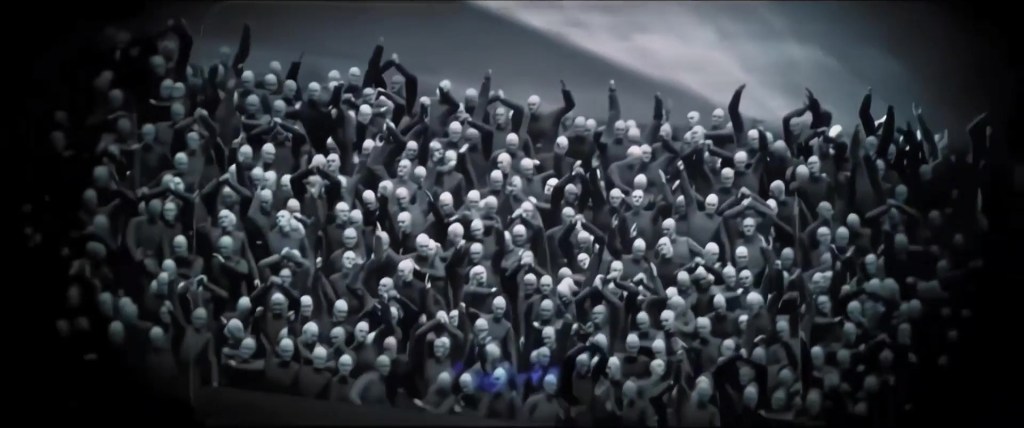
Are the Harkonnens cannibals In Dune 2? Not exactly, but the harem of women maintained by Feyd-Rautha do eat people. Sadly, the film is surprisingly coy about it.
Canadian director Denis Villeneuve’s film Dune: Part Two was the second-biggest earner of (at least the first half of) 2024, taking in $711 million so far worldwide. It is a direct continuation of 2021’s Dune, and if you haven’t seen that yet, I suspect this one will make little sense, unless you’ve read Frank Herbert’s 1965 novel on which both are based.
Dune established a historical mythology set eight thousand years in the future, in which an interstellar alliance is ruled by ‘Great Houses’ who are nominally beholden to the Emperor (played by Christopher Walken), but are often at war with him or each other. Human civilisation has abandoned computers (fear of AI) and must use Melange or “Spice”, a highly addictive hallucinogen, to enable pilots to navigate through “folded space”. The Spice comes from a planet called Arrakis, which is therefore much in demand by imperial powers.
In the first movie, the Atreides were made rulers of the planet, but then were invaded and butchered by the wonderfully evil House of Harkonnen. However, the Atreides heir Paul Atreides (Timothée Chalamet, who is not unacquainted with cannibal movies) and his mother escape the destruction and join the local desert people, the Fremen. These guys are tough nuts, able to bring down even the Emperor’s most vicious special forces, and they ride around the planet on “worms” – huge underground creatures that can swallow anyone and anything they find. The worms are attracted by anything that is making regular sounds. Oh, and they produce the spice as their shit.
Dune 2 delves deeper into the culture of the House of Harkonnen, who believe they have killed off all the Atreides. Like the simplest monsters, they are portrayed as ruthless and devoid of morality, and most are more than a little psychotic.
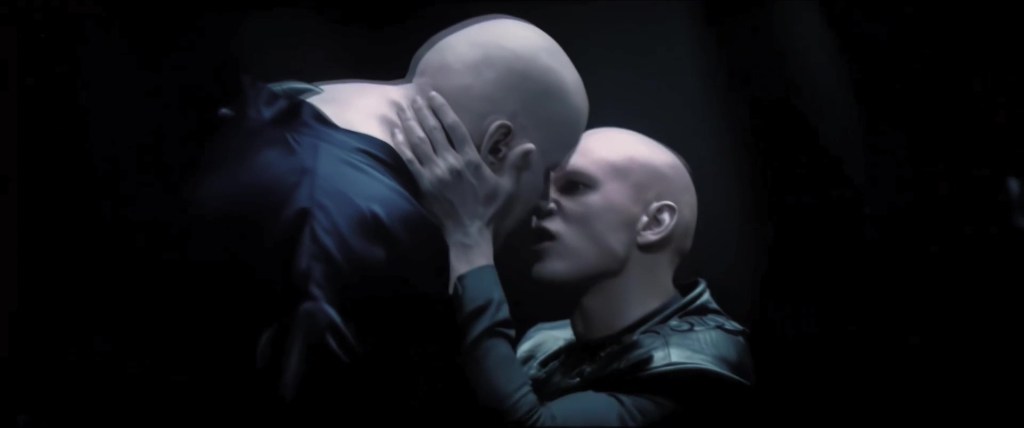
They are all bald for some reason, but their main motivations are cruelty and torture. Particularly the nephew of Baron Harkonnen (Stellan Skarsgård), Feyd-Rautha (Austin Butler, but nothing like Elvis in this movie), who keeps the harem of hungry cannibal women.
The Harkonnens kill capriciously and indulge in brutal pleasures, like making slaves fight to the death in the arena; they are hundredth century Roman emperors. We learn that Feyd-Rautha murdered his mother and now is the favourite of his uncle, the Baron. The ‘uncle and nephew’ thing is honestly a bit of a worn homophobic trope.
But the bit that interests us about him (in this cannibalism blog) is his harem of cannibalistic women. The film is a critique (intentionally or not) of white colonialism (particularly the evil Harkonnens, but also the Atreides and the Emperor) and the way it controls its subjects through the mythology of religion, in this case, messianic tales spread by an exclusive sisterhood called the Bene Gesserit, who use mind control techniques to persuade the colonised (the fierce, warrior race of Fremen) that their leader is coming, a white saviour from beyond their world. Paul does not believe any of this, but he lets his fundamentalist supporters fall for it.
Cannibalism has long been used as an ideological tool both by colonists (the savages accused of being subhuman cannibals like the Troglodytes in Bone Tomahawk) and the colonised, who see the invaders as predators appropriating the land, resources and bodies of the native peoples. Disappointingly, considering the pains the director goes to paint the Harkonnens as irredeemable psychopaths, we never understand them to be indulging in human flesh themselves, although it would have been an ideal metaphor for the way they rape and pillage the planets they control. Maybe Villeneuve felt the ghost of Frank Herbert would come and haunt him.
Feyd-Rautha seems to keep his women more like pets than concubines, calling them his “darlings” and killing various unfortunate slaves to feed them, as well as a flunky on the starship because, you know, they hadn’t been fed on the voyage.
Frank Herbert’s treatment of his characters was rather more nuanced in the books, in which he did not include any cannibalism, sadly. The inclusion of Feyd-Rautha’s harem of cannibals in Dune: Part Two seems a bit of an afterthought, or perhaps the script writers had some grand ideas which ended up being cut. They appear in one scene and for a few seconds, with no backstory. The end result is that the cannibals seem to be there just to enhance our perception of the dynasty’s barbarity.
Despite the rather superficial appearance of cannibal women, there is plenty here to entertain students of anthropocentrism; questions about what it is to be human, to be animal, to be civilised. The animal symbolism is everywhere; the worms, for example, are representations of nature—indifferent, insentient predators of immeasurable power who can, however, be tamed by humans, although their exploitation remains perilous. The bad guys with their bald heads and degenerate ways are depicted in animal forms—the Baron is bloated and presented as porcine, bathing in mud for much of the film, while Feyd-Rautha is reptilian—smooth, slimy and lethal.
The cannibal women are somewhere between aliens from X-Files and characters from pre-woke films like Freaks. Are they human? We never find out.
The film scores 92% fresh on the tomatometer, meaning most critics loved it. The visual effects are spectacular and should really be seen on the big screen, the acting ranges from brilliant to adequate, the battles are spectacular, and Hans Zimmer couldn’t write a bad score if he was paid to do so. But the trivialisation of the cannibalism left me hungry for more.
There are tendencies, dispositions, that characterise each era, each year, sometimes each day. Call them spiritus mundi or the zeitgeist, they appear to us in the media of the time – never more so than now, when we can express instant expression and instant outrage on social media. The current trend seems to be about oppressive elites who are manipulating, enslaving, sometimes consuming us. On the ‘right’ this is sometimes expressed as “the Deep State”, on the ‘left’ it is variously called capitalist exploitation or racist colonialism.
A story that has been doing the rounds for a decade has recently gone (a bit) viral again this month after a podcast called Mexico Unexplained revisited the story of Gabriela Rico Jiménez, a 21-year-old model from Mexico who disappeared some 15 years ago after raging against the machine outside a fancy hotel in Monterrey Nuevo Leon. Jiménez is usually described as a “supermodel” although there is little evidence of that in Google searches. But then again, if she has been “disappeared” by the elites against whom she railed, then they would have made sure to delete her history as well, n’est pas? The Daily Mail rediscovered the story on June 1 2024 and brought it back to life:
Anyhow, she made some interesting if somewhat mystifying accusations:
“I wanted my freedom. Monterrey freed me but it cost me a lot of work. I was in Mexico City for a year and four months. All this began in mid-2001. I barely remember. They were young and powerful, and they killed them. I’ve been knocking on doors. What I wanted was my freedom. I want my freedom. Carlos Slim knew about this. I want my freedom. It hurts my soul that they took him away.”
Carlos Slim at that time was apparently the richest man in Mexico or maybe the world, controlling América Móvil, Latin America’s biggest mobile telecom firm, so it’s not too surprising that her rant was shut down pretty quick, and she was carted off, presumably to a mental asylum, wherein she perhaps still rots, unless she has been cured, killed, or eaten.
As the police (or stooges of the elites if you prefer) began to move in, she screamed,
“You! You were there! … You killed Mouriño! They told me who did they kill? The Queen of England? The Queen of Germany? Did they kill the princesses and Mickey Mouse? It was also him! What? Nothing is going to come here. The people where you come from are crazy! They killed a lot of people. Death to that kind of human! Go away! They ate humans! Disgusting! They ate humans! I wasn’t aware of anything. Of the murders, yes, but they ate humans! Humans! They smell like human flesh!”
Now, Germany does not have a Queen, nor is Mickey Mouse a real live mortal being (sorry for the spoiler, kids). Were other royals and plutocrats engaged in cannibalism? Unfortunately, the sudden disappearance of Ms Jiménez makes it difficult to work out what she was alleging, let alone the truth of such claims. But conspiracy theories love angry rants and disappearing complainants, and so a (smallish) cult has followed Jiménez, particularly after an anonymous person on a blog called “The Black Manik” claimed to have spoken to Jimenez and witnessed the incident, until he was pulled away by “some tall, well-dressed people”. Accusations fly thick and fast about elites and their alleged members, some of whom are occasionally accused of being rich cannibals.
Despite the best efforts of the Daily Mail, no further sightings of Gabriela Rico Jiménez have been reported.
The narrative of cannibalism to describe class warfare is nothing new – in 1789, the sans-culottes felt that French aristocrats were (perhaps metaphorically) eating their flesh, and in turn, the poor eating the aristocrats (more literally) became popular after the Revolution. In films, there are a lot of phantasies about the poor eating the rich, such as the silly English movie Eat the Rich. Indigenous people were routinely accused of eating their European invaders, often as a pretext for enslavement and extermination, but sometimes the eating of the foreigner was presented as a form of liberation. Sawney Bean and his incestuous clan were supposedly preying on rich travellers in the fifteenth century, and have been revived for horror stories ever since. We see cannibalism as a form of revenge on rich exploiters in the classic Suddenly Last Summer, in which the rich, white, effete Sebastian is eaten by the impoverished boys he has been sexually abusing.
But the more realistic horror movies usually show those with money, influence and power eating the poor. Jack the Ripper was never conclusively identified, but seems to have been someone rich and powerful, who got his kicks in 1888 from killing sex workers and, in one case at least, eating parts of them. The film Never Let Me Go showed a future (or alternate present) in which the protagonists were bred as clones, not to be eaten exactly, but to be cut up for organ transplants. More recently, films have speculated on the rich forming clubs to eat the poor, or paying entrepreneurs to kidnap and sell parts of young women to satiate their jaded appetites. In the wonderful Welsh film The Feast, the rich are over-consumers of the environment, and their punishment is to eat each other. And let’s not forget the extraordinary accusations made against actor Armie Hammer, who declared to a girlfriend on social media “I am 100% a cannibal. I want to eat you.”
So it’s not clear who is eating whom – the rich or the poor, or perhaps there is some sort of cultural pendulum. But leaving aside the actual flesh, we are all involved in consumption of the other in some form. Philosophers from Voltaire to Derrida have declared “we are all cannibals”.
Hollywood, they say, will eat you alive, and stories of those who try to succeed (and fail) are often accompanied by metaphors of incorporation. If the city doesn’t eat you, the people will, or if they don’t, you’ll end up eating yourself. That’s what happens to Novella (Meggie Maddock) in this powerful movie about a struggling actress who just can’t get a break.
No wonder she develops some nervous habits. The one revealed here is auto-cannibalism. She eats herself.
Novella has lost control of her life. She hasn’t won a part for three years. Intending to be a famous movie star, she instead finds herself auditioning for porn movies to make ends meet, and then comes home to find an eviction notice on her door. Her life is out of control, and she tries to reclaim it by auto-cannibalism—eating her own flesh. An illness, an addiction or an obsession is often described as “all-consuming” and Eat takes this to its logical conclusion.
The film explores the desperation and isolation that is so much a part of modern cultures, and the extreme reactions to the feeling of failure. What better way to explore the darkness inside us than by opening ourselves up and looking, feeling and tasting it? As the movie reminds us,
This is the debut feature from Jimmy Weber (Incubator), and he demonstrates a rare talent for showing people things that really turn their stomachs. This is what horror should do—while so many entries that once caused people to pass out or vomit in cinemas have become stale and unremarkable, people eating their own flesh still manages to make the gorge rise for many otherwise hardened reviewers of gore movies. It takes us into our deepest fears and lets them out to play in the (relatively) safe world of the cinema.
Andy Warhol made an underground movie called Eat in 1964 which featured a man eating a mushroom for 45 minutes. This Eat is a lot more graphic, although the French got here first with Marina de Van’s extraordinary 2002 film In My Skin. In that film, the protagonist feels the same appetite for her own flesh as so many people seem to feel when they smell bacon.
If you’re not a gore hound, you probably may not like this film. The special effects are excruciatingly realistic, and reinforced by sound effects of biting and slurping that offer a sometimes exaggerated realism. But although it is a disturbing film, it is beautifully made and makes its point about the human tendency to consume, like the ouroboros, the very environment that sustains us.
Cannibalism, or any kind of carnivory, is ultimately about control. Humans seek to control nature by killing and eating others—usually other species, but sometimes, even often, other humans. There is no greater control of another than taking their life and converting their flesh into food and then into faeces. But doing it to ourselves? That is more an enquiry, an interrogation of the usually unquestioned human/animal binary. Reddit reports that a guy who calls himself Incrediblyshinyshart served his friends tacos, made from his own amputated leg, just to see what we taste like. A Spanish influencer ate part of her knee which had been removed surgically, just because it was her property and she could (much the same argument people use to justify eating other animals). Then there’s the vegan who made meringues out of his own blood, because, he said, it is,
“the only ethical source of animal products, because I can give my consent to myself in a way that a sheep can’t.”
Once we look inside our skin, that large sensory organ which identifies us to the world and ourselves, we find meat, the same red meat we find inside other mammals. The only difference between the cannibal who consumes his own flesh and the gourmand who eats that of a pig, cow or sheep is one of consent.
Police in Quebec report that convicted serial killer Robert Pickton is in a medically induced coma and on life support after being attacked by another inmate in prison.
The Canadian pig farmer was convicted of six counts of second-degree murder and sentenced to life in prison with the maximum parole ineligibility period of 25 years in 2007. He was also charged with the murders of 21 other women, but those counts were stayed. In total, investigators found DNA from 33 women — many of them Indigenous sex workers who had vanished from Vancouver’s downtown eastside in the 1990s and early 2000s — at Pickton’s Port Coquitlam pig farm. Pickton also once allegedly bragged to an undercover police officer that he had killed as many as 49 women, and wanted one more to make an even 50.
Pickton allegedly “processed” the meat of his rape and murder victims by feeding them to his pigs and, police said, possibly mixing them up with pork products he sold to his neighbours for their personal consumption. This puts him in the category of entrepreneurial cannibal, selling human products (directly or via porcine digestive tracts) to ‘innocent’ cannibals who bought his products; in the league of Sweeney Todd and Delores Roach.
Whether he fed human flesh to his pigs, his neighbours or himself, the revulsion and fascination in the media, which focussed on the possible cannibalism more than the torture and murder, sheds some light on the fragility of the thin red line between humans and (other) animals. The pigs had reportedly eaten humans and then been eaten by humans, with human meat incorporated into their flesh through digestion, plus possibly a more direct route to cannibalism via the sale of the meat, masquerading as pork. The headlines concentrated on the suffering of the dyspeptic neighbours who may have eaten (and probably enjoyed) the flesh, although it is obvious that their indigestion was far less painful than the torture endured by Pickton’s victims.
In February 2024, Alberta comedy group Danger Cats had their Vancouver, Edmonton and Ottawa performances cancelled after widespread backlash over T-shirts they made showing Pickton grinning and holding a slice of bacon with the caption “Pickton Farms, over 50 flavours of hookery smoked bacon.”
Sources told Radio-Canada on Tuesday that Pickton, 74, was clinging to life following what Correctional Service Canada (CSC) confirmed was a “major assault” on Sunday at the maximum-security Port-Cartier Institution, about 450 kilometres northeast of Quebec City. Pickton was in a segregated intervention unit at the maximum-security prison when he was speared in the head with a broken broom handle on Sunday evening, May 19, 2024.
Chief Marilyn Slett with the Heiltsuk Tribal Council in Bella Bella, B.C., said that discussion about Pickton’s assault has revived painful memories for the families of the victims and Indigenous people. Tammy Lynn Papin, the sister of one of Pickton’s victims, told CBC News that she felt relieved and happy when she heard that the serial killer had been attacked in prison.
“I said, ‘Good for him, he deserved it.’ I don’t wish any harm on anybody but — karma, you know?”
The movie The Farm may perhaps be based on the news reports about Robert Pickton. In the film, tourists are captured, caged, bred, slaughtered and sold as food. Which is what Pickton, the pig farmer, did to pigs for a living, and to humans for diversion. He ‘processed’ the captured women, in the same way that he ‘processed’ the pigs on his farm. Another movie called The Hermit is about to be released starring Lou Ferrigno (The Incredible Hulk) as a cannibalistic pig farmer, making human jerky for a living.
It’s what humans do to billions of farmed animals every year.
PETA (People for the Ethical Treatment of Animals) summed this up with a billboard campaign in 2004 showing a young woman and a pig, with a caption saying, “Neither of us is meat”. Bruce Friedrich, director of PETA’s campaign, responded to the predictable outrage by observing that,
“Canadians who are shocked at the thought that they may have eaten human flesh should think about the fact that there appears not to be a difference in taste between pig flesh and human flesh. A corpse is a corpse, whether it formerly belonged to a pig, a cow, a chicken, or a human.”
The mastermind of a “grisly and gruesome” extreme body modification network who streamed mutilations on his “eunuch maker” website has been jailed for life, with a minimum term of 22 years.
Marius Gustavson, 46, was accused of being the “arch manipulator” of vulnerable victims and purportedly took part in at least 29 procedures, which were “little short of human butchery”, the Old Bailey in London heard.
The “large-scale, dangerous and extremely disturbing” four-year enterprise included castrations, the use of clamps to crush testicles, penis removals, the freezing of limbs and administering electric shocks to a 16-year-old boy, procedures which were streamed on Gustavson’s website.
The “busy and lucrative” business earned more than £300,000 from its global base of 22,841 paying subscribers between 2017 and 2021.
Gustavson, who had previously admitted charges including conspiracy to commit grievous bodily harm, appeared for sentence via video link alongside six other men who had all admitted their involvement. The charges relate to thirteen victims who are under police guard.
Judge Mark Lucraft, the recorder of London and most senior judge at the Old Bailey, said as he announced the sentence:
“Gustavson, you are very much the mastermind behind this grisly and gruesome enterprise. The business you set up was one that was both busy and lucrative. As with all the others involved, you have no medical qualifications. The footage uploaded was extremely explicit and made available to paying subscribers no doubt so they could watch it for their sexual gratification […] Like-minded individuals were recruited by you, Gustavson, to assist in what became a large-scale, dangerous, and extremely disturbing enterprise.”
The prosecutor, Caroline Carberry KC, told the three-day sentencing hearing that there was “clear evidence” of cannibalism and that Gustavson, who had two previous fraud convictions in Norway, had “cooked testicles for lunch in an artfully arranged salad platter”. He also kept numerous body parts as “trophies” in a fridge at his home in Harringay, north London and offered to sell the severed penis of one of his victims for hundreds of pounds. Penisectomy, the removal of the penis and emasculation of the subject, is a popular topic in cannibalism texts, signifying the loss of the dominance of the virile carnivore, eaten by others who are closer to nature, more adventurous in their carnivory, and so more savage. Think of Lenzi’s film Cannibal Ferox, where we have not one but two penisectomies, one by the white invader and the other by the enraged natives.
The court heard the procedures were carried out in “amateur and dangerous” ways with kitchen knives, surgical scalpels and farm or slaughterhouse implements designed to be used on slave animals, leaving victims in agony and often needing medical attention.
The judge said, “They are permanent and irreversible procedures and will have a long-term, lifetime effect on the ability of the victim to carry out their day-to-day activities.”
Gustavson’s film-production techniques seemed to have become more professional as the number of procedures increased. The videos were uploaded to the website and subscribers were offered varying levels of membership from “free” to “VIP”, which cost £100, the court heard.
The scale of the operation run by Gustavson, a Norwegian national, and others was “without precedent”, Carberry said, adding that it was “impossible to know” the full scale of the offending.
The court previously heard that the procedures are linked to a subculture where men become “nullos”, short for nulloplasty or genital nullification, by having their penis and testicles removed. More details are available on the Queerdoc site.
In a video of one incident, which was played in court, one of the group’s victims was branded with the letters “EM”, for eunuch maker, on the back of his calf. The man later complained to police about Gustavson and his “circle of acolytes”, leading to the investigation and arrests in London, Scotland and South Wales. In his victim impact statement, the branded man described Gustavson as a “lunatic” running a “slick, professional website”.
The other six defendants admitted conspiracy to commit grievous bodily harm. The judge ruled that “I am entirely satisfied that the motivation of all those involved were a mix of sexual gratification as well as financial reward.”
Gustavson pleaded guilty to conspiring to commit grievous bodily harm, five counts of grievous bodily harm with intent, making and distributing an indecent photograph of a child, and possession of criminal property.
Peter Wates, 67, of Purley, Surrey, a retired former member of the Royal Society of Chemistry, was sentenced to 12 years in prison. Forensic officers found a scrotum and two penile shafts inside a tub of butter marked with the instruction “do not defrost” at his home address.
Janus Atkin, 38, of Newport, Gwent, who had been completing a veterinary course, was jailed for 12 years.
Ion Ciucur, 30, of Gretna, Scotland, received five years and eight months’ imprisonment, and Stefan Scharf, 61, of no fixed address, was sentenced to four and a half years in jail.
David Carruthers, 61, and Ashley Williams, 32, of Newport, Gwent, were jailed for 11 years and four years, six months respectively.
This was not just a business venture, but an expression of nullo ideology. In January, three men were sentenced after admitting causing grievous bodily harm to Gustavson.
Damien Byrnes, 36, from north London, was jailed for five years for removing Gustavson’s penis with a kitchen knife on video at his home on 18 February 2017. Jacob Crimi-Appleby, 23, from Epsom in Surrey, was jailed for three years and eight months for freezing Gustavson’s leg leading to the need for it to be amputated in February 2019. Nathan Arnold, 48, from South Kensington, west London, received a two-year suspended sentence for the partial removal of Gustavson’s nipple with a scalpel in the summer of 2019.
In mitigation, defence barrister Rashvinderjeet Panesar said the breakdown of Gustavson’s marriage was the “trigger” for his offending.
“He had a desire to be the architect of his own body. His modification led him to feelings of empowerment. It appears at face value to be something that’s become an addiction for him.”
Kate Mulholland, from the Crown Prosecution Service, said, “Whilst the victims in this case all seemingly consented to surgeries and amputations, the victim who bravely reported his assault to the police expressed serious regret regarding his procedure and the lasting impact it has had upon him. This clearly emphasises why such practices are unlawful.”
Detective Inspector Amanda Greig, from the Metropolitan Police’s specialist crime command, thanked the victims for their bravery, adding, “I would like to highlight the excellent work of the Met’s investigation team, who have examined thousands of hours of horrific material seized from the suspects. Their diligence and professionalism have ensured no one else will suffer at the hands of these men.”
The Met said a search of Gustavson’s flat had uncovered boxes of medical needles and syringes, local anaesthetic packs, surgical tools, a wooden chopping board and a mallet, a body board with leg and arm restraints attached, disposable skin staplers, and numerous medical procedure videos.
Body modifications are not unusual; we see men and women proudly displaying tattoos and piercings in public now, although within living memory they were considered only for sailors and members of criminal gangs. Nor is it new; from about 1550 CE to the late 19th century, young boys were castrated, often quite brutally, before puberty, simply to ensure that their voices would not deepen, and they would become “castrati”, with the lung capacity and muscular strength of an adult male, and the vocal range of a prepubescent boy. Before that, since pre-Biblical times, young boys (and in many places girls) have undergone genital mutilations as part of religious or cultural rituals.
News stories about cases like the Eunuch Maker tend to start with warnings to sensitive readers that they may find the details disturbing. But there is also an intriguing ethical question that is largely ignored in all the coverage.
When the issue of modification and mutilation is related to other species, it bizarrely becomes innocuous. Companion animals are usually desexed to ensure they remain docile. Farmed animals such as bulls and boars are routinely castrated when babies, usually without any anaesthetics, so that their taste is not affected by puberty, which gives the meat an unpleasant “taint”. Like most anthropocentric ethics, whatever we choose to do to “animals” is functional, advantageous (to humans only), and considered unremarkable and inculpable, while doing the same things to humans, even consenting ones, is considered (to quote the Judge) “grisly and gruesome”. The exact same baffling and discombobulating shift of perspective happens when portraying the difference between the eating of animal “meat” and human “flesh”. Gustavson ate the flesh of the human animals he castrated, the difference being they had asked for the operation. If one occurrence is repulsive, surely so is the other?
The website is no longer available, but this is what it looked like:
Dmitri Malyshev was recently released from a 25-year sentence for murder and cannibalism to fight on the Ukrainian front for the Russian “Storm V” and “Storm Z” forces.
The enormous number of casualties and shortage of Russian volunteer troops in Ukraine inspired Yevgeny Prigozhin, an oligarch known as “Putin’s chef” because he rose from being a restaurateur and caterer for the Kremlin, to scour the worst prisons in Russia and recruit murderers, rapists and cannibals for his army, the Wagner Group. They were dropped into the thick of the fighting, and promised a full pardon if they survived six months against the Ukrainian army. Prigozhin has since been killed, but the scheme apparently survives, now run by the Russian military.
The latest recruit is Dmitri Malyshev. Originally from Volgograd, Malyshev was sentenced to 25 years in prison in 2015 for multiple criminal offences. Ten years ago, he murdered an acquaintance, a Tajik native, and then filmed himself cutting the heart out of the victim and roasting it in a frying pan and eating it. Malyshev, part of an organized criminal group, had previously killed two businessmen for their money.
In the video, Malyshev said:
“We’re roasting a human. Here it is – a heart. I’ve already added the onion.”
Malyshev subsequently apologized for his actions, “carried out under the influence of alcohol.” Well, that’s OK then. Who hasn’t acted ill-advisedly after a few drinks and eaten a friend?
In March 2024, Malyshev took a photo in Ukraine with another participant in the war, Alexander Maslennikov from Volzhsky, who was convicted in 2017 for stabbing to death two girls he met at a karaoke joint, dismembering them, and hiding them in the forest, for which he received a 22-year sentence. In 2023, residents of Volgograd and Volzhsky expressed their fear on social media about Maslennikov’s potential return to the region.
A cannibal and a serial killer were released from prison and went to the front line
The cannibal Dmitry Malyshev, who ate Tajik’s heart and recorded the whole process on camera, was released from prison and went to war in Ukraine to "fight" sex education in school and gays. At… pic.twitter.com/R26pDYHAMh
During his conversation with V1 journalists, Malyshev confirmed that he had served his prison term alongside Maslennikov, and they both signed a military contract in October 2023. Malyshev was deployed to the ‘Storm V’ unit. The cannibal asserted that he had decided to “fight for the preservation of traditional Russian values.” He added that he came to Ukraine to “fight” against sex education in schools and gays.
Malyshev is currently in hospital. He told reporters:
“A grenade landed on me during an assault manoeuvre. I have a broken jaw, shrapnel in my knee and left hand and my left eardrum burst. Nothing to see here.”
Other cannibals purportedly sent to fight in Ukraine include:
Nikolai Ogolobyak, a Satanist who, with his followers, killed four college students and ate their internal organs in a ritual feast
Denis Gorin, who killed and ate parts of at least three victims, although parts of around twelve bodies were found
From Putin’s point of view, it’s an ideal solution. Why feed these guys (even if not very lavishly) for the next twenty years or so, when they can go off and be killed or else fend for themselves, finding their own sources of meat and onions? And, if they happen to survive the hellish battles in which they are dropped, then they are ‘pardoned’ and sent home where, more than likely, their victims’ relatives may have plans for them. From a military point of view, too, they have proved that the life of a human is worth no more to them than any other kind of edible animal, which, together with having nothing to lose, makes them ideal killing machines.
“…there is no article ‘cannibalism’ in the legislation of the Russian Federation. Perhaps that is why the dehumanization of Russians has already acquired a literal meaning.”
Meat the twenty-first century version of super-soldiers.
A 31-year-old man is in custody on suspicion of killing a man and eating parts of the victim’s face last weekend at East Charleston Boulevard and 3rd Street Las Vegas.
The Las Vegas Metropolitan Police Department released this report:
Police advised that the alleged perp, Colin Czech, had “biological matter in his hair, mouth, and on his clothing.” “Biological matter” is a euphemism for blood, flesh and other bodily substances.
Czech reportedly claimed the victim had attacked him. Police said the victim, identified as Kenneth Brown, was bleeding from head wounds and one of his eyes was missing. He was transported to the hospital, where a doctor pronounced him deceased.
During an interview, Czech allegedly said he was homeless and had been awake for several days because something was “possessing him.” Reports say Czech told detectives he “used his teeth to eat the victim’s eyeballs and ears.”
Police booked Czech into the Clark County Detention Center in absentia on a charge of open murder. Clark County District Attorney Steve Wolfson said it was one of the most unusual cases he has ever seen in more than 40 years as a defence attorney and prosecutor. He says the competency of the defendant will no doubt be addressed, adding “It is not uncommon for some of these cases to take years. Sometimes people never become competent.”
Czech was set to appear in court on Monday, April 29, but was hospitalised. In his eventual court appearance, he appeared dazed and uncomprehending.
Eating faces is not unknown in the annals of Cannibal Studies. In 2012, Rudy Eugene, “the Causeway Cannibal”, bit off the face off a homeless man in Miami, Florida before being shot to death by Miami police. In Wales in 2014, Matthew Williams lured a young woman back to his hotel room and began eating her face, apparently under the influence of amphetamines. Williams had been released from prison just two weeks before the killing and was described by police officers as “demonic”. Again in Florida in 2016, Austin Harrouff killed a couple he didn’t know and chewed off a victim’s face. He was found not guilty by reason of insanity.
Why all the faces? There is not much flesh on a face, yet it is considered a delicacy in some cultures. In the movie Eye without a Face, the protagonist watches on a hacked computer camera as a woman prepares a Persian dish called kale pache, literally “head and hooves”. It’s usually from a sheep, but whose head is it this time? Is she a cannibal serial killer? No spoilers here – you’ll have to watch it to find out.
Meanwhile, back in California, the man this blog reported on a few weeks back who found a human leg on the street in Bakersfield and started chewing on it has been sentenced to one year in jail in a Kern County courtroom. With good behaviour (and eating all his veggies?) he could be out in a lot less than that.
Under the dominant ideology of anthropocentrism or “speciesism”, buying the head or leg of a sheep for consumption is considered perfectly legal, if a bit quirky (or repulsive to some), yet eating a human face is headline material. But is there really that huge a difference between two species of mammals?
If you read this blog, and I hope you do, you might remember a movie we reviewed recently called Wendigo. It was about the mythical creature from Algonquin legends, the spirit who takes over humans and turns them into voracious cannibals whose feeding frenzy makes them grow larger and, consequently, hungrier. The Wendigo is usually represented by the stag or at least the antlers of a stag; thus the title of this week’s film, Antlers, which fronts another Wendigo, although this time a rather less complex creature.
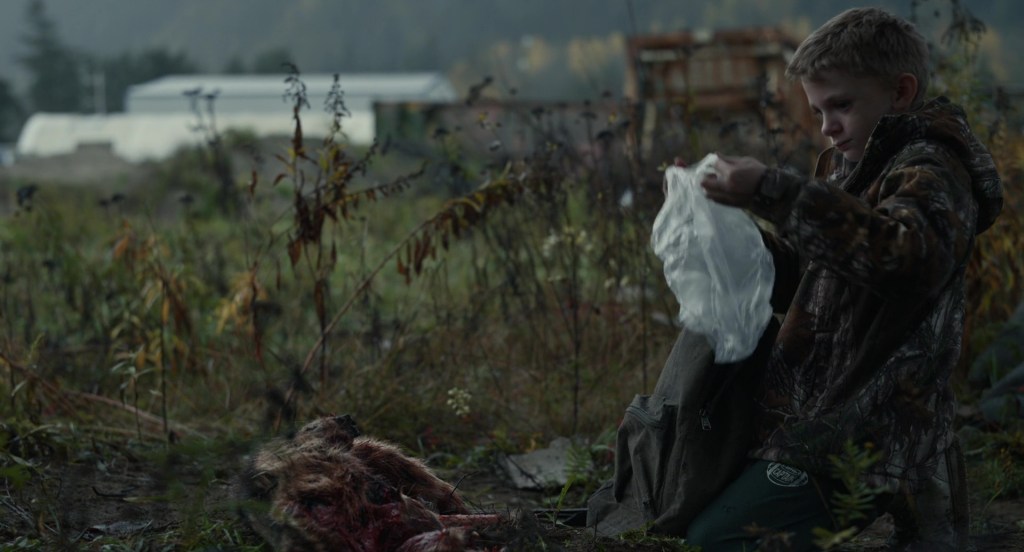
Directed and co-written by Scott Cooper (Crazy Heart, Black Mass) the film is produced by Guillermo del Toro, who has already won three Academy Awards for his imaginative grotesqueries. Del Toro’s films exhibit his fascination with fairy tales and mythology and the monstrous, in which he finds poetic beauty. The cast is outstanding, led by Keri Russell (Grimm Love, The Americans) as Julia, a teacher in rural Oregon who wants to help a young boy in her class named Lucas (Jeremy T. Thomas) who, she suspects, is suffering parental abuse. She thinks this because he is drawing gruesome pictures of creatures with huge antlers, and collecting roadkill.
Jeffrey Dahmer’s dad used to take him out on road trips to find roadkill to dissect, but there was nothing wrong with him, was there? Well, OK, but anyway, he wasn’t being abused, and nor is Lucas (except by the usual school bully).
Lucas’ dad was using an abandoned mine to cook methamphetamine, disturbing the quiet of the place, releasing who knows what has been hiding in there? Yep, but it’s not a balrog (also usually shown with horns), it’s a wendigo. And it has infected both the dad and the little brother. Dad is now very loud, very violent creature with a lack of hair (bit like Gollum, but more excitable) who need to be fed raw meat every day. No smart cracks about Oregonians, please. But Julia is an outsider herself – she fled to California as a young woman to escape her abusive father, and is wracked with guilt about leaving her brother Paul (Jesse Plemons – Friday Night Lights and Breaking Bad) behind. He is now sheriff of the town, where he does exciting things like evict poor people from their humble homes. She thinks he resents her, and we think so too – why wouldn’t he? He tells her he spent his entire life praying she’d come back. But now, whenever he comes near her, she flinches as she flashes back to her father abusing her as a child.
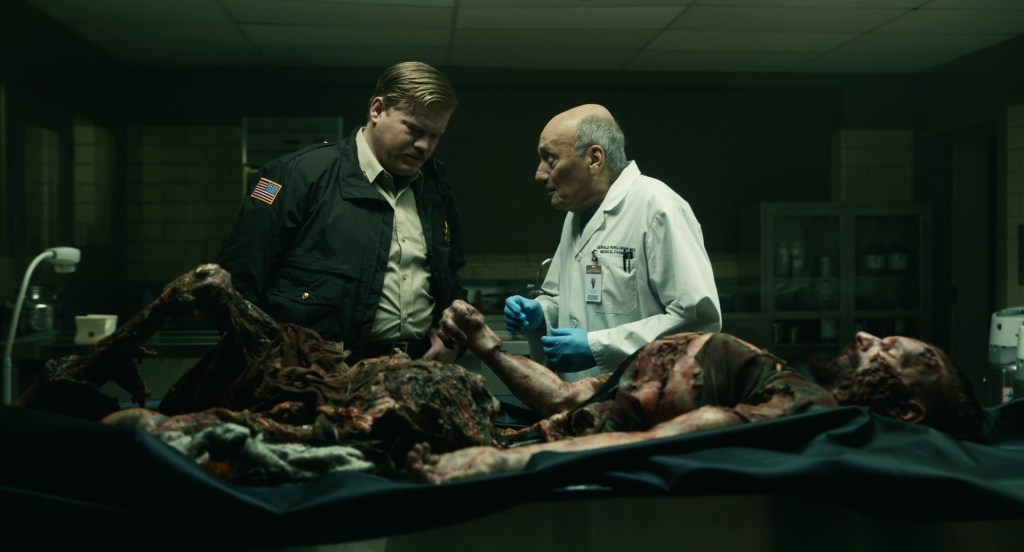
Paul goes into the woods to retrieve half a human body that someone has reported, and takes it to the coroner, who tells him the mutilation shows teeth marks – and they are human teeth. Almost halfway into the movie, and we finally have some cannibalism going on! Paul finds the other half of the dude (the dad’s former business partner) in the mine where they were cooking the meth. Also some mysterious antlers!
From there on, people start getting eaten – the stern school principal, the school bully who has been picking on Lucas (monsters can also be instruments of justice). It doesn’t work well for dad either; after he is finished enjoying the school principal, the real monster, now in the shape of a skeletal beast looking similar to the creature fought in the Alien films (but with antlers), sacrifices his body (the reference to the crucifixion is clear), then bursts out of his mouth, leaving him a charred, flayed wreck.
Lucas is carried off to the hospital, where he is diagnosed as dehydrated, malnourished, and deeply psychotic. Well, no wonder!
Warren, the previous Sheriff, is a local Native American, and explains to them that Lucas’ drawings, as well as the antler found in the mine, depicts the Wendigo,
“…a diabolical wickedness that devours mankind… known to be eternally starving but feasting makes them hungrier, and weaker. Those who are unfortunate enough to encounter one can only kill it when it’s in its weakened state. And only by extinguishing its beating heart, forcing it to search for another host. But it makes sense you see – our ancestral spirits never died. They were here long before we were here, and they’ll be here long after we’re gone. But now they’re angry.”
They find the missing school bully, who has been “eaten in half”, but Paul tells Julia he still cannot believe in a mythical nature spirit. He requires a conversion experience – maybe his deputy getting pin-cushioned and eaten, and then him getting comprehensively monstered? That leaves it up to Julia to take on the Wendigo. Being a teacher, she remembers the bit about it being weakened when eating, and the bit about extinguishing its beating heart. Using some impressive combat techniques that she probably learnt in The Americans, Julia rather easily beats the big beast, but then has a new problem – the Wendigo spirit is now in Aiden, Lucas’ little brother. Does Julia have the heart to kill and tear the beating heart out of an eight-year-old boy who looks like he just needs a meal and a bath? And do it while she is being watched by his big brother, Lucas?
Spoiler alert: you bet she does!
But as we watch the happy ending, Lucas now living with Julia and Paul, we see Paul begin to cough and spit out black foam – the first symptom of becoming a Wendigo (or this version of it.) As Jeffrey Jerome Cohen told us in his “Seven Theses” on monster culture, the monster never really dies or goes away; it just comes back in different clothes, or different skin. No matter how many times Ripley killed the Alien, it kept coming back, sometimes in the shape of its progeny (a reversal of the Beowulf story, where killing the monster arouses his mother’s wrath).
There are several versions of the Wendigo story. In Supernatural, the Wendigo only ate people every 23 years, an extreme version of the paleo diet. In Fear Itself, the Wendigo takes over anyone who is weak and hungry and fills them with rage, while in Lone Ranger, it appeared an outlaw in the Old West, who could only be killed with a silver bullet for some reason. The common thread is insatiable and voracious appetite, a hunger that destroys without thought for sustainability. In Bones and All, that hunger begins young and gets stronger as they grow older. Perhaps the classic of Wendigo literature is the film Ravenous, in which becoming a Wendigo gives not just superhuman strength but close to invulnerability, or at least the ability to heal any wounds by eating more people. And, of course, a voracious hunger.
The film starts with a warning. This is read in Ojibwe, one of the Indigenous languages of the Algonquin people, whose lands stretch from present-day Ontario in eastern Canada all the way into Montana. This is the language in which the mythology of the Wendigo was developed. The English translation scrolls up the screen:
The film is brilliantly acted, beautifully filmed and directed, but could have made more of a point of the environmental message with which it started, rather than just hurtling into the special effects and gore. The Wendigo is well presented, if a little sparse (we hardly see those antlers), but the connection between the greed of humans and the monstrous revenge of nature is left hanging. There have been five great extinction events found in fossil records. The SIXTH MASS EXTINCTION is happening as we speak. Extinctions have occurred at over 1,000 times the background extinction rate since 1900, and the rate is increasing, a result of human activity (or ecocide), driven by population growth and overconsumption of the earth’s natural resources. In late 2021, WWF Germany suggested that over a million species could go extinct within a decade in the “largest mass extinction event since the end of the dinosaur age.”
Humanity has waged war on nature since we came down from the proverbial trees, but particularly since the agricultural revolution some 12,000 years ago, when we decided nature could be dominated rather than placated. Fossil fuel combustion, the selective breeding of billions of other animals for food or clothing, the capture of wild animals for entertainment – these are all manifestations of the war on nature, motivated by a Wendigo-like hunger which can never be satiated. It’s a war that we cannot win, without destroying ourselves in the process – nature never goes away, but, like the Wendigo, comes back in another (angrier) skin – floods, droughts, climate change, etc. We have, as the Ojibwe warning says, pillaged the land and awakened a Malevolent Spirit. Like any organism evolving by natural selection, we can adapt or die. Our only advantage over other species is that we could, if we had the sense, decide which to choose.
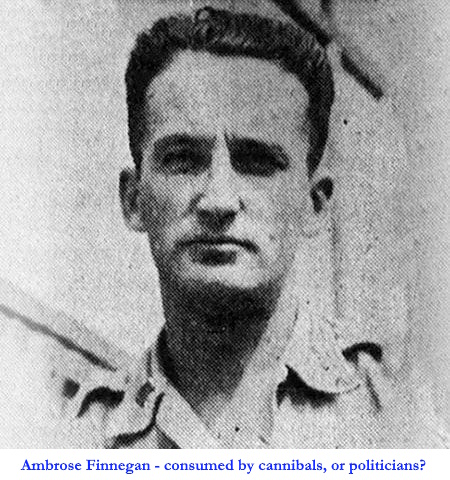
Raising eyebrows is a national sport of the USA during election years, and both Trump and Biden, the contenders, have done their share of the heavy lifting. But Biden really hit his eyebrow-raising stride this week (on April 18 2024) with claims that his uncle, second lieutenant Ambrose Finnegan (known in the family as Bosie), was shot down in the Pacific in 1944, and may have ended up on the dinner menu of Papua New Guineans.
Visiting a missing-in-action war memorial in Scranton, Pennsylvania, Biden put his hand on the engraved name of Ambrose Finnegan, whose plane went down but whose body was never recovered. Biden said,
“He got shot down in New Guinea, and they never found the body because there used to be — there were a lot of cannibals, for real, in that part of New Guinea.”
“For unknown reasons, this plane was forced to ditch in the ocean off the north coast of New Guinea. Both engines failed at low altitude, and the aircraft’s nose hit the water hard. Three men failed to emerge from the sinking wreck and were lost in the crash. One crew member survived and was rescued by a passing barge. An aerial search the next day found no trace of the missing aircraft or the lost crew members.”
Biden’s cannibalism story, told twice during his visit to Pennsylvania, was clearly intended as a gesture of respect for those who died in the war, and a dig at Trump. White House Press Secretary Karine Jean-Pierre stated that Biden’s story presented a contrast with Donald Trump, who reportedly described Americans who died in war as “losers” and “suckers” after refusing to attend the American cemetery in rainy Paris in 2018. Trump also mocked George H.W. Bush who was shot down in 1944 and John McCain who was captured and tortured in Vietnam, claiming real heroes did not get shot down or captured. Trump denies it all, but the Paris story was later confirmed by John Kelly, his longest-serving White House chief of staff.
However, like a lot of off-the-cuff comments, this one may have backfired for Joe Biden. Cannibalism is a convenient excuse for vilifying others, but vilifying Pacific Islanders does not help make any points against Donald Trump, and instead proved a distraction.
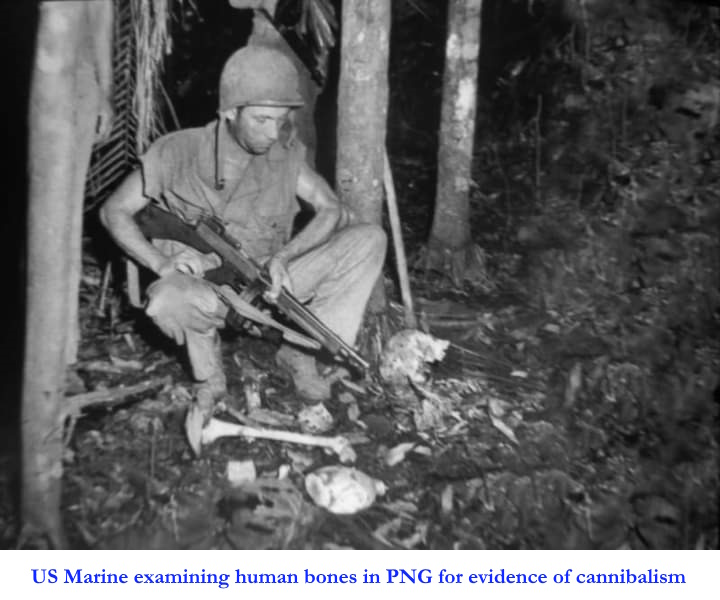
Certainly, cannibalism has been reported in Papua New Guinea (PNG), the Pacific nation that occupies the eastern half of the island of New Guinea, off the northern coast of Australia, but not always by the locals. At least 100 cases have been documented in which Japanese soldiers killed and ate the flesh of Allied troops, Asian labourers and indigenous people in Papua New Guinea during WWII. Researcher Toshiyuki Tanaka, an associate professor of political science at the University of Melbourne, reports,
“These documents clearly show that this cannibalism was done by a whole group of Japanese soldiers, and in some cases they were not even starving.”
Cannibalism can be an affirmation of victory, a way of humiliating an enemy beyond death. Historian Gerald Linderman reports that Japanese soldiers would disembowel captured Americans and leave the bodies “with their severed genitals stuffed in their mouths,” not only symbolically gagging the mouth of the victim but declaring him both sterile (castrated) and edible in one metaphorical gesture of contempt. George H.W. Bush, later to be President of the US, was shot down during bombing raids on Chichijima, a tiny island 700 miles (1,100 km) south of Tokyo, in September 1944. Eight of the airmen with him were captured, tortured and executed, and Japanese officers then ate parts of the bodies of four of the men. Bush was the only one to evade capture.
While the Japanese army may have practised cannibalism in PNG for political and psychological ends, those (relatively rare) tribes of local peoples who did so almost certainly were motivated by ritual, reverential reasons. The memory of ancestors is maintained in some cultures by ceremonially eating their flesh. Some tribes have even cashed in on the cannibal mystique, ushering awestruck tourists around monuments to their supposed recent cannibal past.
Local commentators have not been amused by Biden’s colonialist characterisation of their citizens as primitive savages who routinely eat outsiders, a trope that has proved useful throughout the history of imperial conquest as a pretext for invasion, enslavement and extermination. Michael Kabuni, a lecturer in political science at the University of Papua New Guinea, said that the comments were unsubstantiated and poorly judged, particularly when the US has been seeking to strengthen its ties with the country, and counter Chinese influence in the Pacific region.
“The Melanesian group of people, who Papua New Guinea is part of, are a very proud people. And they would find this kind of categorisation very offensive. Not because someone says ‘oh there used to be cannibalism in PNG’ – yes, we know that, that’s a fact. But taking it out of context, and implying that your [uncle] jumps out of the plane and somehow we think it’s a good meal is unacceptable. There was context. They wouldn’t just eat any white men that fell from the sky.”
Biden is right to say that there were some cannibal tribes in PNG last century, but wrong to universalise it as something routine and simply gustatory. His anecdote may have been inspired by the infamous tale of Michael Rockefeller, the 23-year-old Harvard graduate and son of New York governor Nelson Rockefeller, who vanished in western New Guinea in 1961 while on a trip to collect wooden carvings of the Asmat people for a museum. His boat capsized on the way, and he was reported to have swum towards the shore. His disappearance captivated the world’s media, and later led a researcher to claim in a book that Rockefeller made it to shore and was eaten during a ritual by the Asmat. It became fashionable to set cannibal movies in the jungles of PNG, even if they were not actually filmed there.
There is one more aspect of the history of PNG cannibalism that adds insult to injury. One of the most commonly cited examples of modern cannibalism, often used as a reason to avoid the practice, references kuru, the fatal, neurodegenerative disease discovered in PNG and caused by “misfolding and aggregation of a host-encoded cellular prion protein” and purportedly transmitted by cannibalism. Transmissible spongiform encephalopathies became best known during the outbreak of “mad cow disease” caused by human-imposed bovine cannibalism, in which cows were fed bone meal from other cows. It occurs also in sheep as “scrapie” and in humans as Creutzfeldt–Jakob disease, one form of which, kuru, literally the “trembling” disease, peaked among the Fore people of the Eastern Highlands of Papua New Guinea in the late 1950s. It became famous, not least for showing that cannibalism is not something lost in the mists of history – it even won a mention on The Love Boat! The disease mainly affected women and children, who were allegedly the main consumers of brain tissue during funerary rites. Instances of the disease fell off sharply when cannibalism was prohibited by Western administrators, which led to the hypothesis that kuru was a result of the ingestion of human brains and central nervous systems.
But even if cannibalism and kuru are directly related, it seems a stretch to make this a primary reason for avoiding cannibalism. Mad cow disease was far more widespread than kuru, and yet did not significantly affect the sales of bovine flesh in the long term. Nor, as far as I am aware, have any cannibals reported a preference for central nervous system tissue. Nor would they be likely to catch it from white men that fell from the sky.































 The Cannibal Guy