IDAHO amends its anti-cannibalism bill – cannibalism news, March 2024

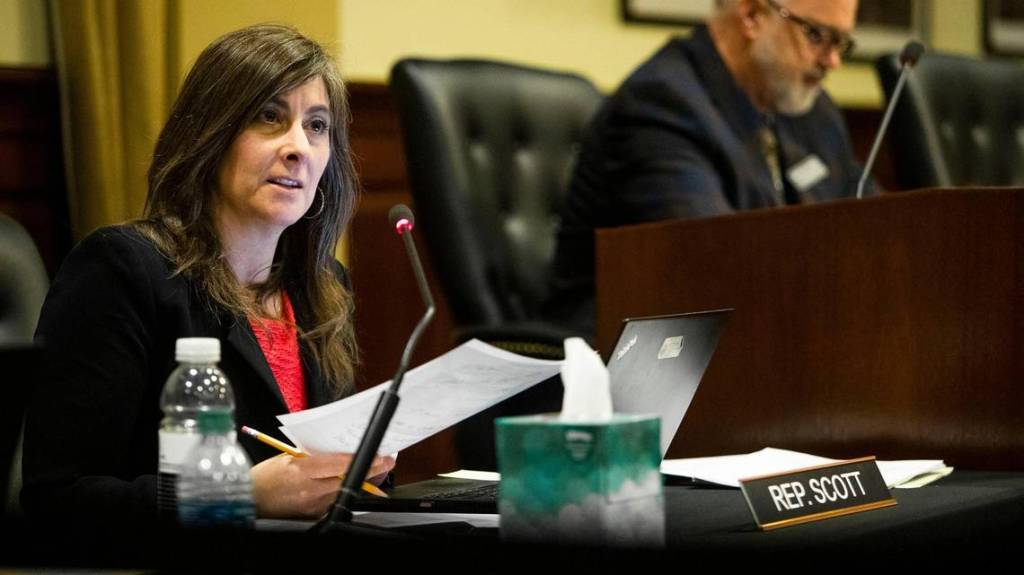
Idaho lawmakers have voted to expand a law that bans cannibalism because of fears about the popularity of human composting. Rep. Heather Scott introduced a bill in February 2024 to expand the state’s cannibalism ban and told a legislative committee that she’s worried about the possibility that people are eating other people.

Scott said:

“This is going to be normalized at some point, the way our society’s going and the direction we’re going.”

People are often surprised to hear that Idaho is the only state in the USA to have outlawed cannibalism. Other states have laws which target abuse or desecration of a corpse, making cannibalism legally impractical and problematic. Idaho introduced its law during the frenzy called the “Satanic Panic” last century.

The US is not unique in this – most countries do not have specific laws banning cannibalism. Germany didn’t, until Armin Meiwes ate his new social media friend.

The new bill, 522, adds to Idaho’s existing prohibition of cannibalism a ban on giving someone else “the flesh or blood of a human being” without that person’s “knowledge or consent.” Scott said she is “disturbed” by the practice of human composting, which is legal in several states as an option for disposing of the dead that is more sustainable than other burial methods and reduces a funeral’s carbon footprint. Human composting involves decomposing human remains like other organic matter and turning it into soil that can be returned to the family or used to make land more fertile. But Scott said outlawing composting would require overhauling rules for morticians, and so instead she focused on banning the act of deliberately giving human flesh to another person.

“I didn’t want to see that in my Home Depot stores.”

Scott said she was on a plane and watched a clip from a TV show displaying a chef feeding human flesh in sausage to contestants, which inspired her to take action. The clip, which she sent to the Idaho Statesman, is from a TruTV prank show, in which they pretend to feed people flesh. “They didn’t tell the people, they fed it to them,” Scott told the Statesman, though she noted it may have been a spoof.

Scott also submitted a link to a video featuring a Chinese official denying that his country had sold canned human flesh to people in Zambia. The canning claim was a hoax, spread with fake photos of butchery, according to news reports from 2016. Scott additionally pointed to a North Idaho man who pleaded guilty to murder last year and was initially also charged with cannibalism after investigators found postmortem mutilation and a bloodied bowl at the crime scene. The cannibalism charge was later dropped, meaning that the Idaho anti-cannibalism laws have still not been tried in court.

An editorial in the Idaho Statesman concluded:

But that’s where we are in Idaho: Unhinged, unreal legislators can bring forth just about any crazy idea and get a bill printed.

But imagining that humans might unwittingly eat other humans is not so far-fetched. Mythology is full of innocent cannibals—Agave eating her son Penteus, Thyestes eating his sons at his brother’s feast, Tereus eating Itys. Becoming “innocent” cannibals make us squirm, writes Donald Tuzin, because it denies us the escape of declaring the cannibal a maniac or monster—anyone can become a cannibal. In the movie The Farm, humans are treated as “living meat” exactly the way cattle are regarded on factory farms—the men are slaughtered for meat, the women bred and their infants pitilessly killed in front of the mother (as often happens in the dairy industry) so the farmers can sell the mothers’ milk. The final commodities are sold to innocent cannibals, who occasionally ring up, horrified to find residues such as a human tooth in their meat. Inverting the agricultural business plan, the “livestock” are human, while the farmers are dressed in animal masks.

But it doesn’t only happen in fiction. The Farm may be based on the Canadian pig farmer and serial killer Robert Pickton who confessed to 49 murders in the 1990s, and allegedly “processed” the meat of his rape and murder victims by feeding them to his pigs and, police said, possibly mixing them up with the pork products he sold to neighbours.

Joe Metheny claimed to have killed 13 people in the Baltimore area in the 1990s and turned them into burgers. He reported:

“Over the next couple weeks on the weekends I opened up a little open-pit beef stand. I had real roast beef and pork sandwiches and why not they were very good. The human body tastes very similar to pork. If you mix it together no one can tell the difference.”

In 2007, two men in England were arrested for the murder of a 14-year-old girl, with the prosecution claiming that her body had been cut up and minced into kebabs in a Blackpool takeaway called “Funny Boys”.

On April 9, 2012, police in Garanhuns, Brazil, arrested for murder Jorge Beltrao Negromonte da Silveira, his wife, Isabel Pires, and his mistress, Bruna Cristina Oliveira, who all lived together in a group they called “The Cartel”.

Residing with the Cartel was a small child named Vitória, who had been the daughter of their first victim. The child’s mother was a seventeen-year-old homeless woman whom the Cartel had invited into their home in Olinda in May 2008. She had been murdered by the Cartel, who then dismembered and skinned her body, storing the meat in their refrigerator before seasoning it with salt and cumin, grilling and eating it. The woman’s daughter was fed some of her mother’s flesh.

The worldwide public interest in the crimes did not stem from their murder of three young mothers, but from the fact that the Cartel had baked the victims’ flesh into salgados, salty, deep-fried pastries, which they then sold to the unsuspecting public. To the disappointment of the media, the pictures of the perpetrators showed them as three ordinary Brazilians, not the monsters the public had expected.

Back to Idaho, where Rep Heather Scott’s bill 522 sailed through the House and is heading to the Senate. She quoted in support of her bill from a recent article in The New Scientist which reviewed the human history of cannibalism (they concluded that it happened a lot) and stated:

“Ethically, cannibalism poses fewer issues than you might imagine. If a body can be bequeathed with consent to medical science, why can’t it be left to feed the hungry? Our aversion has been explained in various ways. Perhaps it is down to the fact that, in Western religious traditions, bodies are seen as the seat of the soul and have a whiff of the sacred. Or maybe it is culturally ingrained, with roots in early modern colonialism, when racist stereotypes of the cannibal were concocted to justify subjugation.”

We don’t have to buy mulch to end up cannibals. Any sausage or burger might have human flesh in it, and no one would know the difference. We are animals, large mammals, made of red meat like cows, pigs and sheep. Unless you think we have some sort of supernatural dissimilarity from other animals, the thin red line between different species can only be identified as a cultural construct.

Donner Party revisited: snowstorm strands hundreds on the DONNER PASS

Videos such as the one above by freelance journalist Jonathan Petramala show hundreds of cars and trucks bogged in deep snow on the infamous Donner Pass, a stretch of road 7,088 feet above sea level over the Sierra Nevada mountains in Nevada County, California. On Saturday March 2 2024, more than three feet of snow fell on and around Interstate 80 northwest of Lake Tahoe, according to the Weather Channel. In winter, the old Donner Pass, now the historic US40, is often at risk of snow avalanches and blizzards, but this one was the strongest blizzard in California in years, and is being called a

‘Snowpocalypse”

Blizzard warnings have been issued with snowfall of up to twelve feet expected in some higher elevation locations. 

Many people would not associate the words “California” and “Snowpocalypse”, but that is exactly what happened in 1846-7 when a group of pioneers became snowbound in the Sierra Nevada over winter, and famously turned to cannibalism to survive. Only 48 of the original 87 members of the party survived. Many of the others were eaten after they died, and when they ran out of corpses, they murdered two of the Native American guides to use as protein.

There have been quite a few films and books about the events of that winter in 1846. Most emphasise the cannibalism that became inevitable, but omit any ethical discussion (probably no record was kept of it anyway) and gloss over the clearly racist decision to kill and eat the Native American guides in preference to “white” meat, even where the potential victim had volunteered. The movie Alive covered this rather better, showing a group of young men, all devout Catholics, debating how to justify eating their dead fellow passengers after the crash of a Uruguayan Air Force plane chartered by their football team in the Andes in 1972.

Back to the future – March 2024. The California Highway Patrol issued an appeal to people not to head out there, for obvious reasons.

The skiers, in particular, were not interested in listening to warnings – they wanted powder, and plenty of it. Despite snowfall of up to 12 feet being expected in some higher elevations, people headed out from San Francisco and all parts of the USA to find a mountain they could slide down. Many of them promptly got stuck in cars that would not respond in the freezing temperatures, and ski resorts had to shut down anyway. Big rigs also were stranded, blocked from moving (even if they had chains) by the inactive cars, or jack-knifing in the treacherous conditions.

Like 1846, this was a recipe for disaster. Residents of Truckee, California, one of the closest towns to Donner Pass, reported having inches of snow in front of their houses making it difficult to get out.

It did not take long for social media to pick up those reports of a “significant number of vehicles stranded over Donner Summit”. One headline read:

Untold Number of People Trapped at Site of Great American Tragedy

Some, of course, made the inevitable logical leap:

Sorry to disappoint, but there have been no reports of cannibalism from the stranded cars, trucks or town-folk. Unlike 1846, there are now emergency services available, including all sorts of technology from drones to snowploughs, and in fact emergency teams and tow services worked tirelessly to reach those affected.

While many had to leave their cars behind, no gnawed bones have been discovered so far. Maybe when the snow melts…

Mark Haydon, who was involved in Snowtown murders, being released from jail. SNOWTOWN (Justin Kurzel, 2011)

SNOWTOWN is back in the news at the moment, due to one of the perpetrators being granted parole after serving his 25-year sentence. Mark Haydon was convicted of assisting John Bunting and Robert Wagner in the murders of 11 people, including his wife, between 1992 and 1999.

Haydon reportedly rented the abandoned state bank building at Snowtown in which the bodies were stored in barrels of acid. A jury deadlocked on the charge that he was involved in the murders of his own wife, Elizabeth Haydon, and of Troy Youde, and he was never retried. His 25-year sentence was completed this year, and he will be freed into the community with no restrictions in May 2024 (unless the government succeeds in attempts to change the law to broaden the definition of a “high-risk offender”).

Above: the real Mark Haydon – then and now.

Relatives of the victims have long voiced their anguish and fear at any prospect of any of the perpetrators being released.

The film Snowtown is a recreation of this case, the most famous serial killer case in Australia (with the exception of the attempted genocide of the Indigenous population). A total of twelve victims were identified, and eight of the bodies were eventually found by police in barrels filled with acid, which were stored in an abandoned bank vault in the small town of Snowtown, in South Australia.

Although the press called this the “bodies in barrels” murders, it soon became known, to the sorrow of that little town, as THE SNOWTOWN MURDERS, even though only one of the murders had taken place there, the rest happening in the big city, Adelaide, between 1992 and 1999.

The final murder that took place in Snowtown, however, involved CANNIBALISM. We’ll have a look at that in this blog, although unfortunately the film doesn’t.

The film is a true Crime retelling, which means that none of the names have been changed to protect – anyone, and of course the dialogue has to be imagined to some extent. But we know a lot of what went on, and so did the film makers.

True Crime has been a popular genre for centuries, and transgressed the line between fiction and non-fiction in 1965, when Truman Capote released In Cold Blood, a “non-fiction novel”, relating or interpreting a 1959 Kansas murder. Modern versions of the genre extend beyond literature to films, podcasts, vodcasts and television shows. They tend to concentrate on the most sensationalistic cases and are grittily and brutally realistic in portraying the violence and gore.

In Australia, where this film originates, a survey found that some 44 percent of podcast listeners had listened to true crime podcasts, with an considerable proportion of them being women.

The protagonist of the film is Jamie Vlassakis, a teenager living with his single mother and two siblings. The mother’s boyfriend is a helpful sort of bloke who makes the kids dinner when mum has to go out, then strips them and takes photos of them for his own gratification. The mother deals quite effectively with this, beating him up and kicking him repeatedly, but soon a new man comes into their lives – John Bunting.

Bunting has a winning smile and a certitude that gets him into the family, and he takes Jamie under his wing. John also has a burning hatred of gay men and paedophiles, two rather different beasts whom he conflates into one evil figure. When Jamie tells him that he was raped by his older half-brother Troy, John tells Jamie he needs to “grow a pair” and take revenge. He involves Jamie in his plans to identify, capture and kill a range of people he considers monsters. He collects detailed information on a “spider wall” in his house. “Rock spider” is Australian slang for a paedophile.

But John Bunting has clearly not read Nietzsche:

He starts by involving Jamie in his plans to drive the erring boyfriend out of town. Jamie finds him in the garden, chopping up and mincing kangaroo body parts to toss onto the neighbour’s front door and sofa.

He involves Jamie in a raucous discussion of paedophile teachers, asking him what he thinks should be done with them. Jamie follows the fatal logic.

John takes Jamie under his wing, teaching him to ride a bike, shaving his head, showing him the spider wall, giving him a gun, and getting him to shoot John’s dog, a brutal blooding. When he introduces Jamie to the act of killing humans, there is also the accompanying deception: each victim is made to record a message that will be played on the answering phone of their loved ones. Jamie’s mum hears Troy say he hates her, and Jamie lies to her, letting her believe that forced call was true. Jamie goes off to doctors and government offices to collect payments, posing as the people they have killed. He doesn’t look happy about it, but he is sinking deeper and deeper into John’s machinations. After a while, collecting the government support payments becomes the motive as in the murder of Gary O’Dwyer; the vigilante pretext is forgotten. O’Dwyer invites the men to his place to watch him feed rats to his python, a process we see in slow motion in which the snake unhinges his jaw to swallow the prey whole, just as the men become unhinged in their growing lust to kill.

So John makes a man of Jamie, in the most toxic sense. He teaches him carnivorous virility – in order to be a man, you have to kill and eat. Not always the same carcass, but that does seem the logical consequence of the objectification of all victims.

The film traces the increasingly violent actions in which Jamie becomes involved, unwillingly at first, but totally under the control of John. He is made to watch them torture his half-brother Troy, who was earlier shown sodomising Jamie, and he finally steps in to finish the killing, tears rolling down his face, while John strokes his cheek and murmurs “good boy.”

Jamie is now a fully-fledged killer and a vigilante, not just an observer and helper the way Mark Haydon (the man currently being released on bail) is portrayed. Mark is a minor character, buying rubbish bags and digging holes for corpses, until near the end of the film, when he tells John he got into a fight with his wife, who called him a pussy. He told her what a big man he was – burying bodies. John brushes the story off, but we know she is next.

Although this murder is not shown in the film, evidence was given that Haydon saw his wife’s body and laughed. Her body was one of the ones found in barrels in the Snowtown bank building.

The final murder was Jamie’s half-brother (through a different father) David Johnson, whose only offence was his fastidiousness and unwillingness to go along with John’s rhetoric of violence. The final scene of the movie shows Jamie persuading David (one of the few wholesome characters in the film) to check out a computer supposedly offered for sale in Snowtown. They stop for a beer, they stop again so Jamie can urinate in a creek. He runs back to the car to accompany David to his death; the car is parked at a crossroads, clearly a symbol, a suggestion that Jamie, who is depicted as hating all the violence, could have chosen a different path at any time.

John Bunting, Australia’s most prolific serial killer, was convicted of eleven murders and sentenced to life imprisonment without the possibility of parole. Robert Wagner, his main accomplice, was convicted of ten murders and sentenced also to life without parole. Mark Haydon was initially charged with two murders but was only convicted on five counts of assisting. The jury did not come to a decision on two murder charges against Haydon, and another charge of assisting murder, which never came to retrial.

More than 250 suppression orders originally prevented publication of the details of this case at the time. In early 2011, a judge lifted the remaining orders in response to a request by the producers of the film Snowtown. Haydon was sentenced to 25 years, which he has now completed; he is back in the community on parole, with the head of the parole board saying he’s well behaved and poses no risk to the community. He has been moved to the Adelaide Pre-Release Centre – a low security facility where prisoners can participate in accompanied and unaccompanied leave, including for work and education. The usual conditions of parole apply (no binge drinking – yet), but he will be a free man in May 2024 when his sentence expires.  

Jamie, presented in the film as an unwilling and even sympathetic killer, pleaded guilty to four murders and provided testimony against the other men, in exchange for a lesser sentence. He testified about the cannibalism that is not shown in this film — that Bunting and Wagner hacked at David’s body to make sure it would fit in the barrel and then sliced off a sliver of flesh from the right thigh. They heated a frying pan, cooked the flesh, and handed it around. Jamie’s testimony was the only evidence police had that cannibalism had taken place, and was presented by his attorney as proof that he was fully cooperating and deserved a lighter sentence. In 2005, when Haydon’s murder charges were dropped by the Director of Public Prosecutions, several suppression orders were lifted. These detailed the murder and cannibalism of the final victim, David Johnson.

Jamie Vlassakis was sentenced to four consecutive life sentences with a non-parole period of 26 years, which means it is possible he could be released on parole in 2025. He will be 45 years old.

The film is gritty and brutal, particularly the scenes of Jamie’s rape, and the torture of their victims. But it is compelling watching, and the acting and directing are quite brilliant, capturing the loss of innocence that starts with abuse and ends with brutality. Bunting’s early life reportedly was very rough; he said he enjoyed killing ants with acid, an idea he later transposed to those humans he saw as vermin. When he grew up, he worked at a slaughterhouse, where he would brag about slaughtering animals, saying that’s what he enjoyed the most. Later, when he moved in on Jamie’s family, he would kill cats and dogs and skin them while making Jamie watch. We see Jamie transform from the innocent teenager who stands around smoking at the start of the film to a shaven-headed killer, and even his little brother is shown with his head shaved, starting his short journey from childhood abuse to callousness.

The film is all about that loss of innocence. At an early age, these kids are introduced to poverty, abuse and violence that is a hallmark of violent, carnivorous society. Children famously love “animals” when they are little, recognising their own infant state of being helpless and unable to communicate, yet are socialised into carnivory by the peer pressure to conform and their recruitment into the ceaseless human war on nature. Animals, particularly the chattel slave animals generally referred to by their monetary value, “livestock”, are nothing and nobody. It is only a small step for John Bunting to assume the same about those he hunts, and so why would he flinch at eating them? It is the logical next step.

The film closes as Jamie shuts the door of the vault, trapping the unfortunate David Johnson with the killer gang. We don’t see the murder, or the frying pan. Unfortunately, that final step over the thin red line between humans and other animals appears to have been a bridge, or a meal, too far for this film.

Cannibalism and ‘Satanic Panic’ in Utah

Utah lawmakers are attempting to pass a bill to criminalise the ‘ritual abuse of a child,’ bringing back memories of the satanic panic of the 1980s, when other states passed similar laws.

Critics of the bill, however, say it is unnecessary and potentially harmful.

Republican state Rep. Ken Ivory is sponsoring the bill, House Bill 196. It defines ritual abuse as abuse that occurs as “part of an event or act designed to commemorate, celebrate, or solemnize a particular occasion or significance in a religious, cultural, social, institutional, or other context.” The bill lists specific actions that fall under the proposed definition: abuse against children that includes rape and sodomy, involving them in animal torture, bestiality or cannibalism, or forcing a child to ingest urine or faeces, enter a coffin or grave containing a corpse, or take drugs as part of a ritual.

A hearing of the House Judiciary Committee on February 21 heard from several adults who described themselves as survivors of ritualistic child sexual abuse. They described devil worship, animal torture, forced bondage, rape, cannibalism, child prostitution and mind control, saying that the abuse was so physically and emotionally traumatic that they had repressed memories of it.

Kimberli Raya Koen, President and Founder of The Healing Center for Complex Trauma in Salt Lake City, told the Committee that she was trafficked into a family that ritually abused her for more than two decades.

She told them:

“I see the light and I have fought to be in this chair, to be in this moment, to have a chance to say this is real and this is happening.”

Utah County Sheriff Mike Smith spoke in favour of the bill, telling the committee that he began investigating a high-profile “ritual sex abuse” case two years ago.

The investigation (covered by this blog at the time) became embroiled in politics after then-Utah County Attorney David Leavitt accused him of dredging up an old, unverified witness statement that accused Leavitt and 14 others of “cannibalizing young children” and participating in a “ritualistic” sex ring. Leavitt subsequently lost his re-election bid.

Several states passed similar laws in the 1980s and 1990s, during the height of furore over satanic ritual abuse, but few, if any, prosecutions came from them. Since then, federal law enforcement agencies, scholars and historians have pointed to the scarcity of evidence for the claims of widespread ritual abuse and warned that such legislation risks generating false allegations, wrongful imprisonments and wasting law enforcement resources.

Mary deYoung, professor emeritus of sociology at Grand Valley State University, has documented the harms of the satanic panic.

“This bill is a very good example of panic legislation, hastily cobbled together, on the basis of testimony from a couple of women recollecting childhood histories of satanic ritual abuse. It’s a bill that responds with the kind of approach where we get really angry and say, ‘There ought to be a law.’ And we don’t think about whether it can be enforced in such a way that adds any benefit to society or that ensures that justice is done.”

County Sheriff Smith acted on the reports, but his prosecutions have lagged in court for years, plagued by accusations that investigators mishandled witness statements and that the investigation was politically motivated from the start. He says:

“I was attacked, I was ridiculed, I’ve had memes made about me because of it. Without a doubt, these things do happen in Utah. I believe they’re happening, I believe they have happened.”

Utah’s proposed bill and the county sheriff’s investigation have attracted national interest from conservative media and online conspiracy theorists who believe this case will prove that the allegations in the satanic panic of the 1980s were true, and that cabals of satanists are still sexually abusing, murdering and cannibalising children. Several self-described internet investigators have, in blogs, videos and podcasts, accused hundreds of Utahns of participating in satanic ritual abuse rings.

Many of the claims in the 1980s were made in Utah, amid claims that local therapists used hypnosis and manipulative interview techniques to recover memories from alleged child victims. These were some of the earliest claims of widespread satanic ritual abuse.

Utah’s governor formed a task force in 1990 which spent $250,000 to address pervasive ritual abuse. Investigators interviewed hundreds of victims in more than 125 alleged cases, only one of which ended in prosecution. A final report from the state’s Attorney General in 1995 suggested that there was evidence of isolated instances of abuse involving rituals, but not a widespread plot to abuse children in this way.

National studies from the Department of Justice and the National Center on Child Abuse and Neglect found no evidence to support claims of widespread ritual abuse. Child sexual abuse, however, is staggeringly common; about 1 in 4 girls and 1 in 20 boys in the United States are victims, according to the Centers for Disease Control and Prevention.

In Utah, the Judiciary Committee voted 10 to 1 to advance the ritual abuse bill to the full House; if passed there, it will advance to the Senate. No one testified in opposition to the bill. Rep. Brian King, one of the two Democrats on the committee, cast a dissenting vote and questioned its necessity, noting that state law already criminalises physical and sexual child abuse. Ivory, the sponsor, conceded the offenses were already criminal, but said a specific law was necessary because the crimes are “so heinous.”

​​Rep. Kera Birkeland, a Republican, cried as she addressed the people who spoke during the hearing.

“I had no idea that this was happening in our state. We believe you.”

Do we? Are children in Utah or elsewhere being forced to eat human flesh (the focus of this blog) or other matter usually considered inedible in polite society? One of the most famous allegations is the conspiracy theory #Frazzledrip which maintains that a video is circulating showing Hillary Clinton and Huma Abedin, a former aide, ripping off a child’s face and wearing it as a mask before drinking the child’s blood in a satanic ritual sacrifice. No claims were made about making the child eat flesh though. So I guess that’s not covered by the bill.

Utah has a bit of a record here, with the ill-fated team eaten by Alferd (or Alfred) Packer leaving from the Bingham Canyon mines near Salt Lake City in November 1873 for the gold fields of Breckenridge in the Colorado Territory. They met Packer some 25 miles from their starting point, near Provo. Unrelated (I guess) is the story of a Utah man who was charged in September 2021 over the Capitol riots and later threatened to “eat the flesh” of a probation officer.

We might also wonder if these laws might be used against churches that practise the Eucharist, the eating and drinking of the wafer and wine in church, which is seen by some (particularly the Catholics) as a literal transubstantiation of wafer and wine into the flesh and blood of Christ. Children are usually expected to take communion, that is, eat the flesh and blood of Christ (in the form of wafer and wine), from the age of about seven. This does sound a lot like what the bill describes as “ingestion… of human bones, blood, or flesh”. I wonder what the churches might say about that?

Idaho is the only state to have a law against cannibalism, but it has never been used. Seems a terrible oversight, really, and perhaps the good folk of Utah can set it right.

It’s just meat: SOCIETY OF THE SNOW (La sociedad de la nieve)  (J.A. Bayona, 2024)

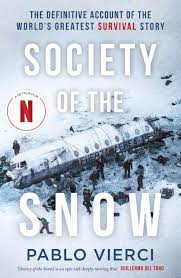
Society of the Snow is a new account of the 1972 Andes plane crash. It is an adaptation of Pablo Vierci‘s book of the same name,which included detailed accounts of all sixteen survivors, many of whom Vierci had known from his earliest years.

The twist here (not really a spoiler as they keep presaging it) is that the narrator of the film is one of those who were not among the sixteen.

Uruguayan Air Force flight 571, chartered to transport the “Old Christians” rugby team to Santiago, Chile, crashed into a glacier in the heart of the Andes. Of the 45 passengers on board, only 16 survived for the 72 days before they were rescued. Trapped in one of the most inaccessible and hostile environments on the planet, they had to choose cannibalism to stay alive. In this blog, we are most interested in the debate that led to the decision to eat their friends and crew, but the whole story of their pursuit of survival goes beyond what they ate and is equally fascinating.

We see a group of very devout young people, laughing and joking as they organise the trip to Chile, horsing around as the plane gets most of the way over the Andes, and then their reactions as the plane just does not reach the required altitude.

After a week without food, their urine turning black from lack of protein, they start exploring their very limited options. One group believe they will be rescued, even though their plane is painted white and they are in one of the biggest snowfields in the world. But most of them start to think about the only realistic way to survive, particularly after they find a portable radio and hear that the search for them has been called off.

The film has some interesting discussions regarding the ethics of cannibalism.

“What’ll happen to us? Will God forgive us?”
“He’ll understand we’re doing everything we can to survive.”

Roberto, the medical student who has been trying to keep the injured alive, explains what happens to the body without food – it dries up, starts to absorb the organs. There is reference to the “God of the Mountains”, a different being to the one in the city. Arturo, one of the wounded, has a fascinating soliloquy about this God:

“That God tells me what to do back home, but not what to do out here…. I believe in another God. In the God that Roberto has in his head when he treats my wounds. In the God that Nando has in his legs when he keeps walking no matter what. I believe in Daniel’s hands when he cuts the meat, and Fito when he gives it to us, without saying which of our friends it belonged to. So we can eat it, without having to remember the life in their eyes.”

They discuss the legality and the practicality of cutting up bodies, the similarity to organ donation, but of course without consent. So that inspires them to make a pledge.

And so they begin to eat. There are scenes of skeletons being picked clean as the three Strauch cousins offer to cut up the bodies in an area that is hidden from the plane, “to keep the ones who eat from losing their minds”.

What the film glosses over is the Catholicism that permeates much of Latino culture. While they make the point that the bodies are now “just meat”, they do not look for the parallels of their cannibalism to the Eucharist, the eating and drinking of the wafer and wine in church which is supposed to transubstantiate into the blood and body of Christ. It is a theme explored in more detail in the earlier film, as well as in the memoirs of the survivors.

“Drawing life from the bodies of their dead friends was like drawing spiritual strength from the body of Christ when they took Communion”
(Parrado & Rause 2006. Miracle in the Andes: 72 Days on the Mountain and My Long Trek Home, p.117.)

They quote to each other Matthew 26:26: “Take and eat, this is my body.”
(Canessa & Vierci 2016. I Had to Survive: How a Plane Crash In The Andes Inspired My Calling to Save Lives,  p.27).

I suspect this might have been considered a bit too close to the bone (apologies for the pun) for the Spanish speaking audience to whom the film is mainly addressed. Or else they wanted to appeal to a wider audience than just the Catholics. Or perhaps a bit of both.

The story is best known in print for Piers Paul Read’s 1974 book Alive: The Story of the Andes Survivors, which was turned into the film Alive in 1993 by Frank Marshall. Since then, several of the survivors have written their own accounts, to set straight some of the alleged inaccuracies in Alive, but none are as well known. Outside of the Hannibal story and perhaps Soylent Green, Alive is the film most people seem to recall when they hear I have written a thesis on cannibalism.

Alive had a few problems that this film nicely avoids. For one thing, it was very Hollywood, or “Anglo” as the politically aware like to say. It starred American actors who did not look like they were starving, even when they were fondly reminiscing and lusting for the food they missed, which seemed to be mainly pizza. Society of the Snow has Uruguayan and Argentinean actors speaking in Spanish, and makeup and special effects have improved markedly in the thirty years between the films, so they look hungry, and their wounds look ghastly. It is a more authentic look at the situation in which a group of deeply religious young men could decide to eat their dead fellow passengers and friends, who conveniently lay around them, preserved in the snow.

The film closed the 80th Venice International Film Festival in an ‘Out of Competition’ slot. It was theatrically released in Uruguay on 13 December 2023, in Spain on 15 December 2023, and in the US on 22 December 2023, before streaming on Netflix in January 2024.

Society of the Snow received positive reviews. At the 96th Academy Awards, it was nominated for the Best International Feature Film, representing Spain, and Best Makeup and Hairstyling.

Society of the Snow is arguably a better movie than Alive, although at two hours forty minutes, I thought a bit more editing might have been useful. Still, sitting through that 160 minutes gave a miniscule sense of the despair of sitting in a wrecked plane in freezing conditions for 72 days, so we cannot complain!

But I was sorry to see them drop the cannibalism/communion issue, even though there is a hint in the final scene where the survivors sit around a dinner table like the Disciples at the Last Supper, their dead friends being the bread of life, transubstantiated from sacred to edible, the reverse of what is supposed to happen to the church wafer. Whether you consider this a cannibal movie or an epic of survival (and yes, there is controversy raging about that), exploring why people do or don’t eat each other is endless fascinating, and the question of cannibalising the body of Christ is, or should be, at the heart of this story.

Meat is meat: THE MAD BUTCHER (Guido Zurli,1971)

Some months ago, I reviewed a film called Auntie Lee’s Meat Pies, in which I asked readers “What’s in your pie?” This film, The Mad Butcher (Lo strangolatore di Vienna), asks a far more profound question: “What’s in your sausage?” In each case, a better pronoun might have been “who”.

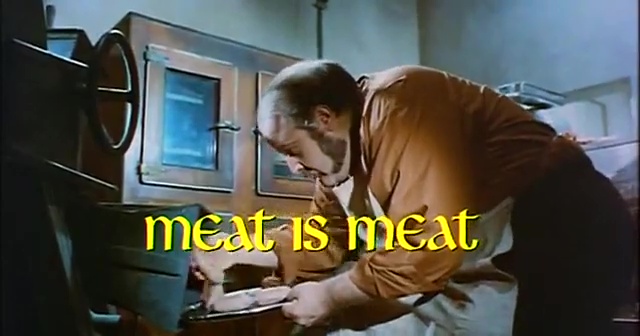
Guido Zurli was an Italian director but this film was made in English, set in Vienna and starred the wonderful, larger-than-life Hollywood actor Victor Buono, who plays the “Mad Butcher” of the title. In the USA, it was released as Meat is Meat, a better title IMHO – describing cannibals as “mad” is such a lazy approach, an intellectual shrug of avoidance. And to the butcher of this film, meat really is… just meat.

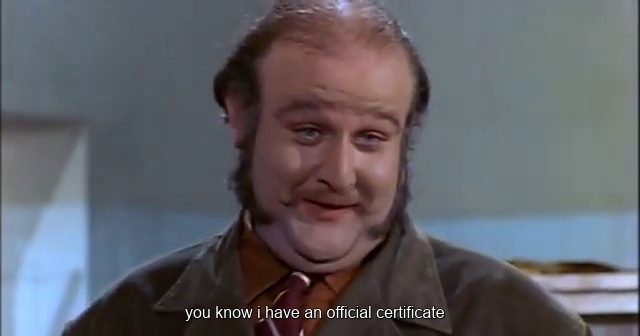
Otto (Buono) is dedicated to his calling – cutting up and selling animal flesh, and to him, the women he kills and minces are just that – meat. Otto has anger issues, which caused him to be confined to an asylum for three years, after slapping a customer with a piece of liver. But now he is being released, with an official certificate allowing him to say, “I’m not crazy now.”

His wife, who had had him committed (to save him going to jail, she claims) wants him to come home with her, worried about what the neighbours will say, but he wants to move into his butcher store where, he tells anyone who will listen, he is “the best butcher in Vienna”.

While throwing from his window the rubbish left by his wife’s brother who was running the store in his absence, Otto sees a neighbour as she showers, in silhouette. She looks, well, edible to him.

His wife catches him staring at the neighbour and, during the resulting row, he strangles her. At first horrified, he realises that there is only one way to get rid of the evidence. After that, he has to dispose of a sex worker brought home by the brother-in-law, and then the brother-in-law, who he has spent much of the film calling a “pig”. Well, he is a very popular butcher, the best in Vienna, and after all, as he opines, “I need this meat.”

But then, when he manages to abduct the neighbour (she of the long showers with the lights on and the blinds open), he has to deal with the American protagonist – a journalist who inexplicably is allowed to hang out with the police and investigate their cases. Otto rips off her clothes (there’s a lot of that sort of thing) and promises her

“I’m not just the best BUTCHER in Vienna!”

As the logline says, in one of those double-entendres that haunt cannibal movies, “His sausage was a cut above the others!

This is more black comedy than traditional horror – Otto relishes turning his customers into innocent cannibals. They, in turn, rave about his sausages, lining up to buy them from his push-cart in the park.

When his activities are disclosed, the police chief, who has been happily eating other animals all movie, is suddenly smitten by a serious bout of nausea.

“Those sausages that I ate! They were made of human flesh!”

The innocent cannibal theme has been popular since Sweeney Todd, who first appeared on film in 1928. Forty years earlier, Jack the Ripper had terrified the citizens of the heaving metropolis of London, brimming with workers drawn to the dark Satanic mills, driven into town by the centralisation of agriculture and the promise of gainful employment. Social cohesion seemed to be failing (isn’t it always?) and the cannibal was the figure who best represented the city as voracious beast. Henry James described London as “an ogress who devours human flesh to keep herself alive to do her tremendous work”. The “savage” of foreign climes who had so thrillingly filled the imaginative accounts of the colonial explorers had come home personfied as their own city, and the unknown faces dwelling within it were chief suspects. This was reflected in H.G. Wells’ first novel, The Time Machine, in which the proletariat, thousands of years in the future, have evolved into a highly technological cannibalistic tribe who feed off the soft, effete gentle people who are all that remain of the bourgeoisie.

Sweeney Todd took this to a new level, showing that even a “gentleman”, an apparently respectable member of society, could kill people. But Sweeney is never shown eating anyone; it is his customers, or the customers of his girlfriend who owns a pie-shop, who enjoy (immensely) the flesh of his victims. This could be done for revenge, as in the later, Tim Burton version of Sweeney, or for profit, particularly in times of shortage, such as Ulli Lomel’s Tenderness of Wolves concerning the German serial killer and cannibal Fritz Haarmann, who supplied meat of many species, particularly human, to his unwitting and grateful neighbours.

The outer limits of the world were still full of cannibalistic savages, but now they were in the same country – Texas Chain Saw Massacre featured a bunch of rednecks who captured tourists and fed them to other tourists (as well as catering to the extended family of course). But we were more worried about the cannibal in our midst, driven by the spectre of Ed Gein, an unassuming if eccentric man who dug up graves and used the bodies for ornaments, graduating into killing people and possibly feeding their flesh to neighbours as venison, an accurate term for animals hunted down for food and fun. A later version was Farmer Vincent in Motel Hell who collected tourists to serve in his motel, quoting his motto “meat’s meat and a man’s gotta eat!). Another slightly less light-hearted group of entrepreneurial cannibals like Vincent were the merry animal liberationists who farmed, milked, slaughtered and sold the flesh of those observed eating animals (to others who pay to eat animals) in The Farm.

Other films from all around the world feature butchers profitably selling human flesh for human consumption: The Butchers, Ebola Syndrome (from Hong Kong), Delicatessen from France, The Green Butchers from Denmark, and Barbaque (Some Like it Rare), also from France. In most of these films, the flesh of humans is found to be irresistibly delicious, until its provenance is discovered (although in Barbaque, only flesh from vegans has that special something). This is also the theme of Sweeney Todd even in the latest personification, The Horror of Delores Roach, in which New Yorkers line up around the block to buy the most delicious empanadas, unaware they are made of the chef’s landlord. Hitchcock had explored the same territory in 1959 with his episode called Specialty of the House, in which members of an exclusive men’s club crave the specialty “lamb Armistran”, which turns out to be the flesh of patrons who had enquired too deeply into the methods of the chef. Just so in this film, The Mad Butcher, which was the subject of this blog before I embarked on one of my legendary tangents.

Hannibal Lecter, untypically, did not eat humans because they were irresistibly delicious, but because they were another species of edible mammals, inferior to Hannibal the Übermensch and those few he considered his equals, no more or less acceptable morally and gustatorily than any other meat animal. Hannibal found amusement watching his guests enjoy his cooking, not because of the type of the meat, but because of his gastronomical skills. Hannibal’s meals were just as delicious whether filled with human, cow, pig, sheep, or anyone else. It’s the preparation, what Claude Lévi-Strauss called “the cultural transformation of the raw”. Hannibal refined the rude into delicious concoctions. Otto feels the same way about refining annoying people through the artistry of his butchery.

“Let me explain. Animals tear meat. Butchers carve.”

Rotten Tomatoes gives this film a solid 42%, based on the wordless review of one critic. I think as cannibal films go it would be forgettable, except for the amazing performance of the great Victor Buono, who turns it into a melodrama, or even a pantomime. It is, whatever its critical failings, very watchable and a lot of fun, and for those who are interested in such things, there is no gore but lots of meat, and lots of dresses being ripped from female bodies. To the protagonist, Otto, sex is one more appetite, like hunger, easily satisfied by violence, and not to be denied by the stultifying conventions of society.

If you speak Italian, the full movie can, at the time of writing, be seen at: https://ok.ru/video/1511628212842

Cannibalism News 2024: Putin pardons more cannibals

Another Russian convicted of murder and cannibalism has been pardoned by Vladimir Putin after fighting in the Ukraine.

Denis Gorin (Денис Горин), from the city of Aniva, Sakhalin region, was recruited into a private military company after signing a contract with the Russian Ministry of Defence. He is known to have been convicted three times for murdering at least four people between 2003 and 2022. He and his brother were also convicted of eating the remains of his victims. Gorin killed his victims, then washed and refrigerated the remains. After his last conviction in 2018, Gorin was sentenced to 22 years in prison.

However, at least seventeen convicted murderers have been pardoned by the Russian President since 2022 for agreeing to serve in the war on Ukraine. A neighbour of Gorin, Dmitry Vladimirovich, said that Gorin was now free and had been admitted to a military hospital in the eastern Russian city of Yuzhno-Sakhalinsk due to a moderate injury. The neighbour added that the victims’ relatives are likely to arrange a lynching.

“He’s basically free, pardoned, and half his sentence has been wiped out. But I don’t think he’ll stay free for long. His victims’ relatives remember everything.”

The first murder was in 2003.

“At the trial, he admitted that they ate the murdered man; he was their acquaintance. They killed him because they were drunk, and then the elder brother, Evgeniy (he had already tasted human flesh by that time), tried to force his wife to eat it. Then – his younger brother, Denis. According to Denis, he refused, but his brother threatened to kill him too. Then he started eating.”

After that first murder, Gorin was sentenced to ten years imprisonment, but released after seven years due to “exemplary behaviour”. Gorin returned to Aniva where he stabbed to death the brother of another prisoner with whom he was in the pre-trial detention centre. After the murder, according to the case file, he “decided to remember the past, namely, to cut off the meat from [the victim] and subsequently eat it.”

In 2011, Denis Gorin and his brother killed a man and hid his body on the banks of the Lyutoga River, and at the beginning of 2012 they committed another murder, according to the regional prosecutor’s office. This was proven five years later. In 2018, the court sentenced Denis Gorin to 22 years of imprisonment in a special regime colony for the last three murders. The neighbour reported that:

“This came up by chance; they also tried to kill one local while they were drunk, but they couldn’t. When they were detained, (I was present), they opened the refrigerator, and it was filled to the brim with human meat! He told us right there how he cut meat from the legs of the dead, looked at the biceps to see if there was meat there. They showed the hole where the remains were buried – there were 12 people there. Not three, as stated in the verdict! And among the skeletons there was a very small one – some girl was killed. But we couldn’t prove it in court.”

In 2023, Putin pardoned him. Pro-Kremlin media has ignored the news of the cannibal’s pardon. Nevertheless, it appears sporadically on social networks and instant messengers.

“Maniacs are real. His brother was killed while still in prison, and this brother didn’t even serve five years, but is already free. Maybe he’ll be patient for a year, and then he’ll start killing again.”

A photo on Gorin’s social media profile on Odnoklassniki – a Russian social media platform shows him wearing a military uniform with the letter Z emblazoned on the sleeve, a pro-war symbol for conflicts in Ukraine and abroad widely used in Russia.

Another man, Nikolai Ogolobyak, a self-confessed Satanist, was convicted of ritual murders, and sentenced to 20 years in prison in 2019 for murdering four teenagers and then consuming their remains. The 33-year-old man was reportedly pardoned by the Russian president for fighting in Ukraine.

This blog reported on another jailed cannibal, Yegor Komarovwho was purportedly released to fight in Ukraine in 2022. 

Russia’s Defence Ministry and the Wagner mercenary group have recruited heavily from Russian prisons to the notorious “Storm Z” unit of convicts, to bolster their manpower in Ukraine, promising convicts a pardon in exchange for military service. Several of these pardoned convicts have reportedly committed new crimes after returning from Ukraine. And returned soldiers do tend to come home undernourished and voraciously hungry.

Is cannibalism a term of racist abuse?

Short answer: yes, and regularly used that way, throughout recorded history.

If you don’t recognise the person in the Tweet, her name is Candace Owens, and she is an American Conservative political commentator, author, activist, and television presenter who has both criticised and supported Donald Trump, attacked Black Lives Matter and been widely condemned for disseminating conspiracy theories, including accusing Israel of genocide. She seems to choose her conspiracies from both extremes of the political crazies – right and left. She has declared Kanye West to be a “dear friend and fellow superhero”.

In the clip above, she is asked by a young woman about Native American “Two Spirit” people – those who might today be called LGBTQIA+, particularly the “T” for “Trans”. The existence of the term and the concept itself would therefore, the questioner argues, go back hundreds or indeed thousands of years, and make nonsense of Owens’ claim that there were no transgender people when she graduated (although it seems she never did), so therefore the population must have has exploded since then. She summarises Owens’ argument: “Trans people are only here because the media is telling people these things”.

Owens does not know the term “Two Spirit” or that there are multiple words referring to the concept in many Native American languages. She answers instead:

“With Two Spirit people, is this like a Native American Tribe? Like high, smoking and talking about your spirit? I’m asking you seriously ’cause I think of Native American tribes talking about their spirits – I know they used to smoke a lot, they used to do drugs, they also were cannibals who used to eat people, so I don’t know if we should be taking our cues from cannibals…”

Owens used the same argument against Colin Kaepernick at the Conservative Political Action Conference in 2020, who had spoken of the 1.5 billion acres of land stolen from Indigenous people in the United States, asking “Did cannibalism get lost in Colin’s flowery depiction of Indigenous people?” She referred to Aztec cannibalism, which is generally thought to have taken place in Mesoamerican areas of what is now central Mexico, from 1300 until their society was decimated by the Spanish conquistadors. There is little academic consensus about this – theories range from Marvin Harris who said the flesh of the human sacrifices to the gods was fed to the ruling class due to the shortage of protein in the area, to William Arens who insisted that “there is no firm, substantiable evidence for the socially accepted practice of cannibalism anywhere in the world, at any time in history.” Nonetheless, cannibalism is still depicted as epitomising the uncivilised or, worse, those who have degenerated to savagery. Think of the “troglodytes” in the movie Bone Tomahawk.

the term “cannibalism” itself comes from Christopher Columbus, who named the practice after the Carib tribe of the Caribbean (also named after the Caribs). He claimed the Caribs ate their neighbors, but there is little evidence for this beyond the accusations of rival tribes who, despite never before meeting Europeans, understood that cannibalism was a powerful way to defame enemies. Frank Lestringant examines, in his book Cannibals: The Discovery and Representation of the Cannibal from Columbus to Jules Verne (1997), the contrasting reports from that period of the “savage” cannibals of the New World and the way they were compared, sometimes favourably, with the horrendous cruelty of European politics of the time, particularly in the writings of Montaigne.

Cannibalism is, therefore, an enduring and popular way to denigrate and vilify another group, to declare them less-than-human and therefore not worthy of respect or consideration. Cannibalism, definitionally, requires both sides of the repast to be human—the eater and eaten. But paradoxically, cannibals deny the anthropocentric particularity of their victims, and are in turn symbolically stripped of humanity due to what is seen as a horrendous contravention of shared ethics, deserving redefinition of the eaters as “inhuman” monsters. This was very useful to Columbus, who was not allowed to take slaves unless they were found to be cannibals, and has been used extensively by colonists to slander other Indigenous people including the people of the Pacific, Africans, and the Aboriginal people of Australia.

Cannibalism is a particularly popular trope for political, racist or queerphobic demonisation. The cannibal is most often depicted as male, but homosexuality, still considered repulsive by some despite its legalisation in most of the world, is often emphasised in the reporting of cases such as Jeffrey Dahmer, Ottis Toole, and Armin Meiwes, as if to impugn their masculinity and erroneously imply that straight men are not potential cannibals.

Accusations that a conspiracy known as “Deep State” was trying to subvert Trump crystallised in groups, accounts and pages linked to QAnon during the 2020 election campaign. The accusations included allegations of devil-worship, child-sex trafficking, torture and cannibalism. The fact-checking website Snopes rebuffed allegations about the existence of a “deep web” video showing Hillary Clinton and her campaign vice-chair raping, torturing and mutilating a little girl to cause the child to release adrenochrome into her bloodstream, before drinking her blood during a Satanic ritual sacrifice. Like characters in the films Texas Chain Saw Massacre (Hooper, 1974) and Silence of the Lambs (Demme, 1991), and the real-life murderer Ed Gein on whom they were based, they also supposedly excoriated the face to use as a mask. The bestselling QAnon-linked novel The Turner Diaries depicts a race war where white women and girls are constantly threatened and raped by “untamed, cannibalistic” black men, presented as symbolic of nature, and resisted by heroic white men, representing civilisation. Infanticide for cannibalistic feasts is not an original accusation, going back to the blood libels targeting European Jews and the Malleus Maleficarum (Hammer of Witches), the Inquisition’s guide to witch-hunting, which stated that witches would steal the host or wine from the Eucharist ritual to manifest a Christ-child, who would then be tortured, killed and consumed during diabolical feasts.

But back to Owens and her dismissal of “two-spirit” people as being the drug-fueled fantasies of cannibals. The term “Two-spirit” refers to persons who identify as having both masculine and feminine spirits, and is used by some Indigenous people to describe their sexual, gender and/or spiritual identity. The wider use of the term is attributed to Elder Myra Laramee, who proposed its use during the Third Annual Inter-tribal Native American, First Nations, Gay and Lesbian American Conference, held in Winnipeg in 1990. The term is a translation of the Anishinaabemowin term niizh manidoowag, meaning two spirits. It seems obvious that we all have some masculine and feminine features within our complex personalities, and it is useful, if poetic, to call these “spirits”. It explains motives, desires, emotions that may roil and confuse and sometimes contradict each other. It has little to do with gustatory preferences, except that some who feel they need to buttress their masculinity may insist on eating other animals to prove some dubious suppositions of human superiority, often including over other people they may consider less than human. “Real men”, they earnestly insist, don’t eat quiche; they eat lumps of meat, rare or even raw.

As do cannibals, very often. And with the flesh may come the spirit, allowing two spirits to co-exist, mingle, join within the cannibal’s body. Armin Meiwes told an interviewer that

“It’s not about killing or butchering. It is about entering into a relationship… My desire has always been to find a “brother” whom I could assimilate into myself.”

The nature or existence of ‘spirit’ is an eternal debate that will not be finalised in a Q&A session, particularly by a speaker who seems to know nothing about it. But it can only be obscured further by unfounded accusations about cannibalism, particularly by those who still happily chow down on their fellow mammals.

THE HUNGER GAMES: Ballad of Songbirds and Snakes [and Cannibals] (Francis Lawrence, 2023)

The Hunger Games began as trilogy of novels by American author Suzanne Collins (2008-2010). The prequel, The Ballad of Songbirds and Snakes, was released in 2020. The first three were adapted into four films (annually from 2012-15), all of which set various box office records. The first film, The Hunger Games (2012), recorded for biggest opening day and biggest opening weekend for an original IP. In 2023, the prequel to the trilogy, titled The Ballad of Songbirds and Snakes, was released as a film.

The Hunger Games is a post-apocalyptic dystopia set in Panem, a North American country consisting of the wealthy Capitol and 13 districts in varying states of poverty, punished for rebelling against the Capitol. Every year, children from the first 12 districts are selected via lottery to participate in a compulsory, televised battle to the death called The Hunger Games. The name Panem derives from the Latin phrase Panem et circenses, which literally translates into “bread and circuses”, the ideology used by the Roman emperors to distract the citizens from their daily struggles and the obscene indulgence of the elites. One of the highlights of the Roman circuses was the gladiators, who would fight to the death, as a popular form of entertainment.

There are not really any rules to the Hunger Games (except kill everyone else) but cannibalism is frowned on, as the audience find it a bit gross. Compared to just, you know, chopping people up. Titus (named after one of the crazier Roman Emperors) kills combatants in the 66th Games by tearing out their throats and eating their organs; he is killed in an avalanche, presumably created by the organisers because of his threat to their ratings. Like many cannibals, he is dismissed as just plumb crazy.

The Ballad of Songbirds and Snakes is a prequel, starting 64 years before the Hunger Games, during the ‘Dark Days’ which led up to the failed rebellion in Panem. How, it wonders, did we get this way? Well, cannibalism of course is part of the answer. In the novel, the narrator says:

“…the siege had reduced the Capitol to cannibalism and despair.”

But this is a movie, and you know the golden rule: show don’t tell. So the opening reveals two children, a young Coriolanus and his cousin Tigris, running through the snowy streets of the Capitol during the rebellion, hunting for food. A man appears with a cleaver and chops the arm from the corpse of a woman.

“Why is doing that?” asks the boy. Tigris replies simply:

So, the scene is set for the rise of Coriolanus Snow, who eventually becomes the ruthless President of Panem (played by Tom Blyth in this film, and later the incomparable Donald Sutherland). To him, the ends justifies the means, and what ends are more important than staying alive, even if it requires killing and sometimes eating people? It’s the human condition, particularly in post-apocalyptic dystopias. That’s entertainment!

“See how quickly we become predator? See how quickly civilisation disappears?”

Is Donald a Cannibal?

No, not that Donald, the one that dresses in a blue suit with no trousers. That still didn’t help? I mean the Duck of course, the Walt Disney creation, who has been around since 1931.

In several films, including the 1948 cartoon Soup’s On (the above clip), Donald is seen enjoying the flesh of a bird, presumably a turkey or large chicken. In the Christmas or Thanksgiving movies such as Mickey’s Once Upon a Christmas, it is normally a turkey, because that is the animal people are encouraged or sometimes browbeaten into eating on those festivals. In that film, Donald actually chases the terrified turkey with a knife. I found it more disturbing than most of the cannibal films I have reviewed on this blog!

Turkeys are birds, and so are ducks, so every now and then, Social Media breaks out in a rash of accusations that Donald is a cannibal, because he is a bird who is eating a bird. Cannibalism, though, is defined as eating another of the same species, so let’s look at this a bit more closely.

It is far from clear what species of duck Donald might be. Taxonomy texts do not reveal any species that speaks (quacky) English, dresses (or half-dresses) in human clothes, or live in human houses. Nor have I been able to discover any animal other than Homo sapiens who cooks its food. Or a species of duck with TEETH! Or, as far as we can tell, one that believes in an afterlife.

Several cartoons depict humans (however vaguely) as cannibals – Disney had a go with Alice Cans The Cannibals in 1925, Merrie Melodies produced Jungle Jitters in 1938, a cartoon so racist that it was later placed  on a list known as the Censored Eleven, the very first episode of Bob’s Burgers explored the commercial perils of serving human meat, and a very odd stop motion video from Robot Chicken explored their theory that cryogenically preserved heads (in this case Walt Disney’s) could be revived as cannibalistic monsters.

A social media dispute arises regularly, in which the “Peanuts” cartoon character Woodstock (who is usually interpreted to be some sort of canary) is depicted eating chicken. Peanuts fans take to social media to accuse Woodstock of cannibalism for being a bird eating a bird, although it seems unlikely that he is eating a canary.

Likewise, there are many species of ducks, none of which Donald seems to be eating.

Ducks have the following taxonomy:

CLASS: Aves (birds)
ORDER: Anseriformes (water fowl – Anatidae plus a couple more species – the screamers, and the magpie goose)
FAMILY: Anatidae (ducks, geese, swans)

The “domestic” turkey, the one most eaten by humans, is quite different. They are one of the two species in the genus Meleagris and are the same species as the wild turkey.

CLASS: Aves (birds)
ORDER: Galliformes (ground-feeding birds – landfowl)
FAMILY: Phasianidae (185 species, including pheasants, partridges, chickens, turkeys and peafowl)

Now if we compare our own animal bodies, we find that humans are:

CLASS: Mammalia (animals that milk-feed their young)
ORDER: Primates (a wide collection of animals from lemurs to simians)
FAMILY: Hominidae (the “Great Apes” – 8 species including orang-utans, gorillas, chimps and humans)

So, if Donald were to eat a duck of a different species or a goose, from the family Anatidae, he would be committing the same sort of act that might cause offence if we found, say, gorilla meat in our supermarket. Very unlikely to happen in most of the places this blog reaches, but not so uncommon in times of shortage in Africa, where it is called “bush meat” and is a major cause of species extinction. Not cannibalism though, because even a goose is a different species to a duck.

But if Donald eats a turkey, he is simply eating another bird of the same Class, Aves. The outrage that accompanies his action should, therefore, be emulated when we see humans eat other Mammalia, such as pigs, sheep and cattle.

Categorically, if Donald is a cannibal, so are most humans. Small children, who tend to gush over other animals, seem instinctively to recognise this. But, by the time they reach the age of Huey, Dewey, and Louie (whatever that is), they are socialised to objectify others as us and them, friend and foe, sacred and edible.

May you have a splendid celebratory season, no matter your metaphysical beliefs, and enjoy lots of festive foods, from Kingdoms other than our kin Animalia.