


I guess it was only a matter of time before cannibalism became part of the culture wars. A light-hearted article in the New York Times July 23 by freelance writer Alex Beggs looked at the undeniable plethora of cannibalism narratives in contemporary movies, TV series, books and news reports, including the TV series Yellowjackets and the recent novel A Certain Hunger by Chelsea Summers, in which a (female) restaurant critic develops a taste for (male) human flesh. The article asserted:
“Turns out, cannibalism has a time and a place. In the pages of some recent stomach-churning books, and on television and film screens, Ms. Summers and others suggest that that time is now.”
Alex Begg has also written for Bon Appétit magazine, making her well qualified to write about food, of whatever provenance. Cooking shows are full of lumps of meat being baked and braised and broiled and smothered in sauces; why not add humans to the livestock list? There certainly are billions of us.
The appearance of cannibalism in secular culture reflects the fading of traditional morality. As Dostoevsky warned in The Brothers Karamazov, without a belief in “immortality” (implying divine judgement), “everything would be lawful, even cannibalism”. Our reflexive distaste for cannibalism (and our fascination with it) comes from the belief that humans are somehow not animals, or animals that have transcended animality – it all comes back to the Biblical statement that we are made in “the image of God”, whatever that means.
Such a belief, with or without support from on high, is called anthropocentrism, or sometimes speciesism, and is maintained by the practice of killing other animals in ever increasing numbers, to prove our superiority. Jacques Derrida called that “carnivorous virility”, but what happens when the lust to kill outruns the limits of anthropocentrism and is instead turned back on fellow humans? We have people who see humans as just another edible species, like Sawney Bean, Sweeney Todd, Albert Fish, Ed Gein, Jeffrey Dahmer and of course Hannibal Lecter. Not all of those were real people, and not all the facts about the real ones are real facts, but one fact remains: humans are animals, and animals are made of meat. When a society reaches a point where the old ethical agreements are disintegrating, it can either forge new ones or dissolve into chaos, war and, yes, cannibalism. At a time when the news is full of pandemics, climate change, famine, school shootings and political turmoil, is it so surprising that cultural representations show us eating each other?
Did I mention culture wars? Those who despise the New York Times (a certain and fairly large section of America apparently) came out with their anti-cannibalism guns blazing (they like guns, love meat, don’t like cannibals – it does seem a little inconsistent.)

Rod Dreher, a senior editor of The American Conservative opined:
“It’s a sign that our culture and civilization has become so decadent, so enamored by sensation, that we actually fetishize eating death…. We now live in a Culture of Death, in which we regard books, television, and film drama about the eating of human beings as pleasurable, as exciting.”
On Twitter, reactions poured in such as that of writer Emmanuel Rincón:

Zack Kanter tweeted
“A zero sum worldview, irrational fear of overpopulation, and hatred of success will inevitably lead NYT journos to the literal conclusion of ‘eat the rich.’”
Journalist Tom Fitton tweeted
“NY Times, taking a break from promoting the mass killing of the unborn through abortion, promotes cannibalism.”
Others linked the article back to the QAnon mythology of Democrats torturing and eating children (particularly Hillary).

American Thinker said (under the headline “Cannibal Communists Crave Kids”):
“maybe there was more to that Pizzagate conspiracy than I realized!”
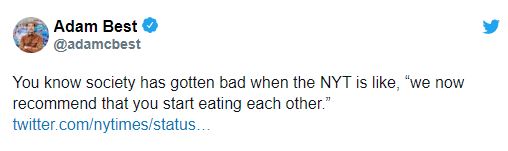
Many had clearly not even bothered to read the article:
And a blessedly brief journalist, Sameera Khan, tweeted
“THIS IS SATANISM”
Greg Gutfeld on his high rating Fox talk show (if you haven’t seen him, imagine a fairy waved a wand and turned The Colbert Report into a real boy) took the opportunity to pack every cannibal pun imaginable (“it’s an ATE part series”) into a short segment, as well as several digs at other shows run by Liberals such as Samantha Bee, and their regular target, CNN. Gutfeld accuses comedian Tom Shillue (formerly of The Daily Show!) of thinking he would be delicious, because he is all white meat.
The gist of much of the criticism was that the Liberal elite are trying to normalise cannibalism, as a way to – what? Reduce overpopulation? Feed the hungry? The website Editorials 360 accuses a “globalist cabal” of planning to make us all eat insects and humans, and drink recycled sewage, a fiendish plot “to enslave, denigrate and dehumanize humanity.”
The website TMZ recalled that the movie Soylent Green was set in 2022, which was then fifty years in the future, but is now, well, now. Are we in fact normalising cannibalism, because it is the logical end-point of voracious consumerism?

Soylent Green is a good place to start the analysis of this “normalizing” phenomenon. Even after fifty years, it is still the movie many people name when cannibalism comes up in discussion (as it seems to do quite a lot whenever thecannibalguy is around). The movie [spoiler alert] was set in 2022 New York, which is portrayed as part of a failed state, in which overpopulation and global warming has led to a chronic shortage of food, leading the authorities (secretly) to grind up humans who have died (or agreed to be euthanised) and convert them into nutritious protein crackers called Soylent Green. Setting it in 2022 was a bit pessimistic, but let us remember that the world’s human population has almost doubled since the movie was made fifty years ago, and that CO2 concentration was 330 parts per million in 1973, compared to around 420 now. Are we entering a time when our voracious consumerism will so deplete the planet that, as Cormac McCarthy suggested, the only thing left to eat will be each other?
Chelsea Summers put it in a political context, relating cannibalism to capitalism:
“Cannibalism is about consumption and it’s about burning up from the inside in order to exist.”
The magazine Evie, which describes itself as “the sister you never had” explains the extraordinary growth of interest in cannibalism stories by referring to the quasi-religious conceits of anthropocentrism:
“Cannibalism is the extreme conclusion of the idea that humans – and their bodies – do not have inherent value that demands respect. American society has been traveling down this philosophical road for a while. It started with legalizing abortion: After Roe v. Wade in 1973, any baby born or killed was just a “choice” at the mercy of their parents. They were not recognized as having inherent value with rights to their body or their life. More recently were the mandatory lockdowns, mask wearing, and vaccinations for Covid-19. Again, a lack of respect for human bodies and for our ability to make decisions for ourselves occurred. The encroachment on human dignity could potentially continue to progress into cannibalism – where the bodies of others have no inherent meaning, value, or sacredness that separates them from the animals we do rightfully and naturally eat.”
Lots of problems with that explanation, not least no attempt to explain the “inherent value” of humans or the assumption that we can eat other animals “rightfully and naturally.” But it is a pretty good summation of the unexamined assumptions at the heart of most writings on cannibalism, or carnivorism, or vivisection, or hunting – the idea that humans are somehow more than animals, and less than edible, while every other species on the planet is stripped of all moral value.
However, talking about cannibalism can put people off the slaughter treadmill altogether. When fact checkers came to ask Chelsea Summers about the way the book’s anti-heroine gastronomically prepares her murdered lovers, their questions about the intricacies of human butchery so disturbed her that she went “full raw vegan for two weeks.” Tobe Hooper gave up meat while making The Texas Chain Saw Massacre, saying “the heart of the film was about meat; it’s about the chain of life and killing sentient beings”. He also claimed that Guillermo Del Toro, no shrinking violet himself in abject filmmaking, gave up meat after seeing it. Bryan Fuller, creator of Hannibal, gave up eating meat during filming of the first season, telling Entertainment Weekly he had been:
“writing about cannibalism for the last three years but also doing considerable research on the psychology of animals, and how sophisticated cows and pigs and the animals that we eat actually are.”
Shows like Hannibal and The Santa Clarita Diet show human flesh as “just meat.” But to do that, they have to (their legal departments insist) come up with ways of simulating the human flesh without actually killing people (or digging them up like Ed Gein). The Yellowjackets prop team chose to use venison (think Bambi). But, the showrunners warned,
“they’ll have to find an alternative for future episodes, because many in its cast are vegan.”
Portrayals of cannibalism, whether actual or fictional, can make some people hungry, and turn others against eating flesh.

Gutfeld points out that:
“In the mind of the NY Times, it’s probably more humane to eat a human being than an animal.”
By “animal”, Gutfeld presumably means every multicellular, eukaryotic organisms in the biological kingdom Animalia except one – Homo sapiens. We know we are a species of great ape, but spend much of our time pretending we don’t know that.
Being humane, being ethical, is largely about respect and consent. Which was precisely the defence offered by Armin Meiwes when arrested for eating a man who had made it very clear he wanted to be eaten. Cannibalism texts, in ever-increasing numbers, joyfully confound the human/animal divide, and show the human body as edible flesh. So it is not surprising that such questions will be raised, and that, as the NYT said, “that time is now.”
However, Ted Cruz, who likes cannibalism jokes as much as the next meal, came up with a brilliant two-word solution that will put people off human flesh for a considerable time:


 The Cannibal Guy