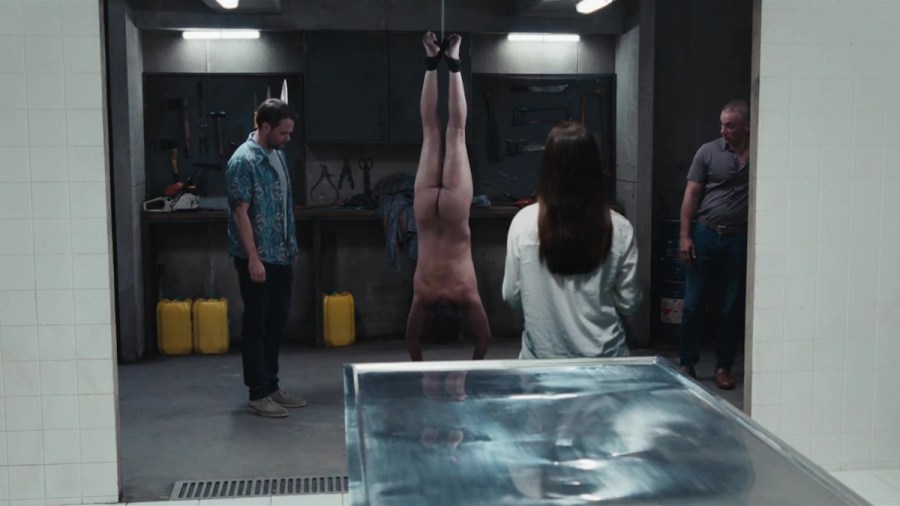
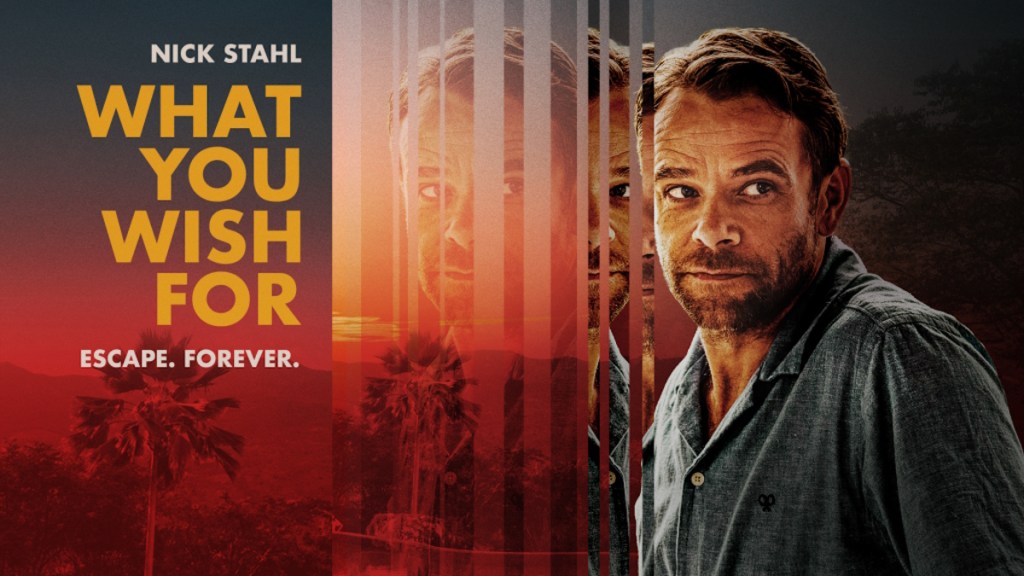
“WHAT YOU WISH FOR” (Nicholas Tomnay, 2024)

Be careful what you wish for! Aesop warned us of that over two thousand years ago, in his fable “The Old Man and Death.” In that story, an old man is so sick of picking up wood in the forest that he drops his bundle and calls on death to free him from his never-ending labours. But when Death appears, he reconsiders, and asks Death just to replace the bundle of sticks onto his back. In this movie, the sticks are gambling debts, and Death is a catering agency that pays chefs to kill people and cook them for rich people. Can his request be retracted like Aesop’s old man?

Look, many of us have sat in a restaurant, even (perhaps especially) the expensive ones, wondering what the hell we were eating. We rarely ask though – too polite, too squeamish, or too indifferent. If it’s on the menu, we figure, it must be OK. Once we’ve asked the waiter for the dish, it’s usually too late to retract. In Mark Mylod’s 2022 film The Menu, audiences speculated on whether the Chef (Ralph Fiennes) had served up humans in his exquisite banquets, including perhaps the Sous Chef and even his own mother, but it was never spelled out, so has not graced this cannibalism blog.

But in this week’s film, Nicholas Tomnay’s What You Wish For, the cannibalism is much more open, particularly for the diners, who are willing to pay big bucks for this, shall we say, unorthodox cuisine. Nicholas Tomnay is an Aussie (like the author of this blog) who works out of Sydney, New York and San Francisco. His first feature film was The Perfect Host (2010) which also included a lot of dining, and What You Wish For follows in this vein, but with a lot of human flesh involved.
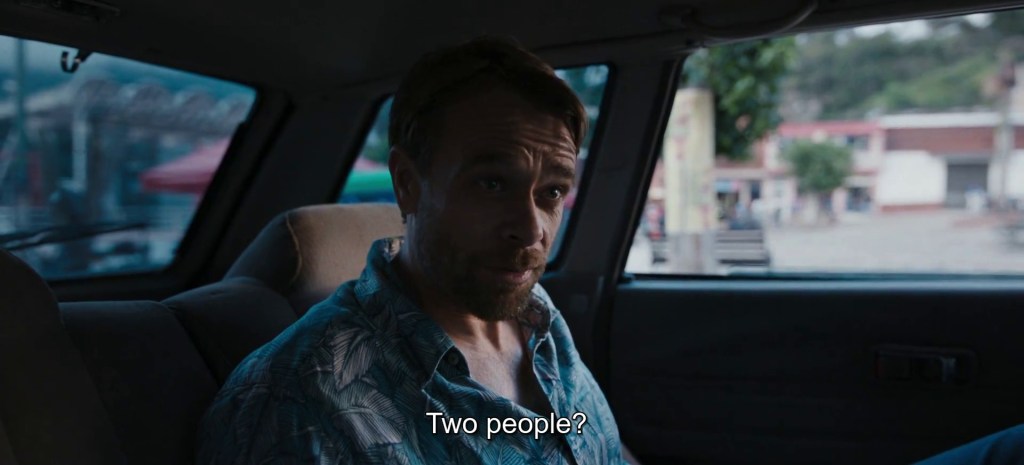
Ryan (Nick Stahl from Man Without a Face) arrives in Colombia (South America) at the invitation of his old friend Jack (Brian Groh). Ryan is on the run from massive gambling debts he has foolishly amassed. Although the debt collectors don’t know where he is, they do know where his mother is, and send him pictures to prove it. He needs lots of money and quickly. His friend Jack seems to have it all – a fancy house where he just has to cook one meal for the agency that contracts him, a fortune in his bank, and big pay cheques delivered after each meal.

But Jack is troubled by conscience, telling Ryan,

“The reward always matches the atrocity”

While Ryan is still coveting Jack’s lifestyle, Jack hangs himself. Recovering from the shock, Ryan realises that all he needs is a fake driver’s licence and a new password to become Jack and access all his money.

But when the agency people arrive – Imogen (Tamsin Topolski) and Maurice (Juan Carlos Messier) – they think he is Jack, and assume he knows what they want him to cook, are angry that he has not yet harvested the meat.

It turns out that his “ingredients” are local poor people, preferably ones who won’t be missed, and Imogen warns him that preparing and serving one bad course will be fatal not just to the person being cooked, but to the chef as well. The guests pay $1.5 million for the meal, including the exotic location, the private jets, and the specially sourced meat. They have special requests too – Imogen tells him “make sure you harvest the tongue.” So any thought of Ryan skipping out before the feast is extremely unpalatable (sorry).

The rationalisation is the same one found in most capitalist enterprises. It is the utilitarian argument in favour of the greatest good for the greatest number. Imogen tells Ryan:

“We kill on average fifty people a year, plus twenty-five in the clean-up. So, 75 deaths a year, and we generate over one hundred million dollars. We funnel 100% of our profits back into the communities. The farming, the infrastructure. We ensure clean drinking water for the entire population. You might say that’s simply self-interest. But we don’t eat everybody. Not even one percent. Now, you tell me what company makes that amount of money, has global presence, assists more than 99% of the people in the communities within which it operates, and their footprint has only ever killed 75 people a year? Oil companies kill on average 110 people a year, farmers are on about 250. Groundskeepers, truck drivers, roofers, they all thrash us in fatalities.”

 The rest of the discussion is phrased in the same vocabulary as used by the meat industries. Old ones will taste disgusting, fear will taint the meat, the butcher will be covered in blood.

The victims are “produce” and become no more or less than “livestock”. Maurice, the agency killer who goes hunting with Jack, assures him “they won’t feel a thing”. When Ryan asks him if he feels bad, the reply is,

“Do you feel sad for a pig when you eat the bacon?”

Jack does what he has to do, after all his attempts to escape or alert the police are foiled.
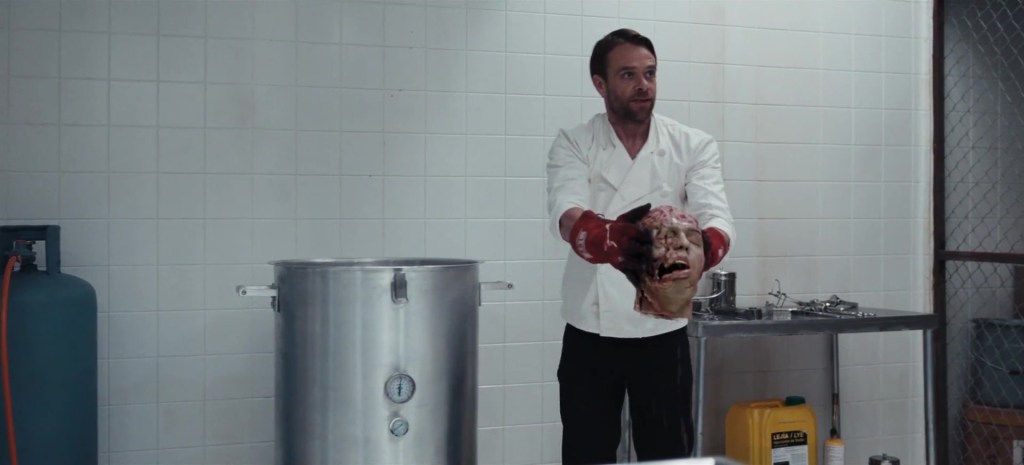
Imogen sympathises with his nagging conscience, telling him what every soldier, assassin, slaughterhouse worker or meat eater is told at first:

“No one likes it at the beginning. But after a while, it does stop bothering you”.

There is a popular meme about “eating the rich”, and even a few movies about it (e.g. Eat the Rich and Eating Raoul). But the facts of nature, humanity and economics are that the rich and powerful get to choose what, and who, they eat. In the film The Cannibal Club, rich Brazilians watch poor people fight to the death and then eat the loser, in Fresh, the protagonist chats up young women then drugs them and sells their flesh and their underwear to the “one percent of the one percent” who want what no one else can have, and can afford to pay for it. Jeffrey Epstein had a similar gig, supplying sex rather than meat.

The people with the power, the rich, eat the poor: they swallow their surplus labour, they squeeze rent from them, they sell them their shoddy products paid for by lending them money at ruinous rates, and they send their children off to war. Why not go the next step and literally cook them for dinner? It’s what we do to other animals, purely because we can.
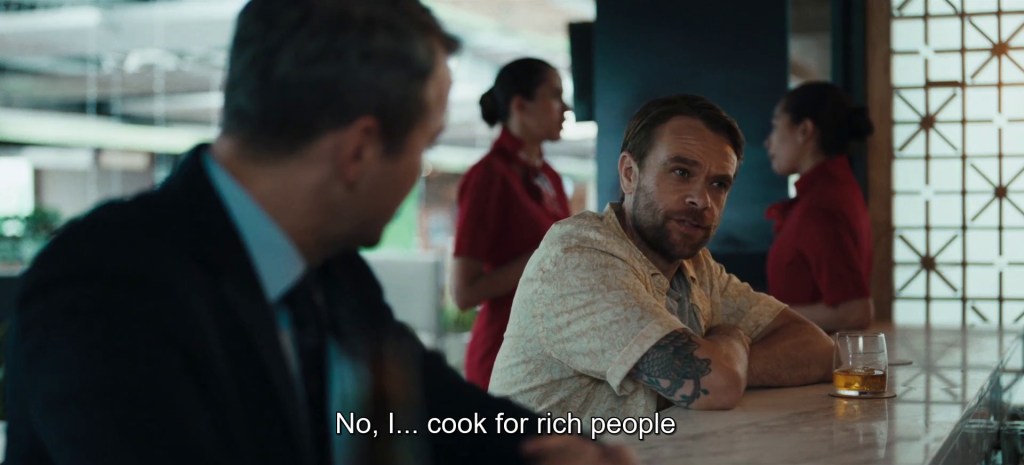
The film is sumptuously presented, the direction is assured and convincing, and the actors are all first rate, including the wealthy guests and the police who pop by and share the main course. The film is rated 80% “Fresh” on Rotten Tomatoes.

One reviewer opined, What You Wish For will convert you to vegetarianism forever”.
“What do you collect?” THE MAN WHO COLLECTED FOOD (Matthew Roth, 2010)

Written, directed and produced by Matthew Roth, The Man who Collected Food (also released as Cannibal Collector) is a parable of modern consumerist society.

Miguel (Mike N. Kelly) is the unexceptional, almost unnoticeable man next door (like most modern cannibals), who is quietly (or sometimes noisily) proud of his collection. What he collects is food, and he hoards it in cupboards and on display shelving. Like any serious collector (think of Barbie collections or comic books), it is definitely not for consumption.

He carefully stores his purchases in their original packaging, knowing that they would be ruined as collector’s items if he were to open them or, heaven forbid, eat them! Like any obsession, collecting takes over his life.

To survive without spoiling his collection, he eats people. He won’t open any of his food packets, but has a cold-room full of abducted humans, collected according to ethnicity, some already cooked, others tied and gagged and awaiting prep, which involves unfastening them and then chasing and killing them with various fun toys like mediaeval maces.

“Mother always told me to never play with my food. But I don’t think she know how much fun it really is.”

It’s just his quirk, and his neighbours are presented as even crazier than him. There’s the deer hunters, identical father and son in matching lumberjack plaid, and then there’s Kelvin, who runs around with a shotgun shooting at aliens (and who is covered in what he claims are bits of their green brains).

Kelvin sums up the film’s theme:

“I believe that there’s something a little strange in all of us. Whether we’d like to admit it or not, there’s just that one thing we don’t want anyone else to know about.”

Miguel attends a group therapy meeting for people with traumas and more common addictions like sex and cigarettes. He tells the group he collects food, which doesn’t seem that big a deal, until he adds,

“In order to keep my collection in mint condition, I have to resort to cannibalism.”

He tells them he can’t eat “animals” because they are food, and so belong in his collection. The facilitator asks him how that is logical, in that people are also food, at least to cannibals, but he points out that people are not food to other people.

“They don’t package or can people, if they had people-sized packages, then you’d have a better argument.”

She might have had better luck pointing out that people are animals too. Instead, she announces that they are all going to go to his home to open all his packets as therapy, and that makes him really mad. The middle of the film is a long, slow-motion sequence of him killing all the people in the group, and then the cleaner who finds the bodies.

His secret is discovered by the deer hunters who decide to hunt him, until he kills and eats them, then hears a phone message about a friend who keeps escaping death in various accidents and is called “the luckiest man in the world”.

Taking the essentialist argument seriously, Miguel decides that eating such a man might allow him to incorporate that luck, and finally find what he has been searching for: “that package of Ranch Wall Rice with Chicken and Vegetables”. Eating the “luckiest man in the world” will, he hopes, make him lucky.

Taking obsession to its logical conclusion, The Man Who Collected Food is a black comedy (or red comedy given the amounts of gore) with a serious message; a critique of modern consumerism.

“It’s all because I’m different. Sometimes I just wish I could collect comics or coins or anything – it has to be food, food, food!”

Our appetites are incited by marketing and advertising, while at the same time we are told that the Earth is being destroyed by our voracious cravings. We are insatiable, and yet we are ashamed of that. As Dylan said,

“If my thought-dreams could be seen, they’d probably put my head in a guillotine,
but it’s all right Ma, it’s life and life only!”

The script is somewhat feeble and the acting varies between wooden and histrionic. The film earned a respectable 71% “fresh” on Rotten Tomatoes, even though there are no reviews listed. But nonetheless, it’s entertaining and funny, the theme music by Daniel Alcheh is terrific, and the gore hounds will appreciate the amount of carnage. And it actually has a lot to say about obsession, greed, consumerist voracity, and the illogical cultural binaries of edibility and abhorrence. Worth a look, if you can find it.

Cannibalism news July 2021: FRENCH POLICE SHOOT SUSPECTED CANNIBAL AFTER BOY’S HEAD FOUND IN BUCKET

French police fatally shot a 32-year-old man suspected of cannibalism on Monday morning (July 19) following the discovery of the decapitated corpse and partially consumed head of a 13-year-old boy.

Police found the remains on Sunday in an apartment in the southern France town of Tarascon, a town between Avignon and Arles.

Public prosecutor Laurent Gumbau told Agence France-Presse that strips of flesh had been ripped from a shoulder, sparking suspicions of cannibalism.

“The body found may be that of the minor… However, it was impossible at the current time to confirm the hypothesis of anthropophagy (cannibalism).” 

The boy disappeared on his way from his foster home in Marseille, about 60 miles away, to see his mother in Tarascon.

Late Sunday night, a neighbour called police and reported seeing a body in a garbage bag. A man, who had previous convictions for acts of violence, fled from his apartment when police arrived by jumping over rooftops, neighbours told the news outlet. Three hours later police found the man and shot him dead, the prosecutor said, adding that the suspect did not appear to have been armed at the time of his death, and had not been formally identified as the killer.

In his apartment, the Bouches-du-Rhône police discovered a dead body in the kitchen, but its right arm and head were missing. The head was later found in a bucket in the bathroom and, according to Le Figaro, had been partially eaten. Satanic cult objects were also found in the home.

Homicide has been with us since the first apeman lifted a bone to beat a rival to death (or actually well before that, using teeth and claws). It is likely that the victor in those early spats would have been loath to waste the resulting meaty corpse.

2001: A Space Odyssey

Accounts of cannibalism still seem to focus on the primitive, the ‘savage’ cannibals eating the unwary missionary who stumbles upon their village, even though there is little evidence that such events ever happened. But in recent years, cannibalism has increasingly been found within our ‘civilised’ cities and towns. 2020 was a big year for cannibalism. So far in 2021, we have had THE OKLAHOMA CANNIBAL in the US and the MEXICAN CANNIBAL who allegedly killed and ate some thirty women. In South Africa at the moment, deadly rioting has led to food shortages that, according to one community leader, has led people to consider cannibalism. Then we have the whole Armie Hammer uproar. These cases, like the one in France, are usually put down to psychotic deviance, the psychological equivalent of a mystified shrug. But economics and politics play their parts too, as does a loss of respect – treating humans as animals (which of course we are) emanates from treating animals as morally valueless, as mere commodities.

Could it be that a toxic mixture of urban loneliness and rampant consumerism, particularly of animal bodies, together with the stripping of humans of their formerly assumed metaphysical superiority to other animals, is leading the murderer to the same conclusion chosen by our pre-sapien ancestors: why waste the meat?

Halloween display in Ukrainian butcher shop window

Humans as livestock: THE FARM (Hans Stjernswärd, 2018)

What does it mean to be “treated like an animal”? We humans are, after all, animals, one species of the family Hominid, or great apes. So why should we not be treated like animals, or, if we are averse to abuse, why then do we treat non-human animals “like animals”? The ultimate act of treating humans “like animals” is the killing and eating or the human body, which of course is made of meat, and various other edible parts.

One of the classics of cannibal studies is the film The Texas Chain Saw Massacre, made on a tight budget by Tobe Hooper in 1974, and remade and turned into multiple sequels since then. In these films, cannibals capture and slaughter tourists for their flesh. The Farm attempts to push the slaughter metaphor a whole lot further.

The cannibal who dwells among us has been a popular trope since Sweeney Todd the Barber starting cutting the throats of his customers over 200 years ago, carting their bodies to the pie shop of Mrs Lovett, who turned them into very popular pies. There have been multiple versions of this story, the latest being a musical with Johnny Depp and Helena Bonham Carter. Variations on this theme included Motel Hell and the Danish comedy Green Butcher, starring Mads Mikkelsen (21st century Hannibal Lecter) as you have never seen him before.

vlcsnap-2018-08-15-15h07m49s449
It’s Mads, Captain, but not as we know it.

Early cannibal stories concentrated on ‘savages’ who ate us just because that’s what the imperialists told us that was what primitive peoples did. Sweeney and his ilk looked a lot like us, but happened to be less discriminating when it came to sourcing their meat. Slasher cannibals were a hybrid – a fusion of the foreign savage and the domestic entrepreneur – they were modern, civilised people who had sunk back into voracious savagery. Texas Chain Saw was a progenitor of the slasher films in which a bunch of urban trendies come up against a whole family of degenerate cannibals – people who have dropped (or been thrown) out of civil society and reverted to savagery and cannibalism. Stories about semi-human, savage cannibals waylaying travellers date back to at least Sawney Bean and his incestuous cannibal family in 16th century Scotland, or even further back to Homer’s Cyclops or the various monsters reported by Herodotus.

What slasher and savage cannibal movies had in common was that the cannibals were more of the hunter-gatherer type, setting traps or chasing potential prey, as our ancestors did for a couple of hundred thousand years before the agricultural revolution started, some ten thousand years ago. At that time, we started selectively breeding animals, confining them, controlling their lifecycles, harvesting their bodily secretions, and slaughtering them for meat at our convenience. This movie, The Farm, takes that social evolution into the world of cannibals. What if our backroad cannibals didn’t just chase down tourists, but farmed humans for their meat and their milk?

It’s an intriguing premise, which starts with the traditional horror preamble, a young couple, Nora (Nora Yessayan, who also did the casting) and Alec (Alec Gaylord) stopping for the night somewhere they should know better than to stop, much like Brad and Janet in Rocky Horror Show.

These films have a formula – the sassy, city folk, some of them in an unmarried relationship (and being judged and often punished for it).

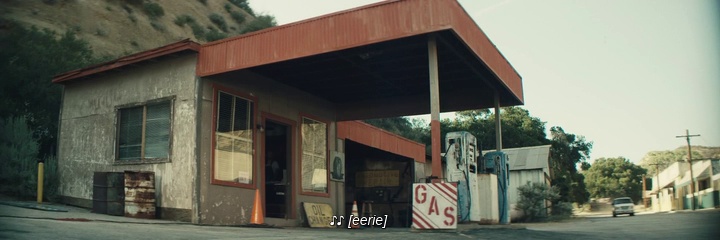
The diner with food of an indeterminable origin, the gas station with the weird attendant.

The house or motel with some nasty surprises (e.g. bloodstained sheets), and (yes) the monster under the bed.

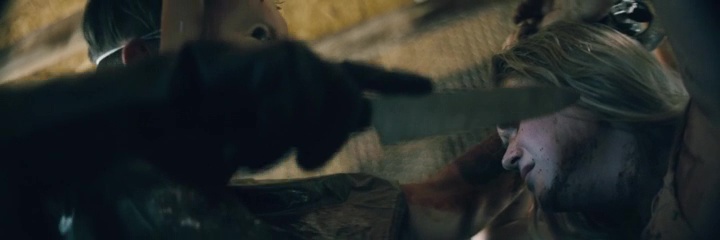
But The Farm goes off in another direction after that. The young couple are captured and put in cages.

They are gagged, and so they are voiceless, the way we consider farm animals to be, and treated ruthlessly by the farmers, who are mostly wearing animal masks.

Nora is tied with her legs apart and artificially inseminated, as happens to millions of cows every year.

Alec is confined, knocked on the head and taken off to where human meat is harvested. Somehow, he survives that and comes looking for Nora.

The farm is a catering company, cooking and selling the meat for festive events.

The captured human men are killed whenever fresh meat is needed, the women are fitted to suction machines and their milk is collected.

When they can no longer become pregnant, they are added to the butchery.

I guess we are (most of us) aware that cows, like all mammals, have to give birth before they produce milk. On this farm, as on dairy farms world-wide, the babies are waste products of milk production and are killed soon after they are born. That indifferent killing of the innocent is the most disturbing scene of the film.

Look, it’s BUSINESS. Just as billions of male chicks are minced alive at hatcheries because they can’t lay eggs, so dairy calves are killed if they can’t produce milk, and human babies dashed against the concrete floor in the milking sheds of The Farm. Of course, businesses of all sorts have production and quality problems, and have to deal with unhappy customers.

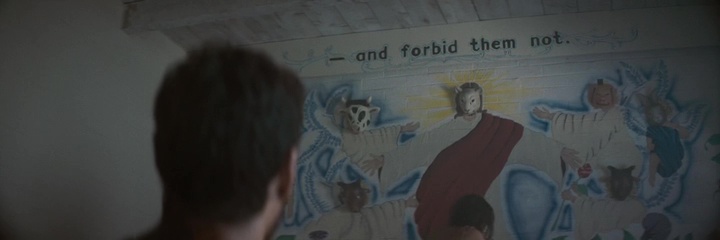
Nora and Alec escape and seek refuge in a church. How much sympathy would an escaped cow or sheep or pig get in a church? It does give us an understanding of the ideology of the Farm though, with it’s mural based on Matthew 19:14:

Suffer little children, and forbid them not, to come unto me: for of such is the kingdom of heaven.

Farmed animals are often compared to children in that they are vulnerable, selectively bred to be dependent and of course are mostly slaughtered when still infant or barely adult. The Dean of St Paul’s, William Ralph Inge, wrote in “The Idea of Progress”,

“We have enslaved the rest of the animal creation, and have treated our distant cousins in fur and feathers so badly that beyond doubt, if they were able to formulate a religion, they would depict the Devil in human form.”

Nora and Alec, at the start of the film, stopped at a café near the Farm, where they were watched as they uncaringly ate beef and bacon burgers. They were, without their knowledge, judged guilty of eating flesh, of cannibalism of their fellow mammals, and the “animals” are now harvesting their bodies in return.

Eric from scariesthings.com summarised:

“this is a tough watch for most audiences and is even a little rough for hardened horror fans”

The reviewers either loved or hated The Farm. Very few thought it was just OK; it was either slammed as stupid and badly made or lauded as a brilliant expose of modern animal agriculture, told in a looking-glass world where we are the animals. I tend to the second view, but I hope you will get the chance to decide for yourself. The film seems to be on Amazon Prime.

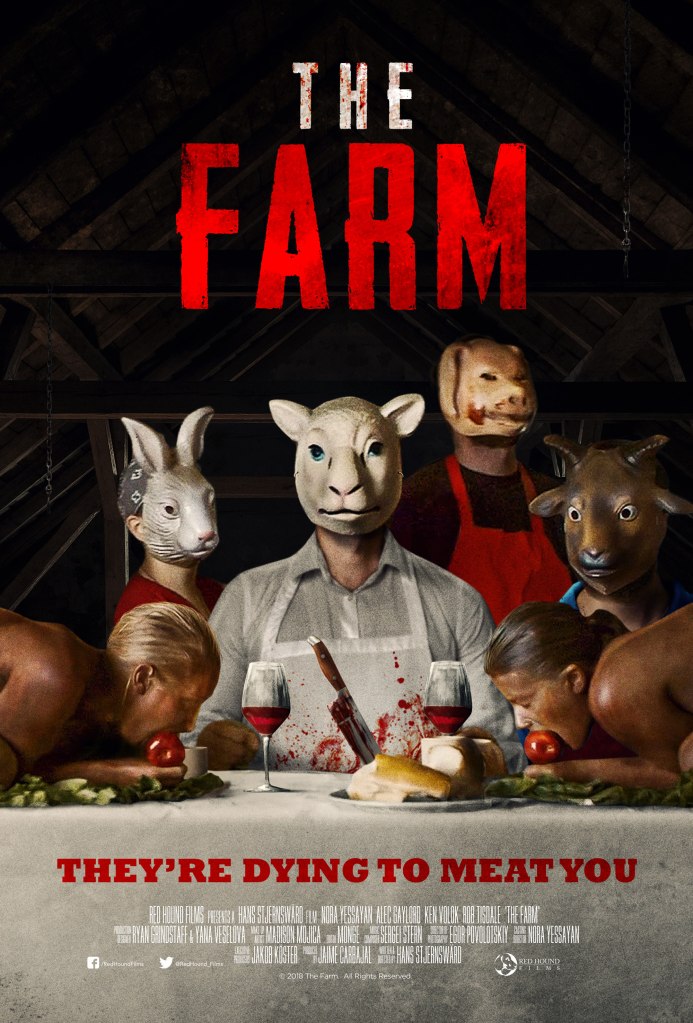
I won’t tell you the ending, but the poster kinda gives it away…