“He got shot down in New Guinea, and they never found the body because there used to be — there were a lot of cannibals, for real, in that part of New Guinea.”
This anecdote aroused plenty of outrage from PNG politicians who proclaimed that there was never, not much, or hardly any cannibalism in the good old days.
But now the story has once again raised its well-chewed head. 2025 is the 50th anniversary of independence for PNG, a year which was expected to be a celebration. Instead, the news is full of stories about nine people being killed in shootouts in Enga Province over that New Year period, as violence escalates in the highlands, a region that was hit by a catastrophic landslide last May.
That news was overshadowed by a video that soon went viral of armed gang members holding mutilated body parts in Central Province, 60 miles (100 km) from the capital.
Voices in the Tok Pisin language on the video said they planned to eat the victim, with one man making licking motions as they displayed a severed foot, saying,
“this is our meat, we will cook it and eat it”
There was an immediate furore over the claims of cannibalism. Police said the deceased was killed in a dispute in the remote Goilala mountains in the province, but there are conflicting accounts of when the video was made.
Prime Minister James Marape called for calm, and stated,
“Such acts of inhumanity are intolerable and represent a significant challenge to our shared humanity”
Marape had objected to Biden’s claims about cannibalism during the war, saying that PNG did not deserve to be labelled as a nation of cannibals.
Community leader Matilda Koma from Auga Dilava added,
“We do not eat people. Goilala people are not cannibals”
Fane’s Catholic priest Francis Pirit said that the video of the killing and youths pretending to eat human remains was a show of bravado, boasting because they had won a battle.
“There are no cannibals in the Goilala area. I sleep, eat and live amongst them. They do not eat human beings”
Despite the boast by the men, there is no footage of flesh being eaten in the gruesome video.
Cannibalism in PNG was largely a ritual practice by a small number of tribes and largely ceased by the 1960s after being banned by the colonial power, Australia. The suspicion that colonised peoples are inevitably cannibals has never completely disappeared; when the Australian soldiers of the 7th Division AIF began to find mutilated and cannibalised bodies in New Guinea in late 1942, they were not sure whether to blame the Japanese or local tribesmen. After a lengthy commission of enquiry, the Australian government in 1945 finally added cannibalism to the War Crimes Act 1945, the only nation to do so.
As recently as 2012, 29 members of a “cannibal cult” were arrested in Madang province on PNG’s northeast coast. Forensic reports and statements made by the accused led police to believe parts of the victims had been eaten.
One of the more persuasive substantiations of PNG cannibalism was Kuru, a rare, incurable neurodegenerative prion disorder that was found in the Fore people of Papua New Guinea in the middle of the last century. Kuru is a form of transmissible spongiform encephalopathy, related to the “mad cow” disease that cured people from eating beef for many years, and appears to have been spread by funerary cannibalism. It is often touted as a reason not to be a cannibal, appearing unexpectedly in films like Jim Mickle’s We Are What We Are and many films about wendigos.
So, cannibalism remains a sensitive topic in PNG. President of the PNG Law Society Hubert Namani sparked outrage when his comments condemning the “barbaric killing, mutilation and cannibalism” over the festive season were reported by the Post Courier newspaper.
Meanwhile, Goilala’s local member of parliament, Casmiro Aio, pointed out this week that there had been no regular police presence in his electorate for 10 years.
The questions remain – did any of the dead people get eaten? And more interestingly, why would that be so much more appalling than the fact that nine people were killed?
‘There will be cannibalism, and rumours of cannibalism”
Yes, I paraphrased the Book of Matthew. Although not all that many people got eaten, the media was full of cannibal stories, and here are a few of them, sorted by their places of occurrence.
Australia
One of the men imprisoned for the so-called Snowtown murders (which mostly did not take place in the little town of Snowtown) was released. Mark Haydon was charged with assisting the men who did the actual killing and who ate part of one victim’s leg some 25 years earlier.
Brazil
Influencer Israel dos Santos Assis, better known online as Pinguim (Penguin) was arrested for desecrating graves in the cemetery of San Francisco the Count in the Salvador Metropolitan Region, stealing human bones, and using human flesh from the corpses to cook his most popular dish: feijoada, a bean stew usually involved simmering beans with beef or pork. Seems rotting human is a good substitute for pork.
Canada
Robert Pickton, the pig farmer convicted of six counts of second-degree murder (although he was charged with at least twenty others), was attacked by another inmate in prison and died a few weeks later. Pickton allegedly “processed” the meat of his rape and murder victims by feeding them to his pigs and, police said, possibly mixing them up with pork products he sold to his neighbours for their personal consumption.
China
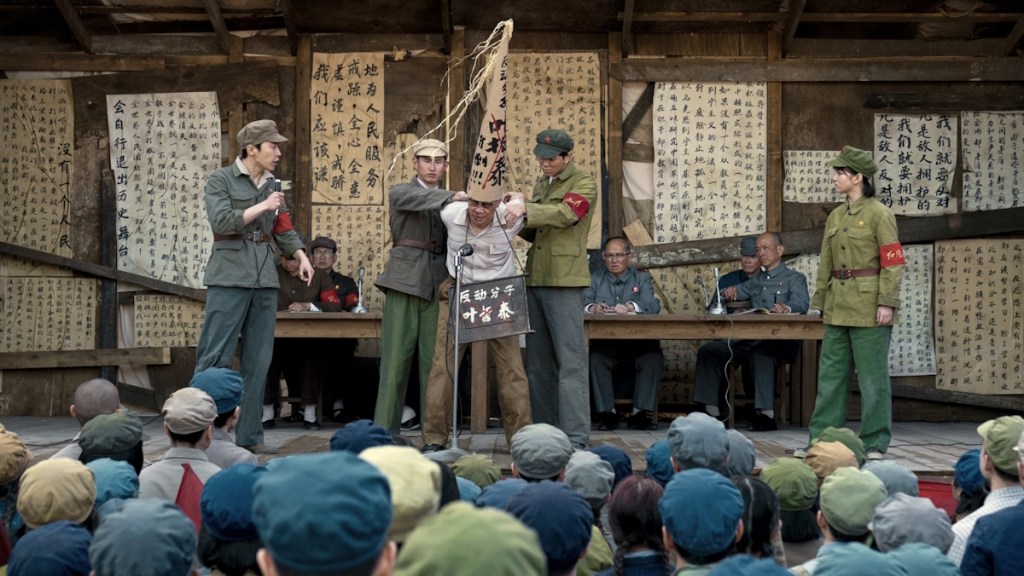
Netflix released a new version of the classic science fiction book 3 Body Problem and ran into a storm of criticism from China for its depictions of the extreme violence of the Cultural Revolution. Although most of the victims of the purges were killed by shooting, live burial, drowning, boiling alive, and disembowelling, there is evidence that several hundred had been cannibalised, as the ultimate in humiliation.
The General who presided over a Cultural Revolution massacre that included cannibalism of those deemed “enemies of the people”, Wei Guoqing, was reburied (or at least his ashes were) with full honours in Beijing’s Babaoshan Revolutionary Cemetery – the resting place of China’s high-ranking leaders and revolutionary heroes. Wei’s name is most strongly linked in the public mind with cannibalism during the massacre period in Guangxi’s Wuxuan and Wuming counties and Nanning city. Researchers have found that at least 137 people were eaten, with thousands participating. “Paying tribute to a legendary gourmet,” wrote one wag on social media.
Cuba
Stories began circulating this year that the extreme food shortages in Cuba were leading to the danger, or actual occurrence, of cannibalism. This was bolstered by reports from 2022 of two hospital workers who had been stealing hearts and fat from human bodies and selling them as mince.
Haiti
Rumours circulated that the natural disasters and gang violence in Haiti was leading to starvation cannibalism. Jimmy Cherizier, a gang leader called Barbecue (“Babekyou” in the local parlance) was known for his penchant for burning people alive, and there was at least one video on Twitter/X of one gang member supposedly “tearing flesh from the leg of a burning corpse and eating it.” Such stories cannot be selfishly maintained by one little country, so of course it was not long before Bill and Hillary Clinton were accused of joining the cannibal feast. To add to the hilarity, Elon Musk posted on his own site, X, that a picture of a man near a fire was evidence of cannibalism, only to have the post removed by his own team for violating community standards. The fact-checking website Snopes pointed out that videos of bodies in Haiti being roasted on spits had previously appeared as accusations against a Nigerian restaurant, and were in fact from a Halloween prank in China in 2018. Still, you know, voodoo and all. Meanwhile, Trump ally Laura Loomer supplied conclusive proof that Haitians were cannibals: apparently, if you Google it, you will see a lot of results. The Prosecution rests its case.
India
India’s top court put a temporary stay on the execution of a man convicted of killing his mother and eating her remains in what is being deemed as the “rarest of rare” cases of cannibalism. Sunil Rama Kuchkoravi of western Maharashtra state’s Kolhapur district was handed a death penalty by a lower court in 2021 for killing his 63-year-old mother in 2017. The High Court in October this year upheld the death sentence against Kuchkoravi, stating that the convict possibly has a “syndrome of pathological cannibalism”. The execution has been delayed until the case is reheard in April 2025.
Israel (and around there)
Francesca Albanese, the U.N. special rapporteur for Palestinian rights, has been condemned for antisemitic rhetoric by the governments of the U.S., France and Germany among others. Albanese, known for accusing Israel of genocide (an odd charge seeing that the population of Gaza has increased in the last twelve months), wrote that the Israeli army was “rotten to the core”. A follower immediately introduced the classic blood libel: “Jews are capable of eating human flesh”, to which Albanese replied along the lines of “not all Jews”. Reassuring to note that a person paid by the taxpayers of the West, who finance the UN, can admit that some Jews are not cannibals!
A Yazidi woman was rescued from Gaza by Israeli troops. She revealed that, after being captured by ISIS in 2014 and forced to be sex slaves, the women were starved and finally fed meat which, they later told her, was from the bodies of a beheaded Yazidi baby, the child of one of the women. They told her:
‘We cooked your one-year-old son that we took from you, and this is what you just ate’.
Indonesia
Police investigated a suspected cannibalism case in West Java Province. The Head of the Criminal Investigation Unit confirmed that a video on social media showed the alleged perpetrator consuming a small portion of the victim’s flesh. He said that police had found 12 body parts of the victim at the crime scene.
Italy
An inmate in the notorious Poggioreale Prison in Naples tore the finger off another inmate and ate it. The Campania Guarantor, Samuele Ciambriello, observed that “it is now clear that the Poggioreale prison needs a structure suitable for hosting inmates suffering from mental disorders.” Seems like a good idea.
Mexico
A podcast called Mexico Unexplained revisited this year the story of Gabriela Rico Jiménez, a 21-year-old model from Mexico who disappeared some 15 years ago, after raging against the machine outside a fancy hotel in Monterrey Nuevo Leon. Ranting about the elites, including oddly the Queens of England and Germany (which is a Republic), she had shouted that “They ate humans! Disgusting!… They smell like human flesh!”
Nigeria
A man accused of being a sorcerer was blamed by villagers of the small town of Kirikiri for the disappearance of several children and elderly people. He was supposed to be “feeding on the flesh of the innocent.” Several claimed to have located the individual on the edge of a forest, wearing clothes “stained with blood” and mumbling mysterious incantations. A group of villagers beat the man and left him for dead.
Russia
Erkinzhon Abdurakhmanov, 47, intended to cure his own heart problems ‘after making a pact with the devil’, he told police. He killed a 65-year-old male pensioner in the Kuyurgazinsky district of Russian region Bashkortostan by striking him three times with an axe, according to reports. He then then cut out the heart and ‘ate the meal’ as he waited at a bus stop. He gave the uneaten remains to a woman also waiting for a bus ‘and asked her to bury it’. He was not arrested, however, until he headed into a liquor store and tried to steal some drinks. Cannibalism is not against the law in Russia, but murder and stealing alcohol is.
Vladimar Putin’s policy of giving pardons to criminals who agreed to fight in Ukraine in lieu of serving their sentences, was honoured in a pardon to a charmer named Denis Gorin, who had been convicted of at least four murders, and had eaten the flesh of his victims.
Another pardon involved Dmitri Malyshev. Malyshev was sentenced to 25 years in prison in 2015 for multiple criminal offences. Ten years ago, he murdered an acquaintance, a Tajik native, and then filmed himself cutting the heart out of the victim and roasting it in a frying pan and eating it. Neighbours seemed uneasy about his imminent return home.
South Africa
On December 26, 2024, eight illegal miners known as zama zamas emerged from Shaft 10 of a mine near Stilfontein, located in Northwest South Africa. They were taken by police, who confirmed that twelve bodies remained trapped beneath the ground, with miners reportedly resorting to eating human flesh due to severe food shortages.
[GRAPHIC CONTENT] Illegal miners have started eating human flesh. That's according to SANCO North West Spokesperson, Mzukisi Jam. The claims were made in Christmas Eve letters sent to the surface claiming that more miners have died. #DStv403#eNCApic.twitter.com/vqDodTXgmZ
Novosibirsk Archpriest Alexander Novopashin became notorious for claiming that Ukrainians are “cannibals”. Although conspiracy theories about cannibals are becoming more common, this particular Archpriest is taken seriously in Russia, and regularly lectures Russian security forces and soldiers.
UK
Marius Gustavson, who called himself “the eunuch maker”, offered a service where he charged men to destroy or remove their testicles, and then charged subscribers to his website to see him perform the operations. The court heard that that there was “clear evidence” of cannibalism and that Gustavson had “cooked testicles for lunch in an artfully arranged salad platter”.
Meanwhile, a candidate from a party called Reform UK was suspended for saying that meat-eaters should “eat other humans” and said humanity should be “obliterated”. Just saying what many are thinking, perhaps.
USA
The cannibal story of the year was the President, Joe Biden, claiming that his uncle had been eaten by cannibals in New Guinea. The leaders of PNG took exception to the stereotyping of their people as cannibals. Apparently, only some of them had been.
Speaking of Presidents, Donald Trump embellished his rhetoric on immigration by pointing out that some of the undocumented people pouring over the border were from insane asylums, and called that “Silence of the Lambs stuff”. Trump had previously claimed that Hannibal Lecter had endorsed his candidacy, which is a bit odd since Hannibal is a fictional character, but by far not the oddest claim in the 2024 election.
In March, a homeless man in Kern County was arrested for picking up the leg of a person who had been killed in a train accident and chowing down on it. California has no laws against cannibalism, but he was charged with “mutilating the body” which is a bit odd, since the train had already done that.
In Utah, which also has no law against cannibalism (Idaho is the only state that does), a law was passed to criminalise the ‘ritual abuse of a child’, which apparently regularly includes making the little ones eat “organic substance or material” (i.e. bits of people) before they are allowed to have their desserts. This in addition to claims that such rituals would sometimes involve eating the children instead.
A keen-eyed traveller pointed out that the road once taken by the Donner Party, which ended up in them getting lost and eating each other, was now signposted with a sign indicating dining was available. Much hilarity ensued on social media.
Conservative political commentator Candace Owens managed to link transexuals, Native Americans and cannibals, all in one sentence. No wonder she is so widely admired.
Much to the relief of the good people of Idaho (the only State in the Union with laws against cannibalism), the law was amended to ensure that giving someone else human flesh to eat was also prohibited. This led, on its long road to farce, to the accusation that bodies were being turned into compost which could be used to grow food for humans to consume. Rather than DNA test all compost, the law confined itself to banning the act of deliberately giving human flesh to another person. The legislator who introduced the bill cited a disturbing case on the show TruTV, which she admitted might have been a prank (it was) in which diners were told they had been eating human flesh, just to whet their appetites perhaps.
Ariana Grande raised some eyebrows when she was asked on a podcast whom she would most like to dine, and named Jeffrey Dahmer. Not sure Dahmer would have agreed – he was more into man-flesh, and there’s not much meat on Ariana anyway.
In April, a man was arrested in Las Vegas for eating a victim’s eyeballs and ears. The victim was pronounced dead. What happens in Vegas stays – internal.
Talking of ears, Mike Tyson, famous for biting the ear of Evander Holyfield in a fight in (where else) las Vegas in 1997, released a line of marijuana gummies shaped like nibbled ears.
Allegations were raised that Gilgo Beach ‘serial killer’ Rex Heuermann’s family was involved in the murders, which took place near the remote beach town of Gilgo in Suffolk County, New York from the 1990s to 2011. His daughter, who likes to paint the odd Satanic scene including body parts and cannibal feasts, was accused of being involved in his depredations. Homicide experts said that was insane, a word that gets tossed around a lot in cannibal stories. Heuermann was charged with a seventh murder last week.
On October 9, a woman in Kentucky, Torilena May Fields, was arrested after a dismembered body was found behind a home in Northern Kentucky and cooked human body parts were found in the oven. The body, and its parts, turned out to have been her mother. She was also charged with cruelty in that she “intentionally tortured and killed a domestic dog.”. A contractor found the dismembered body of the mother, and told police the perp had been “casting spells.” Her bail was set at $1.5 million. Her next court appearance is set for March 10, 2025 in Robertson County. Some people just give cannibalism a bad name.
Another Kentucky woman, a former youth counsellor, was arrested for allegedly discussing cannibalism and other hobbies with a convicted murderer.
In Oklahoma, Kevin Ray Underwood was executed by lethal injection in December (on his 45th birthday, the press gleefully informed us) for killing a ten-year-old girl in a “cannibalistic fantasy.” The man admitted to luring the girl into his apartment and beating her over the head with a cutting board before suffocating and sexually assaulting her. He told investigators that he nearly beheaded her in his bathtub before abandoning his plans to eat her. So not really a cannibalism story, but near enough.
International
Citizen of the world, Donald Duck, appeared on the interview show Hot Ones on the Internet (which is global), where guests eat chicken wings with hot sauce. Turns out Donald is a vegan though, preferring cauliflower, and since ducks aren’t chickens, the controversy that ensued over whether he was (or would have been) a cannibal by partaking of chicken was just silly.
HAPPY NEW YEAR, and may your worst problems be mild gastro-oesophageal reflux.
For the Term of His Natural Life is a 1927 Australian film directed, produced and co-written by Norman Dawn. It is based on the 1874 novel by Marcus Clarke, and was the most expensive Australian silent film ever made. It remains one of the most famous Australian films of the silent era. John Laws, in the trailer above, calls it “the grandest of them all, the climax of Australia’s silent cinema.” Amazingly, it was the third attempt to film the story, starting in 1908 with the film version of a stage play of the book, and then in 1911 another filmed stage adaptation, The Life of Rufus Dawes.
It’s the story of a gentleman (in the traditional sense of that obsolete term) who is wrongly convicted and transported to Australia for “the term of his natural life.” This was a fairly common trope in Victorian novels (no one wanted to read about real criminals), and was recreated by Tim Burton when he made Sweeney Todd into a returned convict in his version of the Demon Barber of Fleet Street. As a convict, he changes his name to Rufus Dawes, and the rest of the story tells of the brutality of life as a convict at Macquarie Harbour in Tasmania and his eventual escape to claim his innocence. And, in the American version of the film, a happy ending (the book and the British version saw the hero and his true love come to a watery end).
The bit that interests devotees of Cannibal Studies in this story is the escape of a group of men led by a particularly evil-looking convict named Matt Gabbett (played by Arthur McLaglen in the 1927 film).
Being a silent movie, even the narrator gets an intertitle card:
After nine days with no food, Gabbett points out that there are only two choices— starvation, or eating one of the followers, who has fortuitously become lame. We see him taking an axe to a fellow escapee, while the others cringe, as we suppose semi-civilised folk would.
Gabbett tells them:
The cannibalism subplot was one of the most controversial aspects of the film. Gabbett is based on the true story of Alexander Pearce, who escaped from Macquarie Harbour in 1822 with seven other prisoners. Once recaptured, Pearce confessed that he had eaten his companions, but the magistrate in Hobart refused to believe him. A year later, Pearce escaped again and this time he was recaptured with the flesh of another man still in his pockets. He was taken to Hobart and hanged.
The story languished somewhat until revived in a six hour mini-series in 1983. In 2008-09, a number of Australian films were made that referenced Pearce – The Last Confession of Alexander Pearce (2008), directed by Michael James Rowland; Dying Breed (2008 – about his supposed offspring who are still eating people in the 21st century), directed by Jody Dwyer; and Van Dieman’s Land (2009), directed by Jonathan auf der Heide, which cut the crap and concentrated on the cannibalism story. We’ll get to revue this one, dear reader, one of these days.
The controversy over Norman Dawn’s 1927 version was driven partly by Tasmanian sensitivities about the unwholesome revelation of the island’s history. Marcus Clarke’s book was one thing; a big international motion picture, intended for a mass audience overseas, was quite another. Certainly, the film does sensationalise the cannibalism, shifting the focus away from the book’s message, which was to advocate prison reform. Prisoners like Gabbett (played by the brother of well-known British actor Victor McLaglen) seemed more likely to offer justification of capital punishment.
Australia is sorely lacking in cannibal stories, so even though Alexander Pearce was Irish (as were a large percentage of convicts), we claim him as our own. He did, after all, eat people and get hanged here, and if he hadn’t, no one would even remember he ever existed.
Two hundred years ago (July 19 1824), Alexander Pearce was hanged in Hobart, Tasmania, and his body dissected for research. He was a cannibal.
Australia has a bit of a dearth of cannibal stories (compared to places like the USA and Russia). Ask Aussies about cannibalism and they will often make a joke about state or federal politicians. Then they may search their memories and come up with Katherine Knight, a slaughterhouse worker who in 2000 had passionate sex with her partner John Price, then stabbed him 37 times, professionally skinned him, hung his hide on a meat hook over the lounge room door, decapitated him, butchered his corpse and cooked some of his flesh. She served up his meat with baked potato, carrot, pumpkin, beetroot, zucchini, cabbage, squash and gravy in neat settings at the dinner table, putting beside each plate placenames for Price’s children. Another meal was tossed into the backyard; it appears she intended to eat it but decided against it. So, no points on that one I’m afraid – no one got eaten, so no cannibals. More recently, the Snowtown bodies in the barrels case was revealed to have an element of cannibalism in the final murder, but this was very much an afterthought to the killings, and not even mentioned in the film of the events.
Most of the real cannibals in Australian history were in fact convicts sent to the worst penal settlements the British could devise (and they were very good at that) then escaping, only to eat their comrades when other food sources were exhausted. Edward Broughton did just that in 1830, as did Thomas Jeffrey, who became a murderous bushranger, in 1836. But before them, a cannibalistic pioneer one might say, there was Alexander Pearce.
Pearce escaped the brutal penal colony only to eat his companions, not once but twice (he confessed when recaptured the first time, but the authorities didn’t believe him). He is shown very briefly in this movie as a historical flashback before the opening title, an escapee who is cornered by a very angry soldier whose gun misfires. Pearce tears the man’s throat out, swallows some and throws a bit to a thylacine (Tamanian Tiger) who is stalking him, to allow him time to escape.
The thylacine was a carnivorous marsupial who was endemic only to Tasmania, until wiped out by European colonists, the last one dying in Hobart zoo in 1936. There is no evidence of them eating humans. Thylacines were not the only targets of white settlers: Tasmanian Indigenous peoples were also rounded up and subjected to genocide in the first half of the nineteenth century.
Anyhow, the plot of this movie revolves around a biologist named Nina and her friends, who are trying to find proof that the thylacine is not extinct – her sister found a paw print, but was killed mysteriously near the Pieman River on the west coast. The film and other sources often claim that Alexander Pearce was known as the pieman due to his love of the meat of a wide variety of animals, although in fact it seems it was named after a pastry cook named Thomas Kent.
They get a punt across the river, driven by a cranky old man with a small girl who is playing with bones and reciting bloodthirsty rhymes. She bites the boyfriend.
They get to the town, where the locals are killing puppies and who knows who else.
Long story short, as they say, these are a cannibal family descended from Alexander Pearce, who they call the Pieman. The city slickers, mocking the locals as they depart, head down the river where, at the midpoint of the film (where the really good or really bad stuff happens) Nina finally but briefly sights a thylacine!
Of course, she doesn’t have her camera, so she grabs it and they go look for the animal, splitting up to search, proving without a doubt that none of them has ever watched a horror film before. You don’t split up! The other girl meets the creepy child from the punt, then is grabbed from behind and killed, and we get to watch her tongue torn out and eaten. The others find her strung up on a meat hook and butchered like any prey animal.
There’s plenty of gore and somewhat predictable jump scares (or maybe I’ve just seen too many of these types of movies) but the plot is interesting, the acting great, the direction and photography first-rate, and the scenery is spectacular, although the depiction of the Deliverance-like locals may reduce the usefulness of this film for promoting Tasmanian tourism.
“What did you hope to find? We’ve been here a long time. Almost as long as the nation. We have a life to protect, a tradition. You tourists have no tradition.”
The cannibals in this film capture tourists and either eat them or breed them, not that different to what humans do to other animals. When modern twenty-first century humans eat others they are often referred to as degenerate cannibals – they are accused of devolving into the cannibalistic savages that early humans are portrayed as, even though there is little evidence that earlier cultures were into cannibalism or that modern ones have outgrown it.
Humans often turn to cannibalism when food runs out. The Biblical story of the siege of Samaria in Israel some 3,000 years ago (2 Kings 6) relates that, unable to afford asses’ heads and doves’ dung, two women agreed to boil their babies for sustenance. But after they’d eaten the first one, his mother found that the second woman had hidden her child, a shocking breach of contract. Such starvation cannibalism became common in the day of sailing ships, but even on land, Sawney Bean in fifteenth or sixteenth century Scotland is supposed to have stopped tourists as they passed through his wild lands and taken them home for dinner. Some of these stories seem to stray from cannibalism into something like an aversion to getting a job, which is how the modern versions like Texas Chain Saw Massacre and Hills Have Eyes are sometimes framed. We eat flesh because we need to or want to, and because we can. That still applies in the meat section of every supermarket. We don’t degenerate to cannibalism, we simply objectify the prey, be it human or any other animal. This objectification is at the heart of all politics.
The moral of these stories (they all have one, even the most basic slasher), is that there are other worlds out there, away from what we are used to in our own little niche. There are people outside our ways of understanding life and morality, whose daily existence may be inconceivable to those looking in. Coetzee said that the “upper intelligentsia” (Nina is a scientist) live lives irrelevant to most people, who may be “devoted to brawling and guzzling and fucking”. That’s whom we meet in the unexplored wilderness of Deliverance or Sawney’s Scotland or the Texas of the forgotten, and in this film; they fight, they kill, they eat and they reproduce. They survive and breed: the basis of all evolution. It’s what animals do, and a good cannibal film like this reminds us that we are, beneath our veneer of civilisation, just another brawling, guzzling, fucking animal.
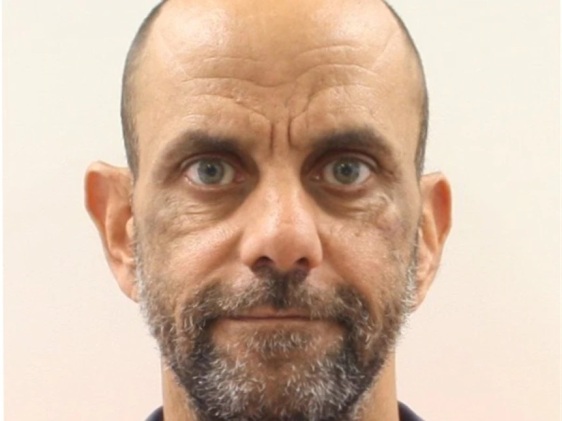
SNOWTOWN is back in the news at the moment, due to one of the perpetrators being granted parole after serving his 25-year sentence. Mark Haydon was convicted of assisting John Bunting and Robert Wagner in the murders of 11 people, including his wife, between 1992 and 1999.
Haydon reportedly rented the abandoned state bank building at Snowtown in which the bodies were stored in barrels of acid. A jury deadlocked on the charge that he was involved in the murders of his own wife, Elizabeth Haydon, and of Troy Youde, and he was never retried. His 25-year sentence was completed this year, and he will be freed into the community with no restrictions in May 2024 (unless the government succeeds in attempts to change the law to broaden the definition of a “high-risk offender”).
Above: the real Mark Haydon – then and now.
Relatives of the victims have long voiced their anguish and fear at any prospect of any of the perpetrators being released.
The film Snowtown is a recreation of this case, the most famous serial killer case in Australia (with the exception of the attempted genocide of the Indigenous population). A total of twelve victims were identified, and eight of the bodies were eventually found by police in barrels filled with acid, which were stored in an abandoned bank vault in the small town of Snowtown, in South Australia.
Although the press called this the “bodies in barrels” murders, it soon became known, to the sorrow of that little town, as THE SNOWTOWN MURDERS, even though only one of the murders had taken place there, the rest happening in the big city, Adelaide, between 1992 and 1999.
The final murder that took place in Snowtown, however, involved CANNIBALISM. We’ll have a look at that in this blog, although unfortunately the film doesn’t.
The film is a true Crime retelling, which means that none of the names have been changed to protect – anyone, and of course the dialogue has to be imagined to some extent. But we know a lot of what went on, and so did the film makers.
True Crime has been a popular genre for centuries, and transgressed the line between fiction and non-fiction in 1965, when Truman Capote released In Cold Blood, a “non-fiction novel”, relating or interpreting a 1959 Kansas murder. Modern versions of the genre extend beyond literature to films, podcasts, vodcasts and television shows. They tend to concentrate on the most sensationalistic cases and are grittily and brutally realistic in portraying the violence and gore.
In Australia, where this film originates, a survey found that some 44 percent of podcast listeners had listened to true crime podcasts, with an considerable proportion of them being women.
The protagonist of the film is Jamie Vlassakis, a teenager living with his single mother and two siblings. The mother’s boyfriend is a helpful sort of bloke who makes the kids dinner when mum has to go out, then strips them and takes photos of them for his own gratification. The mother deals quite effectively with this, beating him up and kicking him repeatedly, but soon a new man comes into their lives – John Bunting.
Bunting has a winning smile and a certitude that gets him into the family, and he takes Jamie under his wing. John also has a burning hatred of gay men and paedophiles, two rather different beasts whom he conflates into one evil figure. When Jamie tells him that he was raped by his older half-brother Troy, John tells Jamie he needs to “grow a pair” and take revenge. He involves Jamie in his plans to identify, capture and kill a range of people he considers monsters. He collects detailed information on a “spider wall” in his house. “Rock spider” is Australian slang for a paedophile.
But John Bunting has clearly not read Nietzsche:
He starts by involving Jamie in his plans to drive the erring boyfriend out of town. Jamie finds him in the garden, chopping up and mincing kangaroo body parts to toss onto the neighbour’s front door and sofa.
He involves Jamie in a raucous discussion of paedophile teachers, asking him what he thinks should be done with them. Jamie follows the fatal logic.
John takes Jamie under his wing, teaching him to ride a bike, shaving his head, showing him the spider wall, giving him a gun, and getting him to shoot John’s dog, a brutal blooding. When he introduces Jamie to the act of killing humans, there is also the accompanying deception: each victim is made to record a message that will be played on the answering phone of their loved ones. Jamie’s mum hears Troy say he hates her, and Jamie lies to her, letting her believe that forced call was true. Jamie goes off to doctors and government offices to collect payments, posing as the people they have killed. He doesn’t look happy about it, but he is sinking deeper and deeper into John’s machinations. After a while, collecting the government support payments becomes the motive as in the murder of Gary O’Dwyer; the vigilante pretext is forgotten. O’Dwyer invites the men to his place to watch him feed rats to his python, a process we see in slow motion in which the snake unhinges his jaw to swallow the prey whole, just as the men become unhinged in their growing lust to kill.
So John makes a man of Jamie, in the most toxic sense. He teaches him carnivorous virility – in order to be a man, you have to kill and eat. Not always the same carcass, but that does seem the logical consequence of the objectification of all victims.
The film traces the increasingly violent actions in which Jamie becomes involved, unwillingly at first, but totally under the control of John. He is made to watch them torture his half-brother Troy, who was earlier shown sodomising Jamie, and he finally steps in to finish the killing, tears rolling down his face, while John strokes his cheek and murmurs “good boy.”
Jamie is now a fully-fledged killer and a vigilante, not just an observer and helper the way Mark Haydon (the man currently being released on bail) is portrayed. Mark is a minor character, buying rubbish bags and digging holes for corpses, until near the end of the film, when he tells John he got into a fight with his wife, who called him a pussy. He told her what a big man he was – burying bodies. John brushes the story off, but we know she is next.
Although this murder is not shown in the film, evidence was given that Haydon saw his wife’s body and laughed. Her body was one of the ones found in barrels in the Snowtown bank building.
The final murder was Jamie’s half-brother (through a different father) David Johnson, whose only offence was his fastidiousness and unwillingness to go along with John’s rhetoric of violence. The final scene of the movie shows Jamie persuading David (one of the few wholesome characters in the film) to check out a computer supposedly offered for sale in Snowtown. They stop for a beer, they stop again so Jamie can urinate in a creek. He runs back to the car to accompany David to his death; the car is parked at a crossroads, clearly a symbol, a suggestion that Jamie, who is depicted as hating all the violence, could have chosen a different path at any time.
John Bunting, Australia’s most prolific serial killer, was convicted of eleven murders and sentenced to life imprisonment without the possibility of parole. Robert Wagner, his main accomplice, was convicted of ten murders and sentenced also to life without parole. Mark Haydon was initially charged with two murders but was only convicted on five counts of assisting. The jury did not come to a decision on two murder charges against Haydon, and another charge of assisting murder, which never came to retrial.
More than 250 suppression orders originally prevented publication of the details of this case at the time. In early 2011, a judge lifted the remaining orders in response to a request by the producers of the film Snowtown. Haydon was sentenced to 25 years, which he has now completed; he is back in the community on parole, with the head of the parole board saying he’s well behaved and poses no risk to the community. He has been moved to the Adelaide Pre-Release Centre – a low security facility where prisoners can participate in accompanied and unaccompanied leave, including for work and education. The usual conditions of parole apply (no binge drinking – yet), but he will be a free man in May 2024 when his sentence expires.
Jamie, presented in the film as an unwilling and even sympathetic killer, pleaded guilty to four murders and provided testimony against the other men, in exchange for a lesser sentence. He testified about the cannibalism that is not shown in this film — that Bunting and Wagner hacked at David’s body to make sure it would fit in the barrel and then sliced off a sliver of flesh from the right thigh. They heated a frying pan, cooked the flesh, and handed it around. Jamie’s testimony was the only evidence police had that cannibalism had taken place, and was presented by his attorney as proof that he was fully cooperating and deserved a lighter sentence. In 2005, when Haydon’s murder charges were dropped by the Director of Public Prosecutions, several suppression orders were lifted. These detailed the murder and cannibalism of the final victim, David Johnson.
Jamie Vlassakis was sentenced to four consecutive life sentences with a non-parole period of 26 years, which means it is possible he could be released on parole in 2025. He will be 45 years old.
The film is gritty and brutal, particularly the scenes of Jamie’s rape, and the torture of their victims. But it is compelling watching, and the acting and directing are quite brilliant, capturing the loss of innocence that starts with abuse and ends with brutality. Bunting’s early life reportedly was very rough; he said he enjoyed killing ants with acid, an idea he later transposed to those humans he saw as vermin. When he grew up, he worked at a slaughterhouse, where he would brag about slaughtering animals, saying that’s what he enjoyed the most. Later, when he moved in on Jamie’s family, he would kill cats and dogs and skin them while making Jamie watch. We see Jamie transform from the innocent teenager who stands around smoking at the start of the film to a shaven-headed killer, and even his little brother is shown with his head shaved, starting his short journey from childhood abuse to callousness.
The film is all about that loss of innocence. At an early age, these kids are introduced to poverty, abuse and violence that is a hallmark of violent, carnivorous society. Children famously love “animals” when they are little, recognising their own infant state of being helpless and unable to communicate, yet are socialised into carnivory by the peer pressure to conform and their recruitment into the ceaseless human war on nature. Animals, particularly the chattel slave animals generally referred to by their monetary value, “livestock”, are nothing and nobody. It is only a small step for John Bunting to assume the same about those he hunts, and so why would he flinch at eating them? It is the logical next step.
The film closes as Jamie shuts the door of the vault, trapping the unfortunate David Johnson with the killer gang. We don’t see the murder, or the frying pan. Unfortunately, that final step over the thin red line between humans and other animals appears to have been a bridge, or a meal, too far for this film.
The recent tour of Australia by British anti-trans campaigner Kellie-Jay Keen-Minshull— who also goes by the name of Posie Parker — added cannibalism to the culture wars already raging over transsexual rights.
Keen-Minshull organised a “Let Women Speak” tour of Australia and New Zealand, holding rallies in several cities to claim the push for transgender rights is “silencing”, endangering and discriminating against women.
There has been a lot said about Keen-Minshull, mostly debating her claim to be a warrior for women’s rights and accusing her of being an extremist, expressing views that are designed to be harmful to the transgender community. The rhetoric she uses is far more extreme than usually expressed in Australian politics, although it has become common in other countries, particularly the USA. She suggests, among other claims, that trans women are sexual predators who pose a safety threat to girls in female bathrooms. She describes gender affirmation healthcare as mutilation, and being transgender as a “fetish” — positions totally at odds with the views of experts who work with people who are transitioning.
Keen-Minshull’s rally in Melbourne was attended by far-right extremists who performed Nazi salutes. Although organisers claimed the masked thugs had “gate-crashed” the event, a trans rights activist and TikTok star known online as LilahRPG said “everyone was just furious, seeing Nazis doing salutes uninterrupted and interacting with the TERFs.” TERF is an acronym for “trans-exclusionary radical feminist“.
This is one of the clearest indications that far-right social media is using the “gender-critical” movement to promote membership of their groups.
Keen-Minshull has made a series of videos (see Twitter message above) about “Grooming Gangs” – repeating unproven claims that a young girl in England was killed and eaten as kebab meat. These claims are then used as racist conspiracy theories, saying that the botched police investigation was in fact a cover-up of paedophile elites who, they say, control everything. Keen-Minshull says:
“What we know is that there’s grooming gangs in Telford. A young woman that never actually really made it to mainstream news, wasn’t a big story, was cut up and I think she was put into meat that was sold for human consumption. We know that there are vast numbers of men involved in these grooming gangs, and we know that there’s weird cover-up stuff going on, that only makes sense if the other people in power are also raping children.”
The case she is referring to seems to be the disappearance of 14-year-old Charlene Downes, who disappeared in Blackpool in north-west England in November 2003. Accusations were made of a child-grooming ring, which induced young girls into having sex in return for cigarettes, food and alcohol. At least one newspaper was quick to claim that investigations had been “hampered by political correctness”, because the girls were white and the perpetrators non-white.
Two men, Ilyad Albattikh and Mohammed Reveshi, were tried in May 2007—the first for Downes’ murder, the other for helping dispose of the body—but the jury failed to reach a verdict. A re-trial was scheduled, but in April 2008 the accused were released because of concerns about serious errors in the evidence compiled by Lancashire Constabulary, who were chastised for their inept handling of the case.
The prosecution had claimed Charlene’s body had been cut up and minced into kebabs in a Blackpool takeaway called “Funny Boys”.
At the time of the trial, the court was told the fast food shop owner had “joked” that Charlene Downes had been chopped up and put into kebabs that were sold to the public.
There is a lot of racism involved in this story. White children being raped by men of colour is stated or implied in many of the reports, although there is little evidence to show that white offenders were not also involved. Many actual cases of the cannibalism of children indicate the opposite – that white men like Jeffrey Dahmer and Albert Fish prey on children of colour, because such missing children are less likely to be investigated by white detectives. Meanwhile, the Indian current affairs website OpIndia did not mince its words about the alleged mincing of the victim:
Groomed by Muslim gangs, minced into pieces, fed as kebabs
Of course, Ms Keen-Minshull did not invent the idea of using cannibalism as a weapon of dehumanisation (Christopher Columbus did that very successfully) or even as a part of the culture wars – recall the hate and scorn aimed at the New York Times when it suggested the “cannibalism has a time and a place… and others suggest that that time is now”.
Classical mythologies told of savage gods who ate their own children, and paranormal entities such as witches, who used body parts for their rituals. Such usages were not exclusively supernatural, with “blood libel” accusations that Jews were killing Christian children to use their blood for religious rituals and cannibalism dating back to the twelfth century, and being revived with nauseating regularity up to the present day.
QAnon has been very successful recruiting members in the US, partly based on accusing everyone from Hillary Clinton to a pizza shop owner of killing and eating children. The accusations are meant to dehumanise the alleged perpetrators, but usually end up doing the same to the victim. Poor little Charlene is now almost unknown, except as the “kebab meat girl”.
Lots more details of her case are available on YouTube investigations such as the one below, some of them are quite lurid.
There just aren’t enough Aussie cannibalism films (IMHO), particularly since the earliest movie I could find showing (purported) cannibalism, The Devil’s Playground, was made in Australia, way back in 1928. What few have been made are pretty great, including movies like The Last Confession of Alexander Pearce(about a cannibal convict) and more recently Two Heads Creek, which saw immigrants to the Australian outback being cooked and eaten. There was also a movie made about the so-called Snowtown murders (most of which did not take place in the town of Snowtown) but it avoids mentioning the cannibalism of the last victim, for some reason.
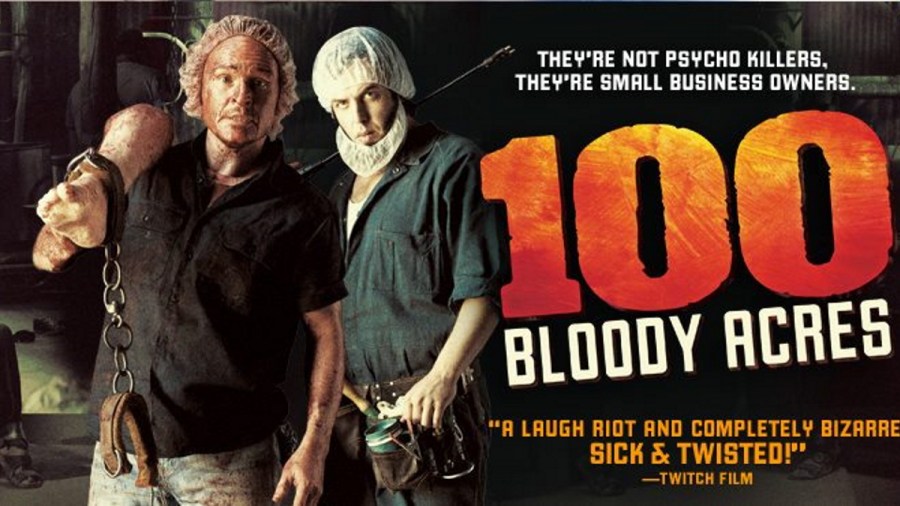
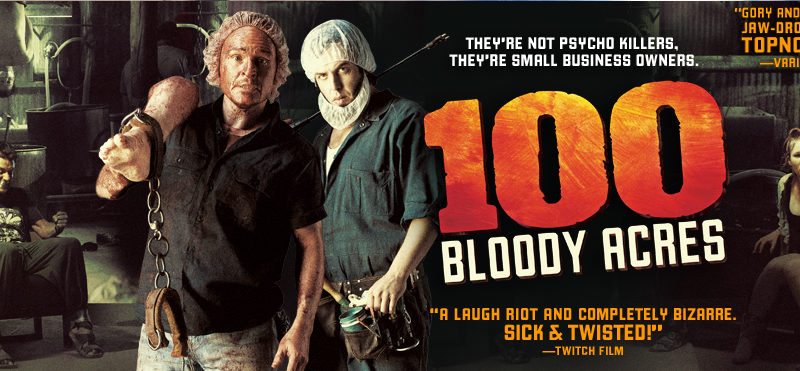
Presenting country folk as hicks, rednecks, hillbillies, etc is certainly not exclusive to Australian films. In the US, such plots are usually presented as slasher horror, such as The Texas Chain Saw Massacre and The Hills Have Eyes, and their endless sequels and prequels. In Italy during the “Cannibal Boom”, the primitives were tribes of savages, eating people for revenge, but also because they were yummy. But Australians love to see the humour, even (especially?) in a rapidly mounting body count and spurting arterial blood. 100 Bloody Acres is right in that tradition, filled with colourful rural characters who mispronounce words and aren’t that smart, taking it out on city slickers who stray into their territories.
Their business has been booming in the area, we are told, where six Salvos (Salvation Army workers – everything in Aust. is abbrev’ed) have disappeared without trace – not hard to see where this plot is going. Reg is on his way to deliver blood and bone fertiliser when he sees a road accident, hauls out the body of a man and puts him into the back of his van, less a few fingers, due to his clumsiness in closing the doors. Meant to be shocking or hilarious? Subjective I guess. Reg then picks up a young woman and her two male companions whose car has died on the way to a music festival, because he fancies the woman. The men go in the back of the truck with the bags of fertiliser and the car crash victim, and predictably freak out when the body is revealed by the bumpy road. Reg takes the trio to the factory, where they are tied up and made to watch the car accident victim, who turns out to be alive, lowered into the meat grinder.
Reg tries to rescue him, but ends up covered in blood and holding just his legs and, perhaps the area between them that attracts his befuddled gaze. There is a theory that movies, particularly thrillers and horror stories, are aimed at 14-year-old boys, and I’m sure they would find this scene side-splitting.
Turns out that blood and bone made from humans is far better (as fertiliser) if they are alive and scared and in agony; it’s all in the hormones. This why torment is a crucial part of the dog-meat industry, and also not far from the way we treat other animals we confine and slaughter.
The older brother, Lindsay, tests the blood from the mixture and declares it “liquid gold”.
The rest of the movie is slapstick gore involving chases, more victims being killed or losing body parts, and other merriment. Rotten Tomatoes gave it a 77% fresh rating, and Matt Zoller Seitz of RogerEbert.com called it:
“a smartly written and acted and exceptionally well-directed movie.”
The Guardian’s Australian Editor, Lenore Taylor, was not so enthusiastic, declaring it,
“a splatterfest that abandons suspense in favour of sniggers.”
100 Bloody Acres is not nearly as shocking as it imagines itself to be (unless maybe I’ve watched too many cannibal movies) but it is entertaining, well made, stylishly directed, and the actors are top-notch. It hums along, and may even be seen as satirising the more strait-laced and dour cannibalism films from the USA and elsewhere. If you like black comedy and gore, this one may impress.
From the point of view of Cannibal Studies, it raises some interesting questions.
Is it still cannibalism is you kill someone not to eat, but to use, for example, as blood and bone (or for their skin and bones, like Ed Gein or Jame Gumb)? Does cannibalism require oral ingestion, or does any use of the human body count?
Is cannibalism of the dead less repugnant if the intended meal is already dead? In this film, the brothers collect dead bodies from road accident sites (human roadkill) and grind them up into blood and bone. While roadkill of wild animals is not a hugely popular source for food or other uses, it is actually more acceptable to some animal activists than confinement and slaughter, in that the animals may not have known what hit them, and in any case are killed without murderous intent. So why not human roadkill (maybe making sure they’re actually dead)? Is it really worse to eat (or otherwise utilise) a dead human, who can feel no pain, than a living, terrified cow or pig? Consider the outrage in Illinois when a satirical site claimed the local morgue assistant was using body parts from deceased men to help her win a spaghetti-cooking competition. It was a hoax, but there have been other cases, such as journalist William Seabrook, who purchased human flesh from a hospital and cooked it just to see what it tasted like. What exactly is the problem?
And most intriguingly, why do we stroll nonchalantly past the blood and bone bags in the hardware store, yet can be shocked at the thought of human blood and bone? As Shylock asked, “if you prick us, do we not bleed?”
The Cannibal Guy is on the road because of the floods in the Northern Rivers of NSW. I feel a bit like Hannibal in season 3, without quite as much gore. Blogs will, hopefully, resume next week, or whenever the flood waters recede. Until then, please check some of the 236 previous posts that can be searched at www.thecannibalguy.com.
What a year it was – if a virus wasn’t invading your body, your neighbour might well be.
Thank you!
First of all, a big thanks for reading and sometimes commenting on my blog. Eighteen months ago, I was very excited at seeing over 1,000 views in a month. In December 2021, we had over 6,000 views.
The year by year growth of readership (59,002 in 2021) has been going, pardon the term, viral. So, thank you!!
Cannibals and rumours of cannibals in 2021
I decided to postpone this blog post until January 2022 because, at the end of 2021, new cannibalism cases were still being reported. In the previous year’s summary, I had missed THE GRANNY RIPPER, because she died of COVID on December 29 2020 while awaiting trial. So we’re sneaking her in to the section at the end – cannibals sentenced in 2021, although her judge and executioner was a tiny virus.
There were so many cannibal stories in 2021 that I am listing them alphabetically by country. I should point out for my American readers that the good ol’ USA won gold in the number and strangeness of cannibal acts last year, with Russia, Mexico and Nigeria tied for silver.
Australia
A Tasmanian man pleaded guilty to assault and attempted abduction of a five-year-old girl, telling the court that he just wanted a cuddle (albeit from a screaming child, whom he had just attempted to strangle) and later telling prison officers that he had wanted to eat her, and that he had been wanting to eat people since he was a child.
Bolivia
A woman chowed down on a burger in Santa Cruz de la Sierra only to find that she was chewing on a severed and decomposing human finger. The unfortunate incident (you’d have to call her an innocent cannibal) was the source of some semi-amusing puns from the world’s press, plus a hilarious unintentional pun from the burger company who told her “the issue is out of our hands”.
France
A man in Tarascon, a town between Avignon and Arles, was shot by police after the decapitated and partly consumed corpse of young boy was found in his apartment.
Ghana
Richard Appiah of Abesim near Sunyani in the Bono Region, allegedly lured three boys to his house, killed them and kept their mutilated bodies in his fridge. He is said to have cooked for them, before cooking them.
Indonesia
A family in Gowa allegedly gouged out their six-year-old daughter’s eye as part of a black magic cannibal ritual that was supposed to bring them wealth, before her mother ate her eyelid. Police also arrested a shaman, who allegedly convinced the family to sacrifice children.
Malawi
Patrick Gome from Ntcheu was allegedly found biting a nine-month old baby on her cheek and thigh. A police spokesperson said Gome acted “like a wild animal”.
Mexico
David Sanabria and his young daughter, trying to cross Mexico from Honduras in the hope of entering the United States, was kidnapped by a Mexican cartel and held for ransom. Those refugees who did not pay, he later told Noticias Telemundo Investiga, were murdered and cooked and the surviving migrants were made to eat the meat.
Andres Filomeno Mendoza Celis, 72, was arrested in Calle Margaritas, in the municipality of Atizapan de Zaragoza. Detectives arrived at Mendoza’s home to interview him about the suspicious disappearance of a woman, Reyna González, a mother of two, only to find her mutilated remains on a table. Mendoza reportedly admitted to slaughtering and eating parts of around thirty women over the last twenty years.
Nigeria
The cannibal of Ebonyi was the name given to a commercial driver in Abakaliki, the Ebonyi State capital, who reportedly bit off and swallowed the finger of a member of the taskforce raised by the state’s Ministry of Capital City Development to enforce compliance with urban planning regulations.
A video has surfaced online purporting to show the Eastern Security Network (ESN), the security wing of the Indigenous People of Biafra (IPOB), celebrating the abduction, beheading and cannibalisation of two police officers. The Director of State Security said “We saw human flesh being roasted, it was an eye-sore.” An IPOB spokesperson, Emma Powerful, denied claims that their members eat human flesh and engage in barbaric acts, saying that the claim by the DSS was meant to demonise IPOB and ESN operatives and tag them as criminals.
Russia
Vladimir Yadne killed three people in Siberia and ate their flesh, washed down with vodka.
On the other side of Russia, Yegor Komarov was seen running from his car, which he had crashed into a road safety barrier. The problem was not the accident, but the headless body which fell from the car boot. Komarov admitted to being a cannibal and stated that he ‘likes killing people’. He confessed to stabbing and killing another man in a park in St Petersburg last year for the sole purpose of tasting human flesh, and said he had sliced off the tongue and fried it in butter.
South Africa
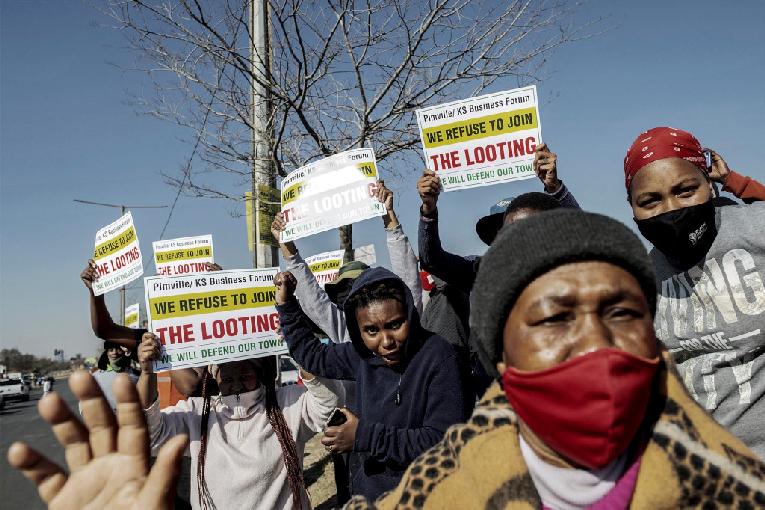
A community leader told the Financial Times newspaper that rioting and looting have caused food shortages which have led people to consider cannibalism.
Spain
National Police officers in Sevilla were deployed on Saturday, September 18, to deal with what they have described as one of the most bizarre incidents in the history of the force, a case involving African witchcraft and cannibalism. Allegedly, a fight had broken out between two women after one threw a bottle of water containing salt at the other, and accused her of witchcraft. Believing that her roommate was possessed, she struck her on the head with a stone, and then bit off and ate two of the woman’s fingers. After this, the aggressor, in an attempt to rid the other woman of the supposed demon, inserted the stone into her anus in an attempt to extract her guts.
USA
The biggest cannibalism story in the USA in 2021 was about a man who almost certainly has not eaten anyone. He did, however, boast about it in text messages to some very pissed off girlfriends, who reported it widely. Yep, the actor (maybe former actor) Armie Hammer. Arguably now more famous for his cannibalism posts than for his movies.
On February 9 2021, Chickasha (Oklahoma) police responded to a 911 call. They found Leon Pye dead and his four-year-old granddaughter Kaeos critically injured. She died in the back of the ambulance. Delsie Pye, Leon’s wife, was alive, but had knife wounds to both eyes. Lawrence Anderson confessed to the Oklahoma State Bureau of Investigation that before slaughtering his family, he had broken into the home of a neighbour and butchered the woman who lived there, cut out her heart, and cooked it with potatoes to feed to his family, to release the demons. Apparently unsuccessfully.
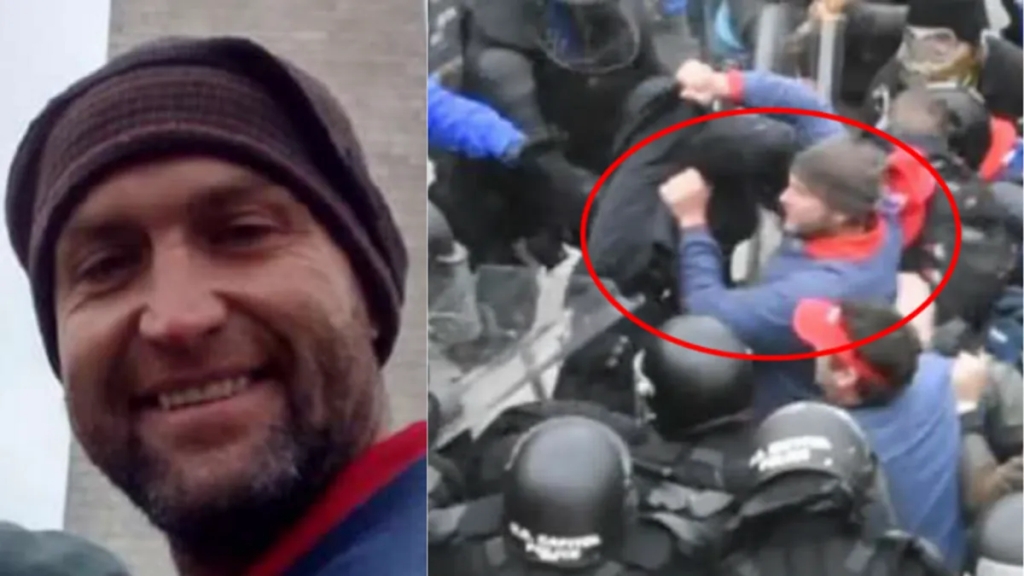
Landon Copeland, an Army veteran from Utah who had been accused of assaulting police during the Capitol insurrection, was refused bail after he threatened to “eat the flesh” of a probation officer. He is said to have shouted “I will eat your flesh for nutrients. I don’t think you don’t know what I am!”
James Phelps, 58, and Timothy Norton, 56, were arrested and charged with kidnapping a young woman named Cassidy Rainwater in September. The County Sheriff said that Rainwater was disembowelled and dismembered after she was strangled. Some of her remains were found in a freezer. Conspiracies are floating around that both Norton and Phelps were involved in cannibalistic activities.
Just squeaking into 2021 before the ball falls in Times Square, Idaho man James David Russell, 39, of Oldtown in Bonner County had cannibalism charges added to his accusations of first-degree murder. Police found pieces of the neighbour, some of which appeared to have been cooked in a microwave oven. According to the supplemental probable cause affidavit, Russell believed that he could “heal himself by cutting off portions of flesh” in order to “cure his brain.”
Sentenced
Some cannibals sit in jail for a while before they are finally sentenced. Here are a few who ate people in earlier years, but were sentenced in 2021.
On Friday, 18 June, a Swiss court sentenced 46-year-old Alieu Kosiah, a West African rebel leader, to 20 years in prison for rape, murder and cannibalism.
Bulawayo man, Rodney Tongai Jindu, has just lodged an appeal to the Zimbabwean Supreme Court against a High Court ruling which sentenced him to death for murdering two of his friends. Jindu had told the court, in gruesome detail, how he had eaten the men’s livers raw, and cooked and eaten their brains.
Alberto Sánchez Gómez, a Madrid waiter, was jailed for 15 years in June. He had told police he butchered his own mother before sharing her body parts with his dog. The 66-year-old pensioner had been chopped into at least 1,000 pieces and her vital organs were missing.
Sunil Rama Kuchkoravi (35) of Kolhapur India was found guilty of murder for killing his mother after she refused to give him money to buy liquor. He later chopped up parts of her body and ate them, after frying them in a pan.
A Sydney (Australia) woman who cut her 57-year-old mother’s head off with kitchen knives in July 2019 was found guilty of manslaughter in the NSW Supreme Court in March, and sentenced to 21 years imprisonment, after pleading not guilty to murder due to mental impairment. The court was told that Jessica Camilleri – who had a history of refusing to take psychiatric medications – had only stopped the attack when her mother’s head fell off and her eyeballs came out of their sockets. The judge said Camilleri had engaged in “acts of decapitation and cannibalism”.
Eduard Seleznev, known as the “Arkhangelsk Cannibal”, who killed and ate the flesh of three men, was sentenced to life imprisonment by the Russian Supreme Court. Seleznev admitted the murders, and added that he had then sliced their bodies up, kept the meat in plastic bags, and disposed of the bodies in the Volokhnitsa river. He subsequently boiled and ate the flesh.
At the end of the year, we heard that Mark Latunski, who allegedly killed his Grindr date, hung him upside down and ate his testicles on Christmas Eve 2019 (thus missing out on my 2020 update), will go to trial early 2022. Very inconsiderate.
Sofia Zhukova, known as the ‘Granny Ripper’, who supposedly gave children sweets made from the flesh of her victims, died in Russia of COVID-19 on December 29 2020, at the age of 81, before the conclusion of her murder trial. You may have noticed that most of the 5,351,812 people who died of COVID up to December 20 (plus millions more whose deaths were not reported to WHO) did not have articles written about them. Sofia had heaps of media coverage though, because, you know, cannibalism.
2022
Well, I hope you can see why I nominated 2021 as THE YEAR OF THE CANNIBAL. But what does 2022 have in store for us? Well, if you follow the prophecies of Nostradamus, which a surprising number of people do, 2022 offers, yep, even more cannibalism, this time because of inflation and the price of food.
“So high the price of wheat that man is stirred his fellow man to eat in his despair.”
Looking further ahead, a professor of astrobiology at Edinburgh University has warned that humans who attempt to colonise other worlds such as Jupiter’s moon Callisto and Saturn’s moon Titan could well find themselves running out of food and resorting to cannibalism. It happens – think of the “Starving Time” in the Virginia colony of Jamestown in 1609-10, or Sir John Franklin’s 1845 exploration of the Arctic that resulted in the crew cannibalising each other.
“As I stand before you, I’ve never had the urge to eat anyone, and it will never happen. So, what people are saying about the vaccine making people want to eat others… of being part of 5G technology, or linked to the work of the devil, is all nothing but a myth. It is not true.”
Hope you enjoyed your New Year festivities! Next year you might need a barbeque. Please keep reading and liking, and commenting! If you need some light reading, here’s my complete listing of Hannibal films and episodes.
The thread that runs through cannibalism texts, from Homer’s Cyclops to Harris’ Hannibal Lecter, is the social outsider. It is a theme that never seems to age, since humans love to form cliques, united by an irrational hatred of those who don’t belong, even if it’s just because they dress differently or support a different sporting team. The most obvious example at the moment, and for most of modern history, is the immigrant.
Norman is played by Jordan Waller who also wrote the script – you may have seen him appear in the TV series Victoria. He runs his mother’s Polish butcher shop in Slough (it’s a real place, although there is definitely a pun in there). It’s post-Brexit Britain, and the locals scream abuse and paint his windows with dog-shit.
He’s English, but his shop sells Polish meats, so he is the hated outsider. His twin sister Anna (Kathryn Wilder) is the assertive one, and is totally uninterested in his butcher shop.
When they discover at their mother’s funeral (held in the butcher shop) that they were adopted, they find a postcard from their mother, postmarked from a small Australian town: Two Heads Creek. Not sure if this is international invective, but in Australia, “two-heads” is pretty much a synonym for “inbred”, and is used to denigrate rural people. The outsider does not need to come from outside – just a different region will do.
Norman is named after his mothers’ favourite singer, the Australian pop star Normie Rowe, who was enormously popular in the sixties, until the government decided to conscript him to the war in Vietnam as a publicity stunt. Normie’s oeuvre is featured heavily in the soundtrack. Nevertheless, the twins know nothing of Australia as they sell the butcher shop and head “Down Under” to seek their birth mother, except for clichéd English convict stereotypes, so when the customs agent asks if he has a criminal record, Norman answers “is that a prerequisite?” They travel ten hours to the outback town with a group of Asian immigrants, on a bus driven by an Indigenous man, Apari (Gregory J. Fryer) who is treated like dirt by their guide.
This is a blog about movies involving cannibalism, so it’s probably not a big spoiler to mention why the immigrants are being sent to Two Heads Creek.
Australian governments of both parties have a long-standing practice of locking up refugees in offshore detention and leaving them there to rot or go mad. So far, they have not considered cannibalism as a solution, so we have to hope they don’t see this movie.
There are lots of explicit cannibalism scenes, as well as some cute intertextual references, e.g.
19
The movie is far from subtle in its treatment of jingoism, racism, sexism and various other discriminatory practices popular in Australia and elsewhere.
But an important thing to realise about cannibalism is that it is an ultimate equaliser – although only certain groups may be chosen as victims, once skinned and cooked, we are all the same. Our differences are, literally, skin deep.
The scenes of cannibalism are accompanied by another soundtrack, this one the Aussie group Skyhooks, with their big hit “Horror Movie” which, in the song, turned out to be about watching the evening news, and so is just as relevant now as ever. Perhaps more so.
They do get to meet (and almost eat) their mother, yes, she is named Mary (the wonderful Kerry Armstrong from Lantana, Seachange and so much more), who perplexes them by describing their father as “a good man”.
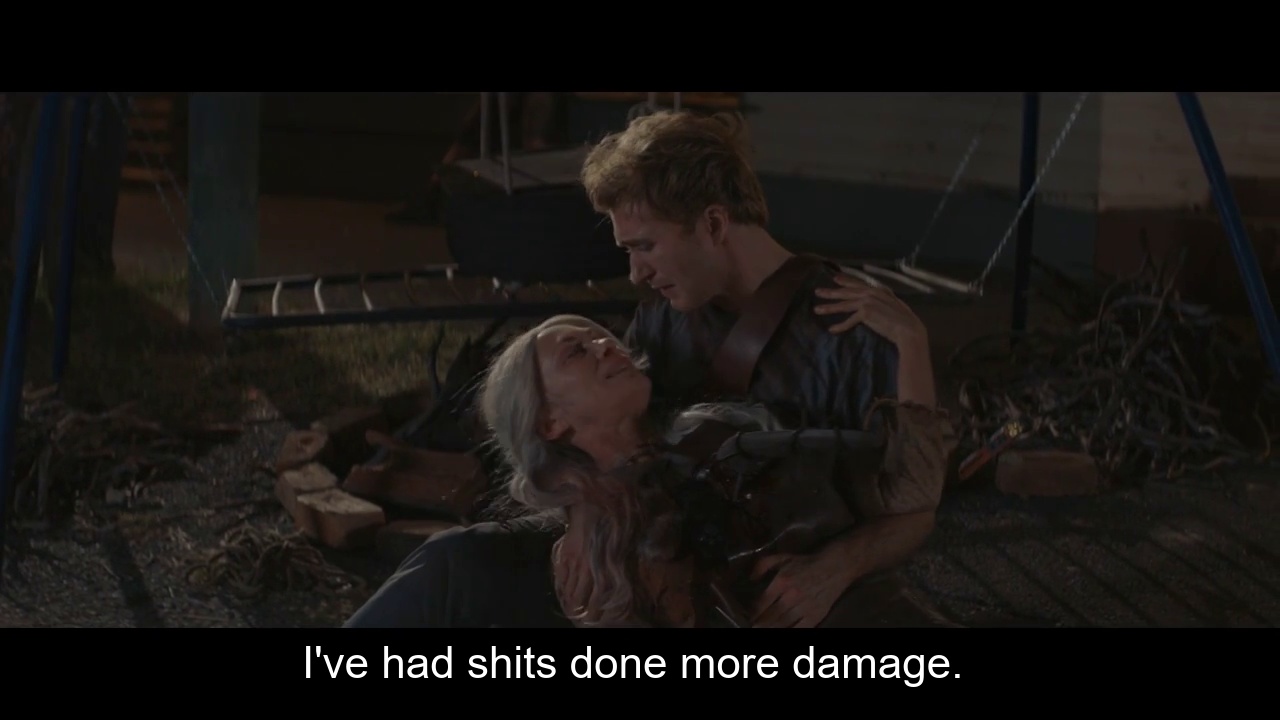
The final act is a climax of gore, wildly over the top and full of people being stabbed in the crotch, presumably for the 14-year-old-boy market. The main antagonist, Apple (Helen Dallimore) gets shot with an arrow and goes into the giant meat-mincer with her middle finger the final part to be ground up, while screaming the theme of the movie:
The best line of the film is from their mother, who is hit in the neck by a lethal boomerang studded with nails, but dismisses it as “only a flesh wound”
Apari, a descendant of the original inhabitants of the land, is left to clean up the blood and corpses that litter the town. With some justification, as he watches the Australians and the English hobble off, he says:
This well-crafted film is only the second feature from Australian director Jesse O’Brien. He said of the setting, the mining town of Cracow in the Banana Shire, 500km northwest of Brisbane, that
“I think that myth of the outback being ‘a scary place’, which isn’t always true, does fit rural Queensland really well.”
The cast is great and the film is fresh, funny and still manages to ask some interesting questions about differences and about appetites. It has a 90% fresh rating on Rotten Tomatoes. Film Threat described it as:
“A deliciously deranged horror-comedy, overflowing with blood and wit.”






























 The Cannibal Guy