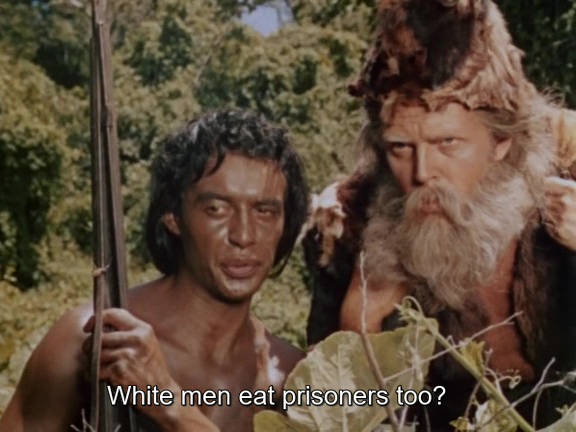
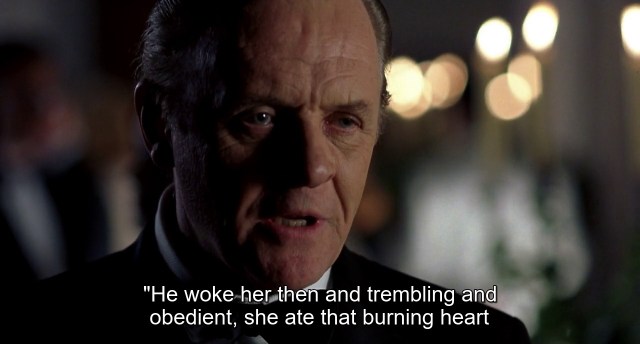
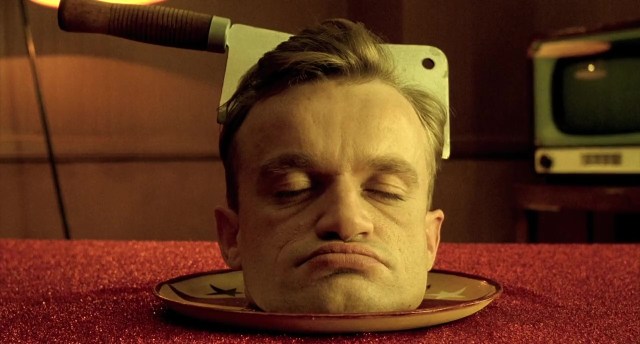
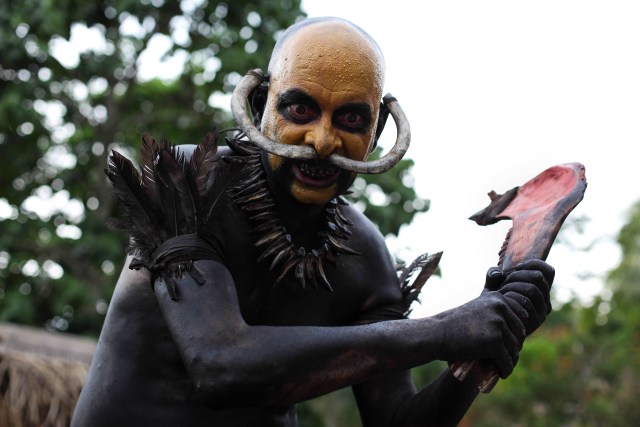
Hobbit cannibals: THE CANNIBAL IN THE JUNGLE (Simon George, 2015)

As a general rule, I am not a big fan of “mockumentaries” – if you’re making stuff up, then why not just describe it as fiction? And if you are a channel like Animal Planet which makes factual documentaries about (real) fauna and flora for its seventy million viewers, it seems at least deceptive if not actively fraudulent to start showing made up stuff as if it is a “documentary”. This is not the first time they’ve done it; they had previously tried to make us believe they had found evidence of dragons and mermaids. So an untrue ‘true-crime’ documentary about a fake cannibal locked up for supposed cannibalism which was actually carried out by an extinct species of hobbits seemed pretty tame to the Ethics Department of Animal Planet I guess.

I should concede that some of the classics of cannibal texts are mockumentaries or “found footage” inventions. Many of the Italian ‘cannibal boom” films attempted to appear as factual records, particularly the classic Cannibal Holocaust, for which the director, Ruggero Deodata, secreted away the actors to make it appear they had been killed, then had to produce them in court to avoid facing  homicide charges. More recently, District Nine, Ghoul and Long Pigs have all made somewhat desultory attempts to persuade us that we were watching the actual killing and eating of humans by humans.

In this week’s offering, The Cannibal in The Jungle, the director Simon George presents a feature-length ‘true-crime’ special about an American scientist accused of murdering and consuming the remains of his fellow explorers while on an expedition in 1970s Indonesia. The murder/cannibalism case is told through interviews with an Australian anthropologist Richard Hoernboeck (played by Scottish actor Jim Sturgeon with a broad Australian accent), who says he found evidence of a tribe of very small hominids which he calls hobbits, and subsequently chose to investigate the murder/cannibalism case, 25 years after it happened. He tells us that in 1977, an American ornithologist was convicted of killing and cannibalising two colleagues in the jungles of Indonesia while on a quest to study eagles, as well as hoping to find a supposedly extinct owl. Instead, Dr Timothy Darrow, branded ‘The American Cannibal’ by the press during his trial for murder and cannibalism, claimed in his (unsuccessful) defence that they had been attacked by a lost species of early humans. These hobbits, he said, were responsible for the murder and consumption of his friends. Nobody believed him. Cannibalism is easier to believe than hobbits.

In fact, the remains of a species matching Darrow’s description were found in those jungles of Indonesia in 2003 by an anthropologist from Wollongong University, although his name was Mike Morwood (a hobbit name if ever I heard one). In what is now regarded as one of the most important anthropological finds ever, a team of scientists discovered the bones of an entirely new species of human, one that stood only 43 inches or 110cm tall. Homo floresiensis (popularly called Flores Man or more popularly Hobbits) lived on the island for perhaps over a million years before going extinct. Some recent research suggests that a tribe of the hominins known as Homo erectus became isolated on this remote Indonesian island, perhaps a million years ago, and evolved a dramatically smaller body size.

But did they really go extinct? An indigenous tribe on the Indonesian island of Flores, where the remains of the ‘hobbits’ were discovered, have their own accounts of little wild men that climb trees and walk on two legs. They also describe them as cannibals. And according to their legends, they may never have died out at all. This story claims to follow Hoernboeck’s expedition into the jungle of Flores, Indonesia, seeking to discover if hobbits still exist, whether Timothy Darrow’s ill-fated expedition really encountered the supposedly extinct creatures, and if the ‘American Cannibal’ was therefore innocent of the crimes for which he was convicted more than three decades previously.

The local people of the island, the Lio, claim that the hobbits were around until very recently, and may still be hiding out in the forest. In the fake doco, they are shown suggesting that they would kidnap and eat children, although being a different species to Homo sapiens, I suppose this would not technically be cannibalism.
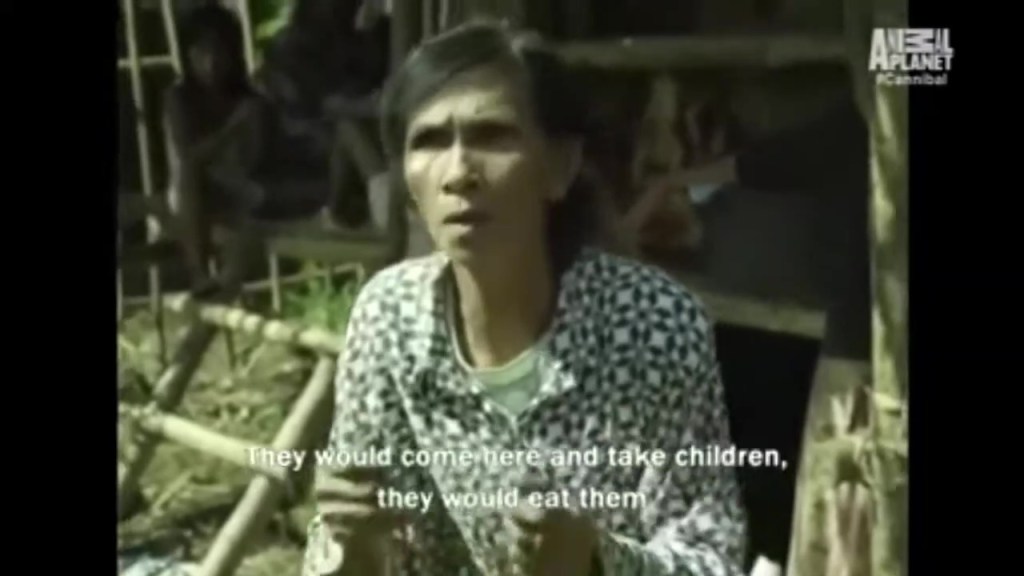
The program is ingeniously done. Hoernboeck, the modern-day anthropologist, shows purportedly real video of his interviews with the imprisoned Darrow (played by Richard Brake, who was in Game of Thrones and Hannibal Rising, so there’s a giveaway for the alert horror fan), and his expedition to trace the journey on which Darrow supposedly found the hobbits. Interspersed with this, we are shown what we are told is a reenactment of the original expedition by Darrow and his friends/victims. The implication is that we can believe the rest is real, because they told us what was staged. We move to the present to see the anthropologist tracking down Darrow’s tape recorder which contains the taped call of the hobbits, then eventually the actual film taken by Darrow that proved his innocence but, alas, not until after he died in the brutal Kerobokan prison.
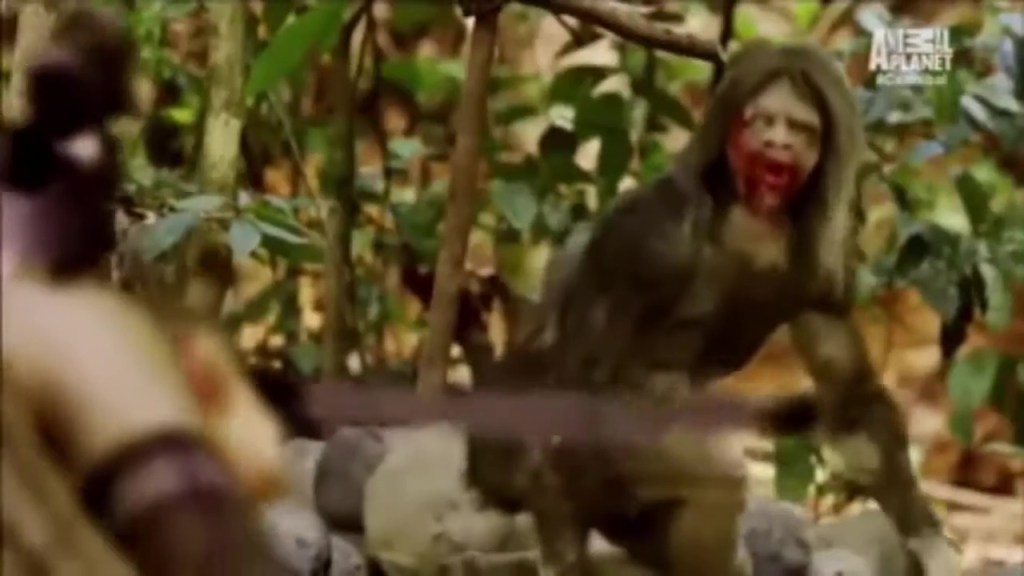
With a modicum of willing suspension of disbelief, it’s actually pretty convincing, and quite sad, unless we keep reminding ourselves that the whole thing is a fake. Those who watched it when it first came out, unless they recognised the Night King or the war criminal who ate Hannibal’s sister, did not discover that it was all fictional until the very end, when there is a (very) short statement. Most viewers probably wouldn’t even have noticed it.
What I found interesting is the depiction of the totally credible outrage of the Indonesian authorities, furious that an American would eat the Indonesian guide. Yet when the Flores locals are shown talking about the hobbits capturing and eating their children, there is inaction. Nature is red in tooth and claw! Animals eat each other, and eat people if they can, so if some unidentified ape ate your child, well, that’s unfortunate. But anthropocentric ideology denies our animality, so for a human to eat a human still manages to shock. The false binary of human/animal has led science to tie knots in the language, with some calling the hobbits “ape-men” and one learned anthropologist, Gregory Forth, calling his book about them Between Ape and Human. Like this documentary, the idea of a lacuna between apes and humans is fictional. We are a species of great ape, and our DNA is 98.8% identical to chimps.

Dr. Darrow’s supposed cannibalism was more horrific than nature’s mundane bloodbaths, not because he was genetically similar to the victim, but because he was a post-doctoral scientist, a ‘civilised’ man. If either party to slaughter, the one wielding or the one enduring the blade, can be defined as ‘animal’, all bets are off. The cannibals we consider in this blog are simply better than most people at dehumanising, objectifying the other.

The full movie is available, at the time of writing, at Daily Motion.

Criminals, rapists and cannibals: Donald Trump and the immigrants

Way back in 2015, when first campaigning for the presidency, Donald Trump announced he would build a wall on the border with Mexico to keep out:

“…people that have lots of problems. They’re bringing drugs. They’re bringing crime. They’re rapists. And some, I assume, are good people.”

That seems quite tame now, doesn’t it? Warning about rapists have lost their power, especially given Trump’s own personal legal struggles regarding sexual assault. 

So he has turned, dear reader, to our fave subject. Speaking on Right Side Broadcasting Network from Mar-a-Lago, a resort that relies heavily on immigrant labour, he upped the ante on border crossers by calling them cannibals released from mental institutions.

“They’re rough people, in many cases from jails, prisons, from mental institutions, insane asylums. You know insane asylums. That’s ‘Silence of the Lambs’ stuff. Hannibal Lecter, anybody know Hannibal Lecter?”  

This is not the first time that Trump has quoted Hannibal. At a rally in Iowa in October 3023, he also spoke of people from insane asylums sneaking into the country, and again quoted Hannibal. He added a rather strange endorsement.

“Hannibal Lecter, how great an actor was he? You know why I like him? Because he said on television on one of the – ‘I love Donald Trump.’ So I love him. I love him. I love him. He said that a long time ago and once he said that he was in my camp, I was in his camp. I don’t care if he was the worst actor, I’d say he was great to me.”

Hannibal Lecter is, of course, not in a position to comment on politics as he is a fictional character born in the mind and the novels of Thomas Harris and born again, we might say, in the films of those books in which Hannibal was played by Brian Cox and then by Anthony Hopkins. Then, in a third coming, Hannibal was rebooted as a Gen-X queer icon in the TV series Hannibal, played by Mads Mikkelsen.

Which of these Hannibals loves, or loved, Donald Trump?

Mads Mikkelsen told CBS News in 2016 that though he could “definitely laugh at some of the stuff [Trump] says, he can also go, ‘Oh my God, did he say that?’ I think he’s a fresh wind for some people.”

Brian Cox called Trump “such a fucking asshole” and “so full of shit.” So Trump is probably not quoting him.

Hopkins, who was born in Wales and became a U.S. citizen in 2000, told The Guardian that he doesn’t care for Trump and explained that he doesn’t vote anyway, because he doesn’t “trust anyone.”

“We’ve never got it right, human beings. We are all a mess, and we’re very early in our evolution.”

Nietzsche wrote of an Übermensch, a super-man who was as superior to ordinary people as they feel themselves to be to pigs. Hannibal clearly sees himself in this role. The mantra of the Übermensch is “Adapt, evolve, become”. But, as Charles Darwin would tell you (if he had not himself become extinct), evolution does not describe a ‘great chain of being’, an evolutionary ladder toward perfection. It is simply about best fitting a niche, surviving a hostile environment while competitors become extinct. The art of evolution is to out-run, out-fight, out-eat the other – to be the last one standing. And the only one eating. Perhaps eating the loser. As Frederick Chilton tells us, “Cannibalism is an act of dominance.”

Early humans seem to have practised cannibalism (according to some palaeontologists), although it may have been more for ritual purposes than for the protein. But in the modern age, protein is king, or at least those who eat the most protein consider themselves therefore superior to nature, and to other humans. Meat is a fetish, an addiction, a way of declaring human, particularly male, supremacy. We confine, torment and slaughter around 80 billion land animals each year (that’s 80,000,000,000) to feed this fetish.

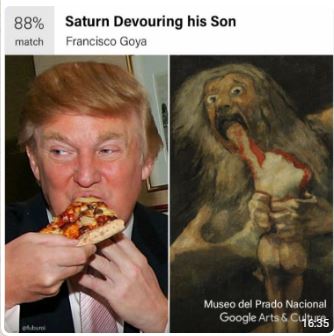
But supremacism does not depend on species – those of another race, another origin, another gender, another age-group may all be dehumanised, objectified like farmed animals, and cannibalism is famously the accusation used to dehumanise colonised people, giving invaders the excuse to enslave or exterminate them. Trump dehumanises immigrants by accusations of cannibalism, just as his political opponents dehumanise him. When American comedian Jon Stewart was asked in 2017 by Late Show host Stephen Colbert to say something nice about then President Donald Trump, he hesitated and eventually blurted, “He’s not a cannibal”. Colbert followed this up a year later suggesting Trump eats human flesh, but only “it’s very well done with some ketchup”.

Consuming the appropriated assets of those considered foreign or inferior is standard operating procedure in human history. In the absence of now largely abandoned concepts of (some) humans being semi-divine creatures, created in the “image of God”, what is to stop the actual consumption of those on the next rung down? As the huge population of humanity consumes the environment, leading to climate change and famine, could cannibalism be the next phase of human evolution?

As anthropologist Harold Monroe asks in Cannibal Holocaust, “I wonder who the real cannibals are?”  

And as Hannibal said,

“It’s only cannibalism if we’re equals.”

Cannibalism in the Ukraine: GHOUL (Petr Jákl, 2015)

Ghoul is a “found footage” movie, a postmodern affectation that pretends it is a documentary that has been ‘found’ after some gruesome disaster. The genre was popularised (although not originated) by the Blair Witch Project in 1999 which, like Ghoul, had young film-makers heading off to investigate the paranormal, and wishing they hadn’t. One of its most famous antecedents was Cannibal Holocaust in 1980, which was purportedly a documentary about missing documentary makers, and was (purportedly) believable enough to lead to a court case in which the actors had to be produced to prove they had not in fact been killed in some sort of snuff movie. This was of course great publicity for the film, as was the fact that it had been banned in several jurisdictions. The very first film in the genre was probably Punishment Park in 1971, in which anti-Vietnam War demonstrators are supposedly dropped in the desert and hunted by Nixon’s cops.

The main point of interest in this film (the found footage itself being unoriginal and totally preposterous) is the fact that it is set in The Ukraine which, at the time of writing, is again suffering from decisions taken in Moscow. The “Holodomor” (literally “murder by starvation”) was an event that took place in the Ukraine in 1932-3, during which the population was deliberately decimated by the collectivisation of the farms and seizure of food stores. As starvation set in, corpses began to disappear, and the government response was simply to put up signs saying, “Eating dead children is barbarism”. Timothy Snyder’s Bloodlands, the history of Nazi and Soviet mass murders between the wars, examines the incidents of cannibalism in the Ukraine and Poland, and concludes “With starvation will come cannibalism”. When there is no bread or other meat, human flesh becomes the currency. Snyder describes several reports, including an orphanage in Kharkiv where the older children began eating the youngest, who himself joined in, “tearing strips from himself and eating them, he ate as much as he could.”

Pretty difficult to invent a story worse than such a reality. So to add some spice, we have in Ghoul an amateur film crew from America who are fascinated by cannibalism (as, apparently, are very many people: this blog is currently receiving over 10,000 views per month – THANK YOU for reading!) They are researching evidence of cannibalism during the Holodomor, as part of a planned television series on cannibals of the twentieth century. They are conducting interviews in Kyiv of elderly survivors of that time, but they are also hoping to interview a man named Boris who was arrested rather more recently for eating a colleague, confessed to the crime under hypnosis, but then was released, as the body was never found. He said that he was made to do it. By whom, they wonder.

The crew are taken to a local psychic/witch, who tells them that paranormal entities were behind that murder. The crew dismisses this as superstition, getting drunk and getting her to perform a séance involving a pentagram, in which they mockingly summon the ghost of Andrei Chikatilo, a notorious serial killer and cannibal who killed and partially consumed dozens of women and children in the late 1970s and 1980s.

The next morning is full of strange and uncanny events, but the crew are unable to leave for help. The Ukrainian psychic tries but fails to evict Chikatilo’s presence, with no luck: he’s back now, and killing again. The idea is that Chikatilo forced Boris, their reluctant interviewee, to kill and eat his victim. He possesses (as in takes over the body of) a cat, then Boris, who proceeds to chase the young filmmakers, screaming, through various dark, gothic passages.

WTF? (Or що за біса as they say in The Ukraine). The film’s poster (below) says “INSPIRED BY TRUE EVENTS”. But where is the connection between Stalin’s attempted genocide in the 1930s and the ghost of a cannibal who had been active in Russia in the 1970s and 80s and was executed by a bullet behind his ear in 1994? Well, turns out Chikatilo had a brother that disappeared during the famine, and his ever-loving mummy told him the brother had been kidnapped and eaten. This may have just been to make him behave better (spoiler: didn’t work very well). So anyway, he decided to become a cannibal, specialising in small children. A real piece of work, and not one you’d want to reawaken from the dead.

I find hand-held filming annoying even in the hands of an expert, and this lot are supposed to be a bit sloppy, so the picture is jumping all over the place, to the point of seasickness. Reminds me of my dad’s Super-8 home movies (although he didn’t have a cannibal ghost to film, just bored kids). If you are patient enough to put up with the soundtrack (annoying bangs meant to scare you) and the shaky camera, the concept of a massacre being presented through the dispassionate eye of a video camera is interesting, in that it could be interpreted as the way the universe indifferently watches the suffering of its animals as they eat each other or, more immediately, the way the world watches as Russia tries to cannibalise Ukraine.

But besides the irritating camera work and the noisy things that go bump in the night, the plot is absurd – you have a historical tragedy, an imaginary murderer and the supposed ghost of a real murderer, who is somehow able to take over cats, people (including during sex) and of course kill people. The whole thing is frankly a bit of a yawn. It somehow managed to get to 22% on Rotten Tomatoes, with the LA Times critic summing it up well:

“Ghoul” can’t decide whether it should be about cannibals, serial killers, ghosts or demons. The found footage trivializes rather than reflects the horrific events that serve as the film’s basis.

According to IMDB, Ghoul was the highest grossing horror in Czech history. It also won the Vicious Cat Award at the Grossmann film and wine festival. Not sure if that will impress you or not.

The full movie was available on YouTube last time I checked, but all the dialog is in Czech and Ukrainian. Even if you speak both fluently, I wouldn’t bother.

“It’s primitive as can be”: GILLIGAN’S ISLAND (1964-67)

A tweet making waves the other day from film director James Gunn reminded me of the many hours I wasted spent as a child watching the seemingly endless travails of the seven castaways on the TV series Gilligan’s Island. Being shipwrecked on a desert island with Mary Ann and Ginger did not seem such an ordeal to my pubescent mind, except every now and the group would be threatened by the arrival of – yep – CANNIBALS!

English professor Priscilla Walton observes that her first encounter with cannibals was also on her television, watching the enormously popular show. The series ran from 1964-67 over some 98 episodes plus occasional reunion movies.

Gilligan’s Island (GI) was a clever reboot of the first English language novel, Daniel Defoe’s Robinson Crusoe (even mentioning that story in the closing song).

“No phone, no lights, no motor car, not a single luxury. Like Robinson Crusoe, they’re primitive as can be.”

Unlike Defoe’s story, Gilligan (Bob Denver) was not a lone survivor of a shipwreck but the hapless “first mate” on a little cruise boat, The Minnow. Gilligan, his skipper (Alan Hale) and five tourists left a tropical port for a three-hour tour, and instead were marooned on an uncharted island, apparently interminably. Various commentators with too much time on their hands have suggested that the seven castaways represent the seven deadly sins (e.g. Ginger was lust and Mary Ann envy). I’m not going near that one, fascinating as it is, because this is a cannibal blog after all. And cannibalism is neither illegal, nor one of the seven deadly sins. It just misses out on all the gongs.

Robinson Crusoe worried ceaselessly about his lack of company, eventually adopting Friday, a local ‘savage’ whom he rescued from a tribe of cannibals. He also spent a lot of the book and some of the movies worried about what to eat, and nervous that Friday might eat him. Like those of us marooned on this planet rather than an island, major preoccupations are always fear and appetite. Appetite is all about food and sex. Fear is about being killed and perhaps eaten.

The obsessions of Gilligan and the other all-white islanders were the same. Of course, it was the sixties, so no sex could be shown except for the movie star, Ginger (Tina Louise) who used her flirty charms to inflame and coax the men into various (non-sexual) activities. But – what did the castaways eat? Well, it was an island, so presumably the would eat sea animals, as well as various plants (including some that grew from a box of radioactive seeds in one episode). There seemed to be a lot of coconut pies.

Then of course, like Crusoe, there were the natives who, like most depictions of indigenous peoples until fairly recently, were assumed to be primitive savages and so, ipso facto, cannibals. No evidence was presented, and no one was ever eaten. From the earliest days of the movie, and well before, indigenous peoples who were being dispossessed by European explorers were declared cannibals, with no evidence needed other than their lack of “civilisation.” Think of movies like Cannibal Holocaust and the various Italian movies of that period, or old classics like Windbag the Sailor, Be My King, or the early racist cartoons like Jungle Jitters.

Sheer Eurocentric racism of course, as I suppose was the choice of the Irish name “Gilligan” for the show’s clown, a boy/man who is usually responsible for thwarting their rescue through his clueless blunderings. The “natives” were invariably people of colour wearing grass skirts with bone piercings in ears, noses, etc and horns on their heads. This probably is the image that springs to mind even now when a cannibal scholar mentions cannibalism in polite company – primitive savages who threaten our safety and bodies if we fall into their clutches. Of course, as Walton points out, the island was the traditional home of the “natives” – it was Gilligan and the castaways who were the intruders, introducing baffling technology and probably a few new pandemics to the locals. There’s a comprehensive study of GI Natives on a Gilligan fandom page. Yes Virginia, there is a GI fandom site.

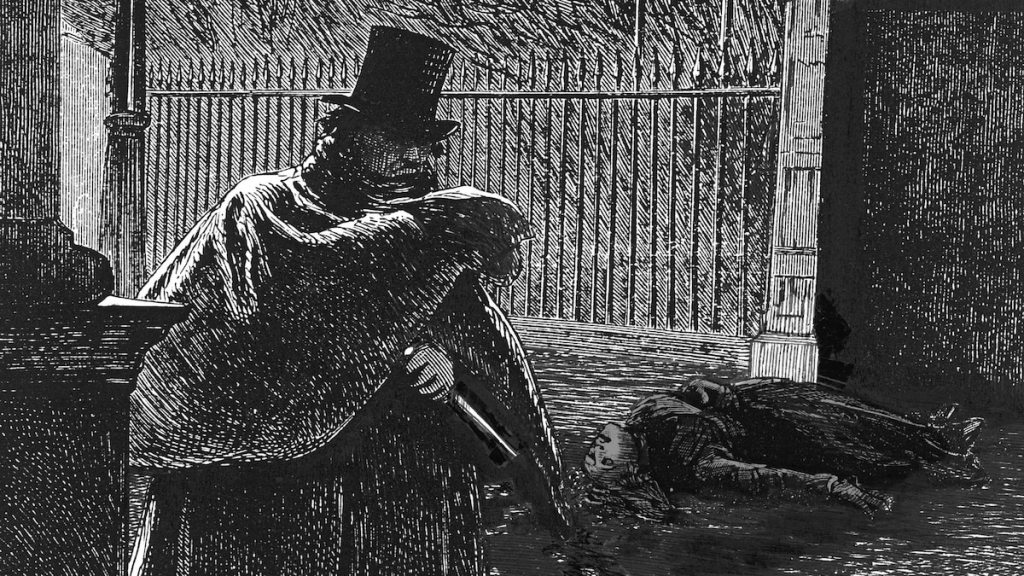
But the cannibal has moved on. From the outsider who was only sighted by explorers or conquistadors, the cannibal has firmly come home and, since the time of Jack the Ripper who boasted of eating the kidney of one of his victims, the vast majority of reports of cannibalism involve people in urban cities and communities eating their neighbours. Generally, they are dismissed as psychotic personalities who know not what they do. That discourse has become ever less convincing, with cannibals like Fritz Haarmann or Armin Meiwes or even Jeffrey Dahmer all seeming to know exactly what they were doing. The ultimate example of the civilised, enlightened, urbane cannibal is of course Hannibal Lecter, who simply sees eating inferior or rude humans as no worse than eating pigs or fish. Unlike the other examples, Hannibal is fictional, but perfectly represents the cultural trend toward the modern, domestic cannibal.

So, who would the cannibals have been in a re-booted Gilligan’s Island? There are clues. While the men seem largely asexual (Gilligan and the Skipper could perhaps be considered bunk-mates, while the Professor is married to science and Thurston Howell III to Lovey and therefore to asexual domesticity), the women are given standard feminine stereotypes of the virgin (Mary Ann), the whore (Ginger) and the symbolic mother (Lovey). Barbara Creed‘s “The Monstrous-Feminine” emphasises the importance of gender in the construction of female monsters, and so it is not totally surprising that when people turn their fantasies beyond the wholesome storyline of the series, it is the gentle, subservient Mary Ann (Dawn Wells) who becomes the knife-wielding cannibal.

The 2002 comic strip Cool Jerk (above) depicted Mary Ann, or maybe a look-alike, as a cannibal named Mary Annibal. The Silence of the Lambs had swept the Oscars in 1992, and the sequel, Hannibal, had come out in a blaze of publicity in 2001.

Cannibalism on a desert island (or in an inaccessible place like the Andes) is a long tradition, and a rich source of humour. Above is the cover of the Horror Society’s Summer 2015 issue. Can you spot the Cannibal Holocaust reference?

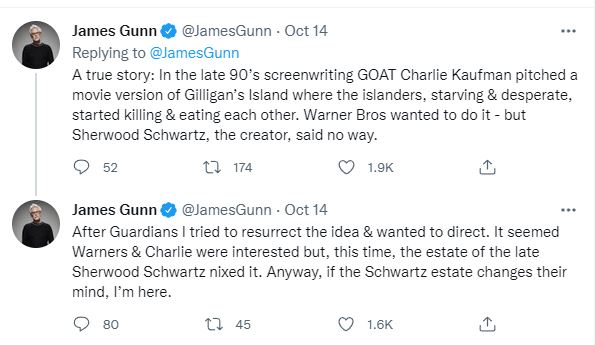
More recently, James Gunn, the director of Guardians of the Galaxy, Suicide Squad and many others (and a known provocateur with a wicked sense of humour) suggested that he and Charlie Kaufman had wanted to restart “Gilligan Kimishima” as a cannibal movie. He tweeted an image of his entry in a Twitter trend that asked people to “pitch a movie with two pictures, no captions.” He juxtaposed the GI tribe with Theodor de Bry’s 16th century engravings of the Tupinambá in Brazil, a series of engravings he based on the sensational accounts of Hans Staden and Jean de Léry, both of whom gave graphic descriptions of cannibalism (hey, it sells books).

Gunn went on to explain that this was a true story. He and Charlie Kaufman had pitched a movie version of Gilligan’s Island to Warner Bros. in which the starving castaways would kill and eat each other. Unfortunately, the creator of GI, Sherwood Schwartz (and later his estate) refused to let it go ahead.

Such a shame. Of course, most of the original GI actors are now dead (Dawn Wells sadly died from COVID-19 just before New Year), but with modern artificial intelligence and deepfake technology, who says we couldn’t have a cannibal feast on an avatar Gilligan’s Island? It would at least be white meat.

Satanic rituals and forced cannibalism. How many refugees share this fate?

The news service Noticias Telemundo recently reported a case of kidnapping, murder and cannibalism which, it seems, may not be so uncommon among refugees trying to cross Mexico into the United States.

Noticias Telemundo Investiga interviewed 32 migrants kidnapped from 2019 to 2021 in Mexico and the U.S. Their relatives were made to pay $1,500 to $5,000 as ransom to criminal gangs for the release of the kidnapped migrants.

The latest story follows the ordeal of a young man named David Sanabria and his little girl Ximena, who are from Honduras.

David Sanabria had arranged a coyote (smuggler) to escort them to the Texan border, where he planned to turn himself and his daughter in to U.S. immigration authorities and seek asylum. But when they reached Reynosa in the Mexican state of Tamaulipas, the coyote turned them over to a cartel gang. David and other captives were repeatedly made to call relatives to ask for a ransom, and were beaten if the relative said they couldn’t afford it. The victims are not US citizens so relatives cannot ask for help from the FBI, and in many cases the local police in Mexico are in the pay of the cartels.

If the ransom was not paid by the deadline, the captives would be murdered. David said:

“With a machete they dismembered them, killed them, and the only thing I could do was cover my daughter’s eyes and ears so that she would not know what was happening, nor would she have those memories for her whole life.”

After that, the corpses were cooked and the surviving migrants were made to eat the human meat, “so that there would be no trace of anything — that’s what one had to eat.” The term “innocent cannibal” is usually reserved for those who are not aware that human meat is in their meal, but in this case, I think we can apply it to David and Ximena.

At night, the kidnappers performed satanic rituals. “They knelt down. They had images of the devil, of Santa Muerte. They made pleas. They made offerings. It was something horrible,” he said. Several survivors who spoke to Noticias Telemundo Investiga talked about the kidnappers’ “cult of death”.

David’s brother borrowed money from his co-workers, friends and relatives and even asked strangers for money on the streets of Nashville. He eventually raised the $7,500 ransom and David and Ximena were released. David waded across the Rio Grande with Ximena on his back. So they made it to the US border where they were detained for three days, but then were returned to Mexico. Under Title 42 to curb the spread of COVID-19, migrants who are detained at the border are returned to Mexico while their petitions for asylum are processed. This year, 100,000 migrants a month are being returned to Mexico.

They were put in a shelter by the National Migration Institute of Mexico, and Al Otro Lado, which provides free legal assistance to migrants from Baja California, helped David fill out an asylum application.

In August, the U.S. granted David and Ximena humanitarian parole so they could enter the country and live with his brother in Tennessee while they await the results of their asylum petitions.

This is Ximena in the shelter.

The United Nations estimates there are over 82 million people in the world who have fled their homes, of whom 26 million are refugees, half of those under the age of eighteen. That means one in every ninety-five people on earth has fled their home as a result of conflict or persecution.

Imagine, if you can, being a refugee, anywhere in the world. You are fleeing from a place which doesn’t want you, and where people are possibly threatening to imprison or kill you, to another place that also does not want you and may send you back, and almost no one will support you en route. Men, women and children are helpless, easy prey for unscrupulous smugglers and criminal gangs. If you disappear, no one will find you, particularly if you have been eaten.

Migrant kidnappings happen all the time. Mexican authorities at the beginning of September 2021 reported a total of 697 migrants kidnapped and rescued in just 10 days. These are not statistics. They are people like David and Ximena, who may be robbed, kidnapped, beaten, killed, forced into cannibalism, and even eaten themselves, as the world ignores them. In a world where we capture, kill and eat some 350 million animals every hour of every day, is it really surprising that we sometimes do the same to members of our own species?

It made me think of the last line of the film Cannibal Holocaust:

What’s your favourite cannibal movie?

Of all the (sometimes) wonderful cannibal movies and shows I have reviewed in this blog, my personal favourite is still The Silence of the Lambs with Anthony Hopkins as Hannibal the Cannibal. It was the first film I reviewed on this blog (does that mean I liked the others less each time? Not at all), and interestingly, it does not actually feature any cannibalism, although we hear a lot about it.

Fun fact!

So I was pretty chuffed to find that The Silence of the Lambs is the favourite horror movie of the State of Utah, according to the Horrornews.net website. They used information from Rotten Tomatoes and Google Trends, and partnered with Mindnet Analytics, to analyse how interest in horror movies varied in each US state and the District of Columbia (DC). The results are presented on their website:

Best Horror Movies: Which Does Each US State Love Most?

This survey covers all horror, whereas in this blog we concentrate on the cannibal, so please let us know your favourite cannibal film (or TV show, but if it’s a series, your favourite episode) either in the comments at the bottom of the page (after a few suggestions) or at cannibalstudies@gmail.com. I’ll let you know the results.

Cannibal – the game (Deodato 2020)

You may remember the seminal cannibalism movie Cannibal Holocaust which I reviewed last year:

“I wonder who the real cannibals are” CANNIBAL HOLOCAUST (Deodato, 1980)

Well, yes, now there is going to be a game based on it, written by the Director, Ruggero Deodato. Set in Borneo, the Cannibal video game will allow players to take on the role of a variety of different characters. We don’t know who those characters will be yet, but more information will follow.

Based on the artwork, it seems as though Cannibal will attempt to replicate the found footage style of the movie, which is something that’s been done in games like Outlast and Resident Evil 7. With one of the innovators of the found footage genre at the helm, though, it will be interesting to see if Cannibal will be able to take this style of horror game to the next level.

Cannibal will launch in November for iOS, Android, PC, PS4, Switch, and Xbox One.