Dmitri Malyshev was recently released from a 25-year sentence for murder and cannibalism to fight on the Ukrainian front for the Russian “Storm V” and “Storm Z” forces.
The enormous number of casualties and shortage of Russian volunteer troops in Ukraine inspired Yevgeny Prigozhin, an oligarch known as “Putin’s chef” because he rose from being a restaurateur and caterer for the Kremlin, to scour the worst prisons in Russia and recruit murderers, rapists and cannibals for his army, the Wagner Group. They were dropped into the thick of the fighting, and promised a full pardon if they survived six months against the Ukrainian army. Prigozhin has since been killed, but the scheme apparently survives, now run by the Russian military.
The latest recruit is Dmitri Malyshev. Originally from Volgograd, Malyshev was sentenced to 25 years in prison in 2015 for multiple criminal offences. Ten years ago, he murdered an acquaintance, a Tajik native, and then filmed himself cutting the heart out of the victim and roasting it in a frying pan and eating it. Malyshev, part of an organized criminal group, had previously killed two businessmen for their money.
In the video, Malyshev said:
“We’re roasting a human. Here it is – a heart. I’ve already added the onion.”
Malyshev subsequently apologized for his actions, “carried out under the influence of alcohol.” Well, that’s OK then. Who hasn’t acted ill-advisedly after a few drinks and eaten a friend?
In March 2024, Malyshev took a photo in Ukraine with another participant in the war, Alexander Maslennikov from Volzhsky, who was convicted in 2017 for stabbing to death two girls he met at a karaoke joint, dismembering them, and hiding them in the forest, for which he received a 22-year sentence. In 2023, residents of Volgograd and Volzhsky expressed their fear on social media about Maslennikov’s potential return to the region.
A cannibal and a serial killer were released from prison and went to the front line
The cannibal Dmitry Malyshev, who ate Tajik’s heart and recorded the whole process on camera, was released from prison and went to war in Ukraine to "fight" sex education in school and gays. At… pic.twitter.com/R26pDYHAMh
During his conversation with V1 journalists, Malyshev confirmed that he had served his prison term alongside Maslennikov, and they both signed a military contract in October 2023. Malyshev was deployed to the ‘Storm V’ unit. The cannibal asserted that he had decided to “fight for the preservation of traditional Russian values.” He added that he came to Ukraine to “fight” against sex education in schools and gays.
Malyshev is currently in hospital. He told reporters:
“A grenade landed on me during an assault manoeuvre. I have a broken jaw, shrapnel in my knee and left hand and my left eardrum burst. Nothing to see here.”
Other cannibals purportedly sent to fight in Ukraine include:
Nikolai Ogolobyak, a Satanist who, with his followers, killed four college students and ate their internal organs in a ritual feast
Denis Gorin, who killed and ate parts of at least three victims, although parts of around twelve bodies were found
From Putin’s point of view, it’s an ideal solution. Why feed these guys (even if not very lavishly) for the next twenty years or so, when they can go off and be killed or else fend for themselves, finding their own sources of meat and onions? And, if they happen to survive the hellish battles in which they are dropped, then they are ‘pardoned’ and sent home where, more than likely, their victims’ relatives may have plans for them. From a military point of view, too, they have proved that the life of a human is worth no more to them than any other kind of edible animal, which, together with having nothing to lose, makes them ideal killing machines.
“…there is no article ‘cannibalism’ in the legislation of the Russian Federation. Perhaps that is why the dehumanization of Russians has already acquired a literal meaning.”
Meat the twenty-first century version of super-soldiers.
If you read this blog, and I hope you do, you might remember a movie we reviewed recently called Wendigo. It was about the mythical creature from Algonquin legends, the spirit who takes over humans and turns them into voracious cannibals whose feeding frenzy makes them grow larger and, consequently, hungrier. The Wendigo is usually represented by the stag or at least the antlers of a stag; thus the title of this week’s film, Antlers, which fronts another Wendigo, although this time a rather less complex creature.
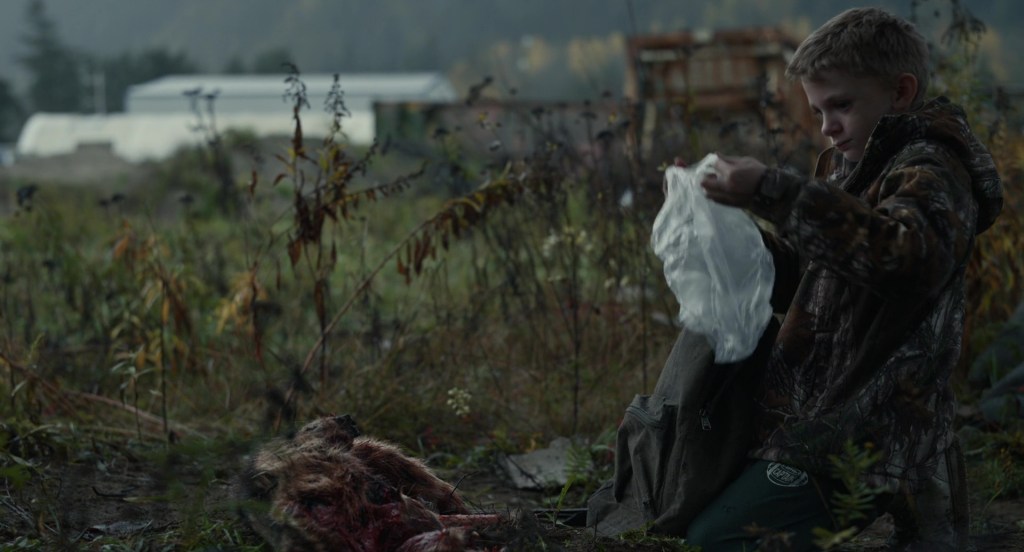
Directed and co-written by Scott Cooper (Crazy Heart, Black Mass) the film is produced by Guillermo del Toro, who has already won three Academy Awards for his imaginative grotesqueries. Del Toro’s films exhibit his fascination with fairy tales and mythology and the monstrous, in which he finds poetic beauty. The cast is outstanding, led by Keri Russell (Grimm Love, The Americans) as Julia, a teacher in rural Oregon who wants to help a young boy in her class named Lucas (Jeremy T. Thomas) who, she suspects, is suffering parental abuse. She thinks this because he is drawing gruesome pictures of creatures with huge antlers, and collecting roadkill.
Jeffrey Dahmer’s dad used to take him out on road trips to find roadkill to dissect, but there was nothing wrong with him, was there? Well, OK, but anyway, he wasn’t being abused, and nor is Lucas (except by the usual school bully).
Lucas’ dad was using an abandoned mine to cook methamphetamine, disturbing the quiet of the place, releasing who knows what has been hiding in there? Yep, but it’s not a balrog (also usually shown with horns), it’s a wendigo. And it has infected both the dad and the little brother. Dad is now very loud, very violent creature with a lack of hair (bit like Gollum, but more excitable) who need to be fed raw meat every day. No smart cracks about Oregonians, please. But Julia is an outsider herself – she fled to California as a young woman to escape her abusive father, and is wracked with guilt about leaving her brother Paul (Jesse Plemons – Friday Night Lights and Breaking Bad) behind. He is now sheriff of the town, where he does exciting things like evict poor people from their humble homes. She thinks he resents her, and we think so too – why wouldn’t he? He tells her he spent his entire life praying she’d come back. But now, whenever he comes near her, she flinches as she flashes back to her father abusing her as a child.
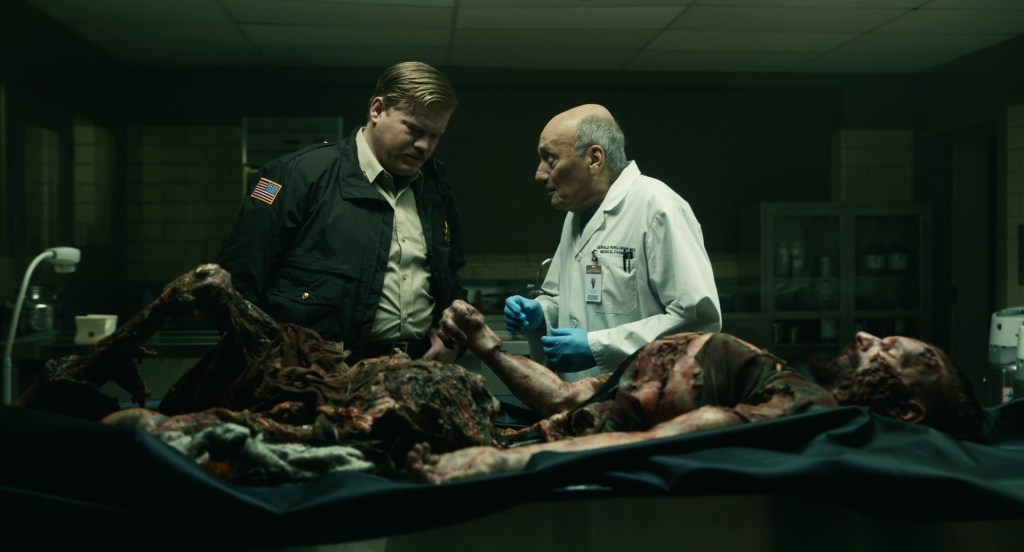
Paul goes into the woods to retrieve half a human body that someone has reported, and takes it to the coroner, who tells him the mutilation shows teeth marks – and they are human teeth. Almost halfway into the movie, and we finally have some cannibalism going on! Paul finds the other half of the dude (the dad’s former business partner) in the mine where they were cooking the meth. Also some mysterious antlers!
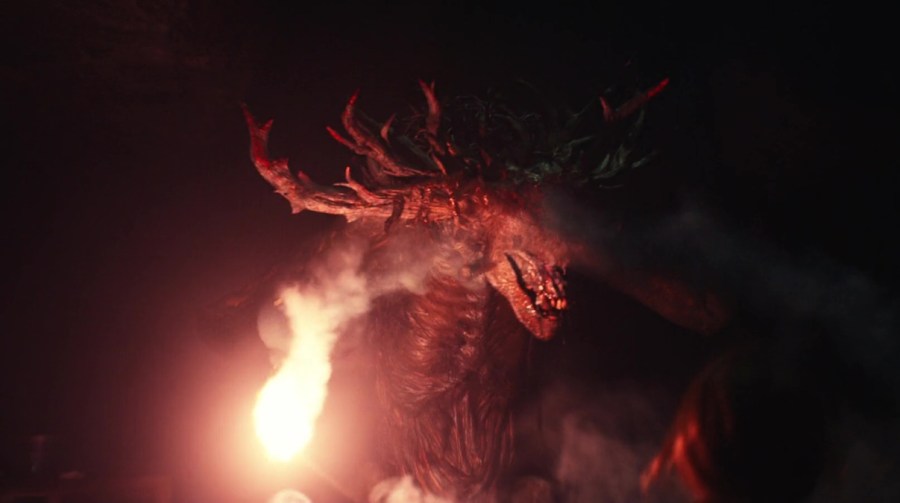
From there on, people start getting eaten – the stern school principal, the school bully who has been picking on Lucas (monsters can also be instruments of justice). It doesn’t work well for dad either; after he is finished enjoying the school principal, the real monster, now in the shape of a skeletal beast looking similar to the creature fought in the Alien films (but with antlers), sacrifices his body (the reference to the crucifixion is clear), then bursts out of his mouth, leaving him a charred, flayed wreck.
Lucas is carried off to the hospital, where he is diagnosed as dehydrated, malnourished, and deeply psychotic. Well, no wonder!
Warren, the previous Sheriff, is a local Native American, and explains to them that Lucas’ drawings, as well as the antler found in the mine, depicts the Wendigo,
“…a diabolical wickedness that devours mankind… known to be eternally starving but feasting makes them hungrier, and weaker. Those who are unfortunate enough to encounter one can only kill it when it’s in its weakened state. And only by extinguishing its beating heart, forcing it to search for another host. But it makes sense you see – our ancestral spirits never died. They were here long before we were here, and they’ll be here long after we’re gone. But now they’re angry.”
They find the missing school bully, who has been “eaten in half”, but Paul tells Julia he still cannot believe in a mythical nature spirit. He requires a conversion experience – maybe his deputy getting pin-cushioned and eaten, and then him getting comprehensively monstered? That leaves it up to Julia to take on the Wendigo. Being a teacher, she remembers the bit about it being weakened when eating, and the bit about extinguishing its beating heart. Using some impressive combat techniques that she probably learnt in The Americans, Julia rather easily beats the big beast, but then has a new problem – the Wendigo spirit is now in Aiden, Lucas’ little brother. Does Julia have the heart to kill and tear the beating heart out of an eight-year-old boy who looks like he just needs a meal and a bath? And do it while she is being watched by his big brother, Lucas?
Spoiler alert: you bet she does!
But as we watch the happy ending, Lucas now living with Julia and Paul, we see Paul begin to cough and spit out black foam – the first symptom of becoming a Wendigo (or this version of it.) As Jeffrey Jerome Cohen told us in his “Seven Theses” on monster culture, the monster never really dies or goes away; it just comes back in different clothes, or different skin. No matter how many times Ripley killed the Alien, it kept coming back, sometimes in the shape of its progeny (a reversal of the Beowulf story, where killing the monster arouses his mother’s wrath).
There are several versions of the Wendigo story. In Supernatural, the Wendigo only ate people every 23 years, an extreme version of the paleo diet. In Fear Itself, the Wendigo takes over anyone who is weak and hungry and fills them with rage, while in Lone Ranger, it appeared an outlaw in the Old West, who could only be killed with a silver bullet for some reason. The common thread is insatiable and voracious appetite, a hunger that destroys without thought for sustainability. In Bones and All, that hunger begins young and gets stronger as they grow older. Perhaps the classic of Wendigo literature is the film Ravenous, in which becoming a Wendigo gives not just superhuman strength but close to invulnerability, or at least the ability to heal any wounds by eating more people. And, of course, a voracious hunger.
The film starts with a warning. This is read in Ojibwe, one of the Indigenous languages of the Algonquin people, whose lands stretch from present-day Ontario in eastern Canada all the way into Montana. This is the language in which the mythology of the Wendigo was developed. The English translation scrolls up the screen:
The film is brilliantly acted, beautifully filmed and directed, but could have made more of a point of the environmental message with which it started, rather than just hurtling into the special effects and gore. The Wendigo is well presented, if a little sparse (we hardly see those antlers), but the connection between the greed of humans and the monstrous revenge of nature is left hanging. There have been five great extinction events found in fossil records. The SIXTH MASS EXTINCTION is happening as we speak. Extinctions have occurred at over 1,000 times the background extinction rate since 1900, and the rate is increasing, a result of human activity (or ecocide), driven by population growth and overconsumption of the earth’s natural resources. In late 2021, WWF Germany suggested that over a million species could go extinct within a decade in the “largest mass extinction event since the end of the dinosaur age.”
Humanity has waged war on nature since we came down from the proverbial trees, but particularly since the agricultural revolution some 12,000 years ago, when we decided nature could be dominated rather than placated. Fossil fuel combustion, the selective breeding of billions of other animals for food or clothing, the capture of wild animals for entertainment – these are all manifestations of the war on nature, motivated by a Wendigo-like hunger which can never be satiated. It’s a war that we cannot win, without destroying ourselves in the process – nature never goes away, but, like the Wendigo, comes back in another (angrier) skin – floods, droughts, climate change, etc. We have, as the Ojibwe warning says, pillaged the land and awakened a Malevolent Spirit. Like any organism evolving by natural selection, we can adapt or die. Our only advantage over other species is that we could, if we had the sense, decide which to choose.
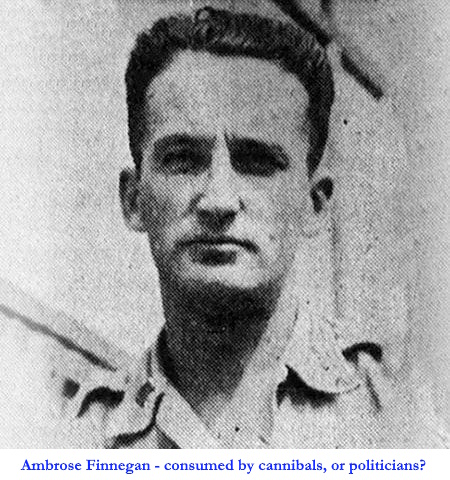
Raising eyebrows is a national sport of the USA during election years, and both Trump and Biden, the contenders, have done their share of the heavy lifting. But Biden really hit his eyebrow-raising stride this week (on April 18 2024) with claims that his uncle, second lieutenant Ambrose Finnegan (known in the family as Bosie), was shot down in the Pacific in 1944, and may have ended up on the dinner menu of Papua New Guineans.
Visiting a missing-in-action war memorial in Scranton, Pennsylvania, Biden put his hand on the engraved name of Ambrose Finnegan, whose plane went down but whose body was never recovered. Biden said,
“He got shot down in New Guinea, and they never found the body because there used to be — there were a lot of cannibals, for real, in that part of New Guinea.”
“For unknown reasons, this plane was forced to ditch in the ocean off the north coast of New Guinea. Both engines failed at low altitude, and the aircraft’s nose hit the water hard. Three men failed to emerge from the sinking wreck and were lost in the crash. One crew member survived and was rescued by a passing barge. An aerial search the next day found no trace of the missing aircraft or the lost crew members.”
Biden’s cannibalism story, told twice during his visit to Pennsylvania, was clearly intended as a gesture of respect for those who died in the war, and a dig at Trump. White House Press Secretary Karine Jean-Pierre stated that Biden’s story presented a contrast with Donald Trump, who reportedly described Americans who died in war as “losers” and “suckers” after refusing to attend the American cemetery in rainy Paris in 2018. Trump also mocked George H.W. Bush who was shot down in 1944 and John McCain who was captured and tortured in Vietnam, claiming real heroes did not get shot down or captured. Trump denies it all, but the Paris story was later confirmed by John Kelly, his longest-serving White House chief of staff.
However, like a lot of off-the-cuff comments, this one may have backfired for Joe Biden. Cannibalism is a convenient excuse for vilifying others, but vilifying Pacific Islanders does not help make any points against Donald Trump, and instead proved a distraction.
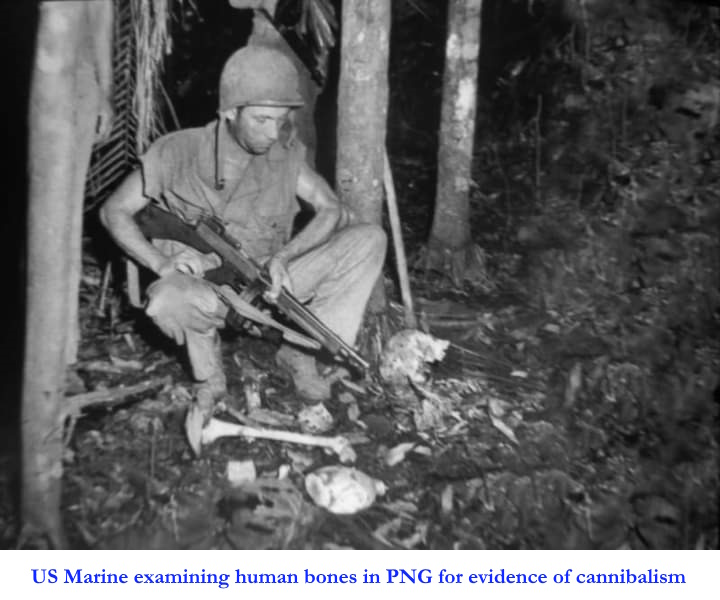
Certainly, cannibalism has been reported in Papua New Guinea (PNG), the Pacific nation that occupies the eastern half of the island of New Guinea, off the northern coast of Australia, but not always by the locals. At least 100 cases have been documented in which Japanese soldiers killed and ate the flesh of Allied troops, Asian labourers and indigenous people in Papua New Guinea during WWII. Researcher Toshiyuki Tanaka, an associate professor of political science at the University of Melbourne, reports,
“These documents clearly show that this cannibalism was done by a whole group of Japanese soldiers, and in some cases they were not even starving.”
Cannibalism can be an affirmation of victory, a way of humiliating an enemy beyond death. Historian Gerald Linderman reports that Japanese soldiers would disembowel captured Americans and leave the bodies “with their severed genitals stuffed in their mouths,” not only symbolically gagging the mouth of the victim but declaring him both sterile (castrated) and edible in one metaphorical gesture of contempt. George H.W. Bush, later to be President of the US, was shot down during bombing raids on Chichijima, a tiny island 700 miles (1,100 km) south of Tokyo, in September 1944. Eight of the airmen with him were captured, tortured and executed, and Japanese officers then ate parts of the bodies of four of the men. Bush was the only one to evade capture.
While the Japanese army may have practised cannibalism in PNG for political and psychological ends, those (relatively rare) tribes of local peoples who did so almost certainly were motivated by ritual, reverential reasons. The memory of ancestors is maintained in some cultures by ceremonially eating their flesh. Some tribes have even cashed in on the cannibal mystique, ushering awestruck tourists around monuments to their supposed recent cannibal past.
Local commentators have not been amused by Biden’s colonialist characterisation of their citizens as primitive savages who routinely eat outsiders, a trope that has proved useful throughout the history of imperial conquest as a pretext for invasion, enslavement and extermination. Michael Kabuni, a lecturer in political science at the University of Papua New Guinea, said that the comments were unsubstantiated and poorly judged, particularly when the US has been seeking to strengthen its ties with the country, and counter Chinese influence in the Pacific region.
“The Melanesian group of people, who Papua New Guinea is part of, are a very proud people. And they would find this kind of categorisation very offensive. Not because someone says ‘oh there used to be cannibalism in PNG’ – yes, we know that, that’s a fact. But taking it out of context, and implying that your [uncle] jumps out of the plane and somehow we think it’s a good meal is unacceptable. There was context. They wouldn’t just eat any white men that fell from the sky.”
Biden is right to say that there were some cannibal tribes in PNG last century, but wrong to universalise it as something routine and simply gustatory. His anecdote may have been inspired by the infamous tale of Michael Rockefeller, the 23-year-old Harvard graduate and son of New York governor Nelson Rockefeller, who vanished in western New Guinea in 1961 while on a trip to collect wooden carvings of the Asmat people for a museum. His boat capsized on the way, and he was reported to have swum towards the shore. His disappearance captivated the world’s media, and later led a researcher to claim in a book that Rockefeller made it to shore and was eaten during a ritual by the Asmat. It became fashionable to set cannibal movies in the jungles of PNG, even if they were not actually filmed there.
There is one more aspect of the history of PNG cannibalism that adds insult to injury. One of the most commonly cited examples of modern cannibalism, often used as a reason to avoid the practice, references kuru, the fatal, neurodegenerative disease discovered in PNG and caused by “misfolding and aggregation of a host-encoded cellular prion protein” and purportedly transmitted by cannibalism. Transmissible spongiform encephalopathies became best known during the outbreak of “mad cow disease” caused by human-imposed bovine cannibalism, in which cows were fed bone meal from other cows. It occurs also in sheep as “scrapie” and in humans as Creutzfeldt–Jakob disease, one form of which, kuru, literally the “trembling” disease, peaked among the Fore people of the Eastern Highlands of Papua New Guinea in the late 1950s. It became famous, not least for showing that cannibalism is not something lost in the mists of history – it even won a mention on The Love Boat! The disease mainly affected women and children, who were allegedly the main consumers of brain tissue during funerary rites. Instances of the disease fell off sharply when cannibalism was prohibited by Western administrators, which led to the hypothesis that kuru was a result of the ingestion of human brains and central nervous systems.
But even if cannibalism and kuru are directly related, it seems a stretch to make this a primary reason for avoiding cannibalism. Mad cow disease was far more widespread than kuru, and yet did not significantly affect the sales of bovine flesh in the long term. Nor, as far as I am aware, have any cannibals reported a preference for central nervous system tissue. Nor would they be likely to catch it from white men that fell from the sky.
Candace Owens responded to a young woman challenging Owen's anti-trans rant by pointing out Native American Two Spirit people existed. Owens goes off on her, calling Native Americans cannibals and drug users. Shocking, racist and vile. pic.twitter.com/HXFRyCR5Eo
Short answer: yes, and regularly used that way, throughout recorded history.
If you don’t recognise the person in the Tweet, her name is Candace Owens, and she is an American Conservative political commentator, author, activist, and television presenter who has both criticised and supported Donald Trump, attacked Black Lives Matter and been widely condemned for disseminating conspiracy theories, including accusing Israel of genocide. She seems to choose her conspiracies from both extremes of the political crazies – right and left. She has declared Kanye West to be a “dear friend and fellow superhero”.
In the clip above, she is asked by a young woman about Native American “Two Spirit” people – those who might today be called LGBTQIA+, particularly the “T” for “Trans”. The existence of the term and the concept itself would therefore, the questioner argues, go back hundreds or indeed thousands of years, and make nonsense of Owens’ claim that there were no transgender people when she graduated (although it seems she never did), so therefore the population must have has exploded since then. She summarises Owens’ argument: “Trans people are only here because the media is telling people these things”.
Owens does not know the term “Two Spirit” or that there are multiple words referring to the concept in many Native American languages. She answers instead:
“With Two Spirit people, is this like a Native American Tribe? Like high, smoking and talking about your spirit? I’m asking you seriously ’cause I think of Native American tribes talking about their spirits – I know they used to smoke a lot, they used to do drugs, they also were cannibals who used to eat people, so I don’t know if we should be taking our cues from cannibals…”
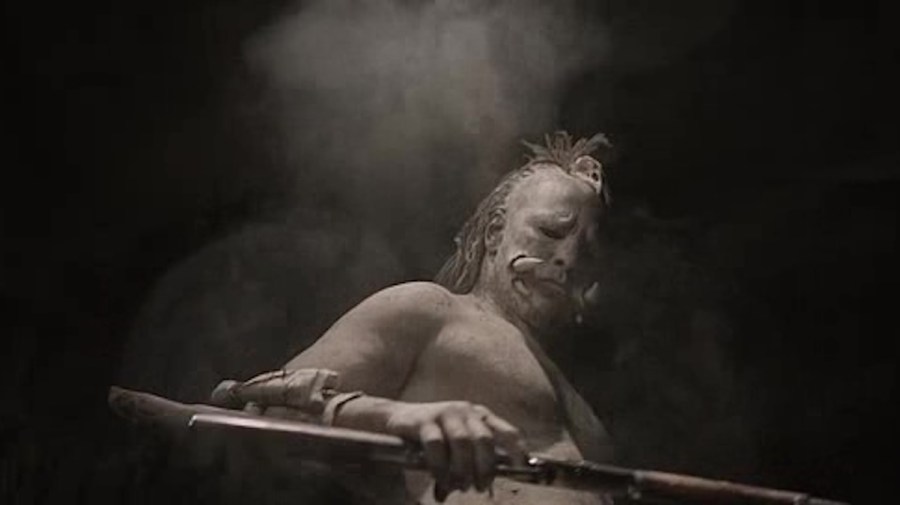
Owens used the same argument against Colin Kaepernick at the Conservative Political Action Conference in 2020, who had spoken of the 1.5 billion acres of land stolen from Indigenous people in the United States, asking “Did cannibalism get lost in Colin’s flowery depiction of Indigenous people?” She referred to Aztec cannibalism, which is generally thought to have taken place in Mesoamerican areas of what is now central Mexico, from 1300 until their society was decimated by the Spanish conquistadors. There is little academic consensus about this – theories range from Marvin Harris who said the flesh of the human sacrifices to the gods was fed to the ruling class due to the shortage of protein in the area, to William Arens who insisted that “there is no firm, substantiable evidence for the socially accepted practice of cannibalism anywhere in the world, at any time in history.” Nonetheless, cannibalism is still depicted as epitomising the uncivilised or, worse, those who have degenerated to savagery. Think of the “troglodytes” in the movie Bone Tomahawk.
the term “cannibalism” itself comes from Christopher Columbus, who named the practice after the Carib tribe of the Caribbean (also named after the Caribs). He claimed the Caribs ate their neighbors, but there is little evidence for this beyond the accusations of rival tribes who, despite never before meeting Europeans, understood that cannibalism was a powerful way to defame enemies. Frank Lestringant examines, in his book Cannibals: The Discovery and Representation of the Cannibal from Columbus to Jules Verne (1997), the contrasting reports from that period of the “savage” cannibals of the New World and the way they were compared, sometimes favourably, with the horrendous cruelty of European politics of the time, particularly in the writings of Montaigne.
Cannibalism is, therefore, an enduring and popular way to denigrate and vilify another group, to declare them less-than-human and therefore not worthy of respect or consideration. Cannibalism, definitionally, requires both sides of the repast to be human—the eater and eaten. But paradoxically, cannibals deny the anthropocentric particularity of their victims, and are in turn symbolically stripped of humanity due to what is seen as a horrendous contravention of shared ethics, deserving redefinition of the eaters as “inhuman” monsters. This was very useful to Columbus, who was not allowed to take slaves unless they were found to be cannibals, and has been used extensively by colonists to slander other Indigenous people including the people of the Pacific, Africans, and the Aboriginal people of Australia.
Cannibalism is a particularly popular trope for political, racist or queerphobic demonisation. The cannibal is most often depicted as male, but homosexuality, still considered repulsive by some despite its legalisation in most of the world, is often emphasised in the reporting of cases such as Jeffrey Dahmer,Ottis Toole, and Armin Meiwes, as if to impugn their masculinity and erroneously imply that straight men are not potential cannibals.
Accusations that a conspiracy known as “Deep State” was trying to subvert Trump crystallised in groups, accounts and pages linked to QAnon during the 2020 election campaign. The accusations included allegations of devil-worship, child-sex trafficking, torture and cannibalism. The fact-checking website Snopes rebuffed allegations about the existence of a “deep web” video showing Hillary Clinton and her campaign vice-chair raping, torturing and mutilating a little girl to cause the child to release adrenochrome into her bloodstream, before drinking her blood during a Satanic ritual sacrifice. Like characters in the filmsTexas Chain Saw Massacre(Hooper, 1974) and Silence of the Lambs (Demme, 1991), and the real-life murderer Ed Gein on whom they were based, they also supposedly excoriated the face to use as a mask. The bestselling QAnon-linked novel The Turner Diaries depicts a race war where white women and girls are constantly threatened and raped by “untamed, cannibalistic” black men, presented as symbolic of nature, and resisted by heroic white men, representing civilisation. Infanticide for cannibalistic feasts is not an original accusation, going back to the blood libels targeting European Jews and the Malleus Maleficarum(Hammer of Witches),the Inquisition’s guide to witch-hunting, which stated that witches would steal the host or wine from the Eucharist ritual to manifest a Christ-child, who would then be tortured, killed and consumed during diabolical feasts.
But back to Owens and her dismissal of “two-spirit” people as being the drug-fueled fantasies of cannibals. The term “Two-spirit” refers to persons who identify as having both masculine and feminine spirits, and is used by some Indigenous people to describe their sexual, gender and/or spiritual identity. The wider use of the term is attributed to Elder Myra Laramee, who proposed its use during the Third Annual Inter-tribal Native American, First Nations, Gay and Lesbian American Conference, held in Winnipeg in 1990. The term is a translation of the Anishinaabemowin term niizh manidoowag, meaning two spirits. It seems obvious that we all have some masculine and feminine features within our complex personalities, and it is useful, if poetic, to call these “spirits”. It explains motives, desires, emotions that may roil and confuse and sometimes contradict each other. It has little to do with gustatory preferences, except that some who feel they need to buttress their masculinity may insist on eating other animals to prove some dubious suppositions of human superiority, often including over other people they may consider less than human. “Real men”, they earnestly insist, don’t eat quiche; they eat lumps of meat, rare or even raw.
As do cannibals, very often. And with the flesh may come the spirit, allowing two spirits to co-exist, mingle, join within the cannibal’s body. Armin Meiwes told an interviewer that
“It’s not about killing or butchering. It is about entering into a relationship… My desire has always been to find a “brother” whom I could assimilate into myself.”
The nature or existence of ‘spirit’ is an eternal debate that will not be finalised in a Q&A session, particularly by a speaker who seems to know nothing about it. But it can only be obscured further by unfounded accusations about cannibalism, particularly by those who still happily chow down on their fellow mammals.
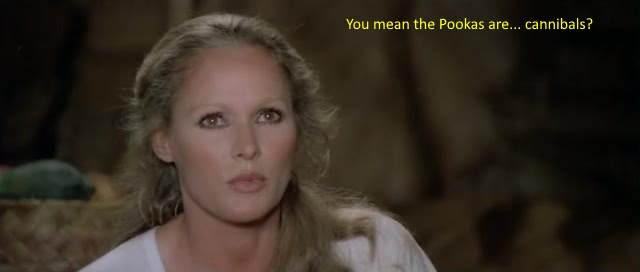
“Why is everyone so scared of the Pooka?” “In their language, Rara Me means mountain of the cannibal god”
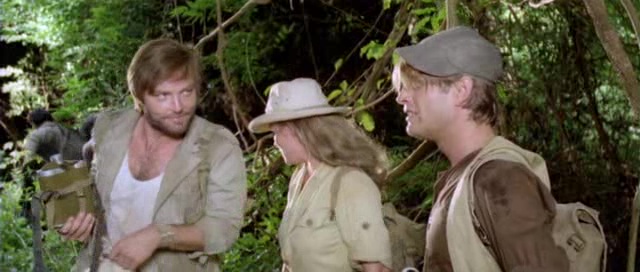
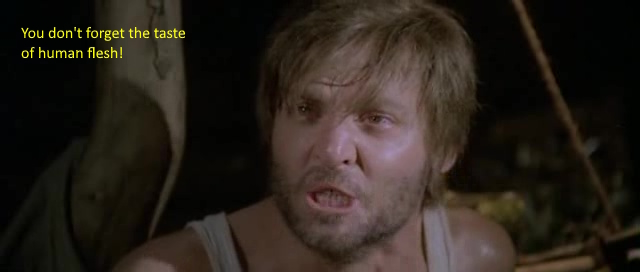
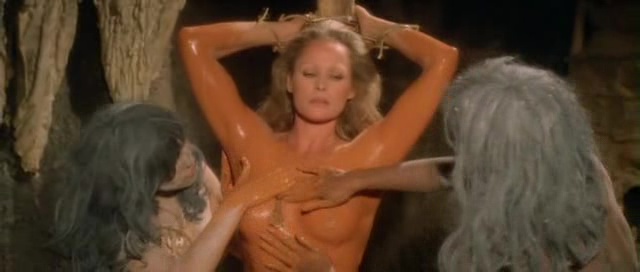
Well that explains it then. Why Susan (Ursula Andress, who was the first “Bond Girl” in Dr No), is tied up in the jungle naked, being smeared with cream by some local girls. Why her husband’s skeleton is being worshipped as a god because his Geiger counter is still ticking within his bones. Why Professor Foster (Stacy Keach) is admitting to having been a cannibal (spoiler: he didn’t like the taste much).
Hey, that pretty much sums up the whole movie. The film starts with stock footage of animals, intended to persuade us we are in the jungles of PNG, but they seem to be chosen at random. The grey-headed flying fox, for example, is native to Australia. Close, but no points.
Like all the Italian horror movies of the seventies, this one has the obligatory scene of real animals being cut up and eaten, some of them while still alive. It was intended to add “realism” to what were pretty dumb plots, but just managed to put a lot of people off watching the films. There is an inordinately long scene of a python eating a monkey alive, and then humans eating a lizard, which Foster tells us is “part of their religion”. Just like eating meat is part of the religion called ‘Humanism’. I guess these scenes also try to teach us that the law of the jungle applies just as much to humans as to other animals. Or else it teaches us to appreciate the fast-forward button.
Manolo (Claudio Cassinelli), a wandering adventurer, joins the merry band and tells them:
“Animals only follow their instincts. That of all living beings – killing and eating. Man too has the same instincts. To satisfy them, he uses more subtle means. Lying, trickery.”
He also tells them he doesn’t kill animals, which would probably make living in the jungle difficult (not many vegan restaurants), but they all seem to enjoy coconuts, so who knows?
The first half of the film is about a motley bunch of white people heading for Papua New Guinea (it was actually filmed in Sri Lanka) on a Pakistani plane, to explore a heavily wooded island inhabited by cannibals called the Pookas, and the various reasons they are there (uranium, that sort of thing, yawn).
The title card explains that “life has remained at its primordial level” – meaning the rest of us have advanced? Just turn on the news channel any time to fact-check that.
Cannibalism doesn’t get a look in until after the first half, when Foster admits to having lived with the Pooka tribe, where he had to eat human flesh. It haunts him still, and he wants to exterminate them. Sure, eating dead humans is horrifying, but killing live ones is fine.
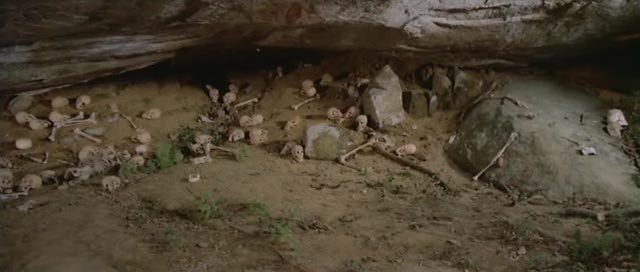
Thirty minutes before the end, they finally agree that the Pooka exist, when they stumble into their pantry.
They are soon captured and the Chief checks them out for meat quality, but then he remembers that he has a photo of her with her husband who, I may have already mentioned, is being worshipped due to his clicking Geiger counter, a proof of his immortality, despite being a rotting corpse.
So now Susan is the new god, and gets dolled up for the occasion, while her brother, luckily dead, is disembowelled for the coronation feast.
Susan gets to eat some of her brother, while the girls who so enjoyed smearing her with whipped cream lie around pleasuring themselves, and the guys engage in bestiality with a totally uninterested pig. This is getting sillier and sillier.
One of the men, perhaps tiring of being ignored by the pig, tries some hanky-panky with the new goddess, and is pulled off and given a rather extreme form of circumcision. Following which, the tribesmen all start eating snakes, for no apparent reason, but with considerable gusto. The film by now is longing to reach some conclusion, so Manolo has a snack with his new friends (seems to be Kentucky Fried Lizard).
Susan is invited to chop up the rapist, but chooses to stick the knife in the Chief instead, and there is now so much meat to go around that everyone goes for a post-prandial nap. Except for Manolo, who watches a bird fight a snake (Pooka version of Netflix perhaps). Finally bored silly, Manolo and Susan fight their way out, kill a lot of cannibals on their way, and escape on a floating log into a river that we have been shown is full of crocodiles. Yes, it’s a happy ending. Maybe more so for the crocs.
Mountain of the Cannibal God is the translation of the Italian title (La montagna del dio cannibale). The movie was released in the US as Slave of the Cannibal God in 1979 and the UK as Prisoner of the Cannibal God, but not until 2001 due to its “graphic violence”. Can’t see the problem myself, but maybe I have watched too many cannibal movies.
“a graphic and unpleasant film, with all the noxious trademarks intact: gratuitous violence, real-life atrocities committed against live animals, and an uncomfortably imperialist attitude towards underprivileged peoples.”
I found it a bit dull, with long scenes of exposition and lingering images of the cast struggling through the jungle or over waterfalls. I guess they had to pad it out somehow, considering all the action takes place in the last ten minutes.
I must admit a bit of a soft spot for road movies, although they have been a little overdone in the cannibalism genre (how many Wrong Turn, Hills Have Eyes, Texas Chain Saw, etc sequels and prequels have there been so far?) But this one seems fresh, mostly due to undeniable talent of the two stars. Caylee Cowan is Penelope, a “doe-eyed femme fatale” who effortlessly channels Marilyn Monroe with a blend of innocence and raw sensuality, and chisel-jawed Billy Budinich, perhaps himself channelling James Dean, is Frank, a man who has lived his life by logic and rules and suddenly breaks out of his self-limitations to live life for himself, but only because he falls for Penelope.
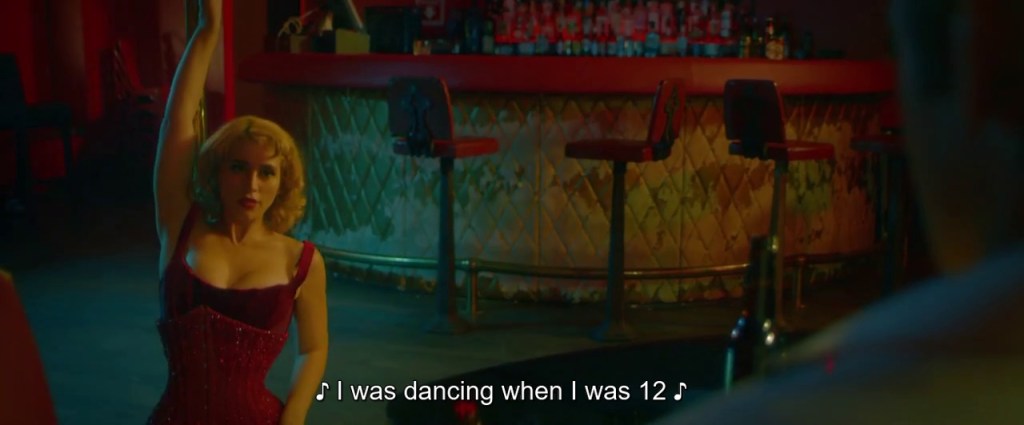
Frank’s world of law and rationality is shattered when he sees his wife having sex with her cross-training instructor, and heads out; he’s not sure where, just heading west. He stops at a strip club where he is taken in by Penelope – pole dancing to Marc Bolan’s song Cosmic Dancer hauntingly performed by Valerie June:
Is it wrong to understand The fear that dwells inside a man? What’s it like to be a loon? I liken it to a balloon
Penelope gets her hands on Frank’s credit card on the pretence that she is willing to abscond with him, but then she has a row with the club owner, played by Sean Patrick Flanery, who also directed and wrote the screenplay (he’s a man of many talents!) When Frank intervenes in Penelope’s fight with the boss, she goes on the run with him, and their fate is sealed. When Frank asks Penelope if she has ever seen the classic 1991 road movie Thelma and Louise, we know this is most likely not going to end well.
There are plots and sub-plots and even a quite unnecessary Greek Chorus in the shape of a nurse (Sonya Eddy from General Hospital) reading Frank’s diary over a brain-dead body, but let’s just get to the cannibalism, because that’s what keeps this blog rolling along each week.
It’s a road movie, so there are lots of cars on roads, and cars stopped on roads, with weirdo’s peering in at the drivers.
The first face is Cleve (Brian Maillard, who’s also done a fair bit of acting, directing and writing) – Cleve is a devout follower of a cannibal cult which collects travellers off the road or in their motel. He appears at first as a whack job, but turns out to have a conscience, of sorts.
The second face at a window is the local Sheriff (Kevin Dillon from Platoon and Entourage) who tries to warn Frank and Penelope against stopping on that track of road. This warning, before the blood starts flowing, is a regular trope for cannibal films, although it’s usually a gas station dude who is dismissed as plumb crazy – e.g. the Wes Craven classic The Hills Have Eyes. In that film, the cannibals were mutants who had been too close to a nuclear bomb-testing site, in Texas Chain Saw Massacre they were unemployed slaughterhouse workers. In The Farm, they are animal liberation activists revenging the depredations humans commit on farmed animals. Every cannibal has a motive. In this film, the Sheriff tells them that:
“You’re about to hit a stretch of about thirty miles with no cell phone towers, and no gas for about forty miles after that. You may want to keep a close eye on that gauge. I mean, you can get gas in Quicksilver, about twelve miles in, but get in and get out of there. Mercury got in the water from that mine, and left them Appalachian transplants bat shit crazy.”
So what do our romantic couple do? Why, head straight for the bat shit crazy Appalachian transplants in Quicksilver, looking for a motel room in which they can practice all the sexual positions Frank has promised to perform. Of course, they could just pay attention to the Sheriff who gave them good advice (while drooling over Penelope), but then it would be a very short movie.
On the way, they run across Chisos (Johnathon Schaech, another writer and actor, you may have seen him in How to Make an American Quilt). He puts his face into the car, pretending he needs a lift, but Penelope turns him down. She can see he is up to no good, even with a name that everyone else pronounces with reverence (as in Jesus) but which she persists in saying as “Cheese Sauce”! This is actually quite a funny film, and Caylee Cowan is a comedy genius.
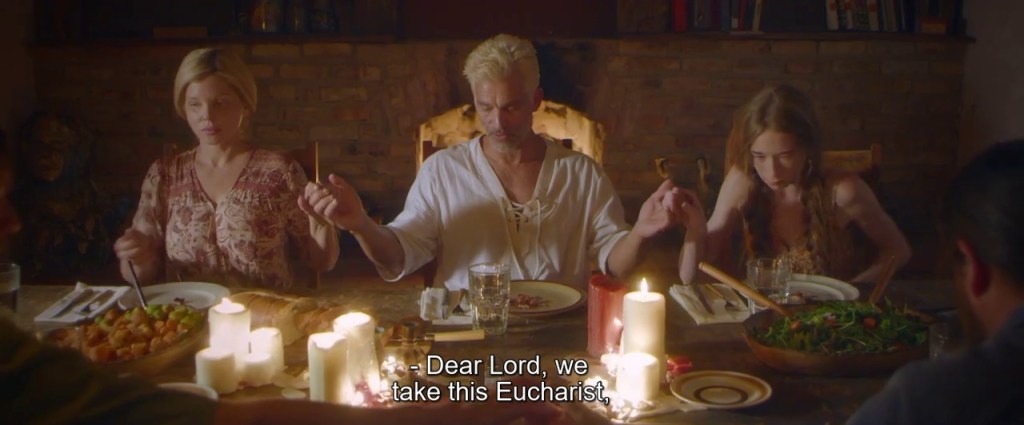
Chisos is the leader of the cannibal cult, and when they meet up at the motel, explains it all to them, in the standard (I’ll tell you everything Mr Bond/Batman/Spiderman since you won’t be alive to tell anyone else) method of horror movie explication. He explains that his grandfather owned the biggest mercury mine in the world, in which he was leading a prison work-release program for a whole bunch of felons – “murderers, rapists, all kinds of filth”. His grandfather survived a cave-in by “eating those sinners, organs and all.” He and his clan are now “Appalachian sin eaters at our core!”
Travellers are tested for their virtue, and eaten for their sins. He shows them his leg, which has a crucifix shaped scar. Yep, he’s been snacking on his own sins. What sin has a man like Cheese Sauce committed? Well, he’s been at it with Cleve’s wife, plus he really wants kids.
And he has decided he really wants those kids with Penelope, so he tosses Frank into a pit with unclimbable sides. There are corpses in there, people who have died in it previously, and there is plenty of water, so Frank won’t die of thirst; but he has to make a choice: he can starve or “take a bite and become one of us.”
The rest of the movie is a suspense story – will Frank die or become a cannibal? Will Penelope agree to become “a vessel” for Chisos’ progeny? What’s the story with her old boss from the strip club, who is still plenty sore at them?
The answers to all these questions you won’t hear from me, because that would be spoiler territory, and you really should see this movie. Admittedly, the critics who have reviewed it so far gave it a cumulative “rotten” score of 25% on Rotten Tomatoes, but the audience rating was a “fresh” 83%. So you’ll have to judge for yourselves. I thought the plot was good, the actors were great, the cars scintillating (if you’re interested in that sort of thing) and the soundtrack outstanding. The cannibalism is not gore based (well, just a bit) but more along the lines of abjection, watching the cult members tucking in to their sacred meal – the flesh of a woman who had admitted to abandoning her children years before.
The Eucharist, as I understand it, is the eating of the blood and body of Jesus to cleanse the sinner of their sin. Chisos has turned this on its head – cut out the middle man and just eat the sinner. Makes a lot of sense, especially if you’re a cult with a lot of mercury in your water supply.
Children as cannibals seems to be the fashion, with fans of Timothée Chalamet waiting impatiently for the new cannibal romance movie Bones and Alldue towards the end of 2022 (maybe). Chalamet teams up with Taylor Russell, who plays a girl that has been a cannibal since she grew her first teeth. Yeah, I read the book, but no spoilers here. A couple of weeks ago, we looked at the movie It’s Alive, which featured a man- (and woman-) eating newborn baby. Combine that hungry little fella with the cannibal kids in The Girl With All the Gifts and some baffled doctors in Rosemary’s Baby or The Exorcist or The Omen and we get this little boy named David (Luke David Blumm from The Sinner), who is a sweet little boy, except that he kills and eats people.
His mother, Laura (Andi Matichak from Halloween) kicks off the movie as she escapes from a religious cult, hugely pregnant, and gives birth in her car as a King Lear level storm rages outside. Yes, there be some devil work afoot – those demons love a young virgin. Or is she escaping extreme sexual abuse? Or is she chronically delusional?
Eight years later, Laura and David are a happy, well-adjusted family of two, until one night she goes into David’s room and there are a whole bunch of people standing around his bed, which she is not happy about – has the cult come back for David? He seems OK, though, with the normal hopes and dreams of an eight-year-old boy.
The cops think she’s crazy, except for Paul (Emile Hirsch from Into The Wild) who seems to have no police work to do other than sympathise with Laura. David starts having seizures, skin irruptions and internal bleeding, which the doctors are baffled by, as they normally are in this genre. Some of them seem to be in cahoots with the cult members who want not Laura, but David. The cult’s slogan is “HE IS COMING”. It turns up, written in blood, all over the place.
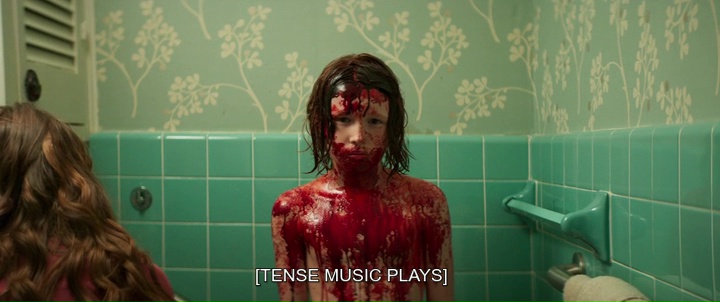
There is only one thing that makes David feel better – a nice dose of human body parts. Not a cure exactly, but it seems to clear up the crusty sores and vomiting of blood very nicely. Laura escapes the hospital with David when she figures the doctors are all involved in the cult, and flees to the home of her friend Susan. She leaves David with Susan while she gets a few essentials from home, but when she comes back, David is feeling much better, and Susan much worse. Yes, some fresh human flesh is a great aid to healing, apparently.
And so it goes. Laura washes David down in the shower and subsequently listens to his entreaties (“It hurts, mom!”) and his threats (“Get me some fuckin’ food, you bitch!”).
But eventually, she does what any good mother would do when faced with a hungry child – she finds him some food. But not just, you know, anyone; like Hannibal who prefers to eat rude people, or Sheila from Santa Clarita Diet who wants to eat “someone bad, who deserves it… the prototype would be a young, single Hitler”, Laura sees a very nasty pimp beating up one of his girls, and decides to invite him around for dinner.
Of course, one of the worst parts of being a parent is cleaning up after dinner.
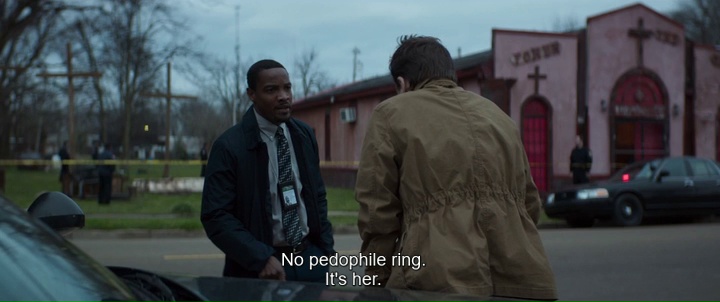
So it’s a cannibal mystery. Laura is really named Anna and, according to the newspapers of the time, she was repeatedly raped by her father and a whole lot of men to whom he sold her from the age of ten. A paedophile cult!
If you can’t accuse someone of being a cannibal, call them a paedophile. But her childhood friend, who admittedly is now a hopeless junkie, tells her that in reality her father didn’t touch her; she was sacred.
The cult would torture and kill animals in her bedroom then force her to chant a spell to summon a demon named Palystes (fun fact, that is not the name of a demon but of a spider) who would rape her and, yep, get her with child. Rosemary’s Baby and The Omen for a new century, a new, improved version, now with cannibalism. Her shrink (retired) tells the police, who are interested in talking to her about the hollowed out friend Susan, that she is psychotic and imagined the whole cult thing. The cops, even Paul who’s really into her, decide she is having a psychotic episode and is the one killing and dismembering people.
Well, it’s a new movie and you might want to catch it, so no spoilers (although so many reviewers say the ending is obvious). The directing by Irish filmmaker Ivan Kavanagh is sure footed, the Irish certainly know their way around devils and the children of supernatural beings. The actors are great, particularly Andi Matichak as Laura and Luke David Blumm as the junior cannibal, the plot rolls along well and if the continuity is a bit jumpy, well, that’s part of the psychotic story arc. For those who like that sort of thing, there is a LOT of gore, and having a cute little boy doing the killing and eating is a nice touch. Although why no one believes a little boy could be a cannibal killer baffles me. I was a little boy once, and I wouldn’t put anything past the kids I knew.
Son scored a respectable 76% “fresh” on Rotten Tomatoes, with the Los Angeles Times calling it “an amped-up version of everyday parental paranoia” and the San Jose Mercury News saying “it’s engrossing and well-made, but you’ll need a strong stomach to get through it”.
Son asks some interesting questions about trauma, believing victims but also questioning false memories, fear of the past and vengeance. It also reminded me of people who are shocked at cannibalism movies, but even more shocked at vegans who, they complain, are neglecting their children by not feeding them meat. David has no such problems in this movie. As Hannibal would say, “nothing here is vegetarian”.
Doghouse is a British slapstick / splatter movie. The danger of mixing genres like that is that sometimes neither one will work, and this is a good example of just that. A bunch of young men head off for a weekend to cheer up one of their friends who has just been divorced. The film introduces them one by one with a placard showing their name (hoping vainly that we will thereafter remember them). They are all being verbally abused by their partners for leaving them, a condition sometimes known as being “in the doghouse”. They diagnose their situation as suffering from what they call “social gender anxiety” and plan to do male things like, you know, drink and smoke and piss on trees. They think they are recapturing their animal essences, whereas in fact they are just being dicks.
They head for a little town where, they have heard, the women outnumber the men four to one. Their minibus driver tells them that it is the middle of nowhere, and hey, there are worse things than divorce.
They are expecting
“an entire village of man-hungry women, waiting to jump the first band of desperadoes rolling up from London.”
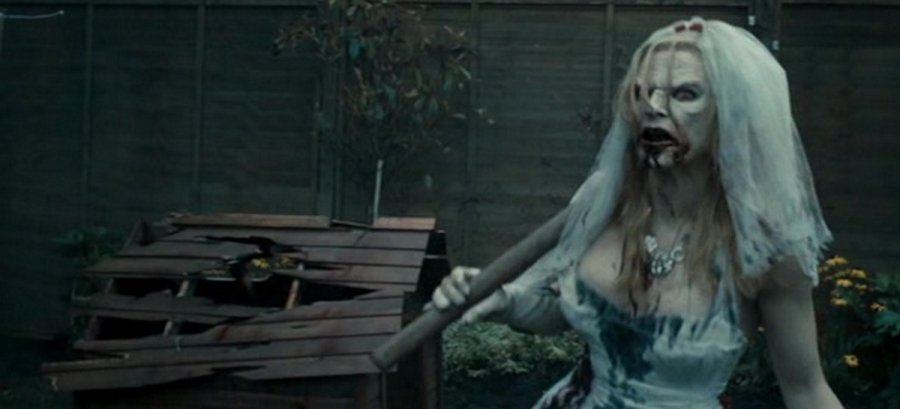
Turns out that’s exactly what they get (yes, such subtle irony) because the women have all been infected with a virus in a biological warfare trial intended to turn one half of an enemy population against the other, and isn’t that a decent summary of human history? This virus turns them into what these guys call
“an army of pissed-off man-hating feminist cannibals”
Each woman is a caricature of her womanly role – a bride, a hairdresser, a grandma, etc.
While this is a remarkably silly film, it does illustrate quite nicely the themes of abjection and the monstrous feminine. Monsters are by definition outsiders, but more so when their appearance and violent activities are in a female form, because we are reminded of the archaic mother – the authority figure of early childhood who toilet trained us, dominated us, exemplified adult sexuality and offered us both nurturing and the threat of Oedipal competition with the father and ultimately castration or reabsorption. Just so, the women of the town represent female roles: the crone (one of the men’s gran), the bride (in virginal white), the hairdresser, the barmaid, the traffic warden. Freud might have enjoyed this film – the women carry castrating weapons – knives, scissors, axes, teeth, a dental drill. Even stilettos. One woman represents voracious appetite and therefore body dysmorphia (obesity) – she has an electric carving knife and kneels in front of her victim in a recreation of every fellatio-gone-wrong castration nightmare, cutting off his, well, his finger. But you know, symbolism.
In case the symbolism is still not clear, the local shop, with a mummified penis in the display case, is called
The men plan a violent exit, declaring “Today is not the day to stop objectifying women”. This gives the film an excuse to answer the women’s cannibalistic violence against the men with some very nasty misogynistic attacks by the surviving men, the ones who were the most obdurate male chauvinists, using ‘male’ weapons like fire and vehicles and sporting equipment, resulting in women being variously burnt, having their teeth knocked out, beheaded and beaten to death with golf clubs. At the climax, one of the surviving men growls “give me a wood” – yeah, you get the picture. There would be a certain section of the audience cheering those scenes, I suspect.
“misogyny and creative bankruptcy in Jake West’s Brit gender-wars comedy horror about a bunch of hen-pecked blokes stuck in a village of cannibalistic women”
If I still haven’t dissuaded you, the full movie can be watched (when I last checked) on YouTube.
If you could somehow bring a dead serial killer back to life, let me ask you this:
What question would you ask him?
Why the hell would you bring him back to life??
This movie was called The Butchers in some markets and Death Factory in others, but didn’t exactly set the world alight in either case. The “plot” (sic and sick) concerns a bunch of misfits reciting a spell that returns to life some of the more notorious recent serial killers, who are featured in a bizarre museum called The Death Factory: Albert Fish, John Wayne Gacy, Jack the Ripper, Jeffrey Dahmer, Ed Gein, and the Zodiac Killer. Wait – that doesn’t make sense? Well, enjoy the ride.
Before the ride, though, a flashback – Simon (Damien Puckler – Grimm) is having a nightmare about when he was a little boy and killed his father with a golf club. First we get to sit through the father killing a neighbour and Simon’s mother, in grisly detail. Yeah, Simon has serious issues. So did I after watching a woman have her teeth knocked out.
He’s on a bus with his brother (who reads Dante’s Inferno, as you do) and a bunch of misfits representing various stereotypes of America, heading for the Grand Canyon, but the bus breaks down and so they hoof it the Death Factory.
Meanwhile, a lawyer from Africa comes to visit the Factory, gets a guided tour of the killers (for the sake of the audience rather than him I rather think) and sees the vials of blood collected from them (how the hell did they get blood from Jack the Ripper?) and then kills the owner.
He has a big antique book, which we just know is going to be full of magic spells. The Goth couple from the bus find it and recite the spell of resurrection (you know, just for fun), and all hell breaks loose. No, really, it’s all a Satanic plot. Say the words, and the drops of blood form columns of fire and the dead butchers are resurrected.
But keep your disbelief suspended – it gets worse. When they get killed, they return to dust and smoke and enter the one who killed them. Confused? So were the writers I fear.
Of course, no slasher film is complete without the impending victims arriving from a broken-down vehicle at a sinister and run-down gas station / diner.
But the interest in this script is not so much in the bus passengers but the six born again killers who stalk them. From the point of view of a cannibalism blog, we only really care about four of them (the cannibals) and there are some real plot problems here. For a start, Albert Fish was ostensibly a harmless old man, unless you were a young child (he used to kidnap children, flog them, murder them and eat them), but he was clearly not up to a fist fight, unless you were under eight years old. Here is the movie Fish, and the real one. Not a bad likeness, but a scary monster?
Jack the Ripper was never identified (nor was Zodiac come to that) so this one wears an old person mask and talks with an English accent. But we have a revelation when Jack takes off the mask! Yes, Jack the Ripper turns out to be a lesbian, who finds out what little girls are made of (with the help of a cut-throat razor). Well, glad they sorted out that mystery anyway. Any clues on who killed JFK while you’re there?
Ed Gein was technically not even a serial killer since he only killed a couple of people, preferring to source his body parts from gravesites, and he was also pretty decrepit, an unlikely partner for hand-to-hand combat. Not even trying for a likeness here – just a scary Fred Flinstone.
That leaves Jeffrey Dahmer who was certainly a serial killer, but his M.O. was to drug his victims then drill holes in their heads when they were unconscious, hoping thereby to keep them around as zombie boyfriends. So, Dahmer was a lover, not a fighter.
Dahmer does, however, have the best line in the movie; after biting one dude:
“33% of Caucasians are A positive… I prefer A negative.”
Another great line is when Simon and the bible thumping lady find a series of pentagrams and vials of serial killer blood (curiouser and curiouser). She has some expertise here, which turns out to be as useless as it sounds:
“I wrote a paper on the psychological dysfunction of fanatical religious behaviour. At Emory.”
But most of the dialog consists of people saying to other people “stay here, I’ll go check it out.” You just know that’s not going to end well. Several times (yawn).
This is a pretty awful movie, garnering a handsome 12% on Rotten Tomatoes. If you like gore, that is well done and you might enjoy it, if you can get past all the metaphysical nonsense of pentagrams and life force transfers. If, however, you are a student of cannibalism, you will be mystified by their portrayals of these murderers. Have these people never heard of Wikipedia?
More importantly, how did they decide on these six as the world’s worst serial killers, and why were four of them (67%) best known for their cannibalistic behaviour? Our fear of death is notorious – watch a group of people flee from a loud noise like a flock of pigeons. The primal part of our brain, like that of the pigeon, takes over when survival seems to be at issue. Cultural anthropologist Ernest Becker argued that our terror of death is the basic motivation of human behaviour.
But the enormous interest in cannibalism indicates that there is something even more terrifying than dying: being eaten. Dramatic headlines announce the victim of the latest shark or crocodile attack, while meanwhile hundreds die unremarked, in more mundane incidents taking place all around them. We build mausoleums or place immense marble slabs over our graves to keep out marauders, we pour chemicals into the veins of our corpses to preserve them from worms and bacteria. The worst terror, though, is incorporation into the body of another human. Theologians write learned pieces on God’s options for restoring the body on the day of judgement; if we have been absorbed into another body, to whom would the restored flesh belong? Ed Gein is included in the canon of cannibals not for the numbers he killed but because he used the body parts to make furniture and lampshades.
Cannibalism feeds our darkest fears – that we are not made in the image of God (however that is interpreted) but that we are edible animals, no different to the millions of other animals we slaughter every day: for their flesh like Dahmer and Fish, for their skins and bones like Gein, or just to see what’s inside, like Jack.
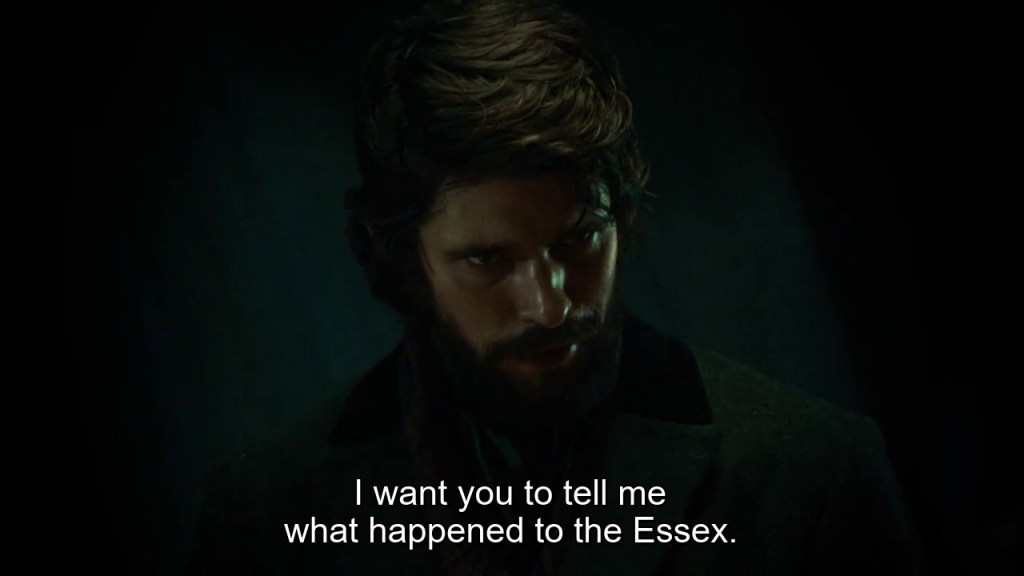
Herman Melville’s Moby Dick, the original ‘Great American Novel’, was based on the story of the Essex, a whaling ship that was destroyed by a bull sperm whale in 1820. The story of the wreck, and particularly the subsequent cannibalism that some of the survivors employed to survive, has largely faded from public knowledge (Moby Dick finished with the whale sinking the ship), but in the nineteenth century, every American child would have learnt about it at school, and this film starts with a young Melville (Ben Wishaw, who played a very different role in Perfume) seeking out the last survivor some decades later, hoping to get the full story to use in his novel.
This film is based on a meticulously researched 2000 book of the same name on the Essex disaster by Nathaniel Philbrick, which won him the National Book Award for Nonfiction in that year. Whaling was no more controversial in the early nineteenth century than crude oil in the early twentieth – it was used to power the factories and light up the cities of the world, and was worth a fortune. As the fleets decimated the whales near shore, the boats had to head further into, well, the heart of the sea, to find their victims. Whaling was, and remains, an incredibly brutal business, with small boats harpooning the giant mammals then drawing near and stabbing them to death. A successful kill was signalled by a plume of blood spurting out of the whale’s blowhole.
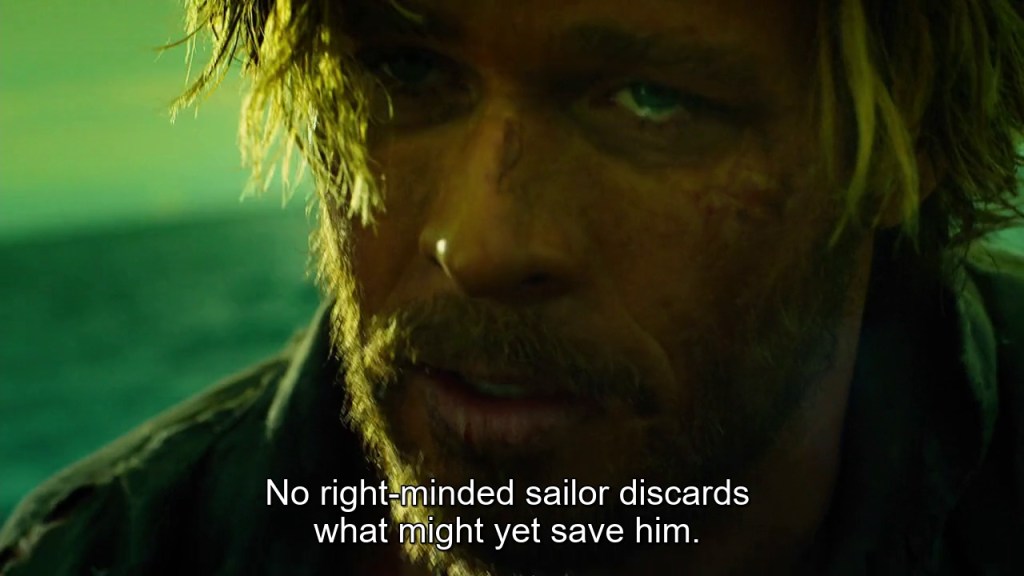
Whaling was a class-based system, with the captains drawn from the powerful old families in Nantucket, the tiny American island that was the centre of the industry. The main protagonist of the film is Owen Chase (Chris Hemsworth – the mighty Thor) as the first mate, who was refused the captaincy because he is socially inferior, an “off-islander”.
His best friend is the second mate Matthew Joy (Cillian Murphy from 28 Days Later). The Captain, George Pollard (Benjamin Walker from Abraham Lincoln: Vampire Hunter) is ineffectual but is from one of the original Nantucket families, and so has been promoted over Chase. In fact, the ships were run on strict class and race lines: the African-Americans and off-islanders lived in the Foc’s’le or front of the ship, where the food was inferior, and did the dirty work. The Nantucketers lived aft, and were fed and treated better. They were, in general, the ones that survived sinkings. Six African-Americans made it into the whaling boats – none survived. True Nantucketers were also mostly devout Quakers, pacifists who, however, saw no problem in killing magnificent whales and “raising bloody havoc at sea” as Philbrick put it. Class conflict is the basis of the story for the first half, before the angry whale comes along.
The story of the Essex is told to Melville by a decrepit old drunk who is the last remaining survivor, Thomas Nickerson (Brendan Gleeson, who was also in 28 Days Later). Nickerson had been a cabin boy (played by Tom Holland – Spiderman) when the boat sank. Nickerson did write an account of the events, but it was not discovered until 1980, so Melville did not in fact use his words. Chase’s brief account would have been the one known to Melville, who embroidered the conflict, as authors do, to make the whale white and almost supernatural, and avoided the controversy, not mentioning the cannibalism that resulted from the wrecking of the boat.
This does shed some light on the different reception of cannibalism over time. When the Essex set sail, cannibalism at sea after shipwrecks was not uncommon, and was generally considered embarrassing but necessary. The Monty Python team did a skit based on a version of this incident.
In the Heart of the Sea suggests a conspiracy by the whaling company to ignore the cannibalism as the presence at sea of a giant, angry whale would discourage further exploration, but Chase and Pollard refuse to cooperate. By Melville’s time, cannibalism was too graphic for his potential audience (he wanted to sell books after all). In our time, the great white whale is still of interest, in that he represents nature fighting back against human rapaciousness, but the real point of this film is now the cannibalism. Would anyone go to see a movie about a shipwreck if Thor didn’t eat anyone?
Or even if he did. The film’s tagline was “Based on the incredible true story that inspired Moby-Dick”, which did not inspire enough people to see it – it grossed $93 million, which sounds great until you see that it’s budget was $100 million. It scored a paltry 42% on Rotten Tomatoes, with the Seattle Times critic summarising it as:
“Thor and Spider-Man fight a whale.”
Despite some critics seeing the movie as over-long and dull, the scenes at sea are full of action (if not exactly Pirates of the Caribbean) and very well done, and the special effects are spectacular, especially the whales and the sails, and the whales demolishing the sails (you can guess which side I was on).
But as Philbrick wrote in his book,
The Essex disaster is not a tale of adventure. It is a tragedy that happens to be one of the greatest true stories ever told. (p.236)
The halfway point of a movie is usually the turning point in some form, and it certainly is here – in the middle of the film, in the middle of the Pacific, they finally find an abundance of whales, including the great white whale that they were warned about on a stop in Ecuador. He charges the ship, staves in the side, the whale oil they had collected goes up in flames, and they have to abandon ship and fit as much food as they can (which isn’t much) into their little whaling boats.
The rest of the movie is all about how some (a few) of them survived the long voyage of 4,500 nautical miles back to South America. They reach a small but uninhabitable island, and the white whale makes them welcome by tipping over their boats as they head for the beach. Chase and the Captain abandon their class struggle to engage in dialogue about anthropocentric carnivorous virility instead.
Pollard answers with presupposed anthropocentric arrogance.
“We are supreme creatures, made in God’s own likeness. Earthly kings, whose business it is to circumnavigate the planet bestowed to us…”
The island cannot sustain them – they find the skeletons of a previous party that took shelter there, so repair the boats and head off again for another agonising trip across the endless ocean. After 48 days stranded, with almost no food or water, one of the sailors on Chase’s boat dies. The others prepare to toss him overboard, but Chase stops them. It’s all handled quite delicately, but it’s definitely become a cannibal movie.
“We prepared the body. We removed the organs. Separated his limbs from his body and cut all the flesh from the bones.”
In the other boat, no one dies so conveniently, so they draw straws for a victim. The captain gets the short straw, but his cousin cannot shoot him and shoots himself instead, keeping the catering in the family.
The whale comes back, but he and Chase exchange a look, and Chase cannot bring himself to kill the magnificent bull.
After ninety days at sea, the survivors reached South America. According to the book, a boat that drew up alongside saw two men sucking the marrow from the bones of the dead, refusing to give them up. Unlike some survivor cannibal stories such as Alive, where the actors looked pretty much the same weight at the end of the ordeal, Hemsworth reported that the cast were put on a strict ration of 500–600 calories a day, and he lost 40 pounds (18kg), giving him a reasonable idea of what the sailors had gone through.
What the film doesn’t mention is that the survivors could have had a much easier time of it if they had headed not for South America but west toward the Marquesas Islands, only 1,200 miles away. They chose not to do so, because of earlier reports that the natives were, yep, cannibals. One mariner, Georg von Langsdorff, had written in 1804 that the natives so loved human flesh that “those who have once eaten it can with difficulty abstain from it.” Of course, it was all nonsense.
Instead, they headed east, and ended up eating each other.






























 The Cannibal Guy