Idaho killer avoids death sentence

Family members of one of the victims of a gruesome murder of four college students in Idaho are furious that Bryan Kohberger has been offered and accepted a plea deal.

Kohberger was accused of stabbing Xana Kernodle, Madison Mogen, Kaylee Goncalves, and Ethan Chapin to death in November 2022 in Moscow, Idaho. The students were found with fatal stab wounds in an off-campus rental home in the early morning hours. Investigators believe the four students, thought to be sleeping at the time, were fatally stabbed between 3 a.m. and 5 a.m. According to the coroner, there was no sign of sexual assault.

A little over a month after the killings, Kohberger, a 28-year-old Ph.D. student and teaching assistant in the Department of Criminal Justice and Criminology at Washington State University, was arrested at his parents’ home in Pennsylvania on Dec. 30, 2022, and extradited to Idaho.

Kohberger was facing a possible death sentence if convicted in a trial that was scheduled to begin Aug. 18, 2025.

A letter sent to families of the victims to inform them of the deal said Kohberger will appear in court Wednesday to enter his guilty plea and be sentenced in late July to life in prison, according to the Idaho Statesman. Kohberger will forfeit his right to appeal as part of the deal. The letter from Moscow Prosecuting Attorney Bill Thompson said:

“We cannot fathom the toll that this case has taken on your family. This resolution is our sincere attempt to seek justice for your family. This agreement ensures that the defendant will be convicted, will spend the rest of his life in prison, and will not be able to put you and the other families through the uncertainty of decades of post-conviction appeals.”

Goncalves’s family had an angry reply on their Facebook page.

“We are beyond furious at the State of Idaho. They have failed us. Please give us some time. This was very unexpected. We appreciate all your love and support.”

The family issued a later post explaining what had been taking place.

“I would like to clarify a couple of things…we DID talk to the prosecution on Friday about the POSSIBILITY of a plea deal and it was a HARD NO from our family. It was very nonchalant and barely discussed as the majority of the conversation was surrounding the upcoming trial. NOTHING in our conversation prepared us for the next steps.”

A family member of one victim told NewsNation that upon hearing of the plea deal, she felt like “all the power had been given back to Kohberger.”

Why is this case featured in a blog about cannibalism? Well, A forensic psychiatrist told  Newsweek after the arrest that Kohberger had battled with “cannibalistic urges.

Reports then surfaced that Kohberger had followed a strict vegan diet, and had reportedly struggled with heroin addiction in the past.

Forensic psychiatrist Carole Lieberman told Newsweek that Kohberger’s “obsessive-compulsive eating habits” indicate he was afraid he would become addicted to meat if he ate it.

“He was not only vegan, he refused to eat off of pots or plates that had had meat on them. Psychologically, this represents his struggle against his cannibalistic urges. He was afraid that if he let himself go to taste meat once, he would become addicted to it—like he had become to heroin—and start killing and eating people.”

A relative told the New York Post that Kohberger’s dietary restrictions were “very, very weird” and that he seemed “very OCD,” referring to obsessive-compulsive disorder.

The woman, who asked not to be named, but said she was previously married into Kohberger’s family, said:

“It was above and beyond being vegan. His aunt and uncle had to buy new pots and pans because he would not eat from anything that had ever had meat cooked in them.”

Casey Arntz, who was friends with Kohberger in middle and high school, said in a video posted on TikTok that he had been “a heavy heroin user” in high school. Kohberger’s struggles with drug addiction continued into his college years, a friend from Northampton Community College told Fox News. Criminal profiler John Kelly told Fox News,

“This kind of person has this volcanic rage inside that’s going to explode on its victim of choice.”

Lieberman told Newsweek that Kohberger had probably studied criminology both to “calm the demons inside him that were telling him to kill” but also to “learn how to commit the perfect crime.”

It is possible that he had been in touch with the so-called BTK killer, Dennis Rader, whose serial killings in Wichita were the subject of a book by his supervisor, Katherine Ramsland.

Kohlberger may have corresponded with Rader (a lot of criminology students do) but we don’t know that for sure. We have to wonder if Rader would have told him about working in the meat department of a Wichita IGA a few years before his murder spree began.  

Kohlberger’s obsession with meat reflects a lot of issues considered in Cannibal Studies. Firstly, the question of human meat: there really is no significant difference between the meat of humans and other large mammals such as cows, pigs or sheep. Hannibal Lecter takes delight in feeding human meat to his guests, such as the flesh of the flautist of the Baltimore Philharmonic, whose Board members subsequently enjoy the meal immensely in the book and film Red Dragon, thus becoming “innocent cannibals”.
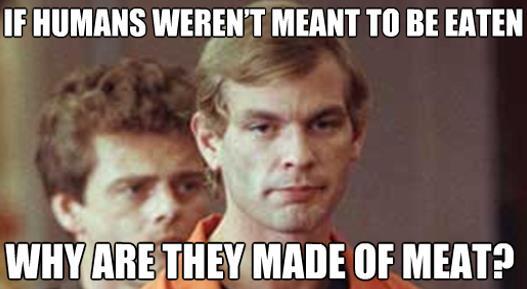
But the point is that once meat is prepared (cooked, seasoned, presented) it is very hard to tell its provenance. Cannibals who have been asked have mostly compared it to pork or veal, with Armin Meiwes telling an interviewer

“It would have made no difference in somebody else had tasted it; he wouldn’t have questioned the meat…. During preparation, it is not as dark, but bright and fresh as pork, and tastes so very close to pork.”

Kohlberger’s belief that he might like human flesh if he tried any meat at all therefore has some logic to it. Since Charles Darwin’s writings overthrew the special status of humans as closer to angels than other animals, anthropocentrism has been amended to offer a story of humans as the culmination of evolution and thereby continues, rather less successfully, to obscure human animality. Should such beliefs falter, as happens repeatedly in many cases of contemporary cannibalism, it becomes a very short step from eating other animals to eating the human one.

But why should he become addicted to any meat? Well, we know Kohlberger has an addictive personality, shown by his very heavy usage of heroin. But we’re not talking drugs of addiction but lumps of protein, aren’t we? Well, there are plenty of studies about that. Marta Zaraska, for example, wrote in her book Meathooked that meat is highly addictive on several fronts – genetic, cultural, historic and commercial, and coined the term “meathooked” for the incongruous compulsion to eat meat despite the pangs of cognitive dissonance – the repressed feeling of guilt when considering oneself an animal-lover while also paying big corporations to kill them. Then there is the mythology of the Wendigo, a creature from Algonquin legend who starts off as a human but becomes a being who can only live on human flesh, which makes him grow bigger and at the same time hungrier. If you believe in Wendigos, then the slippery slope from carnivore to cannibal seems reasonably clear.

This leads us to the issue of Kohlberger’s apparently very strict veganism. Most people seem to believe (or want to believe) that vegans are fanatics, obsessed with animal welfare (or the environment, or their own health) who therefore compulsively avoid meat. But in fact most vegans would certainly wash a pot thoroughly after a relative had cooked meat, but are unlikely to throw it out as irretrievably ruined, as Kohlberger purportedly did. Veganism is an ethical system that attempts to minimise harm to sentient animals, which includes humans (yes, Virginia, humans are animals). If there is a slippery slope from the flesh of other animals to the flesh of Homo sapiens, then the vegan is furthest from the edge of that slope. When Kohlberger killed those students, he was not following any known vegan code of ethics, even if he didn’t sample their flesh on the way out.
“…CANNIBALISTIC URGES” – Man on trial for brutal murder of four Idaho University students

A forensic psychiatrist has told Newsweek that the man charged in connection with the slayings of four University of Idaho students in November 2022 had battled with “cannibalistic urges.

Bryan Kohberger, a 28-year-old Ph.D. student and teaching assistant in the Department of Criminal Justice and Criminology at Washington State University, was arrested at his parents’ home in Albrightsville, Pennsylvania.

Kohberger is accused of breaking into a rental house in Moscow, Idaho, and fatally stabbing Kaylee Goncalves, Madison Mogen, Xana Kernodle and Ethan Chapin in the early morning hours on November 13.

Reports have surfaced divulging that Kohberger follows a strict vegan diet and has reportedly struggled with heroin addiction in the past.

Forensic psychiatrist Carole Lieberman told Newsweek that Kohberger’s “obsessive-compulsive eating habits” indicate he was afraid he would become addicted to meat if he ate it.

“He was not only vegan, he refused to eat off of pots or plates that had had meat on them. Psychologically, this represents his struggle against his cannibalistic urges. He was afraid that if he let himself go to taste meat once, he would become addicted to it—like he had become to heroin—and start killing and eating people.”

A relative told the New York Post last week that Kohberger’s dietary restrictions were “very, very weird” and that he seemed “very OCD,” referring to obsessive-compulsive disorder.

The woman, who asked not to be named, but said she was previously married into Kohberger’s family, said:

“It was above and beyond being vegan. His aunt and uncle had to buy new pots and pans because he would not eat from anything that had ever had meat cooked in them.”

Casey Arntz, who was friends with Kohberger in middle and high school, said in a video posted on TikTok that he had been “a heavy heroin user” in high school. Kohberger’s struggles with drug addiction continued into his college years, a friend from Northampton Community College told Fox News. Criminal profiler John Kelly told Fox News,

“This kind of person has this volcanic rage inside that’s going to explode on is victim of choice.”

Lieberman told Newsweek that Kohberger had probably studied criminology both to “calm the demons inside him that were telling him to kill” but also to “learn how to commit the perfect crime.”

It is possible that he had been in touch with the so-called BTK killer, Dennis Rader, whose serial killings in Wichita were the subject of a book by his supervisor, Katherine Ramsland.

Kohlberger may have corresponded with Rader (a lot of criminology students do) but we don’t know that yet. We have to wonder if Rader would have told him about working in the meat department of a Wichita IGA a few years before his murder spree began.  

Kohberger has been held without bond in Pennsylvania since his arrest. He will be tried in Idaho, the state in which the crimes took place, the only state in the US with a law against cannibalism, although no such charges have been laid against Kohberger.

His next court appearance will be June 26.

Kohlberger’s obsession with meat reflects a lot of issues considered in Cannibal Studies. Firstly, the question of human meat: there really is no significant difference between the meat of humans and other large mammals such as cows, pigs or sheep. Hannibal Lecter takes delight in feeding human meat to his guests, such as the flesh of the flautist of the Baltimore Philharmonic, whose Board members subsequently enjoy the meal immensely in the book and film Red Dragon, thus becoming innocent cannibals. Incidentally, being the Baltimore flautist seems to be a rocky road – their principal flautist Emily Skala, was fired in 2021 for spreading misinformation about the safety of coronavirus vaccines, the efficacy of face masks and the outcome of the 2020 presidential election, relieved of her post, but not eaten.

But the point is that once meat is prepared (cooked, seasoned, presented) it is very hard to tell its provenance. Cannibals who have been asked have mostly compared it to pork or veal, with Armin Meiwes telling an interviewer

“It would have made no difference in somebody else had tasted it; he wouldn’t have questioned the meat…. During preparation, it is not as dark, but bright and fresh as pork, and tastes so very close to pork.”

Kohlberger’s belief that he might like human flesh if he tried any meat at all therefore has some logic to it. Since Charles Darwin’s writings overthrew the special status of humans as closer to angels than animals, anthropocentrism has been amended to offer a story of humans as the culmination of evolution and thereby continues, rather less successfully, to obscure human animality. Should such beliefs falter, as happens repeatedly in many cases of contemporary cannibalism, it becomes a very short step from eating other animals to eating the human one.

But why should he become addicted to any meat? Well, we know Kohlberger has an addictive personality, shown by his very heavy usage of heroin. But we’re not talking drugs of addiction but lumps of protein, aren’t we? Well, there are plenty of studies about that. Marta Zaraska, for example, wrote in her book Meathooked that meat is highly addictive on several fronts – genetic, cultural, historic and commercial, and coined the term “meathooked” for the incongruous compulsion to eat meat despite the pangs of cognitive dissonance – the repressed feeling of guilt when considering oneself an animal-lover while also paying big corporations to kill them. Then there is the mythology of the Wendigo, a creature from Algonquin legend who starts off as a human but becomes a being who can only live on human flesh, which makes him grow bigger and at the same time hungrier. If you believe in Wendigos, then the slippery slope from carnivore to cannibal seems reasonably clear.

This leads us to the issue of Kohlberger’s apparently very strict veganism. Most people seem to believe (or want to believe) that vegans are fanatics, obsessed with animal welfare (or environment or their own health) who therefore compulsively avoid meat. But in fact most vegans I know would wash a pot well after a relative had cooked meat, but are unlikely to throw it out as irretrievably ruined, as Kohlberger purportedly did. Veganism is an ethical system that attempts to minimise harm to sentient animals, which includes humans (yes, Virginia, we are animals). If there is a slippery slope from the flesh of other animals to the flesh of Homo sapiens, then the vegan is furthest from the edge of that slope. If Kohlberger did kill those students (and at this stage it’s only alleged), then he is no vegan, even if he didn’t sample them on the way out.

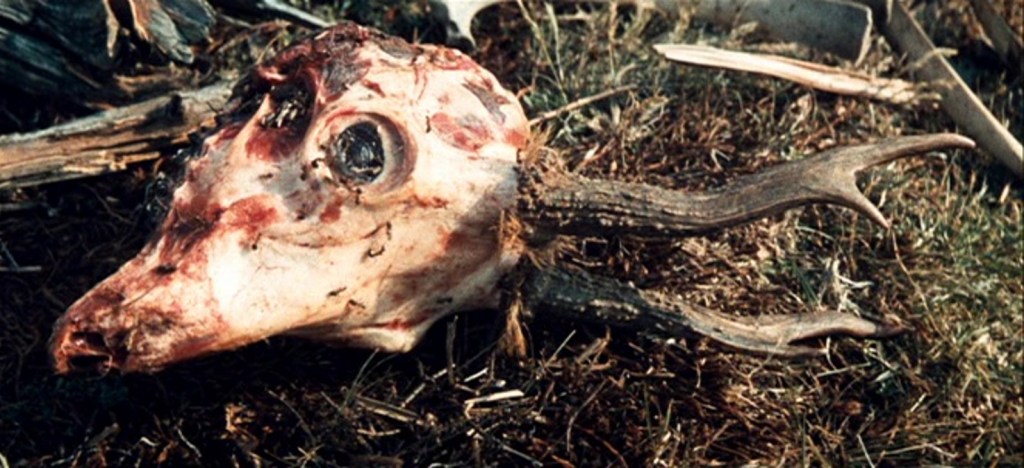
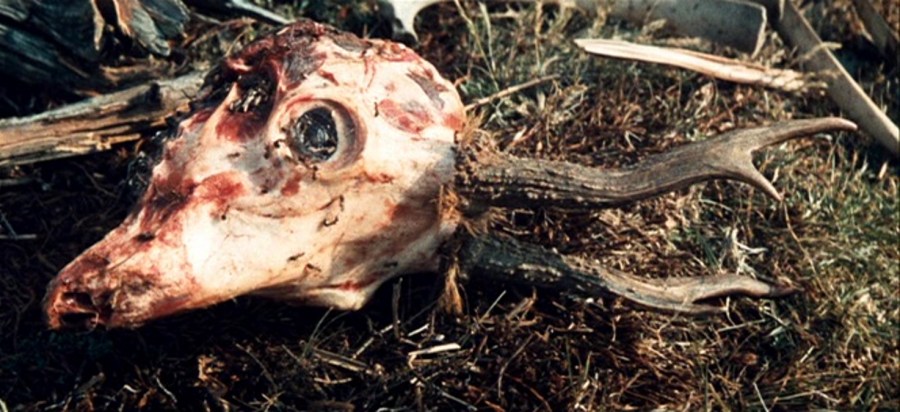
“Reports of widespread cannibalism” – NO BLADE OF GRASS (Cornell Wilde, 1970)

Cities are locked down, citizens are trying to escape from a deadly virus, food is rationed, rumours abound of dark government plots to kill off sections of the population. No, it’s not a COVID-19 movie but a speculative fiction film from over fifty years ago. From the trailer (above):

“Mankind destroyed what made most of the world liveable. Nature – wounded, diseased, and enraged – took revenge on her murderers. She cut off their food supply, and then waited, while they consumed each other.”

Yes, it’s a cannibal film based on a cannibal book, and its premise is the human war against nature, the way victory inevitably turns into defeat, and then perhaps extinction. The book it was based on, The Death of Grass by John Christopher, came out in 1956, which makes it quite prescient, and a bit of a shame more people didn’t read it back then, when carbon dioxide levels were 314 parts per million, compared to today’s 422ppm. Here’s a quote from that book:

“…he could no longer believe that there would be any last-minute reprieve for mankind. First China, and then the rest of Asia, and now Europe. The others would fall in their turn, incredulous, it might be, to the end. Nature was wiping a cloth across the slate of human history, leaving it empty for the pathetic scrawls of those few who, here and there over the face of the globe, would survive.”

Those who did take it seriously were film-makers like Ray Milland, who made Panic in Year Zero! in 1962 with a very similar plot, and this one, No Blade of Grass, an adaptation of Christopher’s book made by the acclaimed American actor turned director Cornell Wilde, whose 1965 film The Naked Prey was in many ways a forerunner of the Italian “Cannibal Boom” films of the 1970s and 1980s.

The film, set in the UK, starts with scenes of environmental destruction, as did its more famous American rival Soylent Green three years later. Soylent Green specifically nominated global warming as the cause of the collapse of the food system, due to the human population peaking in a way Thomas Malthus might have found terrifying.

In No Blade of Grass, it’s a virus sweeping the globe (right up to date, again); this one is killing all the grasses, including wheat, oats, barley, rye and rice, the food staples, without which the human species (and many other animals) will starve. We’re already getting a taste of this, as discussed in last week’s blog, with the blockade of Ukraine, the grains from which make up a majority of the food supplies for some of the poorer countries.

Of course, that is ‘over there’ and while we can feel sorry for the starving masses, we also have remote controls so we can turn off the sad news and enjoy our dinners. Just so, in this film we get unsubtle examples of starving children, interposed with rich, entitled, white British folks scoffing their roast beef and looking superior as they hear the news from overseas where, we are told, 600 million people have died of starvation, and the Chinese government is using nerve gas to kill 300 million of their own citizens to keep the state from total anarchy. The news continues:

“In the countries which no longer have any form of government, there are reports of widespread cannibalism.”

But even the comfortably bourgeois patriarch John Custance (Nigel Davenport) is making plans, in his light-hearted, Pythonesque way, to take his family up to visit his brother in the country. Do come along, old boy, he tells his daughter’s boyfriend, a scientist who has insider knowledge of what’s going to happen, because:

Anarchy breaks out in London and major cities. Fighting their way out of London, John and his family adopt the savagery of the collapsing society, robbing and killing those who stand in their way.

The car is stopped and John is knocked unconscious, while his wife (Jean Wallace, Cornel Wilde’s wife and frequent collaborator) and daughter (Lynne Frederick, later to be the last of the many wives of Peter Sellers) are raped. This rape scene, not the famine and cannibalism, turned out to be the controversial part of the movie, since Lynne Frederick was only 15 at the time. Nevertheless, Michael never loses his eyepatch or his cool or his alpha masculinity, while the women mostly do what they are told, and their hair remains perfectly coiffed.

A short-wave radio news bulletin reports:

“All the evidence indicates that France, Germany, Italy, in fact all of Western Europe along with a major part of Asia, South America and Africa have ceased to exist as part of the civilised world. In the midst of complete anarchy, and mass starvation, the horrors of cannibalism are already widespread.”

Only America and Canada are left, in the words of the US President, to “survive and preserve… the heritage of man’s greatness.”

When they finally arrive at John’s brother’s farm after a battle with a bikie gang that seems to owe more to the early Western than to science fiction, they have collected a whole lot of salt-of-the-earth farmers, whom the brother is not pleased to see, as he doesn’t want to feed them. The final showdown is therefore a modern iteration of Cain and Abel – the battle of the brothers.

The really odd thing about this cannibal film is that, while we witness the descent of civilised British gentlefolk into savagery, we never see any actual cannibalism. We hear a lot about it occurring in other countries, and speculation about it being about to happen at home, but the British seem to find each other particularly unappetising.

Cornell Wilde was an activist director, intent on convincing his audiences that the world was going pear-shaped in a hurry, and he was not big on subtlety. Unfortunately, the audience expects not just social commentary but also entertainment, and despite a lot of shooting and explosions and murders and rapes, the film suffered from some wooden dialogue and irritating flash-forwards which extinguished any suspense. The film received a desultory score of just 40% on Rotten Tomatoes.

No Blade of Grass is over fifty years old, which doesn’t excuse but partly explains the overt sexism, classism and racism that it addresses while also often seeming to endorse. Yet the film’s environmental theme is even more current today than it was on its release fifty years ago. Pollution is killing off agriculture, the water is contaminated and unfit for drinking, animals are dying out everywhere. The two little boys in the car even mention global warming, years before most of us had heard of it.

When COVID hit in 2020, people queued for food and water and guns and (most urgently) toilet paper, and there was much talk of famine, the breakdown of social order and, inevitably, the rise of cannibalism, just as we see in this film (although being British, they never discuss or seemingly require toilet paper). With no grains and no domesticated animals, people naturally turn to the only available meat, that which grows on the ape called Homo sapiens. But fifty years on, we don’t seem to have learnt anything from such speculations.

The film ends with a narrator announcing:

“This motion picture is not a documentary; but it could be.”

Indeed.

Cannibal supermodels: THE NEON DEMON (Nicolas Winding Refn, 2016)

Marcellus (Hamlet Act I, scene iv) claimed that “something is rotten in the state of Denmark”, but it’s not their cannibal films or actors. The Neon Demon is directed by Nicolas Winding Refn (currently in trouble with PETA for killing a pig for a TV series). Refn has made several movies (Pusher, Valhalla Rising, etc) starring Mads Mikkelsen, probably known best by the readers of this blog as Hannibal Lecter, or perhaps Svend in Anders Thomas Jensen’s The Green Butchers. This film does not have Mads in it, but it does have Elle Fanning as a sixteen-year-old model who, we just know, is going to be chewed up, swallowed and spat out by the Los Angeles fashion industry.

Books about screen-writing always stress the opening image – it sets the scene, establishes the atmosphere, tells the viewer what to expect. Well, this one sure does.

Jesse (Elle Fanning from The Great) dead on a couch, blood caked onto her throat and down her arm. A grim male gaze from a photographer. The killer? Police forensics?

No, he’s an amateur photographer doing audition shots for her, and is probably the only nice guy in the story, and we all know where nice guys finish. Anyway, Jesse is befriended, as she wipes off the fake blood, by a make-up artist named Ruby (Jena Malone from The Hunger Games), who takes her to a party to meet the LA fashion scene.

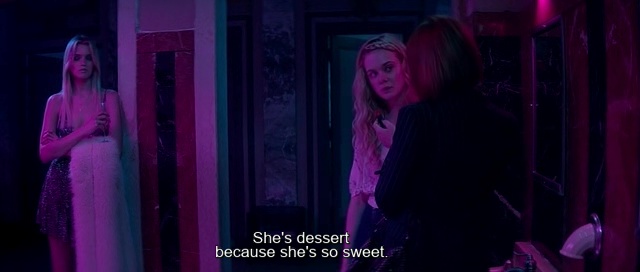
The other models hate her for being young and pretty and not needing the constant plastic surgery to fix all the things the surgeon and our culture say is wrong with their bodies. In the bathroom, as you do, they discuss lipsticks, which they note are always named after either food or sex, and speculate on this new commodity, Jesse. Is she food or sex?

Either way, it’s about appetite. Think of an animal, any animal – a snail, a snake, a human. What is the animal thinking about? It’s almost certainly food or sex. This film combines the two. The men have the power – the celebrity photographer, the fashion designer, even the sleazy motel manager (played with black humour by Keanu Reeves) – Jesse is their fresh meat.

The young, hopeful girls have their looks, and a useful booster of narcissism, a taste for the neon demon of fame, which fuels their journey through the fashion jungle.

When they get “old” (over twenty apparently), they inject various toxins and go under the plastic surgeon’s knife to fix what they are convinced are their failings. But it’s never enough. Jesse sees visions which confirm her own beauty in her eyes:

Women would kill to look like this. They carve and stuff and inject themselves. They starve to death, hoping, praying that one day they’ll look like a second-rate version of me.

But once used up, the women and girls are rejected, discarded, left to fight among themselves – to the death. Jesse is edible to them too, but not in the male way, more in the way that Elizabeth Báthoryis alleged to have bathed in the blood of virgins to keep her youth.

That’s a small taste of the real cannibalism in the film, which infiltrates the metaphoric cannibalism of the meat markets of advertising and fashion. There is an ancient tradition, from the earliest days of tribal ceremonies and the Wendigo to Richard Chase and Armin Meiwes, that eating the flesh or drinking the blood of a victim (preferably a young fit one) will transfer their strength and attractiveness to the eater. If you can keep them down of course.

An even older tradition talks of killing and eating the gods of the harvest, in order that they may be reborn and bring with them next year’s prosperity. The tradition survives in the transubstantiation of the Eucharist service. Jesse is a young and beautiful. She is, or thinks she is, a goddess. How can she not be eaten, in this film both metaphorically and literally?

There is no point in going on with the plot, it’s filled with rape, paedophilia, murder, masturbation, necrophilia, and of course cannibalism, but you really need to see it yourself, and anyway, the plot is not the point. Brian Tellerico, the reviewer from Rogerebert.com, summed this up:

It is a sensory experience, driven by the passion of its fearless filmmaker and a stunning central performance by Elle Fanning.

The director called the film an “adult fairy tale”:

“I woke up one morning a couple of years ago and was like, ‘Well, I was never born beautiful, but my wife is,’ and I wondered what it had been like going through life with that reality. I came up with the idea to do a horror film about beauty, not to criticize it or to attack it, but because beauty is a very complex subject. Everyone has an opinion about it.”

Everyone had an opinion about The Neon Demon too, with some of the audience at Cannes booing it and the rest giving it a standing ovation. You can make up your own mind – it’s an Amazon original, so you should be able to find it quite easily wherever you are in the world. It is a beautiful film, the acting is superb, the direction is assured and precise. The horror is not so much from the gore, as the scenes of young girls being treated as meat. But that is exactly the point.

The French philosopher Jacques Derrida spoke of what he called “carnivorous sacrifice”:

“The establishment of man’s privileged position requires the sacrifice and devouring of animals.”

The animals we sacrifice and devour are little more than infants – chickens for example are slaughtered at seven weeks of age. Pigs are killed at six months (less if they run into Refn, apparently). We no more eat old animals than photographers seek out old models. Remember Curtis’ line in Snow Piercer:

“I know what people taste like. I know that babies taste best.”

Or the words of John Jacques Rousseau:

The animals you eat are not those who devour others; you do not eat the carnivorous beasts, you take them as your pattern. You only hunger after sweet and gentle creatures who harm no one, which follow you, serve you, and are devoured by you as the reward of their service.

Cannibalism is no more or less than the sacrifice and devouring of animals – in this case, the Great Ape known as Homo sapiens. As voracious consumerism and greed extends its reach, to plunder the entire planet, the distinction between us and the other animals seems increasingly to evaporate.