Was Joe right? Cannibalism in PNG?

You may remember people heaping scorn on US President Joe Biden back in April 2024 for claiming that his Uncle Ambrose was eaten by cannibals in PNG (Papua New Guinea) during the Second World War.

“He got shot down in New Guinea, and they never found the body because there used to be — there were a lot of cannibals, for real, in that part of New Guinea.”

This anecdote aroused plenty of outrage from PNG politicians who proclaimed that there was never, not much, or hardly any cannibalism in the good old days.

But now the story has once again raised its well-chewed head. 2025 is the 50th anniversary of independence for PNG, a year which was expected to be a celebration. Instead, the news is full of stories about nine people being killed in shootouts in Enga Province over that New Year period, as violence escalates in the highlands, a region that was hit by a catastrophic landslide last May.

That news was overshadowed by a video that soon went viral of armed gang members holding mutilated body parts in Central Province, 60 miles (100 km) from the capital.

Voices in the Tok Pisin language on the video said they planned to eat the victim, with one man making licking motions as they displayed a severed foot, saying,

“this is our meat, we will cook it and eat it”

There was an immediate furore over the claims of cannibalism. Police said the deceased was killed in a dispute in the remote Goilala mountains in the province, but there are conflicting accounts of when the video was made. 

Prime Minister James Marape called for calm, and stated,

“Such acts of inhumanity are intolerable and represent a significant challenge to our shared humanity”

Marape had objected to Biden’s claims about cannibalism during the war, saying that PNG did not deserve to be labelled as a nation of cannibals.

Community leader Matilda Koma from Auga Dilava added,

“We do not eat people. Goilala people are not cannibals”

Fane’s Catholic priest Francis Pirit said that the video of the killing and youths pretending to eat human remains was a show of bravado, boasting because they had won a battle.

“There are no cannibals in the Goilala area. I sleep, eat and live amongst them. They do not eat human beings”

Despite the boast by the men, there is no footage of flesh being eaten in the gruesome video.

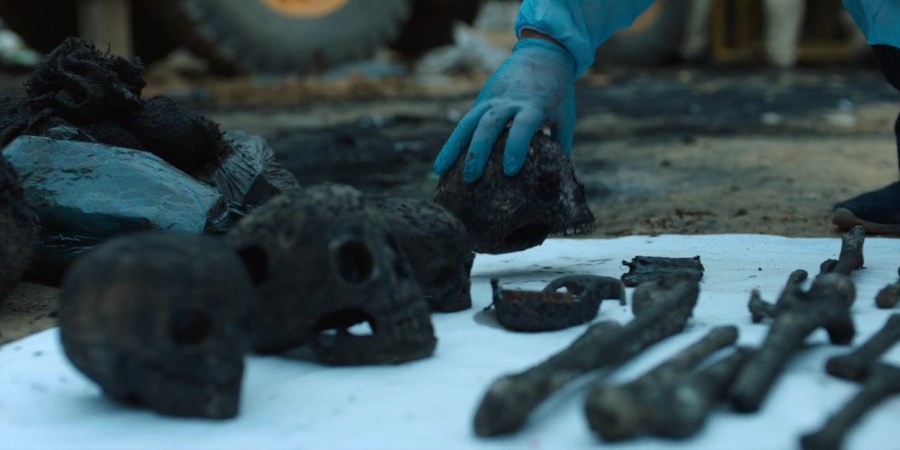
Cannibalism in PNG was largely a ritual practice by a small number of tribes and largely ceased by the 1960s after being banned by the colonial power, Australia. The suspicion that colonised peoples are inevitably cannibals has never completely disappeared; when the Australian soldiers of the 7th Division AIF began to find mutilated and cannibalised bodies in New Guinea in late 1942, they were not sure whether to blame the Japanese or local tribesmen. After a lengthy commission of enquiry, the Australian government in 1945 finally added cannibalism to the War Crimes Act 1945, the only nation to do so.

As recently as 2012, 29 members of a “cannibal cult” were arrested in Madang province on PNG’s northeast coast. Forensic reports and statements made by the accused led police to believe parts of the victims had been eaten.

One of the more persuasive substantiations of PNG cannibalism was Kuru, a rare, incurable neurodegenerative prion disorder that was found in the Fore people of Papua New Guinea in the middle of the last century. Kuru is a form of transmissible spongiform encephalopathy, related to the “mad cow” disease that cured people from eating beef for many years, and appears to have been spread by funerary cannibalism. It is often touted as a reason not to be a cannibal, appearing unexpectedly in films like Jim Mickle’s We Are What We Are and many films about wendigos.

So, cannibalism remains a sensitive topic in PNG. President of the PNG Law Society Hubert Namani sparked outrage when his comments condemning the “barbaric killing, mutilation and cannibalism” over the festive season were reported by the Post Courier newspaper.

Meanwhile, Goilala’s local member of parliament, Casmiro Aio, pointed out this week that there had been no regular police presence in his electorate for 10 years.

The questions remain – did any of the dead people get eaten? And more interestingly, why would that be so much more appalling than the fact that nine people were killed?

I did it Meiwes – “THE CANNIBAL NEXT DOOR”

December 1, the date on which I am writing this blog, is the birthday of perhaps the most famous living cannibal, the German named Armin Meiwes. He became famous around the globe when he was arrested in December 2002 for killing and eating a willing volunteer he had met on the Internet in 2001, a man named Bernd-Jürgen Brandes, who had helped sever and cook his own penis before being finished off and filleted by Meiwes. Movies have been made based on the events, from reenactments like Dora’s Cannibal to fantasies like Weisz’s Grimm Love. Songs have been written about him and sensationalised retellings haunt our documentaries, often inexplicably comparing him to Hannibal Lecter.

Meiwes was born in Essen in 1961, and was raised by his stern and controlling mother after his father and half-brother moved out, not unlike the story of Ed Gein, who tried to resurrect his severe and hard-hearted mother by killing and eating the genitals of local women in Plainfield Wisconsin. Armin Meiwes, hopelessly devoted to his late mother as he brooded in his thirty-room house, sometimes dressing in her clothes and impersonating her voice, was not dissimilar to Norman Bates in Hitchcock’s film Psycho, which was based on the Gein murders. Many have tried to pin his later conduct on his childhood feelings of abandonment and helplessness although, if that were the case, we would expect millions of similar cases around the world. Maybe there are, but they don’t get caught?

At any rate, young Meiwes developed a taste for cannibalism (sometimes called vorarephilia) from reading fairy tales, particularly the Grimm Brothers’ Hansel and Gretel, in which abandoned children almost get eaten by a witch. The witch, we might note, was the only adult to show them any affection, even though her ulterior motives were clear, at least to the children who were reading the story. The Grimms wrote their fairy tales near Rotenburg, where Meiwes killed and butchered his friend. You may also remember (at least, Fannibals will) that Hannibal Lecter referred to this fairy-tale when he was serving up dinner to Abel Gideon; Gideon’s own leg, smoked in candy apples and thyme, glazed, and served on a sugar cane quill.

Meiwes fantasy of eating and incorporating a brother culminated in 2001 in him advertising on a fetish website called The Cannibal Café for “a well-built 18 to 30-year-old to be slaughtered and then consumed”. The only reply that seemed sincere, indeed eager, was from Brandes, who was not really well-built or 18-30, but fitted the bill because he was determined to be eaten.

They got together and, after getting to know each other (which included slicing off Brandes’ penis and cooking it), Meiwes left his friend to bleed out in the bath, and then proceeded to butcher his carcass and eat the meat, in a variety of cuts, over several months.

In case there are still a few psychologists and journalists who haven’t yet pontificated on Meiwes and Brandes, this week we consider a 2023 UK Channel 5 documentary called The Cannibal Next Door, directed by Calum Farmer. This is quite a good reenactment of the events, although like many others, it relies too heavily on brooding, portentous music and opinions from experts, all of whom are universally repulsed by the cannibalism, a repulsion that Meiwes and many of his correspondents clearly did not share.  

“It had broken humanity’s last great taboo.”

Trigger warning: the real Meiwes (seeing it’s his birthday): This website claims it has actual leaked stills from Meiwes’ video. If you don’t like pictures of chopped up humans, maybe skip the link. They look fake to me, but this Reddit reader swears they are real.

Meiwes is still in jail in Germany, not for cannibalism, which is still not a crime, but for murder, which is absurd since Brandes wanted to die, and was in fact obsessed with being slaughtered and eaten. If anything, Meiwes is guilty of assisting a suicide. There was no law in Germany against eating a human.

We know so much about the case because Meiwes was very open in describing what happened, even videotaping the whole process of slaughtering and butchering. The jury in his case watched this video, and reportedly turned quite green, but it seems likely that they would have also done so had they been made to watch some of the horror clips of cruelty and killing in abattoirs that are abundant on YouTube. His lawyer argued:

“We say it is neither murder or manslaughter, but killing on demand. My client is not a monster.”

As it was clearly not murder and there was no law against eating a corpse, Meiwes was sentenced for manslaughter and given an 8½ year sentence. Public outrage resulted in a retrial which then found him guilty of murder, on the devious premise that Brandes had been mentally incapacitated by depression, and therefore open for manipulation by his killer. He was sentenced to life, which in Germany requires a minimum of fifteen years imprisonment. Meiwes has already served more than that.

Meiwes believed that he did nothing wrong. It seems that the only thing he can see as a moral failing is not the fact that he ate human meat, but that he ate any meat; he subsequently became an environmentalist and a vegetarian, both of which would obviate eating any flesh, including human. His simple claim in his defence was that, unlike pigs, sheep, cows, chickens and other animals, here was a willing victim who consented to, indeed demanded, his own slaughter and consumption. Is it not clearly more ethical to eat an animal who wants to be eaten, whatever the species, than one who does not?

Corny cannibalism

Cannibalism is defined by our good friends at Wikipedia as:

“the act of consuming another individual of the same species as food.”

Most dictionaries like to put “human” in there somewhere, but that is just another manifestation of anthropocentrism, a species-wide narcissism that believes everything is just about us. The same ideology also insists that human flesh is somehow different to that of other animals, and human suffering somehow more intense, or at least more important.

Now, we know that corn cobs cannot grow arms and legs and barbecue each other or indeed anyone of another species. As far as we know, they also cannot suffer, as pain is an evolutionary response to danger, and only useful to animals, who can seek to avoid that danger. The concept of corn cobs tormenting and killing other vegetables is absurd.

But that is exactly what humans do, confining, tormenting and slaughtering some eighty billion sentient land animals every year, and several trillion sea animals. We draw the line, usually at other humans, sometimes at dogs and cats in Ohio, but that line is arbitrary and can shift without much impetus.

If corn cobs could eat each other, they probably would. The objectification of the other, human or nonhuman, and the intensity of the slaughterhouse we have built in this world, sees that line between carnivore and cannibal increasingly porous, as we have seen in the hundreds of examples in this blog.

“…as long as human beings will go on shedding the blood of animals, there will never be any peace. There is only one little step from killing animals to creating gas chambers a la Hitler and concentration camps a la Stalin . . . all such deeds are done in the name of ‘social justice’. There will be no justice as long as man will stand with a knife or with a gun and destroy those who are weaker than he is.”
Isaac Bashevis Singer, foreword to ‘Vegetarianism, a Way of Life’, by Dudley Giehl

Convict Cannibals: FOR THE TERM OF HIS NATURAL LIFE (Norman Dawn, 1927)

For the Term of His Natural Life is a 1927 Australian film directed, produced and co-written by Norman Dawn. It is based on the 1874 novel by Marcus Clarke, and was the most expensive Australian silent film ever made. It remains one of the most famous Australian films of the silent era. John Laws, in the trailer above, calls it “the grandest of them all, the climax of Australia’s silent cinema.” Amazingly, it was the third attempt to film the story, starting in 1908 with the film version of a stage play of the book,  and then in 1911 another filmed stage adaptation, The Life of Rufus Dawes.

It’s the story of a gentleman (in the traditional sense of that obsolete term) who is wrongly convicted and transported to Australia for “the term of his natural life.” This was a fairly common trope in Victorian novels (no one wanted to read about real criminals), and was recreated by Tim Burton when he made Sweeney Todd into a returned convict in his version of the Demon Barber of Fleet Street. As a convict, he changes his name to Rufus Dawes, and the rest of the story tells of the brutality of life as a convict at Macquarie Harbour in Tasmania and his eventual escape to claim his innocence. And, in the American version of the film, a happy ending (the book and the British version saw the hero and his true love come to a watery end).

The bit that interests devotees of Cannibal Studies in this story is the escape of a group of men led by a particularly evil-looking convict named Matt Gabbett (played by Arthur McLaglen in the 1927 film).

Being a silent movie, even the narrator gets an intertitle card:

After nine days with no food, Gabbett points out that there are only two choices— starvation, or eating one of the followers, who has fortuitously become lame. We see him taking an axe to a fellow escapee, while the others cringe, as we suppose semi-civilised folk would.

Gabbett tells them:

The cannibalism subplot was one of the most controversial aspects of the film. Gabbett is based on the true story of Alexander Pearce, who escaped from Macquarie Harbour in 1822 with seven other prisoners. Once recaptured, Pearce confessed that he had eaten his companions, but the magistrate in Hobart refused to believe him. A year later, Pearce escaped again and this time he was recaptured with the flesh of another man still in his pockets. He was taken to Hobart and hanged.

The story languished somewhat until revived in a six hour mini-series in 1983. In 2008-09, a number of Australian films were made that referenced Pearce – The Last Confession of Alexander Pearce (2008), directed by Michael James Rowland; Dying Breed (2008 – about his supposed offspring who are still eating people in the 21st century), directed by Jody Dwyer; and Van Dieman’s Land (2009), directed by Jonathan auf der Heide, which cut the crap and concentrated on the cannibalism story. We’ll get to revue this one, dear reader, one of these days.

The controversy over Norman Dawn’s 1927 version was driven partly by Tasmanian sensitivities about the unwholesome revelation of the island’s history. Marcus Clarke’s book was one thing; a big international motion picture, intended for a mass audience overseas, was quite another. Certainly, the film does sensationalise the cannibalism, shifting the focus away from the book’s message, which was to advocate prison reform. Prisoners like Gabbett (played by the brother of well-known British actor Victor McLaglen) seemed more likely to offer justification of capital punishment.

Australia is sorely lacking in cannibal stories, so even though Alexander Pearce was Irish (as were a large percentage of convicts), we claim him as our own. He did, after all, eat people and get hanged here, and if he hadn’t, no one would even remember he ever existed.

The film is currently available on YouTube.

Need to feed, need to breed: THE DYING BREED (Jody Dwyer, 2008)

Two hundred years ago (July 19 1824), Alexander Pearce was hanged in Hobart, Tasmania, and his body dissected for research. He was a cannibal.

Australia has a bit of a dearth of cannibal stories (compared to places like the USA and Russia). Ask Aussies about cannibalism and they will often make a joke about state or federal politicians. Then they may search their memories and come up with Katherine Knight, a slaughterhouse worker who in 2000 had passionate sex with her partner John Price, then stabbed him 37 times, professionally skinned him, hung his hide on a meat hook over the lounge room door, decapitated him, butchered his corpse and cooked some of his flesh. She served up his meat with baked potato, carrot, pumpkin, beetroot, zucchini, cabbage, squash and gravy in neat settings at the dinner table, putting beside each plate placenames for Price’s children. Another meal was tossed into the backyard; it appears she intended to eat it but decided against it. So, no points on that one I’m afraid – no one got eaten, so no cannibals. More recently, the Snowtown bodies in the barrels case was revealed to have an element of cannibalism in the final murder, but this was very much an afterthought to the killings, and not even mentioned in the film of the events.

Most of the real cannibals in Australian history were in fact convicts sent to the worst penal settlements the British could devise (and they were very good at that) then escaping, only to eat their comrades when other food sources were exhausted. Edward Broughton did just that in 1830, as did Thomas Jeffrey, who became a murderous bushranger, in 1836. But before them, a cannibalistic pioneer one might say, there was Alexander Pearce.

Pearce escaped the brutal penal colony only to eat his companions, not once but twice (he confessed when recaptured the first time, but the authorities didn’t believe him). He is shown very briefly in this movie as a historical flashback before the opening title, an escapee who is cornered by a very angry soldier whose gun misfires. Pearce tears the man’s throat out, swallows some and throws a bit to a thylacine (Tamanian Tiger) who is stalking him, to allow him time to escape.

The thylacine was a carnivorous marsupial who was endemic only to Tasmania, until wiped out by European colonists, the last one dying in Hobart zoo in 1936. There is no evidence of them eating humans. Thylacines were not the only targets of white settlers: Tasmanian Indigenous peoples were also rounded up and subjected to genocide in the first half of the nineteenth century.

Anyhow, the plot of this movie revolves around a biologist named Nina and her friends, who are trying to find proof that the thylacine is not extinct – her sister found a paw print, but was killed mysteriously near the Pieman River on the west coast. The film and other sources often claim that Alexander Pearce was known as the pieman due to his love of the meat of a wide variety of animals, although in fact it seems it was named after a pastry cook named Thomas Kent.

They get a punt across the river, driven by a cranky old man with a small girl who is playing with bones and reciting bloodthirsty rhymes. She bites the boyfriend.

They get to the town, where the locals are killing puppies and who knows who else.

Long story short, as they say, these are a cannibal family descended from Alexander Pearce, who they call the Pieman. The city slickers, mocking the locals as they depart, head down the river where, at the midpoint of the film (where the really good or really bad stuff happens) Nina finally but briefly sights a thylacine!

Of course, she doesn’t have her camera, so she grabs it and they go look for the animal, splitting up to search, proving without a doubt that none of them has ever watched a horror film before. You don’t split up! The other girl meets the creepy child from the punt, then is grabbed from behind and killed, and we get to watch her tongue torn out and eaten. The others find her strung up on a meat hook and butchered like any prey animal.

There’s plenty of gore and somewhat predictable jump scares (or maybe I’ve just seen too many of these types of movies) but the plot is interesting, the acting great, the direction and photography first-rate, and the scenery is spectacular, although the depiction of the Deliverance-like locals may reduce the usefulness of this film for promoting Tasmanian tourism.

“What did you hope to find? We’ve been here a long time. Almost as long as the nation. We have a life to protect, a tradition. You tourists have no tradition.”

The cannibals in this film capture tourists and either eat them or breed them, not that different to what humans do to other animals. When modern twenty-first century humans eat others they are often referred to as degenerate cannibals – they are accused of devolving into the cannibalistic savages that early humans are portrayed as, even though there is little evidence that earlier cultures were into cannibalism or that modern ones have outgrown it.

Humans often turn to cannibalism when food runs out. The Biblical story of the siege of Samaria in Israel some 3,000 years ago (2 Kings 6) relates that, unable to afford asses’ heads and doves’ dung, two women agreed to boil their babies for sustenance. But after they’d eaten the first one, his mother found that the second woman had hidden her child, a shocking breach of contract.  Such starvation cannibalism became common in the day of sailing ships, but even on land, Sawney Bean in fifteenth or sixteenth century Scotland is supposed to have stopped tourists as they passed through his wild lands and taken them home for dinner. Some of these stories seem to stray from cannibalism into something like an aversion to getting a job, which is how the modern versions like Texas Chain Saw Massacre and Hills Have Eyes are sometimes framed. We eat flesh because we need to or want to, and because we can. That still applies in the meat section of every supermarket. We don’t degenerate to cannibalism, we simply objectify the prey, be it human or any other animal. This objectification is at the heart of all politics.

The moral of these stories (they all have one, even the most basic slasher), is that there are other worlds out there, away from what we are used to in our own little niche. There are people outside our ways of understanding life and morality, whose daily existence may be inconceivable to those looking in. Coetzee said that the “upper intelligentsia” (Nina is a scientist) live lives irrelevant to most people, who may be “devoted to brawling and guzzling and fucking”. That’s whom we meet in the unexplored wilderness of Deliverance or Sawney’s Scotland or the Texas of the forgotten, and in this film; they fight, they kill, they eat and they reproduce. They survive and breed: the basis of all evolution. It’s what animals do, and a good cannibal film like this reminds us that we are, beneath our veneer of civilisation, just another brawling, guzzling, fucking animal.  

Stalin’s workers’ paradise: CANNIBAL ISLAND

One of the most horrendous abuses of the Stalinist era was the mass deportation of 6,700 prisoners to what became known as “Cannibal Island”. This was a small island called Nazino in the Ob River in western Siberia (now the Tomsk Oblast). The island was 3 kilometres (1.9 miles) long and 600 meters (660 yards) wide and had no possibility of feeding the thousands of new residents.

The only thing the prisoners had was a little raw flour, but no tools and no clothes or shelter from the harsh Siberian climate. They had two choices: to starve, or to tear each other apart for food.

This documentary follows the development of the Soviet Union into a brutal dictatorship under Joseph Stalin in the early 1930s. Stalin was determined to industrialise the still largely rural economy, and his main tool was collectivisation, which forced the peasants onto State farms, to better harvest food and other resources for the growing urban proletariat. Famine followed, and the exodus of millions into the cities.

To control the population, Stalin’s secret police the OGPU led by Genrikh Yagoda introduced compulsory passports, available only to city dwellers – peasants were sent back to work the land. Anyone found without a passport for any reason was arrested and declared “socially harmful”, and thousands were shipped off to Siberia or Khazakstan every month, where there were rich resources, but hardly any people to garner them. The police and militia were given arrest quotas, so there was no avenue of appeal and no mercy.

Those arrested were shipped to usually freezing climes in whatever clothes they were wearing. One young girl was deported after her mother stepped off the train at a transit in Moscow to buy some bread. In Spring 1933 alone, 73,000 people were arrested and deported from Moscow and Leningrad. Thousands were deported on May 1 (May Day) 1933. These deportees, called “outdated elements”, were headed for the island of Nazino.

The first group of deportees to Nazino were petty criminals, delinquents and even vagrants, peasants who had left their villages looking for work in the cities but could not get passports. After them came the mostly innocent civilians arrested for not having passports on them, even if they had just left them at home or popped out for a packet of cigarettes without them, or were passing through the city and hadn’t needed one. It didn’t matter if they were party members or valuable workers. What they had in common was no knowledge of how to survive outside the city or to work the land.

With no preparations in place to feed or house the thousands of deportees, authorities decided to unload the barges full of prisoners on the island near the village of Nazino which soon became known as Cannibal Island. A week after being confined to the island, doctors started reporting incidents of cannibalism. News of this was sent back to Tomsk, but the response was to send another 1,000 prisoners and no extra food.

Within 13 weeks, over 4,000 of the deportees had died or disappeared, and most of the survivors were in ill health. Those who attempted to swim across the river to safety were killed by armed guards. The survivors formed gangs which preyed on the others and ate what food was available, including human flesh. The guards ignored the cannibalism and concentrated on shooting those trying to escape; there was in any case no provision in the Soviet criminal code against necrophagia (eating the dead). One survivor reported:

“I only ate livers and hearts. It was very simple. Just like shashlik. We made skewers from willow branches, cut it into pieces, stuck it on the skewers, and roasted it over the campfire. I picked those who were not quite living, but not yet quite dead. It was obvious that they were about to go — that in a day or two, they’d give up. So, it was easier for them that way. Now. Quickly. Without suffering for another two or three days.”

Young women were particularly preferred by those hunting for meat, and the guards claimed that escapees would take a “cow” – a young, naïve person who was glad to join the escape, but was chosen as a walking meat larder for when the others ran out of food.

Although this happened in 1933, it was not until the 1980s, in the preliminary days before the fall of the Soviet Union, that the archives were opened and historians were able to review the report of Vasily Velichko, a Soviet propaganda worker who had dared to investigate and had even written to Stalin about it. Stalin had ordered a commission of enquiry. These reports were finally published in 2002 by the human rights organisation Memorial. One eyewitness report sighted by the organisation stated:

“They were given a handful of flour. They mixed it with water and drank it and then they immediately got diarrhoea. The things we saw! People were dying everywhere; they were killing each other … On the island there was a guard named Kostia Venikov, a young fellow. He fell in love with a girl who had been sent there and was courting her. He protected her. One day he had to be away for a while, and he told one of his comrades, “Take care of her,” but with all the people there the comrade couldn’t do much really… People caught the girl, tied her to a poplar tree, cut off her breasts, her muscles, everything they could eat, everything, everything … They were hungry, they had to eat. When Kostia came back, she was still alive. He tried to save her, but she had lost too much blood.”

This is a thorough documentary, with plenty of historical images and film clips. That makes the recreations a bit confusing. Obviously, the guy playing Velichko is an actor, but what about the narrator, who tells us he is Ivan Portman, and that his grandfather was arrested in May 1933 and deported, making this seem a personal rather than just a historical account? He is portrayed by French actor/director Fabrice Pierre with English voiceover by actor Geoffrey Bateman. The documentary is basically a recreation of the Velichko report and the commission of enquiry, told by animations and live actors, together with commentary by (real) historians. This is never really made clear.

But overall, it’s a fascinating glimpse of an event from almost a century ago that sheds light on modern politics too. People are still crammed together in inhuman conditions all over the world. A billion people go to sleep hungry each night around the world. When food ceases to exist, death is one option, eating each other is the other, and when it happens, it is not too surprising. The only question is whether it will be done cooperatively like the survivors of Uruguayan Air Force flight 571 in 1972, by some sort of lottery as shipwrecked sailors often did, according to racial or other rankings as in the Donner Party, or just degenerate into a kind of survival of the fittest as individual predators or by Lord of the Flies or Yellowjackets tribalism, as happened with the gangs of Nazino. Unfortunately, the last option is probably the most likely.

The full documentary can be seen on Tubi:

https://tubitv.com/movies/100024747/cannibal-island

Sorority initiation: CANNIBAL HOOKERS (Donald Farmer, 1987)

Also known as I Will Dance on Your Grave, this film’s videotape release by Hollywood International Pictures “through Italian Stallion Video Comportation [sic]” has a notice on the front and back covers that cautions the potential viewer: “Warning: graphic scenes of violence and horror”, and adds that it has a running time of 91 minutes. Subsequent VHS releases were (badly) re-cut to 63 minutes, including the 4 minute end credits. All DVD releases are ripped from the 63 minute version. Which is still about 62 minutes too long.

So, to the “story” (sic). At a sorority initiation (we are told it is “the sleaziest sorority in the State), two girls are given a chance to prove themselves to the sisterhood by posing as hookers. But then they turn into vampires and start killing and eating the frat boys. Not good for business, but luckily there seem to be no bounds to the number or stupidity of the local men.

The movie starts with a guy following a woman to a bar, leering at her from the bed as she returns naked except for an axe held tactfully behind her back, bites off his finger (resulting in lots of the most watered-down fake blood I have ever seen), then chops him up.

Move to domestic turmoil as college girl tells mom she wants to join a sorority, then in the car on the way to college, agrees with her friend it’s only because they like to party. Stark realism so far. They pledge, and their initiation is to dress as sex workers and pick up one man each, on Sunset Boulevard. They agree, because “do you want to be socially ostracised all year?” The other girl suggests they join a frat house as “little sisters” instead. The best line of the movie follows:

“Little sisters? For your information, being a little sister has all the social status of being gang raped by Nazis.”

Despite the occasional zinger, the rest of the film is full of bad writing, laughable acting, gratuitous breast shots, and fake gore. There is an unexplained weirdo named Lobo at the brothel, who takes men’s coats when they arrive, and then kills them while they are getting it on with the girls.

Besides killing people, Lobo’s job is to bring glasses of blood to the head vampire, on whom he has a crush. She sleeps with a human skull on her stomach. Much as one does in sororities, I suppose.

The protagonists are both turned into vampires, and the rest of the film revolves around necks and teeth. There is a detective on their case, but he is easily captured, and told:

“We have a very special diet. We only eat warm human flesh.”
“No kidding. I think I read about that diet in the National Enquirer.”

I won’t give any spoilers in case you are tempted to watch it, but let’s just say that, while some of the female vampires meet a sticky end, there is far more sacrificial killing and eating of males, which makes this somewhat unusual in cannibal films.

I don’t know whether the writer/director Donald Farmer ever saw the German movie Die Wiebchen which came out in 1970. At any rate, male terror at being eaten by females, reabsorbed by the Monstrous-Feminine, is much underrated, and this film, badly made as it is, at least helps to remind us of that uncanny terror and restore the balance, however marginally.

I couldn’t resist this review on IMDB:

The full movie (or the bits that weren’t cut) can be seen if you really want to at https://tubitv.com/movies/100014132/i-will-dance-on-your-grave-cannibal-hookers

Cannibal influencer arrested in Brazil

If you by any chance have watched any of the videos of the influencer Israel dos Santos Assis, better known online as Pinguim (Penguin), you may not have guessed that anything controversial was being shown. The Brazilian, from São Francisco do Conde, a city in the metropolitan area of ​​Salvador in Bahiahad, had been gaining more and more followers on social media over the months before his arrest on July 23 2024, when he was apprehended after being caught desecrating graves in the cemetery of San Francisco the Count, in the Salvador Metropolitan Region, and stealing human bones.

Not just bones. The 22-year-old influencer used human flesh from the corpses to cook his most popular dish: feijoada, a bean stew usually involved simmering beans with beef or pork. Both of which have been reported as tasting very similar to human flesh.

One of Pinguim’s videos, which went viral on social media, explained the secrets of adding meat to beans — and how to get the most out of the final dish.

“Treat and throw it in the beans. But you can’t eat it, no, you just chew it and then throw it away. You don’t swallow it, you just chew it and throw it away, you just taste it, it’s sweet.”

The remains were not only for use in his recipes. After being arrested, Israel led the local police to a mangrove swamp where he had hidden numerous bags of bones. He had been sending these to Salvador, the state capital, to be used in satanic rituals.

The suspect was caught after families of buried people reported that graves had been violated and several bones had been stolen.

Pinguim made a video confession to police which was later released to the media. He reported that he had spent hours at the cemetery to see which graves were the most recent; those with the freshest human flesh. He told police he had fried a piece of a person’s leg and seasoned it with lemon and vinegar before chewing on it.

Local reports say he told police that he stole the body parts to order, in exchange for a payment equivalent to about $US50 from three people who wanted to use the bones as part of a black magic ceremony. He used the money to buy shoes and sandwiches, as well as getting his hair cut.

Surprisingly, Pinguim was released on bail pending an ongoing investigation into charges of desecrating a tomb. His lawyer, Luan Santos, told local media his client suffered from mental health issues and was taking anti-depressants. He added that he would be demanding psychiatric tests to ascertain whether the accused was fully aware of what he was doing.

Pinguim’s social media accounts have been deleted.

Brazil has always been a fascinating area for students of cannibalism. One of the most famous tribes was the Tupinamba, who captured a German soldier and explorer named Hans Staden in the sixteenth century. He claimed to have witnessed their cannibalistic rituals and did very nicely from his subsequent writings, illustrated by the graphic woodcuts of Theodor de Bry. As a result, the Portuguese came to save the ‘savages’ from their sins, and through enslavement, assimilation, extermination and the introduction of Smallpox, managed to wipe them out completely.

The classic cannibalism film How Tasty Was My Little Frenchman (Como Era Gostoso o Meu Francês) is set in this period of imperial invasion, and tries to give a new perspective on the way colonialism used cannibalism as its pretext.

More recently, modern Brazilians have been involved in some of the more interesting cannibalism stories that have graced our news cycles, including the “Cartel” who sold pastries made from human flesh to unwitting customers, and the Brazilian who was arrested in Lisbon for eating a man who had tried to help him. Like most cannibalism films, the ones set in Brazil vary between seeing it as something savages naturally do, such as Emanuelle and the Cannibals, and those that see it as typifying the exploitation of the poor by the rich, such as The Cannibal Club.

The Brazilian anthropologist Eduardo Viveiros de Castro proposed a ‘post-structural anthropology’ in his book Cannibal Metaphysics. De Castro sought to ‘decolonise’ anthropology by challenging the increasingly familiar view that it was ‘exoticist and primitivist from birth’, denying that cannibalism even existed, and so transferred the conquered peoples from the cannibalistic villains of the West into mere fictions of colonialism. This alternative view of Amerindian culture rejects the automatic assumption of the repugnance of cannibalism, which serves to either confront it or deny its existence. Accepting those parts of colonial culture that are useful (they speak Portuguese for example) can be seen as a form of reverse, cultural cannibalism.

But Pinguim demonstrates that even Brazilians have not fully embraced this philosophy, particularly when it involves digging up their relatives.

There is a video showing Pinguim confessing to cooking human bodies. More interesting if you speak Portuguese though.

Is Oprah a cannibal?

Well, apparently not.

The claim has been doing the rounds since a silly post on X in February (now archived).

The claim was made in response to an online request for people to share their fave Oprah moment “in honor of Oprah Winfrey’s 70th birthday”.

The post managed to gain some serious attention:

Even the poster didn’t try to persuade people that it was true.

“crying, why are ppl actually believing this … y’all believe anything”

That is certainly true. You may recall an almost identical campaign a few years back which claimed that Anne Hathaway had left evidence of cannibalism in a house she sold in 2013. This turned out to have been a “sociological study.”

Oprah has a history of media interviews in which she discusses food. Recently, she extolled the idea of using medications for losing weight, revealing that she has been using such drugs. Who can say that a high protein, low carb diet based on the cuisine of Dr Hannibal Lecter might not prove effective? Have you ever met a fat cannibal?

In 2008, Oprah went on a three week “vegan cleanse”. At the end of that brief period, she wrote

“At the end of the 21 days, I could not declare myself vegan or even vegetarian. But I am, for sure, more mindful of my choices. I’m eating a far more plant-based diet.”

Maybe giving up meat for health, environmental or ethical reasons could go beyond just avoiding human flesh, for everyone’s health?

What would you do? HUNGER (Steven Hentges, 2009)

People who automatically flinch at the idea of cannibal movies (or cannibalism generally) give a little mental shrug when the subject turns to starvation. What would you do if you had no food, nothing containing any life-giving nourishment except other human bodies? The honest answer to that is, usually, ‘I don’t know, and I hope never to find out’.

Several films considered in this blog have looked into what we might call “survival cannibalism”, a sub-group of the wider “castaway” genre—films like Hitchcock’s Lifeboat—which derive from the narrative of Robinson Crusoe. The most famous in Cannibal Studies is still Alive, which retold the story of the young footballers who survived a plane crash in the Andes, only to discover that the search had been called off and there was literally no food in the snow, except the bodies of their fellow passengers (most of whom were their friends). It was recently rebooted in Spanish in Bayona’s La sociedad de la nieve. Such stories are contemporary versions of the old shipwreck stories which motivated much of the cannibalism narratives of early modern Europe, horrifying the Europeans, when they weren’t accusing the colonialised of the same thing. A classic story is the whaling ship Essex, the wreck of which inspired Moby Dick. The film In the Heart of the Sea follows that story – what happened to them after the ship sunk? Well, weeks in a lifeboat with nothing but each other for company and no food…

Then we have the many, many post-apocalyptic stories, starting with Soylent Green, in which overpopulation and climate change have led to the recycling of dead people into delicious crackers. Other classics of this genre include Delicatessen, We Are The Flesh, Cadaver, and of course the bleak glimpse of the future, The Road. Such disasters can be intentionally created, such as Stalin’s famine in the Ukraine, during which the starving ate their own relatives. In the USA, the classic case of starvation cannibalism is the Donner Party.

This week’s film, Hunger, explores the same question: what would you do? If you were starving, what, or who, would you eat? An apocalypse is not the fault of the victims, and surviving any way you can, feeding yourself and your family, is difficult to criticise. It may still be gross to some (or most) people, but it is nevertheless, in some ways, understandable.

But this film complicates it by taking away the excuses of an indifferent nature or a catastrophic global event. In Hunger, there is no apocalypse. The characters are just five people who wake to find themselves in a dark dungeon, with no idea how they got there. It’s a cistern, a larger version of the abandoned well in which Catherine Martin found herself trapped in Silence of the Lambs. And, of course, like Catherine, there is no food being catered. Science hates anecdotal evidence, so in this film we have a scientist who has gathered ‘ordinary’ people in extraordinary circumstances, just to see what would happen. You may remember Mason Verger boasting of a similar experiment in Hannibal:

“I adopted some dogs from the shelter. Two dogs that were friends. I had them in a cage together with no food and fresh water. One of them died hungry. The other had a warm meal.”

They have access to four barrels of water, a toilet (of sorts, but only four toilet rolls) and a day-clock that marks off 30 days, the length of time the human body can survive without food.

On the second day, they find on their water barrels a scalpel, an instrument that Jordan, the doctor played by Lori Heuring (Mulholland Drive), calls “a human carving knife”. It soon becomes clear what that is for, and it ends up (after much discussion) being used for just that purpose – to kill and butcher each other.

We find out as they talk that they seem to have been chosen because they have all taken a life – one killed her abusive partner, another in a hold-up gone wrong, another through euthanasia. Doctors like Jordan handle life and death every day. But the scientist wants to know, are they willing to kill out of hunger alone?

Then there is that scientist who kidnapped them; we find that he had been a young boy who survived a car crash: we later discover he cannibalised his mother’s corpse to stay alive. Now he watches his captives, and takes careful notes.

He shares their predilection for taking life: when a couple come to have sex in the quiet country area and hear the pleas for help from their oubliette, he shoots them with tranquiliser darts and pushes their car into the river, but not until they wake up. He thereby reveals a sadistic streak, a psychopathy, or at least a disavowal of empathy, common in scientists who experiment on mice, rats, dogs, monkeys and other animals. Most of us react to seeing other sentient beings in pain by initiating an empathetic response called resonance in the inferior frontal gyrus and the inferior parietal lobule of our brains. Recent research in which rats were given electric shocks and responded similarly both to pain and to watching other rats in pain showed that this ability is not restricted to humans, and in fact may be better developed in rats than in some scientists. Like Descartes torturing dogs or Josef Mengele experimenting on camp inmates, a psychopathic scientist can justify any cruelty for the sake of research.

Cannibalism, the act of killing and eating another, is sometimes considered transcendent (by the cannibal), with one character making reference to cannibalism as a spiritual pursuit:

“Human flesh is essence. It captures a person’s soul!”

The scientist likes this idea, because he ate his mother, so it’s comforting to think that he now contains her soul. But the main theme of the film remains starvation cannibalism, in this case forced on the victims, as it was in the Ukrainian famines or the Nazi death camps. The counterpart of this cannibalism is happening in their bodies. As Dr Jordan tells us, the process of starvation progresses as “your body basically cannibalises itself.” The alternative is what the scientist hopes to witness, the choice to “become a savage”.

Jordan, the doctor, is the only character who refuses to consider cannibalism. Like “the Man” in The Road, she wants to “carry the fire”, and that anthropocentric ideal does not include eating humans. The others spurn such naïve ideology:

“You can hold on to your precious humanity. We’re doing what we have to do to survive.
And your boyfriend? He tasted surprisingly delicious.”

Cannibalism is usually depicted by society as a form of madness or monstrosity involving a devolution from civilised to savage, from enlightened to barbaric. Unless we pay someone else to do it for us—then it’s called animal husbandry.

The film was produced for a tiny $625,000, so the special effects and production time are limited (except for the buckets of gore), but it is still extremely effective. Hunger was released on Fangoria’s Frightfest DVD line, the same distributor as the (reworked) Armin Meiwes story Grimm Love. It does not seem to have received wide distribution, which is a shame, as it is well made, well acted (particularly Lori Heuring, who is quite incandescent) and is well worth your while chasing down. Moreover, it covers a crucial question that becomes more urgent as the world goes to hell in a handbasket – what would you do?