Screams, smashed skulls, flying flesh were not what villagers of an Uttar Pradesh village expected on a quiet Monday morning when a 30-year-old labourer brutally murdered his wife and mother on the rooftop of his house and then chewed flesh from their smashed skulls as his neighbours watched.
A 30-year-old man was arrested on 12 January 2026 in Kushinagar’s Parsa village for the double murder of his mother and wife. The suspect, who has been identified as Sikandar Gupta, had returned to the village about a month previously after working as a labourer in Mumbai. According to police reports, the victims were identified as his wife, Priyanka (28), and his mother, Runa Devi (60). Gupta initially attacked the victims with wooden sticks, and then with cement bricks, causing fatal head injuries to them.
Local residents rushed to the scene as the screams of the women echoed through the neighbourhood. Witnesses reported seeing Gupta mutilate the bodies and consume portions of the remains. When the crowd attempted to stop him, Gupta began throwing pieces of debris and human flesh at them, which caused widespread panic until the Ahirauli police arrived to detain him.
Kushinagar Superintendent of Police, Keshav Mishra, said that,
“a case of double murder was registered, and police are also examining the accused’s mental condition as part of the investigation.”
Neighbours informed police that Gupta had a history of substance abuse involving alcohol and cannabis and was known for frequent domestic disputes. The accused remains in custody pending a formal psychiatric evaluation to determine if he is fit to stand trial or if the murders were the result of a total psychological collapse.
Gupta has been admitted to the Psychiatry Department at AIIMS (All India Institutes of Medical Sciences) under police custody. According to reports, Gupta is speaking incoherently, at times claiming he was drunk during the incident and at other times saying he does not remember anything at all. Doctors have sedated him due to aggressive behaviour and are closely monitoring his condition.
Experts suggest the violence points to deep-seated psychological issues. Dr. PK Khattri, a senior clinical psychologist in Lucknow, said that Gupta’s agitated and non-communicative behaviour “points toward a severe psychotic break” that led to cannibalism.
As Dr Watson used to say, “No shit, Sherlock!”
Ashok Srivastava, an independent criminologist and an associate of the National Forensic Sciences University (NFSU), said that such extreme acts often stem from a
“desire for total domination”
He added that this type of behaviour represents an “ultimate expression of control, often triggered by internal frustrations or extreme psychopathology.”
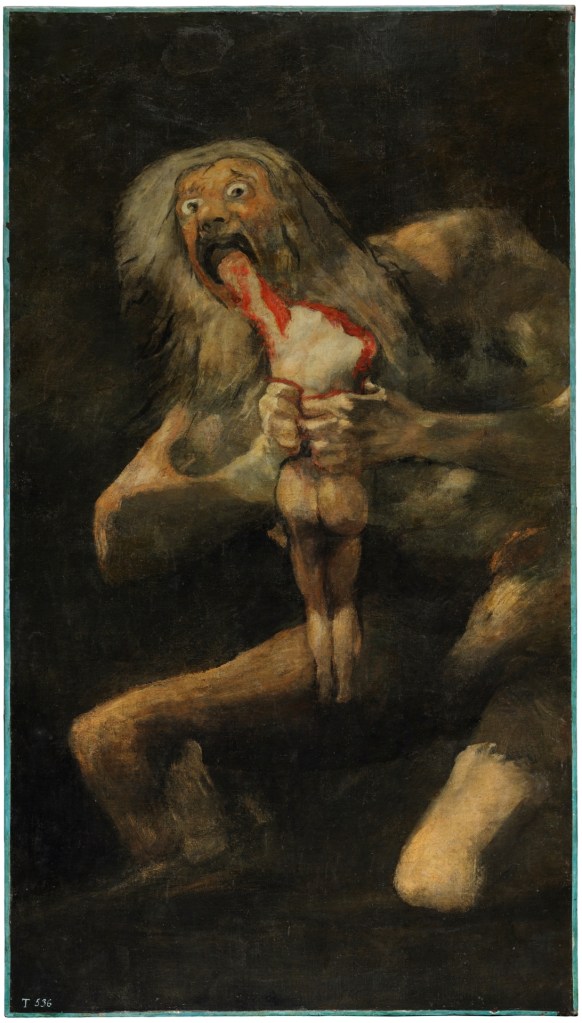
Which could be said of human societies generally. From bullying in school to sexual abuse to war atrocities to the commercially pressured obsession with eating the flesh of other animals, appetites are driven by this “desire for total domination”, of territory, of food, and of the bodies of others. Anthropocentrism, sometimes called speciesism, is maintained by the practice of killing other animals in ever increasing numbers, to prove our superiority and deny our own animality and mortality. The French philosopher Jacques Derrida called that “carnivorous virility”, the sacrificial slaughter and consumption of “inferior” animals by the rational, patriarchal civilised meat-eater.
What happens when the lust to dominate or kill outruns the limits of anthropocentrism and is instead turned back on fellow humans? The biological fact is that humans are animals, and animals are made of meat. When a society reaches a point where the old ethical agreements are disintegrating, it can either forge new ones or dissolve into chaos, war and, yes, cannibalism. The psychopath, such as the one in this case who allegedly started his brutal rampage with domestic violence before turning to murder and flesh eating, seems to understand this better than most ‘sane’ people.
“Get your hand off my knee and get me, uh, my lunch!
What’s leading the news? Wars roiling the globe? Economic dislocations? Warnings about possible new and very nasty pandemics?
No. All anyone seems to want to talk about is Jeffrey Epstein, the late financier and convicted sex offender, and the millions of pages of documents and photos that are being released (the latest and final batch on January 30) by the US Department of Justice in a hodgepodge of verified or dubious forms, some heavily redacted.
Claims are now circulating online that Jeffrey Epstein engaged in cannibalism or, to be more precise, “ate babies”.
One document, cited by online users, contains allegations that babies were dismembered and their remains consumed. The same document makes a reference to “George Bush 1”. However, the claims have not been substantiated, and their origins remain obscure.
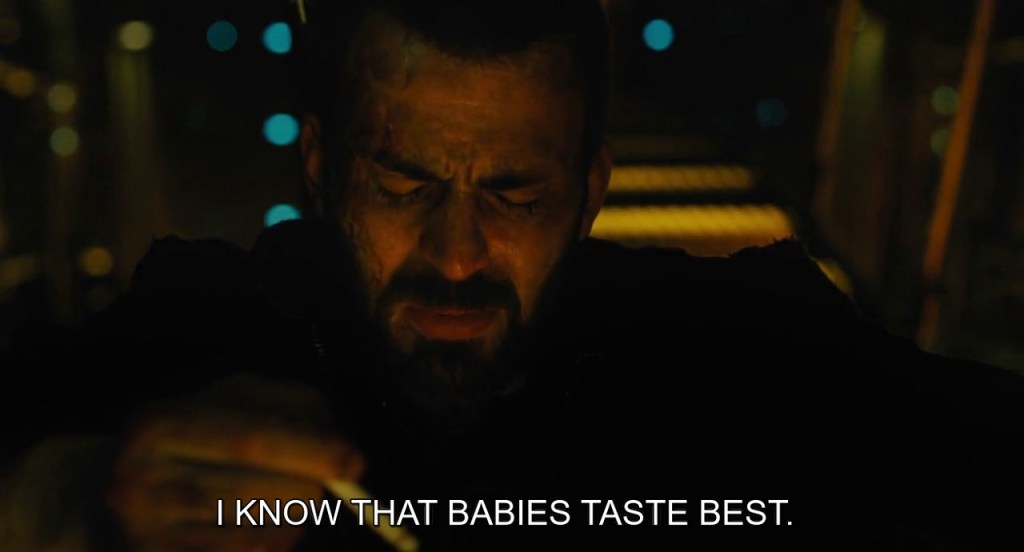
Babies are the first choice of predators and scavengers like humans, because they are easier to catch and their meat more tender. Think of how “lamb” or “veal” sell at a premium to “mutton” or “beef”, how “suckling” pigs are a delicacy, or how so-called “broiler” chickens are killed and eaten at six to seven weeks old. As Curtis says in the movie Snowpiercer:
Some have even suggested, satirically, that eating babies would be a good thing for the environment.
The allegations have been further amplified by the resurfacing of a video from 2009 featuring Gabriela Rico Jimenez, recorded in Mexico. In the clip, Jimenez alleged that she attended a private gathering of wealthy individuals where she witnessed cannibalism.
This story was covered by this blog some months ago, when it last made the rounds due to an exposé on a podcast called Mexico Explained. The blog about her is linked here.
Interest in Jiménez’s case has now surged again, after newly released Epstein documents referenced a party on a yacht and included allegations involving extreme behaviour. One email allegedly sent from Epstein’s known email address read:
“Where are you? Are you okay? I loved the torture video.”
These references, revealed as part of the January 2026 document release, sparked widespread public concern and renewed online theories linking Epstein’s network to past claims made by Jiménez. The material has led many online to speculate on connections between the Epstein files and Jiménez’s 2009 accusations. While no new verified information has emerged about Gabriela Rico Jiménez’s whereabouts or fate, the mystery surrounding her disappearance continues to enthral internet users worldwide. However, there is a dearth of concrete evidence linking her allegations to Epstein.
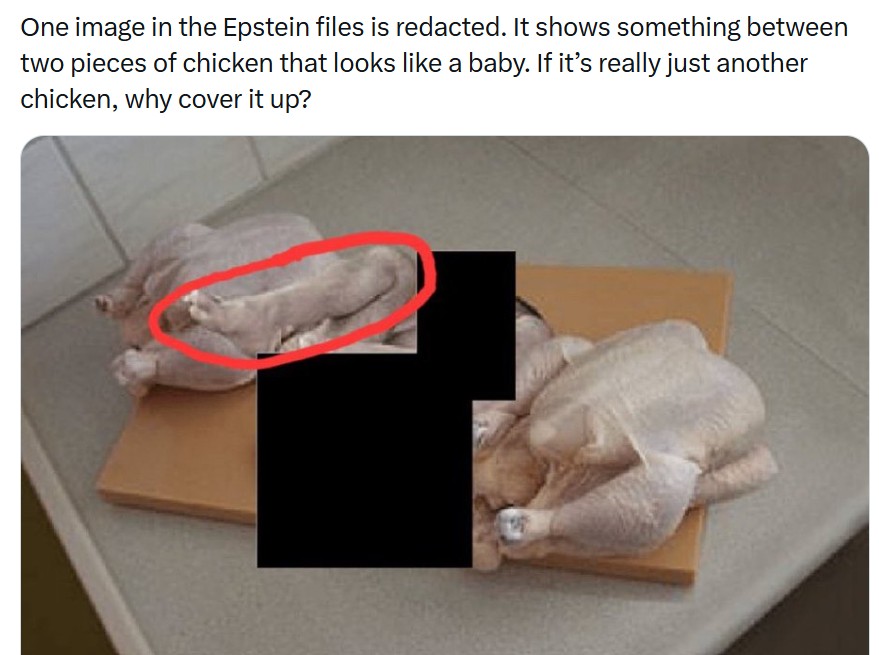
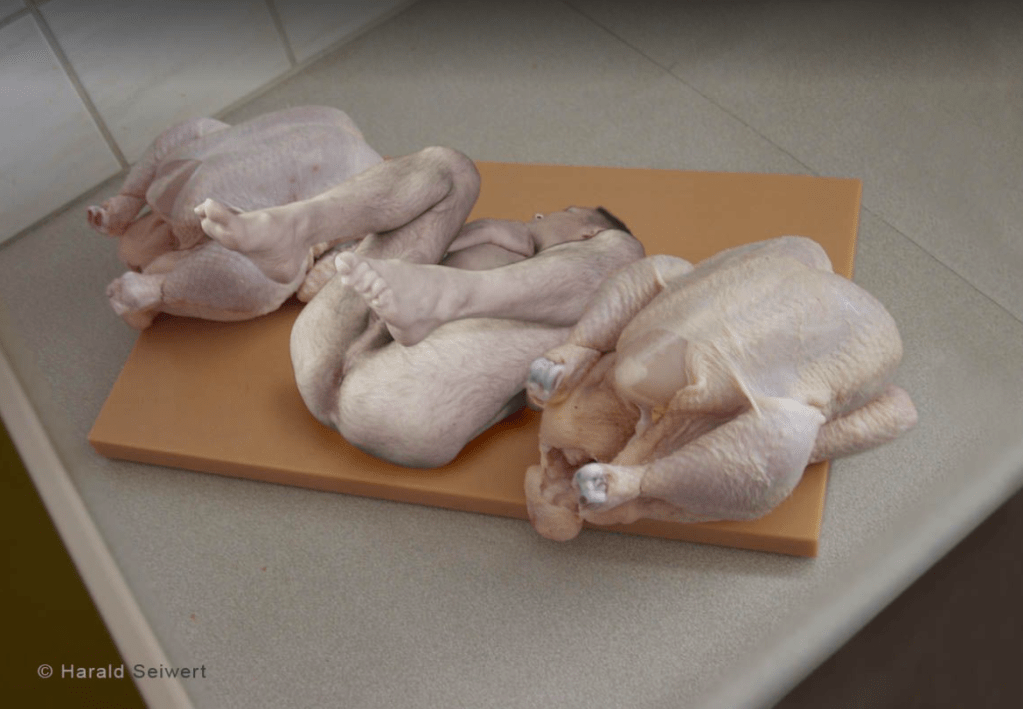
Social media users have drawn further conclusions from unrelated material, including an image (heavily redacted) that they claim emerged from the Epstein files showing a baby among chicken corpses. Observers have noted that the photograph was actually an art work from 2003 by a German artist named Harald Seiwert, used in vegetarian campaigns.
Why cover it up? Well, maybe because it was showing a guy’s hairy bum. Here’s the original:
Several posts on X have promoted conspiracy theories in response to the files. Others are circulating (again) a long-debunked image, clearly a deepfake which first appeared in 2023, purporting to show Epstein with young boys from a rap duo called “Island Boys”, Alexander (Alex) and Franklyn (Franky) Venegas. Some are even claiming the twins are Epstein’s children. However, Snopes rated the claim false in January 2026, Reuters found no supporting evidence, and the Island Boys themselves denied ever meeting Epstein in a 2023 statement to TMZ.
Still, a bit of evidence (or lack thereof) should not spoil a good story. One user wrote:
“These scumbags ate children. Some documents state that they conducted rituals on a yacht and consumed the fetus; they even compared its taste to cheese. They are messengers of the devil in their purest form.”
Another claimed:
“Jeffrey Epstein emails with the gruesome subject ‘Slicing a Pizza’ probably means that Pizza-Gate is most certainly real. Sadly Conspiracy Confirmed.”
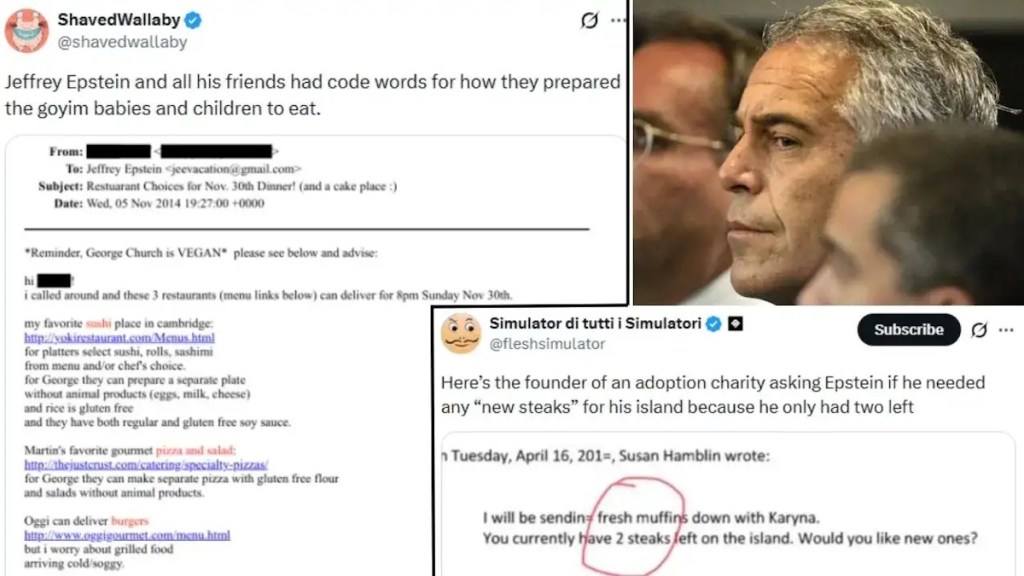
The Pizzagate theory — since widely debunked —was a conspiracy theory that exploded online during the 2016 U.S. presidential election, alleging that a child sex-trafficking ring involving prominent Democratic officials was being run out of a Washington pizzeria called Comet Ping Pong, interpreting food-related terms as code words. Posts suggested that words such as “pizza” or “steak” were code for children. One user alleged that an adoption charity founder asked Epstein if he needed “new steaks” for his island. A text search for the word “pizza” in the Justice Department documents comes up with an astonishing 849 results, most clearly related to Italian cuisine, but someone will no doubt find something there to reignite Pizzagate.
Others invoked comments made by comedian Roseanne Barr in 2024, when she claimed on a television appearance that Hollywood and political elites were “vampires” who drank blood and ate babies.
Note the antisemitic implications in the post above from someone who calls himself “ShavedWallaby”:
“Jeffrey Epstein and all his friends had code words for how they prepared the goyim babies and children to eat.”
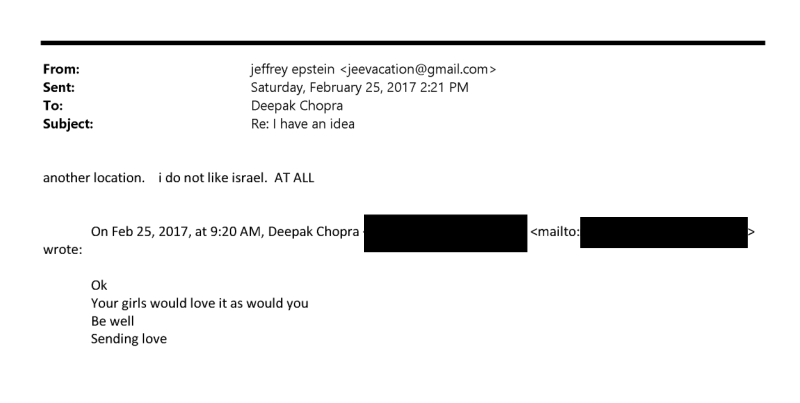
“Goyim” is a word from Hebrew, found in the Bible where it means “nations”, particularly those being described in the narrative of wars from over 3,000 years ago: Hittites, Amorites, Jebusites, etc. Since then, its use has evolved to refer, sometimes disparagingly, to Gentiles, or everyone who is not Jewish. Most languages have a sometimes extensive range of words for outsiders; the Roma refer to outsiders as Gadjo, and the Japanese talk about foreigners as Gaijin. The person posting the above is implying that only non-Jewish children are being eaten at these dinner parties. Epstein of course is a Jewish name, although there is absolutely no indication that he adhered to any religious precepts whatsoever, and was certainly not a Zionist according to a tweet to Deepak Chopra revealed in the latest batch of documents from the Justice Department.
Other posters have alleged that they found evidence in the files proving Epstein was involved in “Baal worship”, was a “Mossad agent” or championed “Jewish supremacy,” old conspiracies are being repackaged as new revelations. In fact, the bank account named “Baal” was a scanning failure: the document says “Bank”. Also, for those who have ever looked at a Bible, a lot of it involves God telling the Israelites to avoid any contamination by the idolatrous Baal worshippers.
The reference to Jews eating (non-Jewish) children is, however, very familiar, even in the twenty-first century, and derives from the “blood libels” that caused riots and pogroms for centuries throughout Europe, starting in the twelfth century. Jews, and those accused of being witches, were tortured, exiled or slaughtered due to totally unsubstantiated claims of infant cannibalism, or more precisely the use of infant blood in religious rituals – an accusation that makes no sense when placed against the strict Kosher rules that forbid eating blood of any animal in any form. But such claims do not fade easily, and will often be seen in new forms, such as descriptions of Israeli soldiers deliberately starving, kidnapping or killing Gazan children in a (singularly unsuccessful) attempt to perform genocide. Only the most malicious and vituperative claims now involve cannibalism, and they are usually posted anonymously (I presume the above is a pseudonym since, in Australia, we do not usually shave wallabies).
A protest in Washington, D.C. on November 20 2025 featuring activists dressed as Israeli Prime Minister Benjamin Netanyahu, U.S. President Donald Trump, U.S. Secretary of State Marco Rubio and other officials dining on food and drink meant to resemble organs, skin and blood. The demonstration took place both inside and outside Union Station, the capital’s central train station. The activists deemed it as “Israel’s Friendsgiving Dinner,” with signage behind a long dining table displaying a menu consisting of “starter: Gaza children’s limbs,” “main: stolen organs,” “drink: Gaza’s spilled blood” and “dessert: illegally harvested skin.”
Meanwhile, this image appeared on the campus of San Francisco State University, or perhaps a modernised version of it (this one was from the second intifada). It is classic blood libel: Thomas of Monmouth would be jealous of the modern technology, but would recognise the vilification strategy.
Epstein’s crimes involved a type of cannibalism – the exploitation and abuse of children who were also supplied to other sexual predators. But despite the volume of accusations filling the social media of those with nothing better to do, there is no concrete evidence in the released documents that Epstein or anyone else in his circle of the rich, entitled and depraved engaged in actual consumption of babies. But then, I guess it’s a bit much to expect them to leave proof, or even bones, lying around. Men (and I guess a few women) who see themselves as gods, masters of the universe, happily guzzle all the evidence.
See also my post on Woody Allen and his friendship with Epstein.
A few years ago, I got chatting to a couple who owned a business in New Zealand – they were undertakers. When I mentioned my doctoral thesis, the thin red line between cannibalism and carnivorism, they told me they often received calls and emails seeking body parts. I doubted the story at the time – after all, cannibalism was a convenient story in the early days of British colonialism, and while Maoris have agreed it happened occasionally, it seemed unlikely to be a regular commercial proposition in the twenty-first century.
But the story lives on. In November 2025, The New Zealand Health Practitioners Disciplinary Tribunal found that a former mortuary technician had posted comments to social media “promoting cannibalism” and boasted that he could “literally steal an entire heart”.
The man – who cannot be named for legal reasons – also shared an image online of a dissected human skull with a handwritten message inside: “We’re inside your head”.
The Tribunal ruled that this constitutes professional misconduct, stating that he:
“engaged in conversations … promoting cannibalism and eating post mortem tissue”
Their ruling noted the man identified himself online as someone who worked in forensic pathology and/or was involved in post-mortems.
The man also engaged in online conversations about rape and sexualising children, his own alleged drug use and ways of making explosives, offering to show others how to make explosives.
One online conversation saw the man claim:
“When we have burn victims…. They smell so good sometimes”
In another online discussion about cannibalism, he discussed the provision of human (post-mortem) tissue to others.
“When you’re working here. We got enough [muscle] to go around. Save your muscle”
He also boasted about being able to access body parts.
“I mean. It’s not actually that hard. I could literally steal an entire heart. It all just goes back into a bag we stitch back inside them not like anyone checks it”
He told one online user he could “sneak a little heart slice next week. It’ll be me conveying my love to you. Sending some actual human heart.”
The man also claimed that he’d decapitated a corpse “to boil her head”.
The Tribunal ruling noted the man “accepts that his rhetoric, comments and information about post-mortems, post-mortem procedures, and dissections that he posted and/or circulated in his social media posts was inappropriate and that his conduct fell below the expected ethical and professional standards that apply to members of his profession”.
The Tribunal also noted the “charge of professional misconduct is established”.
No charges have been laid regarding the man actually carrying out any of these acts. What happened to free speech and entrepreneurialism in New Zealand?
Delicious is a German horror film, a genre that has a proud history, but it’s also a psychological and socio-political drama that examines the many ways the rich eat the poor, and the potential for revenge. It is written and directed by Nele Mueller-Stöfen in her directorial debut, although it as well made as a work from far more experienced directors.
The film starts with social and class-based unrest. In the opening scene, a rich German family are in a car fitted with bulletproof glass as protesters swarm the streets of Paris, jumping on the car and fighting with police. The father is unworried – “they’re not interested in us.” Perhaps that’s true, but the protests are about poverty and the cost of living, and others are very interested in this family.
As they settle into their holiday home in Provence, another group of young working-class people watch them, the serving staff, who live impoverished lives as they wait on the rich, in a hotel room where they are lying on rich people’s beds and pissing in their fancy mineral water bottles. They work at a fancy hotel nearby, and observe as the family have dinner and a few drinks. On the way home, somewhat tipsy, they appear to hit a young woman walking across the road. In fact, we know that her friend has deliberately cut her arm to make the accident more believable. She reopens the wound when necessary, to maintain her connection to their guilt.
The next day, she tells them she has been fired for not being able to work after the accident, and asks for a job as a maid, but she gradually infiltrates the lives of each member of the family. They have designs on her body, but she and her friends have designs on theirs, and (this being a cannibal blog) you can probably work out what is going to happen well before they do.
Serving the rich (in some novel senses) is definitely on the menu, as blood and meat (eaten raw) feature in the early scenes. Less gory versions of eating too, including cunnilingus.
I’ll avoid spoilers, because it’s on Netflix, which means a lot of people will probably watch it. It’s beautifully filmed and well acted, but does tend to drag in the middle, although that is not unusual for European films – they never seem to be in the same hurry as Hollywood, which may explain some of the appalling reviews. But by the time the wife goes to a party with the young ones, we are right into it.
The way of the world is usually the rich squeezing the life out of the poor, and while there are many films about that (think Fresh, The Cannibal Club or What You Wish For), there are not many that look at the retaliation which the exploited must often crave. Eating Raoul captured that anger and propensity to violence well, and this one does it too, without the humour, but with a cast of fine young cannibals for whom the viewer may well feel some sympathy. The family, beset with their own issues to do with work and relationships, does not see disaster coming, and that is the basis for most good horror.
“You have high gates, but your perfect world cannot be separated from ours.”
The plot unravels slowly and by the time blood starts to flow, it’s almost time to finish the film. If you like plots where the invisible reclaim their power, you may enjoy this. Think Parasite or Saltburn, but with the added spice of cannibalism.
At one point Teodora, the “maid” quotes the Marxist, Antonio Gramsci, to her supposed boss.
“The old world is dying, and the new world struggles to be born: now is the time of monsters”
In the time of the monsters, when humanity has turned the planet into a giant abattoir, assuming that some are edible and some are not is just a social construction, with little rational basis. Riding off on their motorbikes, the cannibals seem to have cast off such contingent social customs. But who, the film asks, are the monsters?
Kinds of Kindness is a black comedy drama, presented as a “triptych fable” – three separate stories which are nevertheless connected. The director, Yorgos Lanthimos, has made many celebrated films, including The Lobster,The Killing of a Sacred Deer and most recently Bugonia. He has won a BAFTA and been nominated for five Academy Awards. Kinds of Kindness has his regular extraordinary cast, including Emma Stone, Jesse Plemons, Willem Dafoe and Margaret Qualley.
When directors use ensemble casts, it usually means they use the same actors in a series of unrelated films, but this one is really three films in which the same actors play different roles. The one of interest to us is the middle section, “R.M.F. is flying”, which employs the theme of this blog, cannibalism. But the whole film is a entertaining (if somewhat lengthy), and there is a relationship between the three parts that makes an interesting, if somewhat disorienting and bewildering, whole. Life imitates art, in that the director and Stone have recently been involved in signing uninformed statements about international politics, an area in which they clearly are sadly ignorant. Imagined kindness becomes abusive behaviour, the theme of the film.
Spoiler alert – if you haven’t seen the movie, and plan to do so, maybe do that first.
The first part of the trilogy explores abusive relationships, particularly in the workplace, as Robert (Jesse Plemons) lets his boss Raymond (Willem Dafoe) control every aspect of his life. Raymond is loving and generous (a kind of kindness), but only as long as Robert obeys every order Raymond gives him, including his daily food regime, his sexual activities, and the order to kill a person known only as R.M.F. Kindness is presented as a toxic attachment.
The second story, R.M.F. is Flying, follows a police officer named Daniel, (Plemons), whose wife Liz (Emma Stone) has disappeared at sea while on a biology research expedition. Despite all predictions, she is found and flown back home by R.M.F., but Daniel believes she is an imposter – her shoes don’t fit, she does not remember his favourite song, and she suddenly loves chocolate which she previously could not stand, telling of a dream where dogs were the master species and fed their pet humans on chocolate.
Flashbacks reveal how she survived – by cannibalising the other members of the team.
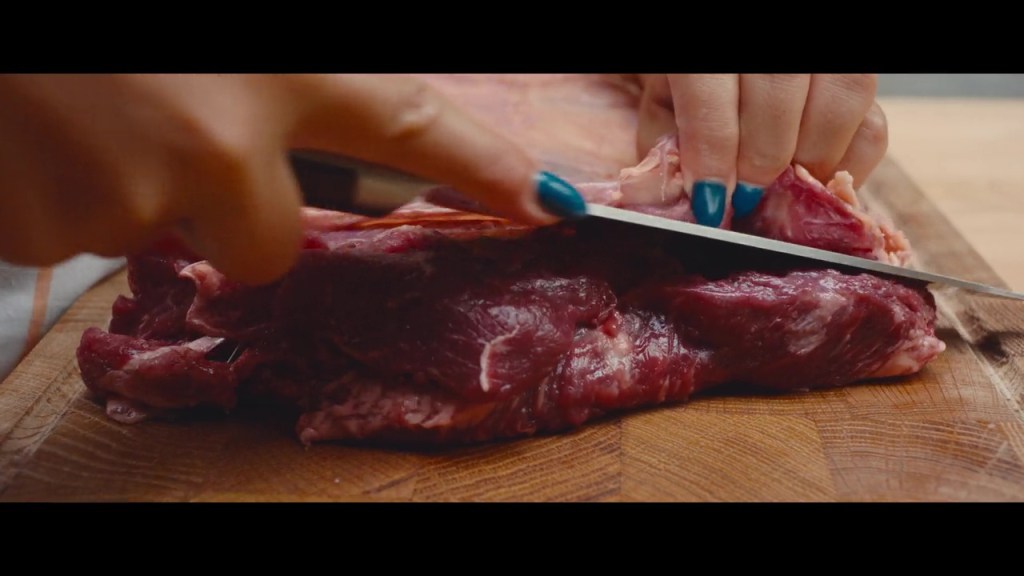
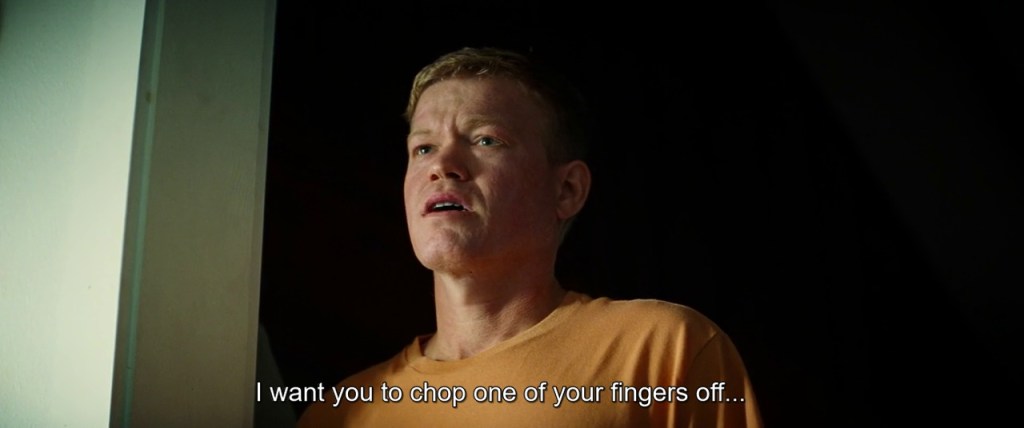
At one point, the distraught cop Daniel shoots a suspect in the hand, and starts licking up the blood from the wound, just as a dog might do. Like the dogs in her dream, Daniel becomes Liz’s pack leader and she accepts his humiliation and cruelty like a “beta dog” would. Demanding she prove her love, Daniel asks her to cook him one of her fingers or thumb, and we see her cut it off and fry it.
When she reveals she is pregnant, he beats her until she loses the baby.
Finally, he says he is still hungry, famished, and says he wants her liver. She removes it with a kitchen knife, dying in the process, and we see the ‘real’ Liz appear at the door, to be greeted lovingly by Daniel.
The closing credits show dogs driving a car, a dead human lying by the roadside like roadkill. This story exposes kindness as vulnerability in intimate relationships. Daniel is determined that Liz be exactly as he wants her and rejects all her overtures of love, eventually leading to her death and rebirth as his ideal wife.
The final story examines a sex cult led by Omi (Dafoe) and Aka (Hong Chau) where followers are purified by drinking water cleansed by the tears of the leaders, and can thereafter only have sex with Omi and Aka. Emily (Stone) and Andrew (Plemons) are paired and sent out to find a messiah – a woman who can revive the dead. Emily, like many converts to cults, has left her family behind, although she sneaks into her old house sometimes to sit on her little girl’s bed. Eventually she goes to visit her family, but the daughter is asleep and her ex-husband drugs and rapes her, meaning that she is now, to the cult, ‘contaminated’, and so ejected from the compound. She perseveres and eventually finds the messiah, a veterinarian named Ruth (Margaret Qualley) who heals a stray dog whose paw Emily has cruelly cut. Liz drugs Ruth and takes her to the morgue, where Ruth brings back R.M.F. from the dead. Triumphant, Emily drives the still dazed Ruth to cult headquarters after doing a victory dance that appears in the trailer at the top of this blog. As the credits roll, though, her reckless driving ends up with her driving her Dodge Charger into a wall, killing Ruth. Abusive kindness again, this time as spiritual devotion turned toward thralldom and abuse.
In all three stories, the characters seek fulfilment and, yes, kindness, going to excessive lengths to achieve it – Daniel kills a man to win his boss’ love, Liz cuts out her own liver to feed her husband and placate his repulsion, and Emily kidnaps her purported messiah to win back the love of her cult leader.
The film is an absurdist romp, reflecting the incongruity of human relationships and social behaviour. In each part, someone is being exploited and abused, a form of consumption, but the middle story makes cannibalism, inherent in all abuse, graphically apparent. There are many variations of cannibalism; Liz indulges in starvation cannibalism to survive as she waits to be rescued, Daniel becomes psychotic and licks blood from a wounded civilian, Daniel indulges in revenge cannibalism, ultimately killing Liz.
When he is convinced the woman that was rescued is not really Liz, he becomes contemptuous, and from that point, her death and consumption are inevitable. She has been, in his eyes, dehumanised, objectified like the animals sent to their deaths by the billions every year for human consumption. They are “de-animalised” – their flesh turned into commodities, made to look as little as possible as the living, feeling animals from which it came. For humans to be cannibalised, they must first be animalised, then de-animalised.
Thus, Daniel licks the wound of the man he shot like a dog might treat a wound; thus, Liz’s dream in which the dogs are in charge and feed the humans, not exactly what they want, but chocolate, of which there is plenty, probably because dogs cannot eat it (it’s toxic for them).
In relationships built on distrust and rage, we are animalised, and animals like dogs become the paradigm of civilisation. The humans are just wearing people masks.
Australian boxer Nikita Tszyu has revealed that he became a “cannibal” as he prepared to fight Lulzim Ismaili this month (August 2025). The boxer said he needed to be at his very best to win over his unbeaten opponent, and hoped that his new diet would boost his training.
Tszyu revealed that his change in nutritional sources was all thanks to his wife, Nikita Bedwell. The couple welcomed their first child earlier this month, named Curiosity after the NASA Mars Rover, and the birth allowed Tszyu to change his diet.
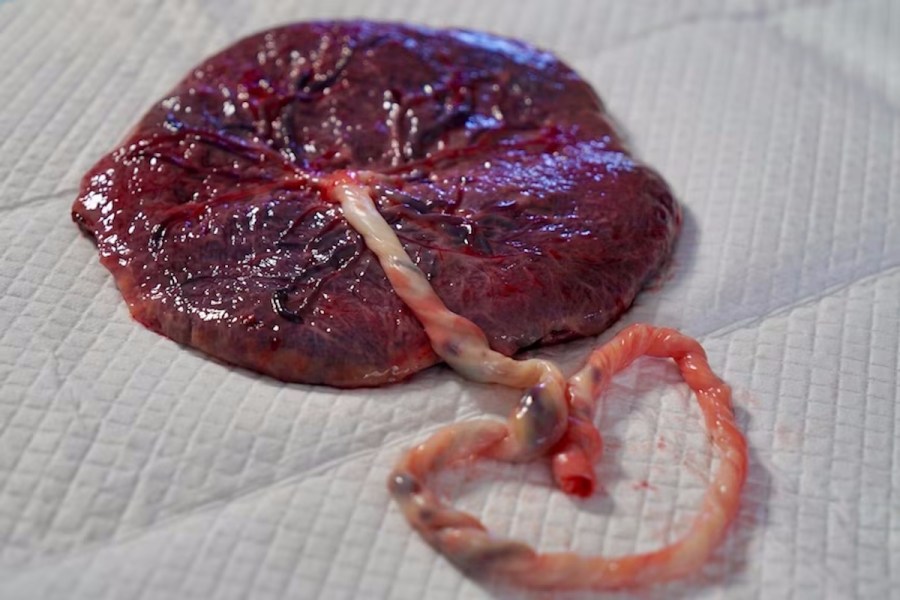
The Australian boxer is eating his wife’s placenta in capsule form as part of his training program, and feels like he is benefitting from the change in diet. He told a Sydney radio station:
“we freeze-dried her placenta and I’ve been supplementing on her placenta recently… in tablet form”
Does that make him a cannibal? Well, he thinks so. He added:
“I’ve technically become a cannibal. It’s actually like a superpower. I’ve done tests with my sparring – days where I’ve had it and days where I haven’t – and it feels like I got all this crazy amount of energy”
If you’re not convinced by that, he told the interviewers he is also including breast milk in his diet. Asked if he had tried it, he replied: “I have, I have… and it’s delicious as well!”
Consuming placentas is a growing trend in America, with mothers usually consuming them as part of their postpartum recovery. The practice dates back to Chinese medicine, though studies are yet to confirm that there are benefits to eating them.
The bout on August 20 was subtitled (based on Tszyu’s nickname):
THE BUTCHER IS BACK
So, is cannibalism the next big thing in athletic enhancements? Well, Tszyu knocked Ismaili, who was previously unbeaten, to the mat in just over one minute. The shaken opponent sat on his stool and refused to leave his corner, throwing in the towel before round two commenced.
Athletes often boast of eating meat to improve their fitness and stamina, although there are also plenty of vegan ones who swear that dropping meat and milk makes them faster, stronger and more alert. But if there is any truth in the meat myth, then I suppose we need to consider the words of Anthropologist Marvin Harris, who stated in his book Good to Eat: Riddles of Food Culture that, while humans are clearly not obligate carnivores,
“our species-given physiology and digestive processes predispose us to learn to prefer animal foods… strictly speaking, human flesh itself contains the highest-quality protein that one can eat”
There’s one to chew on, next time you enter the ring.
Family members of one of the victims of a gruesome murder of four college students in Idaho are furious that Bryan Kohberger has been offered and accepted a plea deal.
Kohberger was accused of stabbing Xana Kernodle, Madison Mogen, Kaylee Goncalves, and Ethan Chapin to death in November 2022 in Moscow, Idaho. The students were found with fatal stab wounds in an off-campus rental home in the early morning hours. Investigators believe the four students, thought to be sleeping at the time, were fatally stabbed between 3 a.m. and 5 a.m. According to the coroner, there was no sign of sexual assault.
A little over a month after the killings, Kohberger, a 28-year-old Ph.D. student and teaching assistant in the Department of Criminal Justice and Criminology at Washington State University, was arrested at his parents’ home in Pennsylvania on Dec. 30, 2022, and extradited to Idaho.
Kohberger was facing a possible death sentence if convicted in a trial that was scheduled to begin Aug. 18, 2025.
A letter sent to families of the victims to inform them of the deal said Kohberger will appear in court Wednesday to enter his guilty plea and be sentenced in late July to life in prison, according to the Idaho Statesman. Kohberger will forfeit his right to appeal as part of the deal. The letter from Moscow Prosecuting Attorney Bill Thompson said:
“We cannot fathom the toll that this case has taken on your family. This resolution is our sincere attempt to seek justice for your family. This agreement ensures that the defendant will be convicted, will spend the rest of his life in prison, and will not be able to put you and the other families through the uncertainty of decades of post-conviction appeals.”
Goncalves’s family had an angry reply on their Facebook page.
“We are beyond furious at the State of Idaho. They have failed us. Please give us some time. This was very unexpected. We appreciate all your love and support.”
The family issued a later post explaining what had been taking place.
“I would like to clarify a couple of things…we DID talk to the prosecution on Friday about the POSSIBILITY of a plea deal and it was a HARD NO from our family. It was very nonchalant and barely discussed as the majority of the conversation was surrounding the upcoming trial. NOTHING in our conversation prepared us for the next steps.”
A family member of one victim told NewsNation that upon hearing of the plea deal, she felt like “all the power had been given back to Kohberger.”
Why is this case featured in a blog about cannibalism? Well, A forensic psychiatrist told Newsweek after the arrest that Kohberger had battled with “cannibalistic urges“.
Reports then surfaced that Kohberger had followed a strict vegan diet, and had reportedly struggled with heroin addiction in the past.
Forensic psychiatrist Carole Lieberman told Newsweek that Kohberger’s “obsessive-compulsive eating habits” indicate he was afraid he would become addicted to meat if he ate it.
“He was not only vegan, he refused to eat off of pots or plates that had had meat on them. Psychologically, this represents his struggle against his cannibalistic urges. He was afraid that if he let himself go to taste meat once, he would become addicted to it—like he had become to heroin—and start killing and eating people.”
A relative told the New York Post that Kohberger’s dietary restrictions were “very, very weird” and that he seemed “very OCD,” referring to obsessive-compulsive disorder.
The woman, who asked not to be named, but said she was previously married into Kohberger’s family, said:
“It was above and beyond being vegan. His aunt and uncle had to buy new pots and pans because he would not eat from anything that had ever had meat cooked in them.”
Casey Arntz, who was friends with Kohberger in middle and high school, said in a video posted on TikTok that he had been “a heavy heroin user” in high school. Kohberger’s struggles with drug addiction continued into his college years, a friend from Northampton Community College told Fox News. Criminal profiler John Kelly told Fox News,
“This kind of person has this volcanic rage inside that’s going to explode on its victim of choice.”
Lieberman told Newsweek that Kohberger had probably studied criminology both to “calm the demons inside him that were telling him to kill” but also to “learn how to commit the perfect crime.”
Kohlberger may have corresponded with Rader (a lot of criminology students do) but we don’t know that for sure. We have to wonder if Rader would have told him about working in the meat department of a Wichita IGA a few years before his murder spree began.
Kohlberger’s obsession with meat reflects a lot of issues considered in Cannibal Studies. Firstly, the question of human meat: there really is no significant difference between the meat of humans and other large mammals such as cows, pigs or sheep. Hannibal Lecter takes delight in feeding human meat to his guests, such as the flesh of the flautist of the Baltimore Philharmonic, whose Board members subsequently enjoy the meal immensely in the book and film Red Dragon, thus becoming “innocent cannibals”.
But the point is that once meat is prepared (cooked, seasoned, presented) it is very hard to tell its provenance. Cannibals who have been asked have mostly compared it to pork or veal, with Armin Meiwes telling an interviewer
“It would have made no difference in somebody else had tasted it; he wouldn’t have questioned the meat…. During preparation, it is not as dark, but bright and fresh as pork, and tastes so very close to pork.”
Kohlberger’s belief that he might like human flesh if he tried any meat at all therefore has some logic to it. Since Charles Darwin’s writings overthrew the special status of humans as closer to angels than other animals, anthropocentrism has been amended to offer a story of humans as the culmination of evolution and thereby continues, rather less successfully, to obscure human animality. Should such beliefs falter, as happens repeatedly in many cases of contemporary cannibalism, it becomes a very short step from eating other animals to eating the human one.
But why should he become addicted to any meat? Well, we know Kohlberger has an addictive personality, shown by his very heavy usage of heroin. But we’re not talking drugs of addiction but lumps of protein, aren’t we? Well, there are plenty of studies about that. Marta Zaraska, for example, wrote in her book Meathooked that meat is highly addictive on several fronts – genetic, cultural, historic and commercial, and coined the term “meathooked” for the incongruous compulsion to eat meat despite the pangs of cognitive dissonance – the repressed feeling of guilt when considering oneself an animal-lover while also paying big corporations to kill them. Then there is the mythology of the Wendigo, a creature from Algonquin legend who starts off as a human but becomes a being who can only live on human flesh, which makes him grow bigger and at the same time hungrier. If you believe in Wendigos, then the slippery slope from carnivore to cannibal seems reasonably clear.
This leads us to the issue of Kohlberger’s apparently very strict veganism. Most people seem to believe (or want to believe) that vegans are fanatics, obsessed with animal welfare (or the environment, or their own health) who therefore compulsively avoid meat. But in fact most vegans would certainly wash a pot thoroughly after a relative had cooked meat, but are unlikely to throw it out as irretrievably ruined, as Kohlberger purportedly did. Veganism is an ethical system that attempts to minimise harm to sentient animals, which includes humans (yes, Virginia, humans are animals). If there is a slippery slope from the flesh of other animals to the flesh of Homo sapiens, then the vegan is furthest from the edge of that slope. When Kohlberger killed those students, he was not following any known vegan code of ethics, even if he didn’t sample their flesh on the way out.
In the year 2000, 44-year-old slaughterhouse worker Katherine Knight had a night of passion with her partner, John Price, then stabbed him 37 times, professionally skinned him, hung his hide on a meat hook over the lounge room door, decapitated him, butchered his corpse and cooked parts of him. She served up his meat with baked potato, carrot, pumpkin, beetroot, zucchini, cabbage, squash and gravy in neat settings at the dinner table, putting beside each plate place-names for Price’s children. Another meal was tossed into the backyard; it appears she intended to eat it but couldn’t do so. The police arrived before Price’s children so, as far as we know, none of him was consumed (by humans anyway).
Knight pleaded guilty to murder and the judge ordered that her papers be marked “never to be released.” An appeal was quickly denied, and she is still serving her life sentence at Silverwater Women’s Correctional Centre in Sydney.
Shoreline Entertainment planned to make a film of the incident based on Peter Lalor’s book Blood Stain, but so far it has not surfaced.
It appears that Knight was NOT a cannibal, despite one of the favourite media labels about her being “Kathy the Cannibal”. Other reports called her “The Woman Hannibal Lecter”, a comparison that makes no sense at all, since Hannibal did not use 37 strokes to kill people, definitely did eat parts of them, and did not (as Knight did) take a cocktail of sleeping tablets afterwards while lying in bed with the mutilated corpse.
Darren O’Sullivan, whose documentary is linked at the top of this blog, commented,
“this is possibly the most horrific thing I have ever discovered”.
Although the series is called “Real Twisted Tales”, I suspect O’Sullivan must have led a sheltered life. Knight was a slaughterhouse worker, recognised for her skills in knife work. She grew up in the NSW town of Aberdeen, where everyone in her family and most of the town were employed in the abattoir. Her job, from a young age, was to kill and cut up animals. She did to John Price what she was trained to do to other animals – slaughter them, cut them up, cook them. She did try to feed bits to his children, which is what farmers did in the UK (feeding cattle bone-meal to cattle), an act of cannibalism which led to Mad Cow Disease. But there is little evidence that she herself ate any of him.
The documentary above states that Katherine Knight is “one of the most evil people in the world”, because she was found sane enough to stand trial. But really, what she did was what she was paid to do every day, just to a different species than those who usually suffered and died under her hand.
Superstitious anthropocentric beliefs put humans on a tier somewhere between angels and animals, but really we are a species of Great Ape, closely related to the chimpanzee. Rationally speaking, there really is only a thin red line between killing and eating any species of animal.
“He got shot down in New Guinea, and they never found the body because there used to be — there were a lot of cannibals, for real, in that part of New Guinea.”
This anecdote aroused plenty of outrage from PNG politicians who proclaimed that there was never, not much, or hardly any cannibalism in the good old days.
But now the story has once again raised its well-chewed head. 2025 is the 50th anniversary of independence for PNG, a year which was expected to be a celebration. Instead, the news is full of stories about nine people being killed in shootouts in Enga Province over that New Year period, as violence escalates in the highlands, a region that was hit by a catastrophic landslide last May.
That news was overshadowed by a video that soon went viral of armed gang members holding mutilated body parts in Central Province, 60 miles (100 km) from the capital.
Voices in the Tok Pisin language on the video said they planned to eat the victim, with one man making licking motions as they displayed a severed foot, saying,
“this is our meat, we will cook it and eat it”
There was an immediate furore over the claims of cannibalism. Police said the deceased was killed in a dispute in the remote Goilala mountains in the province, but there are conflicting accounts of when the video was made.
Prime Minister James Marape called for calm, and stated,
“Such acts of inhumanity are intolerable and represent a significant challenge to our shared humanity”
Marape had objected to Biden’s claims about cannibalism during the war, saying that PNG did not deserve to be labelled as a nation of cannibals.
Community leader Matilda Koma from Auga Dilava added,
“We do not eat people. Goilala people are not cannibals”
Fane’s Catholic priest Francis Pirit said that the video of the killing and youths pretending to eat human remains was a show of bravado, boasting because they had won a battle.
“There are no cannibals in the Goilala area. I sleep, eat and live amongst them. They do not eat human beings”
Despite the boast by the men, there is no footage of flesh being eaten in the gruesome video.
Cannibalism in PNG was largely a ritual practice by a small number of tribes and largely ceased by the 1960s after being banned by the colonial power, Australia. The suspicion that colonised peoples are inevitably cannibals has never completely disappeared; when the Australian soldiers of the 7th Division AIF began to find mutilated and cannibalised bodies in New Guinea in late 1942, they were not sure whether to blame the Japanese or local tribesmen. After a lengthy commission of enquiry, the Australian government in 1945 finally added cannibalism to the War Crimes Act 1945, the only nation to do so.
As recently as 2012, 29 members of a “cannibal cult” were arrested in Madang province on PNG’s northeast coast. Forensic reports and statements made by the accused led police to believe parts of the victims had been eaten.
One of the more persuasive substantiations of PNG cannibalism was Kuru, a rare, incurable neurodegenerative prion disorder that was found in the Fore people of Papua New Guinea in the middle of the last century. Kuru is a form of transmissible spongiform encephalopathy, related to the “mad cow” disease that cured people from eating beef for many years, and appears to have been spread by funerary cannibalism. It is often touted as a reason not to be a cannibal, appearing unexpectedly in films like Jim Mickle’s We Are What We Are and many films about wendigos.
So, cannibalism remains a sensitive topic in PNG. President of the PNG Law Society Hubert Namani sparked outrage when his comments condemning the “barbaric killing, mutilation and cannibalism” over the festive season were reported by the Post Courier newspaper.
Meanwhile, Goilala’s local member of parliament, Casmiro Aio, pointed out this week that there had been no regular police presence in his electorate for 10 years.
The questions remain – did any of the dead people get eaten? And more interestingly, why would that be so much more appalling than the fact that nine people were killed?
‘There will be cannibalism, and rumours of cannibalism”
Yes, I paraphrased the Book of Matthew. Although not all that many people got eaten, the media was full of cannibal stories, and here are a few of them, sorted by their places of occurrence.
Australia
One of the men imprisoned for the so-called Snowtown murders (which mostly did not take place in the little town of Snowtown) was released. Mark Haydon was charged with assisting the men who did the actual killing and who ate part of one victim’s leg some 25 years earlier.
Brazil
Influencer Israel dos Santos Assis, better known online as Pinguim (Penguin) was arrested for desecrating graves in the cemetery of San Francisco the Count in the Salvador Metropolitan Region, stealing human bones, and using human flesh from the corpses to cook his most popular dish: feijoada, a bean stew usually involved simmering beans with beef or pork. Seems rotting human is a good substitute for pork.
Canada
Robert Pickton, the pig farmer convicted of six counts of second-degree murder (although he was charged with at least twenty others), was attacked by another inmate in prison and died a few weeks later. Pickton allegedly “processed” the meat of his rape and murder victims by feeding them to his pigs and, police said, possibly mixing them up with pork products he sold to his neighbours for their personal consumption.
China
Netflix released a new version of the classic science fiction book 3 Body Problem and ran into a storm of criticism from China for its depictions of the extreme violence of the Cultural Revolution. Although most of the victims of the purges were killed by shooting, live burial, drowning, boiling alive, and disembowelling, there is evidence that several hundred had been cannibalised, as the ultimate in humiliation.
The General who presided over a Cultural Revolution massacre that included cannibalism of those deemed “enemies of the people”, Wei Guoqing, was reburied (or at least his ashes were) with full honours in Beijing’s Babaoshan Revolutionary Cemetery – the resting place of China’s high-ranking leaders and revolutionary heroes. Wei’s name is most strongly linked in the public mind with cannibalism during the massacre period in Guangxi’s Wuxuan and Wuming counties and Nanning city. Researchers have found that at least 137 people were eaten, with thousands participating. “Paying tribute to a legendary gourmet,” wrote one wag on social media.
Cuba
Stories began circulating this year that the extreme food shortages in Cuba were leading to the danger, or actual occurrence, of cannibalism. This was bolstered by reports from 2022 of two hospital workers who had been stealing hearts and fat from human bodies and selling them as mince.
Haiti
Rumours circulated that the natural disasters and gang violence in Haiti was leading to starvation cannibalism. Jimmy Cherizier, a gang leader called Barbecue (“Babekyou” in the local parlance) was known for his penchant for burning people alive, and there was at least one video on Twitter/X of one gang member supposedly “tearing flesh from the leg of a burning corpse and eating it.” Such stories cannot be selfishly maintained by one little country, so of course it was not long before Bill and Hillary Clinton were accused of joining the cannibal feast. To add to the hilarity, Elon Musk posted on his own site, X, that a picture of a man near a fire was evidence of cannibalism, only to have the post removed by his own team for violating community standards. The fact-checking website Snopes pointed out that videos of bodies in Haiti being roasted on spits had previously appeared as accusations against a Nigerian restaurant, and were in fact from a Halloween prank in China in 2018. Still, you know, voodoo and all. Meanwhile, Trump ally Laura Loomer supplied conclusive proof that Haitians were cannibals: apparently, if you Google it, you will see a lot of results. The Prosecution rests its case.
India
India’s top court put a temporary stay on the execution of a man convicted of killing his mother and eating her remains in what is being deemed as the “rarest of rare” cases of cannibalism. Sunil Rama Kuchkoravi of western Maharashtra state’s Kolhapur district was handed a death penalty by a lower court in 2021 for killing his 63-year-old mother in 2017. The High Court in October this year upheld the death sentence against Kuchkoravi, stating that the convict possibly has a “syndrome of pathological cannibalism”. The execution has been delayed until the case is reheard in April 2025.
Israel (and around there)
Francesca Albanese, the U.N. special rapporteur for Palestinian rights, has been condemned for antisemitic rhetoric by the governments of the U.S., France and Germany among others. Albanese, known for accusing Israel of genocide (an odd charge seeing that the population of Gaza has increased in the last twelve months), wrote that the Israeli army was “rotten to the core”. A follower immediately introduced the classic blood libel: “Jews are capable of eating human flesh”, to which Albanese replied along the lines of “not all Jews”. Reassuring to note that a person paid by the taxpayers of the West, who finance the UN, can admit that some Jews are not cannibals!
A Yazidi woman was rescued from Gaza by Israeli troops. She revealed that, after being captured by ISIS in 2014 and forced to be sex slaves, the women were starved and finally fed meat which, they later told her, was from the bodies of a beheaded Yazidi baby, the child of one of the women. They told her:
‘We cooked your one-year-old son that we took from you, and this is what you just ate’.
Indonesia
Police investigated a suspected cannibalism case in West Java Province. The Head of the Criminal Investigation Unit confirmed that a video on social media showed the alleged perpetrator consuming a small portion of the victim’s flesh. He said that police had found 12 body parts of the victim at the crime scene.
Italy
An inmate in the notorious Poggioreale Prison in Naples tore the finger off another inmate and ate it. The Campania Guarantor, Samuele Ciambriello, observed that “it is now clear that the Poggioreale prison needs a structure suitable for hosting inmates suffering from mental disorders.” Seems like a good idea.
Mexico
A podcast called Mexico Unexplained revisited this year the story of Gabriela Rico Jiménez, a 21-year-old model from Mexico who disappeared some 15 years ago, after raging against the machine outside a fancy hotel in Monterrey Nuevo Leon. Ranting about the elites, including oddly the Queens of England and Germany (which is a Republic), she had shouted that “They ate humans! Disgusting!… They smell like human flesh!”
Nigeria
A man accused of being a sorcerer was blamed by villagers of the small town of Kirikiri for the disappearance of several children and elderly people. He was supposed to be “feeding on the flesh of the innocent.” Several claimed to have located the individual on the edge of a forest, wearing clothes “stained with blood” and mumbling mysterious incantations. A group of villagers beat the man and left him for dead.
Russia
Erkinzhon Abdurakhmanov, 47, intended to cure his own heart problems ‘after making a pact with the devil’, he told police. He killed a 65-year-old male pensioner in the Kuyurgazinsky district of Russian region Bashkortostan by striking him three times with an axe, according to reports. He then then cut out the heart and ‘ate the meal’ as he waited at a bus stop. He gave the uneaten remains to a woman also waiting for a bus ‘and asked her to bury it’. He was not arrested, however, until he headed into a liquor store and tried to steal some drinks. Cannibalism is not against the law in Russia, but murder and stealing alcohol is.
Vladimar Putin’s policy of giving pardons to criminals who agreed to fight in Ukraine in lieu of serving their sentences, was honoured in a pardon to a charmer named Denis Gorin, who had been convicted of at least four murders, and had eaten the flesh of his victims.
Another pardon involved Dmitri Malyshev. Malyshev was sentenced to 25 years in prison in 2015 for multiple criminal offences. Ten years ago, he murdered an acquaintance, a Tajik native, and then filmed himself cutting the heart out of the victim and roasting it in a frying pan and eating it. Neighbours seemed uneasy about his imminent return home.
South Africa
On December 26, 2024, eight illegal miners known as zama zamas emerged from Shaft 10 of a mine near Stilfontein, located in Northwest South Africa. They were taken by police, who confirmed that twelve bodies remained trapped beneath the ground, with miners reportedly resorting to eating human flesh due to severe food shortages.
[GRAPHIC CONTENT] Illegal miners have started eating human flesh. That's according to SANCO North West Spokesperson, Mzukisi Jam. The claims were made in Christmas Eve letters sent to the surface claiming that more miners have died. #DStv403#eNCApic.twitter.com/vqDodTXgmZ
Novosibirsk Archpriest Alexander Novopashin became notorious for claiming that Ukrainians are “cannibals”. Although conspiracy theories about cannibals are becoming more common, this particular Archpriest is taken seriously in Russia, and regularly lectures Russian security forces and soldiers.
UK
Marius Gustavson, who called himself “the eunuch maker”, offered a service where he charged men to destroy or remove their testicles, and then charged subscribers to his website to see him perform the operations. The court heard that that there was “clear evidence” of cannibalism and that Gustavson had “cooked testicles for lunch in an artfully arranged salad platter”.
Meanwhile, a candidate from a party called Reform UK was suspended for saying that meat-eaters should “eat other humans” and said humanity should be “obliterated”. Just saying what many are thinking, perhaps.
USA
The cannibal story of the year was the President, Joe Biden, claiming that his uncle had been eaten by cannibals in New Guinea. The leaders of PNG took exception to the stereotyping of their people as cannibals. Apparently, only some of them had been.
Speaking of Presidents, Donald Trump embellished his rhetoric on immigration by pointing out that some of the undocumented people pouring over the border were from insane asylums, and called that “Silence of the Lambs stuff”. Trump had previously claimed that Hannibal Lecter had endorsed his candidacy, which is a bit odd since Hannibal is a fictional character, but by far not the oddest claim in the 2024 election.
In March, a homeless man in Kern County was arrested for picking up the leg of a person who had been killed in a train accident and chowing down on it. California has no laws against cannibalism, but he was charged with “mutilating the body” which is a bit odd, since the train had already done that.
In Utah, which also has no law against cannibalism (Idaho is the only state that does), a law was passed to criminalise the ‘ritual abuse of a child’, which apparently regularly includes making the little ones eat “organic substance or material” (i.e. bits of people) before they are allowed to have their desserts. This in addition to claims that such rituals would sometimes involve eating the children instead.
A keen-eyed traveller pointed out that the road once taken by the Donner Party, which ended up in them getting lost and eating each other, was now signposted with a sign indicating dining was available. Much hilarity ensued on social media.
Conservative political commentator Candace Owens managed to link transexuals, Native Americans and cannibals, all in one sentence. No wonder she is so widely admired.
Much to the relief of the good people of Idaho (the only State in the Union with laws against cannibalism), the law was amended to ensure that giving someone else human flesh to eat was also prohibited. This led, on its long road to farce, to the accusation that bodies were being turned into compost which could be used to grow food for humans to consume. Rather than DNA test all compost, the law confined itself to banning the act of deliberately giving human flesh to another person. The legislator who introduced the bill cited a disturbing case on the show TruTV, which she admitted might have been a prank (it was) in which diners were told they had been eating human flesh, just to whet their appetites perhaps.
Ariana Grande raised some eyebrows when she was asked on a podcast whom she would most like to dine, and named Jeffrey Dahmer. Not sure Dahmer would have agreed – he was more into man-flesh, and there’s not much meat on Ariana anyway.
In April, a man was arrested in Las Vegas for eating a victim’s eyeballs and ears. The victim was pronounced dead. What happens in Vegas stays – internal.
Talking of ears, Mike Tyson, famous for biting the ear of Evander Holyfield in a fight in (where else) las Vegas in 1997, released a line of marijuana gummies shaped like nibbled ears.
Allegations were raised that Gilgo Beach ‘serial killer’ Rex Heuermann’s family was involved in the murders, which took place near the remote beach town of Gilgo in Suffolk County, New York from the 1990s to 2011. His daughter, who likes to paint the odd Satanic scene including body parts and cannibal feasts, was accused of being involved in his depredations. Homicide experts said that was insane, a word that gets tossed around a lot in cannibal stories. Heuermann was charged with a seventh murder last week.
On October 9, a woman in Kentucky, Torilena May Fields, was arrested after a dismembered body was found behind a home in Northern Kentucky and cooked human body parts were found in the oven. The body, and its parts, turned out to have been her mother. She was also charged with cruelty in that she “intentionally tortured and killed a domestic dog.”. A contractor found the dismembered body of the mother, and told police the perp had been “casting spells.” Her bail was set at $1.5 million. Her next court appearance is set for March 10, 2025 in Robertson County. Some people just give cannibalism a bad name.
Another Kentucky woman, a former youth counsellor, was arrested for allegedly discussing cannibalism and other hobbies with a convicted murderer.
In Oklahoma, Kevin Ray Underwood was executed by lethal injection in December (on his 45th birthday, the press gleefully informed us) for killing a ten-year-old girl in a “cannibalistic fantasy.” The man admitted to luring the girl into his apartment and beating her over the head with a cutting board before suffocating and sexually assaulting her. He told investigators that he nearly beheaded her in his bathtub before abandoning his plans to eat her. So not really a cannibalism story, but near enough.
International
Citizen of the world, Donald Duck, appeared on the interview show Hot Ones on the Internet (which is global), where guests eat chicken wings with hot sauce. Turns out Donald is a vegan though, preferring cauliflower, and since ducks aren’t chickens, the controversy that ensued over whether he was (or would have been) a cannibal by partaking of chicken was just silly.
HAPPY NEW YEAR, and may your worst problems be mild gastro-oesophageal reflux.



















































 The Cannibal Guy