The revenge of nature: WENDIGO (Larry Fessenden, 2001)

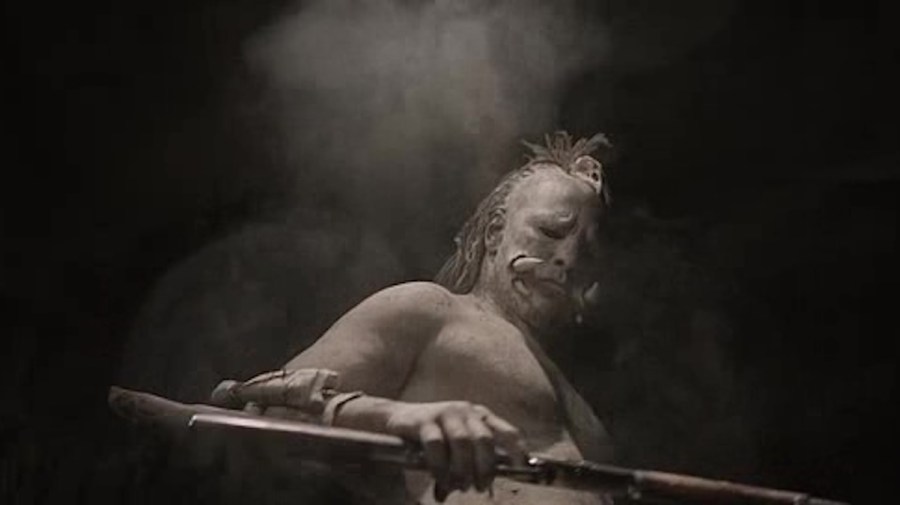
Wendigo is a film written, directed and edited by Larry Fessenden, who would, a few years later, make an episode of the TV horror series Fear Itself called SKIN AND BONES, which was about a guy who disappears on a hunting trip with friends and returns cold, thin and desperately hungry. He has, we quickly discover, become a Wendigo! In this, the earlier film, there are also crazy hunters led by Otis (John Speredakos), who are mad with our protagonists for driving into a stag (the traditional symbol of the Wendigo) who they have been tracking and, worst of all, breaking his antlers, which are apparently very valuable. The Wendigo is already there in their cabin as a “dark presence”, so we just need to be introduced.

First, the really good cast – George (the Dad) is played by Jake Weber, from the 2004 remake of Dawn of the Dead and Meet Joe Black. He is a super-stressed New York photographer, and the last thing he needs is a run-in with a bunch of redneck hunters. Kim, the Mom, is played by the wonderful Patricia Clarkson (most recently starring in Gray) and the kid, Miles, is played by Erik Per Sullivan, who was Dewey in Malcolm in the Middle.

George is more disturbed by the rednecks than he is willing to let on, telling Kim, who is a psychologist, that he is distressed by the “abyss” between him and them, with no possibility of communication. She tells him that:

“It’s very archetypical for the civilised man to feel threatened by the man of the country.”

George is utterly divorced from nature, seeing it as alien and menacing. So, the other last thing he needs to meet is a Wendigo, a figure on the front line of the human war on nature.

They head into town to buy curry (as you do in small towns) and Miles meets in the store a Native American Elder who tells him about the Wendigo, a small carving of which Miles is drawn to.

“The Wendigo is a mighty powerful spirit… it can take on many forms, part wind, part tree, part man, part beast. Shape shifting between them… It can fly at you, like a sudden storm, without warning, and consume you with its ferocious appetite. The Wendigo is hungry, always hungry. The more it eats, the bigger it gets, and the bigger it gets, the hungrier it gets, and we are hopeless in the face of it. We are consumed, devoured…. There are spirits that are angry. Nobody believes in spirits anymore. Doesn’t mean they’re not there.”

The Wendigo is a figure from the mythology of the Algonquin people of North America. They lived in a land of long winters where the competition for food would have been intense and cannibalism of the dead probably not unusual. Myths help to spell out behaviours that societies need to discourage – cannibalism could decimate small, isolated communities. That myth, of the voracious monster whose hunger only grows with feeding, was later applied to the invaders, the colonists who took their land, their produce and often their lives. In such a struggle, the Wendigo, as an original figure of their culture, could take almost a vengeful role, eating the technologically superior invaders. George inadvertently confirms this, telling Miles “the Wendigo only goes after bad guys.”

The Elder tells Miles he can keep the figure, but there is no sign of him when Kim is subsequently asked to pay for it. He is presumably one of those spirits, not angry but advisory.  He warns Miles about the “cry of the Wendigo”. The Wendigo is clearly (to the audience) imbued into that carving.

Then the Wendigo strikes. Or is it the rednecks? Did the Wendigo knock George off his sled, or did it carry him home after Otis shot him? Was it the revenge of nature, or society? When the Wendigo later demands of Otis “Give me my liver!” it voices the cry of revenge of every animal, human and otherwise, killed for fun or profit. When Otis meets justice, Miles awakes with his Wendigo figure in his hand.

It’s a great cast, with an absorbing plot, although it gets a bit lost at the end. But the questions it asks are compelling.  The New York Times critic wrote:

“Mr. Fessenden carefully blurs the line between psychology and the supernatural, suggesting that each is strongly implicated in the other. The rampaging Wendigo may be a manifestation of Miles’s incipient Oedipal rage, but at the same time it is a force embedded in nature and history.”

The Wendigo carries so much symbolism, besides the horror trope in which he seems so regularly to find himself, such as in Fear Itself or the classic Wendigo film, Ravenous, which was made a couple of years before this film. He expresses the anger that rages within George, the father who cannot show interest in his son’s curiosity because of his own issues brought with him from the city, frustration and fear of failure. And we can infer (as the NYT does) that Miles himself feels an Oedipal rage toward his father who, Freud tells us, is the child’s rival for sexual possession of the mother throughout childhood. The voracious hunger comes from an even earlier stage, what Freud called the “cannibalistic stage” of babyhood, where the infant wants to own the breast, consume it so it will always remain in his possession. George’s playacting the cannibal, attacking and pretending to eat Miles, is a common parent/child game, but is also deeply revealing of these forces hidden deep in the unconscious.

At yet another level, the Wendigo represents the revenge of nature on the civilised, those whose insatiable hunger for growth decimates the land and finds sport in killing its inhabitants, be they human, deer or any ‘other’. The antler is a weapon used by the stag, a normally shy and timorous animal who becomes a formidable fighter in the mating season, and the size and strength of its antlers represents both its sexual and fighting prowess. In the hybrid shape of a human and a stag, the Wendigo recasts humans from hunters to hunted, from predator to prey. This is precisely why Hannibal Lecter is shown in Wendigo form throughout much of the three seasons of the television series Hannibal. Hannibal is the civilised, rational, erudite man of science, a psychiatrist who knows of the dark forces inside the human psyche, and has determined that the human is just another animal, no more deserving of respect or inedibility than any other species, and even less if he happens to be rude. Who judges that – the supernatural force, the inhuman, the less-than-human or, in Hannibal’s opinion, the more-than-human? Whichever you choose, it appears as the Wendigo.

Donner Party revisited: snowstorm strands hundreds on the DONNER PASS

Videos such as the one above by freelance journalist Jonathan Petramala show hundreds of cars and trucks bogged in deep snow on the infamous Donner Pass, a stretch of road 7,088 feet above sea level over the Sierra Nevada mountains in Nevada County, California. On Saturday March 2 2024, more than three feet of snow fell on and around Interstate 80 northwest of Lake Tahoe, according to the Weather Channel. In winter, the old Donner Pass, now the historic US40, is often at risk of snow avalanches and blizzards, but this one was the strongest blizzard in California in years, and is being called a

‘Snowpocalypse”

Blizzard warnings have been issued with snowfall of up to twelve feet expected in some higher elevation locations. 

Many people would not associate the words “California” and “Snowpocalypse”, but that is exactly what happened in 1846-7 when a group of pioneers became snowbound in the Sierra Nevada over winter, and famously turned to cannibalism to survive. Only 48 of the original 87 members of the party survived. Many of the others were eaten after they died, and when they ran out of corpses, they murdered two of the Native American guides to use as protein.

There have been quite a few films and books about the events of that winter in 1846. Most emphasise the cannibalism that became inevitable, but omit any ethical discussion (probably no record was kept of it anyway) and gloss over the clearly racist decision to kill and eat the Native American guides in preference to “white” meat, even where the potential victim had volunteered. The movie Alive covered this rather better, showing a group of young men, all devout Catholics, debating how to justify eating their dead fellow passengers after the crash of a Uruguayan Air Force plane chartered by their football team in the Andes in 1972.

Back to the future – March 2024. The California Highway Patrol issued an appeal to people not to head out there, for obvious reasons.

The skiers, in particular, were not interested in listening to warnings – they wanted powder, and plenty of it. Despite snowfall of up to 12 feet being expected in some higher elevations, people headed out from San Francisco and all parts of the USA to find a mountain they could slide down. Many of them promptly got stuck in cars that would not respond in the freezing temperatures, and ski resorts had to shut down anyway. Big rigs also were stranded, blocked from moving (even if they had chains) by the inactive cars, or jack-knifing in the treacherous conditions.

Like 1846, this was a recipe for disaster. Residents of Truckee, California, one of the closest towns to Donner Pass, reported having inches of snow in front of their houses making it difficult to get out.

It did not take long for social media to pick up those reports of a “significant number of vehicles stranded over Donner Summit”. One headline read:

Untold Number of People Trapped at Site of Great American Tragedy

Some, of course, made the inevitable logical leap:

Sorry to disappoint, but there have been no reports of cannibalism from the stranded cars, trucks or town-folk. Unlike 1846, there are now emergency services available, including all sorts of technology from drones to snowploughs, and in fact emergency teams and tow services worked tirelessly to reach those affected.

While many had to leave their cars behind, no gnawed bones have been discovered so far. Maybe when the snow melts…

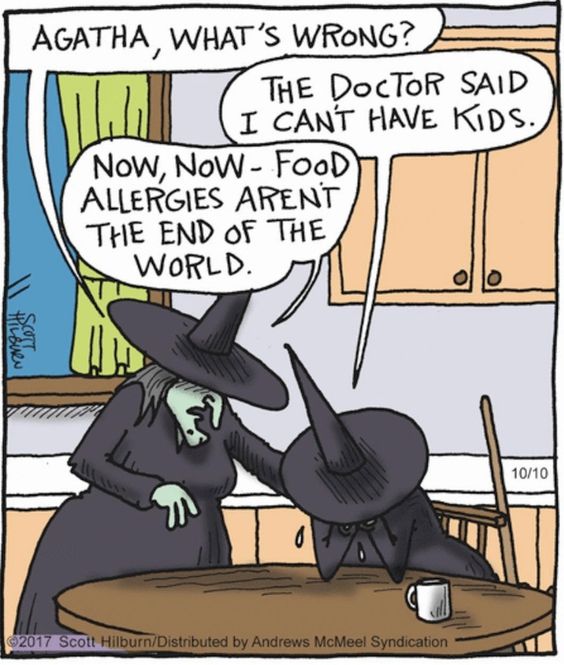
Is cannibalism a term of racist abuse?

Short answer: yes, and regularly used that way, throughout recorded history.

If you don’t recognise the person in the Tweet, her name is Candace Owens, and she is an American Conservative political commentator, author, activist, and television presenter who has both criticised and supported Donald Trump, attacked Black Lives Matter and been widely condemned for disseminating conspiracy theories, including accusing Israel of genocide. She seems to choose her conspiracies from both extremes of the political crazies – right and left. She has declared Kanye West to be a “dear friend and fellow superhero”.

In the clip above, she is asked by a young woman about Native American “Two Spirit” people – those who might today be called LGBTQIA+, particularly the “T” for “Trans”. The existence of the term and the concept itself would therefore, the questioner argues, go back hundreds or indeed thousands of years, and make nonsense of Owens’ claim that there were no transgender people when she graduated (although it seems she never did), so therefore the population must have has exploded since then. She summarises Owens’ argument: “Trans people are only here because the media is telling people these things”.

Owens does not know the term “Two Spirit” or that there are multiple words referring to the concept in many Native American languages. She answers instead:

“With Two Spirit people, is this like a Native American Tribe? Like high, smoking and talking about your spirit? I’m asking you seriously ’cause I think of Native American tribes talking about their spirits – I know they used to smoke a lot, they used to do drugs, they also were cannibals who used to eat people, so I don’t know if we should be taking our cues from cannibals…”

Owens used the same argument against Colin Kaepernick at the Conservative Political Action Conference in 2020, who had spoken of the 1.5 billion acres of land stolen from Indigenous people in the United States, asking “Did cannibalism get lost in Colin’s flowery depiction of Indigenous people?” She referred to Aztec cannibalism, which is generally thought to have taken place in Mesoamerican areas of what is now central Mexico, from 1300 until their society was decimated by the Spanish conquistadors. There is little academic consensus about this – theories range from Marvin Harris who said the flesh of the human sacrifices to the gods was fed to the ruling class due to the shortage of protein in the area, to William Arens who insisted that “there is no firm, substantiable evidence for the socially accepted practice of cannibalism anywhere in the world, at any time in history.” Nonetheless, cannibalism is still depicted as epitomising the uncivilised or, worse, those who have degenerated to savagery. Think of the “troglodytes” in the movie Bone Tomahawk.

the term “cannibalism” itself comes from Christopher Columbus, who named the practice after the Carib tribe of the Caribbean (also named after the Caribs). He claimed the Caribs ate their neighbors, but there is little evidence for this beyond the accusations of rival tribes who, despite never before meeting Europeans, understood that cannibalism was a powerful way to defame enemies. Frank Lestringant examines, in his book Cannibals: The Discovery and Representation of the Cannibal from Columbus to Jules Verne (1997), the contrasting reports from that period of the “savage” cannibals of the New World and the way they were compared, sometimes favourably, with the horrendous cruelty of European politics of the time, particularly in the writings of Montaigne.

Cannibalism is, therefore, an enduring and popular way to denigrate and vilify another group, to declare them less-than-human and therefore not worthy of respect or consideration. Cannibalism, definitionally, requires both sides of the repast to be human—the eater and eaten. But paradoxically, cannibals deny the anthropocentric particularity of their victims, and are in turn symbolically stripped of humanity due to what is seen as a horrendous contravention of shared ethics, deserving redefinition of the eaters as “inhuman” monsters. This was very useful to Columbus, who was not allowed to take slaves unless they were found to be cannibals, and has been used extensively by colonists to slander other Indigenous people including the people of the Pacific, Africans, and the Aboriginal people of Australia.

Cannibalism is a particularly popular trope for political, racist or queerphobic demonisation. The cannibal is most often depicted as male, but homosexuality, still considered repulsive by some despite its legalisation in most of the world, is often emphasised in the reporting of cases such as Jeffrey Dahmer, Ottis Toole, and Armin Meiwes, as if to impugn their masculinity and erroneously imply that straight men are not potential cannibals.

Accusations that a conspiracy known as “Deep State” was trying to subvert Trump crystallised in groups, accounts and pages linked to QAnon during the 2020 election campaign. The accusations included allegations of devil-worship, child-sex trafficking, torture and cannibalism. The fact-checking website Snopes rebuffed allegations about the existence of a “deep web” video showing Hillary Clinton and her campaign vice-chair raping, torturing and mutilating a little girl to cause the child to release adrenochrome into her bloodstream, before drinking her blood during a Satanic ritual sacrifice. Like characters in the films Texas Chain Saw Massacre (Hooper, 1974) and Silence of the Lambs (Demme, 1991), and the real-life murderer Ed Gein on whom they were based, they also supposedly excoriated the face to use as a mask. The bestselling QAnon-linked novel The Turner Diaries depicts a race war where white women and girls are constantly threatened and raped by “untamed, cannibalistic” black men, presented as symbolic of nature, and resisted by heroic white men, representing civilisation. Infanticide for cannibalistic feasts is not an original accusation, going back to the blood libels targeting European Jews and the Malleus Maleficarum (Hammer of Witches), the Inquisition’s guide to witch-hunting, which stated that witches would steal the host or wine from the Eucharist ritual to manifest a Christ-child, who would then be tortured, killed and consumed during diabolical feasts.

But back to Owens and her dismissal of “two-spirit” people as being the drug-fueled fantasies of cannibals. The term “Two-spirit” refers to persons who identify as having both masculine and feminine spirits, and is used by some Indigenous people to describe their sexual, gender and/or spiritual identity. The wider use of the term is attributed to Elder Myra Laramee, who proposed its use during the Third Annual Inter-tribal Native American, First Nations, Gay and Lesbian American Conference, held in Winnipeg in 1990. The term is a translation of the Anishinaabemowin term niizh manidoowag, meaning two spirits. It seems obvious that we all have some masculine and feminine features within our complex personalities, and it is useful, if poetic, to call these “spirits”. It explains motives, desires, emotions that may roil and confuse and sometimes contradict each other. It has little to do with gustatory preferences, except that some who feel they need to buttress their masculinity may insist on eating other animals to prove some dubious suppositions of human superiority, often including over other people they may consider less than human. “Real men”, they earnestly insist, don’t eat quiche; they eat lumps of meat, rare or even raw.

As do cannibals, very often. And with the flesh may come the spirit, allowing two spirits to co-exist, mingle, join within the cannibal’s body. Armin Meiwes told an interviewer that

“It’s not about killing or butchering. It is about entering into a relationship… My desire has always been to find a “brother” whom I could assimilate into myself.”

The nature or existence of ‘spirit’ is an eternal debate that will not be finalised in a Q&A session, particularly by a speaker who seems to know nothing about it. But it can only be obscured further by unfounded accusations about cannibalism, particularly by those who still happily chow down on their fellow mammals.

THE LONE RANGER (Verbinski, 2013)

This film had a lot of publicity due to the cast – Armie Hammer (since mired in cannibalism scandals as detailed elsewhere) plays the Lone Ranger and, wait for it, Johnny Depp (mired in different scandals altogether) plays his Native American off-sider Tonto. Depp claims he has Native American ancestry, perhaps a great-grandmother, so I guess that’s fine. Helena Bonham-Carter is in there somewhere too, as a brothel madam with an ivory leg – she has certainly graced this blog before, and with Johnny Depp! The director, Gore Verbinski, directed The Ring and the first three Pirates of the Caribbean movies, at least one of which I recall walking out of, but so forgettable were they that I can’t remember which one.

Set in the Wild West in 1869, the Lone Ranger starts off as a lawyer named John Reid, coming to Texas as DA to impose law on a savage land, like Jimmy Stewart in High Noon. His “bible” (he tells the Presbyterians on the train) is John Locke’s Treatises, which insist that

“Whenever men unite into society, they must quit the laws of nature and assume the laws of men, so that society as a whole may prosper.”

Good luck with that.

Reid’s brother, a Texas Ranger, deputises him to help catch an escaped outlaw named Butch Cavendish (William Fichtner from Armageddon, Black Hawk Down and many more). All the deputies are killed by Butch’s gang, except the old drunk, who is working with the outlaws and leads them into an ambush. That could easily (and perhaps mercifully) have been the end of the movie, but Reid is awakened by a “Spirit Horse” and Tonto explains he cannot be killed in battle. He also tells Reid that Butch, the outlaw, is a Wendigo, a figure from Algonquin legend – the tribes from the north of America, and nothing to do with Comanche mythology, but hey, maybe Tonto read this blog.

A Wendigo eats people and gets bigger and stronger as a result, but also hungrier. According to Tonto, he can only be killed with a silver bullet (I think that’s actually vampires, kemosabe). Incidentally, Tonto in the original radio series was not a Comanche but from the Potawatomi nation (who might have referenced Wendigos), but let’s not bother too much with, you know, facts. After all, a spirit horse may have edited the script.

So Reid is still alive and puts on his mask (about an hour into the film), Butch captures his dead brother’s wife and child, a whole tribe of Comanches are massacred by the US Cavalry (that has a ring of truth to it at least), but why on earth is this nonsense being reviewed in a blog about cannibalism?

Well, Butch may or may not be a Wendigo, and may or may not require a silver bullet to kill him (he doesn’t), but he is a cannibal. He is pretty keen on eating people’s hearts, or eyes, or maybe his own foot, according to rumour.

The problem with the movie is that it really can’t decide if it’s a Western drama or a comedy. The bad guys are the essence of evil, but the good guys are clowns. Then in the middle they put a gratuitous massacre of Comanches which at least adds a touch of historical realism.

The special effects are pretty great, with people on horses chasing trains, jumping on trains from horses, jumping on horses from trains, and trains getting derailed and crashing spectacularly. The scenery is gorgeous (Monument Valley of course, even though the film is purportedly set in Texas).

But it flopped at the box office, grossing $260 million against the $650 million that it was estimated to need to break even. Rotten Tomatoes gives it a miserable 31% ‘rotten’ rating, with those 31% mainly loving it, and the rest totally trashing it. The New York Post called it a

“bloated, misshapen mess, a stillborn franchise loaded with metaphors for its feeble attempts to amuse, excite and entertain.”

Then again, the San Jose Mercury News was more forgiving, describing it as a “one hot mess”, but an entertaining one.

If you have two and a half hours to waste, I guess it will keep you amused or shocked or sickened or whatever you take from it. I reviewed it here because it has a bit of cannibalism (Butch eats the Lone Ranger’s brother’s heart) and because Tonto calls him a Wendigo. And there’s not much that’s better than a Wendigo movie.
Love and cannibalism: BONES AND ALL (Luca Guadagnino, 2022)

The modern cannibal is usually hard to identify. Jeffrey Dahmer was the all-American boy next door. Armin Meiwes used to mow his neighbours’ lawns to be helpful. Issei Sagawa was so small and helpless that he seemed vulnerable rather than threatening. Albert Fish was a sweet old man, so charming that the Budd’s let him take their little girl to a party.

They were normal, everyday people, a bit weird, but not monsters.

At least, not in appearance. This is a recent phenomenon – the original cannibals were called anthropophagi (Greek for man-eaters) and were humanoid in shape, but were usually some sort of hybrid – a mix of humans and gods or other animals – strong, ferocious, and clearly not quite human. From the 15th century, the alleged cannibals found by Columbus and other explorers were different in culture and skin colouring, so were easily distinguished, defamed and exterminated. It is only recently, since Jack the Ripper in 1888, that the cannibal walked among us, undetected until the victims were found (or what was left of them).

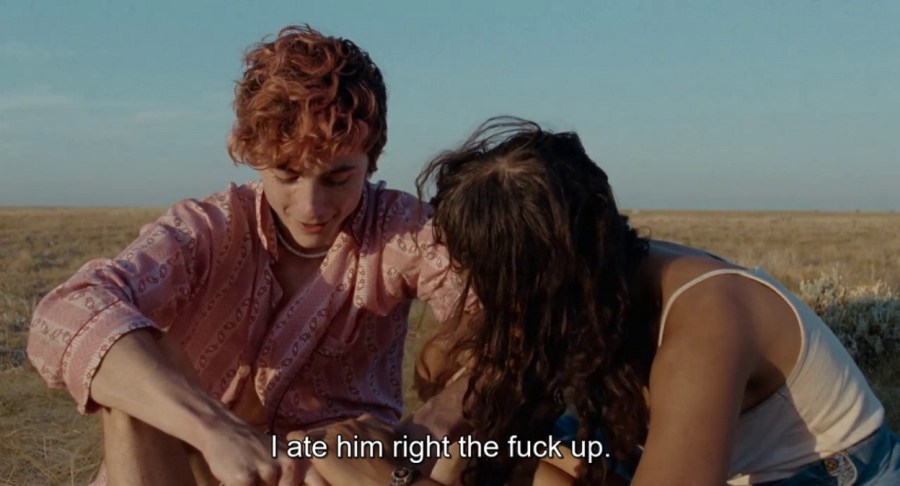
Bones and All presents as a coming of age cannibal romance, taking a sharp turn back into cannibal history for its themes. Maren (Taylor Russell from Lost in Space) is finishing high school, a spectacular end of term in which she is invited to her friend’s sleepover and bites a girl’s finger off, instead of, you know, just admiring the nail polish, as she had been invited to do.

She then goes on the run with her father, who has been keeping her ahead of the law as she grew up (her first human meat was her babysitter when she was three) but now ditches her, with a few hundred dollars and a birth certificate.

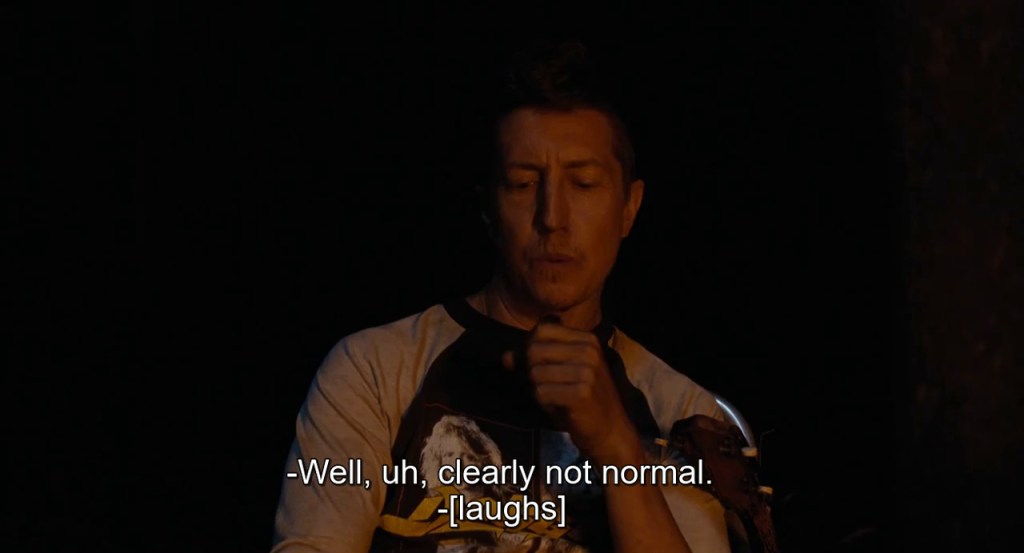
It then becomes a road movie, as she travels through the American Mid-West trying to find her mother, attracting suspicion not because of her eating habits but just because she looks too young to be on the road. She comes across another cannibal (they are called “eaters”) in the shape of a weird old man named Sully (Mark Rylance, Bridge of Spies) before meeting up with Lee, played by the love interest of seemingly everyone nowadays, Timothée Chalamet. Chalamet appeared in the third instalment of Guadagnino’s “Desire Trilogy”, Call Me by Your Name), in which he was the love interest of Oliver, played by Armie Hammer, who has recently been generating his own cannibalism headlines.

As a road movie it’s Thelma and Louise mixed with Romeo and Juliet, if they had been cannibals. In other words outsiders, star-crossed lovers, and lots of flesh being torn off dead (and sometimes living) bodies. Road movies rely on meeting new and weird people, and learning about the protagonists (and ourselves) from their stories.

Sully is a lonely old man who teaches Maren about being an eater, and how an eater has a super-power – like a vampire, they have a nose that can smell other eaters at great distances, and can also smell dying people, which allows him to feast on them fairly inculpably, although Maren rather wonders if they should be calling 911 rather than letting them gasp their last breaths. So they are anthropophagi, they smell different, have a strong sense of smell, and so are not quite human. We subsequently discover that the cannibal gene is passed on – Lee’s dad and Maren’s mother were also eaters. They are a breed apart, hybrid humans, who can mate with non-eaters.

They are also presented as ‘savages’ – related to the colonised peoples who were declared cannibal by the imperial powers. Maren is biracial, and Sully (although played by a classical British Shakespearean actor) seems to be presented as a Native American, with a long ponytail and a feather in his hat. The marginalised and disenfranchised are regularly presented as dangerous, thieves, murders, cannibals, regardless of any evidence.

An interesting character from colonial times is the wendigo, a figure from Algonquin mythology who eats his fellow humans and draws on their strength to grow huge and powerful, which only makes him hungrier and deadlier. Sully tells Maren that her fate is to need more and more flesh as she gets older.

Just like the wendigo, who is an indigenous version of the anthropophagus, and one that was used by the victims to characterise the European invaders and their voracious appetite for land and gold. The phrase “bones and all” reminds us of the colonial greed that denied the humanity of those invaded and insisted on taking everything, leaving nothing and nowhere to go but a few reservations or missions in remote, unprofitable areas. Eating bones and all is also a perfect way of getting rid of the evidence.

The title Bones and All is taken from the book of the same name by Camille DeAngelis, but the phrase was not used in the book – it just meant that Maren and the other eaters would automatically eat the whole person, bones and all. Except for her first, the babysitter, because she was too small to swallow bones – she left a pile of them, a pool of blood, and the hammer from an eardrum. In a movie, though, it can be harder for the viewer to maintain a willing suspension of disbelief, so eating the victim bones and all becomes a rite of passage – the next level of being an eater. Maren and Lee don’t know how to eat a person bones and all, so they are not yet postgrad eaters. Maren puts it succinctly – “that’s impossible.” But what about eating the flesh? Armin Meiwes took ten months to eat 20 kilograms (44 lb) of Brandes, but we are asked to accept that Maren and Lee can eat a whole body in a night.

But then, everything is ambiguous in this story, which has been widely described as a metaphor for otherness and queerness. The story is set in 1981, as Ronald Reagan is entering the White House. Being different, queer, compassionate, seeking social justice were all considered laughable or dangerous. Greed was good, and so eating a victim bones and all might have seemed laudable. Drug addiction was escalating, and some have seen the cannibalism in this film as a metaphor for this as well – Maren and Lee can’t go too long without their feed, and will do whatever they need to in order to get it.

Some of the ambiguities are more subtle: Maren looks young, which bothers various people she deals with, although she is 18 and technically an adult in most places. Lee falls in love with her, but is also capable of appearing to be cruising for gay sex.

He chooses a carnival worker who has been mean to a child, leads him into the bushes and masturbates him, slitting the man’s throat as he orgasms. It was not until twenty years later that gay sex was legalised in the US, and this man’s secret desire for same sex petite mort becomes his real mort. They then discover that the man had a wife and family, and are stricken with guilt, because apparently eating some people is OK, but not family people.

Then we have the eaters – Maren is naïve and caring, horrified by her need to feed. Lee is a puny dude who kills seemingly effortlessly, but like Hannibal Lecter, Lee prefers to eat rude people – when we first meet him, he challenges a rude person in a supermarket and leads him to a deserted shed where he kills and eats him. Sully is an senior eater, so has to eat regularly, but says he tries not to kill people – sniffs out those who are dying, but later he gets violent when Maren rejects his advances.

Jake (Michael Stuhlbarg) is an eater who has graduated to eating bones and all, but he is accompanied by a friend named Brad (David Gordon Green), a cop (!), who is not a natural eater, but just likes doing it. Maren accepts that she and Lee have to eat people, but is revolted by Jake’s wish to do the same. We’re back to the old debate of nature versus nurture. Are people born queer? Or with addictive personalities? Or psychopathic? Or cannibalistic?

The Director, Luca Guadagnino, has made a number of changes from the book, which are examined elsewhere. The most obvious one, though, is that Maren is brought up and then eventually abandoned by her mother in the book, but her father in the film. This changes the dynamic considerably, because we now have two eaters in the family, both female. The eater parent in both versions is locked up in an asylum, having eaten their own hands, but in the movie it’s her mother, (a short but superb appearance by Chloë Sevigny). We arrive at last at the modern horror archetype, the “monstrous-feminine”, the figure that confronts the male viewer with his fears of being castrated (Freud’s favourite explanation), as well as “the monstrous womb” – a terrifying image of a “black hole which threatens to reabsorb what it once birthed” (Creed, The Monstrous-Feminine, p. 27). The female cannibal is quintessentially monstrous-feminine, terrifying men with the antithesis of popular female stereotypes of giving life and nurturing. In the book, Maren only eats boys or men (after the initial babysitter) – she is drawn to eat those who seek to be close to her. In both versions of the story, the ambiguity is clear to us and the female cannibals – they have a compulsion to eat, but don’t want to hurt others.

Maren’s solution is to try to act normal, fall in love, get a job, get “clean” of the eating. Her mother’s was to lock herself away, and even then she chewed off her own hands.

To me, the most fascinating ambiguity in this film and in our societies generally is the question “who can you eat?” Eating some animals is considered just “normal” – Lee is chewing on bacon (pig flesh) served to him in a very respectable café, and has been working in an abattoir. When they need money, he and Maren rob the abattoir at night, later sitting on the overhead walkway watching the cows who are to be killed for legal, non-controversial eating, when Maren observes

“every one of them has a mom and a dad, sisters, brothers, cousins, kids. Friends even.”

The real question, Derrida says, is not what to eat but how to eat well. Perhaps, as Chalamet has said, it is impossible to live ethically – every act of consumption or energy usage wrecks the environment a little bit more. For some carnivores, this is seen as a ‘bones and all’ issue, they call it “nose to tail” – killing is OK, but wasting any part of the animal is the real crime. But as Maren says, cows also feel terror, pain, bereavement when their babies are taken from them. The author of the book, Camille DeAngelis, went vegan before writing it, indicating that the problem of who to eat, the rude or dying, the human or the cow, weighed on her, and the scene filmed in the slaughterhouse indicates that Guadagnino may have felt the same. Cat Woods’ review in Salon reminds us that Brad, the off duty policeman, chooses to be a cannibal:

“Why would he hunt, slaughter, and feast upon human flesh if he doesn’t need to?
And, if we the audience can be repulsed by that – and his evident choice to slaughter and eat flesh when there is abundant satiety that doesn’t cause violence, pain and loss – then perhaps we need to venture a little deeper into our own psyches and ask: Why would we feast upon flesh if we don’t need to?”

This is a seriously good film, with a great cast and, in the midst of all this carnage, we are treated to magnificent scenery beautifully captured by cinematographer Arseni Khachaturan. I have not revealed the ending, and hope I have not revealed too many other plot points. I recommend you go see it.