Children wandering door to door, sometimes unsupervised, is often likely to end in tears. In this film Sector 36, immigrant parents, struggling to survive, have not the time to keep a watchful eye on the kids, resulting in sexual abuse, murder, organ trafficking, and cannibalism.
The words “inspired by true events” allow for all sorts of poetic licence, offering the fascination of actual criminality without the need to prove the veracity of each scene. This one is fairly close to the facts, being based on the 2006 Noida serial murders, in which over thirty children disappeared from a town in Uttar Pradesh in northern India. Evidence was presented, in the trial of the two alleged perpetrators, that the children had been sexually abused and murdered, had their organs sold to traffickers, and in some cases were eaten. The charges included abduction, rape, murder, criminal conspiracy and trafficking. The two men involved, a rich man and his servant, were found guilty of murder in 2009 and sentenced to death but were later (2023) acquitted of all charges against them due to insufficient and largely circumstantial evidence, despite the servant’s recorded confessions, which included admissions of cannibalism.
Before the acquittals, the BBC released a documentary called The Slumdog Cannibal, which tried to examine the motivations of the servant who had admitted to the crimes. The legal position becomes a lot more complicated once convictions are quashed, so in the two-hour Netflix special Sector 36, the original names have been changed, and various details are embellished for dramatic effect. The twists and turns of the plot at the end are completely fictitious. But the direction is sure and never intrusive, the plot is taut and engrossing, and the acting excellent, from the smallest victim to the extraordinary interactions of the two main characters, Prem and Ram.
We start by meeting the hungry servant, in this case called Prem Singh (played by Vikrant Massey), who is looking after the house of his boss, Balbir Singh Bassi (Akash Khurana). He calls his family, tenderly tells his wife he loves her, and then goes off to a storeroom where he starts chopping up a dead woman.
We then we meet a policeman, Ram Charan Pandey (played by Deepak Dobriyal) who is also a loving family man, driving his daughter to school on his scooter, but he turns out to be corrupt and lazy at work, not bothering to investigate the reports of the many small children who have gone missing in the town. They’ll turn up, he tells the distraught parents. He believes it too, until Prem tries to abduct his daughter. Then he takes the cases seriously, only to be hindered and suspended by his superior officer who is a friend or perhaps employee of the rich man, Bassi. When the father of one of the abducted girls appears at Bassi’s house screaming about murder and rape, Bassi reveals that the father was the girl’s pimp.
But then, a child from a wealthy family is taken, a nationwide manhunt is launched, and the child is found almost immediately. One cop tells his colleagues that while Gandhi freed the country, the picture of Gandhi’s face on Indian banknotes will free this rich child. Eventually, Ram’s new superior officer reinstates him and lets him arrest Prem, but only because he wants his temporary posting in Delhi to become permanent.
Is everyone corrupt in this story? The theme, stated at the beginning, is Isaac Newton’s third law of thermodynamic: for every action there is an equal and opposite reaction, which has become in social interactions a “system”. The system means that when a crook gives Pandey a box of cash, he is allowed to leave, while others who have no funds are beaten up and incarcerated. When a rotting child’s hand is found in a sewer, Pandey declares it is a monkey’s paw and gives a reward to the boy who found it.
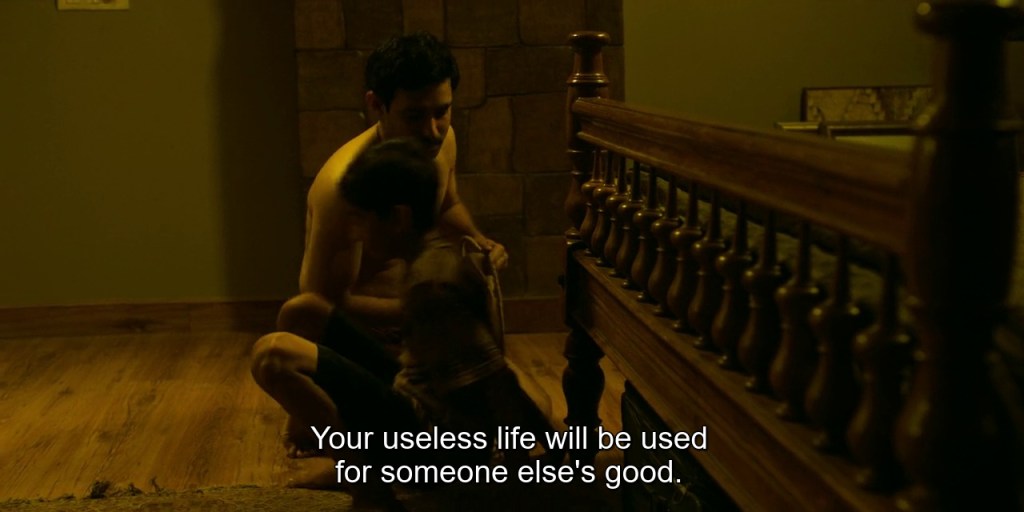
This boy is then captured by Prem who has his own system, capturing little kids to be abused and then slaughtered for their flesh and organs. Prem tells the boy that the police will forget about him after a few days, and even his parents will eventually just replace him. But someone else, someone rich and worthy, will live longer through the appropriation of his organs.
Why, we wonder, is he like this? We have a flashback to Prem’s early life – he is working in his uncle’s butcher shop, chopping up goats and “servicing” his uncle, who enjoys raping little boys. We see him fight back, killing the uncle and then chopping him up, presumably getting rid of the evidence by bundling it up with the goat flesh, and eating his uncle’s liver, raw.
I cut that fucker up and fed him to the dogs. Had a few pieces myself!
As an adult, he has no scruples doing the same thing to kids (human ones), for his own pleasure and profit. Ram, the policeman, arrests Prem who immediately confesses, boasts, that he kidnaps kids, rapes them, chops them up after killing them, eats some of the meat, disposes of the rest, and sells their organs. His “business” involved all the missing children that the police have been ignoring. He tells the police,
Sir, the thing is that after killing Uncle, I got a taste for human flesh. I used to crave it. I needed it every couple of months…. I avoided it for a year, I tried to quit. But that craving wouldn’t go away.
He admits to abducting Ram’s daughter, but says it was an accident. He just didn’t know her father was a cop. Ram asks, “what’s the difference between them and my child?” Prem is outraged – there is no comparison, the kids he kidnapped and slaughtered were nobodies, who would never amount to anything.
While Prem is a bit naïve (one might say stupid), his question is real. No one cares about the sheep, goats or chickens that he chopped up in his Uncle’s shop as a child, nor would they be able to tell the difference if he added Uncle to the mince. Prem’s argument that he became addicted to human flesh is just an excuse – those who have tried the meat of humans report it is hard to distinguish from veal or pork. But poverty, homelessness and alienation is real, and if we can utterly disregard the moral value of any sentient being, we can do the same to those humans who seem, to criminals and authorities alike, outside our scope of care. Those whose lives don’t matter become disposable, and ultimately edible.
Society of the Snow is a new account of the 1972 Andes plane crash. It is an adaptation of Pablo Vierci‘s book of the same name,which included detailed accounts of all sixteen survivors, many of whom Vierci had known from his earliest years.
The twist here (not really a spoiler as they keep presaging it) is that the narrator of the film is one of those who were not among the sixteen.
Uruguayan Air Force flight 571, chartered to transport the “Old Christians” rugby team to Santiago, Chile, crashed into a glacier in the heart of the Andes. Of the 45 passengers on board, only 16 survived for the 72 days before they were rescued. Trapped in one of the most inaccessible and hostile environments on the planet, they had to choose cannibalism to stay alive. In this blog, we are most interested in the debate that led to the decision to eat their friends and crew, but the whole story of their pursuit of survival goes beyond what they ate and is equally fascinating.
We see a group of very devout young people, laughing and joking as they organise the trip to Chile, horsing around as the plane gets most of the way over the Andes, and then their reactions as the plane just does not reach the required altitude.
After a week without food, their urine turning black from lack of protein, they start exploring their very limited options. One group believe they will be rescued, even though their plane is painted white and they are in one of the biggest snowfields in the world. But most of them start to think about the only realistic way to survive, particularly after they find a portable radio and hear that the search for them has been called off.
The film has some interesting discussions regarding the ethics of cannibalism.
“What’ll happen to us? Will God forgive us?” “He’ll understand we’re doing everything we can to survive.”
Roberto, the medical student who has been trying to keep the injured alive, explains what happens to the body without food – it dries up, starts to absorb the organs. There is reference to the “God of the Mountains”, a different being to the one in the city. Arturo, one of the wounded, has a fascinating soliloquy about this God:
“That God tells me what to do back home, but not what to do out here…. I believe in another God. In the God that Roberto has in his head when he treats my wounds. In the God that Nando has in his legs when he keeps walking no matter what. I believe in Daniel’s hands when he cuts the meat, and Fito when he gives it to us, without saying which of our friends it belonged to. So we can eat it, without having to remember the life in their eyes.”
They discuss the legality and the practicality of cutting up bodies, the similarity to organ donation, but of course without consent. So that inspires them to make a pledge.
And so they begin to eat. There are scenes of skeletons being picked clean as the three Strauch cousins offer to cut up the bodies in an area that is hidden from the plane, “to keep the ones who eat from losing their minds”.
What the film glosses over is the Catholicism that permeates much of Latino culture. While they make the point that the bodies are now “just meat”, they do not look for the parallels of their cannibalism to the Eucharist, the eating and drinking of the wafer and wine in church which is supposed to transubstantiate into the blood and body of Christ. It is a theme explored in more detail in the earlier film, as well as in the memoirs of the survivors.
“Drawing life from the bodies of their dead friends was like drawing spiritual strength from the body of Christ when they took Communion” (Parrado & Rause 2006. Miracle in the Andes: 72 Days on the Mountain and My Long Trek Home, p.117.)
They quote to each other Matthew 26:26: “Take and eat, this is my body.” (Canessa & Vierci 2016. I Had to Survive: How a Plane Crash In The Andes Inspired My Calling to Save Lives, p.27).
I suspect this might have been considered a bit too close to the bone (apologies for the pun) for the Spanish speaking audience to whom the film is mainly addressed. Or else they wanted to appeal to a wider audience than just the Catholics. Or perhaps a bit of both.
The story is best known in print for Piers Paul Read’s 1974 book Alive: The Story of the Andes Survivors, which was turned into the film Alive in 1993 by Frank Marshall. Since then, several of the survivors have written their own accounts, to set straight some of the alleged inaccuracies in Alive, but none are as well known. Outside of the Hannibal story and perhaps Soylent Green, Alive is the film most people seem to recall when they hear I have written a thesis on cannibalism.
Alive had a few problems that this film nicely avoids. For one thing, it was very Hollywood, or “Anglo” as the politically aware like to say. It starred American actors who did not look like they were starving, even when they were fondly reminiscing and lusting for the food they missed, which seemed to be mainly pizza. Society of the Snow has Uruguayan and Argentinean actors speaking in Spanish, and makeup and special effects have improved markedly in the thirty years between the films, so they look hungry, and their wounds look ghastly. It is a more authentic look at the situation in which a group of deeply religious young men could decide to eat their dead fellow passengers and friends, who conveniently lay around them, preserved in the snow.
The film closed the 80th Venice International Film Festival in an ‘Out of Competition’ slot. It was theatrically released in Uruguay on 13 December 2023, in Spain on 15 December 2023, and in the US on 22 December 2023, before streaming on Netflix in January 2024.
Society of the Snow received positive reviews. At the 96th Academy Awards, it was nominated for the Best International Feature Film, representing Spain, and Best Makeup and Hairstyling.
Society of the Snow is arguably a better movie than Alive, although at two hours forty minutes, I thought a bit more editing might have been useful. Still, sitting through that 160 minutes gave a miniscule sense of the despair of sitting in a wrecked plane in freezing conditions for 72 days, so we cannot complain!
But I was sorry to see them drop the cannibalism/communion issue, even though there is a hint in the final scene where the survivors sit around a dinner table like the Disciples at the Last Supper, their dead friends being the bread of life, transubstantiated from sacred to edible, the reverse of what is supposed to happen to the church wafer. Whether you consider this a cannibal movie or an epic of survival (and yes, there is controversy raging about that), exploring why people do or don’t eat each other is endless fascinating, and the question of cannibalising the body of Christ is, or should be, at the heart of this story.
A new streaming series promises “never-before-heard” conversations between serial killer Jeffrey Dahmer, “The Milwaukee Cannibal”, and his father, Lionel.
My Son Jeffrey: The Dahmer Family Tapes is streaming from Sept. 18 on Fox Nation, Fox News Channel’s subscription-based streaming service.
The four-part documentary series replays conversations recorded with Dahmer while he was in Columbia Correctional Institution in Portage, Wisconsin, serving 15 life sentences after confessing in 1991 to a string of crimes including murder, necrophilia and cannibalism. The recordings, made by Lionel Dahmer, have not been heard publicly before, according to Fox Nation.
The series also includes Dahmer family home movies, and interviews with a variety of others, including Mike Kukral, a high school friends from Ohio; Michael Prochaska, Dahmer’s college roommate; Ronald Flowers, the man who escaped after Dahmer had drugged, sexually abused and imprisoned him at Dahmer’s grandmother’s house in West Allis; and retired Milwaukee Police lieutenants Kenneth Mueller and Michael Dubis, who were on the scene the night of Dahmer’s arrest.
Dahmer was beaten to death in prison in 1994, but you wouldn’t know from watching streaming services. In 2022, Netflix went full Dahmer-mania, with Ian Brennan and Ryan Murphy’s dramatisation of the life and crimes called DAHMER: MONSTER – The Jeffrey Dahmer Story.
“Monster” won a Golden Globe for best actor in a miniseries or TV movie for Evan Peters for his portrayal of Dahmer. The series received 13 nominations at the Primetime Emmy Awards, which drew some ire from Thomas M. Jacobson, the attorney who represented eight of the families of Jeffrey Dahmer’s victims. He told entertainment industry news site The Wrap that nominations for shows like that contributed “to glamorizing or desensitizing violence and crime in society.”
Netflix quickly followed up their re-enactment with Conversations with a Killer: THE JEFFREY DAHMER TAPES, a set of tapes made by his defence attorneys in which he made all sorts of fascinating admissions. At this point, there wasn’t much the keen true-crime aficionado didn’t know about Dahmer.
Actually, most of this information had long been out there. Plenty of evidence had been removed and studied after his arrest, including the fridge full of human body parts, several skeletons and the barrel of acid he used to dissolve unwanted flesh. Dahmer had spoken freely to his interrogators about the murders he had done, in graphic detail, all of which was revealed at trial. After his sentencing, and before he was killed (obviously), he gave interviews to news programs who could not believe their luck, and treated him like a celebrity.
Jeremy Renner had portrayed Dahmer when Netflix was still sending movies in the post, in a movie called Dahmer.
So what does this new Fox program hope to add (besides some sorely needed ratings)? FOX Nation President Jason Klarman said in a press release:
“The Jeffrey Dahmer case has captivated the public for over three decades and now with these exclusive tapes released for the very first time, viewers will hear from Dahmer in his own words and get insight into his relationship with his father”
Fox is featuring in the promos the fact that Dahmer was killing and pickling men back in the 1980s when he was living with his dear old grandma in Wisconsin. He had lured three men back to granny’s place and killed them, and kept mummified souvenirs in his room and in the basement.
The recording does not make clear to which victims the mummified remains belonged; Jamie Doxtator, Richard Guerrero and Anthony Sears were all killed at the location. Another victim, Steven Tuomi, was murdered by Dahmer in a nearby hotel but he kept those mummified remains in her basement as well. He told his father:
“Remember when you visited grandma? Remember that small, one-by-one square foot box? You know what was in it, don’t you? The mummified head and genitals of the last victim at the West Allis location”
Dahmer’s dad was presumably relieved to hear that it only had mummified body parts, because he was worried it was something naughty:
“It was wooden, but it had a metal covering, and you were very insistent that I opened that up because you thought I had pornography magazines”.
The show also plays up the fact that the dad, Lionel, admits to his son that he also had strange and disturbing thoughts in his youth, and perhaps actions too, since he expressed surprise that he had never been caught. He tells his son, “You’re just like me, Jeff”.
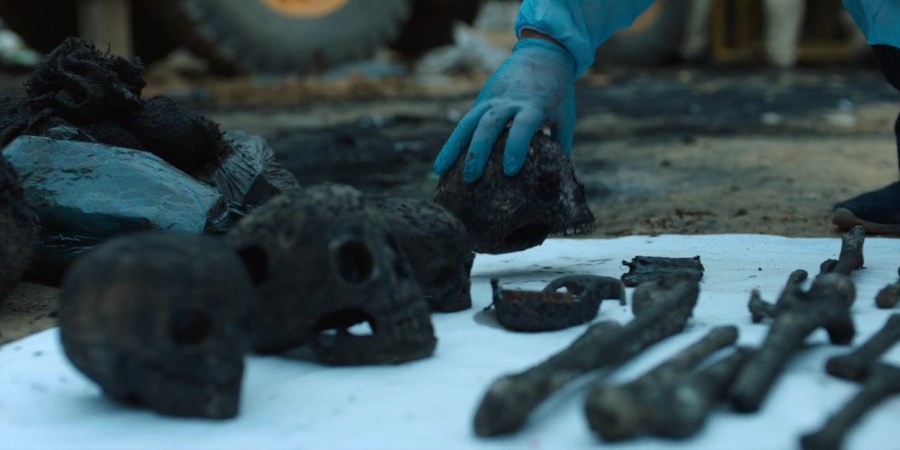
Showing audio on television is pretty dull so, like the Netflix tapes, it’s illustrated with lots of archive pictures. There are skulls, and meat from Dahmer’s fridge,
And his mug shot, which is actually a lot less terrifying than some we’ve seen recently.
It’s hard to imagine that the relatives of Dahmer’s victims, who objected to the Emmy nominations for the Netflix series, are going to be too thrilled at Fox Nation digging up the corpses again. But then, it’s Fox, and they love being on the edge.
It’s definitely Dahmer month, with Netflix releasing this second blockbuster series on October 7, less than three weeks after Ryan Murphy’s ten-part series “Monster”.
The massive interest in Jeffrey Dahmer has been simmering since he was arrested in 1991, but it burst into a conflagration on September 21 2022 with the release of Ryan Murphy’s new documentary MONSTER – The Jeffrey Dahmer Story. This re-enactment, with Evan Peters playing Dahmer, became number one on the Netflix hit parade immediately. According to The New Yorker, as soon as it was released on September 21st, “Dahmer” became far and away the streaming service’s most-watched title of the week and its biggest-ever series début, despite receiving little advance marketing. Subscribers logged nearly two hundred million hours watching the program in its first week of release—more than three times as many hours as Netflix’s next most popular series. There’s even a walking tour in Milwaukee in the footsteps of Jeffrey Dahmer.
My earlier blogs on the Dahmer movie with Jeremy Renner as the killer, and the documentaries showing the real Jeffrey Dahmer being interviewed for news shows, are getting hundreds of hits each week (thank you!), in this new era of Dahmer-mania. Family members of Dahmer’s victims are speaking out against the “Monster” series, saying it forces them to relive the traumatic events and personalises Dahmer, and even complaining about a Keshasong from 2010 which mentioned Dahmer. Nevertheless, Netflix has now released (October 7) a new series of Conversations with a Killer, this time using some previously unreleased tape-recorded interviews of Dahmer himself and his defence team, including his lawyer Wendy Patrickus, during his high-profile case. It was her first case, and she said, “I felt like Clarice Starling in Silence of the Lambs.” She spent months talking to Dahmer about each victim, preparing a defence which could only be based on an insanity plea, since there was a mountain of evidence against him, and he had already confessed everything to the police. Wendy’s DAHMER TAPES cover 32 hours of conversations held from July to October 1991. These tapes were never previously released – and are the basis of this three-part series.
This three-part true crime documentary is the third in a series from Academy Award nominee Producer/Director Joe Berlinger, whose earlier “Conversations with…” covered The Ted Bundy Tapes (2019) and The John Wayne Gacy Tapes (2022). Bundy and Gacy were prolific serial killers but, as far as we know, were not cannibals (although an English tabloid suggested Bundy might have had a few mouthfuls).
This is the Netflix summary of the Conversations with a Killer: The Jeffrey Dahmer Tapes series:
When Milwaukee police entered the apartment of 31-year-old Jeffrey Dahmer in 1991, they weren’t prepared for what they’d find. From a freezer full of human heads to decomposing body parts, the discovery amounted to the grisly personal museum of a sadistic killer. Dahmer quickly confessed to sixteen murders in Wisconsin over the span of four years, plus another murder in Ohio — but the most shocking revelation involved acts of necrophilia and cannibalism…. Why was Dahmer, who had been convicted of sexual assault of a minor in 1988, able to avoid suspicion and detection from police as he stalked Milwaukee’s gay scene for victims, many of whom were people of color?
Like the previous movies and documentaries and even the interviews with Dahmer himself and his family, the question that keeps being raised is why he did these things? Earlier texts concentrate on the psychopathy of the man himself, skirting the politics, while Murphy’s series, and this new documentary, spend more time on the ineptitude and racist privilege that seemingly kept delivering him get-out-of-jail-free cards.
“It [cannibalism] made me feel like they were a permanent part of me.”
This new release sheds much heat but very little new light onto that question. Dahmer has already told interviewers that he just wanted to possess the young men and boys who came to his home under the pretence of taking photos for money, keep them with him, without the complications of building actual reciprocal relationships. He lured them to his apartment, drugged them and then killed them or drilled holes into their skulls and injected muriatic (hydrochloric) acid. He wanted to turn them into zombies, with no will of their own, who would stay with him and be available for sex whenever he wanted. He tells his lawyers all this on the scratchy recordings that assail our ears here. The interviews are accompanied by blurry re-enactments of the prison interviews by actors dressed as Jeff and Wendy, and interspersed with contemporary interviews of the actual journalists, police, lawyers, psychiatrists, friends of the killer and the victims, all noticeably older and still in many cases clearly distressed by their involvement in the case. There are images of his victims, of the saws and drills he used, home movies of him as a (pretty happy and normal) child, as a teen, as a prisoner. There is news footage, from outside the building, of stunned crowds and news reporters doing what they do – repeating the few snippets of information they have, over and over.
But there seems to be a lot more that is alluded to but not fully analysed in both of these new Netflix releases. In flashbacks in the Monster series, and in the “conversations”, we see things like Jeff impaling worms on his hooks with his Dad, saying “ouch!” as they pretend to empathise with the animals’ suffering. We see him as a little boy examining a dead marsupial that, his Dad says, must have crept under the house to escape a predator, despite already having its skull crushed, indicating that brainless (zombie) life is feasible; Dad takes him on road trips to find and then dissect road kill. He tells a wide-eyed Jeff of the biology experiments (Dad was a chemist) in which frogs with most of their brain destroyed will still react to pain stimuli. We see him mock a vegetarian girl in biology class who doesn’t want to dissect a piglet, and later find him torturing small animals including neighbourhood dogs and cats, actions which are strikingly common in the personal histories of serial killers. Dahmer tells the lawyer:
“I didn’t seem to have the normal feelings of empathy.”
Insensitivity to animals (human or otherwise) can snowball. Killing and eating the other has always been the ultimate symbol of domination. Humans have probably done it to enemies for millennia, and psychologists tell us that industrial society since the late nineteenth century has undermined the formation of stable identities through technology-based isolation, mass mediated representations of cultural interactions, the conversion of all human relationships into fiscal transactions and the disintegration of communities. Mass-murderers and particularly cannibals like Dahmer, Fish, Meiwes or Sagawa could not have operated so freely in communities where people more intimately knew their fellow citizens’ daily movements and actions.
But such social and cultural changes affect us all, and we are not all cannibals (at least, not at this historical moment). There is more to it; the borderline pathology formed by modern life has to be ignited into violent action by an often (seemingly minor) inciting incident – Meiwes watched pigs being butchered, Sagawa recalled his uncle, who regularly played cannibalism games. Many cannibals, like many murderers, start their abuse with the objectification of other animals, as did Dahmer. Vincenzo Verzeni, who was arrested in 1871 on suspicion of killing up to twenty women, put his sexual obsession with killing and drinking blood down to the pleasure he had experienced wringing the necks of chickens when he was twelve years old. Jeffrey Dahmer had hidden his sexuality from his disapproving family for so long that he no longer wanted the gay sex that was becoming available in the 1980s – he wanted to sate his appetites without having to satisfy his partners. Sleeping pills, easily obtained due to his work as a night-shift operator at a chocolate factory, meant that he could put them to sleep and do whatever he felt like.
“I could just lay around with them, without feeling pressure to do anything they wanted to do. They wouldn’t make any demands on me. I could just enjoy them the way I wanted to.”
The men he chose were in many cases ready to have casual sex, but that was not enough. He wanted permanent relationships, but only he was to benefit. From drugs, he moved to experiments aimed at creating compliant, subservient zombies. Of course, this didn’t work, so he did the next best thing, killing them, keeping their body parts, eating their flesh so they would be a part of him.
Dahmer had learnt to ignore suffering in his fishing expeditions, at his father’s dissection table, and of course in the kitchen, where we all watch pieces of meat being prepared, our childish minds wrestling with the dawning knowledge that these were the same living, breathing, suffering animals we saw on farms, or whose representations we enjoyed in our toy-boxes or television shows.
One psychiatrist has opined that Dahmer struggled with both borderline personality disorder and schizophrenia, and therefore suffered “great confusion about what’s real and what isn’t”. There is some evidence that Dahmer couldn’t live with what he’d done, or couldn’t live without doing it any more, offering to admit to a crime he didn’t commit (the murder of six-year-old Adam Walsh) if it would get him the electric chair in Florida.
The Dahmer legend continues to grow, despite it being over thirty years since his arrest. How unique is his story? The police investigators called for a manifest of missing persons, trying to establish the identities of the remains found in Dahmer’s apartment. In episode 2, the detective says they were getting 300 calls every day from people looking for their lost loved ones, and wondering if they had ended up in Dahmer’s abattoir. Where do all these missing people go? Is it possible that there are more successful cannibals out there, busily eating the evidence, not raising the suspicions of their neighbours, and not getting caught?
In a world where humans routinely and legally do to other sentient beings what Dahmer did to his victims, it may be that the cannibal is just less tolerant of ambiguity, and when taught that the ‘other’ can be casually and ruthlessly collected, kept captive, killed and eaten, he (or occasionally she) just takes that to its logical conclusion. Interestingly, PETA is already getting feedback about that.
This documentary does not offer any revelations to those of us who already know a lot (too much?) about this case. But it lays it all out in sequence, explained by those who were involved – the police, the journalists, the doctors, and most of all Dahmer himself on the tapes. His voice is that of a witness, trying to explain what he does not understand. He killed and ate people not because he was some uncanny monster, but for the same reason anyone eats anything: because he wanted to, and he could. The jury in his case were adamant that Dahmer was sane.
What does it mean, to say that a person is sane, and how is a jury of non-experts to decide that? In episode 2, the forensic psychiatrist for the Defence, Fred Berlin, says:
“If a man who is preoccupied with having sex with corpses, if a man who is drilling holes in the heads of human beings to try to keep them alive in a zombie-like state doesn’t have a psychiatric disorder, then I don’t know what we mean by psychiatric disease. How many people does someone have to eat in Milwaukee before they think you have a mental disease?
Dahmer comes across as the picture of the civilised male subject, fully initiated into the symbolic order. As the Milwaukee journalist who was first to report the case, Jeff Fleming, put it:
“The danger could be someone who looks just like your next door neighbour. He passed on the street as a very normal person. He didn’t look scary.”
“…in their behavior toward creatures, all men were Nazis. The smugness with which man could do with other species as he pleased exemplified the most extreme racist theories, the principle that might is right.”
But what we see in factory farms is not the hatred and the wish to exterminate that motivated the Nazis. Animal agriculture corporations often tell us that they “love” their animals, just as Dahmer loved his men and boys, and wanted to enjoy them. Perhaps it would be more accurate to say that in our behaviour to animals, all men are Dahmer.
This new docudrama (I can’t believe that’s a word) is quite a big deal in the highly respected academic discipline of Cannibal Studies. While many people think of Hannibal Lecter when the subject of cannibalism arises, in terms of contemporary culture (and therefore putting aside the Donner Party for now), Jeffrey Dahmer, known as the “Milwaukee Cannibal”, is a crucial figure, not least because he really existed, we know a lot about him, and we have a good understanding of what he did. Dahmer typifies the modern cannibal in that he seems so unremarkable; we have seen, and perhaps remarked at, his cool demeanour and the fact that he seemed like just an ordinary, everyday boy next door.
There have been a few Dahmer movies and documentaries, including some interesting interviews with the man himself, arranged in jail, before a fellow prisoner caved his head in with a metal bar. This new one has a pedigree though. First of all because it is presented by Ian Brennan (Glee, Scream Queens, The Politician) and Ryan Murphy, who signed a $300 million deal with Netflix in 2018 and who brought us such enormous and terrifying hits as Glee, Nip/Tuck, American Horror Story andAmerican Horror Stories.
Monster – the Jeffrey Dahmer Story runs over ten episodes, released concurrently on September 21, 2022. The length alone (almost nine hours) makes it more comprehensive and immersive than the other treatments. It is also different to most serial killer / cannibal documentaries and films in that it is presented not from Dahmer’s point of view, but from that of those around him – the victims, but also the family and the neighbours (who had to put up with the appalling stench of death that always emanated from his rooms or apartments).
“We had one rule going into this from Ryan, that it would never be told from Dahmer’s point of view.”
The first episode drops us into the main event – Dahmer in his Milwaukee apartment, trolling gay bars and offering young men and boys money to come home with him for a photo session, where he drugs them and attempts to turn them into love zombies by drilling holes in their skulls and pouring acid into their brains. When this doesn’t work, he has sex with their corpses, and harvests their meat.
One man escapes and flags down the police, who arrest Dahmer. The series then turns back to his childhood, his parents’ messy divorce, and the isolation which left him free to hatch his murderous plots. Later, we meet some of his victims, and his neighbour Glenda Cleveland who repeatedly tried to notify the police and FBI of what she heard, saw and smelled, but was comprehensively ignored and even threatened for her interventions.
“What do you do in there? The smell, power tools going all hours of the night, I hear screaming coming from your apartment.”
Dahmer, threatened with eviction due to her complaints, offers her a sandwich, saying “I used to be a butcher. I made that just for you.” Glenda refuses to eat it, and we know why – it looks like a chicken sandwich (and probably is).
But our willing suspension of disbelief declares it human meat, which is not kosher in any religious tradition. He tells Glenda to “eat it!”
Most of this documentary is very true to the facts as we know them, but in any re-enactment, there will be gaps to fill in or characters that need to be heard, without filling the cast list with an unmanageable number of people to remember. So the sandwich was apparently a fact, but was not given to Glenda but to another neighbour, Pamela Bass, who thought he was a generous if shy young man, and admitted that she ended up eating it.
Glenda, played superbly by Niecy Nash (from Scream Queens and Claws), is a strong woman caught in one of those nightmares where you know there is horror, but no one will believe you.
She demands to know what is in the sandwich.
“It’s just meat… It’s like a, uh, pulled pork.”
This is a regular theme of cannibal texts: they remind us that humans are animals, and our flesh and organs are made of meat. It’s a popular meme on animal rights social media sites. This one shows the real Dahmer, in case you’ve forgotten what he looked like.
Dahmer was looking for love, but he was not willing to risk losing it, so he tried to conscript his victims as undead zombies or as corpses, skeletons, or just happy meals. He showed affection – he is seen lying with his corpses, holding their hands, preserving their body parts. He loved them in much the same way that farmers often claim to love their cattle, sheep, pigs, etc, just before putting them on the abattoir trucks.
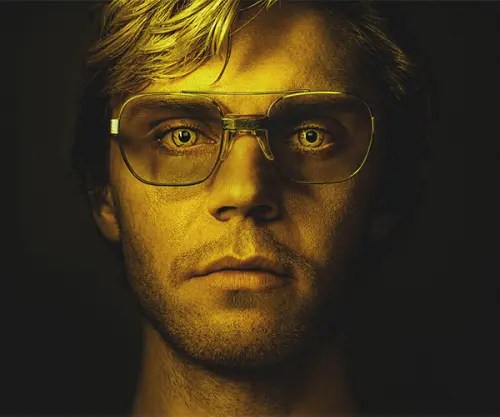
Dahmer is played brilliantly by Evan Peters (American Horror Story, X-Men, Mare of Easttown), who looks a lot like Dahmer, but with a touch of the young Malcolm McDowell – imagine Clockwork Orange but with cannibalism. If you want to know what Dahmer might have looked like forty years after his arrest, check out McDowell in Antiviral.
Jeffrey Dahmer murdered and dismembered seventeen men and boys between 1978 and 1991, thirteen years during which the police had no clue about his serial murder spree and, some might say, didn’t care much, since most of the victims were people of colour. And this is the heart of this rendition of Dahmer’s story – he was protected by the racism and incompetence of the American justice system. Here was a clean-cut white man, and people of colour disappear without trace all the time, apparently, so the police did not bother him, while the judges treated him as just a naughty boy. Glenda’s frantic calls were met with apathy or rudeness.
He kept getting away with everything – one of the most extraordinary moments is shown in flashback in episode 2. On May 27, 1991, Glenda Cleveland called the police to Dahmer’s apartment after her daughter, Sandra Smith, and her niece, Nicole Childress, found a bleeding, naked and incoherent boy on the street who was running from Dahmer. Dahmer appeared, white and polite, and told the police that the boy was his 19 years old boyfriend.
He said the boy was drunk and they had been in an argument, and so the cops helped him take the boy back to his apartment, had a quick look around, made homophobic remarks about AIDS, and left the boy there.
The boy was bleeding from a hole drilled in his skull. After the police left, he was dead within the hour. It was later discovered that the boy was 14-year-old Konerak Sinthasomphone, Dahmer’s 13th victim. Incredibly, Dahmer was actually on parole for an earlier arrest for the molestation of another child, who was one of Konerak’s older brothers.
When Cleveland spotted Konerak’s photo in a missing person alert in the newspaper days later, she realised he was the young boy Dahmer had claimed was his boyfriend. She contacted the police and the FBI yet again, but they didn’t even return her call. Five of Dahmer’s seventeen murders, including that of Konerak, were carried out after Cleveland began contacting police. All but three of Dahmer’s victims were non-white.
The Reverend Jesse Jackson, a leader in the Civil Rights movement since the time of MLK, got involved in the case despite the urgings of some of his supporters, who didn’t think the movement should be linked to “a gay serial killer who eats people”. But as he says:
“I realised it was not just a gruesome horror show. It’s a metaphor for all the social ills that plague our nation. Bad policing, underserved communities, the low value we assign to our young Black and brown men, especially if they happen to be gay.”
The old profiling stereotypes no longer work, in fact never did. Dahmer was a serial killer who was ignored by the law for thirteen years, because he was white and male. In the Soviet Union at the same time, Andrei Chikatilo was killing and eating parts of over fifty women and children, ignored by the police force, because serial killing was considered impossible in the “workers’ paradise”. But those profiles still endure: a Black man on the street is instantly suspected of criminal intent, a white man, even Jeffrey Dahmer, is largely untouchable. In that sense, society dehumanises the poor, the coloured, the disabled, just as effectively as Dahmer did to his prey.
As the philosopher Michel Foucault observed, the world outside was a scary place filled with monsters up to the seventeeth century, and those monsters were thought to be probably criminals. But in modern times, the criminal is considered likely to be a monster. Ancient monsters were recognisable – usually grotesque and often hybrids of humans and other animals. But the contemporary monster looks, speaks and eats pretty much like the rest of us. Like Jeffrey Dahmer – the boy next door.
Netflix released the latest Texas Chainsaw instalment (the ninth!) on February 28th. It’s beginning to feel a lot like Easter (as in: how many ways can you tart up hot cross buns?) but there are some nice features to this one. For a start, well, it’s on Netflix, so a bit less likely to disappear into the Texan mud without trace, like some of the earlier versions. There have been eight sequels and prequels and unrelated but similar-named movies in this franchise, as well as comics (sorry, graphic novels) and a video game of the original.
The original film, in which “chain” and “saw” were two words, is still widely acknowledged as the best, despite its paltry budget and apparently impossible working conditions for the crew. It was released in 1974 by Tobe Hooper, who made a somewhat light-hearted sequel in 1986. It was a pioneer in “slasher” films and drew cannibalism out of the gothic into the sunlight, showing an alienated workforce in “flyover” states turning their (now unwanted) skills in killing steers toward killing tourists instead. It finished with Sally, the “last girl” escaping from a frustrated Leatherface, who was wearing his mask of human skin (fully biodegradable but not much use against viruses) and wielding his chainsaw in a way that buzzed of potential sequels.
This sequel takes place 48 years after the original (yep, now) and blithely ignores any plot points from the intervening movies, comics, etc. Leatherface is back, older but no wiser and still intent on killing teenagers, and so is Sally, the survivor, who is now a Texas Ranger and set on revenge.
And the cute teens, well, they’re everything that the locals hate – inter-racial, trendy, Gen Z “Influencers”, what the creepy gas-station owner (and there’s always one to set the scene) calls “gentrifuckers”.
They want to gentrify the town and set up a trendy area of gourmet cafes and authentic looking but modernised shops and galleries. Leatherface is in retirement in an abandoned orphanage, and Sally, well, she’s been looking for him for a long time apparently, although when last seen in The Texas Chainsaw Massacre: The Next Generation (not an episode of Star Trek), she was catatonic and strapped to a gurney. But now she’s hardass. When we first see her, she’s gutting a pig, just as Leatherface is slaughtering humans. The special effects are pretty similar for both, as are the body shapes, and, frankly, the characterisations. The original actors who portrayed Leatherface and Sally are both dead; the only original cast member is John Larroquette who does the voiceover, which half-heartedly tries to sound like a true-crime documentary, as he did in the original. The new Sally is Olwen Fouéré, the Irish actor, although this Sally seems to be more based on Jamie Lee Curtis’s Laurie Strode in the 2018 reboot of Halloween.
The class struggle of the original Chain Saw has been lost here. The Texas of the original was filled with pockets of people abandoned by modern capitalism and so falling into degeneracy and violence. The new movie seems to valorise the “ordinary” folks who brook no bullshit from the “me generation” and defy the dehumanising effects of capitalism. It’s hard to feel sympathy for the influencers with their real estate auctions and cutesy town planning, or to feel terror at the thought that people might chop you up, but only if you insist on being a dick.
The terror of Leatherface himself revolved not around his nasty dental problems, badly fitting masks and noisy chainsaw, but around his family, the Sawyers, a group of odd but not obviously psychotic individuals who nonetheless were more than happy to chop up and eat innocents from the outside world, which had forsaken them. It felt like this could be any of us, screaming and dying and becoming the family’s dinner, should we venture into the wrong part of the Badlands. This new version is all Leatherface. Somehow, he now has a “mother” who looks after him in an abandoned orphanage, and she dies of a heart attack when the trendies tell her she has to move out, leading to his much delayed rampage. But Leatherface was always the weapon, not the villain, sometimes killing, and sometimes donning an apron and cooking for his dominant family. He doesn’t really work as a lone psycho, particularly when we sort of sympathise with him – he’s just lost his mum, weeps as he wears her face as a mask and then applies her makeup like Norman Bates in Psycho. Who can stay mad at that?
Tobe Hooper’s classic broke new ground in cannibal films and in horror generally. It encapsulated the early 1970s as the endless war in Vietnam and the demise of the hopes of the flower power generation ran into the chainsaw that was Nixon’s silent majority. The new one seems to reflect our time, where the young and idealistic are capitalistic exploiters and Leatherface and the Texan gun-toters are just being pushed too hard into the chainsaw of QAnon. Politics and war are no longer about truth and justice but just fake news in pursuit of tribalism. The film sums this up sardonically in the climactic scene where the busload of influencers are confronted by Leatherface and his chainsaw and respond by pulling out their phones and live streaming the whole massacre.
As Marx said, great historical entities (like Leatherface) appear in history twice – the first time as tragedy, the second time (or perhaps the ninth) as farce.
But here’s my problem with this film. After 83 minutes (which seemed much longer) I looked up from the screen and screamed (internally) “where’s the cannibalism?” Yes, there was a lot of flesh on display, and broken bones, and the occasional internal organ. But none of it got eaten, which, if I had more time, would have disqualified it from this blog. The thing is, cannibalism is not just one more nasty thing that mean people might do to you and me. It is the ultimate act of dehumanisation. Sally’s friends and family in the original were turned into slaughter-animals, chopped up, eaten, and presumably ended up in the family’s outhouse. That’s what we do to those we objectify: pigs and sheep and cows, and we do it to distinguish ourselves from other animals as somehow non-animal, part-god. The slasher might kill us, but the cannibal converts us into shit. Otherwise, we are all potential wielders of the chainsaw.
Without the cannibalism, this is just another slasher with too much emphasis on special effects rather than characterisation.
Texas Chainsaw Massacre 2022 has a 33% “rotten” rating on Rotten Tomatoes, with one audience critic summing up:
“it isn’t very scary — and it definitely doesn’t help that the story hardly makes any sense.”
American Horror Storiesis part of the American Story franchise. It is a 2021 spin-off of the hugely popular American Horror Story, an anthology series created by Ryan Murphy and Brad Falchuk, who were responsible for other terrifying shows like Nip/Tuck and Glee. American Horror Story is currently in its tenth season, and has been renewed for seasons 11-13. Each season is a self-contained mini-series, whereas in this new series, American Horror Stories, each episode is a self-contained narrative.
While there were cannibals in American Horror Story, (the Raspers in season 2 and the Polk family in season 6), the new series seems to be a lot more into them – the first season has two cannibal stories out of the seven episodes, an impressive 28.6% (if anyone is counting).
Episode 3 is called “Drive In” because that’s where most of the gore happens. Kelley (Madison Bailey) and Chad (Rhenzy Feliz) have been arguing about her reluctance to have sex with him, even though he is playing Bob Ross The Joy of Painting on his laptop (he’s been told it’s a sure fire aphrodisiac due to its reputation for causing a relaxed, tingling sensation known as ASMR (autonomous sensory meridian response). Anyway, that trick doesn’t work on Kelley.
Bob Ross is an interesting choice for a horror story opening, as he seems to live on through Twitch and the internet, despite having died in 1995. So much horror is about the undead stalking promiscuous teenagers!
Chad’s friends assure him that ASMR won’t work – what he needs is horror! That’s why horror films are so popular, they are aphrodisiacs, OK? The link between fear and sex – the subject of a whole new dissertation.
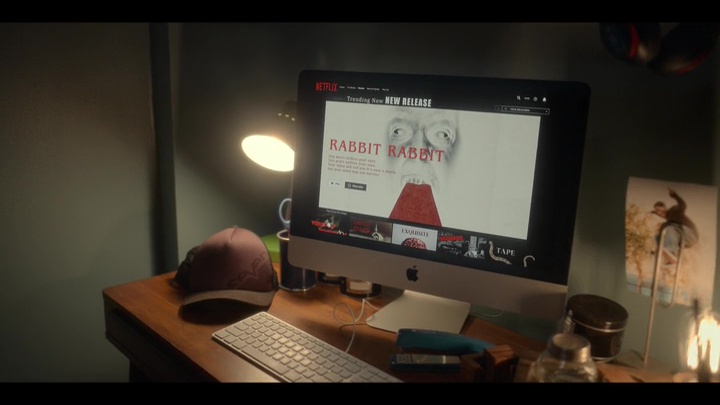
Chad’s friends have one ticket left for the drive-in screening of a film called Rabbit Rabbit. The film was banned by Tipper Gore (Amy Grabow) after the audience at the only showing in 1986 started to massacre each other, and she ordered all prints of the movie destroyed. Except they missed one: the director’s cut. Chad dismisses this whole massacre business as an urban legend, but takes the ticket.
As they drive in, a lone woman is protesting, demanding the screening be stopped. She tells Chad she was at the showing in 1986, where her boyfriend plucked out her eye and ate it before being killed himself. He listens politely, but then Kelley turns up with the biggest bucket of popcorn ever created, and he has to, you know, go. Presumably now full of popcorn, Kelley tells Chad that she is finally ready to have sex with him, and various cannibal metaphors fill the cars before the movie starts – Chad and Kelley pashing in his car, fellatio in his friend’s car next door.
Chad and Kelly’s steamy petting fogs up the car windows, so they cannot see the film, nor do they see the mayhem erupting outside, where people are attacking and devouring each another. They try to drive away when a cannibal smashes through their window but they crash, and have to retreat to the projection room, where we see Chad, who just yesterday was trying to seduce his girlfriend by playing The Joy of Painting, use the last copy of Rabbit Rabbit to cave in the skull of the projectionist, who has just eaten her assistant.
Of course, it’s not the last print. There is a rumour of another print being shown next night. Their mission, should they choose to accept, is to find the director and destroy the NEXT last copy.
So, we finally get to the cannibalism, and it’s plentiful and gory, as we would expect. Those affected by the film get bloodshot eyes, their veins swell, and they are only interested in one thing – human flesh. Chad’s best friend approaches as they leave, eyes bloodshot, veins swollen, and Chad appeals to him to THINK! Remember when we were two little boys, innocently watching porn in the afternoons? Now, according to Aristotle’s theory of the human being as the rational animal, Chad’s appeal to reason, love, friendship, shared porn, should have broken through the spell. Ha!
So what’s with this movie, with the most innocuous title imaginable: Rabbit Rabbit? The rabbit is a gentle, timid, vegan animal who is massacred pretty much everywhere he is found, due to his propensity to breed – a lot! Sounds kind of human?
Chad has done some research before going to the movie; he watched, on YouTube, Tipper Gore’s committee condemning the movie and having it banned after the audience massacre in 1986. Banning things is popular in America due to deep religious convictions, but also not popular due to, you know, the First Amendment. Tipper Gore, married to Vice President Al Gore, was responsible for making music companies add warning labels to songs with explicit content around that time, after finding her 11 year old daughter listening to Darling Nikki by Prince, so this is not just idle chatter – she was seriously into banning stuff.
But why is the government banning Rabbit Rabbit and destroying all copies (or so they imagine)? Well, the director, who glories in the name Larry Bitterman (John Carroll Lynch from Fargo and The Drew Carey Show) is asked by Tipper about his claim in Fangoria Magazine that his movie:
“…would break people’s souls, and anyone who saw it would be damaged forever.”
Publicity hype, laughs Bitterman, but Tipper is worried about the effects of violent content on society, which must be an in-joke for Murphy and Falchuk, after presenting us with ten seasons of violent content, and now this gorefest. Critics have been warning about that sort of thing forever. Civil society has been threatened by the Internet, porn mags, the horror genre, and before that television, movies, radio… hell, conservative Cro-Magnons were probably warning about the evils of cave paintings 40,000 years ago.
Is there any sense to it? Can porn turn us into sex offenders, horror stories into cannibals? The internet certainly turns some people into trolls. Bitterman wants to make cinematic history – he tells the teens that this “was his finest hour” – a cinematic happening, a horror movie where the horror isn’t on screen, it’s in the audience. He refers to Friedkin’s (actual) use of subliminals in The Exorcist – two frames of a demon’s face in reel six had people throwing up in the aisles and women going into labour. Rabbit Rabbit took this to the next level,
“The universal combination of image and sound that would trigger the fear centre of every human brain. I studied intrusive memory formation, the CIA hijinks with MK-Ultra…”
Bitterman had jumped the hearing bench and attacked Tipper Gore when she boasted about destroying the prints of his movie, which resulted in him being locked up for fifteen years for assault. His conclusion: “a society that locks up its artists doesn’t deserve to survive.”
There’s another in-joke – the series was made by FX for Hulu. What if a film like Rabbit Rabbit was to appear on, I dunno, a rival streaming platform – imagine the damage it could do!
But there’s another question for us among all the hacked flesh and explosions. Have you ever felt like you are in a horror movie? Maybe while in the throes of a personal tragedy, or watching a pandemic unfold, or contemplating changing climate. Perhaps you’ve wondered if “they” are playing with your brain. Or perhaps they really are breaking your soul. Or maybe eating you alive. Cannibalism is a brutal metaphor for pretty much every atrocity we visit on our fellow earthlings. A movie, a cataclysm, political upheaval – what would it take to start us eating each other?
New cannibal movies keep arriving, thick and fast. This one is from a young Norwegian director, Jarand Herdal, and was released on Netflix in October 2020. It is a traditional dystopian story, a genre in which people are driven to cannibalism by desperate circumstances – think Soylent Green, Delicatessen, or 28 Days Later. Dystopian films sometimes don’t bother telling you what happened to destroy our civilisation, for example We Are The Flesh or The Road. Others spell it out, and nuclear war is always a popular explanation, as is the case in Cadaver.
The film starts with children running into a vast room, playing among huge piles of clothes and bags. They try things on, and one girl discards a shirt, when she finds a stain on it. A bloodstain of course. We see a family making its way through a street where bodies lie in the road and survivors fight for food.
Discarded newspapers tell of a nuclear disaster. A family, Leonora and Jacob (Gitte Witt and Thomas Gullestad) and their daughter Alice (Tuva Olivia Remman) are desperate and terrified, down to their last tin of food, when they are offered tickets to dinner and a show at a grand hotel. Who hasn’t fallen for that line?
The showman is the suave, beautifully dressed Mathias (Thorbjørn Harr) who seats the crowd at dinner tables where waiters bring steaming plates of meat. Mathias welcomes them to the show, and tells them that
“everything that takes place tonight is staged. Everything is a show. Everything.”
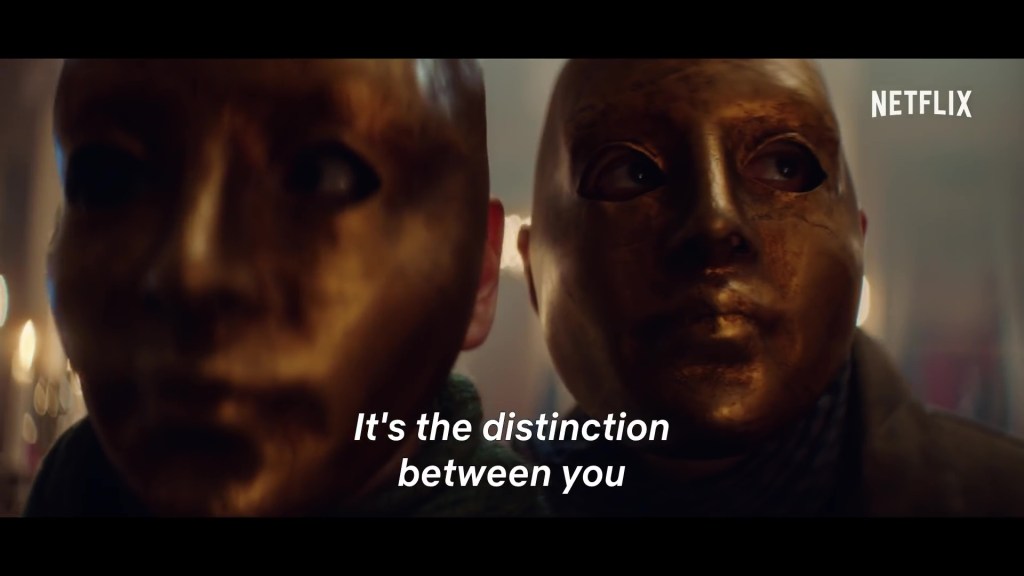
The show is the theatre itself. The “audience” are told to wander the corridors, explore the rooms, but they have to wear bronze masks in order to distinguish themselves from the “actors”, who look like normal (maskless) people, and act out dramatic scenes of conflict and sex and suicide.
Alice disappears and, as Leonora and Jacob search, they ditch their masks, making them indistinguishable – they become actors instead of audience. Just as well, as the audience keep disappearing. And given the plates of meat served up in the middle of mass starvation, you don’t have to be Sherlock Holmes to work out where they are disappearing to. Our protagonists, however, are clueless.
They witness Mathias addressing his actors, like a pope or king, as they kneel before him.
“You know where you came from. You know what we have here. If we don’t stick together like family, it will devour us.”
The rest of the movie is Leonora wandering around the wonderfully atmospheric corridors, trying to work out what is going on, and where the hell Alice has got to. There’s a plot reveal: Mathias is running a factory farm, with the only mammal still available in large numbers. The actors’ job is to put on a show so audience members will split up and follow them into rooms where they will fall through trapdoors, to an unknown fate. At the bottom of the trapdoor are the brawny butchers. It’s Sweeney Todd, in Norwegian.
When the actors and audience follow Leonora into the kitchens, they are shocked and horrified. I mean come on, where did they think all this meat was coming from?
We also find out why the audience must wear masks – because the actors might know some of them, and:
“as long as they are masked, you won’t be able to tell. It makes it easier.”
The identical masks give them an air of indifference and facelessness – they look like victims. It’s the same reason farmers will tell you they never give names to the animals they plan to kill. Anonymity is essential for objectification. You don’t want to meet your meat.
When Leonora confronts Mathias, he offers her the opportunity to join the cast, asking her
“What would you do to keep your family alive?”
The title “CADAVER” (“Kadaver” in Norwegian) is an interesting choice. According to Dictionary.com, it means “a dead body, especially a human body to be dissected”. It is therefore a scientific term, implying research or study. Mathias and his merry men are chopping up the guests for dinner, but there is a way out for a talented person like Leonora – like Theseus and the Minotaur, she can navigate the maze of corridors and trapdoors and confront the beast, or even choose to join him. Survival depends on her choices and decisions. Almost certain starvation outside or murder and cannibalism inside. You can watch on Netflix to see which way she goes.
The Digital Spy review (which, I warn you, is full of spoilers) has a poll at the end, which asks:
“Would you have joined Mathias’ cannibal cast?”
The possible answers are:
1. Look… it’s the apocalypse, OK? 2. No way, I’m a vegetarian.
The author John Steinbeck wrote to a friend in 1941 that:
“It isn’t that the evil thing wins—it never will—but that it doesn’t die… two forces are necessary in man before he is man.”
Horror depends on our inability to accept the inevitability of our own deaths, and cannibalism adds to the recipe the terror of that death involving our total disappearance, not just our spirit but our bodies, incorporated into the stomach, then the cells and finally the shit of another. We cheer the death of the ‘bad guy’ because we feel at a primal level that his death is required for the continuance of our life. But what if, as Steinbeck says, the evil never dies, and keeps coming back for us?
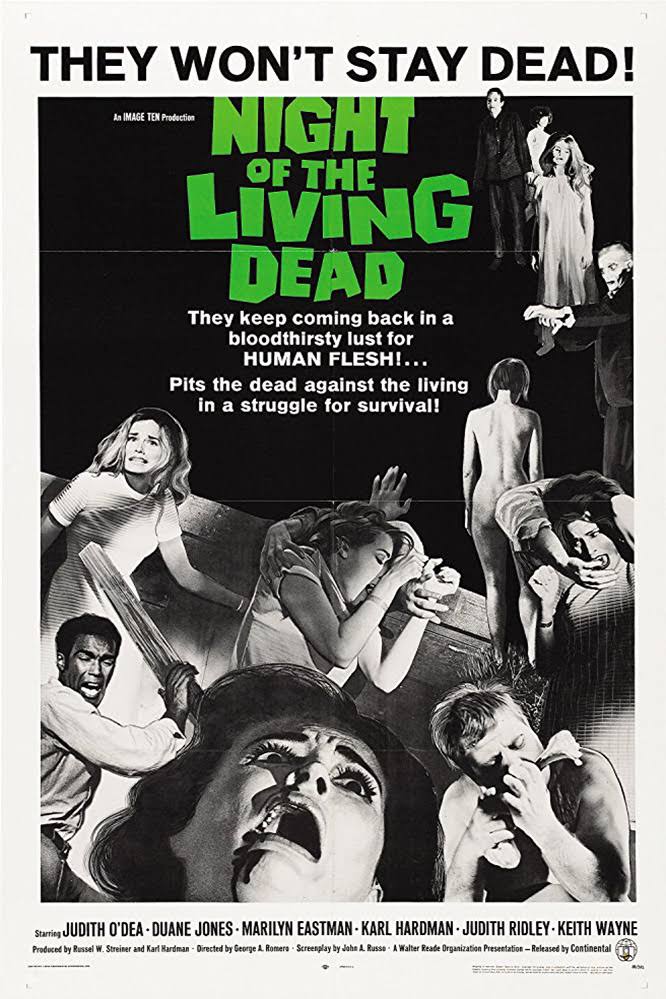
This I think is the attraction of the zombie, who has become a critical character in our culture since the release of this movie in 1968. An earlier movie, The White Zombie (1932) saw Bela Lugosi turned Madge Bellamy into a mindless love object – returned to life, but as a slave with no will of her own. Those zombies did what they were told, but they did not go out of their way to eat people. That type of compliant, submissive zombie is pretty much what Jeffrey Dahmer was hoping to achieve when he drilled holes in his lovers’ skulls and poured in what he hoped were non-lethal doses of acid.
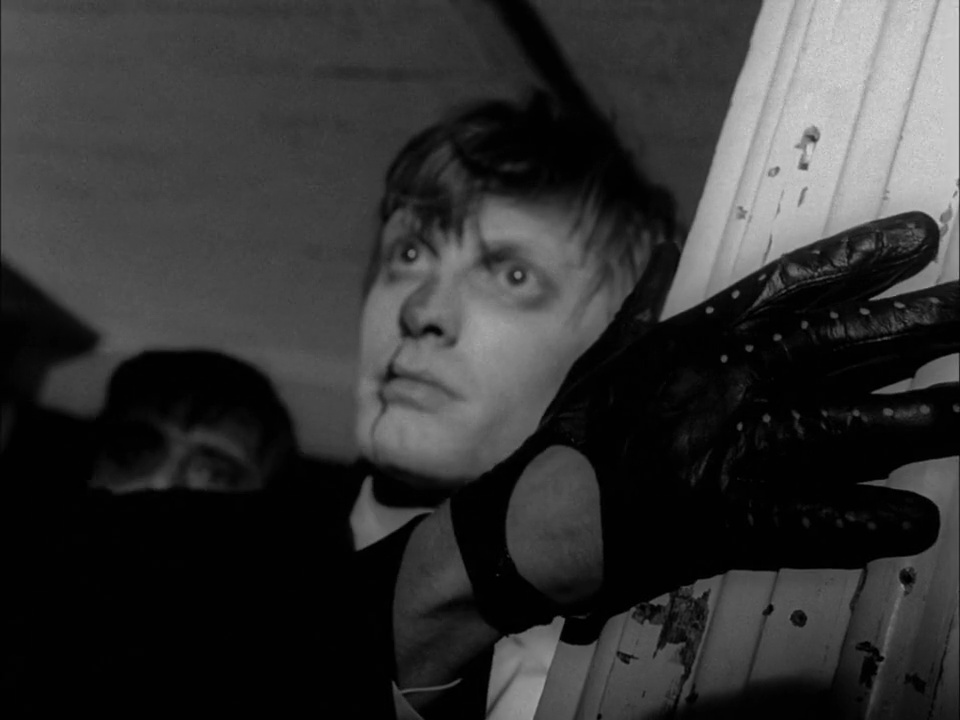
George Romero’s genius was to combine the undead with the cannibal to create what in this story is called a “ghoul”. The zombie was still, in 1968, the undead servant of Haitian mythology. In this film, the ghoul, a figure that traditionally hangs out in graveyards and sometimes digs up corpses, becomes those corpses, and so gives birth to what we will ever after call zombies. These zombies are cheaper by the dozen – they have no will, no intelligence, just the force of numbers, and overwhelm the living with their ragged, shuffling weight of numbers.
What raises these dead? We are told by a TV newsreader that a strange phenomenon, perhaps radiation from a space probe that exploded in Earth’s atmosphere, is causing the dead to rise from their graves. They are voraciously hungry, but very fussy eaters – their preferred cuisine is living human flesh, although cooked (when a truck explodes) will do. But the horror in this movie is from the “banality of evil” – the things that really haunt our nightmares are not ogres and aliens, but cemeteries at dusk,
Ordinary (ish) looking people trying to get into our car, when we can’t find the keys
Technology that won’t work at times of crisis
And of course the dead. Particularly when they look angry. And hungry!
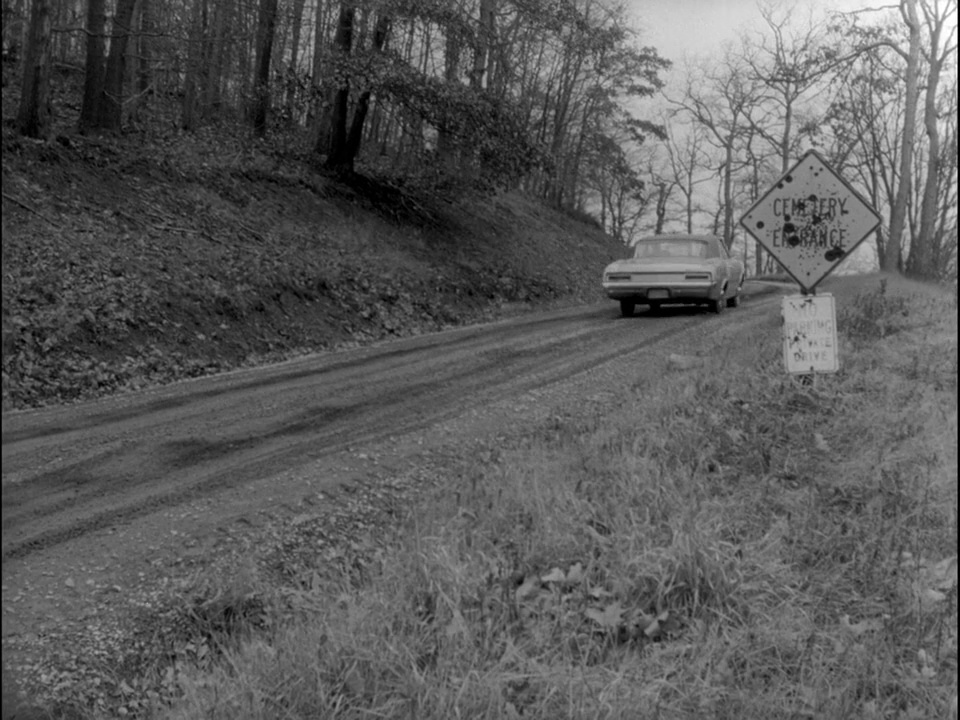
Romero did not just bring to life the zombie hordes, but also very many cannibal movies owe a debt to him, as do “splatter” movies generally. The simple opening scene of a couple of siblings driving across the desert to visit their father’s grave was later replicated to some extent in The Texas Chain Saw Massacre, and The Hills Have Eyes. And of course many, many zombie movies and TV shows have followed in the shuffling footsteps of this one. Without Night of the Living Dead, there is no Walking Dead.
The story revolves around a group of people sheltering in a farmhouse in western Pennsylvania, which is under assault by a growing crowd of cannibalistic, undead corpses. The phone doesn’t work, which is annoying, but the radio and even the TV are fine, which is useful as a dramatic device to fill us in on what’s going on.
The radio reports that they are:
“things that look like people but act like animals.”
The horror of this film seems so much greater by their ordinariness (although the low budget may have had something to do with it). Cannibals are often described as acting “like animals”, but of course, we are all animals, great apes, and cannibals are just as likely to be accused of treating their prey “like animals.” Ordinary people, animals, fall down when shot, but the horror of these undead is their invincibility. It’s hard to kill someone who is dead, and has just risen from the grave. Shoot them in the chest and they fall over and then get up again and keep coming. They can however be shot in the brain or walloped on the head or burnt, so we are not left without hope.
But there are other dynamic binaries – heroism and cowardice, fire and fuel, shelter and intrusion, eater and eaten, and a scene where an infected girl within the boarded up house eats her own parents, and an undead brother returns to eat his sister. In two short scenes, Romero takes Freud’s insistence that cannibalism and incest are the two original prohibitions of mankind, and merges them into incestuous cannibalism. The film comprehensively problematises the narrative of humans vs monsters. We are all hiding in our houses, terrified of the latest headline, and we are also all members of the monster horde.
The protagonist is Ben (Duane Jones), an African-American hero, which in itself was rare in the sixties. Romero says Jones was chosen just because he gave the best audition, but the dynamic he brings, particularly in the inter-relationship battles inside the house, where he insists on being boss, and of course in the climax, took the film into the heart of darkness that was 1968 America. As the ghouls lurched toward the house, the Vietnam war was raging, students and police were battling on the streets of Chicago outside the Democratic Party convention, Martin Luther King and Bobby Kennedy were gunned down, and in Paris revolution was in the air.
But it’s not “all right”. The racism issues raised by the film further complicate the dichotomy between human and ghoul; human and, well, inhuman. Because when the authorities arrive, they are basically a vigilante mob killing ghouls with a random collection of guns, and building bonfires to dispose of the corpses. When they see a black man – will they recognise him as a real, live human? Well, no, Ben has made it through the night, surviving the attack of hundreds of the ghouls, only to be shot through the head by a police sharp-shooter as he emerges. The film ends with grainy images of him being pulled from the house with meat-hooks and burnt with the corpses of the again-dead, and the pictures are unmistakably reminiscent of photos taken at lynchings.
The review from the Pulitzer Prize-winning movie reviewer, Roger Ebert, sums up the response to the movie at the time. This was written after he had watched the movie in a cinema filled with kids, who had been dropped at the cinema, unaccompanied, for an afternoon of fun scary time.
The movie had stopped being delightfully scary about halfway through, and had become unexpectedly terrifying. There was a little girl across the aisle from me, maybe nine years old, who was sitting very still in her seat and crying. I don’t think the younger kids really knew what hit them. They were used to going to movies, sure, and they’d seen some horror movies before, sure, but this was something else. This was ghouls eating people up — and you could actually see what they were eating. This was little girls killing their mothers. This was being set on fire…
The movie has 98% on Rotten Tomatoes, with the Chicago Reader summing up:
Over its short, furious course, the picture violates so many strong taboos — cannibalism, incest, necrophilia — that it leaves audiences giddy and hysterical.
Interestingly, the movie was removed from Netflix in Germany, following a written demand from the German Commission for Youth Protection.
“Banality of evil” is a phrase coined by Hannah Arendt in her report on the trial of Adolf Eichmann, the Nazi organiser of the death camps in which millions died. What shocked Arendt was that, while it would have been comforting to find that Eichmann, one of the most pivotal figures in the Holocaust, was a monster, in fact she found him “terribly and terrifyingly normal”.
This is the crucial difference between the early cannibals of Herodotus or Columbus and the ones inside our cities after 1888 (the year of Jack the Ripper). They don’t look that different from us. They are men and women, young and old, dressed and naked. We can no longer tell them for sure from our next-door neighbours.
The ghouls of Night of the Living Dead are human but dehumanised. They are dead, but still walking and eating, and the dead and the undead all burn in the same fire. In fact, the ghouls are us, filled with rage at the fact of our mortality, but they don’t look that dissimilar from people you might be standing next to at a political rally.



















 The Cannibal Guy