A 31-year-old man is in custody on suspicion of killing a man and eating parts of the victim’s face last weekend at East Charleston Boulevard and 3rd Street Las Vegas.
The Las Vegas Metropolitan Police Department released this report:
Police advised that the alleged perp, Colin Czech, had “biological matter in his hair, mouth, and on his clothing.” “Biological matter” is a euphemism for blood, flesh and other bodily substances.
Czech reportedly claimed the victim had attacked him. Police said the victim, identified as Kenneth Brown, was bleeding from head wounds and one of his eyes was missing. He was transported to the hospital, where a doctor pronounced him deceased.
During an interview, Czech allegedly said he was homeless and had been awake for several days because something was “possessing him.” Reports say Czech told detectives he “used his teeth to eat the victim’s eyeballs and ears.”
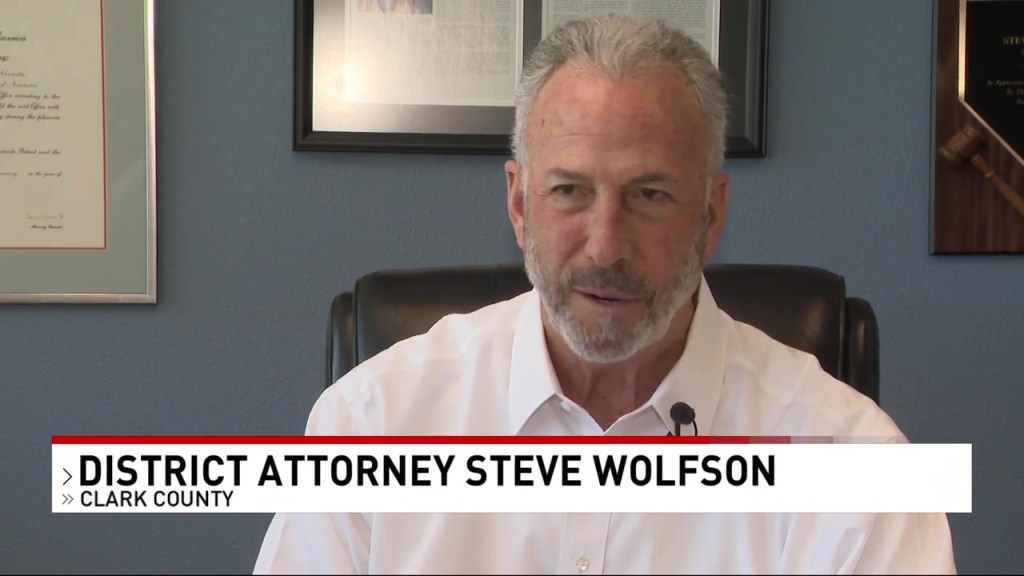
Police booked Czech into the Clark County Detention Center in absentia on a charge of open murder. Clark County District Attorney Steve Wolfson said it was one of the most unusual cases he has ever seen in more than 40 years as a defence attorney and prosecutor. He says the competency of the defendant will no doubt be addressed, adding “It is not uncommon for some of these cases to take years. Sometimes people never become competent.”
Czech was set to appear in court on Monday, April 29, but was hospitalised. In his eventual court appearance, he appeared dazed and uncomprehending.
Eating faces is not unknown in the annals of Cannibal Studies. In 2012, Rudy Eugene, “the Causeway Cannibal”, bit off the face off a homeless man in Miami, Florida before being shot to death by Miami police. In Wales in 2014, Matthew Williams lured a young woman back to his hotel room and began eating her face, apparently under the influence of amphetamines. Williams had been released from prison just two weeks before the killing and was described by police officers as “demonic”. Again in Florida in 2016, Austin Harrouff killed a couple he didn’t know and chewed off a victim’s face. He was found not guilty by reason of insanity.
Why all the faces? There is not much flesh on a face, yet it is considered a delicacy in some cultures. In the movie Eye without a Face, the protagonist watches on a hacked computer camera as a woman prepares a Persian dish called kale pache, literally “head and hooves”. It’s usually from a sheep, but whose head is it this time? Is she a cannibal serial killer? No spoilers here – you’ll have to watch it to find out.
Meanwhile, back in California, the man this blog reported on a few weeks back who found a human leg on the street in Bakersfield and started chewing on it has been sentenced to one year in jail in a Kern County courtroom. With good behaviour (and eating all his veggies?) he could be out in a lot less than that.
Under the dominant ideology of anthropocentrism or “speciesism”, buying the head or leg of a sheep for consumption is considered perfectly legal, if a bit quirky (or repulsive to some), yet eating a human face is headline material. But is there really that huge a difference between two species of mammals?
Long Pigs is a 2007 “found footage” movie, in which two desperate filmmakers come across a cannibal, ask him if they can document his eating habits, and then are shocked when he starts killing people and eating them. It is presented as a documentary, with all the usual warnings about graphic scenes etc.
Bit silly, and found footage has rather been done to death, but it has some interesting ideas, particularly the sympathetic approach to the main character, even as he commits his crimes. Look, it seems to say, everyone needs a hobby and, to this cannibal, killing and eating people is no more ethically questionable than hunting or fishing. Stalk, catch, kill (as quickly and painlessly as possible) and then enjoy. He does his best to keep the movie interesting, with a patter of jokes, historical facts and philosophical observations as he slices and dices.
The cannibal is played by Anthony Alviano (Headcase, A Matter of Justice), and he presents the cannibal, also called Anthony, as a boy-next-door persona, one who kills and guts people. Like a farmer of animals, he starts the film explaining that it’s bad to frighten the victims, not for ethical reasons, but because the adrenaline ruins the taste of the meat. The filming starts as he drives around looking for a “certain kind of woman”, because he wants to make “long pig stew”. “Long pig” is a term supposedly used in the Pacific region before colonisation to designate human meat, although that definition is widely contested. Anyway, Anthony is looking for “marbled meat”, so he searches for a sex worker (traditionally victims who are not exhaustively looked for by police) who is, let’s say, of a heavy build.
“People who eat stew make perfect stew. It sounds obvious. Yeah, she looks like she eats well.”
As she smiles at the camera, he sneaks up behind with a sledgehammer and cracks her skull, resulting in the cameraman vomiting (which is actually rather more gross than the murder). They ask Anthony if gets a sexual thrill from killing women, but he dismisses this, in the same way a slaughterhouse worker might deny any pleasure in killing a different species of mammal.
“I’m not a freak or anything like that. This is all culinary, this is hard work!”
“Any hunter would recognise this position. We got the corpse hanging by the ankles. The first thing I’m gonna do here is make a little incision and tie off the anus. That’s to stop contamination from the feces. You would do that whether it was a deer carcass or a cow or a person… Absolutely necessary for health reasons.”
He cooks a stew from a portion of her thigh, then after dinner goes off to brawl in an ice-hockey game, an arena that seems the very essence of carnivorous virility.
Afterwards, he cooks ribs on a barbecue, assuring the viewers that there are “no animal by-products” used – just soymilk. And a woman’s ribs, of course, thus reinforcing the anthropocentric mythology of the human as not really animal, even though he has just butchered one in the same way as any other animal prepared for human consumption. He quotes the Arawak word barbaca, the grill on which human meat was supposedly cooked, according to explorers like Hans Staden and Jean de Léry, which became the Spanish word barbacoa, and eventually morphed into English as barbecue. Staden’s narratives were later illustrated by Theodor de Bry in his 1592 book Americae Tertia Pars, and the film sneaks in a quick peek at that glimpse of sixteenth century sensationalism.
There’s a lot of moral philosophy interwoven in the scenes of murder and gastronomy. Anthony the cannibal and his friend try to persuade the filmmakers to try some of the ribs, saying, it’s dead, and therefore cannot suffer, whereas we eat live vegetables, and “broccoli feels pain! Did you know that?” This is precisely the argument tossed at vegans by carnists, but in this case, it demonstrates the contention of the nutritionist Herbert M. Shelton:
The cannibal goes out and hunts, pursues and kills another man and proceeds to cook and eat him precisely as he would any other game. There is not a single argument nor a single fact that can be offered in favor of flesh eating that cannot be offered with equal strength, in favor of cannibalism.
Anthony works as a valet in a fancy restaurant, parking cars for rude people, and if you follow the lore of Hannibal Lecter, you will know that rude people are prime targets of cannibals. They park the car of a particularly rude man, take down his address from his licence and, next day, shoot him and load him in their car trunk. Unfortunately, they have a flat tyre and have to head to a pig farm for help, where they witness pigs being slaughtered and prepared for sale, in identical ways to Anthony’s own processes, but with rather better technology, and, oh yes, totally legally.
Most of the film is a spoof on cooking shows, which regularly have smiling chefs, or hopeful chefs, preparing lumps of animal flesh, hoping to win prizes. Anthony shows, in high-speed motion accompanied by the music of the Sugarplum Fairy, exactly how he prepares a body, stripping it and dismembering it until all that is left is two feet (still in socks) and the long femurs. He demonstrates how to get rid of the bones, cutting them up and putting them in a kiln at 2600 degrees – he even uses the line “these are some we prepared earlier.” This is a cooking show for cannibals.
Anthony is a typical modern cognate cannibal; as he says, people expect Hannibal Lecter, so “no one is going to suspect the valet”. This gives him the invisibility that we saw in cases like Jeffrey Dahmer. He loves his old mother who is in a nursing home, and is bewildered by a doctor’s request to do a post mortem analysis brain when she dies, a sophisticated update of cannibalism. He sadly tells the filmmakers that she has Alzheimer’s, but we eventually find that she died of Creutzfeldt-Jakob spongiform encephalopathy, a human version of mad-cow disease, probably from eating human meat that he fed her. He also admits to eating a five-year-old girl called Ashley, because people prefer meat from young animals, but was subsequently perturbed by the extensive police searches, and now avoids playgrounds and schools: “It’s like a supermarket, man.” As New Year celebrations explode outside, he comes to realise the filmmakers are going to release the movie, which will detail all his criminal history, and goes to get his sledgehammer. The rest, as Shakespeare says, is silence.
Anthony has a philosophy that rejects anthropocentrism and sees nothing wrong with cannibalism, or at least nothing that does not apply to any other meat. It’s a cannibalistic rejection of what Richard Ryder and later Peter Singer called “speciesism”.
“It’s only human beings that are so arrogant that they believe they are better than every other kind of animal out there. Worms don’t think about, you know, oh my god, why did mama worm get eaten by a fish; fish eats the worm and that’s that, it’s completely accepted by the worm, and the fish, and small fish gets eaten by the big fish, and if it was so wrong to eat it, then why would it taste so good?”
At the end, he is in jail, but he has published a cookbook. His cooking show has finally paid off.
This is a low-budget film, but is a lot better than might be expected. The creators were lucky enough to secure the services of Chris Bridges, the special effects artist whose credits include the Dawn of the Dead remake, Saw III & IV, 300 and Star Trek Discovery. Unless they actually killed and dismembered people, the result is spectacularly authentic. Anthony Alviano is brilliant in the role, which was written with him in mind.
The full movie (although slashed drastically from 81 minutes to 56 minutes) can, at the time of writing, be seen at https://youtube.com/watch?v=vnGXBRkxXuo.
I guess it was only a matter of time before cannibalism became part of the culture wars. A light-hearted article in the New York Times July 23 by freelance writer Alex Beggs looked at the undeniable plethora of cannibalism narratives in contemporary movies, TV series, books and news reports, including the TV series Yellowjackets and the recent novel A Certain Hunger by Chelsea Summers, in which a (female) restaurant critic develops a taste for (male) human flesh. The article asserted:
“Turns out, cannibalism has a time and a place. In the pages of some recent stomach-churning books, and on television and film screens, Ms. Summers and others suggest that that time is now.”
Alex Begg has also written for Bon Appétit magazine, making her well qualified to write about food, of whatever provenance. Cooking shows are full of lumps of meat being baked and braised and broiled and smothered in sauces; why not add humans to the livestock list? There certainly are billions of us.
The appearance of cannibalism in secular culture reflects the fading of traditional morality. As Dostoevsky warned in The Brothers Karamazov, without a belief in “immortality” (implying divine judgement), “everything would be lawful, even cannibalism”. Our reflexive distaste for cannibalism (and our fascination with it) comes from the belief that humans are somehow not animals, or animals that have transcended animality – it all comes back to the Biblical statement that we are made in “the image of God”, whatever that means.
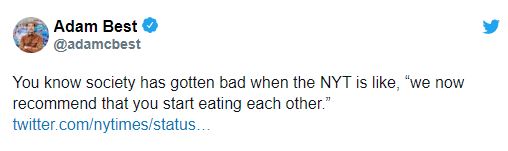
Such a belief, with or without support from on high, is called anthropocentrism, or sometimes speciesism, and is maintained by the practice of killing other animals in ever increasing numbers, to prove our superiority. Jacques Derrida called that “carnivorous virility”, but what happens when the lust to kill outruns the limits of anthropocentrism and is instead turned back on fellow humans? We have people who see humans as just another edible species, like Sawney Bean, Sweeney Todd, Albert Fish, Ed Gein, Jeffrey Dahmer and of course Hannibal Lecter. Not all of those were real people, and not all the facts about the real ones are real facts, but one fact remains: humans are animals, and animals are made of meat. When a society reaches a point where the old ethical agreements are disintegrating, it can either forge new ones or dissolve into chaos, war and, yes, cannibalism. At a time when the news is full of pandemics, climate change, famine, school shootings and political turmoil, is it so surprising that cultural representations show us eating each other?
Did I mention culture wars? Those who despise the New York Times (a certain and fairly large section of America apparently) came out with their anti-cannibalism guns blazing (they like guns, love meat, don’t like cannibals – it does seem a little inconsistent.)
“It’s a sign that our culture and civilization has become so decadent, so enamored by sensation, that we actually fetishize eating death…. We now live in a Culture of Death, in which we regard books, television, and film drama about the eating of human beings as pleasurable, as exciting.”
On Twitter, reactions poured in such as that of writer Emmanuel Rincón:
Zack Kanter tweeted
“A zero sum worldview, irrational fear of overpopulation, and hatred of success will inevitably lead NYT journos to the literal conclusion of ‘eat the rich.’”
Journalist Tom Fitton tweeted
“NY Times, taking a break from promoting the mass killing of the unborn through abortion, promotes cannibalism.”
Many had clearly not even bothered to read the article:
And a blessedly brief journalist, Sameera Khan, tweeted
“THIS IS SATANISM”
Greg Gutfeld on his high rating Fox talk show (if you haven’t seen him, imagine a fairy waved a wand and turned The Colbert Report into a real boy) took the opportunity to pack every cannibal pun imaginable (“it’s an ATE part series”) into a short segment, as well as several digs at other shows run by Liberals such as Samantha Bee, and their regular target, CNN. Gutfeld accuses comedian Tom Shillue (formerly of The Daily Show!) of thinking he would be delicious, because he is all white meat.
The gist of much of the criticism was that the Liberal elite are trying to normalise cannibalism, as a way to – what? Reduce overpopulation? Feed the hungry? The website Editorials 360 accuses a “globalist cabal” of planning to make us all eat insects and humans, and drink recycled sewage, a fiendish plot “to enslave, denigrate and dehumanize humanity.”
The website TMZ recalled that the movie Soylent Green was set in 2022, which was then fifty years in the future, but is now, well, now. Are we in fact normalising cannibalism, because it is the logical end-point of voracious consumerism?
Soylent Green is a good place to start the analysis of this “normalizing” phenomenon. Even after fifty years, it is still the movie many people name when cannibalism comes up in discussion (as it seems to do quite a lot whenever thecannibalguy is around). The movie [spoiler alert] was set in 2022 New York, which is portrayed as part of a failed state, in which overpopulation and global warming has led to a chronic shortage of food, leading the authorities (secretly) to grind up humans who have died (or agreed to be euthanised) and convert them into nutritious protein crackers called Soylent Green. Setting it in 2022 was a bit pessimistic, but let us remember that the world’s human population has almost doubled since the movie was made fifty years ago, and that CO2 concentration was 330 parts per million in 1973, compared to around 420 now. Are we entering a time when our voracious consumerism will so deplete the planet that, as Cormac McCarthy suggested, the only thing left to eat will be each other?
Chelsea Summers put it in a political context, relating cannibalism to capitalism:
“Cannibalism is about consumption and it’s about burning up from the inside in order to exist.”
“Cannibalism is the extreme conclusion of the idea that humans – and their bodies – do not have inherent value that demands respect. American society has been traveling down this philosophical road for a while. It started with legalizing abortion: After Roe v. Wade in 1973, any baby born or killed was just a “choice” at the mercy of their parents. They were not recognized as having inherent value with rights to their body or their life. More recently were the mandatory lockdowns, mask wearing, and vaccinations for Covid-19. Again, a lack of respect for human bodies and for our ability to make decisions for ourselves occurred. The encroachment on human dignity could potentially continue to progress into cannibalism – where the bodies of others have no inherent meaning, value, or sacredness that separates them from the animals we do rightfully and naturally eat.”
Lots of problems with that explanation, not least no attempt to explain the “inherent value” of humans or the assumption that we can eat other animals “rightfully and naturally.” But it is a pretty good summation of the unexamined assumptions at the heart of most writings on cannibalism, or carnivorism, or vivisection, or hunting – the idea that humans are somehow more than animals, and less than edible, while every other species on the planet is stripped of all moral value.
However, talking about cannibalism can put people off the slaughter treadmill altogether. When fact checkers came to ask Chelsea Summers about the way the book’s anti-heroine gastronomically prepares her murdered lovers, their questions about the intricacies of human butchery so disturbed her that she went “full raw vegan for two weeks.” Tobe Hooper gave up meat while making The Texas Chain Saw Massacre, saying “the heart of the film was about meat; it’s about the chain of life and killing sentient beings”. He also claimed that Guillermo Del Toro, no shrinking violet himself in abject filmmaking, gave up meat after seeing it. Bryan Fuller, creator of Hannibal, gave up eating meat during filming of the first season, telling Entertainment Weekly he had been:
“writing about cannibalism for the last three years but also doing considerable research on the psychology of animals, and how sophisticated cows and pigs and the animals that we eat actually are.”
Shows like Hannibal and The Santa Clarita Diet show human flesh as “just meat.” But to do that, they have to (their legal departments insist) come up with ways of simulating the human flesh without actually killing people (or digging them up like Ed Gein). The Yellowjackets prop team chose to use venison (think Bambi). But, the showrunners warned,
“they’ll have to find an alternative for future episodes, because many in its cast are vegan.”
Portrayals of cannibalism, whether actual or fictional, can make some people hungry, and turn others against eating flesh.
Gutfeld points out that:
“In the mind of the NY Times, it’s probably more humane to eat a human being than an animal.”
By “animal”, Gutfeld presumably means every multicellular, eukaryotic organisms in the biological kingdom Animalia except one – Homo sapiens. We know we are a species of great ape, but spend much of our time pretending we don’t know that.
Being humane, being ethical, is largely about respect and consent. Which was precisely the defence offered by Armin Meiwes when arrested for eating a man who had made it very clear he wanted to be eaten. Cannibalism texts, in ever-increasing numbers, joyfully confound the human/animal divide, and show the human body as edible flesh. So it is not surprising that such questions will be raised, and that, as the NYT said, “that time is now.”
However, Ted Cruz, who likes cannibalism jokes as much as the next meal, came up with a brilliant two-word solution that will put people off human flesh for a considerable time:
Back in 2009, fifteen years after the end of apartheid, South Africa seemed to be the obvious place to make movies that offered clear metaphors about racism and xenophobia. Today, they’d probably be filmed in Minneapolis, but nonetheless, after more than ten years, this movie works just as well, perhaps even better in this time, when people have to fight for their lives against both racism and an invasive disease.
DISTRICT 9 is directed by Neill Blomkamp and produced by Peter Jackson (yes, that Peter Jackson), and set in Johannesburg, South Africa. It is presented as “found footage” – fictional news stories, CCTV and interviews. District 9 is an internment camp for aliens – not from across the border or across the ocean, but across the universe. A giant UFO hovers above the city showing no signs of life, and when the authorities cut their way inside they find it is full of diseased and starving aliens, who look, as Roger Ebert said, like two metre tall lobsters. They are brought to land and housed in a secure area – District 9 – where they recover, and cause havoc with their love of wrecking stuff and eating lots of cat food.
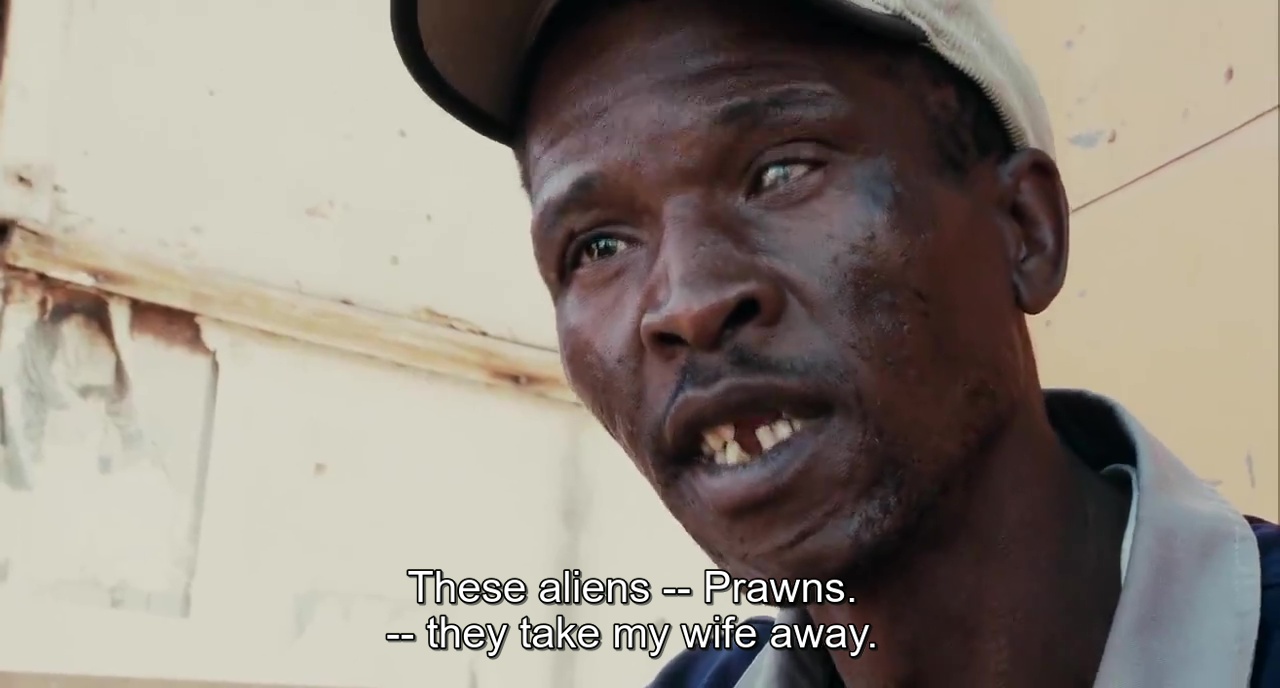
Yes, it’s not without humour. There are “interviews” with people of different races, all saying that these aliens – now known universally as “prawns” – should be sent home or else taken out of the city, away from human contact. Resettlement camp, detention centre, ghetto – those who are different can be separated with just some pernicious circumlocution.
The movie follows Wikus van de Merwe (Sharlto Copley), a naïve and nerdy mid-level executive in a huge multi-national corporation called MNU (it stands for Multi National United), which supplies mercenaries for just such situations.
Wikus heads off with his army and a clipboard, believing that he is going to knock on doors and ask the “prawns” to agree to be moved to a new camp, whereas of course the whole process is aimed at intimidation and terrorising of the populace.
Searching one building, he finds a tube of alien fuel, which they have been synthesising for twenty years, planning an escape. He opens it, and it sprays all over him.
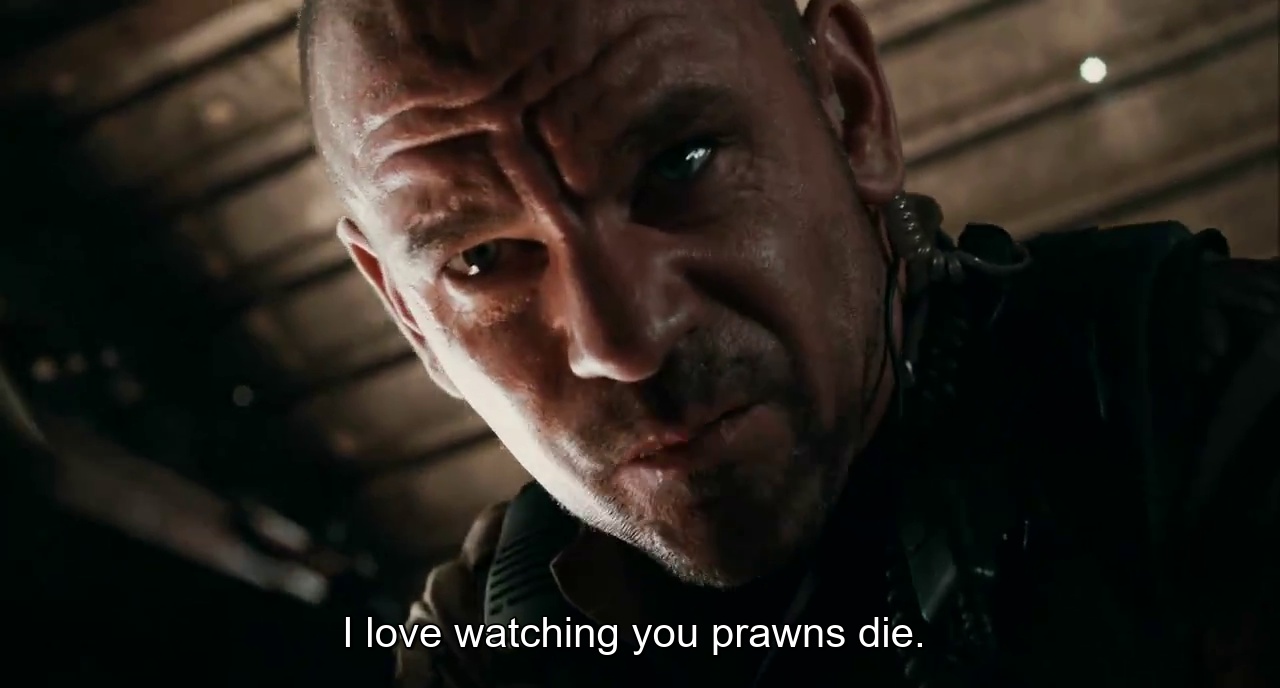
Soon, he starts metamorphosing into a “prawn” – his hand turns into an alien claw, and his teeth and nails start to fall out. This is obviously a big problem – actually two. First, his company, MNU, wants to cut him up and study his organs, desperate to learn how to transmute others, because the aliens have immensely powerful weapons that will only operate in the hands of someone with alien DNA. He escapes back to District 9, pursued by the sadistic head of the corporation’s private army, who personifies white supremacist violence.
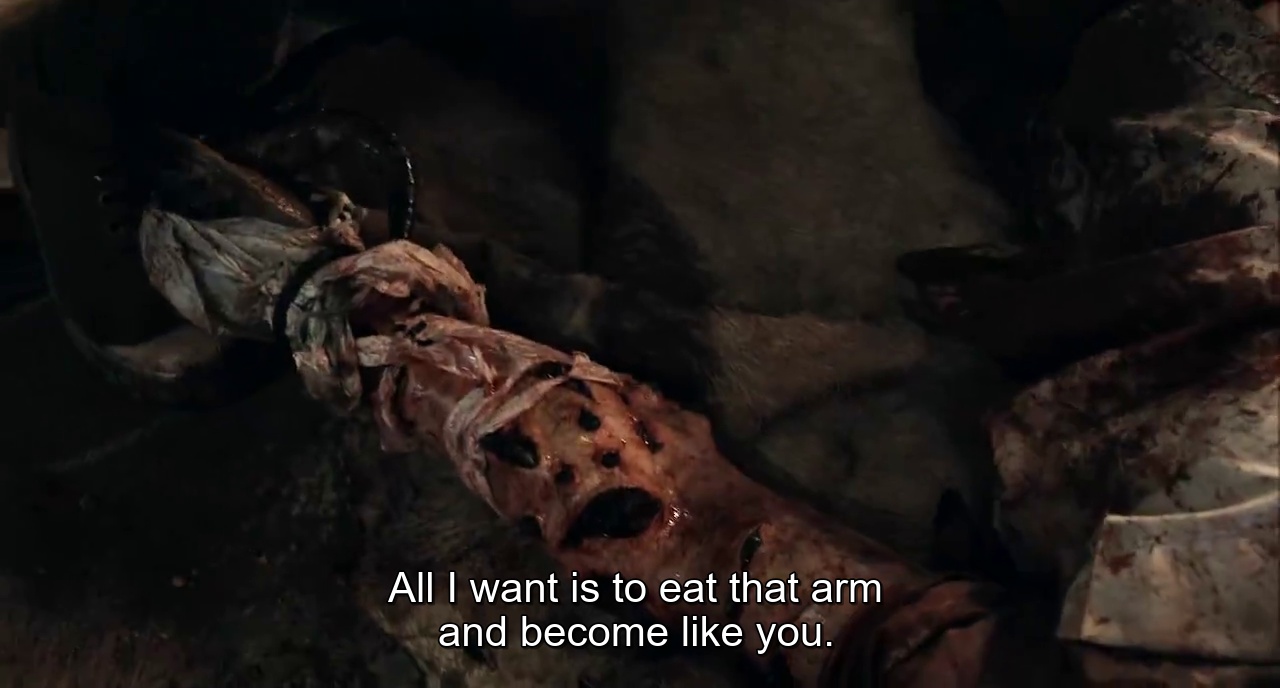
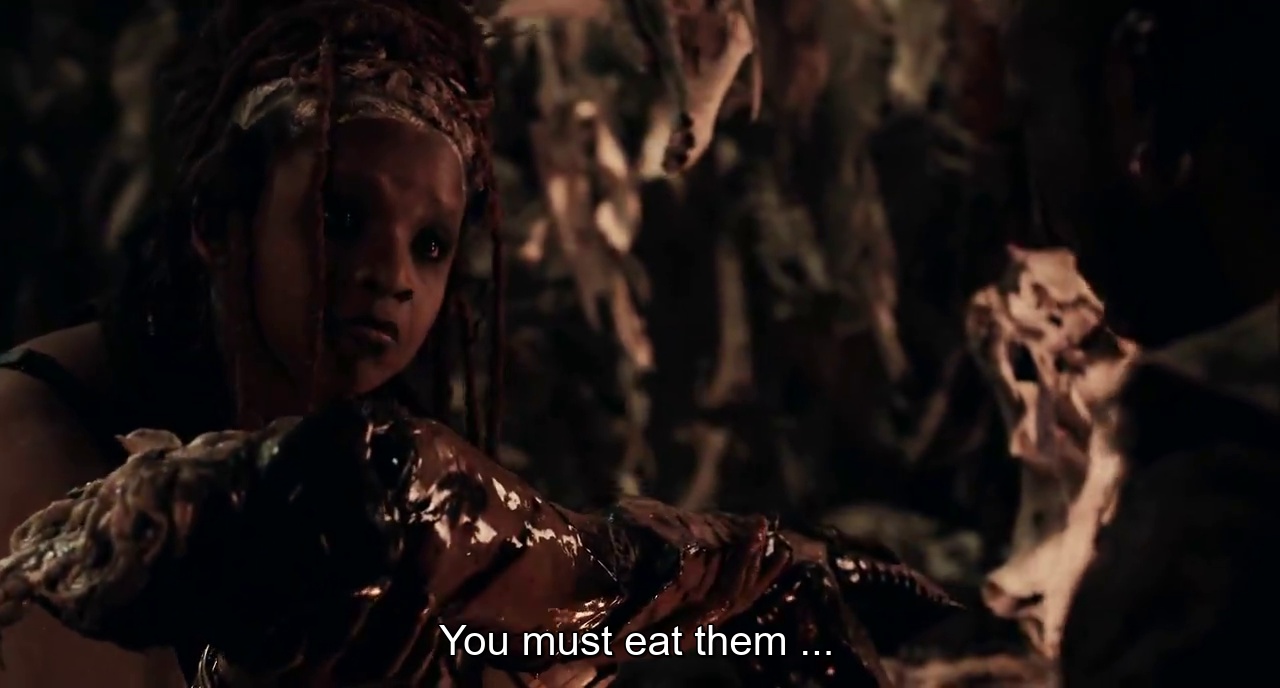
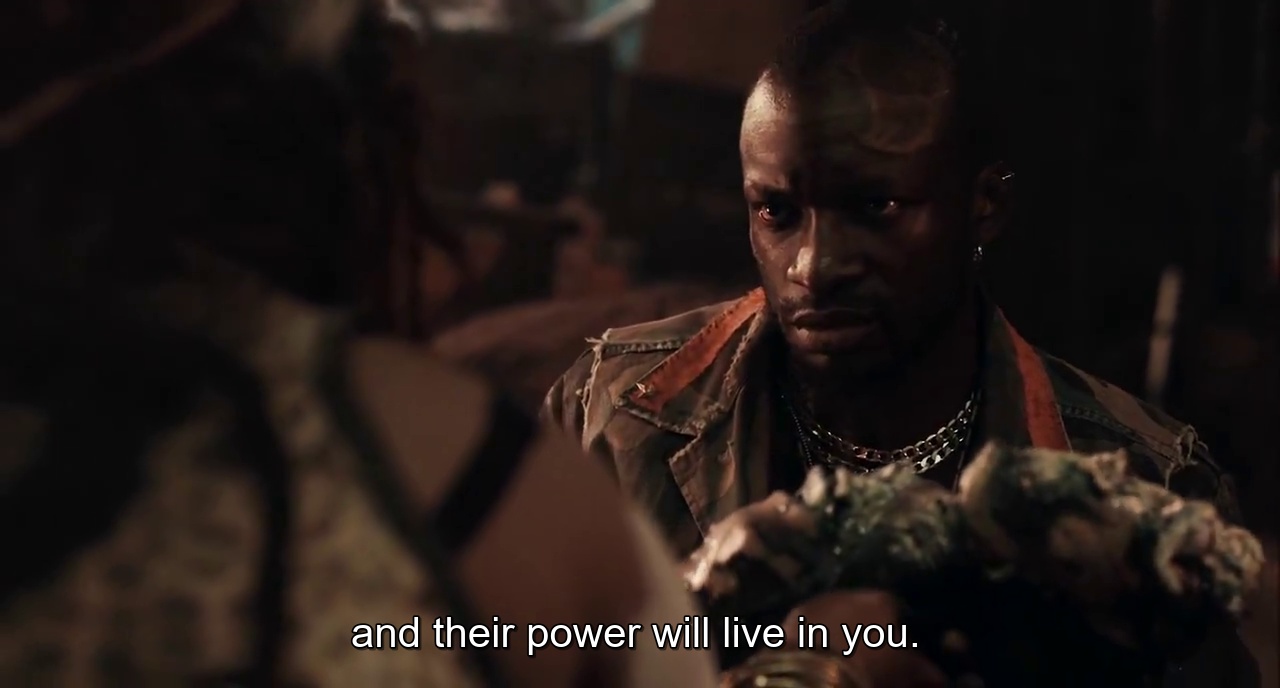
Back in District 9, Wikus is captured by a Nigerian criminal gang, who make their fortune from the aliens, selling them cat food, and offering interspecies prostitution (delicately presented). The Nigerians’ leader, whose name is taken from that of a former President of Nigeria, also wants to control those weapons, and believes eating Wikus’ arm will make him part alien as well. Why not just eat a prawn? Oh, they’ve tried that.
The trope of cannibals taking on the strengths of those they eat has been around pretty much forever. It is used to explain both mortuary cannibalism, where the strength of the ancestors is passed to the descendants through their flesh, and also aggressive cannibalism where the legs of the fastest enemy, or the testicles – you get the idea. It revolves around the idea that “you are what you eat”, but if you believe that, well, what does that say about the trolls who love to write “But BACON!” on vegan social media sites?
The film was shot around Johannesburg, and the squalid hovels shown were in an area of Soweto that was being demolished and the people relocated. The story is based on the true case of District Six in Capetown, where 60,000 inhabitants were forcibly removed during the 1970s by the apartheid regime. But finding a parallel story of forced removals of oppressed populations would not be difficult in most of the world’s nations. A reviewer wrote in an article entitled “District 9 reveals human inhumanity”:
“Substitute “black,” “Asian,” “Mexican,” “illegal,” “Jew,” or any number of different labels for the word “prawn” in this film and you will hear the hidden truth behind the dialogue, echoing what we historically as a species are all too capable of doing.”
Several different facets of cannibalism are presented in District 9. The Nigerians eat “prawns” – is that cannibalism, or if not, what about their plan to eat Wikus as he transforms into a prawn? The big corporation is only interested in the billions of dollars that will come from working out how to operate the alien weapons, and are ready and willing to sacrifice Wikus and use his body parts in pursuit of this goal. The aliens are tall and powerful (pulling people limb from limb in a few scenes) and look a bit reminiscent of the creatures from the Alien movie franchise, even though they don’t eat each other or the humans; but they are keen on meat from other species like pigs and goats and whoever ends up in the slurry called cat food.
The formal definition of cannibalism tries to restrict the definition to humans eating humans, but it is always leaking out the sides. What we see in this film is the way that anyone can be abused, objectified and even eaten if they can be reclassified as inhuman or subhuman. Wikus starts the story happy to burn down shacks full of alien eggs, enjoying the sound of the eggs bursting, which sounds like popcorn. Captured by the corporation and made to operate alien weapons, he is happy to destroy pigs but begs not to be made to shoot the aliens. Later, turning into a “prawn”, he is more than happy to use the alien weapons to blow apart various soldiers of his former employer, to protect the prawns. The irony of this film is that Wikus, who is a fully carnophallogocentric human in the terms used by Derrida (“adult white male, European, carnivorous and capable of sacrifice”), only finds his humanity when he begins morphing into something else and becomes one of the outsiders he previously disdained.
It’s well worth seeing – if you don’t dig the message, then there’s plenty of action scenes, car chases and explosions. Some unintended explosions after the movie, too, when the Nigerian Information Minister asked cinemas to ban the film because it depicted Nigerians as criminals and cannibals. Not the first time white people have applied those epithets against Africans, and the film also scored a mention in Salon’s list of “white saviour” movies, since Wikus is white, and desperate to remain so. But the Malawian actor, Eugene Khumbanyiwa, who played the gang leader, said that the Nigerians in the cast weren’t bothered: “It’s a story, you know. It’s not like Nigerians do eat aliens. Aliens don’t even exist in the first place.” Sensible, but not a great look for a film that is slamming racist stereotypes through the metaphor of speciesism.
The direction is adroit and the story buzzes along with never a dull moment. The acting is first rate, even the guys in the alien suits become sympathetic characters, and the special effects are first rate. The film has a 90% “fresh” rating on Rotten Tomatoes. It’s available on Netflix.



















 The Cannibal Guy