Cannibalism news July 2023: Two men arrested for eating partially-cremated human flesh

Two men in Odisha (eastern India, formerly known as Orissa) have been arrested and accused of cannibalism after locals found them eating half-burnt flesh from the body of a woman who was being cremated at a funeral in Mayurbhanj, Odisha. 

The incident happened in a tribal village called Bandhasahi. The accused were identified as Sundar Mohan Singh, 58, and Narendra Singh, 25, both from Dantuni village. The deceased woman was identified as Madhusmita Singh, 25, who had died in the Bandhasahi village hospital. The family took her body to the cremation ground and performed the last rites. In Hinduism, the preferred way of disposing of the dead is Antyeṣṭi (अन्त्येष्टि), a composite Sanskrit word of antya and iṣṭi, meaning “final sacrifice.”

The two men, who were said to be drunk, were overseeing the proper burning of the body. As the cremation progressed, the body had been burnt almost entirely to ashes, except for a single unburnt piece of flesh. Mohan and Narendra claimed that it wouldn’t burn unless it was cut into smaller pieces and then thrown back into the fire.

Lobo Singh, the grandfather of the deceased girl, watched the men pull the unburnt flesh out of the fire. Narendra proceeded to divide it into three pieces, with Mohan tossing two pieces back into the flames. However, Lobo Singh said he witnessed Mohan concealing the remaining piece in his left hand, He questioned Mohan about this, to which Mohan casually replied that he would discard it later.

The woman’s uncle said that, when he asked them what they would do with the flesh, one of the accused, Sundar Mohan Singh, replied, “You don’t know about witchcraft.” After around 10 minutes, he announced that he would eat the piece of flesh. Before the others could do anything, Mohan put the piece in his mouth and began chewing it; he also offered a portion of flesh to Narendra, who also commenced eating it. 

The villagers caught and beat the accused duo, tied them up in rugs, and informed the local police. Both accused admitted committing the crime, claiming that they had consumed the flesh in an inebriated condition. They were charged under section 297 of the Indian Penal Code. Senior police officer Sanjay Kumar Parida stated that the accused were arrested based on the complaints of the villagers, but no trace of human flesh was found on them. Further investigation into the case continues.

This sort of phantasy, that eating human flesh will give the eater special powers, is not uncommon in Cannibal Studies texts; essentialist speculations that some part of the ‘donor’ remains imbued – such as the courage embodied in the brave enemy’s heart or strength in his or her limbs. Brigid Brophy, one of the seminal voices in the animal justice movement, called this “the primitive superstition that eating the flesh of bulls endows you with the strength of the bull”. Even Freud seemed to have subscribed to such thoughts, claiming in Totem and Taboo that the birth of civilisation occurred when a group of young prehumans came to resent their father’s monopolisation of the tribe’s females (common among primates) and rose up, killing the father to take their mothers and sisters for themselves. “Cannibal savages as they were, it goes without saying that they devoured their victim as well” and, Freud added, as well as the protein they ingested from the fresh meat, the brothers would each have “acquired a portion of his strength”. Freud went on to speculate  that their sense of remorse created the first ethical basis for civilisation, which seems rather far-fetched, and there is no evidence that the Singhs, even when they sober up, will be creating a new form of civilisation in Odisha. Although, to counter my obvious scepticism, there are reports that Armin Meiwes, currently in prison in Germany, allegedly claimed that, after he ate his bilingual lover in 2001, his own English improved considerably. We absorb the nutrition of our food, why should cannibals not absorb the strength, spirit and experiences of their victims?

The Orissa Post called the incident “extremely rare”, but this blog has reported on similar incidents in the past. In Assam in 2022, another inebriated man found edible flesh within the cremation flames.

In 2019, The Global Report on Food Crises estimated that there were some 135 million “acutely food-insecure people in crisis or worse”, including 17 million acutely malnourished children under 5 years old. The changing climate, or future pandemics, could easily double that number, leading to what the head of the UN’s food relief agency warned could be “a famine of biblical proportions”. Globally, over a million people die each (normal) week, many of them still covered in healthy flesh; if human meat is similar to that of other animals, why not let those who are starving eat some of the corpses, at least those who are minimally diseased? Is an agonising death by starvation less abject than eating human meat? And if, as most societies (not including Hindus) seem to believe, it’s OK to eat animals, and humans are animals (a species of Great Ape), then from carnivory to cannibalism is only a very thin red line.
“Reports of widespread cannibalism” – NO BLADE OF GRASS (Cornell Wilde, 1970)

Cities are locked down, citizens are trying to escape from a deadly virus, food is rationed, rumours abound of dark government plots to kill off sections of the population. No, it’s not a COVID-19 movie but a speculative fiction film from over fifty years ago. From the trailer (above):

“Mankind destroyed what made most of the world liveable. Nature – wounded, diseased, and enraged – took revenge on her murderers. She cut off their food supply, and then waited, while they consumed each other.”

Yes, it’s a cannibal film based on a cannibal book, and its premise is the human war against nature, the way victory inevitably turns into defeat, and then perhaps extinction. The book it was based on, The Death of Grass by John Christopher, came out in 1956, which makes it quite prescient, and a bit of a shame more people didn’t read it back then, when carbon dioxide levels were 314 parts per million, compared to today’s 422ppm. Here’s a quote from that book:

“…he could no longer believe that there would be any last-minute reprieve for mankind. First China, and then the rest of Asia, and now Europe. The others would fall in their turn, incredulous, it might be, to the end. Nature was wiping a cloth across the slate of human history, leaving it empty for the pathetic scrawls of those few who, here and there over the face of the globe, would survive.”

Those who did take it seriously were film-makers like Ray Milland, who made Panic in Year Zero! in 1962 with a very similar plot, and this one, No Blade of Grass, an adaptation of Christopher’s book made by the acclaimed American actor turned director Cornell Wilde, whose 1965 film The Naked Prey was in many ways a forerunner of the Italian “Cannibal Boom” films of the 1970s and 1980s.

The film, set in the UK, starts with scenes of environmental destruction, as did its more famous American rival Soylent Green three years later. Soylent Green specifically nominated global warming as the cause of the collapse of the food system, due to the human population peaking in a way Thomas Malthus might have found terrifying.

In No Blade of Grass, it’s a virus sweeping the globe (right up to date, again); this one is killing all the grasses, including wheat, oats, barley, rye and rice, the food staples, without which the human species (and many other animals) will starve. We’re already getting a taste of this, as discussed in last week’s blog, with the blockade of Ukraine, the grains from which make up a majority of the food supplies for some of the poorer countries.

Of course, that is ‘over there’ and while we can feel sorry for the starving masses, we also have remote controls so we can turn off the sad news and enjoy our dinners. Just so, in this film we get unsubtle examples of starving children, interposed with rich, entitled, white British folks scoffing their roast beef and looking superior as they hear the news from overseas where, we are told, 600 million people have died of starvation, and the Chinese government is using nerve gas to kill 300 million of their own citizens to keep the state from total anarchy. The news continues:

“In the countries which no longer have any form of government, there are reports of widespread cannibalism.”

But even the comfortably bourgeois patriarch John Custance (Nigel Davenport) is making plans, in his light-hearted, Pythonesque way, to take his family up to visit his brother in the country. Do come along, old boy, he tells his daughter’s boyfriend, a scientist who has insider knowledge of what’s going to happen, because:

Anarchy breaks out in London and major cities. Fighting their way out of London, John and his family adopt the savagery of the collapsing society, robbing and killing those who stand in their way.

The car is stopped and John is knocked unconscious, while his wife (Jean Wallace, Cornel Wilde’s wife and frequent collaborator) and daughter (Lynne Frederick, later to be the last of the many wives of Peter Sellers) are raped. This rape scene, not the famine and cannibalism, turned out to be the controversial part of the movie, since Lynne Frederick was only 15 at the time. Nevertheless, Michael never loses his eyepatch or his cool or his alpha masculinity, while the women mostly do what they are told, and their hair remains perfectly coiffed.

A short-wave radio news bulletin reports:

“All the evidence indicates that France, Germany, Italy, in fact all of Western Europe along with a major part of Asia, South America and Africa have ceased to exist as part of the civilised world. In the midst of complete anarchy, and mass starvation, the horrors of cannibalism are already widespread.”

Only America and Canada are left, in the words of the US President, to “survive and preserve… the heritage of man’s greatness.”

When they finally arrive at John’s brother’s farm after a battle with a bikie gang that seems to owe more to the early Western than to science fiction, they have collected a whole lot of salt-of-the-earth farmers, whom the brother is not pleased to see, as he doesn’t want to feed them. The final showdown is therefore a modern iteration of Cain and Abel – the battle of the brothers.

The really odd thing about this cannibal film is that, while we witness the descent of civilised British gentlefolk into savagery, we never see any actual cannibalism. We hear a lot about it occurring in other countries, and speculation about it being about to happen at home, but the British seem to find each other particularly unappetising.

Cornell Wilde was an activist director, intent on convincing his audiences that the world was going pear-shaped in a hurry, and he was not big on subtlety. Unfortunately, the audience expects not just social commentary but also entertainment, and despite a lot of shooting and explosions and murders and rapes, the film suffered from some wooden dialogue and irritating flash-forwards which extinguished any suspense. The film received a desultory score of just 40% on Rotten Tomatoes.

No Blade of Grass is over fifty years old, which doesn’t excuse but partly explains the overt sexism, classism and racism that it addresses while also often seeming to endorse. Yet the film’s environmental theme is even more current today than it was on its release fifty years ago. Pollution is killing off agriculture, the water is contaminated and unfit for drinking, animals are dying out everywhere. The two little boys in the car even mention global warming, years before most of us had heard of it.

When COVID hit in 2020, people queued for food and water and guns and (most urgently) toilet paper, and there was much talk of famine, the breakdown of social order and, inevitably, the rise of cannibalism, just as we see in this film (although being British, they never discuss or seemingly require toilet paper). With no grains and no domesticated animals, people naturally turn to the only available meat, that which grows on the ape called Homo sapiens. But fifty years on, we don’t seem to have learnt anything from such speculations.

The film ends with a narrator announcing:

“This motion picture is not a documentary; but it could be.”

Indeed.

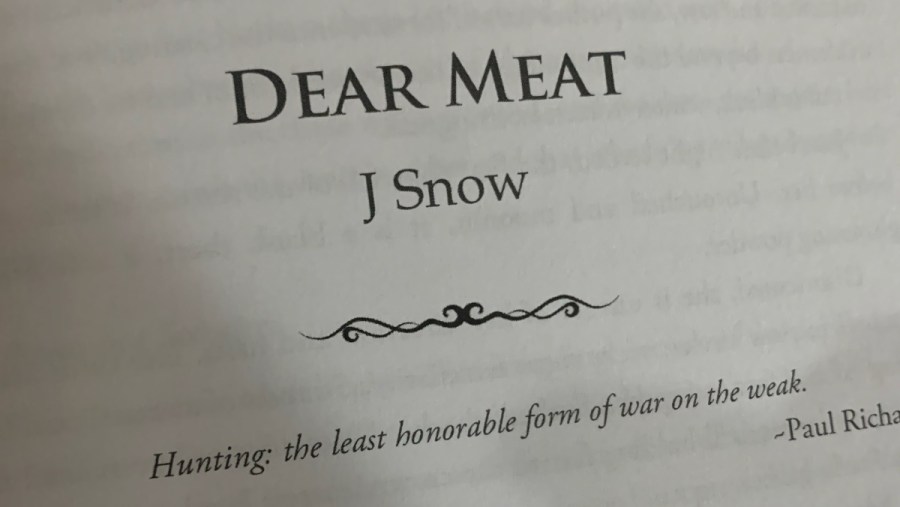
Dear Meat (J. Snow, 2020)

This blog has laboured mightily to keep up with the constantly growing catalogue of cannibalism movies and TV shows, as well as the increasing number of actual cases reported in the media. So this week we are taking a rather exciting side-trip into the wonderful world of short stories, a place where the sets can be as lavish as the author wishes since there are no Producers cutting budgets, the protagonists can do anything the mind can conjure up without the need for stunt persons or insurance, and the whole thing requires no masks or social distancing.

The story considered in this week’s cannibalism blog is called DEAR MEAT, and it appears in the third Women of Horror Anthology, titled THE ONE THAT GOT AWAY.

The anthology contains an amazing assortment of thirty fresh looks at the wonderful world of horror. I have, naturally, chosen to review the cannibalism story by J Snow, since that’s what I do, for reasons best known to myself and the Department of Culture and Communications at the University of Melbourne.

Ms Snow has written and published five cannibalism stories; reassuring to know that others also labour in these fields. For those of you who wish to know how (or why) she writes, there is an interview at Paula Readman’s Clubhouse.

Dear Meat was written a few years before the pandemic, but reads like it could be taken from tomorrow’s newsfeed. It involves a small elite group of rich and powerful men who have decided that human population growth is threatening to destroy the biosphere, and so must be stopped and reversed. More than two thirds of the population, billions of people, must be “eliminated.”

Various ingenious and possibly prophetic strategies are mentioned such as introducing viruses and tainted vaccines, genetically modified foods and contaminated water supplies. Free tubal ligations and vasectomies are encouraged, and abortions allowed up to two months after birth. But the key plan in this story is to set the populace at each other’s throats, or more precisely at the barrels of guns. Yes, hunting season for humans becomes the only way to feed the family. Tags are issued, which is apparently the way hunting works in the USA, and the distribution is weighted according to the discriminatory preferences of these shadowy rulers – the “unworthy and unholy” are allotted the most tags meaning the poor and the non-Christians are most likely to be hunted and cooked. Illegal immigrants are always open season. The rich and the politicians, however, don’t ever seem to end up on the butcher’s slabs.

English cleric and economist Thomas Malthus pointed out in 1798 that population increases geometrically, but food availability increases only arithmetically. All things being equal, this means we must run out of food, unless there is a disaster or an intentional reduction in human population growth. Too many people and not enough food is likely to lead to cannibalism, although Malthus did not venture into such abject speculations. The ethologist John Calhoun crossed that bridge in his study of rats, where he found that putting rats into a utopian environment, with no shortage of food or shelter, and letting them breed unconstrained, ended up in a chaotic maelstrom of sexual deviance and cannibalism. A Malthusian/Calhounian scenario is the basis for the film Soylent Green which is set (honest, I’m not making this up) in 2022, when overpopulation has led to a situation where the enormous population of poor people can only be fed by recycling the bodies of those who die or can be persuaded to accept euthanasia.

Not so in Dear Meat. The people running the government know one thing that has been true since the start of humanity: when there is hunger,

“People turn on each other, become monsters, all for one tiny morsel.”

The people turning on each other in this story are from a family; a man, a woman and a child. Not even close to a large family by today’s standards, but in the world of the story, any increase in population (child) must be balanced by a decrease (a hunted tag). One person must die, be carted to the butcher and carried home as meat, just as the odd hunter does now to deer or kangaroos or anyone else that happens to move at the wrong moment.

I am introducing some levity because this is a grim scenario, skilfully crafted, beautifully written and with an ending that I absolutely will not spoil. The wonderful thing about eBooks is that they are ridiculously affordable and offer hours of reading pleasure. This collection, and particularly Dear Meat, is highly recommended.

Here’s a review from Goodreads:

And here’s one from Amazon:

The author’s details are here, and the book is available at on line retailers including Amazon.

TALIBAN OR TANIBAL: Afghan addicts turn to cannibalism?

In The Tempest, Shakespeare created a monstrous, malformed semi-human character named Caliban, the son of a witch, who is accused of trying to rape Miranda, the daughter of Prospero, the magician that took over Caliban’s island after losing the dukedom of Milan. Caliban has fascinated scholars over the years, with his name often taken to be an anagram of “canibal”, which was then starting to become the preferred term for humans who ate other humans, formerly known as “anthropophagi”. The word “canibal” or “cannibal” came from Christopher Columbus’ clumsy rendering of the name of the Caribs, a tribe he came across in the Lesser Antilles, and who, he was told, were man-eaters. Caliban, then, can perhaps be seen as a satire on the way colonial people were misrepresented and slandered by the imperialist explorers of the time. Post-colonialist versions of the play, including Julie Taymor’s version (you might remember her superb version of Titus), showed Caliban more as a “noble savage”, representing the indigenous inhabitants so rudely displaced from their homes during the period of European expansionism.

As Elvis said, “I said all that to say all this”. The semi-human monsters of our time are plentiful, and include neo-Nazis, whoever is on the other side of your political divide, and all the world’s various terrorist groups. One group that we (the West) went to war with (and lost) was the Taliban, who have taken over Afghanistan, a country now sliding into economic ruin and famine, since the withdrawal of international relief funds. This is not to say that there is anything noble about the Taliban – they are bunch of vicious thugs who apply mediaeval forms of punishment in their courts and slaughter, starve or otherwise deny basic rights to women and ethnic minorities. They are, in a sense, Caliban, and the media never tire of detailing their atrocities and transgressions, whether proven or dubious. The latest is, of course, the old favourite, cannibalism. Yep, the fourth cannibalism case we’ve reported so far in 2022.

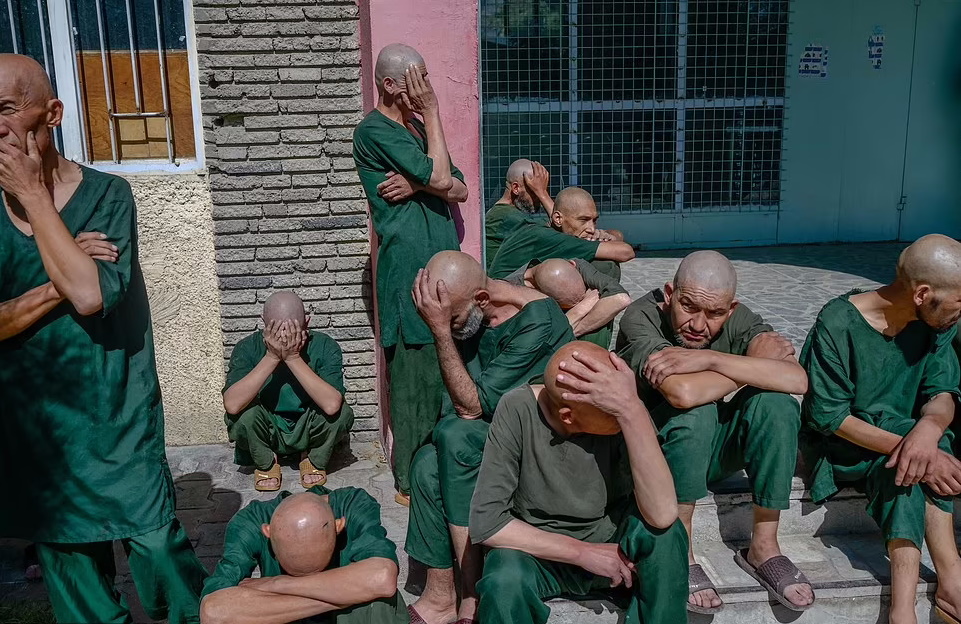
Al Jazeera reported back in October 2021 that the Taliban, back in power after being routed by the US and its allies twenty years earlier, were arresting drug addicts and locking them up to make them go “cold turkey” (what they call “detoxification”). Former guerrilla fighters now raid Kabul’s drug-ravaged streets and bridges, rounding up hundreds of homeless men addicted to heroin and methamphetamines. They are beaten and marched to treatment centres as part of the Taliban’s pledge to clean up the drug trade.

Most of the world’s heroin comes from the vast poppy fields of Afghanistan and, while the crop has financed the Taliban for decades, it has also supplied cheap drugs to the domestic market, leading to a major problem of addiction. The Avicenna Medical Hospital for Drug Treatment, formerly the US military base Camp Phoenix, is chronically short of the alternative opioids, buprenorphine and methadone, typically used to treat heroin addiction. There is no money; the doctors have not been paid for months.

And there is little or no food. The Daily Mail has reported, via a Danish journalist who asserts that he spoke to a recovering addict, that the patients are sleeping three to a bed. They are forced to eat grass just to stave off hunger pangs, and there are “rumours they have resorted to eating cats and even cannibalism in order to survive.” One addict told the journalist:

“They killed a man and made a fire. They took his intestines and ate them.”

In scenes reminiscent of last century’s genocides, men in prison uniforms sit in despair. Denmark Radio reported that a prisoner told them that:

“People ate cats out in the park yesterday. One cut off the cat’s head and ate it.”

Of course, one report from a tabloid does not a cannibalism outbreak make. But it is undeniable that the sudden collapse of the old regime and sweeping to power of the Taliban has been followed by political and economic chaos as Western funding was suddenly withdrawn, and relief agencies struggle with ways to supply support without simply enriching the new Taliban Calibans. Where there is starvation, be it on a shipwrecked lifeboat, a crashed plane, a region facing famine, or a future post-apocalyptic landscape, there will eventually be cannibalism. People will do what they must in order to stay alive, be they Caliban or Prospera.

Wouldn’t you?

American cannibal: THE DONNER PARTY (T.J. Martin, 2009)

The Donner Party was the name given to a group of pioneers heading from Missouri to California in 1846. They became snowbound in the Sierra Nevada over winter, and famously turned to cannibalism to survive. Only 48 of the original 87 members of the party survived.

There have been quite a few films and books about the events of that winter, including documentaries such as “Trail of Tragedy: The Excavation of the Donner Party Site by US Forest Service” and an episode of the PBS series American Experience (Season 5 Episode 3) called “The Donner Party” (you’ll need a VPN if you are outside the US). There are also a few supernatural potboilers like Donner Pass, about evil forces that turned poor George Donner and his mates into ravenous cannibals, and will do the same to any nice-looking millennials who stumble into the region. I am not intending to write about them until I run out of movies about “real” cannibals, which looks like it will be in several years, at the present rate.

Look, this movie doesn’t mess about with any set up. The opening is some written explanation of how they got into that mess

vlcsnap-00001.jpg

Then there’s a dude, who turns out to be William Eddy (Clayne Crawford) pointing a gun, with his voiceover

“In situations like this, some men may abandon their obligations. This being said, I am resolved to provide for my family.”

vlcsnap-00002.jpg

He goes back to camp with some meat (a bear? In winter?) which he shares with William Foster (Crispin Glover from lots of things including Back to the Future and American Gods). Eddy is the group’s guide, and feels that he was pressured to lead them the wrong way, onto the Hastings Cutoff; Foster argues that they all agreed to take the “short cut”. The audience by this point is yawning. From there, as Homer says, “it just gets worse and worse”. The Foster camp is running out of food when the “rescue party” reappears – with no rescue and no food. One of them dies on arrival and they bury him in the snow. Clearly, they had never seen Alive! Once you die, you’re assigned to the frozen food department.

vlcsnap-00003.jpg

But as they set out for a last ditch expedition, later called “The Forlorn Hope”, Foster boasts that they have maintained a “clear line of civility”. We know from history that this won’t last.

vlcsnap-00004.jpg

There is talk of going back to the camp, but Franklin Graves (Mark Boone Jnr from Sons of Anarchy and Memento) disagrees.

vlcsnap-00006.jpg

As they get colder, hungrier and weaker, Foster suggests what we’ve been waiting 51 minutes to hear:

“In the misfortune that one of us should pass, in death we may save the living.”

vlcsnap-00007.jpg

In a scene worthy of Monty Python, they all start volunteering. Eddy suggests he and Foster

“fight to the death, the loser dies like a man, feeds the group”.

Instead, they draw straws – Dolan (Crispian Belfrage – who is a bit wasted in this flick) gets the shortest stick and Foster shoots him (not what really happened, BTW). Eddy refuses to join in the lottery or the meal, but then it turns out he has a lump of bear that his wife smuggled into his backpack, so he’s doing OK.

vlcsnap-00008.jpg

Graves stabs himself and becomes the next course. Before each meal, they say grace and thank God for what they have received. When they run out of those guys, Foster decides, against Eddy’s opposition, that the “Indian” guide will be the next course. This is the hierarchy of eating – the plant, the animal, the human, with the sub-human squeezed in there, defined by layers of contemptuous racism that was standard procedure in 19th century America (and in some places still is). Rather than wasting bullets, he uses the gun as a club.

vlcsnap-00017.jpg

There are long scenes of the group trudging through the snow, interspersed with the survivors sitting around the campfire chewing on some guy and looking vaguely disgusted, but not looking all that gaunt. I guess it would require some pretty good makeup or CGI to make someone look to be genuinely starving, so I can accept that.

What I found disappointing was the total lack of moral debate – one person complains “we’ll go to hell” and Eddy points out that the “Indian” is a man, but still hands the rifle to Foster so he can do the deed. Foster, the gentleman, points out that he is their only hope because he is the only one willing to do whatever it takes. The fascination of the movie Alive! was the deliberation in the plane of the ethical situation, the immortal soul having fled, etc. This lot are devout enough that they could make it a lively discussion, the nature of humanity, why they think it’s wrong to eat white people but not “Indians”, but it never gets past the look of distaste as they chew on bits of other humans. The best scene is the long shot of Foster, the man of God, the keeper of civility, turning into a cannibal king as he watches his flock, waiting to see who will die next.

vlcsnap-00015.jpg

It’s a fictionalisation of a true event, which is always fraught, because the historians will object to the inaccuracies, and everyone else to the squalid reality. But as an imagining of one incident from the Donner story (Donner himself never gets a look in) it’s not a bad taste of nineteenth century morality and its fragility. The disappointment is that the cannibalism is direct and honest, but never considered as anything other than abject but necessary. This is one of the defining stories of modern America, and much more could have been made of it. However.

Now, I’ve seen some great cannibal films and some pretty awful ones, and I don’t always agree with the verdicts of the reviewers on Rotten Tomatoes, but I think this is the first one I have seen where none of the reviewers even bothered to see it.

HorrorNews.Net gave the film a positive review, writing

“Overall The Donner Party was a nice change from the hard core horror films that I usually watch. … I also recommend that you have something to eat on hand while watching it as I was starving by the time I was done watching it. Then again, maybe I have issues.”

Incidentally, Horrornews.net has released their comprehensive survey of the favourite horror movies of each (US) State:

Best Horror Movies: Which Does Each US State Love Most?

donnerparty2.jpg

The log line “They survived by doing the unthinkable” is clearly borrowed from Alive! (“They overcame the impossible by doing the unthinkable”).