It’s just meat: SOCIETY OF THE SNOW (La sociedad de la nieve)  (J.A. Bayona, 2024)

Society of the Snow is a new account of the 1972 Andes plane crash. It is an adaptation of Pablo Vierci‘s book of the same name,which included detailed accounts of all sixteen survivors, many of whom Vierci had known from his earliest years.
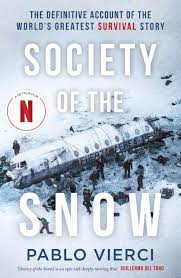
The twist here (not really a spoiler as they keep presaging it) is that the narrator of the film is one of those who were not among the sixteen.

Uruguayan Air Force flight 571, chartered to transport the “Old Christians” rugby team to Santiago, Chile, crashed into a glacier in the heart of the Andes. Of the 45 passengers on board, only 16 survived for the 72 days before they were rescued. Trapped in one of the most inaccessible and hostile environments on the planet, they had to choose cannibalism to stay alive. In this blog, we are most interested in the debate that led to the decision to eat their friends and crew, but the whole story of their pursuit of survival goes beyond what they ate and is equally fascinating.

We see a group of very devout young people, laughing and joking as they organise the trip to Chile, horsing around as the plane gets most of the way over the Andes, and then their reactions as the plane just does not reach the required altitude.

After a week without food, their urine turning black from lack of protein, they start exploring their very limited options. One group believe they will be rescued, even though their plane is painted white and they are in one of the biggest snowfields in the world. But most of them start to think about the only realistic way to survive, particularly after they find a portable radio and hear that the search for them has been called off.

The film has some interesting discussions regarding the ethics of cannibalism.

“What’ll happen to us? Will God forgive us?”
“He’ll understand we’re doing everything we can to survive.”

Roberto, the medical student who has been trying to keep the injured alive, explains what happens to the body without food – it dries up, starts to absorb the organs. There is reference to the “God of the Mountains”, a different being to the one in the city. Arturo, one of the wounded, has a fascinating soliloquy about this God:

“That God tells me what to do back home, but not what to do out here…. I believe in another God. In the God that Roberto has in his head when he treats my wounds. In the God that Nando has in his legs when he keeps walking no matter what. I believe in Daniel’s hands when he cuts the meat, and Fito when he gives it to us, without saying which of our friends it belonged to. So we can eat it, without having to remember the life in their eyes.”

They discuss the legality and the practicality of cutting up bodies, the similarity to organ donation, but of course without consent. So that inspires them to make a pledge.

And so they begin to eat. There are scenes of skeletons being picked clean as the three Strauch cousins offer to cut up the bodies in an area that is hidden from the plane, “to keep the ones who eat from losing their minds”.

What the film glosses over is the Catholicism that permeates much of Latino culture. While they make the point that the bodies are now “just meat”, they do not look for the parallels of their cannibalism to the Eucharist, the eating and drinking of the wafer and wine in church which is supposed to transubstantiate into the blood and body of Christ. It is a theme explored in more detail in the earlier film, as well as in the memoirs of the survivors.

“Drawing life from the bodies of their dead friends was like drawing spiritual strength from the body of Christ when they took Communion”
(Parrado & Rause 2006. Miracle in the Andes: 72 Days on the Mountain and My Long Trek Home, p.117.)

They quote to each other Matthew 26:26: “Take and eat, this is my body.”
(Canessa & Vierci 2016. I Had to Survive: How a Plane Crash In The Andes Inspired My Calling to Save Lives,  p.27).

I suspect this might have been considered a bit too close to the bone (apologies for the pun) for the Spanish speaking audience to whom the film is mainly addressed. Or else they wanted to appeal to a wider audience than just the Catholics. Or perhaps a bit of both.

The story is best known in print for Piers Paul Read’s 1974 book Alive: The Story of the Andes Survivors, which was turned into the film Alive in 1993 by Frank Marshall. Since then, several of the survivors have written their own accounts, to set straight some of the alleged inaccuracies in Alive, but none are as well known. Outside of the Hannibal story and perhaps Soylent Green, Alive is the film most people seem to recall when they hear I have written a thesis on cannibalism.

Alive had a few problems that this film nicely avoids. For one thing, it was very Hollywood, or “Anglo” as the politically aware like to say. It starred American actors who did not look like they were starving, even when they were fondly reminiscing and lusting for the food they missed, which seemed to be mainly pizza. Society of the Snow has Uruguayan and Argentinean actors speaking in Spanish, and makeup and special effects have improved markedly in the thirty years between the films, so they look hungry, and their wounds look ghastly. It is a more authentic look at the situation in which a group of deeply religious young men could decide to eat their dead fellow passengers and friends, who conveniently lay around them, preserved in the snow.

The film closed the 80th Venice International Film Festival in an ‘Out of Competition’ slot. It was theatrically released in Uruguay on 13 December 2023, in Spain on 15 December 2023, and in the US on 22 December 2023, before streaming on Netflix in January 2024.

Society of the Snow received positive reviews. At the 96th Academy Awards, it was nominated for the Best International Feature Film, representing Spain, and Best Makeup and Hairstyling.

Society of the Snow is arguably a better movie than Alive, although at two hours forty minutes, I thought a bit more editing might have been useful. Still, sitting through that 160 minutes gave a miniscule sense of the despair of sitting in a wrecked plane in freezing conditions for 72 days, so we cannot complain!

But I was sorry to see them drop the cannibalism/communion issue, even though there is a hint in the final scene where the survivors sit around a dinner table like the Disciples at the Last Supper, their dead friends being the bread of life, transubstantiated from sacred to edible, the reverse of what is supposed to happen to the church wafer. Whether you consider this a cannibal movie or an epic of survival (and yes, there is controversy raging about that), exploring why people do or don’t eat each other is endless fascinating, and the question of cannibalising the body of Christ is, or should be, at the heart of this story.

All-consuming teenage desire: “DER FAN” (Eckhart Schmidt, 1982)

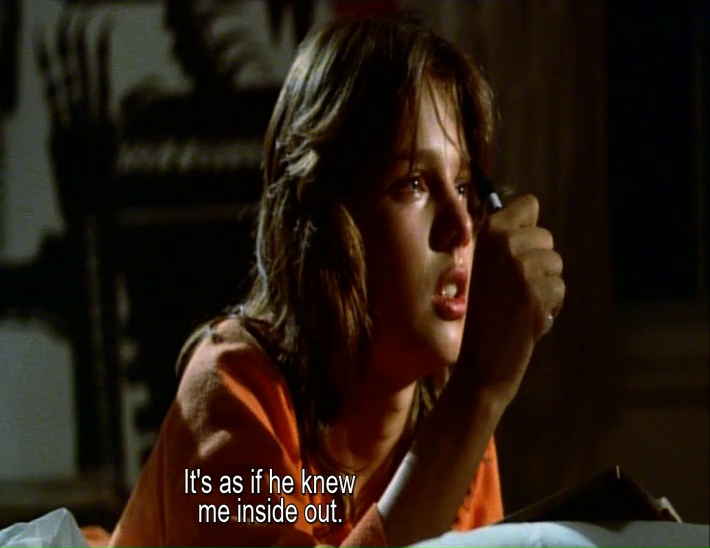
Simone (a bravura performance by 17-year-old Désirée Nosbusch) is a teenage fan obsessed with a pop singer known only as “R.” That obsession takes over her life – she drops out of school, waits outside the post office for a week for a reply to her letter, which will never come because his fan mail goes straight to the tip.  She climbs to the top of the church steeple in her town of Ulm (it’s actually the tallest steeple in the world) and thinks about jumping off, splattering herself all over the town square, but with a letter to R in her pocket, so he will hear of her at last.

Nosbusch as Simone offers a fascinating glimpse of the modern cannibal – she looks and acts normal (for an angst-ridden teen) but underneath are irresistible currents of passion and voracious appetite for her idol. She attacks the postal worker who disappoints her by not having a letter for her, she attacks her father for turning off the TV show on which R is performing. The walls of her room are covered in pictures of R. The film shows parallel imagery to her obsessive love; images of Nazi salutes – the same obsessive love that led Germany and the world into catastrophe a few decades previously.

The word “fan” comes from “fanatic”. The fanatic believes he or she has found the answer, the one who knows us, cares for us. She feels that R, who has never heard of her, knows her inside out. And she will know him, inside out.

She drops out of school and hitchhikes to Munich, where R’s shows are recorded, being accosted on her way by a range of toxic men, but of course the worst of them is the one she is so desperate to meet. She sleeps in unlocked cars while she waits outside the studio, so frantic that, when she finally meets him, she faints.

R seems concerned and kind, invites her to his show, where he appears as a mannequin surrounded by store mannequins – a bald wig symbolically obscuring the divide between human and inhuman, life and death.

He takes Simone back to the apartment of a friend who has gone to the US for a year, where she finally achieves the intimacy she has craved. Nobody knows they are there, so anything can (and does) happen.

But R is a superstar – he is not interested in the meeting of the souls that she imagines will happen, and afterwards tells her he has to go back to his work, tries to fob her off with vague promises of future meetings. He tells her to leave the keys on her way out.

Simone wants to own him and his love, but he just wanted her young body. As he leaves, she picks up a figurine of the goddess Diana, the Huntress, and she then hunts him, killing him with a blow to the head.

Once he is dead, he is hers at last, to do with as she wishes. The imagery switches to that of a Christ, broken and crucified, and she cradles him in her lap like an erotic Pietà.

She sees a freezer, and she sees an electric knife.

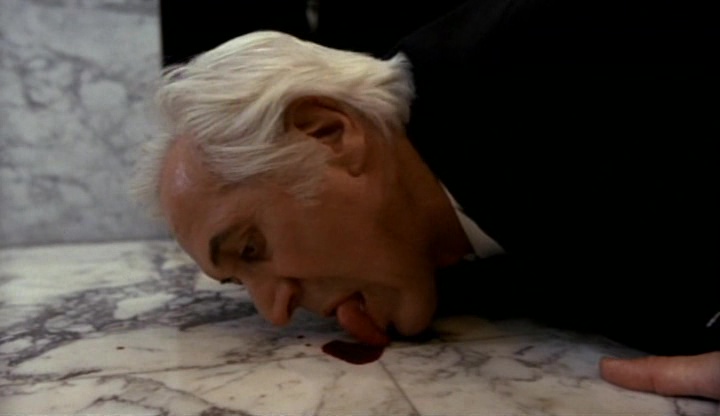
R’s blood is, as the Bible says, his life, and she laps it up from the floor and from her knife.

When R is neatly packed in the freezer, Simone faints, but next day we see pots boiling on the stove, his foot being basted with his juices.

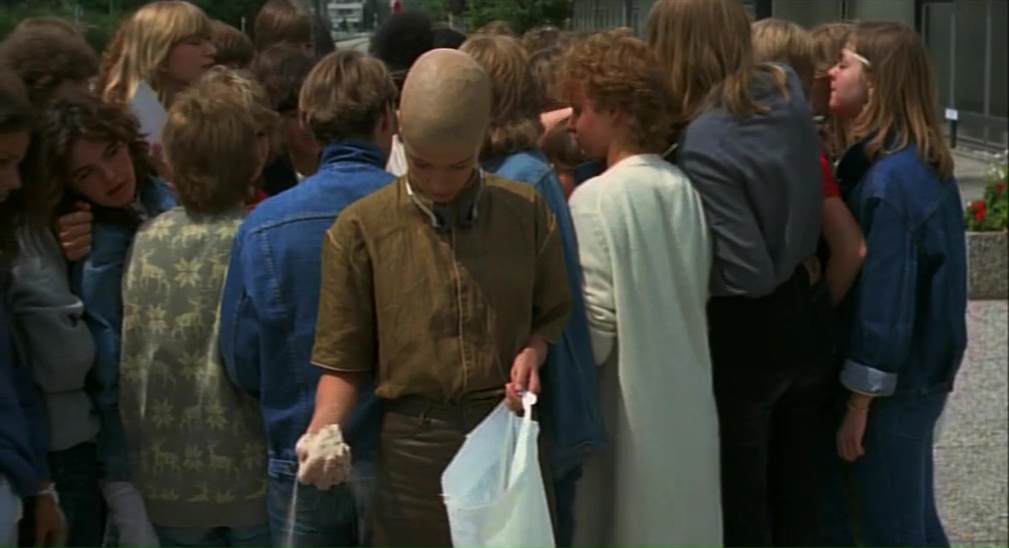
She eats him over a few weeks, then grinds his bones to dust and takes the dust back to the TV studio; pouring it out at the place she met him.

Her revenge involves ceremonial murder and cannibalism, to ensure he will always stay with her, and inside her. Leaving for home, her head shaved so she looks like one of the mannequins from his performance, she promises her parents to return to school.

She sits with them and watches the news – R’s disappearance weeks ago remains a mystery. But she knows where he is.

“I missed my period. I’m four weeks late. I will bring you into the world. We will be happy. I know you love me. And me too: I love you.”

He is inside her, and so is his seed. Like Christian mythology, R will be reborn, but this time totally dependent on her, loving only her.

 The film did not garner a lot of interest or decent reviews, but has picked up a bit of a cult following in the years since. It is an excellent study of the monstrous-feminine, a figure often found in cannibal narratives, particularly around revenge and love. Mariana Enriquez’s recent collection of stories called The Dangers of Smoking in Bed has a similar story called “Meat”, in which two similarly obsessed fans dig up a dead pop idol and eat his rotting corpse. Well worth a read if, perhaps, not during mealtime.

Fuelled by a minimalist synth soundtrack from Rheingold and stunning photography, Der Fan is an engrossing and fascinating study of love, not in its sentimental, romantic form, but as possession, greed, rage and cannibalism. Much of lovemaking is expressed orally, through kissing, fellatio, cunnilingus, and licking or sucking and sometimes chewing of various body parts. Simone has taken this to its logical extreme. R is inside her, and so is an embryonic version of him, which she promises to love as she had hoped to love its father. It’s resurrection through transubstantiation.

Cannibal supermodels: THE NEON DEMON (Nicolas Winding Refn, 2016)

Marcellus (Hamlet Act I, scene iv) claimed that “something is rotten in the state of Denmark”, but it’s not their cannibal films or actors. The Neon Demon is directed by Nicolas Winding Refn (currently in trouble with PETA for killing a pig for a TV series). Refn has made several movies (Pusher, Valhalla Rising, etc) starring Mads Mikkelsen, probably known best by the readers of this blog as Hannibal Lecter, or perhaps Svend in Anders Thomas Jensen’s The Green Butchers. This film does not have Mads in it, but it does have Elle Fanning as a sixteen-year-old model who, we just know, is going to be chewed up, swallowed and spat out by the Los Angeles fashion industry.

Books about screen-writing always stress the opening image – it sets the scene, establishes the atmosphere, tells the viewer what to expect. Well, this one sure does.

Jesse (Elle Fanning from The Great) dead on a couch, blood caked onto her throat and down her arm. A grim male gaze from a photographer. The killer? Police forensics?

No, he’s an amateur photographer doing audition shots for her, and is probably the only nice guy in the story, and we all know where nice guys finish. Anyway, Jesse is befriended, as she wipes off the fake blood, by a make-up artist named Ruby (Jena Malone from The Hunger Games), who takes her to a party to meet the LA fashion scene.

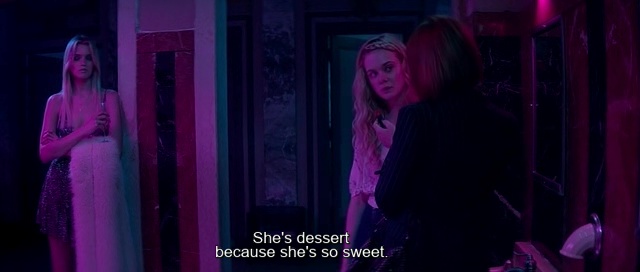
The other models hate her for being young and pretty and not needing the constant plastic surgery to fix all the things the surgeon and our culture say is wrong with their bodies. In the bathroom, as you do, they discuss lipsticks, which they note are always named after either food or sex, and speculate on this new commodity, Jesse. Is she food or sex?

Either way, it’s about appetite. Think of an animal, any animal – a snail, a snake, a human. What is the animal thinking about? It’s almost certainly food or sex. This film combines the two. The men have the power – the celebrity photographer, the fashion designer, even the sleazy motel manager (played with black humour by Keanu Reeves) – Jesse is their fresh meat.

The young, hopeful girls have their looks, and a useful booster of narcissism, a taste for the neon demon of fame, which fuels their journey through the fashion jungle.

When they get “old” (over twenty apparently), they inject various toxins and go under the plastic surgeon’s knife to fix what they are convinced are their failings. But it’s never enough. Jesse sees visions which confirm her own beauty in her eyes:

Women would kill to look like this. They carve and stuff and inject themselves. They starve to death, hoping, praying that one day they’ll look like a second-rate version of me.

But once used up, the women and girls are rejected, discarded, left to fight among themselves – to the death. Jesse is edible to them too, but not in the male way, more in the way that Elizabeth Báthoryis alleged to have bathed in the blood of virgins to keep her youth.

That’s a small taste of the real cannibalism in the film, which infiltrates the metaphoric cannibalism of the meat markets of advertising and fashion. There is an ancient tradition, from the earliest days of tribal ceremonies and the Wendigo to Richard Chase and Armin Meiwes, that eating the flesh or drinking the blood of a victim (preferably a young fit one) will transfer their strength and attractiveness to the eater. If you can keep them down of course.

An even older tradition talks of killing and eating the gods of the harvest, in order that they may be reborn and bring with them next year’s prosperity. The tradition survives in the transubstantiation of the Eucharist service. Jesse is a young and beautiful. She is, or thinks she is, a goddess. How can she not be eaten, in this film both metaphorically and literally?

There is no point in going on with the plot, it’s filled with rape, paedophilia, murder, masturbation, necrophilia, and of course cannibalism, but you really need to see it yourself, and anyway, the plot is not the point. Brian Tellerico, the reviewer from Rogerebert.com, summed this up:

It is a sensory experience, driven by the passion of its fearless filmmaker and a stunning central performance by Elle Fanning.

The director called the film an “adult fairy tale”:

“I woke up one morning a couple of years ago and was like, ‘Well, I was never born beautiful, but my wife is,’ and I wondered what it had been like going through life with that reality. I came up with the idea to do a horror film about beauty, not to criticize it or to attack it, but because beauty is a very complex subject. Everyone has an opinion about it.”

Everyone had an opinion about The Neon Demon too, with some of the audience at Cannes booing it and the rest giving it a standing ovation. You can make up your own mind – it’s an Amazon original, so you should be able to find it quite easily wherever you are in the world. It is a beautiful film, the acting is superb, the direction is assured and precise. The horror is not so much from the gore, as the scenes of young girls being treated as meat. But that is exactly the point.

The French philosopher Jacques Derrida spoke of what he called “carnivorous sacrifice”:

“The establishment of man’s privileged position requires the sacrifice and devouring of animals.”

The animals we sacrifice and devour are little more than infants – chickens for example are slaughtered at seven weeks of age. Pigs are killed at six months (less if they run into Refn, apparently). We no more eat old animals than photographers seek out old models. Remember Curtis’ line in Snow Piercer:

“I know what people taste like. I know that babies taste best.”

Or the words of John Jacques Rousseau:

The animals you eat are not those who devour others; you do not eat the carnivorous beasts, you take them as your pattern. You only hunger after sweet and gentle creatures who harm no one, which follow you, serve you, and are devoured by you as the reward of their service.

Cannibalism is no more or less than the sacrifice and devouring of animals – in this case, the Great Ape known as Homo sapiens. As voracious consumerism and greed extends its reach, to plunder the entire planet, the distinction between us and the other animals seems increasingly to evaporate.

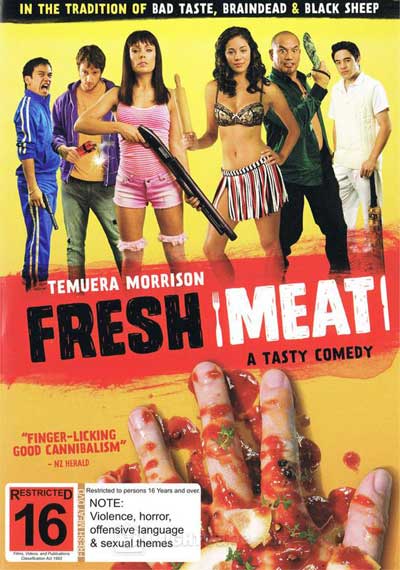
“We’re NOT Maori cannibals”, FRESH MEAT (Danny Mulheron, 2012)

New Zealand has produced some world class directors; think of Jane Campion, or Peter Jackson. Not a lot of cannibal movies unfortunately, considering the country’s reputation – Jackson’s first feature film Bad Taste had a lot of humans being eaten but, unfortunately for this blog, the eaters were space aliens, so not technically cannibals. Jackson’s Braindead was closer, involving zombies. Can you be a cannibal if you are undead? We’ll have to consider that question some time, perhaps when we run out of movies about living cannibals (probably about the time we get to net zero).

But Danny Mulheron gets right into freshly killed, cooked (and sometimes raw) human body parts in this film. Like Jackson’s Bad Taste, Fresh Meat was Mulheron’s first feature film, and it’s an impressive inception.

The plot involves a family of Maoris, recently converted cannibals, being taken hostage by some bumbling criminals. Rina (Hanna Tevita) is home from her lesbian explorations at “St Agnes Boarding School for Young Maori Ladies” when a bunch of criminals break in to her home to hide from the police, having killed some prison guards to free their boss from a prison van.

But that’s Rina’s second shock of the day; the first was finding her parents’ new eating regime in the fridge.

Turns out her Dad (Temuera Morrison from Once Were Warriors and The Mandalorian)  is reviving an “eighteenth century post-colonial religion” – he has found the prophecies of Solomon Smith and become a “Solomonite”; he now believes that eating people (“taking their life-force”) will cause the family to flourish.

Yes, among the satire on Maori and Pakeha cultures, there is the odd dig at Christian transubstantiation.

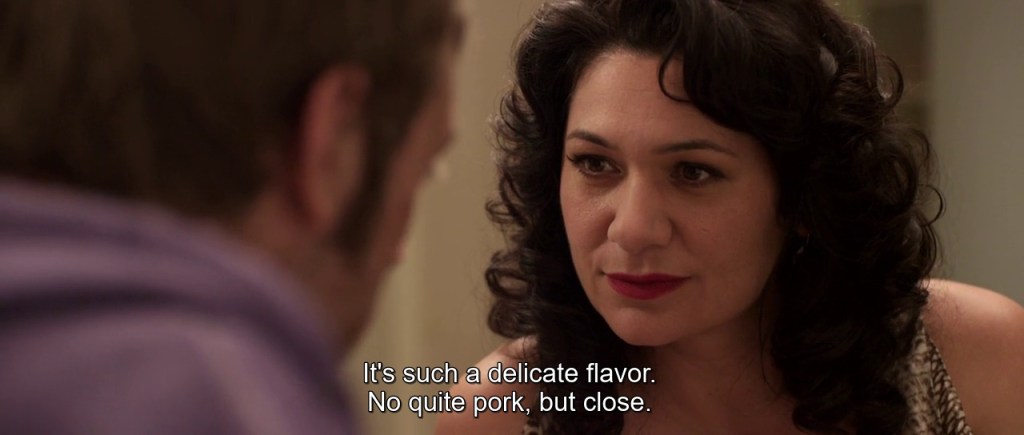
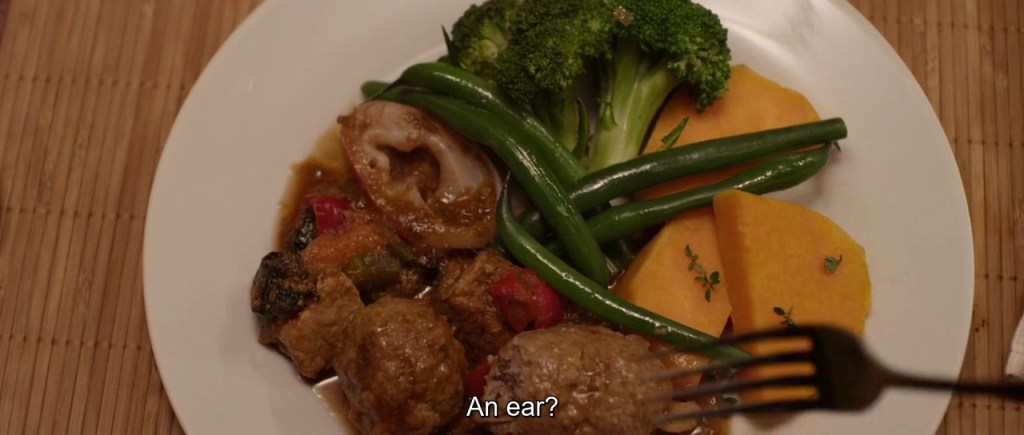
Mum (Nicola Kawana) produces hugely popular cooking shows and books, she’s a Maori Nigella, into marinades, and she describes the meat she uses:

Rina is shocked that her brother (Kahn West) would agree to eat human flesh, until he tells her about the pork and rosemary pies that her family sent to her at school. It wasn’t a choice.

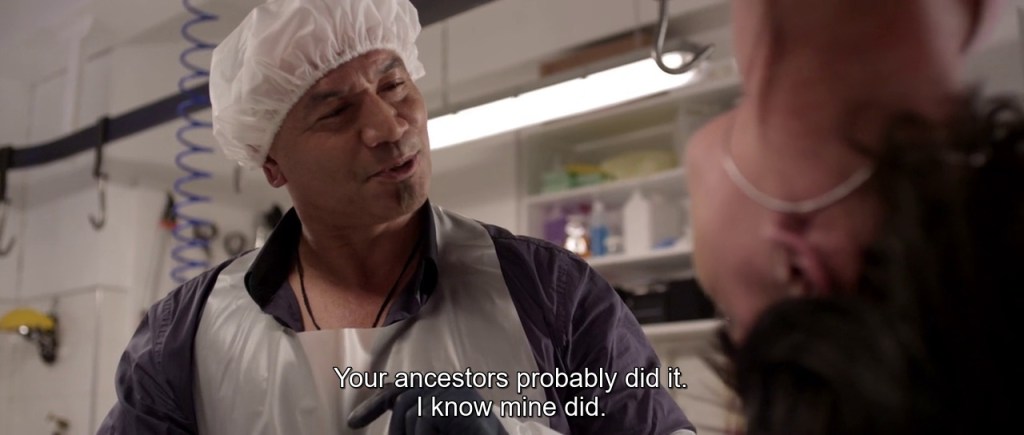
The subsequent bloody altercation with the criminals is set to fill the larder nicely. Dad tells the last living criminal, Gigi (Kate Elliott), who is hanging upside down ready for slaughter, that

“ritualistic cannibalism dates back to 1000BC to the Hun phase in Germany. The Bible itself refers to the siege of Samaria in which two women made a pact to eat their children. The Aztecs, the French, the Brits… Your ancestors probably did it. I know mine did.”

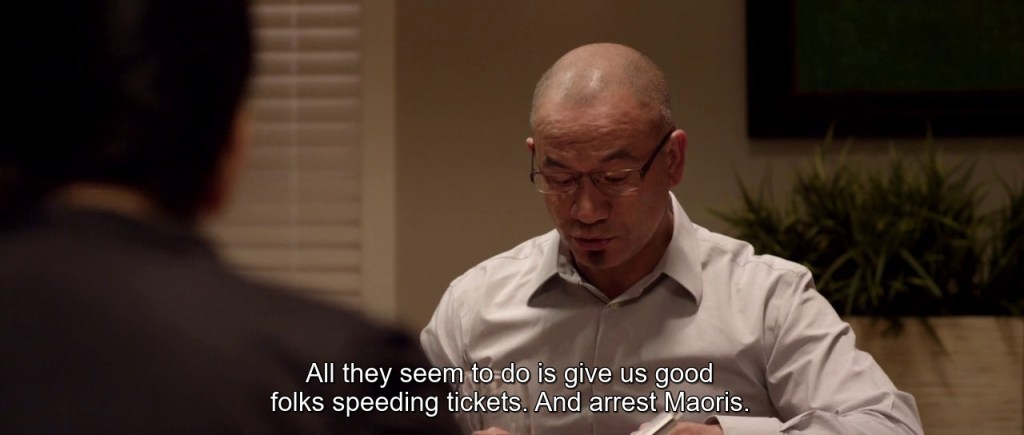
There is lots of Maori humour, and not all relating to cannibalism. Dad is an Associate Professor at the University, and blames white racism for his failure to be given tenure as full professor. When the cops knock at the door, he complains

Rina’s neighbour is a white boy who is in love with her. When he appears and is invited in (“we’ll have him for dinner” says Dad – yes, Hannibal lives), he points out that he is a vegetarian, but politely eats what turns out to be a human testicle, only getting suspicious when he spots something else on his plate.

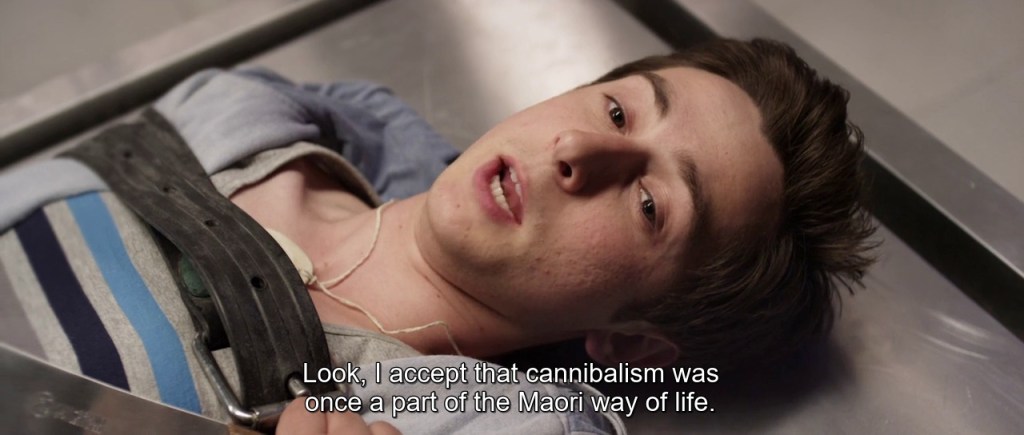
Even when they have him tied up in the basement ready for slaughter, he politely tells them

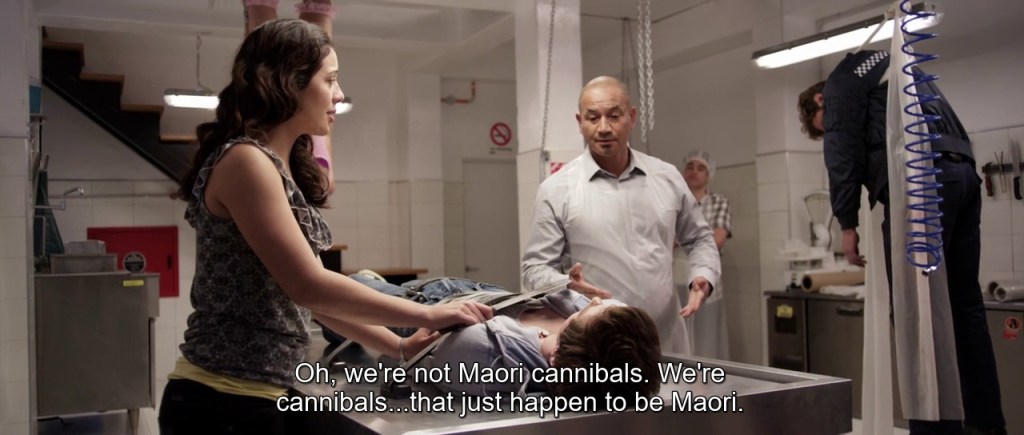
Dad replies with the best line of the movie:

“Oh, we’re not Maori cannibals. We’re cannibals… that just happen to be Maori.”

But Dad has his own agenda: to become immortal:

“By eating the still-beating heart of my youngest son, I’m halfway towards immortality. But I still need to drink the blood of my virgin daughter.”

Doesn’t quite work out that way, Rina’s not a “virgin” after that scene in the shower with her girlfriend. Or does it?

What is it about virgins and blood sacrifices anyway? Are the rest of us not good enough to sanitise humanity’s sins with our polluted blood? We exploit the innocent and gentle ones, and then expect that, by slaughering them, we somehow clear our guilt at doing so. Remember the line from Leonard Cohen’s song Amen:

Tell me again
When the filth of the butcher
Is washed in the blood of the lamb…

Anyway, the takeaway from this movie is that Maoris, traditionally accused of cannibalism, can be Maoris and cannibals without being “Maori Cannibals”. The two identities can be separated, even as they coexist. There are other families of cannibals who are not defined by their race; consider the Mexican film Somos lo que hay or its American adaptation We are what we are.

In cannibal studies, it is not unusual to be buttonholed by someone who has become aware of your field of interest and told with great solemnity “the Maori were cannibals, you know.” I tend to politely thank the informant for sharing a “fact” that almost everyone “knows”. But if I am feeling feisty, or have had a few drinks, I might invite them to unpack that statement – which Maori, whom did they eat, and what evidence are you presenting for this?

The British invaders of New Zealand were keen on declaring that the indigenous peoples, of wherever they went, were cannibals – it made their job of invading, enlightening and/or exterminating the inconvenient locals so much easier. But there is some evidence that much of the talk of Maori cannibalism was either misinterpretation or just slander – imperialists in the age of expansion tended to use words like “savage”, “barbarian” or “cannibal” pretty interchangeably – if you had dark skin and didn’t speak English, you were probably a cannibal, with no evidence required other than some hearsay from conquistadors or missionaries. But if an alien civilisation invaded Earth and found a copy of the Grimm’s Fairy Tales in a bookshelf, they might well assume that it was a history book, and that we were all cannibals.

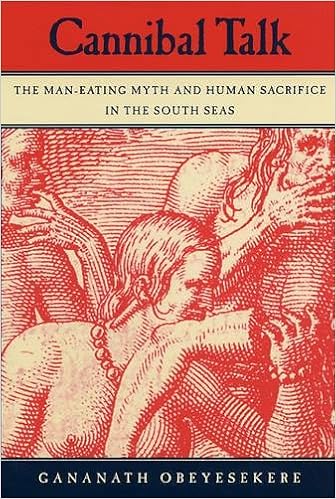
Amazon.com: Cannibal Talk: The Man-Eating Myth and Human Sacrifice in the  South Seas: 9780520243088: Obeyesekere, Gananath: Books

Ganath Obeyesekere’s excellent book on cannibalism in the South Seas makes clear that the oversimplification of Maori culture and mythology (and perhaps humour) probably led to often tragic misinterpretations of local customs. In fact, he says, it is likely that many Maori were convinced that the British were cannibals. And who could blame them? If those aliens mentioned above put down Grimm’s Fairy Tales and took a look inside our industrialised slaughter factories, where 135,000 farmed animals are killed every minute, they would assume we were far more bloodthirsty than they, or the Brothers Grimm, could have imagined. No wonder they don’t make contact.

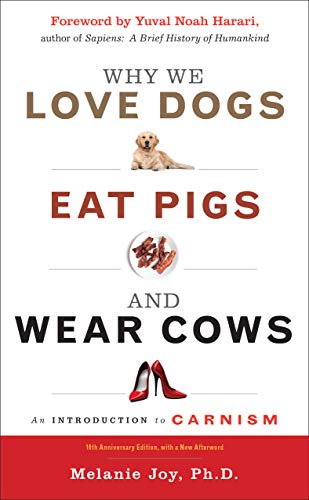
It is interesting to consider the differing responses to cannibalism in the family of this film. Social Psychologist Melanie Joy calls the ideology surrounding and justifying the eating of meat, dairy and eggs “carnism” – a set of largely unconsidered beliefs in three beliefs that start with the letter N: that these products are “normal, natural and necessary“. We drink milk, eat meat, scramble eggs, based on the insouciant assumption that all these things are normal, necessary and natural (and, a fourth N, nice to taste). The family members reflect these views, but in relation to a different food source: Homo sapiens. Dad thinks eating humans is “necessary” in order to absorb the life force of the victims, and make himself immortal. Mother is a celebrated chef; for her, eating meat is “natural”, and where it comes from is not an issue, as long as it cooks well and tastes good. Rina’s brother finds the whole thing “normal” – his parents do it, and he wants to learn from them, and make them proud. Only Rina objects, although she was willing to eat the pies they sent her when she thought they were bits of a different animal. She’s like a vegan at a barbecue, heart-broken to see her family so unthinkingly accepting the death of animals, or at least, those that she can see and talk to.

Why We Love Dogs, Eat Pigs, and Wear Cows: An Introduction to Carnism, 10th  Anniversary Edition - Kindle edition by Joy, Melanie, Harari, Yuval Noah.  Politics & Social Sciences Kindle eBooks @

If you don’t like gore and body parts (and violence and lesbian kissing) then you might want to skip this movie. But if you don’t mind all that, and like a rip-snorting plot, plenty of humour, a little suspense, and lots of intertextual winks to cultural foibles, some (perhaps unintentional) observations on the ideology of carnism, as well as some great acting and direction, then watch Fresh Meat. Recommended.

“This thirst is consuming me”: CRONOS (Guillermo del Toro, 1993)

Cronos is the first feature film of Guillermo del Toro, better known for his later mind-bending fantasies Pan’s Labyrinth and The Shape of Water. Del Toro was originally chosen by Peter Jackson to direct The Hobbit trilogy, but couldn’t do it, due to extended delays. So he’s a top tier director, an auteur, as the French say. He was only 29 when he made Cronos, yet it has been hailed as one of the greatest horror films and one of the best Spanish language films, and has a rating of 91% “fresh” on Rotten Tomatoes. Empire Magazine called it a “unique, terrifying mini-masterpiece.”

At this point I need to admit that it is less a cannibal film than a vampire one. Now I have nothing against vampires, some of my best friends are vampires (probably), but a cannibal should really be alive rather than undead, IMHO. This one is so good, though, that I’m giving it a run on the cannibal blog. Apologies to the cannibal purists.

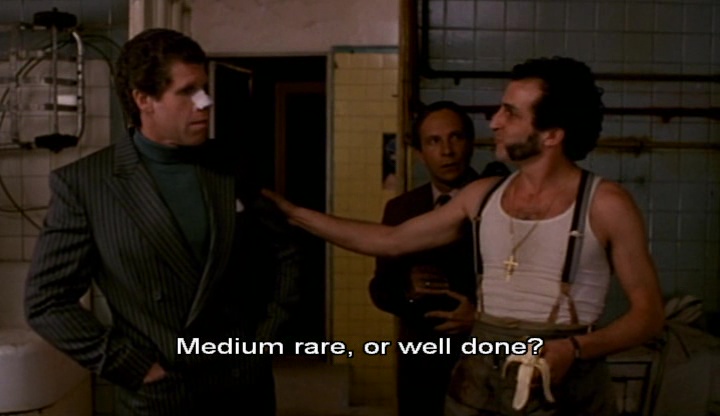
There is also a link to #cannibalism, because the undertaker (yes, even immortals sometimes need undertakers) is Tito (Daniel Giménez Cacho), in a prequel role for the great cannibal movie We Are What We Are, in which he was the coroner who found a finger in the dad’s stomach. You’d have to watch it – it’s worth it.

Anyway. Gothic movies usually start off a few centuries in the past, because old magic is just – better. This one has a 14th century alchemist inventing a device which looks like a Faberge egg with claws. The device sticks its claws into whomever happens to pick it up and an insect inside (species yet to be determined) injects something (IDK – vitamin C? Testosterone?) which makes the person immortal. Centuries later – in the present – an earthquake reveals the dead alchemist. Well, he was immortal, but the earthquake caused a stake to pierce his heart, which is not ideal if you’re a vampire (or anyone else really). The egg is in a statue of an archangel, which is the first of a string of religious symbols (hey, it’s Spanish, OK?)

The statue ends up with antique dealer, Jesús Gris (played by the wonderful Federico Luppi who was one of Guillermo del Toro ‘s favourite actors and was also in The Devil’s Backbone and Pan’s Labyrinth). Gris and his granddaughter Aurora (Tamara Shanath) extract the egg, wind it up and it plunges its stingers into him.

There’s some blood and pain, sure, but he finds he is getting younger, and heals much faster. You laugh a little, you cry a little, but then there’s another problem – he develops a longing for human blood.

There’s also a dying businessman (Claudio Brook, The Exterminating Angel and several other films of Luis Bunuel) who really wants the Cronos Device. His American nephew (Ron Perlman, Hellboy and Sons of Anarchy) is brought in to seek out the device by any means necessary (some of which are quite nasty). He puts up with his uncle, because he is named in the will, but wait, if uncle is immortal…

What would you do to defeat death, to live forever?

As Roger Ebert observed, there are some real religious issues explored here – the battle of good and evil, love (for Gris’ wife and granddaughter) being more powerful than greed, and particularly the unshakeable belief in divine afterlife. What happens to that hope if you never die? And what if that extended life requires eating flesh and drinking blood? Would you risk hell to avoid going to heaven? When little Aurora cuts her hand, Jesus has to decide if his thirst is really worth drinking his granddaughter’s blood.

Of course, that assumes that drinking blood is somehow essentially evil. Tell that to a mosquito.

Jesus Gris is, like any good vampire, likely to start smoking ominously if he finds himself in the sunshine. But can his goodness overcome the vamp issues? Well he dies and comes back to life, reborn in a glowing white skin, he takes many savage beatings, saying that he can handle the pain, then he smashes the egg, declaring

Jesus Gris – translates to English as “the Grey Jesus”. He is the suffering servant, who died and came back to life. There is a lot of that in Spanish films, but this one has an added twist:

Yes, he wants blood. Could that be a backhander to the Church? Religion can motivate good deeds, or suck the blood of the devotees. The Eucharist is all about transubstantiation – the wine and wafer are believed (by some) to be literally the blood and body of Christ. Hannibal is full of it, particularly the resurrection of Mason Verger and his attempt to eat Hannibal. It’s the eternal paradox.

Cronos won the grand prize in the Critics’ Week at the 1993 Cannes Film Festival, and nine Mexican Academy Awards, including best picture and director. It has an enviable 91% “fresh” on the Rotten Tomatoes website. The Criterion Blu-ray edition is available at Amazon. The soundtrack is superb, by the acclaimed Mexican composer Javier Álvarez. Highly recommended.

NEXT WEEK: One of the most controversial cannibal films of all time: Joe D’Amato’s Antropophagus.

Remembrance of Things Past: HANNIBAL Season 3 Episode 4: “Aperitivo”.

There was a “Hannibal” in Proust: Comte Hannibal de Bréauté-Consalvi in The Guermantes Way. Now there is some Proust in Hannibal – everything in this episode is à la recherche du temps perdu – “Remembrance of Things Past” or, more accurately, “In Search of Lost Time”.

Hannibal, let’s be clear, gets into people’s heads (including those of his loyal Fannibals). That of course is his job as a psychiatrist, but he takes it well beyond work hours, getting into the heads of everyone with whom he deals, including Miriam Lass, who was his captive for a long time, and shot Frederick Chilton, because Hannibal was in her head.

vlcsnap-00012.jpg

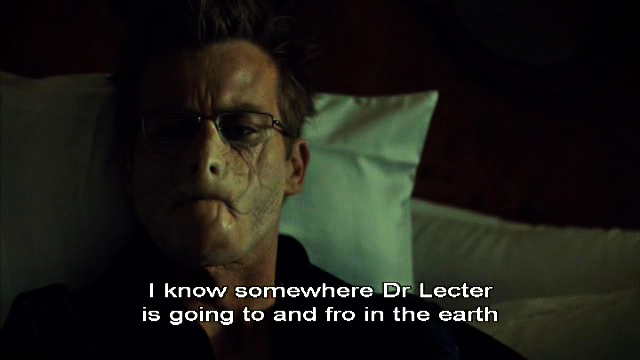
It’s episode 4, and we are finally finding out what happened to all the people knifed, shot and pushed out of windows (or made to eat their own faces) in the previous season. Those still alive have it in for him, are hunting him in their own ways. Mason Verger, whose fortune is based on breeding and killing pigs, wants to catch Hannibal and feed him to those pigs. He has offered a reward of one million dollars for his capture. Chilton, less one eye and half his teeth from Miriam’s bullet, just says “Happy hunting!” Verger’s words about Hannibal are taken from the Bible, the Book of Job, where Satan tells God he has been “going to and fro on the earth, and from walking back and forth on it”. He is relating Hannibal to a supernatural being: Satan. But also to an edible being: a pig. This can’t end well.

vlcsnap-00021.jpg

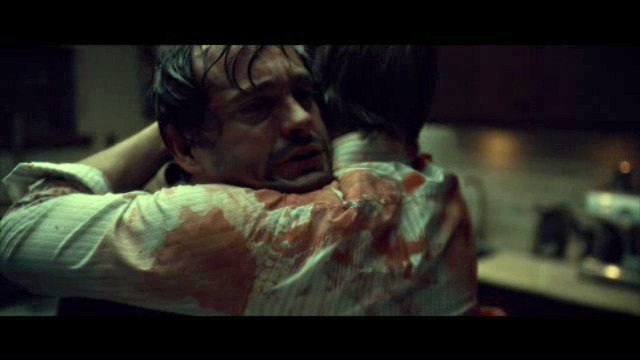
We know Will was cut up good in his last dance with Hannibal, but we get a new perspective in the next scene after the credits – we are inside Will’s body cavity, in the coil of guts, looking at the stomach skin as it is punctured by Hannibal’s linoleum knife. Waking up in the hospital, he is visited not by Abigail, as he had hoped and imagined in episode 2, but Chilton, who wants help catching Hannibal, who would be a prize specimen for his “hospital” for the criminally insane.

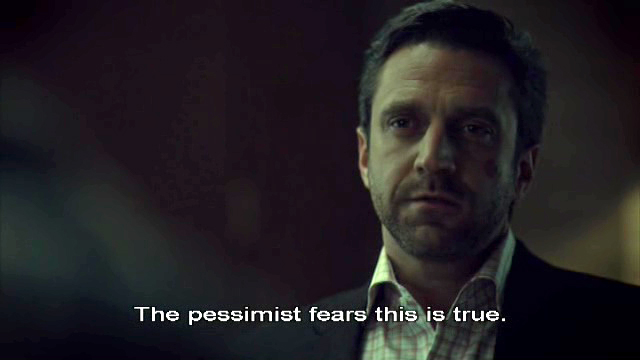
Will spurns Chilton’s offer of compassion and friendship, which leads to one of Chilton’s best lines of the show:

The optimist believes we live in the best of all possible worlds;

vlcsnap-00024.jpg

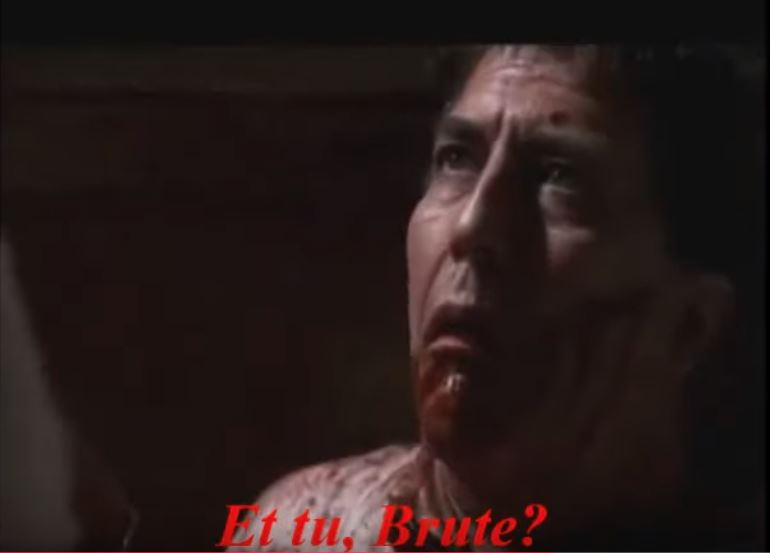
Will is still imagining scenarios – in the next scene, he and Hannibal are plunging knives into Jack Crawford in a scene that could only have been inspired by Julius Caesar.

Et Tu Brute.JPG

vlcsnap-00025.jpg

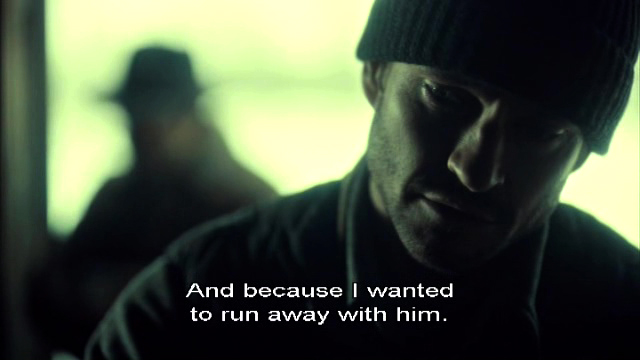
But Will finally didn’t go with Hannibal, and Jack’s not dead – he’s tracking to Will’s boatshed to seek Will’s help, just as he did at the beginning of Red Dragon, where the whole saga started. Will admits that he warned Hannibal, wanted him to run, because “he was my friend”,

vlcsnap-00029.jpg

Alana is still alive too, despite being pushed out of a first storey window. She wakes up full of rods that hold her together. The doctors have told her that a lot of marrow got into her bloodstream from her multiple broken bones, so she should expect to think differently. And she does.

vlcsnap-00031.jpg

She goes to see Mason Verger, who tells her he has found religion, been saved by the risen Jesus or, as he familiarly calls him “the Riz”. As a believer, he says he has forgiven Hannibal. Alana is not so convinced.

vlcsnap-00043.jpg

Jack remembers his apparent death at Hannibal’s hands, but has somehow recovered. His health, not his career – he has been forced to retire from the FBI. The culture has found a new nightmare to slap its clammy flab and ruin its sleep.

vlcsnap-00044.jpg

He also remembers waking up in hospital, lying next to Bella, his wife, who is continuing to die without him as it turns out. He takes her home, sits with her, holds her while her heart stops and her brain dies. He dresses for church and visualises their wedding, but it’s a funeral, she is in a casket, and there is a splendid bouquet from – who else – Hannibal. The card contains a John Donne poem and finishes “I’m so sorry about Bella, Jack”. Fighting to the death does not, apparently, reduce the respect or affection Hannibal feels for his opponents.

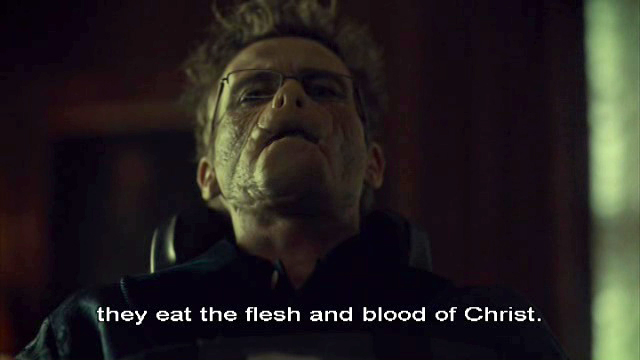
Everyone, everyone alive that is, wants to find Hannibal, and most of them want to kill him. What does Will want, as he embarks on a sustainable sailing voyage to Europe to find Hannibal? We don’t know. Mason Verger is talking transubstantiation – his face has been (somewhat) restored by extensive surgery, now he wants to transubstantiate Hannibal. In most ceremonies

vlcsnap-00052.jpg

He is planning a more elaborate ceremony. He tells his major-domo nurse Cordell

vlcsnap-00055.jpg

Alana is helping, telling Verger that Hannibal will be traceable because, wherever he goes, he will be ordering the very best wine, truffles, etc. She tells him “You’re preparing the theatre of Hannibal’s death. I’m just doing my part to get him to the stage.”

It sounds like they are all conspiring against poor Hannibal. But remember what Alana told Jack when they thought they were outsmarting him – Hannibal is always in charge of the narrative. Whatever the others are doing, he wants them to be doing. Or as Bedelia said, he is drawing them to him. Nietzsche wrote:

“In your friend, you should possess your best enemy. Your heart should feel closest to him when you oppose him.”

While everyone else is remembering things past, or searching for lost time, Hannibal is making friends.