Awarded PhD from the University of Melbourne for a thesis questioning how cultural manifestations of cannibalism challenge the assumed anthropocentrism of our relationships to other animals.
Australian boxer Nikita Tszyu has revealed that he became a “cannibal” as he prepared to fight Lulzim Ismaili this month (August 2025). The boxer said he needed to be at his very best to win over his unbeaten opponent, and hoped that his new diet would boost his training.
Tszyu revealed that his change in nutritional sources was all thanks to his wife, Nikita Bedwell. The couple welcomed their first child earlier this month, named Curiosity after the NASA Mars Rover, and the birth allowed Tszyu to change his diet.
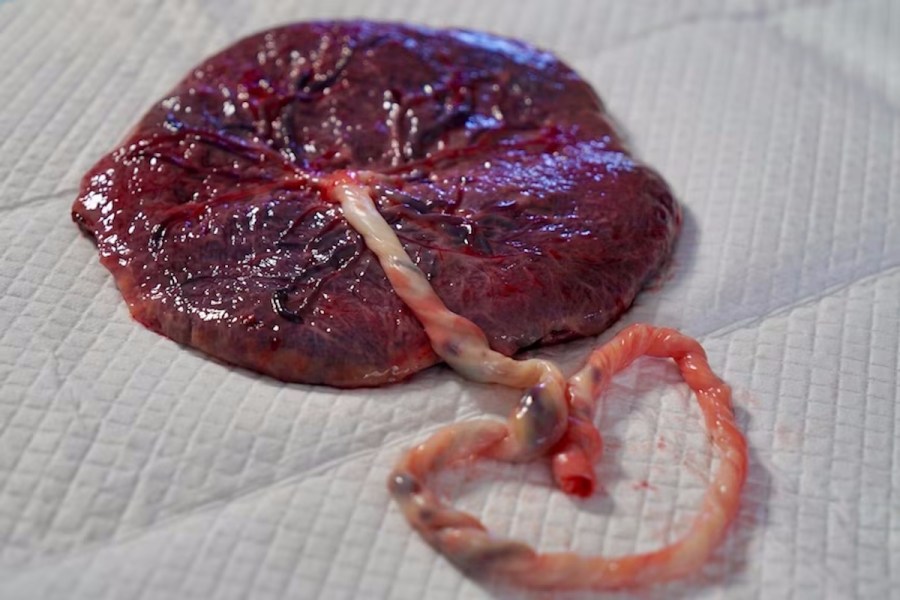
The Australian boxer is eating his wife’s placenta in capsule form as part of his training program, and feels like he is benefitting from the change in diet. He told a Sydney radio station:
“we freeze-dried her placenta and I’ve been supplementing on her placenta recently… in tablet form”
Does that make him a cannibal? Well, he thinks so. He added:
“I’ve technically become a cannibal. It’s actually like a superpower. I’ve done tests with my sparring – days where I’ve had it and days where I haven’t – and it feels like I got all this crazy amount of energy”
If you’re not convinced by that, he told the interviewers he is also including breast milk in his diet. Asked if he had tried it, he replied: “I have, I have… and it’s delicious as well!”
Consuming placentas is a growing trend in America, with mothers usually consuming them as part of their postpartum recovery. The practice dates back to Chinese medicine, though studies are yet to confirm that there are benefits to eating them.
The bout on August 20 was subtitled (based on Tszyu’s nickname):
THE BUTCHER IS BACK
So, is cannibalism the next big thing in athletic enhancements? Well, Tszyu knocked Ismaili, who was previously unbeaten, to the mat in just over one minute. The shaken opponent sat on his stool and refused to leave his corner, throwing in the towel before round two commenced.
Athletes often boast of eating meat to improve their fitness and stamina, although there are also plenty of vegan ones who swear that dropping meat and milk makes them faster, stronger and more alert. But if there is any truth in the meat myth, then I suppose we need to consider the words of Anthropologist Marvin Harris, who stated in his book Good to Eat: Riddles of Food Culture that, while humans are clearly not obligate carnivores,
“our species-given physiology and digestive processes predispose us to learn to prefer animal foods… strictly speaking, human flesh itself contains the highest-quality protein that one can eat”
There’s one to chew on, next time you enter the ring.
The immigration debate in the USA and in other countries has quickly polarised between those who see immigrants as pioneers, walking in the footsteps of all those who settled the lands during the period of colonialisation and their descendants (which is almost everyone except surviving indigenous people), and subhuman invaders who flood the country, take the good jobs, and rape and kill the innocent.
President Trump has referred to undocumented immigrants as being criminals and rapists (although he said some might be “good people”), who come from:
“… jails, prisons, from mental institutions, insane asylums. You know insane asylums. That’s ‘Silence of the Lambs’ stuff. Hannibal Lecter…”
So we waited eagerly (or perhaps apprehensively) to meet these undocumented Hannibals. Now, the Homeland Security Secretary, Kristi Noem, has described how federal agents nabbed a purported cannibal illegal migrant who started to eat his own arms during a deportation flight.
On July 1 2025, Noem was visiting the “Alligator Alcatraz” deportation camp in the South Florida Everglades alongside President Trump. This is a the detention centre located about 40 miles west of Miami and surrounded by alligator- and python-infested swampland.
At a press conference, she said:
“The other day I was talking to some Marshals that had been partnering with ICE. They said that they had detained a cannibal and put him on a plane to take him home and while they had him in his seat, he started to eat himself, and they had to get him off and get him medical attention. These are the kind of deranged individuals that are on our streets in America that we’re trying to target and get out of our country because they are so deranged, they don’t belong here. They shouldn’t be walking the streets with our children, and they shouldn’t be living in the communities with our families who just want to grow up, go to [their] job, raise their children to grow up and get a job, and to live the American dream…. We are going after murderers and rapists and traffickers and drug dealers and getting them off the streets and getting them out of this country.”
Hard to know what to make of this, since the Department of Homeland Security could not immediately provide corroborating details of any case to match Noem’s story. Was this person a cannibal, and if so, who did he eat? Why did he chew on himself? Is airline food that bad?
The story of human evolution: get eaten, or eat ourselves.
ICE Agent: Hey, knock that off. Save it for the gators!
Family members of one of the victims of a gruesome murder of four college students in Idaho are furious that Bryan Kohberger has been offered and accepted a plea deal.
Kohberger was accused of stabbing Xana Kernodle, Madison Mogen, Kaylee Goncalves, and Ethan Chapin to death in November 2022 in Moscow, Idaho. The students were found with fatal stab wounds in an off-campus rental home in the early morning hours. Investigators believe the four students, thought to be sleeping at the time, were fatally stabbed between 3 a.m. and 5 a.m. According to the coroner, there was no sign of sexual assault.
A little over a month after the killings, Kohberger, a 28-year-old Ph.D. student and teaching assistant in the Department of Criminal Justice and Criminology at Washington State University, was arrested at his parents’ home in Pennsylvania on Dec. 30, 2022, and extradited to Idaho.
Kohberger was facing a possible death sentence if convicted in a trial that was scheduled to begin Aug. 18, 2025.
A letter sent to families of the victims to inform them of the deal said Kohberger will appear in court Wednesday to enter his guilty plea and be sentenced in late July to life in prison, according to the Idaho Statesman. Kohberger will forfeit his right to appeal as part of the deal. The letter from Moscow Prosecuting Attorney Bill Thompson said:
“We cannot fathom the toll that this case has taken on your family. This resolution is our sincere attempt to seek justice for your family. This agreement ensures that the defendant will be convicted, will spend the rest of his life in prison, and will not be able to put you and the other families through the uncertainty of decades of post-conviction appeals.”
Goncalves’s family had an angry reply on their Facebook page.
“We are beyond furious at the State of Idaho. They have failed us. Please give us some time. This was very unexpected. We appreciate all your love and support.”
The family issued a later post explaining what had been taking place.
“I would like to clarify a couple of things…we DID talk to the prosecution on Friday about the POSSIBILITY of a plea deal and it was a HARD NO from our family. It was very nonchalant and barely discussed as the majority of the conversation was surrounding the upcoming trial. NOTHING in our conversation prepared us for the next steps.”
A family member of one victim told NewsNation that upon hearing of the plea deal, she felt like “all the power had been given back to Kohberger.”
Why is this case featured in a blog about cannibalism? Well, A forensic psychiatrist told Newsweek after the arrest that Kohberger had battled with “cannibalistic urges“.
Reports then surfaced that Kohberger had followed a strict vegan diet, and had reportedly struggled with heroin addiction in the past.
Forensic psychiatrist Carole Lieberman told Newsweek that Kohberger’s “obsessive-compulsive eating habits” indicate he was afraid he would become addicted to meat if he ate it.
“He was not only vegan, he refused to eat off of pots or plates that had had meat on them. Psychologically, this represents his struggle against his cannibalistic urges. He was afraid that if he let himself go to taste meat once, he would become addicted to it—like he had become to heroin—and start killing and eating people.”
A relative told the New York Post that Kohberger’s dietary restrictions were “very, very weird” and that he seemed “very OCD,” referring to obsessive-compulsive disorder.
The woman, who asked not to be named, but said she was previously married into Kohberger’s family, said:
“It was above and beyond being vegan. His aunt and uncle had to buy new pots and pans because he would not eat from anything that had ever had meat cooked in them.”
Casey Arntz, who was friends with Kohberger in middle and high school, said in a video posted on TikTok that he had been “a heavy heroin user” in high school. Kohberger’s struggles with drug addiction continued into his college years, a friend from Northampton Community College told Fox News. Criminal profiler John Kelly told Fox News,
“This kind of person has this volcanic rage inside that’s going to explode on its victim of choice.”
Lieberman told Newsweek that Kohberger had probably studied criminology both to “calm the demons inside him that were telling him to kill” but also to “learn how to commit the perfect crime.”
Kohlberger may have corresponded with Rader (a lot of criminology students do) but we don’t know that for sure. We have to wonder if Rader would have told him about working in the meat department of a Wichita IGA a few years before his murder spree began.
Kohlberger’s obsession with meat reflects a lot of issues considered in Cannibal Studies. Firstly, the question of human meat: there really is no significant difference between the meat of humans and other large mammals such as cows, pigs or sheep. Hannibal Lecter takes delight in feeding human meat to his guests, such as the flesh of the flautist of the Baltimore Philharmonic, whose Board members subsequently enjoy the meal immensely in the book and film Red Dragon, thus becoming “innocent cannibals”.
But the point is that once meat is prepared (cooked, seasoned, presented) it is very hard to tell its provenance. Cannibals who have been asked have mostly compared it to pork or veal, with Armin Meiwes telling an interviewer
“It would have made no difference in somebody else had tasted it; he wouldn’t have questioned the meat…. During preparation, it is not as dark, but bright and fresh as pork, and tastes so very close to pork.”
Kohlberger’s belief that he might like human flesh if he tried any meat at all therefore has some logic to it. Since Charles Darwin’s writings overthrew the special status of humans as closer to angels than other animals, anthropocentrism has been amended to offer a story of humans as the culmination of evolution and thereby continues, rather less successfully, to obscure human animality. Should such beliefs falter, as happens repeatedly in many cases of contemporary cannibalism, it becomes a very short step from eating other animals to eating the human one.
But why should he become addicted to any meat? Well, we know Kohlberger has an addictive personality, shown by his very heavy usage of heroin. But we’re not talking drugs of addiction but lumps of protein, aren’t we? Well, there are plenty of studies about that. Marta Zaraska, for example, wrote in her book Meathooked that meat is highly addictive on several fronts – genetic, cultural, historic and commercial, and coined the term “meathooked” for the incongruous compulsion to eat meat despite the pangs of cognitive dissonance – the repressed feeling of guilt when considering oneself an animal-lover while also paying big corporations to kill them. Then there is the mythology of the Wendigo, a creature from Algonquin legend who starts off as a human but becomes a being who can only live on human flesh, which makes him grow bigger and at the same time hungrier. If you believe in Wendigos, then the slippery slope from carnivore to cannibal seems reasonably clear.
This leads us to the issue of Kohlberger’s apparently very strict veganism. Most people seem to believe (or want to believe) that vegans are fanatics, obsessed with animal welfare (or the environment, or their own health) who therefore compulsively avoid meat. But in fact most vegans would certainly wash a pot thoroughly after a relative had cooked meat, but are unlikely to throw it out as irretrievably ruined, as Kohlberger purportedly did. Veganism is an ethical system that attempts to minimise harm to sentient animals, which includes humans (yes, Virginia, humans are animals). If there is a slippery slope from the flesh of other animals to the flesh of Homo sapiens, then the vegan is furthest from the edge of that slope. When Kohlberger killed those students, he was not following any known vegan code of ethics, even if he didn’t sample their flesh on the way out.
June 2025: The Sutter County District Attorney has issued a statement declaring that, on June 10, 2025, the California Board of Parole Hearings rescinded a February 2025 grant of parole for Leslie Closner. Mr. Closner will remain incarcerated until another parole hearing is required by law.
Closner was sentenced to 25 years to life after pleading guilty to first degree murder in 1988.
The statement noted that:
Closner strangled his girlfriend to death on the evening after her daughter’s wedding. Once the victim was dead, Closner raped her corpse. He then mutilated and consumed part of her body. He then raped the corpse again. The Sutter County District Attorney believes that this offender should remain behind bars for the remainder of his life. The People would like to thank the victim’s family for their dedication all these years, for attending every hearing and representing their loved one so fiercely. The Sutter County District Attorney’s Office will continue to represent the People of the State of California in these hearings, speaking up for justice for the family of his victim and the well-being of the community.
In October 1987, Closner and his girlfriend, Jan Ferguson, checked into a motel to attend her daughter’s wedding. During a fight, Closner threw Ferguson onto the floor and strangled her to death, according to a parole review document.
After the murder, Closner moved her body to a bed, ripped her clothes off and raped her corpse. He attempted to give Ferguson mouth-to-mouth resuscitation but when that was unsuccessful, he fled from the room.
However, after leaving, Closner realised that he left his wallet in the hotel room. He climbed through an open window to get it, then had sex with Ferguson’s corpse again, bit off both of her nipples and swallowed them.
According to the parole review document, Closner then fled the motel but turned himself in to Oregon police two days later.
This is not the first time Closner was granted parole which was later rescinded. In a 2018 decision to deny Closner parole, former California Governor Jerry Brown wrote that this wasn’t Closner’s first aggressive crime. During Closner and Ferguson’s five-year relationship, he allegedly inflicted repeated emotional and physical abuse on her.
During a short separation, Closner followed Ferguson around “to the point of obsessing over her,” the parole review document said.
Closner told the board during a parole hearing, “I was really obsessed with her, and this obsession was sexual, um, and it just — it spiralled into even more and more heightened tension between us.”
He was also in an abusive relationship with his ex-wife, the parole review document said. In one instance, he attempted to strangle her to the point where she couldn’t breathe. Their marriage ended in divorce, after his ex-wife filed for a restraining order.
Brown wrote in his decision to deny Closner parole that he didn’t think Closner knew why he has violent tendencies. When the board asked him why he committed such an appalling crime, Closner said, “My view is that I was dealing with some, you know, negative core issues that extend back from early childhood and in relationship with my mother.”
Closner said during a parole review that he believes his violent tendencies came from the fact that he was physically abused as a child and saw his mother’s naked body.
A psychologist said in 2014 that Closner spoke about his mother differently, “sometimes with anger and sometimes with a lustful voice” and that at some point during their interview, he “seemed to become sexually excited as he described watching his mother undress,” the parole review document said.
Former Governor Brown wrote that Closner poses an unreasonable danger to society if he was to be released.
Cosner has been in jail for almost forty years. Under California law, Closner could be scheduled for future parole reviews, but given his threat profile, denials are likely.
Be careful what you wish for! Aesop warned us of that over two thousand years ago, in his fable “The Old Man and Death.” In that story, an old man is so sick of picking up wood in the forest that he drops his bundle and calls on death to free him from his never-ending labours. But when Death appears, he reconsiders, and asks Death just to replace the bundle of sticks onto his back. In this movie, the sticks are gambling debts, and Death is a catering agency that pays chefs to kill people and cook them for rich people. Can his request be retracted like Aesop’s old man?
Look, many of us have sat in a restaurant, even (perhaps especially) the expensive ones, wondering what the hell we were eating. We rarely ask though – too polite, too squeamish, or too indifferent. If it’s on the menu, we figure, it must be OK. Once we’ve asked the waiter for the dish, it’s usually too late to retract. In Mark Mylod’s 2022 film The Menu, audiences speculated on whether the Chef (Ralph Fiennes) had served up humans in his exquisite banquets, including perhaps the Sous Chef and even his own mother, but it was never spelled out, so has not graced this cannibalism blog.
But in this week’s film, Nicholas Tomnay’s What You Wish For, the cannibalism is much more open, particularly for the diners, who are willing to pay big bucks for this, shall we say, unorthodox cuisine. Nicholas Tomnay is an Aussie (like the author of this blog) who works out of Sydney, New York and San Francisco. His first feature film was The Perfect Host (2010) which also included a lot of dining, and What You Wish For follows in this vein, but with a lot of human flesh involved.
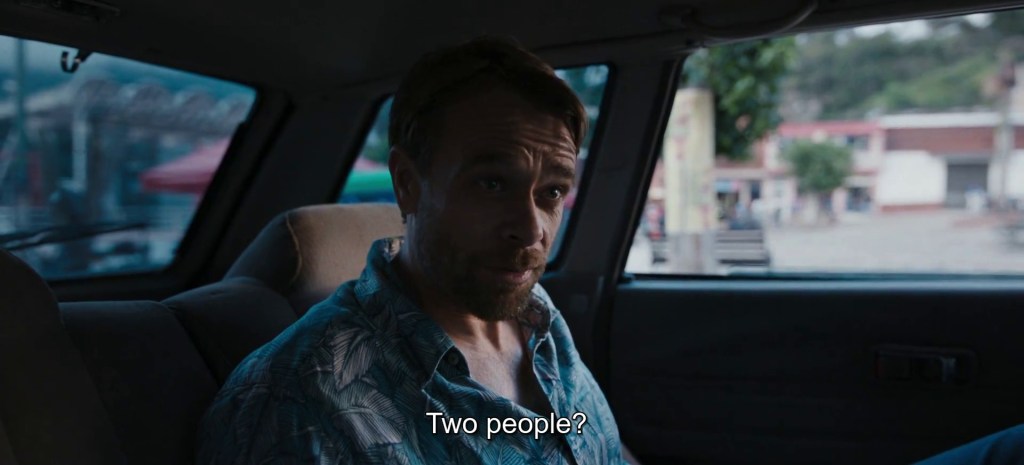
Ryan (Nick Stahl from Man Without a Face) arrives in Colombia (South America) at the invitation of his old friend Jack (Brian Groh). Ryan is on the run from massive gambling debts he has foolishly amassed. Although the debt collectors don’t know where he is, they do know where his mother is, and send him pictures to prove it. He needs lots of money and quickly. His friend Jack seems to have it all – a fancy house where he just has to cook one meal for the agency that contracts him, a fortune in his bank, and big pay cheques delivered after each meal.
But Jack is troubled by conscience, telling Ryan,
“The reward always matches the atrocity”
While Ryan is still coveting Jack’s lifestyle, Jack hangs himself. Recovering from the shock, Ryan realises that all he needs is a fake driver’s licence and a new password to become Jack and access all his money.
But when the agency people arrive – Imogen (Tamsin Topolski) and Maurice (Juan Carlos Messier) – they think he is Jack, and assume he knows what they want him to cook, are angry that he has not yet harvested the meat.
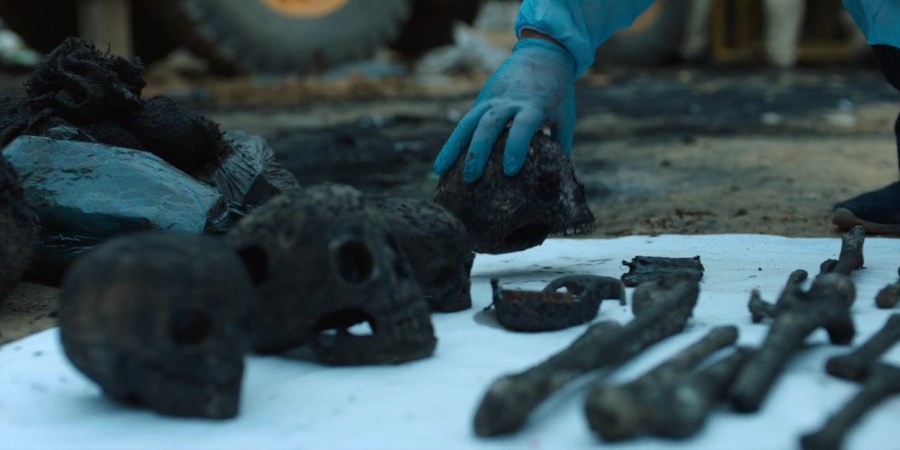
It turns out that his “ingredients” are local poor people, preferably ones who won’t be missed, and Imogen warns him that preparing and serving one bad course will be fatal not just to the person being cooked, but to the chef as well. The guests pay $1.5 million for the meal, including the exotic location, the private jets, and the specially sourced meat. They have special requests too – Imogen tells him “make sure you harvest the tongue.” So any thought of Ryan skipping out before the feast is extremely unpalatable (sorry).
The rationalisation is the same one found in most capitalist enterprises. It is the utilitarian argument in favour of the greatest good for the greatest number. Imogen tells Ryan:
“We kill on average fifty people a year, plus twenty-five in the clean-up. So, 75 deaths a year, and we generate over one hundred million dollars. We funnel 100% of our profits back into the communities. The farming, the infrastructure. We ensure clean drinking water for the entire population. You might say that’s simply self-interest. But we don’t eat everybody. Not even one percent. Now, you tell me what company makes that amount of money, has global presence, assists more than 99% of the people in the communities within which it operates, and their footprint has only ever killed 75 people a year? Oil companies kill on average 110 people a year, farmers are on about 250. Groundskeepers, truck drivers, roofers, they all thrash us in fatalities.”
The rest of the discussion is phrased in the same vocabulary as used by the meat industries. Old ones will taste disgusting, fear will taint the meat, the butcher will be covered in blood.
The victims are “produce” and become no more or less than “livestock”. Maurice, the agency killer who goes hunting with Jack, assures him “they won’t feel a thing”. When Ryan asks him if he feels bad, the reply is,
“Do you feel sad for a pig when you eat the bacon?”
Jack does what he has to do, after all his attempts to escape or alert the police are foiled.
Imogen sympathises with his nagging conscience, telling him what every soldier, assassin, slaughterhouse worker or meat eater is told at first:
“No one likes it at the beginning. But after a while, it does stop bothering you”.
There is a popular meme about “eating the rich”, and even a few movies about it (e.g. Eat the Rich and Eating Raoul). But the facts of nature, humanity and economics are that the rich and powerful get to choose what, and who, they eat. In the film The Cannibal Club, rich Brazilians watch poor people fight to the death and then eat the loser, in Fresh, the protagonist chats up young women then drugs them and sells their flesh and their underwear to the “one percent of the one percent” who want what no one else can have, and can afford to pay for it. Jeffrey Epstein had a similar gig, supplying sex rather than meat.
The people with the power, the rich, eat the poor: they swallow their surplus labour, they squeeze rent from them, they sell them their shoddy products paid for by lending them money at ruinous rates, and they send their children off to war. Why not go the next step and literally cook them for dinner? It’s what we do to other animals, purely because we can.
The film is sumptuously presented, the direction is assured and convincing, and the actors are all first rate, including the wealthy guests and the police who pop by and share the main course. The film is rated 80% “Fresh” on Rotten Tomatoes.
One reviewer opined, “What You Wish For will convert you to vegetarianism forever”.
In the year 2000, 44-year-old slaughterhouse worker Katherine Knight had a night of passion with her partner, John Price, then stabbed him 37 times, professionally skinned him, hung his hide on a meat hook over the lounge room door, decapitated him, butchered his corpse and cooked parts of him. She served up his meat with baked potato, carrot, pumpkin, beetroot, zucchini, cabbage, squash and gravy in neat settings at the dinner table, putting beside each plate place-names for Price’s children. Another meal was tossed into the backyard; it appears she intended to eat it but couldn’t do so. The police arrived before Price’s children so, as far as we know, none of him was consumed (by humans anyway).
Knight pleaded guilty to murder and the judge ordered that her papers be marked “never to be released.” An appeal was quickly denied, and she is still serving her life sentence at Silverwater Women’s Correctional Centre in Sydney.
Shoreline Entertainment planned to make a film of the incident based on Peter Lalor’s book Blood Stain, but so far it has not surfaced.
It appears that Knight was NOT a cannibal, despite one of the favourite media labels about her being “Kathy the Cannibal”. Other reports called her “The Woman Hannibal Lecter”, a comparison that makes no sense at all, since Hannibal did not use 37 strokes to kill people, definitely did eat parts of them, and did not (as Knight did) take a cocktail of sleeping tablets afterwards while lying in bed with the mutilated corpse.
Darren O’Sullivan, whose documentary is linked at the top of this blog, commented,
“this is possibly the most horrific thing I have ever discovered”.
Although the series is called “Real Twisted Tales”, I suspect O’Sullivan must have led a sheltered life. Knight was a slaughterhouse worker, recognised for her skills in knife work. She grew up in the NSW town of Aberdeen, where everyone in her family and most of the town were employed in the abattoir. Her job, from a young age, was to kill and cut up animals. She did to John Price what she was trained to do to other animals – slaughter them, cut them up, cook them. She did try to feed bits to his children, which is what farmers did in the UK (feeding cattle bone-meal to cattle), an act of cannibalism which led to Mad Cow Disease. But there is little evidence that she herself ate any of him.
The documentary above states that Katherine Knight is “one of the most evil people in the world”, because she was found sane enough to stand trial. But really, what she did was what she was paid to do every day, just to a different species than those who usually suffered and died under her hand.
Superstitious anthropocentric beliefs put humans on a tier somewhere between angels and animals, but really we are a species of Great Ape, closely related to the chimpanzee. Rationally speaking, there really is only a thin red line between killing and eating any species of animal.
The ultimate story of our sins coming back to bite us?
Amber Paige Laudermilk, a 34-year-old licensed embalmer from Texas, has been accused of castrating the corpse of a sex offender.
Laudermilk is behind bars at the Harris County Jail after turning herself in on Tuesday. She’s been charged with Abuse of a Corpse – a felony – and remains in jail on a $5,000 bond.
According to a press release from Harris County Constable Alan Rosen, Laudermilk worked for Memorial Mortuary & Crematory and is accused of, in January 2025, “mutilating the body of a dead sex offender.”
The 58-year-old registered sex offender, Charles Roy Rodriguez, had received 10 years of Deferred Adjudication after being charged with Sexual Assault in 2001. Rodriguez died from natural causes in January.
Laudermilk’s alleged action, according to charging documents, was brought to the attention of the funeral director by two employees who said they witnessed the crime. One witness said they saw her stab Rodriguez’s body twice in the groin with a scalpel, before cutting off his penis, after learning Rodriguez was a sex offender.
She then “stuffed it in his mouth,” and allegedly told a trainee in the cremation room, who saw it happen, that they “didn’t see anything.” The witness reported that Laudermilk’s demeanour was threatening. When other employees went to see the body, Laudermilk allegedly covered his groin area with a sheet and said he had “a lot going on with him.”
Precinct One Constable Alan Rosen said in a statement:
“This case is about two troubled people: the victim who was a registered sex offender and the defendant, who is accused of viciously attacking his dead body. No matter what one thinks of his life, the law requires that he be treated with dignity in death.”
Laudermilk’s license was suspended by the Texas Funeral Service Commission, and the Memorial Mortuary & Crematory confirmed that Laudermilk is no longer employed by them.
In their statement, they said:
“We are deeply troubled and saddened by the unlawful and horrifying actions of this individual ex-employee. Our thoughts are with the family and loved ones of the deceased.”
Now, why is this story on a cannibalism blog, I hear you ask? Well, cannibalism is not just about swallowing another person’s flesh or organs. It is also an act of dominance, and often revenge or intimidation. Gerald Linderman in his book on Americans at war in WW2 writes that the Japanese would disembowel captured Americans and leave the bodies “with their severed genitals stuffed in their mouths.” Tim Blackmore, in his book detailing modern military technology and its dehumanising effects, comments,
“Where there was a tongue, now there is a useless penis, a double castration and silencing. Putting flesh in the mouth also suggests that the enemy can be eaten. Cannibalism makes the soldier strong at the attacker’s expense.”
So this was, in a way, the embalmer expressing her opinion, her freedom of speech, using a scalpel instead of a keyboard (which would have been protected by her First Amendment rights I guess). Plenty of written opinions deny the dignity or humanity of the person being described. Does a dead sex offender deserve “dignity in death”, even though he may have had little or none in life?
The fact is that the dead human is just meat. Starving survivors of catastrophes, ship wrecks or plane crashes quickly realise this and soon eat the dead and sometimes even the living – think the Donner Party. Remember the words of a famished Chris Hemsworth saying to his dying crewmen “No right minded sailor discards what might yet save him.” Or the debate in the crashed plane as a group of young men slowly starve to death surrounded by snap-frozen corpses:
“if the soul leaves the body when we die, then the body is just a carcass… What’s there in the snow is just meat, Antonio. Food.”
There are thousands of people dying of starvation every day around the globe, and what dignity do we offer them, even in their last moments of life? As for dignifying the dead, we casually torment, kill and then mutilate the corpses of billions of other animals every year for our food, our medical experiments, our clothing or our entertainment. Yet we are expected to weep for this sex offender’s insentient corpse?
A South Carolina mental health facility is being sued by the family of an alleged victim of a man who has been accused of murdering and cannibalising patients.
A lawsuit filed by the family of 22-year-old Jared Ondrea claims Richland County’s New Hope Home Solutions, facility owner Brittany Reynolds-Jackson and the South Carolina Department of Mental Health (SCDMH) are responsible for his death.
According to documents, Ondrea suffered mental disabilities which led to his placement in 2023 into an assisted living facility, New Hope’s Harper Street facility, which had been recommended to his grandmother by SCDMH. Ondrea was meant to learn independent living and socialization skills there.
Ondrea’s grandmother noticed bruising on his neck and face when she picked him up for a visit in March of that year, but he did not divulge the cause. He also appeared to be “unkempt, his hair was not combed, his clothes were dirty, and his nails were long and dirty,” which seemed odd considering the facility’s undertaking to help him learn independent living skills.
Ondrea was dropped off at the facility later that evening, the last time his family saw him. When his grandfather arrived to pick him up for an appointment two days later, he was not there. The next day, the facility called to let his grandmother know that he had been missing since that night he had been dropped off. Staff was reportedly alerted to his disappearance by another patient who told them they “should be alarmed that Jared was missing.”
That patient was Marc-Anthony Cantrell, who has a violent history, including multiple instances of animal cruelty and arson, allegedly to cover up the torture and killing of his family’s three dogs. He was interviewed during the search for Ondrea and reportedly displayed strange behaviour, which was subsequently reported to law enforcement.
In July, a few months after Ondrea’s disappearance, another resident named Deshea Butler went missing. This time, Cantrell was caught on video removing that victim’s body from the facility. When interviewed, he confessed to the killing and told police that he also killed Ondrea, providing “specific, graphic details as to how the murder was conducted” including that he had strangled both men.
Cantrell reportedly told police that he was compelled by his “alternate personality”, called Robert Baldwin, to kill the victims and consume parts of their bodies “so he could gain their power.” While Ondrea’s body was never found, an autopsy of the second victim was consistent with Cantrell’s description of the killing.
The lawsuit alleges that Cantrell ate both the victims’ ears after killing them and,
…after he had strangled Deshea, he hit him in the head with his lifting weights so he could drink his blood, which he did over several days from a coffee cup.”
A grand jury indicted Cantrell for both killings.
The lawsuit brought by Ondrea’s family blames the facility and SCDMH for allowing what they describe as “a budding serial killer” to be placed in a home with vulnerable adults. Law enforcement and SCDMH were aware of Cantrell’s violent history, and attorneys argue that “SCDMH failed to take any appropriate steps to treat Cantrell or to otherwise prevent the obvious danger that he posed to the public and to those living in close proximity to him.”
The lawsuit also claims New Hope did not have the proper license to be operating as a mental health facility, and “had no business housing mental health patients of any sort — much less ones with the type of violent tendencies displayed by Cantrell.” It also faults staff for failing to notice Ondrea’s disappearance for three days, which was allegedly only brought to their attention after the man accused of murdering him told them they should be concerned.
The defendants are being sued for several claims, including negligence, gross negligence, and wrongful death. The plaintiffs offered to settle with SCDMH for $600,000, but the offer was rejected. A jury trial roster meeting has been scheduled for April 7.
Murder is not unusual in the USA, peaking at 2,000 per month in 2020. Although the rate has decreased a little, murder is still so quotidian that it is rare to see it reported widely in the media. Unless, like this one, it includes cannibalism, which Freud described as one of “the two original prohibitions of mankind” (the other, he thought, was incest). Cantrell believes he had an alternative personality, a wendigo perhaps, who maintained that eating human flesh bestows power. Such a psychotic belief stems from anthropocentrism, the faith in human transcendence, that we are somehow ‘more’ than other animals, so even our flesh must have magical properties. But there is nothing special about us, and no power is imparted by eating human ears, any more than eating a pig’s ear. We are made of red meat, like most mammals, and eating any animal causes appalling suffering, environmental catastrophe and quite often dangerous maladies.
Authorities said Matthew Hertgen brutally beat and slashed his 26-year-old brother, Joseph.
A 31-year-old man has been charged with murdering his brother in February 2025 at their luxury Princeton apartment in the Michelle Mews apartment complex off Witherspoon Street. Police said that Matthew Hertgen, a former college soccer player, allegedly beat and slashed 26-year-old Joseph Hertgen, ripped out his eyeball and then ate it. He also reportedly set the family’s cat on fire.
Afterward, Hertgen called the police to report a body and a fire inside the upscale complex, where units go for up to $2 million. Police discovered the brother’s mutilated body together with a bloody knife, fork, and plate, leading authorities to believe that the suspect had consumed part of his brother’s remains. They also found the charred remains of the cat.
Authorities arrested Hertgen at the scene. They believe he used both a blade and a golf club to kill his brother. His case will be heard on March 6 in Mercer County Superior Court.
The day before the killing, Hertgen posted a selfie with a cat toy.
Months before the attack, Matthew Hertgen had posted a poem on Facebook filled with references to knives, suffocation, and blood oozing from eyes – details that were mirrored in the crime scene.
“I can see the knives sharpening… Blood oozes out of his eyes… He convulses, and he doesn’t stop… He’s lost… He’s asleep… He’s dead.”
Joseph Hertgen was a former University of Michigan soccer player and an analyst at asset management firm Locust Point Capital. His brother Matthew, who played soccer at Wesleyan University, had a prior DUI conviction in 2017 but no other criminal history before this alleged murder.
The Hertgen family originally lived in a $1.1 million Jersey Shore home before moving to Princeton. Their father, David Hertgen Sr., is a high-ranking executive at WiLine Networks.
Authorities have charged Matthew Hertgen with first-degree murder, weapons offences, and animal cruelty. He faces life in prison if convicted.
One police officer observed,
“It’s incredibly tragic. Matthew Hertgen came from what appeared to be a perfect, all-American family. No one could have predicted something like this would happen.”
It seems that, while New Jersey like most states has no laws against cannibalism, they do strongly disapprove of murder and animal cruelty, particularly when done by or to the rich.
Children wandering door to door, sometimes unsupervised, is often likely to end in tears. In this film Sector 36, immigrant parents, struggling to survive, have not the time to keep a watchful eye on the kids, resulting in sexual abuse, murder, organ trafficking, and cannibalism.
The words “inspired by true events” allow for all sorts of poetic licence, offering the fascination of actual criminality without the need to prove the veracity of each scene. This one is fairly close to the facts, being based on the 2006 Noida serial murders, in which over thirty children disappeared from a town in Uttar Pradesh in northern India. Evidence was presented, in the trial of the two alleged perpetrators, that the children had been sexually abused and murdered, had their organs sold to traffickers, and in some cases were eaten. The charges included abduction, rape, murder, criminal conspiracy and trafficking. The two men involved, a rich man and his servant, were found guilty of murder in 2009 and sentenced to death but were later (2023) acquitted of all charges against them due to insufficient and largely circumstantial evidence, despite the servant’s recorded confessions, which included admissions of cannibalism.
Before the acquittals, the BBC released a documentary called The Slumdog Cannibal, which tried to examine the motivations of the servant who had admitted to the crimes. The legal position becomes a lot more complicated once convictions are quashed, so in the two-hour Netflix special Sector 36, the original names have been changed, and various details are embellished for dramatic effect. The twists and turns of the plot at the end are completely fictitious. But the direction is sure and never intrusive, the plot is taut and engrossing, and the acting excellent, from the smallest victim to the extraordinary interactions of the two main characters, Prem and Ram.
We start by meeting the hungry servant, in this case called Prem Singh (played by Vikrant Massey), who is looking after the house of his boss, Balbir Singh Bassi (Akash Khurana). He calls his family, tenderly tells his wife he loves her, and then goes off to a storeroom where he starts chopping up a dead woman.
We then we meet a policeman, Ram Charan Pandey (played by Deepak Dobriyal) who is also a loving family man, driving his daughter to school on his scooter, but he turns out to be corrupt and lazy at work, not bothering to investigate the reports of the many small children who have gone missing in the town. They’ll turn up, he tells the distraught parents. He believes it too, until Prem tries to abduct his daughter. Then he takes the cases seriously, only to be hindered and suspended by his superior officer who is a friend or perhaps employee of the rich man, Bassi. When the father of one of the abducted girls appears at Bassi’s house screaming about murder and rape, Bassi reveals that the father was the girl’s pimp.
But then, a child from a wealthy family is taken, a nationwide manhunt is launched, and the child is found almost immediately. One cop tells his colleagues that while Gandhi freed the country, the picture of Gandhi’s face on Indian banknotes will free this rich child. Eventually, Ram’s new superior officer reinstates him and lets him arrest Prem, but only because he wants his temporary posting in Delhi to become permanent.
Is everyone corrupt in this story? The theme, stated at the beginning, is Isaac Newton’s third law of thermodynamic: for every action there is an equal and opposite reaction, which has become in social interactions a “system”. The system means that when a crook gives Pandey a box of cash, he is allowed to leave, while others who have no funds are beaten up and incarcerated. When a rotting child’s hand is found in a sewer, Pandey declares it is a monkey’s paw and gives a reward to the boy who found it.
This boy is then captured by Prem who has his own system, capturing little kids to be abused and then slaughtered for their flesh and organs. Prem tells the boy that the police will forget about him after a few days, and even his parents will eventually just replace him. But someone else, someone rich and worthy, will live longer through the appropriation of his organs.
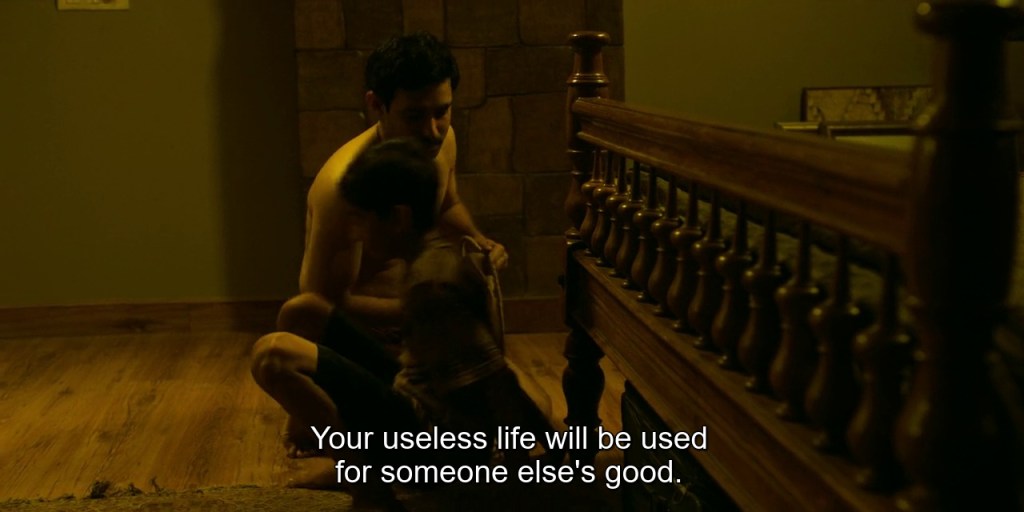
Why, we wonder, is he like this? We have a flashback to Prem’s early life – he is working in his uncle’s butcher shop, chopping up goats and “servicing” his uncle, who enjoys raping little boys. We see him fight back, killing the uncle and then chopping him up, presumably getting rid of the evidence by bundling it up with the goat flesh, and eating his uncle’s liver, raw.
I cut that fucker up and fed him to the dogs. Had a few pieces myself!
As an adult, he has no scruples doing the same thing to kids (human ones), for his own pleasure and profit. Ram, the policeman, arrests Prem who immediately confesses, boasts, that he kidnaps kids, rapes them, chops them up after killing them, eats some of the meat, disposes of the rest, and sells their organs. His “business” involved all the missing children that the police have been ignoring. He tells the police,
Sir, the thing is that after killing Uncle, I got a taste for human flesh. I used to crave it. I needed it every couple of months…. I avoided it for a year, I tried to quit. But that craving wouldn’t go away.
He admits to abducting Ram’s daughter, but says it was an accident. He just didn’t know her father was a cop. Ram asks, “what’s the difference between them and my child?” Prem is outraged – there is no comparison, the kids he kidnapped and slaughtered were nobodies, who would never amount to anything.
While Prem is a bit naïve (one might say stupid), his question is real. No one cares about the sheep, goats or chickens that he chopped up in his Uncle’s shop as a child, nor would they be able to tell the difference if he added Uncle to the mince. Prem’s argument that he became addicted to human flesh is just an excuse – those who have tried the meat of humans report it is hard to distinguish from veal or pork. But poverty, homelessness and alienation is real, and if we can utterly disregard the moral value of any sentient being, we can do the same to those humans who seem, to criminals and authorities alike, outside our scope of care. Those whose lives don’t matter become disposable, and ultimately edible.

































 The Cannibal Guy