Awarded PhD from the University of Melbourne for a thesis questioning how cultural manifestations of cannibalism challenge the assumed anthropocentrism of our relationships to other animals.
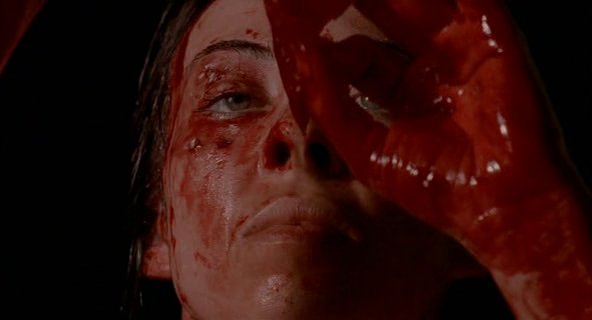
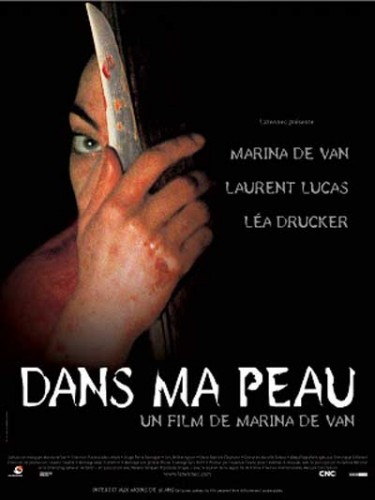
First off, if you don’t like gore (hey, it’s a blog about cannibal films, not necessarily slashers), then you may want to avoid this little French number. If graphic scenes don’t bother you (or if you like them) then this one is quite intriguing and very well made. But –– you’ve been warned.
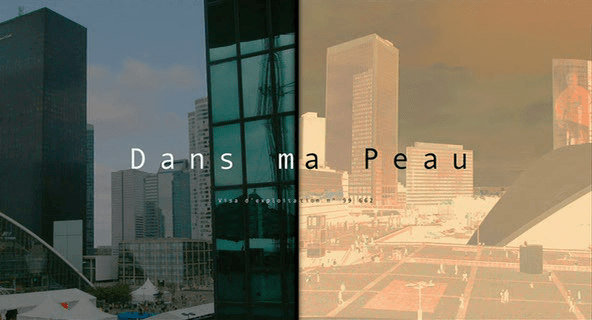
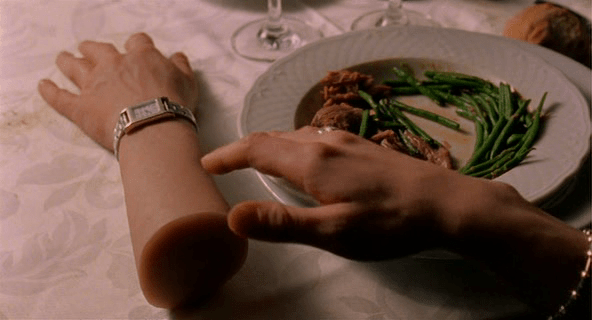
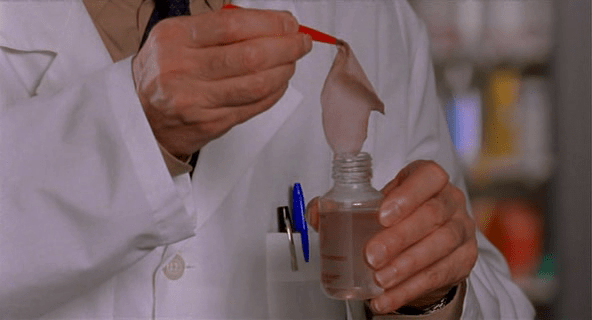
Marina de Van both directed and starred in this film, one in a genre of French movies which became known as New French Extremity films. There’s not a great deal of plot, but there’s a lot to the film in terms of the concepts and questions it raises. The film starts with a series of scenes: traffic, buildings, doors, etc, split screen into the image on one side, and a negative version on the other. So we’re already exploring dualism. The lead character, Esther (played by the director, Marina de Van), is a picture of privilege: she is white, well paid, well off, has a loving boyfriend – she’s on top of her world. Then she has a fall. A real fall, onto some rubbish, and actually injures her leg. But it doesn’t hurt. She doesn’t even notice the abrasions for some time.
Her doctor (played by her real-life brother, Adrian de Van) and her boyfriend (Laurent Lucas) are both concerned about her feeling no pain, but she brushes them off. Then she starts poking her wound, then the cutting starts, then the stabbing, then later the chewing (which qualifies it for my cannibal blog). That’s all I’m saying – no spoilers.
In the director’s words, the movie asks “does this body really belong to me?” In an interview, she revealed that the story is based on an childhood accident, when she was hit by a car and had her leg broken, and she saw her leg not as part of her, but as a “fascinating, deformed object.”
Here’s the point: we look at each other with love or lust or hatred or fear, but it’s always only skin deep. What is beneath that surface? Derrida tells us that the binary opposition of inside to outside is the “matrix” of all oppositions. We consume the insides (muscle, fat, blood) of other animals but are horrified at our own internals – think of the warning given on the news when showing an accident or terrorist event, often quickly followed by an advert or a kitchen show involving bits of a dead lamb.
Why are we so repelled by what’s under our skin? Judith Halberstam tells us that skin is a “metonym for the human”, and any breach of it reveals a “semiotic of monstrosity” – the uncanniness within the body. Or as Angela Carter put it, “if flesh plus skin equals sensuality, then flesh minus skin equals meat”.
This film, and cannibal films generally, remind us that we are not gods or angelic beings – we are animals, and are made of meat, just like the animals we torment and slaughter. When Esther looks into her own being, she feels the same appetite others feel when walking past a roast.
In My Skin received 65% on Rotten Tomatoes, with one reviewer saying “A spellbinding, forceful film that refuses to be ignored” and another slamming it as “a bloody mess, in more ways than one.” The film received the Best International Film award at the Fantasia Film Festival in 2003. Make up your own mind.
This episode is called “Relevés”, an obscure term in the French menu – it comes sort of after the main course, but is not the Rôti (roasts) of episode 11; this one is joints – big butcher joints, served with heavy accompaniments and garnish. Appropriate for a meaty episode, in which Hannibal takes steps not just to cover his own tracks, but to lay a path of suspicion to Will, who has been behaving very strangely lately, thanks to his encephalitis (which Hannibal has also covered up). The real meat of this episode, though, is its treatment of mental illness – where it starts (physical and/or psychological) and how it develops, and the paucity and inadequacy of treatments.
At the start of the episode, everyone is starting to recover. Georgia Madchen, who killed her friend and witnessed Hannibal killing the doctor who knew about Will’s condition, is in an oxygen tank, awaiting shock treatment which may restore her memory.
But she doesn’t want to remember.
Hannibal has brought Will one of his gourmet concoctions: “Silkie chicken in a broth: a black boned bird prized in China for its medicinal value since the seventh century. Wolfberries, ginseng, ginger, red dates and star anise. Will’s bemused response, as though Hannibal was his Jewish mother, making chicken soup to treat a psychic crisis that just seems to get worse:
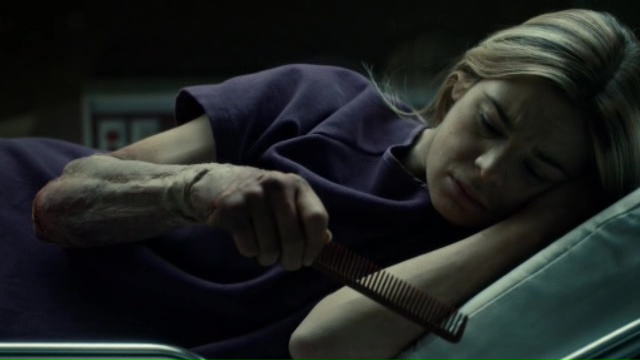
Hannibal also does not want Georgia to recover her memory, because he is vulnerable, even if she was unable to see his face. She wakes up in her oxygen tent and finds a plastic comb, naturally, she starts to comb her hair, and naturally the static creates a spark that ignites the oxygen.
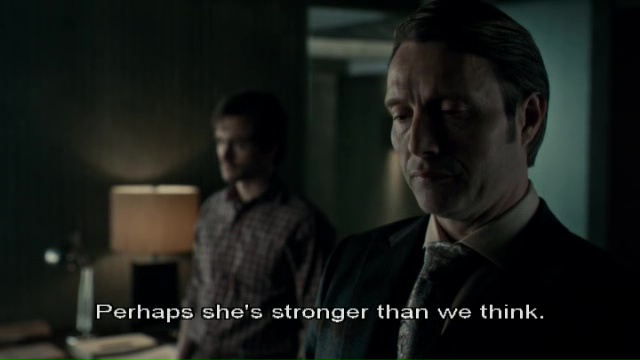
So that leaves Abigail as apparently the only one who could spill the fava beans on Hannibal. She is busy writing her book with Freddie Lounds, who tells her she knows what killers look like
She looks for a specific brand of hostility. She sees it in Will Graham, every time she looks at him. Very convenient for Hannibal. But Will has released himself from hospital, and is starting to realise that the spate of copycat deaths are all the same, but slightly different, to the murders they copied – the copycat killed all of them, including Georgia, who saw his face. Will is furious that Georgia was misdiagnosed and misunderstood her whole life, and doesn’t want the same thing to happen with her death, which Jack is treating as suicide.
Will’s vehement reaction worries Jack, who consults Hannibal, allowing Hannibal to plant the seed of suspicion: does Will suffer from a mental illness that would allow him to do things he doesn’t normally do?
That’s true for Will, but even more true for Hannibal, who sees himself as a species apart from the common herd, an Übermensch, who has cast off normative humanism for his own ends, which we are yet to understand.
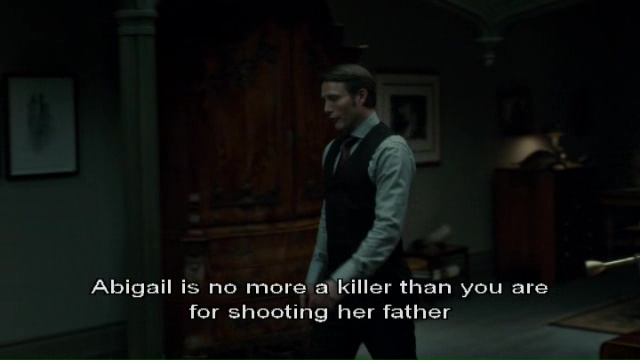
Will is visiting Abigail in hospital. They discuss the nature of killing. Will admits killing her dad was terrifying, but then made him feel powerful. She replies that
She wanted to escape, but Will is doubtful
Her dad is still out there, in the form of the copycat. Will thinks he can catch him,
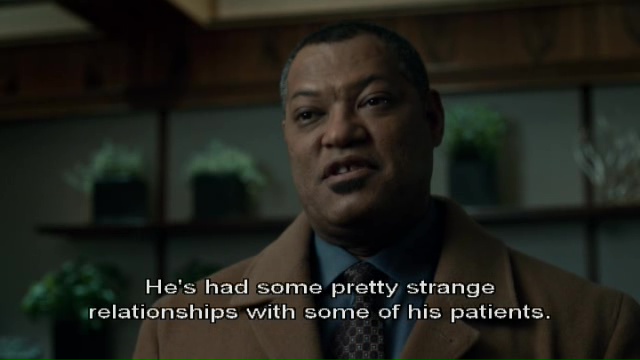
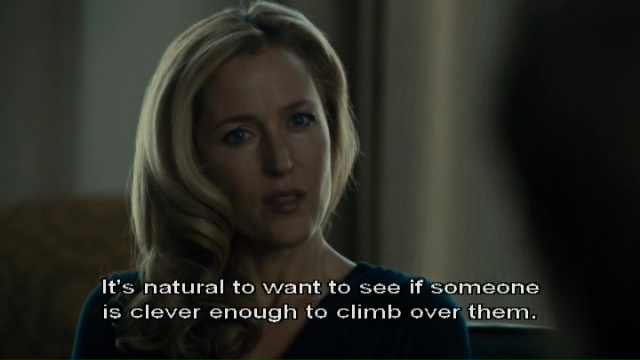
Jack has been visiting Bedelia, who has covered for Hannibal (as any professional psychiatrist would) and has been asking about a case in which a patient, referred to her by Hannibal, tried to kill her, but luckily died by swallowing his own tongue ( a reference to Multiple Miggs in Silence of the Lambs). Hannibal, Jack points out,
30
Hannibal asks what she told Jack?
She doesn’t know quite what Hannibal is trying to do with Will (it seems to us, the omniscient spectators, that he wants to turn Will into a clone of his own powerful self)
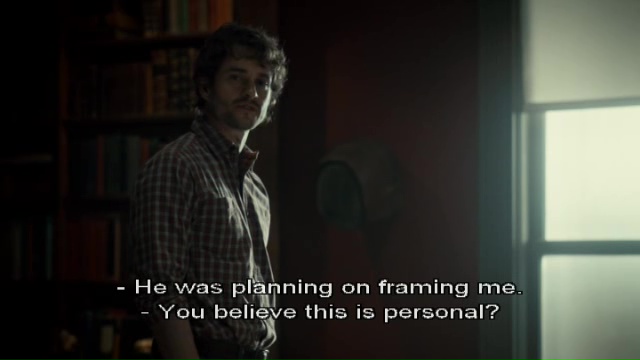
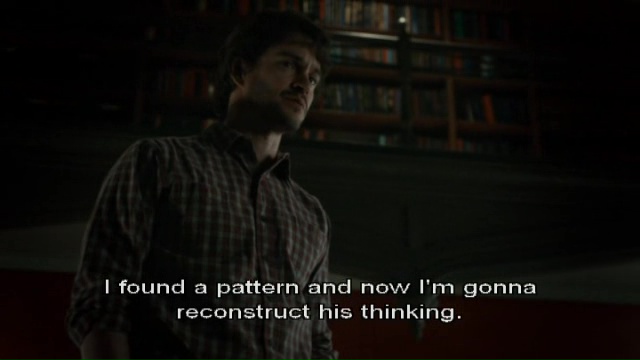
Will is thinking clearly again, he tells Hannibal, and starting to understand the copycat killer that so baffles the FBI. Georgia was killed for seeing the killer, who ended up framing her for it, but
Now it’s personal. Will realises it could be someone at the FBI or the police. He doesn’t, however, realise what we realise, that he is in the same room with the killer. Like a pantomime, we feel like shouting at the screen: look behind you! But we don’t, because we don’t have interactive TVs (yet), and also because we like Hannibal, and don’t really want to see him unmasked (yet). But Will’s clarity, and Abigail’s book, are both threats to Hannibal. And he has only one episode of Season 1 to neutralise them.
Fortunately for Hannibal, everyone is on the wrong scent. Jack is still convinced Abigail is the killer, while Freddie is still convinced it is Will, and tells Jack so.
Will takes Abigail out of the hospital, back to the crime scene – her home in Minnesota. Jack is furious and goes to see Hannibal, who admits to Will’s confused mental states, where he loses time and doesn’t know what he has done. He plays Jack a selected section of the recording of his discussion with Will about the murder of Melissa Schurr.
Together with Hannibal’s revelations about Will’s mental state, Jack is starting to suspect Will.
Will had told Hannibal, who hadn’t told Jack, that he was getting so close to Hobbs that
Now he has Hobb’s daughter, who Hobbs intended to kill. Jack fears the worst. As for Hannibal:
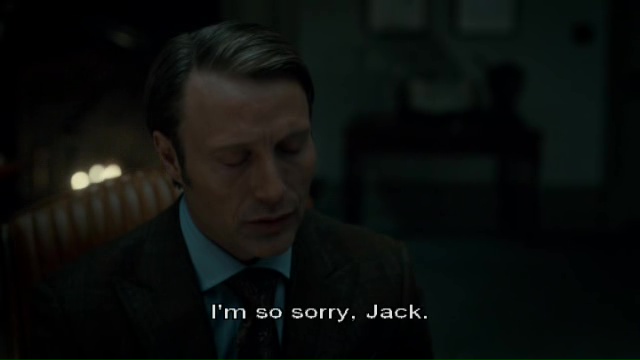
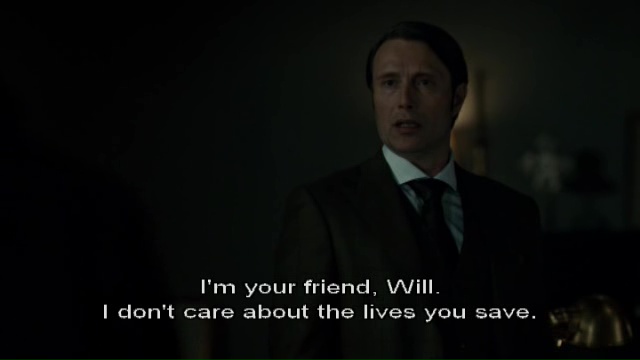
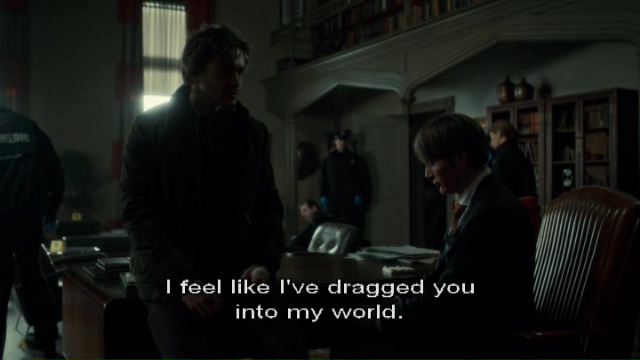
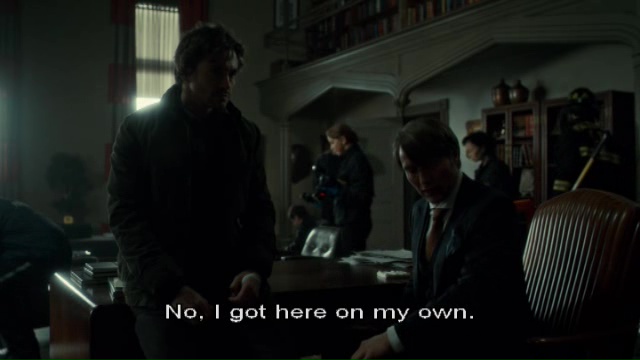
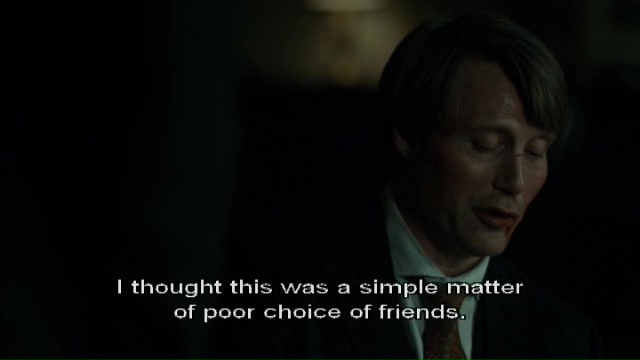
Hannibal is sorry, but not, as Jack thinks, for hiding the “truth” about Will’s mental state. He is truly sad and sorry, for losing his friend, his only friend, feeding him into the jaws of the justice system.
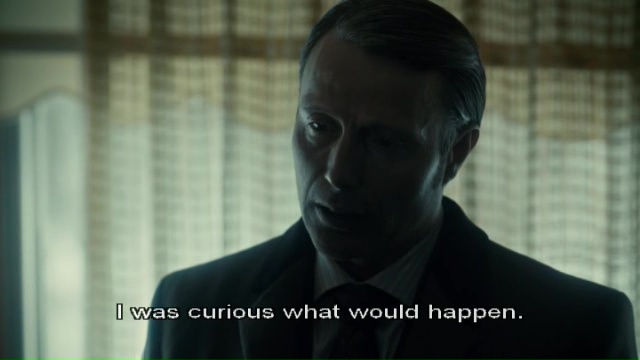
Why does Hannibal do these things? Abigail asks him, and he tells her the truth, at last. He called the house to warn Hobbs they were on their way. Why? she demands. And this is crucial to an understanding of Hannibal:
He killed Marissa, hoping that Abigail would kill the victim’s brother. Abigail is another of his projects
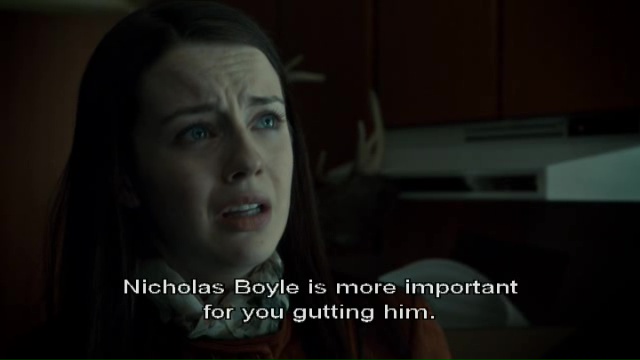
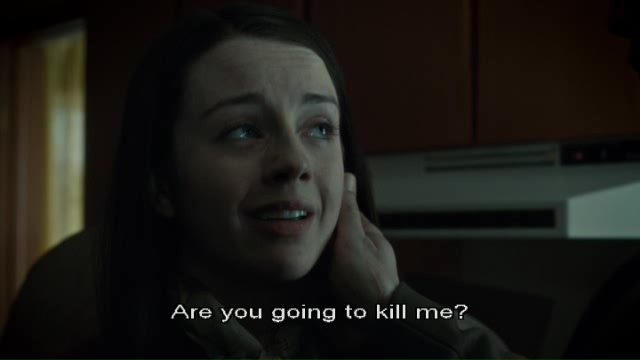
Hannibal believes, as Dolarhyde says in Manhunter, that the people who are killed in these becomings are not real: “You alone know the people I use to help me in these things are only elements undergoing change to fuel the radiance of what I am Becoming. Just as the source of light is burning.” Abigail’s Becoming is far more important than Nick Boyle. But Abigail is scared of Hannibal now: he tells her that he has killed far more people than her father.
Will he or won’t he?
Next episode – the season finale.
IF YOU LIKE MY BLOG, PLEASE FEEL FREE TO RECOMMEND IT (WITH DISCRETION) TO FRIENDS ON SOCIAL MEDIA.
IF YOU HAVE ANY QUESTIONS OR COMMENTS, YOU CAN USE THE TAG, OR EMAIL ME ON CANNIBALSTUDIES@GMAIL.COM.
One of the earliest films in the range of cannibal stories I have chosen to cover is George King’s 1936 version of Sweeney Todd. Sweeney is a modern myth, but is a descendant of the shadow archetype, those who destroy themselves in trying to destroy others, including Homer’s Cyclops, whose behaviour, Lacan would say, is governed by “unregulated libidinism”. This Todd is certainly so governed.
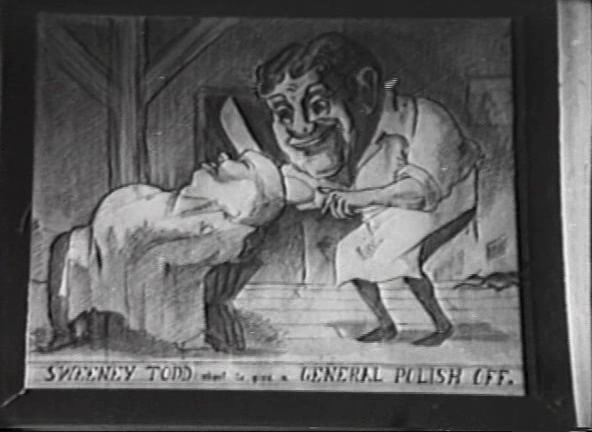
The poster on the wall of the barber shop, where the story is told
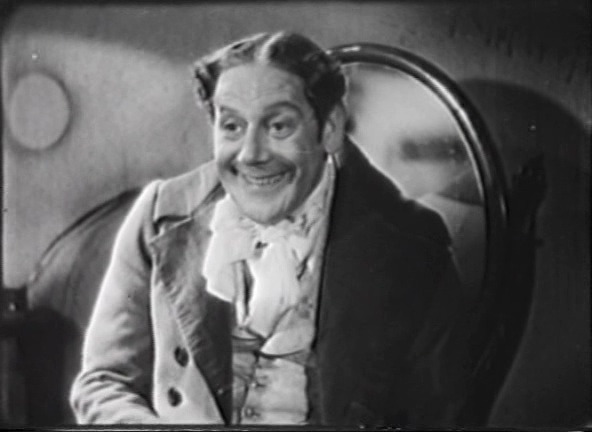
The title role is played by the wonderfully named Tod Slaughter, who presents Todd as pure evil: socially respectable, yet greedy for money and lusting after the young heroine, Johanna. This is a far more straight forward explanation of cannibalism than the 21st century version where Depp is motivated by revenge at injustice (and insists on singing as well).
The plot is straightforward: Todd has a barber shop near the docks where he lures passers-by in for a shave, kills them and steals their valuables, the kind of simple but effective business plan that any bank would find beguiling.
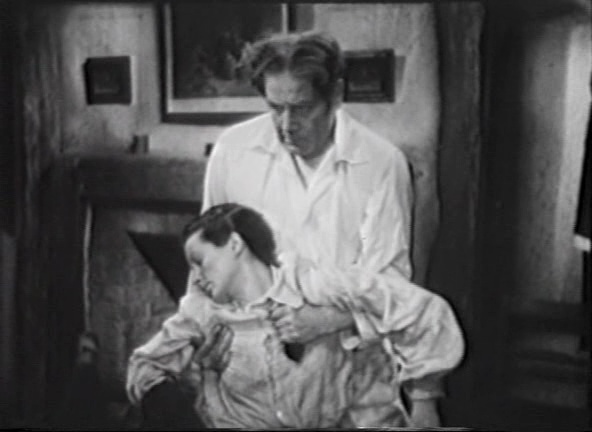
Todd’s partner in crime, Mrs Lovett, has a pie shop and profitably disposes of the bodies. Johanna is the daughter of a local merchant and Todd offers to go into partnership with him, planning to ruin him and blackmail him into approving marriage with his daughter. When the girl’s true love, Mark, returns with riches from the African colonies, (he also bravely fights off a tribe of savages, who are probably cannibals in terms of the colonial trope) he is robbed by Todd but saved from death by Mrs Lovett, who is jealous of Todd’s attention to Johanna. In an interesting instance of early (pre-‘slasher’) gender displacement, Johanna decides to save Mark by dressing as a boy, but is captured by Todd and, setting the gender roles back to basics, has to be rescued from the resulting fire (which consumes Todd) by Mark.
Neither Todd nor Lovett are ever seen eating human flesh – all cannibalism is performed by the unwitting customers, alluded to when Mark’s comic relief friend and shipmate, Pearley, munches through a pie while speculating on what Todd does with the bodies. The word ‘cannibal’ is never uttered, and the only whiff of abjection is when the narrator, a modern day barber in Todd’s old shop recounting the story to a customer, reveals there is a pie shop next door, and watches in amazement as the man flees. This is textbook abjection: the smell of meat from some non-human mammal cooking next door has made the customer in contemporary London realise his own mortality.
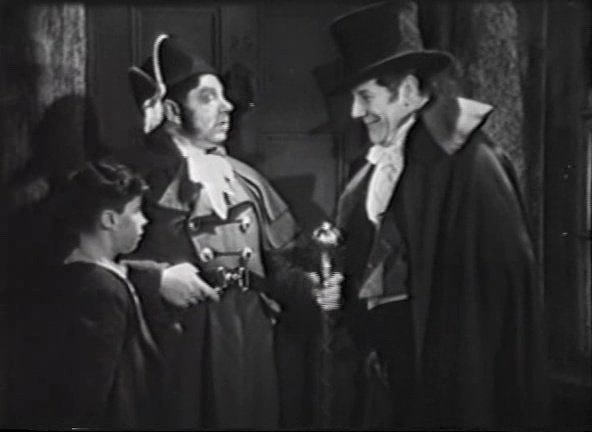
The class nature of nineteenth century England is illustrated by young Tobias, who is brought to Todd as an apprentice: Todd gets one guinea for each boy he takes from the parish. The Beadle warns Todd that this is the last boy he is getting: presumably he has killed, and Mrs Lovett has cooked, the previous seven.
“You’ve brought me another apprentice. And a nice little boy, too!”
The boy prepares the victims by applying shaving cream, and is then sent off for a walk with a penny pie from next door, making the innocent lad the chief innocent cannibal. In fact, all the cannibalism is innocent and is carried out by the lower classes, represented by Pearley and Tobias, an apparent metaphor for the exploitation with which the working class was struggling in the 1930s when the film was made. Todd’s unconscionable slaughter of men (never women, except, almost, the disguised Johanna) for profit is pure objectification: he treats his fellow humans as commodities. No explanation is given, nor needed: Todd’s maniacal laughter is necessary and sufficient to make clear that he is a psychopath; in this, he is a mythic figure: the stuff of nightmares.
We’re finally at the main course of this extended French banquet that makes up the episodes of Season 1. This episode is called Rôti, which means roast. The dead animals are coming out of hot, dark ovens, cooked, carved, and being eaten. And the accompanying sauce is a healthy dose of Existentialism, Hannibal Lecter style.
This episode is all about identity, and identity is all about existence: what is real, what exists and how can we be sure? Here is Sartre’s view of existence from the novel Nausea: the character who sees himself usually as a man named Roquentin, sitting under what seems to be a chestnut tree:
…the diversity of things, their individuality, were only an appearance, a veneer. This veneer had melted, leaving soft, monstrous lumps, in disorder — naked, with a frightful and obscene nakedness.
Roquentin concludes “My existence was beginning to cause me some concern. Was I a mere figment of the imagination?”
Most of the characters are losing their footing in this episode, and some are losing all touch with reality.
Abel Gideon has lost touch with his identity. Thanks to Dr Chilton’s “psychic driving”, Gideon came to believe he was the Chesapeake Ripper. Of course he isn’t – that’s Hannibal, and Hannibal is none too pleased to have someone else take credit for his ‘work’. Hannibal discusses the situation with Chilton over dinner: Kudal, a sheep gut curry. Lots of useful metaphors in this dish – guts because we are getting inside all the characters at last, and sheep? Well, sheep are used (rather unfairly IMHO) as allegories of blind obedience – going where the leader goes, following without question. Chilton thinks psychic driving is something of this sort – lead the patient to the conclusion you have already drawn.
Hannibal points out that Gideon was an ideal patient to be manipulated:
Chilton suggests Gideon is a psychopath, but Hannibal squashes this idea:
So, if Gideon is not really a psychopath, he is just a common killer, a domestic violence offender who went over the edge into serial killer. Chilton told him he was the Ripper. Alana then told him he was not in a state of mind to know who he was.
Chilton feels like his is going to be blamed (especially since Gideon is planning to sue him). Gideon escapes, as he is hoping to attract the real Ripper, who, he hopes, will tell him who he really is, but Will understands that the Ripper will kill Gideon, for taking credit for his ‘work’.
Realising Gideon is not the Ripper, Chilton just wishes he had been more curious about how common minds work. Hannibal replies:
Thus, the sheep’s gut curry.
The psychic driving didn’t work as hoped, Hannibal tells Chilton, because, once a patient is exposed to the methods of manipulation, he will push back.
Will Graham is not aware of Hannibal’s manipulation, or of his now chronic encephalitis. He is having nightmares about water: tsunamis of water at crime scenes, melting clocks à la Dali, hallucinations of water pouring down the walls in the BAU. He imagines Jack is accusing him, Will, of being the killer they seek.
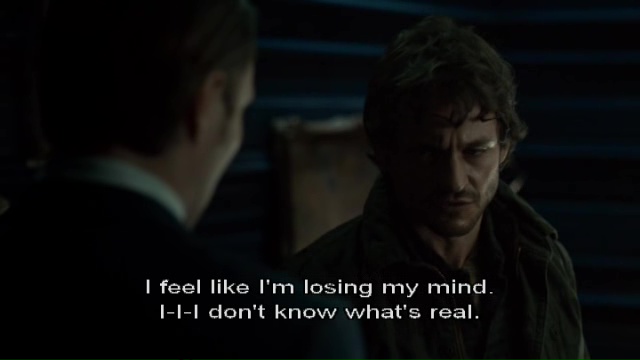
Will is lost. He feels crazy. Is that your worst fear, asks Hannibal?
Gideon’s battle with identity is brought into focus when he kidnaps Freddie Lounds, so that she can document his vengeance on Chilton, and draw the Ripper, who he knows is an “avid fan” of Freddie’s journalism (the term “avid fan” is from the book and movies of Red Dragon).
Gideon describes his existential crisis to Freddie.
He then proceeds to open up Chilton and remove an amazing number of his organs, without actually killing him:
When the FBI bursts in, Freddie is keeping Chilton alive, and Gideon has gone. Will is waiting in Gideon’s car, and takes him, not to the FBI, but to Hannibal’s home. Why? He is convinced that this is not Gideon he has captured, but his dead nemesis, Garret Jacob Hobbs. Hannibal helpfully tells him that there is no one there at all, which tips Will right over the deep end of his identity/existential crisis:
Will has what Hannibal describes as a “mild seizure” and questions Gideon about whether he is the man who claimed to be the Ripper. Why “claimed”?
He sends Gideon off to hunt Alana. He then tricks Will into going after Gideon. They meet up, two lost souls seeking identity.
This slideshow requires JavaScript.
At the end, we have the fascinating session of Hannibal with his psychiatrist, Bedelia. He tells her that Will is troubled, that Hannibal sees his madness and wants to contain it, like an oil spill. Oil, she tells him, is valuable, what is the value to Hannibal of Will’s madness?
And finally we come to the crux of Hannibal’s own identity crisis. He is not the loner that he likes to affect.
Bedelia asks “Do you see yourself in his madness?”
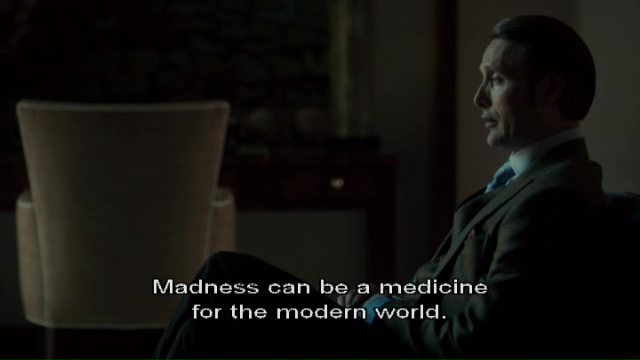
They discuss side-effects, that they can be temporary, or can be beneficial:
Will does not present Hannibal with problems from normal life. What does he present?
Now we’re talking abandoned identities!
IF YOU LIKE MY BLOG, PLEASE FEEL FREE TO RECOMMEND IT (WITH DISCRETION) TO FRIENDS ON SOCIAL MEDIA.
IF YOU HAVE ANY QUESTIONS OR COMMENTS, YOU CAN USE THE TAG, OR EMAIL ME ON CANNIBALSTUDIES@GMAIL.COM.
Be honest: do you still wonder, perhaps late at night, if there is someone/something under your bed? This episode is called “Buffet Froid” (cold buffet) and starts with a young woman returning to her home on a cold, dark night, wisely ignoring rattling noises in her shed and heading inside, but we know from the statue outside that things aren’t going to go well.
She tucks herself into bed but then hears water dripping through her ceiling. She heads up the dark, musty stairs to the attic to investigate – a big lump of her roof is missing. She staples plastic over the hole, but we’re outside, and we can see footprints. When she gets back to her room, she sees puddles, perhaps footprints, and as she reaches her bed, she is dragged underneath it and killed.
Meanwhile, Will is getting more and more unstable. He draws a clock for Hannibal (a simple test for neurological problems). It looks fine to him. But to Hannibal:
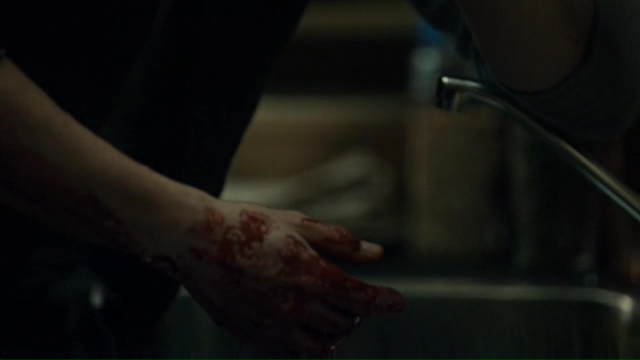
He goes fishing and cuts up the fish which bleeds profusely, like a human, and suddenly he is at the crime scene where the woman was killed, and he seems to be the killer. He rushes from the room, covered in blood, having contaminated the crime scene.
Now even Jack is concerned. Officially. Hannibal offers to refer Will to a Neurologist, but says if there is no physiological cause found, he will have to accept a diagnosis of mental illness. Which is precisely where Hannibal is steering him. Hannibal accompanies Will to the Neurologist, Dr Sutcliffe (John Benjamin Hickey), but while Will is having a brain scan, Hannibal tells Sutcliffe that Will has encephalitis. How does he know? He says he smelt it.
The scan shows massive inflammation on Will’s brain, but Hannibal persuades Sutcliffe to say there is nothing wrong, so that they can study Will’s response. For the good of science, of course.
But Hannibal’s plans don’t only require Will to think he is going insane – Jack needs persuading too. Hannibal tells him about the Neurological examination over a post-dinner brandy, then has a fascinating exchange about how Will’s empathy – his “mirror neurons” – make him vulnerable.
Hannibal and Sutcliffe (they were at Hopkins together – presumably Johns rather than Anthony) meet for dinner and discuss a rare and expensive form of pork – jamon iberico. We learn that Hannibal loves his treats: the more expensive and difficult to obtain they are, the better. They decide that, if the eater decides the meat is superior, then belief determines value. “A case of psychology overriding neurology” points out Hannibal. This banter of course is really about Will Graham. What makes Will rare enough for Hannibal to care about?
So they have set his mind on fire, but when will they put it out? “Will is my friend” says Hannibal. He’ll put it out when it’s necessary.
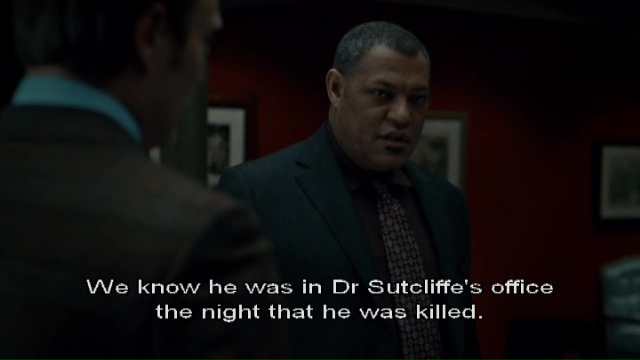
But Sutcliffe is running more tests on Will, which is not part of Hannibal’s plan. As Will comes out of the scanner, he finds the room deserted. Sutcliffe is very dead: he has had his face peeled back, like the woman at the start of the episode, and of course everyone assumes it is the same killer, the one under the bed, Georgia Madchen (Ellen Muth).
That night, as Will sleeps fitfully, his multiple stray dogs start to bark and growl. He realises Madchen is back – under his bed.
He persuades her that she is alive, and not alone. She comes in for treatment. How much, Jack wants to know, will she remember?
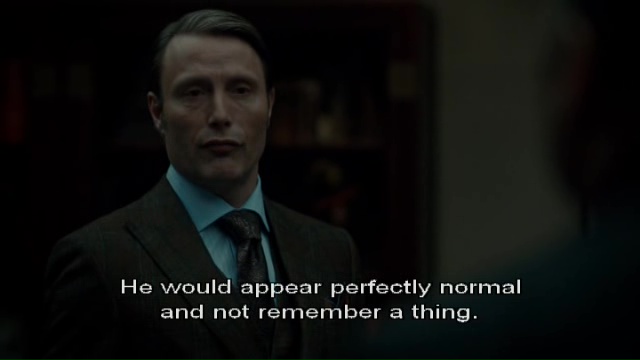
Although she has a disease in which she cannot see faces, she has witnessed Hannibal kill Sutcliffe and then hand her the scissors.
Remembering would be dangerous.
IF YOU LIKE MY BLOG, PLEASE FEEL FREE TO RECOMMEND IT (WITH DISCRETION) TO FRIENDS ON SOCIAL MEDIA.
IF YOU HAVE ANY QUESTIONS OR COMMENTS, YOU CAN USE THE TAG, OR EMAIL ME ON CANNIBALSTUDIES@GMAIL.COM.
Joe D’Amato (real name Aristide Massaccesi) was nothing if not prolific, directing some 200 films from 1972-99. These covered a multitude of genres from westerns to war, comedy to fantasy, but he is best known for his horror, erotic and adult films. His first softcore movie was Emanuelle’s Revenge in 1975, followed by his work on five of the six “Black Emanuelle” movies starring Laura Gemser as a globe-trotting journalist who gets into all sorts of merry scrapes, usually involving violence, horror and rape. They were based around the French Emmanuelle movies, with one “m” removed from the title to avoid copyright problems.
D’Amato’s first Emanuelle movie, Emanuelle’s Revenge (1975), was with German actress Rosemarie Lindt as Emanuelle and George Eastman as Carlo, whose role as a murderous monster with a machete prefigured his later role in D’Amato’s Antropophagus (1980). Both these movies deserve a mention in this blog, since the first has Carlo fantasising about cannibalism while under the influence of LSD, while the second has a demented cannibal who actually eats his own intestines (all right, don’t believe me). We’ll get to them – maybe.
Emanuelle and the Cannibals was the fifth of the Black Emanuelle films; the fourth that D’Amato directed. The porn level is a great deal lower than the others in the series (Emanuelle in America for example had a naked woman masturbating a horse), but this had something better: cannibalism! Who needs horses?
The film starts with a claim to be a true story, which was the thing in those days.
Emanuelle is in an asylum in New York, in which women do crazy things (just like they do in Suddenly Last Summer, so it must be true). Mostly they just talk to themselves and carry dolls, and Emanuelle is “embedded” as they say – an investigative journalist from the Evening Post, cleverly disguised as a doll-carrying crazy. The boss doctor (a cameo by the Director) tells her she will cause a scandal if discovered, and his price if she wants to come back and do it all again will be double.
Meanwhile, one particular crazy is busy biting off and eating a nurse’s breast, which Emanuelle finds fascinating. The staff say she is a “complete savage” and she snarls and snaps at them, but is quickly tamed by Emanuelle, who introduces herself with some hand gestures (between the girl’s legs).
Emanuelle’s editor is fascinated by the story of the cannibal and even asks how the nurse is. Emanuelle answers “she asked for it. She’s well known for her homosexual inclinations.” Well, that’s OK then. Emanuelle has taken photos of the girl with her gown hoisted up, and after studying them extensively, they raise their eyes high enough to notice a huge tattoo “above her pubic region” (I’m not sure if the dialogue really is this bad or if it is the poor translation used for the dubbing). It’s an Aztec symbol – from the Tupinambas according to the newspaper’s resident nerd (do you remember when newspapers could afford to employ nerds?). The Tupinamba were everyone’s favourite Brazilian cannibals since Hans Staden was captured by them and claimed to have witnessed their cannibalistic rituals in the sixteenth century. Fortunately, the Portuguese came to save them from their sins, and through enslavement, assimilation, extermination and the introduction of Smallpox, managed to wipe them out completely.
But not in this movie. Emanuelle goes to the Natural History Museum to meet up with the “famous anthropologist” Mark Lester (Gabriele Tinti, who was Gemser’s real-life husband). He takes her to lunch, to his house to look at films of Tanzanian ritual cannibals cutting off heads, penises and what have you from a pair of adulterers, and then to bed. She takes him to the Amazon. Fair exchange.
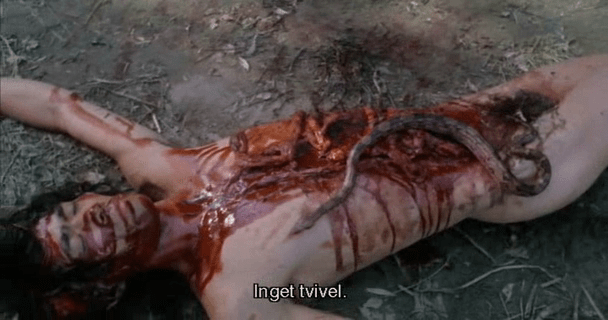
now you know how to say “it’s about cannibalism” and “you’re crazy” in Swedish
Before leaving, the movie treats us to scenes of New York traffic and several gratuitous sex scenes including one with Emanuelle’s steady boyfriend, who seems to be able to make sweet sweet love while still wearing skin-tight jeans. And lots of close-ups of Gemser.
On the plane, they smoke (!) and discuss anthropology and history, appropriate since it’s a Pan Am flight.
Why are there still cannibals? asks Emanuelle. He tells her about political cannibalism like Idi Amin, or “tolerated” cannibalism like the Andes plane crash survivors. But in the Amazon, they live by their own rules, and may eat human flesh for ritual purposes, or because they are peckish. Lucky she brought along an anthropologist.
They interview the dude who found the cannibal girl, and he says he has lived among the Amazonian tribes for 25 years and only come across two cases of cannibalism, which were quickly hushed up by the government. He has a daughter, Isabelle (Mónica Zanchi) who has grown up since she last saw Lester and lusts after him, and she spies on Lester and Emanuelle as they go through the same motions, and the same soundtrack, as the New York sex scenes, while Isabelle masturbates outside. Now that’s the sort of thing that you’d expect to cause a lot more problems than extinct cannibals.
Isabelle is taking supplies to a Missionary down the river who knows all there is to know about the “savages” as they call them, and a Nun and two Indians are going with them (definitely redshirts). The Nun tells them that superstition is still strong in the jungle, and there are still witch-doctors curing people with herbs! Oh, the horror. She does admit that the herbs work, so much so that the mission has appropriated (sorry, adopted) many of the concoctions.
There is a totally superfluous scene where Emanuelle and Isabelle are in the river washing each other (mostly concentrating on each other’s breasts, which I guess must get grimy on the river) and being watched by a chimp, who smokes their cigarettes and tries on their sunglasses. Of the three actors in the scene, the chimp seems to be portrayed as the most intelligent. They meet up with some adventurers, Donald and Maggie, who tell them that the Mission was attacked by savages and everyone massacred. Donald saves Emanuelle from a snake, and she asks him what he is doing in the jungle.
“Hunting. Hunting is my life. I’ve sacrificed a lot to satisfy my craving for – hunting…. The satisfaction of catching it. And to kill! … you have to share risks with the animals. Man too can be hunted.”
And what’s Maggie doing there? Well, she’s doing the African cook, Salvador. And no one seems to wonder what the hell he’s doing there in the middle of the Amazon basin. Donald catches them hard at it in the jungle, but it doesn’t become much of a thing, because they have their own agenda – searching for a crashed plane full of diamonds. When the others decide to go back, they find one of the redshirts cut up, cannibal style, and their boats missing.
They try to head back down the river on foot, but on the way find a Bible, and Father Morales from the Mission to which they had been heading.
So, we all know what happens next. This is a cannibal film after all. The Nun disappears and – well, we know from the very start of the movie which part of the body is the favourite of these particular cannibals. They also like intestines. And we get to see it all happen.
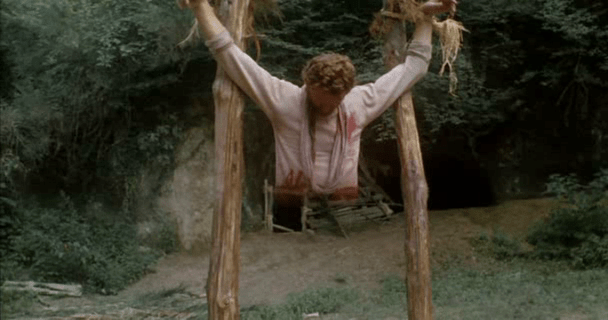
The expeditionaries find the Nun (or some of her), and it just gets worse from there. Donald and Maggie find the plane and the diamonds, pause for a celebratory quickie, and are attacked by the cannibals. Donald forgets to duck and the savages take Maggie, and the diamonds. Our few remaining heroes find the village and the villagers, who are about to sacrifice Maggie to the Goddess of Fertility. We know this because we have an anthropologist along. After that, they put a wire around Donald’s midriff, and have a tug of war.
Donald’s quick weight-loss diet
Isabelle is drugged and naked, but they want to sacrifice a pregnant girl to the river gods, and she’s not pregnant – yet. Cue a rather morose gang rape, led by the Shaman, where the rapists all seem bashful – doing it in front of a crowd I guess?
When everybody has had a turn at poor Isabelle, Emanuelle comes up with an idea – she paints the tattoo found on the crazy girl onto her stomach and appears to the superstitious locals as their Goddess of the river. They hand over Isabelle and the two women dive into the river hand in hand, much to the rage of the hoodwinked cannibals, who pursue them in canoes. Luckily, Emanuelle is willing to do anything for a story, even shoot people, but she’s a bit sorry about the white people (and servants) they lost on the way, even remembering the names of the redshirts. But Mark sums it up, with typical anthropological moral relativity:
“Don’t take it badly, Emanuelle. It’s nobody’s fault.”
And nor, apparently, is cannibalism. Or colonialism. Or killing natives for following their rituals. Or making really bad movies.
Rottentomatoes.com has not bothered to gather the reviews of critics, but the viewers’ score is a miserable 26%, with a “Super Reviewer” pointing out that “The acting may be appalling, but it’s difficult to tell for sure because this is dubbed — badly.”
The Allmovie site summed it up:
“excruciating tedium punctuated by occasional kinky sex in the first half of the film and cheap, gag-inducing special effects in the second…
Too gory for softcore fans and too dull for gorehounds, this is basically a film with no target audience whatsoever.”
Mike Bracken, AKA “The Horror Geek”, calls it a “Trash Cinema Classic”. His review is comprehensive as well as hilarious.
Perhaps the Director was making a subtle point with this scene where they are planning to eat some innocent creature from the jungle:
IF YOU LIKE MY BLOG, PLEASE FEEL FREE TO RECOMMEND IT (WITH DISCRETION) TO FRIENDS ON SOCIAL MEDIA.
IF YOU HAVE ANY QUESTIONS OR COMMENTS, YOU CAN USE THE TAG, OR EMAIL ME ON CANNIBALSTUDIES@GMAIL.COM.
This episode is named “TROU NORMAND”, which is a shot of liquor, usually Calvados, a potent apple liqueur from Normandy, served between courses of a particularly heavy meal. And yes, the first eight episodes of Season 1 were heavy going, and we know that the main course is yet to be served.
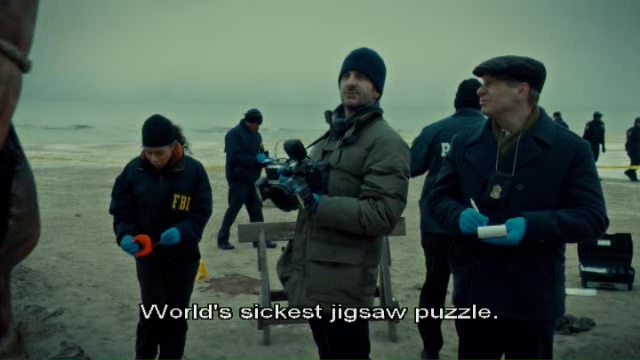
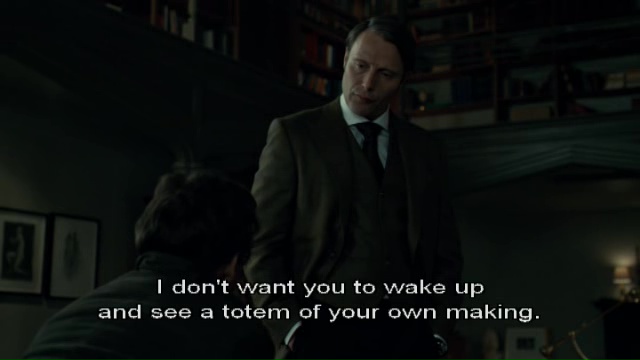
In this one, the FBI team are investigating a totem pole made of dead people in West Virginia. The bodies are carefully coiled together, making a puzzle for the investigators.
Will does his reenactment, then blinks and suddenly he is in Hannibal’s waiting room. He knows then that he is in trouble – the sleepwalking, the hallucinations and now he’s disassociating, and losing time. He has just driven 3 ½ hours from the crime scene to Hannibal’s office with no memory of it at all. Oh yes, he’s a sick puppy. Hannibal’s diagnosis is interesting:
Hannibal also summarises why we care about people we know and usually don’t give a damn about anyone else:
“What if you lose time and hurt yourself? Or someone else?” Hannibal is planting the seed. Will may be capable of – anything.
Will apologises to Jack for disappearing from the crime scene, but Jack hasn’t noticed anything wrong. Is there something wrong? No, Will grins, everything’s fine. No problems.
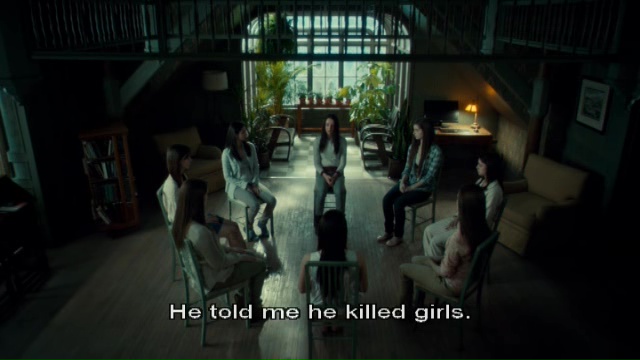
Abigail Hobbes is also in trouble. She is having nightmares where her father tells her he killed all those girls (in the first episode) so he wouldn’t have to kill her. But her support group morphs into those very girls, all saying “he should have killed you, so he wouldn’t have killed me”.
Then Freddie Lounds tells her that she is broke – the families of those girls are suing her father’s estate, and she won’t inherit a thing. She needs to write a book, with Freddie’s help of course. Will and Hannibal try to talk her out of it, but she wants to prove her innocence.
Will is getting more and more unstable. He is lecturing on the totem pole murders, but it turns out he is addressing an empty lecture theatre. Alana finds him there, tells him she can’t get involved with him:
Meanwhile, the FBI have found the body of the boy Abigail gutted and Hannibal helped her hide in episode 3. Jack wants to put her in the room to identify the corpse because he still suspects Abigail of the murder/s. Alana and Will are dead against causing her more trauma. Hannibal? Well, he is into growth and becoming, and for this he puts people in difficult positions:
But Hannibal is putting his own pressure on Abigail. He tells her that he is concerned that her book, and her digging up the body, all put him in danger. He insists that he must be able to trust her. Will realises that she killed the boy, and Hannibal admits he knew, because he helped her hide the body. Is Will going to report them to Jack? Well, no, because Hannibal talks him out of it:
Now Hannibal has Will where he wants him – legally compromised, lying to Jack, and a partner – at least in co-parenting.
Hannibal is putting on one of his fine feasts for – yes – Freddie Lounds, with Will and Abigail eating various bloody concoctions. But Freddie has thrown him, by announcing she is a vegetarian! Hannibal rises to the occasion and prepares the finest salad she has ever tasted. Despite Will’s aggressive sarcasm and Abigail’s defiance, Hannibal manages to get them to agree: we’re all doing this to protect Abigail.
This slideshow requires JavaScript.
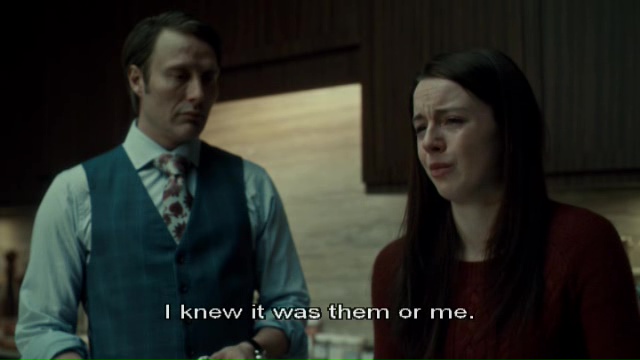
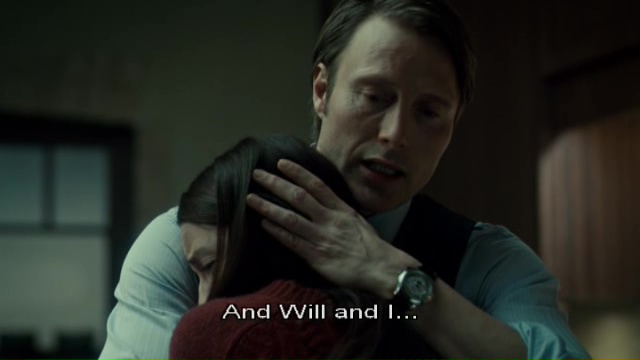
After dinner, Hannibal washes and Abigail dries, and she finally confesses that she did help her father – she would befriend girls that looked like her and find out where they lived, so that he would kill them, instead of her.
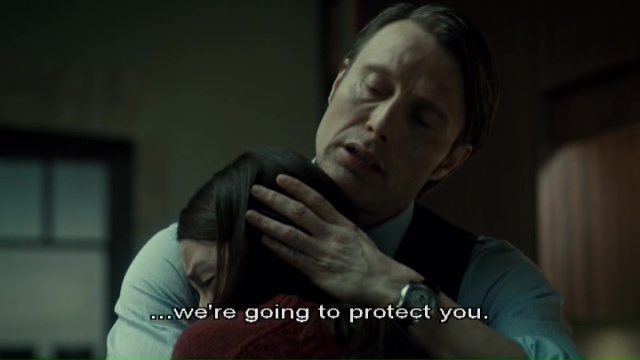
Hannibal comforts her:
Now she is totally in his hegemonic care, Will is a co-conspirator and co-parent, and Hannibal has a friend, and a family.
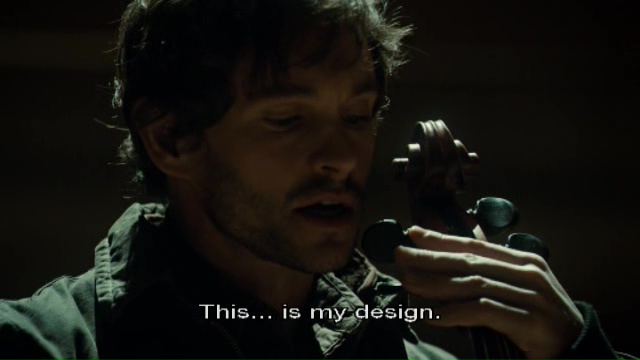
This is his design.
IF YOU LIKE MY BLOG, PLEASE FEEL FREE TO RECOMMEND IT (WITH DISCRETION) TO FRIENDS ON SOCIAL MEDIA.
IF YOU HAVE ANY QUESTIONS OR COMMENTS, YOU CAN USE THE TAG, OR EMAIL ME ON CANNIBALSTUDIES@GMAIL.COM.
So we’re over the half-way point of Season 1, and Hannibal’s fascination with Will has gone from amused manipulation to a possibility of friendship, based on their similarities, made piquant by their differences. This episode is all about friends – lovable, edible or just annoying.
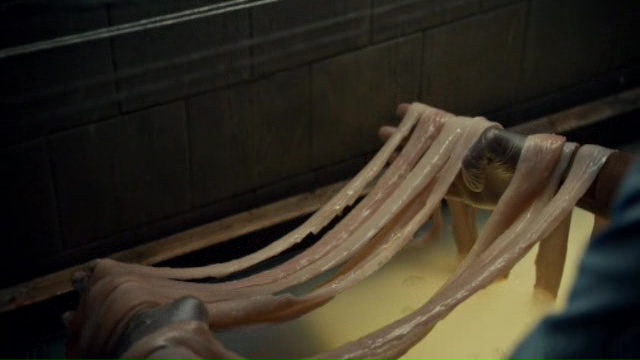
Last episode we met Tobias (Demore Barnes), a friend of Hannibal’s (probably) most annoying patient, Franklyn (Dan Fogler, from Fantastic Beasts). Tobias is teaching a kid violin and talking about superior strings. “Are they made of cat guts?” the kid wants to know. “Not always” answers Tobias, and we then see him making new strings for the orchestra. They are guts, but not from cats.
Franklyn is trying to “be” Hannibal – he has googled “psychopaths” and wants to discuss whether Tobias is crazy. Whether he is a “psychopath”. Whether Franklyn himself is a psychopath. Hannibal tells Franklyn he is not a psychopath, although “you may be attracted to them.” He certainly likes Hannibal a lot. And Tobias. He wants them to be his friends.
The murder victim in this episode (Baltimore is such a dangerous place!) is the trombonist from the Baltimore Metropolitan Orchestra. The killer has jammed a cello down his throat and played him – created a sound – “my sound”.
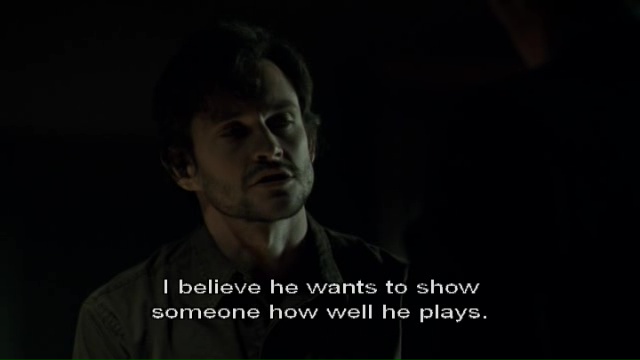
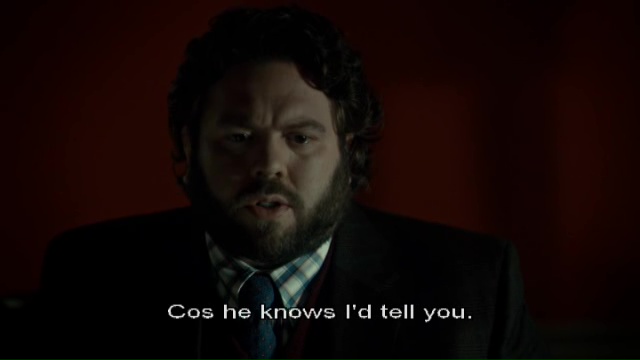
But why go to all that trouble? Franklyn tells Hannibal that Tobias had been talking about cutting someone’s throat and playing them like a violin – exactly what the FBI found. Will has a theory:
Why would he tell Franklyn about it though?
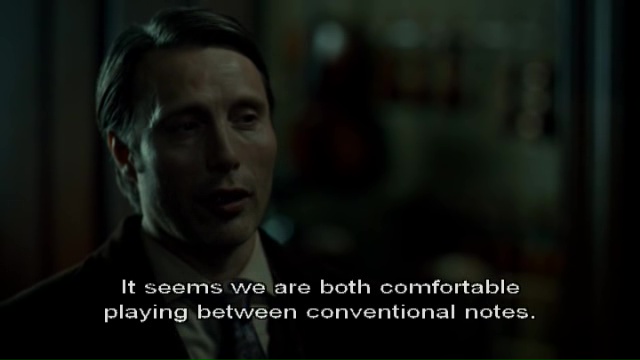
Hannibal goes to visit Tobias, talks about strings, composing or discovering music on his preferred instrument: the Theremin. With a little coded chat, they soon determine that they have a lot in common.
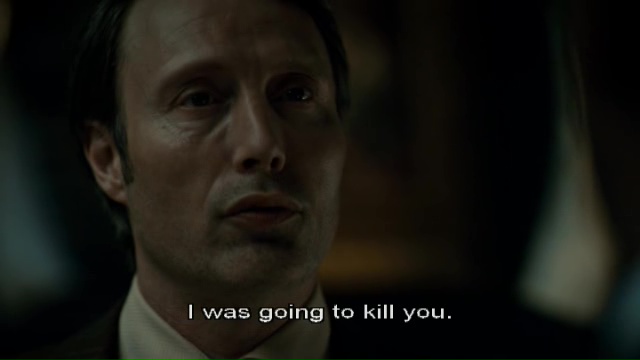
Will wants to be (more than) friends with Alana – he kisses her, but she bolts. Tobias comes to dinner at Hannibal’s home, at which he admits he was going to kill Hannibal.
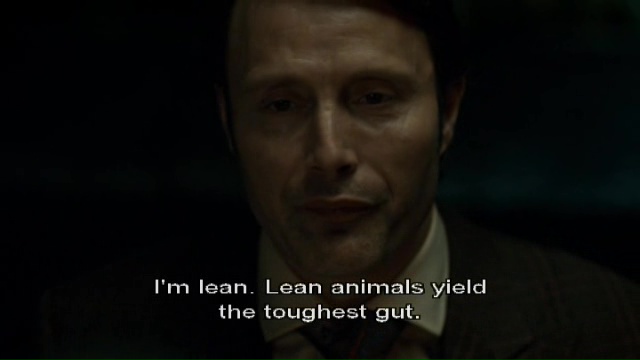
“Of course you were. I’m lean. Lean animals yield the toughest gut.”
Tobias says he changed his mind after following Hannibal to a bus depot, presumably the one referenced last episode (where the victim was cut in two and left sitting across the bus aisle from himself). He knows that Hannibal is the Ripper. Hannibal is not pleased. Tobias doesn’t care about being investigated by the FBI – he will just kill whoever they send to investigate him. Hannibal considers this reckless, and that’s not a term of praise, particularly when that might lead them back to Hannibal. But Tobias, of course, wants to be Hannibal’s friend. He wants a friend who understands him (and isn’t too fussed at the use of human body parts).
But Hannibal is not putting up with reckless friends, even if they have common hobbies.
Tobias asks why, then, did Hannibal invite him for dinner?
Now that is a great line.
They are on the verge of sorting it out with extreme prejudice when Will arrives seeking lonely hearts advice: “I kissed Alana!” Tobias beats it out of the window, and Will gets to eat the dessert he missed. He also gets to tell Hannibal about his latest symptoms – on top of sleepwalking and getting headaches, he is now hearing the cries of wounded animals – the latest was, he thought, in his chimney, which led to some drastic and unnecessary renovations. He admits to being “unstable.” Hannibal clearly decides he needs a challenge, and leaks the information about Tobias and his strings, and suggests Will should go investigate him. He knows Tobias will try to kill any investigators. But Will needs a challenge if he is to grow and become a true protégé. He needs to grow, and “to become”. That is the central theme of all Lecter texts.
Hannibal discusses all this with Bedelia, his psychiatrist, in one of the most fascinating exchanges of the show:
H: I met a man much like myself [Tobias of course]. Same hobbies. Same worldview. But I’m not interested in being his friend. I’m curious about him. And that got me curious about friendship.
B: Whose friendship are you considering?
H: [Now he’s talking about Will Graham] He’s nothing like me. We see the world in different ways, yet he can assume my point of view.
B: It’s nice when someone sees us, Hannibal. Or has the ability to see us. It requires trust. Trust is difficult for you.
H: You’ve helped me to better understand what I want in a friendship and what I don’t.
Will and a couple of cops turn up to interview Tobias about the strings made from the unfortunate trombonist’s vocal chords, but Will is distracted by one of his imaginary distressed animal sounds. By the time he gets back inside, the cops are dead (they are clearly redshirts) and Will follows Tobias down the basement steps, much as Clarice followed Jame Gumb in Silence of the Lambs. There is an underground shoot out, just like – yep. Except Clarice appears to be a much better shot than Will.
Then there’s the whole Franklyn/Tobias/Hannibal thing that has to be resolved, and Hannibal is just the man for that sort of thing. Followed, of course, by the Goldberg Variations.
The Baltimore PD come to tidy up afterwards, with Jack and Will. There is a tender moment of blossoming friendship:
Then Hannibal is back at Bedelia’s place, talking about responsibility. Does he feel responsible for Franklyn? Did Bedelia feel responsibility when she was attacked by her patient [and yes, we’ll hear a lot more about that in the future]? Yes, she says.
Was Tobias a cannibal? We didn’t see him eat anyone, but there were a lot of body parts about his basement, and abuse and exploitation don’t always have to be about eating, do they? He and Hannibal actually did have a lot in common. But he was too rash, too reckless. He could never be a protégé nor a friend. A friend would need to be a lot more vulnerable.
IF YOU LIKE MY BLOG, PLEASE FEEL FREE TO RECOMMEND IT (WITH DISCRETION) TO FRIENDS ON SOCIAL MEDIA.
IF YOU HAVE ANY QUESTIONS OR COMMENTS, YOU CAN USE THE TAG, OR EMAIL ME ON CANNIBALSTUDIES@GMAIL.COM.
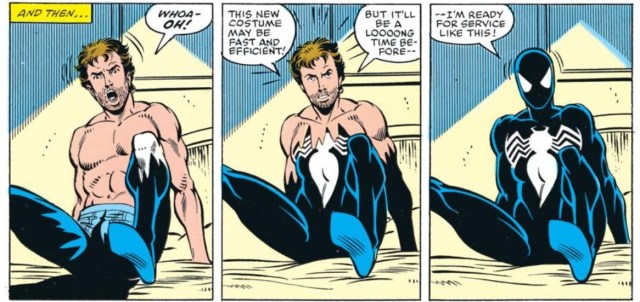
Venom is a character from the Marvel Universe, originally seen in Spider-man #252 (May 1984) as a living costume (honest!) then becoming a symbiote which took over Spidey (remember the black spider-man outfit?). So, if you’ll pardon the arachnid pun, this movie is a spin-off.
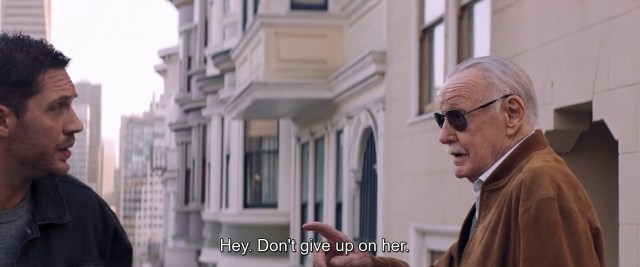
The genius behind Marvel – Stan Lee – in the last cameo released before his death
OK, so I’ll try to keep this short, because you’re reading this on the web (sorry, I just can’t help myself).
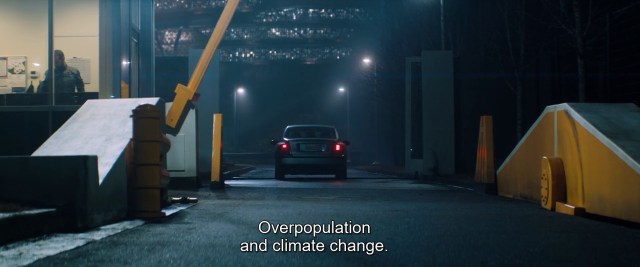
There’s a billionaire (Riz Ahmed from Nightcrawler) who wants to send us into space (not naming names, but there are about three such billionaires in the news at the moment). He sees the future of the species as more important than the lives of the marginalised people on whom he tests his drugs, and whom he “merges” with his aliens.
He has (had) a spaceship, which picked up some symbiotic forms from a meteor; one of those aliens caused the ship to crash on re-entry to earth.
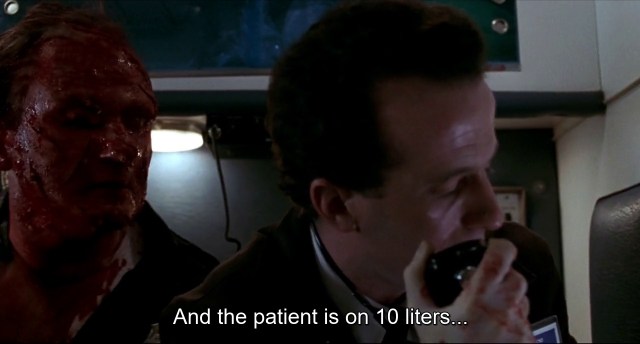
We get the definite impression these things are not too human-friendly, as one of them kills the crew of an ambulance, in a scene that is highly reminiscent of Hannibal’s escape in Silence of the Lambs.
That’s Hannibal Lecter of course, wearing an Officer Pembry mask
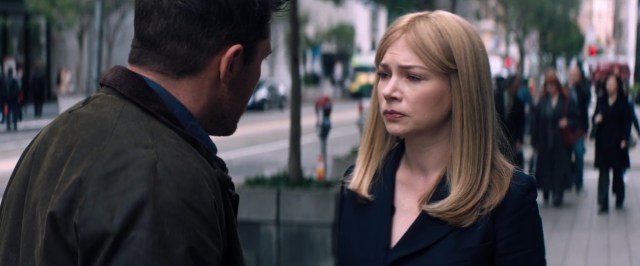
The main character is Eddie Brock (Tom Hardy, an extremely versatile English actor who was playing a Russian in a recent movie review, and is here playing an American). Eddie is an investigative journalist, which apparently requires a lot of chutzpah and some very fast motorcycle stunts. His fiancée is a lawyer named Anne Weying (Michelle Williams from lots of great movies, including Brokeback Mountain). Anne is working for a law firm that is defending the billionaire, but Eddy knows the password on her computer and finds out stuff he isn’t supposed to know about wrongful deaths caused by the company (didn’t we see that plot point on Billions?)
Anyway, he asks the billionaire difficult questions and he and Anne both get fired, because he clearly got the scoop from her. She breaks off the engagement, Eddie ends up down and out, and helpless – he can’t even defend his local convenience store manager from a dude with a gun who comes in for “protection” money on a regular basis.
But hey, there are symbiotes out there, looking for some human interaction, and they have teeth that would make the dental association wet themselves. The one that winds up inside Eddie is named Venom, one of the ones from the billionaire’s lab, and he has been through several hosts, most of which have died because they are not compatible. Then there’s the other one that killed the ambulance crew, and has since killed a lot more people, and he is mad, bad and dangerous to host.
Eddie being a nice guy leads to Venom becoming nice (ish) too and agreeing to oppose the plot to bring the other symbiotes to earth, where they intend to feast on humans – they’ve figured out there are plenty of us to go around.
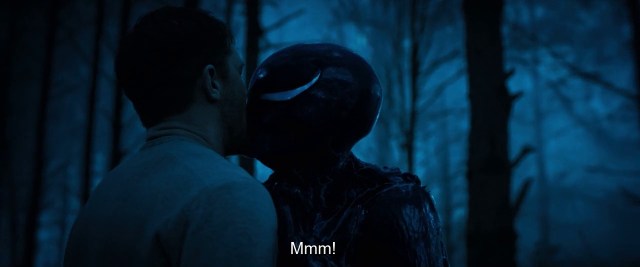
Venom takes over a cute doggie and then moves into Anne, who comes to save Eddie from the bad guys, leading to an awkward kiss between him and the symbiotic version of Anne, now in slinky black alien shape.
Of course, to save Eddie, Anne has to take some fairly drastic action, in her Venom persona.
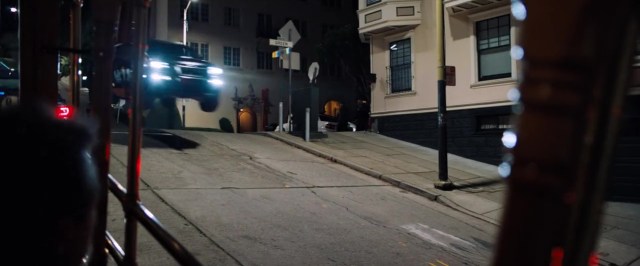
There are some great action sequences involving bikes and drones and cars (leaping off the ground in standard San Fran car chase mode) and a pretty awesome battle between Venom and the nasty alien.
Everyone thinks the aliens have gone, but in fact Venom is still inside Eddie and they are now true sybiotes: two beings in one body. He can turn back into Venom when required, and Venom is almost always hungry, and he doesn’t like dead meat.
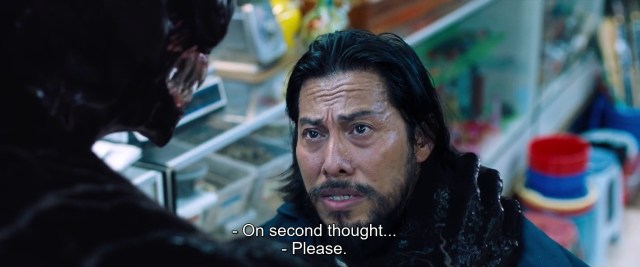
So we come to the point of having this movie in a cannibalism blog. They come to an understanding: they won’t eat any nice humans, but very, very bad ones – that’s fine.
A succinct statement of the ethics of cannibalism. Hannibal would have amended it to “rude people”, but philosophers get to make their own ethical maxims. And so it is that he, or they, eat the rude, violent dude in the convenience store.
Look, it’s not a great movie, and the critics were quite rude, with a pretty ordinary score of 28% on Rotten Tomatoes. The movie-going public felt differently, and the box office so far is over $850 million, which is an almost mind-boggling figure, even for a movie in which the hero bites off people’s heads. I guess people love to see (other) humans being eaten. Is this a cannibal movie? Well, half the main character is human, so I guess it’s half a cannibal film.
So what’s next for a nice guy who occasionally becomes an alien cannibal and eats rude people? Hannibal would approve of Venom’s answer:
“The way I see it, we can do whatever we want”.
IF YOU LIKE MY BLOG, PLEASE FEEL FREE TO RECOMMEND IT (WITH DISCRETION) TO FRIENDS ON SOCIAL MEDIA.
IF YOU HAVE ANY QUESTIONS OR COMMENTS, YOU CAN USE THE TAG, OR EMAIL ME ON CANNIBALSTUDIES@GMAIL.COM.







 30
30


















































 The Cannibal Guy