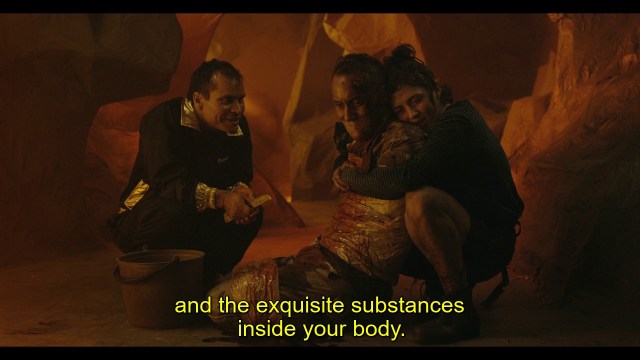
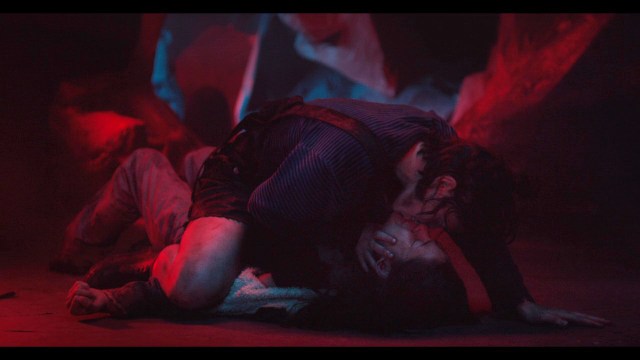
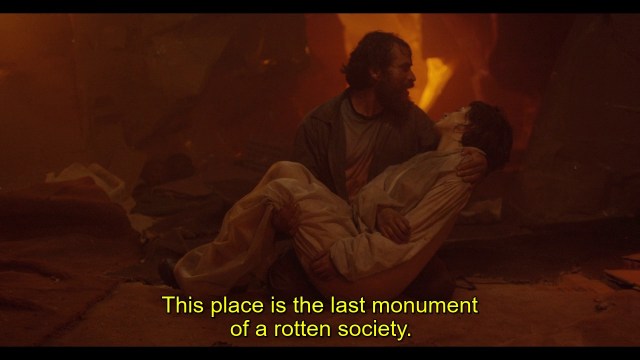
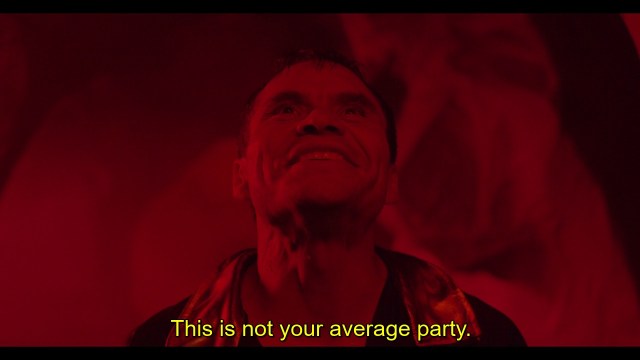
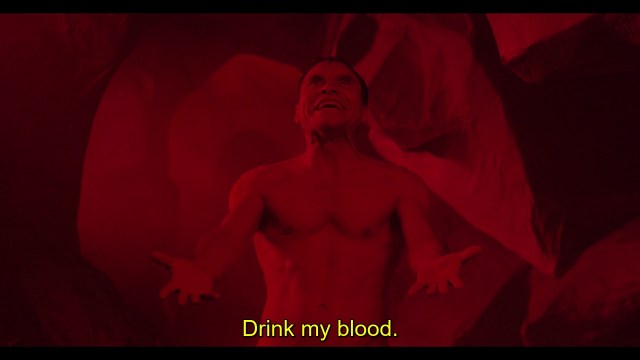
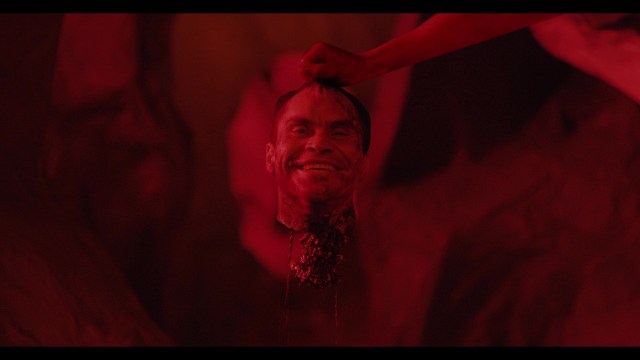
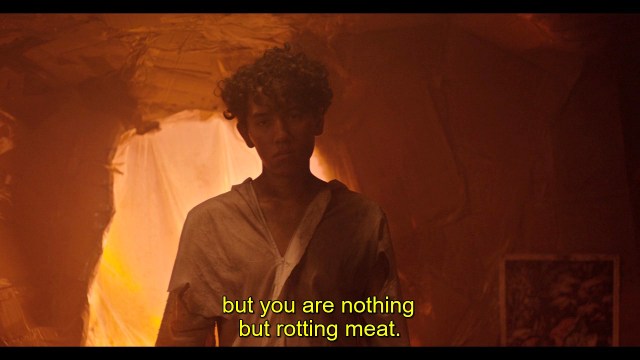
Cannibals in quarantine: THE PLATFORM (Galder Gaztelu-Urrutia, 2019)

As we isolate ourselves in our homes (if we have homes) and wait for the storm of contagion to whistle past outside, we can imagine, rather more easily than was the case ‘way back’ in 2019 when this film was made, what it would be like to be locked in a room with an uncertain supply of food. Would we turn to cannibalism?

Netflix have released The Platform, a Spanish film that has been widely described as “stomach churning”. You’d think a churned stomach would be the bare minimum for cannibal movies! More temptingly, an Indian website called it “Just The Film To Stay Away From During Corona”:

“This Spanish film vomits its venomous bile on a depraved civilization with graphic description of cannibalism and excretion, not in any particular order. Human beings are shown as survivalist degenerates.”

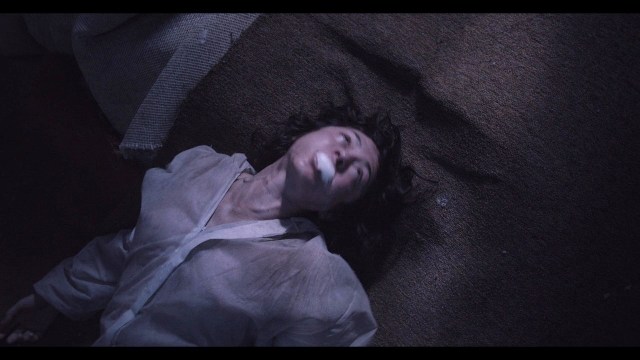
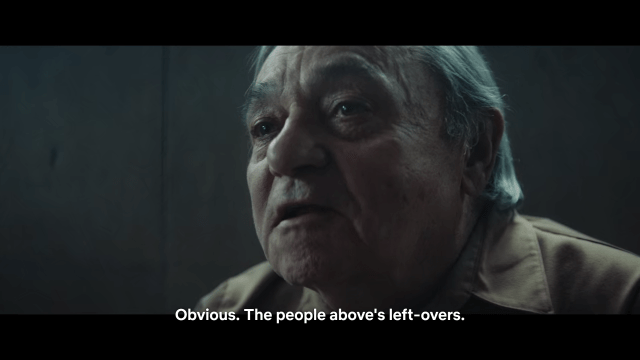
The Platform offers a metaphorical analysis of neo-liberal capitalism (but also Stalinist communism), through the lens of a prison, in which there is plenty of food, if only everyone would share! With true, deadly, neo-lib efficiency, the prisoners are not fed by the labour intensive method of guards delivering food, but by a platform that descends from the top of the building, stopping briefly at each level. The inmates at the top have their choice of the gourmet food, and those further down on each level get the left-overs. “What are we going to eat?” Asks Goreng.
Screenshot (14).png

Of course, the people at the top gorge, binge and horde, occasionally defecating and spitting on those below, and those at the bottom starve or turn to cannibalism. Así es la vida.

“There are three types of person: those at the top, those at the bottom, and those who fall.”

Goreng (it’s a pun – the Indonesian/Malay word for fried food) is played by Iván Massagué, who finds himself in a prison cell with Trimagasi (another Malay pun, meaning “thank you”), Zorion Eguileor. They become friends, for a while, motivated by their shared misfortunes, and then are driven apart by the same thing.
Screenshot (49).png

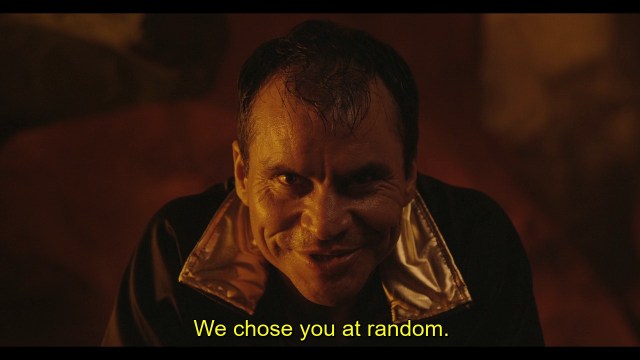
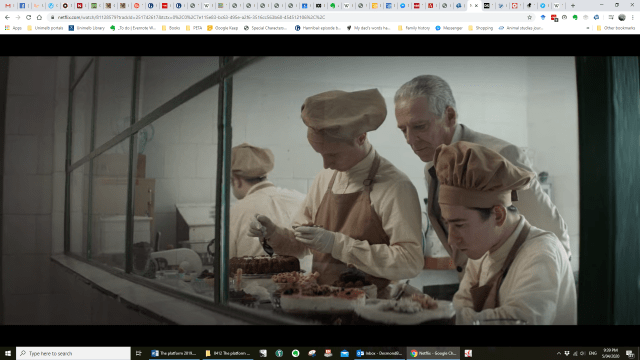
The people at the top get first pick of the superb feasts prepared by a team of chefs, while at the bottom of the platform are the homeless, sleeping rough, hopefully 1.5 metres apart.
Screenshot (7).png

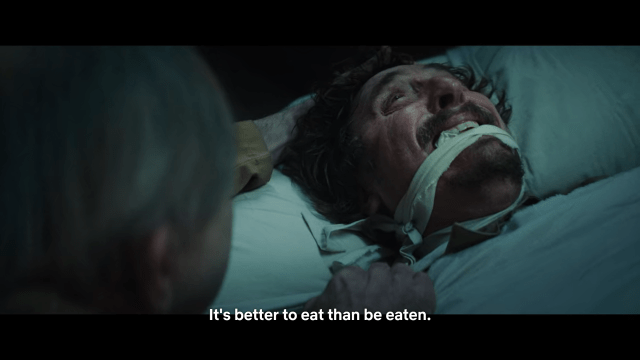
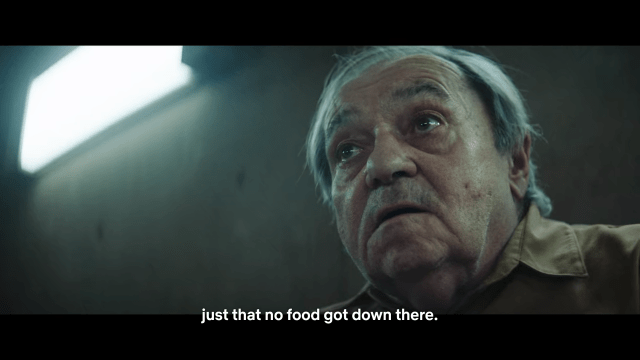
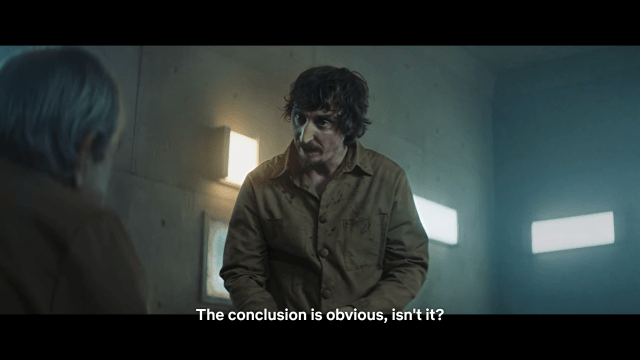
By the time the platform gets to the bottom levels, there is not a scrap of food. Trimagasi has spent a month down there. He tells Goreng about it. “I didn’t say I didn’t eat anything…”
Screenshot (26).png

Screenshot (38).png

Those on the middle levels hope to find some sustenance in the trickle-down from those above them, who in turn consider them barely human.

Screenshot (18).png

Goreng is there for six months to earn a college degree, while Trimagasi is in for manslaughter. His crime was getting mad at the ads and throwing his TV out the window, where it killed an illegal immigrant who was passing by. “He shouldn’t have even been there!” Trimagasi cries. Both actors are best known for playing comedic roles, and there is a surprising amount of humour found in what is otherwise quite a bleak story.

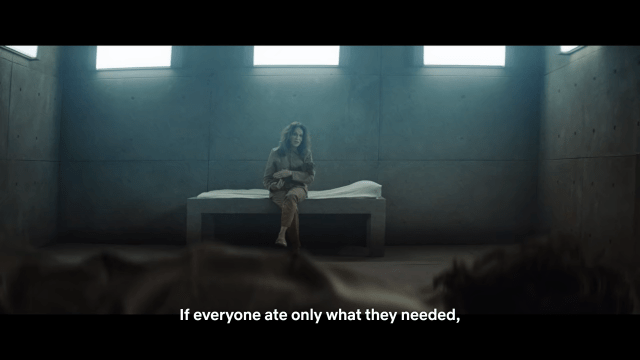
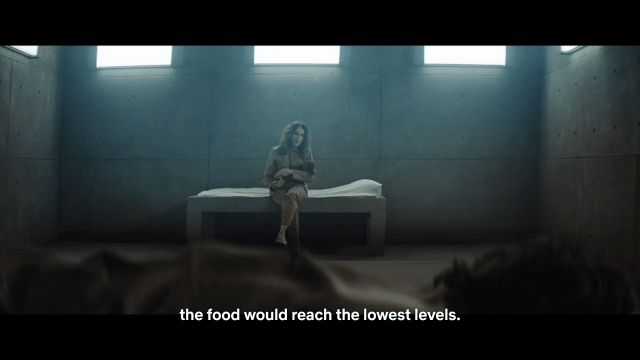
The woman who processed Goreng turns up in his cell, and tells him the prison is a “vertical self-management centre”, an experiment in “spontaneous solidarity”. But it turns out to be closer to a social experiment about weakness, and irresistible hunger, reminiscent of Mason Verger putting two dogs who were friends in a cage with no food, to see who would eat whom.
Screenshot (100).png

Screenshot (101).png

Interest is cannibalism grows apace. A recent article stated that cannibal stories typically emerge at times of social unrest and uncertainty. 2019 and the first quarter of 2020 presented us with plenty of evidence of that, with a plethora of cannibal movies released or in production, including:

She Never Died Audrey Cummings
Corporate Animals Patrick Brice
Pet Sematary Kevin Kölsch and Dennis Widmyer
Big Top Evil Sean Haitz, Chris Potter
The Young Cannibals Kris Carr, Sam Fowler
Aamis (Ravening) Bhaskar Hazarika
The Perfect Patient Mikael Håfström
The Platform Galder Gaztelu-Urrutia
Mr Jones Agnieszka Holland
Two Heads Creek (Aust) Jesse O’Brien
Wrong Turn 7: 2020 Mike P. Nelson
Cannibal Christmas Massacre Nick Heinrichs Jr
Gretel and Hansel Oz Perkins
Human Hibachi Mario Cerrito III
Evil for Dinner Travis Youngquist
Antlers Scott Cooper
Cannibal Comedian Sean Haitz
The Dinner Party Miles Doleac

Look, I’m not going to tell you what happens in The Platform or discuss the rather ambiguous ending (you can google all sorts of explanations, including one from the Director). It would be too easy to drop spoilers, and you really should see this one – it’s a corker, and it’s available on Netflix, so if you have that, watch it while we all stay home isolated or in quarantine. Then turn on the news and watch people fighting for toilet paper.

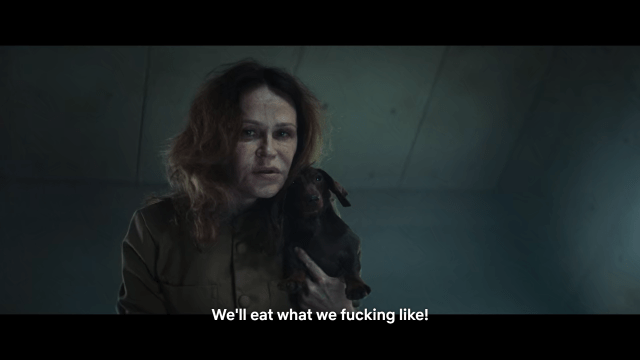
The battle cry of humans when they fear scarcity:
Screenshot (116).png

This film is the perfect metaphor of the fear and greed displayed by those hoarding during the pandemic:

Goreng is haunted by the words of Jesus as he descends to the lowest level:

“If you drink not of the flesh of the Son of Man, nor drink of his blood, ye have no life…. For my flesh is meat indeed, and my blood is drink indeed. He that eateth my flesh and drinketh my blood dwelleth in me, and I in him.”

This is our new reality – cannibalism. The coronavirus is showing us the limits to growth. Voracious appetite, incapable of sharing or even consideration of others, can only lead to one place. When the good times roll past, our flesh is meat indeed.

Screenshot (50).png

The film premiered at the 2019 Toronto International Film Festival, where it won the People’s Choice Award for Midnight Madness. It was released on Netflix on March 20, 2020.

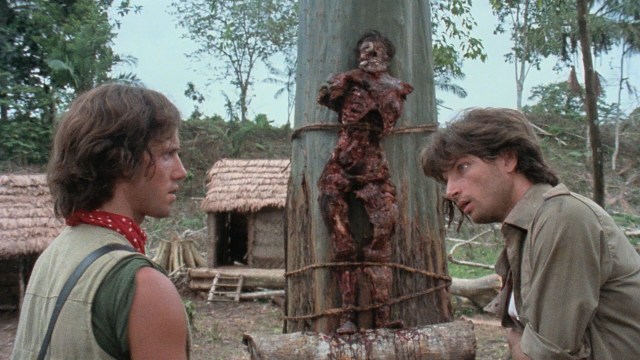
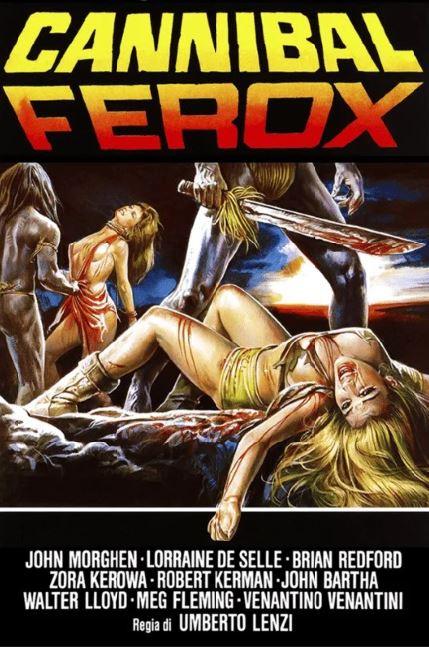
“The most violent film ever made” – CANNIBAL FEROX (Lenzi, 1981)

The US distributor of this film (where it was renamed Make Them Die Slowly) made the claim that it was the most violent film ever made, and had been banned in 31 countries.

Warning.JPG

Both claims are highly dubious, but it is certainly one of the nastiest of the so-called “cannibal boom” movies that came out of Italy in the 1970s and 1980s. These films depicted a savage world in which the primitive natives were merciless cannibals, while the white victims were mostly corrupt and exploitative thugs, who invariably brought on the savagery by their own greed and violence (this one involves eye-gouging and penisectomies as well as brain and intestine munching). They deserved to be killed and eaten, especially since they were aware that all primitive people are cannibals. This from the civilisation that brought you Christopher Columbus, who coined the term “cannibal” and demonised the diverse nations of a whole continent.

cfblu4_original.jpg

Lenzi’s film was made a year after the most famous of the Italian cannibal slashers, Deodato’s Cannibal Holocaust. Although Cannibal Ferox seemed to be a rip-off of Deodato’s magnum opus, let us not forget that Lenzi started the boom back in 1971 with Man From Deep River. That in turn was lifted from the Mondo films like Mondo Cane, films which showed the disturbing violence within nature and primitive societies, and pointed out that such dark forces still swirled within the well-dressed breasts of modern, cosmopolitan Europeans.

cannibalferoxhd_pub.png

Look, I’ve been kinda avoiding reviewing this one, not because I  thought you couldn’t handle it (you are reading a cannibal blog fergoodnessake!) but more because I was wondering if I could. More gratuitously violent than Cannibal Holocaust, the scenes of torture are really all that this one is remembered for (certainly not for the plot or acting). Make up artist Gianetto de Rossi created the realistic special-effects, most infamously remembered for the scene where a woman is hoisted in the air by hooks through her breasts. De Rossi had previously worked on Emanuelle in America and Zombie II, the latter becoming famous as the goriest movie ever made.

MV5BNmVmOTkwMTctNzU0OS00YzIwLWI0MTktNWFkNDA5MWRlNGVmXkEyXkFqcGdeQXVyMjUyNDk2ODc@._V1_SX1777_CR0,0,1777,999_AL_.jpg

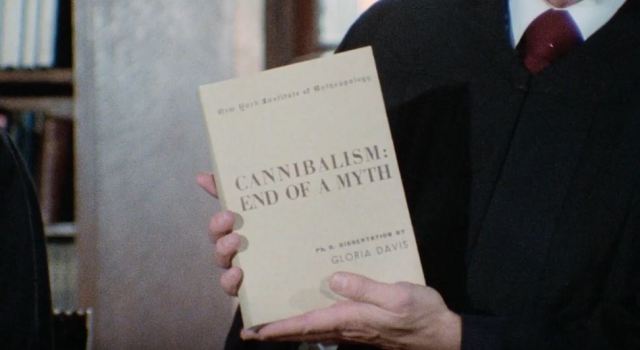
There’s a convoluted plot that you can follow on Wikipedia if you want, or even watch the movie if you must. It involves drugs, the Mafia, cannibals growing drugs for the Mafia, and cannibals eating greedy and vicious, or stupid and naïve, white people. The interesting part of the plot, from a Cannibal Studies point of view, is that the stupid, innocent Westerners who find themselves being caught up in all this (and tortured and eaten) are there on a fool’s errand – one of them, Gloria, is writing a thesis that is going to prove that cannibalism doesn’t exist and never existed. Her thesis is entitled “Cannibalism: End of the Myth”. [Holy excreted humanflesh; that’s kinda what I’m doing!] Radical as this thought is, it had actually been presented in an academic form by William Arens two years before this movie, in his book The Man-Eating Myth: Anthropology and Anthropophagy. Don’t you love coincidences like that? Wanton violence, abusive sex, torture, cannibalism and academic dishonesty – an honest portrait of the PhD process. Then there’s the invariable PhD curse – half way through your research, someone sits down with a bowl of intestines and screws up everything you’ve written.

PhD thesis.JPG

Cannibal Boom movies cannot be accused of involving any sort of academic rigour, concentrating instead on slaughter, torture, exploitative female nudity (and more torture) and cannibalism, as well as the totally gratuitous filming of real animal abuse. Italian cannibal directors love to put real footage into their stories of fake violence. Look, they say, a real animal suffered and died, so now you’ll accept that the actors were also killed. Actually, that sort of worked for Deodato, who was almost tried for murder,until he was able to get his Cannibal Holocaust actors to appear in court, to prove they were still alive.

tumblr_lhgoz0dPwo1qa4d9fo1_540
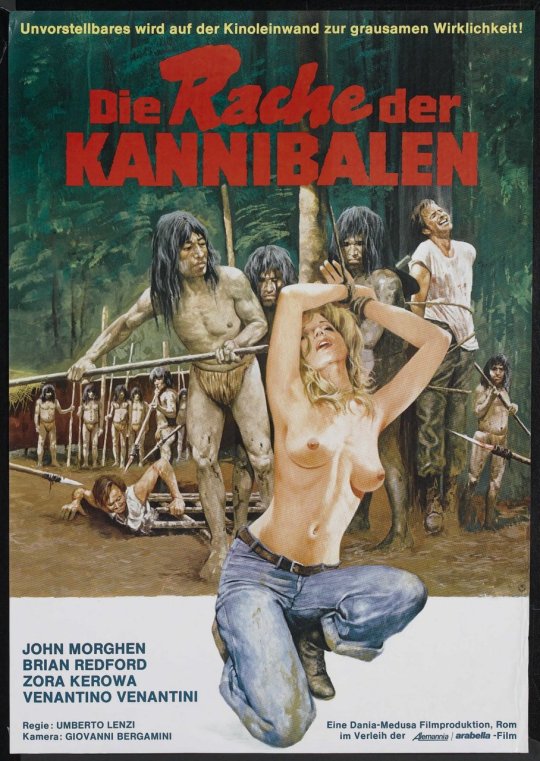
The German version was called “Revenge of the Cannibals”

Cannibal Ferox is torture-porn – it didn’t invent the genre, but it took it to new levels and laid the foundations for some of the grindhouse horror that was to follow. For example, the scene of a skull being opened and the brains eaten from it had already appeared in Deranged (Gillen & Ormsby) in 1974, and was perfected in Hannibal (Ridley Scott, 2001).

Cannibal Ferox managed to scrape together a 40% fresh rating on Rotten Tomatoes, from only five critics, one of whom summed up that “it both feeds and condemns our desire for the taboo sensations promised by its title”.

Couldn’t have put it better myself.

If you can’t be bothered watching the whole thing but would enjoy some highlights, this video review by “The Horror Geek” is hilarious!

“Cannibal Ferox” means fierce cannibals. In the US, it was renamed “Make Them Die Slowly”, and in Australia “Woman from Deep River”. Not sure if that reveals some sort of cultural distinction right there.

Capture

Would you like virus with that? EBOLA SYNDROME (伊波拉病毒) (Herman Yau, 1996)

Director Herman Yau has made a bit of a career from telling stories of “innocent cannibalism”, in which diners in restaurants unknowingly eat human flesh. His 1993 film The Untold Story was based on the “Eight Immortals Restaurant murders” of a family of ten, which took place in August 1985 in Macau. Portions of the bodies were never found, leading to speculation – yeah, you got it.

Following Gordon Gecko’s statement that “greed is good!” in Wall Street (1987), the 1990s saw a spate of films about entrepreneurs selling human flesh for fun and profit. Beside The Untold Story, Untold Story II and Ebola Syndrome from Hong Kong, we saw Delicatessen from France, Aranyak from India, The Deathmaker from Germany, Perdita Durango from Mexico, while the Americans contributed Ice Cream Man and Fried Green Tomatoes.

You see what I’m up against, trying to update you on all these masterpieces?

vlcsnap-00015.jpg

This film gets even weirder, because there is also a pandemic involved – Ebola, the so-called “flesh-eating” disease. Ebola never really got the public going like COVID-19, maybe because it only affected people in places like the Congo and so did not keep the rest of us awake at night. Also, it spreads much more slowly but, if you do get it, you have a 50-90% chance of dying, and it isn’t “just” pneumonia – it is haemorrhagic, meaning that you can bleed out “through your wazoo”, as they say in Last Man on Earth.

“People with Ebola first have symptoms of influenza, but within 72 hours after infection, the virus will dissolve the internal organs”

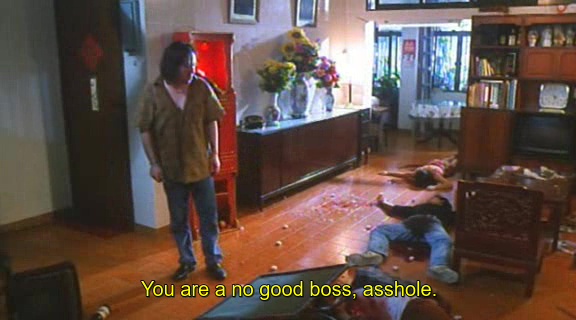
Ah Kai (Anthony Wong) is an escaped criminal from Hong Kong who bolts to South Africa after killing his former boss, his boss’s wife and another employee. Here is an image showing Hong Kong industrial relations in action.

vlcsnap-00014.jpg

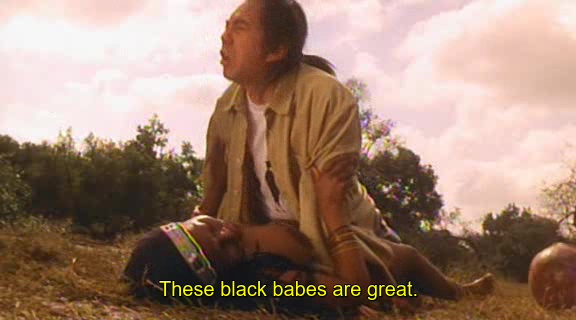
In South Africa, he works at a Chinese restaurant and one day travels with his boss to a Zulu tribe that is infected with the Ebola virus [NOTE: there is no record of Ebola among the Zulu]. He comes across a woman dying of the disease, and decides to rape her – he’s that sort of guy.

vlcsnap-00047.jpg

He is immune to the effects of the virus, so becomes a living carrier, spreading the disease to others through his bodily fluids. He kills his new boss and his boss’s wife and cousin (seems to be becoming a habit), but he has already given the virus to them, so when he cuts up their corpses and serves them as hamburgers in the restaurant, he spreads the virus all over South Africa.

vlcsnap-00064.jpg

vlcsnap-00068.jpg

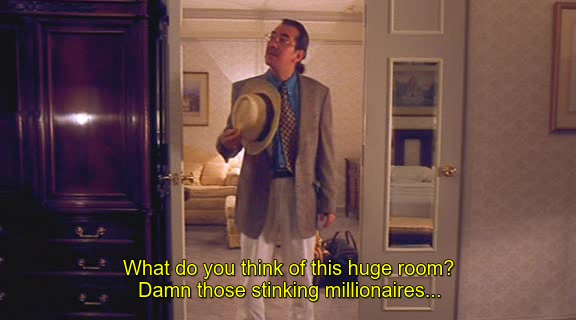
He heads back to Hong Kong with the boss’ cash and moves into a fancy hotel, where he proceeds to spreads the virus to the prostitutes he hires, and everyone else he encounters – dramatic music accompanying each new infection.

vlcsnap-00077.jpg

vlcsnap-00082.jpg

Cannibalism as a carrier for pandemics seems apposite right now. Cannibalism and incest, Freud said, were the two great taboos of civilisation, but their prohibitions also define civilisation, so it is not unreasonable to expect at least one of them to pop up in a civilisation-wide disaster. COVID-19 hasn’t been spread by cannibalism yet, or incest (as far as we know) but this movie looks at more than just crime and disease as social disrupters. Ah Kai is aggressive and violent to anyone whom he believes bullies him, usually the rich people who take advantage of his fugitive status. In South Africa (not a place known for Ebola), he is subject to casual racism from the whites, including prostitutes who refuse him their services. The whites, he complains, treat him like a black, and the blacks treat him like a white. He and his victims are dehumanised, which is a precondition for cannibalism – humans are animalised, animals are objectified and become meat.

vlcsnap-00018.jpg

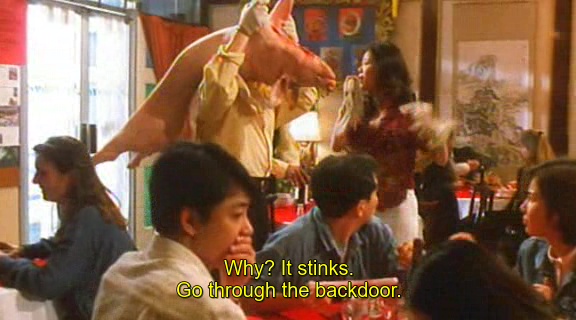
Chinese restaurants, where he works, use a lot of pork, and several scenes problematise the close proximity of pigs to humans in the way they look and, according to some informants, the way they taste. The Ebola is caught at a Zulu camp where multiple people are dying from it; Kai and his boss are there because the racist white butcher is charging too much for pigs.

vlcsnap-00034.jpg

vlcsnap-00035.jpg

When they go to pick up their purchases, Kai uncovers human bodies instead, before he finds the pig corpses.

vlcsnap-00040.jpg

vlcsnap-00043.jpg

Is there really such a difference between corpses? More than 75% of emerging diseases originate in other animals. COVID-19 is said to have originated at a fish market, where close contact between humans and live animals in a small space made it easy for the virus to jump species. Other coronaviruses, such as severe acute respiratory syndrome (SARS) and Middle East respiratory syndrome (MERS), not to mention bird flu and swine flu, all spread due to the human appetite for flesh.

We used to assume that exotic diseases came from wilderness areas where they had been hosted in exotic animals, which then, like the dying Zulu, were used and abused by humans. But a lot of current research seems to indicate that it is actually our destruction of habitat and biodiversity that causes the spread of diseases like Ebola and COVID-19.

“We invade tropical forests and other wild landscapes, which harbor so many species of animals and plants — and within those creatures, so many unknown viruses. We cut the trees; we kill the animals or cage them and send them to markets. We disrupt ecosystems, and we shake viruses loose from their natural hosts. When that happens, they need a new host. Often, we are it.”

David Quammen in the New York Times January 28, 2020

vlcsnap-00086.jpg

vlcsnap-00088.jpg

Really?

Dread Central summed up the movie:

“The horrid acting and paper thin story are forgivable only for the hilarity with which it’s presented.”

That’s a bit harsh! Chinese movies are not as a rule exemplars of subtlety, but Anthony Wong as the virus super-spreader gives it all he’s got, and a bit more too. It’s a rollicking yarn, and it asks some serious questions too. I was surprised to find I quite enjoyed it.

The full movie has been removed from YouTube, but you can still watch the always delightful review by THE HORROR GEEK, Mike Bracken.

Batman and the cannibal: BATMAN: GOTHAM KNIGHT (2008)

Batman: Gotham Knight (バットマン ゴッサムナイト, Battoman Gossamu Naito) is a 2008 anthology animated superhero film consisting of six shorts, supposedly set between the films Batman Begins (2005) and The Dark Knight (2008) although the narrative connection is tenuous.

vlcsnap-00006.jpg

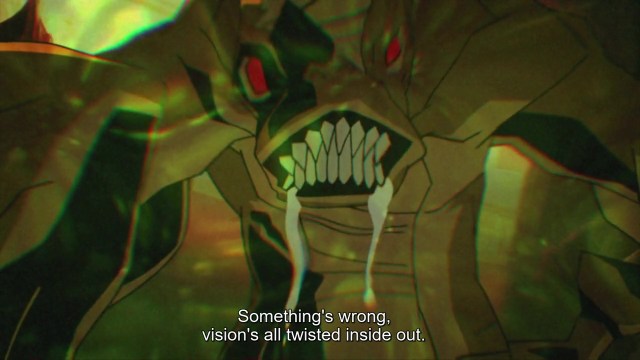
So, of course it has a cannibal in it! Killer Croc, who has been a Batman villain since the 1980s, although getting a grenade down his throat in this episode might, you would think, slow him down a bit. But no, he was back in the computer-animated TV series Beware the Batman in 2013-14. In that one, he bites Batman and boasts that he tastes like chicken. Perhaps a subtle insult rather than a gastronomic judgement. Anyway, that was a prequel, so let’s not give up on grenades just yet.

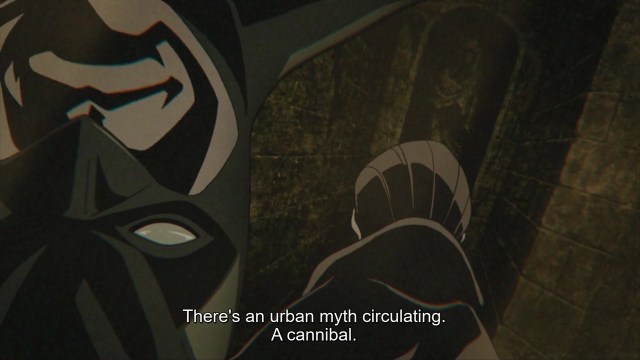
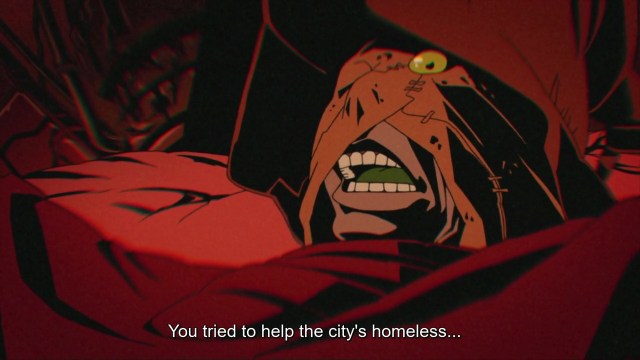
Batman is looking for a large, scaly monster. He finds some homeless dudes in the “ghost stations” under Gotham and asks them if they’ve seen the monster. In one of the great lines of all Batman stories, they answer:

vlcsnap-00009.jpg

Ain’t it the truth.

Killer Croc’s real name is Waylon Jones, and he is a cannibalistic serial killer. The urban legend goes that he was an infant born with the disfiguring skin disorder epidermolytic hyperkeratosis and that his mother abandoned him in the sewers of Gotham City.

vlcsnap-00011.jpg

Probably having scaly skin and looking like a croc didn’t do much for his self-image either. As an adult, he files his front teeth into points to complement the reptilian appearance of his skin and became a circus sideshow performer. Later, he changed his name to Killer Croc and went on a killing spree that eventually landed him in Arkham Asylum. There, his homicidal impulses intensified during “fear aversion therapy”. Croc escaped from Arkham and fled to the sewers with a handful of escaped Arkham inmates. There, he had fear toxin injected into parts of his body. When Scarecrow orchestrates the kidnapping of Cardinal O’Fallon, Croc infiltrates the church and carries him down into the sewers. Batman comes to investigate, but Croc ambushes him, biting and infecting Batman with the fear toxin that is coursing through Croc’s own body.

vlcsnap-00017.jpg

Well, of course Batman works through pain, as he tells the cops. But why did the underground monsters kidnap the cardinal?

vlcsnap-00025.jpg

Yeah, they’re mighty cranky with that Cardinal.

vlcsnap-00020.jpg

Batman: Gotham Knight is the first animated Batman film to be rated PG-13.

cover.jpg

Cannibalism costs an arm and a leg: THE BAD BATCH (Ana Lily Amirpour, 2017)

What do we do when dystopian stories start to look like the daily news? This film was made in the first year of the Trump presidency, which, you will remember, was partly won on the promise to build a “big beautiful wall” to keep criminals and rapists out of the USA. But what do you do with the criminals already inside the big beautiful wall? “Non-functioning members of society” are, in this dystopia, exiled, quarantined as “bad batch”.

Arlen (Suki Waterhouse) is bad batch number 5040, a number which is tattooed behind her ear, similar to the way Holocaust victims were stripped of their names and their humanity and became just numbers. She is then sent through the wall into a vast desert with little more than a sandwich and a bottle of water.

vlcsnap-00002.jpg

She is almost immediately captured by the cannibals, the “bridge people”, who live in crashed planes and work out like Muscle Beach.

vlcsnap-00012.jpg

The two women who caught Arlen hacksaw her leg and arm off, cauterise the stumps with their frying pan, presumably to keep the rest of her fresh, and go off to cook the limbs.

vlcsnap-00008.jpg

Arlen escapes on a skateboard, pushing with one arm and one leg, and, just as she is about to be eaten by crows, is found by a hermit (an unrecognisable Jim Carrey!)

vlcsnap-00028.jpg

The hermit takes her to Comfort, a settlement which seems to be a continuous rave club, run by a charismatic cult leader, The Dream (Keanu Reeves), who throws the parties and has his own harem of pregnant young women. In Comfort, they seem to prefer to eat noodles and rabbits (and lots of drugs) to human flesh, but – who knows? Like the bad bunch people, the camp structures are the rejects and wreckage of society – yet there never seem to be serious shortages of anything, particularly drugs. And The Dream lives in luxury, on the proceeds of the drugs, which are the currency of Comfort.

The folks at Comfort have given Arlen a prosthetic leg, but she still misses her arm. But one hand is enough to handle a gun. Is there some symbolism here that is even more Freudian than Trumpian?

vlcsnap-00019.jpg

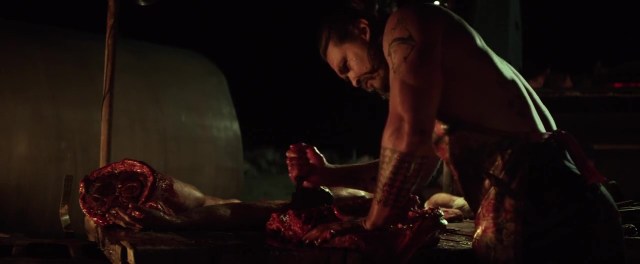
Meanwhile, back at cannibal HQ, the leader, Miami Man (Jason Momoa- you might remember him as Aquaman), is killing and carving up a woman for dinner.

vlcsnap-00016.jpg

Is this going to be a simple good (rabbit eaters) vs evil (human eaters) story?

vlcsnap-00040.jpg

Not quite. How can there be good and evil, when everyone is on the wrong side of the wall? Miami Man turns out to be a devoted Dad; he has a cute little daughter, and you know how much kids eat, right? Some of his tribe collect rubbish from the tip, others collect humans for dinner – is there a difference in a world where value is only assigned to those deemed worthy of being on the right side of the big, beautiful wall?

Arlen is gunning for revenge. She comes across the little girl and one of the bridge people women who kidnapped her, foraging for plates.

vlcsnap-00022.jpg

She shoots the woman and takes the girl back to Comfort, buys her a rabbit. But then Arlen takes drugs, handed out at the party like Eucharist wafers, and wanders into the desert, to wonder at the glories of the galaxy, as you do when you take psychedelics (or so I hear).

vlcsnap-00038.jpg

Well, we know there is going to be a meeting and a reckoning with the cannibal king. It’s hard to tell, though, who are the good guys in a world where everyone is an exile, and maybe a cannibal? As Arlen says to MM:

“Here we are in the darkest corner of this Earth, and we’re afraid of our own kind.”

The film is loosely based on a true story: the so-called “Cannibal Island”, a small island called Nazino in Siberia to which Stalin deported around 4,000 people declared to be “declasse and socially harmful elements” including political dissidents, disabled or impoverished people and criminals. They were dumped on the island with no food except some raw flour, which gave them dysentery. Before long, they turned to cannibalism. Two thirds of the deportees were killed or died of hunger and disease.

Cannibal Island.jpg

It makes Comfort look positively comfortable.

The Vancouver North Shore News said “The Bad Batch could as easily be described as “a Futuristic Cannibal Spaghetti Western,” a dystopian genre mash-up.” It has a disappointing 44% on Rotten Tomatoes, and is admittedly a bit slow in parts (and a bit daft in others), but the cast is great, the photography often superb, and the political timing spot-on. Walls lead to wars, and the phrase “dog-eat-dog” should really be “human-eat-human”. Eating rabbits, eating humans.

vlcsnap-00045.jpg

Because when it all hits the fan, whether it’s outside the wall or sleeping in the streets eating Soylent Green, humans are usually only one species barrier away from cannibalism. Expelled from under the thin camouflage of civilisation, we are all bad batch cannibals.

Poster.jpg

Hansel, Gretel and incestuous cannibalism: WE ARE THE FLESH – Tenemos la carne (Emiliano Rocha Minter, 2016)

It’s Hansel and Gretel, Captain, but not as we know it. This Mexican film is a visual experience, rather than a traditional narrative. It is set, like many of the films we have covered in this blog, after what appears to be an unexplained apocalypse. The “witch” is a crazy old guy named Mariano (Noé Hernández) who makes fuel out of old bread and trades it to persons unknown, through a hole in the wall, for food – mostly eggs and meat. Mariano is more Satan than witch.

vlcsnap-00059.jpg

He believes in chance, which, he says, is “the greatest criminal to ever roam the Earth.”

He is an aficionado of solitude, but when a young brother and sister, Lucio (Diego Gamaliel) and Fauna (María Evoli), appear in his abandoned apartment, he feeds them and puts them to work on ever more peculiar projects, such as a womb-like cocoon, made of wooden struts and vast amounts of packing tape.

vlcsnap-00009.jpg

Mariano receives some meat through the hole in the wall, and cooks it for his guests. But there’s a problem: Lucio is a vegetarian. Fauna tucks into her steak, rather reversing the normal situation where Hansel ignores Gretel’s warnings and eats the gingerbread. But Mariano has laced the meat with poison that, he says, the Nazis used to kill Jews. He won’t give Fauna the antidote until Lucio eats his meat.

vlcsnap-00019.jpg

So, it’s all about transgression, overcoming taboos, abandoning inhibitions, accepting pleasure rather than bothering with difficult questions of ethics. Mariano then decides that the kids need to have sex, and Lucio’s objection, that she is his sister, is dismissed:

“Do you think your cock gives a damn about her being your sister?”

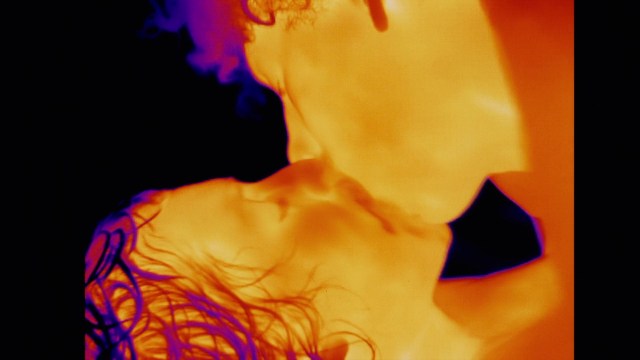
So then there’s lots of incestuous sex, some of which is captured in lurid neon heat-map images. Mariano sings to them and masturbates as they perform for him, finally fainting as he ejaculates. Or dies, but is resurrected, because, as we know, the monster is never really gone.

vlcsnap-00034.jpg

vlcsnap-00036.jpg

The Brothers Grimm was never like this. Although who knows what siblings Jacob and Wilhelm Grimm got up to before they became philologists?

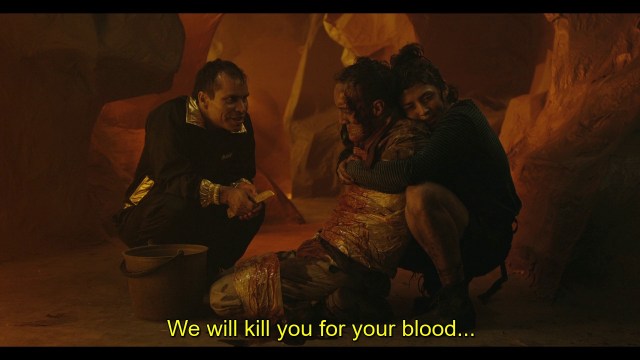
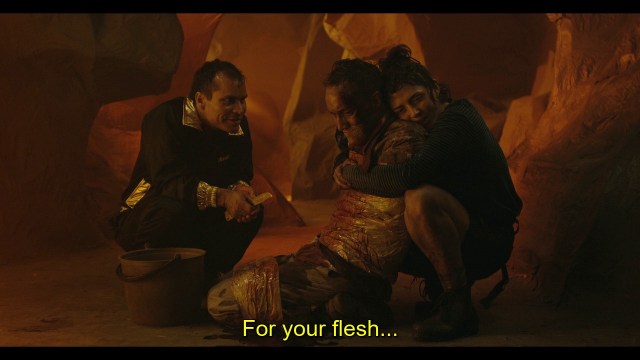
Anyway, we finally get to the cannibalism, about an hour into the film, as Mariano captures a soldier, tells him exactly what they have planned.

“We won’t kill you for money. We won’t kill you for an ideology. Or for the pleasure of watching you suffer. It’s not revenge for what you have done. We are neither avengers nor executioners.”

vlcsnap-00056.jpg

vlcsnap-00057.jpg

vlcsnap-00058.jpg

They sing the Mexican anthem and then slit his throat, catching his blood in a container. Various body parts are rendered into liquid and sealed into buckets, presumably to be traded through the hole in the wall.

Another girl comes into the maze looking for shelter, but is instead raped by Fauna and then Lucio.

vlcsnap-00070.jpg

Have we shattered every convention and broken every taboo yet?

vlcsnap-00022.jpg

Not quite. Mariano celebrates his naming day, a party in which all sorts of weirdos turn up and get it on. Mariano is to be the guest of honour, but also the main course.

vlcsnap-00076.jpg

“It is also the day I’ll live inside your squalid bodies. Don’t forget that the spirit does not reside in our flesh. Flesh is the spirit itself! So I kindly ask that all you lowlifes devour me until there is nothing left.

vlcsnap-00082.jpg

vlcsnap-00083.jpg

vlcsnap-00090.jpg

There’s a twist at the end, but hey, enough spoilers. Go watch it – it’s only 80 minutes.

Catherine Bray in Variety called the movie a “joyously demented portrait of humanity.” She summarised the theme very well:

“Much of its most vivid imagery is purpose-built to interrogate the moral values society projects onto biological matter: human meat ground to a slush, slopping about in a bucket; a clitoral close-up; a pipette inserted casually into a hole in a boy’s temple; a sister’s gelatinous menses dripping into her brother’s mouth.”

The stubborn belief that humans, unlike other animals, have some sort of spirit that elevates us into the ranks of demi-gods and therefore justifies the havoc we unleash on the rest of nature has crumbled. As Mariano insists, flesh IS the spirit. We are meat, driven by our appetites. Our carefully crafted moral convictions can vanish like smoke in the face of hunger or desire.

vlcsnap-00024.jpg


Hansel and Gretel is a seminal cannibal text of course: innocents, abandoned for daring to expect to be fed, and left to face the voracious appetite of the outside world. Many of us probably first heard about cannibalism while sitting on a parent or relative or baby-sitter’s knee, crafting our next nightmare as they read us stories from the Brothers Grimm. Variants of the story are everywhere – a new movie is due soon (I’m looking out for it) called Gretel and Hansel. Here’s the trailer:

Cannibalism as female empowerment: JENNIFER’S BODY (Karyn Kusama, 2009)

Jennifer’s Body is classified as a comedy, even though it’s rated R for sexuality, bloody violence, language and drug use. Well, all those things can be funny. Even cannibalism is sometimes the butt of jokes (well, quite often), and a lot of people get eaten in this movie.

poster-jennifer-body-quad.jpg

The story does not start with Jennifer (Megan Fox) but with her nerdy bestie Needy (Amanda Seyfried), “short” for Anita, although no one calls her that. Needy is revealed to be an ultra-violent resident of an asylum.

vlcsnap-00002.jpg

The rest is flashback. Jennifer is the popular girl, the sexy girl, the one no one can believe is friends with the boring Needy, but she is bored in their little town of – wait for it – Devil’s Kettle. Jennifer wants to get off with the big city band in town, Low Shoulder. At their gig, Needy hears them arguing about whether Jennifer is a virgin, and leaps to her friends defence

vlcsnap-00008.jpg

Jennifer later tells her that’s not even close to the truth.

vlcsnap-00009.jpg

Now, when men are looking for virgins, there are only two possible explanations, depending on whether they are of a metaphysical bent, and these guys are very bent. So telling them Jennifer fits their shopping list turns out to be a very bad idea. Jen gets in the band’s truck as the venue burns down. Needy is distraught.

But she meant well. And later that night, here’s Jen, looking quite sanguine, in both sense of the word.

vlcsnap-00016.jpg

Jennifer has been a virgin sacrifice to a demonic force, which promised greatness to the band. However, not being a virgin (even backdoor) means that the sacrifice, instead of killing her, left her possessed by the demon, a succubus.

vlcsnap-00018.jpg

Yeah, OK, but the audience needs a good reason for a woman to start eating her dates (even if, after 100+ blogs, you and I could think of a dozen good ones). So she is possessed, and eating people. When she’s hungry, she’s weak and unhealthy, but when she’s fed (and cleaned up) she’s the life, or undeath, of the party.

vlcsnap-00052.jpg

This is a really good film, with all the ingredients of greatness: the cast are excellent, the director, Karyn Kusama, is in her element (she made Destroyer with Nicole Kidman recently) and it was written by Diablo Cody, fresh from the triumph of Juno, for which she won an Oscar for best original screenplay. But the film bombed at the box-office, the accepted wisdom in those days being that successful films were made exclusively for 14-year-old (white) boys. This one wasn’t, it was about strong and often violent women, and has been gathering a cult following in the decade since its release.

vlcsnap-00035.jpg

There have been many horror movies about women, often (e.g. Carrie or Teeth) involving revenge for something done to them. This fits with the cultural expectation that men will be the aggressors and the monsters, and from this fetid swamp arose the slasher movies, including most cannibal films. Jennifer herself has been sexualised by most of the men and boys who appears in the plot. She is kidnapped and murdered by the band, despite begging for mercy.

But Jennifer is not seeking revenge on the band – that will (but not until the credits) be Needy’s job.

vlcsnap-00091.jpg

Jennifer is a monster for all the males who have objectified her.

vlcsnap-00037.jpg

The film plays with the assumptions about male power and appetite. The boys Jennifer eats are gentle and considerate, not violent or aggressive – the huge line-backer she tears apart after her return is seen first crying for his friend, who died in the fire.

vlcsnap-00036.jpg

Everyone assumes, of course, that his killer is male.

vlcsnap-00038.jpg

vlcsnap-00039.jpg

But the body when found is being eaten by a gentle fawn.

vlcsnap-00025.jpg

Despite widespread cultural beliefs, female monsters are not rarities.  Earliest mythology tells of the Medusa, the sight of whom “made the spectator stiff with terror” (much to Freud’s amusement) and even earlier, there are claims that Lilith, Adam’s ex before he met up with Eve, was, or became, a succubus. Jennifer is an ideal example of what film scholar Barbara Creed calls “The Monstrous-Feminine”, a concept of monstrosity that depicts not a female version of male monsters, but a cultural force defined by male fears about the feminine. These fears include being castrated (Freud’s favourite explanation), as well as confronting “the monstrous womb” – a terrifying image of a “black hole which threatens to reabsorb what it once birthed” (Creed, The Monstrous-Feminine, p. 27). As the writer, Diablo Cody, says, it is an unashamedly feminist horror movie.

Jennifer’s Body was before it’s time. In an article explaining the woeful critical reaction to the film, Vice summed up:

‘Jennifer’s Body’ Would Kill if It Came Out Today

vlcsnap-00024.jpg


“You’re only as good as you taste”, Cannibal Christmas

I was hoping to review Cannibal Claus, for those of you reading blogs on Christmas day (and a fine way to spend the day it is to be sure). No sign of it in the usual sources, but since IMDB says it was made with the impressive budget of $1,200, it may not be widely available. Let me know if you find it.

There’s quite a funny review of it here.


So…

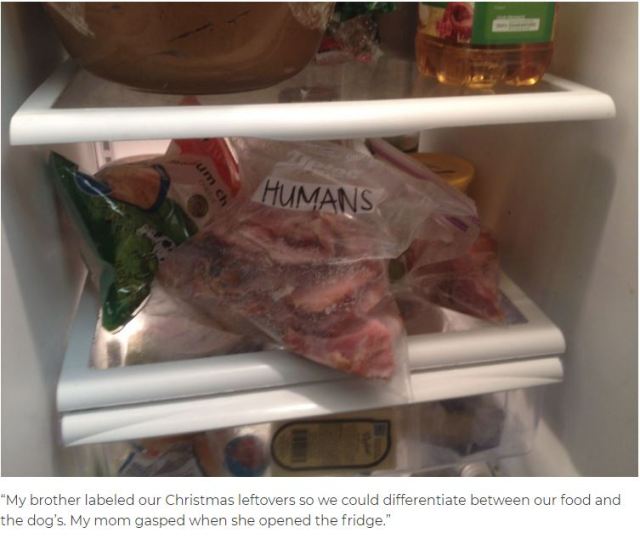
If you celebrate Christmas, have a merry one, and think about who you put in the fridge.

Cannibal Christmas.JPG
Awkward family photos


Cannibalism rocks! THE ROCKY HORROR PICTURE SHOW (Jim Sharman, 1975)

This movie was a cultural phenomenon. The critics hated it; the fans loved it. More and more viewers kept turning up to midnight showings, dressing the part, dancing the dances, singing the songs. It remains the longest running theatrical release in history, because somewhere a cinema will have it on, at midnight, tonight.

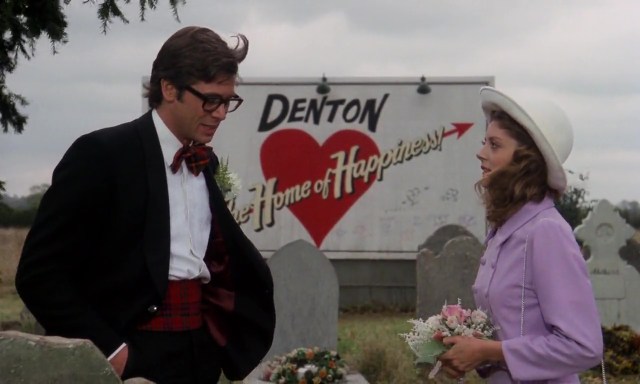
Shot in the style of Hammer Horror films, it is an affectionate satire on the science fiction and horror films that developed in the 1930s, and never went away. There are a mix of tropes, the main ones being the mad scientist (based on Frankenstein) creating life in his lab, and an innocent young couple knocking on the door of a spooky old house after their car breaks down. They are clean-cut Brad and Janet from middle-America town Denton (Barry Bostwick and the brilliant Susan Sarandon).

vlcsnap-00003.jpg

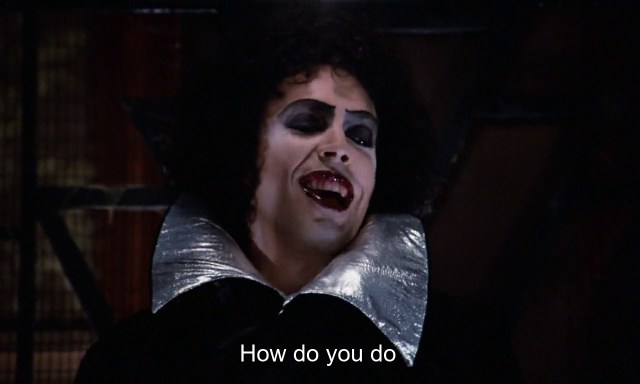
They find themselves in the midst of Dionysian scenes of rock, dancing and sex, presided over by Dr. Frank-N-Furter (Tim Curry, who later played Pennywise), a self-proclaimed “sweet transvestite from Transsexual, Transylvania”. How could this not be popular?

vlcsnap-00004.jpg

vlcsnap-00005.jpg

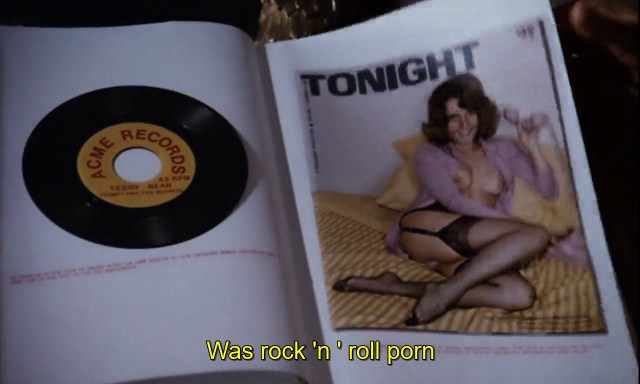
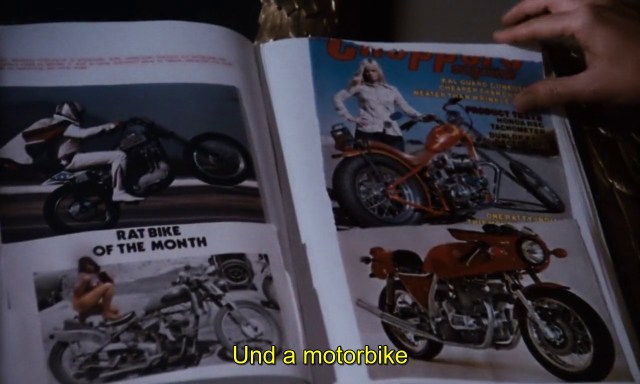
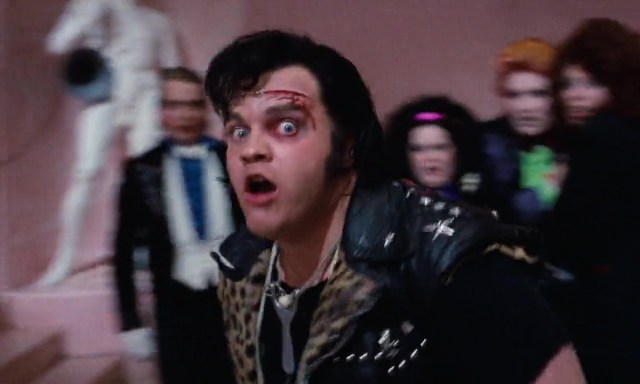
So why is this movie on a cannibal blog? Oh right, EDDIE (Meat Loaf). Some saw Eddie as representing old-time Rock & Roll, being annihilated by Glam Rock, with its emphasis on costumes and makeup. I prefer to speculate that the movie glimpsed the future, say the end of the 2010s. If Frank is alternative, iconoclastic culture, Eddie is one of the basket of deplorables, crashing the party on a motorbike, leather clad and bleeding, part of his brain removed to make the new creature, and preaching the joys of cis-masculinist rock and roll. His knuckles are tattooed “love” and “hate”. We are told that all Eddie wanted

vlcsnap-00022.jpg

vlcsnap-00023.jpg

vlcsnap-00024.jpg

Until Frank takes to him with a pickaxe.

vlcsnap-00008.jpg

vlcsnap-00009.jpg

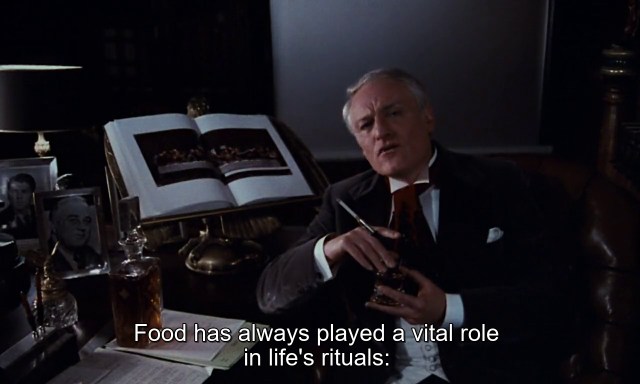
So, what happens to dead Eddie? Well, that’s how we ended up on the cannibal blog. The narrator (Charles Gray, a regular Bond villain) announces what could almost be the mission statement of cannibal studies

vlcsnap-00010.jpg

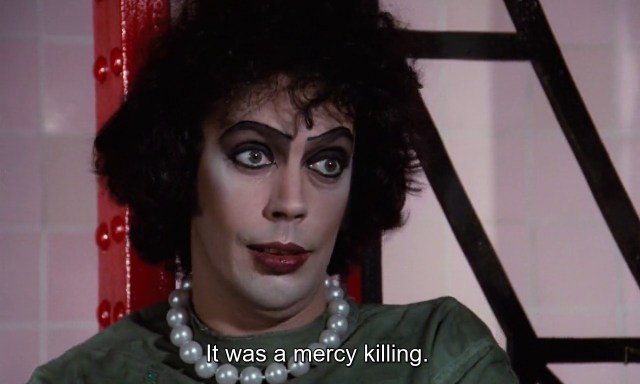
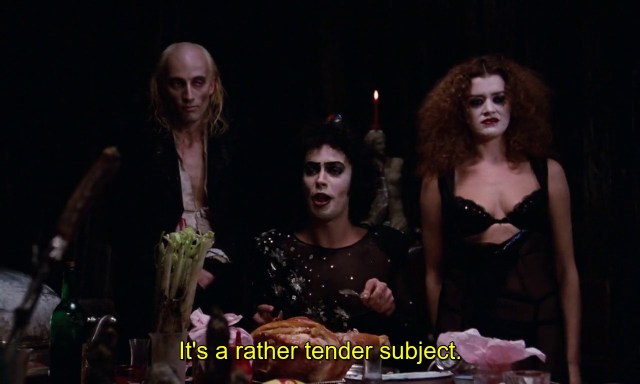
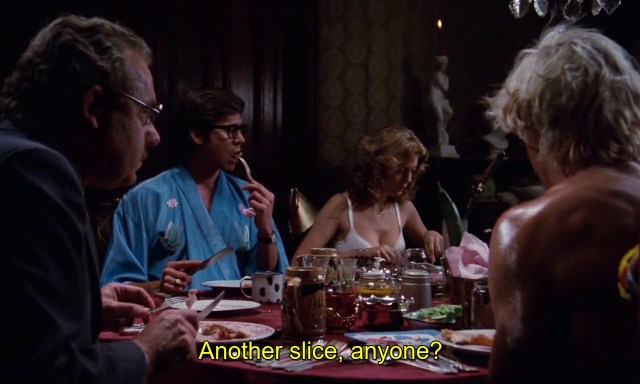
Frank is carving a roast, with an electric knife (anyone remember them?). When the subject of Eddie comes up, he says

vlcsnap-00018.jpg

vlcsnap-00019.jpg

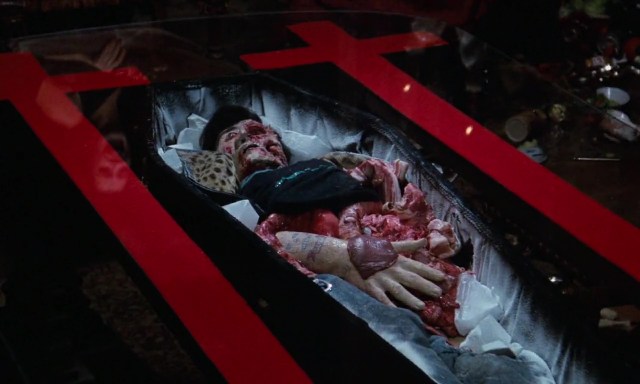
Just in case there was any doubt, Frank pulls off the tablecloth, revealing the rest of Eddie, inlaid in the table

vlcsnap-00027.jpg

The narrator sums up

“Just a few hours after announcing their engagement, Brad and Janet had both tasted forbidden fruit”

Taboos are the sweetest fruit. Brad and Janet have engaged in debauched sex and cannibalism – two areas where humans imagine themselves demarcated from other animals. In fact, the 2016 remake of this film by Fox found the cannibalism scene a bit rich for network television, and when the tablecloth is removed, Eddie is there, dead, but intact and fully dressed.

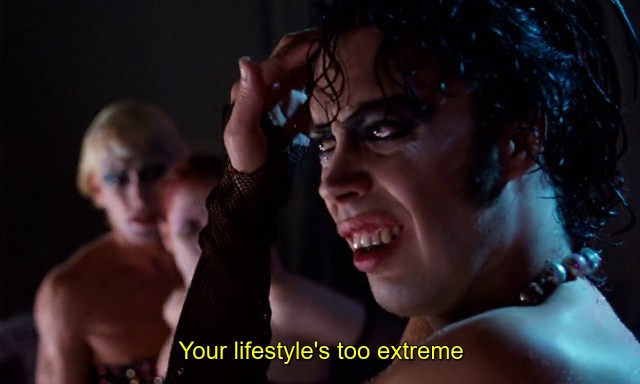
In our strange moral system, murder is fine, but cannibalism is still the final frontier. And it seems to be a universal moral imperative – Frank’s flunkies depose him and kill him because

vlcsnap-00046.jpg

That’s what makes cannibal studies so fascinating.

Anyway, turns out that Frank and his staff are aliens from the planet of Transexual in the galaxy of Transylvania, and the castle is their spaceship. The humans are left crawling in the dust and smoke after the takeoff, and the narrator tells us

“And crawling on the planet’s face, some insects called the human race.
Lost in time and lost in space. And meaning.”

vlcsnap-00002.jpg

Next week: ‘HANNIBAL’ Season 3 Episode 4, ‘Aperitivo’.


“The lucky ones died first” THE HILLS HAVE EYES (Wes Craven, 1977)

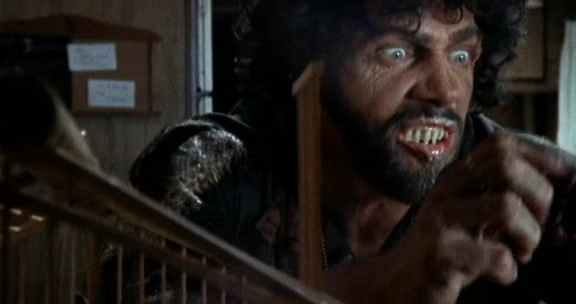
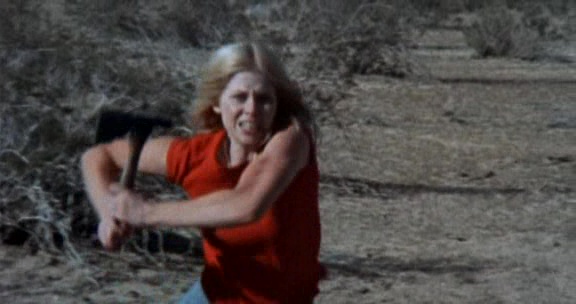
The Hills Have Eyes has become a cult classic of the American horror film genre, as well as an important part of the cannibal studies canon.  The film follows the Carters, a suburban family targeted by a family of cannibal savages after becoming stranded in the Nevada desert.

hillshaveeyes.jpg

Wes Craven’s directorial debut was The Last House on the Left (1972), an American version of Ingmar Bergman’s The Virgin Spring (Swedish: Jungfrukällan), a movie that shocked (at least in 1960) with its themes of rape, torture and murder. Craven became known as a “Master of Horror”, and went on to make such classics as A Nightmare on Elm Street (1984) and Scream (1996).

Other influences on this film include John Ford’s The Grapes of Wrath (1940) and Tobe Hooper’s The Texas Chain Saw Massacre (1974). Like The Last House on the Left before it, the film also drew influence from the work of European masters such as François Truffaut and Luis Buñuel.

Wes Craven liked to find inspiration in the classics, and there’s nothing wrong with that. They say there are only seven or so archetypal stories in literature, and all the others are variations on a theme. So, The Hills Have Eyes is based on the legend of cannibal Sawney Bean, a story that Craven saw as illustrating the fine line between civilized and savage. Bean was believed (and how do we ever sift the fiction from the fact in cannibal stories?) to be the patriarch of a 48-person incestuous Scottish clan which murdered and cannibalised more than one thousand men, women and children in the 16th century. When the King and his soldiers finally caught up with the family, according to the Complete Newgate Calendar,

“The men had their hands and legs severed from their bodies; by which amputations they bled to death in some hours. The wife, daughters and grandchildren, having been made spectators of this just punishment inflicted on the men, were afterwards burnt to death in three several fires.”

Just like the Sawney Bean legend, the violence of the cannibal family in this film is matched by the ferocity of their victims. Unlike Texas Chain Saw, where escape by the “final girl” is victory enough, this movie ends with the “last boy” (as it were) savagely stabbing the last cannibal, and continuing to do so long after he is dead, watched by the “final girl” who is an abused and therefore redeemable member of the cannibal clan. The end of the film is not a fade to black but a fade to red.

vlcsnap-00022.jpg

vlcsnap-00016.jpg

Craven saw this treatment of the Bean clan by supposedly civilised people as paralleling the clan’s own savagery, and illustrated the point graphically in this film.

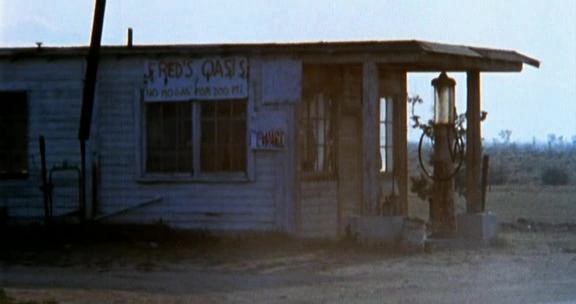
Chain Saw and Hills showed a slice of American life that doesn’t usually make it on to the screen – the “flyover states” where industry and agriculture have closed up shop, and the air force use the “empty” desert for nuclear testing. The remnants of the population, mutated by the radiation (the gas station dude’s baby, who became the cannibal patriarch, was at birth “twenty pounds and hairy as a monkey”), survive in the economic wasteland by doing whatever they can. In Hills, as in Chain Saw, they do it by capturing “civilised” folk who blunder into their killing fields. The survivors of the American Dream have become depraved cannibals, not just eating their victims, but first raping and tormenting them. In both movies, there is what, in his excellent review, Bloody Disgusting’s Zachary Paul called an archetypal “gas station of doom”, a final point of no return. They, and you the viewer, have been warned.

1

vlcsnap-00001.jpg

As a classic horror film, it is actually quite dull in large sections. This is not a fault of the production so much as the budget: the whole thing was made for peanuts and shot on 16mm film, on cameras that were borrowed from a Californian pornographer. There was not a lot of spare cash for gore, so the episodes of violence are extreme, but short. The sudden jolts of music make up for the missing build-ups.

The symbolism of the film is unsubtle. The cannibals are freaks and monsters, although remarkably technology-savvy:

vlcsnap-00003.jpg

This slideshow requires JavaScript.

vlcsnap-00007.jpg

The family of victims are the tough patriarch, a former cop, who cannot save them and is crucified by the cannibals, the virgin daughter who is raped by them, and a baby who is stolen and almost (until they changed the script) eaten (they describe her as “a young Thanksgiving turkey”).

vlcsnap-00002.jpg

vlcsnap-00010.jpg

vlcsnap-00008.jpg

But by the end, both families have descended into mindless brutality.

vlcsnap-00036.jpg

vlcsnap-00030.jpg

A sequel was made by Craven in 1984 called The Hills Have Eyes Part II. Although the villains were allegedly cannibals, there is no cannibalism in it, so I won’t be wasting our time on it in this blog, particularly as it managed a score of ZERO on Rotten Tomatoes, which is quite a feat.

Both films were remade in 2006 and 2007, and we’ll get to those, eventually.

The Hills Have Eyes was part of the “new wave” of horror that arose in the 1970s. Other notable directors who made up this new wave were Tobe Hooper, George Romero, David Cronenberg, John Carpenter and Brian De Palma. Horror had moved away from outsiders (monsters, aliens, vampires, etc) to humans, usually the victims of pervasive social dysfunction and degeneracy. Cannibalism was getting closer to where we live – our species. Later films would move the cannibal into our cities, and then finally into our homes.

Our voracious appetites continue to turn inward.

Poster.jpg