The fifth episode of the first season of Hannibal is called “Coquilles” which is the shellfish dish at a grand French banquet. Consider the nature of a shellfish – soft and vulnerable inside, yet presenting a hard, almost impenetrable surface to the world. Know any humans like that?
Things go on inside us that no one can know. That’s the theme of this episode.
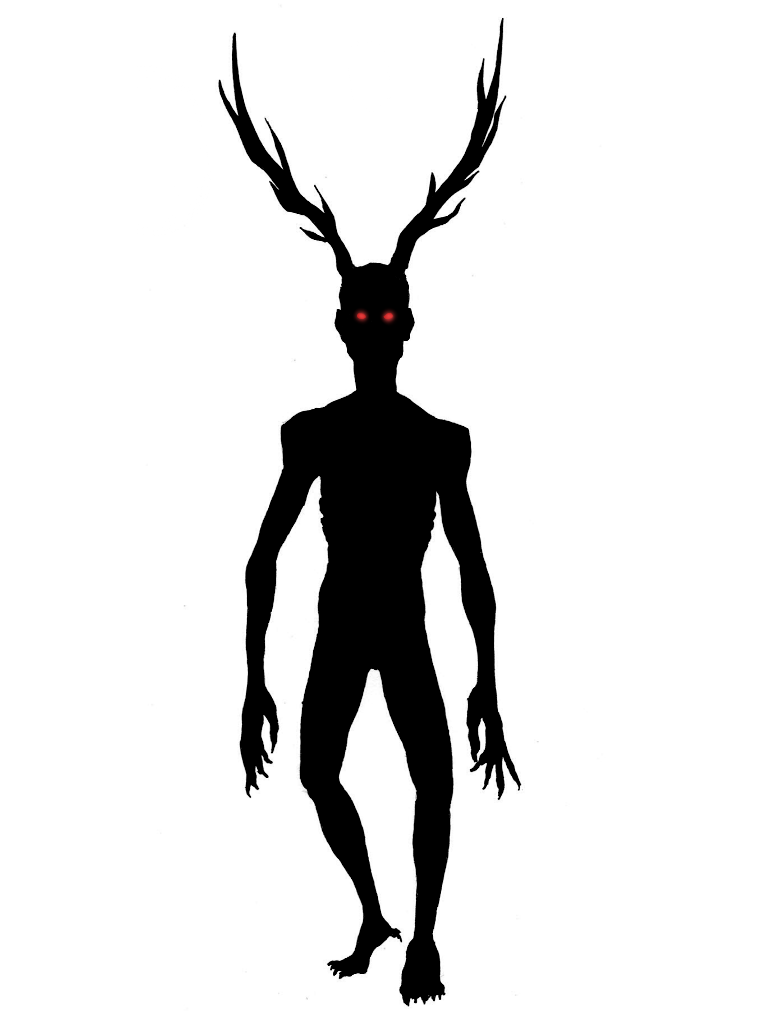
Will Graham is walking barefoot in the middle of a highway, closely followed by a stag, and we are starting to realise that things are going on inside Will as well, things even he cannot understand. This stag is a fascinating piece of symbolism, and there are numerous pages and some fiery debates on the Internet about what he represents, or even what he is called: Stagman and Ravenstag are commonly used, but there are others too. Bryan Fuller calls him a Wendigo. Throughout the series, he comes in various shapes: the stag with raven feathers, or sometimes a man with stag antlers and apparently charred skin.
The Wendigo (sometimes Wetigo) is a figure from North American Algonquin folklore. He is a mythical figure – giant, fierce and cannibalistic. He gathers strength from feeding on human flesh, but the flesh makes him grow larger, and so his appetite can never be satisfied. The Wendigo is able to return from death unless destroyed by fire, and some stories say that his bite will infect the victim and turn him into a Wendigo too.
In the show, this figure often stands in for Hannibal as Will struggles to understand that his friend is the Chesapeake Ripper, and Will is surprised to find a statue of a stag in Hannibal’s office. But, more generally, the giant form of the stag represents the animal inside each of us, the incongruity of our belief that we somehow transcend our animal selves, while in fact our basic instincts and appetites continue to drive us. Welcome to the Wendigo syndrome, a voracious appetite, which made the Native Americans believe that the white man was afflicted with a Wendigo disease when they saw him steal their lands and slaughter their people.
Anyway, the police pick up Will, and the stag walking behind him turns out to be his favourite mutt, Winston. They take him home and, next morning, Hannibal has some significant remarks on Will’s fragile state and Jack’s manipulative practices, and the way Jack got Will back on the job.
The creepy dude, called “the angel-maker” who is the one-episode antagonist for this one has a special power – he can see demonic people. Where we see a nice couple going to their room in a motel, he looks up from his ice bucket and sees a couple of demons with burning skulls.
These sort of delusions never end well, and in this case, their holiday ends with them on their knees, hands clasped in prayer, and the skin of their backs flayed and suspended from the ceiling. They have been turned into angels, praying for the crazy dude who, the team figures out, has a brain tumour and is terrified of dying in his sleep. Turns out his victims are not quite as innocent as we think either. Seems angel-maker really can sense bad dudes. He’s doing, Will tells us, God’s work. He’s making angels out of demons.
Meanwhile, Jack and his wife Bella are having dinner at Hannibal’s table, and Hannibal’s keen sense of smell tells him what Jack hasn’t figured out yet: Bella is also dying of cancer. Jack just thinks she is having an affair.
Hannibal serves a delicacy – “a masterpiece foie gras au torchon with a late harvest of vidal sauce with dried and fresh figs”. Bella declines the course, due to the well-known cruelty involved in producing foie gras. This leads to a fascinating conversation about the nature of the human/animal binary and the human predilection toward cruelty.
Hannibal: too rich?
Bella: too cruel.
Hannibal: First and worst sign of sociopathic behaviour – cruelty to animals.
Jack: that doesn’t apply in the kitchen.
Hannibal: I have no taste for animal cruelty. Which is why I employ an ethical butcher.
Bella: be kind to animals and then eat them?
Hannibal: I’m afraid I insist on it. No need for unnecessary suffering. Human emotions are a gift from our animal ancestors. Cruelty is a gift humanity has given itself.
For the next course, Hannibal serves roasted pork shank.
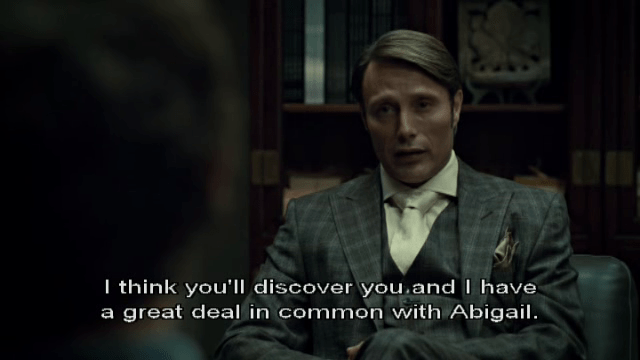
Later, Bella comes to consult Hannibal as her psychiatrist. She is unwilling to tell Jack about her fatal diagnosis, because he has enough to worry about. Or because she is having enough trouble working out her own response to death, and has no desire to deal with how Jack will respond. Hannibal gives her a look – is it a kind of empathy?
Meanwhile, Hannibal is still working on Will, turning him against Jack. Just as the angel-maker has feelings of abandonment, so Will might feel abandoned by Jack – Jack has abandoned him “in the way gods abandon their creation”. Hannibal wants Will to change creative deities, become Hannibal’s protege. It’s working too: Will tells Jack off and is forced to apologise when Jack barks “I didn’t hear that! Did I?” (a line from the book Red Dragon, although not spoken by Jack in that text).
They track down the angel-maker’s wife, who explains how she withdrew from him and ended up leaving him as the cancer progresses. A rather dark light bulb goes on for Jack.
Will is getting worse – the headaches, the sleep walking, and the hallucinations. Just as the angel-maker has a brain tumour and Bella has lung cancer, Will also has hidden things going on: beneath the hard surface of his coquille he has encephalitis. Hannibal, with his unerring sense of smell, knows it immediately, but he is not going to tell anyone about it. He is going to use it, to draw Will towards his becoming.
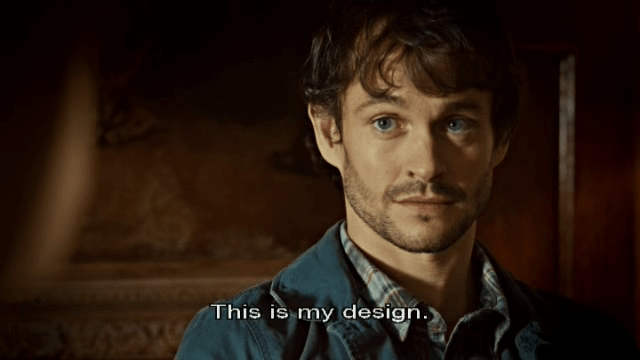
“Œuf” on a French menu means egg, and from eggs of course come children – families. This episode features a woman (played by Molly Shannon) who is abducting children – middle children who have a grievance against their families. She persuades them that she is their family, and that they can only have one family. So she takes them back home to kill their “previous” families. This, as Will would say, is her design.
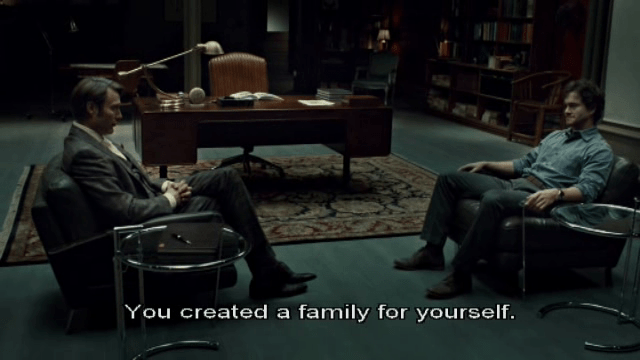
Will, by this episode, is in deep psychoanalysis with Hannibal, and is discussing his feeling that he is somehow psychically linked to Abigail’s father, Garret Jacob Hobbs, whom Will shot in Episode 1, a shooting that left will “psychologically incapacitated” as Fuller said in an interview. He feels like he was doing the same things, even perhaps at the same times – having a shower perhaps – as Hobbs. “You could sense his madness, like a bloodhound” Hannibal tells him. “Like – you were becoming him.” Will snaps back “I know who I am. I’m not Garret Jacob Hobbs, Doctor Lecter.” But could he become that? Will, says Hannibal, created a family for himself. No, not his houseful of stray dogs. He is referring to Abigail. She is now on the way to become Will’s family. This, perhaps, is Hannibal’s design.
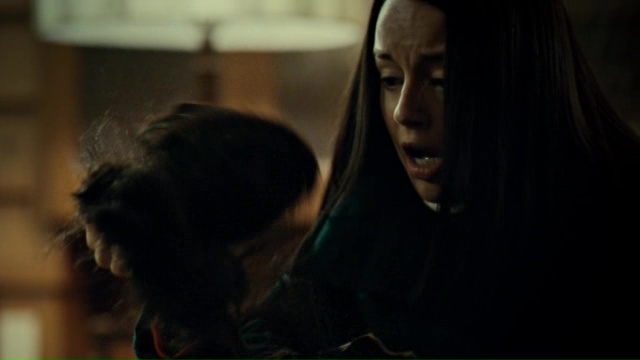
Meanwhile, Abigail is immersed in grief and trauma, having lost her family very suddenly (and violently) in Episode 1. Hannibal is determined to do something about that, and of course it involves psychological manipulation – of everyone involved. He takes Abigail to his home, against her doctor’s wishes (Alana Bloom) and cooks her sausages and eggs – the last meal she had with her family, the first meal with him as her new family. He makes her a tea of hallucinogenic psilocybin mushrooms, asks if she trusts him, and it produces in her the confusion he has planned.
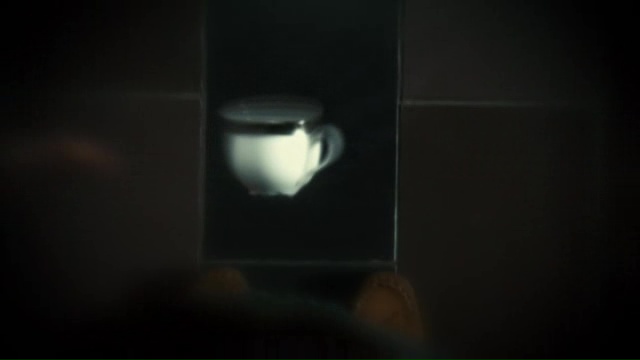
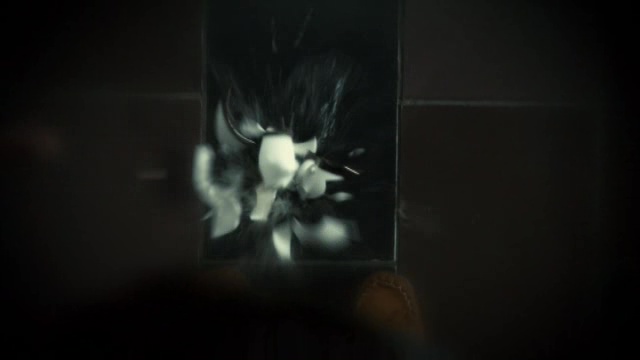
She smashes a teacup, a crucial image for Hannibal, representing his longing to be able to turn back time, and restore his eaten sister to life. Hannibal is obsessed with Stephen Hawking’s description of entropy as proof of the “arrow of time” – we “know” that time only flows one way because a shattered teacup does not gather itself back together (Hawking’s A Brief History of Time, pages 152-3). Hannibal likes Hawking’s early theory that, when the universe stops expanding, time will reverse and entropy mend itself; the teacup will rise and become whole again. Mischa will return, uneaten. Hannibal is apparently a believer in Nietzsche’s eternal recurrence, although, as he picks up the broken shards, it looks like he might also believe he can break the causal chain and restore his family, but through Abigail and Will.
When Alana appears, furious, he apologises, tells her she is right, he was wrong, that Abigail was not ready and that he has given her a mild sedative (half a Valium). Now Hannibal does not apologise as a rule, and this is not a genuine apology of course but another manipulation.
Abigail is not mildly sedated; she is tripping out across the universe, and although she recognises Alana, it is not long before she sees the faces of her parents across the table – the family squabble resolved, she sees – family. She sees mother (Alana) and father (Hannibal) as her dead parents. Can she eventually learn to see two daddies?
They capture the family-killing gang, and Jack talks to the boy who was (maybe) just about to become the latest family killer. The boy tells Jack that he, Jack, cannot understand families, because he doesn’t have children. In bed that night, we finally meet Jack’s wife Phyllis, whom Jack calls Bella (Gina Torres from Suits, who is Laurence Fishburne’s real life wife). Even Hannibal hasn’t met Bella yet, despite already turning Jack into an “innocent” cannibal with his boudin noir (blood sausage) from Ali Bab’s Gastronomie Practique.
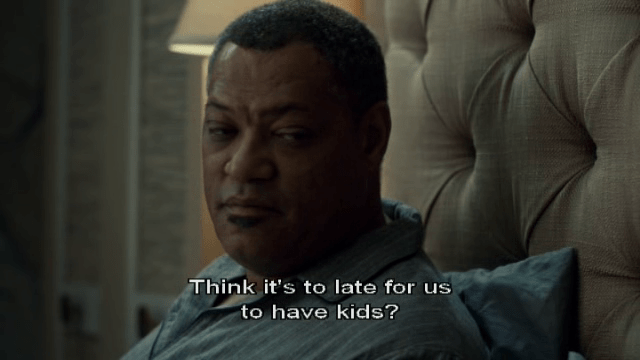
Jack asks Bella if it’s too late for them to have kids. She turns away, her eyes hooded – “it is for me” she replies. Although he is head of Behavioural Science, Jack cannot understand what problem she is hinting about. We know, of course, or at least we do if we have read or seen Silence of the Lambs.
Sorry – no more spoilers.
This episode was originally set to be broadcast on April 25, 2013. However, five days earlier, the episode was pulled from the broadcast schedule in the U.S. at the request of creator Bryan Fuller, and instead appeared on the Internet as “webisodes”. The episode was still shown in other countries. It was widely reported that this was in response to the Boston Marathon bombing on April 15, but in fact, the change had been notified some hours before the bombing happened. It seems likely that this change (they showed episode 5 instead) was due to the Sandy Hook shootings the previous December, in which 20 children aged six or seven and six school staff were gunned down. America was traumatised once again as families were torn apart by gun violence.
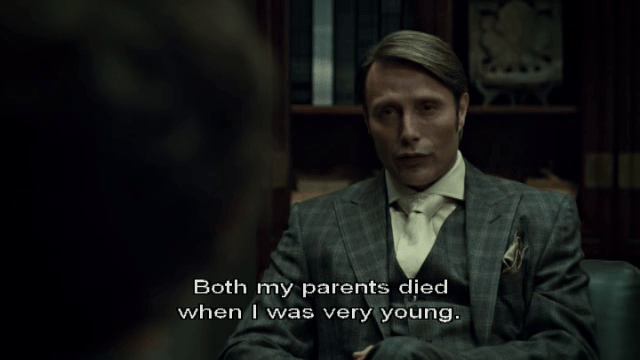
The episode is all about families – we find out about Will’s family (poor, moving around as his father looked for work in shipyards), Jack’s (lack of) family, Abigail’s recently killed family, the murdered families of the so-called “lost boys”, the friendly badinage among the Behavioral Analysis Unit who are almost a family themselves. We even get a tiny but delicious taste of Hannibal’s family. He lost his parents when he was very young; he was “the proverbial orphan” until adopted from the orphanage by his uncle at the age of 16. We are suddenly accessing material from the book Hannibal Rising rather than Red Dragon, although of course without World War II to explain the circumstances (this series gives us a much more millennial Hannibal).
No wonder Hannibal is cooking eggs. No wonder the episode is titled “Œuf”.
If you like my blog, please feel free to recommend it (with discretion) to friends on social media.
If you have any questions or comments, you can use the tag, or email me on cannibalstudies@gmail.com.
As you probably know by now, the episodes in the series Hannibal are named after courses in fine dining. Episodes one and two were the pilots, the ones that established the characters, let us in on secrets they didn’t know, and gave us a taste of what was to come. No on-going story arc you could really get your teeth into though.
Episode 3 is called “potage” which is a thick vegetable soup. Can’t really get our teeth into soup, but it is very nourishing and warming. It looked in the earlier episodes as if this was going to be an episodic show: the secret cannibal would lead the hyper-empathetic FBI Special Agent to capture some single-episode outsider – a serial killer whose whole purpose was to be caught by this team while we giggle and point like kids at a pantomime: look Mum, they still haven’t seen the real bad guy! But there is no new serial killer introduced here. This episode is all about Abigail Hobbs, the orphaned daughter of the serial killer shot dead by Will Graham in the first episode. Her father cut her throat before Will filled him full of lead. The mushroom man from episode 2 tried to kidnap her to feed his mycelium. Now she has woken up, to a lot more than the FBI has managed to figure out.
You may remember from episode 2 Hannibal saying:
“I feel a staggering amount of obligation. I feel responsibility. I’ve fantasised about scenarios where my actions may have led to a different fate for Abigail Hobbs.”
Now he gets his chance. Abigail is becoming a surrogate sister to Hannibal who later will admit to eating his real sister Mischa (not to killing her though). He accuses Will of making her a surrogate daughter, which Will does not deny.
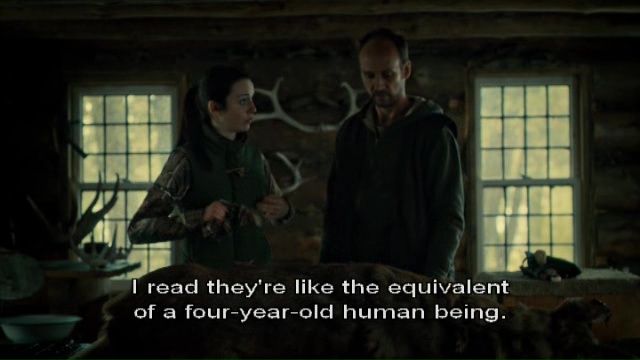
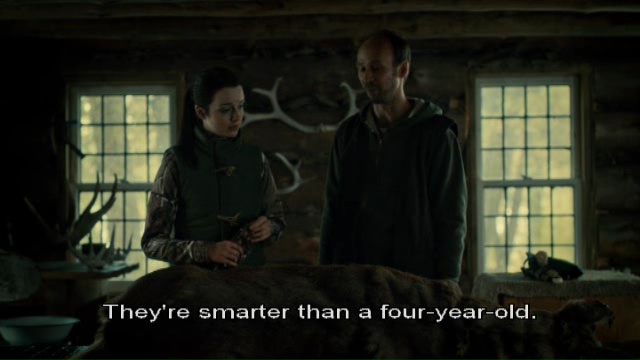
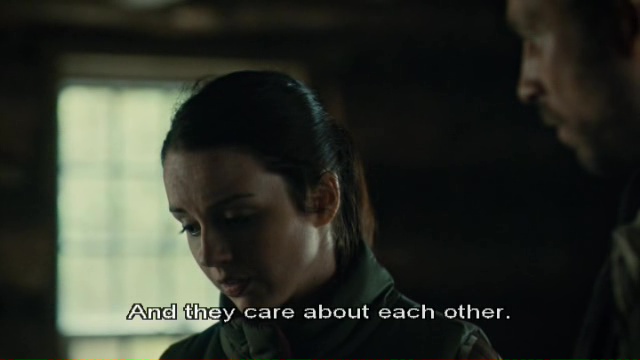
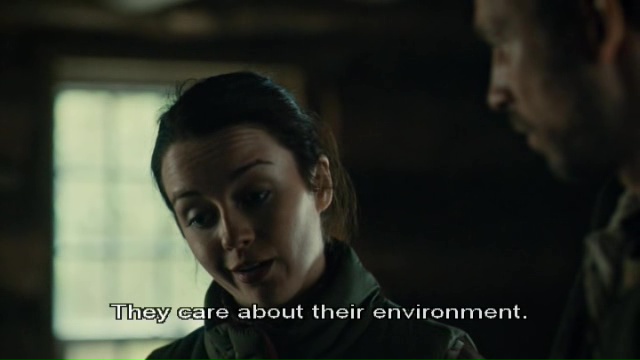
Abigail is smart and sassy and a step ahead of everyone at the FBI, even though she is still deeply traumatised by the death of her parents. In a flashback, she is seen hunting with her father, shooting a deer. She asks him the questions that perhaps we have all asked our parents at some time: was it OK to kill? Wasn’t that deer smart? Don’t they care for each other and their environment? All the reasons we give to valorise human life, applied to those who are like us.
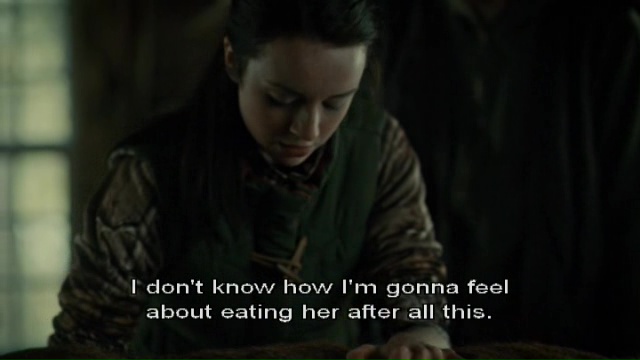
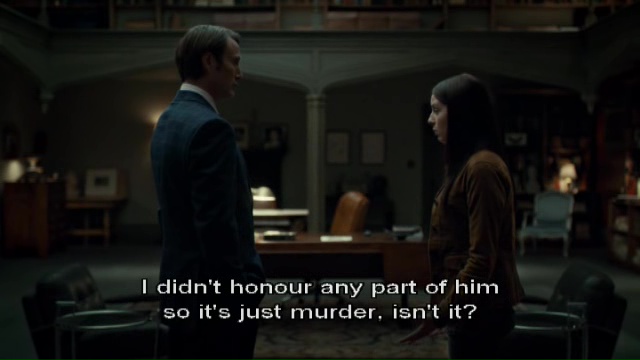
Her father loved her dearly and hated that she was growing up and would leave him. His response is to kill young girls who look just like Abigail, because he can’t bring himself to kill her. He answers her question, in a way, saying that he is “honouring” the deer by using ever part of her. This is the carnivore cop-out: as long as the kill is clean and the corpse not wasted, then it’s OK to kill. Her father feels the same way about eating young women; Hannibal feels the same about eating rude people. When Abigail expresses doubts about eating the doe, her father grabs her arm: eating her is honouring her, otherwise it’s just murder. The logic of the serial killer. And factory farm corporation.
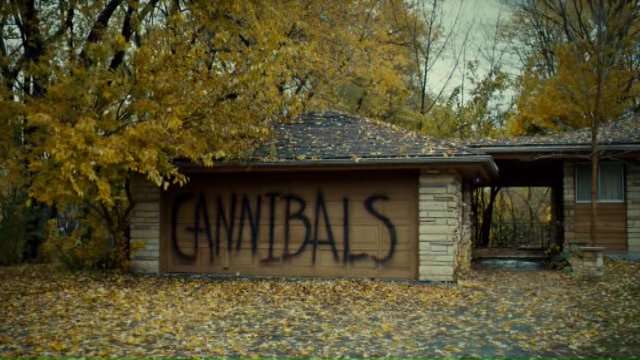
Will, Hannibal and Alana take Abigail back to her home where her mother and father died and she almost died; someone has scrawled graffiti all over the doors: the word “cannibals”.
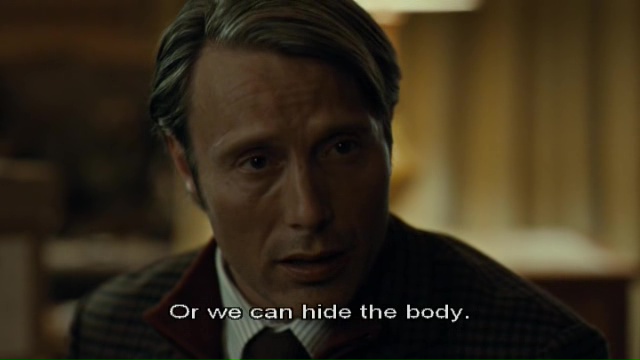
And there is another complication – the brother of the girl killed by the copycat (really Hannibal of course) has come to accuse Abigail of murder, since most people (including Jack Crawford) consider her an accomplice to her father. Then there’s her best friend from school who tells her that everyone (else) thinks she’s guilty. The extras all end up dead (Abigail, like her surrogate brother Hannibal, wields a mean knife) Hannibal arranges everything so that the distressed brother appears to be the killer, and then they hide the body.
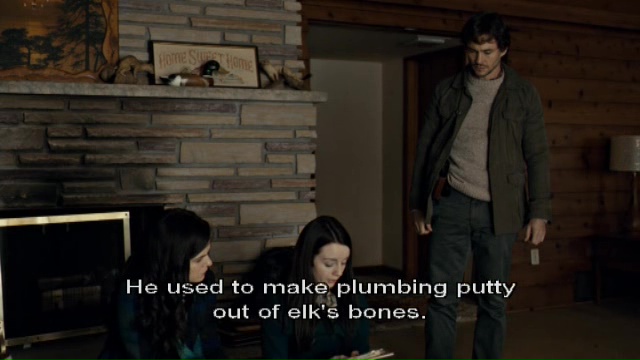
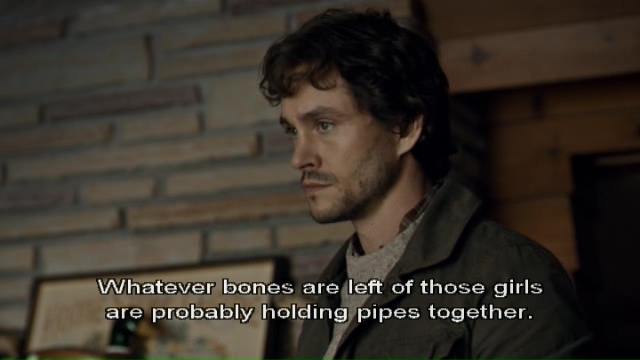
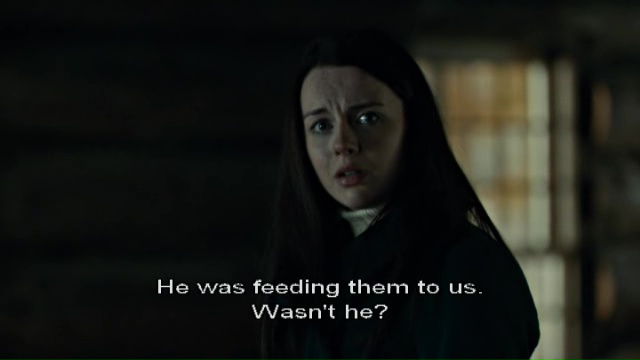
Abigail is further traumatised – even for a girl who shoots innocent deer, watching your father kill your mother and then cut your throat, finding your best friend’s body and then killing the boy whose sister was the previous victim: these are not soothing experiences. Her brain is working fine though: she realises that dear odd dad was feeding them girl meat; she finds the pillows at home are stuffed with girl hair.
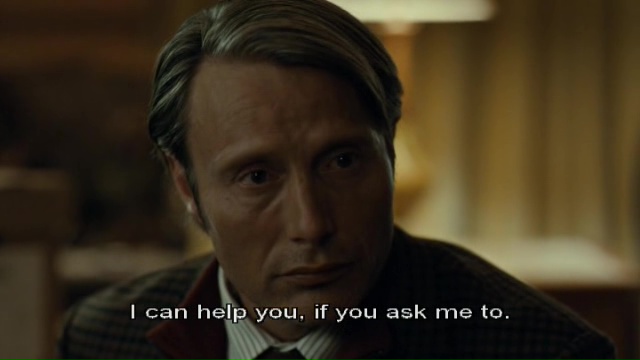
She escapes from hospital and finds herself on the top level of Hannibal’s library. He gallantly helps her off the ladder and offers to help – but only if she asks. Dracula had a similar line – he had to be invited in.
Abigail tells Hannibal she knows: Hannibal is the one who called to warn her Dad. And he called as a serial killer.
He has promised to keep her secrets; now she promises to keep his. Just as his real sister Mischa might have done – if she hadn’t been eaten.
IF YOU LIKE MY BLOG, PLEASE FEEL FREE TO RECOMMEND IT (WITH DISCRETION) TO FRIENDS ON SOCIAL MEDIA.
IF YOU HAVE ANY QUESTIONS OR COMMENTS, YOU CAN USE THE TAG, OR EMAIL ME ON CANNIBALSTUDIES@GMAIL.COM.
The episodes in the series Hannibal are named after courses in fine dining. The first season is based on French recipes – the first episode was the Apéritif – like any good pilot episode, it got us in the mood, intrigued us, gave us an appetite and got us just a bit drunk, so that we could enjoy the courses to come. Episode 2 is the amuse-bouche – literally “amusing the mouth”. It is a small hors d’œuvre which both prepares the guest for the meal and offers a pointer into what the chef has planned for the repast.
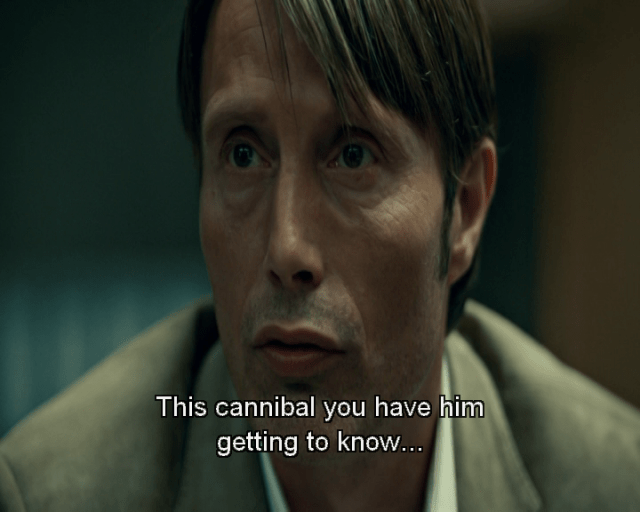
This episode is full of tasty teasers for the series to come. Unlike Will Graham and Jack Crawford, most of us viewers know that Hannibal is a cannibal – with a potential rhyme like that, how could he resist? To them, he is a distinguished and brilliant psychiatrist who, they hope, can keep Will sane enough to solve their murder mysteries, but Hannibal has his own plans for Will, and we even get just a small hint of Hannibal’s mysterious past, what drives him. We, the Hannibal aficionados from the books and/or films, are aware of the fate of his sister Mischa when they were both little – she was eaten by Nazi deserters. Hannibal may have unknowingly participated in some of the broth. But this is a later Hannibal, a Gen X Hannibal, who has not lived through a war, but has still lost and maybe eaten a sister, apparently. So, although he is not the kind of personality who lives in the past or wallows in regrets, he tells Will
“I feel a staggering amount of obligation. I feel responsibility. I’ve fantasised about scenarios where my actions may have led to a different fate for Abigail Hobbs.”
He’s referring to what happened to her in episode 1, but also to what he has planned for her later in the season. Hannibal, like a good chess player, works out his moves far in advance of the play.
We also get a lot of amusement, amuse-bouche, in that the jokes are about cannibalism. These early episodes are more episodic than later in the series – they are almost self-contained. There is a central crazy, and Hannibal and Will work together and apart to their own ends: Will to catch the perp, Hannibal to “blood” Will, give him a taste for killing. This particular perp is burying his victims as feed for his mushrooms – he loves the way mushrooms network and know who is coming. They seem in fact rather more aware of what’s going on than most of the characters, except Hannibal and perhaps Freddie Lounds.
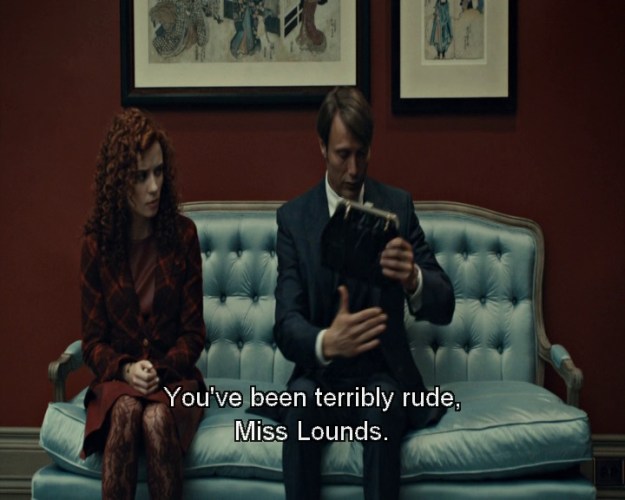
Freddie Lounds, tabloid journalist, is looking for a scoop and hopes to trick Hannibal, who is the ultimate trickster, and unlikely to fall for such shallow pranks. We fall for it, though, when Hannibal finds her recording device, tells her off, and speculates on her punishment.
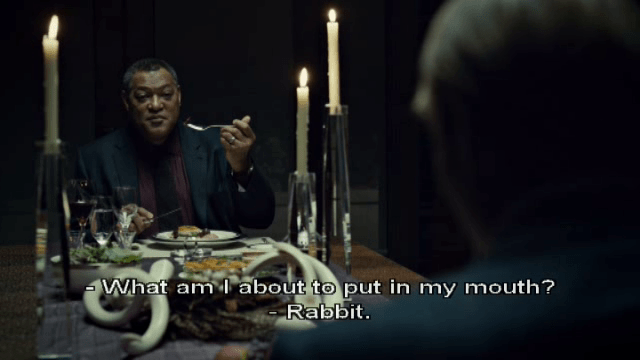
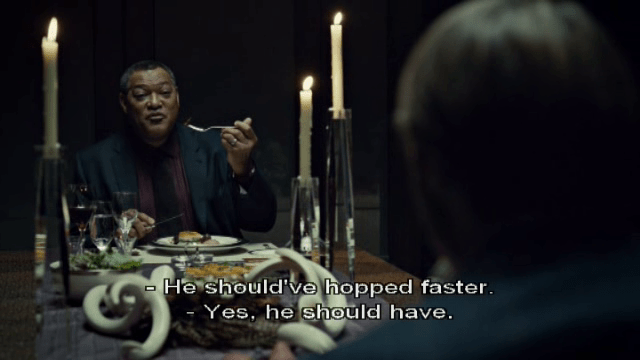
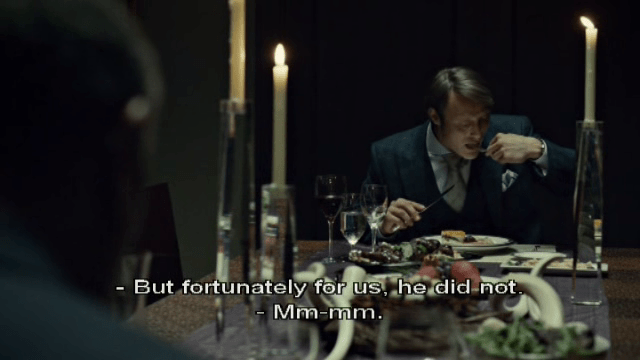
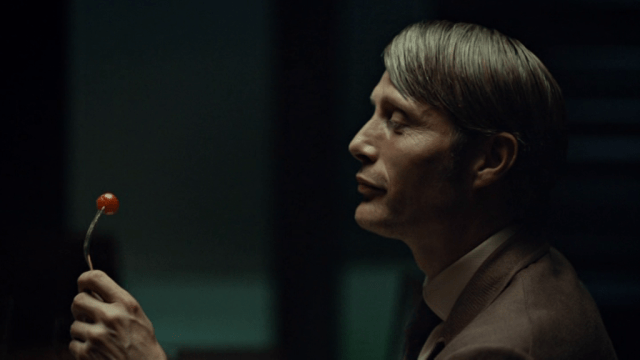
Next scene we see Hannibal entertaining Jack, serving loin with a cumberland sauce of red fruits. Jack asks about the cut of meat (and so do we). “Pork”, says Hannibal, offering us the double entendre (or amuse-bouche) of the night:
Is the pork long pig? Well, maybe, but it turns out it isn’t Freddie – she’ll be back.
Will is now more willingly accepting Hannibal’s psychological analyses. They discuss, doctor to patient, the key concepts of the series: killing, appetite, and power. Will admits to enjoying killing Garrett Jacob Hobbs (which happened in episode 1).
They have broken the taboo. Shooting bad guys is something we watch on TV from a very young age, act out on the playground, but no one is supposed to admit to enjoying it. Enjoying it is unmentionable, but Hannibal won’t leave it alone there. Why do we enjoy killing? And this is the crux of Hannibal’s philosophy and his power: God loves to kill, and we are made in his image. Maybe.
Hannibal may or may not believe in some sort of God – I tend to think he agrees with Nietzsche that God is dead – but he certainly believes in power. Power to satisfy his hunger, without bothering about conventional morality.
That is the journey on which he will take Will for the next 37 episodes (and, dare we hope, Season 4 to come?)
NEXT WEEK: ELI ROTH’S GREEN INFERNO
IF YOU LIKE MY BLOG, PLEASE FEEL FREE TO RECOMMEND IT (WITH DISCRETION) TO FRIENDS ON SOCIAL MEDIA.
IF YOU HAVE ANY QUESTIONS OR COMMENTS, YOU CAN USE THE TAG, OR EMAIL ME ON CANNIBALSTUDIES@GMAIL.COM.
This is going to be a long blog, because Hannibal (three seasons 2013-15) really was one of the best shows on television, and although I am only covering the first episode here (out of 39 made), this was the pilot and introduced most of the main characters and themes of the whole “Hanniverse.”
The cancellation of the show after three seasons was apparently due to insufficient ratings. The surveys used to determine such decisions consider total numbers of viewers, but not the fervour of the viewing. Judging by the comments on social media (and some very weird stuff on Tumblr), the fans of Hannibal were fervent and avid (Francis Dolarhyde, the “Red Dragon”, who appears in Season 3, was of course the first to call himself an “avid fan” of Hannibal Lecter). It has since become a cult series, and far more people have seen it on DVD or streaming services than ever watched it on network television.
Episodic TV when it began was usually static: the main character, whether cop, lawyer or doctor, tended to be the same at the end of the episode, the antagonist dead or defeated. You could pretty much watch any episode in any order. Such was television before video and streaming: if you missed an episode or came in late, it was important that you could quickly work out what was happening, because there was no way to pause or go back. Streaming has opened this up, to the point where now protagonist can change, learn, grow and even die (think Breaking Bad, or Game of Thrones). Hannibal is all about growth. And death.
Hannibal Lecter (Mads Mikkelsen), the famous psychiatrist and infamous cannibal, is an avid fan of growth, evolution and death. Yet the chief protagonist of the series is ostensibly Will Graham (Hugh Dancy), who lectures to FBI rookies, and can recreate mental pictures of the murders being investigated. The first episode starts with a gory crime scene (there is some speculation that Francis Dolarhyde, who does not appear until Season 3, may have committed this particular crime). Will stands and watches the police as they take pictures and collect evidence, then closes his eyes. The heartbeat starts, and then the swinging pendulum, that will become familiar as the series progresses; these props allow him to recreate the murders in his mind, with himself in the disturbing role of perp. He looks for patterns that will help him put a motive and a face to the killer. Each step of each murder is accompanied by his mantra: “this is my design”.
Lecturing his students at the FBI academy, Will tells them: “Everyone has thought about killing someone, one way or another”. At the end of the lecture, Jack Crawford, (Laurence Fishburne), head of Behavioral Sciences at the FBI, asks him where he sits “on the spectrum”. Looking away, Will tells him:
“My horse is hitched to a post that is closer to Asperger’s and autistic than narcissist and sociopath”.
Will lives in Wolf Trap, Virginia, and rescues and adopts a multitude of stray dogs (People for the Ethical Treatment of Animals is also headquartered in Virginia, making it a very animal-friendly place). Will’s talent is empathy, and the imagination to see into the thoughts of others, even those whose dark secrets most of us would rather avoid.
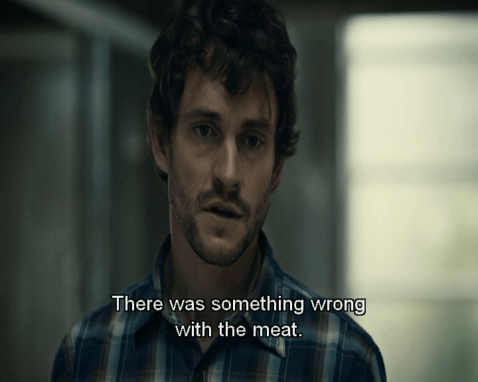
This imagination is what Jack Crawford needs. Eight young women have disappeared, but no bodies have been found. When they find the eighth victim, whom Will discovers has been returned to the bed where she was killed, they discover that her liver has been removed, and then replaced. Why would the killer put it back in? The crime scene investigators Beverly Katz (Hettienne Park), Jimmy Price (Scott Thompson) and Brian Zeller (Aaron Abrams) are baffled. Like a Greek chorus, they explicate each mystery, and lay it out for Will to solve.
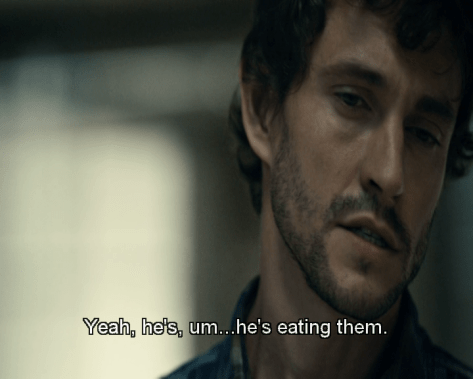
Just so, Will figures this one out: they are looking for a cannibal.
Hannibal Lecter, after whom the series is named, does not even make an appearance until 21 minutes into the first episode. This is the horror genre, so his introduction involves a close-up of his face, which “emphasize(s) its shadows to the point of engulfing it in pitiless darkness” (Deleuze & Guattari, A Thousand Plateaus). Pity, we will discover, is not one of Hannibal’s attributes. He appears to the music of Bach: the Aria from the Goldberg Variations, the music that Anthony Hopkin’s Hannibal requested in Silence of the Lambs, the music that he was playing as he killed and flayed the guards during his escape.
This new Hannibal is enjoying an exquisitely prepared meal of liver, certainly not a diseased one. He is then shown at work, wearing a perfectly fitted blue three-piece suit, analysing a neurotic patient, and annoyed by the blubbering of this patient, and particularly the snotty tissue he leaves on Hannibal’s perfect side-table. At the end of the session, he is visited by Jack Crawford, who admires his drawings, and compliments him on his academic work. He wants Hannibal to help with the investigation. Hannibal agrees, but it’s a whimsical project (and as Clarice Starling says in the book Hannibal, it’s whimsy that gets him caught). He plays with them – a game of hidden identity .
Hannibal is the Renaissance man in all aspects – educated, elegant, tasteful. Crawford wants his help with the case, but his brief really is to evaluate Will’s mental stability.
Will soon realises what is going on: “Jack, whose profile is he working on?” Hannibal is analysing Will. Keeping track of his potential issues. He will use this information later in the season.
A ninth victim is found in a field, impaled on stag-horns. Velvet from such antlers was found in the wounds of number eight, but possibly was put there as a healing agent, an apology. The police and the gutter press (the gossip paper is now called TattleCrime) start calling the killer the “Minnesota Shrike”, named after a bird that spears its prey on sharp objects and then carries off the flesh for later consumption. Will immediately realises that this is not the work of the same killer.
This slideshow requires JavaScript.
The team finds that the victim’s lungs have been removed. In the next scene, Hannibal is preparing, flaming and enjoying a healthy dinner of lungs.
It’s time for Will and Hannibal to go do some FBI investigating (no Supreme Court jokes, please). You may remember that in Bram Stoker’s book, Dracula could never enter a house unless he had been invited. Well, if you don’t remember that, I think Bryan Fuller certainly did:
Hannibal takes an immediate interest in Will. Later in the series, we will see this develop into something resembling love, but let’s not get ahead of ourselves. At this stage, Hannibal sees a kindred spirit and wants Will to grow – he wants to (re)create Will in his own image. For Season 1, only we, the audience, know that the image he wants to recreate is that of a serial killer and cannibal. A man of such superior taste and discernment that eating humans is of no more consequence to him than eating a pig. A ‘super-man’, what Nietzsche called an “Übermensch”. He sees that potential in Will:
The teacup will become a very important plot point later in the show. Hannibal accepts Nietzsche’s “amor fati” (the love of fate) and so is a fatalist, but he also watches Stephen Hawking’s videos and hopes that, if the universe reverses its expansion and time begins to flow backwards, his sister will be resurrected. More on that in a later blog.
Very few characters in Hannibal or the books or films previous to this series refer to Lecter as anything other than “a monster”. Monsters are supposed to scare us, fill us with dread of the “other” who plans to ambush and devour us alive. The genre owes much of its success to our evolution from the tiny, prototype mammals who lived, hundreds of millions of years ago, in terror of the dominant reptiles. We can go back further; most animals will feel fear when faced with a predator. Fear is a biological necessity, a warning; fear keeps us alive. Monsters are grotesque, horrifying, easily identified. Frankenstein’s creature, Dracula, the Wolfman – these are what monsters should look like.
But Hannibal is not such a monster. He is a well-respected psychiatrist, a snappy dresser, a renaissance man who loves art, classical music and rare wines. He is also a sophisticated gourmet cook, albeit with a slightly wider range of meats than your average chef. But here’s the main thing about Hannibal – we like him. It’s difficult to like Dracula, or the Wolfman, or the Walking Dead. But it’s hard to dislike Hannibal, and his evident pleasure in his meals only makes us appreciate his skill the more, even as we realise what he’s cooking. He accepts the consequences of his decisions: Hannibal has staged the copycat crime as a mirror image that will lead Will to the killer, and ensure that Will will have to use lethal force, the trauma of which will change him. Change, growth, death. But the serial killer, Garrett Jacob Hobbs, has killed all those girls because he doesn’t have the heart to kill his daughter, for whom he has incestuous feelings (the other taboo that Freud used to lecture us about).
When Hannibal warns Hobbs that the FBI “know”, Hobbs kills his wife and slits his daughter’s throat, forcing Will to shoot him. Hobbs’ final words to Will are “You see?” Will sees: he sees death, he sees change, he sees the thrill of the chase and of the kill.
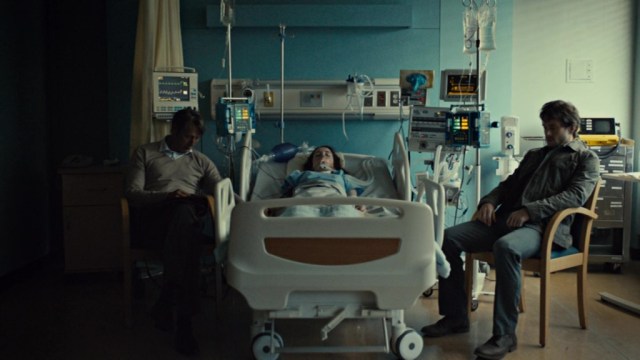
The daughter, Abigail (Kacey Rohl), has been orphaned and almost killed by Hannibal’s ploy. She is collateral damage in Hannibal’s design. Hannibal rarely admits to regret, but he still can take responsibility for this girl, for reasons that will become a little clearer later when he addresses the death of his sister. Will finds Hannibal in Abigail’s hospital room asleep, head bent sideways, clothes crumpled, the devoted parental figure guarding the child.
The character Victor Frankenstein in Mary Shelley’s Frankenstein was terrified by his creation. Similarly, in the foreword to the book upon which the Hannibal series is based, Red Dragon, Thomas Harris considered Hannibal a monster, and was also terrified by him. He described “meeting” his characters as he wrote them:
“I am invisible to my characters when I’m in a room with them and they are deciding their fates with little or no help from me…. Graham and I went on to the Violent Ward and the steel door slammed shut behind us with a terrific noise. Will Graham and I, approaching Dr Lecter’s cell. Graham was tense and I could smell fear on him. I thought Dr Lecter was asleep and I jumped when he recognised Will Graham by scent without opening his eyes. I was enjoying my usual immunity while working, my invisibility to Chilton and Graham and the staff, but I was not comfortable in the presence of Dr Lecter, not sure at all the doctor could not see me.”
Luckily for us, unlike Dr Frankenstein, Harris did not abandon Hannibal to his own devices but gave him brilliance, taste and opportunity. And a massive superiority complex.
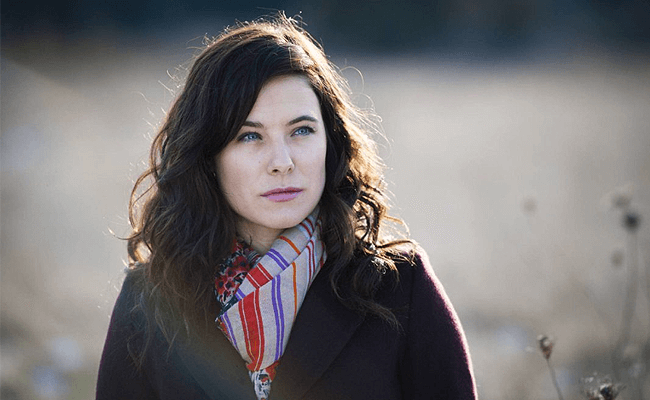
Bryan Fuller, the showrunner, reimagined some of the plot and many of the characters. Jack Crawford is now black, Alan Bloom is now Alana Bloom (Caroline Dhavernas) and is a kind of love interest for Will, the journalist Freddy Lounds is now Fredricka “Freddie” Lounds (Lara Jean Chorostecki). Many of the other characters we knew from the books and movies will be reinvented in later episodes with different skin colour, sex or other characteristics.
Hannibal Lecter himself is quite different, and not just because he is now played by a Danish rather than Welsh actor. Hannibal actually grew more complex and nuanced in each textual rendition of the previous stories. In the book Red Dragon, he was called a psychopath, and Will reported that he had tortured animals as a child, which is a very common marker of that affliction. But by Hannibal Rising, the prequel book and film that explained Hannibal’s history, he is a deeply traumatised child who has witnessed (and perhaps indulged in) the cannibalism of his baby sister. However, his cruel responses are never to non-human animals and never to weaker children – Hannibal picks on the bullies at his orphanage, and his first murder is a vulgar and uncouth butcher who insults his aunt. From that time, he prefers to eat the rude – “free range rude” as he calls them. In the films (most of them) Anthony Hopkins played Hannibal as brilliant but twisted, the crazed jester.
Mads Mikkelsen prefers his Hannibal to be a fallen angel – the devil himself, first diagnosed by a gypsy in the book Hannibal, but brought to full rendition by Bryan Fuller, Mads and the production crew. Director of Photography James Hawkinson explained how this effect was achieved from this first episode, where Hannibal emerges from the chiaroscuro effects that are so prominent in the show:
“He’s basically Satan hiding in plain sight. He’s right there in front of everybody, but no one is able to see him for what he really is. We determined that he should always be shrouded in a certain amount of darkness because of that.”
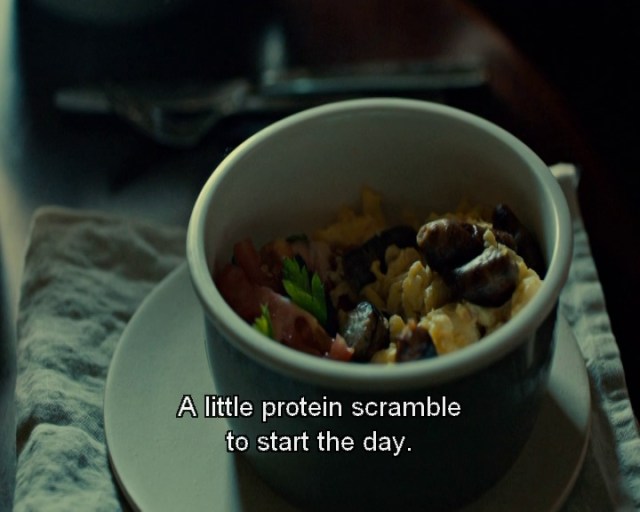
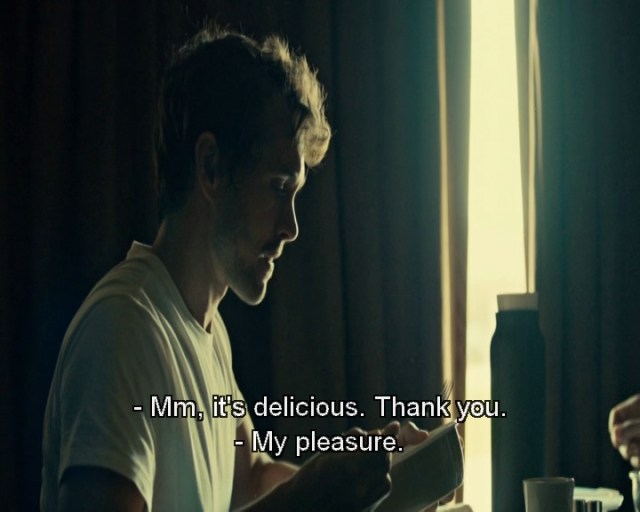
The use of darkness continues through the whole series. Consider the scene in Will’s motel room, where Hannibal brings Will a breakfast of sausages and almost certainly turns him into an ‘innocent’ cannibal with their first shared meal. What’s in those sausages? What’s really in any sausage?
Hannibal brings the darkness into the lives of the other characters as he instructs, feeds or kills them. Hannibal has reversed the Frankenstein story: the talented doctor is now the killer, creating serial killers, super-men and women in his own image. Far from running away from his creations, he devises convoluted ordeals to forge their new personas.
Satan, if he walked among us, would no doubt ensure he was rich, brilliant, and a connoisseur of all the good things of life, those things that the rules of religious humility would disdain. He would also be incredibly powerful. He would be a super-man, an Übermensch. I’ll get to Nietzsche when we arrive at Season 2. That may be a while. Super-men, like psychopaths, are very hard to catch.
If you like my blog, please feel free to recommend it (with discretion) to friends on social media.
If you have any questions or comments, you can use the tag, or email me on cannibalstudies@gmail.com.
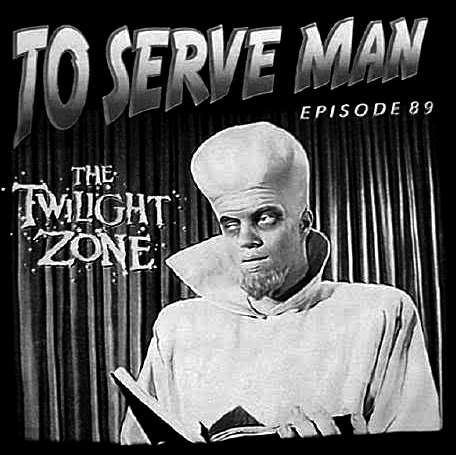
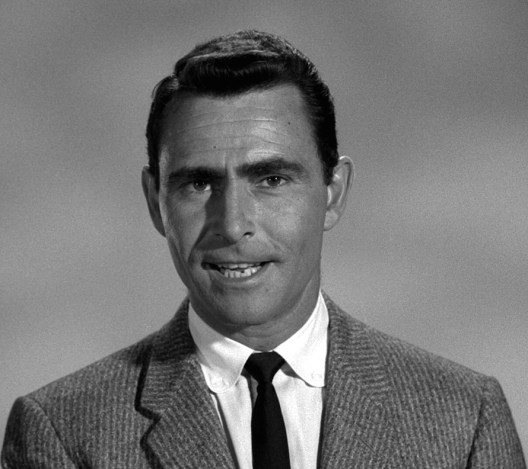
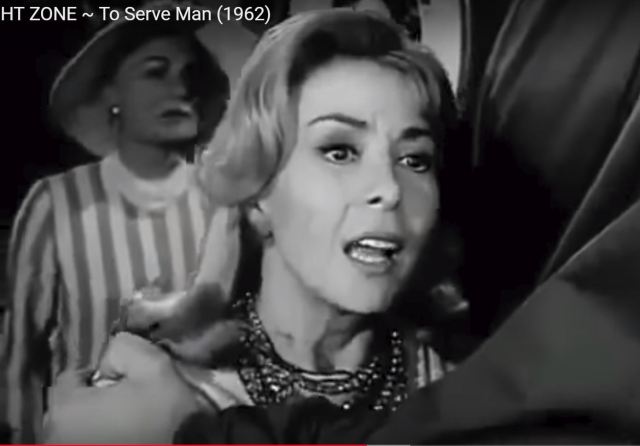
“To Serve Man” was episode 89 of the hugely popular television series Twilight Zone, which ran from 1959-64. This episode is written by Rod Serling who introduced each episode, and is based on a 1950 short story by a science-fiction master, Damon Knight. The television episode moves the action to its own time, where it introduces 1960s politics: the Berlin blockade and the wars in Algeria and Indo-China.
In contrast to all this conflict and confrontation comes a stunning discovery: alien spaceships are landing near cities all over the world. The Secretary-General of the UN, (played by Hardie Albright – fun fact: one of the voices of Bambi), announces that one of the spacecraft has landed near the UN building, and one of the aliens is on his way to the UN to address the people of Earth. The aliens are called Kanamits, and Serling tells us about them:
“Respectfully submitted for your perusal – a Kanamit. Height: a little over nine feet. Weight: in the neighbourhood of three hundred and fifty pounds. Origin: unknown. Motives? Therein hangs the tale, for in just a moment, we’re going to ask you to shake hands, figuratively, with a Christopher Columbus from another galaxy and another time. This is the Twilight Zone.”
Now, Columbus created much havoc in South America, where he coined the term “cannibal”, a mis-hearing of the name of the Carib tribe, and a misunderstanding of their eating habits. But this lot, the Kanamits, seem like good guys. The 3m dude says (without moving his lips – it’s all done by telepathy):
“Our intentions are honourable. We desire above all things to help the people of Earth.”
The narration points out how unlikely this seemed: “as a race, we’re unaccustomed to charity. Brutality is a far more universal language to us.”
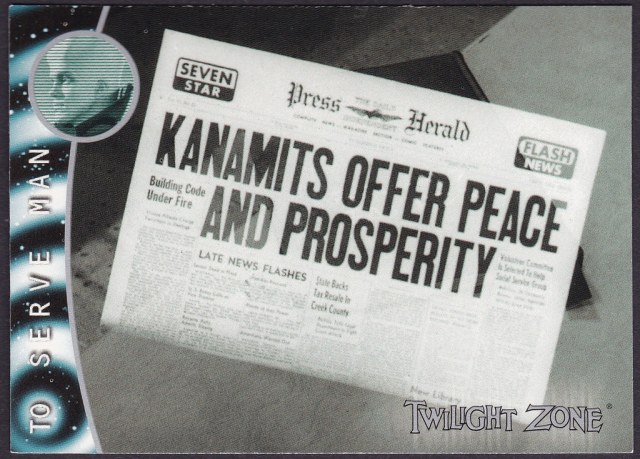
They offer things normally only seen in science fiction or election manifestos – a power source which can supply a whole country for the cost of a few dollars. A cheap nitrate, which can be added to the soil to end famine for good. An impenetrable force field, which nations can use as a defensive shield. “It was the age of Santa Claus”.
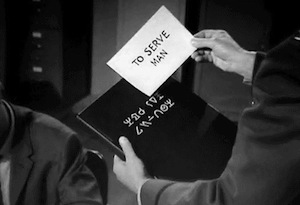
Michael Chambers (Lloyd Bochner), a cryptography expert, is asked by the military to translate the book the Kanamits have left on the table of the UN (why would they do that?) Anyway, it’s a very different language from a different galaxy, so he and his team have no idea where to start. Also, he thinks that maybe the military are “looking a gift horse in the mouth”, worried that with the alien imposed peace and prosperity, the armed forces will be out of a job. Then his assistant, Patty (Susan Cummings), bursts in with the news that they have deciphered the title of the book. It is: “TO SERVE MAN”. Chambers calls this “a reasonably altruistic phrase”, although the others are more cautious. But the deserts bloom, armies are mothballed, and thousands of earthlings are invited to board the spaceships and visit the Kanamit home planet. As the guests embark, a smiling Kanamit weighs each person.
Patty is still working on the book, but explains that the capital letters on the title she translated are different to the lower case letters in the book. THIS is what’s holding them up? Anyway, as Chambers starts to board, Patty arrives, having broken the code. She shouts the famous line to him:
“To serve man: it’s a cookbook!”
She has proved that paraprosdokians somehow work fine in any language, even transgalactically.
Confined on board, Chambers turns to the camera, breaking the fourth wall, which was pretty revolutionary in those days. He asks us:
“How about you? You still on earth, or on the ship with me? It doesn’t make very much difference, because sooner or later we’ll all of us be on the menu. All of us.”
Rod Serling sums up in a more profound explication:
“Simply stated, the evolution of man. The cycle of going from dust to dessert. The metamorphosis from being the ruler of a planet, to the ingredient in someone’s soup.”
There’s the rub. We love to think of ourselves as the “alpha predator” (except when we are surrounded by sharks or crocodiles). But what if we weren’t? What if someone else saw us the way we see animals like cows, pigs, sheep and chickens? Is the fear of cannibalism just the fear of being eaten by humans, or also the fear that civilised people (regardless of galaxy) can be just as fierce and brutal as nature, red in tooth and claw? Aliens eating us can be just as disturbing as cannibals, particularly when they look like us, such as in Under The Skin (Glazer, 2013).
When Hannibal Lecter decides some of us are rude and can only be improved by cooking, are his feelings of superiority different to the Kanamit? To eat a human or any other animal requires objectification: turning an individual into a commodity. We do it to our prey. The Kanamits do it to theirs. Are they wrong? Are we?
The full episode is on Youtube:
If you like my blog, please feel free to recommend it (with discretion) to friends on social media.
If you have any questions or comments, you can use the tag, or email me on cannibalstudies@gmail.com.
OK, last week’s cannibal film blog, Dahmer, was a bit grim (even if we didn’t see anyone eat anyone, for a change), so this week something witty and clever, and with lots of people-eating.
I’ve watched 20 episodes now of the Netflix series Santa Clarita Diet, and I’m still wondering: is this even a cannibalism show? Without risking too many spoilers, the protagonist, Sheila (the wonderful Drew Barrymore) is undead, what we sometimes (but never in this show) call a “zombie”. But she’s not the type that shuffles about, rotting bits falling off of her (well, maybe a few) and drooling for brains. She is sweet, witty, strong, loving and over-sexed. And dead. Sorry, undead.
She just seems so human. Presently human, not just formerly, decrepit, rotting human. I guess there’s room in cannibal studies for the undead human people-eater?
Sheila and husband Joel (Timothy Olyphant) are realtors, living the perfect suburban life-style in sunny Santa Clarita, Los Angeles County. The American Dream becomes more dream-like when Sheila is showing a house to a prospective buyer, but ruins the sale by expelling copious amounts (we’re talking gallons) of vomit on the perfect bedroom carpet, together with a small object that might be her life force or soul or something (later it grows legs, so maybe not a soul). She realises that night that, while she is feeling just fine and dandy, she no longer has a pulse.
And then she gets hungry, and it’s a diet that could only be zombie, or perhaps broadminded paleo. No carbs, just meat. And only one species will do. But, like Hannibal, she will only eat bad people – rude, abusive, Nazis, etc. Can they find a cure? Does Sheila want to?
Don’t you want to be cured?
Of course I do. Although, I do like the way I feel. I have endless energy, and I sleep two hours a night. I get so much done.
You eat people!
I know, it’s just that I’m so much more confident now. And our sex is incredible… And I can parallel park in one move now.
The dialogue is sparkling and very funny. I can imagine the hilarity in the writers’ room when they were putting all this together. Lines like:
We have to kill someone who won’t be missed. Someone without a family. And someone bad, who deserves it… the prototype would be a young, single Hitler.
I’m feeling a little low energy. Maybe I need to eat people with more iron in their diet.
She gets this look in her eye. The next thing you know, she’s yanking intestines out of these guys, like a magician pulling out scarves! The other day I came home and my kitchen looked like someone shot a person out of a confetti gun. There was a dick in my fruit bowl. The next morning I’m eating oatmeal at the same counter like my life is Leave it to Fucking Beaver!
Here’s the thing: it’s very funny, and the characters are sympathetic and honest. Barrymore and Oliphant are brilliant, and so is their daughter, Abby (Liv Hewson) and her friend Eric (Skyler Gisondo), the nerd next door who understands both the science and the occult aspects of the problem.
I’m asking because last night you saw your mom and dad scrape a half-eaten dead guy into a grave.
Please. I once walked in on my grandparents changing in a cabana. That was intense.
Yes, lots of gore (also vomit in episode 1) but in so much surfeit that it is cheerfully fake. The manicured lawns and perfect houses feel even faker – this is the Stepford Wives gone feral. The neighbours suspect nothing, even when Sheila eats one of them.
If you’re wondering how cannibal movies prepare the flesh, the special effects designer said in an interview:
Drew Barrymore is essentially a vegetarian, so a lot of the methods that we might have used traditionally — sushi, tuna coated with fake blood or ground meat or turkey meat or anything like that — was an absolute no. So we had to find other resources. One of the resources that we went to was gummy bears.
And this is the heart of the Santa Clarita Diet. For one thing, it celebrates the resurgence of the monstrous feminine cannibal. From Sheila, to Justine in Raw, and Melanie in The Girl With All The Gifts, and even the Cannibal Women of the Avocado Jungle of Death, we see women cannibals emerge from their niches in myth and fairy tale to stand their ground, glorying in their power. Sheila says she hunts when she feels “a tingle in her vagina” and tells Joel all about the orgasm she enjoyed while eating a human liver.
She so did not eat this heart sandwich. It’s a strictly no-carb diet
It’s also a biting commentary on the stories we tell about appetite and about power. Sheila believes she is a good person, who is strong enough to hunt anyone she chooses, and to eat whatever or whoever she feels she needs or wants. And isn’t that the story of every carnivore?
The only things I believe in enough to crochet on a pillow are “I’m winging it” and “all races taste the same.”
IF YOU LIKE MY BLOG, PLEASE FEEL FREE TO RECOMMEND IT (WITH DISCRETION) TO FRIENDS ON SOCIAL MEDIA.
IF YOU HAVE ANY QUESTIONS OR COMMENTS, YOU CAN USE THE TAG, OR EMAIL ME ON CANNIBALSTUDIES@GMAIL.COM.
Rakewas a television series which first aired on the ABC (Australian Broadcasting Commission for those of you in other parts of the world) in 2010. It ran for four seasons, which is pretty impressive, although Australian series are generally much shorter than those from the US – each season was only eight episodes, making 32 episodes in total, not much longer than season 3 of Lucifer (24 episodes).
Richard Roxburgh is superb as Cleaver Greene, a brilliant Sydney barrister who is always in trouble due to his predilection for the good life. A Sydney Morning Herald reviewer said of the show “Cleaver Greene is a magnificent comic creation, but you wouldn’t want him staying in your place too long.” Incidentally, the Americans had a go at making a version of it with Greg Kinnear as the “rake” but, without the laconic Aussie humour, it only lasted one season (of 13 episodes mind you).
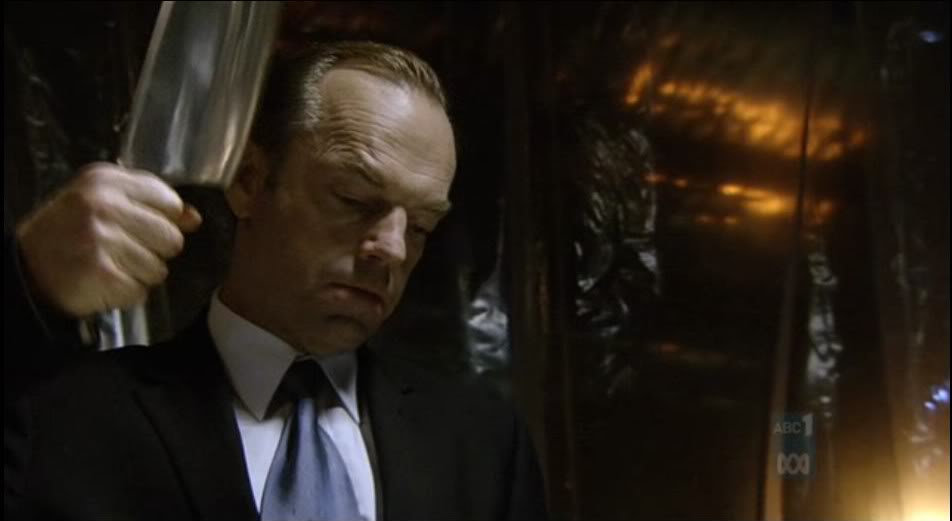
Season 1 Episode 1 starts with a bang – the guest star is the superb Hugo Weaving (Elrond for Tolkien fans) who is a prominent economist with a habit that gets him into trouble: he is a cannibal. Turns out that he advertised for someone who wanted to be eaten (I’m not making this up – there are enough people out there who like this idea that the psychologists have coined a word, vorarephilia, which the enthusiasts have shortened to “vore”).
Like all truly unbelievable plots, this one is based on a true story. Armin Meiwes, a German computer technician, advertised on a fetish website called The Cannibal Café (not to be confused with the popular Vancouver restaurant) for “a well-built 18 to 30-year-old to be slaughtered and then consumed”. He actually received a heap of replies, but the only one that seemed sincere was Jürgen Brandes. The two met in 2001, Brandes took a lot of sleeping pills and half a bottle of schnapps, and they collaboratively sliced off Brandes’ penis and tried, unsuccessfully, to eat it with salt, pepper, wine, and garlic (it ended up in the dog’s bowl. Hope the dog was OK – garlic can be poison for them). Brandes went off to die in the bath while Meiwes read a Star Trek novel (well, he showed some good taste there) and, when he found Brandes still alive hours later, killed him and proceeded to eat quite a lot of him over the coming weeks and months.
Meiwes and Brandes
Rake doesn’t have that sort of time to waste (or presumably any Star Trek novels) so they simplified the plot – the defendant’s meal-ticket makes a video of himself taking a lethal dose of drugs, and he is definitely dead when Hugo’s character chops him up to fridge-sized portions. Where life and art meet is that in Germany, and in New South Wales, and pretty much everywhere else in the world, there is no actual law against cannibalism. Meiwes was charged with manslaughter as he had killed Brandes (at his request – a kind of assisted suicide), and was sentenced to eight years. Due to the ensuing publicity, a retrial was ordered and he was convicted of murder, on the grounds that he had talked Brandes into letting him kill him, for his own sexual pleasure.
In Rake, there is no such complication. The dude was dead at dinner time, and the case only becomes a murder trial because there is a State election coming up and the government needs to appear tough on cannibals. However, it is clear that there is no evidence for murder – you cannot really murder dead people. Hugo looks forward to his release, but as Cleaver points out “you ate someone. You’re never going home”.
Cannibalism is seen as so abject, so vile, that there is no chance of the cannibal going home, even when he clearly is not a murderer, and is guilty at worst of defiling a corpse. Yet why is it so? Eating a cow or sheep or pig who clearly wants to live (watch any one of thousands of Youtube abattoir clips) is fine, but eating a person who wanted, longed, to be eaten is grounds for being locked up for life.
“What could be more natural than wanting to consume human flesh? It combines our two most primal instincts into one single act…. you go that one tiny step further and we’re considered vampires, monsters that should be consigned into eternal darkness. It’s the worst sort of hypocrisy.”
Incidentally, Armin Meiwes is still in jail, this time under a life sentence. He now claims to be a vegetarian, and runs the local prison chapter of the Greens Party. I guess eating someone can make you think twice about eating meat.
If you like my blog, please feel free to recommend it (with discretion) to friends on social media.
If you have any questions or comments, you can use the tag, or email me on cannibalstudies@gmail.com.
Stephen Colbert took over the Late Show from David Letterman in September 2015, but really started drawing the big crowds when Donald Trump was elected President a bit over a year later. Colbert skewers Trump nightly on the late-night show (in fairness, a lot of the material seems to write itself), so when Jodie Foster, who played Clarice Starling in Silence of the Lambs, the movie that brought Hannibal Lecter to fame in 1991, appeared as a guest on the Late Showlast December, it made sense that she would appear as a Special Agent. But instead of working for Jack Crawford, hunting serial killers, she is now working for Robert Mueller, hunting the Russian connection to the President.
Here is part the scene they are spoofing, from The Silence of the Lambs.
Go and watch it again. It’s a classic, and has been used hundreds of times in satirical pieces of all sorts. Hannibal is one of the most iconic figures of our time. Representing voracious appetite, a disavowal of the old humanist ideals of the sanctity of human life, a love of the good things of life, and a wicked sense of humour, it’s pretty clear why that might be so.
If you like my blog, please feel free to recommend it (with discretion) to friends on social media.
If you have any questions or comments, you can use the tag or email me on cannibalstudies@gmail.com.
The Simpsons is still one of the smartest and funniest shows on TV, even though it’s now in its 29th season (really!). Every year since 1990 they have brought out the Treehouse of Horror for Halloween, and every year they have tried to exceed the horror, abjection and disgust of all the previous years.
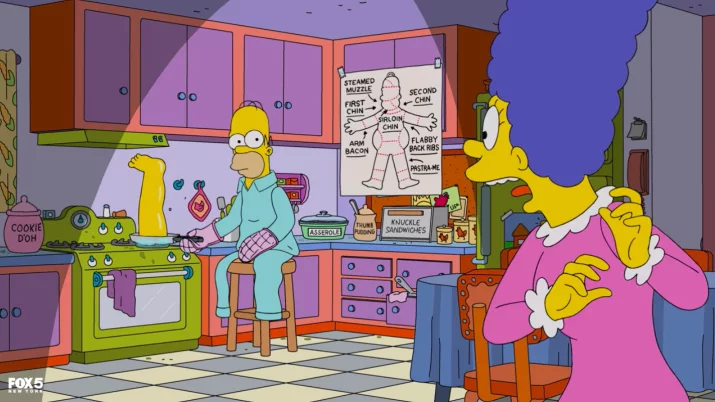
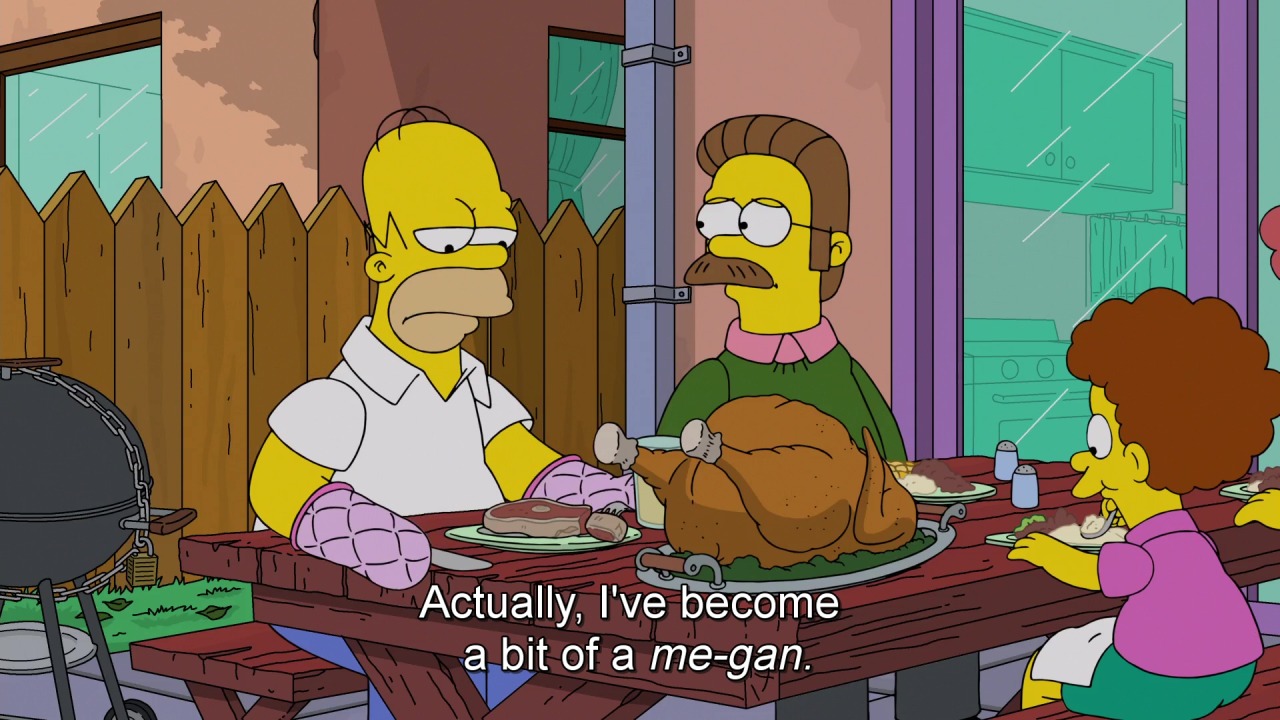
This last one, XXVIII, was regarded by many fans as the ultimate. In a nutshell (it’s awful hard to avoid food puns in a cannibal blog), Homer accidentally slices off his fingers, they fall onto the barbecue, and he finds the taste irresistible. As the family is away, the situation (as always with Homer) escalates. Flanders invites him over for a meal, but he refuses to eat Flanders’ meat, preferring his own:
One of the truly great Simpson puns.
It’s not the first time The Simpsons has approached the subject: in Treehouse of Horrors V, misbehaving students at Springfield Elementary were ground up into meat and served as lunch. But this is fascinating as it is both scrupulously not gory (the slicing is always devoid of any blood or even pain) and yet conceptually manages to deliver the shock value that the producers sought.
































 The Cannibal Guy