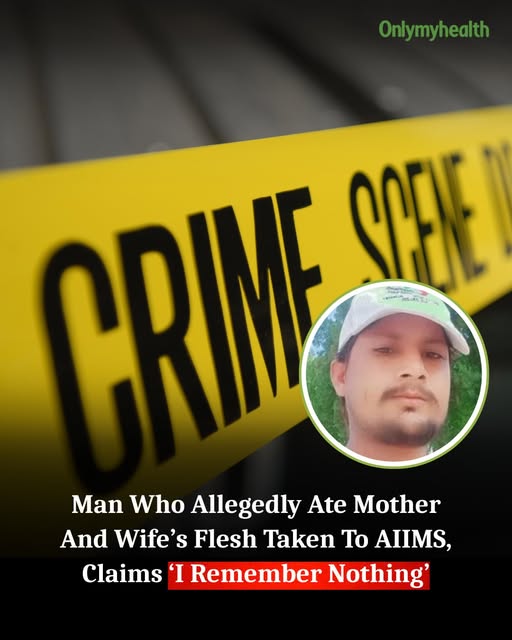
Screams, smashed skulls, flying flesh were not what villagers of an Uttar Pradesh village expected on a quiet Monday morning when a 30-year-old labourer brutally murdered his wife and mother on the rooftop of his house and then chewed flesh from their smashed skulls as his neighbours watched.
A 30-year-old man was arrested on 12 January 2026 in Kushinagar’s Parsa village for the double murder of his mother and wife. The suspect, who has been identified as Sikandar Gupta, had returned to the village about a month previously after working as a labourer in Mumbai. According to police reports, the victims were identified as his wife, Priyanka (28), and his mother, Runa Devi (60). Gupta initially attacked the victims with wooden sticks, and then with cement bricks, causing fatal head injuries to them.
Local residents rushed to the scene as the screams of the women echoed through the neighbourhood. Witnesses reported seeing Gupta mutilate the bodies and consume portions of the remains. When the crowd attempted to stop him, Gupta began throwing pieces of debris and human flesh at them, which caused widespread panic until the Ahirauli police arrived to detain him.
Kushinagar Superintendent of Police, Keshav Mishra, said that,
“a case of double murder was registered, and police are also examining the accused’s mental condition as part of the investigation.”
Neighbours informed police that Gupta had a history of substance abuse involving alcohol and cannabis and was known for frequent domestic disputes. The accused remains in custody pending a formal psychiatric evaluation to determine if he is fit to stand trial or if the murders were the result of a total psychological collapse.
Gupta has been admitted to the Psychiatry Department at AIIMS (All India Institutes of Medical Sciences) under police custody. According to reports, Gupta is speaking incoherently, at times claiming he was drunk during the incident and at other times saying he does not remember anything at all. Doctors have sedated him due to aggressive behaviour and are closely monitoring his condition.
Experts suggest the violence points to deep-seated psychological issues. Dr. PK Khattri, a senior clinical psychologist in Lucknow, said that Gupta’s agitated and non-communicative behaviour “points toward a severe psychotic break” that led to cannibalism.
As Dr Watson used to say, “No shit, Sherlock!”
Ashok Srivastava, an independent criminologist and an associate of the National Forensic Sciences University (NFSU), said that such extreme acts often stem from a
“desire for total domination”
He added that this type of behaviour represents an “ultimate expression of control, often triggered by internal frustrations or extreme psychopathology.”
Which could be said of human societies generally. From bullying in school to sexual abuse to war atrocities to the commercially pressured obsession with eating the flesh of other animals, appetites are driven by this “desire for total domination”, of territory, of food, and of the bodies of others. Anthropocentrism, sometimes called speciesism, is maintained by the practice of killing other animals in ever increasing numbers, to prove our superiority and deny our own animality and mortality. The French philosopher Jacques Derrida called that “carnivorous virility”, the sacrificial slaughter and consumption of “inferior” animals by the rational, patriarchal civilised meat-eater.
What happens when the lust to dominate or kill outruns the limits of anthropocentrism and is instead turned back on fellow humans? The biological fact is that humans are animals, and animals are made of meat. When a society reaches a point where the old ethical agreements are disintegrating, it can either forge new ones or dissolve into chaos, war and, yes, cannibalism. The psychopath, such as the one in this case who allegedly started his brutal rampage with domestic violence before turning to murder and flesh eating, seems to understand this better than most ‘sane’ people.
A South Carolina mental health facility is being sued by the family of an alleged victim of a man who has been accused of murdering and cannibalising patients.
A lawsuit filed by the family of 22-year-old Jared Ondrea claims Richland County’s New Hope Home Solutions, facility owner Brittany Reynolds-Jackson and the South Carolina Department of Mental Health (SCDMH) are responsible for his death.
According to documents, Ondrea suffered mental disabilities which led to his placement in 2023 into an assisted living facility, New Hope’s Harper Street facility, which had been recommended to his grandmother by SCDMH. Ondrea was meant to learn independent living and socialization skills there.
Ondrea’s grandmother noticed bruising on his neck and face when she picked him up for a visit in March of that year, but he did not divulge the cause. He also appeared to be “unkempt, his hair was not combed, his clothes were dirty, and his nails were long and dirty,” which seemed odd considering the facility’s undertaking to help him learn independent living skills.
Ondrea was dropped off at the facility later that evening, the last time his family saw him. When his grandfather arrived to pick him up for an appointment two days later, he was not there. The next day, the facility called to let his grandmother know that he had been missing since that night he had been dropped off. Staff was reportedly alerted to his disappearance by another patient who told them they “should be alarmed that Jared was missing.”
That patient was Marc-Anthony Cantrell, who has a violent history, including multiple instances of animal cruelty and arson, allegedly to cover up the torture and killing of his family’s three dogs. He was interviewed during the search for Ondrea and reportedly displayed strange behaviour, which was subsequently reported to law enforcement.
In July, a few months after Ondrea’s disappearance, another resident named Deshea Butler went missing. This time, Cantrell was caught on video removing that victim’s body from the facility. When interviewed, he confessed to the killing and told police that he also killed Ondrea, providing “specific, graphic details as to how the murder was conducted” including that he had strangled both men.
Cantrell reportedly told police that he was compelled by his “alternate personality”, called Robert Baldwin, to kill the victims and consume parts of their bodies “so he could gain their power.” While Ondrea’s body was never found, an autopsy of the second victim was consistent with Cantrell’s description of the killing.
The lawsuit alleges that Cantrell ate both the victims’ ears after killing them and,
…after he had strangled Deshea, he hit him in the head with his lifting weights so he could drink his blood, which he did over several days from a coffee cup.”
A grand jury indicted Cantrell for both killings.
The lawsuit brought by Ondrea’s family blames the facility and SCDMH for allowing what they describe as “a budding serial killer” to be placed in a home with vulnerable adults. Law enforcement and SCDMH were aware of Cantrell’s violent history, and attorneys argue that “SCDMH failed to take any appropriate steps to treat Cantrell or to otherwise prevent the obvious danger that he posed to the public and to those living in close proximity to him.”
The lawsuit also claims New Hope did not have the proper license to be operating as a mental health facility, and “had no business housing mental health patients of any sort — much less ones with the type of violent tendencies displayed by Cantrell.” It also faults staff for failing to notice Ondrea’s disappearance for three days, which was allegedly only brought to their attention after the man accused of murdering him told them they should be concerned.
The defendants are being sued for several claims, including negligence, gross negligence, and wrongful death. The plaintiffs offered to settle with SCDMH for $600,000, but the offer was rejected. A jury trial roster meeting has been scheduled for April 7.
Murder is not unusual in the USA, peaking at 2,000 per month in 2020. Although the rate has decreased a little, murder is still so quotidian that it is rare to see it reported widely in the media. Unless, like this one, it includes cannibalism, which Freud described as one of “the two original prohibitions of mankind” (the other, he thought, was incest). Cantrell believes he had an alternative personality, a wendigo perhaps, who maintained that eating human flesh bestows power. Such a psychotic belief stems from anthropocentrism, the faith in human transcendence, that we are somehow ‘more’ than other animals, so even our flesh must have magical properties. But there is nothing special about us, and no power is imparted by eating human ears, any more than eating a pig’s ear. We are made of red meat, like most mammals, and eating any animal causes appalling suffering, environmental catastrophe and quite often dangerous maladies.
With the release of another Lion King franchise film, Mufasa, this one a prequel to the earlier story, it is perhaps worth considering the subject of talking animals, and particularly whom they feel OK about eating.
The first film was released in 1994, and was a glorious animation, with music by Elton John and Tim Rice, but was clearly a cartoon, one that has earned almost a billion dollars since its release.
Although we can get into the plot and the emotions of the film, we don’t really feel obliged to believe in the anthropomorphic veracity of cartoon characters. Do we really care if a cartoon duck eats other birds? No, not if he wears clothes and speaks (a form of) English. It is clearly a line drawing that moves, and requires no ethical work.
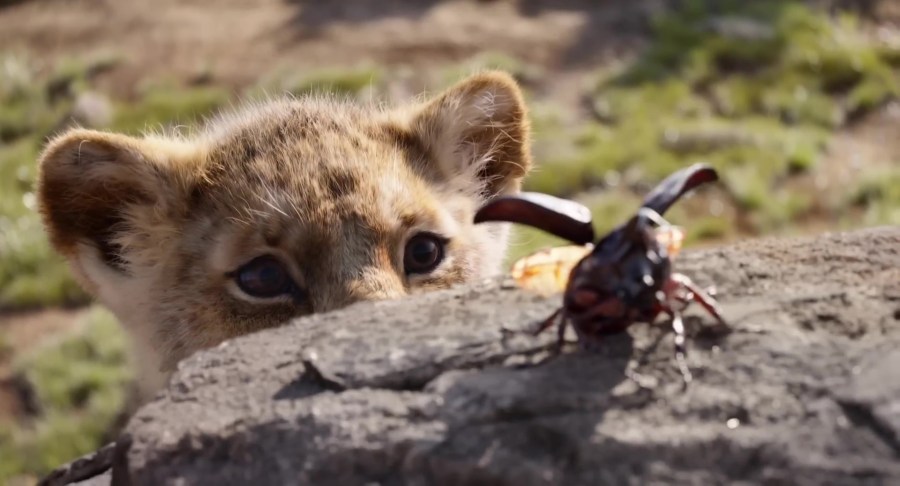
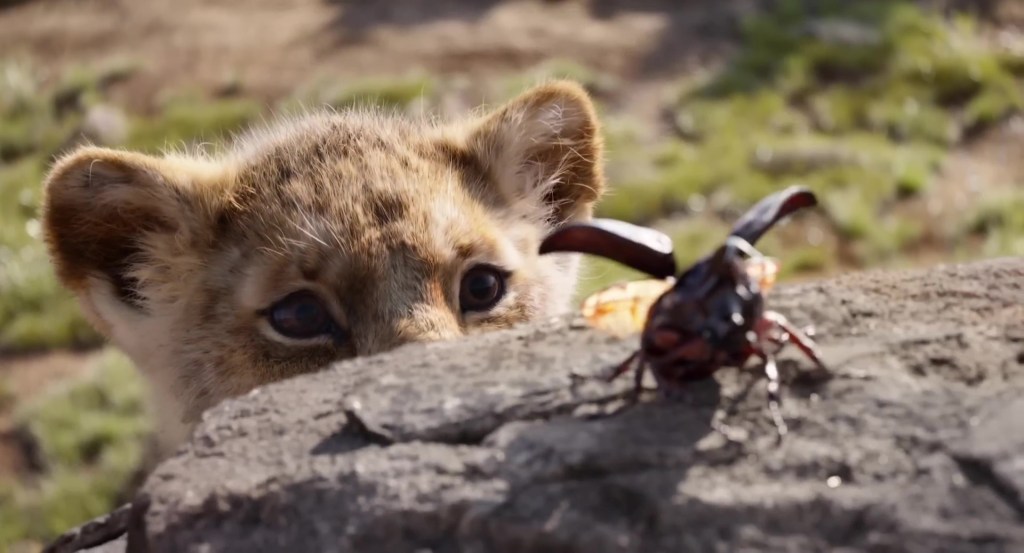
But in 2019, the film was remade as a photorealistic animation. With a small dose of suspension of disbelief, the animals looked like they were real, roared like lions, but somehow spoke English, some of them, strangely, with an eastern European accent. It was a sensation, so far earning over 1.6 billion dollars.
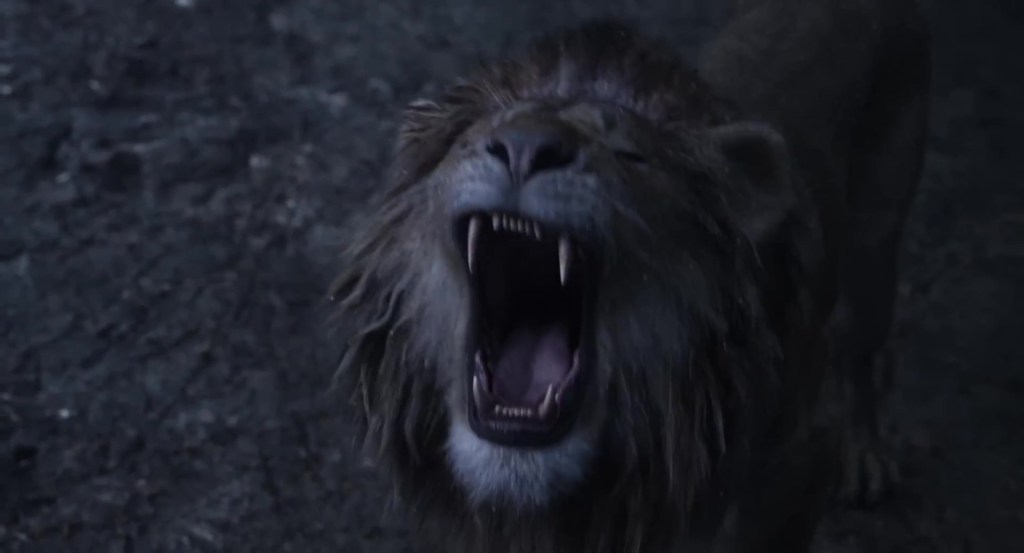
This blog will appear around Christmas, so I guess it is not unreasonable to unleash my inner Grinch, at least when it comes to anthropomorphic representations of carnivorous virility. As far as we are aware, lions can’t talk, except in movies. They can certainly communicate though, and that communication, particularly the roar that can be heard miles away, is featured prominently in all versions of the Lion King.
If they could talk, would they say and do the things shown in the film? Would they, for example, let a mandrill take their cub and hold him, Michael Jackson-like, over a cliff for the other animals to worship and celebrate? I’m even less sure of how celebratory the prey animals would be about the birth of yet another predator, no matter how cute.
But the main thing that bothered me throughout the film was the food, and it wasn’t (just) because I watched it at lunchtime. We are shown a happy monarchy (the “pride land”) where the devoted subjects are summarily executed and eaten by the king and his family. This is later turned into a blasted desert filled with the bones of the prey animals by a usurper king lion, an evil uncle lifted from Hamlet and made leonine.
Those not privileged to live in the pride-land inhabit a shadow terrain, the “elephants’ graveyard”, where (dark-skinned) hyenas skulk, with little evidence of anything to eat and, we are assured, always hungry. We have the “circle of life” followed by a circle of hell.
Even further away, in a wildness to which the exiled lion cub Simba flees from his evil and murderous uncle, we have a sort of Garden of Eden II. Here, mammals take a pledge not to eat each other, an expanded ring of utopian privilege, which excludes only insects and their pupal forms, who clearly would have to exist in immense numbers to feed a growing lion, let alone his friends.
Listen kid: if you live with us, you’re gonna have to eat like us. This looks like a good spot to rustle up some grub. A grub. What’s it look like? Tastes like chicken.
What is the ecology here, and the ethic behind the food choices?
Simba, the cub and heir apparent, wonders about this too. He and his future wife (lions get married?) are the only ones to connect with all these environments, and Simba the only one to question the implicit ethos of each one. Early in the piece, as he surveys the kingdom where “the light touches” (as opposed to the darkness of the hyena shadowlands), he asks his father why they eat their loyal subjects, the zebras, antelopes and presumably anyone else slower than them. It’s a question most parents dread as they feed lumps of animal flesh to their children, and then read them books about happy animals. It’s the circle of life, says Simba’s Dad, clearing his throat for us all to join a singalong. We eat them, then when we die, our bodies feed the grass, and future victims eat the grass.
Now this is just absurd. I’m not sure how much grass the average antelope eats, but it would need an awful lot of dead lions buried underneath it to make it fecund. Photosynthesis, which combines carbon dioxide and water into carbohydrate and oxygen, is what makes the grass grow. Lion corpses (and presumably lion shit, now enriched with zebra fat) might add some trace elements, but they are hardly necessary. What lions actually do for the environment is thin out the number of herbivores so that they don’t eat all the vegetation and turn the area into desert, which is what inexplicably happens when the bad lion, Scar, and his army of hyenas, eat all the herbivores. Where does all the grass go? It should be a jungle without all those antelopes and giraffes.
Then we have the entemo-vegetarians of the land beyond the shadows where, you know, hakuna matata, there are no worries, unless of course you are an insect. If you search the internet, you will find learned articles on how many hours a day a lion would need to be chewing pupae (it’s a lot more than 24) in order to sustain his life, let alone progress from cub through puberty to full sized adult male. And why can the various mammals and birds talk, but the insects can’t? Jiminy Cricket could talk in the early days of Disney – when did he fall out of the circle of privilege?
It’s all absurd, of course, but it’s what we teach kids, and not just by taking them to see Lion King. When they ask questions like “I love animals, so why are we eating them?” talk of feeding grass with our bones doesn’t cut it, which is probably why so many young people go vegan. The correct answer, which won’t satisfy anyone, is “because we want to, and because we can”. We have the appetite, and we have the power. We arbitrarily decide who is within our circle of privilege.
In the film, lions and all mammals, and some other odd creatures, live without being eaten in a hippie paradise. In the pride-land, under good king Mustafa (Simba’s dad) certain animals are part of the elite and don’t get eaten, while the anonymous proletariat animals seemingly go willingly to their just deserts (or desserts). Contrast this with the hyena shadow land, where, according to a Disney comic book, the hyenas enthusiastically engage in cannibalism, as well as presumably eating the dead elephants who come to the elephant graveyard to die (which, BTW, elephants don’t really do). The human circle of life is less well defined, depending on the culture: in the West, humans consider chickens, pigs and cows outside the elite of the inedible, while dogs, cats and dolphins are inside, and we express moral outrage when these capricious lines are crossed. In other parts of the world, dogs and cats may be delicacies, or cows or pigs may be forbidden. And this blog has brought you many films in which humans are the preferred repast.
Animal activists are often accused of anthropocentrism, having the nerve, for example, to suggest that fish feel pain or dogs feel love. But truly toxic anthropomorphism appears in narratives of talking animals, where we offer temporary anthropomorphic capacities to other species, so that we can push ideological or commercial messages like a “circle of life” to an audience of minors, while pleading disingenuously that these are just cartoons. This cartoon lies to kids about the nature of nature, to promote the acceptability of carnivorous virility.
We don’t do our society any favours by lying to our kids. Lions don’t think about dying or the benefits their carcasses will bestow on the grass. They hunt because they are obligate predators and will starve otherwise, regardless of the available insect population. Humans, on the other hand, are closer to hyenas – scavengers who are never satiated. We don’t keep herbivore numbers in check by eating them; the opposite is the case – we deliberately breed them by the billions, often in appalling conditions, then slaughter them, in terror and agony, in industrial killing centres, polluting the land, degrading the water and filling the air with methane.
It’s not clear if Simba will impose insectivarianism on his kingdom after the credits roll – he may have to, insofar as the flocks seem to have been decimated. But Simba, if he really could talk, would be appalled by the way humans cynically misappropriate the role of predator in order to feed our insatiable appetites. I think perhaps even the hyenas would agree with him.
Cannibalism is defined by our good friends at Wikipedia as:
“the act of consuming another individual of the same species as food.”
Most dictionaries like to put “human” in there somewhere, but that is just another manifestation of anthropocentrism, a species-wide narcissism that believes everything is just about us. The same ideology also insists that human flesh is somehow different to that of other animals, and human suffering somehow more intense, or at least more important.
Now, we know that corn cobs cannot grow arms and legs and barbecue each other or indeed anyone of another species. As far as we know, they also cannot suffer, as pain is an evolutionary response to danger, and only useful to animals, who can seek to avoid that danger. The concept of corn cobs tormenting and killing other vegetables is absurd.
But that is exactly what humans do, confining, tormenting and slaughtering some eighty billion sentient land animals every year, and several trillion sea animals. We draw the line, usually at other humans, sometimes at dogs and cats in Ohio, but that line is arbitrary and can shift without much impetus.
If corn cobs could eat each other, they probably would. The objectification of the other, human or nonhuman, and the intensity of the slaughterhouse we have built in this world, sees that line between carnivore and cannibal increasingly porous, as we have seen in the hundreds of examples in this blog.
“…as long as human beings will go on shedding the blood of animals, there will never be any peace. There is only one little step from killing animals to creating gas chambers a la Hitler and concentration camps a la Stalin . . . all such deeds are done in the name of ‘social justice’. There will be no justice as long as man will stand with a knife or with a gun and destroy those who are weaker than he is.” Isaac Bashevis Singer, foreword to ‘Vegetarianism, a Way of Life’, by Dudley Giehl
As a general rule, I am not a big fan of “mockumentaries” – if you’re making stuff up, then why not just describe it as fiction? And if you are a channel like Animal Planet which makes factual documentaries about (real) fauna and flora for its seventy million viewers, it seems at least deceptive if not actively fraudulent to start showing made up stuff as if it is a “documentary”. This is not the first time they’ve done it; they had previously tried to make us believe they had found evidence of dragons and mermaids. So an untrue ‘true-crime’ documentary about a fake cannibal locked up for supposed cannibalism which was actually carried out by an extinct species of hobbits seemed pretty tame to the Ethics Department of Animal Planet I guess.
I should concede that some of the classics of cannibal texts are mockumentaries or “found footage” inventions. Many of the Italian ‘cannibal boom” films attempted to appear as factual records, particularly the classic Cannibal Holocaust, for which the director, Ruggero Deodata, secreted away the actors to make it appear they had been killed, then had to produce them in court to avoid facing homicide charges. More recently, District Nine, Ghoul and Long Pigs have all made somewhat desultory attempts to persuade us that we were watching the actual killing and eating of humans by humans.
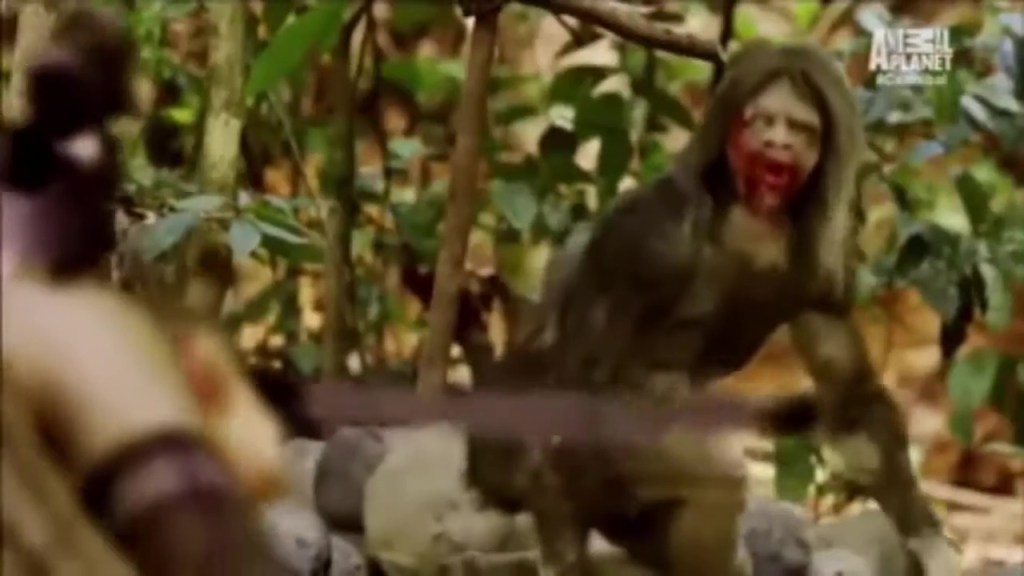
In this week’s offering, The Cannibal in The Jungle, the director Simon George presents a feature-length ‘true-crime’ special about an American scientist accused of murdering and consuming the remains of his fellow explorers while on an expedition in 1970s Indonesia. The murder/cannibalism case is told through interviews with an Australian anthropologist Richard Hoernboeck (played by Scottish actor Jim Sturgeon with a broad Australian accent), who says he found evidence of a tribe of very small hominids which he calls hobbits, and subsequently chose to investigate the murder/cannibalism case, 25 years after it happened. He tells us that in 1977, an American ornithologist was convicted of killing and cannibalising two colleagues in the jungles of Indonesia while on a quest to study eagles, as well as hoping to find a supposedly extinct owl. Instead, Dr Timothy Darrow, branded ‘The American Cannibal’ by the press during his trial for murder and cannibalism, claimed in his (unsuccessful) defence that they had been attacked by a lost species of early humans. These hobbits, he said, were responsible for the murder and consumption of his friends. Nobody believed him. Cannibalism is easier to believe than hobbits.
In fact, the remains of a species matching Darrow’s description were found in those jungles of Indonesia in 2003 by an anthropologist from Wollongong University, although his name was Mike Morwood (a hobbit name if ever I heard one). In what is now regarded as one of the most important anthropological finds ever, a team of scientists discovered the bones of an entirely new species of human, one that stood only 43 inches or 110cm tall. Homo floresiensis (popularly called Flores Man or more popularly Hobbits) lived on the island for perhaps over a million years before going extinct. Some recent research suggests that a tribe of the hominins known as Homo erectus became isolated on this remote Indonesian island, perhaps a million years ago, and evolved a dramatically smaller body size.
But did they really go extinct? An indigenous tribe on the Indonesian island of Flores, where the remains of the ‘hobbits’ were discovered, have their own accounts of little wild men that climb trees and walk on two legs. They also describe them as cannibals. And according to their legends, they may never have died out at all. This story claims to follow Hoernboeck’s expedition into the jungle of Flores, Indonesia, seeking to discover if hobbits still exist, whether Timothy Darrow’s ill-fated expedition really encountered the supposedly extinct creatures, and if the ‘American Cannibal’ was therefore innocent of the crimes for which he was convicted more than three decades previously.
The local people of the island, the Lio, claim that the hobbits were around until very recently, and may still be hiding out in the forest. In the fake doco, they are shown suggesting that they would kidnap and eat children, although being a different species to Homo sapiens, I suppose this would not technically be cannibalism.
The program is ingeniously done. Hoernboeck, the modern-day anthropologist, shows purportedly real video of his interviews with the imprisoned Darrow (played by Richard Brake, who was in Game of Thrones and Hannibal Rising, so there’s a giveaway for the alert horror fan), and his expedition to trace the journey on which Darrow supposedly found the hobbits. Interspersed with this, we are shown what we are told is a reenactment of the original expedition by Darrow and his friends/victims. The implication is that we can believe the rest is real, because they told us what was staged. We move to the present to see the anthropologist tracking down Darrow’s tape recorder which contains the taped call of the hobbits, then eventually the actual film taken by Darrow that proved his innocence but, alas, not until after he died in the brutal Kerobokan prison.
With a modicum of willing suspension of disbelief, it’s actually pretty convincing, and quite sad, unless we keep reminding ourselves that the whole thing is a fake. Those who watched it when it first came out, unless they recognised the Night King or the war criminal who ate Hannibal’s sister, did not discover that it was all fictional until the very end, when there is a (very) short statement. Most viewers probably wouldn’t even have noticed it.
What I found interesting is the depiction of the totally credible outrage of the Indonesian authorities, furious that an American would eat the Indonesian guide. Yet when the Flores locals are shown talking about the hobbits capturing and eating their children, there is inaction. Nature is red in tooth and claw! Animals eat each other, and eat people if they can, so if some unidentified ape ate your child, well, that’s unfortunate. But anthropocentric ideology denies our animality, so for a human to eat a human still manages to shock. The false binary of human/animal has led science to tie knots in the language, with some calling the hobbits “ape-men” and one learned anthropologist, Gregory Forth, calling his book about them Between Ape and Human. Like this documentary, the idea of a lacuna between apes and humans is fictional. We are a species of great ape, and our DNA is 98.8% identical to chimps.
Dr. Darrow’s supposed cannibalism was more horrific than nature’s mundane bloodbaths, not because he was genetically similar to the victim, but because he was a post-doctoral scientist, a ‘civilised’ man. If either party to slaughter, the one wielding or the one enduring the blade, can be defined as ‘animal’, all bets are off. The cannibals we consider in this blog are simply better than most people at dehumanising, objectifying the other.
The full movie is available, at the time of writing, at Daily Motion.
People who automatically flinch at the idea of cannibal movies (or cannibalism generally) give a little mental shrug when the subject turns to starvation. What would you do if you had no food, nothing containing any life-giving nourishment except other human bodies? The honest answer to that is, usually, ‘I don’t know, and I hope never to find out’.
Several films considered in this blog have looked into what we might call “survival cannibalism”, a sub-group of the wider “castaway” genre—films like Hitchcock’s Lifeboat—which derive from the narrative of Robinson Crusoe. The most famous in Cannibal Studies is still Alive, which retold the story of the young footballers who survived a plane crash in the Andes, only to discover that the search had been called off and there was literally no food in the snow, except the bodies of their fellow passengers (most of whom were their friends). It was recently rebooted in Spanish in Bayona’s La sociedad de la nieve. Such stories are contemporary versions of the old shipwreck stories which motivated much of the cannibalism narratives of early modern Europe, horrifying the Europeans, when they weren’t accusing the colonialised of the same thing. A classic story is the whaling ship Essex, the wreck of which inspired Moby Dick. The film In the Heart of the Sea follows that story – what happened to them after the ship sunk? Well, weeks in a lifeboat with nothing but each other for company and no food…
Then we have the many, many post-apocalyptic stories, starting with Soylent Green, in which overpopulation and climate change have led to the recycling of dead people into delicious crackers. Other classics of this genre include Delicatessen, We Are The Flesh, Cadaver, and of course the bleak glimpse of the future, The Road. Such disasters can be intentionally created, such as Stalin’s famine in the Ukraine, during which the starving ate their own relatives. In the USA, the classic case of starvation cannibalism is the Donner Party.
This week’s film, Hunger, explores the same question: what would you do? If you were starving, what, or who, would you eat? An apocalypse is not the fault of the victims, and surviving any way you can, feeding yourself and your family, is difficult to criticise. It may still be gross to some (or most) people, but it is nevertheless, in some ways, understandable.
But this film complicates it by taking away the excuses of an indifferent nature or a catastrophic global event. In Hunger, there is no apocalypse. The characters are just five people who wake to find themselves in a dark dungeon, with no idea how they got there. It’s a cistern, a larger version of the abandoned well in which Catherine Martin found herself trapped in Silence of the Lambs. And, of course, like Catherine, there is no food being catered. Science hates anecdotal evidence, so in this film we have a scientist who has gathered ‘ordinary’ people in extraordinary circumstances, just to see what would happen. You may remember Mason Verger boasting of a similar experiment in Hannibal:
“I adopted some dogs from the shelter. Two dogs that were friends. I had them in a cage together with no food and fresh water. One of them died hungry. The other had a warm meal.”
They have access to four barrels of water, a toilet (of sorts, but only four toilet rolls) and a day-clock that marks off 30 days, the length of time the human body can survive without food.
On the second day, they find on their water barrels a scalpel, an instrument that Jordan, the doctor played by Lori Heuring (Mulholland Drive), calls “a human carving knife”. It soon becomes clear what that is for, and it ends up (after much discussion) being used for just that purpose – to kill and butcher each other.
We find out as they talk that they seem to have been chosen because they have all taken a life – one killed her abusive partner, another in a hold-up gone wrong, another through euthanasia. Doctors like Jordan handle life and death every day. But the scientist wants to know, are they willing to kill out of hunger alone?
Then there is that scientist who kidnapped them; we find that he had been a young boy who survived a car crash: we later discover he cannibalised his mother’s corpse to stay alive. Now he watches his captives, and takes careful notes.
He shares their predilection for taking life: when a couple come to have sex in the quiet country area and hear the pleas for help from their oubliette, he shoots them with tranquiliser darts and pushes their car into the river, but not until they wake up. He thereby reveals a sadistic streak, a psychopathy, or at least a disavowal of empathy, common in scientists who experiment on mice, rats, dogs, monkeys and other animals. Most of us react to seeing other sentient beings in pain by initiating an empathetic response called resonance in the inferior frontal gyrus and the inferior parietal lobule of our brains. Recent research in which rats were given electric shocks and responded similarly both to pain and to watching other rats in pain showed that this ability is not restricted to humans, and in fact may be better developed in rats than in some scientists. Like Descartes torturing dogs or Josef Mengele experimenting on camp inmates, a psychopathic scientist can justify any cruelty for the sake of research.
Cannibalism, the act of killing and eating another, is sometimes considered transcendent (by the cannibal), with one character making reference to cannibalism as a spiritual pursuit:
“Human flesh is essence. It captures a person’s soul!”
The scientist likes this idea, because he ate his mother, so it’s comforting to think that he now contains her soul. But the main theme of the film remains starvation cannibalism, in this case forced on the victims, as it was in the Ukrainian famines or the Nazi death camps. The counterpart of this cannibalism is happening in their bodies. As Dr Jordan tells us, the process of starvation progresses as “your body basically cannibalises itself.” The alternative is what the scientist hopes to witness, the choice to “become a savage”.
Jordan, the doctor, is the only character who refuses to consider cannibalism. Like “the Man” in The Road, she wants to “carry the fire”, and that anthropocentric ideal does not include eating humans. The others spurn such naïve ideology:
“You can hold on to your precious humanity. We’re doing what we have to do to survive. And your boyfriend? He tasted surprisingly delicious.”
Cannibalism is usually depicted by society as a form of madness or monstrosity involving a devolution from civilised to savage, from enlightened to barbaric. Unless we pay someone else to do it for us—then it’s called animal husbandry.
The film was produced for a tiny $625,000, so the special effects and production time are limited (except for the buckets of gore), but it is still extremely effective. Hunger was released on Fangoria’s Frightfest DVD line, the same distributor as the (reworked) Armin Meiwes story Grimm Love. It does not seem to have received wide distribution, which is a shame, as it is well made, well acted (particularly Lori Heuring, who is quite incandescent) and is well worth your while chasing down. Moreover, it covers a crucial question that becomes more urgent as the world goes to hell in a handbasket – what would you do?
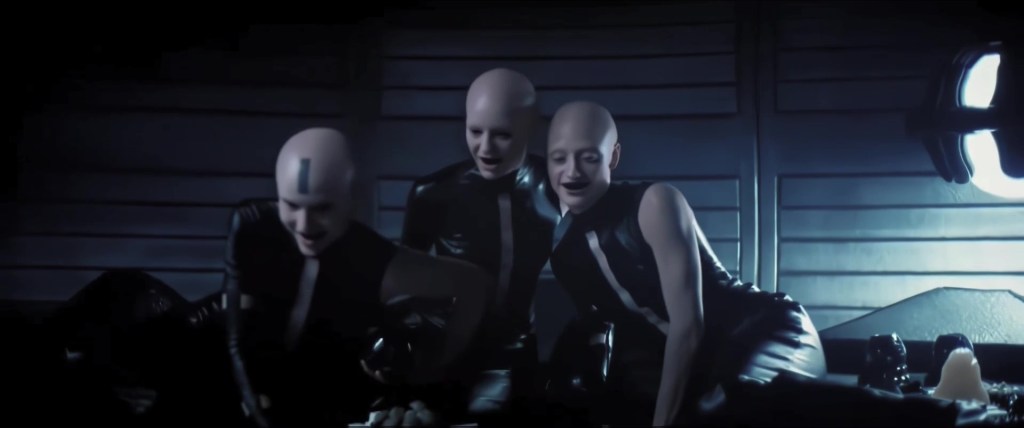
Are the Harkonnens cannibals In Dune 2? Not exactly, but the harem of women maintained by Feyd-Rautha do eat people. Sadly, the film is surprisingly coy about it.
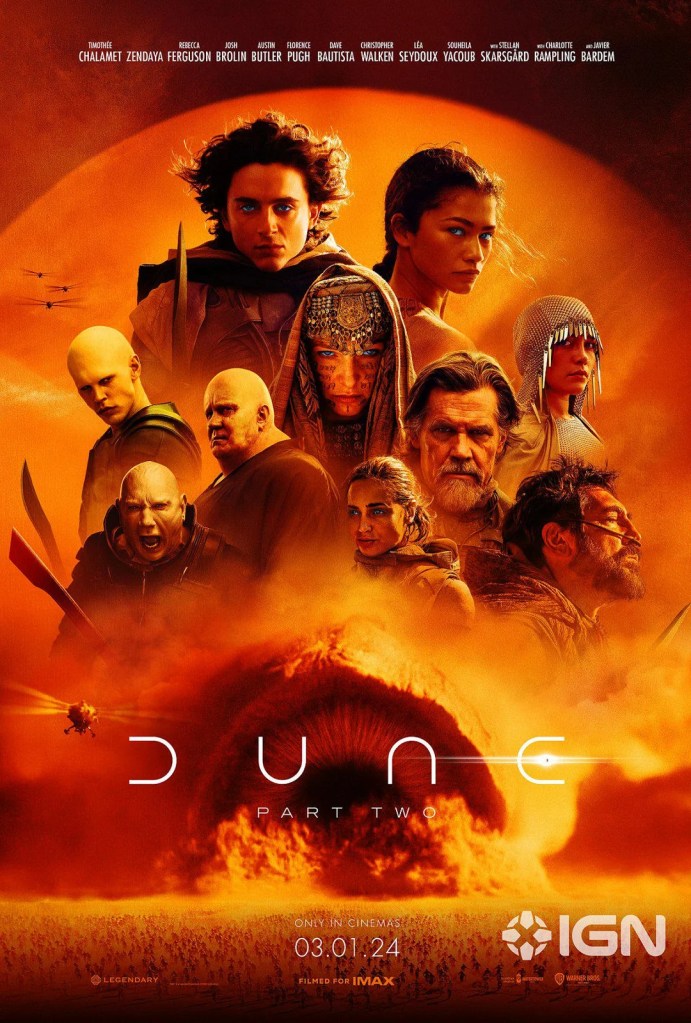
Canadian director Denis Villeneuve’s film Dune: Part Two was the second-biggest earner of (at least the first half of) 2024, taking in $711 million so far worldwide. It is a direct continuation of 2021’s Dune, and if you haven’t seen that yet, I suspect this one will make little sense, unless you’ve read Frank Herbert’s 1965 novel on which both are based.
Dune established a historical mythology set eight thousand years in the future, in which an interstellar alliance is ruled by ‘Great Houses’ who are nominally beholden to the Emperor (played by Christopher Walken), but are often at war with him or each other. Human civilisation has abandoned computers (fear of AI) and must use Melange or “Spice”, a highly addictive hallucinogen, to enable pilots to navigate through “folded space”. The Spice comes from a planet called Arrakis, which is therefore much in demand by imperial powers.
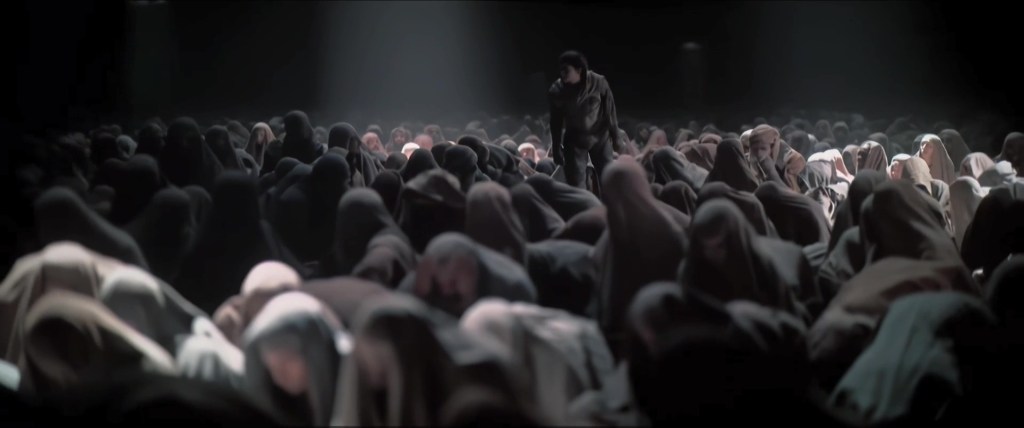
In the first movie, the Atreides were made rulers of the planet, but then were invaded and butchered by the wonderfully evil House of Harkonnen. However, the Atreides heir Paul Atreides (Timothée Chalamet, who is not unacquainted with cannibal movies) and his mother escape the destruction and join the local desert people, the Fremen. These guys are tough nuts, able to bring down even the Emperor’s most vicious special forces, and they ride around the planet on “worms” – huge underground creatures that can swallow anyone and anything they find. The worms are attracted by anything that is making regular sounds. Oh, and they produce the spice as their shit.
Dune 2 delves deeper into the culture of the House of Harkonnen, who believe they have killed off all the Atreides. Like the simplest monsters, they are portrayed as ruthless and devoid of morality, and most are more than a little psychotic.
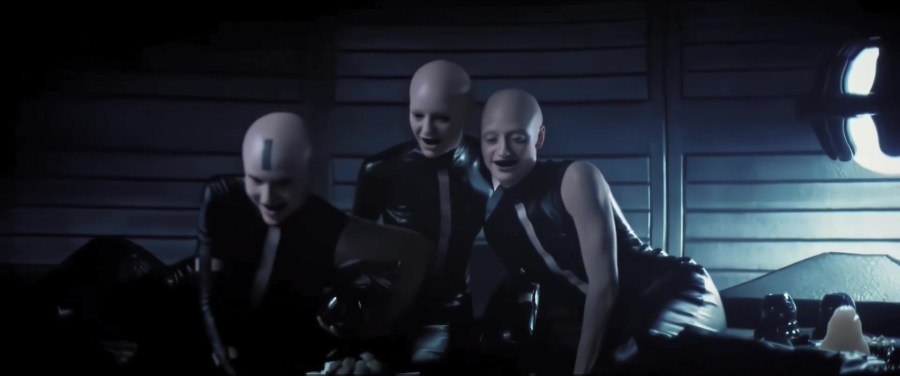
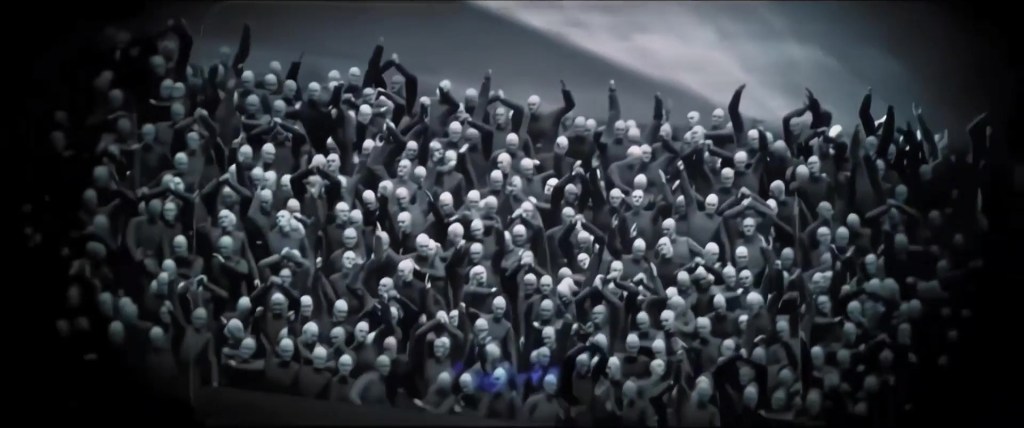
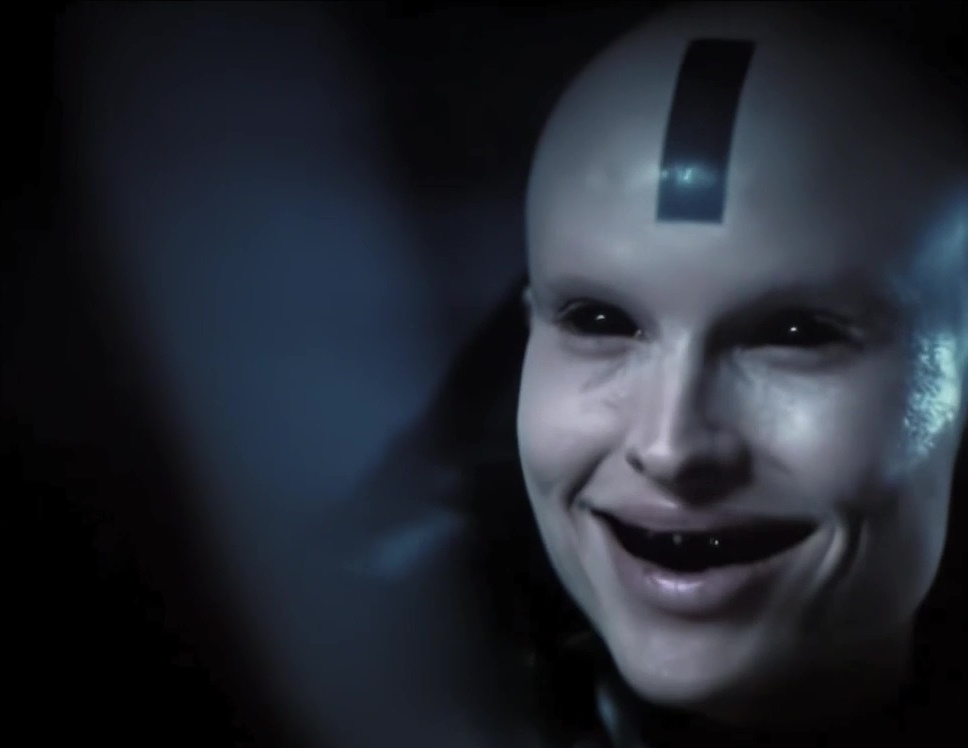
They are all bald for some reason, but their main motivations are cruelty and torture. Particularly the nephew of Baron Harkonnen (Stellan Skarsgård), Feyd-Rautha (Austin Butler, but nothing like Elvis in this movie), who keeps the harem of hungry cannibal women.
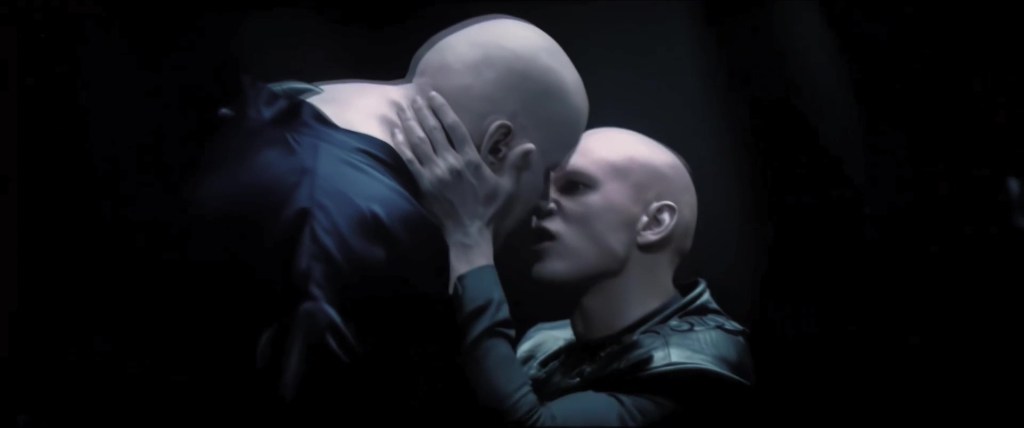
The Harkonnens kill capriciously and indulge in brutal pleasures, like making slaves fight to the death in the arena; they are hundredth century Roman emperors. We learn that Feyd-Rautha murdered his mother and now is the favourite of his uncle, the Baron. The ‘uncle and nephew’ thing is honestly a bit of a worn homophobic trope.
But the bit that interests us about him (in this cannibalism blog) is his harem of cannibalistic women. The film is a critique (intentionally or not) of white colonialism (particularly the evil Harkonnens, but also the Atreides and the Emperor) and the way it controls its subjects through the mythology of religion, in this case, messianic tales spread by an exclusive sisterhood called the Bene Gesserit, who use mind control techniques to persuade the colonised (the fierce, warrior race of Fremen) that their leader is coming, a white saviour from beyond their world. Paul does not believe any of this, but he lets his fundamentalist supporters fall for it.
Cannibalism has long been used as an ideological tool both by colonists (the savages accused of being subhuman cannibals like the Troglodytes in Bone Tomahawk) and the colonised, who see the invaders as predators appropriating the land, resources and bodies of the native peoples. Disappointingly, considering the pains the director goes to paint the Harkonnens as irredeemable psychopaths, we never understand them to be indulging in human flesh themselves, although it would have been an ideal metaphor for the way they rape and pillage the planets they control. Maybe Villeneuve felt the ghost of Frank Herbert would come and haunt him.
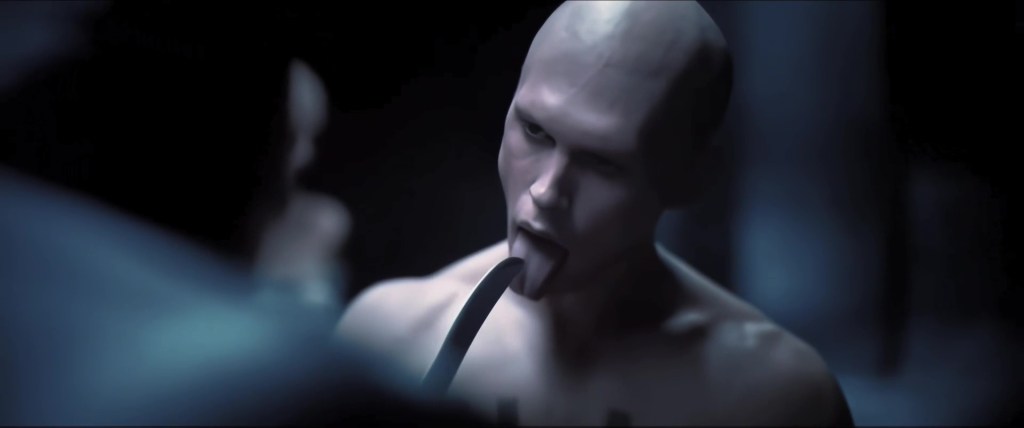
Feyd-Rautha seems to keep his women more like pets than concubines, calling them his “darlings” and killing various unfortunate slaves to feed them, as well as a flunky on the starship because, you know, they hadn’t been fed on the voyage.
Frank Herbert’s treatment of his characters was rather more nuanced in the books, in which he did not include any cannibalism, sadly. The inclusion of Feyd-Rautha’s harem of cannibals in Dune: Part Two seems a bit of an afterthought, or perhaps the script writers had some grand ideas which ended up being cut. They appear in one scene and for a few seconds, with no backstory. The end result is that the cannibals seem to be there just to enhance our perception of the dynasty’s barbarity.
Despite the rather superficial appearance of cannibal women, there is plenty here to entertain students of anthropocentrism; questions about what it is to be human, to be animal, to be civilised. The animal symbolism is everywhere; the worms, for example, are representations of nature—indifferent, insentient predators of immeasurable power who can, however, be tamed by humans, although their exploitation remains perilous. The bad guys with their bald heads and degenerate ways are depicted in animal forms—the Baron is bloated and presented as porcine, bathing in mud for much of the film, while Feyd-Rautha is reptilian—smooth, slimy and lethal.
The cannibal women are somewhere between aliens from X-Files and characters from pre-woke films like Freaks. Are they human? We never find out.
The film scores 92% fresh on the tomatometer, meaning most critics loved it. The visual effects are spectacular and should really be seen on the big screen, the acting ranges from brilliant to adequate, the battles are spectacular, and Hans Zimmer couldn’t write a bad score if he was paid to do so. But the trivialisation of the cannibalism left me hungry for more.
Hollywood, they say, will eat you alive, and stories of those who try to succeed (and fail) are often accompanied by metaphors of incorporation. If the city doesn’t eat you, the people will, or if they don’t, you’ll end up eating yourself. That’s what happens to Novella (Meggie Maddock) in this powerful movie about a struggling actress who just can’t get a break.
No wonder she develops some nervous habits. The one revealed here is auto-cannibalism. She eats herself.
Novella has lost control of her life. She hasn’t won a part for three years. Intending to be a famous movie star, she instead finds herself auditioning for porn movies to make ends meet, and then comes home to find an eviction notice on her door. Her life is out of control, and she tries to reclaim it by auto-cannibalism—eating her own flesh. An illness, an addiction or an obsession is often described as “all-consuming” and Eat takes this to its logical conclusion.
The film explores the desperation and isolation that is so much a part of modern cultures, and the extreme reactions to the feeling of failure. What better way to explore the darkness inside us than by opening ourselves up and looking, feeling and tasting it? As the movie reminds us,
This is the debut feature from Jimmy Weber (Incubator), and he demonstrates a rare talent for showing people things that really turn their stomachs. This is what horror should do—while so many entries that once caused people to pass out or vomit in cinemas have become stale and unremarkable, people eating their own flesh still manages to make the gorge rise for many otherwise hardened reviewers of gore movies. It takes us into our deepest fears and lets them out to play in the (relatively) safe world of the cinema.
Andy Warhol made an underground movie called Eat in 1964 which featured a man eating a mushroom for 45 minutes. This Eat is a lot more graphic, although the French got here first with Marina de Van’s extraordinary 2002 film In My Skin. In that film, the protagonist feels the same appetite for her own flesh as so many people seem to feel when they smell bacon.
If you’re not a gore hound, you probably may not like this film. The special effects are excruciatingly realistic, and reinforced by sound effects of biting and slurping that offer a sometimes exaggerated realism. But although it is a disturbing film, it is beautifully made and makes its point about the human tendency to consume, like the ouroboros, the very environment that sustains us.
Cannibalism, or any kind of carnivory, is ultimately about control. Humans seek to control nature by killing and eating others—usually other species, but sometimes, even often, other humans. There is no greater control of another than taking their life and converting their flesh into food and then into faeces. But doing it to ourselves? That is more an enquiry, an interrogation of the usually unquestioned human/animal binary. Reddit reports that a guy who calls himself Incrediblyshinyshart served his friends tacos, made from his own amputated leg, just to see what we taste like. A Spanish influencer ate part of her knee which had been removed surgically, just because it was her property and she could (much the same argument people use to justify eating other animals). Then there’s the vegan who made meringues out of his own blood, because, he said, it is,
“the only ethical source of animal products, because I can give my consent to myself in a way that a sheep can’t.”
Once we look inside our skin, that large sensory organ which identifies us to the world and ourselves, we find meat, the same red meat we find inside other mammals. The only difference between the cannibal who consumes his own flesh and the gourmand who eats that of a pig, cow or sheep is one of consent.
The mastermind of a “grisly and gruesome” extreme body modification network who streamed mutilations on his “eunuch maker” website has been jailed for life, with a minimum term of 22 years.
Marius Gustavson, 46, was accused of being the “arch manipulator” of vulnerable victims and purportedly took part in at least 29 procedures, which were “little short of human butchery”, the Old Bailey in London heard.
The “large-scale, dangerous and extremely disturbing” four-year enterprise included castrations, the use of clamps to crush testicles, penis removals, the freezing of limbs and administering electric shocks to a 16-year-old boy, procedures which were streamed on Gustavson’s website.
The “busy and lucrative” business earned more than £300,000 from its global base of 22,841 paying subscribers between 2017 and 2021.
Gustavson, who had previously admitted charges including conspiracy to commit grievous bodily harm, appeared for sentence via video link alongside six other men who had all admitted their involvement. The charges relate to thirteen victims who are under police guard.
Judge Mark Lucraft, the recorder of London and most senior judge at the Old Bailey, said as he announced the sentence:
“Gustavson, you are very much the mastermind behind this grisly and gruesome enterprise. The business you set up was one that was both busy and lucrative. As with all the others involved, you have no medical qualifications. The footage uploaded was extremely explicit and made available to paying subscribers no doubt so they could watch it for their sexual gratification […] Like-minded individuals were recruited by you, Gustavson, to assist in what became a large-scale, dangerous, and extremely disturbing enterprise.”
The prosecutor, Caroline Carberry KC, told the three-day sentencing hearing that there was “clear evidence” of cannibalism and that Gustavson, who had two previous fraud convictions in Norway, had “cooked testicles for lunch in an artfully arranged salad platter”. He also kept numerous body parts as “trophies” in a fridge at his home in Harringay, north London and offered to sell the severed penis of one of his victims for hundreds of pounds. Penisectomy, the removal of the penis and emasculation of the subject, is a popular topic in cannibalism texts, signifying the loss of the dominance of the virile carnivore, eaten by others who are closer to nature, more adventurous in their carnivory, and so more savage. Think of Lenzi’s film Cannibal Ferox, where we have not one but two penisectomies, one by the white invader and the other by the enraged natives.
The court heard the procedures were carried out in “amateur and dangerous” ways with kitchen knives, surgical scalpels and farm or slaughterhouse implements designed to be used on slave animals, leaving victims in agony and often needing medical attention.
The judge said, “They are permanent and irreversible procedures and will have a long-term, lifetime effect on the ability of the victim to carry out their day-to-day activities.”
Gustavson’s film-production techniques seemed to have become more professional as the number of procedures increased. The videos were uploaded to the website and subscribers were offered varying levels of membership from “free” to “VIP”, which cost £100, the court heard.
The scale of the operation run by Gustavson, a Norwegian national, and others was “without precedent”, Carberry said, adding that it was “impossible to know” the full scale of the offending.
The court previously heard that the procedures are linked to a subculture where men become “nullos”, short for nulloplasty or genital nullification, by having their penis and testicles removed. More details are available on the Queerdoc site.
In a video of one incident, which was played in court, one of the group’s victims was branded with the letters “EM”, for eunuch maker, on the back of his calf. The man later complained to police about Gustavson and his “circle of acolytes”, leading to the investigation and arrests in London, Scotland and South Wales. In his victim impact statement, the branded man described Gustavson as a “lunatic” running a “slick, professional website”.
The other six defendants admitted conspiracy to commit grievous bodily harm. The judge ruled that “I am entirely satisfied that the motivation of all those involved were a mix of sexual gratification as well as financial reward.”
Gustavson pleaded guilty to conspiring to commit grievous bodily harm, five counts of grievous bodily harm with intent, making and distributing an indecent photograph of a child, and possession of criminal property.
Peter Wates, 67, of Purley, Surrey, a retired former member of the Royal Society of Chemistry, was sentenced to 12 years in prison. Forensic officers found a scrotum and two penile shafts inside a tub of butter marked with the instruction “do not defrost” at his home address.
Janus Atkin, 38, of Newport, Gwent, who had been completing a veterinary course, was jailed for 12 years.
Ion Ciucur, 30, of Gretna, Scotland, received five years and eight months’ imprisonment, and Stefan Scharf, 61, of no fixed address, was sentenced to four and a half years in jail.
David Carruthers, 61, and Ashley Williams, 32, of Newport, Gwent, were jailed for 11 years and four years, six months respectively.
This was not just a business venture, but an expression of nullo ideology. In January, three men were sentenced after admitting causing grievous bodily harm to Gustavson.
Damien Byrnes, 36, from north London, was jailed for five years for removing Gustavson’s penis with a kitchen knife on video at his home on 18 February 2017. Jacob Crimi-Appleby, 23, from Epsom in Surrey, was jailed for three years and eight months for freezing Gustavson’s leg leading to the need for it to be amputated in February 2019. Nathan Arnold, 48, from South Kensington, west London, received a two-year suspended sentence for the partial removal of Gustavson’s nipple with a scalpel in the summer of 2019.
In mitigation, defence barrister Rashvinderjeet Panesar said the breakdown of Gustavson’s marriage was the “trigger” for his offending.
“He had a desire to be the architect of his own body. His modification led him to feelings of empowerment. It appears at face value to be something that’s become an addiction for him.”
Kate Mulholland, from the Crown Prosecution Service, said, “Whilst the victims in this case all seemingly consented to surgeries and amputations, the victim who bravely reported his assault to the police expressed serious regret regarding his procedure and the lasting impact it has had upon him. This clearly emphasises why such practices are unlawful.”
Detective Inspector Amanda Greig, from the Metropolitan Police’s specialist crime command, thanked the victims for their bravery, adding, “I would like to highlight the excellent work of the Met’s investigation team, who have examined thousands of hours of horrific material seized from the suspects. Their diligence and professionalism have ensured no one else will suffer at the hands of these men.”
The Met said a search of Gustavson’s flat had uncovered boxes of medical needles and syringes, local anaesthetic packs, surgical tools, a wooden chopping board and a mallet, a body board with leg and arm restraints attached, disposable skin staplers, and numerous medical procedure videos.
Body modifications are not unusual; we see men and women proudly displaying tattoos and piercings in public now, although within living memory they were considered only for sailors and members of criminal gangs. Nor is it new; from about 1550 CE to the late 19th century, young boys were castrated, often quite brutally, before puberty, simply to ensure that their voices would not deepen, and they would become “castrati”, with the lung capacity and muscular strength of an adult male, and the vocal range of a prepubescent boy. Before that, since pre-Biblical times, young boys (and in many places girls) have undergone genital mutilations as part of religious or cultural rituals.
News stories about cases like the Eunuch Maker tend to start with warnings to sensitive readers that they may find the details disturbing. But there is also an intriguing ethical question that is largely ignored in all the coverage.
When the issue of modification and mutilation is related to other species, it bizarrely becomes innocuous. Companion animals are usually desexed to ensure they remain docile. Farmed animals such as bulls and boars are routinely castrated when babies, usually without any anaesthetics, so that their taste is not affected by puberty, which gives the meat an unpleasant “taint”. Like most anthropocentric ethics, whatever we choose to do to “animals” is functional, advantageous (to humans only), and considered unremarkable and inculpable, while doing the same things to humans, even consenting ones, is considered (to quote the Judge) “grisly and gruesome”. The exact same baffling and discombobulating shift of perspective happens when portraying the difference between the eating of animal “meat” and human “flesh”. Gustavson ate the flesh of the human animals he castrated, the difference being they had asked for the operation. If one occurrence is repulsive, surely so is the other?
The website is no longer available, but this is what it looked like:
A 31-year-old man is in custody on suspicion of killing a man and eating parts of the victim’s face last weekend at East Charleston Boulevard and 3rd Street Las Vegas.
The Las Vegas Metropolitan Police Department released this report:
Police advised that the alleged perp, Colin Czech, had “biological matter in his hair, mouth, and on his clothing.” “Biological matter” is a euphemism for blood, flesh and other bodily substances.
Czech reportedly claimed the victim had attacked him. Police said the victim, identified as Kenneth Brown, was bleeding from head wounds and one of his eyes was missing. He was transported to the hospital, where a doctor pronounced him deceased.
During an interview, Czech allegedly said he was homeless and had been awake for several days because something was “possessing him.” Reports say Czech told detectives he “used his teeth to eat the victim’s eyeballs and ears.”
Police booked Czech into the Clark County Detention Center in absentia on a charge of open murder. Clark County District Attorney Steve Wolfson said it was one of the most unusual cases he has ever seen in more than 40 years as a defence attorney and prosecutor. He says the competency of the defendant will no doubt be addressed, adding “It is not uncommon for some of these cases to take years. Sometimes people never become competent.”
Czech was set to appear in court on Monday, April 29, but was hospitalised. In his eventual court appearance, he appeared dazed and uncomprehending.
Eating faces is not unknown in the annals of Cannibal Studies. In 2012, Rudy Eugene, “the Causeway Cannibal”, bit off the face off a homeless man in Miami, Florida before being shot to death by Miami police. In Wales in 2014, Matthew Williams lured a young woman back to his hotel room and began eating her face, apparently under the influence of amphetamines. Williams had been released from prison just two weeks before the killing and was described by police officers as “demonic”. Again in Florida in 2016, Austin Harrouff killed a couple he didn’t know and chewed off a victim’s face. He was found not guilty by reason of insanity.
Why all the faces? There is not much flesh on a face, yet it is considered a delicacy in some cultures. In the movie Eye without a Face, the protagonist watches on a hacked computer camera as a woman prepares a Persian dish called kale pache, literally “head and hooves”. It’s usually from a sheep, but whose head is it this time? Is she a cannibal serial killer? No spoilers here – you’ll have to watch it to find out.
Meanwhile, back in California, the man this blog reported on a few weeks back who found a human leg on the street in Bakersfield and started chewing on it has been sentenced to one year in jail in a Kern County courtroom. With good behaviour (and eating all his veggies?) he could be out in a lot less than that.
Under the dominant ideology of anthropocentrism or “speciesism”, buying the head or leg of a sheep for consumption is considered perfectly legal, if a bit quirky (or repulsive to some), yet eating a human face is headline material. But is there really that huge a difference between two species of mammals?

























 The Cannibal Guy