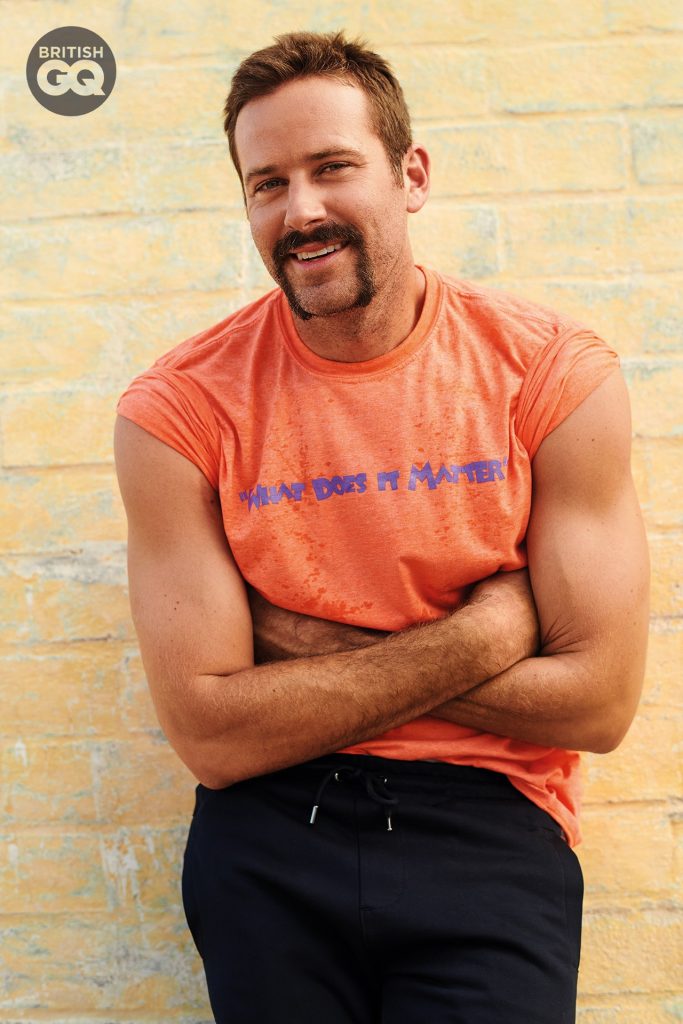
This film had a lot of publicity due to the cast – Armie Hammer (since mired in cannibalism scandals as detailed elsewhere) plays the Lone Ranger and, wait for it, Johnny Depp (mired in different scandals altogether) plays his Native American off-sider Tonto. Depp claims he has Native American ancestry, perhaps a great-grandmother, so I guess that’s fine. Helena Bonham-Carter is in there somewhere too, as a brothel madam with an ivory leg – she has certainly graced this blog before, and with Johnny Depp! The director, Gore Verbinski, directed The Ring and the first three Pirates of the Caribbean movies, at least one of which I recall walking out of, but so forgettable were they that I can’t remember which one.
Set in the Wild West in 1869, the Lone Ranger starts off as a lawyer named John Reid, coming to Texas as DA to impose law on a savage land, like Jimmy Stewart in High Noon. His “bible” (he tells the Presbyterians on the train) is John Locke’s Treatises, which insist that
“Whenever men unite into society, they must quit the laws of nature and assume the laws of men, so that society as a whole may prosper.”
Good luck with that.
Reid’s brother, a Texas Ranger, deputises him to help catch an escaped outlaw named Butch Cavendish (William Fichtner from Armageddon, Black Hawk Down and many more). All the deputies are killed by Butch’s gang, except the old drunk, who is working with the outlaws and leads them into an ambush. That could easily (and perhaps mercifully) have been the end of the movie, but Reid is awakened by a “Spirit Horse” and Tonto explains he cannot be killed in battle. He also tells Reid that Butch, the outlaw, is a Wendigo, a figure from Algonquin legend – the tribes from the north of America, and nothing to do with Comanche mythology, but hey, maybe Tonto read this blog.
A Wendigo eats people and gets bigger and stronger as a result, but also hungrier. According to Tonto, he can only be killed with a silver bullet (I think that’s actually vampires, kemosabe). Incidentally, Tonto in the original radio series was not a Comanche but from the Potawatomi nation (who might have referenced Wendigos), but let’s not bother too much with, you know, facts. After all, a spirit horse may have edited the script.
So Reid is still alive and puts on his mask (about an hour into the film), Butch captures his dead brother’s wife and child, a whole tribe of Comanches are massacred by the US Cavalry (that has a ring of truth to it at least), but why on earth is this nonsense being reviewed in a blog about cannibalism?
Well, Butch may or may not be a Wendigo, and may or may not require a silver bullet to kill him (he doesn’t), but he is a cannibal. He is pretty keen on eating people’s hearts, or eyes, or maybe his own foot, according to rumour.
The problem with the movie is that it really can’t decide if it’s a Western drama or a comedy. The bad guys are the essence of evil, but the good guys are clowns. Then in the middle they put a gratuitous massacre of Comanches which at least adds a touch of historical realism.
The special effects are pretty great, with people on horses chasing trains, jumping on trains from horses, jumping on horses from trains, and trains getting derailed and crashing spectacularly. The scenery is gorgeous (Monument Valley of course, even though the film is purportedly set in Texas).
But it flopped at the box office, grossing $260 million against the $650 million that it was estimated to need to break even. Rotten Tomatoes gives it a miserable 31% ‘rotten’ rating, with those 31% mainly loving it, and the rest totally trashing it. The New York Post called it a
“bloated, misshapen mess, a stillborn franchise loaded with metaphors for its feeble attempts to amuse, excite and entertain.”
Then again, the San Jose Mercury News was more forgiving, describing it as a “one hot mess”, but an entertaining one.
If you have two and a half hours to waste, I guess it will keep you amused or shocked or sickened or whatever you take from it. I reviewed it here because it has a bit of cannibalism (Butch eats the Lone Ranger’s brother’s heart) and because Tonto calls him a Wendigo. And there’s not much that’s better than a Wendigo movie.
The modern cannibal is usually hard to identify. Jeffrey Dahmer was the all-American boy next door. Armin Meiwes used to mow his neighbours’ lawns to be helpful. Issei Sagawa was so small and helpless that he seemed vulnerable rather than threatening. Albert Fish was a sweet old man, so charming that the Budd’s let him take their little girl to a party.
They were normal, everyday people, a bit weird, but not monsters.
At least, not in appearance. This is a recent phenomenon – the original cannibals were called anthropophagi (Greek for man-eaters) and were humanoid in shape, but were usually some sort of hybrid – a mix of humans and gods or other animals – strong, ferocious, and clearly not quite human. From the 15th century, the alleged cannibals found by Columbus and other explorers were different in culture and skin colouring, so were easily distinguished, defamed and exterminated. It is only recently, since Jack the Ripper in 1888, that the cannibal walked among us, undetected until the victims were found (or what was left of them).
Bones and All presents as a coming of age cannibal romance, taking a sharp turn back into cannibal history for its themes. Maren (Taylor Russell from Lost in Space) is finishing high school, a spectacular end of term in which she is invited to her friend’s sleepover and bites a girl’s finger off, instead of, you know, just admiring the nail polish, as she had been invited to do.
She then goes on the run with her father, who has been keeping her ahead of the law as she grew up (her first human meat was her babysitter when she was three) but now ditches her, with a few hundred dollars and a birth certificate.
It then becomes a road movie, as she travels through the American Mid-West trying to find her mother, attracting suspicion not because of her eating habits but just because she looks too young to be on the road. She comes across another cannibal (they are called “eaters”) in the shape of a weird old man named Sully (Mark Rylance, Bridge of Spies) before meeting up with Lee, played by the love interest of seemingly everyone nowadays, Timothée Chalamet. Chalamet appeared in the third instalment of Guadagnino’s “Desire Trilogy”, Call Me by Your Name), in which he was the love interest of Oliver, played by Armie Hammer, who has recently been generating his own cannibalism headlines.
As a road movie it’s Thelma and Louise mixed with Romeo and Juliet, if they had been cannibals. In other words outsiders, star-crossed lovers, and lots of flesh being torn off dead (and sometimes living) bodies. Road movies rely on meeting new and weird people, and learning about the protagonists (and ourselves) from their stories.
Sully is a lonely old man who teaches Maren about being an eater, and how an eater has a super-power – like a vampire, they have a nose that can smell other eaters at great distances, and can also smell dying people, which allows him to feast on them fairly inculpably, although Maren rather wonders if they should be calling 911 rather than letting them gasp their last breaths. So they are anthropophagi, they smell different, have a strong sense of smell, and so are not quite human. We subsequently discover that the cannibal gene is passed on – Lee’s dad and Maren’s mother were also eaters. They are a breed apart, hybrid humans, who can mate with non-eaters.
They are also presented as ‘savages’ – related to the colonised peoples who were declared cannibal by the imperial powers. Maren is biracial, and Sully (although played by a classical British Shakespearean actor) seems to be presented as a Native American, with a long ponytail and a feather in his hat. The marginalised and disenfranchised are regularly presented as dangerous, thieves, murders, cannibals, regardless of any evidence.
An interesting character from colonial times is the wendigo, a figure from Algonquin mythology who eats his fellow humans and draws on their strength to grow huge and powerful, which only makes him hungrier and deadlier. Sully tells Maren that her fate is to need more and more flesh as she gets older.
Just like the wendigo, who is an indigenous version of the anthropophagus, and one that was used by the victims to characterise the European invaders and their voracious appetite for land and gold. The phrase “bones and all” reminds us of the colonial greed that denied the humanity of those invaded and insisted on taking everything, leaving nothing and nowhere to go but a few reservations or missions in remote, unprofitable areas. Eating bones and all is also a perfect way of getting rid of the evidence.
The title Bones and All is taken from the book of the same name by Camille DeAngelis, but the phrase was not used in the book – it just meant that Maren and the other eaters would automatically eat the whole person, bones and all. Except for her first, the babysitter, because she was too small to swallow bones – she left a pile of them, a pool of blood, and the hammer from an eardrum. In a movie, though, it can be harder for the viewer to maintain a willing suspension of disbelief, so eating the victim bones and all becomes a rite of passage – the next level of being an eater. Maren and Lee don’t know how to eat a person bones and all, so they are not yet postgrad eaters. Maren puts it succinctly – “that’s impossible.” But what about eating the flesh? Armin Meiwes took ten months to eat 20 kilograms (44 lb) of Brandes, but we are asked to accept that Maren and Lee can eat a whole body in a night.
But then, everything is ambiguous in this story, which has been widely described as a metaphor for otherness and queerness. The story is set in 1981, as Ronald Reagan is entering the White House. Being different, queer, compassionate, seeking social justice were all considered laughable or dangerous. Greed was good, and so eating a victim bones and all might have seemed laudable. Drug addiction was escalating, and some have seen the cannibalism in this film as a metaphor for this as well – Maren and Lee can’t go too long without their feed, and will do whatever they need to in order to get it.
Some of the ambiguities are more subtle: Maren looks young, which bothers various people she deals with, although she is 18 and technically an adult in most places. Lee falls in love with her, but is also capable of appearing to be cruising for gay sex.
He chooses a carnival worker who has been mean to a child, leads him into the bushes and masturbates him, slitting the man’s throat as he orgasms. It was not until twenty years later that gay sex was legalised in the US, and this man’s secret desire for same sex petite mort becomes his real mort. They then discover that the man had a wife and family, and are stricken with guilt, because apparently eating some people is OK, but not family people.
Then we have the eaters – Maren is naïve and caring, horrified by her need to feed. Lee is a puny dude who kills seemingly effortlessly, but like Hannibal Lecter, Lee prefers to eat rude people – when we first meet him, he challenges a rude person in a supermarket and leads him to a deserted shed where he kills and eats him. Sully is an senior eater, so has to eat regularly, but says he tries not to kill people – sniffs out those who are dying, but later he gets violent when Maren rejects his advances.
Jake (Michael Stuhlbarg) is an eater who has graduated to eating bones and all, but he is accompanied by a friend named Brad (David Gordon Green), a cop (!), who is not a natural eater, but just likes doing it. Maren accepts that she and Lee have to eat people, but is revolted by Jake’s wish to do the same. We’re back to the old debate of nature versus nurture. Are people born queer? Or with addictive personalities? Or psychopathic? Or cannibalistic?
The Director, Luca Guadagnino, has made a number of changes from the book, which are examined elsewhere. The most obvious one, though, is that Maren is brought up and then eventually abandoned by her mother in the book, but her father in the film. This changes the dynamic considerably, because we now have two eaters in the family, both female. The eater parent in both versions is locked up in an asylum, having eaten their own hands, but in the movie it’s her mother, (a short but superb appearance by Chloë Sevigny). We arrive at last at the modern horror archetype, the “monstrous-feminine”, the figure that confronts the male viewer with his fears of being castrated (Freud’s favourite explanation), as well as “the monstrous womb” – a terrifying image of a “black hole which threatens to reabsorb what it once birthed” (Creed, The Monstrous-Feminine, p. 27). The female cannibal is quintessentially monstrous-feminine, terrifying men with the antithesis of popular female stereotypes of giving life and nurturing. In the book, Maren only eats boys or men (after the initial babysitter) – she is drawn to eat those who seek to be close to her. In both versions of the story, the ambiguity is clear to us and the female cannibals – they have a compulsion to eat, but don’t want to hurt others.
Maren’s solution is to try to act normal, fall in love, get a job, get “clean” of the eating. Her mother’s was to lock herself away, and even then she chewed off her own hands.
To me, the most fascinating ambiguity in this film and in our societies generally is the question “who can you eat?” Eating some animals is considered just “normal” – Lee is chewing on bacon (pig flesh) served to him in a very respectable café, and has been working in an abattoir. When they need money, he and Maren rob the abattoir at night, later sitting on the overhead walkway watching the cows who are to be killed for legal, non-controversial eating, when Maren observes
“every one of them has a mom and a dad, sisters, brothers, cousins, kids. Friends even.”
The real question, Derrida says, is not what to eat but how to eat well. Perhaps, as Chalamet has said, it is impossible to live ethically – every act of consumption or energy usage wrecks the environment a little bit more. For some carnivores, this is seen as a ‘bones and all’ issue, they call it “nose to tail” – killing is OK, but wasting any part of the animal is the real crime. But as Maren says, cows also feel terror, pain, bereavement when their babies are taken from them. The author of the book, Camille DeAngelis, went vegan before writing it, indicating that the problem of who to eat, the rude or dying, the human or the cow, weighed on her, and the scene filmed in the slaughterhouse indicates that Guadagnino may have felt the same. Cat Woods’ review in Salon reminds us that Brad, the off duty policeman, chooses to be a cannibal:
“Why would he hunt, slaughter, and feast upon human flesh if he doesn’t need to? And, if we the audience can be repulsed by that – and his evident choice to slaughter and eat flesh when there is abundant satiety that doesn’t cause violence, pain and loss – then perhaps we need to venture a little deeper into our own psyches and ask: Why would we feast upon flesh if we don’t need to?”
This is a seriously good film, with a great cast and, in the midst of all this carnage, we are treated to magnificent scenery beautifully captured by cinematographer Arseni Khachaturan. I have not revealed the ending, and hope I have not revealed too many other plot points. I recommend you go see it.
What a year! These are some of the cannibalism stories, films and songs that arrived in 2022, with links back to the original reports, so that you can look up the ones that catch your interest, and so that this blog does not take all of 2023 to read.
January
A German man dubbed by the press the ‘cannibal teacher’ was convicted of murder and sentenced to life in prison. Stefan R., a 41-year-old maths and chemistry teacher, had apparently searched on the dark web for terms such as “long pig” and “fatten and slaughter people”. The man claimed his victim died of natural causes after a (presumably vigorous) sexual tryst, and he had removed the man’s penis “since my DNA could still have possibly been present due to the oral sex I performed”. In other words, he didn’t mind a bit of mutilation and perhaps cannibalism, but was concerned not to be “outed” as gay.
Djalma Campos Figueiredo, 46, was arrested in Brazil. He had been sentenced by the Court of Justice of Rondonia in the city of Porto Velho to 42 years in prison for several counts of aggravated murder but had escaped custody. The Civil Police alleged he would eat his victims’ eyes and ears and drink their blood.
Meanwhile, the Zamfara (NW Nigeria) State Police Command arrested a 57-year-old man, Aminu Baba, for allegedly eating and selling human body parts. Baba and three others were arrested after the murder of a nine-year-old boy. The Police Commissioner reported that Baba had “confessed that he usually ate the body parts and identified the throat as the most delicious part. He also sold some of the human parts to his customers.”
February
A war between rival cartels in the Mexican state of Zacatecas graduated from the normal torture and beheadings to systematic cannibalism, with new sicarios (cartel assassins) being required to eat parts of their rivals before being allowed to graduate (or remain alive).
In Afghanistan, we discovered that the Taliban were rounding up drug addicts and putting them in rehabilitation centres to detox, which is a nice thought, except that they gave them little or no food (“cold turkey” does not count), so they apparently resorted to cannibalism.
In the Indian state of Assam, a man who had had perhaps more than a few drinks smelt cooking meat in a crematorium in a Hindu cremation ground. He helped himself to a few portions of the body, but was caught by villagers and handed over to police; but not before he had eaten about half of his purloined flesh.
May
A man calling himself The Chinese Zodiac Killer was arrested by the FBI in Jefferson County, New York for sending letters to media outlets, government offices including the White House, and other organisations, claiming he killed people and ate their flesh, and that he plans to kill more. He seems to have based his story on the Zodiac killer who terrorised California in the late 1960s. The original Zodiac Killer (who was not accused of cannibalism) was never caught, but this one was easily found, posting his threatening letters (what century is this again?) at the same letterbox he had previously used.
June
The case against James David Russell (see above in April) went to preliminary trial. Sadly, the judge threw out the charge of cannibalism, saying there was insufficient evidence to pursue it, and went with the rather more mundane offence of first-degree murder. Since this has a life sentence attached, the practical effect of dropping the cannibalism charge is negligible, but as the first cannibalism case in the USA, it would have been fascinating.
A rumour swept the Internet that the actress Anne Hathaway was a cannibal, based on a cryptic Tweet saying “police didn’t find human remains and evidence of cannibalism in her LA home that she sold in 2013.” We were all later astonished to discover the whole thing was a hoax.
The effects of the war in The Ukraine were starting to be felt in Europe and the UK (whose people often do not think it’s part of Europe). The Russians fell gladly on a statement from one Jeremy Clarkson (a car enthusiast) that “Hunger makes people eat their neighbours” to predict that the British will soon be a nation of cavemen feeding off each other. Of course, if you’ve ever been to a soccer match…
industrial/electronic music duo SKYND released their tenth song, called ARMIN MEIWES, about the German man who killed and ate a willing volunteer.
The New York Times raised the temperature of the culture wars with its review of several books, movies and TV shows about cannibalism, culminating in the (somewhat tongue in cheek) statement that “Cannibalism has a time and place… that time is now.” The right-wing press predictably jumped on the story accusing the NYT of everything from irresponsibility to Satanism.
Also in New York, Steven Spielberg whipped out his cell phone to record Marcus Mumford singing his new work, a haunting song called “CANNIBAL“. The song might be about love and lockdown, or it could involve child abuse.
DISCOVERY+ launched a three-part series called HOUSE OF HAMMER. The series explored allegations from various girlfriends of the actor Armie Hammer that he was a cannibal, or had at least threatened them with cannibalism. It also examined his relatives, many of whom seemed to be presented as even worse specimens than Armie.
Russia discovered the war was not going well in Ukraine, and started recruiting murderers and rapists to be sent to the front as reinforcements. Also – one cannibal, Yegor Komarov, whose man-eating exploits we learned about in December 2021.
October
In the Indian state of Kerala, there were allegations that a couple who ran a massage centre were bringing women home not so much for massages, but for human sacrifice and ritual cannibalism.
In the US state of Michigan, Mark David Latunski, who had been arrested in 2019 for killing and eating his Grindr date, finally came to trial and entered a plea of guilty.
November
Issei Sagawa, the “Kobe Cannibal”, died of pneumonia at the age of 73. Sagawa had killed and eaten a young Dutch fellow-student in Paris in 1981. He was found insane and sent back to Japan, where he was released and lived free ever since, making movies, writing books, and even becoming a restaurant reviewer.
Rapper Comethazine released Bawskee 5, the 12th song on which was called “CANNIBAL“.
Back in Brazil again! A patient in the Municipal Hospital of Nuovo Hamburgo in the state of Rio Grande do Sul attacked other patients, screamed and spat at people, and eventually chewed off his own fingers and toes. A witness said “while he was chewing his own meat, you could hear the crackling of bones in his mouth”.
December
Mark Latunski, 52, was sentenced to life in prison without the possibility of parole on December 15 for the murder of his Grindr date three years previously. Kevin Bacon, 25, had been killed and mutilated by Latunski on December 24, 2019 at Latunski’s Bennington home. Latunski pleaded guilty in September to killing Bacon and eating one of his testicles, after stabbing him in the back and slitting his throat. In a victims’ impact statement, the victim’s father said “Evil does exist, and it touched us.”
On the screen
The big news on streaming television this year was Jeffrey Dahmer, the “Milwaukee Cannibal”, who took Netflix by storm with not one but two titles, despite having been killed by a fellow prisoner in 1994.
Ryan Murphy and Ian Brennan’s docudrama called “MONSTER: THE JEFFREY DAHMER STORY“, which logged nearly two hundred million hours of watching in its first week of release
Joe Berlinger’s third series of CONVERSATIONS WITH A KILLER, featuring previously unheard defence attorney tapes of interviews with Dahmer.
Lots of new cannibalism feature films in 2022, some of which I will catch up with next year:
Luca Guadagnino’s BONES AND ALL, featuring Timothée Chalamet and Taylor Russell as teenage cannibals in a tender and gory road movie, has been getting heaps of publicity.
Mimi Cave’s FRESH is a charming romcom, until the knives come out. A fascinating insight into ultimate consumerism.
Leatherface came back (again!), this time older but no wiser. This is the ninth (!) instalment of the TEXAS CHAINSAW MASSACRE franchise, and went straight to Netflix.
John Ainslie’s DO NOT DISTURB depicts a couple renewing their romance by taking peyote, but finding that this particular variant of the drug awakens a taste for human flesh.
Leatherface came out to play again, this time as a fan-film prequel called THE SAWYER MASSACRE. Made on a shoestring but arguably superior to the other sequels and prequels.
Liam Regan’s EATING MISS CAMPBELL, in which a vegan, goth student falls in love with her new English teacher and develops a taste for human flesh.
Sean Patrick Flanery’s enjoyable road movieFRANK AND PENELOPE, in which a couple take on a cannibal cult in the wilds of Texas.
Timo Vuorensola’s JEEPERS CREEPERS REBORN, the umpteenth take on a supernatural tale of the demon who eats people and incorporates their bodies, but only every 23 years.
Fred Olen Ray’s PIRANHA WOMEN offers a totally believable story of women who turn into man-eaters because of an anti-cancer treatment.
THE MENU has Ralph Fiennes as a demented chef and Anya Taylor-Joy as the fly, as it were, in his menu plan. There is no obvious cannibalism involved in the movie, but there is some speculation on-line about the final cheeseburger.
‘Ted Lasso goes cannibal’ in Adam Leader & Richard Oakes’ FEED ME, a jolly rant in which a grieving man wants to die, and a nearby cannibal wants to help him, but by instalment.
And now for something completely different
From out of the future, we have some new AI software of which Shital Shah, a senior research engineer at Microsoft, said:
ChatGPT was dropped on us just bit over 24 hours. It's like you wake up to the news of first nuclear explosion and you don't know yet what to think about it but you know world will never be the same again. Here some interesting snapshots of this "explosion"🧵:
ChatGPT is “a large language model that has been trained to generate human-like responses to text input.” In other words, you can ask it questions and receive (often) intelligent answers, rather than a series of links, like Google. You can try it for free (at the moment) here.
Naturally, I asked it questions such as “is meat murder” and it replied:
“Ultimately, whether or not eating meat is considered murder is a matter of personal belief and moral judgement.”
So, I barked back, like a prosector out for a conviction, “Where does that leave the cannibal?”
“Whether or not eating other humans is considered murder would also be a matter of personal belief and moral judgement. Most people would consider cannibalism to be morally reprehensible, as it involves the killing and consuming of another human being. However, there may be some individuals who do not see it that way, and their personal beliefs and moral judgement would dictate their view on the matter.”
Hammer is a young American actor (in his thirties) who found fame with his 2008 portrayal of the evangelist Billy Graham in Billy, the Early Years for which he won a “Faith and Values Award” from Mediaguide, a Christian review organisation. Don’t you love irony?
Now, a new three-part documentary on Discovery+ has gone through the history of the Hammer family, and the way the Hammers seem to treat everyone as, well, nails. Narrated in part by Armie’s aunt, Casey Hammer, the documentary makes clear that the family tree is rotten with toxic masculinity, abuse and exploitation. If we were wondering how Armie got that way, this sheds plenty of light on the question.
Hammer’s family was, shall we say, a colourful one. His aunt Casey declared,
“I know my grandfather had a dark side, but I saw my father’s dark side first hand, and I’ve seen my brother’s dark side, and I’ve just heard about Armie’s dark side. But I believe it.”
The documentary goes through the dark deeds of these generations: the patriarch and oil tycoon Armand Hammer, his son Julian, his son (and Casey’s brother) Michael, and his son, Armie. Casey said of her brother Michael (Armie’s dad):
“That’s the sign of a true monster. You can look in the mirror and not see any fault or that you’re doing anything wrong. And that’s how deep it goes with my brother. And that’s why he’s so scary, because he has no conscience.”
The first episode is about Armie’s allegedly violent relationships with young women who were often so star-struck that they would often let him get away with tying them up and biting them, among other things. He made his appetite seem like love.
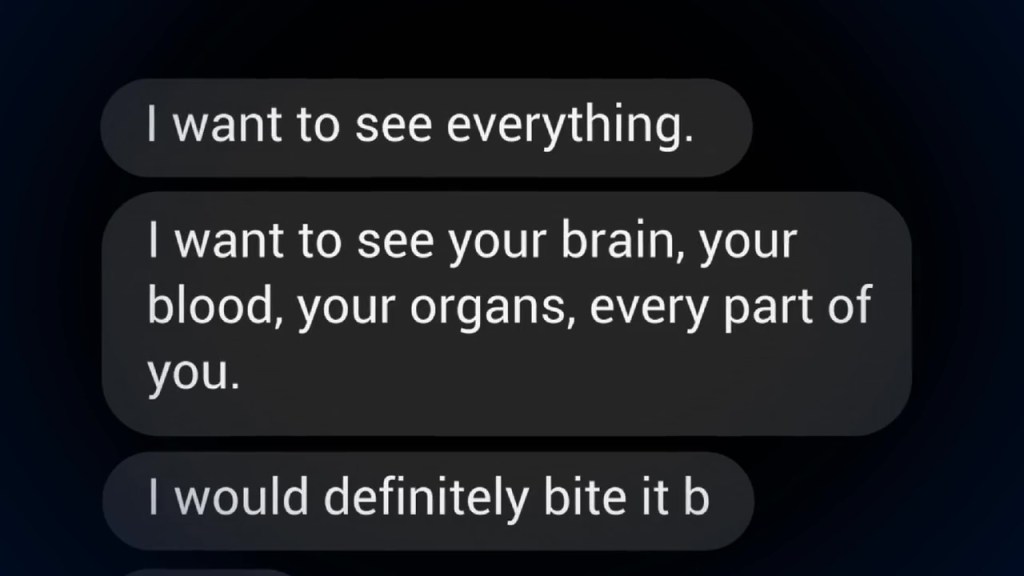
In early 2021, several of Armie’s girlfriends took to social media to describe Hammer as abusive, manipulative and violent. Screenshots of his text messages appeared to show him describing fantasies (or real events) of rape and cannibalism.
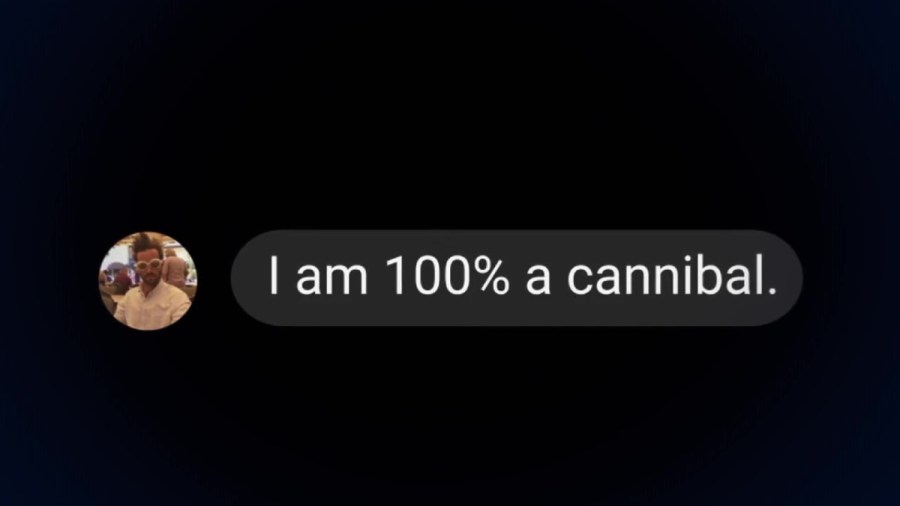
“I am 100% a cannibal…. Fuck. That’s scary to admit. I’ve never admitted that before. I’ve cut the heart out of a living animal before and eaten it while still warm. Totally raw. Still warm. ‘d eat your heart if i wasn’t stuck without you after.”
“I want to see your brain, your blood, your organs, every part of you. I would definitely bite it. 100%. Or try to fuck it. Not sure which. Probably both.”
“If I fucked you into a vegetative state id keep you, feed you, watch you, and keep fucking you…Till you are so sore and broken…. I can’t stop thinking of [fucking] your actual brain.”
“…cut a piece of your skin off and make you cook it for me…. Who’s slave/master relationship is the strongest? We’d win. When I tell you to slit your wrists and use the blood for anal.”
The documentary shows a clearly nervous Courtney Vucevovich describing Armie taking her to Sedona, tying her up, and doing whatever he wanted to her.
She shows texts on her phone, but also a note that he left at her home after he stalked her and found her address.
“Armie wanted total control of me, and absolute compliance, destroying any sense of bodily autonomy.”
Then he took her to meet his Mom! But, she said, “it was like a band-aid on a bullet wound.”
In early March, Armie’s ex-girlfriend Paige Lorenze, 24, said in an explosive interview with Vanity Fair that during their time together she felt “really unsafe and sick to her stomach.” The interview claimed that the celebrity’s ex-partners have “compared him to Ted Bundy” and said he was obsessed with shibari – a Japanese bondage art form where people are tied up in intricate patterns.
Lorenze was horrified to see the accusations of cannibalism,
“Because he would say things to me…weird stuff…like, ‘I want to eat your ribs’.”
She also claimed that Hammer had carved his initial into her pubic area and licked the wound, later bragging about it to friends, and that Hammer was fixated on biting her body, saying,
”If you did not tell me to stop I would eat a piece out of you.” And he was serious too. It was like he actually wanted to eat my flesh away.
The “A” that Armie allegedly carved into Paige
On their first night together, Lorenze said Hammer insisted: ‘You can either call me daddy or sir.’ She tells us in the documentary that
“He’s obsessed with meat. I brushed it off, but I do believe that he was serious.”
Another woman named Effie whom he dated for about five months in 2020 said that he had raped her for over four hours in Los Angeles. He told her he wanted to eat her flesh, and would suck or lick her wounds if she had “a little cut on my hand.”
Most of the documentary details allegations of non-consensual sex, AKA rape, for which Armie is being investigated by detectives from the Los Angeles sex crime division.
One such text read:
“I’m not going to lie… you cryin and crawling away while I stalked you down your halway was so exhilarating”
But on the subject of cannibalism (which is what this blog is about) let’s remember that Hammer has not been charged with acting on his cannibalistic fantasies — and in fact he has denied sending those texts. Courtney Vucevovich claims that her shoulder bears evidence of his cannibalistic ways, a wound that he suggested should be tattooed into her skin to make it permanent:
But texting and sex play, even bondage and sado-masochism (if consensual), are not illegal, and Hammer clearly enjoyed both.
But if he said these things and sent these texts, and if they were just fantasies, he picked the very worst time, the apex of the #MeToo movement, to send them. Hammer subsequently lost leading roles for which he had been preparing, including in the Jennifer Lopez film Shotgun Wedding, and his agency dropped him.
In March 2021, Effie, the woman who initially came forward with abuse allegations on Instagram, identified herself and accused Hammer of violently raping her in April 2017. The Los Angeles Police Department subsequently confirmed that he was the subject of a sexual assault investigation, which had been set in motion a month prior. Hammer has vehemently denied any wrongdoing via his lawyer, who stated that “all of his interactions with [Effie] – and every other sexual partner of his for that matter – have been completely consensual, discussed and agreed upon in advance, and mutually participatory.”
Hammer was unable to see his family during the pandemic lockdown, and his marriage fell apart. In June 2021, Hammer checked into a Florida treatment centre for drug, alcohol and sex issues.
The documentary outlines Armie’s fantasies and alleged assaults, and also goes into details of the corruption and violent activities of his forebears. So that raises the question, the one that Clarice asked Hannibal, “what happened to you?” Nothing happened, Hannibal answered. “I happened… Look at me, Officer Starling. Can you stand to say I’m evil?”
WTF? Is there a curse of the Hammer family? An evil gene? An epigenetic generational trauma that makes each new generation a bit more abusive than the last? Of course, Hannibal has some philosophy about this as well:
“when it comes to nature versus nurture I choose neither. We are built from a DNA blueprint and born into a world of scenario and circumstance we don’t control.“
The Hammer family have for some generations been enormously wealthy, and with wealth comes privilege. That does not necessarily lead to cannibalism (although movies like The Cannibal Club suggest otherwise), and certainly poor people can also be cannibals, but it may make the wealthy feel insulated against consequences – that is one important theme of shows like Succession. Wealth, privilege and entitlement does lead to cannibalism (not clear whether real or imagined) in American Psycho, at least in the book, (the film lingered on the murders but wimped out a bit on the actual eating of body parts).
Cannibalism is an act of domination – there can be no greater conquest of another than converting them into a meal and eventually into excrement. Hammer revealed this need to dominate in wanting to be called ‘daddy or sir’. In wanting to tie these women up so they are helplessly compliant with his every desire. In the power of watching them cry and beg. In ownership of their bodies.
The massive wealth of the Hammers demonstrates Bataille’s concept of “the accursed share”. Excess energy – in this case, wealth from the exploitation of energy in the form of oil – is spent on luxury without any public benefit, in non-procreative sexuality, in pageants and grand buildings, or else in catastrophic ways like war or sacrifice. In other words, in social terms, it must be used, or wasted. Armie Hammer used his excess energy on finding ways to control women, ultimately tying them up for the purposes of eroticism. Whether this was consensual or forced, which is what most of the women allege, is up to the Los Angeles sex crime detectives to determine. But it seems clear that privilege, particularly multiplied over several generations,
“must necessarily be lost without profit; it must be spent, willingly or not, gloriously or catastrophically.”
Georges Bataille, The Accursed Share Vol 1, p.21.
Excess energy can be donated – billionaires such as Warren Buffett and Bill Gates have pledged to give away at least half of their wealth during their lifetimes or at their deaths. Or they can expend their excess energy (wealth) on fancy homes and cars and bending others to their will. Although they usually do this less publicly than Armie Hammer did, this is still metaphoric cannibalism.
Fun fact: Rotten Tomatoes critics gave the documentary a 67% “fresh” rating, but the “audience” rating is only 5%. Most reviews, and thousands of other social media posts, doubted the veracity of the women’s claims, saying that Hammer had suffered the loss of his career because he openly expressed his fantasies. Vucekovich, on the other hand, says that after the news came out about her relationship with Hammer, she received death threats and harassing messages from Armie’s “die-hard fans.” Out of fear, she relocated from an apartment to a house where she installed cameras. “The ‘Charmies’ made my life hell,” she says. At the same time, she fielded “thousands” of messages from women who had been through something similar.
Is Armie Hammer a cannibal? He is a rich and handsome movie star from a wealthy and privileged family, who built his career on playing men who can get away with anything. He is certainly a persuasive abuser of (often much) younger women, a form of exploitative consumption that is uncomfortably close to cannibalistic ingestion.
But is he a cannibal? Technically, almost certainly not. But in his mind, in the deep, dark fissures of his unconscious, he certainly is. According to Freud, we all are.
In case you’re wondering, the above clip is definitely satirical.
So the news media is sure that Armie Hammer either is, or is not, a cannibal. Let us (briefly I hope) review.
Hammer is a young American actor (not yet 35) who found fame with his 2008 portrayal of the evangelist Billy Graham in Billy, the Early Years for which he won a “Faith and Values Award” from Mediaguide, a Christian review organisation. Will the ironies never cease!
Hammer went on to star in several movies (including some bombs like The Lone Ranger alongside Johnny Depp) but he is best known for playing Oliver in Call Me by Your Name in 2017. He was supposed to star in a sequel, based on the novel Find Me, when his world turned to shit. Or didn’t. Because he was a cannibal. Or wasn’t.
While most of us were locked down in our humble homes for much of 2020, Hammer and his family locked down in a luxury villa in the Cayman Islands, where, he told GQ Mag,
“It was a very complicated, intense situation, with big personalities all locked in a little tiny place. I don’t think I handled it very well. I think, to be quite frank, I came very close to completely losing my mind.”
Hammer’s family was, shall we say, a colourful one. His aunt Casey declared “I started watching Succession and I had to turn it off, because it was like, ‘Oh, my God. That’s my family.’”
Close families! Hammer said he felt like a trapped wolf who wanted to “chew his own foot off.” Despite the raging pandemic, he flew back to the US, where he got over his imminent divorce with wild parties and a series of girlfriends.
Unfortunately for him, several of those girlfriends in early 2021 took to social media to describe Hammer as abusive, manipulative and violent. Screenshots of his text messages appeared to show him describing fantasies (or real events) of rape and cannibalism.
“I am 100% a cannibal…. Fuck. That’s scary to admit. I’ve never admitted that before. I’ve cut the heart out of a living animal before and eaten it while still warm.”
“I want to see your brain, your blood, your organs, every part of you. I would definitely bite it. 100%. Or try to fuck it. Not sure which. Probably both.”
“If I fucked you into a vegetative state id keep you, feed you, watch you, and keep fucking you…Till you are so sore and broken…. I can’t stop thinking of [fucking] your actual brain.”
“Brand you, tattoo you, mark you, shave your head and keep your hair with me, cut a piece of your skin off and make you cook it for me…. “Who’s slave/master relationship is the strongest?” We’d win. When I tell you to slit your wrists and use the blood for anal.”
In early March, Armie’s ex-girlfriend Paige Lorenze, 24, said in an explosive interview with Vanity Fair that during their time together she felt “really unsafe and sick to her stomach.” The interview claimed that the celebrity’s ex-partners have “compared him to Ted Bundy” and said he was obsessed with Shibari – a Japanese bondage art form where people are tied up in intricate patterns. Lorenze was horrified to see the accusations of cannibalism,
“Because he would say things to me…weird stuff…like, ‘I want to eat your ribs’.”
Paige Lorenze
She also claimed that Hammer had carved his initial into her pubic area and licked the wound, later bragging about it to friends, and that Hammer was fixated on biting her body, saying,
”If you did not tell me to stop I would eat a piece out of you.” And he was serious too. It was like he actually wanted to eat my flesh away.
The “A” that Armie allegedly carved into Paige
On their first night together, Lorenze said Hammer insisted: ‘You can either call me daddy or sir.’
Another woman named Effie whom he dated for about five months in 2020 said that he had told her he wanted to eat her flesh, and would suck or lick her wounds if she had “a little cut on my hand.”
Armie and Effie
But let’s remember that no one has actually accused Hammer of acting on his alleged cannibalistic fantasies — and in fact he has never confirmed that he sent those texts. In any case, texting and sex play, even bondage and sado-masochism (if consensual), are not illegal, and Hammer clearly enjoyed both.
But if he sent these texts, and if they were just fantasies, as they appear to be, he picked the very worst time, the apex of the #MeToo movement, to send them. Hammer subsequently lost leading roles for which he had been preparing, including in the Jennifer Lopez film Shotgun Wedding, and his agency dropped him. In March 2021, Effie, the woman who initially came forward with abuse allegations on Instagram, identified herself and accused Hammer of violently raping her in April 2017. The Los Angeles Police Department subsequently confirmed that he was the subject of a sexual assault investigation, which had been set in motion a month prior. Hammer has vehemently denied any wrongdoing via his lawyer, who stated that “all of his interactions with [Effie] – and every other sexual partner of his for that matter – have been completely consensual, discussed and agreed upon in advance, and mutually participatory.”
Hammer was unable to see his family during the pandemic lockdown, and his marriage fell apart.
In June 2021, Hammer checked into a Florida treatment centre for drug, alcohol and sex issues.
Katharine Gates, the author ofDeviant Desires, describes a cannibalistic sex role play that tends to “involve more realistic scenarios…but still fantasy—they’re not actually eating pieces of people, but you will have one person be the meat and another is the preparer.”
One role play which seems popular on sites like Tumblr revolves around cannibal acts, a ‘paraphilia’ known as vorarephilia (it’s not in the DSM) – sexual arousal at eating, or being eaten by, another person (enthusiasts call themselves “vores”). A few, such as Armin Meiwes, eventually find a willing partner and make the fantasy a reality, but such cases are incredibly rare – Meiwes himself found that almost all the men who responded to his requests for someone who wanted to be eaten were not finally ready to take it to the next level – actually becoming his meal.
But why this fascination? Cannibalism is an act of domination – there can be no greater conquest of another than converting them into a meal and eventually into excrement. Hammer revealed this need to dominate in wanting to be called ‘daddy or sir’. But this hunger for incorporative power goes back to our earliest experiences.
Freud wrote of an infantile impulse toward “oral incorporation” – a desire not just to feed at the mother’s breast but to consume, possess that source of nourishment, comfort, security and love. He called one of the earliest psychological phases the “cannibalistic pregenital sexual organisation”. This drive is both loving – wanting to unite with the object of desire, and destructive – prepared to destroy the object to satisfy those desires. Infants may generate such hostility when their needs and desires are not satisfied promptly, and may also learn fear from the suspicion that the source will never be enough, or that their feeble attempts to dominate the adult may be met with far more powerful reprisals.
Maggie Kilgour, the doyen of Cannibal Studies, summed up:
“…far from being sublimated into symbolic forms or even sexual desire, our original appetites still move us, so that we remain trapped in a new oral phase of consumption. The work implies that man-eating is a reality – it is civilisation that is the myth.”
So there is a deep vein of cannibalism in our unconscious minds, and it may resurface at times of stress (e.g. being locked down in the Cayman Islands) or as an expression of affection, which in Hammer’s case did not go over well.
Is Armie Hammer a cannibal? He is a rich and handsome movie star from a rich and famous family, who built his career on playing men who can get away with anything. He is certainly a privileged and persuasive abuser of (often much) younger women, a form of exploitative consumption that is uncomfortably close to cannibalistic ingestion.
But is he a cannibal? Almost certainly not in reality. But in his mind, in the deep, dark fissures of his unconscious, he certainly is. We all are.














 The Cannibal Guy