If Donald Duck (who vaguely resembles a duck) eats a chicken’s body parts, such as wings, does that make him a cannibal? You know, because he’s a (sort of) bird eating body parts of birds.
Donald appeared this week on the YouTube interview show HOT ONES (see link above). Hot Ones calls itself:
The show with hot questions, and even hotter wings.
It’s a talk show produced by First We Feast and Complex Media and hosted by the very congenial host Sean Evans. The simple but ingenious premise is that Evans interviews celebrities while they eat a platter of spicy chicken wings. To make it interesting, the wings are served with increasingly hot chilli sauces. The questions become deeper and more personal as the Scoville hotness score of the sauces is ramped up and the guest becomes hot and bothered.
The Scoville score on Donald’s last sauce, “Straight out of Hades”, is 1,454,000, which has the expected result on poor Donald.
So anyway, would eating chicken wings be classified as cannibalism for young Mr Duck (who, we are told, is actually celebrating his 90th anniversary of his animated life)? Well, I covered the biological question pretty comprehensively in my blog last Christmas, which looked at the ethics of Donald and family eating chickens and turkeys for their festive meal.
The traditional definition of cannibalism is eating the flesh of a member of one’s own species. Now, it is not clear what species of duck Donald purports to be, but to be a cannibal, he would have to be eating a duck that wears clothes and speaks (sort of) English (the Hot Ones interview helpfully offers subtitles). This would probably limit his cannibalism feasting options to his nephews, Huey, Dewey and Louie, or Uncle Scrooge, and all of those people remain alive and uneaten, as far as we are aware. Or, of course, his long-time paramour Daisy, and he tells us that she is still around; indeed, she was the one who challenged him to agree to the interview while they were watching earlier episodes.
Now if we’re going to say that Donald eating any bird (Class: Aves) is cannibalism, then we need to agree that humans eating cows, pigs, sheep, goats, etc (Class: Mammalia) would also be cannibalism. I’m happy to go with that, but I haven’t found too many other takers.
But there is one more obstacle to the outrage of those condemning Donald’s consumption of chicken wings. Sean Evans states very clearly at the start of the feast
I notice you have the cauliflower wings on that side of the table, but no water or milk to help you out?
Donald doesn’t need them (he claims). What a rebel! That’s why we love Donald, far more than we love Mickey, at least, according to the totally unscientific surveys I have performed.
Donald doesn’t want chicken meat, or cow’s milk. Donald is a vegan! I guess in a world where humans eat twelve million ducks (and 200 million chickens) every day, we shouldn’t expect anything else.
As a general rule, I am not a big fan of “mockumentaries” – if you’re making stuff up, then why not just describe it as fiction? And if you are a channel like Animal Planet which makes factual documentaries about (real) fauna and flora for its seventy million viewers, it seems at least deceptive if not actively fraudulent to start showing made up stuff as if it is a “documentary”. This is not the first time they’ve done it; they had previously tried to make us believe they had found evidence of dragons and mermaids. So an untrue ‘true-crime’ documentary about a fake cannibal locked up for supposed cannibalism which was actually carried out by an extinct species of hobbits seemed pretty tame to the Ethics Department of Animal Planet I guess.
I should concede that some of the classics of cannibal texts are mockumentaries or “found footage” inventions. Many of the Italian ‘cannibal boom” films attempted to appear as factual records, particularly the classic Cannibal Holocaust, for which the director, Ruggero Deodata, secreted away the actors to make it appear they had been killed, then had to produce them in court to avoid facing homicide charges. More recently, District Nine, Ghoul and Long Pigs have all made somewhat desultory attempts to persuade us that we were watching the actual killing and eating of humans by humans.
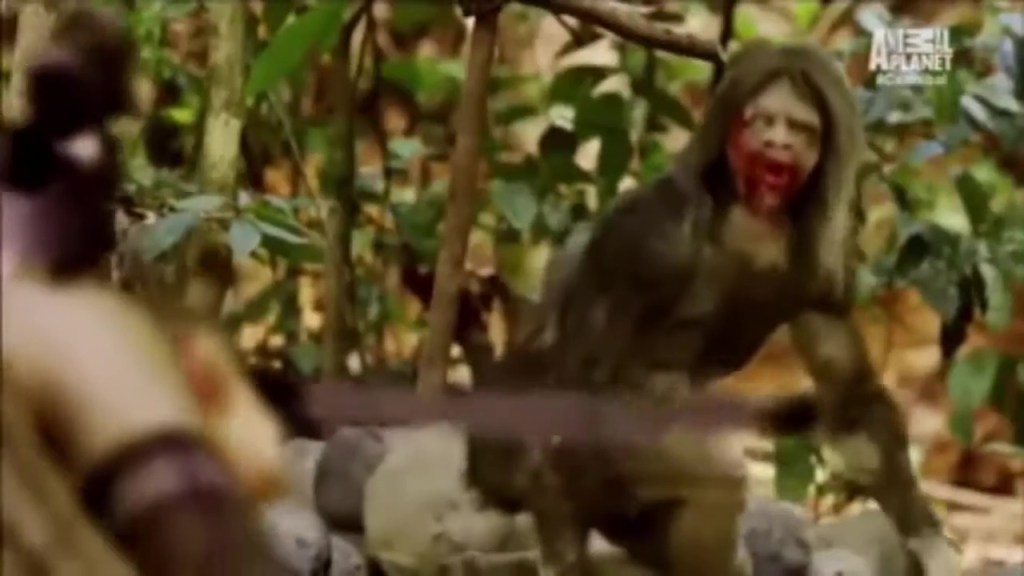
In this week’s offering, The Cannibal in The Jungle, the director Simon George presents a feature-length ‘true-crime’ special about an American scientist accused of murdering and consuming the remains of his fellow explorers while on an expedition in 1970s Indonesia. The murder/cannibalism case is told through interviews with an Australian anthropologist Richard Hoernboeck (played by Scottish actor Jim Sturgeon with a broad Australian accent), who says he found evidence of a tribe of very small hominids which he calls hobbits, and subsequently chose to investigate the murder/cannibalism case, 25 years after it happened. He tells us that in 1977, an American ornithologist was convicted of killing and cannibalising two colleagues in the jungles of Indonesia while on a quest to study eagles, as well as hoping to find a supposedly extinct owl. Instead, Dr Timothy Darrow, branded ‘The American Cannibal’ by the press during his trial for murder and cannibalism, claimed in his (unsuccessful) defence that they had been attacked by a lost species of early humans. These hobbits, he said, were responsible for the murder and consumption of his friends. Nobody believed him. Cannibalism is easier to believe than hobbits.
In fact, the remains of a species matching Darrow’s description were found in those jungles of Indonesia in 2003 by an anthropologist from Wollongong University, although his name was Mike Morwood (a hobbit name if ever I heard one). In what is now regarded as one of the most important anthropological finds ever, a team of scientists discovered the bones of an entirely new species of human, one that stood only 43 inches or 110cm tall. Homo floresiensis (popularly called Flores Man or more popularly Hobbits) lived on the island for perhaps over a million years before going extinct. Some recent research suggests that a tribe of the hominins known as Homo erectus became isolated on this remote Indonesian island, perhaps a million years ago, and evolved a dramatically smaller body size.
But did they really go extinct? An indigenous tribe on the Indonesian island of Flores, where the remains of the ‘hobbits’ were discovered, have their own accounts of little wild men that climb trees and walk on two legs. They also describe them as cannibals. And according to their legends, they may never have died out at all. This story claims to follow Hoernboeck’s expedition into the jungle of Flores, Indonesia, seeking to discover if hobbits still exist, whether Timothy Darrow’s ill-fated expedition really encountered the supposedly extinct creatures, and if the ‘American Cannibal’ was therefore innocent of the crimes for which he was convicted more than three decades previously.
The local people of the island, the Lio, claim that the hobbits were around until very recently, and may still be hiding out in the forest. In the fake doco, they are shown suggesting that they would kidnap and eat children, although being a different species to Homo sapiens, I suppose this would not technically be cannibalism.
The program is ingeniously done. Hoernboeck, the modern-day anthropologist, shows purportedly real video of his interviews with the imprisoned Darrow (played by Richard Brake, who was in Game of Thrones and Hannibal Rising, so there’s a giveaway for the alert horror fan), and his expedition to trace the journey on which Darrow supposedly found the hobbits. Interspersed with this, we are shown what we are told is a reenactment of the original expedition by Darrow and his friends/victims. The implication is that we can believe the rest is real, because they told us what was staged. We move to the present to see the anthropologist tracking down Darrow’s tape recorder which contains the taped call of the hobbits, then eventually the actual film taken by Darrow that proved his innocence but, alas, not until after he died in the brutal Kerobokan prison.
With a modicum of willing suspension of disbelief, it’s actually pretty convincing, and quite sad, unless we keep reminding ourselves that the whole thing is a fake. Those who watched it when it first came out, unless they recognised the Night King or the war criminal who ate Hannibal’s sister, did not discover that it was all fictional until the very end, when there is a (very) short statement. Most viewers probably wouldn’t even have noticed it.
What I found interesting is the depiction of the totally credible outrage of the Indonesian authorities, furious that an American would eat the Indonesian guide. Yet when the Flores locals are shown talking about the hobbits capturing and eating their children, there is inaction. Nature is red in tooth and claw! Animals eat each other, and eat people if they can, so if some unidentified ape ate your child, well, that’s unfortunate. But anthropocentric ideology denies our animality, so for a human to eat a human still manages to shock. The false binary of human/animal has led science to tie knots in the language, with some calling the hobbits “ape-men” and one learned anthropologist, Gregory Forth, calling his book about them Between Ape and Human. Like this documentary, the idea of a lacuna between apes and humans is fictional. We are a species of great ape, and our DNA is 98.8% identical to chimps.
Dr. Darrow’s supposed cannibalism was more horrific than nature’s mundane bloodbaths, not because he was genetically similar to the victim, but because he was a post-doctoral scientist, a ‘civilised’ man. If either party to slaughter, the one wielding or the one enduring the blade, can be defined as ‘animal’, all bets are off. The cannibals we consider in this blog are simply better than most people at dehumanising, objectifying the other.
The full movie is available, at the time of writing, at Daily Motion.
Even the poster didn’t try to persuade people that it was true.
“crying, why are ppl actually believing this … y’all believe anything”
That is certainly true. You may recall an almost identical campaign a few years back which claimed that Anne Hathaway had left evidence of cannibalism in a house she sold in 2013. This turned out to have been a “sociological study.”
Oprah has a history of media interviews in which she discusses food. Recently, she extolled the idea of using medications for losing weight, revealing that she has been using such drugs. Who can say that a high protein, low carb diet based on the cuisine of Dr Hannibal Lecter might not prove effective? Have you ever met a fat cannibal?
In 2008, Oprah went on a three week “vegan cleanse”. At the end of that brief period, she wrote
“At the end of the 21 days, I could not declare myself vegan or even vegetarian. But I am, for sure, more mindful of my choices. I’m eating a far more plant-based diet.”
Maybe giving up meat for health, environmental or ethical reasons could go beyond just avoiding human flesh, for everyone’s health?
People who automatically flinch at the idea of cannibal movies (or cannibalism generally) give a little mental shrug when the subject turns to starvation. What would you do if you had no food, nothing containing any life-giving nourishment except other human bodies? The honest answer to that is, usually, ‘I don’t know, and I hope never to find out’.
Several films considered in this blog have looked into what we might call “survival cannibalism”, a sub-group of the wider “castaway” genre—films like Hitchcock’s Lifeboat—which derive from the narrative of Robinson Crusoe. The most famous in Cannibal Studies is still Alive, which retold the story of the young footballers who survived a plane crash in the Andes, only to discover that the search had been called off and there was literally no food in the snow, except the bodies of their fellow passengers (most of whom were their friends). It was recently rebooted in Spanish in Bayona’s La sociedad de la nieve. Such stories are contemporary versions of the old shipwreck stories which motivated much of the cannibalism narratives of early modern Europe, horrifying the Europeans, when they weren’t accusing the colonialised of the same thing. A classic story is the whaling ship Essex, the wreck of which inspired Moby Dick. The film In the Heart of the Sea follows that story – what happened to them after the ship sunk? Well, weeks in a lifeboat with nothing but each other for company and no food…
Then we have the many, many post-apocalyptic stories, starting with Soylent Green, in which overpopulation and climate change have led to the recycling of dead people into delicious crackers. Other classics of this genre include Delicatessen, We Are The Flesh, Cadaver, and of course the bleak glimpse of the future, The Road. Such disasters can be intentionally created, such as Stalin’s famine in the Ukraine, during which the starving ate their own relatives. In the USA, the classic case of starvation cannibalism is the Donner Party.
This week’s film, Hunger, explores the same question: what would you do? If you were starving, what, or who, would you eat? An apocalypse is not the fault of the victims, and surviving any way you can, feeding yourself and your family, is difficult to criticise. It may still be gross to some (or most) people, but it is nevertheless, in some ways, understandable.
But this film complicates it by taking away the excuses of an indifferent nature or a catastrophic global event. In Hunger, there is no apocalypse. The characters are just five people who wake to find themselves in a dark dungeon, with no idea how they got there. It’s a cistern, a larger version of the abandoned well in which Catherine Martin found herself trapped in Silence of the Lambs. And, of course, like Catherine, there is no food being catered. Science hates anecdotal evidence, so in this film we have a scientist who has gathered ‘ordinary’ people in extraordinary circumstances, just to see what would happen. You may remember Mason Verger boasting of a similar experiment in Hannibal:
“I adopted some dogs from the shelter. Two dogs that were friends. I had them in a cage together with no food and fresh water. One of them died hungry. The other had a warm meal.”
They have access to four barrels of water, a toilet (of sorts, but only four toilet rolls) and a day-clock that marks off 30 days, the length of time the human body can survive without food.
On the second day, they find on their water barrels a scalpel, an instrument that Jordan, the doctor played by Lori Heuring (Mulholland Drive), calls “a human carving knife”. It soon becomes clear what that is for, and it ends up (after much discussion) being used for just that purpose – to kill and butcher each other.
We find out as they talk that they seem to have been chosen because they have all taken a life – one killed her abusive partner, another in a hold-up gone wrong, another through euthanasia. Doctors like Jordan handle life and death every day. But the scientist wants to know, are they willing to kill out of hunger alone?
Then there is that scientist who kidnapped them; we find that he had been a young boy who survived a car crash: we later discover he cannibalised his mother’s corpse to stay alive. Now he watches his captives, and takes careful notes.
He shares their predilection for taking life: when a couple come to have sex in the quiet country area and hear the pleas for help from their oubliette, he shoots them with tranquiliser darts and pushes their car into the river, but not until they wake up. He thereby reveals a sadistic streak, a psychopathy, or at least a disavowal of empathy, common in scientists who experiment on mice, rats, dogs, monkeys and other animals. Most of us react to seeing other sentient beings in pain by initiating an empathetic response called resonance in the inferior frontal gyrus and the inferior parietal lobule of our brains. Recent research in which rats were given electric shocks and responded similarly both to pain and to watching other rats in pain showed that this ability is not restricted to humans, and in fact may be better developed in rats than in some scientists. Like Descartes torturing dogs or Josef Mengele experimenting on camp inmates, a psychopathic scientist can justify any cruelty for the sake of research.
Cannibalism, the act of killing and eating another, is sometimes considered transcendent (by the cannibal), with one character making reference to cannibalism as a spiritual pursuit:
“Human flesh is essence. It captures a person’s soul!”
The scientist likes this idea, because he ate his mother, so it’s comforting to think that he now contains her soul. But the main theme of the film remains starvation cannibalism, in this case forced on the victims, as it was in the Ukrainian famines or the Nazi death camps. The counterpart of this cannibalism is happening in their bodies. As Dr Jordan tells us, the process of starvation progresses as “your body basically cannibalises itself.” The alternative is what the scientist hopes to witness, the choice to “become a savage”.
Jordan, the doctor, is the only character who refuses to consider cannibalism. Like “the Man” in The Road, she wants to “carry the fire”, and that anthropocentric ideal does not include eating humans. The others spurn such naïve ideology:
“You can hold on to your precious humanity. We’re doing what we have to do to survive. And your boyfriend? He tasted surprisingly delicious.”
Cannibalism is usually depicted by society as a form of madness or monstrosity involving a devolution from civilised to savage, from enlightened to barbaric. Unless we pay someone else to do it for us—then it’s called animal husbandry.
The film was produced for a tiny $625,000, so the special effects and production time are limited (except for the buckets of gore), but it is still extremely effective. Hunger was released on Fangoria’s Frightfest DVD line, the same distributor as the (reworked) Armin Meiwes story Grimm Love. It does not seem to have received wide distribution, which is a shame, as it is well made, well acted (particularly Lori Heuring, who is quite incandescent) and is well worth your while chasing down. Moreover, it covers a crucial question that becomes more urgent as the world goes to hell in a handbasket – what would you do?
Police in Quebec report that convicted serial killer Robert Pickton is in a medically induced coma and on life support after being attacked by another inmate in prison.
The Canadian pig farmer was convicted of six counts of second-degree murder and sentenced to life in prison with the maximum parole ineligibility period of 25 years in 2007. He was also charged with the murders of 21 other women, but those counts were stayed. In total, investigators found DNA from 33 women — many of them Indigenous sex workers who had vanished from Vancouver’s downtown eastside in the 1990s and early 2000s — at Pickton’s Port Coquitlam pig farm. Pickton also once allegedly bragged to an undercover police officer that he had killed as many as 49 women, and wanted one more to make an even 50.
Pickton allegedly “processed” the meat of his rape and murder victims by feeding them to his pigs and, police said, possibly mixing them up with pork products he sold to his neighbours for their personal consumption. This puts him in the category of entrepreneurial cannibal, selling human products (directly or via porcine digestive tracts) to ‘innocent’ cannibals who bought his products; in the league of Sweeney Todd and Delores Roach.
Whether he fed human flesh to his pigs, his neighbours or himself, the revulsion and fascination in the media, which focussed on the possible cannibalism more than the torture and murder, sheds some light on the fragility of the thin red line between humans and (other) animals. The pigs had reportedly eaten humans and then been eaten by humans, with human meat incorporated into their flesh through digestion, plus possibly a more direct route to cannibalism via the sale of the meat, masquerading as pork. The headlines concentrated on the suffering of the dyspeptic neighbours who may have eaten (and probably enjoyed) the flesh, although it is obvious that their indigestion was far less painful than the torture endured by Pickton’s victims.
In February 2024, Alberta comedy group Danger Cats had their Vancouver, Edmonton and Ottawa performances cancelled after widespread backlash over T-shirts they made showing Pickton grinning and holding a slice of bacon with the caption “Pickton Farms, over 50 flavours of hookery smoked bacon.”
Sources told Radio-Canada on Tuesday that Pickton, 74, was clinging to life following what Correctional Service Canada (CSC) confirmed was a “major assault” on Sunday at the maximum-security Port-Cartier Institution, about 450 kilometres northeast of Quebec City. Pickton was in a segregated intervention unit at the maximum-security prison when he was speared in the head with a broken broom handle on Sunday evening, May 19, 2024.
Chief Marilyn Slett with the Heiltsuk Tribal Council in Bella Bella, B.C., said that discussion about Pickton’s assault has revived painful memories for the families of the victims and Indigenous people. Tammy Lynn Papin, the sister of one of Pickton’s victims, told CBC News that she felt relieved and happy when she heard that the serial killer had been attacked in prison.
“I said, ‘Good for him, he deserved it.’ I don’t wish any harm on anybody but — karma, you know?”
The movie The Farm may perhaps be based on the news reports about Robert Pickton. In the film, tourists are captured, caged, bred, slaughtered and sold as food. Which is what Pickton, the pig farmer, did to pigs for a living, and to humans for diversion. He ‘processed’ the captured women, in the same way that he ‘processed’ the pigs on his farm. Another movie called The Hermit is about to be released starring Lou Ferrigno (The Incredible Hulk) as a cannibalistic pig farmer, making human jerky for a living.
It’s what humans do to billions of farmed animals every year.
PETA (People for the Ethical Treatment of Animals) summed this up with a billboard campaign in 2004 showing a young woman and a pig, with a caption saying, “Neither of us is meat”. Bruce Friedrich, director of PETA’s campaign, responded to the predictable outrage by observing that,
“Canadians who are shocked at the thought that they may have eaten human flesh should think about the fact that there appears not to be a difference in taste between pig flesh and human flesh. A corpse is a corpse, whether it formerly belonged to a pig, a cow, a chicken, or a human.”
Wendigo is a film written, directed and edited by Larry Fessenden, who would, a few years later, make an episode of the TV horror series Fear Itselfcalled SKIN AND BONES, which was about a guy who disappears on a hunting trip with friends and returns cold, thin and desperately hungry. He has, we quickly discover, become a Wendigo! In this, the earlier film, there are also crazy hunters led by Otis (John Speredakos), who are mad with our protagonists for driving into a stag (the traditional symbol of the Wendigo) who they have been tracking and, worst of all, breaking his antlers, which are apparently very valuable. The Wendigo is already there in their cabin as a “dark presence”, so we just need to be introduced.
First, the really good cast – George (the Dad) is played by Jake Weber, from the 2004 remake of Dawn of the Dead and Meet Joe Black. He is a super-stressed New York photographer, and the last thing he needs is a run-in with a bunch of redneck hunters. Kim, the Mom, is played by the wonderful Patricia Clarkson (most recently starring in Gray) and the kid, Miles, is played by Erik Per Sullivan, who was Dewey in Malcolm in the Middle.
George is more disturbed by the rednecks than he is willing to let on, telling Kim, who is a psychologist, that he is distressed by the “abyss” between him and them, with no possibility of communication. She tells him that:
“It’s very archetypical for the civilised man to feel threatened by the man of the country.”
George is utterly divorced from nature, seeing it as alien and menacing. So, the other last thing he needs to meet is a Wendigo, a figure on the front line of the human war on nature.
They head into town to buy curry (as you do in small towns) and Miles meets in the store a Native American Elder who tells him about the Wendigo, a small carving of which Miles is drawn to.
“The Wendigo is a mighty powerful spirit… it can take on many forms, part wind, part tree, part man, part beast. Shape shifting between them… It can fly at you, like a sudden storm, without warning, and consume you with its ferocious appetite. The Wendigo is hungry, always hungry. The more it eats, the bigger it gets, and the bigger it gets, the hungrier it gets, and we are hopeless in the face of it. We are consumed, devoured…. There are spirits that are angry. Nobody believes in spirits anymore. Doesn’t mean they’re not there.”
The Wendigo is a figure from the mythology of the Algonquin people of North America. They lived in a land of long winters where the competition for food would have been intense and cannibalism of the dead probably not unusual. Myths help to spell out behaviours that societies need to discourage – cannibalism could decimate small, isolated communities. That myth, of the voracious monster whose hunger only grows with feeding, was later applied to the invaders, the colonists who took their land, their produce and often their lives. In such a struggle, the Wendigo, as an original figure of their culture, could take almost a vengeful role, eating the technologically superior invaders. George inadvertently confirms this, telling Miles “the Wendigo only goes after bad guys.”
The Elder tells Miles he can keep the figure, but there is no sign of him when Kim is subsequently asked to pay for it. He is presumably one of those spirits, not angry but advisory. He warns Miles about the “cry of the Wendigo”. The Wendigo is clearly (to the audience) imbued into that carving.
Then the Wendigo strikes. Or is it the rednecks? Did the Wendigo knock George off his sled, or did it carry him home after Otis shot him? Was it the revenge of nature, or society? When the Wendigo later demands of Otis “Give me my liver!” it voices the cry of revenge of every animal, human and otherwise, killed for fun or profit. When Otis meets justice, Miles awakes with his Wendigo figure in his hand.
It’s a great cast, with an absorbing plot, although it gets a bit lost at the end. But the questions it asks are compelling. The New York Times critic wrote:
“Mr. Fessenden carefully blurs the line between psychology and the supernatural, suggesting that each is strongly implicated in the other. The rampaging Wendigo may be a manifestation of Miles’s incipient Oedipal rage, but at the same time it is a force embedded in nature and history.”
The Wendigo carries so much symbolism, besides the horror trope in which he seems so regularly to find himself, such as in Fear Itself or the classic Wendigo film, Ravenous, which was made a couple of years before this film. He expresses the anger that rages within George, the father who cannot show interest in his son’s curiosity because of his own issues brought with him from the city, frustration and fear of failure. And we can infer (as the NYT does) that Miles himself feels an Oedipal rage toward his father who, Freud tells us, is the child’s rival for sexual possession of the mother throughout childhood. The voracious hunger comes from an even earlier stage, what Freud called the “cannibalistic stage” of babyhood, where the infant wants to own the breast, consume it so it will always remain in his possession. George’s playacting the cannibal, attacking and pretending to eat Miles, is a common parent/child game, but is also deeply revealing of these forces hidden deep in the unconscious.
At yet another level, the Wendigo represents the revenge of nature on the civilised, those whose insatiable hunger for growth decimates the land and finds sport in killing its inhabitants, be they human, deer or any ‘other’. The antler is a weapon used by the stag, a normally shy and timorous animal who becomes a formidable fighter in the mating season, and the size and strength of its antlers represents both its sexual and fighting prowess. In the hybrid shape of a human and a stag, the Wendigo recasts humans from hunters to hunted, from predator to prey. This is precisely why Hannibal Lecter is shown in Wendigo form throughout much of the three seasons of the television series Hannibal. Hannibal is the civilised, rational, erudite man of science, a psychiatrist who knows of the dark forces inside the human psyche, and has determined that the human is just another animal, no more deserving of respect or inedibility than any other species, and even less if he happens to be rude. Who judges that – the supernatural force, the inhuman, the less-than-human or, in Hannibal’s opinion, the more-than-human? Whichever you choose, it appears as the Wendigo.
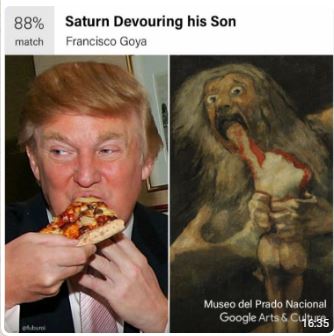
Way back in 2015, when first campaigning for the presidency, Donald Trump announced he would build a wall on the border with Mexico to keep out:
“…people that have lots of problems. They’re bringing drugs. They’re bringing crime. They’re rapists. And some, I assume, are good people.”
That seems quite tame now, doesn’t it? Warning about rapists have lost their power, especially given Trump’s own personal legal struggles regarding sexual assault.
So he has turned, dear reader, to our fave subject. Speaking on Right Side Broadcasting Network from Mar-a-Lago, a resort that relies heavily on immigrant labour, he upped the ante on border crossers by calling them cannibals released from mental institutions.
“They’re rough people, in many cases from jails, prisons, from mental institutions, insane asylums. You know insane asylums. That’s ‘Silence of the Lambs’ stuff. Hannibal Lecter, anybody know Hannibal Lecter?”
This is not the first time that Trump has quoted Hannibal. At a rally in Iowa in October 3023, he also spoke of people from insane asylums sneaking into the country, and again quoted Hannibal. He added a rather strange endorsement.
Trump on Hannibal Lecter: You know why I like him? Because he said on television “I love Donald Trump” so I love him pic.twitter.com/1jYyXKFkjI
“Hannibal Lecter, how great an actor was he? You know why I like him? Because he said on television on one of the – ‘I love Donald Trump.’ So I love him. I love him. I love him. He said that a long time ago and once he said that he was in my camp, I was in his camp. I don’t care if he was the worst actor, I’d say he was great to me.”
Hannibal Lecter is, of course, not in a position to comment on politics as he is a fictional character born in the mind and the novels of Thomas Harris and born again, we might say, in the films of those books in which Hannibal was played by Brian Cox and then by Anthony Hopkins. Then, in a third coming, Hannibal was rebooted as a Gen-X queer icon in the TV series Hannibal, played by Mads Mikkelsen.
Which of these Hannibals loves, or loved, Donald Trump?
Mads Mikkelsen told CBS News in 2016 that though he could “definitely laugh at some of the stuff [Trump] says, he can also go, ‘Oh my God, did he say that?’ I think he’s a fresh wind for some people.”
Hopkins, who was born in Wales and became a U.S. citizen in 2000, told The Guardian that he doesn’t care for Trump and explained that he doesn’t vote anyway, because he doesn’t “trust anyone.”
“We’ve never got it right, human beings. We are all a mess, and we’re very early in our evolution.”
Nietzsche wrote of an Übermensch, a super-man who was as superior to ordinary people as they feel themselves to be to pigs. Hannibal clearly sees himself in this role. The mantra of the Übermensch is “Adapt, evolve, become”. But, as Charles Darwin would tell you (if he had not himself become extinct), evolution does not describe a ‘great chain of being’, an evolutionary ladder toward perfection. It is simply about best fitting a niche, surviving a hostile environment while competitors become extinct. The art of evolution is to out-run, out-fight, out-eat the other – to be the last one standing. And the only one eating. Perhaps eating the loser. As Frederick Chilton tells us, “Cannibalism is an act of dominance.”
Early humans seem to have practised cannibalism (according to some palaeontologists), although it may have been more for ritual purposes than for the protein. But in the modern age, protein is king, or at least those who eat the most protein consider themselves therefore superior to nature, and to other humans. Meat is a fetish, an addiction, a way of declaring human, particularly male, supremacy. We confine, torment and slaughter around 80 billion land animals each year (that’s 80,000,000,000) to feed this fetish.
But supremacism does not depend on species – those of another race, another origin, another gender, another age-group may all be dehumanised, objectified like farmed animals, and cannibalism is famously the accusation used to dehumanise colonised people, giving invaders the excuse to enslave or exterminate them. Trump dehumanises immigrants by accusations of cannibalism, just as his political opponents dehumanise him. When American comedian Jon Stewart was asked in 2017 by Late Show host Stephen Colbert to say something nice about then President Donald Trump, he hesitated and eventually blurted, “He’s not a cannibal”. Colbert followed this up a year later suggesting Trump eats human flesh, but only “it’s very well done with some ketchup”.
Consuming the appropriated assets of those considered foreign or inferior is standard operating procedure in human history. In the absence of now largely abandoned concepts of (some) humans being semi-divine creatures, created in the “image of God”, what is to stop the actual consumption of those on the next rung down? As the huge population of humanity consumes the environment, leading to climate change and famine, could cannibalism be the next phase of human evolution?
As anthropologist Harold Monroe asks in Cannibal Holocaust, “I wonder who the real cannibals are?”
Another Russian convicted of murder and cannibalism has been pardoned by Vladimir Putin after fighting in the Ukraine.
Denis Gorin (Денис Горин), from the city of Aniva, Sakhalin region, was recruited into a private military company after signing a contract with the Russian Ministry of Defence. He is known to have been convicted three times for murdering at least four people between 2003 and 2022. He and his brother were also convicted of eating the remains of his victims. Gorin killed his victims, then washed and refrigerated the remains. After his last conviction in 2018, Gorin was sentenced to 22 years in prison.
However, at least seventeen convicted murderers have been pardoned by the Russian President since 2022 for agreeing to serve in the war on Ukraine. A neighbour of Gorin, Dmitry Vladimirovich, said that Gorin was now free and had been admitted to a military hospital in the eastern Russian city of Yuzhno-Sakhalinsk due to a moderate injury. The neighbour added that the victims’ relatives are likely to arrange a lynching.
“He’s basically free, pardoned, and half his sentence has been wiped out. But I don’t think he’ll stay free for long. His victims’ relatives remember everything.”
The first murder was in 2003.
“At the trial, he admitted that they ate the murdered man; he was their acquaintance. They killed him because they were drunk, and then the elder brother, Evgeniy (he had already tasted human flesh by that time), tried to force his wife to eat it. Then – his younger brother, Denis. According to Denis, he refused, but his brother threatened to kill him too. Then he started eating.”
After that first murder, Gorin was sentenced to ten years imprisonment, but released after seven years due to “exemplary behaviour”. Gorin returned to Aniva where he stabbed to death the brother of another prisoner with whom he was in the pre-trial detention centre. After the murder, according to the case file, he “decided to remember the past, namely, to cut off the meat from [the victim] and subsequently eat it.”
In 2011, Denis Gorin and his brother killed a man and hid his body on the banks of the Lyutoga River, and at the beginning of 2012 they committed another murder, according to the regional prosecutor’s office. This was proven five years later. In 2018, the court sentenced Denis Gorin to 22 years of imprisonment in a special regime colony for the last three murders. The neighbour reported that:
“This came up by chance; they also tried to kill one local while they were drunk, but they couldn’t. When they were detained, (I was present), they opened the refrigerator, and it was filled to the brim with human meat! He told us right there how he cut meat from the legs of the dead, looked at the biceps to see if there was meat there. They showed the hole where the remains were buried – there were 12 people there. Not three, as stated in the verdict! And among the skeletons there was a very small one – some girl was killed. But we couldn’t prove it in court.”
In 2023, Putin pardoned him. Pro-Kremlin media has ignored the news of the cannibal’s pardon. Nevertheless, it appears sporadically on social networks and instant messengers.
“Maniacs are real. His brother was killed while still in prison, and this brother didn’t even serve five years, but is already free. Maybe he’ll be patient for a year, and then he’ll start killing again.”
A photo on Gorin’s social media profile on Odnoklassniki – a Russian social media platform shows him wearing a military uniform with the letter Z emblazoned on the sleeve, a pro-war symbol for conflicts in Ukraine and abroad widely used in Russia.
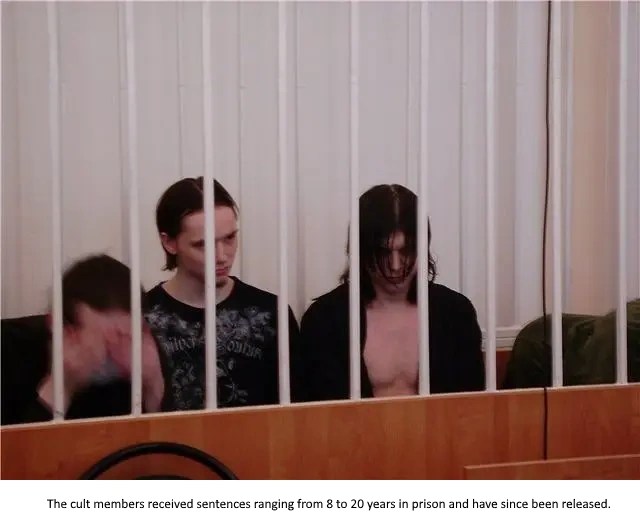
Another man, Nikolai Ogolobyak, a self-confessed Satanist, was convicted of ritual murders, and sentenced to 20 years in prison in 2019 for murdering four teenagers and then consuming their remains. The 33-year-old man was reportedly pardoned by the Russian president for fighting in Ukraine.
This blog reported on another jailed cannibal, Yegor Komarov, who was purportedly released to fight in Ukraine in 2022.
Russia’s Defence Ministry and the Wagner mercenary group have recruited heavily from Russian prisons to the notorious “Storm Z” unit of convicts, to bolster their manpower in Ukraine, promising convicts a pardon in exchange for military service. Several of these pardoned convicts have reportedly committed new crimes after returning from Ukraine. And returned soldiers do tend to come home undernourished and voraciously hungry.
The Moscow Times has reported that a self-confessed member of a Satanist sect, who was serving a twenty-year prison sentence for murder and the desecration of dead bodies, has been freed after completing six months of military service in Ukraine.
Nikolai Ogolobyak and other Satan worshippers, including one nicknamed “Hitler,” beheaded two of their four victims — then removed their hearts and tongues, fried and ate them.
In a second case in which they killed two other people, Ogolobyak made 666 stabs on his victim as an apparent reference to the ‘number of the beast’, a symbol of the devil.
Ogolobyak, 33, from the Yaroslavl region, was released earlier this month after he was severely injured in battle, his father said. His prison sentence had been set to end in 2030. His father told the press:
“He is not working. He is recovering. It is unlikely that he will be taken to the ‘special military operation’ again.”
Ogolobyak and his underage accomplices were sentenced in 2010 for killing four teenagers and desecrating their bodies in 2008 initiation rituals. Another suspect, Anton Makovkin, was ruled insane and was placed in a mental institution. The ritualistic murders rocked the Yaroslavl region — where the then-teenage Ogolbyak was known as “Count.”
Other members included Alexei “Dead” Chistyakov; Anton “Doctor Goth” Makovkin; Sergey “Distris” Karpenko, and Alexander “Hitler” Voronov”.
For the first two years, the teen Satanist carried out bloody rituals by sacrificing stray dogs and cats. Initially, new members were inducted into the cult using the blood of slaughtered animals, which were tied to an upside-down cross.
But in the summer of 2008, the Satanists went out hunting for people to sacrifice — and wound up killing and dismembering four college students they had befriended: Olga Pukhova, Anna Gorokhova, Andrej Sorokin and Varya Kuzmina.
On June 28, 2008, after a night of drinking, Pukhova and Gorokhova were lured to a clearing, where the cult members started a bonfire and positioned themselves in a pentagram formation, according to documents filed in the case.
When one of them gave a sign, all the suspects fell upon the two young women and plunged daggers into their bodies. Makovkin then decapitated the girls with a sword, after which the mutilated corpses were dismembered and carved up, and several internal organs were fried and eaten, according to the court records.
The newest member of the group, Ksenia “Kara” Kovaleva, was bathed in the victims’ blood as part of her initiation ceremony. One of the suspects was known in the group as “the secretary from hell” who took notes in a book of made from the skin of the victims.
Russia’s Defence Ministry and the Wagner mercenary group have recruited heavily from Russian prisons to the notorious “Storm Z” unit of convicts, to bolster their manpower in Ukraine, promising convicts a pardon in exchange for military service. Several of these pardoned convicts have reportedly committed new crimes after returning from Ukraine.
According to leading prisoner’s rights activist Olga Romanova, around 80,000 convicts were recruited from Russian prisons, and 20-30,000 have already returned to civilian life. The Kremlin has reiterated that they will keep the pardoning practice active for the foreseeable future.
Dmitri Peskov, Putin’s spokesperson, defended these pardons, believing that “people convicted, including for serious crimes, atone for their crime with blood on the battlefield.”
This blog reported on another jailed cannibal, Yegor Komarov, who was purportedly released to fight in Ukraine in 2022. It now appears that the cannibal sent to fight in the Ukraine may actually have been Ogolobyak.
The Times reports that Russians are increasingly uneasy about the release of killers on the basis that they served in the army. Particularly, one must assume, cannibal Satanists.
Long Pigs is a 2007 “found footage” movie, in which two desperate filmmakers come across a cannibal, ask him if they can document his eating habits, and then are shocked when he starts killing people and eating them. It is presented as a documentary, with all the usual warnings about graphic scenes etc.
Bit silly, and found footage has rather been done to death, but it has some interesting ideas, particularly the sympathetic approach to the main character, even as he commits his crimes. Look, it seems to say, everyone needs a hobby and, to this cannibal, killing and eating people is no more ethically questionable than hunting or fishing. Stalk, catch, kill (as quickly and painlessly as possible) and then enjoy. He does his best to keep the movie interesting, with a patter of jokes, historical facts and philosophical observations as he slices and dices.
The cannibal is played by Anthony Alviano (Headcase, A Matter of Justice), and he presents the cannibal, also called Anthony, as a boy-next-door persona, one who kills and guts people. Like a farmer of animals, he starts the film explaining that it’s bad to frighten the victims, not for ethical reasons, but because the adrenaline ruins the taste of the meat. The filming starts as he drives around looking for a “certain kind of woman”, because he wants to make “long pig stew”. “Long pig” is a term supposedly used in the Pacific region before colonisation to designate human meat, although that definition is widely contested. Anyway, Anthony is looking for “marbled meat”, so he searches for a sex worker (traditionally victims who are not exhaustively looked for by police) who is, let’s say, of a heavy build.
“People who eat stew make perfect stew. It sounds obvious. Yeah, she looks like she eats well.”
As she smiles at the camera, he sneaks up behind with a sledgehammer and cracks her skull, resulting in the cameraman vomiting (which is actually rather more gross than the murder). They ask Anthony if gets a sexual thrill from killing women, but he dismisses this, in the same way a slaughterhouse worker might deny any pleasure in killing a different species of mammal.
“I’m not a freak or anything like that. This is all culinary, this is hard work!”
“Any hunter would recognise this position. We got the corpse hanging by the ankles. The first thing I’m gonna do here is make a little incision and tie off the anus. That’s to stop contamination from the feces. You would do that whether it was a deer carcass or a cow or a person… Absolutely necessary for health reasons.”
He cooks a stew from a portion of her thigh, then after dinner goes off to brawl in an ice-hockey game, an arena that seems the very essence of carnivorous virility.
Afterwards, he cooks ribs on a barbecue, assuring the viewers that there are “no animal by-products” used – just soymilk. And a woman’s ribs, of course, thus reinforcing the anthropocentric mythology of the human as not really animal, even though he has just butchered one in the same way as any other animal prepared for human consumption. He quotes the Arawak word barbaca, the grill on which human meat was supposedly cooked, according to explorers like Hans Staden and Jean de Léry, which became the Spanish word barbacoa, and eventually morphed into English as barbecue. Staden’s narratives were later illustrated by Theodor de Bry in his 1592 book Americae Tertia Pars, and the film sneaks in a quick peek at that glimpse of sixteenth century sensationalism.
There’s a lot of moral philosophy interwoven in the scenes of murder and gastronomy. Anthony the cannibal and his friend try to persuade the filmmakers to try some of the ribs, saying, it’s dead, and therefore cannot suffer, whereas we eat live vegetables, and “broccoli feels pain! Did you know that?” This is precisely the argument tossed at vegans by carnists, but in this case, it demonstrates the contention of the nutritionist Herbert M. Shelton:
The cannibal goes out and hunts, pursues and kills another man and proceeds to cook and eat him precisely as he would any other game. There is not a single argument nor a single fact that can be offered in favor of flesh eating that cannot be offered with equal strength, in favor of cannibalism.
Anthony works as a valet in a fancy restaurant, parking cars for rude people, and if you follow the lore of Hannibal Lecter, you will know that rude people are prime targets of cannibals. They park the car of a particularly rude man, take down his address from his licence and, next day, shoot him and load him in their car trunk. Unfortunately, they have a flat tyre and have to head to a pig farm for help, where they witness pigs being slaughtered and prepared for sale, in identical ways to Anthony’s own processes, but with rather better technology, and, oh yes, totally legally.
Most of the film is a spoof on cooking shows, which regularly have smiling chefs, or hopeful chefs, preparing lumps of animal flesh, hoping to win prizes. Anthony shows, in high-speed motion accompanied by the music of the Sugarplum Fairy, exactly how he prepares a body, stripping it and dismembering it until all that is left is two feet (still in socks) and the long femurs. He demonstrates how to get rid of the bones, cutting them up and putting them in a kiln at 2600 degrees – he even uses the line “these are some we prepared earlier.” This is a cooking show for cannibals.
Anthony is a typical modern cognate cannibal; as he says, people expect Hannibal Lecter, so “no one is going to suspect the valet”. This gives him the invisibility that we saw in cases like Jeffrey Dahmer. He loves his old mother who is in a nursing home, and is bewildered by a doctor’s request to do a post mortem analysis brain when she dies, a sophisticated update of cannibalism. He sadly tells the filmmakers that she has Alzheimer’s, but we eventually find that she died of Creutzfeldt-Jakob spongiform encephalopathy, a human version of mad-cow disease, probably from eating human meat that he fed her. He also admits to eating a five-year-old girl called Ashley, because people prefer meat from young animals, but was subsequently perturbed by the extensive police searches, and now avoids playgrounds and schools: “It’s like a supermarket, man.” As New Year celebrations explode outside, he comes to realise the filmmakers are going to release the movie, which will detail all his criminal history, and goes to get his sledgehammer. The rest, as Shakespeare says, is silence.
Anthony has a philosophy that rejects anthropocentrism and sees nothing wrong with cannibalism, or at least nothing that does not apply to any other meat. It’s a cannibalistic rejection of what Richard Ryder and later Peter Singer called “speciesism”.
“It’s only human beings that are so arrogant that they believe they are better than every other kind of animal out there. Worms don’t think about, you know, oh my god, why did mama worm get eaten by a fish; fish eats the worm and that’s that, it’s completely accepted by the worm, and the fish, and small fish gets eaten by the big fish, and if it was so wrong to eat it, then why would it taste so good?”
At the end, he is in jail, but he has published a cookbook. His cooking show has finally paid off.
This is a low-budget film, but is a lot better than might be expected. The creators were lucky enough to secure the services of Chris Bridges, the special effects artist whose credits include the Dawn of the Dead remake, Saw III & IV, 300 and Star Trek Discovery. Unless they actually killed and dismembered people, the result is spectacularly authentic. Anthony Alviano is brilliant in the role, which was written with him in mind.
The full movie (although slashed drastically from 81 minutes to 56 minutes) can, at the time of writing, be seen at https://youtube.com/watch?v=vnGXBRkxXuo.
















 The Cannibal Guy