CANNIBAL SCHOOL – Mexican cartel recruits are being taught to eat rival sicarios

In the past 18 months, the war between CJNG (Cartel Jalisco Nueva Generacion) and the Sinaloa cartels has been intensifying. Sinaloa is the largest, while CJNG is arguably the most violent.

The Mexican state of Zacatecas is their main battleground.

Sicarios (cartel assassins) on both sides fight for territory, and the profits from the production of synthetic drugs, particularly fentanyl, in that region.

They also profit mightily from kidnapping refugees trying to cross into the USA, and cooking the ones whose ransoms are not paid.

Violence in this war is not just done, but is seen to be done, with videos being released onto social media showing various atrocities, in order to demoralise the opposing cartel members. An earlier video involved a CJNG soldier using a spoon to remove the eyes of a captured rival.

A new video (widely and ironically known as “Sponsored By Adidas” due to the killers’ love of that brand of shoe) is circulating on the Internet now. It shows a soldier from the CJNG crouching over the disembowelled body of a man from a rival cartel, supposedly the Sinaloa. The man opens the corpse’s chest and removes an organ, either the heart of liver (some say a lung), and bites into it, then seems to offer it to the corpse to see if it wants a bite.

This seems to be the latest escalation of cartel violence. Before 2006, beheadings were unknown; but now there are dozens of beheadings every year in Mexico. How do you up the stakes from beheading? The previous video from a cartel, called “Funky Town” showed a live and conscious prisoner having his face flayed from his head, later to be sewn onto a soccer ball. But the big new thing for the cartels now seems to be cannibalism.

Man-eating appears to have become a requirement for new recruits to CJNG at its training camps or “cannibal schools.” One member of CJNG told a journalist that there is widespread cannibalism at the camps. Recruits are taught how to cut fingers and toes, and eat them They then graduate onto larger internal organs. He reported (anonymously) that:

“You have to do it without reacting or vomiting or you are beaten. If you didn’t want to [eat human flesh] they wouldn’t let you leave, they had you there.”

The video in question can be found on the Internet if you look hard enough. I am not posting links, because those who don’t want to see it might accidentally click, and those who do are gorehound enough to find it.

Why is cannibalism such a popular strategy for terrifying the enemy? Because there is no higher form of humiliation, no greater insult, than being killed, eaten, and then crapped out of the anus of your enemy.

Issei Sagawa: THE CANNIBAL THAT WALKED FREE (Toby Dye, 2007)

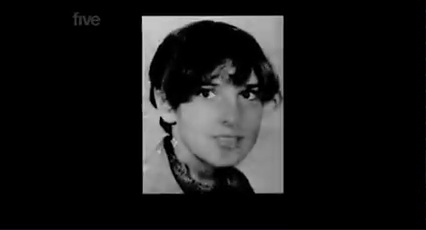
The Cannibal that Walked Free (AKA Cannibal Superstar) is a British documentary produced by Visual Voodoo for Channel Five which explores the case of Japanese cannibal Issei Sagawa. It uses dialogues with police and psychiatrists and, most intriguingly, extensive interviews with the cannibal himself.

Sagawa murdered a young Dutch woman, Renée Hartevelt, a fellow student at the Paris Sorbonne, then mutilated, cannibalised, and performed necrophilia on her corpse over two days.

The mellow voice of the narrator, Struan Rodger (Chariots of Fire), announces:

“This man murdered and ate a woman in Paris… he has never stood trial. Today he walks the Tokyo streets a free man, a free man with an ongoing appetite for human flesh.”

Around midnight on June 13 1981, 32 year old the Japanese exchange student, Issei Sagawa, emerged from his apartment at 10 Rue Erlanger in the 16th arrondissement of Paris with two large suitcases, hailed a taxi and travelled the short distance to the Bois de Boulogne. His hopes that the park would be empty at night were in vain, and several witnesses saw this 4’9” (145cm) smartly dressed Asian man trying to drag two large suitcases to the lake. Worn out (and probably full of meat), Sagawa fell asleep on a bench and woke to find an old man opening one of the cases. When the old man began to scream, Sagawa walked calmly away.

The police found that someone had removed flesh from parts of the body. During the autopsy, they discovered there had been post mortem sexual intercourse – necrophilia.

Within four days, the police tracked Sagawa through the taxi driver, and he confessed immediately. In his refrigerator, they found a large quantity of human flesh.

On the table was a plate with pieces of cooked human flesh, condiments and mustard.

The case was reported globally with the press expressing horror and disbelief. Patrick Duval, Author Le Japonais Cannibal interviewed Sagawa for several hours.

Sagawa said that the feelings began when he was very young: “I was very weak, very ugly, like a small monkey.” He described as an important memory from his childhood a game in which his uncle would play a ravenous cannibal, out to gobble up Issei and his brother.

As he grew up, he felt unable to attract the kind of women that he desired:

“Object of my desire is definitely the white girl, beautiful blonde hair, blue eyes.”

Jean-Pierre Van Geirt – a journalist from Paris Match, said “Sagawa was deeply in love with Renée, and his love was so mad that he thought the most he could love her was to eat her.”

Sagawa had invited the young student to his apartment to discuss literature. He said he asked Renée to read a German language poem he had chosen, a poem about cannibalism, and that she was unaware that he was standing behind her, holding a rifle. He shot her in the back of the neck.

“I had decided before that the first bite would be the buttocks. I was able to cut through the skin, I’m a fool so I didn’t have a clue about human body structure. I thought that red flesh would appear straight away but it wasn’t like that, and this layer that was like sweet corn just carried on for ages, however deep I cut through. I couldn’t reach with my knife so I ripped out the flesh with my fingers and put it in my mouth. After I had sex with her, I tried to kiss her I said out loud I love you, in French. And I felt a huge shiver.

He had a tape recording of the murder and a camera with which had recorded the stages of what he did to Renée after her death; police found both in his apartment after his arrest. He had also saved a good deal of her flesh in his fridge, before packing up her remains in two suitcases.

Just 34 months after his confession, Sagawa would be a free man.  Found to be insane and unfit to stand trial in France, his father employed an influential French lawyer who argued successfully that it was unfair for the French taxpayer to pay for indefinite confinement in a mental hospital, and that he should be sent back to Japan to be cured. Accordingly, less than three years after his confession, Sagawa was put on a plane and sent back to Japan. The only condition was that he could never come back to France. He spent 18 months in a Japanese mental hospital but then checked himself out, and has been free ever since.

The interviewers tracked down his psychiatric report: it said

“He was hung up by his height, not self-assured, over-sensitive and most of all emotionally cold and self-satisfied when he talked about the murder. Someone who is capable of feeling guilty wouldn’t commit such an act. You have to be completely devoid of some human emotions. Among which is the sharing of the universal taboo of cannibalism.”

The interviewer visited Sagawa’s Tokyo apartment where he lives under a false name and found him enjoying Beethoven’s 9th Symphony – the second movement, popularised in the film Clockwork Orange. He claims that he wept for the victim’s family and for his family, who were devastated – his father lost his high-powered job, his mother attempted suicide.

Despite his alleged distress, in the mid-1980s he wrote a book “In the Fog”, against the express wishes of both his and Renée’s family. It is the story of his crime, written from his perspective. It sold out. He wrote a further 19 books about his crime, became a columnist in magazines, joined a symposium at a Japanese university and appeared in two stage shows, finally appearing in torture porn, including recreations of his crime, using tall, Western actresses.

Under his false name, he told the interviewer, he meets up with Western sex workers.

“My final desire is just the same – when I see all the beautiful girls’ legs, I want to eat. So I’m not cured at all.
But now, I’m not interested in at all the white women. I hate them. I found that Japanese women are the most beautiful in the world.”

Sagawa now feels the urge to cannibalise young Japanese women.

At the programme’s request, Sagawa agreed to attend his first psychiatric assessment in over ten years. In the documentary, he tells the Criminal Psychiatrist, Dr Susumu Oda:

“My libido and appetite are connected. This is very important. For instance, you see the beautiful girls on the train in summer, and you see their legs, don’t you. I think they look delicious.”

He says that he masturbates to make his feelings disappear.

Oda reported:

“A child suckles on his mother’s breast. A child survives eating breasts. So it is not that strange that a child would want to eat something he loves.”

Sagawa was small, weak and spoiled, so he never learnt to suppress those desires.

“Deep down, he doesn’t regret what he has done. He has a tendency to slowly turn the other person into an object. I think this is very dangerous.”  

The doctor’s conclusion:

Freud maintained that there are two “pregenital” forms of sexual organisation in very young children not yet predominantly motivated by their genital zones. The first of these he called “oral-sadistic” or “cannibalistic”, in which sexual activity is not separated from ingestion (the second was “sadistic-anal”), and he suggested that these were “harking back to early animal forms of life”. In this “cannibalistic” stage, “the object that we long for and prize is assimilated by eating and is in that way annihilated as such.” It is not surprising, therefore, that Sagawa wanted to eat his ideal woman, and he made a particular point of eating her breasts.

“Too Much Blood”, a song on the Rolling Stones‘ 1983 album Undercover, is about Sagawa and violence in the media. His crime also inspired the Stranglers‘ 1981 song “La Folie”. The Noise Black Metal band Gnaw Their Tongues released an EP titled Issei Sagawa in 2006.

The documentary is available in full on Youtube at the time of writing. The link is at the top of this blog.

A more recent look at Sagawa is the 2017 documentary Caniba.

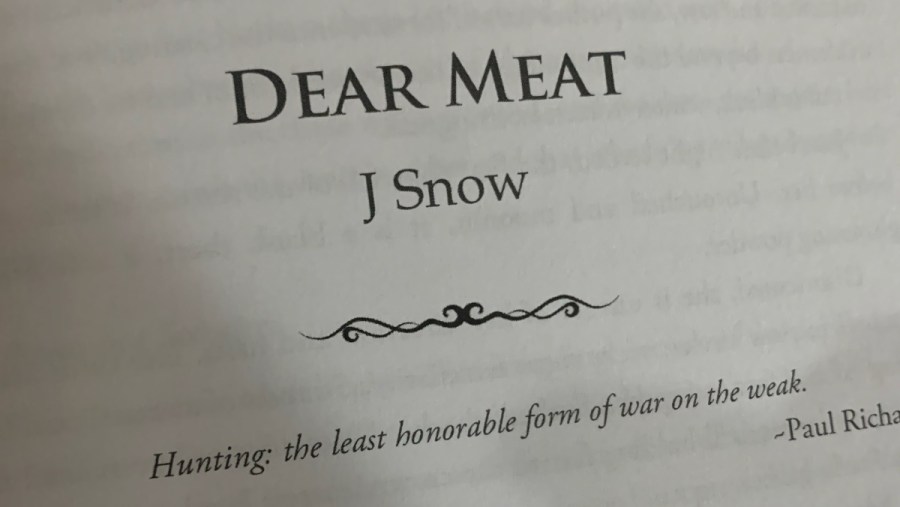
Dear Meat (J. Snow, 2020)

This blog has laboured mightily to keep up with the constantly growing catalogue of cannibalism movies and TV shows, as well as the increasing number of actual cases reported in the media. So this week we are taking a rather exciting side-trip into the wonderful world of short stories, a place where the sets can be as lavish as the author wishes since there are no Producers cutting budgets, the protagonists can do anything the mind can conjure up without the need for stunt persons or insurance, and the whole thing requires no masks or social distancing.

The story considered in this week’s cannibalism blog is called DEAR MEAT, and it appears in the third Women of Horror Anthology, titled THE ONE THAT GOT AWAY.

The anthology contains an amazing assortment of thirty fresh looks at the wonderful world of horror. I have, naturally, chosen to review the cannibalism story by J Snow, since that’s what I do, for reasons best known to myself and the Department of Culture and Communications at the University of Melbourne.

Ms Snow has written and published five cannibalism stories; reassuring to know that others also labour in these fields. For those of you who wish to know how (or why) she writes, there is an interview at Paula Readman’s Clubhouse.

Dear Meat was written a few years before the pandemic, but reads like it could be taken from tomorrow’s newsfeed. It involves a small elite group of rich and powerful men who have decided that human population growth is threatening to destroy the biosphere, and so must be stopped and reversed. More than two thirds of the population, billions of people, must be “eliminated.”

Various ingenious and possibly prophetic strategies are mentioned such as introducing viruses and tainted vaccines, genetically modified foods and contaminated water supplies. Free tubal ligations and vasectomies are encouraged, and abortions allowed up to two months after birth. But the key plan in this story is to set the populace at each other’s throats, or more precisely at the barrels of guns. Yes, hunting season for humans becomes the only way to feed the family. Tags are issued, which is apparently the way hunting works in the USA, and the distribution is weighted according to the discriminatory preferences of these shadowy rulers – the “unworthy and unholy” are allotted the most tags meaning the poor and the non-Christians are most likely to be hunted and cooked. Illegal immigrants are always open season. The rich and the politicians, however, don’t ever seem to end up on the butcher’s slabs.

English cleric and economist Thomas Malthus pointed out in 1798 that population increases geometrically, but food availability increases only arithmetically. All things being equal, this means we must run out of food, unless there is a disaster or an intentional reduction in human population growth. Too many people and not enough food is likely to lead to cannibalism, although Malthus did not venture into such abject speculations. The ethologist John Calhoun crossed that bridge in his study of rats, where he found that putting rats into a utopian environment, with no shortage of food or shelter, and letting them breed unconstrained, ended up in a chaotic maelstrom of sexual deviance and cannibalism. A Malthusian/Calhounian scenario is the basis for the film Soylent Green which is set (honest, I’m not making this up) in 2022, when overpopulation has led to a situation where the enormous population of poor people can only be fed by recycling the bodies of those who die or can be persuaded to accept euthanasia.

Not so in Dear Meat. The people running the government know one thing that has been true since the start of humanity: when there is hunger,

“People turn on each other, become monsters, all for one tiny morsel.”

The people turning on each other in this story are from a family; a man, a woman and a child. Not even close to a large family by today’s standards, but in the world of the story, any increase in population (child) must be balanced by a decrease (a hunted tag). One person must die, be carted to the butcher and carried home as meat, just as the odd hunter does now to deer or kangaroos or anyone else that happens to move at the wrong moment.

I am introducing some levity because this is a grim scenario, skilfully crafted, beautifully written and with an ending that I absolutely will not spoil. The wonderful thing about eBooks is that they are ridiculously affordable and offer hours of reading pleasure. This collection, and particularly Dear Meat, is highly recommended.

Here’s a review from Goodreads:

And here’s one from Amazon:

The author’s details are here, and the book is available at on line retailers including Amazon.

Women’s Health and Cannibalism – DIE WIEBCHEN (Zbynek Brynych, 1970)

In 1967, Valerie Solanas self-published the SCUM Manifesto, a document which began:

“Life in this society being, at best, an utter bore and no aspect of society being at all relevant to women, there remains to civic-minded, responsible, thrill-seeking females only to overthrow the government, eliminate the money system, institute complete automation and destroy the male sex.”

SCUM stood for Society for Cutting Up Men, and its manifesto was considered on its release something of a parody, satirising patriarchy; an exaggerated propaganda diatribe for Women’s Liberation, which was making men a little nervous by then (or at least making us reassess some of the previously unquestioned societal beliefs). That changed in 1968, when Solanas bought a gun and shot Andy Warhol in The Factory, his studio in New York City. Apparently, she really did want to cut up men.

This German-language German-French-Italian made film Die Wiebchen, translated variously as “The Females” or “The Bitches” or “Feminine Carnivores” came out a couple of years later, and was certainly influenced by Solanas and her manifesto, and her gun.

Zbyněk Brynych was a Czech director of the New Wave, which emphasised improvisational film-making rather than punctilious adherence to narrative scripts. Die Wiebchen starts with Eve (Uschi Glas) suffering from anxiety attacks. She is sent off to the Van Marens psychiatric retreat, which turns out to be staffed almost exclusively by women, except for a giant who is the gardener, an almost archetypal monster, toothless and with a long scar on his face. Incidentally (fun fact time), When Eve arrives at the health spa, the first woman to greet her is carrying a German translation of Valerie Solanas’ SCUM Manifesto. She is examined in stirrups by the head of the clinic, Dr Barbara (Gisela Fischer from Torn Curtain, in which she was also a doctor).

Drugged and disorientated, Eve wanders out of her room and opens a cupboard, out of which falls a man with a knife in his back. Yep, SCUM it is. Men are welcome though – particularly an extremely sleazy guy with open shirt and gold chain who thinks he’s landed in heaven, only to end up in male hell, and a hot oven. Men are lured in for sex and then killed, in the manner of the praying mantis or black widow spider.

Eve wants to warn the other men about the female man-eaters, but, of course, no one believes her. The police chief is, admittedly, male, but also chronically alcoholic, and certainly not interested in investigating murders. “I have three murders a day; they have to wait their turn.”

Dr Barbara diagnoses Eve as suffering from post-traumatic hallucinations and we, the audience, can never be sure whether this is actually the case. There’s certainly meat on the dinner menu, but from which species of animal? No spoilers, but the question of reality is settled at the conclusion, with a surprisingly graphic scene for 1970.

Just in case we haven’t got the point, the women hold a joyous bra-burning ceremony. This movie really has something for everyone. The music is jazzy sixties and the photography tends to the gimmicky with extreme fisheye lenses and trippy montages. It gets a bit annoying, but overall it’s a lot of fun.

Die Weibchen is an interesting entry in the all too brief list of female cannibal films because, while the male reaction against feminism or “women’s lib” as it was known in 1970 is obvious with every slash of the knife and every burnt bra, nonetheless the protagonists are all strong women, with the only men being drooling idiots or sex-obsessed sleazebags.

Uschi Glas wrote in her memoir Mit einem Lächeln (With a Smile) that she was glad to be able to play a new type of woman for the first time, a “beautiful change”. But she regretted that the film never became a big success.

The website Girls with guns summed up:

“If ever a film were guilty of sending out mixed messages, this would be it – but, surprisingly, I didn’t feel that hurt it much.”

My preferred title was the Italian version: Femmine Carnivore: Carnivorous Females. Eating meat is usually considered a male pursuit (strange, in that men don’t menstruate), yet there is a terror of the female, and particularly the fact that we emerge from the womb, and subconsciously fear that we could be reabsorbed into it. Professor Barbara Creed writes about the archaic mother as a “primordial abyss”, the place we all came from, and to which we fear we will return. Unlike Freud’s insistence that boys are terrified of what they see as their potential castration when they perceive their mother’s genitals as “a lack”, the female cannibal with her knife or teeth or her vagina dentata (toothed vagina) demonstrates the real fear felt by men – their cannibalisation by the strong woman. Often she is presented as a monster or possessed by an evil entity, such as in Inseminoid or Jennifer’s Body, or turned into a zombie by some contagious virus such as in Doghouse. But it’s nice to see a movie like Die Wiebchen, where the female cannibals are just – enjoying their dinners.

2021: THE YEAR OF THE CANNIBAL

What a year it was – if a virus wasn’t invading your body, your neighbour might well be.

Thank you!

First of all, a big thanks for reading and sometimes commenting on my blog. Eighteen months ago, I was very excited at seeing over 1,000 views in a month. In December 2021, we had over 6,000 views.

The year by year growth of readership (59,002 in 2021) has been going, pardon the term, viral. So, thank you!!

Cannibals and rumours of cannibals in 2021

I decided to postpone this blog post until January 2022 because, at the end of 2021, new cannibalism cases were still being reported. In the previous year’s summary, I had missed THE GRANNY RIPPER, because she died of COVID on December 29 2020 while awaiting trial. So we’re sneaking her in to the section at the end – cannibals sentenced in 2021, although her judge and executioner was a tiny virus.

There were so many cannibal stories in 2021 that I am listing them alphabetically by country. I should point out for my American readers that the good ol’ USA won gold in the number and strangeness of cannibal acts last year, with Russia, Mexico and Nigeria tied for silver.

Australia

A Tasmanian man pleaded guilty to assault and attempted abduction of a five-year-old girl, telling the court that he just wanted a cuddle (albeit from a screaming child, whom he had just attempted to strangle) and later telling prison officers that he had wanted to eat her, and that he had been wanting to eat people since he was a child.

Bolivia

A woman chowed down on a burger in Santa Cruz de la Sierra only to find that she was chewing on a severed and decomposing human finger. The unfortunate incident (you’d have to call her an innocent cannibal) was the source of some semi-amusing puns from the world’s press, plus a hilarious unintentional pun from the burger company who told her “the issue is out of our hands”.

France

A man in Tarascon, a town between Avignon and Arles, was shot by police after the decapitated and partly consumed corpse of young boy was found in his apartment.

Ghana

Richard Appiah of Abesim near Sunyani in the Bono Region, allegedly lured three boys to his house, killed them and kept their mutilated bodies in his fridge. He is said to have cooked for them, before cooking them.

Indonesia

A family in Gowa allegedly gouged out their six-year-old daughter’s eye as part of a black magic cannibal ritual that was supposed to bring them wealth, before her mother ate her eyelid. Police also arrested a shaman, who allegedly convinced the family to sacrifice children.

Malawi

Patrick Gome from Ntcheu was allegedly found biting a nine-month old baby on her cheek and thigh. A police spokesperson said Gome acted “like a wild animal”.

Mexico

David Sanabria and his young daughter, trying to cross Mexico from Honduras in the hope of entering the United States, was kidnapped by a Mexican cartel and held for ransom. Those refugees who did not pay, he later told Noticias Telemundo Investiga, were murdered and cooked and the surviving migrants were made to eat the meat.

Andres Filomeno Mendoza Celis, 72, was arrested in Calle Margaritas, in the municipality of Atizapan de Zaragoza. Detectives arrived at Mendoza’s home to interview him about the suspicious disappearance of a woman, Reyna González, a mother of two, only to find her mutilated remains on a table. Mendoza reportedly admitted to slaughtering and eating parts of around thirty women over the last twenty years.

Nigeria

The cannibal of Ebonyi was the name given to a commercial driver in Abakaliki, the Ebonyi State capital, who reportedly bit off and swallowed the finger of a member of the taskforce raised by the state’s Ministry of Capital City Development to enforce compliance with urban planning regulations.

A video has surfaced online purporting to show the Eastern Security Network (ESN), the security wing of the Indigenous People of Biafra (IPOB), celebrating the abduction, beheading and cannibalisation of two police officers. The Director of State Security said “We saw human flesh being roasted, it was an eye-sore.” An IPOB spokesperson, Emma Powerful, denied claims that their members eat human flesh and engage in barbaric acts, saying that the claim by the DSS was meant to demonise IPOB and ESN operatives and tag them as criminals.

Russia

Vladimir Yadne killed three people in Siberia and ate their flesh, washed down with vodka.

On the other side of Russia, Yegor Komarov was seen running from his car, which he had crashed into a road safety barrier. The problem was not the accident, but the headless body which fell from the car boot. Komarov admitted to being a cannibal and stated that he ‘likes killing people’. He confessed to stabbing and killing another man in a park in St Petersburg last year for the sole purpose of tasting human flesh, and said he had sliced off the tongue and fried it in butter.

South Africa

A community leader told the Financial Times newspaper that rioting and looting have caused food shortages which have led people to consider cannibalism.

Spain

National Police officers in Sevilla were deployed on Saturday, September 18, to deal with what they have described as one of the most bizarre incidents in the history of the force, a case involving African witchcraft and cannibalism. Allegedly, a fight had broken out between two women after one threw a bottle of water containing salt at the other, and accused her of witchcraft. Believing that her roommate was possessed, she struck her on the head with a stone, and then bit off and ate two of the woman’s fingers. After this, the aggressor, in an attempt to rid the other woman of the supposed demon, inserted the stone into her anus in an attempt to extract her guts.

USA

The biggest cannibalism story in the USA in 2021 was about a man who almost certainly has not eaten anyone. He did, however, boast about it in text messages to some very pissed off girlfriends, who reported it widely. Yep, the actor (maybe former actor) Armie Hammer. Arguably now more famous for his cannibalism posts than for his movies.

On February 9 2021, Chickasha (Oklahoma) police responded to a 911 call. They found Leon Pye dead and his four-year-old granddaughter Kaeos critically injured. She died in the back of the ambulance. Delsie Pye, Leon’s wife, was alive, but had knife wounds to both eyes. Lawrence Anderson confessed to the Oklahoma State Bureau of Investigation that before slaughtering his family, he had broken into the home of a neighbour and butchered the woman who lived there, cut out her heart, and cooked it with potatoes to feed to his family, to release the demons. Apparently unsuccessfully.

Landon Copeland, an Army veteran from Utah who had been accused of assaulting police during the Capitol insurrection, was refused bail after he threatened to “eat the flesh” of a probation officer. He is said to have shouted “I will eat your flesh for nutrients. I don’t think you don’t know what I am!”

James Phelps, 58, and Timothy Norton, 56, were arrested and charged with kidnapping a young woman named Cassidy Rainwater in September. The County Sheriff said that Rainwater was disembowelled and dismembered after she was strangled. Some of her remains were found in a freezer. Conspiracies are floating around that both Norton and Phelps were involved in cannibalistic activities.

Cassidy Rainwater kidnappers arrested

Just squeaking into 2021 before the ball falls in Times Square, Idaho man James David Russell, 39, of Oldtown in Bonner County had cannibalism charges added to his accusations of first-degree murder. Police found pieces of the neighbour, some of which appeared to have been cooked in a microwave oven. According to the supplemental probable cause affidavit, Russell believed that he could “heal himself by cutting off portions of flesh” in order to “cure his brain.”

Sentenced

Some cannibals sit in jail for a while before they are finally sentenced. Here are a few who ate people in earlier years, but were sentenced in 2021.

  • On Friday, 18 June, a Swiss court sentenced 46-year-old Alieu Kosiah, a West African rebel leader, to 20 years in prison for rape, murder and cannibalism.
  • Bulawayo man, Rodney Tongai Jindu, has just lodged an appeal to the Zimbabwean Supreme Court against a High Court ruling which sentenced him to death for murdering two of his friends. Jindu had told the court, in gruesome detail, how he had eaten the men’s livers raw, and cooked and eaten their brains.
  • Alberto Sánchez Gómez, a Madrid waiter, was jailed for 15 years in June. He had told police he butchered his own mother before sharing her body parts with his dog. The 66-year-old pensioner had been chopped into at least 1,000 pieces and her vital organs were missing.
  • Sunil Rama Kuchkoravi (35) of Kolhapur India was found guilty of murder for killing his mother after she refused to give him money to buy liquor. He later chopped up parts of her body and ate them, after frying them in a pan.
  • A Sydney (Australia) woman who cut her 57-year-old mother’s head off with kitchen knives in July 2019 was found guilty of manslaughter in the NSW Supreme Court in March, and sentenced to 21 years imprisonment, after pleading not guilty to murder due to mental impairment. The court was told that Jessica Camilleri – who had a history of refusing to take psychiatric medications – had only stopped the attack when her mother’s head fell off and her eyeballs came out of their sockets. The judge said Camilleri had engaged in “acts of decapitation and cannibalism”.
  • Eduard Seleznev, known as the “Arkhangelsk Cannibal”, who killed and ate the flesh of three men, was sentenced to life imprisonment by the Russian Supreme Court. Seleznev admitted the murders, and added that he had then sliced their bodies up, kept the meat in plastic bags, and disposed of the bodies in the Volokhnitsa river. He subsequently boiled and ate the flesh.
  • At the end of the year, we heard that Mark Latunski, who allegedly killed his Grindr date, hung him upside down and ate his testicles on Christmas Eve 2019 (thus missing out on my 2020 update), will go to trial early 2022. Very inconsiderate.
  • Sofia Zhukova, known as the ‘Granny Ripper’, who supposedly gave children sweets made from the flesh of her victims, died in Russia of COVID-19 on December 29 2020, at the age of 81, before the conclusion of her murder trial. You may have noticed that most of the 5,351,812 people who died of COVID up to December 20 (plus millions more whose deaths were not reported to WHO) did not have articles written about them. Sofia had heaps of media coverage though, because, you know, cannibalism.

2022

Well, I hope you can see why I nominated 2021 as THE YEAR OF THE CANNIBAL. But what does 2022 have in store for us? Well, if you follow the prophecies of Nostradamus, which a surprising number of people do, 2022 offers, yep, even more cannibalism, this time because of inflation and the price of food.

 “So high the price of wheat
that man is stirred
his fellow man to eat in his despair.”

Looking further ahead, a professor of astrobiology at Edinburgh University has warned that humans who attempt to colonise other worlds such as Jupiter’s moon Callisto and Saturn’s moon Titan could well find themselves running out of food and resorting to cannibalism.  It happens – think of the “Starving Time” in the Virginia colony of Jamestown in 1609-10, or Sir John Franklin’s 1845 exploration of the Arctic that resulted in the crew cannibalising each other.

https://www.news24.com/witness/news/the-covid-jab-wont-turn-you-into-a-cannibal-kzn-health-mec-20211026

As I stand before you, I’ve never had the urge to eat anyone, and it will never happen. So, what people are saying about the vaccine making people want to eat others… of being part of 5G technology, or linked to the work of the devil, is all nothing but a myth. It is not true.” 

Hope you enjoyed your New Year festivities! Next year you might need a barbeque. Please keep reading and liking, and commenting! If you need some light reading, here’s my complete listing of Hannibal films and episodes.

Christmas slasher: “THE 12 DEATHS OF CHRISTMAS (MOTHER KRAMPUS)” James Klass, 2017

In case you are breathing a sigh of relief that Christmas has been and gone, here’s the latest news – it goes for twelve days, and involves a lot of odd things like lords leaping and pear trees containing medium sized birds. This film covers the twelve days, but omits French hens and turtle doves, etc, in favour of lots of blood and gore.

“Bah! Humbug” always seems like a pretty good response to the confected cheer of Christmas, particularly to those who do not, for various reasons, celebrate the event or conform to the voracious consumerism that accompanies it. If you are one of the many who is over the Christmas rom-coms and tear-jerkers, you may have already come across the German Christmas demon Krampus, who appeared in a 2015 movie from Michael Dougherty, involving goblins, killer toys, malicious snowmen and a jack-in-the-box that eats a child whole, although he has been punishing naughty children for a lot longer than that, and may date back to pre-Christian folklore.

The cannibal movie reviewed today, though, was originally called The 12 Deaths of Christmas and features a different villain – a Christmas witch named Frau Perchta who, according to legend, steals a child each of the twelve nights of Christmas. The witch is also said to slit open the bellies of disobedient children (not dissimilar to the threats of cannibalism which Andre Chikatilo’s mother used to keep him in line). The film’s name was changed to Mother Krampus for the American audience, many of whom have adopted Krampus as a sort of anti-Santa. Frau Perchta does not have nearly the same fan base.

The Santa Claus dogma is of course about socialisation – children are told that a large stranger will sneak into their houses at night and reward them if they are “good”. What if they are not good? Who will sneak into their house then, and what mayhem will ensue? Krampus was one answer, Frau Perchta another. Then there was Santa’s assistant, Père Fouettard who, like the Australian Prime Minister, hands out lumps of coal to children who are not deemed to have been good, and sometimes whips them too (the name Père Fouettard translates as “Father Whipper”. Following Santa around appears to have been his punishment for engaging in a bit of entrepreneurial cannibalism, in which he and his wife drugged three children, slit their throats, cut them into pieces, and stewed them in a barrel, to be sold as Christmas hams. The taste, allegedly, is almost identical.

But today’s film is not just about stealing the bad children, and perhaps killing them, no, it’s all about the punishment of the wicked being extended to the following generations – a popular theme in the Bible (check out Deuteronomy 5:9 for some unfair shit). Perchta is coming for the children of adults who wronged her.

One of these children, and the protagonist of what passes for the plot, is Amy (Faye Goodwin – Mandy the Doll). Her mum is Vanessa (Claire-Maria Fox of Suicide Club and Bride of Scarecrow), and Vanessa’s dad – Amy’s grandpa – (Tony Manders, from The Young Cannibals) lives outside the village, near a scary forest in Belgrave (the UK one), and asks her to drive him, on Christmas no less (no Ubers I guess) to the Church, where a bunch of locals want to discuss the focal local issue – lots of village children are disappearing. There we finally get to hear the legend of the witch:

“Frau Perchta was a witch, who over Christmas stole the souls of children.”

Dad admits to Vanessa that the peaceful villagers got together to kill an old woman 25 years ago (in 1992). We, the audience, know the background, through an endless voiceover accompanied by cards at the start of the movie. 12 kids disappeared over the 12 days of Christmas in 1921, and none were found, except for one girl whose mind was gone, and she could only scream “the witch! The witch!”

Then, in 1992, five more kids disappeared, their bodies were found in the forest, and the villagers believed, for reasons far from clear, that a nice old lady was the killer and was in fact Frau Perchta the witch, so they stabbed her and lynched her, as you do if the local constable is on leave, in a backward and primitive town like Belgrave, which apparently hosts the National Space Centre!

But as she died, she shouted a curse – that Frau Perchta would be back to wreak revenge on them, and their children. So, maybe she wasn’t quite so nice. Yeah, that’s about it for plot – we see (several times) the stringing up of the old woman, we see the risen witch. The witch kills lots of people in creative ways, including one who is cut up and made into a Christmas light show, another whose flesh is pressed into a cookie cutter to make Christmas peoplebread men, while another is trussed up like a Christmas turkey with an apple in her mouth and carved up, and her flesh cooked and fed to her boyfriend, who is Amy’s absentee dad. Then dad has his heart pulled out and eaten (not uncommon in cannibal stories – think Fresh Meat or even Hannibal).

The climax of a horror film (or any action movie) is usually the last ten minutes, in which the story is resolved and the bad guy defeated (until the sequel). This one goes on (and on and on) for about half an hour, presumably to ensure the film is considered a full-length feature, and it resolves nothing much, with a twist at the end that makes no sense at all. But lots of people get killed, and several have parts of them eaten, which is enough to get a mention in this blog, I guess. The plot is thin, the acting is often appalling, the continuity director in some parts seems to have been taken into the forest and eaten. But it’s presented as a low-budget slasher, and that’s what they are often like – they are not dramatic masterworks, but gruesome pantomimes. The idea of one child’s aunt walking him home through the dark forest at night when bodies are turning up everywhere is narratively absurd but, in a panto, we want to anticipate the villain, we want to guess what is going to happen, and yell at the actors to “look behind you!” And the gore, and the fright factors, are quite well done.

The moral of the story, if there is such a thing, is pronounced by a mysterious woman who turns out to be Amy’s grandma, not that it does her much good.

“Taking it into our own hands, playing God. That’s why all this is happening.”

Isn’t that exactly what humans do – play God? Nietzsche told us that God is dead, we killed him, so we have to become God. We play God in so many ways – the Christmas story in essence is about a Jewish family trying to escape one of the many psychopaths who have played God over the centuries. We play God when we nominate ourselves as above nature, more angel than animal, and proceed to destroy our own ecosystem. Who bears the suffering from such follies? The children, who are the ultimate examples of what Judith Butler calls “precarious life”. Like Frau Perchta, our vicious brutality usually comes back to haunt us, through the generations.

At the time of writing, the full movie (should you wish to bother) was available on YouTube.

Dec 2021 Cannibal News: IDAHO MAN CHARGED WITH MURDER AND CANNIBALISM

A man from Oldtown in Bonner County has had cannibalism charges added to his accusations of first-degree murder.

The Bonner County Prosecutor amended the criminal complaint on Wednesday, December 15, charging James David Russell, 39, of cannibalism in relation to the September 10 murder of David Flaget.

Police searched Russell’s home the day after the murder and found portions of Flaget’s body, including a “thermal artifact” which is an observational finding showing that heat has been applied to only a portion of the remains, rather than the entire body.

Dr. Veena Singh of the Spokane Medical Examiner’s Office completed an autopsy on September 13, finding that the tissue found in Russell’s residence belonged to Flaget. Some of Flaget’s remains have not been found.

Police seized a bloodied microwave oven and glass bowl and a bloodied knife and duffel bag. Bonner County Detective Phillip Stella said on Thursday

“When dealing with death and carnage it’s a shock to our conscience. As far as I know this is the first cannibalism charge in Idaho.”

Sheriff’s deputies had been called to a possible murder on Lower Mosquito Creek Road on September 10. They found Flaget upside down in the passenger’s seat of his truck, unresponsive. Russell eluded the officers, barricading himself in the loft space of the garage on the property.

After a brief stand-off, Russell was apprehended. According to court documents, Russell was unable to understand his Miranda rights after they were repeatedly read to him. Russell made only one statement to law enforcement in which he repeated more than twice: “It’s private property and we don’t like non-family on it.”

“Flaget had several conflict-like run-ins with Russell and told the family about them,” Detective Stella said. “The family had enough warning signs that Mr. Russell was a danger to himself or others.”

According to the supplemental probable cause affidavit, Russell believed that he could “heal himself by cutting off portions of flesh” in order to “cure his brain.”

The Detective added:

“There’s a lot of facets we will certainly never know. It wasn’t the bloodiest crime scene, but it’s more of the psychological, ‘what the heck is going on here?’ and ‘why am I picking up pieces?’ It’s a walk down the dark path that we don’t see very often.”

Court proceedings were paused in late October after First District Magistrate Judge Tara Harden found Russell unfit to stand trial for first-degree murder and ordered him to the Idaho Security Medical Program. The results of the mental health evaluation on October 5 remain sealed by court order.

Oldtown is on the state border of Washington, and is a suburb of Newport, Washington, but is but is officially a city in Bonner County, Idaho, with a population of 184 at the 2010 census.

Idaho is the only state of the United States which has laws against cannibalism, having introduced legislation in 1990 aimed at stopping Satanic rituals.

TITLE 18
CRIMES AND PUNISHMENTS
CHAPTER 50 MAYHEM

18-5003.  CANNIBALISM DEFINED — PUNISHMENT. 
(1) Any person who wilfully ingests the flesh or blood of a human being is guilty of cannibalism.
(2)  It shall be an affirmative defense to a violation of the provisions of this section that the action was taken under extreme life-threatening conditions as the only apparent means of survival.
(3)  Cannibalism is punishable by imprisonment in the state prison not exceeding fourteen (14) years.

This is not to say that you should all start eating each other. The Legal Information Institute points out that

…most, if not all, states have enacted laws that indirectly make it impossible to legally obtain and consume the body matter. Murder, for instance, is a likely criminal charge, regardless of any consent. Further, even if someone consents to being eaten and kills himself, the cannibal may still be liable for criminal or civil actions based on laws governing the abuse or desecration of a corpse, which vary from state to state.

What you may do under the law of most states of the world is pay someone to kill pretty much any other animal for your dinner. As philosophy Professor William B. Irvine of Wright State University (Ohio) says:

“in America and in much of the world a human corpse is more of a sacred thing than is a living cow: to defile a corpse – which of course is incapable of suffering – is a far greater crime than is causing a cow significant discomfort and suffering simply so that one can enjoy a Big Mac.”

We end 2021 with yet one more proof that Aristotle’s claim that humans are rational animals was vastly over-optimistic.

Cannibals in the Soviet paradise: CITIZEN X (Chris Gerolmo, 1995)

Three years ago (where has the time gone?) I reviewed a pretty great movie called Child 44, with Tom Hardy as a Soviet investigator in pursuit of a murderer, based on the most prolific serial killer of the Soviet Union (excluding Stalin), Andre Chikatilo. Yes, pretty great, but it had some problems; from the point of view of this blog, it barely mentioned cannibalism. The murderer was “just” a psychopathic sadist. It also changed all the names and dates, presumably to protect the guilty.

But ten years earlier, today’s film Citizen X was made as an HBO television movie, based on Robert Cullen’s non-fiction book The Killer Department. This is a much more accurate rendering of the career of Andrei Chikatilo, the “Rostov Ripper”, who was eventually convicted of 52 murders, although he confessed to several more.

Chikatilo was able to continue killing for seventeen years, from 1978 to 1995, due to a combination of general ineptitude, official denial of the possibility of such a thing as a Soviet serial killer (they considered it a bourgeois American crime, inconceivable in the workers’ paradise), and luck (apparently his semen was found to have a different grouping to his blood). The authorities preferred to round up the Rostov homosexual community because of some absurd reasoning that homosexuals are also paedophiles, and some of the victims had been boys, which resulted in some gay men committing suicide in custody.

Chikatilo claimed that his mother had told him that his older brother had been kidnapped and cannibalised by starving neighbours when he was little. This may have been her way of trying to scare him into behaving, but he had been born in Ukraine at the time of the Holodomor, when Stalin was busy starving millions of people to death as part of the process of Collectivisation, so could well have been true.  Chikatilo was a self-confessed cannibal, stating that he gained sexual satisfaction from torturing his victims, and would sometimes drink their blood and eat their genitals, nipples and tongues.

This film is presented as a true-crime documentary. The viewer knows very early who the killer is – Chikatilo, a loser driven insane by rejection and humiliation at work and in bed.

Chikatilo is played with nerdish rage by Jeffrey DeMunn, who we know now as Charles Rhoades, Sr. in Billions; no wonder he captures a psychopath perfectly. The rest of the cast is just as impressive – the forensic cop is played with tightened jaw and occasional tears by Stephen Rea (The Crying Game, Interview with the Vampire), his wife is played by the iconic actress Imelda Staunton, and his boss, Colonel Fetisov, is the wonderful Donald Sutherland, looking uncomfortable in a Soviet army uniform yet getting away with it due to his devilish grin.

The psychiatrist who helps them crack the case is played by the doyen of cinema Max von Sydow, who played chess with Death in Bergman’s The Seventh Seal, played Jesus in The Greatest Story Ever Told and even got an Emmy nomination for his role in Game of Thrones. With a cast like that, what could go wrong?

Roger Ebert nominated Citizen X as his example of a movie that totally immerses the viewer in a believable reality:

“We experience the hopelessness, self-loathing, fear, and bleak reality displayed by most of the characters, regardless of station, age, self-discipline, or level of humanity.”

Chikatilo, the very image of the alienated outsider, preys on society’s lost and abandoned, befriending them (like Fritz Haarmann in Germany in the 1920s) and then luring them to their death.

The story shows a lot of murders, children falling backwards, blood dribbling from their mouths, knife plunged into their defenceless breasts.

We see graphic scenes of their post mortem examinations after the bodies are eventually found.

But that’s not really what the film is about – it takes us into the stultifying atmosphere of a grey bureaucracy in which truth is determined not by facts but by favouritism, prejudice and nepotism. In that sense, it is a fascinating portrait of the closing years of the Soviet Union, but it also jolts us into the realisation that we have all been there, a system where, in order to make any progress, you have to play along with the idiots in charge. A world where who you know is more important than what you do, a frustration that is felt universally. It is really a psychological thriller more than a murder procedural. The militsia make little progress, stymied by the bureaucracy, the unwillingness to admit to the fact that a serial killer could inhabit the workers’ paradise, by the apparent blunder in typing Chikatilo’s blood and semen, and by the insistence that the hectoring interrogation is the only way to succeed in getting the truth.

Ultimately, it is the psychiatrist, reading his paper, in which he had earlier tried to profile the killer, that makes Chikatilo confess, recognising that someone has finally understood the torments churning inside him.

The story is not about Chikatilo’s hunger for flesh, but his appetite for compliant sex, for a partners unable to resist his sexual appetite, because they are dead or squirming in agony. Children were ideal objects for his cravings, particularly young ones who were lost, homeless or runaways.

“Citizen X has probably had a tendency towards isolation since childhood. His internal world, filled with fantasy, is closed to those around him, even those close to him. The adolescence of such a person is, as a rule, painful, because he is often subjected to the laughter of his peers, at a time when success among them is the subject of his secret dreams. His sexuality is not noticeable to those around him, however it is an external asexuality that frequently coincides with steady masturbation and wild erotic fantasies. He is painfully sensitive in company, incapable of flirting and courtship, however it cannot be excluded that he has fathered a family.

There is reason to think that Citizen X has a weakness of sexual potency.He sits or squats astride his victim. The orgasm and ejaculation most likely occur at this stage of the act and in this position, sitting on the victim in the period of her agony…. You ejaculated while stabbing them.”

The film scored an 86% “fresh” rating on Rotten Tomatoes. The director, Chris Gerolmo, also wrote the screenplay, which earned him an Emmy nomination, a Writers Guild of America Award, and an Edgar Award. It’s an absorbing film, the acting is great (although the fake Russian accents don’t really convince anyone), but I still have an issue. Chikatilo is known for being the most prolific serial killer in the Soviet Union. But he is most notorious for being a cannibal, and that is barely mentioned.

What is it about cannibalism that makes it so comprehensively abject that a film about a serial killer who admitted to murdering over 53 people, 35 of them children, cannot bring itself to mention his regular feasting on the bodies?  Evidence aplenty spoke of the mutilation of the victims, particularly their eyes and sexual organs, and Chikatilo admitted in court that he had eaten the sexual organs. Yet the film, like the later Child 44, skipped over this aspect except for one brief glimpse.

Freud wrote that the two primary taboos of humanity are incest and cannibalism. It seems that his words are still accurate. We routinely see murder in films and television series – but it happens to someone else, and our attention is usually on the authority figure solving the crime. Cannibalism though is different – it opens up the human body and shows that we are made of meat, just like the animals we so carelessly torment and kill by the billions. Unlike the sometimes shocking, sometimes light-hearted killing of other people, cannibalism shows us what is inside us. It shows us our own mortality.

Cannibal supermodels: THE NEON DEMON (Nicolas Winding Refn, 2016)

Marcellus (Hamlet Act I, scene iv) claimed that “something is rotten in the state of Denmark”, but it’s not their cannibal films or actors. The Neon Demon is directed by Nicolas Winding Refn (currently in trouble with PETA for killing a pig for a TV series). Refn has made several movies (Pusher, Valhalla Rising, etc) starring Mads Mikkelsen, probably known best by the readers of this blog as Hannibal Lecter, or perhaps Svend in Anders Thomas Jensen’s The Green Butchers. This film does not have Mads in it, but it does have Elle Fanning as a sixteen-year-old model who, we just know, is going to be chewed up, swallowed and spat out by the Los Angeles fashion industry.

Books about screen-writing always stress the opening image – it sets the scene, establishes the atmosphere, tells the viewer what to expect. Well, this one sure does.

Jesse (Elle Fanning from The Great) dead on a couch, blood caked onto her throat and down her arm. A grim male gaze from a photographer. The killer? Police forensics?

No, he’s an amateur photographer doing audition shots for her, and is probably the only nice guy in the story, and we all know where nice guys finish. Anyway, Jesse is befriended, as she wipes off the fake blood, by a make-up artist named Ruby (Jena Malone from The Hunger Games), who takes her to a party to meet the LA fashion scene.

The other models hate her for being young and pretty and not needing the constant plastic surgery to fix all the things the surgeon and our culture say is wrong with their bodies. In the bathroom, as you do, they discuss lipsticks, which they note are always named after either food or sex, and speculate on this new commodity, Jesse. Is she food or sex?

Either way, it’s about appetite. Think of an animal, any animal – a snail, a snake, a human. What is the animal thinking about? It’s almost certainly food or sex. This film combines the two. The men have the power – the celebrity photographer, the fashion designer, even the sleazy motel manager (played with black humour by Keanu Reeves) – Jesse is their fresh meat.

The young, hopeful girls have their looks, and a useful booster of narcissism, a taste for the neon demon of fame, which fuels their journey through the fashion jungle.

When they get “old” (over twenty apparently), they inject various toxins and go under the plastic surgeon’s knife to fix what they are convinced are their failings. But it’s never enough. Jesse sees visions which confirm her own beauty in her eyes:

Women would kill to look like this. They carve and stuff and inject themselves. They starve to death, hoping, praying that one day they’ll look like a second-rate version of me.

But once used up, the women and girls are rejected, discarded, left to fight among themselves – to the death. Jesse is edible to them too, but not in the male way, more in the way that Elizabeth Báthoryis alleged to have bathed in the blood of virgins to keep her youth.

That’s a small taste of the real cannibalism in the film, which infiltrates the metaphoric cannibalism of the meat markets of advertising and fashion. There is an ancient tradition, from the earliest days of tribal ceremonies and the Wendigo to Richard Chase and Armin Meiwes, that eating the flesh or drinking the blood of a victim (preferably a young fit one) will transfer their strength and attractiveness to the eater. If you can keep them down of course.

An even older tradition talks of killing and eating the gods of the harvest, in order that they may be reborn and bring with them next year’s prosperity. The tradition survives in the transubstantiation of the Eucharist service. Jesse is a young and beautiful. She is, or thinks she is, a goddess. How can she not be eaten, in this film both metaphorically and literally?

There is no point in going on with the plot, it’s filled with rape, paedophilia, murder, masturbation, necrophilia, and of course cannibalism, but you really need to see it yourself, and anyway, the plot is not the point. Brian Tellerico, the reviewer from Rogerebert.com, summed this up:

It is a sensory experience, driven by the passion of its fearless filmmaker and a stunning central performance by Elle Fanning.

The director called the film an “adult fairy tale”:

“I woke up one morning a couple of years ago and was like, ‘Well, I was never born beautiful, but my wife is,’ and I wondered what it had been like going through life with that reality. I came up with the idea to do a horror film about beauty, not to criticize it or to attack it, but because beauty is a very complex subject. Everyone has an opinion about it.”

Everyone had an opinion about The Neon Demon too, with some of the audience at Cannes booing it and the rest giving it a standing ovation. You can make up your own mind – it’s an Amazon original, so you should be able to find it quite easily wherever you are in the world. It is a beautiful film, the acting is superb, the direction is assured and precise. The horror is not so much from the gore, as the scenes of young girls being treated as meat. But that is exactly the point.

The French philosopher Jacques Derrida spoke of what he called “carnivorous sacrifice”:

“The establishment of man’s privileged position requires the sacrifice and devouring of animals.”

The animals we sacrifice and devour are little more than infants – chickens for example are slaughtered at seven weeks of age. Pigs are killed at six months (less if they run into Refn, apparently). We no more eat old animals than photographers seek out old models. Remember Curtis’ line in Snow Piercer:

“I know what people taste like. I know that babies taste best.”

Or the words of John Jacques Rousseau:

The animals you eat are not those who devour others; you do not eat the carnivorous beasts, you take them as your pattern. You only hunger after sweet and gentle creatures who harm no one, which follow you, serve you, and are devoured by you as the reward of their service.

Cannibalism is no more or less than the sacrifice and devouring of animals – in this case, the Great Ape known as Homo sapiens. As voracious consumerism and greed extends its reach, to plunder the entire planet, the distinction between us and the other animals seems increasingly to evaporate.

Cannibal news: Russia, 2021, “I fried it in butter”

Russia is a big place, and has a population of around 144 million, so we could expect some cannibal news to come out of there. But two stories in one month is a new record.

Last week’s story concerned Vladimir Yadne who ate three people in Gaz-Sale in northern Russia, up near the Arctic Circle. This new case is 4,300 km (2,700 miles) west, near the border with Finland.

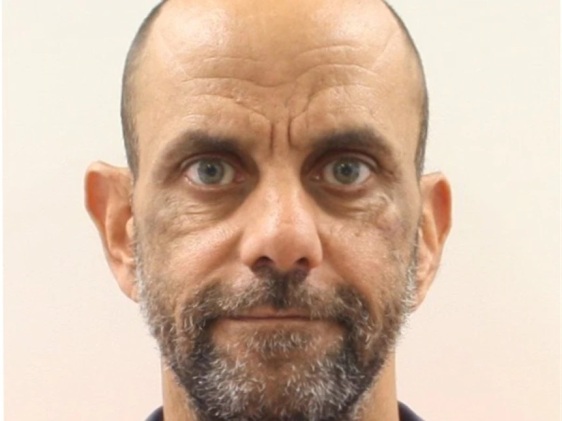
A suspect identified as Yegor Komarov, 23, has been arrested in Sortavala, Northern Russia, following a car accident on November 22, 2021, in which he crashed into a road safety barrier and a headless body fell out of his car boot, according to the news agency Tass.

Komarov and two other men fled into a nearby forest after the crash, leaving behind spades, ropes and sacks in the car boot.

After he was apprehended, Komarov admitted to being a cannibal and stated that he ‘likes killing people’. He confessed to stabbing and killing another man in a park in Sosnovka Park St Petersburg last year for the sole purpose of tasting human flesh, and said he had sliced off the tongue and fried it in butter before disposing of the body.

“When he died, I gutted his neck and tasted the blood and meat. However, because the knife was blunt, cutting the meat was difficult, and the taste of his veins was unpleasant. But I probably would have liked another part of the body.”

He said he regretted killing that victim:

“I killed that one in Sosnovka in vain, It turned out he was not tasty.”

A video of the court hearing was leaked to social media:

“I nibbled to just take a taste.”
“Are you ready to eat a human again?”
“Do you have some?”

Online media 47news reported that during the interrogation police took Komarov’s handcuffs off, and he screamed: “What are you doing, I can bite you to death!”
“Police thanked Komarov for his confession, twisted his arms behind this time and put the handcuffs back on,” the report said.

Komarov is interested in ‘anarcho-primitivism,’ ‘elixirs of immortality,’ and psychedelic music, according to his social media profile on the Russian site VKontakte.

One comment on social media said:

“You walk on the streets, stroll in the parks without any clue that some pedestrian who looks like an ordinary man, could turn out to be a man eater”

Such is the nature of modern, domestic cannibalism. To the contemporary cannibal, humans are just one more animal, and if you are going to eat pigs or cows, why not add one more mammal to the menu? Fried in butter of course.